Trainable Speaker-Based Referring Expression Generation
Giuseppe Di Fabbrizio
and
Amanda J. Stent
and
Srinivas Bangalore
AT&T Labs - Research, Inc.
180 Park Avenue
Florham Park, NJ 07932, USA
{
pino,stent,srini
}
@research.att.com
Abstract
Previous work in referring expression gen-eration has explored general purpose tech-niques for attribute selection and surface realization. However, most of this work did not take into account: a) stylistic dif-ferences between speakers; or b) trainable surface realization approaches that com-bine semantic and word order information. In this paper we describe and evaluate sev-eral end-to-end referring expression gener-ation algorithms that take into considera-tion speaker style and use data-driven sur-face realization techniques.
1 Introduction
Natural language generation (NLG) systems have typically decomposed the problem of generating a linguistic expression from a conceptual specifi-cation into three major steps: content planning, text planning and surface realization (Reiter and Dale, 2000). The task in content planning is to select the information that is to be conveyed to maximize communication efficiency. The task in text planning and surface realization is to use the available linguistic resources (words and syntax) to convey the selected information using well-formed linguistic expressions.
During a discourse (whether written or spoken, monolog or dialog), a number of entities are in-troduced into the discourse context shared by the reader/hearer and the writer/speaker. Construct-ing lConstruct-inguistic references to these entities efficiently and effectively is a problem that touches on all
c
!2008. Licensed under the Creative Commons Attribution-Noncommercial-Share Alike 3.0 Unported li-cense (http://creativecommons.org/licenses/by-nc-sa/3.0/). Some rights reserved.
parts of an NLG system. Traditionally, this prob-lem is split into two parts. The task of selecting the attributes to use in referring to an entity is the attribute selection task, performed during content planning or sentence planning. The actual con-struction of the referring expression is part of sur-face realization.
There now exist numerous generpurpose al-gorithms for attribute selection (e.g., (Dale and Re-iter, 1995; Krahmer et al., 2003; Belz and Gatt, 2007; Siddharthan and Copestake, 2004)). How-ever, these algorithms by-and-large focus on the algorithmic aspects of referring expression gener-ation rather than on psycholinguistic factors that influence language production. For example, we know that humans exhibit individual differences in language production that can be quite pronounced (e.g. (Belz, 2007)). We also know that the language production process is subject to lexical priming, which means that words and concepts that have been used recently are likely to appear again (Levelt, 1989).
In this paper, we look at attribute selection and surface realization for referring expression gener-ation using the TUNA corpus1, an annotated cor-pus of human-produced referring expressions that describe furniture and people. We first explore the impact of individual style and priming on at-tribute selection for referring expression genera-tion. To get an idea of the potential improvement when modeling these factors, we implemented a version of full brevity search that uses speaker-specific constraints, and another version that also uses recency constraints. We found that using speaker-specific constraints led to big performance gains for both TUNA domains, while the use of
cency constraints was not as effective for TUNA-style tasks. We then modified Dale and Reiter’s classic attribute selection algorithm (Dale and Re-iter, 1995) to model individual differences in style, and found performance gains in this more greedy approach as well.
Then, we look at surface realization for re-ferring expression generation. There are sev-eral approaches to surface realizations described in the literature (Reiter and Dale, 2000) rang-ing from hand-crafted template-based realizers to data-driven syntax-based realizers (Langkilde and Knight, 2000; Bangalore and Rambow, 2000). Template-based realization provides a straightfor-ward method tofill out pre-defined templates with the current attribute values. Data-driven syntax-based methods employ techniques that incorporate the syntactic relations between words which can potentially go beyond local adjacency relations. Syntactic information also helps in eliminating un-grammatical sentence realizations. At the other ex-treme, there are techniques that exhaustively gen-erate possible realizations with recourse to syntax in as much as it is reflected in localn-grams. Such techniques have the advantage of being robust al-though they are inadequate to capture long-range dependencies. We explore three techniques for the task of referring expression generation that are different hybrids of hand-crafted and data-driven methods.
The layout of this paper is as follows: In Sec-tion 2, we describe the TUNA data set and the task of identifying target entities in the context of dis-tractors. In Section 3, we present our algorithms for attribute selection. Our algorithms for sur-face realization are presented in Section 4. Our evaluation of these methods for attribute selection and surface realization are presented in Sections 5 and 6.
2 The TUNA Corpus
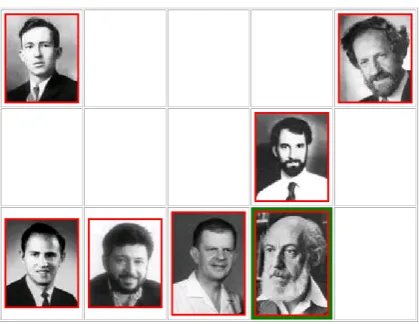
The TUNA corpus was constructed using a web-based experiment. Participants were presented with a sequence of web pages, on each of which they saw displayed a selection of 7 pictures of ei-ther furniture (e.g. Figure 1) or people (e.g. Fig-ure 2) sparsely placed on a 3 row x 5 column grid. One of the pictures (the target) was high-lighted; the other 6 objects (thedistractors) were randomly selected from the object database. Par-ticipants were told that they were interacting with a
computer system to remove all but the highlighted picture from the screen. They entered a description of the object using natural language to identify the object to the computer system.
[image:2.595.299.510.218.355.2]The section of the TUNA corpus we used was that provided for the REG 2008 Challenge2. The training data includes 319 referring expressions in the furniture domain and 274 in the people domain. The development data (which we used for testing) includes 80 referring expressions in the furniture domain and 68 in the people domain.
Figure 1: Example of data from the furniture do-main (The red couch on top).
Figure 2: Example of data from the people domain (The bald subject on the bottom with the white beard).
3 Attribute Selection Algorithms
Given a set of entities with attributes appropriate to a domain (e.g., cost offlights, author of a book,
2http://www.nltg.brighton.ac.uk/research/reg08/.
[image:2.595.299.509.414.576.2]color of a car) that are in a discourse context, and a target entity that needs to be identified, the task of attribute selection is to select a subset of the at-tributes that uniquely identifies the target entity. (Note that there may be more than one such at-tribute set.) The efficacy of atat-tribute selection can be measured based on the minimality of the se-lected attribute set as well as its ability to deter-mine the target entity uniquely. There are varia-tions however in terms of what makes an attribute set more preferable to a human. For example, in a people identification task, attributes of faces are generally more memorable than attributes pertain-ing to outfits. In this paper, we demonstrate that the attribute set is speaker dependent.
In this section, we present two different attribute selection algorithms. TheFull Brevity algorithm selects the attribute set by exhaustively searching through all possible attribute sets. In contrast,Dale and Reiter algorithm orders the attributes based on a heuristic (motivated by human preference) and selects the attributes in that order until the tar-get entity is uniquely determined. We elaborate on these algorithms below.
Full Brevity (FB) We implemented a version of full brevity search. It does the following: first, it constructs AS, the set of attribute sets that uniquely identify the referent given the distrac-tors. Then, it selects an attribute set ASu ∈ AS based on one of the following four criteria: 1) The
minimality (FB-m)criterion selects from among the smallest elements of AS at random. 2) The
frequency (FB-f)criterion selects the element of AS that occurred most often in the training data. 3) The speaker frequency (FB-sf) criterion se-lects the element of AS used most often by this speaker in the training data, backing off to FB-f if necessary. This criterion models individual speak-ing/writing style. 4) Finally, thespeaker recency (FB-sr) criterion selects the element of AS used most recently by this speaker in the training data, backing off to FB-sf if necessary. This criterion models priming.
Dale and Reiter We implemented two variants
of the classic Dale & Reiter attribute selection (Dale and Reiter, 1995) algorithm. For Dale & Reiter basic (DR-b), wefirst build the preferred list of attributes by sorting the attributes according to frequency of use in the training data. We keep separate lists based on the “LOC” condition (if its
value was “+LOC”, the participants were told that they could refer to the target using its location on the screen; if it was “-LOC”, they were instructed not to use location on the screen) and backoff to a global preferred attribute list if necessary. Next, we iterate over the list of preferred attributes and select the next one that rules out at least one en-tity in the contrast set until no distractors are left.
Dale & Reiter speaker frequency (DR-sf) uses a different preferred attribute list for each speaker, backing off to the DR-b preferred list if an attribute has never been observed in the current speaker’s preferred attribute list. For the purpose of this task, we did not use any external knowledge (e.g. tax-onomies).
4 Surface Realization Approaches
A surface realizer for referring expression genera-tion transforms a set of attribute-value pairs into a linguistically well-formed expression. Our surface realizers, which are all data-driven, involve four stages of processing: (a) lexical choice of words and phrases to realize attribute values; (b) genera-tion of a space of surface realizagenera-tions (T); (c) rank-ing the set of realizations usrank-ing a language model (LM); (d) selecting the best scoring realization. In general, the best ranking realization (T∗) is de-scribed by equation 1:
T∗=Bestpath(Rank(T, LM)) (1)
We describe three different methods for creating the search space of surface realizations – Template-based,Dependency-basedand Permutation-based methods. Although these techniques share the same method for ranking, they differ in the meth-ods used for generating the space of possible sur-face realizations.
4.1 Generating possible surface realizations
4.1.1 Template-Based Realizer
In the template-based approach, surface realiza-tions from our training data are used to infer a set of templates. In the TUNA data, each attribute in each referring expression is annotated with its at-tribute type (e.g. in “the large red sofa” the sec-ond word is labeled ‘size’, the third ‘color’ and the fourth ‘type’). We extract the annotated re-ferring expressions from each trial in the training data and replace each attribute value with its type (e.g. “thesize color type”) to create a tem-plate. Each template is indexed by the lexicograph-ically sorted list of attribute types it contains (e.g. color size type). If an attribute set is not found in the training data (e.g. color size) but a superset of that set is (e.g. color size type), then the corresponding template(s) may be used, with the un-filled attribute types deleted prior to output.
At generation time, wefind all possible realiza-tions (l) (from the training data) of each attribute value (a) in the input attribute set (AS), andfill in each possible template (t) with each combination of the attribute realizations. The space of possible surface realizations is represented as a weighted finite-state automaton. The weights are computed from the prior probability of each template and the prior probability of each lexical item realizing an attribute (Equation 2). We have two versions of this realizer: one with speaker-specific lexi-cons and templates (Template-S), and one without (Template). We report results for both.
P(T|AS) =! t
P(t|AS)∗" a∈t
!
l
P(l|a, t) (2)
4.1.2 Dependency-Based Realizer
To construct our dependency-based realizer, we first parse all the word strings from the train-ing data ustrain-ing the dependency parser described in (Bangalore et al., 2005; Nasr and Rambow, 2004). Then, for every pair of words wi,wj that occur in the same referring expression (RE) in the training data, we compute: f req(i < j), the fre-quency with which wi precedes wj in any RE; f req(dep(wi, wj)∧ i < j), the frequency with whichwidepends on and precedeswj in any RE, andf req(dep(wi, wj)∧j < i), the frequency with whichwidepends on and followswjin any RE.
At generation time, wefind all possible realiza-tions of each attribute value in the input attribute
set, and for each combination of attribute realiza-tions, wefind the most likely set of dependencies and precedences given the training data. In other words, we bin the selected attribute realizations according to whether they are most likely to pre-cede, depend on and prepre-cede, depend on and fol-low, or folfol-low, the head word they are closest to. The result is a set of weighted partial orderings on the attribute realizations. As with the template-based surface realizer, we implemented speaker-specific and speaker-independent versions of the dependency-based surface realizer. Once again, we encode the space of possible surface realiza-tions as a weightedfinite-state automaton.
4.1.3 Permute and Rank Realizer
In this method, the lexical items associated with each attribute value to be realized are treated as a disjunctive set of tokens. This disjunctive set is represented as a finite-state automaton with two states and transitions between them labeled with the tokens of the set. The transitions are weighted by the negative logarithm of the probability of the lexical token (l) being associated with that attribute value (a): (−log(P(l|a))). These sets are treated as bags of tokens; we create permutations of these bags of tokens to represent the set of possible sur-face realizations.
In general, the number of states of the minimal permutation automaton of even a linear automaton (finite-state representation of a string) grows expo-nentially with the number of words of the string. Although creating the full permutation automaton for full natural language generation tasks could be computationally prohibitive, most attribute sets in our two domains contain no more than five at-tributes. So we choose to explore the full permu-tation space. A more general approach might con-strain permutations to be within a local window of adjustable size (also see (Kanthak et al., 2005)).
rep-0000
1000
1
0100
2
1100
2
1010
3
1
1110
3
1101
4
1111
4
[image:5.595.151.432.68.136.2]3 2
Figure 3: Locally constraint permutation automaton for a sentence with 4 positions and a window size of 2.
resents the fact that the word/phrase at position 1 has been used. The next two (window=2) posi-tions are the possible outgoing arcs from this state with labels 2 and 3 connecting to state “1100” and “1010” respectively. The bit vectors of two states connected by an arc differ only by a single bit. Note that bit vectors elegantly solve the problem of recombining paths in the automaton as states with the same bit vectors can be merged. As a result, a fully minimized permutation automaton has only a single initial andfinal state.
4.2 Ranking and Recovering a Surface
Realization
These three methods for surface realization create a space of possible linguistic expressions given the set of attributes to be realized. These expressions are encoded asfinite-state automata and have to be ranked based on their syntactic well-formedness. We approximate the syntactic well-formedness of an expression by the n-gram likelihood score of that expression. We use a trigram model trained on the realizations in the training corpus. This language model is also represented as a weighted finite-state automaton. The automaton represent-ing the space of possible realizations and the one representing the language model are composed. The result is an automaton that ranks the possible realizations according to their n-gram likelihood scores. We then produce the best-scoring realiza-tion as the target realizarealiza-tion of the input attribute set.
We introduce a parameter λ which allows us to control the importance of the prior score rela-tive to the language model scores. We weight the finite-state automata according to this parameter as shown in Equation 3.
T∗=Bestpath(λ∗T ◦(1−λ)∗LM) (3)
DICE MASI Acc. Uniq. Min. Furniture
FB-m .36 .16 0 1 1
FB-f .81 .58 .40 1 0
FB-sf .95 .87 .79 1 0
FB-sr .93 .81 .71 1 0
DR-b .81 .60 .45 1 0
DR-sf .86 .64 .45 1 .04 People
FB-m .26 .12 0 1 1
FB-f .58 .37 .28 1 0
FB-sf .94 .88 .84 1 .01 FB-sr .93 .85 .79 1 .01
DR-b .70 .45 .25 1 0
DR-sf .78 .55 .35 1 0
Overall
FB-m .32 .14 0 1 1
FB-f .70 .48 .34 1 0
FB-sf .95 .87 .81 1 .01 FB-sr .93 .83 .75 1 .01
DR-b .76 .53 .36 1 0
DR-sf .82 .60 .41 1 .02
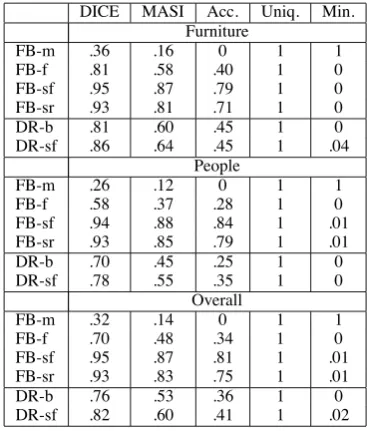
Table 1: Results for attribute selection
5 Attribute Selection Experiments
Data Preparation The training data were used
to build the models outlined above. The develop-ment data were then processed one-by-one.
Metrics We report performance using the
[image:5.595.308.492.187.403.2]that attribute selection algorithms such as Dale & Reiter’s are based on the observation that humans frequently do not produce minimal referring ex-pressions.
Results Table 1 shows the results for variations of full brevity. As we would expect, all approaches achieve a perfect score on uniqueness. For both corpora, we see a large performance jump when we use speaker constraints for all metrics other than minimality. However, when we incorporate recency constraints as well performance declines slightly. We think this is due to two factors: first, the speakers are not in a conversation, and self-priming may have less impact than other-self-priming; and second, we do not always have the most recent prior utterance for a given speaker in the training data.
Table 1 also shows the results for variations of Dale & Reiter’s algorithm. When we incorporate speaker constraints, we again see a performance jump for most metrics, although compared to the best possible case (full brevity) there is still room for improvement.
We conclude that speaker constraints can be suc-cessfully used in standard attribute selection algo-rithms to improve performance on this task.
The most relevant previous research is the work of (Gupta and Stent, 2005), who modified Dale and Reiter’s algorithm to model speaker adaptation in dialog. However, this corpus does not involve dialog so there are no cross-speaker constraints, only within-speaker constraints (speaker style and priming).
6 Surface Realization Experiments
Data Preparation Wefirst normalized the train-ing data to correct misspelltrain-ings and remove punc-tuation and capitalization. We then extracted a phrasal lexicon. For each attribute value we ex-tracted the count of all realizations of that value in the training data. We treated locations as a spe-cial case, storing separately the realizations of x-y coordinate pairs and single x- or x-y-coordinates. We added a small number of realizations by hand to cover possible attribute values not seen in the training data.
Realization We ran two realization experiments. In the first experiment, we used the human-selected attribute sets in the development data as the input to realization. If we want to
maxi-λ SED ACC Bleu NIST Furniture
Permute&Rank 0.01 3.54 0.14 0.311 3.87 Dependency 0.90 4.51 0.09 0.206 3.29 Dependency-S 0.60 4.30 0.11 0.232 3.91 Template 0.10 3.59 0.13 0.328 3.93 Template-S 0.10 2.80 0.28 0.403 4.67
People
Permute&Rank 0.04 4.37 0.10 0.227 3.15 Dependency 0.70 6.10 0.00 0.072 2.35 Dependency-S 0.50 5.84 0.02 0.136 3.05 Template 0.80 3.87 0.07 0.250 3.18 Template-S 0.70 3.79 0.15 0.265 3.59
Overall
[image:6.595.304.499.64.249.2]Permute&Rank .01/.04 3.92 0.12 0.271 4.02 Dependency 0.9/0.7 5.24 0.05 0.146 3.23 Dependency-S 0.6/0.5 5.01 0.07 0.187 3.98 Template 0.1/0.8 3.77 0.10 0.285 4.09 Template-S 0.1/0.7 3.26 0.22 0.335 4.77
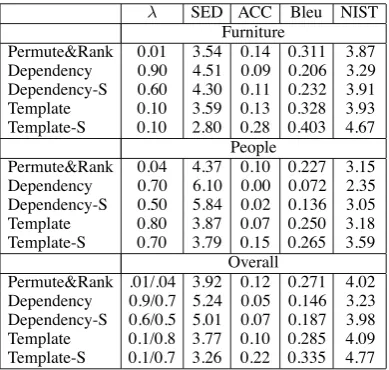
Table 2: Results for realization using speakers’ at-tribute selection (SED: String Edit Distance, ACC: String Accuracy)
mize humanlikeness, then using these attribute sets should give us an idea of the best possible perfor-mance of our realization methods. In the second experiment, we used the attribute sets output by our best-performing attribute selection algorithms (FB-sf and DR-sf) as the input to realization.
Metrics We report performance of our surface
SED ACC Bleu NIST Furniture
FB-sf DR-sf FB-sf DR-sf FB-sf DR-sf FB-sf DR-sf Permute&Rank 3.97 4.22 0.09 0.06 .291 .242 3.82 3.32 Dependency 4.80 5.03 0.04 0.03 .193 .105 3.32 2.46 Dependency-S 4.71 4.88 0.06 0.04 .201 .157 3.74 3.26 Template 3.89 4.56 0.09 0.05 .283 .213 3.48 3.22 Template-S 3.26 3.90 0.19 0.12 .362 .294 4.41 4.07
People
Permute&Rank 4.75 5.82 0.09 0.03 .171 .110 2.70 2.31 Dependency 6.35 6.91 0.00 0.00 .068 .073 1.81 1.86 Dependency-S 5.94 6.18 0.01 0.00 .108 .113 2.73 2.41 Template 3.62 4.24 0.07 0.04 .231 .138 2.88 1.35 Template-S 3.76 4.38 0.12 0.06 .201 .153 2.76 1.88
Overall
[image:7.595.148.430.63.258.2]Permute&Rank 4.33 4.96 0.09 0.05 .236 .235 3.73 3.72 Dependency 5.51 6.00 0.02 0.01 .136 .091 2.97 2.50 Dependency-S 5.36 5.67 0.04 0.02 .159 .136 3.77 3.25 Template 3.76 4.41 0.08 0.05 .258 .180 3.69 2.89 Template-S 3.48 4.12 0.16 0.09 .288 .229 4.15 3.58
Table 3: Results for realization with different attribute selection algorithms
Furniture People FB-sf DR-sf FB-sf DR-sf Permute&Rank .01 .05 .05 .04
Dependency .9 .9 .9 .1
Dependency-S .2 .2 .4 .4
Template .8 .8 .8 .8
[image:7.595.83.278.297.365.2]Template-S .6 .8 .8 .8
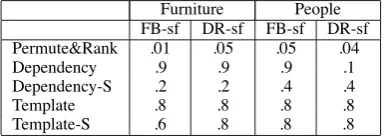
Table 4: Optimalλvalues with different attribute selection algorithms
Results Our experimental results are shown in
Tables 2 and 3. (These results are the results obtained with the language model weighting that gives best performance; the weights are shown in Tables 2 and 4.) Our approaches work better for the furniture domain, where there are fewer at-tributes, than for the people domain. For both domains, for automatic and human attribute se-lection, the speaker-dependent Template-based ap-proach seems to perform the best, then the speaker-independent Template-based approach, and then the Permute&Rank approach. However, we find automatic metrics for evaluating generation qual-ity to be unreliable. We looked at the output of the surface realizers for the two examples in Section 2. The best output for the example in Figure 1 is from the FB-sf template-based speaker-dependent algo-rithm, which isthe big red sofa. The worst out-put is from the DR-sf dependency-based speaker-dependent algorithm, which ison the left red chair with three seats. The best output for the exam-ple in Figure 2 is from the FB-sf template-based speaker-independent algorithm, which isthe man with the white beard. The worst output is from the
FB-sf dependency-based speaker-dependent algo-rithm, which isbeard man white.
Discussion The Template-S approach achieves
the best string edit distance scores, but it is not very robust. If no examples are found in the training data that realize (a superset of) the input attribute set, neither Template approach will produce any output.
The biggest cause of errors for the Permute and Reorder approach is missing determiners and miss-ing modifiers. The biggest cause of errors for the Dependency approach is missing determiners and reordered words. The Template approach some-times has repeated words (e.g. “middle”, where “middle” referred to both x- and y-coordinates).
Here we report performance using automatic metrics, but wefind these metrics to be unreliable (particularly in the absence of multiple reference texts). Also, we are not sure that people would ac-cept from a computer system output that is very human-like in this domain, as the human-like out-put is often ungrammatical and telegraphic (e.g. “grey frontal table”). We plan to do a human eval-uation soon to better analyze our systems’ perfor-mance.
7 Conclusions
data-driven, speaker-aware approaches to attribute selection and referring expression realization. We showed that individual speaking style can be use-fully modeled even for quite ‘small’ generation tasks, and confirmed that data-driven approaches to surface realization can work well using a range of lexical, syntactic and semantic information.
We plan to explore the impact of human visual search strategies (Rayner, 1998) on the referring expression generation task. In addition, we are planning a human evaluation of the generation sys-tems’ output. Finally, we plan to apply our algo-rithms to a conversational task.
Acknowledgments
We thank Anja Belz, Albert Gatt, and Eric Kow for organizing the REG competition and providing data, and Gregory Zelinsky for discussions about visually-based constraints.
References
Bangalore, S. and O. Rambow. 2000. Exploiting a probabilistic hierarchical model for generation. In Proc. COLING.
Bangalore, S., A. Emami, and P. Haffner. 2005. Fac-toring global inference by enriching local represen-tations. Technical report, AT&T Labs-Research.
Belz, A. and A. Gatt. 2007. The attribute selection for GRE challenge: Overview and evaluation results. In Proc. UCNLG+MT at MT Summit XI.
Belz, A. 2007. Probabilistic generation of weather forecast texts. InProc. NAACL/HLT.
Dale, R. and E. Reiter. 1995. Computational interpre-tations of the Gricean maxims in the generation of referring expressions.Cognitive Science, 19(2).
Dice, L. 1945. Measures of the amount of ecologic association between species.Ecology, 26.
Doddington, G. 2002. Automatic evaluation of ma-chine translation quality using n-gram co-occurrence statistics. InProc. HLT.
Gupta, S. and A. Stent. 2005. Automatic evaluation of referring expression generation using corpora. In Proc. UCNLG.
Kanthak, S., D. Vilar, E. Matusov, R. Zens, and H. Ney. 2005. Novel reordering approaches in phrase-based statistical machine translation. InProc. ACL Work-shop on Building and Using Parallel Texts.
Krahmer, E., S. van Erk, and A. Verleg. 2003. Graph-based generation of referring expressions. Computa-tional Linguistics, 29(1).
Langkilde, I. and K. Knight. 2000. Forest-based statis-tical sentence generation. InProc. NAACL.
Levelt, W., 1989. Speaking: From intention to articu-lation, pages 222–226. MIT Press.
Nasr, A. and O. Rambow. 2004. Supertagging and full parsing. InProc. 7th International Workshop on Tree Adjoining Grammar and Related Formalisms (TAG+7).
Nenkova, A., R. Passonneau, and K. McKeown. 2007. The Pyramid method: incorporating human con-tent selection variation in summarization evaluation. ACM Transactions on speech and language process-ing, 4(2).
Papenini, K., S. Roukos, T. Ward, and W.-J. Zhu. 2001. BLEU: A method for automatic evaluation of ma-chine translation. InProc. ACL.
Rayner, K. 1998. Eye movements in reading and infor-mation processing: 20 years of research. Psycholog-ical Bulletin, 124(3).
Reiter, E. and R. Dale. 2000. Building Natural Lan-guage Generation Systems. Cambridge University Press.