Semi-Supervised Recognition of Sarcastic Sentences
in Twitter and Amazon
Dmitry Davidov ICNC
The Hebrew University Jerusalem, Israel
Oren Tsur
Institute of Computer Science The Hebrew University
Jerusalem, Israel
Ari Rappoport
Institute of Computer Science The Hebrew University
Jerusalem, Israel
Abstract
Sarcasmis a form of speech act in which the speakers convey their message in an implicit way. The inherently ambiguous nature of sarcasm sometimes makes it hard even for humans to decide whether an ut-terance is sarcastic or not. Recognition of sarcasm can benefit many sentiment analy-sis NLP applications, such as review sum-marization, dialogue systems and review ranking systems.
In this paper we experiment with semi-supervised sarcasm identification on two very different data sets: a collection of 5.9 million tweets collected from Twit-ter, and a collection of 66000 product re-views from Amazon. Using the Mechani-cal Turk we created a gold standard sam-ple in which each sentence was tagged by 3 annotators, obtaining F-scores of 0.78 on the product reviews dataset and 0.83 on the Twitter dataset. We discuss the dif-ferences between the datasets and how the algorithm uses them (e.g., for the Amazon dataset the algorithm makes use of struc-tured information). We also discuss the utility of Twitter #sarcasm hashtags for the task.
1 Introduction
Sarcasm(also known asverbal irony) is a sophis-ticated form of speech act in which the speakers convey their message in an implicit way. One in-herent characteristic of the sarcastic speech act is that it is sometimes hard to recognize. The dif-ficulty in recognition of sarcasm causes misun-derstanding in everyday communication and poses
problems to many NLP systems such as online review summarization systems, dialogue systems or brand monitoring systems due to the failure of state of the art sentiment analysis systems to detect sarcastic comments. In this paper we experiment with a semi-supervised framework for automatic identification of sarcastic sentences.
One definition for sarcasm is: the activity of saying or writing the opposite of what you mean, or of speaking in a way intended to make someone else feel stupid or show them that you are angry
(Macmillan English Dictionary (2007)). Using the former definition, sarcastic utterances appear in many forms (Brown, 1980; Gibbs and O’Brien, 1991). It is best to present a number of examples which show different facets of the phenomenon, followed by a brief review of different aspects of the sarcastic use. The sentences are all taken from our experimental data sets:
1. “thank you Janet Jackson for yet another year of Super Bowl classic rock!” (Twitter)
2. “He’s with his other woman: XBox 360. It’s 4:30 fool. Sure I can sleep through the gun-fire”(Twitter)
3. “Wow GPRS data speeds are blazing fast.”
(Twitter)
4. “[I] Love The Cover”(book, amazon)
5. “Defective by design” (music player, ama-zon)
Example (1) refers to the supposedly lame mu-sic performance in super bowl 2010 and attributes it to the aftermath of the scandalous performance of Janet Jackson in the previous year. Note that the previous year is not mentioned and the reader has to guess the context (use universal knowledge). The wordsyetandanothermight hint at sarcasm.
Example (2) is composed of three short sentences, each of them sarcastic on its own. However, com-bining them in one tweet brings the sarcasm to its extreme. Example (3) is a factual statement without explicit opinion. However, having a fast connection is a positive thing. A possible sar-casm emerges from the over exaggeration (‘wow’, ‘blazing-fast’).
Example (4) from Amazon, might be a genuine compliment if it appears in the body of the review. However, recalling the expression ‘don’t judge a book by its cover’, choosing it as the title of the review reveals its sarcastic nature. Although the negative sentiment is very explicit in the iPod re-view (5), the sarcastic effect emerges from the pun that assumes the knowledge that the design is one of the most celebrated features of Apple’s prod-ucts. (None of the above reasoning was directly introduced to our algorithm.)
Modeling the underlying patterns of sarcastic utterances is interesting from the psychological and cognitive perspectives and can benefit var-ious NLP systems such as review summariza-tion (Popescu and Etzioni, 2005; Pang and Lee, 2004; Wiebe et al., 2004; Hu and Liu, 2004) and dialogue systems. Following the ‘brilliant-but-cruel’ hypothesis (Danescu-Niculescu-Mizil et al., 2009), it can help improve ranking and recommen-dation systems (Tsur and Rappoport, 2009). All systems currently fail to correctly classify the sen-timent of sarcastic sentences.
In this paper we utilize the semi-supervised sar-casm identification algorithm (SASI) of (Tsur et al., 2010). The algorithm employs two modules: semi supervised pattern acquisition for identify-ing sarcastic patterns that serve as features for a classifier, and a classification stage that classifies each sentence to a sarcastic class. We experiment with two radically different datasets: 5.9 million tweets collected from Twitter, and 66000 Amazon product reviews. Although for the Amazon dataset the algorithm utilizes structured information, re-sults for the Twitter dataset are higher. We discuss the possible reasons for this, and also the utility of Twitter #sarcasm hashtags for the task. Our al-gorithm performed well in both domains, substan-tially outperforming a strong baseline based on se-mantic gap and user annotations. To further test its robustness we also trained the algorithm in a cross domain manner, achieving good results.
2 Data
The datasets we used are interesting in their own right for many applications. In addition, our algo-rithm utilizes some aspects that are unique to these datasets. Hence, before describing the algorithm, we describe the datasets in detail.
Twitter Dataset. Since Twitter is a relatively new service, a somewhat lengthy description of the medium and the data is appropriate.
Twitteris a very popular microblogging service. It allows users to publish and read short messages calledtweets(also used as a verb: to tweet: the act of publishing on Twitter). The tweet length is re-stricted to 140 characters. A user who publishes a tweet is referred to as atweeterand the readers are casual readers orfollowersif they are registered to get all tweets by this tweeter.
Apart from simple text, tweets may contain ref-erences to url addresses, refref-erences to other Twit-ter users (these appear as @<user>) or a con-tent tag (calledhashtags) assigned by the tweeter (#<tag>). An example of a tweet is: “listen-ing to Andrew Ridgley by Black Box Recorder on @Grooveshark: http://tinysong.com/cO6i #good-music”, where ‘grooveshark’ is a Twitter user name and #goodmusic is a tag that allows to search for tweets with the same tag. Though fre-quently used, these types of meta tags are optional. In order to ignore specific references we substi-tuted such occurrences with special tags: [LINK], [USER] and [HASHTAG] thus we have “listen-ing to Andrew Ridgley by Black Box Recorder on
[USER]: [LINK] [HASHTAG]”. It is important
to mention that hashtags are not formal and each tweeter can define and use new tags as s/he likes.
The number of special tags in a tweet is only subject to the 140 characters constraint. There is no specific grammar that enforces the location of special tags within a tweet.
The informal nature of the medium and the 140 characters length constraint encourages massive use of slang, shortened lingo, ascii emoticons and other tokens absent from formal lexicons.
These characteristics make Twitter a fascinat-ing domain for NLP applications, although posfascinat-ing great challenges due to the length constraint, the complete freedom of style and the out of discourse nature of tweets.
words per tweet, 18.7% contain a url, 35.3% con-tain reference to another tweeter and 6.9% concon-tain at least one hashtag1.
The #sarcasm hashtag One of the hashtags used by Twitter users is dedicated to indicate sar-castic tweets. An example of the use of the tag is: ‘I guess you should expect a WONDERFUL video tomorrow. #sarcasm’. The sarcastic hashtag is added by thetweeter. This hashtag is used in-frequently as most users are not aware of it, hence, the majority of sarcastic tweets are not explicitly tagged by the tweeters. We use tagged tweets as a secondary gold standard. We discuss the use of this tag in Section 5.
Amazon dataset. We used the same dataset used by (Tsur et al., 2010), containing 66000 re-views for 120 products from Amazon.com. The corpus contained reviews for books from differ-ent genres and various electronic products. Ama-zon reviews are much longer than tweets (some reach 2000 words, average length is 953 charac-ters), they are more structured and grammatical (good reviews are very structured) and they come in a known context of a specific product. Reviews are semi-structured as besides the body of the re-view they all have the following fields: writer, date, star rating (the overall satisfaction of the re-view writer) and a one line summary.
Reviews refer to a specific product and rarely address each other. Each review sentence is, there-fore, part of a context – the specific product, the star rating, the summary and other sentences in that review. In that sense, sentences in the Ama-zon dataset differ radically from the contextless tweets. It is worth mentioning that the majority of reviews are on the very positive side (star rating average of 4.2 stars).
3 Classification Algorithm
Our algorithm is semi-supervised. The input is a relatively small seed of labeled sentences. The seed is annotated in a discrete range of 1. . .5
where 5 indicates a clearly sarcastic sentence and 1 indicates a clear absence of sarcasm. A1. . .5
scale was used in order to allow some subjectiv-ity and since some instances of sarcasm are more explicit than others.
1The Twitter data was generously provided to us by Bren-dan O’Connor.
Given the labeled sentences, we extracted a set of features to be used in feature vectors. Two basic feature types are utilized: syntactic and pattern-based features. We constructed feature vectors for each of the labeled examples in the training set and used them to build a classifier model and assign scores to unlabeled examples. We next provide a description of the algorithmic framework of (Tsur et al., 2010).
Data preprocessing A sarcastic utterance usu-ally has a target. In the Amazon dataset these targets can be exploited by a computational al-gorithm, since each review targets a product, its manufacturer or one of its features, and these are explicitly represented or easily recognized. The Twitter dataset is totally unstructured and lacks textual context, so we did not attempt to identify targets.
Our algorithmic methodology is based on patterns. We could use patterns that include the targets identified in the Amazon dataset. However, in order to use less specific patterns, we automatically replace each appearance of a product, author, company, book name (Amazon) and user, url and hashtag (Twitter) with the corresponding generalized meta tags ‘[PRODUCT]’,‘[COMPANY]’,‘[TITLE]’ and ‘[AUTHOR]’ tags2 and ‘[USER]’,‘[LINK]’ and ‘[HASHTAG]’. We also removed all HTML tags and special symbols from the review text.
Pattern extraction Our main feature type is based on surface patterns. In order to extract such patterns automatically, we followed the algorithm given in (Davidov and Rappoport, 2006). We clas-sified words into high-frequency words (HFWs) and content words (CWs). A word whose cor-pus frequency is more (less) thanFH (FC) is
con-sidered to be a HFW (CW). Unlike in (Davidov and Rappoport, 2006), we consider all punctuation characters as HFWs. We also consider [product], [company], [title], [author] tags as HFWs for pat-tern extraction. We define a patpat-tern as an ordered sequence of high frequency words and slots for content words. TheFH andFC thresholds were
set to 1000 words per million (upper bound for FC) and 100 words per million (lower bound for
FH)3.
2
Appropriate names are provided with each review so this replacement can be done automatically.
3Note thatF
The patterns allow 2-6 HFWs and 1-6 slots for CWs. For each sentence it is possible to gener-ate dozens of patterns that may overlap. For ex-ample, given a sentence “Garmin apparently does not care much about product quality or customer support”, we have generated several patterns in-cluding “[COMPANY] CW does not CW much”, “does not CW much about CW CW or”, “not CW much” and “about CW CW or CW CW.”. Note that “[COMPANY]” and “.” are treated as high frequency words.
Pattern selection The pattern extraction stage provides us with hundreds of patterns. However, some of them are either too general or too specific. In order to reduce the feature space, we have used two criteria to select useful patterns.
First, we removed all patterns which appear only in sentences originating from a single prod-uct/book (Amazon). Such patterns are usually product-specific. Next we removed all patterns which appear in the seed both in some example la-beled 5 (clearly sarcastic) and in some other exam-ple labeled 1 (obviously not sarcastic). This filters out frequent generic and uninformative patterns. Pattern selection was performed only on the Ama-zon dataset as it exploits review’s meta data.
Pattern matching Once patterns are selected, we have used each pattern to construct a single en-try in the feature vectors. For each sentence we calculated a feature value for each pattern as fol-lows:
1 : Exact match – all the pattern components appear in the sentence in correct order without any additional words. α: Sparse match – same as exact match
but additional non-matching words can be inserted between pattern components. γ∗n/N: Incomplete match – onlyn >1ofNpattern
components appear in the sentence, while some non-matching words can be inserted in-between. At least one of the appearing components should be a HFW. 0 : No match – nothing or only a single
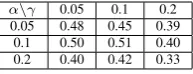
pattern component appears in the sentence. 0≤α ≤1and0 ≤γ ≤1are parameters we use to assign reduced scores for imperfect matches. Since the patterns we use are relatively long, ex-act matches are uncommon, and taking advantage of partial matches allows us to significantly re-duce the sparsity of the feature vectors. We used
[image:4.595.369.466.62.99.2]α\γ 0.05 0.1 0.2 0.05 0.48 0.45 0.39 0.1 0.50 0.51 0.40 0.2 0.40 0.42 0.33
Table 1: Results (F-Score for ”no enrichment” mode) of cross validation with various values for αand γ on Twit-ter+Amazon data
α = γ = 0.1in all experiments. Table 1 demon-strates the results obtained with different values forαandγ.
Thus, for the sentence “Garmin apparently does not care much about product quality or customer support”, the value for “[company] CW does not” would be 1 (exact match); for “[company] CW not” would be0.1(sparse match due to insertion of ‘does’); and for “[company] CW CW does not” would be 0.1 ∗ 4/5 = 0.08 (incomplete match since the second CW is missing).
Punctuation-based features In addition to pattern-based features we used the following generic features: (1) Sentence length in words, (2) Number of “!” characters in the sentence, (3) Number of “?” characters in the sentence, (4) Number of quotes in the sentence, and (5) Num-ber of capitalized/all capitals words in the sen-tence. All these features were normalized by di-viding them by the (maximal observed value· av-eraged maximal value of the other feature groups), thus the maximal weight of each of these fea-tures is equal to the averaged weight of a single pattern/word/n-gram feature.
Data enrichment Since we start with only a small annotated seed for training (particularly, the number of clearly sarcastic sentences in the seed is modest) and since annotation is noisy and expen-sive, we would like to find more training examples without requiring additional annotation effort.
To achieve this, we posited that sarcastic sen-tences frequently co-appear in texts with other sar-castic sentences (i.e. example (2) in Section 1). We performed an automated web search using the Yahoo! BOSS API4, where for each sentencesin the training set (seed), we composed a search en-gine queryqs containing this sentence5. We
col-lected up to 50 search engine snippets for each example and added the sentences found in these snippets to the training set. The label (level of
sar-4
http://developer.yahoo.com/search/boss.
casm)Label(sq)of a newly extracted sentencesq
is similar to the label Label(s) of the seed sen-tencesthat was used for the query that acquired it. The seed sentences together with newly acquired sentences constitute the (enriched) training set.
Data enrichment was performed only for the Amazon dataset where we have a manually tagged seed and the sentence structure is closer to stan-dard English grammar. We refer the reader to (Tsur et al., 2010) for more details about the en-richment process and for a short discussion about the usefulness of web-based data enrichment in the scope of sarcasm recognition.
Classification In order to assign a score to new examples in the test set we use a k-nearest neigh-bors (kNN)-like strategy. We construct feature vectors for each example in the training and test sets. We would like to calculate the score for each example in the test set. For each feature vectorvin the test set, we compute the Euclidean distance to each of the matching vectors in the extended train-ing set, where matchtrain-ing vectors share at least one pattern feature withv.
Let ti, i = 1..k be the k vectors with lowest
Euclidean distance tov6. Thenvis classified with
a labellas follows:
Count(l) =Fraction of training vectors with labell
Label(v) =
"
1
k
X
i
Count(Label(ti))·Label(ti)
P
jCount(label(tj))
#
Thus the score is a weighted average of thek clos-est training set vectors. If there are less than k matching vectors for the given example then fewer vectors are used in the computation. If there are no matching vectors found forv, we assigned the default value Label(v) = 1, since sarcastic sen-tences are fewer in number than non-sarcastic ones (this is a ‘most common tag’ strategy).
4 Evaluation Setup
Seed and extended training sets (Amazon). As described in the previous section,SASIis semi su-pervised, hence requires a small seed of annotated data. We used the same seed of 80 positive (sar-castic) examples and 505 negative examples de-scribed at (Tsur et al., 2010).
After automatically expanding the training set, our training data now contains 471 positive exam-ples and 5020 negative examexam-ples. These ratios are
6We usedk= 5for all experiments.
to be expected, since non-sarcastic sentences out-number sarcastic ones, definitely when most on-line reviews are positive (Liu et al., 2007). This generally positive tendency is also reflected in our data – the average number of stars is 4.12.
Seed training set with #sarcasm (Twitter). We used a sample of 1500 tweets marked with the #sarcasm hashtag as a positive set that represents sarcasm styles special to Twitter. However, this set is very noisy (see discussion in Section 5).
Seed training set (cross domain). Results ob-tained by training on the 1500 #sarcasm hash-tagged tweets were not promising. Examination of the #sarcasm tagged tweets shows that the annota-tion is biased and noisy as we discuss in length in Section 5. A better annotated set was needed in order to properly train the algorithm. Sarcas-tic tweets are sparse and hard to find and annotate manually. In order to overcome sparsity we used the positive seed annotated on the Amazon dataset. The training set was completed by manually se-lected negative example from the Twitter dataset. Note that in this setting our training set is thus of mixed domains.
4.1 Star-sentiment baseline
Many studies on sarcasm suggest that sarcasm emerges from the gap between the expected utter-ance and the actual utterutter-ance (see echoic mention, allusion and pretense theories in Related Work Section( 6)). We implemented a baseline designed to capture the notion of sarcasm as reflected by these models, trying to meet the definition “saying the opposite of what you mean in a way intended to make someone else feel stupid or show you are angry”.
We exploit the meta-data provided by Amazon, namely the star rating each reviewer is obliged to provide, in order to identify unhappy review-ers. From this set of negative reviews, our base-line classifies as sarcastic those sentences that ex-hibit strong positive sentiment. The list of positive sentiment words is predefined and captures words typically found in reviews (for example, ‘great’, ‘excellent’, ‘best’, ‘top’, ‘exciting’, etc).
4.2 Evaluation procedure
We used two experimental frameworks to test
classification. We did that by 5-fold cross valida-tion over the seed data.
In the second experiment we evaluatedSASIon a test set of unseen sentences, comparing its out-put to a gold standard annotated by a large number of human annotators (using the Mechanical Turk). This way we verify that there is no over-fitting and that the algorithm is not biased by the notion of sarcasm of a single seed annotator.
5-fold cross validation (Amazon). In this ex-perimental setting, the seed data was divided to 5 parts and a 5-fold cross validation test is executed. Each time, we use 4 parts of the seed as the train-ing data and only this part is used for the feature selection and data enrichment. This 5-fold pro-cess was repeated ten times. This procedure was repeated with different sets of optional features.
We used 5-fold cross validation and not the standard 10-fold since the number of seed exam-ples (especially positive) is relatively small hence 10-fold is too sensitive to the broad range of possi-ble sarcastic patterns (see the examples in Section 1).
Classifying new sentences (Amazon & Twitter). Evaluation of sarcasm is a hard task due to the elusive nature of sarcasm, as discussed in Sec-tion 1. In order to evaluate the quality of our al-gorithm, we used SASI to classify all sentences in both corpora (besides the small seed that was pre-annotated and was used for the evaluation in the 5-fold cross validation experiment). Since it is impossible to created a gold standard classifica-tion of each and every sentence in the corpus, we created a small test set by sampling 90 sentences which were classified as sarcastic (labels 3-5) and 90 sentences classified as not sarcastic (labels 1,2). The sampling was performed on the whole corpus leaving out only the seed data.
Again, the meta data available in the Amazon dataset allows us a stricter evaluation. In order to make the evaluation harder for our algorithm and more relevant, we introduced two constraints to the sampling process: i) we sampled only sen-tences containing a named-entity or a reference to a named entity. This constraint was introduced in order to keep the evaluation set relevant, since sen-tences that refer to the named entity (the target of the review) are more likely to contain an explicit or implicit sentiment. ii) we restricted the non-sarcastic sentences to belong to negative reviews
(1-3 stars) so that all sentences in the evaluation set are drawn from the same population, increas-ing the chances they convey various levels of di-rect or indidi-rectnegativesentiment7.
Experimenting with the Twitter dataset, we sim-ply classified each tweet into one of 5 classes (class 1: not sarcastic, class 5: clearly sarcastic) according to the label given by the algorithm. Just like the evaluation of the algorithm on the Amazon dataset, we created a small evaluation set by sam-pling 90 sentences which were classified as sarcas-tic (labels 3-5) and 90 sentences classified as not sarcastic (labels 1,2).
Procedure Each evaluation set was randomly divided to 5 batches. Each batch contained 36 tences from the evaluation set and 4 anchor sen-tences: two with sarcasm and two sheer neutral. The anchor sentences were not part of the test set and were the same in all five batches. The purpose of the anchor sentences is to control the evaluation procedure and verify that annotation is reasonable. We ignored the anchor sentences when assessing the algorithm’s accuracy.
We used Amazon’s Mechanical Turk8 service in order to create a gold standard for the evalua-tion. We employed 15 annotators for each eval-uation set. We used a relatively large number of annotators in order to overcome the possible bias induced by subjectivity (Muecke, 1982). Each an-notator was asked to assess the level of sarcasm of each sentence of a set of 40 sentences on a scale of 1-5. In total, each sentence was annotated by three different annotators.
Inter Annotator Agreement. To simplify the assessment of inter-annotator agreement, the scal-ing was reduced to a binary classification where 1 and 2 were marked as non-sarcastic and 3-5 as sar-castic (recall that 3 indicates a hint of sarcasm and 5 indicates ‘clearly sarcastic’). We checked the Fleiss’κ statistic to measure agreement between multiple annotators. The inter-annotator agree-ment statistic wasκ= 0.34on the Amazon dataset andκ= 0.41on the Twitter dataset.
These agreement statistics indicates a fair agreement. Given the fuzzy nature of the task at
7Note that the second constraint makes the problem less easy. If taken from all reviews, many of the sentences would be positive sentences which are clearly non-sarcastic. Doing this would bias selection to positive vs. negative samples in-stead of sarcastic-nonsarcastic samples.
Prec. Recall Accuracy F-score
punctuation 0.256 0.312 0.821 0.281
patterns 0.743 0.788 0.943 0.765
pat+punct 0.868 0.763 0.945 0.812
enrich punct 0.4 0.390 0.832 0.395
enrich pat 0.762 0.777 0.937 0.769
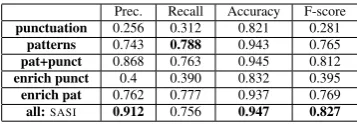
[image:7.595.91.270.61.123.2]all:SASI 0.912 0.756 0.947 0.827
Table 2:5-fold cross validation results on the Amazon gold standard using various feature types. punctuation: punctua-tion mark;,patterns: patterns;enrich: after data enrichment;
enrich punct: data enrichment based on punctuation only; en-rich pat: data enrichment based on patterns only;SASI: all features combined.
hand, thisκvalue is certainly satisfactory. We at-tribute the better agreement on the twitter data to the fact that in twitter each sentence (tweet) is con-text free, hence the sentiment in the sentence is ex-pressed in a way that can be perceived more easily. Sentences from product reviews come as part of a full review, hence the the sarcasm sometimes re-lies on other sentences in the review. In our evalu-ation scheme, our annotators were presented with individual sentences, making the agreement lower for those sentences taken out of their original con-text. The agreement on the control set (anchor sen-tences) hadκ= 0.53.
Using Twitter #sarcasm hashtag. In addition to the gold standard annotated using the Mechanical Turk, we collected 1500 tweets that were tagged #sarcastic by their tweeters. We call this sample thehash-gold standard. It was used to further eval-uate recall. This set (along with the negative sam-ple) was used for a 5-fold cross validation in the same manner describe for Amazon.
5 Results and discussion
5-fold cross validation (Amazon). Results are analyzed and discussed in detail in (Tsur et al., 2010), however, we summarize it here (Table 2) in order to facilitate comparison with the results obtained on the Twitter dataset. SASI, including
all components, exhibits the best overall perfor-mances with 91.2% precision and with F-Score of 0.827. Interestingly, although data enrichment bringsSASIto the best performance in both preci-sion and F-score, patterns+punctuations achieves almost comparable results.
Newly introduced sentences (Amazon). In the second experiment we evaluatedSASIbased on a
gold standard annotation created by 15 annotators. Table 3 presents the results of our algorithm as well as results of the heuristic baseline that makes
Prec. Recall FalsePos FalseNeg F Score
Star-sent. 0.5 0.16 0.05 0.44 0.242 SASI(AM) 0.766 0.813 0.11 0.12 0.788 SASI(TW) 0.794 0.863 0.094 0.15 0.827
Table 3: Evaluation on the Amazon (AM) and the Twitter (TW) evaluation sets obtained by averaging on 3 human an-notations per sentence. TW results were obtained with cross-domain training.
Prec. Recall Accuracy F-score
punctuation 0.259 0.26 0.788 0.259
patterns 0.765 0.326 0.889 0.457
enrich punct 0.18 0.316 0.76 0.236
enrich pat 0.685 0.356 0.885 0.47
all no enrich 0.798 0.37 0.906 0.505
[image:7.595.310.525.63.99.2]allSASI: 0.727 0.436 0.896 0.545
Table 4:5-fold cross validation results on the Twitterhash -gold standard using various feature types.punctuation: punc-tuation marks;patterns: patterns; enrich: after data enrich-ment;enrich punct: data enrichment based on punctuation only; enrich pat: data enrichment based on patterns only; SASI: all features combined.
use of meta-data, designed to capture the gap be-tween an explicit negative sentiment (reflected by the review’s star rating) and explicit positive senti-ment words used in the review. Precision ofSASI
is 0.766, a significant improvement over the base-line with precision of 0.5.
The F-score shows more impressive improve-ment as the baseline shows decent precision but a very limited recall since it is incapable of recog-nizing subtle sarcastic sentences. These results fit the works of (Brown, 1980; Gibbs and O’Brien, 1991) claiming many sarcastic utterances do not conform to the popular definition of “saying or writing the opposite of what you mean”. Table 3 also presents the false positive and false negative ratios. The low false negative ratio of the baseline confirms that while recognizing a common type of sarcasm, the naive definition of sarcasm cannot capture many other types sarcasm.
Newly introduced sentences (Twitter). Results on the Twitter dataset are even better than those obtained on the Amazon dataset, with accuracy of 0.947 (see Table 3 for precision and recall).
[image:7.595.325.505.165.228.2]Our explanation of the excellent results is three-fold:i)SASI’s robustness is achieved by the sparse match (α) and incomplete match (γ) that toler-ate imperfect pattern matching and enable the use of variations of the patterns in the learned feature vector. α andγ allow the introduction of patterns with components that are absent from the posi-tive seed, and can perform even with patterns that contain special tags that are not part of the test set. ii)SASIlearns a model which spans a feature
space with more than 300 dimensions. Only part of the patterns consist of meta tags that are spe-cial to product reviews, the rest are strong enough to capture the structure of general sarcastic sen-tences and not product-specific sarcastic sensen-tences only. iii) Finally, in many cases, it might be that the contextless nature of Twitter forces tweeters to express sarcasm in a way that is easy to understand from individual sentence. Amazon sentences co-appear with other sentences (in the same review) thus the sarcastic meaning emerges from the con-text. Our evaluation scheme presents the annota-tors with single sentences therefore Amazon sen-tences might be harder to agree on.
hashgold standard (Twitter). In order to fur-ther test out algorithm we built a model consist-ing of the positive sample of the Amazon trainconsist-ing, the #sarcasm hash-tagged tweets and a sample of non sarcastic tweets as the negative training set. We evaluated it in a 5-fold cross validation man-ner (only against thehash-gold standard). While precision is still high with 0.727, recall drops to 0.436 and the F-Score is 0.545.
Looking at the hash-gold standard set, we ob-served three main uses for the #sarcasm hashtag. Differences between the various uses can explain the relatively low recall. i) The tag is used as a search anchor. Tweeters add the hashtag to tweets in order to make them retrievable when searching for the tag. ii) The tag is often abused and added to non sarcastic tweets, typically to clarify that a previous tweet should have been read sarcastically, e.g.: “@wrightfan05 it was #Sarcasm ”. iii) The tag serves as a sarcasm marker in cases of a very subtle sarcasm where the lack of context, the 140 length constraint and the sentence structure make it impossible to get the sarcasm without the ex-plicit marker. Typical examples are: “#sarcasm not at all.”or“can’t wait to get home tonite #sar-casm.”, which cannot be decided sarcastic without the full context or the #sarcasm marker.
These three observations suggest that the hash-gold standard is noisy (containing non-sarcastic tweets) and is biased toward the hardest (insepa-rable) forms of sarcasm where even humans get it wrong without an explicit indication. Given the noise and the bias, the recall is not as bad as the raw numbers suggest and is actually in synch with the results obtained on the Mechanical Turk human-annotated gold standard. Table 4 presents detailed results and the contribution of each type of feature to the classification.
We note that the relative sparseness of sarcas-tic utterances in everyday communication as well as in these two datasets make it hard to accurately estimate the recall value over these huge unanno-tated data sets. Our experiment, however, indi-cates that we achieve reasonable recall rates.
Punctuation Surprisingly, punctuation marks serve as the weakest predictors, in contrast to Tep-permann et al. (2006). An exception is three con-secutive dots, which when combine with other fea-tures constitute a strong predictor. Interestingly though, while in the cross validation experiments
SASIperformance varies greatly (due to the prob-lematic use of the #sarcasm hashtag, described previously), performance based only on punctua-tion are similar (Table 2 and Table 4).
Tsur et al. (2010) presents some additional ex-amples for the contribution of each type of feature and their combinations.
6 Related Work
While the use of irony and sarcasm is well stud-ied from its linguistic and psychologic aspects (Muecke, 1982; Stingfellow, 1994; Gibbs and Col-ston, 2007), automatic recognition of sarcasm is a novel task, addressed only by few works. In the context of opinion mining, sarcasm is mentioned briefly as a hard nut that is yet to be cracked, see comprehensive overview by (Pang and Lee, 2008). Tepperman et al. (2006) identify sarcasm in spoken dialogue systems, their work is restricted to sarcastic utterances that contain the expres-sion ‘yeah-right’ and it depends heavily on cues in the spoken dialogue such as laughter, pauses within the speech stream, the gender (recognized by voice) of the speaker and prosodic features.
PMI. Validity is relatively lower when a sentence includes a made-up entity or when a sentence con-tains unusual combinations of named entities such as, for example, those in the satirical article be-ginning “Missing Brazilian balloonist Padre spot-ted straddling Pink Floyd flying pig”. We note that while sarcasm can be based on exaggeration or unusual collocations, this model covers only a limited subset of the sarcastic utterances.
Tsur et al. (2010) propose a semi supervised framework for recognition of sarcasm. The pro-posed algorithm utilizes some features specific to (Amazon) product reviews. This paper continues this line, proposing SASI a robust algorithm that successfully captures sarcastic sentences in other, radically different, domains such as twitter.
Utsumi (1996; 2000) introduces theimplicit dis-playtheory, a cognitive computational framework that models theironic environment. The complex axiomatic system depends heavily on complex for-malism representing world knowledge. While comprehensive, it is currently impractical to im-plement on a large scale or for an open domain.
Mihalcea and Strapparava (2005) and Mihalcea and Pulman (2007) present a system that identi-fies humorous one-liners. They classify sentences using naive Bayes and SVM. They conclude that the most frequently observed semantic features are negative polarity and human-centeredness. These features are also observed in some sarcastic utter-ances.
Some philosophical, psychological and linguis-tic theories of irony and sarcasm are worth refer-encing as a theoretical framework: theconstraints satisfaction theory (Utsumi, 1996; Katz, 2005), therole playingtheory (Clark and Gerrig, 1984), theechoic mentionframework (Wilson and Sper-ber, 1992) and the pretence framework (Gibbs, 1986). These are all based on violation of the max-ims proposed by Grice (1975).
7 Conclusion
We usedSASI, the first robust algorithm for recog-nition of sarcasm, to experiment with a novel Twitter dataset and compare performance with an Amazon product reviews dataset. Evaluating in various ways and with different parameters con-figurations, we achieved high precision, recall and F-Score on both datasets even for cross-domain training and with no need for domain adaptation.
In the future we will test the contribution of
sarcasm recognition for review ranking and sum-marization systems and for brand monitoring sys-tems.
References
R. L. Brown. 1980. The pragmatics of verbal irony. In R. W. Shuy and A. Snukal, editors,Language use and the uses of language, pages 111–127. George-town University Press.
Clint Burfoot and Timothy Baldwin. 2009. Automatic satire detection: Are you having a laugh? In Pro-ceedings of the ACL-IJCNLP 2009 Conference Short Papers, pages 161–164, Suntec, Singapore, August. Association for Computational Linguistics.
H. Clark and R. Gerrig. 1984. On the pretence the-ory of irony. Journal of Experimental Psychology: General, 113:121–126.
Cristian Danescu-Niculescu-Mizil, Gueorgi Kossinets, Jon Kleinberg, and Lillian Lee. 2009. How opinions are received by online communities: A case study on amazon.com helpfulness votes. Jun.
D. Davidov and A. Rappoport. 2006. Efficient unsupervised discovery of word categories using symmetric patterns and high frequency words. In
COLING-ACL.
Macmillan English Dictionary. 2007. Macmillan En-glish Dictionary. Macmillan Education, 2 edition.
Raymond W Gibbs and Herbert L. Colston, editors. 2007. Irony in Language and Thought. Routledge (Taylor and Francis), New York.
R. W. Gibbs and J. E. O’Brien. 1991. Psychological aspects of irony understanding.Journal of Pragmat-ics, 16:523–530.
R. Gibbs. 1986. On the psycholinguistics of sar-casm. Journal of Experimental Psychology: Gen-eral, 105:3–15.
H. P. Grice. 1975. Logic and conversation. In Peter Cole and Jerry L. Morgan, editors, Syntax and se-mantics, volume 3. New York: Academic Press.
Minqing Hu and Bing Liu. 2004. Mining and sum-marizing customer reviews. InKDD ’04: Proceed-ings of the tenth ACM SIGKDD international con-ference on Knowledge discovery and data mining, pages 168–177, New York, NY, USA. ACM.
Jingjing Liu, Yunbo Cao, Chin-Yew Lin, Yalou Huang, and Ming Zhou. 2007. Low-quality product re-view detection in opinion summarization. In Pro-ceedings of the 2007 Joint Conference on Empirical Methods in Natural Language Processing and Com-putational Natural Language Learning (EMNLP-CoNLL), pages 334–342.
Rada Mihalcea and Stephen G. Pulman. 2007. Char-acterizing humour: An exploration of features in hu-morous texts. InCICLing, pages 337–347.
Rada Mihalcea and Carlo Strapparava. 2005. Making computers laugh: Investigations in automatic humor recognition. pages 531–538, Vancouver, Canada.
D.C. Muecke. 1982. Irony and the ironic. Methuen, London, New York.
Bo Pang and Lillian Lee. 2004. A sentimental educa-tion: Sentiment analysis using subjectivity summa-rization based on minimum cuts. InProceedings of the ACL, pages 271–278.
Bo Pang and Lillian Lee. 2008. Opinion Mining and Sentiment Analysis. Now Publishers Inc, July.
Ana-Maria Popescu and Oren Etzioni. 2005. Extract-ing product features and opinions from reviews. In
HLT ’05: Proceedings of the conference on Hu-man Language Technology and Empirical Methods in Natural Language Processing, pages 339–346, Morristown, NJ, USA. Association for Computa-tional Linguistics.
Frank Jr. Stingfellow. 1994. The Meaning of Irony. State University of NY, New York.
J. Tepperman, D. Traum, and S. Narayanan. 2006. Yeah right: Sarcasm recognition for spoken dialogue systems. InInterSpeech ICSLP, Pittsburgh, PA.
Oren Tsur and Ari Rappoport. 2009. Revrank: A fully unsupervised algorithm for selecting the most help-ful book reviews. InInternational AAAI Conference on Weblogs and Social Media.
Oren Tsur, Dmitry Davidiv, and Ari Rappoport. 2010. Icwsm – a great catchy name: Semi-supervised recognition of sarcastic sentences in product re-views. In International AAAI Conference on We-blogs and Social Media.
Akira Utsumi. 1996. A unified theory of irony and its computational formalization. InCOLING, pages 962–967.
Akira Utsumi. 2000. Verbal irony as implicit dis-play of ironic environment: Distinguishing ironic utterances from nonirony. Journal of Pragmatics, 32(12):1777–1806.
Janyce Wiebe, Theresa Wilson, Rebecca Bruce, Matthew Bell, and Melanie Martin. 2004. Learn-ing subjective language. Computational Linguistics, 30(3):277– 308, January.