Abstract— Virtual cellular manufacturing systems (VCMS) have gained popularity quite recently after realizing a fact that it overcomes the difficulty posed by traditional cellular manufacturing systems (CMS) in terms of rearrangements and reconfiguration of the existing machineries and facilities. Worker assignments are crucial for VCMS since many of the benefits associated with it come from deriving an optimal worker assignment and adequate worker flexibility levels. Artificial neural networks (ANNs) are quite popular in mapping input and output variables to find out similar patterns and clusters. In this paper, a simulated ANN model has been proposed, for worker assignments into virtual cells, which is driven by genetic algorithm (GA) for optimizing ANN architectural parameters. Key findings and analysis on findings are presented and discussed.
Index Terms— Artificial Neural Networks, Genetic
Algorithm, Virtual Cellular Manufacturing, Worker Assignment
I. INTRODUCTION
In manufacturing environments, group technology (GT) has completely revamped the process of manufacturing that enabled manufacturing organizations to achieve reduced time to make the products, minimum flow time of parts, reduced work-in-process (WIP) inventory and improved product quality. More importantly, GT enabled firms are able to respond to changes quickly in product design and demand. VCMS that originally sprang from traditional CMS, virtually arranges and rearranges machineries and facilities in order to form production cells across the shop floor without moving them physically. In other words, this production methodology would not insist upon any reconfiguration of the existing layouts in the company unlike traditional CMS, while enjoying the benefits associated with traditional CMS [1]. Authors of [2] have reiterated that workers’ role is a major constraining resource in VCMS environments and disregarding this aspect would undermine company’s projection of the output.
ANNs, a network classifier based on human biological nervous systems, show enough evidence of successfully
Manuscript received December 29, 2009, revised version received March 23, 2010. The first author would like to thank executives of Caledonian College of Engineering, Oman for supporting his PhD course under Staff Development Programme of which the present study is a part.
R.V. Murali is with Caledonian College of Engineering, Department of Mechanical & Industrial Engineering, PB2322, PC111, Muscat, SULTANATE OF OMAN, (Telephone: 968-99660536; fax: 968-24535675; e-mail: [email protected])
A.B.Puri is working with National Institute of Technology, Department of Mechanical Engineering, Durgapur, INDIA, 713209, (e-mail: [email protected])
G.Prabhakaran is with the Mechanical Engineering Department, Sri Ramachandra Institute of Technology, Chennai, INDIA, 600116 (e-mail:
classifying the input data of more complex and nonlinear problems through learning and training. Applications of ANNs have been very emergent particularly in manufacturing context cell formation has been an excellent domain. There are a number of neural network approaches experimented for cell formation [3]-[5]. However, application of ANN on worker assignments in virtual cellular environments has not been found in literature since assignments are done traditionally on the basis of experience of the production team involved with the cells. Initial groundwork for employing ANNs for worker assignments is done [13] by proposing an ANN framework, for assigning workers in to virtual cells, trained by datasets called worker fitness attributes derived from cell formation solutions (published) and workers’ skill matrix. In this paper, GA, an evolutionary optimization tool, is integrated in to this frame work in order to derive optimized ANN parameters settings for maximizing its generalizing capability to carry out worker assignment task.
II. LITERATURE REVIEW
Tasks of worker allocation are considered significant in any manufacturing environment because of the major constraints posed in terms of resources and their utilization. However, workforce problems, for a long time, have been handled heuristically by matching the technical skills of the workers with production requirements. Most worker assignments are made based on the experience of the personnel involved with the cells.
Various research works have been undertaken in the context of workers assignment into cell-based manufacturing systems as reported in literature. A multiobjective mathematical model was proposed for forming machine and human manufacturing cells on the basis of skill match [6]. A two-phase hierarchical methodology, proposed by [7], achieved an optimal manpower assignment which was further extended by the same authors to generate alternative operator levels and to obtain the optimal common operator and product assignment to the cells. Later, the impact of lot-splitting in terms of setup times on the work undertaken in this context was examined [8].
Integer programming and mixed integer programming models were developed [9]-[10] for assigning workers to cells and determining an appropriate training programme schedule for employees. These studies considered only the technical skills of the workers, not other abilities such as human skills. This was followed by development of goal programming model [1] for a virtual cellular design framework to form virtual cells initially and then to assign workers to these virtual cells. This work was further developed and analyzed [11] considering the empirical aspects such as job criticality and varied worker efficiency
GA-Driven ANN Model for Worker
Assignment into Virtual Manufacturing Cells
through a binary integer programming model. Recently, preliminary works for employing ANNs for worker assignments are taken up [13] by proposing an ANN framework for assigning workers in to virtual cells.
It is discovered from the past studies on worker assignment for virtual cells that there are various heuristics, mathematical models developed and tested. Although preliminary works were done on applying ANN for worker assignments, its full potential on worker assignment tasks still remains to be explored. This work is built upon the work carried out already [13] by integrating GA with ANN framework in order to derive optimized ANN parameters settings and architecture. Training datasets for ANN are derived in the form of worker fitness attributes that are generated by linking cell formation solutions available in the literature with workers’ skill matrix.
III. TOPOLOGY & GA STRUCTURE
A. ANN Architecture
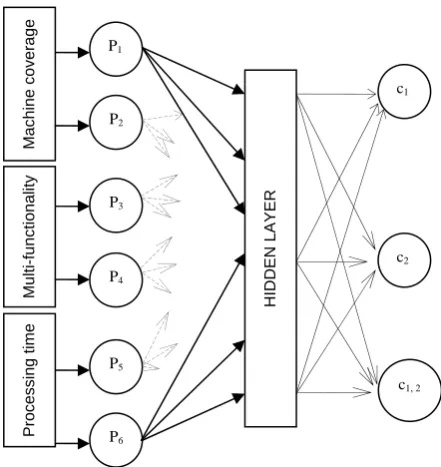
[image:2.595.315.537.405.496.2]ANNs prove to be a worth-applying tool for matching input and output information patterns in the context of engineering and nonengineering applications. The generalizing ability of ANNs depends heavily on the training datasets and architectural parameter settings. Among ANN types, feed forward networks (with one or more hidden layers) are one of the important types of supervised neural networks that find solutions for almost all complex nonlinear problems or approximate any functions. Most commonly used activation functions for hidden and output are sigmoid and pure linear. This powerful network architecture is used in this work with one layer and more number of nodes for effective clustering of workers.
Figure 1 Proposed Structure of a Feed Forward Network Equation (1) gives the output of each layer (i) for a generalized multilayered feed forward neural network in which outi and wi-1,i are the output of the layer i and weight factor values of the data flow from layer i-1 to layer i.
output
i
out
i1.
w
i1,i ………. (1) Figure 1 shows the proposed structure of a feed forward network with six input variables to the input layer, 1 hidden layer with 3 nodes and 3 output variables on the output layer as indicated.B. GA structure
[image:2.595.47.268.463.697.2]Genetic Algorithm (GA), an evolutionary method, seeks optimal solutions genetically from the large search space for combinatorial kind of problems on the principle ‘survival of the fittest’. Initial population (chromosomes) is randomly generated and subsequently will undergo GA operations such as reproduction, cross over and mutation. Each operation will improve the fitness of the chromosome based on the objective function value. In this paper, GA optimizes ANN topological parameters so that the fitness function (i.e., mean squared error-MSE) of each generation is minimized. ANN parameters such as number of nodes in the hidden layer, learning rate (LR), momentum coefficient (MC) and activation function are considered for optimization process. This paper utilizes real coded method as opposed to binary coded method since it is found to yield optimal or near-optimal results faster and it is relatively easier to write MATLAB code for real valued methods. Other GA structural parameters are given in the Table 1.
Table 1 GA Structural Parameters Population size 20
Number of generations 20
Termination criterion Maximum no of generations Selection function Roulette wheel
Crossover function Discrete method
(0.65 probability of crossover) Mutation function Real valued
(0.05 probability of mutation)
IV. PROBLEM DESCRIPTION & MODEL FORMULATION
This paper contemplates two cell configuration problems available in literature (appendix of [12]) and proposes a worker assignment model on the basis of fitness attribute values of each available worker.
These fitness values are determined by taking cell formation solutions of the problems considered and the worker skill sets. It assigns workers in to each virtual cell for different time periods on the basis of workers’ degree of association or contribution to each cell. It is advocated that worker assignment depends on to what extent a worker adds value to a particular cell in terms of fitness attributes such as machine coverage ratio, multifunctionality and total processing load.
If the contribution to a particular cell by a worker is very less, it would imply that he/she might not be eligible to process as many jobs assigned in that cell as anticipated and would result in underutilization of workforce.
P1
Machine coverage
P2
P3
Multi-functionality
P4
P5
Processing time P
6
c1
c2
c1, 2
Total number of workers for each VCMS period is so chosen considering the Dual-Resource-Constrained contexts in which the total number of workers available is less than the number of machines available for a specified time period (in this study, one month is the VCMS period).
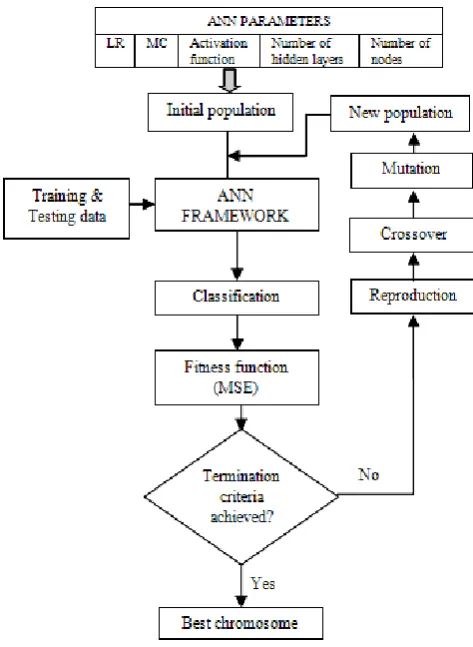
Figure 2 GA-driven ANN model framework
Then fitness attributes aredetermined for each worker and fed into ANN framework as training/validating/testing inputs. These training datasets derived hitherto along with two other indigenous valid datasets generated will form the central training datasets that would eventually train ANN framework. The datasets were randomly divided into three groups: a training set, a validation set and a prediction set. Table 2 presents sample datasets derived for two cell literature problems.
GA optimization is interposed into this framework in order to optimize the ANN training parameters so that the best chromosome having optimal parameter settings can be obtained. An initial population size of 20 is assumed and fed into ANN framework that performs the classification. MSE is the average error incurred when ANN classifies the large input data. Our objective is to minimize MSE and obtain the best chromosome for an optimal set of ANN parameters used to classify testing datasets. The initial weights were randomly selected between 0 and 1. Figure 2 shows the model of proposed GA-ANN framework.
Table 2 Sample datasets derived from literature problems
Datasets* Wor
k
er
s
Workers Fitness Attributes (6 input variables) Desired Target Vectors
(3 output variable s) Machine
coverage ratio of each
worker in
Multifunctio nality of each
worker in
Total processing (hr) load in
Cell 1
Cell 2
Cell 1
Cell 2
Cell 1
Cell 2
1
W1 0.66 0.5 4 4 3.38 2.92 0 0 1
W2 0.33 1 3 7 1.37 4.12 0 1 0
W3 1 0 7 0 4.75 0 1 0 0
W4 0.66 0.5 4 3 3.38 1.2 1 0 0
2
W1 0.5 0.66 2 7 1.53 3.54 0 1 0
W2 1 0.33 3 4 2.03 1.31 1 0 0
W3 0 1 0 11 0 4.85 0 1 0
W4 0.5 0.66 1 7 0.5 3.54 0 1 0
3
W1 0.66 0.5 10 12 5.73 7.64 0 1 0
W2 0.33 1 5 24 2.4 14.9 0 1 0
W3 1 0 15 0 8.13 0 1 0 0
W4 0.66 0.5 10 12 5.73 7.29 0 0 1
4
W1 0.33 0.4 6 14 2.86 9.18 0 1 0
W2 0.33 0.4 9 16 5.41 8.7 0 1 0
W3 0.66 0.4 18 14 8.9 7.18 1 0 0
W4 0.33 0.4 6 16 2.86 7.67 0 1 0
W5 0 0.4 0 16 0 8.7 0 1 0
W6 0.33 0.4 9 14 3.49 8.15 0 1 0
W7 0.66 0.2 15 8 8.27 4.25 1 0 0
* for details on datasets, please refer to appendix of [12] corresponding to two cell configurations
Workers’ Fitness Attributes Machine coverage ratio
In this context machine coverage ratio of workers is referred to be a ratio of the number of machines he/she is eligible to operate in a cell to the total number of machines assigned to the particular cell. Higher values of this parameter imply that he/she is more qualified and suitable to process more parts in that particular cell.
Multifunctionality
Authors propose to consider multifunctionality as an index referring to the total number of operations he/she is eligible to perform on different machines in a particular cell in which he/she is presently considered for assignment. This index is deemed to measure the ability of a worker to process a number of operations in a virtual cell. When a worker is able to perform more number of operations on different parts in a particular cell, then he/she will secure higher fitness values for assignment into this virtual cell.
Total processing time
[image:3.595.48.285.124.448.2]V. RESULTS &DISCUSSION
In this section, the results obtained for standalone ANN and GA-integrated-ANN models are presented in the Table 3 in terms of average MSE, minimum MSE and average classification success rates. It is clearly observed that the GA-ANN gives better results for all VCMS periods on comparison of standalone ANN. However, the classification rates, in general, for standalone ANN across all VCMS periods have been reported to be slightly on the lower side since the number of training and testing data are relatively less voluminous.
The number of iterations for standalone ANN was fixed as 20 whereas number of generations for GA-ANN is set to be 20. The stopping criterion is the maximum number of generations and Table 4 gives the best chromosome (optimal ANN parameter settings) obtained within this stopping criterion for different periods. Although, the accuracy and performance can be improved by altering the process parameters such as training algorithm, LR, MC and MSE values, the major factors that play crucial role in determining the performance of ANN include validity, quantum and accuracy of the training data [14]-[15]. Standalone ANN and GA-ANN frame works are created, designed, developed and tested in MATLAB 2007 software with Intel Pentium-4 processor with 3GHz speed.
Table 3 Results of proposed two models
Standalone ANN model
GA-ANN model
[image:4.595.327.516.272.758.2]Table 4 Best Chromosomes for different VCMS periods
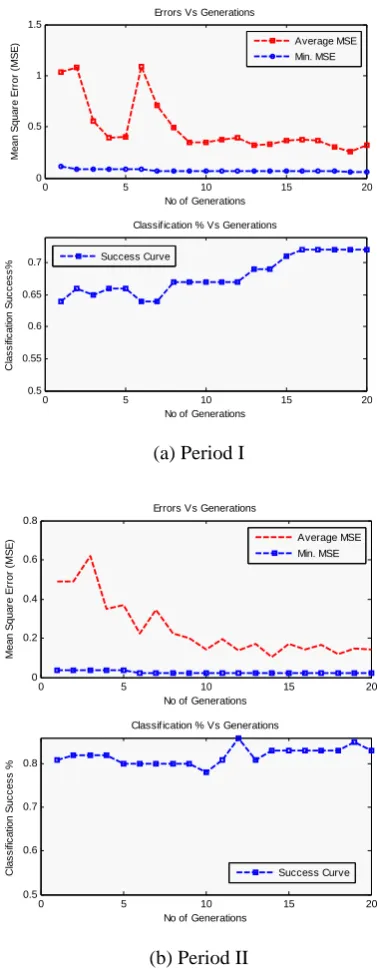
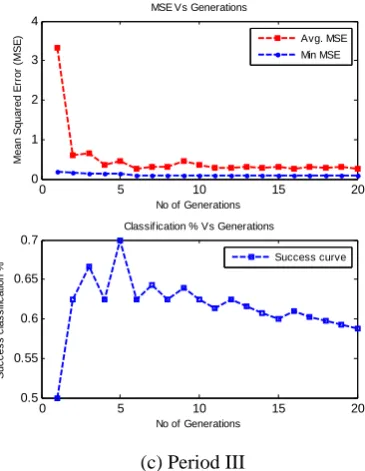
Figure 3 shows the performance curves i.e., variation of average & minimum MSE values and figure 4 shows the classification success % versus number of generations during different VCMS periods for GA-ANN models.
0 5 10 15 20
0 0.5 1 1.5
No of Generations
M
e
a
n
S
q
u
a
re
E
rro
r (M
S
E
)
Errors Vs Generations
0 5 10 15 20
0.5 0.55 0.6 0.65 0.7
No of Generations
C
las
s
ifi
c
at
ion
S
uc
c
es
s
%
Classification % Vs Generations
Success Curve
Average MSE Min. MSE
(a) Period I
0 5 10 15 20
0 0.2 0.4 0.6 0.8
No of Generations
Mean
S
q
uar
e E
rr
o
r (
M
S
E
)
Errors Vs Generations
0 5 10 15 20
0.5 0.6 0.7 0.8
No of Generations
C
la
ss
ifi
ca
tio
n
S
u
cce
ss
%
Classification % Vs Generations
Average MSE Min. MSE
Success Curve
(b) Period II VCMS
Periods Data
sets
Min. MSE
Average MSE
Classification success rate
(Average)
VCM periods
I 1 0.1502 0.3798 60%
II 2 0.1718 0.2328 58.75%
III 3 0.0495 0.1997 64%
No of epochs=100; No of iterations=20; No of hidden layers=1; No of nodes on hidden layers=3; activation
function=logsig; LR=0.6; MC=0.4
VCMS Periods
Data sets
Min. MSE
Average MSE
Classification success rate (Average)
VCM periods
I 1 0.0628 0.0738 68%
II 2 0.0960 0.3171 61.25%
III 3 0.0203 0.0239 82%
No of epochs=100; No of generations=20; No of hidden layers=1, [No of nodes on hidden layers, activation
function, LR&MC]*
* from the best chromosomes values
VCMS period
No of nodes on
hidden layer
LR MC Activatio n function
I 3 0.4 0.3 tansig
II 9 0.2 0.3 tansig
0 5 10 15 20 0
1 2 3 4
No of Generations
Me
an
S
q
u
a
re
d
E
rr
o
r (
M
S
E
)
MSE Vs Generations
0 5 10 15 20
0.5 0.55 0.6 0.65 0.7
No of Generations
S
u
cc
e
ss
cl
a
ss
ifi
ca
tio
n
%
Classif ication % Vs Generations
Avg. MSE Min MSE
Success curve
[image:5.595.72.255.57.293.2]
(c) Period III
Figure 3 GA-ANN Performances for different VCMS Periods
Figure 4 Success% vs Two models - all periods of VCMS
VI. CONCLUSION
A new approach ANN-GA integrated model for workers assignments into virtual cells was presented in this paper. This is built upon the ANN framework proposed in the recent work as indicated earlier. In doing so, an independent ANN framework model and a GA integrated ANN model are analysed separately. Results of this analysis have demonstrated that GA has improved the performance of ANN with optimized architectural parameter settings for all the three VCMS periods. Cell formation solutions for two cell configurations from published literature are deemed to be desired input data for different periods of VCM environment and through cell formation literature solutions & workers skill sets, training datasets are generated for driving ANN framework. The average & minimum MSE values have considerable reduced whereas classification success % values have shot up relatively in GA-ANN on comparison
Future works in this direction are to extend this analysis to multicell configurations and examine its effectiveness followed by embedding workers’ empirical aspects such as jobs criticality and workers efficiencies into this proposed model as ANN inputs.
ACKNOWLEDGMENT
The first author would like to place his gratitude and appreciation to Executives of Caledonian College of Engineering, Oman for continual support for his research work which this present study is a part of. Also he gratefully acknowledges the assistance of Mr. D. Ragavesh, Faculty Member, Electronic & Computer Engineering Department, Caledonian College of Engineering, Oman, in successfully carrying out MATLAB tasks.
References
[1] Slomp, J., Chowdary, B.V. and Suresh, N.C. (2005). Design of virtual manufacturing cells: a mathematical programming approach, Robotics and Computer-Integrated Manufacturing, Vol. 21, pp.273–288.
[2] Suresh, N.C. and Slomp, J. (2005). Performance comparison of virtual cellular manufacturing with functional and cellular layouts in DRC settings, International Journal of Production Research, Vol. 43, No. 5, pp.945–979.
[3] Kaparthi, S. and Suresh, N.C. (1992). Machine-component cell formation in group technology: a neural network approach, International Journal of Production Research, Vol. 30, No. 6, pp. 1353-1368.
[4] Dagli, C. and Huggahalli, R., A neural network approach to Group Technology, in J. Wang & Y. Takefugi Ed., Neural Networks in Design and Manufacturing, (River Edge, NJ: World Scientific, 1993) 1-55.
[5] Sudhakara Pandian. R, and Mahapatra, S.S. (2009). Manufacturing cell formation with production data using neural networks, Computers & Industrial Engineering, Vol. 56, No. 4, pp. 1340-1347.
[6] Min, H., and Shin, D. (1993). Simultaneous formation of machine and human cells in group technology: A multiple objective approach, International Journal of Production Research, Vol. 31, pp. 2307–2318. [7] Suer, G.A., and Ivan Sánchez-Bera. (1997). Common cell size
determination and cell loading in labor-intensive manufacturing cells, Computers & Industrial Engineering, Vol. 33, No. 1-2, pp. 221-224. [8] Suer, G.A., and Ivan Sánchez-Bera. (1998). Optimal operator
assignment and cell loading when lot-splitting is allowed, Computers and Industrial Engineering, Vol.35, No. 3-4, pp. 431-434.
[9] Askin, R. G., and Huang, Y. (2001). Forming effective worker teams for cellular manufacturing, International Journal of Production Research, Vol. 39, No.11, pp. 2431–2451.
[10] Bopaya Bidanda, Poonsiri Ariyawongrat, Kim LaScola Needy, Bryan A. Norman & Wipawee Tharmmaphornphilas. (2005). Human related issues in manufacturing cell design, implementation, and operation: a review and survey, Computers &Industrial Engineering, Vol. 48, pp. 507–523.
[11] Murali, R.V., Prabhakaran, G., Puri, A.B. and Ragavesh, D., (2009). Worker efficiency and job criticality consideration in virtual cellular manufacturing environments, International Journal of Advanced Operations Management, Vol. 1, Nos. 2/3, pp. 203–223.
[12] Jose´ Fernando Goncalves, and Mauricio G.C. Resende. (2004). An evolutionary algorithm for manufacturing cell formation, Computers & Industrial Engineering, Vol. 47, pp. 247–273.
[13] Murali, R.V., Puri, A.B and Prabhakaran, G., (2010) Artificial neural networks based predictive model for worker assignment into virtual cells, International Journal of Engineering, Science and Technology, Vol. 2, No. 1, 2010, pp. 163-174
[14] MATLAB, The Language of Technical Computing, Neural Network Toolbox, The Mathworks Inc., 2007.
[15] Haykin S., Neural Networks: A Comprehensive Foundation,
[image:5.595.72.272.354.525.2]