Proceedings of the Third Conference on Machine Translation (WMT), Volume 2: Shared Task Papers, pages 272–303
Findings of the 2018 Conference on Machine Translation (WMT18)
Ondˇrej Bojar
Charles University Christian FedermannMicrosoft Cloud + AI University of TartuMark Fishel
Yvette Graham
Dublin City University University of EdinburghBarry Haddow Matthias HuckLMU Munich
Philipp Koehn
JHU / University of Edinburgh University of AmsterdamChristof Monz
Abstract
This paper presents the results of the premier shared task organized alongside the Confer-ence on Machine Translation (WMT) 2018. Participants were asked to build machine translation systems for any of 7 language pairs in both directions, to be evaluated on a test set of news stories. The main metric for this task is human judgment of translation quality. This year, we also opened up the task to additional test sets to probe specific aspects of transla-tion.
1 Introduction
The Third Conference on Machine Translation (WMT) held at EMNLP 20181 host a number of
shared tasks on various aspects of machine trans-lation. This conference builds on twelve previous editions of WMT as workshops and conferences (Koehn and Monz, 2006; Callison-Burch et al.,
2007,2008,2009,2010,2011,2012;Bojar et al.,
2013,2014,2015,2016a,2017).
This year we conducted several official tasks. We report in this paper on the news translation task. Additional shared tasks are described in sep-arate papers in these proceedings:
• biomedical translation (Neves et al.,2018),
• multimodal machine translation (Barrault et al.,2018),
• metrics (Ma et al.,2018),
• quality estimation (Specia et al.,2018),
• automatic post-editing (Chatterjee et al., 2018), and
• parallel corpus filtering (Koehn et al.,2018b).
In the news translation task (Section2), partic-ipants were asked to translate a shared test set, optionally restricting themselves to the provided training data (“constrained” condition). We held
1http://www.statmt.org/wmt18/
14 translation tasks this year, between English and each of Chinese, Czech, Estonian, German, Finnish, Russian, and Turkish. The Estonian-English language pair was new this year. Simi-larly to Latvian, which we had covered in 2017, Estonian is a lesser resourced data condition on a challenging language pair. System outputs for each task were evaluated both automatically and manually.
This year the news translation task had two ad-ditional sub-tracks: multilingual MT and unsuper-vised MT. Both sub-tracks were included into the general list of news translation submissions and are described in more detail in corresponding sub-sections of Section2.
The human evaluation (Section3) involves ask-ing human judges to score sentences output by anonymized systems. We obtained large numbers of assessments from researchers who contributed evaluations proportional to the number of tasks they entered. In addition, we used Mechanical Turk to collect further evaluations. This year, the official manual evaluation metric is again based on judgments of adequacy on a 100-point scale, a method we explored in the previous years with convincing results in terms of the trade-off be-tween annotation effort and reliable distinctions between systems.
The primary objectives of WMT are to evalu-ate the stevalu-ate of the art in machine translation, to disseminate common test sets and public train-ing data with published performance numbers, and to refine evaluation and estimation methodologies for machine translation. As before, all of the data, translations, and collected human judgments are publicly available2. We hope these datasets
serve as a valuable resource for research into data-driven machine translation, automatic evaluation, or prediction of translation quality. News
transla-2http://statmt.org/wmt18/results.html
tions are also available for interactive visualization and comparison of differences between systems at
http://wmt.ufal.cz/ using MT-ComparEval (Sudarikov et al.,2016).
In order to gain further insight into the perfor-mance of individual MT systems, we organized a call for dedicated “test suites”, each focussing on some particular aspect of translation quality. A brief overview of the test suites is provided in Sec-tion4.
2 News Translation Task
The recurring WMT task examines translation be-tween English and other languages in the news do-main. As in the previous year, we include Chinese, Czech, German, Finnish, Russian, and Turkish. A new language this year is Estonian.
We created a test set for each language pair by translating newspaper articles and provided train-ing data.
2.1 Test Data
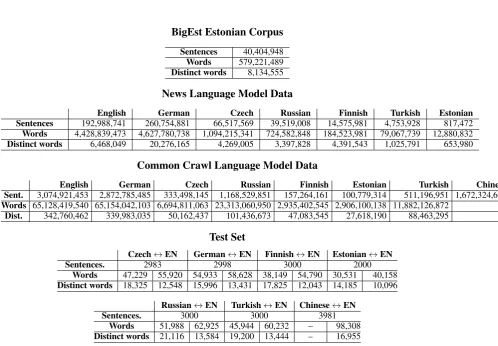
The test data for this year’s task was selected from online sources, as in previous years. We took about 1500 English sentences and translated them into the other languages, and then additional 1500 sentences from each of the other languages and translated them into English. This gave us test sets of about 3000 sentences for our English-X language pairs, which have been either originally written in English and translated into X, or vice versa. The composition of the test documents is shown in Table1, the size of the test sets in terms is given in Figure2.
The stories were translated by professional translators, funded by the EU Horizon 2020 projects CRACKER and QT21 (German, Czech), by Yandex3, a Russian search engine company
(Turkish, Russian), by BAULT, a research com-munity on building and using language technol-ogy funded by the University of Helsinki (Finnish) and the University of Tartu4 (Estonian). The
Chinese–English task was sponsored by Nanjing University, Xiamen University, the Institutes of Computing Technology and of Automation, Chi-nese Academy of Science, Northeastern Univer-sity (China) and Datum Data Co., Ltd. All of the
3http://www.yandex.com/
4Estonian Research Council institutional research grant IUT20-56: “Computational models of the Estonian Lan-guage”
translations were done directly, and not via an in-termediate language.
Since Estonian-English was run for the first time, both the test and development set had to be translated: the size of both was 2000 sentences (4000 in total).
2.2 Training Data
As in past years we provided parallel corpora to train translation models, monolingual corpora to train language models, and development sets to tune system parameters. Some training corpora were identical from last year (Europarl,5Common
Crawl, SETIMES2 , Russian-English parallel data provided by Yandex, Wikipedia Headlines pro-vided by CMU) and some were updated (United Nations, CzEng v1.7 (Bojar et al.,2016b), News Commentary v13, monolingual news data). A new corpus is the EU Press Release parallel corpus for German, Finnish, and Latvian.
For Latvian and Chinese, a number of new cor-pora were released. For Latvian, this data was pre-pared by the University of Latvia and Tilde, the Chinese corpora were prepared by the Institutes of Computing Technology and of Automation, Chi-nese Academy of Science, Northeastern Univer-sity (China) and Datum Data Co., Ltd.
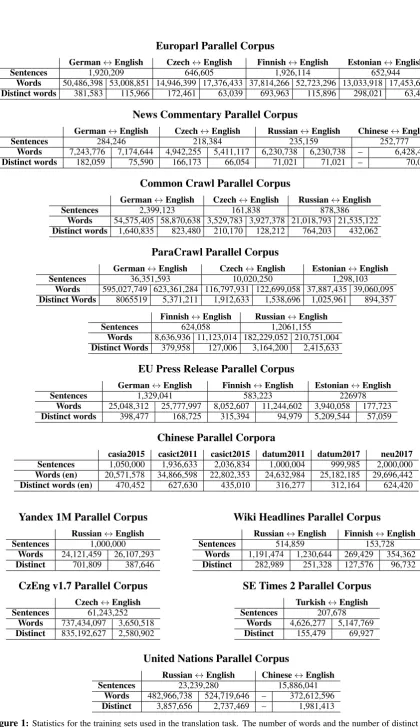
Some statistics about the training materials are given in Figure1.
2.3 Submitted Systems
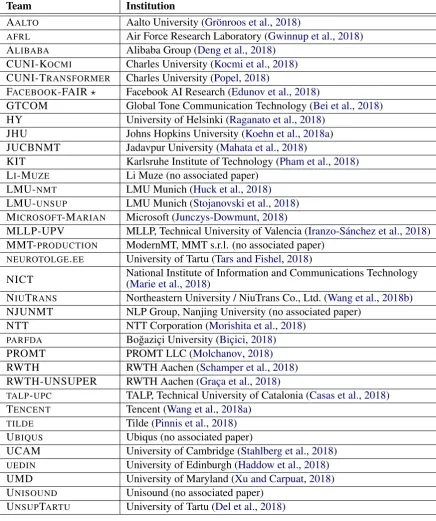
We received 103 submissions from 32 institutions. The participating institutions, organized into 35 teams are listed in Table2and detailed in the rest of this section. Each system did not necessarily appear in all translation tasks. We also included 39 online MT systems (originating from 5 services), which we anonymized asONLINE-A,B,F,G.
For presentation of the results, systems are treated as eitherconstrainedorunconstrained, de-pending on whether their models were trained only on the provided data. Since we do not know how they were built, these online and commercial sys-tems are treated as unconstrained during the auto-matic and human evaluations.
2.3.1 AALTO(Grönroos et al.,2018)
Europarl Parallel Corpus
German↔English Czech↔English Finnish↔English Estonian↔English
Sentences 1,920,209 646,605 1,926,114 652,944 Words 50,486,398 53,008,851 14,946,399 17,376,433 37,814,266 52,723,296 13,033,918 17,453,613 Distinct words 381,583 115,966 172,461 63,039 693,963 115,896 298,021 63,432
News Commentary Parallel Corpus
German↔English Czech↔English Russian↔English Chinese↔English Sentences 284,246 218,384 235,159 252,777
Words 7,243,776 7,174,644 4,942,255 5,411,117 6,230,738 6,230,738 – 6,428,459 Distinct words 182,059 75,590 166,173 66,054 71,021 71,021 – 70,092
Common Crawl Parallel Corpus
German↔English Czech↔English Russian↔English Sentences 2,399,123 161,838 878,386
Words 54,575,405 58,870,638 3,529,783 3,927,378 21,018,793 21,535,122 Distinct words 1,640,835 823,480 210,170 128,212 764,203 432,062
ParaCrawl Parallel Corpus
German↔English Czech↔English Estonian↔English
Sentences 36,351,593 10,020,250 1,298,103 Words 595,027,749 623,361,284 116,797,931 122,699,058 37,887,435 39,060,095 Distinct Words 8065519 5,371,211 1,912,633 1,538,696 1,025,961 894,357
Finnish↔English Russian↔English
Sentences 624,058 1,2061,155 Words 8,636,936 11,123,014 182,229,052 210,751,004 Distinct Words 379,958 127,006 3,164,200 2,415,633
EU Press Release Parallel Corpus
German↔English Finnish↔English Estonian↔English Sentences 1,329,041 583,223 226978
Words 25,048,312 25,777,997 8,052,607 11,244,602 3,940,058 177,723 Distinct words 398,477 168,725 315,394 94,979 5,209,544 57,059
Chinese Parallel Corpora
casia2015 casict2011 casict2015 datum2011 datum2017 neu2017 Sentences 1,050,000 1,936,633 2,036,834 1,000,004 999,985 2,000,000 Words (en) 20,571,578 34,866,598 22,802,353 24,632,984 25,182,185 29,696,442 Distinct words (en) 470,452 627,630 435,010 316,277 312,164 624,420
Yandex 1M Parallel Corpus Russian↔English
Sentences 1,000,000 Words 24,121,459 26,107,293 Distinct 701,809 387,646 CzEng v1.7 Parallel Corpus
Czech↔English
Sentences 61,243,252 Words 737,434,097 3,650,518 Distinct 835,192,627 2,580,902
Wiki Headlines Parallel Corpus
Russian↔English Finnish↔English
Sentences 514,859 153,728 Words 1,191,474 1,230,644 269,429 354,362 Distinct 282,989 251,328 127,576 96,732
SE Times 2 Parallel Corpus Turkish↔English
Sentences 207,678 Words 4,626,277 5,147,769 Distinct 155,479 69,927
United Nations Parallel Corpus
Russian↔English Chinese↔English Sentences 23,239,280 15,886,041
[image:3.595.82.503.21.749.2]Words 482,966,738 524,719,646 – 372,612,596 Distinct 3,857,656 2,737,469 – 1,981,413
Language Sources (Number of Documents)
English ABC News (1), BBC (4), Brisbane Times (1), CBS News (1), Daily Mail (4), Euronews (3), Globe and Mail (1), Guardian (4), Independent (4), Los Angeles Times (4), MSNBC (3), Novinte (2), New York Times (2), Reuters (3), Russia Today (2), Scotsman (2), Sydney Morning Herald (2), Telegraph (2), The Local (2), Time Magazine (2), UPI (1), Washington Post (3)
Czech blesk.cz (16), deník.cz (5), Deník Referendum (1), DNES.cz (7), lidovky.cz (6), Novinky.cz (3), Re-flex (2), tyden.cz (12), ZDN (2)
German Aachener Nachrichten (1), Abendzeitung Nürnberg (2), Braunschweiger Zeitung (1), Der Standard (1), Die Presse (1), Euronews (1), Fehmarn24 (1), Handelsblatt (1), Hannoversche Allgemeine (2), Hes-sische/Niedersächsische Allgemeine (1), In Franken (4), Kreiszeitung (2), Krone (1), Mainpost (1), Merkur (3), Morgenpost (1), n-tv (1), Neue Westfälische (1), oe24 (2), Peiner Allgemeine (1), Passauer Neue Presse (2), Rheinzeitung (1), Rundschau (1), Schwarzwälder Bote (16), Segeberger Zeitung (2), Südkurier (1), Thüringer Allgemeine (1), Thüringer Landeszeitung (1), Volksblatt (2), Volksfreund (3), Westfälische Nachrichten (1), Westdeutsche Zeitung (8).
Estonian Arileht (7), Maaleht (3), Postimees (17), Sloleht (23).
Finnish Etelä-Saimaa (2), Etelä-Suomen Sanomat (3), Helsingin Sanomat (4), Iltalehti (13), Ilta-Sanomat (29), Kaleva (12), Kansan Uutiset (1), Karjalainen (13), Kouvolan Sanomat (2).
Russian aif (4), Altapress (1), Argumenti (19), ERR.ee (3), eg-online.ru (2), Euronews (2), Fakty (5), In-fox (2), Izvestiya (25), Kommersant (16), Lenta (9), lgng (3), MK RU (5), nov-pravda.ru (1), pnp.ru (6), rg.ru (4), Vedomosti (3), Versia (1), Vesti (3), zr.ru (1)
[image:4.595.81.512.85.298.2]Turkish Hürriyet.com (48), Sabah (96), Sözcü (19)
Table 1:Composition of the test set. For more details see the XML test files. Thedocidtag gives the source and the date for each document in the test set, and theoriglangtag indicates the original source language.
BigEst Estonian Corpus Sentences 40,404,948 Words 579,221,489 Distinct words 8,134,555 News Language Model Data
English German Czech Russian Finnish Turkish Estonian Sentences 192,988,741 260,754,881 66,517,569 39,519,008 14,575,981 4,753,928 817,472 Words 4,428,839,473 4,627,780,738 1,094,215,341 724,582,848 184,523,981 79,067,739 12,880,832 Distinct words 6,468,049 20,276,165 4,269,005 3,397,828 4,391,543 1,025,791 653,980
Common Crawl Language Model Data
English German Czech Russian Finnish Estonian Turkish Chinese Sent. 3,074,921,453 2,872,785,485 333,498,145 1,168,529,851 157,264,161 100,779,314 511,196,951 1,672,324,647 Words 65,128,419,540 65,154,042,103 6,694,811,063 23,313,060,950 2,935,402,545 2,906,100,138 11,882,126,872 – Dist. 342,760,462 339,983,035 50,162,437 101,436,673 47,083,545 27,618,190 88,463,295 –
Test Set
Czech↔EN German↔EN Finnish↔EN Estonian↔EN Sentences. 2983 2998 3000 2000
Words 47,229 55,920 54,933 58,628 38,149 54,790 30,531 40,158 Distinct words 18,325 12,548 15,996 13,431 17,825 12,043 14,185 10,096
Russian↔EN Turkish↔EN Chinese↔EN
Sentences. 3000 3000 3981 Words 51,988 62,925 45,944 60,232 – 98,308 Distinct words 21,116 13,584 19,200 13,444 – 16,955
[image:4.595.71.570.366.712.2]Team Institution
AALTO Aalto University (Grönroos et al.,2018)
AFRL Air Force Research Laboratory (Gwinnup et al.,2018) ALIBABA Alibaba Group (Deng et al.,2018)
CUNI-KOCMI Charles University (Kocmi et al.,2018) CUNI-TRANSFORMER Charles University (Popel,2018)
FACEBOOK-FAIR? Facebook AI Research (Edunov et al.,2018)
GTCOM Global Tone Communication Technology (Bei et al.,2018) HY University of Helsinki (Raganato et al.,2018)
JHU Johns Hopkins University (Koehn et al.,2018a) JUCBNMT Jadavpur University (Mahata et al.,2018)
KIT Karlsruhe Institute of Technology (Pham et al.,2018) LI-MUZE Li Muze (no associated paper)
LMU-NMT LMU Munich (Huck et al.,2018) LMU-UNSUP LMU Munich (Stojanovski et al.,2018) MICROSOFT-MARIAN Microsoft (Junczys-Dowmunt,2018)
MLLP-UPV MLLP, Technical University of Valencia (Iranzo-Sánchez et al.,2018) MMT-PRODUCTION ModernMT, MMT s.r.l. (no associated paper)
NEUROTOLGE.EE University of Tartu (Tars and Fishel,2018)
NICT National Institute of Information and Communications Technology(Marie et al.,2018) NIUTRANS Northeastern University / NiuTrans Co., Ltd. (Wang et al.,2018b) NJUNMT NLP Group, Nanjing University (no associated paper)
NTT NTT Corporation (Morishita et al.,2018) PARFDA Bo˘gaziçi University (Biçici,2018)
PROMT PROMT LLC (Molchanov,2018)
RWTH RWTH Aachen (Schamper et al.,2018)
RWTH-UNSUPER RWTH Aachen (Graça et al.,2018)
TALP-UPC TALP, Technical University of Catalonia (Casas et al.,2018) TENCENT Tencent (Wang et al.,2018a)
TILDE Tilde (Pinnis et al.,2018)
UBIQUS Ubiqus (no associated paper)
UCAM University of Cambridge (Stahlberg et al.,2018) UEDIN University of Edinburgh (Haddow et al.,2018) UMD University of Maryland (Xu and Carpuat,2018) UNISOUND Unisound (no associated paper)
[image:5.595.80.517.128.650.2]UNSUPTARTU University of Tartu (Del et al.,2018)
and Estonian. The system is based on the Trans-former (Vaswani et al., 2017) implementation in OpenNMT-py (Klein et al.,2017). It is trained on filtered parallel and filtered back-translated mono-lingual data. The main contribution is a novel cross-lingual Morfessor (Virpioja et al.,2013) seg-mentation using cognates extracted from the par-allel data. The aim is to improve the consistency of the morphological segmentation. Aalto decode using an ensemble of 3 (et) or 8 (fi) models.
2.3.2 AFRL(Gwinnup et al.,2018)
AFRL-SYSCOMB is a system-combination entry consisting of three inputs. The first is an Open-NMT system trained on the provided parallel data except ParaCrawl and the backtranslated corpus used in the AFRL WMT17 system (Gwinnup et al., 2017). This system uses a standard RNN architecture and was fine-tuned with the other available news task test sets. The second is a Marian (Junczys-Dowmunt et al., 2018) system ensembling 5 Univ. Edinburgh “bi-deep” and 6 transformer models all trained on the WMT18 bi-texts provided, including ParaCrawl. Some mod-els employed pretrained word embeddings built on BPE’d corpora (Sennrich et al.,2016). A Marian transformer model performed right-to-left rescor-ing for this system. The third system is trained with Moses (Koehn et al.,2007), using the same data as the Marian system. Hierarchical reordering and Operation Sequence Model were employed. The 5-gram English language model was trained with KenLM (Heafield,2011) on the same corpus as the AFRLWMT15 system with the same BPE used in the Marian systems. Lastly, RWTH Jane’s system combination (Freitag et al.,2014) was ap-plied yielding approximately a +0.5 gain in BLEU.
2.3.3 ALIBABA(Deng et al.,2018)
Alibaba systems are based on the Transformer model architecture, with the most recent features from the academic research integrated, such as weighted Transformer, Transformer with relative position attention, etc. The system also employs most techniques that have been proven effective during the past WMT years, such as BPE-based subword, back translation, fine-tuning based on selected data, model ensembling and reranking, at industrial scale. For some morphologically-rich languages, linguistic knowledge is also incorpo-rated into the neural network.
2.3.4 CUNI-KOCMI(Kocmi et al.,2018) The CUNI-KOCMI submission focuses on the low-resource language neural machine translation (NMT). The final submission uses a method of transfer learning: the model is pretrained on a re-lated high-resource language (here Finnish) first, followed by a child low-resource language (Esto-nian) without any change in hyperparameters. Av-eraging and backtranslation are also experimented with.
2.3.5 CUNI-TRANSFORMER(Popel,2018) CUNI-TRANSFORMERis the Transformer model trained according toPopel and Bojar(2018) plus a novel concat-regime backtranslation with check-point averaging, tuned separately for CZ-domain and nonCZ-domain articles, possibly handling also translation-direction (“translationese") issues. For cs→en also a coreference preprocessing was
used adding the female-gender pronoun where it was pro-dropped in Czech, referring to a human and could not be inferred from a given sentence.
2.3.6 FACEBOOK-FAIR?(Edunov et al.,
2018)
FACEBOOK-FAIR is an ensemble of six self-attentional models with back-translation data ac-cording toEdunov et al.(2018). Synthetic sources are sampled instead of beam search, oversampling the real bitext at a rate of 16, i.e., each bitext is sampled 16 times more often per epoch than the back-translated data. At inference time, transla-tions which are copies of the source are filtered out, replacing them with the output of a very small news-commentary only trained model.
The system FACEBOOK-FAIR has been sub-mitted anonymously as ONLINE-Z and approval for disclosing the authors’ identity has only been granted after the final results had become avail-able. Due to the non-standard way of submission, the system is not considered a regular participant, but an invited/late submission and marked with “?” throughout the paper.
2.3.7 GTCOM(Bei et al.,2018)
given to data filtering through rules, translation model and language model including parallel data and monolingual data. The language model is based the Transformer architecture as well. The fi-nal system is trained with four different seeds and mixed data.
2.3.8 HY(Raganato et al.,2018;Hurskainen and Tiedemann,2017)
The University of Helsinki (HY) submitted four systems: HY-AH, HY-NMT, HY-NMT-2STEP and HY-SMT.
HY-AH (Raganato et al., 2018; Hurskainen and Tiedemann,2017) is a rule-based machine translation system, relying on a rule-based depen-dency parser for English, a hand-crafted transla-tion lexicon (based on dictransla-tionary data extracted from parallel corpora by word alignment), various types of transfer rules, and a morphological gener-ator for Finnish.
HY-NMT(Raganato et al.,2018) submissions are based on the Transformer “base" model, trained with all the parallel data provided by the shared task plus back-translations, with a shared vocabulary between source and target language and a domain label for each source sentence. For the multilingual sub-track synthetic data for English→Estonian and Estonian→English was
also used. Ultimately, a single model for all lan-guage pairs was trained and then fine-tuned for each language pair.
HY-NMT-2STEP (Raganato et al., 2018) is a Transformer model trained on interleaved lemmas and morphological tags on the Finnish side. Mor-phological categories (number, tense etc.) have separate tags, and a tag is only added if the value of the category differs from the default value (in the same way that languages have morphemes only for marked values of morphological categories). The final translation is deterministically generated from the sequence of lemmas and morphological tags which the model outputs.
HY-SMT (Tiedemann et al., 2016) is the Helsinki SMT system submitted at WMT 2016 (the constrained-basic+back-translated version). The system was not retrained and it may thus suffer from poor lexical coverage on recent test data. The main motivation for including this base-line was to have a statistical machine translation
(SMT) submission for the Finnish morphology test suite (Burlot et al.,2018).
2.3.9 JHU(Koehn et al.,2018a)
The JHU systems are the result of two relatively independent efforts on German–English language directions and Russian–English, using the Marian and Sockeye (Hieber et al.,2017) neural machine translation toolkits, respectively. The novel contri-butions are iterative back-translation (for German) and fine-tuning on test sets from prior years (for both languages).
2.3.10 JUCBNMT(Mahata et al.,2018)
JUCBNMT is an encoder-decoder sequence-to-sequence NMT model with character level encod-ing. The submission uses preprocessing like tok-enization, truecasing and corpus cleaning. Both encoder and decoder use a single LSTM layer each. The batch size was set to 128, number of epochs was set to 100, activation function was softmax, optimizer chosen was RMSprop and the loss function used was categorical cross-entropy. Learning rate was set to 0.001.
2.3.11 KIT(Pham et al.,2018)
The KIT submission is the NMT Transformer ar-chitecture, enhanced in model depth. Techniques for reducing memory consumption (recalculating intermediate results at layers instead of caching them), 4 times larger model could fit on one GPU and improve the performance by 1.2 BLEU points. Sentences selection from the new ParaCrawl improved the effectiveness of the corpus by 0.5 BLEU points, with an overall increase of 0.8 BLEU compared to the baseline of not using ParaCrawl.
2.3.12 LI-MUZE
LI-MUZE is an ensembles of 4 averaged Trans-former models with one right-to-left and one target-to-source averaged Transformer model, the configuration of all the models is the same as the Transformer big-model, trained on the official training data with 4.5M back-translated data from the monolingual news of 2016 and 2017 data. The English vocabulary size is 36K BPE subwords. Chinese is tokenized by Chinese characters and the vocabulary size is 10K.
2.3.13 LMU-NMT(Huck et al.,2018)
ba-sic shallow attentional encoder-decoder systems (Bahdanau et al.,2014) with the Nematus toolkit (Sennrich et al.,2017), like last year (Huck et al.,
2017a). LMU has participated with these NMT systems for the English–German language pair in both translation directions. The training data is a concatenation of Europarl, News Commentary, Common Crawl, and some synthetic data in the form of backtranslated monolingual news texts. The 2017 monolingual News Crawl is not em-ployed, nor are the parallel Rapid and ParaCrawl corpora. The German data is preprocessed with a linguistically informed word segmentation tech-nique (Huck et al., 2017b). By using a linguisti-cally more sound word segmentation, advantages over plain BPE segmentation are expected in three important aspects: vocabulary reduction, reduc-tion of data sparsity, and open vocabulary trans-lation. The NMT system can learn linguistic word formation processes from the segmented data. In the English→German translation direction, LMU furthermore conducted fine-tuning towards the do-main of news articles (Huck et al., 2017a) and reranked then-best list with a right-to-left neural
model (Liu et al., 2016) which is trained for re-verse word order (Freitag et al.,2013).
2.3.14 LMU-UNSUP(Stojanovski et al.,2018) For the unsupervised track of the WMT18 news translation task, LMU Munich submitted the LMU-UNSUP system (Stojanovski et al., 2018) which is a neural translation model trained with-out any access to parallel data. The model is trained with∼4M German and English sentences
each, which are sampled from NewsCrawl articles from 2007 to 2017. Bilingual word embeddings trained in an unsupervised manner (Conneau et al.,
2017) were used to translate the monolingual data by doing word-by-word translation and this syn-thetically created parallel data is used in the train-ing as well. The same model is used to do both German→English and English→German
transla-tion. The model is based on (Lample et al.,2018) and it uses denoising and on-the-fly backtransla-tion. Additionally the model uses the word-by-word translated data in the initial training stages to jump-start the training and disables the denoising component as the last training step for further im-provements. The NMT embeddings are initialized with embeddings obtained fromfasttexttrained jointly on German and English monolingual BPE-level data.
2.3.15 MICROSOFT-MARIAN (Junczys-Dowmunt,2018)
MICROSOFT-MARIAN is the Transformer-big model implemented in Marian with an up-dated version of Edinburgh’s training scheme for WMT2017, following current common practices: truecasing and tokenization using Moses scripts, BPE subwords, backtranslation (using a shal-low model), ensembling of four left-to-right deep models and reranking of 12-best list with an en-semble of four right-to-left models.
The novelties are primarily in new data filtering (dual conditional cross-entropy filtering) and sen-tence weighting methods.
2.3.16 MLLP-UPV(Iranzo-Sánchez et al.,
2018)
MLLP-UPV is an ensemble of Transformer architecture-based neural machine translation sys-tems. To train the system under “constrained" conditions, the provided parallel data was filtered with a scoring technique using character-based language models, and was augmented based on synthetic source sentences generated from the pro-vided monolingual corpora.
The ensemble consists of 4 independent train-ing runs of the Transformer “base” model, trained with 10M filtered sentences (including from ParaCrawl) and 20M backtranslated sentences from NewsCrawl2017.
2.3.17 MMT-PRODUCTION
MMT-PRODUCTION is the machine translation system offered by MMT s.r.l. (www.modernmt. eu) as of July 2018. It is a Transformer-based
neural MT system trained on public and propri-etary data, containing about 100M sentence pairs and about 1.5G English words. It exploits a sin-gle model of ‘transformer-big’ size, and a sinsin-gle pass-decoding; texts are processed using internal tools.
2.3.18 NEUROTOLGE.EE(Tars and Fishel, 2018)
classified using its sentence embedding and trans-lated as the corresponding cluster/domain.
2.3.19 NICT(Marie et al.,2018)
NICT NMT systems were trained with the Trans-former architecture using the provided parallel data enlarged with a large quantity of back-translated monolingual data generated with a new incremental training framework. The primary sub-missions to the task are the result of a simple com-bination between NICT SMT and NMT systems.
2.3.20 NIUTRANS(Wang et al.,2018b)
NIUTRANS baseline systems are based on the Transformer architecture with the “base” model, equipped with checkpoint averaging and back-translation techniques. NIUTRANS further improve the translation performance 2.28-3.83 BLEU points from four aspects including model variances (larger inner-hidden-size in FFN, us-ing ReLU and attention dropout, Swish activa-tion funcactiva-tion, relative posiactiva-tional representaactiva-tion), diverse ensemble decoding (ensemble decoding with up to 15 models, generated by different strategies), reranking (up to 14 features for rerank-ing), and post-processing (aim at the inconsistent translation of proper nouns, especially the English literals in Chinese sentences).
2.3.21 NJUNMT
The NJUNMT-PRIVATE is most likely the sys-tem developed by Natural Language Process-ing Group of NanjProcess-ing University based on high-level API of TensorFlow, https://github. com/zhaocq-nlp/NJUNMT-tf. Further details
on training are not available.
2.3.22 NTT(Morishita et al.,2018)
NTT combine Transformer “big” model, corpus cleaning technique for provided and synthetic par-allel corpora, and right-to-left n-best re-ranking techniques. Through their experiments, NTT found filtering of noisy training sentences and right-to-left re-ranking as the keys to better accu-racy.
2.3.23 PARFDA(Biçici,2018)
PARFDA selects a subset of the training and LM data to build task-specific SMT models. PARFDA uses phrase-based Moses and all constrained avail-able resources provided by WMT18. The datasets are available athttps://github.com/bicici/ parfdaWMT2018.
2.3.24 PROMT(Molchanov,2018)
PROMT submitted three systems: PROMT-HYB-MARIAN, PROMT-HYB-OPENNMT and PROMT-RULE-BASED.
PROMT-HYB-MARIAN is an ensemble of 5 transformer models trained on WMT data and in-house news data.
PROMT-HYB-OPENNMT is a hybrid system based on PROMT Rule-based engine and a NMT post-editing (PE) engine. The NMT PE compo-nent is a sequence-to-sequence model with atten-tion and deep biRNN encoder trained with Open-NMT toolkit.
PROMT-RULE-BASED is a rule-based system, without any specific training or tuning.
2.3.25 RWTH(Schamper et al.,2018)
All systems submitted by RWTH Aachen for Ger-man to English are based on the Transformer ar-chitecture implemented in Sockeye. The final RWTH system has been an ensemble of three Transformer models, where each individual model had been already very strong. The strength of the RWTH systems is probably due to the follow-ing four key factors: (a) Using the Transformer architecture. (b) Rather large models and large batch size which was made possible due to syn-chronous training on 4 GPUs and roughly 8 days of training. (Details: embed: 1024; num-layers: 6; attention-heads: 16; transformer-feed-forward-num-hidden: 4096; transformer-model-size: 1024, no weight-tying. In sum, this results in 291M trainable parameters.) (c) Careful ex-periments on data conditions: E.g. oversampling of parallel data, LM driven filtering of ParaCrawl (retained 50%), testing different amounts of BPE merge operations. (d)Fine-tuning on old testsets (newstest2008-newstest2014).
RWTH English→Turkish system is based on
2.3.26 RWTH-UNSUPER(Graça et al.,
2018)
The RWTH-UNSUPER unsupervised NMT sys-tem is built based on recent works by Lample et al.(2018) andArtetxe et al. (2018). RWTH-UNSUPER best performing systems follow the batch optimization strategy and are initialized with cross-lingual embeddings. Furthermore, RWTH-UNSUPER found that sharing a vocabulary per-forms better than having separate ones. Freezing embeddings hurts performance and it was found best to initialize embeddings with pre-trained ones and train them as usual.
2.3.27 TALP-UPC(Casas et al.,2018)
TALP-UPC is the Transformer “base” model trained with the Tensor2Tensor implementation (Vaswani et al.,2018) and wordpieces vocabulary. The training corpus is multilingual (concatenat-ing Finnish–English and Estonian–English) and includes ParaCrawl with garbage cleaned up via langdetect.
2.3.28 TENCENT(Wang et al.,2018a)
TENCENT-ENSEMBLE(called TenTrans) is an im-proved NMT system on Transformer based on self-attention mechanism. In addition to the ba-sic settings of Transformer training, TENCENT -ENSEMBLE uses multi-model fusion techniques, multiple features reranking, different segmenta-tion models and joint learning. Addisegmenta-tionally, data selection strategies were adopted to fine-tune the trained system, achieving a stable performance improvement.
An additional system paper (Hu et al.,2018) de-scribes a non-primary submission.
2.3.29 TILDE(Pinnis et al.,2018)
TILDE submitted four systems: TILDE-C-NMT, TILDE-C-NMT-COMB, TILDE-C-NMT-2BT and TILDE-NC-NMT.
TILDE-C-NMT are constrained English-Estonian and Estonian-English NMT systems that were de-ployed as ensembles of averaged factored data Transformer models. The models were trained us-ing filtered parallel data and back-translated data in a 1-to-1 proportion. The parallel data were sup-plemented with synthetic data (generated from the same parallel data) that contain unknown token identifiers in order to acquire models that are more robust to unknown phenomena.
TILDE-C-NMT-COMB is a constrained Estonian-English NMT system that is a system combination of multiple constrained factored data NMT sys-tems.
TILDE-C-NMT-2BT systems were trained using Sockeye and Transformer models. Before train-ing the initial systems, parallel data were cleaned using the parallel-corpora-tools. Before back-translation, monolingual data were also fil-tered. After back-translation, the resulting syn-thetic corpora were filtered again. Intermediate systems were trained with the first batch of par-allel+synthetic data. The back-translation and fil-tering process was performed a second time with additional monolingual data to train the final sys-tems with parallel and two sets of synthetic data.
TILDE-NC-NMT are unconstrained English→Estonian and Estonian→English NMT systems that were deployed as averaged Transformer models. These models were also trained using back-translated data similarly to the constrained systems, however, the data, taking into account its relatively large size, was not factored.
2.3.30 UBIQUS
The UBIQUS-NMT system is probably developed by the Ubiqus company (www.ubiqus.com). No further information is available.
2.3.31 UCAM(Stahlberg et al.,2018)
UCAM is a generalization of previous work (de Gispert et al.,2017) to multiple architectures. It is a system combination of two Transformer-like models, a recurrent model, a convolutional model, and a phrase-based SMT system. The output is probably dominated by the Transformer, and to some extend by the SMT system.
2.3.32 UEDIN(Haddow et al.,2018)
For Estonian↔English and Finnish↔English, the
For English↔Estonian, UEDIN selected 30% of ParaCrawl based on translation model perplexity for a model built on the rest of the data.
TheUEDINsystems for other language pairs use an ensemble of four deep RNN left-to-right tems, reranked with 4 deep RNN right-to-left sys-tems. The RNN models use theUEDINmulti-head / multi-hop attention variant. All the provided par-allel data (including ParaCrawl) were used, apply-inglangidfiltering to remove some incorrect sen-tence pairs. Synthetic data were also used, cre-ated by back-translating the 2017 English news crawl, and the 2017 and 2016 Czech news crawls. For Czech→English, the synthetic data was over-sampled 2x.
2.3.33 UMD(Xu and Carpuat,2018)
The UMD best system is an ensemble of three 6-layer left-to-right Transformer models reranked with target-to-source and left-to-right models. Each Transformer model is trained with a 2:1 mix-ture of parallel and backtranslated monolingual data. For parallel data, duplicates are removed and “bad” sentence pairs filtered out. Monolingual data is sub-sampled from news 2017 (English) and news 2011 (Chinese). Subwords (BPE) are used for both English and Chinese sentences.
2.3.34 UNISOUND
The UNISOUND systems are probably developed by the Unisound company (www.unisound.com).
No further information is available.
2.3.35 UNSUPTARTU(Del et al.,2018)
UNSUPTARTUis an unsupervised MT system us-ing n-gram embedding cross-lingual mapping to
create a phrase table. An RNN LM is used in de-coding.
2.4 Multilingual Sub-track
This year the news translation track included an explicit sub-track on multilingual translation. This covered any submissions that used any data (monolingual or parallel) from a third language to help the language pair in question: for example, using Finnish data to improve English-Estonian translation. All entries to this sub-track had to use only the WMT-provided data sets, and thus had to be constrained. Submissions to this sub-track are joined with the main translation track and evaluated without separation in the same way. While there was no restriction in terms of lan-guage pairs, three lanlan-guage pairs were “verbally
endorsed”: English to/from Turkish, Estonian and German. The motivation behind the choice of languages was to test the effect of multilingual (and unsupervised) methods on low-resource lan-guage pairs (Turkish-English, Estonian-English) and to contrast the results with a resource-rich pair (German-English).
2.5 Unsupervised Sub-track
In the unsupervised MT sub-track the participants were constrained to using only the monolingual training data from WMT; this additionally ex-cluded the monolingual corpora that are largely parallel (monolingual parts of Europarl and News Commentary). The aim of this task was to see how far can one get in terms of translation quality with-out any parallel data used for training. As an ex-ception it was allowed to use a parallel dev set for parameter tuning and/or model selection. The lan-guage pairs of this sub-track coincided with the multilingual sub-track: English to/from Turkish, Estonian and German.
3 Human Evaluation
A human evaluation campaign is run each year to assess translation quality and to determine the final ranking of systems taking part in the competition. This section describes how preparation of evalu-ation data, collection of human assessments, and computation of the official results of the shared task was carried out this year.
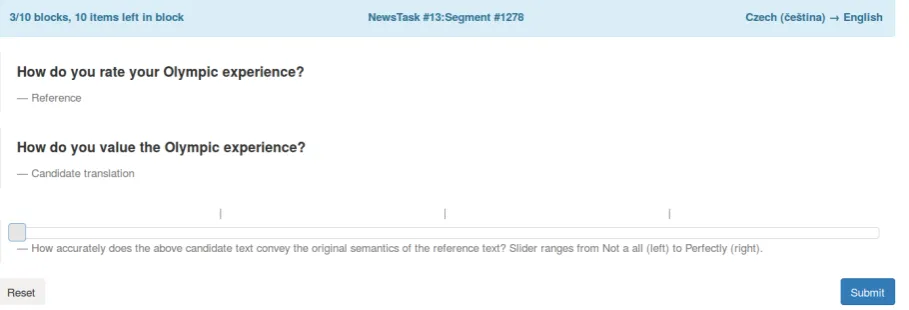
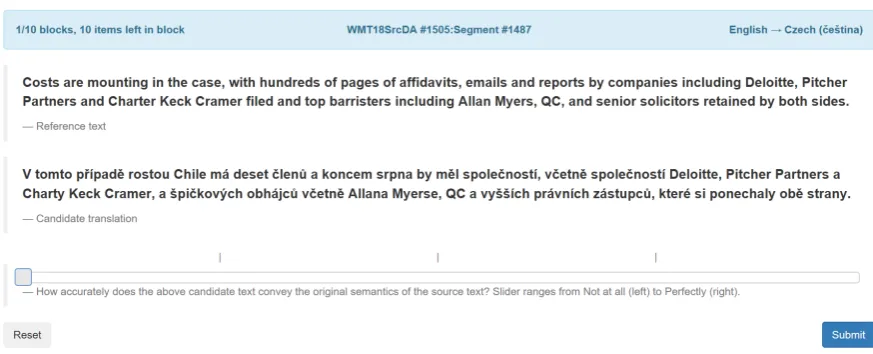
Figure 3:Screen shot of Direct Assessment in the Appraise interface used in the human evaluation campaign. The annotator is presented with a reference translation and a single system output randomly selected from competing systems (anonymized), and is asked to rate the translation on a sliding scale.
Figure 4:Screen shot of Direct Assessment as carried out by workers on Mechanical Turk.
we collect DA judgments via the crowd-sourcing platform, Amazon’s Mechanical Turk, and as in previous year’s we ask participating teams to pro-vide manual evaluation of system outputs via Ap-praise. Researcher involvement was needed par-ticularly for translations into Czech, German, Es-tonian, Finnish and Turkish.
Human assessors are asked to rate a given trans-lation by how adequately it expresses the mean-ing of the correspondmean-ing reference translation (i.e. no bilingual speakers are needed) on an analogue scale, which corresponds to an underlying abso-lute 0–100 rating scale. Since DA involves evalu-ation of a single translevalu-ation per screen, this allows the sentence length restriction usually applied dur-ing manual evaluation to be removed for both re-searchers and crowd-sourced workers.6 Figure3
6The maximum sentence length with RR was 30 in
shows one DA screen as completed by researchers on Appraise, while Figure4provides a screenshot of DA shown to crowd-sourced workers on Ama-zon’s Mechanical Turk.
The annotation is organized into “HITs” (fol-lowing the Mechanical Turk’s term “human intel-ligence task”), each containing 100 such screens and requiring about half an hour to finish. Ap-praise users were allowed to pause their annota-tion at any time, Amazon interface did not allow any pauses. More details of composition of HITs are given in Section3.3below.
3.1 Evaluation Campaign Overview
In terms of the News translation task manual eval-uation, a total of 584 individual researcher
counts were involved, and 915 turker accounts.7
Researchers in the manual evaluation came from 33 different research groups and contributed judg-ments of 118,705 translations, while 225,900 translation assessment scores were submitted in total by the crowd.8
Under ordinary circumstances, each assessed translation would correspond to a single individ-ual scored segment. However, since distinct sys-tems can produce the same output for a particular input sentence, we are often able to take advan-tage of this and use a single assessment for mul-tiple systems. Similar to last year’s evaluation, we only combine human assessments in this way if the string of text belonging to multiple systems is exactly identical. For example, even small dif-ferences in punctuation disqualify combination of similar system outputs, and this is due to a general lack of evidence about what kinds of minor differ-ences may or may not impact human evaluation.
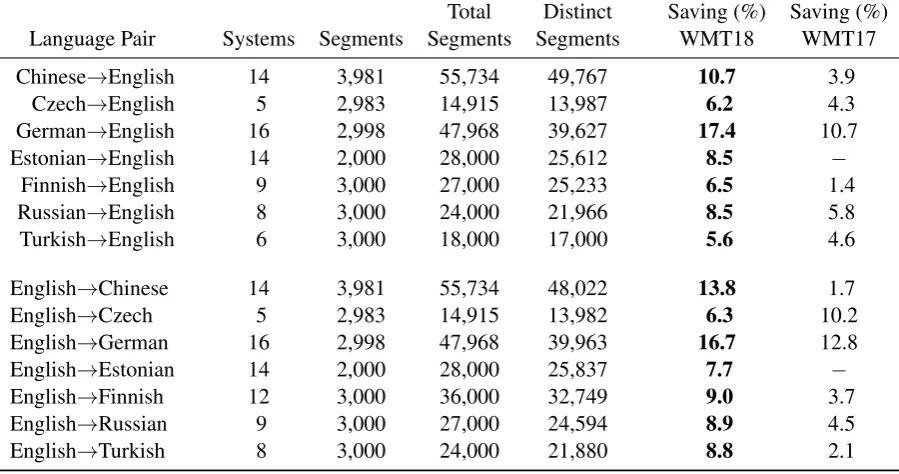
Table 3 shows the numbers of segments for which distinct MT systems participating in the News Translation Task produced identical outputs. The biggest saving in terms of exact duplicate translations, being produced by multiple systems, was for German to English, where a 17.4% saving of resources by combining identical outputs before human evaluation.
3.2 Data Collection
System rankings are produced from a large set of human assessments of translations, each of which indicates the absolute quality of the output of a system. Annotations are collected in an evalua-tion campaign that enlists the help of participants in the shared task. Each team is asked to contribute 8 hours annotation time, which we estimated at 16 100-translation HITs per primary system submit-ted. We continue to use the open-source Appraise9
(Federmann,2012) tool for our data collection, in addition to Amazon Mechanical Turk.10 Table4
shows total numbers of human assessments col-7Numbers do not include the 1,533 workers on Mechani-cal Turk and 7 Appraise evaluators who did not pass quality control.
8Numbers include quality control items for workers who passed quality control but omit the additional 347,700 assess-ments collected on Mechanical Turk where a worker did not pass quality control and equivalent 1,466 judgments for the small number of Appraise workers who did not meet the qual-ity control threshold. A 40% pass rate for qualqual-ity control is typical of DA evaluations on Mechanical Turk.
9https://github.com/cfedermann/Appraise 10https://www.mturk.com
lected in WMT18 contributing to final scores for systems.11
The effort that goes into the manual evalua-tion campaign each year is impressive, and we are grateful to all participating individuals and teams. We believe that human annotation provides the best decision basis for evaluation of machine translation output and it is great to see continued contributions on this large scale.
3.3 Crowd Quality Control
This year, two distinct HIT structures were run in the overall evaluation campaign, the standard DA set-up was employed for Mechanical Turk and a portion of the Appraise evaluation, while an ad-ditional HIT structure was used for the remaining part of the Appraise evaluation. Below we firstly describe the standard DA HIT structure and qual-ity control mechanism before describing the addi-tional version used for part of the Appraise eval-uation. In both set-ups, translations are arranged in sets of 100-translation HITs to provide control over assignment and positioning of quality control items to human annotators.
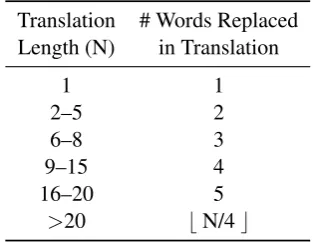
In the standard DA HIT structure, three kinds of quality control translation pairs are employed as described in Table 5: we repeat pairs (expecting a similar judgment), damage MT outputs (expect-ing significantly worse scores) and use references instead of MT outputs (expecting high scores).
In total, 60 items in a 100-translation HIT serve in quality control checks but 40 of those are regu-lar judgments of MT system outputs (we exclude assessments of bad references and ordinary ref-erence translations when calculating final scores). The effort wasted for the sake of quality control is thus 20%.
Also in the standard DA HIT structure, within each 100-translation HIT, the same proportion of translations are included from each participating system for that language pair. This ensures the final dataset for a given language pair contains roughly equivalent numbers of assessments for each participating system. This serves three pur-poses for making the evaluation fair. Firstly, for the point estimates used to rank systems to be re-liable, a sufficient sample size is needed and the
Total Distinct Saving (%) Saving (%)
Language Pair Systems Segments Segments Segments WMT18 WMT17
Chinese→English 14 3,981 55,734 49,767 10.7 3.9
Czech→English 5 2,983 14,915 13,987 6.2 4.3
German→English 16 2,998 47,968 39,627 17.4 10.7
Estonian→English 14 2,000 28,000 25,612 8.5 −
Finnish→English 9 3,000 27,000 25,233 6.5 1.4
Russian→English 8 3,000 24,000 21,966 8.5 5.8
Turkish→English 6 3,000 18,000 17,000 5.6 4.6
English→Chinese 14 3,981 55,734 48,022 13.8 1.7
English→Czech 5 2,983 14,915 13,982 6.3 10.2
English→German 16 2,998 47,968 39,963 16.7 12.8
English→Estonian 14 2,000 28,000 25,837 7.7 −
English→Finnish 12 3,000 36,000 32,749 9.0 3.7
English→Russian 9 3,000 27,000 24,594 8.9 4.5
[image:14.595.74.524.67.304.2]English→Turkish 8 3,000 24,000 21,880 8.8 2.1
Table 3:Total segments prior to sampling for manual evaluation and savings made by combining outputs produced by different systems that were identical.
most efficient way to reach a sufficient sample size for all systems is to keep total numbers of judgments roughly equal as more and more judg-ments are collected. Secondly, it helps to make the evaluation fair because each system will suf-fer or benefit equally from an overly lenient/harsh human judge. Thirdly, despite DA judgments be-ing absolute, it is known that judges “calibrate” the way they use the scale depending on the gen-eral observed translation quality. With each HIT including all participating systems, this effect is averaged out. Furthermore apart from quality con-trol items, HITs are constructed using translations sampled from the entire set of outputs for a given language pair.
The alternate DA HIT structure employed by Appraise this year for a subset of researcher HITs is shown in Table6. This set-up reduces the num-ber of quality control items in a HIT and is thefore more efficient (12% overhead) by omitting re-peat pairs and good reference pairs. This comes at the cost of a reduced ability to analyze the quality of data provided by human annotators. In addition for this set-up, an additional constraint (not orig-inally applied in standard DA) was imposed. As much as possible within a 100-translation HIT the HIT included the output of all participating sys-tems for each source input. This constraint has the advantage of producing assessments from the same human assessor for translations of the same
source input but is not ideal in terms of the orig-inal aim of DA – to as much as possible produce absolute scores for translations (as opposed to rel-ative ones) – because it positions assessment of competing translations in close proximity within a HIT and judges may attempt to remember their judgment for a different candidate translation of a given input sentence.
Language Pair Systems Comps Comps/Sys Assessments Assess/Sys
Chinese→English 14 − − 32,919 2,351.4
Czech→English 5 − − 12,209 2,441.8
German→English 16 − − 48,469 3,029.3
Estonian→English 14 − − 28,868 2,062.0
Finnish→English 9 − − 18,868 2,096.4
Russian→English 8 − − 17,711 2,213.9
Turkish→English 6 − − 29,784 4,964.0
English→Chinese 14 − − 32,411 2,315.1
English→Czech 5 − − 10,080 2,016.0
English→German 16 − − 13,754 859.6
English→Estonian 14 − − 15,800 1,128.6
English→Finnish 12 − − 9,995 832.9
English→Russian 9 − − 27,977 3,108.6
English→Turkish 8 − − 3,644 455.5
Total Researcher 149 − − 101,189 679.1
Total Crowd 95 − − 201,300 2,118.9
Total WMT18 150 − − 302,489 2,016.6
WMT17 153 − − 307,707 2,011.2
WMT16 138 569,287 4,125.2 284,644 2,062.6
WMT15 131 542,732 4,143.0 271,366 2,071.5
WMT14 110 328,830 2,989.3 164,415 1,494.7
WMT13 148 942,840 6,370.5 471,420 3,185.3
WMT12 103 101,969 999.6 50,985 495.0
[image:15.595.102.259.505.626.2]WMT11 133 63,045 474.0 31,522 237.0
Table 4:Amount of data collected in the WMT18 manual evaluation campaign (assessments after removal of quality control items and “de-collapsing”multi-system outputs). The final seven rows report summary information from previous years of the workshop.
Translation # Words Replaced Length (N) in Translation
1 1
2–5 2
6–8 3
9–15 4
16–20 5
>20 bN/4c
3.4 Annotator Agreement
When an analogue scale (or 0–100 point scale, in practice) is employed, agreement cannot be measured using the conventional Kappa coeffi-cient, ordinarily applied to human assessment when judgments are discrete categories or pref-erences. Instead, to measure consistency we fil-ter crowd-sourced human assessors by how con-sistently they rate translations of known distinct
quality using the bad reference pairs described previously. Quality filtering via bad reference pairs is especially important for the crowd-sourced portion of the manual evaluation. Due to the anonymous nature of crowd-sourcing, when col-lecting assessments of translations, it is likely to encounter workers who attempt to game the ser-vice, as well as submission of inconsistent eval-uations and even robotic ones. We therefore em-ploy DA’s quality control mechanism to filter out low quality data, facilitated by the use of DA’s ana-logue rating scale.
Repeat Pairs: Original System output (10) An exact repeat of it (10); Bad Reference Pairs: Original System output (10) A degraded version of it (10);
[image:16.595.106.492.64.99.2]Good Reference Pairs: Original System output (10) Its corresponding reference translation (10).
Table 5: Standard DA HIT structure quality control translation pairs hidden within 100-translation HITs, numbers of items are provided in parentheses.
Bad Reference Pairs: Original System output (12) A degraded version of it (12).
Table 6: Additional DA HIT structure used for a portion of researchers in Appraise data collection, where quality control translation pairs hidden within 100-translation HITs, numbers of items are provided in parentheses in adapted version of DA used for a subset of researchers HITs.
than their original counterparts and the p-value produced by this test is used as an estimate of human assessor reliability. Assessments of work-ers whose p-value does not fall below the conven-tional0.05threshold are omitted from the
evalua-tion of systems, since they do not reliably score degraded translations lower than corresponding MT output translations.
This year’s assessment includes the first large-scale DA evaluation where quality control items were applied to assessments of a known-reliable group, comprised of the portion of researchers who completed HITs on Appraise with the original DA HIT structure. Although this group should be considered highly reliable compared to Mechani-cal Turk for example, we must however keep in mind that a small part of this group are in fact hired to complete assessments and their reliability could vary more than what would be expected of volun-teer researchers.
Table 7 shows the number of workers in the crowd-sourced and researcher groups who met our filtering requirement by showing a significantly lower score for bad reference items compared to corresponding MT outputs, and the proportion of those who simultaneously showed no significant difference in scores they gave to pairs of identical translations.
A main observation to be taken from Table 7
is the difference in proportions of human asses-sors on Mechanical Turk versus researchers who passed the quality filtering criteria for DA, by scoring degraded translations significantly lower than the original MT output counterparts, as 37% of Mechanical Turk workers were deemed reli-able compared to 93% of evaluators in the re-searcher group. This low rate of workers pass-ing quality filterpass-ing is inline with past DA evalua-tions, and the high proportion of annotators pass-ing quality control is expected of a mostly
known-reliable group. For crowd-sourced workers, con-sistent with past DA evaluations, Table7shows a substantially higher number of low quality work-ers encountered for evaluation of languages other than English on Mechanical Turk. For example, in the case of Russian and Chinese only a respective 22% and 10% of workers were considered reliable enough to include their assessments in the eval-uation, compared to around 42% on average for English evaluations.
When we examine repeat assessments of the same translation, both filtered groups show simi-lar levels of reliability with 96% of filtered Me-chanical Turk workers and 95% of researchers showing no significant difference in scores for re-peat assessment of the same translation. The idea is that the repeated input should receive a very similar score. Assuming that annotators do not remember their previous assessment for the re-peated sentence, the “Exact Rep.” corresponds to intra-annotator agreement and it reaches very high scores.12
(A) (B)
Sig. Diff. (A) & No Sig. Diff.
All Bad Ref. Exact Rep.
Mechanical
Turk
Cr
owd
Czech→English 169 74 ( 44%) 70 ( 95%)
German→English 514 227 ( 44%) 216 ( 95%) Estonian→English 397 157 ( 40%) 150 ( 96%) Finnish→English 238 102 ( 43%) 99 ( 97%)
Russian→English 203 96 ( 47%) 93 ( 97%) Turkish→English 480 172 ( 36%) 166 ( 97%) Chinese→English 401 153 ( 38%) 148 ( 97%)
English→Russian 209 47 ( 22%) 45 ( 96%) English→Chinese 406 39 ( 10%) 37 ( 95%) Crowd 2,477 915 ( 37%) 880 ( 96%)
Resear
cher
German→English 41 39 ( 95%) 37 ( 95%)
Estonian→English 16 13 ( 81%) 13 (100%)
Finnish→English 3 3 (100%) 3 (100%)
Russian→English 8 8 (100%) 8 (100%)
Turkish→English 7 7 (100%) 7 (100%)
Chinese→English 4 3 ( 75%) 3 (100%)
English→Czech 17 17 (100%) 17 (100%)
English→German 48 47 ( 98%) 44 ( 94%)
English→Estonian 6 4 ( 67%) 3 ( 75%)
English→Finnish 29 27 ( 93%) 25 ( 93%)
English→Russian 26 25 ( 96%) 24 ( 96%)
English→Turkish 17 15 ( 88%) 13 ( 87%)
English→Chinese 34 31 ( 91%) 30 ( 97%)
Researcher 256 239 ( 93%) 227 ( 95%)
Resear
cher
al
t
Czech→English 32 30 ( 94%) —
German→English 41 39 ( 95%) —
Estonian→English 12 12 (100%) —
Finnish→English 4 3 ( 75%) —
Russian→English 7 5 ( 71%) —
Turkish→English 3 2 ( 66%) —
Chinese→English 4 4 (100%) —
English→Czech 49 49 (100%) —
English→German 31 31 (100%) —
English→Estonian 83 83 (100%) —
English→Finnish 30 30 (100%) —
English→Russian 37 36 ( 97%) —
English→Turkish 6 6 (100%) —
English→Chinese 23 22 ( 96%) —
Researcheralt 362 352 ( 97%) —
[image:17.595.137.461.77.717.2]Total WMT18 3,095 1,506 ( 49%) 1,107 ( 96%)
viduals.
3.5 Producing the Human Ranking
All research and crowd data that passed qual-ity control were combined to produce the overall shared task results. In order to iron out differ-ences in scoring strategies of distinct human as-sessors, human assessment scores for translations were first standardized according to each individ-ual human assessor’s overall mean and standard deviation score, for both researchers and crowd. Average standardized scores for individual seg-ments belonging to a given system are then com-puted, before the final overall DA score for that system is computed as the average of its segment scores (Avezin Table8). Results are also reported
for average scores for systems, computed in the same way but without any score standardization applied (Ave % in Table8).
Table 8 includes final DA scores for all sys-tems participating in WMT18 News Translation Task. Clusters are identified by grouping systems together according to which systems significantly outperform all others in lower ranking clusters, ac-cording to Wilcoxon rank-sum test.
Note that for English→German, the system FACEBOOK-FAIR is not considered a regular par-ticipant, but an invited/late submission, see Sec-tion2.3.6.
AppendixAshows the underlying head-to-head significance test results for all pairs of systems.
3.6 Source-based Direct Assessment
A secondary bilingual manual evaluation was car-ried out involving an adaptation of the standard monolingual DA evaluation in which the source language input segment was used in place of the reference. Figure5 provides a screenshot of this evaluation as implemented in Appraise, which we refer to assource-based DA. In this set-up system outputs are evaluated by bilinguals who have ac-cess to the source language input segment only and no reference translation. The main motivation for doing so was to free up reference translations to allow them to be used instead as a “human sys-tem” in the evaluation. By structuring the evalua-tion as a bilingual task it allows a human system to be manually evaluated under exactly the same conditions as all other systems thus providing an estimate of human performance.13
13An alternate method is to keep DA monolingual but to employ secondary reference translations. No secondary
ref-The aim of source-based DA is to produce ac-curate rankings for systems as well as the hu-man system to allow direct comparison of system and human performance, motivated by recent in-dications that Machine Translation quality may in some cases be approaching human performance (Wu et al.,2016;Hassan et al.,2018). For source-based DA, annotators will ideally be bilingual, i.e. understand the source language sufficiently well, in addition to being native speakers of the target language. However, we did not specifically stipu-late in this year’s evaluation that human annotators be native speakers of the target language.
We run source-based DA for evaluation of En-glish to Czech translation. This language pair was selected because sufficient annotators were avail-able, helped by the fact that the set of systems par-ticipating in this language pair is small. This part of the campaign employs the alternate HIT struc-ture described in Section3.3with reduced quality control items, i.e. it does not include exact repeats of translations or reference translations for quality control purposes.
A total of 17 annotators worked on the source-based DA pilot. 100% of annotators proved re-liable, meaning that they scored bad reference items significantly lower than corresponding MT outputs (see Table 7 part (A) for corresponding reference-based DA percentages). For six candi-date systems we collected2,574assessments,
re-sulting in an average of429annotations per
indi-vidual system. Enforcing segment overlap during HIT creation resulted in 423 segments for which all six candidate translations have been scored. In total, annotators worked on 438 distinct segments. Table9provides source-based DA scores for all primary English→Czech systems participating in
WMT18 News Translation Task as well as the hu-man system comprised of reference translations. Clusters are identified by grouping systems to-gether according to which systems significantly outperform all others in lower ranking clusters, ac-cording to Wilcoxon rank-sum test.
As can be seen from clusters in Table9, one sys-tem, CUNI-TRANSFORMER, appears to achieve quality better than that of the human reference, NEWSTEST2018-REF, while another, UEDIN, ap-pears to be on par with human performance, and although both systems certainly achieve very im-pressive results, claims ofhuman parityshould be
Chinese→English Ave. % Ave. z System
1 78.8 0.140 NIUTRANS
77.7 0.111 ONLINE-B
77.9 0.109 UCAM
78.0 0.108 UNISOUND-A 77.5 0.099 TENCENT-ENSEMBLE 77.5 0.094 UNISOUND-B 77.9 0.091 LI-MUZE
77.0 0.089 NICT
76.7 0.078 UMD
10 75.0 −0.005 ONLINE-Y 74.5 −0.017 UEDIN 12 73.6 −0.061 ONLINE-A 13 65.9 −0.327 ONLINE-G 14 64.4 −0.377 ONLINE-F
English→Chinese Ave. % Ave. z System
1 80.7 0.219 TENCENT-ENSEMBLE
80.3 0.206 UNISOUND
80.5 0.199 GTCOM-PRIMARY
79.7 0.185 ALIBABA-ENS-RERANK 79.2 0.173 ALIBABA-GENERAL-A 79.5 0.166 ONLINE-B
79.0 0.165 ALIBABA-GENERAL-B
8 78.1 0.094 UMD
77.5 0.082 NICT
77.1 0.069 ONLINE-Y 75.5 0.037 ONLINE-A 12 70.7 −0.202 UEDIN 13 63.3 −0.419 ONLINE-F
63.4 −0.435 ONLINE-G
Czech→English Ave. % Ave. z System
1 71.8 0.298 CUNI-TRANSFORMER
2 67.9 0.165 UEDIN
3 66.6 0.115 ONLINE-B
4 62.1 −0.023 ONLINE-A 5 57.5 −0.183 ONLINE-G
English→Czech Ave. % Ave. z System
1 67.2 0.594 CUNI-TRANSFORMER
2 60.6 0.384 UEDIN
3 52.1 0.101 ONLINE-B
4 46.0 −0.115 ONLINE-A 5 42.0 −0.246 ONLINE-G
German→English Ave. % Ave. z System
1 79.9 0.413 RWTH
79.4 0.395 UCAM
78.2 0.359 NTT
77.3 0.346 ONLINE-B
77.4 0.321 MLLP-UPV
77.0 0.317 JHU
76.9 0.315 UBIQUS-NMT 76.7 0.310 ONLINE-Y 75.7 0.268 ONLINE-A
75.4 0.261 UEDIN
11 72.5 0.162 LMU-NMT
72.2 0.149 NJUNMT-PRIVATE 13 65.2 −0.074 ONLINE-G 14 58.5 −0.296 ONLINE-F 15 45.4 −0.752 RWTH-UNSUPER 16 42.7 −0.835 LMU-UNSUP
English→German Ave. % Ave. z System
1 85.5 0.653 FACEBOOK-FAIR?
2 82.2 0.561 ONLINE-B
81.9 0.551 MICROSOFT-MARIAN 81.6 0.539 MMT-PRODUCTION
82.3 0.537 UCAM
80.2 0.491 NTT
79.3 0.454 KIT
8 77.7 0.396 ONLINE-Y
76.7 0.377 JHU
76.3 0.352 UEDIN
11 71.8 0.213 LMU-NMT
12 67.4 0.060 ONLINE-A
13 53.2 −0.385 ONLINE-F 53.8 −0.416 ONLINE-G 15 36.7 −0.966 RWTH-UNSUPER 16 32.6 −1.122 LMU-UNSUP
Estonian→English Ave. % Ave. z System 1 73.3 0.326 TILDE-NC-NMT
2 71.1 0.238 NICT
69.9 0.215 TILDE-C-NMT 69.0 0.187 TILDE-C-NMT-2BT
69.2 0.186 UEDIN
68.7 0.171 TILDE-C-NMT-COMB 67.1 0.117 ONLINE-B
66.4 0.106 HY-NMT
66.8 0.106 TALP-UPC
10 65.4 0.063 ONLINE-A
64.0 0.007 CUNI-KOCMI
12 59.4 −0.117 NEUROTOLGE.EE 13 52.7 −0.341 ONLINE-G 14 34.6 −0.950 UNSUPTARTU
English→Estonian Ave. % Ave. z System 1 64.9 0.549 TILDE-NC-NMT
2 62.1 0.453 NICT
61.6 0.427 TILDE-C-NMT 61.2 0.418 TILDE-C-NMT-2BT
5 58.6 0.340 AALTO
58.6 0.329 HY-NMT
57.5 0.295 UEDIN
8 55.5 0.216 CUNI-KOCMI
54.6 0.181 TALP-UPC
10 52.1 0.097 ONLINE-B
11 45.7 −0.132 NEUROTOLGE.EE 12 43.8 −0.195 ONLINE-A 13 37.6 −0.406 ONLINE-G 14 34.3 −0.520 PARFDA
Finnish→English Ave. % Ave. z System
1 75.2 0.153 NICT
74.4 0.128 HY-NMT
74.0 0.103 UEDIN
72.7 0.083 CUNI-KOCMI
72.9 0.078 ONLINE-B 71.9 0.047 TALP-UPC 71.5 0.045 ONLINE-A 8 66.1 −0.134 ONLINE-G 9 58.9 −0.404 JUCBNMT
English→Finnish Ave. % Ave. z System
1 64.7 0.521 NICT
63.1 0.466 HY-NMT
3 59.2 0.324 UEDIN
58.3 0.271 AALTO
57.9 0.258 HY-NMT-2STEP
57.4 0.238 TALP-UPC
55.9 0.184 CUNI-KOCMI
56.6 0.183 ONLINE-B 9 45.9 −0.212 ONLINE-A 45.3 −0.233 ONLINE-G 11 42.7 −0.334 HY-SMT
41.5 −0.369 HY-AH
Russian→English Ave. % Ave. z System
1 81.0 0.215 ALIBABA
80.3 0.192 ONLINE-B 79.6 0.170 ONLINE-G
4 77.5 0.110 UEDIN
5 76.2 0.034 ONLINE-A
6 74.1 −0.014 AFRL-SYSCOMB 73.7 −0.027 JHU 8 64.2 −0.398 ONLINE-F
English→Russian Ave. % Ave. z System 1 72.0 0.352 ALIBABA-ENS
71.4 0.324 ONLINE-G
3 66.8 0.159 ONLINE-B
66.0 0.144 UEDIN
64.9 0.115 PROMT-HYB-MARIAN
6 63.9 0.066 PROMT-HYB-OPENNMT
7 62.2 −0.004 ONLINE-A
8 59.1 −0.075 PROMT-RULE-BASED 9 44.5 −0.580 ONLINE-F
Turkish→English Ave. % Ave. z System
1 70.2 0.101 ONLINE-G
69.3 0.077 ONLINE-A 68.1 0.030 ALIBABA-ENS 68.0 0.027 ONLINE-B 67.0 −0.008 UEDIN 66.0 −0.040 NICT
English→Turkish Ave. % Ave. z System
1 66.3 0.277 ONLINE-B
63.6 0.222 UEDIN
63.5 0.216 ALIBABA-ENS-A
62.0 0.128 NICT
[image:19.595.77.541.96.693.2]60.1 0.111 ALIBABA-ENS-B 60.1 0.058 ONLINE-G 7 55.0 −0.060 RWTH 8 49.6 −0.254 ONLINE-A
Table 8:Official results of WMT18 News Translation Task. Systems ordered by standardized mean DA score, though systems within a cluster are considered tied. Lines between systems indicate clusters according to Wilcoxon rank-sum test at p-level
Figure 5: Screen shot of source-based Direct Assessment in the Appraise interface used in the English→Czech pilot cam-paign. The annotator is presented with a source text and a single system output randomly selected from competing systems (anonymized), and is asked to rate the translation on a sliding scale.
taken with a degree of caution for several reasons which we outline below.
Firstly, the alternate HIT structure applied in this version of DA has not been tested thoroughly enough to be certain of high reliability. For exam-ple, as described in Section3.3, forcing all transla-tions of a given source segment to be assessed by the same human judge within the same HIT could cause individual DA ratings to become highly rel-ative as opposed to the aim of DA ratings to be as close as possible to absolute judgments of transla-tion quality. Furthermore, an additransla-tional bias that could cause problems for this HIT structure is one associated with a past evaluation method, relative ranking. When evaluating competing translations of the same source that are situated in close prox-imity within a HIT, annotators may be primed by high (or low) quality outputs resulting in overly se-vere (or lenient) judgments for subsequent trans-lations of the same source segment (Bojar et al.,
2011).
Secondly, while standard monolingual DA em-ploys annotators only required to be speakers of a single language, source-based DA requires fluency in two languages and it is not known the degree to which varying levels of native language fluency in at least one language may negatively impact the reliability of DA rankings in the case of bilingual annotators.
Thirdly, it is likely that the quality of reference translations can vary and this could potentially impact the reliability of human performance es-timates in source-based DA. Although
reference-based DA assumes high quality reference transla-tions, in the unfortunate case of problematic ref-erences, the overall rankings are unlikely to suffer to any large degree in terms of the reliability of system rankings, since all competing systems are likely to suffer equally from any lack of quality in reference translations.
However, in the adapted source-based version of DA, the effect of low quality reference trans-lations is quite different. Firstly, since assess-ment involves comparison of MT outputs with the source, genuine participating systems will not suf-fer from the fact resuf-ference translations are low quality, since references are not involved in their evaluation. On the other hand, human perfor-mance estimates certainly will, as a drop in ref-erence quality is indeed highly likely to negatively impact the placement of human performance esti-mates in system rankings. The reliability of com-parisons with human performance with source-based DA is therefore highly dependent on high quality reference translations, as employment of a low quality set of references can only lead to
underestimates of human performance. Consider-ing the manual evaluation included several reports of ill-formed reference translations, conclusions of human parity and/or superiority relative to humans should be avoided.
3.7 Considerations as to Human Parity
ad-English→Czech Ave. % Ave. z System
1 84.4 0.667 CUNI-TRANSFORMER 2 79.8 0.521 UEDIN
78.6 0.483 NEWSTEST2018-REF 4 68.1 0.128 ONLINE-B
[image:21.595.93.270.61.147.2]5 59.4 −0.178 ONLINE-A 6 54.1 −0.354 ONLINE-G
Table 9: Source-based DA results for English→Czech newstest2018, where systems are ordered by standardized mean DA score, though systems within a cluster are consid-ered tied. Lines between systems indicate clusters accord-ing to Wilcoxon rank-sum test at p-levelp < 0.05. Sys-tems with gray background indicate use of resources that fall outside the constraints provided for the shared task. NEWSTEST2018-REFdenotes the human system comprised of human-produced reference translations.
ditional points:
• Since none of WMT18 systems process larger units than individual sentences and our evaluation does not include any context be-yond individual segments, it is possible that the human estimate is under-rewarded for correct cross-sentential phenomena.
• The sample size employed in the
source-based DA evaluation was smaller than the recommended 1,500 judgments per system.
• The way in which translations in the test sets were originally created was as follows: one half of the test data for a given language pair was translated in one language direction and the other half in the opposite direction. It is well known that the translation direction af-fects translation quality in training and this could also be the case for evaluation.
• The formal education in linguistics or
trans-latology of human assessors has not been taken into account: it is likely that whether or not human assessors have received any for-mal training in translation might influence their acceptance of varying levels of well-formedness in translations. For example, un-trained assessors might not be as sensitive to subtle differences in verb conjugation, based on their own experience: In many real-life situations, the exact verb tense or conditional chosen in one sentence may not really im-pact the overall message because it can be implied from the context (and thus left free to the imagination of the annotator in our sentence-based evaluation) or from general knowledge.
4 Test Suites
Arguably, both the manual and automatic evalua-tions carried out at WMT News Translation Task are rather opaque. We learn (for each language pair and with a known confidence) which systems perform betteron averageover the sentences sam-pled from the news test set.
This average performance however does not provide any insight intowhich particular phenom-enaare handled better or worse by the systems. It is quite possible that the overall best-performing system may be unreliable for long sentences, for named entities, for pronouns or others. Such tar-geted evaluations may be important for particular deployment settings and use cases, and they are definitely important for us, MT system developers, in order to focus on them in subsequent research.
Acknowledgments
This work was supported in part by fund-ing from the European Union’s Hori-zon 2020 research and innovation programme under grant agreement Nos. 645452 (QT21) and 645357 (Cracker), and from the Con-necting Europe Facility under agreement No. NEA/CEF/ICT/A2016/1331648 (ParaCrawl).
We would also like to thank the University of Helsinki, the University of Tartu, Yandex and Microsoft for supplying test data for the news translation task.
The human evaluation campaign was very gratefully supported by contributions from Ama-zon, Microsoft, and Science Foundation Ireland in the ADAPT Centre for Digital Content Tech-nology (www.adaptcentre.ie) at Dublin City University funded under the SFI Research Centres Programme (Grant 13/RC/2106) co-funded under the European Regional Development Fund.
We would also like to give special thanks to the small group of Turkish speakers who rescued our English-Turkish human evaluation at very short notice by contributing their time voluntarily. Fi-nally, we are grateful to the large number of anonymous Mechanical Turk workers who con-tributed their human intelligence to the human evaluation.
References