Proceedings of the 9th Workshop on Computational Approaches to Subjectivity, Sentiment and Social Media Analysis, pages 292–298 292
Emo2Vec: Learning Generalized Emotion Representation by Multi-task
Training
Peng Xu, Andrea Madotto, Chien-Sheng Wu, Ji Ho ParkandPascale Fung Center for Artificial Intelligence Research (CAiRE)
The Hong Kong University of Science and Technology, Clear Water Bay [pxuab,eeandreamad,cwuak,jhpark,pascale]@ust.hk
Abstract
In this paper, we propose Emo2Vec which en-codes emotional semantics into vectors. We train Emo2Vec by multi-task learning six dif-ferent emotion-related tasks, including emo-tion/sentiment analysis, sarcasm classification, stress detection, abusive language classifica-tion, insult detecclassifica-tion, and personality recog-nition. Our evaluation of Emo2Vec shows that it outperforms existing affect-related rep-resentations, such as Sentiment-Specific Word Embedding and DeepMoji embeddings with much smaller training corpora. When concate-nated with GloVe, Emo2Vec achieves compet-itive performances to state-of-the-art results on several tasks using a simple logistic regression classifier.
1 Introduction
Recent work on word representation has been fo-cusing on embedding syntactic and semantic in-formation into fixed-sized vectors (Mikolov et al., 2013;Pennington et al.,2014) based on the distri-butional hypothesis, and have proven to be useful in many natural language tasks (Collobert et al., 2011). However, despite the rising popularity re-garding the use of word embeddings, they of-ten fail to capture the emotional semantics the words convey. For example, the GloVe vector cap-tures the semantic meaning of “headache”, as it is closer to words of ill symptoms like “fever” and “toothache”, but misses the emotional association that the word carries. The word “headache” in the sentence “You are giving me a headache” does not really mean that the speaker will get a headache, but instead implies the negative emotion of the speaker.
To include affective information into the word representation, Tang et al. (2016) proposed Sentiment-Specific Word Embeddings (SSWE) which encodes both positive/negative sentiment
and syntactic contextual information in a vec-tor space. This work demonstrates the effective-ness of incorporating sentiment labels in a word-level information for sentiment-related tasks com-pared to other word embeddings. However, they only focus on binary labels, which weakens their generalization ability on other affect tasks. Yu et al.(2017) instead uses emotion lexicons to tune the vector space, which gives them better results. Nevertheless, this method requires human-labeled lexicons and cannot scale to large amounts of data. Felbo et al.(2017) achieves good results on affect tasks by training a two-layer bidirectional Long Short-Term Memory (bi-LSTM) model, named DeepMoji, to predict emoji of the input docu-ment using a huge dataset of 1.2 billions of tweets. However, collecting billions of tweets is expensive and time consuming for researchers.
Furthermore, most works in sentiment and emo-tion analysis have focused solely on a single task. Nevertheless, as emotion is a complex concept, we believe that all emotion involving situations such as stress, hate speech, sarcasm, and insult, should be included for a deeper understanding of emo-tion. Thus, one way to achieve this is through a multi-task training framework, as we present here.
Contributions: 1) We propose Emo2Vec1which are word-level representations that encode emo-tional semantics into fixed-sized, real-valued vec-tors. 2) We propose to learn Emo2Vec with a multi-task learning framework by including six different emotion-related tasks. 3) Compared to existing affect-related embeddings, Emo2Vec achieves better results on more than ten datasets with much less training data (1.9M vs 1.2B doc-uments). Furthermore, with a simple logistic re-gression classifier, Emo2Vec reaches competitive performance to state-of-the-art results on several
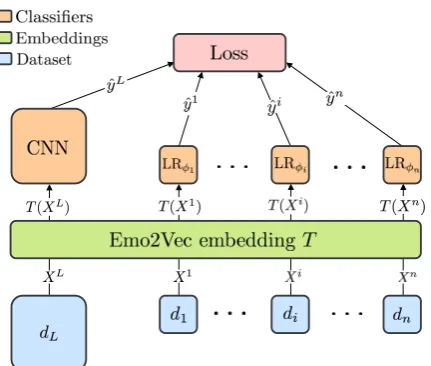
Figure 1: Multi-task learning diagram
datasets when combined with GloVe.
2 Methodology
We train Emo2Vec using an end-to-end multi-task learning framework with one larger dataset and several small task-specific datasets. The model is divided into two parts: a shared embedding layer (i.e. Emo2Vec), and task-specific classifiers. All datasets share the same word-level representations (i.e. Emo2Vec), thus forcing the model to encode shared knowledge into a single matrix. For the larger dataset, a Convolutional Neural Network (CNN) (LeCun et al.,1998) model is used to cap-ture complex linguistic feacap-tures present in the cor-pus. On the other hand, the classifier of each small dataset is a simple logistic regression.
Notation: We defineD ={dL, d1, d2,· · · , dn}
as the set ofn+ 1datasets, wheredLis the larger
dataset and the otherdiare the small datasets. We
denote a sentenceXi withi∈ {L,1,2,· · ·, n}as
[wi,1, wi,2,· · · , wi,Ni]wherewi,j is thej-th word in thei-th sample andNiis the number of words.
All the models’ parameters are defined as MΦ = {T,CNN,LRϕ1, . . . ,LRϕn}, where T ∈ R|
V|×k
is the Emo2Vec matrix,|V|is the vocabulary size andkis the embedding dimension, CNN is a Con-volutional Neural Network model and LRϕi for
i∈ [1, n]is a logistic regression classifier param-eterized byϕi which is specific for the datasetdi.
We denote the embedded representation of a word
wi,jwithewi,j.
2.1 CNN model
The CNN architecture used is illustrated in Fig-ure2. Firstly, 1-D convolution is used to extract
n-Figure 2: Structure of CNN model
gram features from the input embeddings. Specif-ically, thej-th filter denoted byFj, is convolved
with embeddings of words in a sliding window of size kj, giving a feature value cj,t. J filters are
learned trough this process:
cj,t=Fj ∗ ewL,t:t+kj−1+bj
where∗is the 1-D convolution operation. This is followed by a layer of ReLU activation (Nair and Hinton,2010) for non-linearity. After that, we add a max-pooling layer of pooling size M −Fj + 1 along the time dimension to force the network to find the most relevant feature for predictingyL
correctly. The result of this series of operations is a scalar output of f mj. All f mj for j ∈ [1, J]
are then concatenated together to produce a vector representationf m1:J of the whole input sentence.
f mj =Max Pooling(ReLU(cj,t))
To make the final classification, the vector
f mi,1:J is projected to the target label space by
adding another fully connected layer (i.e. parame-terized byW andb), with a softmax activation.
ˆ
yL=Softmax(W ·[f m1:J] +b)
2.2 Multi-task learning
[image:2.595.305.526.65.265.2]personality recognition are included. The reason why we include many datasets is to 1) leverage dif-ferent aspects of words emotion knowledge, which may not be present in single domain dataset; 2) create a more general embedding emotional space that can generalize well across different tasks and domains. To avoid over-fitting, L2 regularization penalty is added from the weights of all logistic regression classifiersϕifori ∈[1, n]. Hence, we
jointly optimize the following loss function:
L(MΦ) =
1 n
n
∑
j=1
Lj +λ n
∑
j=1
∥LRϕj∥2
WhereLj is the negative log likelihood (NLL)
be-tweenyˆjandyj, andλan hyper-parameter for the regularization terms.
3 Experimental Setup
3.1 Dataset
Larger dataset
We collect a larger dataset from Twitter with hash-tags as distant supervision. Such distant super-vision method using hashtags has already been proved to provide reasonably relevant emotion la-bels by previous works (Wang et al., 2012).We construct our hashtag corpus from Wang et al. (2012), and Sintsova et al.(2017)2. More tweets between January and October 2017 are addition-ally added using the Twitter Firehose API by us-ing the hashtags based on the hierarchy mentioned in Shaver et al. (1987). The hashtags are trans-formed into corresponding emotion labels of Joy, Sadness, Anger, and Fear. When extending the dataset, we only use documents with emotional hashtags at the end and filter out any documents with URLs, quotations, or less than five words as Wang et al.(2012) did. The total number of doc-uments is about 1.9 million with four classes: joy (36.5%), sadness (33.8%), anger (23.5%), and fear (6%). The dataset is randomly split into a train (70%), validation (15%), and test set (15%) for ex-periments.
Small datasets
For sentiment, we include 8 datasets. (1,2) SST-fine and SST-binary (Socher et al., 2013) (3) OpeNER (Agerri et al., 2013) (4,5) tube auto
2
http://hci.epfl.ch/sharing-emotion-lexicons-and-data#emo-hash-data
and tube tablet (Uryupina et al., 2014) (6) Se-mEval (Hltcoe, 2013) (7,8) Twitter and SS-Youtube (Thelwall et al., 2010). For emotion tasks, we include 4 datasets, (1) ISEAR (Wallbott and Scherer,1986) (2) WASSA (Mohammad and Bravo-Marquez,2017) (3) Olympic Sintsova et al. (2013) (4) SE0714 (Staiano and Guerini, 2014). We further include 6 other affect-related datasets. (1,2) SCv1-GEN and SCv2-GEN for sarcasm de-tection, (3) Stress (Winata et al.,2018), (4) Abu-sive (Waseem, 2016;Waseem and Hovy, 2016). (5) Personality (Pennebaker and King,1999) (6) Insult. The detailed statistics can be found in Table 4and Table5in Supplemental Material.
3.2 Pre-training Emo2Vec
Emo2Vec embedding matrix and the CNN model are pre-trained using hashtag corpus alone. Pa-rameters ofT and CNN are randomly initialized and Adam is used for optimization. Best param-eter settings are tuned on the validation set. For the best model, we use the batch size of 16, em-bedding size of 100, 1024 filters and filter sizes are 1,3,5 and 7 respectively. We keep the trained embedding and rename it as CNN embedding for comparison. 100-dim for Emo2Vec is used in all experiments.
3.3 Multi-task training
We tune our parameters of learning rate, L2 reg-ularization, whether to pre-train our model and batch size with the average accuracy of the devel-opment set of all datasets. We early stop our model when the averaged dev accuracy stop increasing. Our best model uses learning rate of 0.001, L2 regularization of 1.0, batch size of 32. We save the best model and take the embedding layer as Emo2Vec vectors.
3.4 Evaluation
model SS-T SS-Y SS-binary SS-fine OpeNER tube auto tube tablet SemEval average
SSWE 0.815 0.835 0.698 0.365 0.701 0.620 0.654 0.629 0.665
DeepMoji embedding 0.788 0.841 0.751 0.369 0.754 0.628 0.675 0.676 0.685 CNN embedding 0.803 0.862 0.734 0.369 0.713 0.605 0.667 0.622 0.672 Emo2Vec 0.801 0.859 0.812 0.416 0.744 0.629 0.688 0.638 0.698
Table 1: Comparison between different emotion representations on sentiment datasets, all results are reported with accuracy. The best results are highlighted with bold fonts. Emo2Vec achieves best average score.
model ISEAR WASSA SE0714 Olympic Stress SCv1-GEN SCv2-GEN Insult Abusive Personality average
SSWE 0.327 0.466 0.217 0.508 0.704 0.660 0.678 0.559 0.539 0.674 0.533
DeepMoji embedding 0.379 0.532 0.286 0.485 0.739 0.658 0.685 0.666 0.586 0.678 0.569 CNN embedding 0.384 0.549 0.259 0.480 0.744 0.657 0.707 0.623 0.560 0.676 0.564 Emo2Vec 0.372 0.559 0.323 0.506 0.744 0.674 0.710 0.647 0.588 0.675 0.580
Table 2: Comparison between different representations on other affect related datasets. All results are reported with f1 score. The best results are highlighted with bold fonts. On average, Emo2Vec achieves best f1 score.
input document using a huge dataset of 1.2 bil-lion tweets. Their embedding layer is implicitly encoded with emotion knowledge. Thus, we use the DeepMoji embedding, the 256-dimension em-bedding layer of DeepMoji as another baseline.
Evaluation method: To make a fair comparison with other baseline representations, we first take one datasetdiout fromnsmall datasets as the test
set. The remainingn−1 small datasets and the larger dataset are used to train Emo2Vec through multi-task learning. We take the trained Emo2Vec as the feature fordi and train a logistic regression
ondito compare the performance with other
base-line representations. The procedure is repeatedn
times to see the generalization ability on differ-ent datasets. We release Emo2Vec trained on all datasets. For sentiment tasks, accuracy score is reported. For other tasks, if it is binary task, we report f1 score for the positive class. If it is multi-class multi-classification tasks, we make it binary clas-sification problem for each class and report aver-aged f1 score.
4 Results
We compare our Emo2Vec with SSWE, CNN em-bedding, DeepMoji embedding and state-of-the-art(SOTA) results on 18 different datasets. The results can be found in Table1and Table2.
Compared with CNN embedding: Emo2Vec
works better than CNN embedding on 14/18 datasets, giving 2.6% absolute accuracy improve-ment for the sentiimprove-ment task and 1.6% absolute f1-score improvement on the other tasks. It shows multi-task training helps to create better general-ized word emotion representations than just using a single task.
Compared with SSWE: Emo2Vec works much better on all datasets except SS-T datasets, which gives 3.3% accuracy improvement and 4.7% f1
score improvement respectively on sentiment and other tasks. This is because SSWE is trained on 10M binary classification task on twitter which then over-fits on dataset SS-T, and generalizes poorly to other tasks.
Compared with DeepMoji embedding:
Emo2Vec outperforms DeepMoji on 13/18 datasets despite the much smaller size of our training corpus (1.9M documents for us vs 1.2B documents for DeepMoji). On average, it gives 1.3% improvement in accuracy for the sentiment task and 1.1% improvement of f1-score on the other tasks.
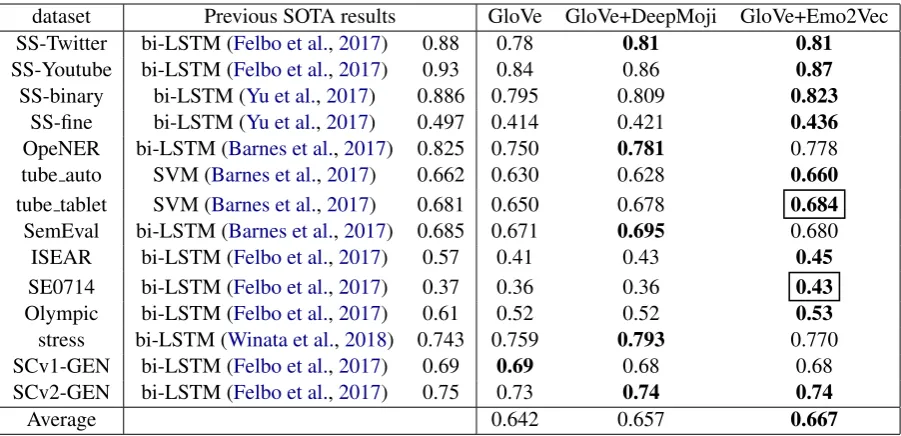
Compared with SOTA results: We further com-pare the performance of Emo2Vec vectors with SOTA results on 14 datasets where the same split is shared. Since Emo2Vec is not trained by pre-dicting contextual words, it is weak on capturing synthetic and semantic meaning. Thus, we con-catenate Emo2Vec with the pre-trained GloVe vec-tors, which are trained on Twitter and Wikepedia
3. Then, the concatenated vector of GloVe and
Emo2Vec, the concatenated vector of GloVe and DeepMoji embeddings and GloVe are included for comparison with SOTA results. Note that SOTA results require complex bi-LSTM model while all these representations are trained and reported with a logistic regression classifier. Here, we want to highlight that solely using a simple classifier with good word representation can achieve promising results.
Table 3 shows that GloVe+Emo2Vec out-performs GloVe on 13/14 datasets. Com-pared with GloVe+DeepMoji, GloVe+Emo2Vec achieves same or better results on 11/14 datasets, which on average gives 1.0% improvement. GloVe+Emo2Vec achieves better performances on
3http://nlp.stanford.edu/data/glove.twitter.27B.zip and
dataset Previous SOTA results GloVe GloVe+DeepMoji GloVe+Emo2Vec SS-Twitter bi-LSTM (Felbo et al.,2017) 0.88 0.78 0.81 0.81 SS-Youtube bi-LSTM (Felbo et al.,2017) 0.93 0.84 0.86 0.87 SS-binary bi-LSTM (Yu et al.,2017) 0.886 0.795 0.809 0.823
[image:5.595.75.526.61.279.2]SS-fine bi-LSTM (Yu et al.,2017) 0.497 0.414 0.421 0.436 OpeNER bi-LSTM (Barnes et al.,2017) 0.825 0.750 0.781 0.778 tube auto SVM (Barnes et al.,2017) 0.662 0.630 0.628 0.660 tube tablet SVM (Barnes et al.,2017) 0.681 0.650 0.678 0.684 SemEval bi-LSTM (Barnes et al.,2017) 0.685 0.671 0.695 0.680 ISEAR bi-LSTM (Felbo et al.,2017) 0.57 0.41 0.43 0.45 SE0714 bi-LSTM (Felbo et al.,2017) 0.37 0.36 0.36 0.43 Olympic bi-LSTM (Felbo et al.,2017) 0.61 0.52 0.52 0.53 stress bi-LSTM (Winata et al.,2018) 0.743 0.759 0.793 0.770 SCv1-GEN bi-LSTM (Felbo et al.,2017) 0.69 0.69 0.68 0.68 SCv2-GEN bi-LSTM (Felbo et al.,2017) 0.75 0.73 0.74 0.74 Average 0.642 0.657 0.667
Table 3: Comparison between different word-level emotion representations with state-of-the-art results. The best results are in bold. New state-of-the-art results Emo2Vec that achieves are highlighted with boxes.
SOTA results on three datasets (SE0714, stress and tube tablet) and comparable result to SOTA on another four datasets (tube auto, SemEval, SCv1-GEN and SCv2-SCv1-GEN). We believe the reason why we achieve a much better performance than SOTA on the SE0714 is that headlines are usually short and emotional words exist more commonly in headlines. Thus, to detect the corresponding emo-tion, more attention needs to be paid to words.
5 Related work
For sentiment analysis, numerous classification models (Kalchbrenner et al.; Iyyer et al., 2015; Dou,2017) have been explored. Multi-modal sen-timent analysis (Zadeh et al., 2017; Poria et al., 2017) extends text-based model to the combi-nation of visual, acoustic and language, which achieves better results than the single modality. Various methods are developed for automatic con-structions of sentiment lexicons using both su-pervised and unsusu-pervised way (Wang and Xia, 2017). Aspect-based sentiment (Chen et al.,2017; Wang et al., 2016) is also a hot topic where re-searchers care more about the sentiment towards a certain target. Transfer learning from the large corpus is also investigated by Felbo et al.(2017) to train a large model on a huge emoji tweet corpus, which boosts the performance of affect-related tasks. Multi-task training has achieved great success in various natural language tasks, such as machine translation (Dong et al., 2015; Malaviya et al.,2017), multilingual tasks (Duong et al., 2015; Gillick et al., 2016), semantic
pars-ing (Peng et al., 2017). Hashimoto et al. (2017) jointly learns POS tagging, chunking, dependency parsing, semantic relatedness, and textual en-tailment by considering linguistic hierarchy and achieves state-of-the-results on five datasets. For sentiment analysis, Balikas et al. (2017) jointly trains ternary and fine-grained classification with a recurrent neural network and achieves new state-of-the-art results.
6 Conclusion and Future Work
In this paper, we propose Emo2Vec to represent emotion with vectors using a multi-task train-ing framework. Six affect-related tasks are uti-lized, including emotion/sentiment analysis, sar-casm classification, stress detection, abusive lan-guage classification, insult detection, and per-sonality recognition. We empirically show how Emo2Vec leverages multi-task training to learn a generalized emotion representation. In addition, Emo2Vec outperforms existing affect-related em-beddings on more than ten different datasets. By combining Emo2Vec with GloVe, logistic regres-sion can achieve competitive performances on sev-eral state-of-the-art results.
7 Acknowledgements
References
Rodrigo Agerri, Montse Cuadros, Sean Gaines, and German Rigau. 2013. Opener: Open polarity en-hanced named entity recognition. Procesamiento del Lenguaje Natural, (51).
Georgios Balikas, Simon Moura, and Massih-Reza Amini. 2017. Multitask learning for fine-grained twitter sentiment analysis. In Proceedings of the 40th International ACM SIGIR Conference on Re-search and Development in Information Retrieval, SIGIR ’17, pages 1005–1008, New York, NY, USA. ACM.
Jeremy Barnes, Roman Klinger, and Sabine Schulte im Walde. 2017. Assessing state-of-the-art senti-ment models on state-of-the-art sentisenti-ment datasets. In Proceedings of the 8th Workshop on Computa-tional Approaches to Subjectivity, Sentiment and So-cial Media Analysis, pages 2–12.
Steven Bird and Edward Loper. 2004. Nltk: the nat-ural language toolkit. In Proceedings of the ACL 2004 on Interactive poster and demonstration ses-sions, page 31. Association for Computational Lin-guistics.
Peng Chen, Zhongqian Sun, Lidong Bing, and Wei Yang. 2017. Recurrent attention network on mem-ory for aspect sentiment analysis. InProceedings of the 2017 Conference on Empirical Methods in Nat-ural Language Processing, pages 452–461.
Ronan Collobert, Jason Weston, Lon Bottou, Michael Karlen, Koray Kavukcuoglu, and Pavel Kuksa. 2011. Natural language processing (almost) from scratch. Journal of Machine Learning Research, 12(Aug):2493–2537.
Daxiang Dong, Hua Wu, Wei He, Dianhai Yu, and Haifeng Wang. 2015. Multi-task learning for mul-tiple language translation. In Proceedings of the 53rd Annual Meeting of the Association for Compu-tational Linguistics and the 7th International Joint Conference on Natural Language Processing (Vol-ume 1: Long Papers), volume 1, pages 1723–1732.
Zi-Yi Dou. 2017. Capturing user and product informa-tion for document level sentiment analysis with deep memory network. InProceedings of the 2017 Con-ference on Empirical Methods in Natural Language Processing, pages 521–526.
Long Duong, Trevor Cohn, Steven Bird, and Paul Cook. 2015. Low resource dependency parsing: Cross-lingual parameter sharing in a neural network parser. In Proceedings of the 53rd Annual Meet-ing of the Association for Computational LMeet-inguistics and the 7th International Joint Conference on Natu-ral Language Processing (Volume 2: Short Papers), volume 2, pages 845–850.
Bjarke Felbo, Alan Mislove, Anders Sgaard, Iyad Rah-wan, and Sune Lehmann. 2017. Using millions of
emoji occurrences to learn any-domain representa-tions for detecting sentiment, emotion and sarcasm. In Proceedings of the 2017 Conference on Empiri-cal Methods in Natural Language Processing, pages 1616–1626.
Dan Gillick, Cliff Brunk, Oriol Vinyals, and Amarnag Subramanya. 2016. Multilingual language process-ing from bytes. InProceedings of the 2016 Confer-ence of the North American Chapter of the Associ-ation for ComputAssoci-ational Linguistics: Human Lan-guage Technologies, pages 1296–1306.
Kazuma Hashimoto, Yoshimasa Tsuruoka, Richard Socher, et al. 2017. A joint many-task model: Grow-ing a neural network for multiple nlp tasks. In Pro-ceedings of the 2017 Conference on Empirical Meth-ods in Natural Language Processing, pages 1923– 1933.
J Hltcoe. 2013. Semeval-2013 task 2: Sentiment anal-ysis in twitter. Atlanta, Georgia, USA, 312.
Mohit Iyyer, Varun Manjunatha, Jordan Boyd-Graber, and Hal Daum´e III. 2015. Deep unordered com-position rivals syntactic methods for text classifica-tion. InProceedings of the 53rd Annual Meeting of the Association for Computational Linguistics and the 7th International Joint Conference on Natural Language Processing (Volume 1: Long Papers), vol-ume 1, pages 1681–1691.
Nal Kalchbrenner, Edward Grefenstette, and Phil Blun-som. A convolutional neural network for modelling sentences.
Yann LeCun, L´eon Bottou, Yoshua Bengio, and Patrick Haffner. 1998. Gradient-based learning applied to document recognition. Proceedings of the IEEE, 86(11):2278–2324.
Chaitanya Malaviya, Graham Neubig, and Patrick Lit-tell. 2017. Learning language representations for ty-pology prediction. InProceedings of the 2017 Con-ference on Empirical Methods in Natural Language Processing, pages 2529–2535.
Tomas Mikolov, Ilya Sutskever, Kai Chen, Greg S. Cor-rado, and Jeff Dean. 2013. Distributed representa-tions of words and phrases and their compositional-ity. InAdvances in neural information processing systems, pages 3111–3119.
Saif Mohammad and Felipe Bravo-Marquez. 2017. Wassa-2017 shared task on emotion intensity. In
Proceedings of the 8th Workshop on Computational Approaches to Subjectivity, Sentiment and Social Media Analysis, pages 34–49.
Hao Peng, Sam Thomson, and Noah A Smith. 2017. Deep multitask learning for semantic dependency parsing. InProceedings of the 55th Annual Meet-ing of the Association for Computational LMeet-inguistics (Volume 1: Long Papers), volume 1, pages 2037– 2048.
James W Pennebaker and Laura A King. 1999. Lin-guistic styles: Language use as an individual differ-ence. Journal of personality and social psychology, 77(6):1296.
Jeffrey Pennington, Richard Socher, and Christopher Manning. 2014. Glove: Global vectors for word representation. InProceedings of the 2014 confer-ence on empirical methods in natural language pro-cessing (EMNLP), pages 1532–1543.
Soujanya Poria, Erik Cambria, Rajiv Bajpai, and Amir Hussain. 2017. A review of affective computing: From unimodal analysis to multimodal fusion. In-formation Fusion, 37:98–125.
Phillip Shaver, Judith Schwartz, Donald Kirson, and Cary O’connor. 1987. Emotion knowledge: Further exploration of a prototype approach. Journal of per-sonality and social psychology, 52(6):1061.
Valentina Sintsova, Margarita Bolvar Jimnez, and Pearl Pu. 2017. Modeling the impact of modifiers on emo-tional statements. In Proceedings of the 18th Int. Conference on Computational Linguistics and Intel-ligent Text Processing (CICLing).
Valentina Sintsova, Claudiu-Cristian Musat, and Pearl Pu. 2013. Fine-grained emotion recognition in olympic tweets based on human computation. In4th Workshop on Computational Approaches to Subjec-tivity, Sentiment and Social Media Analysis.
Richard Socher, Alex Perelygin, Jean Wu, Jason Chuang, Christopher D Manning, Andrew Ng, and Christopher Potts. 2013. Recursive deep models for semantic compositionality over a sentiment tree-bank. In Proceedings of the 2013 conference on empirical methods in natural language processing, pages 1631–1642.
Jacopo Staiano and Marco Guerini. 2014. Depeche mood: a lexicon for emotion analysis from crowd annotated news. InProceedings of the 52nd Annual Meeting of the Association for Computational Lin-guistics (Volume 2: Short Papers), volume 2, pages 427–433.
Duyu Tang, Furu Wei, Bing Qin, Nan Yang, Ting Liu, and Ming Zhou. 2016. Sentiment embed-dings with applications to sentiment analysis. IEEE Transactions on Knowledge and Data Engineering, 28(2):496–509.
Mike Thelwall, Kevan Buckley, Georgios Paltoglou, Di Cai, and Arvid Kappas. 2010. Sentiment strength detection in short informal text. Journal of the As-sociation for Information Science and Technology, 61(12):2544–2558.
Olga Uryupina, Barbara Plank, Aliaksei Severyn, Agata Rotondi, and Alessandro Moschitti. 2014. Sentube: A corpus for sentiment analysis on youtube social media. InLREC, pages 4244–4249. Citeseer.
Harald G. Wallbott and Klaus R. Scherer. 1986. How universal and specific is emotional experience? ev-idence from 27 countries on five continents. In-formation (International Social Science Council), 25(4):763–795.
Leyi Wang and Rui Xia. 2017. Sentiment lexicon con-struction with representation learning based on hi-erarchical sentiment supervision. InProceedings of the 2017 Conference on Empirical Methods in Nat-ural Language Processing, pages 502–510.
Wenbo Wang, Lu Chen, Krishnaprasad Thirunarayan, and Amit P. Sheth. 2012. Harnessing twitter” big data” for automatic emotion identification. In
Privacy, Security, Risk and Trust (PASSAT), 2012 International Conference on and 2012 Interna-tional Confernece on Social Computing (Social-Com), pages 587–592. IEEE.
Yequan Wang, Minlie Huang, Li Zhao, et al. 2016. Attention-based lstm for aspect-level sentiment clas-sification. InProceedings of the 2016 Conference on Empirical Methods in Natural Language Process-ing, pages 606–615.
Zeerak Waseem. 2016. Are you a racist or am i seeing things? annotator influence on hate speech detection on twitter. InProceedings of the first workshop on NLP and computational social science, pages 138– 142.
Zeerak Waseem and Dirk Hovy. 2016. Hateful sym-bols or hateful people? predictive features for hate speech detection on twitter. In Proceedings of the NAACL student research workshop, pages 88–93.
Genta Indra Winata, Onno Pepijn Kampman, and Pas-cale Fung. 2018. Attention-based lstm for psycho-logical stress detection from spoken language using distant supervision. 2018 IEEE International Con-ference on Acoustics, Speech and Signal Processing.
Liang-Chih Yu, Jin Wang, K Robert Lai, and Xuejie Zhang. 2017. Refining word embeddings for sen-timent analysis. In Proceedings of the 2017 Con-ference on Empirical Methods in Natural Language Processing, pages 534–539.
A Supplemental Material
A.1 Preprocessing
datasets SS-T SS-Y SS-binary SS-fine OpeNER tube auto tube tablet SemEval Domain Tweets Coments Movie reviews Movie reviews Hotel reviews Coments Coments Tweets
#classes 2 2 2 5 4 2 2 3
#training 800 800 6920 8544 2780 3381 4997 6021 #validation 100 100 872 1102 186 225 333 890
[image:9.595.72.529.548.612.2]#testing 1213 1242 1821 2210 743 903 1334 2376
Table 4: statistics of 8 sentiment datasets
datasets ISEAR WASSA SE0714 Olympic Stress SCv1-GEN SCv2-GEN Insult Abusive Personality Domain Experiences tweets Headlines Tweets Interviews Debates Debates Comments Tweets Essays
#classes 7 4 3 4 2 2 2 2 2 5
#training 900 3613 200 200 1751 800 800 4450 12016 1578
#validation 100 347 50 50 200 100 100 495 3005 395
#testing 6480 3142 1000 762 320 1095 2360 1237 3756 494