Proceedings of the 9th Workshop on Computational Approaches to Subjectivity, Sentiment and Social Media Analysis, pages 43–49 Brussels, Belgium, October 31, 2018. c2018 Association for Computational Linguistics
43
Amobee at IEST 2018: Transfer Learning from Language Models
Alon Rozental∗, Daniel Fleischer∗, Zohar Kelrich∗
Amobee Inc., Tel Aviv, Israel
[email protected] [email protected]
Abstract
This paper describes the system developed at Amobee for the WASSA 2018 implicit emotions shared task (IEST). The goal of this task was to predict the emotion expressed by missing words in tweets without an explicit mention of those words. We developed an ensemble system consisting of language models together with LSTM-based networks containing a CNN attention mechanism. Our approach represents a novel use of language models—specifically trained on a large Twitter dataset—to predict and classify emotions. Our system reached 1st place with a macro F1score
of 0.7145.
1 Introduction
Sentiment analysis (SA) is a sub-field of natural language processing (NLP) that explores the automatic deduction of feelings and attitudes from textual data. One popular choice of source to study is Twitter, a social network website where people publish short messages, called tweets, with a maximum length of 280 characters. People write on various topics, including global and local events, public figures, brands and products. Twitter data has attracted the interest of both academia and industry for the last several years. It contains some unique features, such as emojis, misspelling and slang that are of interest to NLP researchers while also containing insights relevant for business intelligence, marketing and e-governance.
The implicit emotions shared task (IEST) is part of the WASSA 2018 workshop, and is concerned with classifying tweets into one of 6 emotions—anger, disgust, fear, joy, sadness and surprise—without an explicit mention of emotion words. There were 30 teams who participated in
∗
These authors contributed equally to this work.
the task; for a description and analysis of the task and the datasets, seeKlinger et al.(2018).
This paper describes our specially developed system for the shared task; it comprises several ensembles, where our new contribution is the use of a language model as an emotion classifier. A language model, based on the Transformer-Decoder architecture (Vaswani et al., 2017) was trained using a large Twitter dataset, and used to produce probabilities for each of the 6 emotions.
The paper is organized as follows: Sections 2
and3describe our data sources and the embedding training, Section4describes the training and usage of the language models. In Section5we describe the resources that are used as features; Section
6 describes the architecture, broken into smaller components. Finally, we review and conclude in Section7.
2 Data Sources
We used several data sources for the shared task:
1. Twitter Firehose: we took a random sample of 5 billion unique tweets using the Twitter Firehose service. The tweets were used to train language models and word embeddings; in the following, we will refer to this as the Tweets 5B dataset.
2. Semeval 2018 shared task 1 datasets, specif-ically subtasks 1 and 5 in which tweets are classified into one of 4 emotions (anger, fear, joy and sadness; subtask 1) and a multi-label classification of tweets into 11 emotions (sub-task 5). We used both the datasets and our trained models; Rozental and Fleischer
(2018) describes the system andMohammad et al.(2018) describes the shared task.
Label Train Dev Test
Anger 25562 1600 4794
Disgust 25558 1597 4794
Fear 25575 1598 4791
Joy 27958 1736 5246
Sad 23165 1460 4340
Surprise 25565 1600 4792
[image:2.595.107.257.61.188.2]Total 153383 9591 28757
Table 1: Distributions of labels in the train, dev and test datasets.
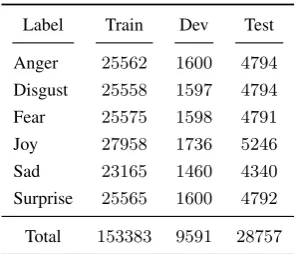
keyword [#TRIGGERWORD#]. Table 1
presents the label distributions; refer to the task paper for a description of the dataset.
We used different pre-processing procedures on the aforementioned tweets for our different learning algorithms. Those procedures ranged from no pre-processing at all (for language models), through a simple cleanup (for word embeddings) to an extensive pre-processing, used with our Semeval (2018) system to produce predictions, with the following processing steps: word tokenization, part of speech tagging, regex treatment, lemmatization, named entity recogni-tion, synonym replacement and word replacement using a wikipedia-based dictionary.
3 Embeddings Training
Word embeddings are a set of algorithms de-signed to encode a large vocabulary using low-dimensional real vectors. Depending on the algorithm, the vectors carry additional semantic information, and are used in down-stream NLP tasks. We trained word embeddings specifically for the task; first, starting with the Tweets 5B dataset, we removed exact duplicates. Then we used a regex process: URLs, emails and Twitter usernames were replaced with special keywords. Next we removed tweets by using a text similarity threshold1. Finally, we replaced rare words with a special token; the criterion was to have a vocabulary of 300K unique tokens in total. We used the Gensim package (Reh˚uˇrekˇ and Sojka,2010) to train 4 embeddings with sizes of 300, 500, 700 and 1000 with the Word2vec (Mikolov et al., 2013) algorithm. Similarly, we trained 4 embeddings using the FastText
1Using theSequenceMatchermodule in Python.
algorithm (Bojanowski et al., 2017). We found that for the purpose of downstream tasks, the Word2vec embeddings outperformed the FastText embeddings for each of the 4 sizes. In addition, the Word2vec embedding of size 1000 performed better than the others, provided that the training set is large enough. The size of the IEST 2018 train set was sufficiently large for us to use that single word embedding. The embeddings usage is described in the architecture section6.
4 Language Models
We trained a language model (LM) using the Transformer-Decoder architecture, introduced in
Vaswani et al.(2017). We used theTensor2Tensor
library (Vaswani et al., 2018) with the built-in
transformer-big parameter set, where we only set the tweet maximum length to be 64 tokens. The model was trained for 2 days using the Tweets 5B dataset on 8 Nvidia Tesla V100 GPUs. We will refer to this model as LM1. We built a pipeline around the trained model, such that given a sentence, its probability to be randomly generated by the model is returned. For example, under LM1 the probability of the text “I was surprised to see you here” (S1) being generated isexp (−25.76)and the text “I was afraid to see you here” (S2) has a probability ofexp (−27.86). One can then calculate the conditional probability of having S1 given only S1 or S2 were generated, with a resulting value of0.89.
In order to use LM1 to predict the correct label for a tweet, we created a list of possible words for each of the six emotions, presented in appendixA. For each tweet, we replaced the trigger word with each of the words from the list and then selected the most probable version of each emotion. The resulting 6 normalized probabilities are considered to be the probabilities assigned by the LM for the possible labels. See table 2 for a more detailed example with 3 emotions.
Emotion Possible Tweet Log Probability Max Final Probability
Joy I’mhappythan you. −24.38 −19.7 0.89995
I’mhappierthan you. −19.7
Angry I’mangrythan you. −26.8 −21.9 0.09972
I’mangrierthan you. −21.9
Surprise I’msurprisethan you. −27.6 −27.6 0.00033
I’msurprisedthan you. −31.5
Table 2: Probability calculation of the sentence “I’m #{TRIGGERWORD}than you.” with 3 emotions using the language models. Notice that the sentences which are grammatically incorrect have much lower probabilities.
the features we extracted from these models are the final 6 probabilitiespi(s), the log probability
to generate the most likely candidate tweet by random—referred to as tweet complexity—given by comp(s) = max
w∈Wlogpw(s), where W is the set
of possible replacement words and finally, for each candidate tweet, its shifted log probability, given bylog ˜pw(s) = logpw(s)−comp(s).
5 Features
We used 4 types of features in our system: first we used predictions from the language models; we took both the log-probabilities of the tweets with the trigger words replaced by each word from appendix A, as well as the final 6 probabilities for each tweet, for each of the two language model. Next, we used our system for the Semeval 2018 task 1 competition to generate features and predictions for sub-tasks 1 and 5 (as mentioned in section 2). Next we used 2 external resources for tweets embedding: Universal Sentence Embedding (Cer et al., 2018), using the Tensorflow Hub service and the DeepMoji package (Felbo et al., 2017). We created 7 versions of each tweet by replacing the trigger word with one of the 6 emotions and an unrecognized word, thus creating 7 Universal Sentence Embedding of dimension 512. The DeepMoji embedding size is 2304 and only one was produced for each tweet. Finally, we added a binary feature that captures whether the trigger word has a prefix in each tweet. These features are used in the 1st (6.2) and 2nd (6.3) ensembles.
6 Architecture Overview
The system comprises of a multi-level soft-voting ensemble. Each building block described in this section is a classifier by itself and is
presented as such. For our submitted solution, the building blocks were trained jointly in the manner described in the next section, using a single Nvidia GTX 1080 Ti GPU. We used the Keras
library (Chollet et al.,2015) and the TensorFlow
framework (Abadi et al.,2016).
6.1 Mini ASC Modules
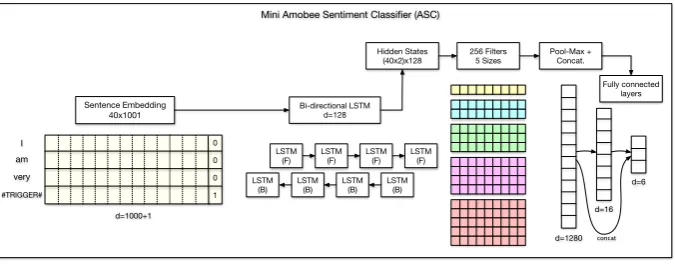
This component consists of a bi-LSTM layer with a CNN-based attention mechanism, similar to a single module in the Amobee Sentiment Classifier (ASC) architecture described in (2018). A Dropout layer (Srivastava et al., 2014) of 0.5 was applied between each 2 consecutive layers except for the word embedding layer; for an illustration, see figure 1. The input was the official dataset, transformed using our trained embeddings, where the trigger word was embedded as an unknown word using the rare-words token. We concatenated an additional bit to each word vector, denoting whether it is the missing trigger-word, differentiating it from other unknown words. There are three key differences from our original work:
1. The GRU layer was replaced by an LSTM layer.
2. Residual connections were added from the output of the max-pooling layer to the network output.
3. Hyper parameters values were in the follow-ing ranges: embeddfollow-ing size=1000, LSTM hidden size=[128, 512], number of fil-ters=[128, 512] and dense layer size=[16, 32].
LSTM
(F) LSTM (F) LSTM (F) LSTM (F) LSTM
(B) LSTM (B) LSTM (B) LSTM (B) I
am very
#TRIGGER#
Sentence Embedding 40x1001
d=1000+1
Bi-directional LSTM d=128
Hidden States
(40x2)x128 256 Filters5 Sizes
d=1280 Pool-Max +
Concat.
d=16 d=6 Fully connected
layers Mini Amobee Sentiment Classifier (ASC)
0 0 0 1
[image:4.595.131.469.62.196.2]concat
Figure 1: Architecture of the mini Amobee sentiment classifier.
loss function and a batch size of 32, results in an average accuracy of 0.669 on the official validation set.
6.2 First Ensemble
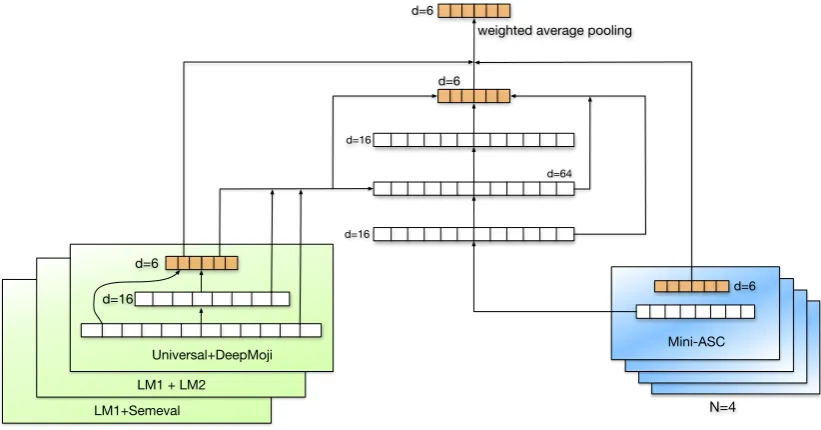
The first level ensemble incorporates 4 mini ASC modules and 3 identical sub-networks (see figure
2). The sub-networks share the same architecture and their inputs are the following:
1. Universal + DeepMoji embeddings; this network reaches an average F1score of 0.587
by itself on the validation set.
2. The LM1 + LM2 predictions; this network reaches an average F1score of 0.637 by itself
on the validation set.
3. The Semeval 2018 predictions, together with the LM1 predictions; this network reaches an average F1 score of 0.646 by itself on the
validation set.
These networks share the same structure: the input is connected to a dense layer of dimension 16 and then concatenated with the input going into a final dense layer of size 6 with a softmax activation function. Dropout layers of 0.5are applied after the input and before the output layers.
The other 4 models are copies of the architec-ture described in 6.1. All orange layers of size 6 are outputs of the model and are trained against the labels with equal contribution to the total loss. We used the Adam optimizer with a batch size of 32, a learning rate of 5·10−4 and a decay of
5·10−5(decay in Adam is introduced in Keras, and is not part of the original algorithm; it represents decay between batches). This network reaches an average F1 score of 0.700 on the validation set.
This first ensemble is denoted by E1.
6.3 Second Ensemble
In the second level ensemble (figure 3), we started with 8 copies of the aforementioned E1 models (with different parameters for the Mini ASC modules in the ranges described in section
6.1) and combined them with a concatenation of the following features (described in section
5): two external embeddings (Universal Sentence Embedding, DeepMoji) and our Semeval 2018 pipeline predictions.
We have used a dense layer of size 16 over the outputs of the 8 E1 models and a dense layer of size 100 over all of the above features (including the E1 outputs). These two layers were concatenated into a softmax layer of size 6 which was the output of the second ensemble; we denote this by E2. This E2 network reaches an average F1 score of 0.702 on the validation set. The final
model is a soft voting ensemble, comprising 128 networks of type E2; this probability averaging is meant to decrease the variance of the model which reaches an average F1score of 0.705 on the
validation set.
Since the final model is an ensemble, where some models are somewhat overfitted with respect to the training dataset (e.g. E1) and some models are not overfitted at all (LM1), we decided to use the validation dataset to train the final model for an additional 4 epochs using a large batch size of 900. After this procedure, the system scored an F1
of 0.7145 on the test dataset.
7 Review and Conclusions
Mini Mini Mini
Universal+DeepMoji d=16
d=6
d=6
d=16
d=64 d=16
weighted average pooling
Mini-ASC
LM1 + LM2 LM1+Semeval
d=6
d=6
[image:5.595.93.504.65.280.2]N=4
Figure 2: Architecture of the first-level ensemble.
Mega Mega
d=100 d=16
d=100 d=16
d=100 d=16
d=6412
N=8 d=6
N=128
E2
d=100 d=16
mean pooling
d=6
d=6
E1
d=6
E2
Figure 3: Architecture of the second-level ensemble.
previous high-ranking architecture, used in the Semeval 2018 sentiment shared task, and two external embeddings. The system reached 1st place with macro F1 of 0.7145, with the next
system scoring 0.7105. Examining the nature of the this task, it is a combination of both sentiment classification and word prediction; this was the motivation of using the Semeval 2018 models, which were designed to classify emotions. On the other hand, the language model is specifically trained to maximize the likelihood of matching a word to a given sentence, thus naturally lending itself to the word prediction aspect of the task.
We have seen that splitting the dataset into two parts, one for training our models and the other for the ensembling process (in this case
the second part is the validation set) is much more beneficial than training our models on the combined bigger dataset, in cases when some of the models are expected to be much less generalizable than others.
It is interesting to note the task organizers have tested human performance on a subset sample, achieving macro F1 of 0.45, which is much lower
than the automated systems.
[image:5.595.162.436.321.494.2]References
Mart´ın Abadi, Paul Barham, Jianmin Chen, Zhifeng Chen, Andy Davis, Jeffrey Dean, Matthieu Devin, Sanjay Ghemawat, Geoffrey Irving, Michael Isard, et al. 2016. Tensorflow: A system for large-scale machine learning. InOSDI, volume 16, pages 265– 283.
Piotr Bojanowski, Edouard Grave, Armand Joulin, and Tomas Mikolov. 2017. Enriching word vectors with subword information. Transactions of the Association for Computational Linguistics, 5:135– 146.
Daniel Cer, Yinfei Yang, Sheng-yi Kong, Nan Hua, Nicole Limtiaco, Rhomni St. John, Noah Constant, Mario Guajardo-Cespedes, Steve Yuan, Chris Tar, Yun-Hsuan Sung, Brian Strope, and Ray Kurzweil. 2018. Universal sentence encoder. CoRR, abs/1803.11175.
Franc¸ois Chollet et al. 2015. Keras. https://
github.com/keras-team/keras.
Bjarke Felbo, Alan Mislove, Anders Søgaard, Iyad Rahwan, and Sune Lehmann. 2017. Using millions of emoji occurrences to learn any-domain representations for detecting sentiment, emotion and sarcasm. In Conference on Empirical Methods in Natural Language Processing (EMNLP).
Diederik P Kingma and Jimmy Ba. 2014. Adam: A method for stochastic optimization. arXiv preprint arXiv:1412.6980.
Roman Klinger, Orph´ee de Clercq, Saif M. Mo-hammad, and Alexandra Balahur. 2018. Iest: Wassa-2018 implicit emotions shared task. In
Proceedings of the 9th Workshop on Computational Approaches to Subjectivity, Sentiment and Social Media Analysis, Brussels, Belgium. Association for Computational Linguistics.
Tomas Mikolov, Ilya Sutskever, Kai Chen, Greg S Corrado, and Jeff Dean. 2013. Distributed representations of words and phrases and their compositionality. In C. J. C. Burges, L. Bottou, M. Welling, Z. Ghahramani, and K. Q. Weinberger, editors,Advances in Neural Information Processing Systems 26, pages 3111–3119. Curran Associates, Inc.
Saif M. Mohammad, Felipe Bravo-Marquez, Mo-hammad Salameh, and Svetlana Kiritchenko. 2018. Semeval-2018 Task 1: Affect in tweets. In
Proceedings of International Workshop on Semantic Evaluation (SemEval-2018), New Orleans, LA, USA.
Radim ˇReh˚uˇrek and Petr Sojka. 2010. Software Framework for Topic Modelling with Large Cor-pora. InProceedings of the LREC 2010 Workshop on New Challenges for NLP Frameworks, pages 45– 50, Valletta, Malta. ELRA. http://is.muni.
cz/publication/884893/en.
Alon Rozental and Daniel Fleischer. 2018. Amobee at semeval-2018 task 1: GRU neural network with a CNN attention mechanism for sentiment classification.CoRR, abs/1804.04380.
Nitish Srivastava, Geoffrey Hinton, Alex Krizhevsky, Ilya Sutskever, and Ruslan Salakhutdinov. 2014. Dropout: a simple way to prevent neural networks from overfitting. The Journal of Machine Learning Research, 15(1):1929–1958.
Ashish Vaswani, Samy Bengio, Eugene Brevdo, Francois Chollet, Aidan N. Gomez, Stephan Gouws, Llion Jones, Łukasz Kaiser, Nal Kalchbrenner, Niki Parmar, Ryan Sepassi, Noam Shazeer, and Jakob Uszkoreit. 2018. Tensor2tensor for neural machine translation.CoRR, abs/1803.07416.
A Emotions Lexicon
Emotion Words
Anger Anger, angry, fuming, angrily, angrier, angers, angered, furious. Disgust Disgust, disgusted, disgusting, disgustedly, disgusts.
Fear Fear, feared, fearing, fearfully, frightens, fearful, afraid, scared. Joy Joy, happy, thrilling, joyfully, happily, happier, delights, joyful, joyous. Sad Sad, sadden, depressing, depressingly, sadder, depresses, sorrowful, saddened. Surprise Surprise, surprised, surprising, surprisingly, surprises, shocked.