© Medwell Journals, 2019
Augmentation of Nano Fluid (
Γ
-AL
2O
3/Water) Heat Transfer with
Different Forms of Twisted Tape in a Horizontal Tube
1
Riyadh S. Al-Turaihi and
2Sarah H. Oleiwi
1
Department of Mechanical Engineering, University of Babylon, Hilla, Iraq
2Department of Mechanical Engineering, University of Al-Qadisiyah, Al-Diwaniya, Iraq
Abstract: Twisted tapes are used to rise the amount of the heat transfer in pipes. In this study, the heat transfer was studied numerically in horizontal pipe with normal twisted tape inserted and two modified twisted tapes. Nine different values of fluid velocity were used (0.15, 0.2, 0.25, 0.3, 0.6, 0.65, 0.9, 0.95 and 1.3 m/sec), the flowing fluid through the pipes was γ-Al2O3/water nanofluid. ANSYS Fluent 15.0 combined with k-epsilon
turbulent model was used for simulations, the model was validated using the classical formula of Dittus-Boelter. The results from the simulations were established to be in good agreement with the formula results.
Key words: ANSYS Fluent, heat transfer, nano fluid, numerical study, twisted tapes, simulations
INTRODUCTION
The heat transfer coefficient is an important character to consider. Heat transfer technology enhancement has become very important for industrial applications counting nuclear power stations, heat exchangers and solar water heater as well as in processes such as petroleum and chemical engineering (Hong et al., 2017). Massive effective heat transfer area should be used to increase the heat transfer in addition to the residence time should increase, turbulent intensity should improve and the boundary layer should have developed (Hong et al., 2017). Twisted tapes were used for the heat exchangers to facility the recovery of heat from the diesel exhaust generator (Mokkapati and Lin, 2014) numerically studied the recovery of heat from the exhaust generator for heat exchangers using twisted tape inserted through a corrugated tube. They found an increase in the heat transfers by 235.3 and 67.26%. Built in twisted belt tube that was externally threaded was used by Sun et al. (2017) to study the flow characteristics and the heat transfer, the results showed that these tubes gave 50.32% rise in the coefficient of heat transfer if it was compared with horizontal tubes. Twisted tapes were studied numerically as well by Shaji (2016) which studied twisted tape inserted in a double pipe in this way they produced effect on the two sides of the pipe, the flow inside the pipe and the outlet heat exchanger annulus side. Some of the researchers studied the using of multi twisted tapes inside a single tube (Zhang et al., 2012) numerically studied two insertions for the twisted tapes which were quadruple and triple. The results of the simulation indicated that the Nusselt number increased by 182% for the tube with twisted tapes quadruple inserted and 171% for the pipe
with twisted tapes triple inserted. The heat transfer was numerically investigated on a single, double and triple twisted tapes by Zhu and Chen (2015) with air flowing in the pipes, the heat transfer coefficient was improved by 1.8-4.5 times. Hong et al. (2017) performed an experiment using two wisted tape insert overlapped in a spiral grooved tube and plain tube. Air was used as the working fluid and different overlapped twisted ratio were tested 1.06, 1.56, 2.44 and 3.22 with Reynolds number ranging between 8000-22000. One of the methods used by Azmi et al. (2014) to rise the coefficient of heat transfer is to use new high performance conventional liquids with high thermal conductivity (TiO2/water nano
fluid). They also used twisted tape inserted through the pipes. The heat transfer coefficient was boosted by 23.2% with 1% volume concentration of nano fluid but they originated that the coefficient of heat transfer decreased as the nano fluid concentration increased to 3% that if the heat transfer coefficient were compared with water flowing through the pipes. Maddah et al. (2014) used Al2O3/water as the working fluid through a tube with
concentration. In this study, two methods to boost the heat transfer was applied which are using nanoparticles plus inserting a modified tape through the flow pipe. Normal structure for the TTI was studied as well as two modified ones with triangles shapes were added on the sides with different triangle angles.
MATERIALS AND METHODS
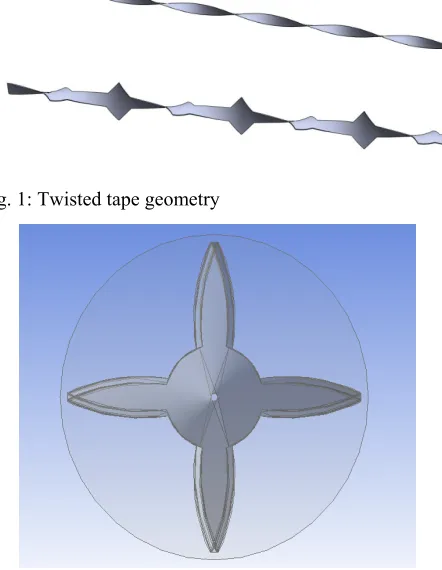
Model description: The geometry of the twisted tape inserted was generated using solidWorks 2013. Figure 1 shows both normal and modified structure of the TTI. The modification is performed by making triangles on the two sides of the tape. Two triangle dimensions were generated differencing in the triangle top angle, one with 90° and the other with 83°. The pipe for the TTI was generated using enclosure in ANSYS Fluent 15.0, Fig. 2 shows right view of the entire geometry. The pipe has length of 1000 mm and diameter of 50 mm. TTI has length of 994 mm, width of 16 mm and thickness of 1 mm. Twisting ratio was kept constant for all the models. Tetrahedrons mesh type was used which gave (85353, 86940 and 88511) elements and (17537, 18031 and 18391) nodes for the normal tape, the 90° tape and the 83° tape, respectively. Simulation was performed as horizontal pipe using fluent combined with ANSYS 15.0. Steady state with k-epsilon turbulent model was simulated. γ-Al2O3/water was used as the flowing
fluid, the nanoparticles properties are listed in Table 1. The diversity in choosing the velocities for the flowing fluid is considered, nine velocities was tested (0.15, 0.2, 0.25, 0.3, 0.6, 0.65, 0.9, 0.95 and 1.3 m/sec). Volume concentration for the nanoparticles used was 1%. Several equations were used to calculate the working fluid properties. The thermal conductivity calculated using Eq. 1 (Yu and Choi, 2004):
(1) 3
k +2kp bf+2(k -kp bf)(1+ ) knf kbf
3 k +2kp bf-(k -kp bf)(1+ )
Where, β is taken to be 0.1, Esmaeilzadeh et al. (2014) which is the ratio of nanolayer thickness to nanoparticle diameter. Equation 2 was used to calculate the nanofluid viscosity, Einstein (1956).
(2) nf (1+2.5 ) bf
The density was calculated using Eq. 3, Pak and Cho (1998):
(3) nf (1- ) bf+ p
The nanofluid specific heat was calculated using Eq. 4:
(4) nf
Cp
nf(1- )
bfCp +
bf pCp
p [image:2.612.325.546.118.403.2]
Fig. 1: Twisted tape geometry
[image:2.612.315.541.440.481.2]Fig. 2: Right view for the geometry Table 1: Properties of nanoparticles
Variables Values
Density 3650 kg/m3
Thermal conductivity 36 W/mK
Specific heat 733 j/kgk
RESULTS AND DISCUSSION
Model validation: The model was validated using the classical Eq. 5 of Dittus-Boelter (Lienhard and Lienhard, 2005):
(5)
0.8 n
Nu 0.0243Re Pr
For heating process n = 0.4. Figure 3 shows the comparison between the formula results and the fluent model calculations for a pipe with the same length and diameter without any tape inserted inside it. The maximum percentage of deviation between the two results was found to be 10% which can be considered good results.
400
300
100
0
Nu
0 20000 40000 60000 80000 Re
Nu (Model calculations) Nu (Dittus-Boelter equations)
1500
1400
1300
1200
1100
1000
900
0.15 0.25 0.35 0.45 0.55 0.65 0.75 0.85 x(m)
H
eat
tr
an
sf
er
c
oef
?c
ie
nt
(
W
/m
K
)
2
Velocity = 0.15 m/sec Velocity = 0.2 m/sec
1300
1200
1100
1000
900
800
0.15 0.25 0.35 0.45 0.55 0.65 0.75 0.85 x(m)
Modi?ed structure TTI with 83 triangle Without TTI
H
ea
t tr
an
sf
er
coe
f?
ci
ent
(W
/m
K
)
2
520
420
320
120
20
3500 17500 31500 45500 59500 73500 Re
N
u
Without TTI Flat plate TTI
[image:3.612.72.276.97.307.2]Modi?ed structure TTI with 90 triangles Modi?ed structure TTI with 83 triangles
[image:3.612.316.523.103.260.2]Fig. 3: Comparison between Nu from the fluent model and the classical formula of Dittus-Boelter
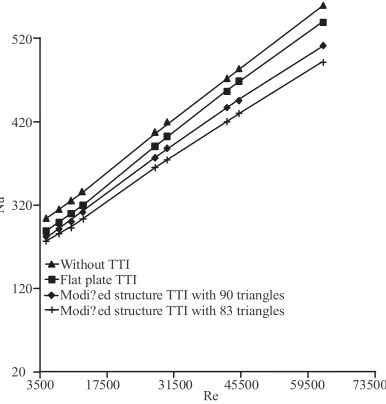
Fig. 4: Nusselt number for pipe without TTI and with different types of TTI
inserted and with normal twisted tape. Figure 4 also shows the nusselt number for the two modified twisted tapes inserted, twisted tape with 90° triangle top angle gave 21.077% increase in the Nusselt number while twisted tape with 83° triangle top angle gave 48.22% increase in the nusselt number. Figure 4 shows that as the reynolds number rise the nusselt number rise as well. Because of the helical passage of the flow and the pipe blockage that was created by the twisted tape the velocity of the flow will be higher at the pipe with twisted tapes more than the pipe without TTI (Hong et al., 2017) which will give higher the nusselt number.
Fig. 5: The coefficient of heat transfer along the pipe with different velocities
Fig. 6: Comparison for the coefficient of heat transfer for the pipe without TTI and with modified TTI
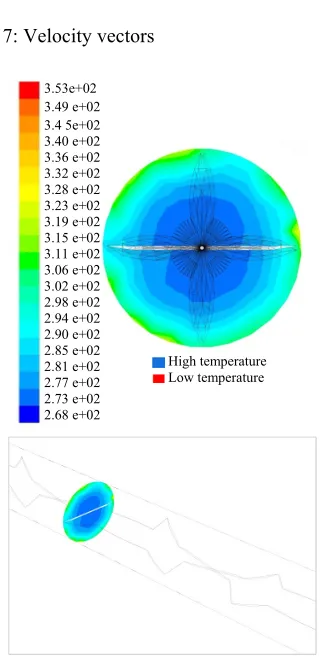
[image:3.612.324.530.303.462.2] [image:3.612.89.282.350.552.2]Fig. 7: Velocity vectors
Fig. 8: Temperature distributions
Velocity vectors and temperature distributions:
Figure 7 shows the velocity for the pipe with twisted tape inserted. Figure 7 shows high swirl created by the twisted tape due to the centrifugal force. The fluid mixing was also enhanced by the twisted tape. Figure 8 shows the contours of the temperature taken at plane at the middle of the pipe, the contours of the temperature shows that the temperature of the fluid at the tape curvature is higher.
CONCLUSION
The twisted was studied in this researche numerically using ANSYS fluent 15.0. Both normal twisted tape and two modified structure were studied. Turbulent flow with several ranges of velocities were tested. The model was validated using formula developed by other researche and the results were in good agreement. The conclusions drawn from this researchers are:
C Inserting tapes inside the pipes increase the heat transfer coefficient
C The modified tapes presented in this study (modified by adding triangles on the sides) increase the heat transfer coefficient
C The tapes with triangle of 83° angles have higher Nusselt number than that the ones with 90° angle
NOMENCLATURE
Cp : Specific heat (J/kg.K) d : Width of the tape (m) D : Diameter of the pipe (m) H : Twisted tape pitch length (m) h : Heat transfer coefficient (W/m2.K)
H/d : Twist ratio
k : Thermal conductivity (W/m.K) Nu : Nusselt number
Pr : Prandtl number Re : Reynolds number
μ : Viscosity (kg/msec)
ρ : Density (kg/m3)
n : Volume concentration f : Fluid (water)
p : Particles (nano particles of γ-Al2O3)
TTI : Twisted Tape Inserted
REFERENCES
Azmi, W.H., K.V. Sharma, P.K. Sarma, R. Mamat and S. Anuar, 2014. Comparison of convective heat transfer coefficient and friction factor of TiO2 nanofluid flow in a tube with twisted tape inserts. Intl. J. Therm. Sci., 81: 84-93.
Einstein, A., 1956. Investigations on the Theory of Brownian Movement. Dover Publication Inc., New York, USA., ISBN:9780486603049, Pages: 119. Esmaeilzadeh, E., H. Almohammadi, A. Nokhosteen, A.
Motezaker and A.N. Omrani, 2014. Study on heat transfer and friction factor characteristics of ?-Al2O3/water through circular tube with twisted tape inserts with different thicknesses. Intl. J. Therm. Sci., 82: 72-83.
3.53e+02 3.49 e+02 3.4 5e+02 3.40 e+02 3.36 e+02 3.32 e+02 3.28 e+02 3.23 e+02 3.19 e+02 3.15 e+02 3.11 e+02 3.06 e+02 3.02 e+02 2.98 e+02 2.94 e+02 2.90 e+02 2.85 e+02 2.81 e+02 2.77 e+02 2.73 e+02 2.68 e+02
Hamad, A.J. and R.A. Jasim, 2018. Experimental investigation of condensation heat transfer characteristics of R-134a vapor in horizontal heat exchanger. J. Univ. Babylon Eng. Sci., 26: 16-31.
Hong, Y., J. Du and S. Wang, 2017. Experimental heat transfer and flow characteristics in a spiral grooved tube with overlapped large/small twin twisted tapes. Intl. J. Heat Mass Trans., 106: 1178-1190.
Kramallah, A.A., N.S. Mahmoud and A.M. AL-Tajer, 2018. Numerical study of heat transfer and flow of nanofluid using multi-phase mixture model through elliptical tubes. J. Univ. Babylon Eng. Sci., 26: 294-308.
Lienhard, J.H. IV and J.H.V. Lienhard, 2005. Heat Transfer Textbook. 3rd Edn. Phlogiston Press, Cambridge MA.,.
Maddah, H., M. Alizadeh, N. Ghasemi and S.R.W. Alwi, 2014. Experimental study of Al2O3/water nanofluid turbulent heat transfer enhancement in the horizontal double pipes fitted with modified twisted tapes. Intl. J. Heat Mass Trans., 78: 1042-1054.
Mokkapati, V. and C.S. Lin, 2014. Numerical study of an exhaust heat recovery system using corrugated tube heat exchanger with twisted tape inserts. Intl. Commun. Heat Mass Trans., 57: 53-64.
Pak, B.C. and Y.I. Cho, 1998. Hydrodynamic and heat transfer study of dispersed fluids with submicron metallic oxide particles. Exp. Heat Trans. Intl. J., 11: 151-170.
Shaji, K., 2016. Numerical analysis on a double pipe heat exchanger with twisted tape induced swirl flow on both sides. Proc. Technol., 24: 436-443.
Sun, B., A. Yang and D. Yang, 2017. Experimental study on the heat transfer and flow characteristics of nanofluids in the built-in twisted belt external thread tubes. Intl. J. Heat Mass Trans., 107: 712-722.
Yu, W. and S.U.S. Choi, 2004. The role of interfacial layers in the enhanced thermal conductivity of nanofluids: A renovated Hamilton-Crosser model. J. Nanopart. Res., 6: 355-361.
Zhang, X., Z. Liu and W. Liu, 2012. Numerical studies on heat transfer and flow characteristics for laminar flow in a tube with multiple regularly spaced twisted tapes. Intl. J. Therm. Sci., 58: 157-167.