ISSN: 1815-932X
© Medwell Journals, 2019
Pattern of Mobile Learning Utilization for Higher Education in Oman
1
Alaa Edein M. Qoussini and
2Shaima M. Al-Tabib
1Department of Basic Science and Humanities,
Scientific College of Design, Muscat, Oman
2
Department of English Language, Oman Tourism College, Muscat, Oman
Abstract: The mobile phones ownership among the undergraduates in Oman was recorded as high. However, little was known about its utilization patterns, thus, the focus of this study was to determine the utilization patterns of mobile phones based on the National Education Technology Standard for Students (NETS.S) among undergraduates in Oman. This study was based on a quantitative research and the population comprised undergraduates from four different faculties in the public university (SQU). A total of 380 questionnaires were analyzed. Based on the results, the undergraduates’ utilization level of mobile phones for communication and collaboration tool was the highest level. Also, mobile phones utilization as tool for basic operations, research and information fluency, critical thinking and problem solving, digital citizenship, finally creativity and innovation were all at high level, respectively. Hence, more interest should be given to the use of mobile learning in order to encourage the students in higher education to fully utilize mobile learning technology for the learning purposes and enhancing the higher education.
Key words:Undergraduate’s students, mobile phones, utilization patterns, NETS.S, learning technology, education
INTRODUCTION
Mobile learning technology and their benefits: During the last decade, the rapid development of telecommunication technology and the use of information technology tools have gained momentum (Saraubon et al., 2016) and popularity in the field of learning system which increased the opportunities of applying mobile devices in learning environment (Hassan et al., 2016). The preferences towards mobile learning (m-learning) over e-learning is started to take hold in the academic segments and in the near future the primary delivery platform for learning content will be mobile learning.
However, many researchers have suggested that m-learning supports and improves the teaching and learning (Sung et al., 2016) and it can be applied to a wide range of students without age boundaries (Baharom, 2013). So, integrating mobile learning technology into teaching and learning is one of the most important strategies employed by the Omani Ministry of Higher Education (Al-Khanjari et al., 2015). According to Sarrab and Elgamel (2013), Oman can be one of the first few countries in the Middle East to adopt this revolutionary technology in mobile learning through portable devices. Mobile learning is defined as the use of portable mobile devices such as smart phones, laptops, tablets and mobile phones equipped with the internet in the learning process (Alharbi and Drew, 2014; Sarrab, 2015; Oyelere et al., 2016). Kurkovsky (2013) stated that,
the learning environment may become an attractive option for many students who have increasing commitments to technology. Mobile learning is able to support a variety of learning activities (Oyelere et al., 2016) as well as give an enjoyable learning (Hassan et al., 2016).
The Ministry of Higher Education in Oman has focused on increasing the number of future technology and technically-skilled workers by strengthening the field of study based on practical and technical training. However, higher education sector in Oman has grown and made significant development in the last decade and there is heavy investment to improve the education infrastructure, provide increased education opportunities with focus on women education to ensure equality and equity (Baporikar and Shah, 2012).
(2014) and Tenhet the use of technology can be studied through the quantity of use which refers to how much is being used as well as the quality of use which refers to what and how it is being used.
For the purposes of this study, utilization of mobile learning refers to a systematic use of resources for learning purposes and providing learners with specific materials according to six categories (ISTE., 2007).The International Society for Technology in Education (ISTE., 2007) developed the National Education Standards for students (NETS.s) which suggested that measuring the student’s usage of technology can be categorized into six categories: basic operation purpose, communication and collaboration, research and information purposes, digital citizenship purposes, critical thinking and problem solving purposes and innovation and creation.
According to ISTE. (2007), operations and concepts is defined as the use of technology in demonstrating an operation, selecting, using the applications and sound understanding of concepts in productive and effective way. In this research, context it is hoped that the participants will record a better practices by using mobile learning.
The communication and collaboration purposes refer to communication, collaboration, interaction purposes to support user’s learning and contribute to their learning by employing a different digital media (ISTE., 2007). In this study, using mobile learning is assumed to increase the engagement and motivation of the undergraduate students to lead for better communication and collaboration purposes.
According to ISTE. (2007), the term of research and information purposing is known as analyzing, evaluating and using information from a wide array of sources and media for research purposes. For the purpose of this study, it is hoped that using mobile learning can improve the student’s ability in doing their research and increase their information fluency.
The next category is digital citizenship which refers to the use of technology and its applications for understanding social issues or human and cultural aspects as well as enhancing the practice of the students in ethical and legal behavior (ISTE., 2007). From that, we can suggest that the students should be able to use mobile learning to improve their skills in dealing with cultural, human, social and ethical issues.
The term of critical thinking and problem solving refers to employ technology for completing learning tasks that need solving problem and critical thinking. According to this study, utilization of mobile learning among higher education may give a variance of benefits in developing the critical thinking skills and promoting student’s abilities to solve problems related to their learning. Finally, the last purpose from (NETS.s) is for creativity
and innovativeness which it is consented that the students will use mobile learning to improve their learning by expressing their expressions and creativity.
In conclusion with the utilization of mobile learning has contributed a lot of benefits such as the student’s abilities and their information can be improved. This developing can be in terms of enhancing their skills in collaboration and communication as well as developing a good practice in doing researches and contributing beneficial awareness in digital citizenship. Furthermore, using mobile learning assist to install higher level of critical thinking skills and problem solving and develop their capabilities in creative and innovative purposes.
Meanwhile, using mobile learning may play as essential role in promoting student’s skills and knowledge depending on student’s perceptions toward mobile learning. The important thing is how utilization of mobile learning will be perceived as ease of use and usefulness for helping students to complete their learning tasks. Thus, it is important to determine such these factors which may influence the utilization of mobile learning. So, the next section discusses the potential factors that may influence mobile learning utilization.
Statement of problem: Using mobile learning can support the existing e-learning environment which has limited to the area out of location (Almatari et al., 2013; Al-Khanjari et al., 2014) and the use of mobile devices as a learning tool is still low among undergraduates. However, research that confirmed the findings in determine the level utilization of mobile learning technology among undergraduates is lacking. Most of researches in Oman have examined the use of technology based only on frequency and volume but not on how mobile learning technology was being used. Also, mobile learning utilization was only invested in term of communication purpose and not for specific purposes such as problem solving, critical thinking, research or innovation (Tagoe and Abakah, 2014; Gao et al., 2015). Based on the previous discussion and in order to bridge the knowledge gaps related to the use of mobile learning technology, it is found that there is a need to conduct a study to identify the use of mobile learning technology patterns as according to NETS.s among undergraduate students in Oman. This set of categories will use as indicators on how the mobile learning technology will benefit Omani undergraduates.
Rq 1: Determine the usage level of mobile learning technology among the undergraduates?
Rq 2: Determine the utilization patterns of mobile learning technology among the undergraduates based on the NETS.s standards?
MATERIALS AND METHODS
The type of research that was carried out in this study was a survey research and the accessible population were included the selected third and fourth years undergraduates from four faculties. In order to reconfirm the minimum recommended sample for this study, two ways were employed, namely using a Raosoft® Software and Cochran’s formula (Cochran, 2007). For sampling purpose, the proportional stratified sampling was used and the questionnaires were distributed randomly to the identified sample in each faculty in the public university. The questionnaire was divided into two sections. Section A, collected the student’s demographic information, section B was on the patterns of mobile technology utilization.
However, for the purpose of this study, the researcher had discussed only on the analysis done on section B. 468 questionnaires were distributed and all were returned. The returned percentage was 100% that may due to the personal distribution and collection. Nevertheless, only 380 responses were analyzed and the other 88 responses were invalid as they were identified containing missing data. Prior to data analysis, the questionnaires were carefully screened by checking for missing data. A five-point Likert scale used were as follows, never, rarely, sometimes, often, Very Often [VO]. The obtained quantitative data were analyzed by using the SPSS Version 20.0. The reliability test was conducted in order to find the consistency of scores or answers provided by an instrument. From the analysis, the range of the instrument’s reliability was between 0.82 and 0.94. Overall the reliability of the instrument were higher than 0.7 this indicated an acceptable reliability.
Findings
Demographic information: This section describes the respondent’s demographic characteristics, namely; faculty, gender, age, years of study and mobile devices ownerships. The descriptive statistics of the sample under study were measured of mean, frequency, percentage and standard deviation.
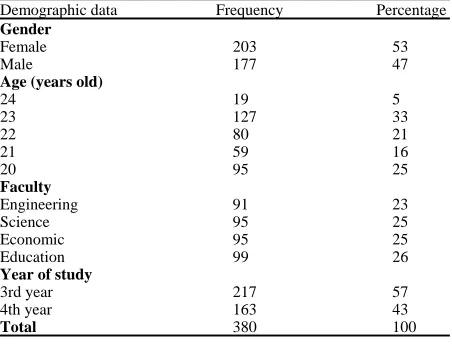
[image:3.612.315.541.105.279.2]Table 1 presents the discretion of demographic data of the undergraduates participated in this study. A total 380 undergraduates were from the four chosen faculties in the study. The gender distribution was almost equal among the participators, female (n = 203,53%) and male (n = 177,47%). The number of undergraduates from each faculty was nearly equal too. The age of the respondents varied from 20-24 years old, the maximum number of the
Table 1: Distribution of respondents by demographic data
Demographic data Frequency Percentage
Gender
Female 203 53
Male 177 47
Age (years old)
24 19 5
23 127 33
22 80 21
21 59 16
20 95 25
Faculty
Engineering 91 23
Science 95 25
Economic 95 25
Education 99 26
Year of study
3rd year 217 57
4th year 163 43
[image:3.612.313.540.117.447.2]Total 380 100
Table 2: Distribution of mobile devices ownership Frequency (Percentage)
---Mobile devices ownership Male Female Total
Smart Yes 171 (45%) 198 369
phone No 6 (1%) (52%) (97%)
5 (1%) 11 (4%) Laptop Yes 153 (41%) 167 (44%) 320 (85%)
No 24 (6%) 36 (10%) 60 (16%)
Tablet Yes 68 (18%) 68 (18%) 136
No 109 (29%) 135 (35%) (36%)
244 (64%) Two Tablet and laptop 44 (11%) 88 (24%) 132 (35%) devices smart phone 139 (36%) 170 (45%) 309 (81%) and laptop 43 (12%) 85 (22%) 128 (34%) smart phone
and tablet
Three Smart phone 61 (16%) 63 (17%) 124
devices Tablet and laptop (33%)
undergraduates were around 23 years old (n = 127, 33%) and those of age 24 years were the fewest participants (n = 19, 5%). In terms of the year of study, a total of 217 (57%) undergraduates were in their third year and 163 (43%) were in their fourth year. Consequently, the sample represents the population very well and thus, effect of non-probability sampling is mitigated and generalizability about the population is less difficult. Table 2 explains the findings of mobile devices ownership among the undergraduates. Most of the undergraduates (n = 369, 97%) owned smart phones (171 = males, 198 = females). A total of 320 (85%) owned laptops (153 = males, 167 = females) and females (n = 167, 44%) whereas 60 (16%) undergraduates did not own laptops and136 (36%) undergraduates had tablets.
350
300
250
200
150
100
50
0
Utilization level High = 155-114 Moderate = 113-72 Low = 71-31
Va
lu
es
292 77%
68 18%
16 4%
Variables
[image:4.612.75.541.106.283.2]High Moderate Low Table 3: Communication and collaboration purposes
Frequency/Percentage
---Items N R S O A Mean SD
CC1: chatting online with friends, lecturers and 7 50 90 185 48 3.57 0.94
family via. (yahoo messenger, IRC, ICQ, etc.) 2% 13% 24% 50% 13%
CC2: contacting friends, lecturers and family 12 39 113 168 48 3.53 0.95
using e-mail 3% 10% 30% 44% 13%
CC3: receiving and reply messages through 11 55 91 163 60 3.54 1.02
social networking sites 3% 15% 24% 42% 16%
(Twitter, Facebook, Whatsapp, Viber, …, etc.) 3 49 108 172 48 3.56 0.90
CC4: sharing opinions and ideas through 1% 13% 28% 45% 13%
other people’s blog, social forum, social networking site’s walls, etc.
Interacting with supervisors, teachers frequently 11 39 103 166 61 3.60 0.97
3% 10% 27% 44% 16%
CC5: sharing with group collaboration (e.g.,
working well with other students in small 14 40 87 187 52 3.59 0.98
groups) 4% 11% 23% 49% 13%
Total 3.57 0.84
[image:4.612.82.287.306.440.2]*N = Never*R = Rarely *S = Seldom*O = Often *A = Always
Fig. 1: The overall utilization level of mobile learning technology
Rq 1: Determine the current usage level of mobile learning technology among the undergraduates? The findings showed that the current usage level of mobile learning technology was high. From Fig. 1, the results reveals that the majority of undergraduates (n = 292, 77%) perceived their utilization level of mobile learning technology as high. Then, 68 (18%) undergraduates perceived their utilization level as moderate and only 16 (4%) as low.
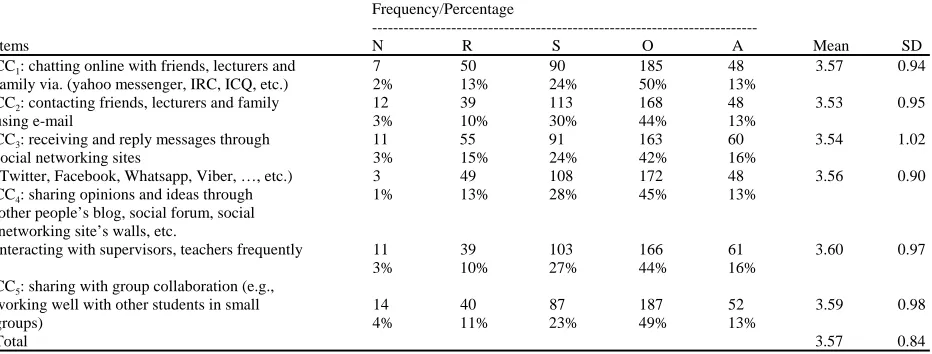
Rq 2: Determine the utilization patterns of mobile learning technology among the undergraduates? Based on the overall results of the usage level of mobile learning technology, the highest usage was for using mobile learning technology for communication and collaboration purposes, followed by basic operation purposes, research and information fluency, critical thinking and problem solving purposes, digital citizenship purposes and the lowest usage was for creativity and innovation purposes. Table 3 shows the level of using mobile learning for communication and collaboration purposes which was
the highest level among all the responses (M = 3.57, SD = 0.84). For this purpose, the use of mobile learning for interacting with supervisors, teachers frequently (M = 3.60, SD = 0.97) was at high level whereas, the lowest usage was for using mobile learning for contacting friends, lecturers and family using e-mail (M = 3.53, SD = 0.95). Table 4 indicates the overall mean in using mobile learning technology for basic operation purpose was high (M = 3.56, SD = 0.95) and this means that the undergraduates always used mobile learning for their basic purposes. This findings indicated that the highest usage of mobile learning technology was for setting an event reminder such as place and time (M = 3.62, SD = 1.10). Meanwhile from Table 5, the utilization of mobile learning for research and information fluency purposes was high (M = 3.54, SD = 0.85). The most frequent usage was for opening several programs simultaneously by having multiple windows open at the same time (M = 3.56, SD = 0.99) and the lowest usage was for delivering digital presentations such as chart, power point slides and others for academic research purposes (M = 3.52, SD = 1.03).
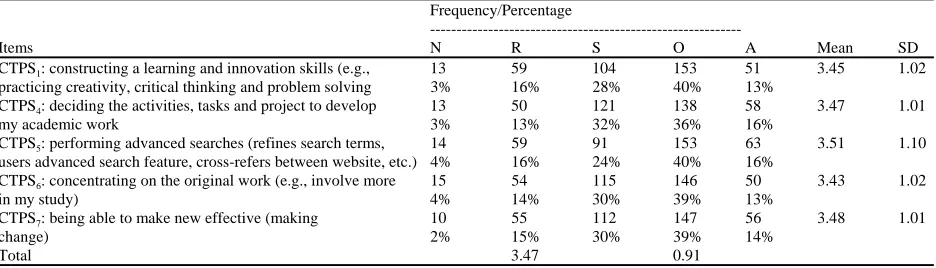
Then, Table 6 presents the findings of using mobile learning technology for solving problems creativity and thinking critically and the overall usage was also high (M = 3.47, SD = 0.91). The highest frequent usage was for performing advanced searches such as refines search terms, users advanced search features, cross-refers between website (M = 3.51, SD = 1.10) and concentrating on the original work and involve more in their study (M = 3.43, SD = 1.02) was the lowest. Moreover, Table 7 indicates the high usage of mobile learning technology for digital citizenship purposes (M = 3.45, SD = 0.82).
Table 4: Basic operation purposes
Frequency/Percentage
---Items N R S O A Mean SD
BO1: saving files and documents 13 56 90 159 62 3.53 1.04
3% 15% 24% 42% 16%
BO2: setting and event reminder 18 51 63 172 76 3.62 1.10
(e.g., place and time) 5% 13% 17% 45% 20%
BO3: capturing pictures 20 48 93 142 77 3.55 1.11
5% 13% 25% 37% 20%
BO4: recording videos 21 84 72 156 83 3.61 1.23
6% 13% 19% 41% 22%
BO5: organizing files into folders 14 47 94 167 58 3.55 1.22
4% 12% 25% 44% 15%
BO9: submitting assignments electronically 13 57 97 160 53 3.48 1.02
3% 15% 26% 42% 14%
Total 3.56 0.95
[image:5.612.74.539.289.443.2]*N = Never; *R = Rarely; *S = Seldom; *O = Often; *A = Always
Table 5: Communication and collaboration purposes
Frequency/Percentage
---Items N R S O A Mean SD
RIF1: downloading research material such as lecture or not 12 44 103 166 55 3.55 0.98 from online portal website (e = book, assignment questions) 3% 12% 44% 44% 14%
RIF2: preparing research documents by creating tables, 5 62 85 180 48 3.54 0.95
manipulating digital data, generating 1% 16% 22% 48% 13 %
graphs and managing records
RIF3: delivering several programs simultaneously 12 166 116 133 69 3.52 1.03
(Chart, power point slides and other) for academic 3% 31% 31% 35% 18% research purposes
RIF4: opening several programs simultaneously by having 10 46 107 154 63 3.56 0.99
multiple windows open at the same time 3% 12% 28% 40% 17%
RIF5: forming a text document by margins, set tabs insert 5 52 103 172 48 3.54 0.93
page breaks, for research 1% 14% 27% 45% 13%
Total 3.54 0.85
*N = Never; *R = Rarely*; S = Seldom*; O = Often; *A = Always
Table 6: Critical thinking and problem solving purposes
Frequency/Percentage
---Items N R S O A Mean SD
CTPS1: constructing a learning and innovation skills (e.g., 13 59 104 153 51 3.45 1.02 practicing creativity, critical thinking and problem solving 3% 16% 28% 40% 13%
CTPS4: deciding the activities, tasks and project to develop 13 50 121 138 58 3.47 1.01
my academic work 3% 13% 32% 36% 16%
CTPS5: performing advanced searches (refines search terms, 14 59 91 153 63 3.51 1.10 users advanced search feature, cross-refers between website, etc.) 4% 16% 24% 40% 16%
CTPS6: concentrating on the original work (e.g., involve more 15 54 115 146 50 3.43 1.02
in my study) 4% 14% 30% 39% 13%
CTPS7: being able to make new effective (making 10 55 112 147 56 3.48 1.01
change) 2% 15% 30% 39% 14%
Total 3.47 0.91
*N = Never; *R = Rarely; *S = Seldom; *O = Often; *A = Always
followed by setting up mobile learning with other digital equipment such as LCD projectors, printer and camera, M = 3.548, SD = 0.96).
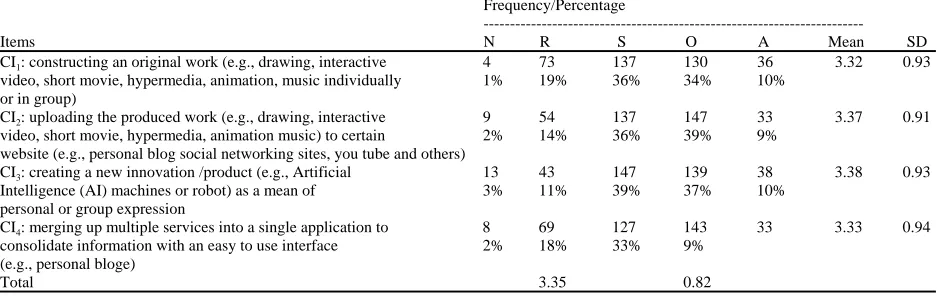
Finally, from Table 8, the least usage of mobile learning technology was as creativity and innovation purposes (M = 3.35, SD = 0.82) but it indicated as high usage too. The undergraduate’s utilization was for creating a new innovation or product such as artificial intelligence machines or robot as a mean of personal or
[image:5.612.73.541.471.605.2]Table 7: Digital citizenship purposes
Frequency/Percentage
---Items N R S O A Mean SD
DC1: installing reliable antivirus software for more 3 62 113 137 65 3.52 0.98
comprehensive protection system against any security threats 1% 16% 30% 36% 17%
DC2: setting up mobile learning with other digital 10 41 142 130 57 3.48 0.96
equipment (e.g., LCD projectors, printer and camera) 3% 11% 37% 34% 15%
DC3: accessing web sites of any learning organization 9 42 143 142 44 3.45 0.92
to enhance your academic achievement 2% 11% 38% 37% 12%
DC4: teaching others (e.g. friends and relatives) some 5 65 137 132 41 3.37 0.93
basic operation of technology 1% 17% 36% 35% 11%
DC6: keeping up with civic literacy 5 62 119 156 38 3.42 0.92
(e.g., news, politics and ethical practices) 1% 16% 31% 41% 10%
Total 3.45 0.82
*N = Never; *R = Rarely; *S = Seldom; *O = Often; *A = Always
Table 8: The least usage of mobile learning technology
Frequency/Percentage
---Items N R S O A Mean SD
CI1: constructing an original work (e.g., drawing, interactive 4 73 137 130 36 3.32 0.93 video, short movie, hypermedia, animation, music individually 1% 19% 36% 34% 10%
or in group)
CI2: uploading the produced work (e.g., drawing, interactive 9 54 137 147 33 3.37 0.91 video, short movie, hypermedia, animation music) to certain 2% 14% 36% 39% 9%
website (e.g., personal blog social networking sites, you tube and others)
CI3: creating a new innovation /product (e.g., Artificial 13 43 147 139 38 3.38 0.93
Intelligence (AI) machines or robot) as a mean of 3% 11% 39% 37% 10%
personal or group expression
CI4: merging up multiple services into a single application to 8 69 127 143 33 3.33 0.94 consolidate information with an easy to use interface 2% 18% 33% 9%
(e.g., personal bloge)
Total 3.35 0.82
*N = Never; *R = Rarely; *S = Seldom; *O = Often; *A = Always
multiple services into a single application to consolidate information with an easy to use interface (e.g., personal bloge).
RESULTS AND DISCUSSION
Based on the findings from the demographic data, it can be included that the ownership of mobile phones among the undergraduates in SQU was extremely high. However, most of undergraduates owned smartphones and laptops and only few of them owned tablets. This could be due to Mobile devices provide modern technologies opportunities for interaction with their instructors and enable them do their work flexibly. This is in line with AL Harbi and Drew (2014) and Kurilovas (2014) who found that, modern mobile learning activities applying tablets based on personalization and collaboration are more possibilities for feedback, more activities engaging students in learning and facilitating interaction and collaboration. According to Sung et al.
(2015), it was determined that using smartphones was seemed as important that led learning to be more enjoyable and meaningful.
The majority of the participants perceived their level of use mobile learning as high level. This means that the undergraduates always use mobile learning for numerous
activities and purposes. Meanwhile, the high level in using mobile learning could possibly be due to the sufficient skills of the undergraduates in utilizing mobile learning technology related to their studies and was seen as useful in assisting students to conduct various activities and enabling them to increase their understanding in learning other related subjects. This finding is in congruence with Frazier (2013) who found that, utilizing new mobile learning perceived as high level and brings a level of comfort that fosters creativity.
[image:6.612.72.542.269.417.2]They added that using the available communication and interaction features of mobile devices are able to encourage learners communicate with others and construct new knowledge. Mobile learning utilization level as basic operation was recorded as the second highest usage. This demonstrated that the students always used mobile learning for submitting their assignments electronically and for various daily activities such as capturing pictures, saving files, setting an event reminder for time or place and recording videos. And could be due to the academic and personal needs of the students at SQU for doing basic operations that can benefit and facilitate their learning by using the recent technology and assist them in completing their learning tasks during their studying in the university.
This finding also confirms the findings by Arrigo et al. (2015) who found that the students were always used mobile devices to complete basic activities such as reading test online, recording video, making notes and writing their own test.
This finding is in line with Passey and Zozimo (2015) who found that, students often used a new technology for common and basic purposes such as saving files, capturing pictures, recording videos and installing software as a common purposes.
Utilizing mobile learning for research and information fluency purpose is the third highest level. This can be concluded that undergraduates in SQU frequently used mobile learning for downloading research material, opening several programs simultaneously, preparing research materials and delivering presentations for research purposes. These findings were echoed by Bozdogan and Uzoglu (2012) and Hochstrasser (2014). Also Saraubon et al. (2016), assessed that mobile learning plays an increasingly important role in education field via. using mobile devices such as smart phones and tablets. Using these powerful tools for storing and retrieving digital contents or using several databases for seeking information can facilitate research completion of research activities.
CONCLUSION
Therefore, since, the current study has basically emphasized on mobile learning utilization among undergraduates in higher learning in Oman, particularly at SQU which is the only governmental university in Oman, the researcher recommends that, the target population can be further outspread to the private universities and colleges in Oman.
As such the scope of the population can be expanded. The results of varied levels and dissimilar geographic regions will be able to yield distinctive findings. More studies could be conducted to compare the level of technology utilization and its impacts on
undergraduate’s performances. Furthermore, it is suggested to conduct more studies with a pre/post-test design in determining the effectiveness of mobile learning technology utilization for learning purposes.
RECOMMENDATIONS
The results appeared that the use of mobile learning among undergraduates for critical thinking and problem solving purposes was as high level as they attended to use mobile learning for conducting special activities that allowed them to enhance their critical thinking and problem solving skills, practicing and developing their academic work by deciding some tasks or activities. Along similar line by Frazier (2013) who concluded that, students used their mobile devices for solving their problem and developing solution for completing projects. The participating agreed that, the process of planning, conducting, developing, solving problems and finding alternative solution easier through using mobile learning. Also Hassan et al. (2016), concluded that, students frequently login to their university account in order to use some of the provided facilities such as marks and registered models mobile learning is interactive environments that in enhancing student’s engagement with their university, understanding their current academic state and managing their problems such as solving certain problem, simplifying their presentations and their awareness of university’s regulation in regard to graduation requirements as credit hours system.
He high utilization of mobile learning for digital citizenship purposes showed that the students in SQU were fully used mobile learning and in understanding individual cultural and social issues and they were probably aware of the capability lying behind these technologies in enhancing knowledge related to technology on ethical, human and social issues such as copy-rights infringement and plagiarism. And it may possibly due to full understanding how to use knowledge by the students on the importance of practicing a good habit of digital security which refers to a channel that protects individual identities, based on a combination of secure personal passwords, anti-virus and software as Sarrab (2015) reported too. The undergraduates also often installed licensed software and set up their mobile devices with other digital equipment and taught friends or relatives on the ethical or social behavior in using mobile technology.
them chance to constructing innovation skills and uploading the produced work such as drawing interactive video, short movie, hypermedia animation, music individually or in group. According to Kurilovas (2014), the use of mobile devices such as tablets in classroom is developing innovation teaching and learning activities and enhancing content creation.
Also Sung et al. (2016) found that, mobile devices were expected to encourage innovation in education and increase high-level abilities. Additionally, Hochstrasser (2014) found that, students used computer-based software programs frequently to combine audio and video data in a movie file then share them with others via presentation. According to Al-Kanjari et al. (2015), mobile devises were found to encourage innovation in education and increase student’s abilities and offer extra function and capabilities for engineering students at SQU which involved them in creative learning environment easier such as service oriented architecture.
REFERENCES
Al-Khanjari, Z., K. Al-Kindi, A. Al-Zidi and Y. Baghdadi, 2014. M-Learning: The new horizon of learning at SQU. J. Eng. Res., 11: 15-26.
Al-Khanjari, Z., Z. Al-Kindi, E. Al-Kindi and N. Kraiem, 2015. Developing educational mobile application architecture using SOA. Int. J. Multimedia Ubiquitous Eng., 10: 247-254.
Alharbi, S. and S. Drew, 2014. Mobile learning-system usage: An integrated framework to measure students behavioural intention. Proceedings of the 2014 International Conference on Science and Information, August 27-29, 2014, IEEE, London, UK., pp: 906-911.
Almatari, A.Y., N.A. Iahad and A.S. Balaid, 2013. Factors influencing students intention to use M-learning. J. Inf. Syst. Res. Innovation, Vol. 5, No. 1.
Amhag, L., 2015. Learner centered experiences with flipped classroom and mobile online webinars in distance higher education program. Proceedings of the 11th International Conference on Mobile Learning (IADIS’15), March 14-16, 2015, Madeira, Portugal, pp: 99-103.
Arrigo, M., G. Fulantelli and D. Taibi, 2015. Challenges of using learning analytics techniques to support mobile learning. Proceedings of the International Conference on Mobile Learning, March 14-16, 2015, Maderia, Portugal, pp: 147-149.
Baharom, S., 2013. Designing mobile learning activities in the Malaysian HE context: A social constructivist approach. Ph.D. Thesis, University of Salford, Greater Manchester, England.
Baporikar, N. and I.A. Shah, 2012. Quality of higher education in 21st century-A case of Oman. J. Educ. Instructional Stud. World, 2: 9-18.
Bozdogan, A.E. and M. Uzoglu, 2012. The development of a scale of attitudes toward tablet PC. Mevlana Int. J. Educ., 2: 85-95.
Cochran, W.G., 2007. Sampling Techniques. 3rd Edn., Wiley India Private Ltd., New Delhi, India, ISBN-13: 978-8126515240,.
Eslampour, H., M. Joshi, S. Park, H. Shin and J. Chung, 2013. Advancements in Package-on-Package (PoP) technology, delivering performance, form factor & cost benefits in next generation smartphone processors. Proceedings of the 2013 IEEE 63rd International Conference on Electronic Components and Technology, May 28-31, 2013, IEEE, Las Vegas, Nevada, USA., pp: 1823-1828.
Frazier, S.D., 2013. An analysis of the current use and intentions to use mobile learning strategies among full-time community college faculty. Ph.D. Thesis, University of South Carolina, Columbia, South Carolina.
Gao, C., A. Gutierrez, M. Rajan, R.G. Dreslinski, T. Mudge and C.J. Wu, 2015. A study of mobile device utilization. Proceedings of the 2015 IEEE International Symposium on Performance Analysis of Systems and Software (ISPASS’15), March 29-31, 2015, IEEE, Philadelphia, Pennsylvania, USA., pp: 225-234.
Hassan, M.H., F. Alhosban and M.A. Hourani, 2016. Using mobile technologies for enhancing student academic experience: University of Jordan case study. Int. J. Interact. Mob. Technol., 10: 13-18. Hochstrasser, J.L., 2014. The use of technology for
enhancing the learning experiences of undergraduate students: From online education to the use of mobile devices and web-based programs. Ph.D. Thesis, University of Idaho, Moscow, Idaho.
ISTE., 2007. ISTE standards for students. International Society for Technology in Education (ISTE), Eugene, Oregon, USA. https://www.iste.org/standards/nets-for-students/nets-student-standards-2007
Kurilovas, E., 2014. Research on tablets application for mobile learning activities. J. Mob. Multimedia, 10: 182-193.
Kurkovsky, S., 2013. Mobile computing and robotics in one course: Why not?. Proceedings of the 18th ACM International Conference on Innovation and Technology in Computer Science Education (ITiCSE '13), July 01-03, 2013, ACM, Canterbury, England, UK, pp: 64-69.
Liu, M., C. Navarrete, E. Maradiegue and J. Wivagg, 2014. Mobile learning and English language learners: A case study of using iPod touch as a teaching and learning tool. J. Interact. Learn. Res., 25: 373-403. Mosley, V.V., 2012. Technology adoption in K-12
education: A qualitative study using TAM3 to explore why technology is underutilized. Ph.D. Thesis, Capella University, Minneapolis, Minnesota.
Oyelere, S.S., J. Suhonen and E. Sutinen, 2016. M-learning: A new paradigm of learning ICT in Nigeria. Int. J. Interact. Mobile Technol., 10: 35-44.
Passey, D. and J. Zozimo, 2015. Mobile learning and teacher education: Researching MLearn pilot development. Proceedings of the 11th International Conference on Mobile Learning, March 14-16, 2015, Madeira, Portugal, pp: 62-69.
Saraubon, K., P. Nilsook and P. Wannapiroon, 2016. System design of mobile augmented book. Int. J. Interact. Mobile Technol., 10: 52-59.
Sarrab, M. and L. Elgamel, 2013. Contextual M-learning system for higher education providers in Oman. World Applied Sci. J., 22: 1412-1419.
Sarrab, M., 2015. M-learning in education: Omani undergraduate students perspective. Procedia Soc. Behav. Sci., 176: 834-839.
Sung, H.N., D.Y. Jeong, Y.S. Jeong and J.I. Shin, 2015. The relationship among self-efficacy, social influence, performance expectancy, effort expectancy and behavioral intention in mobile learning service. Int. J. U. E. Serv. Sci. Technol., 8: 197-206. Sung, Y.T., K.E. Chang and T.C. Liu, 2016. The effects
of integrating mobile devices with teaching and learning on student’s learning performance: A meta-analysis and research synthesis. Comput. Educ., 94: 252-275.