warwick.ac.uk/lib-publications
Original citation:Cole, Daniel J. and Hine, Nicholas. (2016) Applications of large-scale density functional theory in biology. Journal of Physics : Condensed Matter, 28 (39). 393001.
Permanent WRAP URL:
http://wrap.warwick.ac.uk/81038
Copyright and reuse:
The Warwick Research Archive Portal (WRAP) makes this work by researchers of the University of Warwick available open access under the following conditions. Copyright © and all moral rights to the version of the paper presented here belong to the individual author(s) and/or other copyright owners. To the extent reasonable and practicable the material made available in WRAP has been checked for eligibility before being made available.
Copies of full items can be used for personal research or study, educational, or not-for-profit purposes without prior permission or charge. Provided that the authors, title and full
bibliographic details are credited, a hyperlink and/or URL is given for the original metadata page and the content is not changed in any way.
Publisher’s statement:
"This is an author-created, un-copyedited version of an article accepted for
publication/published Journal of Physics : Condensed Matter. IOP Publishing Ltd is not responsible for any errors or omissions in this version of the manuscript or any version derived from it. The Version of Record is available online at http://dx.doi.org/10.1088/0953-8984/28/39/393001 "
A note on versions:
The version presented here may differ from the published version or, version of record, if you wish to cite this item you are advised to consult the publisher’s version. Please see the ‘permanent WRAP URL’ above for details on accessing the published version and note that access may require a subscription.
Theory in Biology
Daniel J. Cole1,2 and Nicholas D. M. Hine3
1Theory of Condensed Matter group, Cavendish Laboratory, 19 JJ Thomson Ave,
Cambridge CB3 0HE, U.K.
2School of Chemistry, Newcastle University, Newcastle upon Tyne NE1 7RU, U.K. 3Department of Physics, University of Warwick, Coventry CV4 7AL, U.K.
E-mail: [email protected]
Abstract. Density functional theory (DFT) has become a routine tool for the computation of electronic structure in the physics, materials and chemistry fields. Yet the application of traditional DFT to problems in the biological sciences is hindered, to a large extent, by the unfavourable scaling of the computational effort with system size. Here, we review some of the major software and functionality advances that enable insightful electronic structure calculations to be performed on systems comprising many thousands of atoms. We describe some of the early applications of large-scale DFT to the computation of the electronic properties and structure of biomolecules, as well as to paradigmatic problems in enzymology, metalloproteins, photosynthesis and computer-aided drug design. With this review, we hope to demonstrate that first principles modelling of biological structure–function relationships are approaching a reality.
1. Introduction
An important goal of molecular biology is an understanding of the relationship between structure and function. Often, it is not only the overall shape of the biological molecule (such as the arrangement of α-helices and β-sheets in proteins) and the identity of its building blocks (such as the sequence of nucleobases in DNA), but also its underlying
electronic structure that determines the function of the molecule. Quantum mechanical
(QM) simulations have played a crucial role in determining the electronic properties of the amino acids, nucleic acids, carbohydrates, lipids and so forth that go into building a biological organism. Yet, if first principles calculations are to become a truly predictive tool in the biological sciences, then we require the ability to study the properties of these molecules within their natural environment. For example, the bond breaking/forming reactions in enzymes, the absorption of light by optically-active pigment molecules, and the transport of electrons in DNA and proteins may all be studied using simplified models in vacuum. However, we will argue that it is only by studying the complex effects of the biological environment that the functional mechanism of the system may be accurately quantified from first principles.
In this review, we begin by motivating the need to construct realistic, large-scale QM models when studying biological systems. In particular, we find, by collecting together literature spanning a wide range of biological fields, that QM system sizes in excess of around 500 atoms are required for the accurate determination of many properties of interest. Therefore, to focus our review, we limit ourselves to the literature describing biomolecular simulations with a minimum of 500 atoms treated at the QM level of theory. This size regime is typically at the limit of that which can be studied using traditional QM calculations, which are at least three orders of magnitude more expensive than molecular mechanics (MM) force fields and which typically scale as the third (or greater) power of the number of atoms in the simulation. However, over the last two decades, the ability of density functional theory (DFT) to treat large system sizes has advanced dramatically, particularly with the advent of linear-scaling methods. When combined with increasing computational processing power, this enables the almost routine application of quantum mechanics to the description of the physics and chemistry of complex biological molecules.
enzymology, metalloproteins, photosynthesis and computer-aided drug design. In general, the chosen applications are paradigmatic problems that have been widely studied, and are well-characterised through experimental measurements. However, a vast range of biological problems are much less straightforward to access experimentally. It is therefore an opportune time to reflect and consider if we are ready for truly predictive first principles modelling that can explain the functional interactions and chemistry of complex biological molecules.
1.1. Necessity for Large-Scale QM Simulations
Despite the huge complexity of biological organisms, many phenomena can be studied in a relatively localised region, such as an active site of an enzyme, or a binding pocket, or a chromophore. In these cases, quantum mechanical accuracy in the description of for example bond-breaking, transition metal chemistry, intermolecular binding or electronic excitations is both appealing and computationally feasible. Assuming that one requires a QM treatment, then the choice is between a QM cluster approach and a hybrid QM/MM simulation, in which a QM subsystem is embedded inside a larger region treated at a less expensive molecular mechanics level of theory [4]. Ideally the two methods should converge for sufficiently large QM regions. The advantage of the former approach is simplicity – there is no need to assign an MM force field or to model the boundary between the QM and the MM regions. The advantage of the latter is that, in theory, properties of interest should converge with a smaller QM region. Although the MM region does not explicitly account for electronic polarisation, this may be accounted for in an approximate manner by embedding the system in a polarisable continuum model [5, 6], or in a fully-atomistic polarisable medium [7, 8, 9]. As a cautionary note, QM/MM results can depend sensitively on the methods used [10] and one must be careful about how the boundary is treated. Shaw et al. give the example of solvating a single QM water molecule in a bath of MM water [11]. One widely used water model, despite performing well in purely MM simulations, undergoes significant structural distortions when used in a QM/MM scheme. In this section, we summarise the results of a number of studies that have explicitly considered the convergence of a range of different observables with respect to the size of the QM region. We give examples of both QM cluster and hybrid QM/MM studies of biological systems, and we will show evidence that, in both cases, large-scale QM regions in excess of 500 atoms are required to converge many properties of interest.
radius) for the polar region and 300 QM atoms (∼7.5 ˚A radius) for the apolar region. More relevantly for the biological modelling community, the free energy of a proton transfer reaction between a water molecule and a glutamic acid residue in the polar region showed similarly slow convergence with the size of the QM region. For example, increasing the radius of the QM region from 3 to 6 ˚A, decreases the free energy of proton transfer by 3 kcal/mol. These effects are attributed to inconsistencies between QM and MM treatment of long-ranged electrostatic interactions, and the neglect of explicit polarisation in the latter. Indeed, the same effects have been observed in solution, where it has been shown that spherical shells of QM water of ∼ 8−9 ˚A radius are required to converge interaction energies between a series of small organic molecules and water [13, 14].
Sumowski et al. also studied the effect of the environment on proton transfer isomerisation energies, in this case to investigate the protonation states of a stacked arginine pair in adenovirus Ad11, a motif that has been shown to be important for binding to its receptor CD46 [15]. While small QM models favour proton transfer to neighbouring residues to form a neutral arginine pair, inclusion of a larger, more realistic computational model stabilises the zwitterionic form. As above, a relatively large QM region (6 ˚A, 437 atoms) is required to converge the QM/MM isomerisation energies to less than 1 kcal/mol. Although, interestingly, there is still a discrepancy in excess of 3 kcal/mol between the converged QM/MM result and the largest purely QM calculation (1000 atoms), indicating that long-ranged electrostatics are particularly crucial here.
Another widespread use of QM in biological modelling is in enzymology, and this is reflected in the number of studies that examine the dependence of computed structural and energetic data on the number of atoms that are treated quantum mechanically. Sadeghian et al. study base excision repair of oxidised guanine by the bacterial glycosylase, MutM, using QM/MM with large-scale QM regions [16]. The authors perform extensive convergence tests of the reaction pathways with the size of the QM region studied. Particularly noteworthy is the barrier height of the second stage of the proposed reaction (the deprotonation of a proline residue), which varies from 28 kcal/mol using 143 QM atoms, to 6 kcal/mol using 278 QM atoms, to the converged value of 14 kcal/mol using 493 atoms. All barrier heights and interaction energies are converged to within 2 kcal/mol using QM clusters of radius 8 ˚A (∼ 600 atoms). These conclusions are broadly consistent with studies of nucleophilic attack and proton transfer in acetylene hydratase [17], and of a methyl transfer reaction in catechol-O-methyltransferase [18].
and protein environments [20], and compared QM/MM calculations with a full QM treatment of the system. In solution, it was found that quantum mechanical treatment of 40-200 water molecules surrounding the chromophore are needed to converge the peak position and width of the computed absorption spectrum. In the protein, the effect of QM treatment is even more visible – upon extending the QM region from 104 to 723 atoms, the spectrum is red-shifted by 0.3 eV. It was confirmed that the 723 atom result was converged by comparing with a calculation in which the entire protein was included in the QM region. Similarly, Zuehlsdorff et al. show that around 380 QM water molecules are required to converge time-dependent DFT calculations of the magnitude of the solvatochromic shift of an alizarin dye in solution [21]. In this system, use of an implicit solvent model actually shows qualitatively wrong behaviour (a blue shift of the spectrum relative to vacuum) when compared with the full QM result (red shift). It was further conclusively demonstrated that the origin of the red shift is the partial delocalisation of the excitation onto a 7 ˚A volume of water surrounding the pigment, an effect which cannot be modelled without explicit QM treatment of the environment.
Even stronger sensitivity to the environment has been observed when studying NMR chemical shifts in proteins. For a DNA-enzyme complex, the computed 1H and 13C shifts of a particular DNA lesion were found to drop below acceptable thresholds
(0.1 and 0.5 ppm respectively) only when a QM cluster of radius 9 ˚A (1400 atoms) was used [22]. Although this minimum radius reduces to around 8 ˚A when used in a QM/MM scheme, this is still a formidable system size for conventional DFT approaches. Similar results were obtained for the 46 amino acid fungal dockerin domain, which is small enough that the entire protein may be treated quantum mechanically [23]. Here a QM radius of at least 6 ˚A is recommended (albeit with less stringent thresholds on convergence).
In contrast, local spectroscopic measurements may converge very quickly with the size of the QM region. For example, manganese isotropic hyperfine coupling constants in the oxygen evolving complex of photosystem II converge already after including around 100 atoms in the QM region, if used as part of a QM/MM protocol [24]. However, when using QM-only clusters, more than 200 atoms are required due to structural artefacts of the model that propagate into the inorganic core.
Summary: A consensus is forming that large QM regions are required to ensure
that spectroscopic and energetic observables are converged with system size. Although QM/MM shows faster convergence than purely QM approaches, still QM regions in excess of 500 atoms are required in many cases. Such system sizes are problematic for many conventional QM approaches and so, in what follows, we outline some of the methods that will in future enable these calculations to become routine.
1.2. Feasibility of Large-Scale Simulations
that have been most actively used for biological applications. In practice, this restricts us to codes based on the Kohn-Sham formulation of density functional theory [25, 26], and its linear-scaling reformulations, as these are to date the only methodologies offering the requisite balance of speed with accuracy. Traditional approaches to DFT are in general based on finding eigenstates ψi(r) with eigenvalues i of the Kohn-Sham equation:
− ¯h
2
2m∇ 2
+Vext(r) +VH(r) +Vxc(r) !
ψi(r) = iψi(r), (1)
where we have labelled eigenstates by a band index i but not by not by a k-point, as models of biological systems are unlikely to display short-ranged periodicity, and most calculations will be performed at the Γ point only, if a periodic model is used. HereVext(r) is the external potential of the nuclei,VH(r) is the Hartree potential of the electron density, andVxc(r) is the exchange-correlation potential. Spin labels have been omitted. Atomic units will be used henceforth, in which ¯h=m=e= 1. Depending on the basis set used, many calculations on biological systems rely on the replacement of an all-electron representation of the potential of the nuclei by a representation based on pseudopotentials, or the projector augmented wave (PAW) method [27], in which case Vext becomes a nonlocal potential. The term in brackets is the Kohn-Sham Hamiltonian, and it is the computational effort of evaluating and solving this Hamiltonian, in a self-consistent manner, that dominates the computational effort of a DFT calculation. It is therefore of considerable importance to consider appropriate choices of methodology and basis set in which to express the solutions, and the scaling of the computational effort associated with each.
inevitable approximations associated with issues of continuity and treatment of kinetic energies at boundaries between regions. The rest of this review will therefore focus on methodologies where all of the QM system is treated concurrently in a single calculation, removing the need for human judgement in breaking the model down into subsystems.
1.2.1. Choice of Basis Set. One of the most important demarcations between different
DFT methods is the type of basis set used. There is an apparently fundamental distinction between methods based on an equal treatment of all space (via a plane-wave basis or by real-space grids), and those based on the knowledge that the single-electron wavefunctions of condensed matter systems strongly resemble superpositions of atomic-like solutions (i.e. methods based on local orbitals). As we shall see, this distinction is in fact not so clear, with many of the most successful methods able to harness beneficial aspects of both approaches.
Plane waves have many advantages for total energy calculations: they offer an equal treatment of all space, and systematic convergence using a single parameter with respect to which the total energy is variational. They also offer advantages for calculation of forces, in that there is no need for Pulay terms to ensure accurate forces [34]. They necessitate the use of pseudopotentials or Projector Augmented Wave methods [27], and while in the past this was often a source of error, in recent years there is an emerging consensus that carefully-produced pseudopotentials can be precisely as accurate as all-electron methods in describing quantities associated with valence states. The “Delta” project, a collaborative effort between the developers of major DFT codes to validate their datasets and methodologies, recently showed [35] that pseudopotentials associated with a wide range of codes agree very well with each other, with pairwise differences that are comparable to those between different high-precision experiments.
However, large basis sets become increasingly problematic for large biological systems. One can estimate the scaling of the computational effort with respect to two main factors: the number of basis functions M and the number of occupied eigenstates N. In the case of plane-wave calculations, many parts of the calculation, including those that dominate for small systems, such as construction of the density, scale relatively benignly at first (e.g. as O(MlnM)×O(N)) due to the advantages of the fast Fourier transform [36]. However, at larger sizes, eventually the requirement of mutual orthogonalisation of all the eigenstates becomes the dominant source of computational effort. This step is associated withO(N2)×O(M) scaling, which becomes infeasible for large systems. Furthermore, the representation of large simulation cells with significant vacuum (or implicit solvent) regions is problematic due to the large memory requirements of storingN bands with M coefficients if bothN and M are very large. Leading DFT codes that make use of this plane-wave formalism include Quantum Espresso [37], ABINIT [38], CASTEP [39], and VASP [40]: there are many examples of applications of these tools to problems in the field of biochemistry, but few which meet the size criteria we have identified above for inclusion in this review.
equivalent, namely the use of straightforward representation of eigenstates on a grid, a topic reviewed by Beck [41] in 2008. The grids utilised can be either uniform, or multi-resolution, such that computational effort can be focused selectively on regions where wavefunctions are rapidly-varying. To ensure that the combination of finely-spaced grids with large simulation cells does not result in a rapid explosion of the computational effort required, various approaches have been used to improve the efficiency of grid-based methods. GPAW [42, 43] utilises the projector augmented wave formalism to ensure that relatively coarse grids can be used with high-accuracy, whereas RMGDFT [44, 45, 46] and others use a multigrid approach. The approach used in PARSEC is to bypass the use of an explicit basis and represent wavefunctions explicitly on a real space grid [47, 48]. Liu, Yarne and Tuckerman [49] investigated the use of a so-called Discrete Variable Representation, using continuous functions that satisfy the properties of position eigenfunctions on an appropriate grid. The resulting approach has been demonstrated in ab initio MD simulations [50]. RMGDFT, in particular, has been applied to various biological systems, including prion folding [51, 52], but this has usually been as part of a mixed scheme involving embedding a relatively small full-DFT region within an orbital-free DFT treatment of a surrounding environment. There are also grid-based codes with strengths in particular domains such as modelling excited states and spectroscopy, including OCTOPUS [53].
As a result of the poor eventual scaling of plane-wave and grid-based approaches for large systems, methods based on atom-centred local orbitals have traditionally been a much more common choice for biological applications where the full system is represented quantum mechanically. In this approach, a basis set is generated based on the solutions of the Kohn-Sham DFT problem for an isolated atom. Extra flexibility of this basis set is then generated by ‘splitting’ and ‘polarisation’ [54] of the orbitals to allow variational freedom to describe the redistribution of density that occurs as part of bond formation. Resulting basis sets are expressed as the product of a spherical harmonic and a radial function, expressed either via a parameterisation in terms of simple functions such as Gaussians, or numerically on a radial grid, as a so-called numerical atomic orbital (NAO) basis:
φα(r) =ϕnαlα(rI)Ylαmα(ˆrI), (2)
where for an ion labelled by I at RI , we definerI =r−RI, andnα,lα and mα are the principle, orbital and angular quantum numbers of a local orbital labelled by α. The major advantages of such a basis set are that it is relatively small compared to plane-waves or grids in terms of the total number of functions required to achieve a given accuracy, and that each basis function is localised, in that it is only non-zero within a certain radius of the atom on which it is centred.
representation requires the evaluation of all non-zero elements of:
Hαβ =hφα|HˆKS|φβi, (3)
The effort of each such evaluation does not need to grow with the size of the system, for local orbitals, and thus scales as O(1). Furthermore, the number of such evaluations scales only as O(N), so we can see that, asymptotically, the computational effort of evaluating Hαβ does not need to grow faster than O(N). Similarly, the number of non-zero elements of the overlap matrix grows only linearly with system size:
Sαβ =hφα|φβi
However, to solve the Hamiltonian and find the KS eigenstates, one is still required to either fully diagonalise the matrix by solving or to use techniques such as conjugate gradients to find the low-lying eigenstates, both of which areO(N3) operations.
The ‘traditional’ mode of operation of a number of local-orbital based codes (some of which also support the linear-scaling and/or adaptive local orbital schemes discussed below) follows this general scheme and utilises NAOs, for example SIESTA [55], FHI-AIMS [56], OpenMX [57], DMOL3 [58] and Conquest [59, 2]. Due to their advantages in terms of analytical evaluation of matrix elements between local orbitals, Gaussian type orbitals (GTOs) are also a very popular choice for local orbitals in biological calculations, as used in, for example, Gaussian [60], CRYSTAL [61], NWChem [62], FreeON [63] and TeraChem [64]. Finally, there is a class of hybrid methods which combine local orbital and plane-wave basis sets within one calculation. One of the most notable examples of such methodology is the CP2K code [65], which uses a dual basis of atom-centred Gaussian orbitals and plane waves [66], with the former used to represent the wavefunctions and the latter used to represent the electronic density.
Many of these codes have demonstrated good convergence to very close to plane-wave-quality results for specific cases. However, the transferability of basis sets between dissimilar environments must be carefully tested. Furthermore, high-accuracy forces can be rather hard to obtain in local orbital methods due to the need for Pulay terms [34] to incorporate the fact that the basis changes as the atoms move, and the associated possibility of basis set superposition error (BSSE) [67].
One relevant distinction in the context of large-scale simulation is between so-called “strong-scaling” and “weak-scaling”. “Strong-scaling” refers to the ability to increase the number of parallel cores for a fixed-size simulation and achieve a corresponding decrease in the wall time taken. “Weak-scaling” refers to the ability to scale up the size of the simulation, with a corresponding scaling of the computational resources, while keeping wall time roughly constant. Corsetti investigated the performance of the SIESTA code with respect to both metrics [75], for large boxes of water. The results indicate that traditional DFT approaches are limited not just by the total computational effort, but also by their limited ability to scale to very large computational resources. Similar topics have been investigated by VandeVondele et al. in the context of the CP2K code [76]. There have been recent proposals for DFT methodologies and basis sets whose main virtues are that they can be efficiently parallelised to very large numbers of cores [77].
1.2.2. Linear-Scaling Methods. For biological applications, the traditional DFT
approaches described above encounter a scaling-wall of computational effort, prohibiting calculations much beyond around 1000 atoms. At the same time, they also encounter severe limitations in terms of the computational memory required to perform such calculations, which scales at least quadratically with system size. Fortunately, a parallel trend in the DFT methodology literature, dating back as far as the early nineties, has been the development of linear-scaling approaches to density functional theory. A review of the early years of this field was produced by Goedecker in 1999 [78], describing the foundational work of a number of research groups, including those of Yang [79, 80, 81], Kohn [82, 83] and Vanderbilt [84]. A more recent summary was provided by Bowler and Miyazaki [3]. We will not attempt to reproduce the material covered therein, but rather summarise the state-of-the-art in terms of methods appropriate for high-accuracy calculations on biomolecules. For example, while orbital-free DFT is making significant progress in the description of metallic and simple semiconducting systems [85], it is not yet widely applied to biological systems except in the context of improving the description of the region surrounding an embedded system of interest [51] described with a higher-level method. It would appear that for the moment, given the limited accuracy of orbital-free representations of kinetic energy functionals based only on the density, the higher-accuracy representation of the kinetic energy that is possible within Kohn-Sham DFT is required to describe the variety of bonding present within a biological system.
closely associated with the existence of a gap at the Fermi level in the density of states. The existence of such a gap means that, in the Kohn-Sham picture, the system can be well-represented by a set of eigenstates which are either fully-occupied (below the Fermi level) or fully-unoccupied (above the Fermi level). This is true of most components of biological molecules, particularly the more structural components of most proteins, but as we shall see in Section 3, it is not automatically true of model systems which have not been prepared with sufficient attention to considerations of saturating bonds and electrostatic screening.
A second crucial ingredient in linear-scaling methods based on KS-DFT is the use of a density matrix representation. The one-electron density matrix can be shown to completely specify a quantum-mechanical system, within the independent-electron picture used within KS-DFT, such that all observables can be calculated from it. McWeeny [86] provided an early review of the use of the density matrix within electronic structure theory. The aforementioned linear-scaling DFT reviews trace later developments in more detail than is possible here [78, 3]: the key points relevant to the simulation of biological systems are described below.
The density matrix is a representation of the density operator ˆρ. For a single-determinant wavefunction, as is used in KS-DFT to describe an insulating system, the density matrix can be expressed in the position representation as:
ρ(r,r0) =X i
ψi∗(r)fiψi(r), (4)
that is, as a sum over the orbitals ψi(r) multiplied by their occupancy fi (0 for empty states, 1 for filled states). The expectation value of any operator ˆA can be expressed by taking its trace with the density operator, tr( ˆρA). For example, the kinetic andˆ potential energies (for a local potential) can be written as
Ekin =− 1 2
Z
∇2 rρ(r,r
0
)|r=r0dr0
Epot= Z
ρ(r,r)Veff(r) dr .
As these are the components of the band structure energy, it is possible to express the band structure energy of a system succinctly as EBS = tr( ˆρH), and the total energyˆ ET =EBS−Edc , where Edc is a double-counting term depending only on the electron density. Given that it is thus possible to express the total energy in terms of the density matrix, without use of the eigenstates, it is natural to use it as the fundamental quantity in a total energy calculation.
The idempotency condition can be expressed as ˆρ2 = ˆρ, or Z
ρ(r,r00)ρ(r00,r0) dr00 =ρ(r,r0). (5)
It is straightforward to verify that this is obeyed for the form given in eq 4. Meanwhile the normalisation condition is tr( ˆρ) =Ne, or
Z
ρ(r,r) dr =Ne . (6)
Note that eigenvalues of the density matrix for an insulator will be zero or one: for a spin-degenerate system, therefore, we must multiply by a factor of 2 in equation 6 for doubly-occupied orbitals to obtain the correct number of electrons. Spin labels will be omitted throughout this work for the sake of simplicity.
Extensive effort has been devoted to analysis of the properties of the density matrix, particularly of its decay properties as a function of the separation of the two position operators,|r−r0|. Via the connection to the range of a corresponding Wannier function description, it can be shown [87] that the density matrix is a highly diagonally-dominant operator, in that asymptotically there is a rapid decay of ρ(r,r0) as a function of
|r −r0|. This decay can be shown to be exponential for an insulator or a metal at finite temperatures, but only algebraic in the case of a zero temperature metal.
This diagonal dominance means that if represented using localised orbitals similar to those introduced above, the density matrix is expressible as a sparse matrix. Hernandez and Gillan [88] introduced a form which is now widely-used:
ρ(r,r0) =X αβ
φ∗α(r)Kαβφβ(r0), (7)
whereKαβ is known as the density kernel. This is a sparse matrix representation of the density matrix, which technically is expressed in terms of the (contravariant) dualsφα(r) of the local orbitalsφα(r). The dual functions are bi-orthogonal to the direct functions, hence they obey R
φα(r)φ
β(r) dr = δαβ, and are in general more delocalised than the direct functions. However, since in most approaches of this type, one never needs to explicitly construct the duals, this is not usually problematic (though care must be taken in general to ensure that all quantities correctly respect the covariant/contravariant nature of localised orbitals).
The use of sparse matrices can thus be seen as the foundation for linear-scaling reformulations of KS-DFT. In terms of the aforementioned sparse matrix forms of the Hamiltonian, overlap, and density kernel, we can express the total energy as:
ET= X
αβ
KαβHβα−Edc[ρ(r)], (8)
as well as the requirements for idempotency:
Kαβ =X γδ
KαγSγδKδβ , (9)
and normalisation
X
αβ
The problem of finding the total energy is now to self-consistently minimise eq 8 while maintaining the constraints of eqs 9 and 10. Approaches to do this can be divided into three general classes as discussed in more detail in the aforementioned reviews [78, 89, 3]: direct methods, purification methods, and variational methods.
Direct methods, such as the Fermi operator expansion (FOE) [90, 91, 92] and the kernel polynomial method of Voter et al. [93], attempt to find the density kernel corresponding to a given Hamiltonian and electron chemical potential. These must in general be accompanied by self-consistency loops to ensure correct assignment of the chemical potential and self-consistency of the density. Purification-based methods seek to iteratively improve upon an initial guess for the density kernel, without knowledge of the chemical potential. This class includes approaches such as that of Palser and Manolopoulos [94], Niklasson et al. [95], and many more recent variations on this theme, such as Rubensson et al. [96]. Finally, in variational methods, the interacting energy of eq 8 is minimised with an approach that adheres to the constraints as the optimisation proceeds. These approaches include the Li, Nunes and Vanderbilt (LNV) method [84], and methods based on penalty functionals that penalise deviation from idempotency [83, 97].
Within all of these linear-scaling techniques, in the simplest analysis of scaling of computational effort with system size, computational time (for fixed number of CPU cores) would scale asT(N) = AN+B, in the limit of largeN for constantA,B whereA is the prefactor andB is a small constant related to operations that are independent of the size of the system (such as electrostatic calculations in the context of a fixed-size cell). The prefactor A is a hugely important consideration as it determines at what system size there is a crossover to where linear-scaling calculations are more computationally efficient than traditional approaches. To enable large calculations, one needs to keep the size of the local orbital representation as low as possible such that this prefactor is small, and this depends crucially on the choice of basis set. Significant effort has been devoted to finding compact yet accurate combinations of fixed basis sets in the context of linear-scaling approaches such as in OpenMX [57, 98], and SIESTA [55].
1.2.3. In Situ Optimised Local Orbitals. While the previous section made a
for biological applications, because there are in general many different forms of bonding present in a biomolecule, and many different elemental species, yet it is important to treat them all on an equal footing and not bias the results through a choice of basis which may unintentionally be better adapted to describe one type over another.
CONQUEST uses the representation of the density matrix in eq 7, written in terms of support functions that can either be fixed NAOs [104] or adaptive functions expressed using B-spline (blip) functions [59] and optimisedin situ. The former approach has been used for large-scale demonstrations of modelling biological molecules [105, 106], but the latter approach is not yet widely used for this purpose.
In a similar vein, the BigDFT code uses a basis of Daubechies wavelets of degree 16, on an adaptive real-space mesh with two levels of resolution, to represent its support functions [107, 108]. Despite successful demonstrations to multiple inorganic systems, and benchmarks showing scaling of a calculation for a DNA fragment consisting of 14,300 atoms to over 25,000 parallel cores [99], this combination of approaches is not yet widely used for full-scale biomolecular applications.
The MGMOL code formulates the equations of DFT in terms of general non-orthogonal orbitals instead of eigenfunctions. These are represented on a real-space uniform mesh, using a finite difference discretisation to calculate kinetic energies. The approach used is to directly compute the localised orbitals, truncated beyond a cutoff radius, by minimising an energy functional with localisation constraints that only minimally, and controllably, affect the overall accuracy. This also requires computation of selected elements of the inverse overlap matrix, which is accomplished by inverting principal sub-matrices of the global Gram matrix [109]. The code has been designed to express excellent parallel scaling, with reports of MD calculations of up to 100,000 atoms on 100,000 processors, with a wall-clock time of O(1) minute per molecular dynamics step [110].
ONETEP uses in situ optimised local orbitals expressed in a basis of periodic cardinal sine (psinc) functions on a regular real-space grid [100, 101] whose spacing is controlled by a cutoff energy equivalent to a plane-wave cutoff. Multiple options are available for density matrix optimisation: the approach utilises LNV, penalty functional, and purification schemes [111], all employing highly-optimised parallel sparse matrix algebra [112, 113]. The support functions, known as non-orthogonal generalised Wannier functions (NGWFs), are optimised in situ and demonstrate controllable variational convergence to plane-wave results [114] with respect to the radius of the functions, and systematic elimination of BSSE [115]. Good computational scaling has been demonstrated on calculations of amyloid fibril systems of 41,907 atoms, to in excess of 30,000 parallel cores [116].
Summary: Linear-scaling methodologies based on systematically-described,
as the simulation of full-scale biomolecular systems becomes more widespread. One pressing need is for systematic comparisons between these various approaches, since to date we are not aware of any work that has attempted to examine either the ability of the various schemes to provide equivalent, well-converged energy differences. Another important area of investigation would be to compare the computational effort required to achieve a given level of accuracy for different methods.
2. Required Functionality
2.1. Challenges Involved in Studying Biological Systems
Apart from the question of size, we can identify four further complications that make modelling biological molecules more challenging than modelling the inorganic crystalline systems for which DFT has become so successful. These are: i) the need for very high accuracy, due to the relatively small energy scales associated with the accessible microstates of a system at room temperature (typically overall precision well under 1 kcal/mol would be required for useful total energy comparisons); ii) the need to combine multiple advanced functionalities of electronic structure codes to describe solvation, strong correlations, dispersion, and excited states, possibly all at once; iii) the need to extract useful information beyond just total energies, such as geometry and spectroscopy; and iv), since biological molecules are relatively flexible and function at finite temperature, the need to sample a very large number of geometrical conformations of the biomolecule and solvent. In this section, we examine recent developments in the functionality required to address these challenges.
On the subject of accuracy, it is important to consider whether sufficiently well-converged calculations can be achieved with the linear-scaling methodologies discussed above. In the case of adaptive local orbitals, this has been demonstrated for several approaches. Fox et al. made a careful comparison of binding energies for a system comprising a phenol molecule in a solvation shell of water [14]. Binding energies were calculated firstly with adaptive support functions as in ONETEP (i.e. NGWF optimisation), and with standard GTO basis sets in the NWChem code, with and without counterpoise corrections [67] to address the issue of BSSE. These results show that convergence is achieved relatively rapidly with increasing support function radius in ONETEP, with a convergence to better than 0.05 kcal/mol by 8.0a0. By comparison, results for the GTO basis sets without counterpoise corrections showed no clear convergence to a well-defined answer (variations of ±10 kcal/mol) and those with counterpoise required basis sets at the highly-expensive cc-pVTZ level before comparable convergence to 8a0 NGWFs was achieved. It has been demonstrated that the use of such accuracy settings is sufficient for high-accuracy forces, e.g. for geometry optimisation and transition state searching [117].
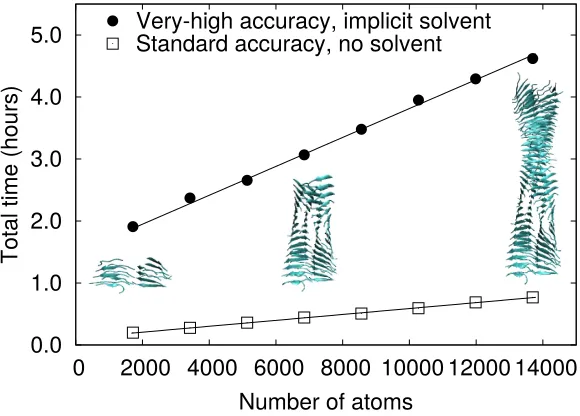
the requirements for biomolecular applications introduce over-and-above the normal demands of a DFT calculation, we show in Figure 1 two plots of the total execution time for single-point energy calculations using the ONETEP code on models of amyloid fibrils of a range of sizes, run on 3840 cores of the UK’s national supercomputer ARCHER. The size of the simulation cell was kept constant (80 × 80× 175 ˚A) as the size of the amyloid fibril model was varied.
The squares illustrate calculation times at relatively modest accuracy settings, namely support function radii of 7 a0, expanded in a psinc basis with a 600 eV energy cutoff, with kernel truncation at 20 a0, and no use of implicit solvent. The PBE generalised gradient approximation was used in all calculations [118]. These settings would be adequate for a preliminary investigation of the energy landscape, and total wall-time for an electronic structure calculation is very clearly linear with system size, and remains well under 1 hour even for a system of nearly 14,000 atoms. By contrast, when adjusting all settings to a level which produces high-accuracy forces (as described in Ref. [117]), namely 8a0 support function radii, 800 eV psinc cutoff, kernel truncation at 25 a0, and an implicit solvent description using a multigrid solver, there are two significant changes to the profile of time as a function of system size. Firstly, there is a constant offset, representing the computational time associated with the multigrid solver. Secondly, the slope is increased by a factor of around five compared to the coarser computational settings. However, recent work to extend the parallelisation via hybrid OpenMP/MPI parallelism means that these calculations can be scaled to many thousands of parallel cores [116], keeping the required wall-time within reasonable bounds.
2.2. Electrostatics and Implicit Solvation
In most functional proteins, one of the purposes of the protein structure is to encapsulate and protect a small number of sites from which the main functionality is derived, for example the active site of an enzyme. As such, the protein structure will have been tuned to optimise the function of this site. One of the ways a protein achieves this is by tuning the site’s immediate electrostatic environment, through the charges and dipole moments associated with each residue in the structure. It is therefore of the utmost importance in the simulation of biological molecules to include accurate treatment of long- and short-ranged electrostatics.
0.0 1.0 2.0 3.0 4.0 5.0
0 2000 4000 6000 8000 10000 12000 14000
Total time (hours)
Number of atoms
[image:18.612.150.440.87.295.2]Very-high accuracy, implicit solvent Standard accuracy, no solvent
Figure 1. Timings for total energy calculations using ONETEP, with in situ
optimisation of the NGWF representation, on amyloid fibril structures. Two sets of timings are shown: standard-accuracy total energy calculations (squares) with typical ONETEP parameters (see text for convergence parameters) which have been shown to be of accuracy comparable to a 6-311+G* GTO basis, and for high-accuracy settings (filled circles) equivalent to fully-converged plane-wave accuracy or cc-pVQZ with counterpoise corrections. Trendlines are shown of the formT(N) =AN+B for each case, with the majority of the increase inB for the high-accuracy settings being the result of the time required for applying the multigrid solver for Poisson’s equation in a large simulation cell. The structures were obtained with permission from the authors of Ref. [119] and were previously used for similar benchmarks in Ref. [14].
in most real cases it is necessary either to use explicit open boundary conditions or to truncate the Coulomb interaction if periodic boundary conditions are in use. Various “cutoff Coulomb” approaches have been studied and may be efficiently implemented for a range of geometries [120, 121, 122, 123, 124, 125, 126]. Open boundary conditions generally necessitate the use of a multigrid approach to the solution of the Poisson equation. It is important to note that in some cases the solution of the Poisson equation can become the computational bottleneck dominating the overall computational effort, particularly if its solution exhibits poor parallel scaling. Consequently, significant effort has been invested in optimising the solution of this problem [127].
Continuum Model (PCM) [128], the COSMO model [129], the SMD model [130], and the unified electrostatic and cavitation model of Scherlis et al. [131]. An adaptation of the latter by Dziedzic et al [132] has recently been demonstrated for application to entire proteins [133, 134].
2.3. Dispersion
Van der Waals interactions are generally understood to cover all attractive and repulsive forces between molecules or atoms that do not arise from a covalent bond or directly from electrostatic interactions [135]. While they are relatively weak compared to covalent bonds, they nevertheless account for a significant fraction of the total interaction energy between groups of atoms, particularly, for example, at protein-protein interfaces, or in lipid bilayers, or in non-bonded stacking interactions in DNA [136]. The most significant component in most cases is the so-called London dispersion force, a weak intermolecular force arising from the formation and interaction of instantaneous polarisation multipoles in molecules. Despite their widespread use, traditional semi-local functionals, including the local density approximation and popular generalised gradient approximations, such as PBE, are unable to capture the correct long-ranged tail of the dispersion interaction. A great deal of methodological research in recent years has therefore focused on developing appropriate approaches to correctly model dispersive interactions, and many of these are now approaching extremely high accuracy even for the intermolecular binding of large complexes [137]. These approaches can be categorised into a few main groups [138]: semi-empirical parameterised approaches based on interatomic C6 coefficients fit to reproduce the results of high-accuracy quantum chemistry calculations [139, 140], schemes that use ab initio methods based on the wavefunction or density around each atom to parameterise interaction terms [141, 142, 143], and fully-nonlocal functionals of the density, most notably those based on the van der Waals density functional (vdW-DF) approach [144, 145, 146].
Berland et al. recently reviewed the vdW-DF method [147], covering its applications to biology, notably to DNA [148, 149]. A crucial advance in making applications to large systems feasible was the discovery by Rom´an-P´erez and Soler that the fully-nonlocal (and henceO(N2)-scaling) expressions of the original formulation of vdW-DF could be re-expressed via interpolation of the integration kernel and fast Fourier transforms [146], reducing the scaling to O(NlogN).
effect on geometries. We can therefore expect, for example, theoretical spectroscopy to be quite accurate even if the direct effect of vdW interactions are neglected in the DFT calculation.
2.4. Strongly-Correlated Methods and Self-Interaction
Almost half of all enzymes associate with a metal in order to function [150]. Wherever this is the case, it must be assumed that there are specific electronic properties of the metal ion that are required for its function, otherwise organisms would not incorporate elements which are scarce and/or toxic. Often, in the case of partially-occupied d-subshells, this is their ability to exist in multiple oxidation and/or spin states.
For any quantitative computational studies of ligand binding or chemical reactions at metal sites, a quantum mechanical description of the metal centre is clearly required. However, standard DFT treatments of transition metal chemistry is often inadequate due to the strong electron correlation effects associated with the d orbitals. It is well-known that DFT suffers from self-interaction errors [151], which particularly affect the description of transition metal chemistry. There is an extensive literature on attempts to correct these closely-related issues, and many of the resulting approaches have been successfully carried over to large-scale biomolecular simulations.
The class of methods known as DFT+U attempts to use a corrective functional inspired by the Hubbard model to improve deficiencies of the standard DFT description [152, 153, 154]. In practice, DFT+U methods have the effect of penalising non-integer occupations of orbitals of a partially-filled correlated subspace such as the 3d electrons of a first-row transition metal. As such they improve upon the DFT description of both self-interaction and strong-correlation effects [155], at the expense of the introduction of an unknown parameter, though more recently methods to calculate this parameter from first principles have been developed [156]. The DFT+U method has been implemented in several of the codes discussed above, notably in ONETEP [157, 158] (applications of this combination of approaches will be discussed in Section 4.3), as well as in SIESTA, CP2K and other codes. An alternative, which in many cases has been shown to have a qualitatively similar effect to DFT+U is to use a hybrid functional incorporating a certain fraction of exact exchange, as this is known to improve the description of self-interaction effects. Popular examples include the B3LYP [159], HSE [160] and PBE0 functionals [161].
study of the role of quantum many-body effects in large systems [165].
2.5. Spectroscopy via Time-Dependent DFT
Absorption or emission of light, or more generally the properties of electronic excited states, play a vital role in many biomolecular processes. Most notable of these is of course photosynthesis, as well as vision, luminescence, and photo-induced damage to DNA and other biological molecules. As we have discussed in the context of ground state calculations, there are a wide range of possible methodologies that can be used for excited states, but the need to describe large system sizes imposes strong restrictions on what is feasible, in practice leaving only time-dependent forms of DFT (TDDFT) as viable options. Nevertheless, these come in several relevant forms: TDDFT can be performed in a real-time formalism [166], which explicitly propagates time to study dynamical processes, or it can be performed in the linear-response framework [167], whereby the dynamical response of a system to an excitation at a specific frequency is considered, so as to find the energies of specific excitations. Both approaches have found application within the field of modelling small-scale biological molecules such as individual DNA bases and base-pairs [168], structures such as porphyrin rings [169], and chromophores embedded in protein environments such as those found in pigment-protein complexes and fluorescent pigment-proteins [170]. Castro et al. have provided a review of theory and applications of TDDFT to biomolecules up to 2009 [169].
As discussed above in the context of ground-state energies, the majority of the field of TDDFT applied to larger biomolecules still utilises fragment-based or QM/MM descriptions of a small chromophore inside a host medium (such as the rest of the protein) described with approximate methods: as before, we will not cover such approaches within this review as they have been widely discussed elsewhere. Recently, however, there has been increasing availability of methodology for large-scale TDDFT calculations. Real space methods including Octopus [53] can be used for calculations of very large systems such as chlorophyll networks in pigment-protein complexes [171], as will be discussed in more detail in Section 4.4. Zuehlsdorff et al. developed an approach to enable linear-response TDDFT within the ONETEP large-scale DFT code [172, 173, 174], and demonstrated application to solvated chromophores and dye molecules embedded in explicit solvent [21]. Tretiak et al. and Challacombe have also developed linear-scaling approaches within the linear-response formalism [175, 176]. O’Rourke and Bowler, meanwhile, have demonstrated a real time, density matrix based approach to TDDFT within the CONQUEST approach [177]. This bears similarity to earlier work by Yam et al. [178].
charge-Figure 2. Difference in energy between the highest occupied molecular orbital (HOMO) and lowest unoccupied molecular orbital (LUMO) for a series of spherical water clusters of increasing radius [184]. In the standard simulation, the cluster is cut out of the bulk liquid. In the minimised simulation, the cluster first undergoes structural optimisation. Finally, in the implicit solvent calculation, the QM calculation is performed in a dielectric medium (= 80). Reproduced with permission from the Institute of Physics.
transfer character. This issue carries over to modelling large-scale biomolecules, where charge-transfer states are often expected to play an important role and are generally not well-described by semi-local functionals, requiring a portion of exact exchange, with an associated increase in computational effort.
3. Mind the Gap
Before we begin our review of the applications of DFT in biology, we first address a widely held misconception that pure exchange-correlation functionals (that is, those containing no Hartree-Fock exchange) cannot be applied to large system sizes. If correct, this would significantly hinder the study of biological molecules since computation of the Hartree-Fock energy is expensive due to its inherent non-locality and poor scaling with system and basis set size. The root of these beliefs was a series of observations reporting unphysical vanishing HOMO-LUMO gaps and poor self-consistent field (SCF) convergence in proteins [179, 180, 181, 182] and even water clusters [183]. SCF convergence issues were often attributed to the well-known under-estimation of the HOMO-LUMO gap by pure functionals.
[image:22.612.190.400.86.242.2]supercell of water has a clearly defined band gap of 4.2 eV (Figure 2, dashed line). The observed insulating behaviour of the bulk system thus indicates that there are no difficulties in applying pure functionals to large system sizes, but instead the vanishing HOMO-LUMO gap is caused by the creation of an artificial vacuum-water interface in cluster simulations.
Analysis of the electrostatic properties of a cluster of water molecules reveals a significant dipole moment that increases with system size up to around 75 D in the largest cluster studied [184]. This effect is due to unterminated hydrogen bonds at the surface-water interface and is entirely unphysical as, in reality, the surface water molecules would reorient to counteract the net dipole moment. In the simulation, however, the artificially imposed dipole moment has a significant effect on the electronic properties of the system. The local density of states (LDoS) computed as a function of the distance along the dipole moment vector shows a clear shift in electronic energy levels, with the electric field pushing some states higher in energy and some lower. The HOMO-LUMO gap vanishes when electronic states on opposite surfaces of the cluster coincide.
We therefore hypothesised that there is no inherent problem with the use of pure functionals in studying biological systems, but rather that SCF convergence problems are manifested in smaller system sizes than for hybrid functionals due to the formers’ inherently smaller HOMO-LUMO gap. Furthermore, we were able to make a number of practical suggestions for simulating cluster models of biological systems. Figure 2 shows that if the water cluster undergoes structural optimisation prior to electronic structure analysis, or if the analysis is run using an implicit solvent model, the expected HOMO-LUMO gap of around 4 eV is recovered. It has also been shown previously that embedding classical point charges outside the electron distribution has a similar effect [182]. In all three cases, the preparation method results in a more physical environment for the water cluster and screens the unrealistic dipole moment observed in vacuum simulations.
We have gone on to show that simulation of the electronic structure of proteins is also possible using the methods described here. In vacuum, all proteins studied, ranging in size from 75 to 1231 atoms, displayed vanishing HOMO-LUMO gaps. However, all of the gaps were recovered when the environment of the protein was modelled using either implicit or explicit solvent [184]. Thus, simulations of very large system sizes are fully feasible with Kohn-Sham DFT as long as the environment is modelled in a physical manner. Furthermore, similar concepts are extremely useful in spectroscopic analysis of cluster models. Time-dependent DFT simulations of chromophores in vacuum-terminated water clusters are problematic due to charge transfer to low-lying excited states at the vacuum-water interface [185, 186]. Zuehlsdorff et al. have shown that the use of an implicit solvent model greatly reduces spurious charge transfer states between the surface waters and the pigment which otherwise arise from the mechanism described above [21].
HOMO-LUMO gap in DFT simulations of large-scale biological molecules is a simple electrostatic artefact of the system preparation method, and may be trivially remedied by using an implicit solvent model [184]. We hope that this knowledge, in conjunction with the ever-expanding set of tools that is available for tackling such systems, encourages the community to further explore the wide biochemistry of living organisms.
4. Applications
In this section, we summarise applications in biology where large-scale DFT has made the greatest impact, due to the need for both large system sizes and quantum-mechanical detail in the description of bond-breaking, transition metals, electronic excitations, or intermolecular interactions.
4.1. Biomolecular Structure and Electronic Properties
A more complete picture of crambin and its interactions with its environment was recently obtained by modelling the periodic protein crystal structure, which contains two proteins in the repeating unit, along with different levels of lattice water solvation [194]. The crystal was modelled using the B3LYP hybrid functional and a 6-31G(d,p) basis set with Grimme’s empirical dispersion correction [139]. Both cell parameters and atomic coordinates were optimised for systems ranging in size from 1284 atoms (no added water molecules) to 1800 atoms (172 solvating water molecules). As expected, the fully hydrated system gives structural parameters in the best agreement with experiment. In this case, computed lattice parameters are around 3% smaller in every direction than experimental values, though this may be mostly attributed to the thermal expansion in the crystal structure which was collected at 290 K. Additional factors which should be noted are the neglect of zero point energy contributions in the simulations and over-binding due to basis set superposition error (BSSE), which may become significant for small basis sets. The root-mean-square deviations of the atomic positions relative to experiment were around 0.4 ˚A. As expected, α-helix and β-sheet secondary structures were better modelled than the random coil regions of the protein. The authors also computed crystal formation energies of the optimised structures. Of particular note here is that i) even in the fully solvated system, dispersion interactions play a significant role in protein-protein binding (37% of the formation energy); ii) before corrections, around 50% of the cohesive energy is due to spurious BSSE-driven attraction, which indicates that the model is still far from basis set convergence; iii) clathrate-like pentagonal rings were observed around hydrophobic residues indicating the possible importance of ordered water structures at the protein surface.
In order to ascertain the accuracy of ab initio methods for protein structure refinement, Kulik et al. studied a much larger benchmark set comprising 58 proteins ranging in size from 70 to 590 atoms [180]. The proteins were optimised using the TeraChem package [64] using both restricted Hartree-Fock (RHF) and the range-corrected ωPBEh density functional with basis sets up to a maximum size of 6-31G. Comparing the root-mean-square deviations between computed Cα positions and experiment, it is perhaps surprising to note that even the most accurate QM methods (around 0.7 ˚A RMSD) appear to be less accurate than MM force fields (0.6 ˚A RMSD). However, this may be rationalised by considering that MM force fields are extensively parameterised to produce “healthy” solution phase protein structures. The authors provide convincing evidence that the force field often predicts healthy structures even when the experiment suggests an unusual or disordered structure. In these cases, QM methods are likely to be more reliable. However, there is also room for improvement in the QM methods. Firstly, as discussed above in the case of the crambin crystal, the obtained geometries likely suffer from BSSE anomalies. Indeed, the smallest basis set studied suffers from an unusual deprotonation of amide nitrogen atoms. Secondly, the structural optimisations were performed in the gas phase, and so the obtained structures are likely to differ from the crystalline or solution phase structures.‡ To correct this
second issue, the authors also performed QM/MM simulations for a subset of 20 proteins embedded in a bath of classical point charges to represent the water medium. Protein solvation now eliminates the spurious amide backbone deprotonation and reduces the Cα RMSD to below 0.4 ˚A, which is a more encouraging result.
The first ab initio molecular dynamics simulation of an entire protein – bovine pancreatic trypsin inhibitor (BPTI) – was also performed using the TeraChem software [64]. Optimisation of the protein and crystal waters at the RHF/6-31G level resulted in a RMSD of 0.3 ˚A in the positions of the backbone atoms [195]. A molecular dynamics simulation of 8.8 ps was run treating the protein and six water molecules (900 atoms in total) at the RHF/STO-3G level and the rest of the solvent using a classical force field (i.e. a QM/MM simulation). Even with this relatively short equilibration time, the RMSD of the protein backbone showed signs of stabilising to a value of around 1.5 ˚A relative to the experimental structure. In order to investigate charge transfer at the protein-water interface, 88 geometries were extracted from the dynamics for further analysis at the RHF/6-31G and B3LYP/6-31G levels, now with every atom treated quantum mechanically (2634 atoms). On average, around 2.6 electrons were transferred to the protein from water, thus the net charge of the protein differs significantly from its putative charge of +6 e assigned using standard pH rules. The charge transfer is even larger for B3LYP which may be due to the tendency of DFT to delocalise electrons. In the gas phase, there is a strong intra-protein charge transfer, whereby neutral residues donate around 1 e in total to charged residues. Adding water neutralises the excess of positive charge on the neutral residues and releases polarisation stress in the protein. Thus, as well as demonstrating the feasibility of ab initio MD of entire proteins, these simulations also highlight a potentially important role for biological water [195].
It is particularly interesting to study the properties of proteins whose electronic structure is expected to play a specific role in their function. Feliciano et al. study the electronic structure of a small α-helical peptide (known as a pilin) belonging to the bacterium Geobacter sulfurreducens [196]. Filaments formed by these peptides are conductive and seem to play a role as the electronic conduits between the cell and extracellular electron acceptors. QM single point calculations were performed on solvated pilin structures (comprising 4580 atoms) using the SIESTA code [55] with the PBE exchange-correlation functional and a DZP basis set. The authors observed a biphasic charge distribution along the length of the helix (positive potential in the mid-region, and negative at the two termini). This in contrast to a polyalanine helix, which displayed a relatively flat charge distribution due to solvent screening of the permanent dipole of the helical backbone. This different electrostatic behaviour is also reflected in the computed HOMO-LUMO gaps which are around 1 eV and 3 eV for the pilin and polyalanine respectively, which is consistent with the filament’s role in electron transport. The QM calculations indicate that the closing of the gap is due to specific amino acid motifs, in particular positively charged residues, that localise the HOMO
in the mid-region of the helix. Interestingly, both the HOMO and LUMO have weight in regions containing aromatic tyrosine residues, which have particularly low oxidation potentials and which may aid hopping of electrons under thermal fluctuations [196].
Similarα-helical structural motifs are found in ion channels, whose function it is to regulate the flow of ions across the cell membrane. Large-scale DFT calculations may be particularly important here, since ion permeation is expected to be strongly dependent on the electrostatic potential, which is difficult to model for confined ions with MM force fields in the absence of electronic polarisation. Todorovi´c et al. use the CONQUEST software [59, 2] to investigate the structural and electronic properties of the gramicidin A ion channel [106]. It is one of the simplest ion channels (552 atoms) and has an unusual structure in which all peptide side chains face outwards towards the membrane. Despite this simple structure, it is selective for monovalent cations and shows no measurable permeability for anions or polyvalent cations [197]. Optimised structures of the channel in vacuum, using the PBE exchange-correlation functional, are in good agreement with experiment (RMSD of 0.20 ˚A in the positions of the backbone atoms). Interestingly, the substitution of tryptophan (Trp) residues with non-polar phenylalanine has been shown experimentally to reduce the ion permeation rate [198], even though the Trp sidechain is not located along the channel axis. However, large-scale DFT calculations reveal that the electrostatic potential inside the gramicidin A ion channel is identical (to within 1 meV) to that of a hypothetical polyalanine tube [106]. Thus, it seems that the effect of the Trp side chains is a more subtle one that may only be revealed by studying dynamical interactions with the lipid membrane and solvent.
(an electron/hole in an empty/filled band coupled to a lattice distortion) hopping in DNA of 0.15 eV in good agreement with experiment (0.12 eV [202]). Meanwhile, subsequent studies of wet DNA tetramers found that water is able to dope DNA if it is able to enter the structure at structural defect sites [203].
Summary: The studies reviewed in this section have played an important role
in demonstrating the feasibility of determining not only the electronic, but also the structural, properties of biological macromolecules. In this respect, an average optimisation step for the largest studied system in the aforementioned crambin study (1800 atoms) required around 23 minutes on 1920 cores of a Cray Cascade XC40 supercomputer [194]. The same authors also report timings of 3 hours for a 4575 atom model ofγ-chymotrypsin on the same machine [194]. Meanwhile the authors of the BPTI study showed that single point calculations for a 2634 atom system may be performed in under 3 hours on a single desktop machine with eight GPUs [195]. We caution, however, that care must be taken to accurately represent the surrounding environment (Section 3) and further investigation of the convergence of structural properties with basis set size are needed to avoid spurious artefacts and establish large-scale DFT as the benchmark of choice for these systems.
4.2. Enzymes
Due to their extraordinary ability to catalyse biochemical reactions with high specificity and under mild, physiological conditions, enzymes have been the subject of intense computational scrutiny since the pioneering works of Warshel and Levitt in the 1970s [204]. Computational studies have a particularly important role to play in this field, because the transition state of the chemical reaction has a very short lifetime and, hence, is difficult to characterise experimentally. As well as providing information on the structure of the transition state, computation also has the potential to validate proposed reaction mechanisms, balance various contributions to the catalytic effect and discern the roles of active site residues [205, 206]. Armed with this knowledge, researchers have been able to interpret and predict the effects of mutagenesis [206], design transition state analogues as potent enzyme inhibitors [207], predict the factors that control drug metabolism in vivo [208], and even design new enzymes [209].
Figure 3. Optimised structures of (a) chorismate, (b) the transition state and (c) prephenate in the chorismate mutase enzyme using large-scale DFT calculations [212].
Reproduced with permission from the American Chemical Society.
focus on two recent examples of the application of large-scale DFT to computational enzymology.
4.2.1. Chorismate Mutase. Over the past few decades, a number of enzymes,
functional augmented by empirical dispersion corrections [140]. Transition state (TS) optimisation was performed using a linear and quadratic synchronous transit pathway algorithm (LST/QST) with conjugate gradient optimisation [220].
An important consideration when planning large-scale DFT calculations with structural optimisation is not only the scaling of the QM calculation with system size, but also the rapid increase in the number of evaluations of the potential energy surface that are required to find the minimum energy structure [221]. We have found that for enzymology applications optimising an inner ‘mobile’ region within a fixed outer region improves the tractability of the problem whilst retaining the scaffold and electrostatic environment of the surrounding protein. However, it is important to show that the computed properties of the system are converged with respect to the size of these optimisation regions. For the chorismate to prephenate reaction in the enzyme, we investigated system sizes ranging from 900 to 1900 atoms and mobile regions from 100 to 200 atoms. The maximum change in the computed activation energy barrier and reaction energy was just 0.3 kcal/mol, indicating convergence of the energetics of the system with respect to the size of the computational model.
Figure 3 shows the optimised RS, TS and PS geometries in chorismate mutase. It is important to note that no information regarding the structure of the transition state or any reaction coordinate was fed into the calculations; the transition-state searching algorithm used only the RS and PS structures as input. After averaging over five reaction pathways to account in an approximate manner for temperature effects, we found that the chorismate mutase enzyme reduces the barrier height by 10.5 kcal/mol relative to water, which is in good agreement with experiment (8.0 kcal/mol [218, 216]). The small discrepancy is likely dominated by the use of the PBE functional to describe bond-breaking. Future studies will examine the stability of the results with respect to changes to the exchange-correlation functional.
Finally, as well as reproducing experimental data, it is important to also use large-scale DFT calculations to extract insight into the catalytic mechanism. To this end, we have performed natural bond orbital analysis [222, 223, 224] to estimate the contribution of each active site residue to enzymatic rate enhancement [212]. It was found that significant orbital overlap between the substrate and a number of charged active site residues act to stabilise the transition state (relative to the reactant and product states). This picture is supported by a previous study, which demonstrated the importance of electrostatic interactions in the active site to TS stabilisation in chorismate mutase [225].
4.2.2. Acetylcholinesterase. In most enzymatic applications employing large QM
![Figure 2.Difference in energy between the highest occupied molecular orbital(HOMO) and lowest unoccupied molecular orbital (LUMO) for a series of sphericalwater clusters of increasing radius [184]](https://thumb-us.123doks.com/thumbv2/123dok_us/9468231.453241/22.612.190.400.86.242/dierence-occupied-molecular-unoccupied-molecular-sphericalwater-clusters-increasing.webp)
![Figure 3. Optimised structures of (a) chorismate, (b) the transition state and (c)prephenate in the chorismate mutase enzyme using large-scale DFT calculations [212].Reproduced with permission from the American Chemical Society.](https://thumb-us.123doks.com/thumbv2/123dok_us/9468231.453241/29.612.107.490.88.224/structures-chorismate-transition-prephenate-chorismate-calculations-reproduced-permission.webp)
![Figure 4. Computational models of haem [229]. Iron and Oand red spheres. (right) The myoglobin protein, with the 53 residues modelled in ourlarge-scale DFT simulations shown in green.2 are shown as orange Reproduced with permission fromthe American Chemical Society.](https://thumb-us.123doks.com/thumbv2/123dok_us/9468231.453241/32.612.102.490.88.225/computational-myoglobin-residues-simulations-reproduced-permission-american-chemical.webp)

![Figure 6. (a) Free energy cycle employed in Refs. [267, 268, 269, 270]. The totaland complex (∆binding free energy (∆G) is given by the sum of the gas phase binding free energy(∆Gg) and the relative solvation free energies of the receptor (red), ligand (ye](https://thumb-us.123doks.com/thumbv2/123dok_us/9468231.453241/37.612.86.508.103.244/figure-employed-totaland-complex-relative-solvation-energies-receptor.webp)
![Figure 7.The protein–protein interface between RAD51 (grey) and the BRC4repeat [276].](https://thumb-us.123doks.com/thumbv2/123dok_us/9468231.453241/39.612.215.393.92.251/figure-protein-protein-interface-rad-grey-brc-repeat.webp)