University of Warwick institutional repository:
http://go.warwick.ac.uk/wrap
A Thesis Submitted for the Degree of PhD at the University of Warwick
http://go.warwick.ac.uk/wrap/57550
This thesis is made available online and is protected by original copyright.
Please scroll down to view the document itself.
U N
IV
ER
SITAS WARWICEN
SIS
Supporting cooperation and coordination in
open multi-agent systems
by
Henry Philip William Franks
A thesis submitted to The University of Warwick
in partial fulfilment of the requirements
for admission to the degree of
Doctor of Philosophy
Department of Computer Science
The University of Warwick
AUTHOR:Henry Philip William Franks DEGREE:Ph.D.
TITLE:Supporting cooperation and coordination in open multi-agent systems
DATE OF DEPOSIT: . . . .
I agree that this thesis shall be available in accordance with the regulations governing the University of Warwick theses.
I agree that the summary of this thesis may be submitted for publication.
I agree that this thesis may be photocopied for study purposes only.
Theses with no restriction on photocopying will also be made available to the British Library for microfilming. The British Library may supply copies to individuals or libraries. subject to a statement from them that the copy is supplied for non-publishing purposes. All copies supplied by the British Library will carry the following statement:
“Attention is drawn to the fact that the copyright of this thesis rests with its author. This copy of the thesis has been supplied on the condition that anyone who consults it is understood to recognise that its copyright rests with its author and that no quotation from the thesis and no information derived from it may be published without the author’s written consent.”
AUTHOR’S SIGNATURE: . . . .
USER’S DECLARATION
1. I undertake not to quote or make use of any information from this thesis without making acknowledgement to the author.
2. I further undertake to allow no-one else to use this thesis while it is in my care.
DATE SIGNATURE ADDRESS
. . . .
. . . .
. . . .
. . . .
Cooperation and coordination between agents are fundamental processes for
in-creasing aggregate and individual benefit in open Multi-Agent Systems (MAS).
The increased ubiquity, size, and complexity of open MAS in the modern world
has prompted significant research interest in the mechanisms that underlie
co-operative and coordinated behaviour. In open MAS, in which agents join and
leave freely, we can assume the following properties: (i) there are no centralised
authorities, (ii) agent authority is uniform, (iii) agents may be heterogeneously
owned and designed, and may consequently have conflicting intentions and
in-consistent capabilities, and (iv) agents are constrained in interactions by a
com-plex connecting network topology. Developing mechanisms to support
cooper-ative and coordinated behaviour that remain effective under these assumptions
remains an open research problem.
Two of the major mechanisms by which cooperative and coordinated
be-haviour can be achieved are (i) trust and reputation, and (ii) norms and
con-ventions. Trust and reputation, which support cooperative and coordinated
behaviour through notions of reciprocity, are effective in protecting agents from
malicious or selfish individuals, but their capabilities can be affected by a lack of
a population adopts, (ii) how to exploit knowledge of the underlying network
structure to improve mechanism efficacy, and (iii) how conventions might be
manipulated in the middle and latter stages of their lifecycle, when they have
become established and stable.
In this thesis, we address these issues and propose a number of techniques
and theoretical advancements that help ensure the robustness and efficiency
of these mechanisms in the context of open MAS, and demonstrate new
tech-niques for manipulating convention emergence in large, distributed populations.
Specifically, we (i) show that gossiping of reputation information can mitigate
the detrimental effects of incomplete information on trust and reputation and
re-duce the impact of network structure, (ii) propose a new model of conventions
that accounts for limitations in existing theories, (iii) show how to
manipu-late convention emergence using small groups of agents inserted by interested
parties, (iv) demonstrate how to learn which locations in a network have the
greatest capacity to influence which convention a population adopts, and (v)
show how conventions can be manipulated in the middle and latter stages of
Many people have, over the years, given me a great deal of advice, support and
friendship, and without their generosity I would neither have completed this
thesis nor consider my PhD years as the most rewarding and interesting years
of my life.
First and foremost, I would like to acknowledge my research supervisor
Nathan, who has had invaluable input into my work and has worked tirelessly
to teach and support me. Certainly, his contribution to this thesis is the most
significant of all those who have helped me.
I am also indebted to Sarab and Arshad, who have contributed a great
deal of advice and discussion to various parts of my research. Their input
greatly enriched my research and it is my great pleasure to acknowledge their
contribution.
My time as a postgraduate student in the Department of Computer Science
would not have been nearly as wonderful without the friendship of everyone
there, and I would particularly like to thank Matthew for always providing a
listening ear and sound advice.
I would also like to offer special thanks to Kate, who selflessly supported
I reserve a special vote of thanks for Owain Franks and Ben Jones, for
This thesis is presented in accordance with the regulations for the degree of
Doctor of Philosophy. It has been composed by the author and has not been
submitted in any previous application for any degree. The work described in
this thesis has been undertaken by the author except where otherwise stated.
The work presented in this thesis is based on the following publications:
• Franks, H.P.W., Griffiths, N. and Jhumka, A. (2010) Image Scoring in
Ad-Hoc Networks: An Investigation on Realistic Settings. In: 8th European
Workshop on Multi-Agent Systems, Paris, France.
The work presented in this publication appears in Chapter 3.
• Franks, H.P.W., Griffiths, N. and Jhumka, A. (2012) Robust reputation
in decentralized markets. In: ACM EC 2012 Workshop on Incentives and
Trust in E-Commerce, Valencia, Spain.
The work presented in this publication appears in Chapter 3.
• Franks, H.P.W., Griffiths, N. and Jhumka, A. (2012) Manipulating
conven-tion emergence using influencer agents. Autonomous Agents and
Multi-Agent Systems, Doi: 10.1007/s10458-012-9193-x
national Conference on Autonomous Agents and Multiagent Systems, To
Appear.
Agents abbreviations
MAS Multi-Agent System
P2P Peer-to-Peer
T&R Trust and Reputation
IS Image Scoring
IA Influencer Agent
Network abbreviations
LO Lowest Overlap
HO Highest Overlap
AO Average Overlap
HEE Highest Edge Embeddedness
LEE Lowest Edge Embeddedness
AEE Average Edge Embeddedness
ASPL Average Shortest Path Length
AND Average Neighbour Degree
LCC Local Clustering Coefficient
BFS Breadth-First Search
SNS Snowball Sampling
RW Random Walk
MHRW Metropolis-Hastings Random Walk
Abstract iii
Dedication v
Acknowledgements vi
Declarations viii
Abbreviations x
List of Figures xxiv
List of Tables xxx
1 Introduction 1
1.1 Open Multi-Agent Systems . . . 2
1.2 Supporting cooperative and coordinated behaviour . . . 3
1.2.1 Norms and conventions . . . 4
1.2.2 Trust and reputation . . . 4
1.3 Local interactions and information propagation . . . 5
1.7 Structure of the thesis . . . 9
2 Background and related work 11 2.1 Cooperative and coordinated behaviour . . . 12
2.1.1 Coordination . . . 12
2.1.2 Cooperation . . . 12
2.1.3 The importance of local interactions . . . 15
2.2 Trust and reputation . . . 16
2.3 Norms and conventions . . . 17
2.3.1 Online and offline generation . . . 19
2.3.2 The El-farol bar problem and sub-conventions . . . 20
2.3.3 Norms . . . 21
2.4 Case Study Scenarios . . . 22
2.4.1 Scenario 1: distributed resource-limited domains . . . 22
2.4.2 Scenario 2: social networking and media . . . 23
2.4.3 Scenario 3: Peer-to-Peer (P2P) systems . . . 24
2.5 Conclusions . . . 25
3 Trust, Reputation and Gossiping 26 3.1 Introduction . . . 27
3.2 Background . . . 28
3.2.1 Trust and reputation . . . 28
3.2.2 Image scoring . . . 30
3.2.3 Gossiping . . . 32
3.3 Incorporating gossiping into image scoring . . . 33
3.3.1 Image scoring model . . . 33
3.3.2 Observability of interactions . . . 34
3.3.3 Reproducing the population . . . 35
3.5 Results and discussion . . . 40
3.5.1 Incomplete information due to high interaction rate . . . 40
3.5.2 Effect of network structure . . . 43
3.5.3 Incomplete information due to low interaction rate . . . . 47
3.5.4 Larger population sizes . . . 49
3.5.5 Introducing gossiping . . . 50
3.5.6 Gossiping without observation of interactions . . . 54
3.5.7 Gossiping with high cost of cooperation . . . 56
3.6 Conclusions . . . 57
4 Conventions 61 4.1 Introduction . . . 62
4.2 The foundations of conventions . . . 63
4.2.1 The role of expectations . . . 64
4.2.2 The convention life cycle . . . 66
4.3 Perspectives on conventions . . . 68
4.3.1 Conventions in agent systems . . . 68
4.3.2 Lewis’ analysis of convention . . . 70
4.3.3 Convention research in other fields . . . 73
4.3.4 The convention life cycle revisited . . . 77
4.3.5 Illustrative examples . . . 78
4.4 Interaction formalism . . . 79
4.4.1 Dimensions . . . 81
4.4.2 Roles . . . 82
4.4.3 Interactions . . . 85
4.4.4 Interaction regime . . . 86
4.4.5 Agent memory . . . 87
4.5.1 Motivating arguments . . . 91
4.5.2 Basic definitions . . . 92
4.5.3 Agent adherence and membership . . . 92
4.5.4 Convention membership sets . . . 94
4.5.5 Support of conventions . . . 96
4.5.6 Quality and stability of conventions . . . 98
4.5.7 Linking connection topology with conventions . . . 100
4.6 Conclusions and further work . . . 102
5 Manipulating conventions using Influencer Agents 105 5.1 Introduction . . . 106
5.2 Influencer Agents . . . 107
5.3 Strategies for IAs . . . 110
5.4 Experimental setup . . . 112
5.4.1 Interaction regime . . . 115
5.4.2 Roles, dimensions and observability . . . 119
5.4.3 Network topology . . . 120
5.4.4 Metrics . . . 121
5.4.5 Simplifying assumptions . . . 122
5.4.6 Configuration . . . 123
5.4.7 Differences from Salazaret al.. . . 123
5.5 Results and discussion . . . 123
5.5.1 Convention emergence without Influencer Agents . . . 124
5.5.2 The effect of network topology without Influencer Agents 126 5.5.3 Introducing IAs . . . 135
5.5.4 Inserting agents versus inserting conventions . . . 138
5.5.5 Effect of position of IAs in the network . . . 144
6 Determining agent influence 156
6.1 Introduction . . . 157
6.2 Background . . . 158
6.2.1 Influence propagation . . . 158
6.3 Methodology for learning influence . . . 160
6.3.1 Selecting representative node samples . . . 162
6.4 Topological metrics . . . 163
6.4.1 Metrics . . . 163
6.4.2 Computational tractability . . . 168
6.5 Network sampling . . . 170
6.5.1 Network sampling techniques . . . 171
6.5.2 Technique efficacy . . . 173
6.6 Experimental setup . . . 178
6.6.1 Language coordination domain . . . 179
6.6.2 Coordination game domain . . . 180
6.7 Results . . . 181
6.7.1 Targeting IAs using individual metrics . . . 181
6.7.2 Targeting IAs using learnt models . . . 183
6.7.3 Targeting IAs in the coordination game domain . . . 186
6.7.4 Using learnt models in other domains . . . 190
6.7.5 Deriving the properties of an ideal influence metric . . . . 192
6.8 Conclusions and further work . . . 193
7 Manipulating established conventions 195 7.1 Introduction . . . 196
7.2 Background . . . 198
7.2.1 Network structure . . . 198
7.2.2 Manipulating conventions . . . 199
7.5.1 Baseline behaviour . . . 207
7.5.2 Configuration 1: static population with no pre-existing conventions . . . 211
7.5.3 Configuration 2: static population with pre-existing con-ventions . . . 217
7.5.4 Configuration 3: time-varying population with pre-existing conventions . . . 218
7.6 Conclusions . . . 221
8 Discussion and conclusions 223 8.1 Contributions . . . 224
8.2 Directions for future research . . . 228
8.3 Final remarks . . . 231
A Network structures 233 A.1 Introduction . . . 233
A.2 Network concepts . . . 235
A.2.1 Basic definitions . . . 235
A.2.2 Global graph properties . . . 237
A.2.3 Metrics of topological location . . . 240
A.2.4 Network structures . . . 241
A.3 Issues in topological research . . . 243
A.3.1 Dynamism of networks . . . 243
A.3.2 Impact of network structure in MAS . . . 244
A.3.3 Synthetic networks . . . 245
A.3.4 Sampling real-world networks . . . 247
B.1.1 Model description . . . 252
B.2 Walker and Wooldridge’s convention emergence . . . 254
B.2.1 Model description . . . 255
B.3 Payoff based on agent interaction history . . . 258
B.3.1 Model description . . . 258
B.4 Illustrative comparative analyses . . . 259
B.5 Summary . . . 262
1.1 Illustration depicting conceptual organisation of research topics
for cooperative and coordinated behaviour in open MAS. . . 5
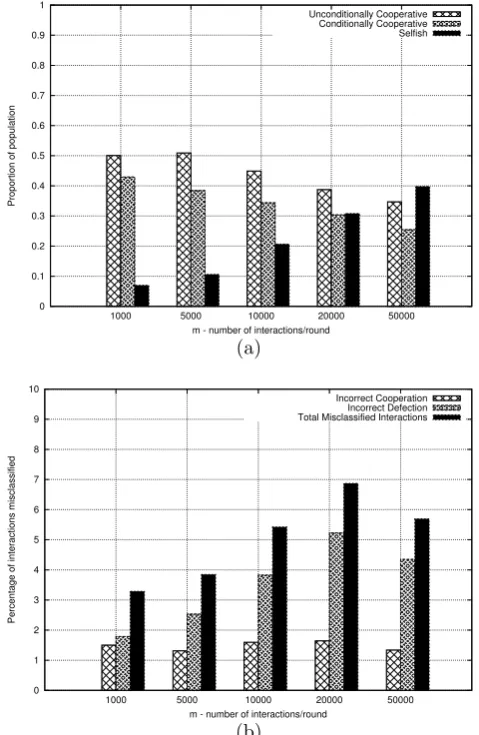
3.1 (a) Strategy classifications and (b) levels of misclassified
interac-tions, using a completely connected topology, for n = 100, o =
0.1, µ= 0.001, while varying m. Both the proportion of
selfish-ness in the population and the levels of misclassified interactions
rise with greater numbers of interactions. . . 41
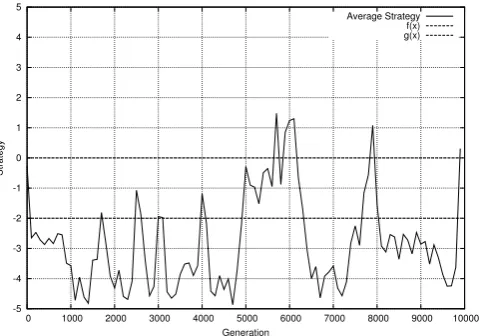
3.2 Average strategy over time, sampled every 100 generations, for
m = 1000, for a representative run from Figure 3.1. In this
run, the population is predominantly cooperative, and the cycles
in agent strategy are clearly visible. The population does not
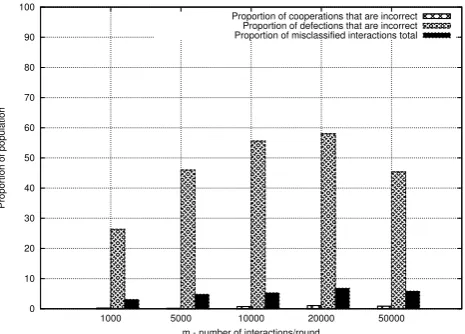
that are incorrect is the number of interactions in which the donor
donated incorrectly divided by the total number in which the
donor donated (as opposed to divided by the total number of
interactions for the donor). . . 44
3.4 (a) Strategy classifications and (b) levels of misclassified
inter-actions, using a random topology, varying p, with m = 1000.
Results are given forn= 100, o= 0.1, andµ= 0.001. . . 45
3.5 (a) Strategy classifications and (b) levels of misclassified
inter-actions, for scale-free topology, varying m, using 1000 edges in
total, and with all other settings as Figure 3.4. . . 45
3.6 Comparison of population strategy distribution over 4 classes of
topology: Completely Connected (CC), Scale-Free (SF), Random
(Ran), and Small World (SW), using m = {125,300} and n =
100. There are clear differences in population behaviour between
topological classes, with scale-free being particularly conducive to
selfish behaviour. Small-world networks appear highly supportive
of cooperative behaviour, which may be due to the effects of
clustering. . . 48
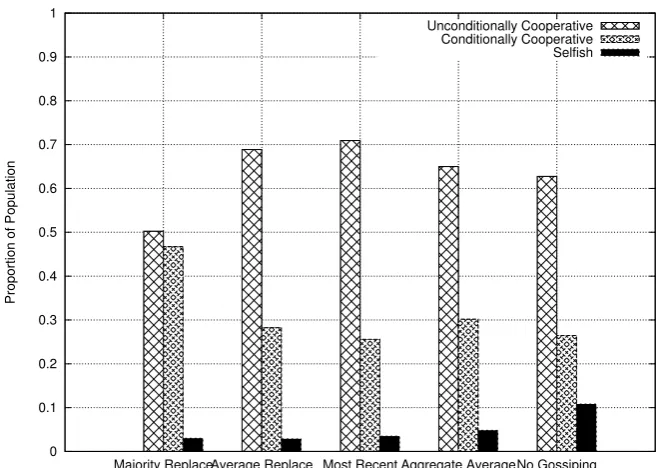
3.7 Strategy distribution using gossiping withm= 1000, on a
scale-free network with 1000 edges, while varying the update rule that
agents use to update their image score from received gossips. All
of the aggregation rules support a drop in selfish behaviour. . . . 52
3.8 The population strategy distribution when neighbours cannot
ob-serve interactions with either gossiping (ogp= 1) or no gossiping
(ogp= 0), forn= 100, and averaged over all networks and
(ogp = 0), for n = 1000, and averaged over all networks and
network samples. . . 56
3.10 Population strategy distribution while increasing the cost of
coop-eration for populations with no gossiping, averaged across all
net-work topologies. Results are given form= 1000, o= 0.1, µ= 0.001. 57
3.11 Population strategy distribution while increasing the cost of
coop-eration for populations which gossip, averaged across all update
rules and network topologies. Results are given form= 1000, o=
0.1, µ= 0.001. . . 58
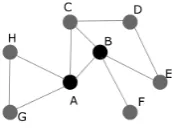
4.1 Example showing how the observation set is determined. Here,
all agents except D are considered observers of the interaction
between agents A and B, since they are connected to at least one
of the participants. . . 88
5.1 Illustration of a lexicon and a simple communication action. . . . 114
5.2 (a) Average communicative efficacy, and (b) dominant
conven-tion membership using a scale-free topology with 1000 agents
and 10000 edges, with varying proportions of elitist and random
lexicon update strategies in the population. Elitist strategies
re-sult in significant gains in coordination levels and convergence
time. . . 125
5.3 Average communicative efficacy for a population of 1000 (a)
ran-dom selection and (b) elitist selection strategy agents while
vary-ing the total number of edges in a scale-free topology. . . 127
5.4 Average communicative efficacy for 100% elitist and 100%
ran-dom lexicon selection populations on small-world networks while
while varying the Clustering Exponent (CE) and (b)
compara-ble scale-free and small-world networks. . . 129
5.6 Distribution of agent lexicon groups at t = 1000, 10000, 50000,
and 100000, using a fully elitist population of 1000 agents
situ-ated on a scale-free topology with 10000 edges. The scales of the
axes change between graphs for clarity of illustration. Figures are
ordered in time from left to right and top to bottom. A single
lexicon quickly emerges with the majority of individuals
adher-ing; the remaining agents are split between fragmented groups of
largely homogeneous size. . . 131
5.7 Visualisation of group growth of the most dominant lexicon (by
the end of the simulation) for a typical run at t = 250, 10000,
50000 and 100000 on a scale-free network. Agents using the
lexi-con in question are plotted dark, and their direct neighbours are
plotted light. No other agents are plotted. Edges between two
directly connected agents using the dominant lexicon are plotted
dark. Figures are ordered in time from left to right and top to
bottom. . . 132
5.8 (a) Average communicative efficacy, and (b) dominant convention
membership for varying proportions of IAs that are initialised
with same high quality lexicon. Results are shown for a
scale-free network topology with 10000 edges. The non-IA population
is entirely elitist. IAs result in moderate increases in coordination
with same high quality lexicon. Results are shown for a
scale-free network topology with 10000 edges. The non-IA population
is entirely elitist. . . 139
5.10 (a) Average communicative efficacy and (b) dominant convention
membership for varying proportions of IAs that are initialised
with same high quality lexicon. Results are shown for a
small-world network topology. The non-IA population is entirely elitist. 140
5.11 (a) Average communicative efficacy, and (b) dominant convention
membership for varying proportions of agents initialised with the
same high quality lexicon. Results are shown for a scale-free
network topology with 10000 edges. . . 142
5.12 Average communicative efficacy for varying proportions of agents
given a high quality lexicon at the start of the simulation, situated
on a small-world network topology. . . 144
5.13 (a) Average communicative efficacy, and (b) dominant
conven-tion membership for varying proporconven-tions of IAs when placed in
the network by node degree. Results are shown for a scale-free
network topology with 10000 edges. The non-IA population is
entirely elitist. . . 147
5.14 (a) Average communicative efficacy, and (b) dominant convention
membership for varying proportions of IAs when placed in the
network by node degree. Results are shown for a small-world
network topology. The non-IA population is entirely elitist. . . . 148
5.15 Number of agents using most common lexicon on scale-free
topol-ogy with 1000 agents and 10000 edges, while varying proportion
of IAs. In (a) IAs are given the same random (and therefore,
on average, poor quality) lexicon, whereas in (b) IAs are given
the same random lexicon. . . 151
6.1 Degree distribution of an Enron-SNS network sample, where the
dotted lines denote the boundaries of each bucket when applying
our stratified sampling technique. . . 163
6.2 Structure of an example network sample produced by (a)
Snow-ball sampling (SNS) and (b) MHRW sampling. . . 175
6.3 Correlation of HEE, EC, and HITS with node degree in an
ex-ample arXiv-SNS network sex-ample. . . 183
6.4 Predicted influence for each node in an example SNS sample from
the arXiv network. Less than 10% of the individuals in the
net-work account for almost all of its influence. . . 187
7.1 Membership counts for the top 5 strategies on (a) EU-Email-SNS
and (b) Gnutella-SNS networks, and (c) arXiv-SNS, usingα= 0.5.208
7.2 Membership counts for the top 5 strategies on arXiv-SNS with
no agent exploration, andα= 0.5. . . 209
7.3 Figure showing membership counts for the top 5 strategies on
arXiv-SNS with (a)α= 0 and (b)α= 1. . . 210
7.4 Membership counts for each strategy on the arXiv-MHRWDA
sample with one agent randomly reset every timestep, α = 1.
There is a much greater variability in convention membership,
with lower average membership counts, allowing IAs greater
2.1 Payoff matrices for the (a) coordination game and (b) Prisoner’s
Dilemma. . . 12
3.1 Selfish proportion of population (S) and Percentage of
Incor-rect interactions (IP) for Completely Connected (CC), Scale Free
(SF), Small World (SW) and Random (Ran) networks while
vary-ingm, whenn= 100. All other parameters are as Figure 3.1. . 43
3.2 Strategy distribution for various scale-free and small-world
net-works. UC is Unconditionally Cooperative, CC is Conditionally
Cooperative, and S is Selfish. CE is the Clustering Exponent,
n= 1000, andm= 1000. Results are given foro= 0.1, µ= 0.001. 49
3.3 Comparison of the average proportion of selfish agents in the
population for the runs in Figure 3.6, when agents either do not
gossip (i.e. when ogp = 0) or gossip using the Average Replace
Aggregate Average (AA), Average Replace (AR), Majority
Re-place (MR), or Most Recent (Mrec)). Results are shown for
ogp= 1, n= 1000, andm= 1000. . . 51
4.1 Payoff matrices for the social dilemma (a) and coordination game
(b). . . 78
4.2 Basic notation used in our formalism for describing open MAS
models concerned with convention emergence. . . 80
4.3 Model level concepts and notation used in our formalism for
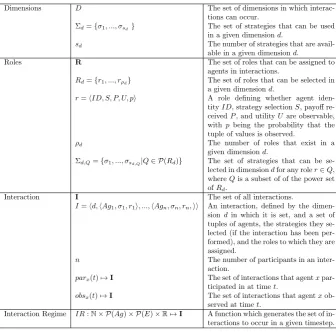
de-scribing open MAS models concerned with convention emergence. 85
4.4 Agent level concepts and notation used in our formalism for
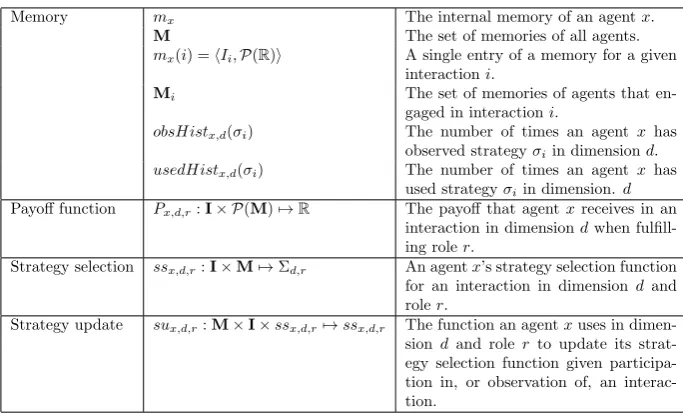
de-scribing open MAS models concerned with convention emergence. 90
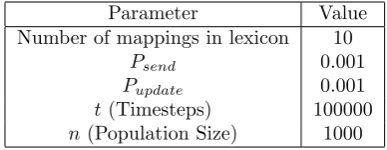
5.1 Default parameters used for the simulation configuration. . . 122
5.2 Number of groups (n) of size (s), and average communicative
efficacy (ACE), at various timesteps (presented as n×s), for
a fully elitist population of 1000 agents situated on a scale-free
topology with 10000 edges. . . 130
5.3 Statistical significance resulting from a t-test of the levels of
domi-nant convention membership exhibited with different proportions
of IA or HQ agents, with α = 0.05, where • represents
non-significant differences, and◦significant differences. . . 143
5.4 Statistical significance resulting from a t-test of the average
com-municative efficacy exhibited with different proportions of IA or
HQ agents, with α = 0.05, where • represents non-significant
portion of IAs inserted by highest node degree on a small-world
network topology. . . 146
5.6 Number of groups (n) of size (s) at various timesteps (presented
as n×s) for representative bad, average, and good runs, for an
IA proportion of 0.05 inserted randomly on a scale-free network
topology with 10000 edges. IAs are given the same random, and
therefore poor quality, lexicon. . . 153
6.1 Correlation between estimated centrality using Gregory’s h-betweenness
concept and actual centrality, for Betweenness Centrality (BC),
and applying the technique to Eigenvector Centrality (EC) and
Closeness Centrality (CC), averaged over 15 networks for each
sampling technique (see Section 6.5 for more details). . . 169
6.2 Computational and information requirements for the calculation
of each metric that we hypothesise might predict node influence. 170
6.3 Important global metrics for network samples produced by
apply-ing each samplapply-ing technique to the Gnutella network, averaged
over 15 repeats. Standard deviation is in brackets. . . 176
6.4 Important global metrics for network samples produced by
ap-plying each sampling technique to the Enron network, averaged
over 15 repeats. Standard deviation is in brackets. . . 177
6.5 Important global metrics for network samples produced by
ap-plying each sampling technique to the arXiv network, averaged
Standard deviation is in brackets. For the Eppstein networks,
the number annotation after Eppstein indicates the number of
edges. For the Kleinberg networks, the “-c” annotation indicates
the additional number of extra connections (a parameter to the
algorithm) that was used to generate the network. . . 177
6.7 Payoff structure for the 10-action coordination game. . . 180
6.8 Average lexicon similarity and number of wins for placing a
sin-gle fixed-strategy agent (IA) either at a location maximising one
of the chosen metrics or randomly. The best performing
place-ment strategies are in bold. In the Kleinberg networks, the “CE”
annotation indicates the clustering exponent (a parameter of the
algorithm) used to generate the network. . . 184
6.9 Correlation of each learnt model with measured influence, using
separate training and test data, over each class of network sample
and learnt on both random and stratified node sampling. Bolded
entries indicate the highest correlation for that network sample. . 186
6.10 Average lexicon similarity and normalised number of wins when
placing an IA at a location chosen by the predictive models. The
best performing placement strategies are shown in bold. . . 187
6.11 Normalised number of wins when placing an IA at a location
se-lected by maximising each of the four heuristic metrics identified
in Section 6.7.1 in the coordination game domain. Best
perform-ing metrics are highlighted in bold. . . 189
6.12 Normalised number of wins when placing an IA at a location
chosen by the predictive models, using the coordination game
domain. The best performing placement strategies are shown in
ordination data, using the coordination game domain. The best
performing placement strategies are shown in bold. . . 191
7.1 Payoff structure for coordination game. . . 201
7.2 Table showing the key parameters used throughout simulations
in Chapter 7 . . . 206
7.3 Increase in rank and membership (in parentheses) of targeted
convention after rewarding a proportion of individuals at t= 0,
selected either randomly or by highest degree, withα= 0.5. . . . 211
7.4 Convention rank increase and (in parentheses) membership
in-crease (over average numbers for simulation runs with no
inter-ventions) for the targeted convention when varying proportions
of IAs use incentives and sanctions within their interactions. IAs
are placed either Randomly (R) or by Degree (D). We useα= 0.5
andP C = 0 (i.e. no population churn). The best result, in terms
of membership increase, in each row is shown in bold and the
best result in each column is italicised. “Inc.” indicates
incen-tives, and “Sanc.” indicates sanctions. . . 214
7.5 The change in convention rank and membership for the targeted
convention when introducing 10 agents att= 0 using incentives
and sanctions, placed either randomly or by degree in a static
population, withα= 0.5 andobs= 1. . . 215
7.6 Increase in rank and membership (in parentheses) of the targeted
convention (compared to average) after rewarding a proportion
of individuals at t= 500 selected either randomly or by highest
and sanctions, placed either randomly or by degree in a static
population, withα= 0.5 andobs= 1. . . 218
7.8 The change in convention rank and membership for the targeted
convention when introducing 10 agents at t = 500 using
incen-tives and sanctions, placed either randomly or by degree in a
population with 1 agent being replaced per timestep, withα= 0.5.219
7.9 The change in convention rank and membership when applying
one-off rewards to agents att= 500 withP C = 0.001. . . 219
B.1 Payoff matrices for (a) the coordination game and (b) the social
Introduction
Cooperative and coordinated behaviour are fundamental to increasing individual
and aggregate welfare in Multi-Agent Systems (MAS)1. By cooperation, we
mean the process by which agents select strategies while potentially incurring
personal costs in order to attain mutual benefit; and by coordination the process
by which agents act in such a way that they do not cause other agents to incur
unnecessary costs. Both are key factors in allowing large populations of agents to
interact in complex environments while reducing the ability of malicious agents
to exploit individuals for personal gain. A wide variety of fields have significant
interest in the mechanisms of cooperation and coordination, including biology,
economics, sociology and computer science (Axelrod, 1986). The study of such
behaviour serves two purposes (Lakkaraju & Gasser, 2008): (i) revealing how
these processes have emerged in the natural world (e.g. Boltonet al.(2005); Fehr
& Fischbacher (2004); Lotem et al.(1999); Riolo et al. (2001); Young (1993))
and (ii) increasing levels of coordinated and cooperative behaviour among agents
1We adopt the convention of MAS indicating both singular and plural usage throughout
in artificial societies (e.g. Ebadiet al. (2008); Hales (1979); Shenet al.(2004);
Walker & Wooldridge (1995)). In this thesis, we are primarily concerned with
a specific kind of MAS, in which agents can join and leave freely. Such open
systems embody particular properties that can reduce the efficacy of mechanisms
for supporting coordinated and cooperative behaviour.
1.1
Open Multi-Agent Systems
MAS are an increasingly pervasive paradigm in real-world domains (Mamidi
& Chang, 2012; Shieh et al., 2012), and the need for scalable, distributed
mechanisms for increasing coordinated and cooperative behaviour has seen a
corresponding increase in research activity (Durfee, 2001; Purviset al., 2006).
Open MAS characterise an enormous set of domains found in the real world,
including Peer-to-Peer (P2P) networks, social networking and media, and many
economic markets. In recent years, as computational capacity and connectivity
have increased, these systems have become increasingly widespread and
com-plex. Since agents join or leave freely, systems can be expected to contain large
dynamic populations, complex connectivity structures, heterogeneous agent
ar-chitectures, heterogeneous and potentially conflicting agent intentions, and
ho-mogeneous levels of authority (Sycara, 2008). Developing mechanisms for
en-couraging cooperative and coordinated behaviour that remain effective under
these assumptions remains an open research problem.
Each of these features present specific challenges to mechanisms that
pro-mote desirable behaviour. Since populations are potentially large, any solution
must be entirely decentralised, and agents joining and leaving freely may mean
that many agent architectures and capabilities are present in the system. These
agents may further be intermediaries for a variety of stakeholders (Ramchurn
et al., 2005). Accordingly, we cannot assume the ability to mandate behaviour
conducive to cooperation or coordination across the population, and successful
behavioural assumptions beyond that of basic rationality. Since agents can join
or leave freely, determining agent identity accurately may also be difficult.
In addition, the underlying network structures that constrain agent
interac-tions and communicainterac-tions often exhibit complex properties (Albert & Barab´asi,
2002; Newman & Girvan, 2004) that significantly alter the dynamics of societies
built upon them (Albertet al., 2000; Delgado, 2002; Kittock, 1993; Pirzada &
Mcdonald, 2006; Tomassini et al., 2007). Consequently, while we assume
uni-form levels of agent authority, some agents may attain considerably more
influ-ence or power by virtue of their connectivity and the local network structure
surrounding them.
1.2
Supporting cooperative and coordinated
be-haviour
Two established techniques for encouraging desirable behaviour in open MAS
are (i) norms and conventions, which consider the interactions between agents
in aggregate, and (ii) trust and reputation, which consider individual agents
and ways to protect them from malicious or selfish agency. Many approaches
for both (i) and (ii) are entirely decentralised and subsequently are suitable for
application to open MAS. It should be noted that while we focus on norms,
con-ventions, trust and reputation in this thesis, a large number of other mechanisms
have been proposed for supporting coordinated or cooperative behaviour. For
example, tags are a lightweight and effective mechanism in domains with low
probabilities of repeat interaction (Griffiths, 2008), and organisational
struc-tures and patterns that specify agent authorities and roles are successful in
closed systems (Zambonelliet al., 2001). Contracts have also been proposed as
ways of constraining agent behaviour in return for guarantees on system
prop-erties (Dellarocas, 2000). These techniques are successful in given domains but
1.2.1
Norms and conventions
Norms and conventions are socially adopted rules or standards of behaviour that
reduce costs to agents associated with conflicting strategies and goals (Kittock,
1993), encourage cooperative behaviour between agents (Axelrod, 1986), reduce
the ability of malicious agents to disrupt the system (Perreau de Pinnincket al.,
2009) and reduce the computational burden of action selection for individuals.
Conventions are socially accepted standards of behaviour. There is no obligation
to act according to the convention, but instead there exists an understanding
that not to act in that way will potentially result in costs to the agent and the
society through malcoordination. Norms incorporate an element of obligation,
such that those who do not adhere to the norm might be punished. In many open
MAS domains, considerations of time-variance and system complexity mean
that conventions or norms cannot be designed a priori (Salazar et al., 2010b).
Open research problems include the generation, propagation, manipulation, and
establishment of desirable norms and conventions in real time.
1.2.2
Trust and reputation
In trust and reputation mechanisms, agents assess the probability that another
agent will carry out its obligations. Trust and reputation systems thus protect
agents from selecting interaction partners which might reduce utility
(Bucheg-ger, 2005). Trust systems have been extensively investigated and have shown
considerable success (e.g. Pirzada & Mcdonald (2006); Sabater et al.(2006)).
The best-performing systems tend to incorporate a wide variety of information
sources in calculating a trust assessment, limiting their applicability in domains
with potentially anonymous agents and constrained resources (e.g. Huynh et
al.(2006)). Reputation, often seen as a socially-accepted trust assessment of an
individual, is an important component in systems where an individual’s
knowl-edge of a potential interaction partner is insufficient to calculate a reliable trust
reputa-tion systems, including the effects of incomplete informareputa-tion on system efficacy,
and whether reputation can be used as a predictor of convention adherence.
1.3
Local interactions and information
propaga-tion
As illustrated in Figure 1.1, local interactions between agents underpin the
oper-ation of both of these mechanisms: trust and reputoper-ation mechanisms constrain
action or partner selection towards those most likely to be beneficial to the
agent, and conventions and norms restrict action selection towards those likely
to result in behaviour that is beneficial for the society and, on average, the
agent.
Figure 1.1: Illustration depicting conceptual organisation of research topics for cooperative and coordinated behaviour in open MAS.
Consequently, we require an understanding of factors that underlie partner
the efficacy and efficiency of mechanisms for convention and norm emergence,
and trust and reputation systems, and (ii) exploit this knowledge to design new
mechanisms more suited to the difficulties of open MAS domains.
Agent decision making processes are, for the most part, based on information
gathered during interactions within the system. Consequently, the propagation
of this information, whether explicitly by agents or through observation of agent
behaviour, plays a major role in determining agent behaviour (e.g. Ghanem
et al. (2012); Salazar et al. (2010b); Villatoro & Sabater-Mir (2011)). The
transmission of information such as reputation and trust assessments, agent
action selections, or agent identity, is fundamental to the effective operation of
mechanisms that support cooperation or coordination. Agents only have access
to local information about the system in which they are participating, and this
can lead to partial or out-of-date information on which to base decisions.
Open MAS are also typically constrained by underlying network structures
that limit communication and the potential interaction partners for an agent.
The structural properties of these networks are highly complex and remain only
partially understood. However, such network structures mediate information
propagation and therefore have a significant impact on agent interaction
deci-sions.
Understanding how information propagation and network structure alter
the efficacy of typical mechanisms for establishing cooperative or coordinated
behaviour is therefore fundamental, and forms a central theme in this thesis.
1.4
Problem definition
In this thesis, we investigate how mechanisms that support cooperative and
co-ordinated behaviour, specifically trust, reputation, norms and conventions, can
be made robust to the characteristic properties of open MAS discussed above, by
exploiting knowledge regarding (i) information propagation through the system
1.5
Objectives of the thesis
The overall objective of this thesis is to develop an understanding of how
mech-anisms for supporting trust, reputation, norms, and conventions can be
effec-tively applied in open MAS in order to encourage cooperative and coordinated
behaviour.
In detail, this thesis aims to do the following.
1. Explore how information propagation and network structure affect the
emergence of cooperative and coordinated behaviour and develop
strate-gies that support cooperative and coordinated behaviour robust to the
challenges of open MAS, including decentralisation, homogeneous levels
of agent authority, and complex network connectivity structures.
2. Identify modifications to simple trust and reputation mechanisms that (i)
impart robustness in response to issues caused by insufficient information
propagation and (ii) mitigate variance in efficacy caused by the underlying
network structure.
3. Identify limitations in current research and models of convention
emer-gence and develop a model of convention emeremer-gence that accounts for
features of convention behaviour not typically described by current
ap-proaches.
4. Develop techniques for manipulating (i) which convention or norm a
so-ciety adopts and (ii) levels of convention or norm adherence which are
robust to the challenges of open MAS.
5. Identify methodologies for exploiting knowledge of the network structure
to increase the efficacy of mechanisms that support cooperative and
1.6
Contributions of the thesis
In this thesis we make 6 primary contributions, as follows.
1. We show that incomplete information and topological structure can
sig-nificantly affect the operation of simple reputation mechanisms, and
sub-sequently reduce levels of cooperative behaviour. We apply gossiping
al-gorithms using simple aggregation rules to reduce the levels of incomplete
information and show that this aids the establishment of cooperative
be-haviour. We characterise the configurations under which (i) incomplete
information is a problem, and (ii) gossiping algorithms are applicable, and
present an analysis of the effect of topological structure on gossiping
effi-cacy. We show that uncertainty regarding agent strategies, for example in
a highly varied population, can increase selfishness in a society, motivating
the need for convention and norms.
2. We present a technique for manipulating convention adherence in
popu-lations of agents with uniform levels of authority, by insertingInfluencer
Agents, and show that (i) small numbers of Influencer Agents are
suffi-cient to manipulate the emergent dominant convention, and (ii) Influencer
Agents provide significant gains in both the number of agents adhering to
a convention and the speed of convergence.
3. We analyse the impact of topological structure on Influencer Agent
effi-cacy and show how different topological classes can significantly alter the
quality and size of conventions that emerge. We develop a methodology
for learning the specific metrics of a given network that predict Influencer
Agent efficacy, and use this methodology to identify four specific
met-rics that are effective in predicting influence across a range of real-world
networks. We build prediction models to identify particularly influential
locations by exploiting knowledge of the underlying network structure.
demonstrate the insufficiency of typical synthetic network generation
al-gorithms in modelling structures found in the real world, and show that
the wide variety of structures found in such domains require adaptive
mechanisms for efficient exploitation.
4. We identify several limitations in the descriptive power of the current
theory of convention emergence and use aspects of convention emergence
literature from several fields to synthesise a formalism for describing
con-vention emergence in open MAS. We show how several established models
for investigating convention emergence can be expressed in this formalism.
5. We use our convention formalism to (i) develop a general definition of
con-ventions and norms, and (ii) define a wide variety of metrics of convention
quality, support and stability, and show how these allow a more detailed
analysis of conventions that enables us to characterise domains in which
we either cannot attain or do not desire a single convention across the
entire population.
6. We use our model of convention emergence to evaluate the effects of
rewards, Influencer Agents, and incentives and sanctions on convention
emergence at different stages in the convention lifecycle. We show that
Influencer Agents are effective at manipulating conventions in the middle
and late stages of emergence, provided there is a minimal level of
popula-tion churn.
1.7
Structure of the thesis
The remainder of this thesis is structured as follows. For those unfamiliar with
cooperation and coordination in open MAS, Chapter 2 introduces the key
con-cepts and discusses relevant contributions in the literature. As discussed above,
issues of network structure topology underpin much of the work presented in
Detailed literature reviews are contained within the relevant subsequent
chap-ters as necessary, and readers familiar with open MAS and the study of network
structures can omit these background discussions.
The remaining chapters present the main contributions of this thesis.
Chap-ter 3 deals with trust and reputation mechanisms, while ChapChap-ters 4, 5, 6, and
7 deal with conventions.
In Chapter 3, we report on our investigations into the impact of
incom-plete information and network structure on cooperative behaviour supported
by simple reputation mechanisms, and whether gossiping can mitigate negative
effects.
We introduce our work on conventions and norms in Chapter 4, which
re-views the current state of convention research and identifies several limitations.
We define a formalism with which typical models of convention emergence can
be described, and develop (i) a definition of conventions and (ii) a set of metrics
defining convention support, stability and quality, which account for these
lim-itations and facilitate future research. A detailed introduction to conventions
is contained within this chapter, and we discuss concepts used throughout the
remaining chapters of the thesis.
In the subsequent chapters, we address three areas for research identified in
Chapter 4, namely, (i) how to manipulate which convention is adopted in
dis-tributed open MAS (Chapter 5), (ii) how to exploit knowledge of the underlying
network structure when manipulating convention emergence (Chapter 6), and
(iii) how to manipulate convention emergence in the middle and latter stages of
the convention lifecycle (Chapter 7). Each of these chapters deals with largely
independent work, although there is some overlap in concepts (for example, the
usage of the Influencer Agent mechanism).
We discuss our conclusions, limitations of our work, and directions for future
research in Chapter 8. Appendix B describes how typical models of convention
Background and related work
This chapter reviews the essential related work that underpins this thesis and
introduces motivating application domains. While this chapter includes only a
high-level discussion of core concepts, detailed discussion of related work is
intro-duced in subsequent chapters as necessary. In particular, Chapter 3 is primarily
concerned with trust and reputation, and Chapter 4 discusses conventions in
detail.
Within this chapter, Section 2.1 introduces coordination and cooperation,
and discusses their desirability in open MAS. Sections 2.2 and 2.3 introduce
trust, reputation, and conventions respectively, which are the key mechanisms
investigated in this thesis. Finally, we include three case study scenarios in
Section 2.4 to illustrate how the concepts included in this thesis might be applied
2.1
Cooperative and coordinated behaviour
Cooperation and coordination are fundamental mechanisms for increasing
aggre-gate welfare in open MAS (Jennings, 1993). We discuss typical characterizations
in this section.
2.1.1
Coordination
Agents can be said to becoordinated when they select their decisions to reduce
costs associated with unnecessary overlap or conflict. Without coordination
agents can waste limited resources or fail to achieve goals that require collective
effort (Durfee, 2001). Coordinated agents are likely to be more efficient (Salazar
et al., 2010b), even if not working on a shared objective.
Research into coordination between agents is often approached through the
use of the coordination game (Shoham & Tennenholtz, 1997), where typical
payoffs are shown in Table 2.1(a) (Sen & Airiau, 2007). Agents receive positive
and equal payoff for selecting the same strategies, and negative and equal payoff
for choosing differing strategies. The coordination game thus minimally
encap-sulates the fundamental tensions at the heart of a wide variety of interactions in
open MAS. The quintessential social instruments for establishing coordinated
behaviour are conventions, which we discuss in detail in Section 2.3.
0 1
0 4,4 -1,-1
1 -1,-1 4,4
C D
C 3,3 0,5
D 5,0 1,1
(a) (b)
Table 2.1: Payoff matrices for the (a) coordination game and (b) Prisoner’s Dilemma.
2.1.2
Cooperation
Cooperation is typically considered a stronger form of coordination, in which
personal cost. Cooperation has been studied in a wide variety of fields,
includ-ing economics and evolutionary biology, and is typically investigated usinclud-ing the
Prisoner’s Dilemma (PD), a minimal representation of the dilemma at the heart
of cooperation (Table 2.1(b)). Nowak (2006) considers cooperation from an
evo-lutionary standpoint, in which selfish individuals forgo reproductive potential
to aid each other, and thus increase the chances of any individual in the group
as a whole reproducing. Nowak defined 5 mechanisms by which cooperation
can arise in evolutionary systems: (i) kin selection, (ii) direct reciprocity, (iii)
indirect reciprocity, (iv) network reciprocity, and (v) group selection. Kin
se-lection does not translate easily to the computational domain, but the other
mechanisms are rich sources for research in open MAS, and are introduced
be-low. There are a number of limitations in this approach: it is not clear whether
these rules are complete, in the sense that they describe all possible ways in
which cooperation might be evolutionarily selected for. Furthermore, they are
grounded in the evolutionary viewpoint, and this is clearly only an
approxima-tion of agent processes in typical open MAS. Nonetheless, they provide a useful
starting point for developing mechanisms that encourage cooperative behaviour.
1. Direct reciprocity
Direct reciprocity is the mechanism by which an agent that cooperates
with another individual can expect cooperation back from that same
indi-vidual in return, and is neatly encapsulated by the aphorism “you scratch
my back, and I’ll scratch yours”. (Nowak & Sigmund, 2005) In repeated
PDs, Axelrod (1987) has shown that the tit-for-tat strategy, in which
agents reproduce the action their last partner selected, performs extremely
effectively.
2. Indirect reciprocity
Direct reciprocity, while effective at supporting cooperation, requires
re-peated interactions between the same two individuals. This cannot be
large populations. Indirect reciprocity is a mechanism by which agenta,
after cooperating with agentb, can expect reciprocal cooperation in return
from some other agentc1, and is typically supported through notions of
trust and reputation.
3. Network reciprocity
While many early investigations focused on well-mixed populations (e.g.
Axelrod (1986), Nowak & Sigmund (1998)), in real-world domains agent
interactions are constrained by an underlying network structure that
re-sults in some agents interacting more than others, and precludes many
agents from interacting with more than a small group at all (Nowak,
2006). Consequently, local communities can form that allow cooperative
behaviour to flourish when it would not otherwise do so in a well-mixed
group.
4. Group selection
In a similar way to groups of agents that reciprocate due to their
topolog-ical position, groups that form as a result of other processes may also
fa-cilitate cooperative behaviour. For example, agents forming groups based
on tags, which represent observable markings or traits, have been shown
to effectively support cooperative behaviour (Hales & Edmonds, 2005).
Nowak’s rules provide a strong theoretical underpinning for designing
mech-anisms that support cooperative behaviour in open MAS. Trust and reputation
mechanisms, which work via direct and indirect reciprocity, have seen
consider-able success in a wide variety of domains (e.g. Huynh et al.(2006), Pirzada &
McDonald (2006), Sabateret al.(2006)). Chapter 3 investigates how inaccurate
reputation assessments can undermine indirect reciprocity in open MAS.
Con-ventions and norms, which are underpinned by a system of mutual expectations,
can be used to support direct and indirect reciprocity and provide a mechanism
1In other words, “you scratch my back and someone else will scratch mine”. (Nowak &
by which group selection can act (i.e. wherein a group is defined by
conven-tion adherence). These are investigated in Chapters 4, 5, 6, and 7. Chapter
4 introduces various concepts of convention membership and how to identify
groups of agents. Network reciprocity clearly influences cooperative processes
in all systems constrained by an underlying network structure, and the effect of
network structure underpins much of the work presented in this thesis.
At the heart of research into cooperation and coordination is the dilemma:
Why would agents act for mutual benefit when it is in their interest to act
selfishly? Trust and reputation, and norms and conventions, are two key
mech-anisms by which cooperative and coordinated behaviour can be attained, and
it is these we investigate in this thesis. Coordination and cooperation are
in-trinsically linked: if agents mutually cooperate, then they have coordinated as
well, but the converse is not necessarily true.
2.1.3
The importance of local interactions
Agent-based systems operate under the assumption of a population of
indepen-dent and autonomous entities making decisions in a distributed manner. These
interactions can be described aslocal in the sense that they are based on a
non-global view of information and cause non-non-global effects on the environment. In
aggregate, local interactions can become system-wide trends, defining the
be-haviour of the system. While many MAS can be designed from a top-down
perspective, as the complexity and size of the system increase this approach
becomes increasingly difficult. Mataric (1993) notes that the top-down view
limits exactly the type of interactions that result in complex behaviour in
na-ture: “the global behaviour of complex systems [...] is determined by the local
interactions of their constituent parts”. As a result, much MAS research focuses
on manipulating the choices of individuals with a view to changing the
system-wide trends that result. In this thesis, we focus on manipulations designed to
engender cooperative or coordinated behaviour. We are primarily concerned
trust and reputation (Chapter 3) and conventions and norms (Chapters 4, 5,
6, 7). Many other mechanisms exist, such as biasing partner-selection through
tags (e.g. Griffiths (2008)), but we have chosen to investigate trust, reputation,
norms and conventions since these are (i) major mechanisms for cooperative
and coordinated behaviour and (ii) highly complementary: trust and
reputa-tion manipulate partner selecreputa-tion and norms and convenreputa-tions manipulate acreputa-tion
selection, meaning that the two classes of mechanism can be used in parallel.
2.2
Trust and reputation
Trust and reputation are highly successful mechanisms for supporting
coopera-tive and coordinated behaviour (Josanget al., 2007; Nowak & Sigmund, 1998;
Pirzada & Mcdonald, 2006; Ramchurn et al., 2005). Trust has been subject
to many attempts at definition and we adopt the definition of Ramchurn et
al. (2005): “Trust is a belief an agent has that the other party will do what it
says it will (being honest and reliable) or reciprocate (being reciprocative for the
common good of both), given an opportunity to defect to get higher payoff”.
Trust encourages acts of direct reciprocity, and accordingly requires
signif-icant historical interaction data for accurate assessments (which can limit its
accuracy and applicability). Instantiations of trust in MAS often make use of
multiple dimensions of information (Huynh et al., 2006; Sabater et al., 2006)
including that of reputation, typically defined as a socially known and accepted
assessment of trustworthiness. The reputation component of trust and
reputa-tion systems thus allows societies to benefit from indirect reciprocity. Indirect
reciprocity has been shown to be a greater force in encouraging cooperative
behaviour than direct reciprocity in domains with a low probability of repeat
interaction (Bravo & Tamburino, 2008). Given that many open MAS domains
display this property, reputation is likely to be far more effective than simple
trust mechanisms.
re-sults also tend to be the most architecturally complex (Huynh et al., 2006;
Sabater et al., 2006). Given the properties of open MAS systems, such
mech-anisms may not be as suitable as those that have less complex requirements.
However, while robust systems tend to incorporate more complex architectures,
systems have been demonstrated that are remarkably simple and support
coop-erative behaviour in low-overhead environments. For example, image scoring,
initially proposed by Nowak and Sigmund (1998), is a simplified model of
rep-utation that exhibits low space and time complexity and promotes cooperation
through indirect reciprocity. Similarly, Pirzada and Mcdonald (2006) exploit
domain-specific insights to develop a low-overhead trust model applicable to
communication routing in ad-hoc networks. The Pirzada and Mcdonald model
is highly domain specific, and therefore not applicable to open MAS systems
in general. Image scoring is perhaps the most applicablelightweight reputation
mechanism available, but it is likely to be vulnerable to the challenges of open
MAS. We investigate this further in Chapter 3.
Trust and reputation, while useful mechanisms for supporting cooperation,
are not universally applicable as a solution to cooperative and coordinated
be-haviour in open MAS. They do not perform well in systems in which agents
can be anonymous (since it is necessary to be able to link a single individual
to an interaction history or reputation assessment), and they do not provide
an account of how agents can coordinate their actions, orwhat action to select.
Norms and conventions are a useful complementary mechanism that account for
these limitations.
2.3
Norms and conventions
Conventions are generally thought of as socially accepted expectations of
be-haviour, and represent an aggregation of a population’s choices in its individual
interactions. System designers are typically concerned with reducing the cost
abstraction for analysing the behaviour of large numbers of agents, to support
this aim.
A wide variety of definitions have been proposed in the literature. Lewis (1969)
defines a convention as aregularityin the behaviour of a population in repeated
iterations of the same situation, subject to constraints such as the proportion of
agents that conform to the regularity and the proportion of agents that expect
others to conform. Goyal (1997) describes conventions as an arbitrary solution
to a social problem, wherein individuals only conform because they expect
oth-ers to conform. Shoham and Tennenholtz (1997) approach conventions from
a game-theoretic perspective, defining a convention as a restriction of agents’
decisions to a single choice in a given coordination game. Kittock (1993)
con-siders a convention to exist when a high proportion of agents use the same given
strategy. There is little universal agreement on what constitutes a convention,
or conventional behaviour, and the theory of convention emergence is
under-developed past the initial emergence phase. In Chapter 4, we propose a new
formalism of conventions that unifies the above definitions into a cohesive
frame-work that describes what conventional behaviour is and allows investigation into
the entire convention lifecycle, which was previously not possible.
It is important to distinguish between conventions andnorms, which also
represent socially-accepted rules governing behaviour, but are generally
consid-ered to include an obligation to act according to the norm. Norms are thus
a stronger form of convention, with mechanisms to encourage norm emergence
typically includingincentivesorsanctionsto motivate agent adherence (Agotnes
et al., 2009; Axelrod, 1986; Modgilet al., 2009; Perreau de Pinnincket al., 2009;
Savarimuthu et al., 2007; Sethi & Somanathan, 2002). Such mechanisms may
require additional agent-level or society-level components, which may not always
be practical. How sanctions and incentives can be practically applied remains an
open research problem, with typical approaches including ostracism of defecting
agents (e.g. Villatoro et al. (2011)). In this thesis, we focus on the behaviour
although we do investigate lightweight sanctions and incentives in Chapter 7.
Conventions and norms can be viewed either as rules that are explicitly
reasoned upon using some representative language, or as implicit phenomena
that emerge from the choices of agents in repeated interactions. Each
char-acterisation involves a number of areas for investigation: (i) using explicitly
represented norms, fundamental concerns involve representation, reasoning and
mechanisms for enforcement (e.g. Alechinaet al.(2012), Boella & Torre (2004),
Boella & Tosatto (2012), Modgil et al. (2009)), and (ii) considering implicit
norms, research has focused on how norms emerge dynamically, the impact of
network structure, and questions of enforcement (e.g. Axelrod (1986), Pujol et
al.(2005), Salazaret al.(2010b), Sen & Airiau (2007), Villatoroet al.(2009a)).
In this thesis we are concerned with the second characterisation, which sees
social processes such as observation, imitation, and information propagation as
key mechanisms by which agents coordinate strategy selection and shared and
implicit norms and conventions subsequently emerge.
2.3.1
Online and offline generation
Conventions can be generated either online or offline. In this thesis, we are
primarily concerned with conventions that emerge online. Offline generation
is not, in general, suited to open MAS domains due to lack of knowledge of
society characteristics, time-variance, and issues of computational tractability.
Conventions generated offline tend to lack robustness to environmental change.
Relatively little research has considered the online generation of conventions.
Recently, Moraleset al.(2011) presented work on generating conventions using
historical data on the success of a given convention. They situate agents in
an abstract traffic model and use monitoring agents to determine the efficacy
of imposed conventions. A machine-learning algorithm generates new
conven-tions as necessary and these are communicated to the agents in the environment.
Their approach is one of the few to address the generation of norms and
Influencer Agents (see Chapter 5). However, their model requires a central
au-thority to process convention data and generate new conventions, rendering it
unsuitable to our domains of interest.
2.3.2
The El-farol bar problem and sub-conventions
Typical models of convention emergence, including those used by Walker and
Wooldridge (1995), Sen and Airiau (2007), Salazar et al. (2010b) and
Kit-tock (1993) all assume that the ideal goal is that of a single convention being
agreed upon across the entire population. The El-farol bar problem, initially
proposed by Arthur (1994) and extensively investigated since (e.g. De Cara et
al.(1999)), provides a useful thought experiment for when multiple conventions
might be ideal. The problem posits a population of individuals that wish to
visit a bar on one day of a week, with the best night being when the number of
other agents at the bar falls within a given range (i.e. not too empty, and not
too full). The ideal situation occurs when exactly 1/7th of the population goes
on each night of the week. Even in domains where a single convention is
in-deed the ideal situation, population size, network effects or other environmental
conditions may render this goal unattainable.
The El-farol bar problem illustrates the major limitation with much of the
current theory on conventions, in that they assume that the ideal or attainable
goal in a system is to emerge a single convention. As a result, they provide a
very limited account of how multiple conventions might co-exist, how to identify
which convention might be better than another that is co-existing, or how to
destabilise undesirable conventions. These are only a sub-set of the problems
that may arise when dealing with conventions in open MAS, demonstrating the
need for research in this area.
There is very little research currently addressing these problems. Goyal (1997)
discusses a model in which conventions are non-exclusive, in that agents can
hold more than one convention simultaneously. Agents are situated on a
analytically concludes that a medium cost of flexibility (i.e. the cost of
simulta-neously holding two conventions) can allow two conventions to co-exist.
How-ever, the use of a 1-dimensional lattice and a highly restricted convention space
significantly reduce the applicability of these results, and we cannot therefore
conclude how or if conventions might co-exist in general open MAS. There has
also been some research into how sub-conventions can be destabilised in pursuit
of a single dominant convention (e.g. Boyer & Orlean (1992), Villatoro (2011)),
but little exploration beyond this.
The limitations in typical characterisations of conventions described above
are analysed in detail in Chapter 4, where we propose a new definition of
con-ventions which mitigates these flaws in traditional thinking.
2.3.3
Norms
Norms are generally considered to be a stronger form of conventions in that
they embody an element of obligation. Norms may not be an arbitrary solution
to an otherwise indistinguishable set of social choices (as conventions are), since
the presence of the obligation means that norms can be used to support unique
cooperative choices that would not otherwise be chosen (e.g. in the Prisoner’s
Dilemma). Norms are enforced using sanctions or incentives, and there has been
significant research interest in their efficacy. Axelrod’s seminal investigation of
norms (Axelrod, 1986) modelled agent strategies as a combination of boldness
and vengefulness, in which boldness indicated the agent’s propensity to violate
a norm, and vengefulness the agent’s willingness to punish observed violations
(at personal cost). Axelrod found that such sanctioning behaviour could create
stable norm emergence, but subsequent investigations have cast doubt on the
scalability of the results. Specifically, Galan (2005) has shown that Axelrod’s
norms may not be stable over long time periods, and Mahmoud (2011) has shown
that the introduction of network topologies constraining agent interactions can
also destabilise cooperative norms. How sanctions can be realistically applied