University of Warwick institutional repository: http://go.warwick.ac.uk/wrap
A Thesis Submitted for the Degree of PhD at the University of Warwick
http://go.warwick.ac.uk/wrap/50236
This thesis is made available online and is protected by original copyright. Please scroll down to view the document itself.
Library Declaration and Deposit Agreement
1. STUDENT DETAILS
Please complete the following:
Full name: ………. University ID number: ………
2. THESIS DEPOSIT
2.1 I understand that under my registration at the University, I am required to deposit my thesis with the University in BOTH hard copy and in digital format. The digital version should normally be saved as a single pdf file.
2.2 The hard copy will be housed in the University Library. The digital version will be deposited in the University’s Institutional Repository (WRAP). Unless otherwise indicated (see 2.3 below) this will be made openly accessible on the Internet and will be supplied to the British Library to be made available online via its Electronic Theses Online Service (EThOS) service.
[At present, theses submitted for a Master’s degree by Research (MA, MSc, LLM, MS or MMedSci) are not being deposited in WRAP and not being made available via EthOS. This may change in future.] 2.3 In exceptional circumstances, the Chair of the Board of Graduate Studies may grant permission for an embargo to be placed on public access to the hard copy thesis for a limited period. It is also possible to apply separately for an embargo on the digital version. (Further information is available in the Guide to Examinations for Higher Degrees by Research.)
2.4 If you are depositing a thesis for a Master’s degree by Research, please complete section (a) below. For all other research degrees, please complete both sections (a) and (b) below:
(a) Hard Copy
I hereby deposit a hard copy of my thesis in the University Library to be made publicly available to readers (please delete as appropriate) EITHER immediately OR after an embargo period of ………... months/years as agreed by the Chair of the Board of Graduate Studies. I agree that my thesis may be photocopied. YES / NO (Please delete as appropriate)
(b) Digital Copy
I hereby deposit a digital copy of my thesis to be held in WRAP and made available via EThOS. Please choose one of the following options:
EITHER My thesis can be made publicly available online. YES / NO (Please delete as appropriate)
OR My thesis can be made publicly available only after…..[date] (Please give date)
YES / NO (Please delete as appropriate)
OR My full thesis cannot be made publicly available online but I am submitting a separately identified additional, abridged version that can be made available online.
YES / NO (Please delete as appropriate)
3. GRANTING OF NON-EXCLUSIVE RIGHTS
Whether I deposit my Work personally or through an assistant or other agent, I agree to the following: Rights granted to the University of Warwick and the British Library and the user of the thesis through this agreement are non-exclusive. I retain all rights in the thesis in its present version or future versions. I agree that the institutional repository administrators and the British Library or their agents may, without changing content, digitise and migrate the thesis to any medium or format for the purpose of future preservation and accessibility.
4. DECLARATIONS
(a) I DECLARE THAT:
I am the author and owner of the copyright in the thesis and/or I have the authority of the authors and owners of the copyright in the thesis to make this agreement. Reproduction of any part of this thesis for teaching or in academic or other forms of publication is subject to the normal limitations on the use of copyrighted materials and to the proper and full acknowledgement of its source.
The digital version of the thesis I am supplying is the same version as the final, hard-bound copy submitted in completion of my degree, once any minor corrections have been completed.
I have exercised reasonable care to ensure that the thesis is original, and does not to the best of my knowledge break any UK law or other Intellectual Property Right, or contain any confidential material.
I understand that, through the medium of the Internet, files will be available to automated agents, and may be searched and copied by, for example, text mining and plagiarism detection software.
(b) IF I HAVE AGREED (in Section 2 above) TO MAKE MY THESIS PUBLICLY AVAILABLE DIGITALLY, I ALSO DECLARE THAT:
I grant the University of Warwick and the British Library a licence to make available on the Internet the thesis in digitised format through the Institutional Repository and through the British Library via the EThOS service.
If my thesis does include any substantial subsidiary material owned by third-party copyright holders, I have sought and obtained permission to include it in any version of my thesis available in digital format and that this permission encompasses the rights that I have granted to the University of Warwick and to the British Library.
5. LEGAL INFRINGEMENTS
I understand that neither the University of Warwick nor the British Library have any obligation to take legal action on behalf of myself, or other rights holders, in the event of infringement of intellectual property rights, breach of contract or of any other right, in the thesis.
Please sign this agreement and return it to the Graduate School Office when you submit your thesis.
Eigenforms of Half-Integral Weight
by
Soma Purkait
Thesis
Submitted to the University of Warwick
for the degree of
Doctor of Philosophy
Mathematics Institute
Contents
Acknowledgments iii
Declarations iv
Abstract v
Chapter 1 Introduction 1
1.1 Overview of previous work . . . 1
1.2 This Thesis . . . 5
Chapter 2 Background 8 2.1 Congruence Subgroups . . . 8
2.2 Modular Forms of Integral Weight . . . 9
2.3 Half-Integral Weight Modular Forms . . . 16
2.3.1 Definitions . . . 16
2.3.2 Dimension Formulae . . . 19
2.3.3 Operators . . . 20
2.3.4 Shimura’s Correspondence . . . 22
2.4 Algorithms for Computing Half-Integral Weight Modular Forms 23 2.5 Automorphic Representations . . . 25
Chapter 3 Shimura’s Correspondence 30 3.1 The Space S0(N, χ) . . . 31
3.2 Shimura Lifts . . . 35
3.3 Recursion Formula for the Hecke Operators Tp2l . . . 39
3.4 Eigenforms in Half-Integral Weight . . . 48
3.4.2 Generators for the Hecke Action . . . 51
3.5 Shimura’s Decomposition . . . 54
3.6 Algorithm for Computing Shimura’s Decomposition . . . 57
3.7 An Example of Non-Injectivity of Shimura Lifts . . . 61
3.8 Modular Forms are Determined by Coefficients Modulo n . . . 62
Chapter 4 Waldspurger’s Theorem and Applications 71 4.1 Correspondence between Dirichlet Characters and Hecke Char-acters on A× Q/Q × of Finite Order . . . . 72
4.1.1 How to Evaluateχp? . . . 73
4.2 Correspondence between Modular Forms of Even Integer Weight and Automorphic Representations . . . 75
4.3 Waldspurger’s Theorem and Notation . . . 78
4.4 Period . . . 90
4.5 Applications of Waldspurger’s Theorem . . . 92
4.5.1 A First Example . . . 93
4.5.2 Second Example . . . 106
4.5.3 Example with a Non-Rational Newform . . . 110
Chapter 5 Ternary Quadratic Forms 112 5.1 Positive-Definite Quadratic Forms and associated Theta-Series 112 5.2 Action of Hecke operators on Theta-Series . . . 117
5.3 Examples . . . 118
Appendix A Tables 124 A.1 Dimensions . . . 124
Acknowledgments
I am immensely thankful to my supervisor Professor Samir Siksek. He has
been a great guide as well as a great friend. I thank him for all his support,
care and encouragement that has made my Ph.D. life very fruitful, comfortable
and enjoyable and my stay in UK beautiful.
I would like to thank all the members of Warwick Number Theory group
for all the activities and discussions that have been mathematically enriching
and helpful towards my work. My sincere thanks goes to University of Warwick
for funding my research and to Mathematics Institute for all its support.
Finally I would like to thank my parents and my little brother for their
unconditional love and care, to Professor Sury for being a great teacher, to
Fumie-san for cheerful support, to Mr. and Mrs. Forey for being loving
neigh-bours, to all my friends, Ujjwal, Mithunda, Su-Yuon, Masami, Roni,
Geetan-jali, Meenakshi, Swati for all the beautiful memories.
My most special thanks goes to Kimi for all his love and care and for
Declarations
Chapter 2 of this thesis summarizes background results found in the literature
and is not my work, except for the presentation. Chapters 3, 4, 5 are entirely
Abstract
Let k be an odd integer and N a positive integer such that 4 | N. Let χ be a Dirichlet character modulo N. Shimura decomposes the space of half-integral weight formsSk/2(N, χ) as
Sk/2(N, χ) = S0(N, χ)⊕
M
φ
Sk/2(N, χ, φ)
whereφ runs through the newforms of weightk−1 and level dividingN/2 and characterχ2;Sk/2(N, χ, φ) is the subspace of forms that are Shimura-equivalent to φ; and S0(N, χ) is the subspace generated by single-variable theta-series. We give an explicit algorithm for computing this decomposition.
Once we have the decomposition, we can explore Waldspurger’s theorem
expressing the critical values of the L-functions of twists of an elliptic curve
in terms of the coefficients of modular forms of half-integral weight. Following
Tunnell, this often allows us to give a criterion for then-th twist of an elliptic curve to have positive rank in terms of the number of representations of certain
Chapter 1
Introduction
1.1
Overview of previous work
In 1983 J. B. Tunnell gave a remarkable solution to the congruent number
problem, assuming the celebrated Birch and Swinnerton-Dyer Conjecture. This
ancient Diophantine question asks for the classification of congruent numbers,
those positive integers which are the areas of right-angled triangles whose sides
are rational numbers.
Letn be a square-free positive integer. It is relatively easy to show that
n is a congruent number if and only if the elliptic curve
En : Y2 =X3−n2X
has infinitely many rational points. If En has infinitely many rational points,
then by a theorem of Coates and Wiles (which is a special case of the Birch
and Swinnerton-Dyer Conjecture), L(En,1) = 0, where L is the L-function of
the elliptic curveEn. If we assume the Birch and Swinnerton-Dyer Conjecture,
then the reverse implication holds: if L(En,1) = 0 thenEn has infinitely many
rational points.
Note here thatEn is the quadratic twist of the elliptic curve
Theorem 1.1.1 (Tunnell). If n is a square-free odd positive integer that is a congruent number, then
#{x, y, z ∈Z|n = 2x2+y2+ 32z2}= 1
2#{x, y, z ∈Z|n= 2x
2+y2+ 8z2}.
If n is a square-free even positive integer that is a congruent number then,
#{x, y, z ∈Z| n
2 = 4x
2+y2+ 32z2}= 1
2#{x, y, z ∈Z|
n
2 = 4x
2+y2+ 8z2}.
If the weak Birch and Swinnerton-Dyer Conjecture is assumed for En, then, conversely, these equalities imply thatn is a congruent number.
The proof of Tunnell’s Theorem comprises of two main steps. The
first step is to explicitly construct certain cusp forms of weight 3/2 which are “Shimura-equivalent” to the newform of weight 2 corresponding to the
elliptic curve E1 via the Modularity Theorem. The second is to apply Wald-spurger’s Theorem 4.3.4 to these cusp forms; this relates the critical value of the L-function of a modular form of even integral weight to the square of the
coefficients of the q-expansion of a corresponding form (again via Shimura-equivalence) of half-integral weight.
Given an elliptic curveE/Q, one can ask similar questions:
• Which of the quadratic twists ofE have infinitely many rational points?
• Is there a nice formula for the critical value of the L-function as in the case of the congruent number curve?
To be able to answer such questions, we would like to explicitly construct
the half-integral weight forms corresponding via Shimura-equivalence to the
elliptic curve E. It is well-known by the results of Flicker (Theorem 4.3.1) and Vigneras (Theorem 4.3.2) that such a half-integral weight forms exist,
although there is no indication of their levels.
One of the methods to construct cusp forms of weight 3/2 is as in the paper of Tunnell. Let M1/2(N1, ψ1) be the space of modular forms of weight 1/2, level N1 and character ψ1, and letS1(N2, ψ2) be the space of cusp forms of weight 1, level N2 and characterψ2. Then
where N = lcm(N1, N2). A basis for the space M1/2(N, ψ) is given by Serre and Stark (see Theorem 2.3.4). Also, due to Deligne and Serre [15], there
is one-to-one correspondence between newforms inS1(N, ψ) and certain two-dimensional Galois representations of the absolute Galois groupGQ. For more details, see for example, [2].
Tunnell in fact used this idea and constructed a unique normalized
newformgof weight 1, level 128 and characterχ−2 := −·2
, havingq-expansion
g = X
m,n∈Z
(−1)nq(4m+1)2+8n2.
For an integer t it is known that θt =P ∞ −∞qtm
2
is a modular form of weight
1/2, level 4t and characterχt := t·
. Thus,
gθ2 ∈S3/2(128, χtriv), gθ4 ∈S3/2(128, χ2).
Moreover, it turns out thatgθ2 andgθ4 are Shimura-equivalent to the newform corresponding to E1. Let gθ2 = Panqn and gθ4 = Pbnqn. Tunnell showed
that if d is an odd positive square-free integer, then L(Ed,1) =a2d·
Ω
4√d, L(E2d,1) =b
2
d·
Ω
2√2d
where Ω denotes the real period ofE1 given by Ω =
Z ∞
1
dx
(x3−x)1/2 = 2.62205. . . .
In particular, L(Ed,1) = 0 if and only if ad = 0 for d odd, and if and only if
bd
2 = 0 for d even. The Birch and Swinnnerton-Dyer Conjecture now implies
thatd(respectively 2d) is congruent number if and only ifad = 0 (respectively
bd= 0).
In general, however, it is not known, given an elliptic curve E/Q, that one can always construct corresponding modular forms of weight 3/2 by the above method. For example, in [3], Basmaji considers the elliptic curve 53A
given by
He examines the space of cusp forms of weight 3/2 and level up to 24 ·53, using the above method. It turns out that there is no linear combination of
theta-series, obtained from multiplying theta-series of weight 1/2 with forms of weight 1, that gives an eigenform corresponding toE. However there exists an eigenform corresponding to E inS3/2(Γ0(24·53)), namely,
FE(z) = q−2q4−2q9+q13−q16−q17−2q24−q25+q28+q29+4q36+5q37+O(q40).
Another possible way to construct such cusp forms of weight 3/2 is using positive-definite ternary quadratic forms. Each positive definite ternary
quadratic form of levelN, gives rise to a theta-series of weight 3/2 and levelN. It is possible to obtain part of the spaceS3/2(N) this way, but not the whole space in general. In particular, the cusp form of weight 3/2 corresponding to the elliptic curve that we are interested in, might not arise from ternary
quadratic forms. For example, let E be the curve 121D, given by Weierstrass equation
E : Y2 +Y =X3−X2−7X+ 10.
Bungert in [7] examined the spaces of theta-series of positive-definite ternary
forms up to level 24·121, and showed that in these spaces, no cusp form of
weight 3/2 exists which corresponds toE. Bungert however constructed such a cusp form of weight 3/2 using a two dimensional Galois representation as mentioned above. We will be discussing more about such cusp forms which
come from ternary quadratic forms in the later chapters.
On the other hand, Kohnen in his paper [24] looks into a suitable
sub-space of the sub-space of half-integral weight cusp forms for which the Shimura
correspondence turns out to be an isomorphism of Hecke modules. For N a
positive odd square-free integer, andλ a positive integer Kohnen defines what is called theKohnen plus space S+
λ+12(4N), as follows:
S+
λ+12(4N) := {g(z) =
∞
X
n=1
bnqn∈Sλ+12(4N) such that
bn= 0 for (−1)λn≡2,3 (mod 4)}.
under the action of the Hecke operators Tp2 for all primes p coprime to 4N.
Kohnen develops a theory of newforms for this subspace analogous to
Atkin-Lehner’s theory in the integral case and proves the strong ‘multiplicity-one
theorem’ forS+
λ+12
new
(4N) in this case. It is to be noted that the multiplicity-one theorem does not hold for a general levelN. Kohnen proved the following remarkable theorem.
Theorem 1.1.2 (Kohnen). For N odd and square-free, there is an isomor-phism between Sλ++1
2
new
(4N) and S2newλ (N) as Hecke modules.
The isomorphism is given by finite linear combination of Shimura cor-respondences.
In the later papers Kohnen and Zagier [26] proved the following formula
for level 4 which was later generalized by Kohnen [25] to odd square-free level
N:
Let f(z) = P∞
n=1anqn ∈ S2newλ (N) be a newform of odd square-free
level N and let g(z) = P∞
n=1bnqn ∈ Sλ++1 2
new
(4N) be the corresponding form under the above isomorphism. LetDbe a fundamental discriminant such that (−1)λD >0 and (N, D) = 1. Then,
L(f, D, λ)
hf, fi =
(b|D|)2 hg, gi
πλ
2ν1(N)(λ−1)!|D|λ−1/2,
ν1(N) denotes for number of different prime divisors of N.
Kohnen’s work is based on explicit relations involving traces of Hecke
operators. This work has been generalized by Ueda [43] to a general odd
level and recently Sakata [31] has given generalizations for the Kohnen-Zagier formula for such levels (with weights λ=2 ).
1.2
This Thesis
This thesis attempts to answer the questions raised in the previous section.
We summarize the results step by step as follows:
the newform. In particular, this leads to an algorithm for computing an
eigenbasis for a space of half-integral weight forms under the action of
Hecke operators Tp2 with p not dividing the level.
2. We simplify Waldspurger’s Theorem in the case where the half-integral
weight forms correspond to newforms with trivial character, and develop
results that allow us to apply it.
3. We give examples of Tunnell-like formulae for L(En,1) in terms of ternary
quadratic forms, for certain rational elliptic curvesE and certain families of twists En.
Chapter 2 of this thesis introduces basic definitions and parts of the
theory of modular forms that we require in the rest of the thesis. Chapter 3
consists of several results which finally lead to our algorithm for computing
the space of Shimura equivalent forms. In the process we also prove certain
interesting theorems which we will be using in the later chapters. In Chapter 4 we discuss Waldspurger’s Theorem in detail and simplify it for our use. We
present some examples of elliptic curves for which we use our algorithm and
Waldspurger’s Theorem to give some explicit formulae for the critical values of
L-functions of the quadratic twists. Finally in the last chapter we discuss the
relation between modular forms and quadratic forms and we conclude with
examples of Tunnell-like formulae in terms of ternary quadratic forms. In
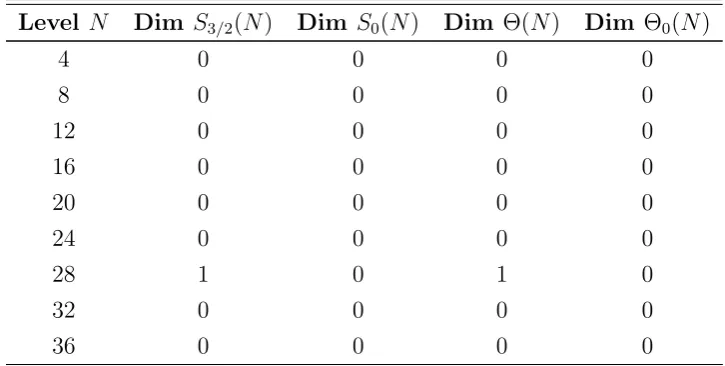
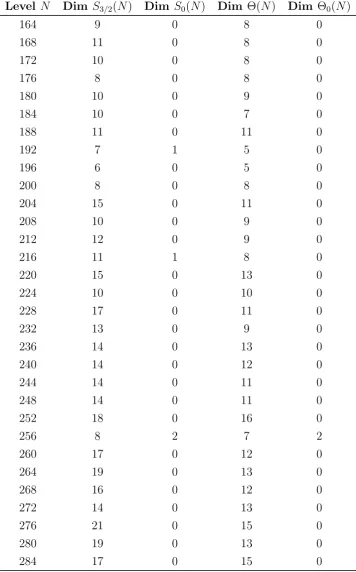
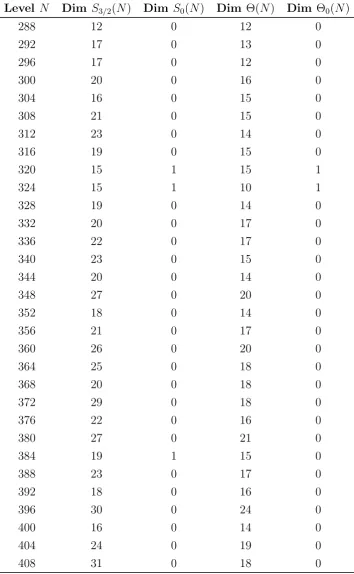
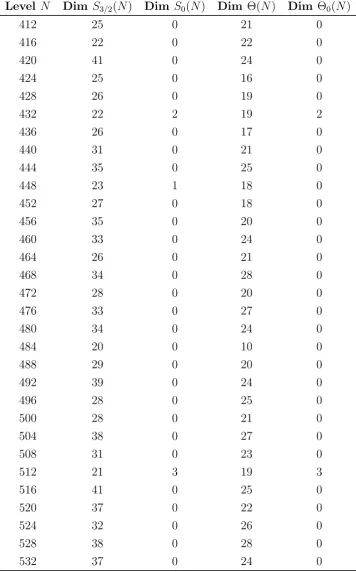
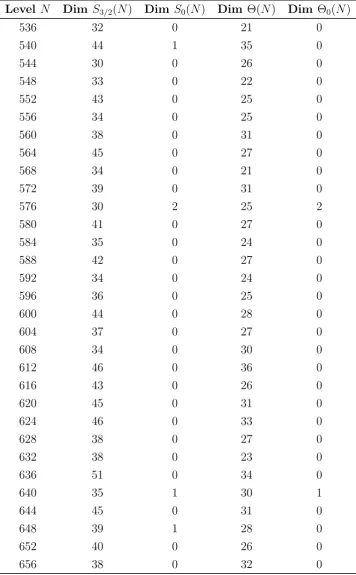
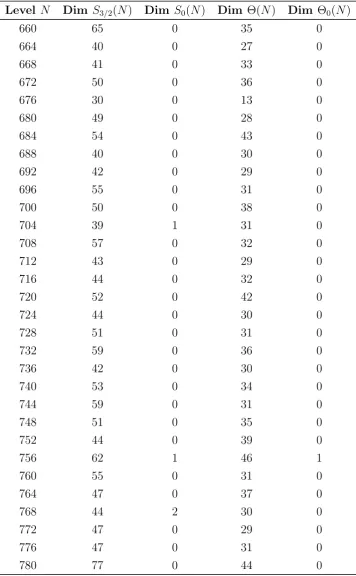
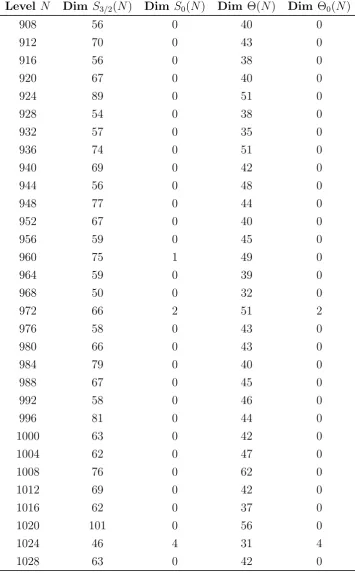
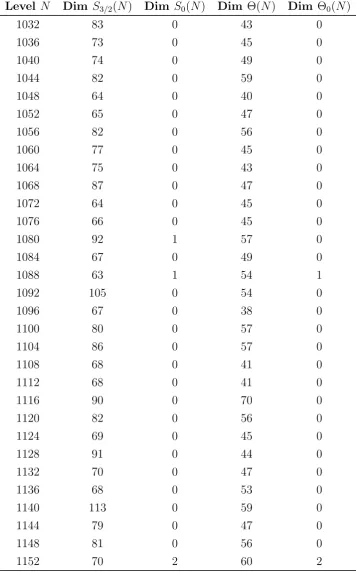
the Appendix, we give a table for the dimension of S3/2(N) and some of its subspaces, for N ≤2000.
What follows is an example of the results we develop in the thesis; it
is in fact Example 5.3.1 given in Chapter 5. Let E be an elliptic curve of conductor 50 given by
E :Y2+XY +Y =X3+X2−3X+ 1.
LetQ1, . . . , Q4 be the following positive-definite ternary quadratic forms,
Q1 = 25x2+ 25y2+z2, Q2 = 14x2+ 9y2+ 6z2+ 4yz+ 6xz+ 2xy
Letn be positive square-free number such that 5-n. Then, L(E−n,1) =
L(E−1,1)
√
n ·c
2
n,
where
cn=
4
X
i=1
(−1)i−1
Chapter 2
Background
2.1
Congruence Subgroups
All the material in this section is standard, and can be found in any book on modular forms; for example [16], [28], [23].
LetR be any commutative ring with unity. We denote by GL2(R), the group of 2×2 matrices with entries inRand determinant an invertible element of R. By SL2(R) we denote the subgroup of GL2(R) consisting of matrices with determinant 1. We will be generally interested in these groups when the
ring R = R, Q or Z and in those cases GL+2(R) stands for the subgroup of GL2(R) consisting of matrices with positive determinant.
LetC =C∪ {∞}. The group SL2(R) acts on C by the M¨obius
trans-formation, i.e., givenA= [a b
c d]∈SL2(R) and z ∈C,
Az := az+b
cz+d, A∞:= a c.
LetH={z ∈ C| Im(z)>0} be the complex upper half-plane. Then SL2(R) acts onHsince Im(Az) =|cz+d|−2det(A)Im(z) and one can easily prove that the action of SL2(R) on H is transitive.
Definition 2.1.1. Let N be a positive integer. Then
Γ(N) :=
("
a b c d
#
∈SL2(Z) :a≡d≡1 (mod N), b≡c≡0 (mod N)
)
,
Γ1(N) :=
("
a b c d
#
∈SL2(Z) :a≡d≡1 (mod N), c≡0 (mod N)
)
,
Γ0(N) :=
("
a b c d
#
∈SL2(Z) :c≡0 (mod N)
)
.
Definition 2.1.2. A subgroup of SL2(Z) is called a congruence subgroup of
level N if it contains Γ(N) for some positive integer N. Thus Γ(N), Γ1(N)
and Γ0(N) are congruence subgroups of level N.
Note that Γ(N) ⊂ Γ1(N) ⊂ Γ0(N) ⊂ SL2(Z) and that Γ(N0) ⊂ Γ(N) whenever N |N0.
Proposition 2.1.3. Let N be a positive integer. Then
[SL2(Z) : Γ0(N)] =N
Y
p|N
1 + 1
p
,
[SL2(Z) : Γ1(N)] =N2Y
p|N
1− 1
p2
.
Proof. See either [23, Exercise III.1.7] or [16, Page 14].
It is easy to see that SL2(Z) acts transitively on the set Q∪ {∞}.
Definition 2.1.4. LetΓbe a congruence subgroup of SL2(Z). Define a cusp of
Γto be an equivalence class ofQ∪ {∞}under the action ofΓ onH∪Q∪ {∞}.
2.2
Modular Forms of Integral Weight
We continue reviewing standard material on modular forms.
Let k be a positive integer. The group GL+2(R) acts on the set of
complex valued function on H as follows. Let f : H → C and γ = [a b
c d] ∈
GL+2(R), then
is a function onH, wherej(γ, z) = cz+d.
Let Γ be a congruence subgroup of levelN.
Definition 2.2.1. A modular form of weight k forΓ is a holomorphic function on H which satisfies
(i) f|[γ]k =f for all γ ∈Γ, and
(ii) If γ0 ∈ SL2(Z), then f|[γ0]k(z) has a Fourier expansion of the form
P∞
n=0anqNn where qN :=e2πiz/N.
The condition (ii) is interpreted as holomorphicity of f at all the cusps of Γ. We call a modular form a cusp form if it vanishes at all the cusps of Γ, i.e.,
in (ii) above, a0 = 0 for all γ0 ∈SL2(Z).
We denote byMk(Γ) andSk(Γ) respectively, the space of modular forms
and the space of cusp forms of weightk for level Γ.
If Γ ⊂ Γ0 then clearly Mk(Γ0) ⊂ Mk(Γ). Also, note that since [1 10 1] belongs to Γ0(N) and Γ1(N) for any N, if f belongs to either Mk(Γ0(N)) or
Mk(Γ1(N)) then f has a Fourier expansion at ∞ given by f(z) =P ∞ n=0anq
n
where q=e2πiz. Since −1 0 0 −1
∈ Γ0(N), there are no nonzero modular forms of odd weight k for Γ0(N).
Let χ be a Dirichlet character modulo N. We denote Mk(N, χ) and
Sk(N, χ) to be the respective subspaces of Mk(Γ1(N)) and Sk(Γ1(N)) consist-ing of f(z) such that f|[γ]k = χ(d)f for all γ = [a bc d] ∈ Γ0(N). If χ is a trivial character then we denoteMk(N, χ) andSk(N, χ) simply byMk(N) and
Sk(N).
From now on we will be only interested in the congruence subgroups
Γ0(N) and Γ1(N). We now give definition for Hecke operators on the space of modular forms in terms of double cosets.
Definition 2.2.2. Let G be any group and Γ and Γ0 be two subgroups of G. We say that Γ and Γ0 are commensurable if
[Γ : Γ∩Γ0]<∞ and [Γ0 : Γ∩Γ0]<∞.
Definition 2.2.3. Let α ∈ GL+2(R) such that Γ0(N) and α−1Γ0(N)α are
(i)
f|[Γ0(N)αΓ0(N)]k(z) := det(α)k/2−1 d
X
ν=1
f|[αν]k(z), where Γ0(N)αΓ0(N) =
Fd
ν=1Γ0(N)αν. (ii)
Tn(f) :=
X
f|[Γ0(N)αΓ0(N)]k, where the sum is over all α = [l 0
0 m] with l, m positive integers, l | m,
(l, N) = 1 and lm=n. (iii) If (n, N) = 1, then
T(n,n)(f) :=f|[Γ0(N) [n0 n0] Γ0(N)]k. The operators Tn and T(n,n) are called the Hecke operators.
The Hecke operators so defined preserve the cusp forms and one can
similarly define the Hecke operators on the space of modular forms with
char-acters. The following proposition lists the important properties of the Hecke operators.
Proposition 2.2.4. (a) If (m, n) = 1, then Tmn =TmTn.
(b) If p is a prime dividing N, then Tpe =Tpe for any positive integer e.
(c) If p is a prime such that (p, N) = 1, then for any positive integer e,
Tpe+1 =TpTpe −pT(p,p)Tpe−1 where for f ∈ Mk(N, χ) the action of T(p,p)
can be explicitly expressed as T(p,p)(f) = pk−2χ(p)f.
Proof. See [28, Lemma 4.5.7] and [28, Pages 142-143].
Hence the Hecke operators form an algebra over Z generated by Tp,
T(p,p) and Tq wherep, qvaries over primes with p-N andq |N. We can write
the action of Hecke operators in terms ofq-expansions.
Proposition 2.2.5. Let f be a modular form in Mk(N, χ) with q-expansion
f(z) =P∞
n=0anq
n. Then T
p(f)(z) = P ∞ n=0bnq
n where,
Here we take an/p = 0 if p-n.
Proof. See [28, Lemma 4.5.14].
A modular form f(z) ∈ Mk(N, χ) is called a Hecke eigenform if for
every positive integer m there exists λm ∈Cwith Tm(f) = λmf.
Proposition 2.2.6. Let f(z) = P∞
n=0anq
n ∈M
k(N, χ) be a Hecke eigenform as above. Then,
(i) If f(z) is non constant, then a1 6= 0.
(ii) If f(z) is a normalised cusp form, that is, a1 = 1, then am =λm for all
m and amn =aman whenever (m, n) = 1. (iii) If a0 6= 0, then λm=
P
d|mχ(d)dk−1.
Proof. See [30, Proposition 2.6] or [28, Theorem 4.5.16].
Definition 2.2.7. Let f andg be cusp forms in Sk(N, χ). Then their Peters-son inner product hf, gi is defined as
hf, gi= 1
[SL2(Z) : Γ1(N)]
Z
Γ1(N)\H
f(z)g(z)ykdxdy
y2 , z =x+iy. It is well-known that the Petersson inner product is well-defined and
induces a Hermitian scalar product on the spaceSk(N, χ); for details see [28,
Page 44]. With respect to this inner product, if αn =
p
χ(n) and (n, N) = 1 then the operatorsαnTn are Hermitian:
Proposition 2.2.8.
hαnTnf, gi=hf, αnTngi if (n, N) = 1. Proof. See [28, Theorem 4.5.4].
Thus, Sk(N, χ) has a basis consisting of eigenforms under all Hecke
operatorsTn with (n, N) = 1.
There are several other important operators on the space of integral
Letp |N be a prime and Qp =pl. TheAtkin-Lehner operator |[WQp]k
onMk(N) is defined by any matrix of the form
WQp := "
Qpα β
N γ Qpδ
#
∈M2(Z), α, β, γ, δ ∈Z
with determinantQp; different choices ofα,β,γ andδdo not affect the action
of WQp on Mk(N).
The Fricke involution |[WN]k is defined by WN := [N0 −01]. It is to be
noted that|[WQp]k, |[WN]k are involutions on Mk(N) and commute with the
Hecke operatorsTn for (n, N) = 1 (see [30, Proposition 2.21]).
Further, we define V-operator and U-operator. Let d be a positive integer and f(z) = P∞
n=0anqn ∈Mk(N, χ). Then,
V(d)f(z) :=
∞
X
n=0
anqdn ∈Mk(N d, χ),
U(d)f(z) :=
∞
X
n=0
adnqn ∈Mk(N, χ) if d|N, else ∈Mk(N d, χ).
It is clear that iff is a cusp form thenV(d)f andU(d)f both vanish at infinity. In fact, more is true: bothV(d)f and U(d)f are cusp forms ( [30, Proposition 2.22]). It is easy to verify thatTp commutes with the operatorU(d) and for p
coprime tod,Tp commutes withV(d).
Another important notion of modular forms we will be considering in
the later sections is that of a twist with a Dirichlet character.
Definition 2.2.9. Let f(z) = P∞
n=0anqn ∈ Mk(N, χ). If ψ is a Dirichlet character, then the ψ-twist of f is defined by
fψ(z) = ∞
X
n=0
ψ(n)anqn.
Proposition 2.2.10. Let f be as above and ψ be a Dirichlet character of conductor m, then
fψ(z) = ∞
X
n=0
Moreover, if f is a cusp form then so is fψ.
Remark. Note that here,fψ does not have to be in the new subspace at level
N m2. However, if we suppose (N, m) = 1 and thatf is a newform of level N, then that would be true.
Proof of Proposition 2.2.10. See Proposition 17 in [23, Chapter III] for the
proof.
For more details on this twisting operator, see for example Theorem
4.2.2.
Let us now recall the theory of newforms. Define the space of oldforms
Sold
k (N) in Sk(N) by
Skold(N) := M
M|N
1≤M <N
M
d|(N/M)
V(d)(Sk(M)).
The new subspace, Snew
k (N), is defined to be the orthogonal complement of
Sold
k (N) inSk(N) with respect to the Petersson inner product. Note that these
spaces are preserved under Tn for (n, N) = 1.
Definition 2.2.11. An element of Sknew(N) is called a newform if it is a normalised eigenform under all Hecke operators Tn and the AtkLehner in-volutions |[WQp]k for p|N and |[WN]k.
We have the following theorem on newforms.
Theorem 2.2.12. (Atkin-Lehner) Let f(z) = P∞
n=0anq
n ∈ Snew
k (N) be a newform. Then,
(i) Tn(f) =anf for all n.
(ii) If p is a prime such that ordp(N)≥2, then ap = 0.
(iii) If p | N with ordp(N) = 1, then ap = −ωppk/2−1, where ωp ∈ {±1} is such that f|[WQp]k =ωpf.
It is to be noted that a similar theorem holds for newforms with
char-acters (see [28, Theorem 4.6.17]); in particular the statement (i) of the above theorem is true if f is a newform in Snew
k (N, χ).
It is a well-known result that, if f ∈ Snew
k (N) is a newform then the
coefficients an of f belong to the ring of integers OK for some number field
K [16, Page 234 ]. Moreover, from the above theorem it is clear that the
coefficients an are totally real, since they are the eigenvalues of Hermitian
operators.
We will be using the following proposition which can be deduced as a
corollary to the “multiplicity-one” theorem [28, Theorem 4.6.19] on newforms in the later sections.
Proposition 2.2.13. Let f be a common eigenfunction f ∈ Sk(N, χ) of Tn with eigenvalues an for all n prime to N. Then there uniquely exist a divisor
M of N satisfying Cond(χ) | M and a newform g ∈ Snew
k (M, χ) such that
Tn(g) = ang for alln prime toN, andf can be written as a linear combination
f = X
d|(N/M)
αdVd(g). Proof. This is Corollary 4.6.20 in [28].
We will conclude this section by stating the following result due to
Sturm [40]. We start with a definition.
Definition 2.2.14. Fix a number field F and let OF be the ring of integers of F and λ be a prime ideal of OF. Suppose f(z) =
P
n≥0anqn is a formal power series with coefficients in OF. Then we define ordλ(f) to be
ordλ(f) := inf{n :an∈/ λ}. If an ∈λ for all n, then we let ordλ(f) :=∞.
It is easy to see that ordλ(f1f2) = ordλ(f1) + ordλ(f2).
of integers of a number field F. Let λ be a prime ideal of OF. If
ordλ(f −g)>
k
12[SL2(Z) : Γ],
then ordλ(f −g) = ∞, i.e., f ≡g (mod λ). Proof. See [40, Page 276].
2.3
Half-Integral Weight Modular Forms
In this section we summarize standard material on modular forms of
half-integral weight found in Shimura’s paper [36], supplemented by material from
the papers of Serre and Stark [35] and Cohen and Oesterl´e [12].
2.3.1
Definitions
Before getting into the definition of half-integral weight forms, we first define
the standard Kronecker symbol cd
and d for c, d∈Zwith d 6= 0:
(i) cd= 0 if (c, d)6= 1.
(ii) If d is an odd prime, then dc is the usual Legendre symbol. (iii) If d >0, the map c7→ c
d
is a character modulo d. (iv) Forc6= 0, the mapd7→ c
d
is a character of conductor equal to the
mod-ulus of the discriminant of the field Q(√c)/Q. We denote this character by χc.
(v) −c1
= 1 or−1 according as c > 0 or c <0 and, ±01
= 1.
(vi) −d1= (−1)(d−1)/2 for all positive or negative odd integersd. (vii) For odd d,d= 1 or
√
−1 according as d≡1 or 3 (mod 4).
LetG be the group consisting of all ordered pairs (α, φ(z)), where α= [a b
c d]∈GL
+
2(Q) andφ(z) is a holomorphic function onH satisfying
φ(z)2 =t√cz+d
detα
for somet ∈ {±1}, with the group law defined by
(α, φ(z))·(β, ψ(z)) = (αβ, φ(βz)ψ(z)).
Let P : G → GL+2(Q) be the homomorphism given by the projection
map onto the first coordinate. The group G acts on the space of complex
valued functions onH byf|[ξ]k/2(z) := f(αz)φ(z)−k, where ξ= (α, φ(z))∈G and f :H→C.
Let N be a positive integer with 4 | N. Then for γ = [a b
c d] ∈ Γ0(N)
define
j(γ, z) :=
c
d
−d1√cz+d, ∆0(N) :={γe:= (γ, j(γ, z))|γ ∈Γ0(N)}.
Then ∆0(N) is a subgroup of G. The map L : Γ0(4) → G given by γ 7→
e
γ defines an isomorphism onto ∆0(4). Thus P|∆0(4) : ∆0(4) → Γ0(4) and
L : Γ0(4) → ∆0(4) are inverse of each other. Denote by ∆1(N) and ∆(N) respectively the images of Γ1(N) and Γ(N).
Definition 2.3.1. Let k, N be positive integers with k odd and 4|N.A holo-morphic function f on H is a modular form of weight k/2 for ∆1(N) if f
satisfies f|[eγ]k/2 = f for all γ ∈ Γ1(N) and is holomorphic at all the cusps
of Γ1(N). As before, f is called a cusp form if it vanishes on all cusps. We
denote such a space of modular forms by Mk/2(Γ1(N)) and the subspace of
cusp forms by Sk/2(Γ1(N)). Let χ be a Dirichlet character modulo N. Then
Mk/2(N, χ) (respectively Sk/2(N, χ)) is the subspace of Mk/2(Γ1(N)) (respec-tively Sk/2(Γ1(N))) consisting of all elements f such that f|[γe]k/2 =χ(d)f for
all γ = [a b
c d]∈Γ0(N).
For the precise meaning of ‘holomorphicity at cusps’ in the above
It is clear that the spaceMk/2(N, χ) = 0 if χ is an odd character, that is,χ(−1) =−1. Henceforth we will be assumingχ to be an even character. If
χis a trivial character, we writeMk/2(N, χ) andSk/2(N, χ) simply byMk/2(N) and Sk/2(N).
It is to be noted that since ([1 1
0 1],1) ∈ ∆1(N), a modular form f ∈
Mk/2(Γ1(N)) has a Fourier expansion of the form f(z) =
P∞
n=0anqn where
q=e2πiz.
The theta-functions provides us with a large class of examples of
half-integral weight modular forms. We are interested in theta-functions of one
variable (also known as theta-forms).
Definition 2.3.2. Let ν be either 0 or 1. Let ψ be a Dirichlet character such thatψ(−1) = (−1)ν. Then we define
Θ(ψ, ν, z) :=
∞
X
n=−∞
ψ(n)nνqn2, (2.1)
where 00 is taken to be 1.
Theorem 2.3.3. (Shimura) Let ψ be a Dirichlet character with conductor rψ. (i) If ψ is even then Θ(ψ,0, z)∈M1/2(4rψ2, ψ).
(ii) If ψ is odd then Θ(ψ,1, z)∈S3/2(4rψ2, ψ·χ−1).
Proof. See [36, Section 2].
Serre and Stark [35] proved in fact that every modular form of weight
1/2 can be written as a linear combination of theta-functions with ν = 0.
Theorem 2.3.4. (Serre and Stark) Let 4 | N and χ be an even Dirichlet character modulo N. Let Ω(N, χ) be the set of pairs (ψ, t) with t ∈ N and ψ
an even primitive Dirichlet character with conductorrψ satisfying
i) 4rψ2t|N, ii) χ(n) =ψ(n)
t n
for n ∈Z coprime to N.
Ω(N, χ) with ψ a square of some character, of conductor rψ if rψ is odd, and
2rψ if rψ is even. Let Ωc(N, χ) = Ω(N, χ)−Ωe(N, χ). Then Θ(ψ,0, tz) with
(ψ, t)∈Ωc(N, χ) form a basis for S1/2(N, χ).
Proof. See [35, Section 2] for the statements and [35, Sections 6,7] for the
proofs.
We will see later that there are many modular forms other than
theta-functions for weights ≥3/2.
2.3.2
Dimension Formulae
In this section we briefly state dimension formulae forSk/2(N, χ) due to Cohen and Oesterl´e [12], for odd k. The above theorem of Serre and Stark gives explicit bases in the casek = 1. Thus we restrict tok odd≥3. As usual 4|N
and χ(−1) = 1. Let f be the conductor of χ. Write
N =Yprp, f =Ypsp.
Write
λp =
prp/2+prp/2−1 if 2s
p ≤rp and rp is even
2p(rp−1)/2 if 2s
p ≤rp and rp is odd
2prp−sp if 2s
p > rp.
The formulae involve another parameter ζ which we now define. Ifr2 ≥4 we let ζ = λ2; if r2 = 3 we let ζ = 3. As 4 | N, the only case left is r2 = 2. Supposer2 = 2. Let (C) be the following condition:
(C) there is a prime p≡3 (mod 4) such that p|N with eitherrp odd
If (C) holds then we letζ = 2. Suppose (C) does not hold. Let
ζ =
3/2 if s2 = 0 andk ≡1 (mod 4) 5/2 if s2 = 2 andk ≡1 (mod 4) 5/2 if s2 = 0 andk ≡3 (mod 4) 3/2 if s2 = 2 andk ≡3 (mod 4).
Theorem 2.3.5. (Cohen and Oesterl´e [12, Th´eor`eme 2]) With notation as
above,
dimSk/2(N, χ)−dimM2−k/2(N, χ) =
k−2
24 N
Y
p|N
(1 + 1/p)− ζ
2
Y
p|N,p6=2
λp. Here we take M2−k/2(N, χ) = 0 for k≥5.
2.3.3
Operators
As in the case of integral weight modular forms we have several operators that
act on the spacesMk/2(N, χ) and Sk/2(N, χ).
We will start with the Hecke operators which are defined again in terms
of double cosets. Let ξ be an element ofG such that ∆1(N) and ξ−1∆1(N)ξ are commensurable. Define an operator |[∆1(N)ξ∆1(N)]k/2 on Mk/2(Γ1(N)) by
f|[∆1(N)ξ∆1(N)]k/2 = det(ξ)k/4−1
X
ν
f|[ξν]k/2 where ∆1(N)ξ∆1(N) =Sν∆1(N)ξν.
Now supposemis a positive integer andα = [1 0
0m],ξ = (α, m1/4). Then
the Hecke operator Tm is defined as the restriction of |[∆1(N)ξ∆1(N)]k/2 to
Mk/2(N, χ). It is to be noted that by [36, Proposition 1.0], ifmis not a square and (m, N) = 1 then |[∆1(N)ξ∆1(N)]k/2 is the zero operator. So we assume that m=n2 for a positive integer n. We write the Hecke operatorTn2 as
Tn2(f) :=n k 2−2X
ν
χ(aν)f|[ξν]k/2,
that P(ξν) = [a∗ ∗ν ∗]. We have the following theorem.
Theorem 2.3.6. (Shimura) Let f(z) = P∞
n=0anq
n ∈ M
k/2(N, χ). Then
Tp2(f)(z) = P∞
n=0bnq
n where,
bn =ap2n+χ(p)
−1
p
λ
n p
pλ−1an+χ(p2)pk−2an/p2,
and λ= (k−1)/2 and an/p2 = 0 whenever p2 -n.
Proof. See [36, Theorem 1.7].
As in the integral weight case, if (m, n) = 1, then Tm2n2 = Tm2Tn2; in
particular the Hecke operators Tm2 and Tn2 commute (see [36, Proposition
1.6] for details). The operators Tp2 with p prime generate the Hecke
alge-bra. Moreover, as before we can define a Petersson inner product on the space
Sk/2(N, χ) and with respect to this inner product χ(p)Tp2 are Hermitian
when-ever (p, N) = 1. Hence Sk/2(N, χ) has a basis of eigenforms under all Hecke operatorsTp2 with (p, N) = 1.
Example 2.3.7. Just as in the integral case, it is not true that the space
of cusp forms has a basis of eigenfunctions under all Hecke operators. We
computed the action of T4 on S3/2(N) for all N up to 180. We found thatT4 is not diagonalizable forN = 160 only.
MAGMA gives the following basis for the spaceS3/2(160):
f1 =q−q9−q25−2q41+ 3q49+O(q60)
f2 =q2−q10−q18+ 2q22−2q30−2q38+q50+ 2q58+O(q60)
f3 =q4−q20−2q24−q36+ 2q40+ 2q56+O(q60)
f4 =q5−2q21−3q45+O(q60)
f5 =q6−q10−q14+q30+ 2q34−q46−2q54+O(q60)
f6 =q7−q15−q23+q47+O(q60). We find thatT4(fi) = 0 for i= 1, 2, 4, 5, 6 and
Let M be the 6 × 6 matrix representing the action of T4 with respect to the basis f1, . . . , f6. Then M has eigenvalue 0 with multiplicity 6. If T4 is diagonalizable, then T4 = 0. Since this is not the case, we see that it is not diagonalizable.
Further, we can define V-operators and U-operator as in the integral weight case and we have the following proposition.
Proposition 2.3.8. Let f(z)∈Mk/2(N, χ). Let d be a positive integer.
(i) V(d)(f)∈Mk/2(N d, 4.d
χ). (ii) If d|N, U(d)(f)∈Mk/2(N, 4.d
χ).
Moreover in above cases V(d) and U(d) take cusp forms to cusp forms. Proof. See [30, Proposition 3.7].
One can verify as in the integral weight case that Tp2 commutes with
the operator U(d) and for p coprime tod,Tp2 commutes withV(d).
2.3.4
Shimura’s Correspondence
We will conclude this section by presenting a fundamental theorem of Shimura [36] which connects the arithmetic of half-integral weight cusp forms and even
integer weight modular forms.
Theorem 2.3.9. (Shimura) Let N and k be positive integers such that 4| N
and k≥3. Let λ= (k−1)/2. Let f(z) =P∞
n=1anq
n∈S
k/2(N, χ). Let t be a
square-free integer and let ψt be the Dirichlet character modulo tN defined by
ψt(m) =χ(m)
−1
m
λ
t m
.
Let At(n) be the complex numbers defined by ∞
X
n=1
At(n)n−s= ∞
X
i=1
ψt(i)iλ−1−s
! ∞
X
j=1
atj2j−s !
. (2.2)
Let Sht(f)(z) =
P∞
the orthogonal complement of S0(N, χ), the subspace of S3/2(N, χ) spanned by
single variable theta-functions.
The formulation we used of Shimura’s Theorem is one found in Ono’s
book [30, Theorem 3.14]. Please refer to section 3.1 for the explicit definition
of S0(N, χ).
The Sht(f) is called the Shimura lift of f corresponding to t. In the
later chapters we will discuss deeper properties of Shimura lifts and several
results surrounding them.
2.4
Algorithms for Computing Half-Integral
Weight Modular Forms
As far as we know, the only algorithm found in the literature for computing a
basis for the space of half-integral weight modular forms is given in Basmaji’s
thesis [3]. Basmaji’s algorithm is for modular forms of half-integral weight
and level divisible by 16. However the computer algebra system MAGMA [5]
computes bases for spaces of half-integral weight modular forms of general
level. By reading the relevant part of the MAGMA source code written by Steve
Donnelly and William Stein, we have been able to write down the algorithm
it is relying on, which is a variant of Basmaji’s, and to verify its correctness.
Let k > 1 be an odd integer and N ∈ N such that 16 | N. Let χ
be a Dirichlet character modulo N. Basmaji in his thesis gives the following algorithm for computing a basis for Sk/2(N, χ). The idea of the algorithm is to use theta-series. Let
Θ(z) :=
∞
X
n=−∞
qn2 = 1 + 2
∞
X
n=1
qn2,
Θ1(z) := 1 2
∞
X
n=−∞ n≡1(mod2)
qn2 =
∞
X
n=1
n≡1(mod2)
qn2
whereq =e2πiz.
proved independently in Basmaji’s thesis. Let χ−1 be the nontrivial Dirichlet character modulo 4 and
S =Sk+1 2
N, χ·χ
k+1 2
−1
.
Basmaji defines the following embedding,
ϕ:Sk/2(N, χ)→S×S, f 7→(fΘ, fΘ1),
proving that fΘ and fΘ1 do indeed belong to S. Let U be the subspace of
S×S consisting of elements (f1, f2) such that
f1·Θ1 =f2·Θ (2.3)
holds. ThenU is isomorphic to Sk/2(N, χ) via the map (f1, f2)7→f1/Θ (=f2/Θ1).
There are standard methods for computing a basis for a space of
mod-ular forms of integral weight; see for example [39]. Thus one can start with
a given basis for S and form a system of linear equations in terms of the coefficients of q-expansions of the basis elements and solve for (f1, f2) in the equation (2.3), thereby recovering a basis for Sk/2(N, χ).
It is to be noted that the hypothesis 16| N is only used to show that
fΘ1 belongs to the spaceS and so it seems possible to drop this hypothesis by working with other theta-series. This is precisely what is done in the MAGMA
implementation for general levelN. Suppose 4 |N and 16-N. Let Θ2(z) := Θ(2z) = 1 + 2
∞
X
n=1
q2n2 ∈M1/2(8, χ8) whereχ8 = 8.
is the Dirichlet character modulo 8. LetN0 = lcm(N,8). Let
S be as before and
S0 =Sk+1 2
N0, χ·χ8·χ
k+1 2
−1
Then we have an embedding as above given by
ϕ:Sk/2(N, χ)→S×S0
f 7→(fΘ, fΘ2).
Lemma 2.4.1. If f ∈Sk/2(N, χ) then fΘ2 ∈S0.
We shortly prove Lemma 2.4.1. LetU0 be the subspace of S×S0 con-sisting of elements (g1, g2) such that
g1Θ2 =g2Θ.
As before this gives a system of linear equations that we can solve and recover
a basis forSk/2(N, χ).
Proof of Lemma 2.4.1. Let γ = [a b
c d]∈Γ0(N0). Then (fΘ2)(γz) = f(γz)Θ2(γz)
=χ(d)χ8(d)j(γ, z)k+1f(z)Θ2(z) = (χ·χ8)(d)(j(γ, z)2)(k+1)/2f(z)Θ2(z) = (χ·χ8)(d)(−d2(cz+d))(k+1)/2f(z)Θ2(z) = (χ·χ8·χ
(k+1)/2
−1 )(d)(cz+d)(k+1)/2(fΘ2)(z).
Note that fΘ2 is holomorphic on H as so are f and Θ2. We want to show that fΘ2 is holomorphic at the cusps. Let s ∈ Q∪ {∞} be any cusp. Then
s = α∞ for some α ∈ SL2(Z). Following the definitions one can easily show that
(fΘ2)(z)|[α](k+1)/2 =κα·f(z)|[α]k/2Θ2(z)|[α]1/2.
where κα is a fourth root of unity. Now the result follows since f is a cusp
form.
2.5
Automorphic Representations
LetF be a number field and AF be its ring of adeles. In this section we will
standard material as presented in Bump’s book [6].
Definition 2.5.1. Let G be a locally compact abelian group. Then, by a
qua-sicharacter of G we mean a continuous homomorphism χ : G → C×. If
|χ(g)| = 1 for all g ∈ G, then χ is called a character. In particular, we say that a character χν of Fν× is unramified if it is trivial on the unit group O
× ν. Here Fν is the completion of F at the place ν of F and Oν is the ring of integers ofFν.
Note that an unramified character of Fν× is determined by its value on any uniformizer. In our subsequent work we will be only interested in the case of GLn(AF) where F =Q and n≤2.
If n = 1, an automorphic representation of GL1(AQ) is indeed simply
a Hecke character, i.e., a continuous homomorphism χ : A×
Q/Q
× →
C× and
it corresponds to a primitive Dirichlet character. This follows from Tate’s
thesis [9, Chapter XV] and we will discuss this in more detail in Section 4.1.
We will henceforth assume that n= 2 and we will see that one can associate automorphic representations of GL2(AQ) to classical Hecke eigenforms.
Before going into the definition of automorphic representations, we first
recall the theory of admissible representations ofG= GL2(f) wherefis a non-Archimedean local field (that is a finite extension ofQp for some finite prime
p) with ring of integers o. Please refer to either [6, Chapter IV] or [14] for the details of what follows.
A representation of G on a complex vector space V is smooth if the stabilizer of any vector in V is an open subgroup of G; it is admissible if it is smooth and for every open subgroupU ofGthe spaceVU of vectors stabilized
by U is finite dimensional. We will be interested in irreducible admissible representations.
Letχ1 andχ2 be quasicharacters off×. LetB(χ1, χ2) be the space of all smooth (i.e, locally constant) functionsf :G→C which satisfy the following identity
f
"
y1 x 0 y2
#
g
!
=
y1
y2
1/2
χ1(y1)χ2(y2)f(g).
Here | · | is the usual norm character of f×, which takes y ∈ f× to q−ordp(y)
right translation, i.e., (gf)(g0) = f(g0g) and the resulting representation can be shown to be an admissible representation of G. Further, if we assume that
χ1χ−21 is not equal to either of the quasicharacters| · |or|·|
−1, thenB(χ
1, χ2) is irreducible (see [6, Theorem 4.5.1]) and in this case, the isomorphism classes of
the B(χ1, χ2) are called the principal series representations; the isomorphism class of B(χ1, χ2) is denoted by π(χ1, χ2).
When χ1χ−21 is equal to | · |±1, the representation B(χ1, χ2) has two composition factors in its Jordan-H¨older series, a 1-dimensional factor and an
infinite dimensional factor. Precisely, say χ1χ−21 =| · | and write χ1 =χ| · |1/2 and χ2 = χ| · |−1/2. Then B(χ1, χ2) has a unique irreducible subrepresenta-tion St2(χ) which is infinite dimensional. The quotient B(χ1, χ2)/St2(χ) is 1-dimensional and Gacts on it through the character g 7→χ(detg). Write St2 in place of St2(χ) when χ is the trivial character. The representation St2 is called the Steinberg representation. One has St2(χ) = St2⊗χ.
An irreducible admissible representation (π, V) of Gis called supercus-pidal if associated “Jacquet module” J(V) is zero. We have the following classification of the irreducible admissible representations of G which can be gleaned from Bump’s book [6]; the formulation we use is that of [14].
Theorem 2.5.2. Let (π, V) be an irreducible admissible representation of G. IfV is finite dimensional then it is 1-dimensional and there exists a quasichar-acterχof f× such thatπ(g)v =χ(det(g))v for allg ∈Gandv ∈V. Otherwise,
(π, V) is equivalent to one and only one of the following:
(i) An irreducible principal series representation π(χ1, χ2) with χ1χ−21 6=
| · |±1.
(ii) A twist St2⊗χ of the Steinberg representation St2.
(iii) A supercuspidal representation.
Proof. See [6, Section 4.5, 4.6, 4.7] for a complete proof.
Definition 2.5.3. An irreducible admissible representation (π, V) of G is called spherical (or unramified) if it has a vector which is invariant under
It is well-known (see [6, Theorem 4.6.4]) that (π, V) is spherical if and only if either it is a 1-dimensional representation given by g 7→χ(det(g)) for some unramified quasicharacter χ of f×, or it is a principal series of the form
π(χ1, χ2) with χ1 and χ2 unramified quasicharacters of f×.
We will now define an automorphic cuspidal representation of GL2(AF).
Letω be a Hecke character. Let L2(GL2(F)\GL2(AF), ω) be the space of all
functions f : GL2(AF) → C that are measurable with respect to the Haar
measuredg and satisfy
f([z 0
0 z]g) =ω(z)f(g), z ∈A × F,
f(γg) = f(g), γ ∈GL2(F),
and that are square integrable modulo centreZAF (the group of scalar matrices with entries inA×F):
Z
ZAFGL2(F)\GL2(AF)
|f(g)|2dg <∞.
Let L20(GL2(F)\GL2(AF), ω) be the closed subspace (cusp forms) satisfying
the cuspidal condition, that is,
Z
F\AF
f([1x
0 1]g)dx= 0
for almost all g ∈ GL2(AF). The group GL2(AF) acts on this L2 space by
right translation; this representation is called right regular representation and
is denoted by ρ. The space of cusp forms (L20 subspace) is invariant under this representation and decomposes into an infinite direct sum of irreducible
invariant subspaces. If (π, V) is a representation of GL2(AF) that is isomorphic
to the representation on one of these invariant subspaces, then we say that
(π, V) is an automorphic cuspidal representation with central character ω. Let g∞ = Qν∈S∞gl2(Fν), where S∞ is the set of Archimedean places
of F and gl2(Fν) is the Lie algebra of GL2(Fν), i.e., the set of 2×2 matrices
over Fν . Let K =
Q
νKν where Kν = GL2(Oν) if ν is non-Archimedean,
Kν =O(2) if ν is a real andKν =U(2) if ν is a complex; note that O(2) and
It turns out that if (π, V) is an automorphic cuspidal representation of GL2(AF) then on the space of K-finite vectors in V one can write π =⊗0νπν
where ⊗0 represents a restricted tensor product; here for each Archimedean
place ν of F, πν is an irreducible admissible (g∞, Kν)-module and for each
non-Archimedean place ν, πν is an irreducible admissible representation of
GL2(Fν). It is to be noted that πν is spherical for almost all ν, which allows
us to define the restricted tensor product. For details see [6, Theorem 3.3.2,
Theorem 3.3.3, Theorem 3.3.4].
Assume now F =Q. Let f ∈Sk(N, χ) be such that f is an
eigenfunc-tion for all Hecke operators Tp with p - N. One can associate to χ a Hecke
characterω as remarked earlier. Letω =Q
pωp. By the strong approximation
theorem [6, Theorem 3.3.1], it follows that any element g ∈ GL2(AQ) can be
written as g = γg∞k0 where γ ∈ GL2(Q), g∞ ∈ GL+2(R) and k0 ∈ K0(N); here K0(N) =
Q
p<∞K0(N)p, where if p | N then K0(N)p is the subgroup
of GL2(Zp) of the form [a bc d] where c ≡ 0 (mod N) in Zp and for primes
p - N, K0(N)p = GL2(Zp). Let Ω be the character of K0(N) given by Ω(α βγ δ) =Q
p|Nωp(δp).
Then the adelization of f is the function φf : GL2(AQ) → C defined
by φf(g) := f|[g∞]k(i)·Ω(k0). Since f is a cusp form, φf satisfies several
properties and in fact it turns out thatφf is anautomorphicform on GL2(AQ)
(see [6, Page 343 ] for details). We have the following theorem; the formulation
is as in [21, Page 93].
Theorem 2.5.4. Let πf be restriction of the right regular representation ρ of
GL2(AQ)on the subspaceVf of L20(GL2(Q)\GL2(AQ), ω)spanned by{ρ(g)φf :
Chapter 3
Shimura’s Correspondence
Shimura’s Correspondence relates certain cusp forms of half-integral weight to
modular forms of integral weight. In this chapter we give a precise statement
of this correspondence and use it to study eigenfunctions and what is known
as the Shimura decomposition.
Letk be an odd integer ≥ 3 and N a positive integer such that 4| N. Let χ be an even Dirichlet character modulo N. As we saw in the previous chapter,Sk/2(N, χ) can contain single-variable theta-series fork= 3. We shall denote by S0(N, χ) the subspace generated by single-variable theta-series. If
k≥5 then S0(N, χ) = 0, but this is often not the case for k = 3.
The interesting part of the space Sk/2(N, χ) is the orthogonal com-plement of S0(N, χ) with respect to the Petersson inner product, denoted by Sk/⊥2(N, χ). It is cusp forms belonging to this subspace that feature in Shimura’s decomposition. To compute the dimension ofSk/⊥2(N, χ) we need to know the dimension of S0(N, χ). A generating set for this is given in several references, e.g. Shimura’s paper [36]. We show that this generating set is in fact a basis of eigenfunctions, although we have not found this result anywhere
in the literature.
As we will see in this chapter, Shimura decomposes the spaceSk/⊥2(N, χ) as
Sk/⊥2(N, χ) =M
φ
Sk/2(N, χ, φ)
whereφ runs through the newforms of weightk−1 and level dividingN/2 and characterχ2;S
to φ. We give an explicit algorithm for computing this decomposition. This decomposition will be crucial for our efforts later on to express the critical
values of L-functions of twists of elliptic curves in terms of coefficients of
modular forms of weight 3/2.
3.1
The Space
S
0(
N, χ
)
Let N be a natural number such that 4 | N. Let χ be an even Dirichlet
character of modulusN.
Letψ be a primitive odd Dirichlet character of conductor rψ and
hψ(z) :=
1
2Θ(ψ,1, z) =
∞
X
m=1
ψ(m)mqm2.
Recall, by Theorem 2.3.3 that hψ ∈ S3/2(4r2ψ,( −1
. )ψ). Consider the operator
V(t) (see section 2.2). By definition,
V(t)(hψ)(z) = ∞
X
m=1
ψ(m)mqtm2 ∈S3/2
4r2ψt,
−4t
.
ψ
.
Following Shimura [36], we define the space S0(N, χ) to be a subspace of
S3/2(N, χ) spanned by
S ={ V(t)(hψ) : 4rψ2t|N and ψ is a primitive odd character of
conductor rψ such that χ=
−4t
.
ψ }.
The purpose of this section is to prove the following theorem.
Theorem 3.1.1. The setS constitutes a basis of eigenforms forS0(N, χ). In
particular, the dimension of S0(N, χ) is simply #S.
To prove the theorem we shall need a series of lemmas.
primes p. Indeed,
Tp2V(t)hψ =
ψ(p)(1 +p)V(t)hψ if p-2t
ψ(p)pV(t)hψ if p|2t. Proof. Let us writeV(t)hψ(z) =
P∞
n=1anqn. Thus
an=
ψ(m)m if n=tm2
0 otherwise.
Letp be any prime. WriteTp2V(t)hψ =P∞n=1bnqn. Then by Theorem 2.3.6,
bn=ap2n+
4tn p
ψ(p)an+
−
4t p
2
ψ(p)2pan/p2.
If n/t is not the square of an integer, then bn = 0. Write n =tm2. If p | 2t,
then bn = ap2n = atp2m2 = ψ(pm)pm. This completes the proof when p | 2t.
Supposep-2t. Then
bn=atp2m2 +
4t2m2
p
ψ(p)atm2+
−
4t p
2
ψ(p)2patm2/p2
=atp2m2 +
m2
p
ψ(p)atm2 +ψ(p)2patm2/p2
=
atp2m2 +
m2
p
ψ(p)atm2 if p-m
atp2m2 +ψ2(p)patm2/p2 if p|m
=ψ(pm)pm+ψ(pm)m
= (1 +p)ψ(p)atm2.
Hence the lemma follows.
Lemma 3.1.3. Letψ be a Dirichlet character modulo r. Let ψ0 be a Dirichlet character modulo R. Let N be a natural number such that r | R | N and
ψ(n) =ψ0(n) for all n with (n, N) = 1. If ψ0 is primitive character modulo R, then R=r and ψ0 =ψ.
Proof. LetR =Qk
i=1p
αi
i andN =
Qk
i=1p
βi
i ·
Ql
j=1q
γj
j wherep1, . . . , pk, q1, . . . , ql
Theorem there exists anm such that
m ≡
n (mod Qk
i=1p
βi
i )
1 (mod Ql
j=1q
γj
j ).
Som≡n (mod R) and (m, N) = 1. Hence we have,
ψ(n) =ψ(m) = ψ0(m) = ψ0(n).
Thus ψ0 is induced by ψ. Since ψ0 is a primitive character modulo R we get
R=r and ψ0 =ψ.
We have following easy corollary to the above lemma.
Corollary 3.1.4. Let ψ1 and ψ2 be primitive Dirichlet characters modulo r1
and r2 respectively, and supposer1 |N, r2 |N. Let χ be a Dirichlet character
modulo N such that ψ1(n) = ψ2(n) = χ(n) for all n such that (n, N) = 1.
Then r1 =r2 and ψ1 =ψ2.
Proof. Let the conductor ofχbe r and ψ be the primitive Dirichlet character modulo r which induces χ. Then r | r1 and r | r2. Hence the result follows from the lemma.
Proof of Theorem 3.1.1. We will prove the theorem by showing that the
ele-ments of the setSare linearly independent. LetS ={V(ti)(hψi) : 1≤i≤k}.
We claim that ti’s are all distinct. Suppose not. Then there exists i, j such
that ti =tj. We know that χ= (−4.ti)ψi = ( −4tj
. )ψj. Thus, ψi(n) =ψj(n) for
all (n, N) = 1. Since ψi and ψj are primitive, we can apply Corollary 3.1.4 to
get that ψi = ψj and that V(ti)(hψi) = V(tj)(hψj). Hence the claim follows.
We can assume that t1 < t2 <· · ·< tk.
Now let αi for 1≤i≤k be such that
α1V(t1)(hψ1) +α2V(t2)(hψ2) +· · ·+αkV(tk)(hψk) = 0.
By the above equation and theq-expansion ofV(ti)(hψi), it follows that
coefficient of qt1 =α
Hence α1 = 0. Repeating the same argument with t2, t3, . . . , tk, we get that
α2 =α3 =· · ·=αk = 0. Thus we are done.
Remark. In the literature (see [30]), S0(N, χ) is referred to as the space spanned by single variable theta-functions. Kohnen states in [25] that the
“space of theta-functions” is zero for square-free level and arbitrary character, and also for cube-free level and trivial character. Kohnen does not give a
proof. We prove this statement in the following easy proposition.
Proposition 3.1.5. (Kohnen) Suppose either of the following holds:
1. N/4 is square-free, or
2. N/4 is cube-free and χ is a trivial character. Then S0(N, χ) = 0.
Proof. In the case N/4 is square-free, it is clear that the set S =∅. Let N/4 be cube-free andχ be a trivial character. Hence for any V(t)hψ ∈S we have
−4t n
ψ(n) = 1 for all (n, N) = 1. That is, for all such n, ψ(n) = −tn. It is to be noted that the character −t. is a primitive character modulo 4t ort
depending on the value of t (mod 4) and hence using Corollary 3.1.4 we get that rψ = 4t or rψ =t respectively. However, N = 4r2ψt. This contradicts the
assumption that N/4 is cube-free. Thus, in this case the set S =∅.
Note. Recall that for k ≥ 5, we defined S0(N, χ) = 0. In the upcoming sections we will use the following notation:
Sk/⊥2(N, χ) := S0(N, χ)⊥;
in words, the orthogonal complement toS0(N, χ) with respect to the Petersson inner-product. Thus, fork ≥5,
3.2
Shimura Lifts
For this section fix positive integersk, N with k ≥3 odd and 4|N. Let χ be an even Dirichlet character of modulusN. LetN0 =N/2. We recall Shimura’s Theorem.
Theorem 3.2.1. (Shimura) Let λ = (k − 1)/2. Let f(z) = P∞
n=1anqn ∈
Sk/2(N, χ). Let t be a square-free integer and let ψt be the Dirichlet character modulo tN defined by
ψt(m) =χ(m)
−
1
m
λ
t m
.
Let At(n) be the complex numbers defined by ∞
X
n=1
At(n)n−s= ∞
X
i=1
ψt(i)iλ−1−s
! ∞
X
j=1
atj2j−s !
. (3.1)
Let Sht(f)(z) =
P∞
n=1At(n)qn. Then (i) Sht(f)∈Mk−1(N0, χ2).
(ii) If k ≥5 then Sht(f) is a cusp form.
(iii) If k = 3 and f ∈S3⊥/2(N, χ) then Sht(f) is a cusp form.
(iv) Suppose f is an eigenform for Tp2 for all primes p and let Tp2f =λpf.
Then P∞
n=1A0(n)qn∈Mk−1(N0, χ2) where A0(n) is defined by
∞
X
n=1
A0(n)n−s=
Y
p
(1−λpp−s+χ(p)2pk−2−2s)−1. (3.2) In fact if at6= 0 then Sht(f)/at =P
∞
n=1A0(n)q
n.
Proof. For (i), (ii) and (iv) see [36, Section 3, Main Theorem, Corollary], for
the rest see [30, Theorem 3.14]. In particular, the fact that N0 = N/2 was proved by Niwa [29, Section 3].
Lemma 3.2.2. The Shimura lift Sht is linear.
Lemma 3.2.3. If Sht(f) = 0 for all positive square-free integers t thenf = 0. Proof. By Equation (3.1) we know that atj2 = 0 for all positive square-free
integers t and all positive integersj. Thenan = 0 for alln.
In Ono’s book [30, Chapter 3, Corollary 3.16] and several other places
[24] we find the following result stated without proof.
Proposition 3.2.4. Suppose f ∈ Sk/2(N, χ). Let t be a square-free positive
integer. If p-4tN is a prime then
Sht(Tp2f) = TpSht(f).
Here Tp2 is the Hecke operator on Sk/2(N, χ) and Tp is the Hecke
op-erator on Mk−1(N0, χ2). We will denote by Tk/2 and Tk−1 the Hecke algebras overZ acting on the space Mk/2(N, χ) and Mk−1(N0, χ2) respectively.
For what follows we shall need the following strengthening of this result.
Proposition 3.2.5. Supposef ∈Sk/2(N, χ)and t a square-free positive
inte-ger. If p is a prime then
Sht(Tp2f) = TpSht(f).
We do not know why the above references impose the conditionp-tN. We shall give a careful proof that does not use this assumption.
Proof of Proposition 3.2.5. The proof uses the explicit formulae for Hecke
op-erators in terms of q-expansions. As in Shimura’s Theorem above, write
f(z) = P∞
n=1anqn. Fix t to be a positive square-free integer. To simplify
notation, we shall write An for At(n). Thus we have the relation ∞
X
n=1
Ann−s = ∞
X
i=1
ψt(i)iλ−1−s
! ∞
X
j=1
atj2j−s !
.
We may rewrite this as
An=
X
ij=n
Let
Tp2(f)(z) =
∞
X
n=1
bnqn.
Then using Theorem 2.3.6 we get,
bn=ap2n+ψ1(p)
n p
pλ−1an+χ2(p)pk−2an/p2. (3.4)
The reader will recall that ifn/p2 is not an integer then we take a
n/p2 = 0.
Letg = Sht(f)(z) =
P∞
n=1Anqn. Write
Tp(g)(z) = ∞
X
n=1
Bnqn.
Let
Sht(Tp2f)(z) =
∞
X
n=1
Cnqn.
To prove the proposition, it is enough to show that Bn = Cn for all n. We
shall do this by direct calculation, expressing bothBn and Cn in terms of the
ai.
Sinceg(z) = P
Anqn∈Mk−1(N0, χ2) and Tp(g)(z) =PBnqn we know
by Proposition 2.2.5 that
Bn =Apn+χ2(p)pk−2An/p.
Substituting from (3.3) we have
Bn=
X
ij=pn
ψt(i)iλ−1atj2 + X
ij=n/p
χ2(p)ψt(i)pk−2iλ−1atj2; (3.5)
here the second sum is understood to vanish ifp-n.
Recall Tp2f(z) = Pbnqn and Sht(Tp2f)(z) = PCnqn. Hence by (3.3)
we have
Cn =
X
ij=n