Manuscript version: Author’s Accepted Manuscript
The version presented in WRAP is the author’s accepted manuscript and may differ from the
published version or Version of Record.
Persistent WRAP URL:
http://wrap.warwick.ac.uk/128475
How to cite:
Please refer to published version for the most recent bibliographic citation information.
If a published version is known of, the repository item page linked to above, will contain
details on accessing it.
Copyright and reuse:
The Warwick Research Archive Portal (WRAP) makes this work by researchers of the
University of Warwick available open access under the following conditions.
© 201
5
Elsevier. Licensed under the Creative Commons
Attribution-NonCommercial-NoDerivatives 4.0 International
http://creativecommons.org/licenses/by-nc-nd/4.0/.
Publisher’s statement:
Please refer to the repository item page, publisher’s statement section, for further
information.
A parameter-free perfectly matched layer formulation
for the finite-element-based solution of the Helmholtz
equation
Radu Cimpeanua,∗, Anton Martinssonb, Matthias Heilc
aDepartment of Mathematics, Imperial College London, SW7 2AZ, London, United
Kingdom, Tel. No.:+44 (0)7723 541154, Fax.:+44 (0)161 275 5819, E-mail:[email protected]
bSchool of Mathematics, University of Manchester, Oxford Road, Manchester M13 9PL,
United Kingdom, Tel. No.:+44 (0)7557 375827 E-mail:[email protected]
cSchool of Mathematics, University of Manchester, Oxford Road, Manchester M13 9PL,
United Kingdom, Tel. No.:+44 (0)161 275 5808, E-mail:[email protected]
Abstract
This paper presents a parameter-free perfectly matched layer (PML) method
for the finite-element-based solution of the Helmholtz equation. We employ one
of Berm´udezet al.’s unbounded absorbing functions for the complex coordinate
mapping underlying the PML. With this choice, the only free parameter that
controls the accuracy of the numerical solution for a fixed numerical cost
(char-acterised by the number of elements in the bulk and the PML regions) is the
thickness of the perfectly matched layer,δPML. We show that, for the case of
planar waves, the absorbing function performs best for PMLs whose thickness
is much smaller than the wavelength. We then perform extensive numerical
ex-periments to explore its performance for non-planar waves, considering domain
shapes with smooth and polygonal boundaries, different solution types (smooth
and singular), and a wide range of wavenumbers,k, to identify an optimal range
for the normalised PML thickness,kδPML, such that, within this range, the error
introduced by the presence of the PML is consistently small and insensitive to
change. This implies that if the PML thickness is chosen from within this range
∗Corresponding author
URL:http://www3.imperial.ac.uk/people/radu.cimpeanu11(Radu Cimpeanu),
no further PML optimisation is required, i.e. the method is parameter-free. We
characterise the dependence of the error on the discretisation parameters and
establish the conditions under which the convergence of the solution under mesh
refinement is controlled exclusively by the discretisation of the bulk mesh.
Keywords: Perfectly matched layers, Helmholtz equation, acoustic scattering,
finite element method.
1. Introduction
Many problems that involve the propagation of time-harmonic waves are
naturally posed in unbounded domains. For instance, a common problem in
the area of acoustic scattering is the determination of the sound field that is
generated when an incoming time-harmonic wave (which is assumed to arrive
“from infinity”) impinges onto a solid body (the scatterer). The boundary
conditions to be applied on the surface of the scatterer (typically of Dirichlet,
Neumann or Robin type) tend to be easy to enforce in most numerical solution
schemes. Conversely, the imposition of a suitable decay condition (typically a
variant of the Sommerfeld radiation condition [1]), which is required to ensure
the well-posedness of the solution, is considerably more involved. As a result,
many numerical schemes generate spurious reflections from the outer boundary
∂Dc of the finite computational domainDc.
Popular methods for the imposition of the radiation condition (and/or
con-ditions that allow scattered waves to leave the computational domain without
being reflected at its outer boundary) include local absorbing boundary
condi-tions (ABCs). These can be derived either by formulating condicondi-tions that aim
to minimise the reflection of waves from∂Dc[2], or by matching the numerical
solution to the general solution of the relevant wave equation in the far field ([3];
[4]). ABCs are easy to implement within a finite-element-based solution scheme
(see, e.g., [5]) and they retain the sparsity of the system matrix. However, they
are only accurate if applied at large distances from the scatterer, thus requiring
use of high-order local non-reflecting ABCs [6].
An alternative approach is given by Dirichlet-to-Neumann (DtN) mappings
which match the solution in the computational domain to a far field solution via
an integral equation that is defined on the outer boundary of the computational
domain (see, e.g., [7, 8, 9]). DtN-based boundary conditions can be applied close
to the scatterer but create a direct coupling between the degrees of freedom on
the boundary of the computational domain, resulting in a dense sub-block in the
system matrix which makes the solution of the associated linear system costly.
We refer to [10] for a more detailed discussion of these methods.
In the present paper we will concentrate on the imposition of the radiation
condition by perfectly matched layers (PMLs) which were first introduced by
B´erenger [11] in the context of electromagnetic wave propagation. PML methods
employ a complex coordinate transformation which turns propagating waves
into damped waves when they enter a layer of elements that surrounds the
computational domain. They combine the advantages of both previous methods
since they are easy to implement, retain the sparsity of the system matrix, and
can be applied close to the boundary of the scatterer. The methodology has since
been extended to other wave equations and is now widely used for the numerical
solution of problems in acoustic scattering [12, 13], seismology [14, 15], linear
elasticity [16, 17, 18], and ultrasound [19], to name but a few.
All three methods discussed above introduce errors into the numerical
so-lution and contain parameters that control the magnitude of that error. For
PML-based methods the error is controlled by the functional form of the
com-plex coordinate mapping (the absorbing function), the thickness of the layer
that surrounds the computational domain, and the number of elements used
to discretise it. Unfortunately, the optimisation of these parameters in order to
obtain the best numerical solution for a given computational effort is non-trivial
and often highly problem-dependent [18, 20, 21, 22, 23, 24]. Recently, Berm´udez
et al. [25] proposed a novel unbounded absorbing function which ensures that
(in the continuous setting) spurious reflections off the boundary of the
Helmholtz equation. Numerical experiments for a variety of 2D acoustic
scat-tering problems demonstrated that the method works extremely well (and much
better than many previously used absorbing functions) for problems involving
non-planar waves too. Rabinovichet al. [26] subsequently also showed that the
method outperforms the commonly used polynomial absorbing functions and
presents significant advantages over ABC-based discretisations. A key feature
of Berm´udezet al.’s approach is that the only parameter to be adjusted in order
to achieve the optimal numerical solution for a given computational effort is the
thickness of the PML region.
In the present paper we analyse the dependence of the error on this quantity.
We show the existence of an optimal range of (normalised) PML thicknesses for
which the error of the numerical solution is small and insensitive to change. This
implies that, as long as the PML thickness is chosen from within that range,
its specific value has no effect on the result and is therefore not a parameter
that needs to be optimised. Thus we arrive at a parameter-free optimal PML
method for the finite-element-based solution of the 2D Helmholtz equation.
The structure of the paper is as follows. We start with a brief review of
the finite-element-based discretisation of the 2D Helmholtz equation and give
details of Berm´udez et al.’s [25] absorbing function. In section 3 we first show
analytically that, for the case of planar waves, the absorbing function performs
best for PMLs whose thickness is much smaller than the wavelength. We then
report the results of extensive numerical experiments on three test problems.
These reveal the existence of an optimal range of (normalised) PML thicknesses
for which the error of the numerical solution is small and insensitive to changes
in that thickness. We show that, for a sufficiently large number of elements in
the PML region, the error is completely controlled by the bulk discretisation and
decreases at the optimal theoretical convergence rate. For non-planar waves, the
presence of the PML ultimately leads to a saturation of the error under further
bulk mesh refinement. We analyse the dependence of the error on the bulk and
PML discretisation and demonstrate in section 3.3 that the optimal convergence
layers in the PML is increased in proportion to the number of elements per
wavelength in the bulk. Finally, we summarise our results and discuss possible
extensions in section 4.
2. Problem setup
We consider the solution of the 2D Helmholtz equation
∇2u+k2u= 0 (1)
for a real wavenumberk, in an infinite domainD with interior boundary∂D=
∂DD∪∂DN, subject to Dirichlet boundary conditions on∂DD,
u∂DD =u0, (2)
Neumann boundary conditions on∂DN,
∂u ∂n ∂D N
=g0, (3)
and the Sommerfeld radiation condition [1]
lim
r→∞r 1/2
∂u
∂r −iku
= 0. (4)
We wish to solve equations (1)-(4) in a finite (computational) domain of interest,
Dc, using a finite element method, and applying the Sommerfeld radiation
con-dition (4) by a perfectly matched layer technique. For this purpose we employ
the usual complex coordinate mapping [27]
∂ ∂xi
→ 1 γi(xi)
∂ ∂xi
, (5)
and multiply (1) byγ1γ2, which transforms it into
∂ ∂x1 γ2 γ1 ∂u ∂x1 + ∂ ∂x2 γ1 γ2 ∂u ∂x2
+k2γ1γ2u= 0. (6)
We surround the domain of interest,Dc, by axis-aligned PML regions of constant
width,δPML, and choose the complex functionsγi as
γi=
1 inDc
1 + kiσi(νi) otherwise,
whereνi∈[0, δPML] is the normal distance of a point in the PML region from
the boundary ofDc along which xi =const; see Fig. 1. It is well known that
the coordinate transformation described above ensures that, as long as the
real-valued absorbing functionsσiare positive, any propagating waves that enter the
PML region (i) do so without being reflected at the interface∂Dc, and (ii) are
then rapidly attenuated within that region (see section 3.1 for details). Provided
the PML region is sufficiently thick and/orσisufficiently large, the propagating
waves decay so rapidly that their reflections at the outer boundary of the PML
region (where we apply the homogeneous Dirichlet boundary condition u =
0) are very weak; furthermore, the reflected waves are attenuated yet further
while they return through the PML region to the domain of interest, leading to
minimal artificial reflections from∂Dc intoDc.
6
-x
1x
2δ
PML-δ
PML?
6
N
PML= 3
N
PML=
3
-ν
1ν
16
ν
ν
22(a)
(b)
Figure 1: (a) Plot of a typical hybrid finite element mesh, comprising an unstructured mesh
of triangular elements (the bulk mesh) for the discretisation of the domain of interest, Dc,
surrounded by a layer of quadrilateral PML elements. (b) Detail of the top right corner of
[image:7.612.139.499.399.599.2]Unfortunately, none of these desirable features are completely preserved
when the problem is discretised and, as usual, a trade-off then has to be found
between computational cost and the accuracy of the numerical solution. PML
methods therefore have to be optimised to achieve the best possible solution
for a given computational cost. For a hybrid mesh comprising an unstructured
mesh of triangular elements in Dc (which we will occasionally refer to as the
bulk mesh) and a conforming structured mesh of quadrilaterals elements in the
PML region, as shown in Fig. 1, the accuracy of the solution is controlled by:
1. The order p of the finite element basis functions (e.g. piecewise linear
(p= 1), quadratic (p= 2) or cubic (p= 3)).
2. The typical element size in the region of interest, Dc, characterised, e.g.
in terms of the number of elements per wavelength
N = 2π
kh, (8)
wherehis the typical edge length of the elements used to discretiseDc.
3. The number of element layers,NPML, in the PML regions.
4. The thickness of the PML region,δPML.
5. The functional form of the absorbing functionsσi.
Improvements via options 1-3 (i.e. via h- or p-refinement) increase the
com-putational cost. PML optimisation at fixed cost has traditionally focused on
tuning the absorbing functionsσi, while keeping the thickness of the PML
re-gions,δPML, fixed and typically comparable to the wavelength or some
problem-specific lengthscale; see e.g. [22, 28]. Rabinovichet al. [26] analysed the effect
of variations inδPML andNPML on the accuracy of the solution, but restricted
themselves to PML thicknesses within that range. Popular choices for σi are
powers of the normal distance from∂Dc, i.e. functions of the form σi =Sνin
which, forS, n >0, gradually increase the strength of the attenuation into the
PML region. Unfortunately, the optimal choice of the constants n and S is
highly problem- and mesh-dependent; see, e.g., [20, 21, 24].
Recently, Berm´udezet al. [25] proposed an interesting alternative approach
the PML region. Specifically, they showed that the choice
σi=
1 δPML−νi
, (9)
is optimal in the sense that (in the continuous setting) it completely suppresses
the reflection of planar waves with arbitrary incidence angle off the boundary of
the domain of interest. (Berm´udezet al.’s expression for the damping function,
equation (5.2) in their paper, includes the wavespeedc, which can be set to 1
by a suitable non-dimensionalisation of the equations.)
They performed numerical experiments using piecewise linear (p = 1)
el-ements to show that (9) systematically outperformed traditional polynomial
absorbing functions. Possibly the most important property of Berm´udezet al.’s
absorbing function is that the sole parameter to be optimised is the thickness
of the PML region,δPML, which Berm´udezet al. kept constant in all their
nu-merical experiments. We shall demonstrate below that variations inδPML(with
all other parameters kept constant) can have a strong effect on the accuracy of
the numerical solution and will then identify an optimal choice forδPML. Thus
we propose a truly parameter-free PML method for the finite-element-based
solution of the 2D Helmholtz equation.
3. Optimisation of the PML thickness δPML
3.1. The optimal PML thickness for the case of planar waves
To analyse how the performance of Berm´udezet al.’s damping function (9)
depends on the PML thickness,δPML, we initially consider the case of a planar
wave, propagating in thex1-direction,
u= exp(ikx1), (10)
which we wish to resolve in a computational domainDc={(x1, x2)|x1∈[0,1]},
bounded by a PML region DPML ={(x1, x2) | x1 ∈ [1,1 +δPML]}. We now
recall that the PML method is based on the complex coordinate transformation
c x1(x1) =
x1 forx1∈[0,1]
x1+ki
Z x1
1
σ(s)ds forx1∈[1,1 +δPML],
and that the application of this coordinate transformation to any exact solutions
of the original Helmholtz equation (1), provides an exact solution of the modified
Helmholtz equation (6) in the entire domainDc∪DPML. The exact solution for
the 1D planar travelling wave problem is therefore given by
u= exp(ikx1)f(x1), (12)
where
f(x1) =
1 forx1∈[0,1]
exp
−
Z x1
1
σ(s)ds
forx1∈[1,1 +δPML].
(13)
This shows that, as long as σ(s) > 0, the solution decays rapidly
(exponen-tially for σ(s) = const.) inside the PML, and is therefore very small (but in
general nonzero) at the outer edge of the PML region. The imposition of a zero
Dirichlet boundary condition at the outer edge of the PML region is therefore
(slightly) inconsistent with the exact solution and in general causes (very small)
reflections. Our key observation is that Berm´udezet al.’s damping function (9)
does not suffer from this problem. Inserting (9) into (13) yields
f(x1) =
1 forx1∈[0,1]
1 +δPML−x1
δPML
forx1∈[1,1 +δPML],
(14)
implying that the exact solution is obtained by pre-multiplying the original
so-lution (10) by a piecewise linear function that is exactly zero at the outer edge of
the PML region and therefore consistent with the application of homogeneous
Dirichlet boundary conditions. This provides an alternative interpretation of
Berm´udezet al.’s observation (which they derived via the analysis of the
reflec-tion coefficient) that their damping funcreflec-tion completely suppresses the reflecreflec-tion
of planar waves.
Both Berm´udez et al.’s and our own analysis only apply in the continuous
setting but our interpretation of their results allows insight into the
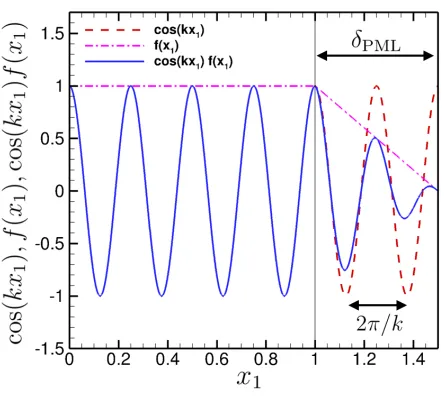
Figure 2: Plot of the real part of the 1D travelling solution, cos(kx1) (dashed line) and its counterpart after the PML coordinate transformation, Re(u) = cos(kx1)f(x1) (solid line). The thin vertical line indicates the outer boundary of the computational domain.
this purpose we note that the plot of the real part of the solution, Re(u) =
cos(kx1)f(x1), and its constituent factors in Fig. 2 shows that the number of
el-ements in the PML region required to accurately represent this solution depends
on the ratio of the PML thickness,δPML to the wavelength 2π/k, i.e. it is
con-trolled by the value of the normalised PML thickness,kδPML. IfkδPML=O(1),
the exact solution oscillates within the PML region (as in Fig. 2) and can
therefore only be resolved by a large number of finite elements. Conversely, as
kδPML→0 the solution in the PML region approaches a straight line because
cos(kx1) remains virtually constant over the width of the PML region. The
so-lution can therefore be approximated to high accuracy with even a single linear
element inside the PML region. We note that the slope of the solution is
dis-continuous at the outer edge of the computational domain,∂Dc. This does not
cause any problems if the equations are discretised with Lagrange-type finite
elements which allow for such discontinuities at element boundaries.
best if the PML thickness is chosen such thatkδPML1. However, we expect
that in actual computations there will be a lower limit of δPML beyond which
the distortion of the elements in the PML region will cause numerical problems.
Furthermore, the analysis presented so far only applies to planar waves. In
the next section we will therefore present the results of comprehensive
numer-ical experiments by which we explore these ideas for a number of increasingly
challenging test cases.
3.2. Numerical Experiments
To assess the effect of variations in the PML thicknessδPML on the quality
of actual numerical solutions we performed numerical experiments using a
stan-dard Galerkin discretisation of the transformed Helmholtz equation (6),
employ-ing Lagrange-type finite elements with linear, quadratic or cubic basis functions.
The equations were implemented inoomph-lib, the open-source object-oriented
multi-physics finite element library [29], freely available athttp://www.oomph-lib.org.
SuperLU, a sparse direct solver [30], was used to solve the linear systems.
In test cases where an exact solution, uex, is available we characterised the
accuracy of the numerical solution, uFE, in terms of the normalised L2 error,
computed over the domain of interest,Dc, (excluding the PML regions),
E =
R
Dc|uFE−uex| 2 dx
1 dx2
R
Dc|uex| 2 dx
1 dx2
!1/2
. (15)
The integration is always carried out on the mesh on which the actual
compu-tation is performed, using the same elemental Gauss integration scheme that
is used to evaluate the finite element matrices and vectors. In cases where an
analytical solution is known, we evaluated uex directly at the relevant Gauss
points. In cases where no exact solution is available and the reference solution
was pre-computed on a finer mesh, we evaluated the equivalent of uex on the
3.2.1. Test case 1: A one-dimensional waveguide
We start with the simple, quasi-one-dimensional test case discussed in
sec-tion 3.1 and solve the Helmholtz equasec-tion in the rectangular domain Dc =
{(x1, x2)| x1 ∈[0,1]; x2 ∈[0, H]}. The application of the Dirichlet boundary
conditionu= 1 at the left boundary (at x1 = 0), and homogeneous Neumann
boundary conditions∂u/∂n=±∂u/∂x2= 0 at the top and bottom boundaries
(at x2 = 0 and x2 = H, respectively) makes the 1D travelling wave solution
(10) the exact solution of this problem.
Since the solution is independent ofx2we discretiseDcusing a single row of
(square) quadrilateral elements of constant edge lengthhand set the (arbitrary)
height of the domain toH =h. We then aim to suppress reflections off the right
boundary (atx1= 1) with a PML region of widthδPML, which we discretise with
another NPML (rectangular) quadrilateral elements. We apply homogeneous
Neumann boundary conditions at their top and bottom boundaries, and the
homogeneous Dirichlet condition u= 0 atx1 = 1 +δPML. With this setup it
is possible to perform computations with very large numbers of elements per
wavelength since the total number of unknowns in the problem increases linearly
withN.
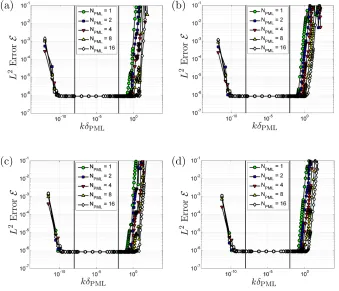
Fig. 3 shows the dependence of the error,E, on the normalised PML
thick-ness, kδPML, for a range of wavenumbers (k = 8,16,32 and 64) and different
numbers of elements in the PML region (NPML= 1,2,4,8 and 16, distinguished
by the different symbols). For all computations shown in this figure, we used
piecewise quadratic basis functions (p= 2), and set the number of elements per
wavelength in Dc toN = 100 to ensure that E is dominated by the error due
to the PML.
The figure shows a very robust behaviour that is consistent with the analysis
presented in section 3.1. SinceNPML is kept constant along the various curves,
an increase in δPML makes it more and more difficult to resolve the solution
in the PML region. A rise inkδPML beyond≈10−2 therefore leads to a rapid
(a)
(b)
[image:14.612.135.474.218.509.2](c)
(d)
Figure 3: ErrorEas a function of the normalised PML thickness,kδPML, and the number of element layers in the PML region,NPML, for Test Case 1. (a)k= 8, (b)k= 16, (c)k= 32, (d)
obviously incurs additional computational cost.
For smaller values of the PML thickness, the solution in the PML region
is sufficiently close to a linear function of x1 that it is easy to resolve with a
very small number of elements. As a result, in this regime the error obtained
forNPML= 1 is practically identical to that obtained with a much finer spatial
resolution (e.g. NPML = 16). This is illustrated further in Fig. 4 where we
plot the exact (solid lines) and computed (dashed lines) solutions fork= 8 for
three different values of the PML thickness. All computational results in this
figure were obtained with linear elements (p = 1) and a fine bulk
discretisa-tion (N = 100) to ensure that the error is dominated by the presence of the
PML region which we discretised with a single element, NPML = 1. The left
column shows the overall solution; in the right column we plot the solutions
near the boundary of the computational domain as a function of the normalised
coordinateν1/δPML, where ν1 =x1−1 is the distance from the outer edge of
the computational domain. This normalisation ensures that the PML region
is always located between 0 and 1 and facilitates the comparison between the
solutions for different PML thicknesses. The oscillations of the exact solution in
the PML region forδPML= 1.0 (shown in the top row of the figure) can clearly
not be resolved by this discretisation and the error in the overall solution is
therefore very large. A reduction in δPML reduces the number of waves that
are contained in the PML region and this greatly improves the accuracy of the
computed solution. For δPML = 10−6 (in the bottom row of the figure), the
exact and computed solutions become graphically indistinguishable.
Returning now to Fig. 3, we observe that for even smaller PML thicknesses,
kδPML<10−8, when the elements in the PML region become rather distorted,
the errorE increases again. We performed numerical experiments to show that
the rise in the error in this regime is correlated with the rapidly increasing
inaccuracy of the numerical integration scheme. In all our computations the
elements’ contributions to the matrix and right hand side of the global linear
system that determines the solution were computed with “full integration”,
Figure 4: The exact (solid lines) and computed (dashed lines) solutions for Test Case 1 for
basis functions exactly (this requires the use of (p+ 1)×(p+ 1)-node
tensor-product Gauss rules for quadrilateral elements with basis functions of orderp;
see, e.g., [31]). We compared the entries in the numerically computed elemental
matrices against their exact counterparts, obtained by evaluating the relevant
integrals usingmaple. As expected, the elemental matrices associated with
el-ements in the bulk (for which the integrands are low-order polynomials inx1)
were found to be accurate to machine precision, while those associated with
ele-ments in the PML region generally contained small errors because the presence
of the singular absorbing functions (9) in the transformed Helmholtz equation
(6) turned the integrands into rational functions. Interestingly, the error
intro-duced by the numerical integration only became significant in a regime when
even the evaluation of the exact integrals inmaplebecame numerically difficult
and required the computations to be performed with 200 digits, indicating that
in this regime roundoff errors are beginning to have an increasingly detrimental
effect on the accuracy of the computation.
We note that for very small values ofδPML the bulk and PML meshes
con-tain elements of extremely different sizes. This has the potential to cause
ill-conditioning of the finite element matrix which may limit the accuracy of the
solution of the linear system by the direct solver. We investigated this
possi-bility by monitoring the condition number of the finite element matrices which
we found to display only a very modest increase with a reduction in δPML.
The assumption that this increase is insignificant is confirmed by the fact that
oomph-libactually treats all problems as nonlinear and solves the discretised
equations by Newton’s method. For linear problems with well-conditioned
fi-nite element matrices this method converges in one iteration. Based on our
experience with other problems, ill-conditioning of the finite element matrix
tends to result in additional Newton iterations or even cause the convergence
of the Newton method to stall. None of this behaviour was observed in any of
the computations we performed. Ill-conditioning of the finite element matrix is
therefore unlikely to be responsible for the increase in the error at small PML
Figure 5: Error E as a function of the normalised PML thickness, for Test Case 1 with
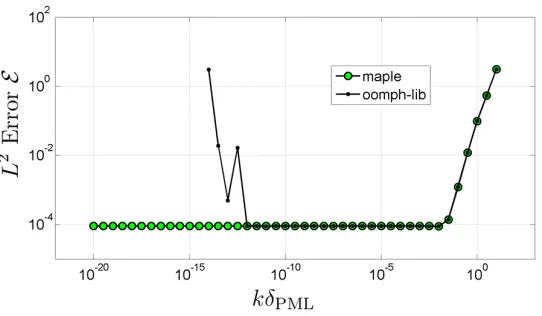
k= 8, discretised with N = 250 linear elements per wavelength in the bulk and a single element in the PML,NPML = 1. The small markers show the error obtained when using our finite element codeoomph-lib. The larger markers represent the error obtained when the entire finite-element computation is performed inmaple, using an accuracy of 200 digits when evaluating symbolic expressions numerically.
This explanation for the rise of the error at extremely small values ofkδPML
is further supported by Fig. 5, which shows a plot of the error as a function of
the normalised PML thickness,kδPML, for the same discretisation as in Fig. 4
(linear elements, a single element in the PML region butN = 250 elements per
wavelength in the bulk). The small markers show the error when solving the
equations with our finite element code, within which the integrals are evaluated
numerically and all computations are performed in double precision arithmetic.
The larger markers show the error obtained when re-implementing the entire
finite element computation in maple, evaluating all integrals analytically and
performing the final floating point evaluation of the results with an accuracy of
200 digits. Over most of the range of PML thicknesses both formulations give
exactly the same result, but themaplecomputation does not display the rise in
the error for extremely small values ofkδPML. In fact, it is possible to
analyt-ically perform the limitkδPML→0 withinmaple. The result obtained for this
shown in this plot. While performing these computations we also monitored the
condition number of themaple-generated finite-element matrix. We found that
it also tended to a constant as kδPML was reduced. The limiting value agreed
with the condition number of the finite-element matrix obtained by actually
settingδPML= 0. This proves that the rise in the error for small values of the
PML thickness observed in Fig. 3 is due to the use of numerical integration in
the evaluation of the finite-element matrices, and the finite precision arithmetic
employed in the code. We note that, since the elements in the PML region are
right-angled quadrilaterals, the contributions to the finite-element matrix and
the right hand side of the linear system could, in principle, be computed
ana-lytically, thus bypassing the error due to the numerical integration. Appendix
A in [25] lists the relevant integrals for the case of linear elements.
The key feature that emerges from the results presented in Fig. 3 is the
existence of a large intermediate range of PML layer thicknesses,
Iopt={kδPML |10−8< kδPML<10−2}, (16)
within which the error remains approximately constant and close to its overall
minimum, virtually independent of NPML. This parameter regime is
charac-terised by the fact that within it the PML thickness is so small that the
solu-tion in the PML region is close to linear (and therefore easy to represent on a
finite element mesh) but not so small that the numerical integration of the finite
element matrices becomes difficult.
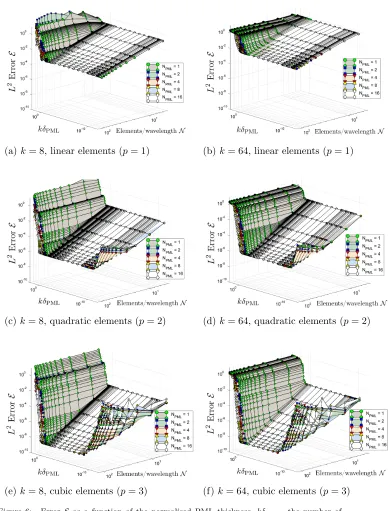
Fig. 6 shows that the features observed in Fig. 3 (forN = 100 and piecewise
quadratic basis functions) are independent of the type of basis functions, and are
not affected by variations in the bulk discretisation in the sense that for all values
ofN in the range 5≤ N ≤100, the error is small and insensitive to changes
in the normalised PML layer thickness if kδPML ∈ Iopt. In all cases the error
increases rapidly once the thickness of the PML layer exceeds kδPML >10−2.
Conversely, the increase in E for very small PML thicknesses only arises once
the bulk discretisation is sufficiently fine so that the error drops belowO(10−4).
(a)k= 8, linear elements (p= 1) (b)k= 64, linear elements (p= 1)
(c)k= 8, quadratic elements (p= 2) (d)k= 64, quadratic elements (p= 2)
[image:20.612.136.528.91.602.2](e)k= 8, cubic elements (p= 3) (f) k= 64, cubic elements (p= 3)
Figure 6: ErrorE as a function of the normalised PML thickness,kδPML, the number of elements per wavelength in the bulk,N, and the number of element layers in the PML region,
Berm´udezet al.’s absorbing function (9) yields optimal results for a given
com-putational cost if it is applied with a normalised PML layer thickness from the
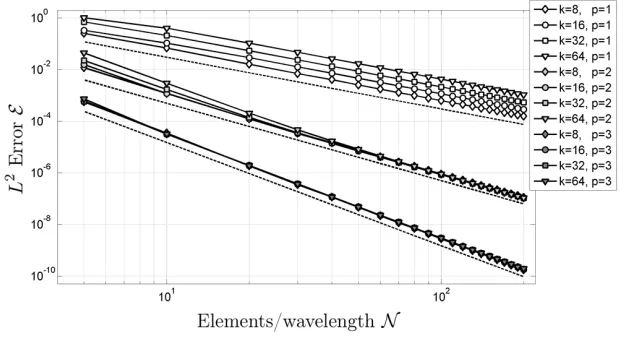
optimal range Iopt. In fact, Fig. 7 demonstrates that for the specific choice
δPML = 10−6, so that kδPML ∈Iopt (and a single element in the PML region,
NPML= 1) theL2error behaves like E ∼ N−(p+1) (forp= 1,2 and 3) asN is
increased, indicating that the error is completely controlled by the discretisation
of the bulk mesh. We refer to [32, 33, 34] for a discussion of the optimal
con-vergence rate of numerical solutions obtained from finite element discretisations
of the Helmholtz equation and note that the observed convergence rate
indi-cates that the bulk discretisation was always sufficiently fine to avoid dispersion
[image:21.612.150.464.329.498.2]errors.
Figure 7: ErrorEfor Test Case 1 as a function of the number of elements per wavelength in
the bulk,N, for various wavenumbers (k= 8,16,32,64) and element types (p= 1,2,3). The PML discretisation is held fixed atδPML= 10−6 andNPML= 1. The dashed lines indicate the optimal convergence rates under bulk mesh refinementE ∼ N−(p+1).
3.2.2. Test case 2: Scattering of a planar wave off a cylinder
Guided by the insight obtained from the study of the simple
quasi-one-dimensional model in the previous section, we now explore the approach in a
equation (1) representing outward propagating waves is given by
u(r, θ) =
∞
X
n=−∞
An Hn(1)(kr) exp(inθ), (17)
where (r, θ) are cylindrical polar coordinates. TheAn are constant coefficients
which are determined by the boundary conditions. For the numerical
experi-ments presented below we chose
An =−
inJn(k)
Hn(1) 0
(k)
. (18)
With this choice, the solution (17) represents the scattered field generated by
a planar sound wave, propagating in thex1-direction, interacting with an
im-penetrable (sound-hard) cylinder of unit radius, centred at the origin of the
coordinate system [35]; see Fig. 1 for a contour plot of this solution, which
we obtained in a computational domain bounded by the lines x1 = ±2 and
x2=±2.
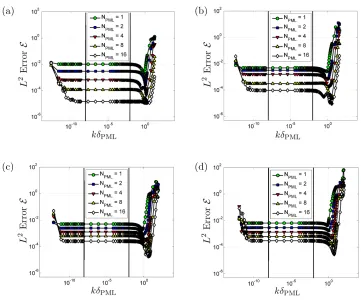
Fig. 8 shows the variation of the error withkδPML, as in Fig. 3, again for
a discretisation with piecewise quadratic basis functions,p= 2. (The range of
wavenumbers considered here is smaller because the computational cost of the
numerical simulations performed to obtain these results is significantly greater
than in the quasi-one-dimensional case; the simulations withk= 12 involved up
to 1.7 million unknowns.) We note that many features of Fig. 3 are observed
here too. Specifically, forkδPML<10−8, the error increases with a reduction in
the PML thickness. For larger values of the PML thickness the error is again
virtually independent ofkδPML, until beyondkδPML= 10−2the error begins to
vary strongly with the thickness of the PML region. Careful adjustment ofδPML
in the regime wherekδPML=O(1) (the range in which most previous attempts
at PML optimisation have been performed) allows a reduction of the error by
another order of magnitude. However, the precise value for which this optimum
is achieved depends sensitively onNPML and small changes to δPML from its
global optimum can lead to a large increase in the error. Ultimately, the error
(a) (b)
[image:23.612.132.493.111.411.2](c) (d)
Figure 8: ErrorE as a function of the normalised PML thickness,kδPML, and the number of element layers in the PML region,NPML, for Test Case 2. (a)k= 2, (b)k= 4, (c)k= 8, (d)k= 12. All computations were performed withN = 50 elements per wavelength in the bulk and quadratic basis functions,p= 2. The vertical lines delimit the optimal parameter regimeIoptwithin which the error is small and insensitive to changes in the thickness of the PML region.
PML region becomes insufficient to resolve the spatial variations of the solution
in this region.
An important difference to the results shown in Fig. 3 is that if kδPML
is chosen from the optimal range the error displays a marked dependence on
the number of element layers in the PML region, with an increase in NPML
consistently reducing the error (at additional computational cost). To explain
this observation, Fig. 9 shows how the error depends on the bulk discretisation
(a)k= 4, linear elements (p= 1) (b)k= 12, linear elements (p= 1)
(c)k= 4, quadratic elements (p= 2) (d)k= 12, quadratic elements (p= 2)
[image:24.612.136.516.144.644.2](e)k= 4, cubic elements (p= 3) (f) k= 12, cubic elements (p= 3)
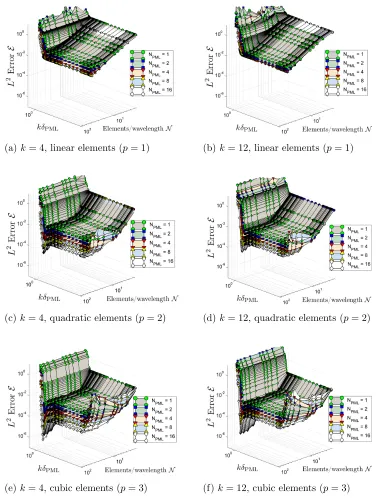
Figure 9: ErrorE as a function of the normalised PML thickness,kδPML, the number of elements per wavelength in the bulk,N, and the number of element layers in the PML region,
vary between 2 and 50). Overall, the figure is very similar to its counterpart for
the quasi-one-dimensional case (Fig. 6). For a given discretisation of the PML
region (i.e. for fixedNPML andkδPML∈Iopt) an increase in the bulk resolution
(via an increase inN) initially reduces the error at the optimal rateE ∼ N−(p+1)
(see also Fig. 10), with little dependence onNPMLandkδPML, exactly as in Fig.
6). However, once the bulk discretisation has become sufficiently fine, the overall
error saturates and becomes dominated by the error due to the discretisation
of the PML region. The onset of the saturation can be delayed (and hence the
reduction in the error with an increase in N continued to larger values of N)
by increasingNPML (at additional computational cost).
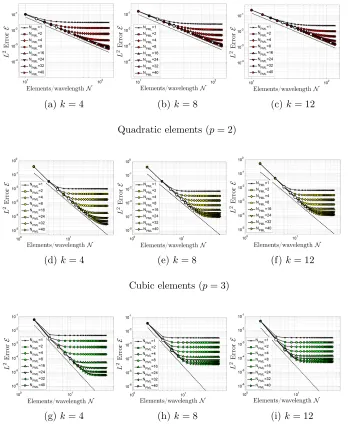
The saturation of the error under bulk mesh refinement is illustrated more
clearly by the plots in Fig. 10, which show the variation of the error with an
increase inN forδPML= 10−6, such thatkδPML∈Iopt, for various wavenumbers
(k= 4,8,12), basis functions (p= 1,2,3) and values ofNPML. We note that the
dependence of the error displayed in Fig. 10 onN and NPML is well described
by a relation of the form
E(N, NPML) =CN−(p+1)+EPML(NPML) (19)
whereC is a constant that depends only weakly onk, andEPML(NPML) defines
the minimum error achievable with a given number of element layers in the
PML region. EPML(NPML) decreases approximately linearly with an increase in
NPML. It is interesting to note that the saturation of the error under increasing
bulk mesh refinement is not present in the corresponding results for Test Case
1, confirming, yet again, that Berm´udezet al.’s attenuation function is perfect
(so that there is zero reflection from the PML layer into the bulk, at least in
the continuous setting) only for planar waves.
3.2.3. Test case 3: Scattering off multiple polygonal scatterers
Finally, we assess the performance of our approach in a multiple-scattering
problem in which an incoming planar wave, travelling in the negativex1-direction,
Linear elements (p= 1)
(a)k= 4 (b)k= 8 (c)k= 12
Quadratic elements (p= 2)
(d)k= 4 (e) k= 8 (f)k= 12
Cubic elements (p= 3)
[image:26.612.139.487.131.559.2](g)k= 4 (h)k= 8 (i)k= 12
Figure 10: ErrorE for Test Case 2 as a function of the number of elements per wavelength
in the bulk,N, for various wavenumbers (k= 4,8,12) and element types (p= 1,2,3). The PML discretisation is held fixed atδPML = 10−6. The dashed lines indicate the optimal convergence rates under bulk mesh refinement,E ∼ N−(p+1). The white symbols indicate
the point at which the error is deemed to start saturating, based on the criteria used in section
which we apply the Neumann boundary condition
∂u
∂n = ikn1exp(−ikx1), (20)
wheren= (n1, n2) is the outer unit normal on∂DN. Fig. 11 shows the real part
of the scattered field fork= 40, computed on a very coarse mesh with a thick
PML region. A key feature of this problem is that the sharp re-entrant corners
on the surface of the scatterer create a derivative singularity in the solution
which limits the asymptotic convergence rate of the numerical solution under
mesh refinement. Since there is no exact solution for this problem, we use the
numerical solution computed withN = 180, a PML layer thickness ofδPML =
10−6 and N
PML = 16 as a proxy for uex. This involved the most expensive
simulations performed in this study and required in excess of 10 million degrees
of freedom for the most refined simulations with cubic elements.
6
-x
1x
2 [image:27.612.140.490.422.610.2]-1
Figure 11: Plot of the solution of Test Case 3 for a wavenumber ofk= 40 computed on a very coarse finite element mesh surrounded by a (relatively thick) PML.
by the vertical lines in Fig. 12(a) again leads to a minimal error for fixed values
of the discretisation parametersN and NPML (here kept fixed at N = 22 and
NPML= 16) for linear, quadratic and cubic basis functions. Furthermore, Fig.
12(b) shows that for the specific choiceδPML= 10−6, such that kδPML∈Iopt,
the error decays at the same rate E ∼ N−5/3 (shown by the dashed line) for
all types of basis functions. This is consistent with the theoretically expected
behaviour for domains with sharp re-entrant corners; see e.g. [36] for a discussion
in the context of the Poisson equation.
We note that unlike the behaviour shown in Fig. 10, the error in Fig. 12(b)
does not display any saturation under bulk mesh refinement, despite the fact
that the scattered waves impinging on the PML boundary are non-planar. This
is due to the fact that the error displayed in Fig. 12(b) was computed by
referring to a numerical solution that was computed on a finer bulk mesh (larger
N) but with the same number of element layers in the PML region (sameNPML).
Assuming that the actual error (relative to the (unknown) exact solution) in
both numerical solutions has the functional form (19), the saturation errorEPML
is expected to cancel out. The absence of the saturation in Fig. 12(b) therefore
provides further support for our conjecture that the actual error associated with
Berm´udezet al.’s PML depends on the discretisation parametersN, NPMLand
pas described by equation (19). We have performed additional computations to
confirm that the saturation error re-appears if the reference solution is computed
with a larger number of elements in the PML region.
3.3. The saturation of the error for non-planar waves
The numerical results presented so far indicate that for a fixed computational
effort (i.e. constant p, N and NPML) there exists a range of normalised PML
thicknesses such that for kδPML ∈ Iopt, the error remains small and typically
close to the global minimum achievable. If the thickness of the PML region is
chosen from within this range, the error may be reduced further by p-refinement,
i.e. an increase in the order of the elements’ basis functions; the benefit of
(a) (b)
Figure 12: Results for Test Case 3 withk= 40. (a) ErrorEas a function of the normalised PML thickness,kδPMLforN = 22 andNPML = 16. The vertical lines delimit the optimal parameter regimeIopt defined in equation (16). (b) ErrorEas a function of the number of elements per wavelength in the bulk, N, for three elements types (p = 1,2,3). The PML discretisation is held fixed atδPML= 10−6 andNPML= 16. The dashed line indicates the optimal convergence rate under bulk mesh refinement,E ∼ N−5/3.
to saturate with increasingN (unless the solution consists of planar waves for
which Berm´udezet al.’s [25] PMLs cause practically no reflection).
Since the onset of the saturation can be delayed by an increase in NPML
(see also [21, 23]), it is desirable to determine the minimum number of element
layers in the PML region,NPMLmin, that is required to ensure that the quality of
the numerical solution is controlled exclusively by the bulk discretisation so that
for sufficiently smooth solutions the dependence of the error on the parameters
N andpfollows the asymptotic behaviourE ∼ N−(p+1). To determine the
de-pendence ofNmin
PMLonN based on this criterion we note that in the log-log plots
in Fig. 10 the curves representing the error for fixedNPMLcontain two
approx-imately straight segments – one in the region where the error decays according
to the asymptotic error estimate, the other where the error has saturated and
remains constant. To determine the transition between these two regimes (and
thus the onset of the saturation) we fitted a spline to each of these curves and
particular value ofNPMLfirst deviated from the theoretical convergence rate by
more than 10%. The pairs (Nb, NPML) obtained by this procedure are shown by
the white symbols in Fig. 10. They define the valueNPML required to
(approx-imately) retain the theoretical convergence rate under bulk mesh refinement up
to the spatial resolution associated withNb and thus defineNPMLmin (N).
Fig. 13 indicates howNmin
PML varies withN for the data from Test Case 2.
The range over which data is displayed in Fig. 13 is determined by the range
ofN over which saturation is observed in Fig. 10. For linear elements (p= 1),
b
N approaches the maximum value of N considered (N ≤ 120), while for the
higher-order elements (p= 2,3) saturation is observed at more modest values
ofN so that the original data is limited by the maximum number of element
layers in the PML region (NPML ≤ 40). Additional computations with up to
NPML = 240 were therefore performed to extend the range of data available.
Fig. 13 shows that in all cases the number of element layers in the PML region
must increase linearly with the number of elements per wavelength in the bulk
to retain the asymptotic convergence rate under (bulk) mesh refinement. While
higher-order elements require much larger numbers of elements in the PML
region to achieve this, it is important to stress that they tend to be much more
accurate than their low-order counterparts and always give far more accurate
results for given values ofN andNPML.
4. Summary and Conclusions
We have provided an alternative interpretation of Berm´udez et al.’s
obser-vation that, in a continuous setting, PMLs that are based on the unbounded
damping function (9) do not cause any reflections for planar waves. This
al-lowed us to show that, when discretised with conforming Lagrange-type finite
elements, such PMLs perform best (for a given computational effort) when their
thickness is chosen such thatkδP M L 1, i.e. if the thickness of the PML
re-gion is much smaller than the wavelength. Motivated by this observation we
nor-(a) k=4 (b) k=8 (c) k=12
Figure 13: The minimum number of element layers in the PML region,Nmin
PML, required to
maintain the optimal convergence rate under bulk mesh refinement for a)k= 4, b)k= 8 and c)k= 12 and the three element types (p= 1,2 and 3) considered in this study. The thick solid lines are straight lines through the data points for largeN. PML thicknessδPML= 10−6 for all cases.
malised PML thicknesses, Iopt, such that for kδPML ∈ Iopt Berm´udez et al.’s
unbounded absorbing function (9) yields an error that is optimal (in the sense
of being both small and insensitive to change) for a given computational cost
(number of elements in the bulk and in the PML regions). Within the optimal
parameter regime, the error remains small and virtually constant over several
orders of magnitude of the normalised PML thickness kδPML. The optimal
regime is bounded above by a regime in which the error increases due to
insuffi-cient spatial resolution in the PML region, and below by a regime in which the
numerical integration becomes inaccurate. We stress that the optimal choice of
the PML thickness does not require further optimisation within Iopt since the
error is virtually constant within this range. As long as kδPML is chosen from
withinIoptits actual value is irrelevant since it neither affects the error nor the
computational cost. Our recommendation to choose the normalised PML
thick-nesskδPMLfrom anywhere within the optimal regimeIopttherefore makes PML
optimisation unnecessary and thus makes Berm´udez et al.’s PMLs parameter
free.
lay-ers in the PML region, NPML, the error is controlled exclusively by the bulk
discretisation, which we characterised in terms of the number of elements per
wavelength,N. For a PML thickness from the optimal range, the error follows
the theoretical error estimate (E ∼ N−(p+1)for smooth solutions andE ∼ N−5/3
for solutions with derivative singularities) until the presence of the PML causes
a saturation of the error under further bulk mesh refinement. The saturation in
the error can be delayed by an increase inNPML (at additional computational
cost). We showed that a linear increase inNPMLtogether with an increase inN
suffices to retain the theoretical convergence rate under bulk mesh refinement;
see also [21, 23].
We note that Berm´udezet al. introduce a whole family of unbounded
damp-ing functions (types A-D, which all have a free parameter, β). They all share
the property that, in the continuous setting, they completely suppress the
re-flection of planar waves with arbitrary incidence angle. In recent years other
authors (e.g. [37, 38]) have also considered this class of functions and have
conducted studies on the variation of the various parameters in their respective
formulations (e.g. [26, 39]). It is therefore important to stress that the damping
function (9) used in the present paper isthe onlyfunction that has the key
prop-erty that the complex coordinate mapping (11) transforms a planar travelling
wave (10) into a linear function within the PML region as kδPML → 0. It is
interesting to note that Berm´udez et al. determined the optimal value of their
parameterβ via numerical experiments. These suggested β= 1 – precisely the
value required to turn their type A function into (9). We refer to the Appendix
for a more detailed discussion of Berm´udezet al.’s other unbounded damping
functions.
As in Berm´udez et al.’s paper, our theoretical analysis applies only to the
case of planar waves. We employed extensive numerical experiments to explore
the optimal PML thickness in other settings. Given that these experiments
in-cluded test cases with a variety of solution types (planar and non-planar waves;
domains with smooth and polygonal boundaries; smooth and singular solutions;
differ-ent elemdiffer-ent types and an extremely wide range of spatial resolutions, we have
confidence in the general nature of our results. Following the suggestion of a
ref-eree, we also explored the behaviour of Berm´udezet al.’s damping function with
spectral elements (using nodal Legendre bases of various orders). The
simula-tions (not presented here) showed the same behaviour that we reported for the
low-order Lagrange-type finite elements. We suspect that our recommendation
for the optimal thickness of the PML region also applies to the 3D Helmholtz
equation, though the computational cost of performing equally comprehensive
numerical experiments on 3D test problems would be considerable. It will be
interesting to explore the performance of Berm´udez et al.’s absorbing functions
in other wave equations, such as the equations of time-harmonic linear elasticity,
to assess if our recommendation for the optimal thickness of the PML region
applies here too. This work is currently in progress.
Acknowledgements
We would like to acknowledge the financial support of Thales UK Limited
and the School of Mathematics at the University of Manchester. We are
grate-ful to Phil Cotterill and Robert Harter for their comments on a draft of this
manuscript. We also wish to thank the referees for their constructive comments
and suggestions.
References
[1] A. Sommerfeld, Partial Differential Equations in Physics, Academic Press,
New York, 1949.
[2] B. Engquist, A. Majda, Absorbing boundary conditions for the numerical
simulation of waves, Mathematics of Computation 31 (139) (1977) 629–651.
[3] R. Mittra, O. Ramahi, Absorbing boundary conditions for the direct
problems. PIER 2: Finite Element and Finite Difference Methods in
Elec-tromagnetic Scattering., M.A. Morgan, Elsevier, New York, 1990.
[4] A. Bayliss, M. Gunzburger, E. Turkel, Boundary conditions for the
nu-merical solution of elliptic equations in exterior regions, SIAM Journal on
Applied Mathematics 42 (1982) 430–451.
[5] J. Jin, The Finite Element Method in Electromagnetics, 2nd Edition,
Wiley-Blackwell, New York, 2002.
[6] D. Givoli, High-order local non-reflecting boundary conditions: a review,
Wave Motion 39 (2003) 319–326. doi:10.1016/j.wavemoti.2003.12.004.
[7] S.-K. Jeng, C.-H. Chen, On variational electromagnetics: theory and
ap-plication, IEEE Transactions on Antennas and Propagation 32.
[8] R.-B. Wu, C. Chen, Variational reaction formulation of scattering problem
for anisotropic dielectric cylinders, IEEE Transactions on Antennas and
Propagation 34 (5) (1986) 640–645. doi:10.1109/TAP.1986.1143874.
[9] L. Pearson, R. Whitaker, L. Bahrmasel, An exact radiation boundary
con-dition for the finite-element solution of electromagnetic scattering on an
open domain, IEEE Transactions on Magnetics 25 (4) (1989) 3046–3048.
doi:10.1109/20.34364.
[10] K. Ihlenburg, Finite Element Analysis of Acoustic Scattering,
Springer-Verlag, New York, 1998.
[11] J.-P. B´erenger, A perfectly matched layer for the absorption of
electromag-netic waves, Journal of Computational Physics 114 (2) (1994) 185 – 200.
doi:http://dx.doi.org/10.1006/jcph.1994.1159.
[12] I. Harari, A survey of finite element methods for time-harmonic
acous-tics, Computer Methods in Applied Mechanics and Engineering 195 (1316)
(2006) 1594 – 1607, a Tribute to Thomas J.R. Hughes on the Occasion of
[13] X. Yuan, D. Borup, J. Wiskin, M. Berggren, R. Eidens, S. Johnson,
Formulation and validation of Berenger’s PML absorbing boundary for
the FDTD simulation of acoustic scattering, IEEE Transactions on
Ul-trasonics, Ferroelectrics, and Frequency Control 44 (4) (1997) 816–822.
doi:10.1109/58.655197.
[14] D. Komatitsch, R. Martin, An unsplit convolutional perfectly matched layer
improved at grazing incidence for the seismic wave equation, Geophysics
72 (5) (2007) SM155–SM167. doi:10.1190/1.2939484.
[15] D. Komatitsch, J. Tromp, A perfectly matched layer absorbing boundary
condition for the second-order seismic wave equation, Geophysical Journal
International 154 (1) (2003) 146–153.
[16] U. Basu, A. Chopra, Perfectly matched layers for time-harmonic
elasto-dynamics of unbounded domains: theory and finite-element
implementa-tion, Computer Methods in Applied Mechanics and Engineering 192 (2003)
1337–1375. doi:10.1016/S0045-7825(02)00642-4.
[17] G. Cohen, S. Fauqueux, Mixed spectral finite elements for the linear
elastic-ity system in unbounded domains, SIAM Journal on Scientific Computing
26 (3) (2006) 864–884. doi:10.1137/S1064827502407457.
[18] K. Meza-Fajardo, A. Papageorgiou, A nonconvolutional, split-field,
per-fectly matched layer for wave propagation in isotropic and anisotropic
elas-tic media: Stability analysis, Bulletin of the Seismological Society of
Amer-ica 98 (4) (2008) 1811–1836. doi:10.1785/0120070223.
[19] Y. Ukai, S. Ishida, N. Hata, T. Azuma, S. Umemura, T. Dohi, A 3−d
simulation of focused ultrasound propagation for extracorporeal shock wave
osteotomy, International Congress Series 1256 (1) (2003-06-01T00:00:00)
658–663. doi:10.1016/S0531-5131(03)00278-4.
ab-sorbers for finite-element mesh truncation, IEEE Transactions on Antennas
and Propagation 45 (3) (1997) 474–486. doi:10.1109/8.558662.
[21] G. Pan, A. Abubakar, T. Habashy, An effective perfectly matched
layer design for acoustic fourth-order frequency-domain finite-difference
scheme, Geophysical Journal International 188 (1) (2012) 211–222.
doi:10.1111/j.1365-246X.2011.05244.x.
[22] E. B´ecache, A.-S. B.-B. Dhia, G. Legendre, Perfectly matched layers for
the convected Helmholtz equation, in: G. C. Cohen, P. Joly, E. Heikkola,
P. Neittaanmki (Eds.), Mathematical and Numerical Aspects of Wave
Propagation WAVES 2003, Springer Berlin Heidelberg, 2003, pp. 142–147.
doi:10.1007/978-3-642-55856-6-23.
[23] I. Singer, E. Turkel, A perfectly matched layer for the Helmholtz equation
in a semi-infinite strip, Journal of Computational Physics 201 (2) (2004)
439–465. doi:10.1016/j.jcp.2004.06.010.
[24] X. Jiang, W. Zheng, Adaptive perfectly matched layer method
for multiple scattering problems, Computer Methods in
Ap-plied Mechanics and Engineering 201204 (0) (2012) 42 – 52.
doi:http://dx.doi.org/10.1016/j.cma.2011.09.013.
[25] A. Berm´udez, L. Hervella-Nieto, A. Prieto, R. Rodr´ıguez, An optimal
per-fectly matched layer with unbounded absorbing function for time-harmonic
acoustic scattering problems, Journal of Computational Physics 223 (2)
(2007) 469 – 488. doi:http://dx.doi.org/10.1016/j.jcp.2006.09.018.
[26] D. Rabinovich, D. Givoli, E. B´ecache, Comparison of high-order absorbing
boundary conditions and perfectly matched layers in the frequency domain,
International Journal for Numerical Methods in Biomedical Engineering
26 (10) (2010) 1351–1369. doi:10.1002/cnm.1394.
[27] F. Teixeira, W. Chew, A general approach to extend Berenger’s
Transactions on Antennas and Propagation 46 (9) (1998) 1386–1387.
doi:10.1109/8.719984.
[28] S. Kucukcoban, L. Kallivokas, A symmetric hybrid
formu-lation for transient wave simulations in PML-truncated
het-erogeneous media, Wave Motion 50 (1) (2013) 57 – 79.
doi:http://dx.doi.org/10.1016/j.wavemoti.2012.06.004.
[29] M. Heil, A. L. Hazel,oomph-lib– an object-oriented multi-physics
finite-element library, in: M. Sch¨afer, H.-J. Bungartz (Eds.), Fluid-Structure
Interaction, Springer, 2006, pp. 19–49, oomph-lib is available as
open-source software athttp://www.oomph-lib.org.
[30] J. W. Demmel, S. C. Eisenstat, J. R. Gilbert, X. S. Li, J. W. H. Liu, A
supernodal approach to sparse partial pivoting, SIAM Journal on Matrix
Analysis and Applications 20 (3) (1999) 720–755.
[31] K.-J. Bathe, Finite element procedures, 2nd Edition, Prentice-Hall,
Engle-wood Cliffs, 1996.
[32] F. Ihlenburg, I. Babu˘ska, Solution of Helmholtz problems by
knowledge-based FEM, Computer Assisted Mechanics and Engineering Sciences 4
(1997) 397–415.
[33] I. Babu˘ska, M. Suri, The p and h-p versions of the finite element method,
basic principles and properties, SIAM Review 36 (1994) 4:578–632.
[34] I. Babu˘ska, F. Ihlenburg, E. Paik, S. Sauter, A generalized finite element
method for solving the Helmholtz equation in two dimensions with minimal
pollution, Computer Methods in Applied Mechanics and Engineering 128
(1995) 325–359. doi:10.1016/0045-7825(95)00890-X.
[35] C. Linton, P. McIver, Handbook of mathematical techniques for
[36] H. Elman, D. Silvester, A. Wathen, Finite Elements and Fast Iterative
Solvers, Oxford University Press, Oxford, 2005.
[37] J. Kormann, P. Cobo, A. Prieto, Perfectly matched layers for
mod-elling seismic oceanography experiments, Journal of Sound and Vibration
317 (12) (2008) 354 – 365. doi:10.1016/j.jsv.2008.03.024.
[38] S. Ham, K.-J. Bathe, A finite element method enriched for wave
prop-agation problems, Computers and Structures 9495 (0) (2012) 1 – 12.
doi:10.1016/j.compstruc.2012.01.001.
[39] A. Modave, E. Delhez, C. Geuzaine, Optimizing perfectly matched
lay-ers in discrete contexts, International Journal for Numerical Methods in
Engineering 99 (6) (2014) 410–437. doi:10.1002/nme.4690.
Appendix: The performance/behaviour of other unbounded damping
functions
One of the key observations of our paper is that the damping function (9) is
the onlyfunction that has the key property that the complex coordinate mapping
(11) transforms a planar travelling wave (10) into a linear function within the
PML region askδPML→0. This observation explains why for sufficiently small
values of the PML thickness even a single linear element suffices to represent
the exact solution of the coordinate-transformed Helmholtz equation (6) within
the PML region, implying that the accuracy of the overall solution is controlled
exclusively by the bulk discretisation.
Berm´udezet al. [25] introduce a much wider class of unbounded damping
functions which all have the property that, in the continuous setting, they yield
zero reflection from the boundary of the computational domain. Our
analy-sis suggests that their performance in a finite-element-based discretisation will
depend crucially on how easy it is resolve this exact solution within the PML
(which we discuss below), Berm´udez et al. [25] consider four different
damp-ing functions, Types A-D. All of these transform the travelldamp-ing wave solution
u(x1) = exp(ikx1) intof(x1) exp(ikx1), where f = 1 at the interface between
the computational domain and the PML region, andf = 0 at the outer
bound-ary of the PML region where we impose (consistent) homogeneous Dirichlet
boundary conditions. The ease with which this exact solution can be
repre-sented on a finite-element mesh depends on the shape off(x1) within the PML
region.
(a) (b)
[image:39.612.132.492.260.561.2](c) (d)
Figure 14: Prefactorfas a function of the normalised coordinateν1/δPML, whereν1=x1−1 is the distance from the outer edge of the computational domain for (a) Type A, (b) Type
B, (c) Type C and (d) Type D damping profiles. We present results for PML thicknesses
δPML = 100 (dotted black lines) andδPML = 10−6 (thick coloured lines). The inset in (b) and (d) shows a zoom into the region near the interface between the computational domain
Type A:
σ(x1) =
1 1 +δPML−x1
.
This corresponds to our choice (9) and yields
f(x1) =
1 +δPML−x1
δPML
,
a straight line across the PML, irrespective of the PML thickness. See
Fig. 14(a).
Type B:
σ(x1) =
1
(1 +δPML−x1)2
This is obtained by raising the “Type A” function to the second power and
thus leads to a more rapid attenuation of the solution within the PML. It
yields
f(x1) = exp
1
δPML
− 1
1 +δPML−x1
.
Fig. 14(b) shows that this function is highly nonlinear and becomes
in-creasingly steep near the interface between the computational domain and
the PML region as kδPML →0, making it difficult to resolve on a finite
element mesh. This function can therefore only be used for relatively large
PML thicknesses, while using a sufficient number of elements in the PML
to resolve the spatial variation to the required accuracy. The
determi-nation of the optimal values for NPML and δPML requires a case-by-case
numerical PML optimisation.
Type C:
σ(x1) =
1 1 +δPML−x1
− 1 δPML
.
This is obtained by the addition of the constant 1/δPML to the Type A
function which makes σ(x1) continuous across the interface between the
computational domain and the PML region. This may be advantageous
in certain problems because it avoids the discontinuity in the slope of the
the desirable linear variation off(x1) within the PML region by an
expo-nential,
f(x1) =
1 +δPML−x1
δPML
exp
x
1−1
δPML
(see Fig. 14(c)), making it impossible to resolve the exact solution in
the PML with a single linear element. The shape of the scaling factor is
independent of δPML, therefore an increase in the number of elements in
the PML region, NPML (or an increase in the order of the finite element
basis function, p) suffices to reduce the error, irrespective of the PML
thickness.
Type D:
σ(x1) =
1
(1 +δPML−x1)2
− 1 δ2
PML
,
is the continuous version of the Type B function. It corresponds to
f(x1) = exp
1
δPML
− 1
1 +δPML−x1
+x−1 δ2
PML
which suffers from the same problem as its discontinuous counterpart; see
Fig. 14(d).
(a)N = 20, NPML= 1 (b)N = 100, NPML= 1 (c)N = 100, NPML= 8
Figure 15: ErrorEfor Test Case 1 withk= 8 as a function of the normalised PML thickness,
kδPML for damping profiles of Type A-D. (a) N = 20 (b) N = 100 linear elements per wavelength in the bulk, and a single element in the PML, NPML = 1. (c)N = 100 and
[image:41.612.143.475.452.573.2]Fig. 15 shows the dependence of the error on the normalised PML thickness
for the quasi-one-dimensional Test Case 1 considered in section 3.2.1. The
domain is discretised with (a)N = 20 and (b,c) N = 100 linear finite elements
per wavelength in the bulk. In (a,b) the PML contains a single linear element,
NPML= 1, while the results in (c) were obtained withNPML= 8. As expected,
the Type B and D damping functions perform very poorly for thin PMLs. The
error for the Type C function is much larger than that for the Type A function
but for kδPML ∈ Iopt the error remains approximately constant as δPML is
reduced because the variation off(x1) through the PML is independent of its
thickness. The comparison between Figs. 15(a) and (b) shows that an increase
in the bulk resolution (from N = 20 to 100 elements per wavelength) only
reduces the error for the Type A function. This is consistent with our assertion
that the error associated with the Type C solution is controlled by the overly
coarse discretisation of the PML – a single linear element cannot resolve a
function that has the same shape as that shown in Fig. 14(c). Finally, Figs.
15(b) and (c) show the effect of an increase fromNPML= 1 to 8 at a fixed bulk
resolution (N = 100). As expected, we find that for kδPML∈Iopt the Type C
solution benefits from this increase since it allows an improved resolution of the
solution in the PML. Conversely, the error associated with the Type A solution
remains unaffected since a single linear element is already sufficient to represent
the profile shown in Fig. 14(a).
Having confirmed that, of the various damping functions considered by
Berm´udez et al., the Type A function performs best, we finally consider the
effect of including a multiplicative constantB into the mapping function,
σ(x1) =
B 1 +δPML−x1
.
This yields the scaling factor
f(x1) =
1 +δ
PML−x1
δPML
B .
The spatial variation of this function across the PML is independent of δPML
for all other values the linear profile is distorted and thus unnecessarily difficult
to resolve on a finite element mesh (with values in the range B < 1 being
particularly problematic because of the infinite slope off(x1) at the outer edge
of the PML). We note that the constant B is the non-dimensional equivalent
of Berm´udezet al.’s factorβ which they determined by numerical experiments
to yield optimal results if set to the wavespeedc– this corresponds precisely to

![Figure 4: The exact (solid lines) and computed (dashed lines) solutions for Test Case 1 forvarious PML thicknesses [the entire computational domain,δPML = 1.0 (top), 0.1 (middle) and 10−6 (bottom)], plotted over x1 ∈ [0, 1 + δPML] (left) and near the bound](https://thumb-us.123doks.com/thumbv2/123dok_us/9501910.455643/16.612.136.468.104.568/figure-computed-solutions-forvarious-thicknesses-computational-domain-plotted.webp)