ISSN: 1680-5593
© Medwell Journals, 2020
Effect of Substituting Commercial Feed with Mulberry Leaf Meal on
Performance of Broiler Chickens
1
Muhammed Tilahun,
2MengistuUrge and
3MekonnenYirga
1
School of Veterinary Medicine, Wollo University, P.O. Box 1145, Dessie, Ethiopia
2School of Animal and Range Science, College of Agriculture and Environmental Sciences,
Haramaya University, P.O. Box138, Dire Dawa, Ethiopia
3
Department of Animal Science, College of Agriculture, Wollo University,
P.O. Box 1145, Dessie, Ethiopia
Abstract: The study was conducted to evaluate the effect of substituting commercial broiler feed with mulberry leaf meal on feed intake, weight gain, feed conversion ratio and mortality. About 144 Cobb 500 broiler breed chicks were randomly distributed to 4 treatments in completely randomized design. Treatment diets were prepared by substituting 7.5, 15 and 22.5% of commercial broiler feed with mulberry leaf meal during the starter, grower and finisher phases. The average feed intake of broilers was affected (p<0.0001) by treatment diets where substitution of mulberry leaf meal at 7.5% and above had decreased the feed intake. Analysis of variance revealed higher (p<0.0001) weight gain in control group (M0) as compared to the other treatments.
Inclusion of mulberry leaf meal up to 15% has no adverse effect on the survival rate. This study has showed that mulberry leaf meal substitution at 7.5% and more seems to have good effect on broilers carcass quality and reduction of abdominal fat that can positively affect consumer’s desire.
Key words: Feed intake, feed conversion ratio, mortality, weight gain, control, group
INTRODUCTION
The productivity of poultry in the tropics has been limited by scarcity and consequent high prices of the conventional chicken feed. The price of conventional protein feed resources is high and cannot permit profit maximization in poultry business. In view of this, current research interest in the poultry industry is aimed at finding alternatives to this elusive feed ingredient (Kamruzman et al., 2012; Islam et al., 2014). The list of possible feed alternatives includes mulberry leaves as a source of dietary protein for poultry operations. Mulberry leaves are rich in protein, minerals (Ca, P) and metabolizable energy with absence of or negligible anti-nutritional factors (Omar et al., 1999; Srivastava et al., 2006). The available information on the effect of mulberry leaf inclusion on the performance of broiler chicken is not available under Ethiopian condition. Therefore, the present experiment was undertaken with the objective of assessing the substitution of mulberry leaf meal in broiler diet on feed intake, weight gain, feed conversion ratio, carcass yield and mortality.
MATERIALS AND METHODS
Study area: The study was conducted at Kombolcha Agriculture Technical Vocational Education (ATVET)
College, South Wollo Zone, Amhara region, Ethiopia. Kombolcha is located 375 km North of Addis Ababa (Ethiopia) at 1350 masl, 11.1°N latitude and 39.40°E longitudes. The annual rainfall ranges between 750 and 900 mm with 8.6 and 30.8°C of minimum and maximum temperature, respectively.
Preparation of mulberry leaf meal: Seventy five days old fresh mulberry leaves re-growth of S30 and K1 varieties were collected. After harvesting, leaves were separated from their stems and dried 3 to 4 days under shade. Dried leaves were ground coarsely using hand mortar and pass through sieve, so as to be similar to the size of the commercial broiler ration.
Experimental chicks and their management: A total of 144 Cobb 500 day old commercial broiler chicks were purchased from Alema poultry farms, DebreZeit, Ethiopia. The birds were reared in a deep litter housing system and chicks were allocated at random into twelve pens. Routine vaccination against Newcastle and Gumborro were given as recommended by the manufacturers on the 1st, 14th, 21st and 28th day of age.
Feed preparation and feeding: Commercial starter and grower feed used in this study were obtained from Alema
Koudijs Feed PLC (a joint venture between De Heus Animal Nutrition BV and Alema Farms). Direct substitution of commercial broiler feed with Mulberry Leaf Meal (MLM) was used in this experiment. The MLM were prepared from the two varieties with equal amounts and then mixed thoroughly to the commercial broiler feed based on the treatment ratio. Feed and water were offered ad libitum during the starter (day 1-11), grower (day 12-21) and finisher (after 22 days) phases. Feed intake was measured on daily basis by taking the difference between the quantity of feed offered the previous day and the quantity of feed left the next morning.
Experimental design and treatments: Broilers were assigned to four treatment groups following the principles of Completely Randomized Design (CRD). Each treatment group has three replicates of twelve birds per pen. The treatments are MU0 = 100% Commercial broiler diet (Control); MU7.5 = 92.5% Commercial broiler diet +7.5% Mulberry leaf meal; MU15 = 85% Commercial broiler diet +15% Mulberry leaf meal; and MU22.5 = 77.5% Commercial broiler diet+22.5% Mulberry leaf meal.
Body weight measurement: All chicks are weighed on group base in each pen for the first two weeks of age. After two weeks, chick weight was taken individually before morning feeding on a weekly basis.
Carcass evaluation: At the end of the experiment, four broilers were randomly picked from each replication and slaughtered after being starved overnight for about 12 h, so as to allow the emptying of the crop and excretion of the undigested feed residue. After starvation, each bird were weighed, slaughtered, dressed, eviscerated and cut into parts to record pre-slaughter weight, dressing weight, eviscerated weight, carcass weight, breast weight, thigh and drumstick weight, liver, heart, gizzard, abdominal fat and intestine. Dressing, eviscerated and carcass percentage were calculated as percent of live weight. Dressing % was calculated as % of live weight after bleeding and de-feathering. Eviscerated % were measured by removing the viscera, head, shank, trachea, lungs but with giblets (heart, liver and gizzard) and skin and expressed as % of live weight. The carcass weight and % was taken into account without the giblet. The abdominal fat, liver, leg, drum stick, thigh, heart, gizzard, intestine and breast weight were measured individually and equated with percent of live weight.
Chemical analysis: Feed samples of both commercial feed and mulberry leaf were analyzed to determine their Crude Fiber (CF), Ether Extract (EE), Nitrogen (N), Dry Matter (DM) and Ash contents using Proximate analysis
method of the AOAC (1990). Crude Protein (CP) was calculated by multiplying the nitrogen content of the feed with 6.25. Metabolizable Energy (ME) content of feed ingredients and experimental diets was determined using the method of Wiseman (1987) as follows: ME (kcal/kg DM) = 3951+54.4 EE-88.7 CF-40.80 Ash.
Statistical analysis: The model used for data analysis was:
ij i ij
Y +T +e
Where:
Yij: An observation (experimental unit)
μ : Overall mean
Ti : Treatment effect (i = 1-4)
eij : Random error term
Experimental data were subjected to Analysis of Variance (ANOVA) using the General Linear Model (GLM) procedure of SAS (2002) Version 9.0. Treatment means were separated using Tukey honestly significant difference test.
RESULTS AND DISCUSSION
The chemical compositions of experimental feeds and feed intake of broilers across experimental period are presented in Table 1-3. The crude fiber content of mulberry leaf meal (15.23% DM) was higher than the commercial feed used for starter, grower and finisher diets (5.5% DM), respectively. When the commercial feed was incrementally replaced by mulberry leaf meal, the crude fiber content of the mixture has been increased. Feed intake, body weight gain and feed conversion ratio of broilers across weeks and entire experimental period is indicated in Table 4-6. Substitution of mulberry leaf meal at 7.5% and above has decreased the feed intake and analysis of variance revealed higher weight gain in control group (M0) as compared to the other treatments.
Table 1: Chemical composition of commercial feed
Feed types DM (%) Ash (DM%) EE (DM%) CF (DM%) CP (DM%) ME (Kcal/Kg DM)
MU 89.35 21.00 2.69 15.23 16.65 1889.6
Starter diet 90.50 11.30 6.50 7.30 22.60 3196.1
Grower diet 90.40 10.70 7.20 7.10 21.40 3276.4
Finisher diet 90.20 9.30 8.00 6.90 20.00 3355.3
MU = Mulberry leaf meal, DM = Dry Matter; EE = Ether Extract, CF = Crude Fiber; CP = Crude Protein, ME = Metabolizable energy
Table 2: Chemical composition of experimental feeds for different phases of broiler growth (calculated)
Treatment DM (%) CP ( DM%) EE (%) CF (%) Ash (DM %) ME (Kcal/Kg DM)
Starter
MU0 90.50 22.60 6.50 7.30 11.30 3196.1
MU7.5 90.40 22.16 6.20 7.90 12.03 3098.1
MU15 90.30 21.71 5.93 8.49 12.76 3000.1
MU2.5 90.20 21.27 5.65 9.09 13.49 2902.1
Grower
MU0 90.40 21.40 7.20 7.10 10.70 3276.4
MU7.5 90.30 21.00 6.68 7.70 11.48 3172.4
MU15 90.24 20.60 6.52 8.32 12.25 3068.4
MU22.5 90.16 20.30 6.19 8.93 13.02 2964.4
Finisher
MU0 90.20 20.00 7.50 6.90 9.60 3355.3
MU7.5 90.12 19.75 7.14 7.52 10.46 3245.4
MU15 90.07 19.50 7.14 7.52 11.31 3135.4
MU22.5 90.00 19.25 6.42 8.78 12.17 3025.5
[image:3.612.71.540.415.485.2]MU = Mulberry leaf meal; MU0 = 100% commercial broiler feed; MU7.5 = 7.5% substitution of mulberry leaf meal; MU15 = 15% substitution of mulberry leaf meal; MU22.5 = 22.5% substitution of mulberry leaf
Table 3: Chemical composition of commercial feeds (as manufacturer)
Feed types CP (min.) EE (min.) CF (max.) Ca (min.) Moisture (max.) ME (min.)
Starter 22 6.50 5.50 0.65 10 3050
Grower 19 9.00 5.50 0.65 10 3150
Finisher 18 8.00 5.50 0.75 10 3250
CP = Crude Protein; EE = Ether Extract; CF = Crude Fiber; Ca = Calcium; ME = Metabolizable Energy
Table 4: Feed intake of broilers across the experimental period
Age (week) MU0 (%) MU7.5 (%) MU15 (%) MU22.5 (%) SEM p-values
1 141.70a 137.60b 131.00c 1210.00d 0.54 <0.0001
2 526.60a 486.90b 452.70c 436.10d 2.58 <0.0001
3 1142.10a 996.50b 922.20c 909.80d 8.39 <0.0001
4 1920.60a 1753.40b 1654.00c 1628.30c 18.61 <0.0001
5 2852.10a 2604.30b 2539.30bc 2505.00c 29.84 <0.0001
6 3797.30a 3508.70b 3444.30bc 3399.10c 21.90 <0.0001
MU0 = 100% commercial broiler feed; MU 7.5 = 7.5% substitution of mulberry leaf meal; MU15 = 15% substitution of mulberry leaf meal; MU22.5 = 22.5% substitution of mulberry leaf meal for commercial broiler diet; SEM = Standard Error of the Mean
Table 5: Average weight gain of broiler across weeks and entire experimental period
Age MU 0 (%) MU 7.5 (%) MU 15 (%) MU 22.5 (%) SEM p-values
1 118.30a 85.60b 84.60b 75.10c 2.04 <0.0001
2 389.30a 275.60b 239.20c 214.60d 4.92 <0.0001
3 786.50a 543.10b 439.80c 397.10d 10.31 <0.0001
4 1245.50a 841.70b 712.50c 624.90d 17.66 <0.0001
5 1705.50a 1109.70b 925.80c 820.00d 23.11 <0.0001
6 2195.20a 1568.10b 1291.90c 146.70d 31.91 <0.0001
45 days 2451.30a 1729.90b 1434.20c 1260.30c 58.04 <0.0001
MU0 = 100% commercial broiler feed; MU7.5 = 7.5% substitution of mulberry leaf meal; MU15 = 15% substitution of mulberry leaf meal; MU22.5 = 22.5% substitution of mulberry leaf meal for commercial broiler diet; SEM = Standard Error of the Mean
Table 6: Feed conversion ratio of broilers fed diet containing different substitution level of mulberry leaf meal
Age MU 0 (%) MU 7.5 (%) MU 15 (%) MU 22.5 (%) SEM p-values
1 1.20b 1.61a 1.56a 1.62a 0.04 0.0002
2 1.35d 1.76c 1.90b 2.03a 0.02 <0.0001
3 1.45d 1.84c 2.10b 2.29a 0.03 <0.0001
4 1.54d 2.08c 2.32b 2.60a 0.04 <0.0001
5 1.67d 2.35c 2.74b 3.06a 0.06 <0.0001
6 1.73d 2.23c 2.67b 2.97a 0.04 <0.0001
45 days 1.73d 2.20c 2.57b 2.90a 0.06 <0.0001
[image:3.612.74.541.628.706.2]Table 7: Mortality rate of broilers fed different substitution level of mulberry leaf meal
Age MU0 (%) MU7.5 (%) MU15 (%) MU22.5 (%)
1 0 0 0 3
2 1 0 0 0
3 0 0 0 0
4 3 0 0 0
5 3 0 0 0
6 4 0 0 0
Entire period 11 0 0 0
Mortality rate 30.6% 0 0 8.3%
MU0 = 100%commercial feed; MU7.5 = 7.5% substitution mulberry leaf meal; MU15 = 15% substitution of mulberry leaf meal; MU22.5 = 22.5% substitution of mulberry leaf meal
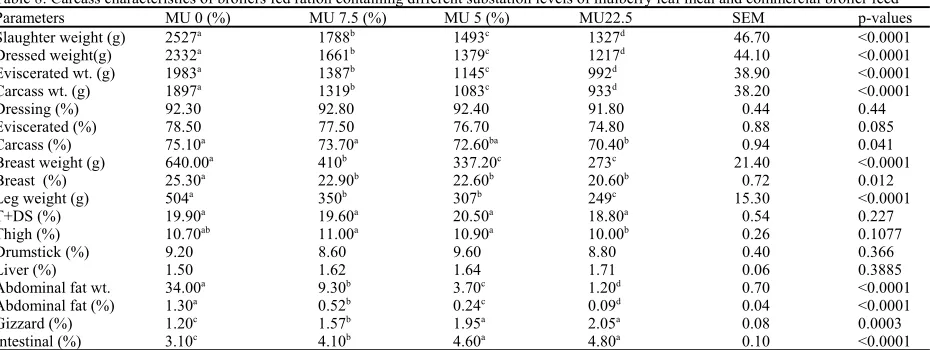
Table 8: Carcass characteristics of broilers fed ration containing different substation levels of mulberry leaf meal and commercial broiler feed
Parameters MU 0 (%) MU 7.5 (%) MU 5 (%) MU22.5 SEM p-values
Slaughter weight (g) 2527a 1788b 1493c 1327d 46.70 <0.0001
Dressed weight(g) 2332a 1661b 1379c 1217d 44.10 <0.0001
Eviscerated wt. (g) 1983a 1387b 1145c 992d 38.90 <0.0001
Carcass wt. (g) 1897a 1319b 1083c 933d 38.20 <0.0001
Dressing (%) 92.30 92.80 92.40 91.80 0.44 0.44
Eviscerated (%) 78.50 77.50 76.70 74.80 0.88 0.085
Carcass (%) 75.10a 73.70a 72.60ba 70.40b 0.94 0.041
Breast weight (g) 640.00a 410b 337.20c 273c 21.40 <0.0001
Breast (%) 25.30a 22.90b 22.60b 20.60b 0.72 0.012
Leg weight (g) 504a 350b 307b 249c 15.30 <0.0001
T+DS (%) 19.90a 19.60a 20.50a 18.80a 0.54 0.227
Thigh (%) 10.70ab 11.00a 10.90a 10.00b 0.26 0.1077
Drumstick (%) 9.20 8.60 9.60 8.80 0.40 0.366
Liver (%) 1.50 1.62 1.64 1.71 0.06 0.3885
Abdominal fat wt. 34.00a 9.30b 3.70c 1.20d 0.70 <0.0001
Abdominal fat (%) 1.30a 0.52b 0.24c 0.09d 0.04 <0.0001
Gizzard (%) 1.20c 1.57b 1.95a 2.05a 0.08 0.0003
Intestinal (%) 3.10c 4.10b 4.60a 4.80a 0.10 <0.0001
a,b,c,d Means with different superscript letters in rows are significantly different (p<0.01); SEM = Standard Error of the Mean; MU0 = 100% commercial broiler feed ; MU7.5 = 7.5% substitution of MLM; MU15 = 15% substitution of MLM; MU22.5 = 22.5% substitution of MLM; T = Thigh; DS = Drum Stick; AF = Abdominal Fat; Wt = Weight
A decrease in feed intake as the level of mulberry leaf increased may be due to both physical characteristics (semi-powdery nature and bulkiness) and bitter taste, which may affect the appetite of the birds and reduced the feed intake. The feed intake of broilers of this study is in line with Al-Kirshi et al. (2010) who have reported a significant reduction of feed intake during a 10% mulberry leaf meal substitution for commercial diet. Olmo et al. (2012) noted that inclusion of 10-30% mulberry foliage meal in the diets of hybrid broiler chicken significantly decreased feed intake. Udedibie and Opara (1998), Odunsi (2003) and Akande et al. (2007) also reported a reduction of feed intake with increased level of mulberry leaf meal in the diets of broilers and laying hens. In contrast, Kamruzzaman et al. (2012) and Lokaewmanee et al. (2009) had reported no adverse effect in feed intake up to 9 % inclusion of mulberry leaf meal in the ration. From weight gain perspective, Chowdary et al. (2009) has reported that highest body weight gain was observed in 10% mulberry leaf meal inclusion. On the contrary, Olmo et al. (2012) and Has et al. (2013) concluded that inclusion of 10% of mulberry foliage leaf reduced body weight gain. Kamruzzaman et al. (2012) has also showed that inclusion of mulberry leaf meal up to 9% has no adverse effect on
that substitution of mulberry leaf meal at 10, 20 and 30% progressively decreases the weight of carcass, breast, thigh, leg and abdominal fat. Ayerza et al. (2002) and Aguilar et al. (2011) also found that inclusion of foliage mulberry leaf meal in broilers diets has decreased abdominal fat weight.
Based on the result of this experiment, it can be concluded that mulberry leaf meal substitution to commercial broiler diets at 7.5% and more had negative effect on growth performance and carcass characteristics, no adverse effect on the survival of the broilers and seems to have a good effect on reduction of abdominal fat that can positively affect consumer’s desire. Therefore, further study is required to understand the optimum level of substitution and know its effect on meat quality and reductions of mortality.
ACKNOWLEDGEMENTS
The resaerchers would like to express their gratitude to head of Kombolcha Collage of Agriculture for allowing the poultry farm and the necessary facilities relevant to their work.
REFERENCES
AOAC., 1990. Official Methods of Analysis. 13th Edn., Association of Official Analytical Chemists, Washington, DC., USA.
Aguilar, Y.M., O.M. Yero, M.I.V. Navarro, C.A.B. Hurtado, J.A.C. Lopez and L.B.G. Mejia, 2011. Effect of squash seed meal (Cucurbita moschata) on broiler performance, sensory meat quality and blood lipid profile. Revista Brasileira Ciencia Avicola, 13: 219-226.
Akande, T.O., M.K. Adeyeri, O.G. Longe and A.A. Odunsi, 2007. Response of laying chickens to graded levels of Tephrosia bracteolate leaf meal fed with soyabean meal or full fat soyabean meal. Livestock Res. Rural Dev., Vol. 19, No. 8.
Al-Kirshi, R.A., A. Alimon, I. Zulkifli, S. Atefeh, M.W. Zahari and M. Ivan, 2013. Nutrient digestibility of mulberry leaves (Morus alba). Ital. J. Anim. Sci., Vol. 12. 10.4081/ijas.2013.e36
Al-Kirshi, R.A., A.R. Alimon, I. Zulkifli, A. Sazili, M.W. Zahari and M. Ivan, 2010. Utilization of mulberry leaf meal (Morus alba) as protein supplement in diets for laying hens. Italian J. Anim. Sci., 9: e51-e51. Ayerza, R., W. Coates and M. Lauria, 2002. Chia seed
(Salvia hispanica L.) as an ?-3 fatty acid source for broilers: Influence on fatty acid composition, cholesterol and fat content of white and dark meats, growth performance and sensory characteristics. Poult. Sci., 81: 826-837.
Behnke, K.C., 2001. Processing factors influencing pellet quality. Feed Tech., 5: 4-4.
Chowdary, N.B., M.V. Rajan and S.B. Dandin, 2009. Effect of poultry feed supplemented with mulberry leaf powder on growth and development of broilers. J. Life Sci., 3: 51-54.
Guven, I., 2012. Effect of species on nutritive value of mulberry leaves. Kafkas Univ. Vet. Fak. Derg., 18: 865-869.
Has, H., V.D. Yunianto and B. Sukamto, 2013. The effectivity of fermented mulberry leaves with rumen liquor as broiler feed on final body weight, dry matter and crude fiber digestibility and metabolic energy. Anim. Prod., 15: 173-179.
Iqbal, S., U. Younas, K.W. Chan, R.A. Sarfraz and M.K. Uddin, 2012. Proximate composition and antioxidant potential of leaves from three varieties of Mulberry (Morus sp.): A comparative study. Int. J. Mol. Sci., 13: 6651-6664.
Islam, M.R., M.N. Siddiqui, A.B.M. R. Bostami, M.Z. Rahman, A. Khatun and A.S. Selim, 2014. Dietary effect of mulberry leaf (Morus alba) meal in the growth performance and serum cholesterol content of broiler. SAARC J. Agric., 12: 79-89.
Kamruzzaman, M., M.S. Rahman, M. Asaduzzaman and M.Z. Rahman, 2012. Significant effect of mulberry leaf (Morus alba) meal in the reduction of egg-yolk cholesterol. Bangladesh Res. Publ. J., 7: 153-160. Lokaewmanee, K., S. Mompanuon, P. Khumpeerawat and
K. Yamauchi, 2009. Effects of dietary mulberry leaves (Morus alba L.) on egg yolk color. J. Poult. Sci., 46: 112-115.
Ly, J., T. Chhay, C. Phiny and T.R. Preston, 2001. Some aspects of the nutritive value of leaf meals of Trichanthera gigantean and Morus alba for Mong Cai pigs. Livest. Res. Rural Dev., Vol. 13,
Machii, H., 2002. Evaluation and Utilisation of Mulberry for Poultry Production in Japan. In: Mulberry for Animal Production, Sanchez, M.D. (Ed.). Food and Agriculture Organization, Rome, Italy, ISBN: 9789251045688, pp: 241-248.
Odunsi, A.A., 2003. Assessment of lablab (Lablab Purpureus) leaf meal as a feed ingredient and yolk colouring agent in the diet of layers. Int. J. Poult. Sci., 2: 71-74.
Olmo, C., Y. Martinez, E. Leon, L. Leyva and M. Nunez et al., 2012. Effect of mulberry foliage (Morus alba) meal on growth performance and edible portions in hybrid chickens. Int. J. Anim. Vet. Adv., 4: 263-268.
Omar, S.S., C.M. Shayo and P. Uden, 1999. Voluntary intake and digestibility of mulberry (Morus alba) diets by growiang goats. Trop. Grasslands, 33: 177-181.
Simol, C.F., A.A. Tuen, H.H.A. Khan, J.K. Chubo, P.J.H. King and K.H. Ong, 2012. Performance of chicken broilers fed with diets substituted with mulberry leaf powder. Afr. J. Biotechnol., 11: 16106-16111. Srivastava, S., R. Kapoor, A. Thathola and R.P.
Srivastava, 2006. Nutritional quality of leaves of some genotypes of mulberry (Morus alba). Int. J. Food Sci. Nutr., 57: 305-313.
Udedibie, A.B.I. and C.C. Opara, 1998. Responses of growing broilers and laying hens to the dietary inclusion of leaf meal from Alchornia cordifolia. Anim. Feed Sci. Technol., 71: 157-164.