http://wrap.warwick.ac.uk/
Original citation:Utili, Stefano. (2014) Discussion of “Stability assessment of slopes with cracks using limit analysis”. Canadian Geotechnical Journal, 51 (7). pp. 822-825.
http://dx.doi.org/10.1139/cgj-2014-0085
Permanent WRAP url:
http://wrap.warwick.ac.uk/71270
Copyright and reuse:
The Warwick Research Archive Portal (WRAP) makes this work of researchers of the University of Warwick available open access under the following conditions. Copyright © and all moral rights to the version of the paper presented here belong to the individual author(s) and/or other copyright owners. To the extent reasonable and practicable the material made available in WRAP has been checked for eligibility before being made available.
Copies of full items can be used for personal research or study, educational, or not-for-profit purposes without prior permission or charge. Provided that the authors, title and full bibliographic details are credited, a hyperlink and/or URL is given for the original metadata page and the content is not changed in any way.
A note on versions:
The version presented here may differ from the published version or, version of record, if you wish to cite this item you are advised to consult the publisher’s version. Please see the ‘permanent WRAP url’ above for details on accessing the published version and note that access may require a subscription.
1
Discussion of “Stability assessment of slopes with cracks
using limit analysis”*
By Stefano Utili
Stefano Utili,
School of Engineering, University of Warwick, Coventry, UK [email protected]
Corresponding Author Stefano Utili
2
Introduction
1
The discusser has recently published a paper in Geotechnique entitled “Investigation 2
by limit analysis on the stability of slopes with cracks” (Utili, 2013) which included 3
for the first time, to the discusser’s knowledge, a systematic investigation on the 4
influence of the presence of cracks in uniform slopes for rotational failure 5
mechanisms via the limit analysis upper bound approach. Looking at the discusser’s 6
paper and the discussed paper, (Michalowski, 2013), a reader may note that the aim 7
of the two papers is the same, namely to assess quantitatively the effect of the 8
presence of cracks on the stability of slopes, and the methodology of using the upper 9
bound approach of limit analysis. The discusser’s paper was sent to Geotechnique
10
when the discusser had no knowledge of either the author’s conference paper 11
(Michalowski, 2012), or of the discussed paper published in July 2013. On the other 12
hand, the discusser’s paper was published after the publication of the author’s 13
conference paper (Michalowski, 2012). Hence, it can be concluded that the discusser 14
and the author had independently developed an original formulation for the 15
calculation of upper bounds based on rotational failure mechanisms for cracked 16
uniform slopes at similar times. 17
However, regarding the findings and the formulation of the problem, (Utili, 18
2013) and the discussed paper, (Michalowski, 2013), are rather different. In this 19
discussion, the discusser wants to highlight the main complementary and different 20
findings between the two papers and point to some aspects of the discussed paper 21
that in the discusser’s opinion need clarifications especially with regard to the 22
3
of the external rate of work for rotational failure mechanism; the failure mechanisms 24
analyzed for pre-existing cracks; and the failure mechanisms with crack formation. 25
26
Calculation of the external rate of work for rotational failure
27mechanisms
28Concerning the calculation of the external rate of work in case of a rotational failure 29
mechanism, the author reports neither the derivation nor the final analytical 30
expressions of the functions employed to calculate the rate of the external work done 31
by the soil mass sliding away, wedge BOCDB in figure 6. The calculation of the 32
external work is as important as the calculation of the energy dissipated since both 33
appear in the energy balance equation from which the stability factor, γH/c (Taylor, 34
1948; Chen, 1975), is calculated. In this regard, the author seems to justify the lack 35
of detail provided making reference to the works of Chen (e.g. Chen & Giger, 1969; 36
Chen & Giger, 1971) and stating that “without a crack, this mechanism has been 37
described in the literature multiple times”. However, this is not the case. In fact, in 38
the referenced Chen’s publications, the calculation of the external work rate is 39
reported only for failure surfaces made entirely by a log-spiral (wedge BOCADB in 40
figure 6) with either the logspiral passing through the slope toe (see Fig. 6a) or 41
below (see Fig. 6b). Here instead, the failure surface is composite: partly log-spiral 42
and partly planar (wedge BOCDB in figure 6). The calculation of the external work 43
in this case of a composite partly log-spiral partly linear failure surface requires the 44
calculation of the work done by the fictitious wedge BOCADB minus the work of 45
4
calculation of the external work done by soil masses sliding along composite log-47
spiral failure surfaces, which requires the use of fictitious wedges bordered by a log-48
spiral, was first presented in (Utili, 2005; and Utili & Nova, 2008) for the case of 49
slopes with horizontal upper part subject to a sequence of landslides, and in (Utili 50
and Crosta, 2011) for the more general case of slopes with an inclined upper part. In 51
(Utili and Nova 2007), the calculation of the work done by a wedge enclosed by two 52
log-spirals is presented. In these publications the calculation of the external work is 53
reported in detail together with the related analytical expressions. 54
55
Failure mechanisms for pre-existing cracks
56In the analysis of rotational failure mechanisms for slopes with pre-existing cracks, 57
rightly the author states that the minimization of the function providing the stability 58
number is a problem of constrained minimization because of the constraint on the 59
maximum depth of the crack. In the search for the failure mechanism of a slope of 60
given inclination and friction angle (β and φ respectively), the length and location of 61
the crack is free, i.e. the minimization of the function is sought over 4 independent 62
variables, the angles θ0, θh, θC (χ, ν, ζ in (Utili, 2013) with χ=θ0, ν=θh, ζ=θD) and β’
63
with the additional constraint that “the crack cannot be deeper than the maximum 64
depth of the crack discussed”. Concerning the variable β’, the discusser has shown 65
that for φ>5°, all the failure mechanisms pass through the slope toe, i.e. β’=β, 66
whatever values of β and φ are considered (Utili, 2013), so that for the drained 67
5
variables to be considered in the unconstrained minimization can be reduced to three: 69
θ0, θh, θC.
70
With regard to the maximum crack depth allowable, unfortunately, the author 71
does not state when the constraint turns out to be active, i.e. for what values of the 72
parameters β and φ. In case of dry slopes, employing the formula given in Eq. (5), 73
the discusser has verified that this limit on the maximum crack depth is never 74
exceeded by the crack depth resulting from the unconstrained optimization of the 75
function expressing the stability factor for all the considered values of β and φ (see 76
Figure 1). The interested reader can find the analytical expression of the function 77
reported in Eq. (25) in (Utili, 2013). This implies that the inequality of Eq. (5) is not 78
active so that the minimization presented in the discussed paper is actually an 79
unconstrained minimization rather than a constrained one providing the solution to 80
the problem of determining the critical failure mechanism for slopes with cracks of 81
unspecified location and depth (problem c in Utili, 2013). This solution is a 82
particular case of the solutions found for the other two dual problems tackled in 83
(Utili, 2013): determination of the critical failure mechanism for slopes with a crack 84
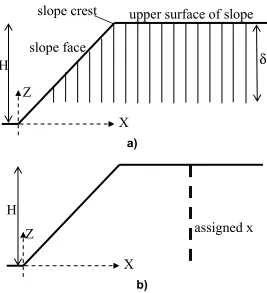
of known length but unspecified location (see Figure 2a) and determination of the 85
critical failure mechanism for slopes with a crack of known location but unknown 86
depth (see Figure 2b), problems a and b respectively in (Utili 2013), which are not 87
tackled in the discussed paper. The solution to these problems is provided by a 88
genuine constrained optimization where the minimum for the function expressing the 89
stability factor, is sought with the additional constraint of satisfying a non-linear 90
6
the crack location, so that the number of independent variables in both problems is 92
reduced to two. The stability factors found for these two problems, are a function of 93
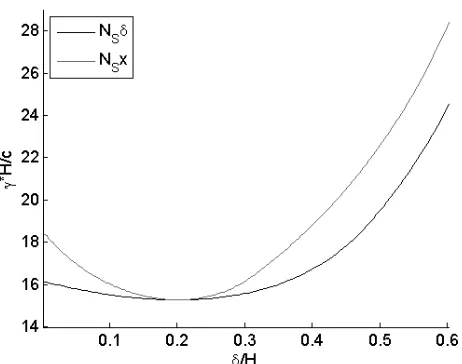
the crack depth and of the crack distance respectively (the imposed constraints), and 94
their minimum with respect to crack depth and crack distance corresponds to the 95
solution presented in the discussed paper for the case of cracks of any depth and 96
location (see Figure 3). 97
With regard to the geometry of the failure mechanisms, it is important to note 98
that in the discussed paper, failure mechanisms are assumed to pass either through 99
the toe or below without consideration for mechanisms daylighting on the slope face 100
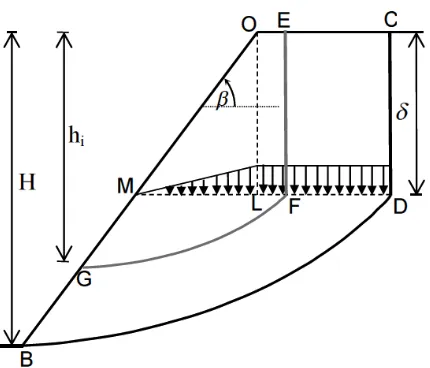
above the toe. However, unlike the case of intact slopes, the presence of cracks 101
implies that mechanisms passing above the slope toe are no longer self-similar (see 102
figure 4) and therefore need to be considered in the calculation of the upper bounds. 103
From the calculations in (Utili, 2013), it turns out that in case of dry slopes with 104
either dry or water filled cracks, the failure mechanisms pass through the slope toe. 105
However, for different hydraulic conditions as the ones considered in the discussed 106
paper and in case of failure mechanisms accounting for crack formation, mechanisms 107
daylighting on the slope face could still turn out to be more critical than the 108
mechanisms passing through the toe assumed in the discussed paper. Hence, it could 109
be interesting to know if the mechanisms considered by the author are still the most 110
critical once potential failure mechanisms daylighting on the slope face are 111
accounted for in the calculations. 112
Finally, concerning how good the achieved upper bounds are, the following 113
7
for soils considered in the literature, it is the rotational one that has been found most 115
critical for uniform slopes (Chen, 1975)” overlooks the fact that (Bekaert 1995) 116
found an upper bound of 1.0% lower for a vertical uniform slope with φ=0, by 117
considering a multiple rotation mechanisms made of several log-spiral blocks. 118
However, although it has to be pointed out that Chen’s upper bounds obtained 119
assuming a rigid rotation may no longer be the best upper bounds in the light of 120
more recent works in the literature, they are very close to the true collapse load: for 121
instance (Krabbenhoft et al., 2005) achieved lower bounds by finite element limit 122
analyses which are on average 1.5% and in the most unfavourable case 2.5% less 123
than the upper bounds obtained for β ranging from 50° to 90° and φ from 10° to 40°. 124
Conversely, it is crucial, in the discusser’s view, to point out that when cracked 125
slopes are considered, no lower bound solutions are available in the literature to 126
bracket the true collapse values; therefore in case of cracked slopes it cannot be 127
taken for granted that the upper bounds obtained for rigid rotational mechanisms are 128
still close to the true collapse load. In this regard, it is reasonable to expect that at 129
low crack depths, the upper bounds remain close to the true values whereas for high 130
values of crack depths, they may diverge substantially. This limitation of the 131
presented solutions should be acknowledged. Also in the conclusions, the author 132
remarks that “for slopes with an inclination of 30° or less, the calculated critical 133
height is little or not affected by the presence of a crack. The influence of the crack 134
presence becomes significant however with an increase of the slope inclination”. On 135
this point it is interesting to note that if the newly found upper bounds for rotational 136
8
the reduction on the stability factor determined, i.e. the improvement of the upper 138
bounds of the new solution in comparison with the available bounds for planar 139
mechanisms (Hoek and Bray, 1977), the trend is opposite with the upper bound 140
reduction being higher for shallow slopes (Utili, 2013). 141
142
Failure mechanisms including crack formation
143Concerning translational mechanisms, the discusser points out to a typographical 144
error in the equation provided for the dilation angle, 2 π
δ = − −θ φ, which instead needs
145
to be 2
π
δ = −θ φ+ for the mechanisms to be kinematically admissible.
146
Concerning rotational mechanisms with crack formation, the paper does not 147
specify what physical phenomena cause the envisaged formation of the cracks. This 148
is an essential point if the analysis is to be realistic. In the presented analysis, a non-149
zero shear stress state underneath the crack tip has been assumed for respect of the 150
normality rule, given the direction of the velocity vectors underneath the crack tip as 151
the author’s points out: “The stress associated with this kinematics is described by 152
the circular portion of the yield condition. This is not necessarily the true stress state 153
but it is consistent with the selected kinematics”. However, if one considers the 154
starting point where the crack begins to form, i.e. at the ground level on the 155
horizontal upper part of the slope, the presence of shear stresses violates equilibrium 156
since no loads are applied on the slope. Moreover, the author does not specify how 157
the envisaged shear stress relates to any of the several different possible physical 158
phenomena leading to crack formation: e.g. desiccation, wetting, and drying cycles, 159
9
Finally, the first statement in the conclusions “It was demonstrated that crack 161
formation is an important factor affecting the outcome of stability analyses of 162
slopes.” appears unjustified for the fact that when crack formation is considered, the 163
failure mechanisms turn out to be less critical than the case of pre-existing cracks, so 164
in the stability analysis of uniform slopes, consideration of crack formation is not 165
critical according to the analysis performed. More importantly, the usefulness of the 166
whole stability analysis with crack formation is rather debatable since the crack 167
formation mechanisms considered are driven by an unrealistic state of stress in the 168
ground for the aforementioned violation of the equilibrium at the boundary of the 169
slope (where the crack begins to form) and it has not been related to any physical 170
phenomenon causing the formation of cracks. 171
172
Summary
173The discussed paper (Michalowski, 2013) presents an interesting analysis of the 174
stability of slopes subject to vertical tension cracks. The authors considered both pre-175
existing cracks and forming cracks, focusing considerable attention on the maximum 176
possible crack depth and seepage effects. These findings, when considered in 177
conjunction with the independently obtained findings of the discusser’s paper (Utili, 178
2013), are likely to provide a comprehensive analysis of the effect of the presence of 179
cracks in various scenarios. The fact that two independent authors developed these 180
original formulations at simultaneous times demonstrates how strong the interest of 181
the geotechnical community is in this area. I hope that this discussion will contribute 182
10 184
11
References:
Bekaert, A. (1995). Improvement of the kinematic bound for the stability of a
vertical cut-off. Mech. Res. Comm., 22(6): 533-540.
Chen, W.F., Giger, M.W., Fang, H.Y. (1969). On the limit analysis of the stability of
slopes. Soils and Foundations, 9(4): 23-32.
Chen, W.F., Giger, M.W. (1971). Limit analysis of stability of slopes. Soil
mechanics and foundations division, ASCE, 97(1): 19-26.
Chen, W.F. (1975). Limit analysis and soil plasticity. New York. NY, USA:
Elsevier.
Hoek, E. and Bray J.W. (1977). Rock slope engineering. 2nd edn. London, UK:
Institution of mining and metallurgy.
Krabbenhoft, K., Lyamin, A. V., Hjiaij, M. & Sloan, S. W. (2005). A new
discontinuous upper bound limit analysis formulation. International Journal of
Numerical Methods in Engineering, 63, 1069-1088.
Michalowski, R. (2012). Cracks in slopes: limit analysis approach to stability
assessment. In Proceedings of Geocongress, Oakland, California (USA), March
2012, 442-450.
Michalowski, R. (2013). Stability assessment of slopes with cracks using limit
analysis. Canadian Geotechnical Journal, 50, 1011-1021.
Utili, S. (2013). Investigation by limit analysis on the stability of slopes with cracks.
12
Utili S. (2005). An analytical relationship for weathering induced slope
retrogression: a benchmark. RIG (Italian Geotechnical Journal), 39(2): 9-30.
Utili, S. and Crosta G. B. (2011). Modeling the evolution of natural cliffs subject to
weathering: 1. Limit analysis approach. Journal of Geophysical Research 116,
F01016.
Utili, S. and Nova, R. (2007). On the optimal profile of a slope. Soils and
foundations, 47: 717-729.
Utili, S., Nova, R. (2008). DEM analysis of bonded granular geomaterials.
International Journal for Numerical and Analytical Methods in Geomechanics,
32(17): 1997-2031.
Taylor, D. W. (1948). Fundamentals of soil mechanics. New York, NY, USA: John
13
14
δ
Z
X
H
slope face
slope crest
upper surface of slope
a)
Z
X
assigned x
H
[image:15.612.185.452.93.386.2]b)
15
Figure 3 after (Utili, 2013). Stability factor obtained by constrained minimization vs. crack depth for a slope with φ=20° and β=45°: the gray line represents the stability factor, NSx, obtained for cracks of fixed location, x, whilst the black line represents the stability factor, NSδ,
obtained for cracks of fixed depth, δ. The minimum of the curves
16
Figure 4. The gray log-spiral G-F represents a potential failure