Certifying quantumness: Benchmarks for the optimal processing of generalized
coherent and squeezed states
Yuxiang Yang and Giulio Chiribella
Center for Quantum Information, Institute for Interdisciplinary Information Sciences, Tsinghua University, Beijing 100084, China
Gerardo Adesso
School of Mathematical Sciences, University of Nottingham, University Park, Nottingham NG7 2RD, United Kingdom
(Received 11 July 2014; published 16 October 2014)
Quantum technology promises revolutionary advantages in information processing and transmission compared to classical technology; however, determining which specific resources are needed to surpass the capabilities of classical machines often remains a nontrivial problem. To address such a problem, one first needs to establish the best classical solutions, which set benchmarks that must be beaten by any implementation claiming to harness quantum features for an enhanced performance. Here we introduce and develop a self-contained formalism to obtain the ultimate, generally probabilistic benchmarks for quantum information protocols including teleportation and approximate cloning, with arbitrary ensembles of input states generated by a group action, so-called Gilmore-Perelomov coherent states. This allows us to construct explicit fidelity thresholds for the transmission of multimode Gaussian and non-Gaussian states of continuous-variable systems, as well as qubit and qudit pure states drawn according to nonuniform distributions on the Bloch hypersphere, which accurately model the current laboratory facilities. The performance of deterministic classical procedures such as square-root measurement strategies is further compared with the optimal probabilistic benchmarks, and the state-of-the-art performance of experimental quantum implementations against our newly derived thresholds is discussed. This work provides a comprehensive collection of directly useful criteria for the reliable certification of quantum communication technologies.
DOI:10.1103/PhysRevA.90.042319 PACS number(s): 03.67.Ac,03.65.Ta,42.50.Ex,02.20.Qs
I. INTRODUCTION
Quantum information technology [1] is progressing at a fast pace. Theoretical and experimental results announcing groundbreaking demonstrations of the power of quantum hardware and quantum algorithms for the encoding and secure transmission of information receive media attention on an almost daily basis. However, while basic building blocks for a distributed quantum communication network are available with current technology (encompassing, e.g., photonic architectures, solid-state memories, and hybrid in-terfaces thereof) [2], there remains as a crucial question to verify that the practical implementations of such devices are genuinely harnessing quantum resources and can provably outperform optimized special-purpose classical machines in realistic conditions of noise and decoherence. The problem of verifying quantum devices is in fact playing center stage for the lively debate surrounding the operation of D-Wave “quantum” annealing processors; see, e.g., [3].
A general verification method consists in deriving tests, or benchmarks, which have to be passed by any realization of a quantum protocol, to corroborate its genuine use of quantumness; in this respect, benchmarks establish a quality control for realistic quantum information processing devices. A standard way to construct such benchmarks is by focusing on a protocol and its figure of merit, and determine the corresponding classical threshold, i.e., the maximum value of the figure of merit which can be attained if the involved parties do not make use of any shared quantum resource, such as entanglement and quantum communication. Hence, if an actual experimental demonstration, despite being affected by unavoidable losses and imperfections, still manages to
achieve a higher value of the figure of merit compared to the classical threshold, then the benchmark has been passed and the experiment is certified quantum, in the sense that its performance could not have been reached without the sharing and the utilization of suitable quantum resources.
corresponding results for teleportation in particular limits (e.g., in the case of cloning forN =M=1). Finally, an alternative approach to quantum benchmarks, testing the ability of a quantum device to transmit entanglement, has also been put forward [19–21].
In this paper we develop a powerful and general formalism to obtain benchmarks for quantum protocols with arbitrarily distributed input ensembles generated by a group action, so-called generalized Gilmore-Perelomov coherent states (GPCS) [22,23]. While this formalism allows us to straightforwardly recover a number of benchmark results existing in literature on teleportation, cloning and amplification of conventional co-herent states (pure displaced Gaussian states) [9,17,18], it then goes significantly beyond by leading us to obtain analytical benchmarks for broad and relevant classes of input ensembles which can be used in present-day experiments. For example, our framework allows one consider pure qubit and qudit states distributed according to realistically finite-width distributions on their respective Hilbert spaces, as well as single-mode and multimode Gaussian and non-Gaussian squeezed states with adjustable finite-width squeezing distributions, which are all examples of GPCS. Our machinery thus provides directly useful tests to certify the quantum domain of current and future experiments encompassing discrete-variable and continuous-variable systems with realistic prior distributions.
The benchmarks we derive are probabilistic [11,18]; that is, we allow for the possibility to discard some unfavorable trials. This increases the achievable fidelity threshold, at the expense of a nonunit success probability of the corresponding classical strategy. This procedure sets therefore the ultimate bounds that need to be surpassed by quantum implementations claiming to exploit authentic quantum resources to attain clas-sically unreachable performances. Probabilistic benchmarks are important not only as a stronger certificate of quantumness, but also because they are indispensable for assessing recent breakthrough experiments in quantum optics, implementing new quantum devices, that achieve an enhanced performance at the price of a nonunit probability of success. The latest demonstrations of noiseless probabilistic amplifiers [24–27] provide a fitting example of such devices. Clearly, this new generation of quantum experiments cannot be assessed using the old benchmarks, which referred only to deterministic strategies. The increased interest in probabilistic devices provides also a strong motivation to analyze ensembles of input states with nonuniform priors, because the advantages of probabilistic protocols can only be seen in this setting [18,24–28].
The paper is organized as follows. In Sec. II we de-velop the general machinery of probabilistic benchmarks for GPCS. In Sec. III we showcase examples specialized to benchmarks for quantum cloning of qubit and qudit states with finite-width prior distributions. In Sec. IV we derive benchmarks for quantum cloning of relevant families of single-mode Gaussian states. In Sec.Vwe present benchmarks for general multimode non-Gaussian states belonging to the class of Perelomov squeezed states. In Sec.VIwe investigate whether deterministic measure-and-prepare strategies (such as the square-root measurement) can achieve the bounds determined by the general probabilistic benchmarks of the previous sections. In Sec.VIIwe discuss the implementation
of the optimal transposition of GPCS, a task which cannot be realized perfectly, and for which quantum protocols offer no advantage over the benchmarks. In Sec. VIII we conclude with a summary and an outlook on future theoretical and experimental directions. Some technical proofs and derivations are deferred to the Appendix.
II. QUANTUM BENCHMARKS FOR THE STATE TRANSFORMATION OF GENERALIZED
COHERENT STATES
This section presents the general framework and the key result on quantum benchmarks for generalized coherent states, providing the foundation for the concrete applications worked out in the rest of the paper. We start from the general framework of quantum benchmarks and then specialize ourselves to the case of generalized coherent states, providing a general ex-pression that allows one to evaluate the benchmarks explicitly.
A. General framework for quantum benchmarks
1. State transformation games
A convenient way to discuss quantum benchmarks is in terms of a game featuring two collaborating players, Alice and Bob, and a verifier, traditionally referred to as Victor [6]. In this game, Victor presents Alice with an input state ρx, with the labelxranging in some set X, and later he asks Bob to provide an output state, which should resemble as much as possible some desired target state ρx. In between, Alice and Bob team up to achieve the best possible approximation of the transformationρx →ρx, using the resources that are available to them. Here we assume that Alice and Bob know exactly the set of input states{ρx|x∈X}and the set of target states{ρx|x∈X}, but they do not know which particular input ρx is presented to them. We refer to games of this form as state transformation games. Most of the relevant examples of quantum information processing tasks can be cast in the form of state transformation games, by suitably choosing the Hilbert spaces of the input (output) system—here denoted by Hin (Hout)—and the input (output) states. For example, choosing
Hin=Hout andρx =ρx one has the game of implementing quantum teleportation and quantum memories for the set of states{ρx|x ∈X}. ForHin=H⊗N,Hout=H⊗M,ρx =ψx⊗N, andρx =ψ⊗M
x one has the game of quantum cloning, with an input of N identical copies and an ideal target ofM output copies.
consider the (average) probability of passing the test as our figure of merit, and denote it byF.
Suppose that Alice and Bob follow a deterministic protocol, described by a trace-preserving completely positive (CP) map
M. In this case, the average probability of passing Victor’s test is
FM=
x
pxTr[TxM(ρx)]. (1)
More generally, however, the protocol adopted by Alice and Bob can be probabilistic. A probabilistic protocol will either implement a desired quantum process—described by a trace-nonincreasing CP map N—or output a “failure” message, heralding the fact that the processN did not take place. The probability that the process takes place on the input stateρx isp(yes|x)=Tr[N(ρx)]. When this happens, the output state becomes
¯ ρx =
N(ρx) Tr[N(ρx)]
. (2)
The average probability that the process takes place is
pyes=
x
pxTr[N(ρx)]. (3)
Conditional on the occurrence of the processN, the figure of merit is given by
FN =
x
p(x|yes) Tr[Txρ¯x], (4)
wherep(x|yes) is the probability that the input state was ρx conditioned on the information thatN took place. Inserting Eq. (2) into the above expression and using Bayes’ rule p(x|yes)=p(yes|x)px/pyesone then obtains
FN =
xpxTr[TxN(ρx)]
Tr[N(ρ)] , (5)
whereρis the average input state
ρ:= x
pxρx. (6)
Note that when the device is deterministic (i.e., whenN is trace-preserving), Eq. (5) coincides with Eq. (1).
2. Ultimate performance achievable by quantum strategies
How well Alice and Bob can fare in a given state transformation game depends on which resources they are allowed to use. In particular, if Alice and Bob are allowed to communicate quantum states to one another (which implies, in particular, that they can share entanglement), they can act effectively as a single superplayer, who in principle is able to implement arbitrary quantum devices. In this way, they can achieve the best performance allowed by quantum mechanics, given by the supremum of the figure of merit in Eq. (5) over all CP trace-nonincreasing maps. This supremum, denoted byFq, represents the ultimate limit that can be achieved by arbitrary processes in nature (assuming quantum mechanics as the correct theory of nature), including even processes that take place with small probability. The actual value ofFq, which can
be computed along the lines of Refs. [18,29], is given by
Fq =1out⊗ρ−
1
21out⊗ρ− 1 2in
∞, (7) where 1out is the identity on the output Hilbert space,in is
the operation of partial transpose on the input Hilbert space, the operatoris defined as
:=
x
pxTx⊗ρx, (8)
and A∞ denotes the operator norm, which for positive operators is given by the maximum expectation value
A∞= sup ψ=1
ψ|A|ψ. (9)
Clearly, when the set of states is continuous, the sums in Eqs. (5), (6), and (8) have to be replaced by integrals and the probability distributionpx has to be replaced by a probability densityp(x)dx.
3. Quantum benchmarks
Suppose now that Alice and Bob are only allowed to communicate classical data. Under this restriction, the most general protocol that they can perform is a measure-and-prepare (MP) protocol, i.e., a procedure where Alice measures the input system and communicates the outcome to Bob, who uses this information to prepare the output system in a suitable quantum state. The supremum of the figure of merit of Eq. (5) over all MP protocols is thequantum benchmarkfor the task ρx →ρx. By definition, if Alice and Bob can beat the quantum benchmark, they must have used quantum communication resources, either directly (with Alice sending quantum states to Bob) or indirectly (using the assistance of entanglement).
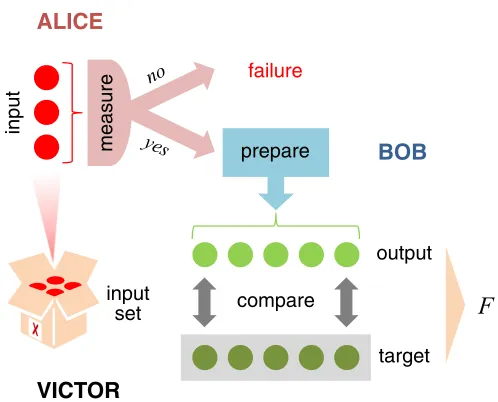
The most stringent benchmark is obtained if we allow Alice and Bob to use probabilistic protocols, which provide an output to the verifier only if the measurement outcome belongs to a subset of favorable outcomes. A generic MP protocol, as schematically depicted in Fig. 1, is specified by a POVM {Py}y∈Y and by a set of quantum states {σy}y∈Yyes that are
re-prepared when the measurement outcome belongs to the set of favorable outcomes Yyes⊆Y. In the favorable instances,
the protocol is described by the CP mapN given by
N(ρ) := y∈Yyes
Tr[Pyρ]σy. (10)
We denote byFc the supremum of the figure of merit in Eq. (5) over all probabilistic MP protocols described by CP mapsN as in Eq. (10). Following the arguments of Ref. [18], the actual value ofFccan be expressed as
Fc=1out⊗ρ−
1 21
out⊗ρ−
1 2
×, (11) whereis the operator defined in Eq. (8) andA×denotes theinjective cross norm[30], which for positive operators is given by the maximum expectation value on product states
A×= sup φ=ψ=1
φ|ψ|A|φ|ψ. (12)
FIG. 1. (Color online) Scheme of a probabilistic measure-and-prepare (MP) state transformation game. The figure of merit F is typically the fidelity between the output prepared by Bob and the target state set by the verifier Victor for a given input state supplied to Alice, averaged over the input set X according to a specified prior probability distribution. The maximum value Fc of F over all MP protocols implementable by Alice and Bob sets a quantum benchmark for the transformation of the input ensemble of states. Any demonstration of state transformation of the input set which achieves, on average, a figure of merit exceedingFc, implies necessarily that a quantum channel has been used as a resource by Alice and Bob.
small probability. Hence, if an experiment achieves a figure of merit which exceeds the classical thresholdFc, then one can
certify that the experimental setup has implemented a genuine quantum processing. If eachTx is of the formTx= |ψxψx| for some pure state |ψx, then we call Fc the probabilistic
classical fidelity threshold (CFT) for the transformation ρx→ |ψxψx|.
Note the following important property:
Proposition 1. The CFT for the transformation ρx → |ψxψx|is equal to the CFT for the three transformations
ρx→ |ψx∗ψx∗|,
ρx∗→ |ψxψx|,
ρx∗→ |ψx∗ψx∗|,
where |ψx∗(ρx∗) is the complex conjugate of|ψx(ρx) in a given basis.
The validity of the above property can be immediately derived from Eqs. (8), (11), and (12): Indeed, the value of the cross norm does not change if we replace the test operator Tx and/or the state ρx by its complex conjugate. Similarly, the optimal MP protocol for one of the four tasks can be obtained from the optimal MP protocol of any of the others by applying complex conjugations where needed. Note also that, at the density matrix level, complex conjugation is equivalent to transposition.
Combining this fact with Proposition 1, one can see that the difference between the ultimate quantum fidelity Fq and the
quantum benchmarkFcis nothing but the difference between
two norms, namely the operator norm in Eq. (7) and the cross norm in Eq. (11).
B. Generalized coherent states
We now specialize our analysis to the processing of generalized coherent states, providing an explicit and easily computable expression for the quantum benchmark of Eq. (11). We consider Gilmore-Perelomov coherent states (GPCSs) [22,23,31,32], a broad class of quantum states that contains the coherent states of the harmonic oscillator, the spin-coherent states common in atomic physics, the families of coherent, squeezed, and pure Gaussian states in quantum optics, and (infinitely) many other families of non-Gaussian quantum states for continuous-variable systems.
Technically, GPCSs are associated with irreducible repre-sentations of locally compact groups [31,32]. Given a group G, a unitary projective representationU :g→Ug acting on some Hilbert spaceH, and a unit vector|φ ∈H, we say that the states
|φg:=Ug|φ g∈G (13)
are GPCSs if the action of the representationUis irreducible in the subspace spanned by them.
The best known examples of GPCSs are the coherent states of the harmonic oscillator, defined as
|α:=D(α)|0 α∈C,
whereD(α) is the displacement operatorD(α)=exp[αa†− α∗a],aanda†satisfy the commutation relation [a,a†]=1, and |0is the vacuum state, identified by the equationa|0 =0. Another example is provided by the spin-coherent states
|j,θ,φ:=eiθ2(sinϕJx−cosϕJy)|j,j θ ∈[0,π],ϕ∈[0,2π],
whereJx,Jy,Jzare the angular momentum operators, satisfy-ing the relations [Jx,Jy]=iJz, [Jy,Jz]=iJx, [Jz,Jx]=iJy and |j,j is the state identified by the equation Jz|j,j = j|j,j.
In addition to being GPCSs, the harmonic oscillator coherent states and the spin-coherent states have an important feature: when one takes the tensor product of two states with the same label, one still obtains a GPCS. For example, the product states|j,θ,ϕ|j,θ,ϕare GPCSs for every pair of val-ues (j,j), as they are unitarily equivalent to the spin-coherent state|j +j,θ,ϕ. Similarly the product states|gα|gαare GPCSs for every pair of complex numbersgandg, as they are unitarily equivalent to the coherent state||g|2+ |g|2α.
It turns out that this property is common to most of the examples that are relevant for applications, including squeezed states, pure Gaussian states, and arbitrary pure states of finite-dimensional quantum systems. The property plays a crucial role in our work and therefore it is convenient to give it a name:
Definition 1. Two sets of GPCSs {|φ1,g} and {|φ2,g}
aremutually coherentif the product states {|φ1,g|ψ2,g}are GPCSs.
[image:4.608.47.296.65.266.2]i=1, . . . ,K, we say that theK sets are mutually coherent if the product states{|φ1,g|φ2,g · · · |φK,g}are GPCSs.
In representation theory, the chief example of mutually coherent GPCSs is the example of GPCSs generated by the action of a semisimple Lie group on highest weight vectors [32]. We recall that every semisimple Lie algebra can be decomposed into roots, and that highest (lowest) weight vectors are those that are annihilated by all the positive (negative) roots. For example, the Lie algebra of SU(2) can be decomposed assu(2)=jz⊕j+⊕j−, where thej+is the positive root andj− is the negative root, and the vector|j,j is a highest weight vector, as j+|j,j =0. By definition, if |φi ∈Hi is a highest weight vector for every i, then also |φ1|φ2 · · · |φKis a highest weight vector and the subspace generated by the product vectors|φ1,g · · · |φK,gis irreducible.
Hence, the states{|φ1,g · · · |φK,g}are GPCSs. Summarizing,
GPCSs that are generated from a highest weight vector are always mutually coherent. This is the case of the spin-coherent states in atomic physics [associated with the group SU(2)] and of most of the squeezed states considered in quantum optics [associated with the group SU(1,1)].
C. General quantum benchmark for GPCSs
We consider the task of transformingNcopies of an input generalized coherent state|φg ∈HintoMcopies of another, possibly different generalized coherent state|ψg ∈K. As a figure of merit, we consider the maximization of the fidelity between the output state produced by the device and the target state|ψg⊗M. In the notation of Sec.II A, this means choosingx ≡g,ρg =(|φgφg|)⊗N,ρg =(|ψgψg|)⊗M, and Tg =(|ψgψg|)⊗M. Importantly, here we do not require the probability distributionp(g) to be uniform. Instead, we allow it to be any probability distribution of the form
pγ(g)=dγ|φγ|φγ ,g|2, (14)
where|φγ ,g:=Uγ ,g|φγis a GPCS in some Hilbert spaceHγ anddγ is the normalization constant defined by
dγ :=
dg|φγ|φγ ,g|2 −1
,
dgbeing the Haar measure on the group G. For example, when G is the group of translations in the plane, picking|φγ ,gto be the ordinary coherent states|√γ α =D(√γ α)|0, we have the Gaussian prior
pγ(α)=γ e−γ|α|
2
. (15)
In general, the prior of Eq. (14) has a precise operational meaning: it is the prior that can be generated by preparing a GPCS|φγand by measuring it via the coherent-state POVM
Pγ ,g =dγ|φγ ,gφγ ,g|,
whose normalization dg Pγ ,g =1 follows from Schur’s lemma. Hence, we can imagine that the ensemble of input states{|φg,pγ(g)}is generated by performing the coherent-state POVM and, conditionally on outcome g, preparing the state|φg. The uniform distribution, traditionally consid-ered in most of the past literature, can be seen as a special case of our probability distribution in Eq. (14), obtained by
choosing the spaceHγ to be one-dimensional and the group representation to be trivial (Ug≡1 for everyg∈G).
From now on, we will make the standing assumption that the states |φg⊗N,|ψg⊗M, and|φγ ,gare mutually coherent GPCSs. Under this assumption, we provide a straightforward and in principle easy to compute expression for the quantum benchmark of Eq. (11). This expression is the central result of the paper and is summarized in the following theorem:
Theorem 1. The probabilistic CFT for the transformation |φg⊗N→ |ψg⊗M is given by
Fc(γ)=
dgpγ(g)|ψ|ψg|2M|φ|φg|2N dgpγ(g)|φ|φg|2N
. (16)
It is easy to see that there exists a probabilistic MP protocol (see Fig. 1) that achieves the above fidelity. The protocol consists in the following steps:
(1) measure the input states on the two-outcome POVM {Pyes,Pno}, wherePyes:=(|φφ|)⊗NandPno:=1⊗N−Pyes;
(2) if the outcome is yes, prepare the output state|ψ⊗M; if the outcome is no, then declare “failure.”
The successful instance of this protocol is described by the quantum operationN(ρ) :=Tr[Pyesρ] (|ψψ|)⊗Mwhich
takes place with average probability
pyes=
dg pγ(g)|φ|φg|2N. (17)
Conditional on the occurrence of the successful outcome, the fidelity of the protocol is given by Eq. (5) and is exactly equal to Fc(γ). In the Appendix we prove that this value of the
fidelity is optimal; i.e., it is the highest value of the fidelity that can be achieved by arbitrary MP protocols. Therefore, we have thatFc(γ) is the CFT.
The result of Theorem 1 can be extended to benchmarks where the performance is assessed on groups of k output systems. Imagine that a quantum device attempts at performing the transformation |φg⊗N → |ψg⊗M and the performances of the device are tested according to the following recipe:
(1) pick a numberkMat random with probabilityp(k); (2) pick ak-element subset of the output systems, say Sj, at random with probabilityp(j|k);
(3) test the fidelity between the state of the output systems in Sj andkperfect copies of the state|ψg.
Even in this more general setting, the quantum benchmark has a simple form, given by the CFT:
Fc(γ ,p)=
M
k=1
p(k)
dgpγ(g)|ψ|ψg|2k|φ|φg|2N dgpγ(g)|φ|φg|2N
. (18)
The derivation of the benchmark is immediate: On the one hand, it is clear thatFc(γ ,p) is an upper bound, because for
every fixedka generic MP protocol cannot perform better than the optimal MP protocol, whose fidelity is given by Eq. (16) withM=k. On the other hand, it is easy to see that the MP protocol described after Theorem 1 achieves probabilistically the fidelityFc(γ ,p).
complex conjugation, cloning, and loss of generalized coherent states. We now analyze some of the most relevant cases and highlight the applications of our benchmarks to several experimental setups. For simplicity, we start from discrete variables, while in the next two sections we will present results for continuous variables, both in the Gaussian and non-Gaussian scenario.
A. Pure qubit states
Let us start from the simplest possible case: benchmarking devices that transform N equally prepared qubits into M approximate copies. ForM=N, the devices in question can be teleportation devices or quantum memories, where the state of the N identically prepared qubits is stored. For M > N the devices are quantum copy machines (cloners), while for M < N they are noisy channels in whichN−Mqubits are lost. The case M < N is interesting because it allows us to distinguish between different types of noise: on one hand, the noise resulting from the mere loss of particles, and on the other hand the noise due to a measurement, possibly by an eavesdropper controlling the transmission line.
Thanks to Eq. (16), we can now evaluate the CFT for all the above cases. Let us denote by |ψθ,ϕ⊗N the state of N identically prepared qubits, where
|ψθ,ϕ:=cosθ
2|0 +sin θ 2e
iϕ|
1 θ ∈[0,π], ϕ∈[0,2π),
(19)
is the single-qubit state with Bloch vector rθ,φ= (sinθcosϕ,sinθsinϕ,cosθ). It is well known that the uni-taries in SU(2) are represented by rotations on the Bloch sphere and that a generic pure state|ψθ,ϕcan be obtained by applying a rotation on the initial state|ψ0,0 ≡ |0.
Similarly, the states{|ψθ,ϕ⊗N}are generated from the state |0⊗Nby theN-fold tensor representation of the group SU(2). They are GPCSs for everyN, since they are generated from the highest weight vector|0⊗N.
We consider input states distributed according to the prior distribution
pβ(θ,ϕ)dθ dϕ:=dβ|0|ψθ,ϕ|2β
sinθ dθ dϕ 4π
=(β+1)
cosθ 2
2β+1
sinθ 2dθ
dϕ 2π, (20)
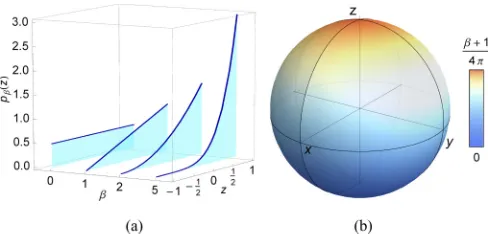
which for integer β is of the form Eq. (14) [recall that the SU(2)-invariant measure on the sphere is given by sinθ dθ dϕ/(4π)]. Qubit states that are picked according to the prior pβ(θ,ϕ) have a Bloch vector rθ,ϕ with totally random orientation in the x-y plane and with z compo-nent distributed according to the marginal prior distribution pβ(z)=2−(β+1)(β+1)(z+1)β, for z∈[−1,1]. Note that pβ(z) becomes more peaked around z=1 as β becomes larger, as illustrated in Fig.2where we plotpβ(z) for several values ofβ.
Now, using Eq. (16) it is immediate to evaluate the CFT, which is given by
Fc(2)(β)= N+β+1
M+N+β+1, (21)
FIG. 2. (Color online) (a) Marginal prior probability distribution pβ(z) for thezcomponent of the Bloch vector of single-qubit pure
states, plotted for different values of the inverse-width parameter β(β=0,1,2,5). (b) Overlay of the corresponding prior probability distributionpβ(θ,ϕ) for single-qubit states|ψθ,ϕon the Bloch sphere
(whereθ,ϕdenote the polar and azimuthal angles), forβ=5. where the superscript (2) refers to the dimension of the input systems. In AppendixA 2we extend the validity of this formula from integerβto arbitraryβ >0, allowing one to interpolate continuously from the completely flat distribution forβ=0 to the Dirac-delta distribution forβ→ ∞.
Our Eq. (21) can be readily applied, for instance, to validate implementations of quantum telecloning of qubit inputs [33,34]. The benchmark for these tasks is plotted in Figs.3(a)–3(b). The benchmark for probabilistic single-qubit teleportation, derived by setting the special caseN =M=1 in Eq. (21), is
Fc(2)tele(β)= β+2
β+3. (22)
Interestingly, both Eqs. (21)–(22) reproduce known results in the literature [7,8] in the limit of uniform priorβ →0. Since these results had been derived for deterministic protocols, their coincidence with our benchmark shows that, for uniform prior, probabilistic strategies offer no advantage: the absolute best MP protocol can be implemented with probability 1. This feature is general: the “magic” of probabilistic protocols for the processing of GPCSs fades away in the presence of maximal symmetry, as observed in Ref. [28] (cf. the Methods section therein and the discussion of the so-called “many-world fairness”), and as proven explicitly in AppendixA 4of this paper.
B. Spin-coherent states
The result for qubits can be extended in a straightforward way to spin-coherent states of spin-j quantum systems with arbitraryj. From the mathematical point of view, the extension is trivial, because a system of spin j can be thought as a composite system of 2j qubits. However, from the physical point of view, it is worth treating this case separately, since not all physical systems of spinj are composite systems of qubits (think, for example, of the orbital angular momentum of an atom).
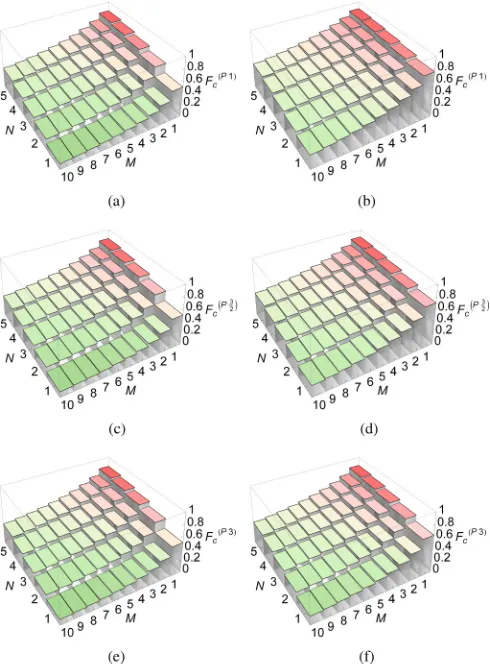
[image:6.608.313.557.69.186.2]FIG. 3. (Color online) Fidelity benchmark for theN →M trans-formation of arbitrary pure qudit states with (a)–(b)d=2, (c)–(d) d=3, and (e)–(f)d=4. The input states are distributed according to a prior distributionpβdependent on an inverse-width parameterβ
as explained in the main text. In the first column [panels (a), (c), (e)], we setβ=0, corresponding to a uniform distribution. In the second column [panels (b), (d), (f)], we setβ=5, which gives a peaked distribution depicted in Fig.2(b)for the qubit case (d=2). The color legend for the CFTF(d)
c in the bar charts is 0 (green) to 1 (red).
this transformation is
Fc(spin)(β)= 2j N+β+1
2j N+2kM+β+1, (23)
which follows from Eq. (23) by making the substitutions N→2j N andM→2kM.
Forj =kandM=N =1, Eq. (23) gives the probabilistic CFT for the teleportation and storage of spin-coherent states [35–37], while forM > Nit provides the CFT for successful implementation of spin-coherent state cloning [38]. Fork > j and M=N =1, it gives the CFT for “spin-stretching,” namely the task of enlarging the angular momentum of quantum systems while preserving its orientation in space [39]. To the best of our knowledge, the optimal spin stretching has not been implemented yet in atomic systems and beating the CFT in Eq. (23) sets the goal for future experiments in this direction.
C. Pure qudit states
We now extend our result for qubits to arbitrary d -dimensional quantum systems (qudits), with d <∞. We analyze the task of transforming N copies of a generic pure state|ψ ∈Cd intoMcopies of the same state, with a prior
pβ(ψ)=dβ|0|ψ|2β, (24)
where |0 is a fixed pure state and dβ is the normalization constant defined by
dβ :=
dψ|0|ψ|2β −1
, (25)
dψ being the SU(d)-invariant probability distribution on the set of pure states. Again, for integerβ the prior is exactly of the form of Eq. (14) and goes from the uniform prior forβ =0 to a Dirac-delta centered around the state|0forβ→ ∞.
The state|ψcan be expressed in the Hurwitz parametriza-tion [40,41] as
|ψ =cosθ0eiϕ0|0 +
d−1
j=1
cosθjeiϕj j−1
n=0
sinθn
|j, (26)
where θj ∈[0,π2) and ϕj ∈[0,2π) for n∈ {0, . . . ,d−2}, while ϕd−1=θd−1=0. In this parametrization, the SU(d
)-invariant measure reads [41]
dψ = (d−1)! πd−1
d−2
j=0
cosθj(sinθj)2(d−j−1)−1dθjdϕj. (27)
In addition, one has |0|ψ| =cosθ0 and the normalization constant in Eq. (25) can be evaluated explicitly as
dβ =
(β+d) (β+1)(d) ≡
β+d−1 d−1
. (28)
The CFT for the transformation|ψ⊗N → |ψ⊗M, expressed as a function of the dimensiondand the inverse widthβof the prior, is then given by
Fc(d)(β)=
N+β+d−1
d−1
M+N+β+d−1
d−1
, (29)
and is plotted in Fig.3.
This expression follows directly from the combination of Eq. (28) with Eqs. (16) and (25), which gives F(d)
c (β)=
dN+β/dM+N+β. Naturally, the quantum benchmark for qubits [Eq. (21)] can be retrieved by setting d=2 in Eq. (29). In AppendixA 2we extend the validity of Eq. (29) from integer β to arbitrary positive realβ.
IV. BENCHMARKS FOR SINGLE-MODE GAUSSIAN STATES
When moving from finite to infinite dimension, an almost trivial result is obtained if one takes the limit d → ∞ in Eq. (29): in this limit,F(d)
c tends to zero for every finiteβ,M,N.
[image:7.608.50.295.70.415.2]restricted sets of input states, the most interesting of which are those that can be prepared with the current experimental techniques. An important example is provided by the Gaussian states, which are the principal resources for most quan-tum information protocols with continuous-variable systems [42–46]. Although they live in an infinite-dimensional Hilbert space, Gaussian states enjoy a simple mathematical description in terms of a finite set of degrees of freedom, given by the first and second moments of their creation and annihilation operators. Pure Gaussian states and many of their relevant subclasses are GPCSs. This is the case, e.g., of the conventional coherent states, generated by the Weyl-Heisenberg group, and of the squeezed states, generated by the group SU(1,1).
In the following we recall some recent results on quan-tum benchmarks forN →Mtransformation of single-mode Gaussian states, and we present several new results on general non-Gaussian and multimode quantum states.
A. Coherent states
The coherent states of the harmonic oscillator are the prototype example of GPCSs, and the optimal cloning [47–51] and optimal amplification [18,24–27,52–54] of coherent states form a canonical chapter of continuous-variable quantum information [42,45]. Recently, the experimental breakthroughs in the demonstration of noiseless probabilistic amplifiers [24–27] have sparked a renewed interest in the optimal processing of coherent states. Here the valuable feature is that quantum devices based on probabilistic filters can almost achieve the impossible tasks of amplification and cloning, with the catch that their probability of success decreases exponentially fast with the amplitude of the input coherent state. For this reason, being able to handle a nonuniform prior concentrated on the low-amplitude states is the key to discuss the new experiments of probabilistic amplification. In this section we review the known benchmarks for the amplification of coherent states, showing how the general result of our paper provides an easy and quick derivation of the probabilistic CFT. As mentioned in Sec.II B, a coherent state of a single-mode continuous-variable system can be written as
|α =D(α)|0, (30) where
D(α)=exp(αa†−α∗a) (31)
is the displacement operator, a and a† are annihilation and creation operators obeying the commutation relation [a,a†]= 1, and|kdenotes thekth Fock state, with|0being the vacuum. Now, suppose that an experimenter Alice is given N copies of an input state|αwith complex displacementαdistributed according to the Gaussian distribution
pλ(α)= λ πe
−λ|α|2
(32)
with inverse widthλ−1, and suppose that her task is to produce
M copies of the target state |gα for some fixed g∈C. When g is positive and larger than 1, the state |gα is an amplified version of |α. More generally, allowing g to be a complex number means allowing also for attenuation and phase shifting. Teleportation, storage, complex conjugation,
cloning, loss, amplification, and attenuation of coherent states are all examples of the general task discussed here and can be retrieved by settingN,M, andgto the appropriate values.
The study of quantum benchmarks for the processing of coherent states was first addressed in the case of teleportation by Hammereret al.[9], who proved the optimality of a fidelity threshold conjectured by Braunstein, Fuchs, and Kimble [6]. Later, benchmarks for deterministic amplification and attenuation were put forward by Namiki et al. [17]. More recently, Chiribella and Xie derived the quantum benchmark for probabilistic amplification of coherent states [18]. Quite surprisingly, the value of the probabilistic benchmark coin-cides with the value of the deterministic benchmark obtained in Ref. [17], implying that probabilistic MP protocols offer no advantage over deterministic ones in the case of coherent states. All these findings can be obtained from the general result of Theorem 1. Indeed, since the prior of Eq. (32) is of the form given in Eq. (14), our general machinery applies and the probabilistic CFT can be obtained via Eq. (16). The calculation is immediate and gives the result
Fc(1c)(λ)= N+λ
M|g|2+N+λ, (33)
where we use the suffix “(1c)” to indicate that the benchmark holds for single-mode coherent states. For N =M=1, the above value coincides with the teleportation benchmark conjectured in [6] and proven in [9], which converges to 12for uniform prior distribution (λ→0). For generalN andM, it reproduces the various bounds given in [16–18].
B. Squeezed vacuum states
An important class of single-mode squeezed states is generated by squeezing the vacuum. Mathematically, this means applying the squeezing operator
S(ξ)=exp12(ξ a†2−ξ∗a2) (34)
to the vacuum state, thus obtaining the state
|ξ:=S(ξ)|0.
In this subsection we will provide the benchmark for states of this form, with arbitrary complex squeezing parameterξ. In the same spirit of the previous sections, we deal with the input state with a nonuniform prior, of the formpβ(ξ)μ(d2ξ), wherepβ(ξ) is proportional to|0|ξ|2(β+2)andμ(d2ξ) is the invariant measure on the squeezed states, given by
μ(d2ξ)=sinhscoshs ds dθ/(2π) ξ :=seiθ
(see, e.g., [55]). Precisely, the prior is given by pβ(ξ)μ(d2ξ) :=dβ|ξ|0|2(β+2)μ(d2ξ)
= βsinhs ds (coshs)β+1
dθ
2π. (35)
Sec.V. We anticipate here the probabilistic benchmark for the single-mode squeezed vacuum, given by
Fc(1s)(β)= N+β
M+N+β. (36)
Note that forN =M=1 the benchmark (36) reduces to the benchmark for teleportation of single-mode squeezed vacuum states recently obtained by some of us in Eq. (3a) of Ref. [11]. The single-mode squeezed vacuum states are frequently used as an approximation of the so-called “even Schr¨odinger cat states” [56–59], which are defined as superpositions of two coherent states
|ψeven cat(α):=
|α + | −α
2(1+e−2|α|2
).
The approximation is accurate when the squeezing degree|ξ| is small, and rapidly worsens as|ξ|increases. Choosing a prior distribution that is concentrated aroundξ =0 (i.e., choosing a sufficiently largeβ), we can guarantee that the input squeezed state will be with high probability a good approximation of an even cat state and we can use Eq. (36) as a teleportation and cloning validation criterion for even cat input states. Needless to say, the feature that our benchmarks hold for a generally nonuniform prior is essential here.
C. Arbitrary single-mode Gaussian states
A general pure single-mode Gaussian state can be written as
|α,ξ:=D(α)S(ξ)|0, (37)
where D(α) is defined in Eq. (31) and S(ξ) is defined in Eq. (34). Pure single-mode Gaussian states are thus entirely specified by their displacement vectorα∈C, their squeezing degrees∈R+, and their squeezing phaseθ∈[0,2π). Quite conveniently for our purposes, they are also a family of GPCSs, generated by the action of the Jacobi group on the vacuum [60]. Following the general prescription of Eq. (14), we consider the following prior distribution [11]:
pλ,β(α,s,θ)= λβ 2π2
e−λ|α|2+λRe(e−iθα2) tanhs
sinhs
(coshs)β+2 . (38)
This prior, depicted in Fig. 4, depends on two inverse-width parameters, λ regulating the distribution of the dis-placement α, and β regulating the distribution of the squeezing degree s, while the squeezing phase θ is uni-formly distributed. Note that the prior in (38) can be writ-ten aspλ,β(α,ξ)∝ |0|λα,ξ|2|0|ξ|2(4+β)ν(d2α,d2ξ), where ν(d2α,d2ξ)=d2αsinhs(coshs)3dsdθ is the invariant
mea-sure under the joint action of displacement and squeezing [31]. In the case of no squeezing (β → ∞), this prior correctly reproduces the Gaussian prior for coherent states, with limβ→∞
d2ξ pλ,β(α,ξ)=pλ(α). Similarly, the marginal prior of Eq. (35) for squeezed states is recovered by integrating pλ,β(α,ξ) overα, namely
d2α p
λ,β(α,ξ)=pβ(ξ) [11]. For integer values of λ,β, the benchmark for N →M transformation of arbitrary pure single-mode Gaussian states distributed according to the prior in (38) is then given by evaluating Eq. (16), which results in the following CFT, where
FIG. 4. (Color online) Prior probability distribution over the in-put ensemble of pure single-mode Gaussian states, Eq. (38), setting the inverse-width parameters toλ=2 andβ=6. Panel (a) depicts the marginal prior distribution for displacement α and squeezing degree s after integrating Eq. (38) over the squeezing phase θ, yieldingpλ,β(α,s)=π−1λβe−λ|α|
2
sinhs(coshs)−β−2I
0[λ|α|2tanhs] [11], whereI0is a modified Bessel function. Panel (b) depicts cross sections of the phase-space Wigner functions for a small sample of pure single-mode Gaussian states with parameters α, s, and θ randomly sampled according to the considered prior distribution. The correspondence between the parameters of a Gaussian state and the form factor of the corresponding cross section (which is an ellipse obtained by cutting the two-dimensional Gaussian Wigner function) is as follows: the center of the ellipse has phase-space coordinates (q,p)≡(√2Reα,√2Imα), the ellipse is rotated byθ/2 with respect to the horizontal axis, and the ratio between the lengths of the semiaxes ise2s; see, e.g., [46] for more detail.
the suffix “(1cs)” stands for one-mode coherent (i.e., displaced) squeezed states:
Fc(1cs)(λ,β)= (N+λ)(N+β)
(N+M+λ)(N+M+β). (39)
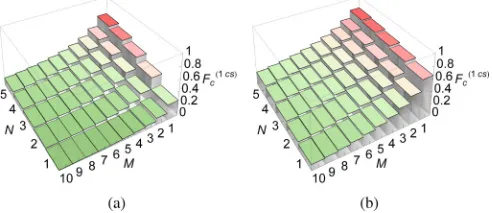
The benchmark of Eq. (39) is plotted in Fig. 5. For N =M=1, this result reproduces the very recent benchmark for teleportation and storage of pure single-mode Gaussian states, obtained by some of us in Ref. [11]. Interestingly, the benchmark for pure Gaussian states is equal to the product of the benchmarks for coherent states [Eq. (33) withg=1] and the benchmark for squeezed vacuum states [Eq. (36)].
FIG. 5. (Color online) Fidelity benchmark for theN→M trans-formation of arbitrary pure single-mode Gaussian states, distributed according to the prior pλ,β of Eq. (38), with (a) λ=β=0
(input ensemble of infinite energy), and (b)λ=2,β=6 (peaked distribution as in Fig.4). The color legend for the CFTF(1cs)
[image:9.608.317.558.69.198.2] [image:9.608.313.559.575.682.2]These two benchmarks are retrieved in the limitsβ → ∞(no squeezing) andλ→ ∞(no displacement), respectively. One can numerically verify that the benchmark in Eq. (39) holds for generally noninteger values ofβ andλas well, by using a laborious but straightforward operator approach [11].
V. BENCHMARKS FOR NON-GAUSSIAN MULTIMODE SQUEEZED STATES
In the following, we turn our attention from single-mode Gaussian states to multisingle-mode non-Gaussian states. Specifically, we introduce the benchmark for a family of squeezed states which were first proposed by Perelomov [23,31]. The family of Perelomov squeezed states includes Gaussian states such as the single-mode squeezed vacuum states (discussed in Sec. IV B) and, more intriguingly, also several non-Gaussian states. For example, the state obtained by squeezing a single-photon Fock state belongs to this class; such a state is a good approximation of an “odd Schr¨odinger cat state” and has applications in hybrid continuous variable quantum information processing [56–59,61].
A. Benchmark for general Perelomov squeezed states Perelomov squeezed states are characterized by an index j >0 and by a squeezing parameterξ =seiθ. For every fixed value ofj one has a family of squeezed states, generated by the action of a suitable squeezing operator on a given state. The members of the family are states of the form
|ξ,j:= 1 (coshs)j
∞
n=0
n+j−1 n
(eiθtanhs)n|ψn(j),
(40)
where {|ψn(j)}n∈N is a given orthonormal basis. For a fixed
value of j, we call the states in this family thePerelomov-j states. Many known families of squeezed states can be ex-pressed as Perelomov-j states. For example, the single-mode squeezed vacuum states, discussed in Sec.IV B, can be viewed as Perelomov-21states by setting|ψn(j=1/2) ≡ |2nin Eq. (40). Similarly, the squeezed single-photon states can be viewed as Perelomov-23states by setting|ψn(j=3/2) ≡ |2n+1.
Let us consider the transformation |ξ,j⊗N→ |ξ,k⊗M, where N copies of a Perelomov-j state are mapped intoM copies of the corresponding Perelomov-k state. Among the possible examples one has not only state teleportation and cloning, but also more exotic tasks, such as the transformation of squeezed vacuum states into squeezed single-photon states. Assuming the same prior used in Eq. (35) it is easy to evaluate the benchmark from Eq. (11). The calculation, presented in Appendix A 3, yields the following CFT for Perelomov squeezed states:
Fc(P)(β)= 2j N+β
2kM+2j N+β. (41)
Plenty of appealing results can be derived from Eq. (41), e.g., the benchmark for the single-mode squeezed states in Eq. (36). In the rest of this section we will show a selection of what we believe are the the most meaningful ones.
B. Squeezed single-photon states
The squeezed single-photon states are defined asS(ξ)|1, where S(ξ) is the single-mode squeezing operator (34) and |1 is the one-photon Fock state [62]. When the amount of squeezing is small, they are a good approximation of the odd Schr¨odinger cat states [56–59], i.e., of the superposition of two coherent states defined by
|ψodd cat(α):= |
α − | −α
2(1−e−2|α|2
) .
As we mentioned earlier, the squeezed single-photon states are the Perelomov-j states with j =3/2. Accordingly, the benchmark for transformingN copies of a squeezed single-photon state intoMcopies is obtained by settingj =k=3/2 in Eq. (41), which yields the CFT
F(P
3 2)
c =
3N+β
3(N+M)+β. (42)
The benchmark is plotted in Figs. 6(c)–6(d). Note that when β is large and the prior distribution of the squeez-ing parameter is concentrated around |ξ| =0, this bench-mark can be approximately applied to the teleportation and cloning of odd Schr¨odinger cat states. The application of our benchmark leads to some rather strong consequences. Indeed, when the average photon number is small (here we choose |α|1), an odd cat state |ψodd cat(α) can be well
approximated by the squeezed single-photon state |ξ∗,3/2 where the optimal amount of squeezing is ξ∗=s∗e2iθ with s∗= 1
2ln(|α|
2/3+9+4|α|4/3) andθ being the phase of
α [59]. Choosing β to be large, one can guarantee that the squeezing degree is smaller than |ξ∗(α=1)| with high probability, so that the input states are likely to be close to odd cat states. For example, one can consider the case of teleportation (N =M=1); solving the inequality
2π
0
dθ 2π
s∗(1)
0
βsinhsds
(coshs)β+1 0.99,
one getsβ 95.79, which, plugged into the benchmark (42), yields
Fc(odd cat)0.971.
This lower bound shows that MP protocols can achieve high fidelity in the teleportation of odd cat states with small photon numbers (|α|1), due to the large amount of prior information available about the input. In this regime, demonstrating a genuine quantum teleportation of odd cat states appears nearly impossible. Of course, one can still consider the more feasible task given by teleportation of single-photon squeezed states for broader prior distributions, allowing the input states to be different from cat states.
C. Unbalanced two-mode squeezed number states In this subsection we introduce the benchmark for another important family of continuous-variable states, which are generated by applying the two-mode squeezing operator
FIG. 6. (Color online) Fidelity benchmark for theN →M trans-formation of Perelomov-j squeezed states with (a)–(b) j=1, corresponding to (Gaussian) two-mode squeezed vacuum states, (c)–(d) j= 32, corresponding to (non-Gaussian) squeezed single-photon states, and (e)–(f)j=3, corresponding to (non-Gaussian) states obtained by applying a two-mode squeezing operation to the Fock states|2|0. The input states are distributed according to a prior distributionpβ dependent on an inverse-width parameterβas
explained in the main text. In the first column [panels (a), (c), (e)], we setβ=0, corresponding to a uniform distribution. In the second column [panels (b), (d), (f)], we setβ=4. The color legend for the CFTF(Pj)
c in the bar charts is 0 (green) to 1 (red).
to the two-mode Fock state|m|0, withman arbitrary integer. Form=0, these are the standard two-mode squeezed vacuum states, which are ubiquitous in continuous-variable quantum information processing [42,43,45]. Form >0, one has instead a set of non-Gaussian unbalanced two-mode squeezed number states [63]. Like in the case of squeezed single-photon states, the non-Gaussianity of these states is a precious resource for continuous-variable quantum information pro-cessing [58,61,64]. Consequently, having a benchmark for this class of states provides a useful criterion for the verification of quantum protocols empowered by non-Gaussianity [65].
The unbalanced two-mode squeezed state of Eq. (43) corresponds to the Perelomov-(m+1) state
|ξ,m+1 =S(2)(ξ)|m|0,
where the basis in Eq. (40) is|ψ(m)
n := |n+m|n. Setting k=j =m+1 in Eq. (41), we immediately get the CFT
Fc(Pm+1)= 2(m+1)N+β
2(m+1)(N+M)+β. (44)
This is plotted in Fig.6for selected values ofmandβ. Notice in particular that the benchmark for Gaussian two-mode squeezed vacuum states (m=0) returns:
Fc(P 1)= 2N+β
2(N+M)+β. (45)
Such a CFT can be equivalently obtained from the benchmark for Gaussian single-mode squeezed vacuum states, Eq. (36), by doublingNandM. This is consistent with the fact that a two-mode squeezed vacuum state can be always generated from two single-mode squeezed vacuum states (equally squeezed in orthogonal quadratures) by means of a balanced beam splitter. A quantum memory for entangled two-mode squeezed light was demonstrated in [66]. However, in that implementation the input squeezing degree was assumed to be known and therefore a different benchmark was used to validate the experiment [12].
VI. DETERMINISTIC VS PROBABILISTIC BENCHMARKS In the preceding sections we established the ultimate probabilistic benchmarks for a variety of protocols and input states. A natural question is whether there existdeterministic MP strategies which are able to achieve the benchmarks. In the following we address this question, considering separately the cases of uniform and nonuniform priors.
A. Uniform prior: Optimality of the square-root measurement Let us assume that the input states {|φg} are chosen at random according to the normalized Haar measure. This assumption is easily justified when the group G is compact. Nevertheless, one can make sense of it also in more general cases of noncompact groups, by considering the uniform prior as the limit of a sequence of priors with increasing width. Alternatively, one can also interpret the (unnormalized) Haar measure as a weight that Victor assigns to the different input states when computing the figure of merit.
Whenever the input states are uniformly distributed (or weighted), one can prove that the the probabilistic benchmark can be reached by a deterministic strategy, which consists in performing the square-root measurement[67] and preparing the output state that corresponds to the measurement outcome. In general, for a given set of states {ρx}and a given set of probabilities{px}, the square-root measurement is the POVM {Px}x∈Xdefined by
Px =ρ−
1
2(pxρx)ρ− 1 2
x , (46)
where ρ=xpxρx (note that this definition makes sense even if{px}are weights, provided that the sum is finite). In the case of the uniformly distributed GPCS{|φg}, the square-root measurement is just the POVM with operators
Pg =dφ|φgφg| dφ :=
dg|φ|φg|2 −1
[image:11.608.50.295.70.404.2]In AppendixA 4we prove that performing the square-root measurement and repreparing the output state corresponding to the outcome is an optimal strategy. In other words, the ultimate CFTFccan be achieved with unit probability when
the prior is uniform. This feature holds also not only for MP protocols but also for the optimal quantum devices: in the case of uniform prior Alice and Bob can achieve the ultimate quantum fidelityFqwith probability 1 by applying a suitable quantum channel [68], which generalizes the universal cloning channel by Werner [69] and the Gaussian cloners by Cerf, Ipe, Rottenberg, Iblisdir, and Lindblad [47–49].
B. Nonuniform prior: A counterexample
The result of the previous paragraph might suggest that one can always attain our benchmarks using a deterministic protocol based on the square-root measurement. A further clue that goes in that direction comes from the benchmarks for coherent states of the harmonic oscillator [9,17,18], which can all be achieved by the square-root measurement. Nevertheless, these results cannot be generalized to arbitrary GPCSs: here we show a counterexample where the square-root measurement does not achieve the probabilistic benchmark. It remains how-ever an open question whether more complicated deterministic strategies can achieve our probabilistic benchmarks in the general case.
Suppose that Alice wants to teleport a single-qubit state to Bob, chosen at random on the Bloch sphere according to the nonuniform prior pβ(dg)=dβ|φ|φg|2βdg of Eq. (20) and Fig.2. Consider the MP protocol that consists in measuring the square-root measurement with POVM operators
Pη(g) :=pη(g)ρ−
1 2
η (|ψgψg|)⊗Nρ−
1 2
η , (48)
where
ρη=
pη(dg) (|ψgψg|)⊗N.
Strictly speaking, the square-root measurement associated with the input ensemble would haveη≡β, but here we grant Alice and Bob the additional freedom to optimize over η, possibly obtaining a better fidelity.
By performing the square-root measurement with param-eter η and repreparing the qubit state corresponding to the outcome, Alice and Bob get the teleportation fidelity
F(β,η)=
dg
dgpˆ β(g)pη( ˆg)|ψg|τ−
1 2
η |ψg|ˆ 2|ψg|ψg|ˆ 2.
(49)
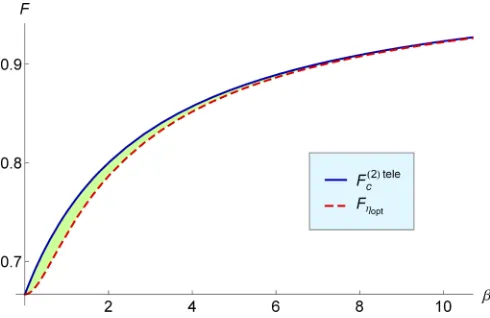
For fixed inverse width β, we can now find the value of η that maximizes the teleportation fidelity. The optimization can be done analytically (see Appendix A 5) and yields a fidelity Fηopt(β) that is strictly smaller than the benchmark
Fc(2)tele(β)=ββ++23 from Eq. (22). In Fig.7, the fidelity for the optimal square-root measurementFηopt(β) and the benchmark
F(2)tele
c are plotted as functions ofβ. Clearly, the square-root
measurement is not optimal for every finite valueβ∈(0,∞). The explicit expression of the gap(β) between the two fideli-ties is reported in AppendixA 5. Interestingly, for largeβthe gap vanishes polynomially withβ, precisely(β)≈O(β−3). Therefore we conclude that the square-root measurement is
FIG. 7. (Color online) The fidelityFηopt(β) :=maxηF(β,η) for
the optimal deterministic square-root measurement (red dashed line) and the ultimate probabilistic benchmark F(2)tele
c (β) for one-qubit teleportation (blue solid line) as functions of the inverse widthβ of the prior distribution. The (green) filling between the two lines represents the gap between the benchmark and the performance of the optimal square-root measurement.
asymptotically optimal, when the prior knowledge about the input state becomes more and more peaked.
VII. QUANTUM BENCHMARKS VS OPTIMAL QUANTUM STRATEGIES: A TASK WITH NO QUANTUM ADVANTAGE The main application of quantum benchmarks is the certification of quantum advantages in realistic experimental settings. However, not every task displays a quantum advan-tage: for some transformations, the maximum fidelity achieved by arbitrary quantum strategies is equal to the quantum benchmark associated with the best MP procedure.
An example of this situation is the following: Suppose that we want to transformN copies of the GPCS|φg, distributed with prior probabilitypγ(g)=dγ|φγ|φγ ,g|2, intoMcopies of the state |ψg∗, the complex conjugate of another GPCS state |ψg. As in the rest of the paper, we assume that the states|ψg⊗M,|φg⊗N, and|φγ ,gare mutually coherent, i.e., that their product is a GPCS. In this setting, we can prove that there is no quantum advantage: MP protocols are optimal among all possible quantum strategies. The proof is presented in AppendixA 6, where we show the equalityFq =Fcbetween
the ultimate quantum fidelity in Eq. (7) and the benchmark of Eq. (11).
[image:12.608.312.557.70.229.2][74]. Optimal MP protocols for the transposition of arbitrary pure states in finite dimensions have also been proposed in [74]. Our result extends the optimality of MP protocols to a large variety of new scenarios, including the transposition of various Gaussian and non-Gaussian pure states, distributed according to a generally nonuniform prior.
VIII. DISCUSSION AND CONCLUSIONS
Very recent experiments have reached a remarkable degree of control in the preparation and manipulation of hybrid states of light and matter [58,75–77]. Hybrid optical technologies [61] combine the best of both worlds, discrete-variable and continuous-variable systems, in order to efficiently realize elementary building blocks for distributed quantum communi-cation [2]. For instance, in a recent experiment a single-photon state was teleported unconditionally, i.e., deterministically, using a continuous-variable setup [75]. Complementary to such an approach, a proposal to realize high-fidelity telepor-tation of continuous-variable states by multiple single-photon teleportation channels was also recently put forward [78]. One can easily imagine extensions of such protocols from telepor-tation to the more general instance of asymmetric telecloning [33], where remote parties receive approximate copies of input unknown states, possibly with nonuniform fidelities. So far, telecloning has been successfully implemented for Gaus-sian (coherent) inputs exploiting GausGaus-sian shared entangled states [79].
However, to the best of our knowledge, a completely satis-factory teleportation or telecloning experiment demonstrating the use of entangled resources to surpass the best classical performance in the transmission of anensembleof input states has not been achieved to date. Such an experiment would require sampling a high number of input states from a prior distribution known to senders and receivers, accomplishing the transmission for each input, and eventually calculating the experimental average fidelity over the ensemble. This should then be compared to, and shown to surpass, the ultimate benchmark corresponding to the given input ensemble.
The present work offers a powerful and general machinery to derive such benchmarks for many instances of relevant input ensembles, with adjustable prior distributions which can be tailored to reliably mimic the experimental facilities. One of the strengths of our approach to quantum benchmarking is that it encompasses under a unifying mathematical framework both discrete- and continuous-variable states, and both Gaussian and non-Gaussian ones in the latter case. The obtained benchmarks are therefore ideally and naturally suited to be used as tests to validate current and future implementations of hybrid quantum communication.
We hope this paper may stimulate further efforts by the experimental community, and further interaction with the theoretical one, in order to reach new heights in the successes of quantum optical technologies and demonstrate performances even more markedly above what classically possible. In particular, new (possibly probabilistic) protocols and new tools are required to beat the benchmarks for the transmission of squeezed vacuum or squeezed Fock states (or, similarly, Schr¨odinger-cat-like states) using affordable degrees of shared
entangled resources, as discussed, e.g., in [80] and in the present paper.
Finally, despite the large variety of relevant cases in which this work succeeds to deliver analytical benchmarks, let us briefly comments on some limitations of our approach which call for further investigation. One of the main limitations is in the fact that our input states are always assumed to be pure. A more faithful analysis of experiments might require the derivation of benchmarks for ensembles of initially mixed states; while this may not be possible in closed form for all the classes of states analyzed here, one can always resort to numerical methods, e.g., semidefinite programming as in [13]. From this point of view, Eq. (11) represents a convenient starting point. More generally, the application of our group-theoretic methods to the assessment of the ultimate quantum (rather than classical) bounds in protocols such as remote state preparation, optimal quantum cloning, amplification and attenuation of generalized coherent states, and optical imaging technologies, will be analyzed in forthcoming works.
ACKNOWLEDGMENTS
This work was supported by the National Basic Research Program of China (973) 2011CBA00300 (2011CBA00301), by the National Natural Science Foundation of China (Grants No. 11350110207, No. 61033001, and No. 61061130540), by the 1000 Youth Fellowship Program of China, by the Tsinghua-Nottingham Teaching and Research Fund 2013, by the Foundational Questions Institute (Grants No. FQXi-RFP3-1325 and No. FQXi-RFP3-1317), and by the Brazilian CAPES (Pesquisador Visitante Especial, Grant No. 108/2012). We thank I. Kogias, S. Ragy, and U. Andersen for fruitful discussions. G.A. acknowledges the hospitality of Tsinghua University. G.C. acknowledges the hospitality of the Simons Institute for the Theory of Computing and of Perimeter In-stitute for Theoretical Physics. Research at Perimeter InIn-stitute for Theoretical Physics is supported in part by the Government of Canada through NSERC and by the Province of Ontario through MRI.
APPENDIX: PROOFS 1. Proof of Theorem 1
Since we have already exhibited a probabilistic MP protocol that achieves the fidelity in Eq. (16), here we only need to show that the right-hand side of Eq. (16) is an upper bound for arbitrary MP protocols. To this purpose, we start from Eq. (11), which now reads
Fc(γ)=Iout⊗ρ−
1 2
γ
γ
Iout⊗ρ−
1 2
γ ×, (A1)
whereργ is the averaged input state, given by
ργ :=
pγ(dg)(|φgφg|)⊗N,
andγ is the average input-output state, given by
γ :=
![FIG. 3. (Color online) Fidelity benchmark for the Ncolumn [panels (b), (d), (f)], we setas explained in the main text](https://thumb-us.123doks.com/thumbv2/123dok_us/8700417.381349/7.608.50.295.70.415/color-online-fidelity-benchmark-ncolumn-panels-setas-explained.webp)