Detecting Anomalous Process Behaviour using
Second Generation Artificial Immune Systems
JAMIETWYCROSS, UWEAICKELIN†, AMANDAWHITBROOK‡
IMA Research Group, School of Computer Science, University of Nottingham, UK
Artificial Immune Systems have been successfully applied to a number of problem domains including fault tolerance and data mining, but have been shown to scale poorly when applied to computer intrusion detection despite the fact that the biological immune system is a very effective anomaly detector. This may be because AIS algorithms have previously been based on the adaptive immune system and biologically-naive models. This paper focuses on describing and testing a more complex and biologically-authentic AIS model, inspired by the interactions between the innate and adaptive immune systems. Its perfor-mance on a realistic process anomaly detection problem is shown to be better than standard AIS methods (negative-selection), policy-based anomaly detection methods (systrace), and an alternative innate AIS approach (the DCA). In addition, it is shown that run-time information can be used in combination with system call information to enhance detection capability.
Key words: Second generation Artificial Immune Systems,
innate immunity, process anomaly detection, intrusion de-tection systems
1 INTRODUCTION
This paper is concerned with the classification performance of a novel Arti-ficial Immune System (AIS) on a process anomaly detection problem. The
novel AIS (thetlralgorithm) incorporates mechanisms inspired by both the
innate and adaptive biological immune systems, and produces a very low false positive rate when detecting attacks on an FTP server. As with many other process anomaly detection systems, system call information is used as one source of input data. However, another novel aspect of thetlralgorithm is the use of runtime statistics (such as process memory and file usage) as con-text signals that form additional sources of input data. This aspect builds on the idea of gray-boxing, a term introduced several years ago [8] to denote in-trusion detection systems that use runtime information as well as system call information.
The rest of the paper is structured as follows. Section 2 provides some es-sential background information on intrusion and process anomaly detection, reviewing and describing the various approaches. It also introduces some fundamental AIS concepts including the notion of first and second generation AIS algorithms. A detailed explanation of thetlralgorithm’s architecture is given in Section 3, and Section 4 describes how a test dataset (wuftpd) is cre-ated and how the normal and anomalous test data is constructed, i.e., how the input system calls and context signals used by thetlralgorithm are gathered in practice. Section 5 reports on the experimental procedures adopted and the results are presented and discussed in Section 6; in particular, thetlr algo-rithm’s performance is compared with those of several other classifiers and anomaly detection approaches. Section 7 concludes the paper.
2 BACKGROUND
2.1 Process Anomaly Detection
run. The operating system is responsible for managing the execution of run-ning processes, and associates a number with each one. This is called the process identifier (PID), as it uniquely identifies each process. When a pro-cess is started, the operating system associates other metadata with it too, such as the user who started it, and the PID of the parent process that created it. The operating system also allocates resources to running processes, includ-ing memory (which stores the executable code and data) and file descriptors, which identify files or network sockets that belong to the process.
A number of host-based Intrusion Detection Systems (IDSs) have been built around monitoring running processes to detect intrusions. In general, these IDSs collect information about a running process from a variety of sources, including from log files created by the process, or from other in-formation gathered from the operating system. The general idea is that by observing what the process is currently doing, for example by looking at its log files, it is possible to tell whether the process is behaving normally or has been subverted by an attack. While log files are an obvious starting point for such systems, and are still an important component in a holistic security approach, it is fairly easy to execute attacks which do not cause any logging to take place, and so evade detection. Because of this, much research effort has been directed towards the use of other data sources, usually collected by the operating system. Of these, system calls (syscalls) have been the most favoured approach.
A syscall is a low-level mechanism by which an application requests sys-tem services such as peripheral I/O or memory allocation from an operat-ing system. As a process runs it cannot usually directly access memory or hardware devices; instead, the operating system manages these resources and provides a set of functions, called syscalls, which processes can call to ac-cess these services. On modern Linux systems there are around 300 syscalls, accessed via wrapper functions in the libc library.
2.2 Process Anomaly Detection Systems
Due to space constraints, this section focuses on syscall-based IDSs. The
used to add syscalls to the policy, adjusting it before using it in automatic mode. Initial policies for a process are obtained by using templates or by run-ningsystracein automatic policy-generation mode, where the monitored process is run under normal usage conditions, and permit entries are created in the policy file for all the syscalls made by the process. The policy spec-ification also allows some matching of syscall arguments as well as syscall numbers. The system’s automatic policy-generation approach is used as a baseline comparison for thetlralgorithm presented in this paper, which can be seen as a more sophisticated and dynamic alternative tosystrace.
In [8], Gao et al. introduce a new model of syscall behaviour called an ex-ecution graph. An exex-ecution graph is a model that accepts approximately the same syscall sequences as a model built on a control flow graph. However, the execution graph is constructed from syscalls gathered during normal execu-tion, as opposed to a control flow graph, which is derived from static analysis. In addition to system call number, stack return addresses are also gathered and used in construction of the execution graph. The authors also introduce a course-grain classification of syscall-based IDSs into white-box, black-box and gray-box approaches. Black-box systems build their models from a sam-ple of normal execution using only system call number and argument infor-mation. Gray-box approaches, as with black boxes, build their models from a sample of normal execution but, as well as using syscall information, also use additional runtime information. White-box approaches do not use samples of normal execution, but instead use static analysis techniques to derive their
models. Thetlralgorithm, in Gao’s terms, is a gray-box approach, and is
complementary to the specific gray-box approach described by Gao, explor-ing different sources of runtime information other than stack return addresses. Specifically,tlruses the memory and file-usage levels of the executing ap-plication.
is detected, execution of the process that produced the syscalls is delayed for a period of time. The work presented in this paper differs from these ap-proaches in that thetlralgorithm does not actively respond to misbehaving processes as in [21], it only generates alerts. Also,tlrbases its alerts on the simple syscall number combined with other runtime information (to im-prove detection capability), as opposed to the more complex representations of syscalls used by Forrest et al.
2.3 Artificial Immune Systems
The field of Artificial Immune Systems (AIS) began in the early 1990s with a number of independent groups conducting research that used the biologi-cal immune system as inspiration for solutions to problems in other domains. AISs have been built for a wide range of applications including document classification, fraud detection, and network- and host-based intrusion detec-tion [6]. Specifically of relevance to the work here are AIS approaches to intrusion detection, which are reviewed by Aickelin et al. [5]. For example, a negative selection AIS algorithm is used in the process anomaly detection systems built by Forrest et al [7]. AISs have met with some success and in some cases have rivalled or bettered existing statistical and machine learning techniques [13].
Immunology textbooks generally characterise the innate and adaptive im-mune systems as separate. The adaptive system is described as capable of specific recognition and remembrance of antigen, while the innate system is seen mainly as a first line of defence and rapid-response mechanism. Under-standably perhaps, from this perspective a computer scientist might view the adaptive immune system as having more interesting properties such as learn-ing and memory. However, this view of the immune system as two discrete systems does not reflect the intensive research and reassessment of the role of the innate immune system conducted over the last decade, as evidenced by the large number of papers published in immunology journals [9]. This re-search has uncovered many mechanisms by which the innate immune system interacts with the adaptive immune system, and has highlighted the role of the innate immune system as controller of the adaptive system. In other words, the protection afforded to the host by the immune system as a whole arises from mechanisms of the innate and adaptive immune systems, which form an
integrated system. This new understanding of the structure and control of the
One of the aims of this work is to show the value of considering the biolog-ical immune system as composed of interacting innate and adaptive subsys-tems when attempting to design a realistic and profitable AIS model. Over the last few years a number of design principles have been developed for constructing what are termed second generation AISs [25]. These employ algorithms inspired by both the biological innate and adaptive immune sys-tems, as opposed to first generation AISs, which employ algorithms inspired
only by the adaptive immune system. A software system calledlibtissue
has also been developed. This allows researchers to implement second gen-eration AISs as multiagent systems and to analyse their behaviour when they are applied to real-world problems [26, 23]. With the work here and other work, the aim is to show how second generation AISs can overcome some of the problems that have been attributed to first generation AISs, for example accuracy and scalability [26].
3 THETLRALGORITHM
The tlr algorithm is inspired by current immunological understanding of
the interactions between two classes of immune cell: dendritic cells (DCs)
and T cells (TCs). In particular,tlruses a model of DC polarisation of T
helper cells, based on the work of Kapsenberg [16]. Section 3.1 describes the biological theory that relates to these cells, their interactions and their environments, and Section 3.2 shows how these ideas have been abstracted to
form thetlralgorithm - a working model of the innate and adaptive immune
subsystems. Section 3.3 explains how the model has been used to create a host-based grey-box IDS.
3.1 The Underlying Biology
in combination with a self receptor called a major histocompatibility complex (MHC) molecule.
TCs begin life in a naive state, in the lymph node, and there are two major subtypes; the killer TC and the helper TC. Killer TCs only recognize antigens coupled to Class I MHC (MHCI) molecules and are specialized in attacking cells of the body infected by viruses and sometimes by bacteria. They can also attack cancer cells. In contrast, helper TCs only recognize antigens coupled to Class II (MHC2) molecules and are responsible for regulation of both the innate and adaptive immune responses. They help determine which type of immune response the body will make to a particular antigen. Most antigens are T-dependent, meaning that two signals are necessary before the cell is attacked. The first signal comes from cross linking of the BC receptor and antigen and the second signal comes from co-stimulation provided by the helper TC. Co-stimualtion occurs when antigen presenting cells (APCs), for example DCs, present antigen on their MHC2 molecules. When these are recognized by helper TCs, the helper TC is activated and releases cytokines and other stimulatory signals that cause the activity of macrophages, killer TCs and BCs.
In contrast to the adaptive case, the receptors of innate system cells are entirely germline-encoded, in other words their structure is determined by the genome of the cell and has a fixed, genetically-determined specificity. Un-like adaptive system cells, they recognise a set of ligands under evolutionary pressure. One key group of innate receptors is the pattern recognition
recep-tor (PRR) superfamily which recognises evolutionary-conserved pathogen-associate molecular patterns (PAMPs). PRRs do not recognise a specific
feature of a specific pathogen as variable-region receptors do, but instead recognise common features or products of an entire class of pathogens. Thus, innate immune system receptors are termed non-specific, while adaptive im-mune system receptors are termed specific. The toll-like receptor (TLR) fam-ily of PRRs is the best characterised.
a special set of TLRs, which respond to PAMPs and are also activated by host-derived endogenous molecules (danger signals) that are produced when tissue is damaged. Periodically, DCs migrate to the draining lymphoid tissues where they halt phagocytosis, display the peptides they have collected, and in-teract with naive TCs. When their TLRs have become activated and antigen have been detected they differentiate into mature DCs and immediately mi-grate. They also migrate when they have reached their maximum lifespan and have detected antigen, in which case they differentiate into semi-mature DCs. Both semimature and mature DCs express antigen producers (AgPs), which give other cells access to the antigen they have collected. Mature DCs alone produce IL-12, which is used by naive TCs to differentiate between mature and semimature DCs. Essentially, the presence of biological danger signals causes a DC to present its antigen in a mature, immunogenic context, causing TC activation, whereas their absence causes the antigen to be presented in a semi-mature, tolerogenic context, and the TC is deleted.
In this way, DCs match the quality of the adaptive immune effector re-sponse to the nature of the antigen. They are therefore vital in the control of the adaptive immune system and the generation of tolerance to antigen in pe-ripheral tissue. Through the production of a range of cytokines, DCs control the activation and proliferation of TCs and BCs, and determine the qualitative and quantitative nature of the adaptive immune response.
3.2 ThetlrModel
As in Kapsenberg’s model [16], DCs can either be immature, semimature or
mature, and TCs either naive or activated. Furthermore, in thetlrmodel,
cells exist within either the extralymphoid tissue compartment or lymph node compartment, and cell types are restricted to particular compartments. This is shown schematically in Figure 1. Immature DCs and activated TCs are only found in the extralymphoid compartment, and semimature DCs, mature DCs and naive TCs in the lymph node compartment.
nTC
IL−12R
TCR
nTC
IL−12R
TCR
iDC
aTC
mDC smDC
AgP
apoptosis
TCR activated
node lymph extralymphoid
tissue
antigen
AgR
AgP
IL−12R unactivated
TCR activated IL−12R activated TLRs unactivated
antigen collected
TLRs activated antigen collected
IL−12 TLRs
[image:9.594.177.438.126.274.2]signals
FIGURE 1
A schematic representation of thetlralgorithm. For DCs i = immature, sm =
semi-mature and m = semi-mature. For TCs a = activated, n = naive.
is monitored, and if any activated TCs are produced an alert is generated. Homeostatic determination of cell numbers is found to be particularly useful since, during periods of normal usage, cell numbers are generally kept at low levels, which reduces the computational cost of the algorithm.
mature DCs, so if the number of mature DCs is greater than the number of semimature DCs, a naive TC will have a greater probability of binding with a mature DC than a semimature DC and vice versa. If a naive TC successfully binds with a DC then it will examine the antigen the DC has collected as an immature DC in the extralymphoid compartment (and is displaying on its AgPs). If a match occurs and the bound DC is a semimature DC then the naive TC will be deleted and the semimature DC will receive a stay-alive signal. This stay-alive signal resets the number of iterations the semimature DC has existed for to zero. If a match occurs and the bound DC is a mature DC then the naive TC will be activated and will clone a single activated TC. The activated TC will then traffic back to the extralymphoid compartment and the naive TC will remain in the lymph node compartment. In this case, both the naive TC and mature DC receive stay-alive signals, resetting the number of iterations these cells have existed for to zero, based on biological mechanisms of reverse signalling. Detailed pseudocode for thetlralgorithm is provided in Section 3.4.
3.3 The Use oftlras an IDS
The TLRs on DCs are activated by certain context signal values analagous to biological danger signals. Here, system information (other than syscall number) is used, (discussed shortly in Section 4). In contrast, AgRs on naive TCs are activated by certain antigen values, which are the syscall numbers. In order to determine which signal and antigen values activate these receptors
tlrneeds to be provided with a set of training data consisting of a sample of normal instances only. Once this is provided, all of the normal antigen and danger signal values are extracted and stored, and then a new set of per-missible AgR values is created by removing all the antigen observed in the training set from the set of all possible antigen values (around 350 in the case of syscall numbers). In a similar way, TLRs are only activated by signal lev-els not seen in the training set. However, since context signals are represented as real numbers, the set of all possible values for a particular context signal need not be finite. Additionally, TLRs, unlike AgRs, are not specific for one particular value, but rather any value not seen in the training set. The sig-nals used here (see Section 4) are all integers from finite sets, so this scheme works well. However, the levels of other real-valued signals would need to be discretised for this scheme to work effectively with them.
only activated if its lock matches that of an antigen presented on an AgP of a DC. This is equivalent to the naive TC undergoing negative selection on the antigen in the training set, and produces naive TCs with AgRs that will never match an antigen seen in the training set.
Syscalls are collected and grouped temporally, i.e. those which occur around the same time period are collected and stored, and the external sig-nals sensed by immature DCs also group the syscalls contextually; semima-ture DCs associate a normal context to the syscalls they have collected, while mature DCs associate an attack context with these syscalls. The addition of contextual grouping as well as temporal grouping has two effects on the reper-toire of AgRs. First, non-deterministic interactions between semimature DCs and naive TCs allowstlrto continue to censor its AgR repertoire after the training phase, i.e. AgRs that are specific for syscalls produced during normal sessions (but not present during training) are quickly removed. This periph-eral tolerance mechanism helps reduce the number of false positives. Second, non-deterministic interactions between mature DCs and naive TCs promote the survival of naive TCs that successfully match antigen presented by mature DCs. These naive TCs are given a stay-alive signal by the mature DCs and remain within the population of naive TCs for longer. Since the population size of naive TCs is constant, the rate of entry of new naive TCs into the cur-rent naive TC population is reduced. Therefore, the contextual information provided by mature DCs serves to help maintain a population of successful
naive TCs, and reduce the number of incoming naive TCs. Thetlralgorithm
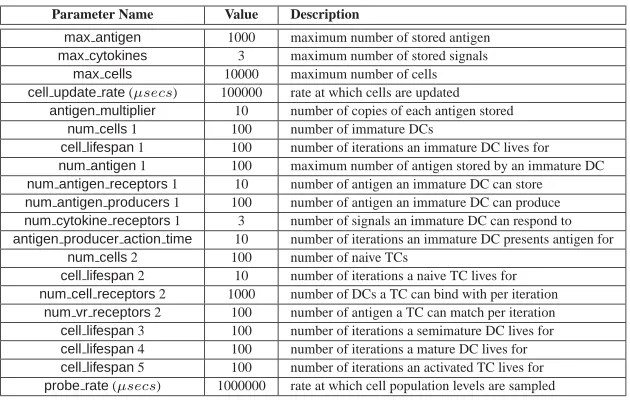
is formalized in the pseudocode given below, and thelibtissueparameters
used are given in Table 4 in Appendix A. A full justification of the selection of parameters is provided in [24], Chapter 8.
3.4 tlrPseudocode
Pseudocode for thetlralgorithm, see Table 4 in Appendix A for parameter
values.
SUBROUTINE i m m a t u r e dc c e l l c y c l e c a l l b a c k IF c e l l i t e r a t i o n s >= c e l l l i f e s p a n 1 THEN
IF c e l l h a s c o l l e c t e d any a n t i g e n THEN SET c e l l t y p e t o s e m i m a t u r e dc
SET c e l l c y c l e t o s e m i m a t u r e dc c e l l c y c l e SET c e l l i t e r a t i o n s t o 0
SET number o f a n t i g e n p r o d u c e r s t o n u m a n t i g e n p r o d u c e r s 1 SET number o f a n t i g e n r e c e p t o r s t o 0
SET number o f c y t o k i n e r e c e p t o r s t o 0 add a new i m m a t u r e dc t o t i s s u e c o m p a r t m e n t RETURN
r e p l a c e c e l l w i t h a new i m m a t u r e dc RETURN
ENDIF ENDIF
FOR a l l c y t o k i n e r e c e p t o r s DO# n u m c y t o k i n e r e c e p t o r s 1
IF c y t o k i n e r e c e p t o r a c t i v a t e d THEN IF c e l l h a s c o l l e c t e d any a n t i g e n THEN
SET c e l l t y p e t o m a t u r e dc
SET c e l l c y c l e t o m a t u r e dc c e l l c y c l e SET c e l l i t e r a t i o n s t o 0
SET number o f a n t i g e n p r o d u c e r s t o n u m a n t i g e n p r o d u c e r s 1 SET number o f a n t i g e n r e c e p t o r s t o 0
SET number o f c y t o k i n e r e c e p t o r s t o 0 add a new i m m a t u r e dc t o t i s s u e c o m p a r t m e n t RETURN
ENDIF ENDIF ENDFOR ENDSUBROUTINE
SUBROUTINE n a i v e t c c e l l c y c l e c a l l b a c k IF c e l l i t e r a t i o n s >= c e l l l i f e s p a n 2 THEN
r e p l a c e c e l l w i t h a new n a i v e t c RETURN
ENDIF
FOR a l l v r r e c e p t o r s DO# n u m v r r e c e p t o r s 2
IF v r r e c e p t o r a c t i v a t e d THEN
IF v r r e c e p t o r a c t i v a t e d by a n t i g e n on s e m i m a t u r e dc THEN SET s e m i m a t u r e dc i t e r a t i o n s t o 1
r e p l a c e c e l l w i t h a new n a i v e t c RETURN
ENDIF
IF v r r e c e p t o r a c t i v a t e d by a n t i g e n on m a t u r e dc THEN SET m a t u r e dc i t e r a t i o n s t o 1
SET c e l l t y p e t o a c t i v a t e d t c
SET c e l l c y c l e t o a c t i v a t e d t c c e l l c y c l e SET c e l l i t e r a t i o n s t o 0
SET number o f c e l l r e c e p t o r s t o 0 SET number o f v r r e c e p t o r s t o 0
add a new n a i v e t c t o t i s s u e c o m p a r t m e n t WRITE m a t c h e d a n t i g e n t o l o g f i l e RETURN
ENDIF ENDIF ENDFOR ENDSUBROUTINE
SUBROUTINE s e m i m a t u r e dc c e l l c y c l e c a l l b a c k IF c e l l i t e r a t i o n s >= c e l l l i f e s p a n 3 THEN
remove s e m i m a t u r e dc f r o m t i s s u e c o m p a r t m e n t ENDIF
ENDSUBROUTINE
SUBROUTINE m a t u r e dc c e l l c y c l e c a l l b a c k IF c e l l i t e r a t i o n s >= c e l l l i f e s p a n 4 THEN
remove m a t u r e dc f r o m t i s s u e c o m p a r t m e n t ENDIF
SUBROUTINE a c t i v a t e d t c c e l l c y c l e c a l l b a c k IF c e l l i t e r a t i o n s >= c e l l l i f e s p a n 5 THEN
remove a c t i v a t e d t c f r o m t i s s u e c o m p a r t m e n t ENDIF
FOR e a c h a n t i g e n i n t i s s u e c o m p a r t m e n t DO IF v r r e c e p t o r m a t c h e s a n t i g e n THEN
SET c e l l i t e r a t i o n s t o 0 BREAKFOR
ENDIF ENDFOR ENDSUBROUTINE
Greensmith [12, 11, 10] has also usedlibtissueto implement an
immune-inspired process anomaly detection system. This algorithm, called the DCA, is inspired by biological DCs and is similar to thetlralgorithm in its use of
libtissueand models of biological DC activation and maturation.
How-ever, there are several important differences betweentlrand the DCA.
Al-though both systems incorporate the use of signals to govern DC behaviour, they do so in different ways. For example, the DCA might identify CPU us-age as belonging to the class of safe signals and memory usus-age to the class of danger signals. Due to the way DCs integrate and process input signals, the class an input signal belongs to has a differential effect on DC matura-tion. If the classes of CPU and memory usage signals are interchanged, the algorithm behaves differently. In contrast, thetlralgorithm does not differ-entiate between different classes; all input signals have the same effect on DC maturation, i.e. they cause immature DCs to become mature DCs if the signal level is not observed during training. In this sense, the DCA uses a finer-grain model of input signals thantlr.
Another important difference relates to the way in which anomalies are de-tected by the two systems. The DCA observes DCs to determine if a process
is behaving anomalously, whereastlruses DCs to control TCs and observes
TCs to determine anomalous process behaviour. While the DCA concentrates
on developing a system based entirely on DCs,tlrfocuses on combining a
DC-based algorithm with current adaptive AIS algorithms. This is a result
of different motivations for developing the DCA and thetlralgorithm. The
DCA was developed to explore better methods of modelling DCs in AISs,
whereastlrwas developed to explore the construction of second generation
the computer system being protected to determine activating levels of signals. The DCA has been tested on the same dataset used here and its results [10] are presented for comparison with thetlralgorithm in Section 6.
4 DATASETS
4.1 Network Architecture
In order to derive a suitable test dataset, a small experimental network with two hosts is set up. One host, the target, runs software, in this case a Red-hat 6.2 server with a number of vulnerabilities, andwuftpdis started at boot time. The other host acts as a client which interacts with the target machine, either attempting to exploit its vulnerabilities or simulating normal usage. In order to gather the actual data, i.e. process syscall information and con-text signals, the target system is instrumented: the FTP server executable is
wrapped withstrace[18], which logs all the syscalls made bywuftpdand
its children. At the same time, aprocess monitoris started, which
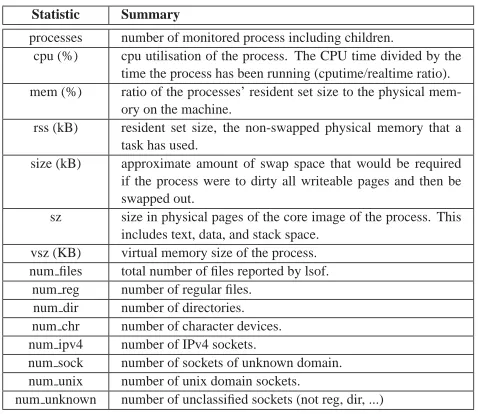
mon-itors a process and all of its child processes at regular intervals. In order to see a useful resolution in the signals, a monitoring interval of one tenth of a second is used. This method is found to be the most portable and still quite efficient, only using around 1-2% of the system CPU resources on aver-age, which is considered reasonable. The range of context signals which are thought to be potentially interesting are logged for later analysis and are sum-marised in Table 1. As well as being feasible to gather, these context signals all relate to a process’s interaction with the operating system, and other local or remote processes. Further technical details about the platform set-up are provided in Appendix B.
4.2 Normal Usage
The levels of the collected signals need to be examined over a range of dif-ferent server activities in order to establish which ones are useful for detect-ing process anomalies. Data is therefore collected over several normal usage scenarios, with the aim of getting the testbed FTP server to behave as if a
real FTP server is running on a production network. Ideally, ifstraceand
datasets of FTP client-server interactions are used to provide samples of nor-mal usage. The dataset used is a subset of LBNL-FTP-PKT [3], which con-tains all incoming anonymous FTP connections to public FTP servers at the Lawrence Berkeley National Laboratory over a ten-day period. The dataset is available from the Internet Traffic Archive [3], and its traces, which pro-vide a rich source of normal usage sessions, contain connections between 320 distinct FTP servers and 5832 distinct clients. The traces for one FTP server (IP 131.243.2.12) on the 10/01/03 and 11/01/03 are used in the experiments presented here, providing a total of 340 traces for 76 distinct clients. This particular FTP server is selected as it was runningwuftpd2.6.2-1, a similar version to the testbed server used here, and also because it has the second highest number of connections.
In all cases, FTP server activity is produced by the interaction of FTP clients, i.e. an FTP client connects to a server and initiates an FTP session in which it issues FTP requests according to the FTP protocol (defined in RFC959) before disconnecting from the server. Out of the 340 traces used, eight are empty, containing no FTP requests, and many of the other 332 are characterised by USER and PASS commands, followed by an optional STAT, then a series of PORT commands, often lasting tens of minutes, finishing with an optional QUIT. One session of each of these is included in the normal usage dataset and the others (278) are discarded so as not to bias the data.
For the testing of process anomaly detection systems, which is concerned primarily with the type of behaviour and not its frequency, only one exam-ple of a typical normal session is necessary. Duplicate sessions are therefore removed from the data, i.e. the original FTP sessions are examined, largely by hand, and sessions which contain the same commands with very similar relative timings (no more than around a second) are removed. These sessions are usually seen coming from the same hosts and appear to be generated by an automated FTP client repeating the same sessions. Indeed, analysis of the two days’ worth of traces shows that many sessions are frequently repeated. Discarding duplicates over the two days leaves 55 different normal usage ses-sions. Although some information in the traces has been anonymised using Bro [17] to remove private information, it is still possible to reproduce realis-tic normal usage.
4.3 Attack Traces
by default. It has been seen in the wild in manual attacks and automated attacks such as the Ramen worm [19]. An FTP bounce scan attack [1] is also performed; here, an attacker uses an FTP server as an intermediary to perform a network scan and hide the IP address of their machine.
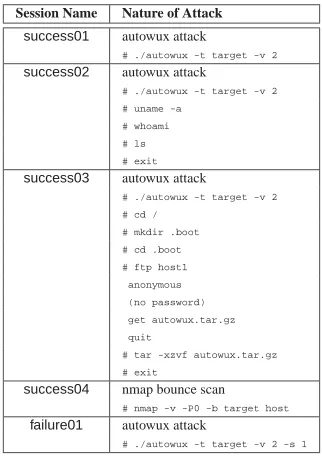
The syscalls and signal levels for several differentautowuxattacks and one nmap FTP bounce attack are recorded. In each case, the commands given on the attacking client machine are summarised in Table 2. The DNS host-name of the FTP server is “target” and “host” denotes the attacking machine.
Commands following the firstautowuxcommand are those given in the
re-mote shell once it has been opened several minutes after the launch of the
attack. The sessionsuccess01consists of theautowuxattack without any
commands executed in the remote shell, mainly for comparison with the other attacks (although this is fairly unrealistic). Sessionsuccess02and session success03simulate potential actions an attacker might perform in the shell
once it has been opened and are of more interest. Sessionsuccess02
repre-sents a minimal information gathering excerise, while in sessionsuccess03
the attacker connects back to the attacking machine via FTP and downloads and untars a file, in this case theautowuxattack itself. Sessionsuccess04 is an nmap FTP bounce attack that was successful for unprivileged ports. An
unsuccessfulautowuxattack session,failure01, is also performed by
spec-ifying the insertion of OpenBSD shellcode on theautowuxcommand line.
This is seen as important since process anomaly detection systems should not alert against failed attacks otherwise they become vulnerable to diversionary noise attacks such as snot [20], which can be used to hide successful attacks. In total these attacks generated around 40,000 syscalls, and 10,000 readings for each signal.
The combined normal and attack traces form a single dataset (called the
wuftpddataset) that can be used to evaluate the classification performance of the anomaly detection systems described here. In order to facilitate com-parisons with other systems it is publically available [4].
4.4 Signal Analysis
The strategy adopted during signal collection as described above is to collect, from the authors’ experience, what might be interesting signals. For the pur-poses of the research presented here interesting signals are those that vary in a
complex way across normal usage and attack sessions. Clearly, if a particular
Statistic Summary
processes number of monitored process including children. cpu (%) cpu utilisation of the process. The CPU time divided by the
time the process has been running (cputime/realtime ratio). mem (%) ratio of the processes’ resident set size to the physical
mem-ory on the machine.
rss (kB) resident set size, the non-swapped physical memory that a task has used.
size (kB) approximate amount of swap space that would be required if the process were to dirty all writeable pages and then be swapped out.
sz size in physical pages of the core image of the process. This includes text, data, and stack space.
vsz (KB) virtual memory size of the process. num files total number of files reported by lsof.
num reg number of regular files. num dir number of directories. num chr number of character devices. num ipv4 number of IPv4 sockets.
num sock number of sockets of unknown domain. num unix number of unix domain sockets.
[image:17.594.191.430.241.448.2]num unknown number of unclassified sockets (not reg, dir, ...)
TABLE 1
Statistics collected byprocess monitor. Fourteen context signals are collected in
Session Name Nature of Attack
success01 autowux attack
# ./autowux -t target -v 2
success02 autowux attack
# ./autowux -t target -v 2
# uname -a
# whoami
# ls
# exit
success03 autowux attack
# ./autowux -t target -v 2
# cd /
# mkdir .boot
# cd .boot
# ftp host1
anonymous
(no password)
get autowux.tar.gz
quit
# tar -xzvf autowux.tar.gz
# exit
success04 nmap bounce scan
# nmap -v -P0 -b target host
failure01 autowux attack
[image:18.594.233.394.225.453.2]# ./autowux -t target -v 2 -s 1
TABLE 2
The five attack sessions collected forwuftpdrunning on an instrumented Redhat 6.2
signals are expected nor have been found. In order to determine which of the collected signals are potentially interesting an analysis of the gathered data is performed.
When examining the signal levels for all 55 normal usage sessions more closely it becomes clear that the memory related signals are closely corre-lated, as are a number of the file signals. Closer examination of these two groups leads to the elimination of several of the correlated signals. For ex-ample, thesizeandszsignals always report the same values. Also, several of the signals have the same small number of levels in general regardless of whether the session is an attack or normal usage, and so these signals are also eliminated. The range of values a signal takes over all the normal and attack sessions can be seen from the scatter plots shown in Figure 2. The upper graph in shows the observed signal levels for the number of process children, which is considered uninteresting due to its lack of variation over normal and attack sessions. The lower graph in Figure 2 shows the observed levels for therssmemory signal, which is considered interesting since there is consid-erable variation in signal levels between normal and attack sessions, although there is no clear division of levels and crossover exists between signal levels. A similar plot for all the remaining signals shows that there is also
consid-erable variation in thenum filesandnum regsignals. These two signals
together withrssare used as the context (danger) signals in the experiments that follow.
5 EXPERIMENTAL PROCEDURES
An important aspect of second generation AISs is their use of multiple sources of input data. This idea has also been advocated by Gao et al. [8] through the notion of gray-boxing. In order to explore these ideas further, three different
versions of thetlralgorithm are evaluated, namedtlr1,tlr2andtlr3.
For all three of these algorithms, the syscall number alone is used as antigen.
Fortlr1, therss context signal is used as the danger signal, and
imma-ture DCs have a TLR that monitors this signal and is activated by values not
seen during training. Fortlr2, immature DCs have two TLRs, one that
re-sponds to thersscontext signal, and another that is activated by values of the
num filescontext signal not seen during training. If either of these recep-tors is activated, then the immature DC will develop into a mature DC. For
tlr3, immature DCs have three TLRs, one for thersscontext signal, one
num_chld signal levels
seconds
0 50 100 150 200 250
level
1 2 3
success.001 success.002 success.003 success.004 failure.001 benign
rss signal levels
seconds
0 50 100 150 200 250
level
500 1000 1500 2000 2500 3000
[image:20.594.210.422.125.513.2]success.001 success.002 success.003 success.004 failure.001 benign
FIGURE 2
into a mature DC. Hence, the effects of the addition of input data sources can
be assessed by comparing the performances oftlr1,tlr2andtlr3.
The use ofprocess monitor andstrace imposes minimal CPU and
memory overheads on the system when gathering data. Timings of syscalls during a single session are preserved and readings of resource usage statistics are taken at regular intervals. One limitation of the dataset is that, when stored astcreplaylog files, the overall timings of these sessions relative to each other are not stored. Consequently, when testing AISs with this dataset, an assumption has to be made concerning the relative timings of each session. In the experiments that follow sessions are assumed to occur sequentially, with a short, uniformly-distributed period of no activity between sessions.
The dynamics of thetlralgorithm for a particular FTP session are in part determined by previous FTP sessions. For example, syscalls which are not available during training but which are presented in a normal context dur-ing operation, as discussed above, lead to a reduction in the number of TCs specific for such syscalls through peripheral tolerance. Hence, usingtlrto classify FTP sessions in isolation could produce unrealistic results. A num-ber of scenarios are therefore created, consisting of a numnum-ber of FTP sessions occurring sequentially with a random pause of 1 to 10 seconds between them. This is a simplification of the session timings observed for the actual FTP sessions in the LBNL-FTP-PKT traces, but is necessary in order to reduce the durations of the experiments. (In the LBNL-FTP-PKT traces there are often several minutes between one session and the next, and at other times two sessions overlap.) Here, each scenario takes approximately 50 minutes to run.
Forty scenarios are generated in total, with 20 containing only normal FTP sessions and the remaining 20 containing normal and attack FTP sessions. The latter group should hence be classified as attack sessions. In order to create a scenario the 55 normal sessions are partitoned into two sets of 27 and 28 sessions. One set is used to traintlr, and the other set is used to
create the scenario on whichtlris tested. The two sets are then swapped
around, so that the sessions in the testing scenario are used to traintlr, and vice versa for the training sessions. In other words, two-fold crossvalidation is performed. The sets are randomly partitioned in this way eight times so that sixteen normal scenarios are generated. The attack sessions are produced in exactly the same way except that an attack session is inserted at a random
point in the sequence of normal sessions. Thesuccess.001andsuccess.002
sessions are used six times each, and thesuccess.003andsuccess.004
normal scenarios are also created as just described by inserting the failed at-tack session at a random point in a sequence of normal sessions. Together with the 16 normal scenarios already generated, this makes a total of 20 nor-mal scenarios.
In order to provide a comparison with the results for thetlralgorithm, several other classifiers are also tested with each of the 40 scenarios. First, as a baseline comparison, a classifier that uses a whitelist of acceptable syscalls is used. A syscall policy is generated for a process by recording the syscalls it makes under normal usage, with a permit policy statement entered for all these syscalls. During testing, syscalls are compared to this whitelist and any process that generates unlisted syscalls is classified as under attack. The
method is quite realistic considering how current systems such assystrace
automatically generate a policy.
The whitelist approach is also taken using the signal valuesrss,num files
andnum reginstead of the syscalls. This generates three simple classifiers, calledsig1,sig2andsig3, which extract all the signal levels seen during training. These systems classify a scenario as an attack if any signal levels absent from the whitelist are seen during testing. Systemsig1 classifies a scenario as an attack based only on thersssignal, systemsig2uses this and thenum filessignal, and systemsig3uses all three signals.
Thetlralgorithm is also compared to a standard negative selection AIS
approach, since for a finite set, asystrace whitelist approach and
nega-tive selection blacklist approach are logically equivalent and are therefore ex-pected to perform similarly. In order to implement a negative selection algo-rithm, a slightly altered version oftlr(calledtlr-negsel) is created with
the TLRs on immature DCs disabled. Intlr-negselimmature DCs are no
longer able to respond to signals and hence always differentiate into semima-ture DCs and never become masemima-ture DCs. Consequently, naive TCs are never activated and no alerts are ever produced, since these are generated whenever
activated TCs are observed. Therefore, intlr-negselsemimature DCs are
forced to express IL-12, effectively turning them into mature DCs, which
permits their activation. The absence of semimature DCs in tlr-negsel
means that no peripheral tolerance of naive TCs by semimature DCs occurs. The only criteria for activation of native TCs is a match between their AgRs and the syscalls being presented by DCs. By disabling peripheral tolerance, negative selection alone (which is used to generate the AgRs) controls the
classification performance oftlr-negsel.
Finally, the performance of the DCA with the wuftpd dataset has also
comparison to thetlralgorithm. This is both fair and convenient since both
the DCA and thetlr algorithm use thelibtissueframework and make
use of the same information in order to process the data. As with thetlr
algorithm, the DCA uses system call ID numbers to represent antigen and the context signalsrss,num filesandnum regto represent the danger signals.
6 RESULTS
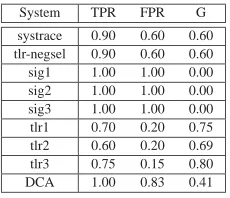
The true and false positive rates for each of the classifiers are given in Table 3 below. The true positive rate TPR is calculated from:
T P R= T P
T P +F N, (1)
where TP is the number of true positives and FN is the number of false nega-tives. Likewise, the false positive rate FPR is calculated from:
F P R=F PF P+T N, (2)
where FP is the number of false positives and TN is the number of true nega-tives. The table also shows the g-mean G given by:
G=T P R(1−F P R), (3)
which provides an overall evaluation of the TPR and FPR, producing a high value for better classifiers. Note that an equal cost for true and false positives is assumed here. However, in situations where one of these costs is more important than the other, further analysis would be necessary to characterise the relative performance of the classifiers.
Table 3 shows that thesig1,sig2 andsig3classifiers perform badly,
classifying every scenario as an attack. Consequently, the systems are of no
use and this is reflected in the g-mean value of 0.00. Thesystraceand
negative selection classifiers perform equally, with a high TPR of 0.90, but also a high FPR of 0.60, meaning that while these classifiers identify 90% of attack scenarios correctly, they also identify 60% of normal scenarios as
attacks. The g-mean for both of these systems is 0.60. In general, thetlr
classifiers reduce the FPR with an accompanying small reduction in the TPR.
Compared with thesystraceand negative selection classifiers, the tlr1
System TPR FPR G
[image:24.594.257.372.123.222.2]systrace 0.90 0.60 0.60 tlr-negsel 0.90 0.60 0.60 sig1 1.00 1.00 0.00 sig2 1.00 1.00 0.00 sig3 1.00 1.00 0.00 tlr1 0.70 0.20 0.75 tlr2 0.60 0.20 0.69 tlr3 0.75 0.15 0.80 DCA 1.00 0.83 0.41
TABLE 3
Classification performance results for the systems implemented. For equal true and false positive costs,tlr3is the best performing classifier.
gives a g-mean value of 0.69. Thetlr3classifier performs best reducing the
FPR by 45% to 0.15, while only reducing TPR by 15% to 0.75. Its resulting g-mean value is 0.80, the highest of all the systems tested. The DCA has a
perfect TPR of 1.00 i.e. all attack scenarios are correctly classified, but the
FPR is unacceptably high (0.83), which produces a low g-mean value of 0.41.
Thetlralgorithm, which is unoptimised, uses around 10% of the CPU
re-sources and never more than 8% of the memory rere-sources on the test machine. Generally, CPU usage is only a few percent as cell levels are maintained at a low level during normal usage.
6.1 Discussion
The results have provided evidence that the additional context signalsrss,
num filesandnum reg have the capacity to reduce the false positive rate
when used as danger signals in the immune-inspiredtlralgorithm. In
ad-dition, the system performs best when all three of these signals are used in conjunction with the syscall information. However, when the the syscall in-formation is removed (in the case ofsig1,sig2, andsig3) and the system is run as a white-list classifier, the IDS is unable to function. This strongly suggests that both types of information source have an important role to play in process anomaly detection.
significant decrease in the classification performance. Based on these obser-vations, Stibor concludes that negative approaches such as immune-inspired negative selection are unsuitable for real-world anomaly detection problems. Perhaps it would be more correct to say that detection systems based only on negative selection are unsuitable in this context. Used in combination with innate-inspired mechanisms results could be much improved, as demon-strated here.
Thesystraceand negative selection basedtlr-negselclassifiers give the same classification results in terms of true and false positives. Exami-nation of the results for each scenario shows that both systems also classify exactly the same scenarios as normal and anomalous. This is expected and is a good test for determining the completeness of coverage for the negative
selection algorithm. As mentioned previously, thesystracewhitelist
ap-proach and negative selection blacklist apap-proach are in principle equivalent for a finite set of antigen. This is because a blacklist is the complement set of a whitelist, so determining whether an antigen is on the whitelist or not on the blacklist are the same. However, the way negative selection algorithms usually generate a blacklist is stochastic as a dynamically changing set of cells is used. Furthermore, antigen are matched to the blacklist by random encounters between TCs and antigen, so there may be some errors. When implementing the negative selection classifier here, the aim is to reduce these errors as much as possible, otherwise they might influence true and false pos-itive rates. The parameters are hence selected to create a high turnover of naive TCs, which allows them to inspect many semimature and mature DCs and the antigen they present.
Thetlralgorithm also performs much better than the DCA with regard
to the false positive rate. In [10] the chief limitation of the DCA with the
wuftpddataset is cited as a requirement for much larger volumes of anti-gen data, which is connected with the stochastic nature of the DCA’s antianti-gen sampling process. Also, the DCA is a much finer-grained system, classify-ing data on a per process basis. This means that, theoretically, the process responsible for the anomalous behaviour can be determined. However, the
wuftpddataset does not provide the names of the processes so there is no way in which this information can be utilized to the DCA’s advantage.
7 CONCLUSIONS
adaptive biological immune systems, in particular the interactions between two classes of immune cell, DCs and TCs. The performance of the system has been evaluated on a realistic process anomaly detection problem and com-pared to those of several other classifiers. It was found that the use of the
in-nate immune system mechanisms employed intlrcontributed to a decrease
in the false positive rate and produced a better overall performance compared to policy-based methods, negative selection approaches, and an alternative DC-based AIS system (the DCA). The paper has also shown how runtime information such as memory and file usage levels can be used in combination with system call information to enhance detection capability. This suggests that such context signals might prove useful in improving the detection capa-bilities of other IDSs. Indeed, this work has employed novel context signals with a novel algorithm, so it could be the case that more well-established
algorithms might perform as well as or better thantlrusing these context
signals. Further research is needed to implement and test such algorithms, although it is unclear how many traditional approaches would combine the multiple data sources which is one of the hallmarks of this work. More so-phisticated algorithms such as support vector machines or techniques from multisensor data fusion would seem more applicable in this sense.
The generation of thewuftpddataset showed that the collection and usage of runtime statistics as sources of external signals for second generation AISs is possible. Additionally, the use of publically-available datasets to generate thewuftpddataset proved to be an effective methodology. Using part of the LBNL-FTP-PKT data, as well as data from other repositories, this technique could be employed to create a larger database of context signals, which would aid research into the use of these signals as input data for IDSs.
In this work, failed attack sessions are classed as normal, but it may be argued that it is useful and necessary for failed attacks to be registered in order to alert an administrator of suspicious activity. Future work could therefore extend the IDS described here to include a third failed attack class rather than just the normal or abnormal data categories.
Finally, the implementation of thetlr and the other second generation
AISs more generally showed the feasibility of using libtissueto
imple-ment AISs as multiagent systems, and of applying them to real-world prob-lems.
ACKNOWLEDGMENTS
REFERENCES
[1] (1995). The FTP Bounce Attack. Bugtraq: http://seclists.org/bugtraq/ 1995/Jul/0046.html.
[2] (2000). CERT Advisory CA-2000-13 Two Input Validation Problems In FTPD. http: //www.cert.org/advisories/CA-2000-13.html.
[3] (2003). LBNL-FTP-PKT dataset.http://www-nrg.ee.lbl.gov/LBNL-FTP-PKT. html.
[4] (2007). libtissue sourcecode and datasets.http://cs.nott.ac.uk/˜jpt. [5] Uwe Aickelin, Julie Greensmith, and Jamie Twycross. (2004). Immune System
Ap-proaches to Intrusion Detection - A Review. In Proc. of the 3rd International Conference
on Artificial Immune Systems, pages 316–329, Catania, Italy. LNCS 3239.
[6] L. N. de Castro and J. Timmis. (2002). Artificial Immune Systems: A New Computational
Intelligence Approach. Springer.
[7] Stephanie Forrest, Steven Hofmeyr, and Anil Somayaji. (1997). Computer immunology.
Communications of the ACM, 40(10):88–96.
[8] Debin Gao, Michael K. Reiter, and Dawn Song. (August 2004). On Gray-Box Program Tracking for Anomaly Detection. In Proc. of the 13th USENIX Security Symposium, pages 103–118, San Diego, CA.
[9] R. N. Germain. (2004). An innately interesting decade of research in immunology. Nature
Medicine, 10(12):1307–1320.
[10] Julie Greensmith. (2007). The Dendritic Cell Algorithm. PhD thesis, School of Computer Science, University of Nottingham.
[11] Julie Greensmith, Uwe Aickelin, and Jamie Twycross. (2006). Articulation and Clarifi-cation of the Dendritic Cell Algorithm. In Proc. of the 5th International Conference on
Artificial Immune Systems, pages 404–417, Oeiras, Portugal. LNCS 4163.
[12] Julie Greensmith, Jamie Twycross, and Uwe Aickelin. (2006). Dendritic Cells for Anomaly Detection. In Proc. of the IEEE World Congress on Computational Intelligence, pages 664–671, Vancouver, Canada.
[13] Emma Hart and Jonathan Timmis. (2005). Application Areas of AIS: The Past, The Present and The Future. In Proc. of the 4th International Conference on Artificial Immune
Systems, pages 483–497, Banff, Canada. LNCS 3627.
[14] Steven Hofmeyr and Stephanie Forrest. (1998). Intrusion Detection using Sequences of System Calls. Journal of Computer Security, 6(3):151–180.
[15] A. Iwasaki and R. Medzhitov. (2004). Toll-like receptor control of the adaptive immune response. Nature Immunology, 5(10):987–995.
[16] M. L. Kapsenberg. (2003). Dendritic-cell control of pathogen-driven T-cell polarization.
Nature Reviews in Immunology, 3:984–993.
[17] Ruoming Pang and Vern Paxson. (2003). A High-level Programming Environment for Packet Trace Anonymization and Transformation. In Proc. of ACM SIGCOMM. [18] N. Provos. (August 2003). Improving Host Security with System Call Policies. In Proc.
of the 12th USENIX Security Symposium, pages 257–272, Washington, D.C.
[19] SANS Global Incident Analysis Center, (2001). Ramen Worm. http://www.sans. org/y2k/ramen.htm.
[21] Anil Somayaji. (2002). Operating System Stability and Security Through Process
Home-ostasis. PhD thesis, University Of New Mexico.
[22] Thomas Stibor. (2006). On the Appropriateness of Negative Selection for Anomaly
Detec-tion and Network Intrusion DetecDetec-tion. PhD thesis, Darmstadt University of Technology.
[23] Jamie Twycross. (2007). Integrated Innate and Adaptive Artificial Immune Systems
Ap-plied to Process Anomaly Detection. PhD thesis, School of Computer Science, University
of Nottingham, U.K.
[24] Jamie Twycross. (2007). Integrated Innate and Adaptive Artificial Immune Systems
Ap-plied to Process Anomaly Detection. PhD thesis, School of Computer Science, University
of Nottingham.
[25] Jamie Twycross and Uwe Aickelin. (2005). Towards a Conceptual Framework for Innate Immunity. In Proc. of the 4th International Conference on Artificial Immune Systems, pages 112–125, Banff, Canada. LNCS 3627.
[26] Jamie Twycross and Uwe Aickelin. (2006). libtissue - Implementing Innate Immunity. In Proc. of the IEEE World Congress on Computational Intelligence, pages 499–506, Van-couver, Canada.
A LIBTISSUE PARAMETER SETTINGS
Thelibtissueparameter values used fortlrare shown in Table 4.
B PLATFORM TECHNICAL DETAILS
A Redhat 6.2 ISO image is downloaded from an official Redhat mirror and used to install a vanilla server as a VMware guest on the testbed. The default
wuftpd FTP server package (2.6.0-3) is replaced with a separately
down-loadedwuftpd2.6.0-1 RPM. This is necessary as although thewuftpd
pack-age in the original Redhat 6.2 distribution has the SITE EXEC vulnerabil-ity, Redhat replaced this distribution with a “respin” (read “second edition”) which contains a patchedwuftpd2.6.0-3. Once installed, the default config-uration ofwuftpdis slightly modified to make it vulnerable.
In the default installation,wuftpdis started at boot time wrapped by the inetd super-server. This makes monitoring more complex as in this configu-ration the FTP server is only started once a connection has been established through inetd. However, monitoring is technically easier when a process is running continuously. Therefore, the FTP server is disabled in inetd by com-menting out the appropriate FTP service entries in /etc/inetd.conf. An init script is written to start the FTP server as a standalone server, running con-tinuously, at boot time. In order to gather the actual data, i.e. process syscall information and context signals, the target system is instrumented: the FTP
server executable is wrapped withstrace[18], which logs all the syscalls
Parameter Name Value Description
max antigen 1000 maximum number of stored antigen max cytokines 3 maximum number of stored signals
max cells 10000 maximum number of cells cell update rate(µsecs) 100000 rate at which cells are updated
antigen multiplier 10 number of copies of each antigen stored num cells1 100 number of immature DCs
cell lifespan1 100 number of iterations an immature DC lives for num antigen1 100 maximum number of antigen stored by an immature DC num antigen receptors1 10 number of antigen an immature DC can store num antigen producers1 100 number of antigen an immature DC can produce num cytokine receptors1 3 number of signals an immature DC can respond to antigen producer action time 10 number of iterations an immature DC presents antigen for
num cells2 100 number of naive TCs
cell lifespan2 10 number of iterations a naive TC lives for num cell receptors2 1000 number of DCs a TC can bind with per iteration
[image:29.594.157.472.244.445.2]num vr receptors2 100 number of antigen a TC can match per iteration cell lifespan3 100 number of iterations a semimature DC lives for cell lifespan4 100 number of iterations a mature DC lives for cell lifespan5 100 number of iterations an activated TC lives for probe rate(µsecs) 1000000 rate at which cell population levels are sampled
TABLE 4