R E V I E W
Extended spider cognition
Hilton F. Japyassu´1,2 •Kevin N. Laland2
Received: 22 April 2016 / Revised: 20 December 2016 / Accepted: 1 January 2017
TheAuthor(s) 2017. This article is published with open access at Springerlink.com
Abstract There is a tension between the conception of cognition as a central nervous system (CNS) process and a view of cognition as extending towards the body or the contiguous environment. The centralised conception requires large or complex nervous systems to cope with complex environments. Conversely, the extended concep-tion involves the outsourcing of informaconcep-tion processing to the body or environment, thus making fewer demands on the processing power of the CNS. The evolution of extended cognition should be particularly favoured among small, generalist predators such as spiders, and here, we review the literature to evaluate the fit of empirical data with these contrasting models of cognition. Spiders do not seem to be cognitively limited, displaying a large diversity of learning processes, from habituation to contextual learning, including a sense of numerosity. To tease apart the central from the extended cognition, we apply the mutual manipulability criterion, testing the existence of reciprocal causal links between the putative elements of the system. We conclude that the web threads and configura-tions are integral parts of the cognitive systems. The extension of cognition to the web helps to explain some puzzling features of spider behaviour and seems to promote evolvability within the group, enhancing innovation through cognitive connectivity to variable habitat features.
Graded changes in relative brain size could also be explained by outsourcing information processing to envi-ronmental features. More generally, niche-constructed structures emerge as prime candidates for extending animal cognition, generating the selective pressures that help to shape the evolving cognitive system.
Keywords Extended cognitionModular cognition Web building EvolvabilityNiche construction
Boundaries of cognition
The field of animal cognition is subject to several contro-versies, perhaps the most obvious of which is the tension between a conception of cognition as operating like a general purpose problem-solving device and the view that cognition is more reliant on functionally dedicated, spe-cialised neural modules. The former position remains influential within experimental psychology, while the latter is prevalent among evolutionary biologists, behavioural ecologists and evolutionary psychologists (Laland and Brown2011; Sanderson 2014), although a range of inter-mediate positions are tenable. What these stances have in common, however, is the premise that, excluding some aspects of perception, cognition primarily occurs within the boundaries of the central nervous system (CNS). A further controversy, potentially even more fundamental than the aforementioned one, takes issue with this premise by extending the seat of cognition into the external environ-ment, either through an extended (Wilson2008) or enacted (Thompson2010) cognition thesis, or through a dynamical systems approach (Shanker and King2002).
Resolution of these tensions requires accurate accounts of alternative conceptions of cognition and their
& Hilton F. Japyassu´ [email protected]
1 Biology Institute, Federal University of Bahia,
Rua Bara˜o de Jeremoabo s/n, Campus de Ondina, Salvador, Bahia 40170-115, Brazil
2 Centre for Biodiversity, School of Biology, University
of St Andrews, Harold Mitchell Building, St Andrews, Fife, UK KY16 9TH
contrasting predictions, together with clear-cut criteria for deciding between them (Kaplan2012). It is not in the scope of this paper to discuss a definition of cognition in itself, although the findings we present clearly have implications for such a definition. Instead, we embrace a broad and prevalent definition of cognition as the acquisition, pro-cessing, storage and use of information (Shettleworth 2010). In doing so, we focus on contrasting the conceptions of cognition that confine cognition to the CNS (which we refer to as the ‘central cognition’ hypothesis—Fodor1983; Barkow et al.1995), and those that extend it to the body or its contiguous environment (the ‘extended cognition’ hypothesis), using the cognition of spiders as a model system.
The central cognition hypothesis is being challenged from various perspectives (Noe¨2004; Churchland2007). It is clear, for example, that humans extend their information processing power through computers and a variety of so-called intelligent gadgets, but many other animals use tools, some of which may potentially function as infor-mation processing devices (Biro et al. 2013). It remains possible that some animal-constructed devices will also help the constructor to perform cognitively challenging tasks. We make no distinction here between the various ways that animals could extend their cognition out of the brain, nor are we defending one of these particular ways of extending cognition. While we acknowledge that differ-ences exist between the embodied (Varela et al.1992), the extended (Clark and Chalmers 1998), and the enactive (Thompson2010) views of cognition, here we concentrate on the general similarity between them: that is, we focus on the general idea that somehow cognition also operates outside the bounds of the brain, and accordingly we refer to all variants of these views as extending cognition.
The central and extended cognition hypotheses lead to fairly general contrasting predictions. Ashby’s (1960) ‘Law of Requisite Variety’ specifies that, if it is to be stable, the number of states of the control mechanism of a system (e.g., the variant states available to an organism) must be greater than or equal to the number of states in the system being controlled (e.g., the variant environmental states with which the organism must cope). It follows that organisms that experience more complex environments require more complex behaviour. Hence, from a central cognition per-spective, individuals inhabiting more challenging envi-ronments, for instance with unpredictable fluctuations in resources, should possess larger or more complex brains than those in less complex environments (Shumway2008). This prediction follows from the assumption that neural complexity or processing power underlies behavioural complexity, and that the requirement to solve challenging environmental problems in order to survive and reproduce selects for a rich neural architecture in the CNS capable of
delivering behavioural flexibility. As an illustration of this reasoning, the ‘social brain hypothesis’ states that living in groups is cognitively demanding, because the complexities of social interactions impose a burden on cognitive pro-cessing (Dunbar 1998; Dunbar and Shultz 2007), for instance, requiring individuals to remember and contextu-alise diverse relationships, which is known to be critical for effective social interaction.1Accordingly, living in larger groups is associated with increases in grey matter in mid-superior temporal sulcus and rostral prefrontal cortex in Macaques (Sallet et al.2011). In general, the social brain hypothesis has found wide acceptance, notwithstanding criticisms concerning, for example, the difficulties it faces in accommodating non-modular aspects of intelligence (Reader et al.2011) and in explaining graded changes in relative brain size (van Schaik et al. 2012).
Conversely, the extended cognition perspective antici-pates a less clear-cut relationship between environmental complexity and brain size. That is because this position does not conceptualise cognition as exclusively grounded in the central nervous system, but instead regards cognition as a more or less distributed process that extends from the brain to the body and/or the surrounding environment. Extended cognition hence replaces aspects of central pro-cessing with more peripheral propro-cessing units.
Another important distinction between central and extended cognition relates to their informational require-ments. The central cognition conception specifies that specific biological (internal) information is required to process task-specific (environmental) information, and hence that the centralised neural mechanisms, whether they be general or modular, must be sufficiently informed with task-relevant biological information to solve the tasks faced by the organism. In other words, the neural mecha-nisms must possess or draw on large quantities of biolog-ical information2in order to function effectively; they are expected to be informationally greedy. Such biological information concerns or relates to properties of the task, and/or aspects of the world, and hence has a referential property. The most clear-cut examples here would involve communication with signs, whereby a behaviour (a
1 Since individual recognition is not necessary for social life, this line
of reasoning does not apply to all social species. Invertebrates, for example, have not been fully investigated in this respect, presenting mixed evidence for either class recognition, kin recognition or familiar recognition, but never for the full set of properties defining true individual recognition (Gherardi et al.2012).
2 ‘‘Information’’ is a difficult concept with multiple meanings. At
vocalisation, a vibratory pattern) explicitly conveys to others information concerning an object or an event in the external world. Thus, the central cognition hypothesis endorses a representational stance to cognition, in which the external world is, in some way, mimicked or captured isomorphically within the nervous system (Gallistel1989), for instance, as symbolic representations. Effective beha-viour is thought to arise through the individual manipu-lating these representations, for example, planning future behaviour, prior to performing motor actions. The central cognition conception is informationally greedy because the brain either already possesses (i.e., in a nativist account) or through experience constructs (i.e., in an empiricist account) internal models of the external world. In contrast, extended approaches to cognition are either not represen-tational, or at least require fewer representations, in their conception, and thus are less demanding in terms of the informational requirements of the brain. On this view, informational content is offloaded to the body, or to aspects of the world (Shapiro2010; Pfeifer et al.2014; Cappuccio 2016).
Two further points are important here. First, at least in natural systems, information is a fundamentally relational property that pertains to particular organisms, and only exists to the extent that a communication channel is operating that allows the organism to read or extract it. Information cannot exist solely in the external environ-ment. Second, while the notion of extended cognition inherently implies a trade-off between information stored in the brain and information distributed beyond it, any such trade-off operates within a species and not necessarily between species. Although it is hard to quantify, we envisage that different species of organisms will vary in the gross quantity of acquired semantic information that they possess, and hence that there is no reason to expect that large-brained organisms will not exhibit extended cogni-tion: to the contrary, humans would seem a prime example. The idea that cognition extends towards the body, artefacts or the nearby environment holds similarities with the idea of ‘extended phenotypes’, adaptations expressed outside of the organism that constructed them (Dawkins 1999). However, while both concepts deal with artefacts and modified environments, any similarities are superficial. Dawkins characterises all phenotypes, be they extended or not, as the expression of information perceived to be encoded in genes; in this respect, his position is consistent with internalist models of cognition, since the ‘controlling’ information is thought to reside inside the organism. Internalist models are at odds with a view of information as a relational concept, a view that implies that the relevant information emerges only within a system that includes the interaction between the components that constitute the system (among which some external devices could be
included). The relational or systemic view of information is embraced by the extended cognition approaches in its embodied, extended, and particularly in its enactivist ver-sions. Extended cognition is more akin to the niche con-struction perspective (Odling-Smee et al.2003), because it implies reciprocal causation between the organism and the artefact, or modified environment (Laland 2004). In this way, despite the superficial similarities between the extended cognition and the extended phenotype approa-ches, they are in opposition when it comes to some of their core assumptions.
Brains are energetically costly organs and, from the allometry between brain and body size (Haller’s rule, Striedter2005), it follows that the maintenance costs of a large brain, demanded by the central cognition approach, is a particular challenge for tiny animals. These costs mean that smaller animals face more severe trade-offs between energy demands and information processing in their ner-vous systems (Niven and Farris 2012). Thus, allometry implies that the cost of the brain is proportionally higher for smaller animals, if their small body size is taken into consideration. In other words, it should be harder for smaller than larger animals to maintain energetically costly large brains, but (from the central cognition perspective) reducing brain size potentially leads to a reduced cognitive capacity, and errors in information gathering and process-ing. Consistent with this reasoning, smaller-brained fishes suffer stronger predation pressure and exhibit reductions in learning and gathering of information about predators (van der Bijl et al. 2015; Kotrschal et al. 2013,2015), and are restricted to live in less complex habitats (Huber et al. 1997), compared to larger-brained fishes. This trade-off should be particularly strong for predators, because predators tend to be large and mobile so as to track diverse, changeable and spatially distinct prey distributions, and thus require the information processing capability to detect and respond to changes in these distributions (Edmunds et al.2016a). Consistent with this, in mammals, carnivores have larger brains relative to body size than ungulates (Jerison 1973), and a higher trophic position is connected to larger brains in teleost fishes (Edmunds et al.2016b). A generalist foraging strategy would also require enhanced information processing capabilities,3 because (as Ashby’s Law dictates) a wide niche requires a large number of skills to cope with the diversity of resources, predators, parasites, or competitors, while a narrow niche would impinge less stress over the information processing system. Accord-ingly, combinations of neural limitations are associated
with reduced diet breadth in many unrelated insect taxa (Bernays2001).
These considerations lead us to expect, other things being equal, that predators, of a relatively small size, with generalist habits, are prime candidates for extended cog-nition, because they should be under particularly strong selection to reduce their relative brain size but maintain their behavioural richness, and one means by which this could be achieved is through offloading brain processing to the body or to the environment. Spiders, as small, gener-alist predators (Peka´r and Toft 2015), have all the above reasons for living in an informationally overloaded world. These considerations do not mean that other organisms do not extend cognition, but nonetheless do potentially leave this particular order of arthropods of central interest to debates over extended cognition.
The above considerations lead us to expect that natural selection will have favoured cognitive strategies in spiders that allow them to deal with a relatively large amount of information processing without paying the costs of exceptionally large brains, including through extended cognition. Spiders are also interesting because they show taxonomically widespread niche-constructing abilities, using silk for many functions (Krafft and Cookson 2012; Eberhard2014), most notably in egg sacs and webs. Spi-ders’ webs are diverse in form, encompassing orbs, cobs, sheets, irregular, and even single-line webs, all of them structures with a long evolutionary history (Hormiga and Griswold2014). These silk structures have been postulated to act as an extension of the perceptual organs of the spi-ders, enhancing sensitivity through amplification or atten-uation of particular vibrations, and allowing them to detect movements of the substrate some distance away (Naftilan 1999; Masters 1984). The hypothesis of the web as an extended perceptual system, the expectation that web characteristics will have coevolved with spider perceptual systems, and the extensive means by which spiders control and regulate their local environment, most obviously through the use of silk, all combine to leave spiders prime model organisms for extended cognition.
In this paper we first provide a brief overview of the literature on spider cognition, concentrating on new find-ings and domains relevant to the challenge of distinguish-ing between the central and the extended conceptions of cognition (see Herberstein2011; Jackson and Cross 2011 or Hesselberg 2015 for more extensive reviews). Differ-entiating between these alternative accounts of cognition has historically proven rather difficult (Adams and Aizawa 2001; Shapiro2010). For this reason, we go on to discuss the ‘mutual manipulability criterion’ (which specifies that two entities that can reciprocally alter the state of each other pertain to one-and-the-same system), a straightfor-ward criterion recently developed explicitly to evaluate
claims of extended cognition (Kaplan 2012). Finally, we consider three cases where the mutual manipulability cri-terion can be deployed alongside empirical evidence con-cerning spider cognition, and in this manner discuss the support that the experimental data provide to the central and extended models of cognition.
Spider cognition: what is new?
Nowadays, spiders are far removed from their old depiction as hardwired, instinct-driven animals with few learning capabilities. As this brief section will show, spiders behave as if planning routes in advance, show a sense of numerosity, learn conditional tactics of aggressive mimi-cry, reverse previous learned associations, and adjust their behaviour to altered conditions in a variety of ways. Indeed, the growing literature on spider cognition has even prompted the creation of an immersive virtual reality sys-tem for spiders (Peckmezian and Taylor 2015a), turning them into model organisms for research on learning (Peckmezian and Taylor 2015b).
Route planning
Araneophagic jumping spiders (Portia fimbriata), while foraging on orb weavers, watch the motionless prey from a distance, before engaging in a circuitous path, which often involves losing sight of the spider’s prey, so as to appear near the top of the orb-web. From this position, the jumping spider hangs down from a line until she is able to grab the prey in the centre of its web (Jackson and Cross 2011). This route-planning ability has been experimentally demonstrated (Tarsitano and Jackson 1997; Tarsitano 2006) and involves the categorisation of prey types, com-bined with the specialised use of working memory (Cross and Jackson2014).
Learning
2013), and to change web properties as a function of pre-vious prey catches (Nakata2012; Heiling and Herberstein 1999).
If walking onto an orb-web, araneophagic jumping spiders can learn to use alternative vibratory signals of aggressive mimicry, conditional on the size of the prey. Small, easy to catch, orb weavers are stimulated, through the jumping spider’s vibratory signals, to perform a full attack on a fictitious prey item ensnared in the web. Con-versely, more dangerous, larger orb weavers are attracted to the periphery of the orb through alternative vibratory signals that do not stimulate a full attack by the resident spider (Tarsitano et al. 2000). The jumping spiders have been shown to learn to produce the deceptive vibratory signal by trial and error (Jackson and Nelson2011). That jumping spiders can learn this is not surprising, considering that they can learn associations between vibration and other stimuli (Long et al. 2015) and can reverse previously learned associations between stimuli (Liedtke and Schnei-der2014).
Jumping spiders are also able to generalise problem-solving strategies and apply these to new cognitive domains (Cross and Jackson2015). This ability to perform cross-context generalisations could provide the basis of some findings reporting a sense of numerosity among jumping spiders (Nelson and Jackson2012). The abstrac-tion needed to generalise between contexts and cognitive domains could be at the base of the abstraction needed for having a sense of numerosity, one that has also been found among web-building spiders (Rodrı´guez et al.2015). While jumping spiders do not build webs, they do use silk in a variety of ways, including hunting and kleptoparasitism on other spiders’ webs, as a tether to reach otherwise inac-cessible prey, for navigation, and reproduction. Hence, they remain candidates for extended cognition.
Cognition and performance in small animals
One way to reduce informational demands would be to reduce the computational power of the nervous system, at the cost of performance. Animals with reduced size would show fewer and smaller neurons (Niven and Farris2012), reducing the resolution of sensory systems and the control over motor systems (Chittka and Niven2009). Neverthe-less, the cognitive feats of spiders (reviewed in Herberstein 2011, and Jackson and Cross 2011) do not consistently suggest any clear reduction in performance with reduced body size. For example adult orb-weaving spiders vary in body mass by 400,000 times (including those near the lower size limit for spiders in general), yet there is no evidence of inferior performance due to very small sizes (Eberhard and Wcislo2011,2012). Even the tiniest spiders have much smaller spiderlings that are seemingly as
proficient at orb weaving as their adult mothers, when it comes to the precision of performance (Eberhard 2007,2011). This lack of clear constraints in behavioural performance due to miniaturisation raises the possibility of the occurrence of qualitatively distinct ways to deal with information processing in miniature animals.
The mutual manipulability criterion
Other criteria have been proposed to demarcate the boundaries of cognition, such as the ‘proprietary demar-cation criteria’4or the ‘bandwidth criterion’.5Nevertheless, the MM criterion outperforms these criteria, because it is better able to distinguish causally relevant components of cognition from background conditions, lower-level corre-lates, and/or causally inert connections (see below), which constitutes the sole criteria for empirical tests of hypothe-ses concerning extended cognition (Kaplan2012).
The proper use of MM circumvents two major criticisms of extended cognition: the ‘coupling-constitution fallacy’ (Adams and Aizawa 2001, 2010), which is the argument that the coupling of an element to a system does not imply that this element is constitutively relevant to the system, and the concern that cognition will be extended to objects only indirectly and distantly connected to the cognitive system through a long and networked causal pathway (Rupert2004), a possibility labelled ‘cognitive bloat’.6
With respect to the coupling-constitution fallacy, we agree that coupling does not inherently entail constitution. For instance, although cognitive activity is coupled to regionally enhanced blood flow in the active brain area, blood flow is not considered to constitute the cognitive process. However, such examples fail the MM criteria: they are coupled to cognition through a one-way, but not through a reciprocal causal path (in this instance, experi-mentally induced increases in blood flow in a brain area is not expected to lead to increased neural activity in that area). Thus, the reciprocal causality eliminates the possi-bility of erroneously taking background conditions for
components of the cognitive system. As Adams and Aizawa (2010) acknowledge, coupling does not entail constitution, but MM is tailored to identify constitutive relations correctly (Craver2007; Kaplan2012).
The correct application of MM also eliminates the possibility of a cognitive bloat. For example, the cognition of one person could be said to be causally connected to the workings of a vast knowledge base like the internet, because changes in the internet content perceived by that person would change her brain’s cognitive states. However, any suggestion that changes in the brain workings of one person will immediately elicit change in the state of an external knowledge database that receives simultaneously the input of billions of people lacks credibility. The MM requirement of reciprocal causality prevents cognitive bloat and rules out many other obviously non-cognitive candi-date entities. Likewise in spiders, manipulations of prey type or prey size might well change spider predatory behaviour, but prey should not be taken as a component of the spider cognitive system because they do not satisfy the MM criteria (if one changes the functioning of the neural networks involved in the organisation of the attack beha-viour this will not lead to instantaneous changes in either the diversity or the abundance of prey in the environment). In this way, the reciprocal causal pathways in the cognitive bloat type of argument are not effective, and thus the MM again emerges as a powerful criterion to exclude causally inert connections.
Case 1: Attention extends to web threads
Attention mechanisms are important to filter out irrelevant sensory information, helping spiders to focus on germane areas of the sensory landscape, such as potential prey. Web-building spiders can actively focus attention on a particular web portion. They do that by pulling more strongly the web threads on the more profitable areas of the trap, a behaviour that has been shown to lead to enhanced capture success in these web regions (Nakata 2010).
Enhanced attention to specific web areas can be induced by manipulating thread tension. It is possible to increase the tension of particular web sections experi-mentally, for example, inducing spiders to build their webs over movable supports; one can change the dis-tances between the supports after the web has been built, thus altering artificially the tension of the horizontal, or alternatively of the vertical threads of the web. In experiments in which researchers artificially tensed the radial threads that led to one web area, the spider increased attention to that area, responding more quickly to stimuli coming from that particular region of the web (Watanabe 2000; Nakata 2010).
4 A proprietary demarcation criterion specifies the condition to be
met for a process to count as cognitive. There are some candidate criteria to mark a process as cognitive, but the most widely endorsed is the ‘‘non-derived content’’. For example, Adams and Aizawa (2001) propose that cognitive processes must involve the transfor-mation and manipulation of representational states bearing non-derived contents, i.e., bearing contents that do not derive from the external world, that are thus intrinsic to the cognitive system. The problem here is that derived content is an ill defined concept, sometimes connected to intuitions about intentionality, without any consensus as how to differentiate derived from non-derived content. Also, a yet unavailable, consensual and complete theory of content would be necessary to account for the origin of these intrinsic, non-derived contents, within a naturalistic perspective (Shapiro 2009; Kaplan2012; Gallagher2013).
5 The bandwidth criterion relies on the pattern of causal interactions
among the parts of a system. It states that causal connectivity should be stronger and more complex within the system, and weaker and simpler at the interfaces between distinct systems. Thus, the amount of connectivity should be used to decide the boundaries of the system.
6 It is important to note that these criticisms apply specifically to the
Naturally, it is also possible to alter the state of the foraging system in spiders, by simply letting the spiders get hungrier. Hungry spiders will increase web thread tension, so as to respond promptly even to usually less noticeable, and less profitable prey, such as small fruit flies (Watanabe 2000).
Spiders can also learn to focus attention on particular areas of the web. Where researchers have experimentally presented prey items exclusively on the horizontal threads of the web, the spiders have learned to pull these threads more strongly, and thus to respond more quickly to prey offered in the horizontal dimension (Nakata2013).
Applying the MM to the above experimental results seems straightforward. Experimentally increasing the ten-sion of web threads in a particular area of the web will alter the spider foraging behaviour. The reverse is also true, because one can experimentally induce changes in the internal state of the foraging system (changing the level of satiation of the spider), and this results in changes in the tension of web threads. Thus, to the extent that the above results are experimentally correct, there is reciprocal cau-sation between the web and the foraging system, satisfying the MM criterion. Those cognitive processes associated with spider foraging, particularly the attention system, would appear to extend to the web, mediated by beha-vioural manipulations of the tension of the radial threads.
The radial threads modulate the resonance and the attenuation of prey vibrations, as well as the velocity of their propagation, and thereby promote signal transmission through the web (Landolfa and Barth1996). Changes in the tension of threads will differentially affect the nature of web vibrations: while longitudinal waves vary mainly with the composition of the silk, the transmission of transversal waves increases greatly with thread tension (Mortimer et al.2014). Tense threads increase the amplitude of some and reduce the amplitude of other frequencies, an effect that can also be obtained by increases in thread diameter (Mortimer et al. 2015). This means that the spider can effectively change the transmission properties of the silk, and its processing of vibratory stimuli, by varying its ten-sion. Smaller prey would be less able to produce strong longitudinal waves, but the spider is able to modulate the transmission properties in the web, by tensioning its trap, so as to change her own sensorial input. In this manner, spiders are able to tune the overall attentional system extended through the web to become more sensitive to distinct kinds of stimuli. In this sense, web threads cannot be understood as passive transmitters, or even passive fil-ters of vibratory information. Thread properties are adjustable and thus can process the same information in different and adaptive ways.
The spider regulates thread information processing so as to decide whether to attack a prey in as adaptive a fashion
as she regulates the nervous system. For example, she may activate a courtship neural network instead of a prey cap-ture neural network (neural regulation), if the vibration originates from a male walking over the web instead of a prey ensnared in the adhesive threads. Now, the decision-making process that evaluates whether to attack a prey item is initiated before the vibratory information enters the CNS, while it is still being processed outside the spider body in the threads.7Tensed threads will make the spider attentive to small prey, but the same prey will be ignored under a non-tensed threads context. If we accept that the decision whether to attack or engage in courtship is an aspect of cognition (because the spider regulates processing of information within the respective neural networks), then we must equally consider as cognitive the decision to attack a prey. However, this last decision is based on the regulation of web information processing. Moreover, such web regulation is adaptive, because for hungrier spiders small prey are more valuable than for satiated spiders; the latter accordingly focus on larger prey items by relaxing thread tension.
The extension of the foraging cognitive system to silken threads is potentially ubiquitous in spiders. Web tensing is not a rare behaviour in spiders. It is used for prey detection among groups as diverse as Pholcidae (Japyassu´ and Macagnan 2004), Scytodidae (Japyassu and Machado 2010), Araneidae (Lubin1980), Theridiidae (Japyassu´ and Jotta 2005; Garcia and Japyassu´ 2005), Tetragnathidae (Yoshida1990), Nephilidae (Japyassu´ and Viera2002), or Mygalomorphae (Coyle 1986) and occurs even among web-less spiders that invade other spiders’ webs (White-house 1986). One of the primary, and basal, functions of spider silk is prey detection, a widespread function present in all major spider groups, from Mesothelae, through Mygalomorphae to Araneomorphae, including Haplogynae and Entelegynae (Coddington and Levi 1991; Blackledge et al. 2009). Silk use is a characteristic feature of spiders (Craig 2003), and diversification in silk use (associated with gene duplication and differentiation) is tied to the diversification of spiders (Starrett et al. 2012). Hence, it
7 This is not to say that web threads alone could in any way decide
would seem that the web tension mechanism is a pervasive, and ancient component of the spider attentional system, and is not restricted to web builders or any highly cognitive sub-group of spiders.
Even outside of web-building spiders, among cursorial spiders, the regulation of the transmission and filtering properties of the substrate could also be affected indirectly, through the spider actively choosing particular substrates. For example, many cursorial spiders forage over leaves, or flowers, and it has been shown thatCupiennius coccineus select leaves with particularly high vibration transmission properties, such as banana leaves (Barth2002b). Spiders could thus possibly actively regulate the transmission of vibrations by choosing different substrates for different purposes, such as prey detection, or courtship. Consistent with this, male wolf spiders are found to prefer habitats that transmit better the vibrations (such as leaves) in the courtship context (Gordon and Uetz2011).
Case 2: Extended web-building algorithms
We have seen above that radial thread tensing is a com-ponent of the attentional system, modulating attention to different web areas and/or prey. The tensing of threads is certainly a small portion of the overall spider foraging system, which comprises much more than attention to prey. Foraging involves many distinct behaviours: the spider has to search for a suitable place for web-building, she has to build and repair the web, detect and capture the prey, and monitor site quality for web relocation (Shear 1986). Among these behaviours, web building is probably the best studied, with a long tradition of natural history descriptions (Tilquin1942; Savory 1952; Witt et al. 1968), as well as experimental data concerning a variety of influences on web building. This work reveals the spider’s web to be a structure exquisitely dependent on both major environ-mental features (Scharf et al. 2011) and self-built cues, based on precise interactions between the spider and actual thread configuration (Peters1970; Ades1995).
From a functional perspective, web builders modify web dimensions and mesh size in response to exposure to dif-ferent prey types and sizes (Sandoval1994; Schneider and Vollrath 1998; Murakami 1983; Heiling and Herberstein 2000). Long-term learning seems important to some of these adaptive structural changes (Heiling and Herberstein 1999, Venner et al. 2000).
Descriptive and experimental work has been performed to understand web-building rules (Eberhard 1972, 1990; Zschokke and Vollrath1995; Zschokke1996,2000,2011). This research suggests that spiders use many distinct external cues while building the web, such as prey-induced vibratory stimuli and prey nutrients (Pasquet et al. 1994;
Blamires et al. 2011), wind intensity (Wu et al. 2013), gravity (Witt et al. 1976; Eberhard 1987; Vollrath 1988a,b), and humidity (Baba et al.2014). Spiders also use internal cues to guide web building, such as the amount of silk supply, spider size, weight (Eberhard 1988a), and leg length (Witt et al.1968; Vollrath1987).
A spider also relies on cues that she herself has pro-duced, through building earlier stages of the web, using the configuration of previous laid threads to organise the next steps of web building (Peters1970). These cues include the spider position in the web (near or far from, and above or below, the hub), or cues from sticky lines already present in the web that are sensed anew on each radius (the site where the preceding loop of sticky line was attached to the radius, and the distance from the outer loop of temporary spiral to this inner loop of sticky spiral—Eberhard 1972, 1982, 2012a). Moreover, while walking on previ-ously laid lines, spiders do not solely respond automatically to present stimuli, but also rely on memory and attention. Spiders also do not invariably respond instantaneously to the immediate thread configuration because in many con-texts spiders walk long journeys (relative to their body sizes) from one point of the web to another, and must keep track of the distances travelled in order to fix the new line at a precise point: they need to memorise the distances travelled at each step, while building the trap (Eberhard 1988b). Frequently the relevant cues are not immediately available (Eberhard 2012a, b), so that the spider must decide where to fix its current thread based on memories about previous decisions in the web-building process. Memory and attention are integral parts of web building, and it is probable that these cognitive processes are even more relevant in the initial, exploratory phase of web building (Hesselberg2015).
conflict between distinct cues; removal of the temporary spiral in one sector of the web (which can be done experimentally, or by the spider herself) introduces con-flict between the actual and the previous temporary spiral to inner-loop distances, and in this case the spider fre-quently ignores one set of cues (for example, inner-loop sensing) in favour of others (previous temporary spiral to inner loop, Eberhard and Hesselberg 2012). The reverse effect also happens in natural or experimental webs, when there is an over-sized distance between the preceding sticky spiral loops: in this situation the spider sometimes ignores the inner loop cue in the actual radius and over-shoots the actual inner-loop segment attachment point, thus producing a reduced distance between the actual and the previous sticky spiral loop, so as to compensate for the over-sized distance between the preceding loops (Eberhard 2011, in prep). Thus, by manipulating the actual configuration of threads during the web-building process, the experimenter can actively change the spider’s
attention, leading the spider more prone to ignore some cues in favour of others.
The spider’s use of memory can also be deduced from more long-term and global changes in web structure that result from learning. Spiders will increase the size of a particularly profitable web area, leading to changes in web symmetry, if offered prey preferentially in the region below the hub (Nakata 2012; Heiling and Herberstein 1999). Similarly, spiders detecting prey without capturing it increased the total thread length and capture areas of their webs compared to a control group (Nakata2007). Evidence of learning also stems from forcing spiders to build in abnormal conditions. Argiope argentata usually builds vertical orbs; if forced to build in horizontal cages, her first web is very irregular, but subsequent ones become pro-gressively similar to regular orbs (Nogueira and Ades 2012).
Manipulations of regions of the CNS involved in web building have also been performed. Spiders with laser
walk in R
nwalk T
ntouch R
n+1touch T
n(temporary spiral sensing)
walk out R
n+1touch S
n(inner loop sensing)
walk in R
n+1process slowly
changing cues
position in relation to hubradius angle with gravity
memory
S, T and Radii position
integrate cues
to radiusA B
web peripher
y
(outer par
t)
web centr
e
(inner par
t)
Fig. 1 Cycle of actions necessary to build the current segment of the adhesive spiral. Steps and processes within the cycle (a), with the illustration of some of the behaviours involved (b adapted from Eberhard and Wcislo2011). The cycle (blue arrowsina) begins and ends with the fixation of the current adhesive spiral segment (blue box). The spider fix (the current segment) over the current radius (Rn, a; spider behaviour displayed atb,top figure), and then in the next radius (Rn?1,a; spider behaviour displayed atb,bottom figure). The
spider performs successive actions (large blue arrows, a), while
assessing the position of some rapidly changing cues (coloured balls, A and B). Slowly and rapidly changing cues are stored, compared to each other (to obtain distances and rates of change) and then integrated (continuousandthin blue lines,a) to determine the position of the next adhesive segment fixation (in Rn?1). When confronted
[image:9.595.76.516.57.366.2]induced lesions in the C3 region of the supraoesophageal ganglion build smaller and rounded webs, with reduced regularity in the positioning of repetitive components (Witt 1969). Interventions in the CNS with neurotoxins also resulted in significant changes in web properties. Chlor-promazine, diazepam and psilocybin prevent onset of web building and sodium pentobarbital causes end of radius construction before completion. D-amphetamine causes irregular radius and spiral spacing, while LSD-25 results in unusually regular webs (review: Witt1971). Amphetamine, scopolamine and caffeine cause various alterations in web geometry (Hesselberg and Vollrath 2004). Substances present in potential prey (gonyleptidine), such as harvest-man, cause the construction of more irregular webs (Albı´n et al.2014), and some parasites even manipulate the web-building behaviour of their host spiders, injecting sub-stances that cause them to build altered web structures to be exploited by the parasites themselves (Eberhard2000a,b; Matsumoto2009). The effects of these substances on web structure reveal the targeting by parasitoids of areas of the CNS that regulate web-building rules (Eberhard2010). It seems abundantly clear that changes in the functioning of the CNS, particularly in some specific areas of the supraoesophageal ganglion, have substantial effects on the webs built by the spider.
In spiders, hunger levels also have clear effects on for-aging behaviour, particularly web building. Well-fed spi-ders build orbs less frequently (Vollrath and Samu1997), with smaller capture webs (Mayntz et al.2009; Baba and Miyashita2006, but see Vollrath and Samu1997), and also webs with an added structure, the barrier web (Baba and Miyashita2006). This result is not restricted to orb wea-vers: well-fed cob weavers also decrease the amount of silk used in the capture area (viscid silk, number of anchor lines, and sheet of the web), while increasing the amount of silk used for supporting or barrier structures (Blackledge and Zevenbergen 2007). Hunger levels change foraging behaviour not only in web builders, but also in other trap builders (Scharf et al.2011), and even in wandering spiders (Okuyama 2011; Aguilar-Argu¨ello and Garcı´a-Cha´vez 2015).
From the literature reviewed above, it becomes clear that one can alter the attentional state of the spider to web-building cues by changing thread configurations. This is an intervention on the web threads promoting a change in cognition. The reverse intervention also reveals connec-tivity between web structure and its underlying cognitive system: the manipulation of the functioning of parts of the CNS resulting in web-induced changes is abundantly documented and, more generally, the effects of specific neural networks on foraging activity are also well docu-mented, for hunger regulates the activation of motor activities in invertebrates through 5-HT neurons embedded
in the feeding motor network, configuring a promoter of appetitive state (Gillette 2006). The evidence is thus that the MM can be applied to the foraging system, more specifically to web building, implying that the web-build-ing cognitive machinery extends from the spider brain to the web itself.
The claim of the extended cognition approach would be, in the case of web building, that the use of the structural connections and organisation of the web as integral components of the cognitive system itself would reduce the necessity for cognitive processing within the CNS. This could be achieved, for example, by a reduction in the need for long-term spatial memory. It is well known that some spatial tasks require long-term spatial memory and that the performance of these tasks is asso-ciated with increases in brain size. For example, many birds cache food for later retrieval (Balda and Kamil 1989; Shettleworth1990) and cannot rely on any clear-cut environmental cue for retrieval, because otherwise con-specifics would readily pilfer these easy caches (see review by Keefner 2016). In this way, birds have to memorise the location of literally thousands of caches (Pravosudov and Roth 2013), and this enhanced reliance on spatial memory is correlated with larger hippocampal volumes and neural numbers, either across populations (Roth and Pravosudov 2009; Croston et al. 2015) or across time (within individual seasonal variation, Smul-ders et al. 1995,2000).
long-term memories, to solve the task. After operational mem-ory is erased, the CNS circuitry responsible for this memory can potentially be available for the memorisation connected to the next behavioural routine (i.e., in a sense, operational memory is renewable). A simple thought experiment helps to make clear the substantial economy in cognitive resources provided by the silken lines already in place: imagine a spider that performs exactly the same movements that a regular spider performs to build a web, only that this imaginary spider does not lay down silk, but rather ‘builds’ a web without leaving traces of her path. To do this, the imaginary spider would have to memorise the whole path, and all the decisions previously taken, so that she would not pass two times on the same place, or fix ‘spiral segments’ twice in the same point of the same ‘ra-dius’. This is the kind of memory that a real spider does not need, because she uses previous threads as physical memories of her path.
This is not to suggest that web building does not need long-term memory: it does. Rather, the point here is that the spider, by relying on the previous threads as external, long-term memory devices, probably requires less CNS long-term memory than other similarly complex animal activities (that must instead rely mostly on centralised cognition). Spiders are not alone in using external cues to simplify complex navigation tasks (see review in Shettle-worth2010), but they are certainly an outstanding example because, since they build their own externalised memory traces, these built ‘environmental’ cues are extremely reliable, allowing the cognitive system to evolve in the direction of extending itself to encompass the previously external, niche-constructed environment (the web itself). The same logic applies to any niche-constructed device (burrows, retreats) built by one single individual, and thus extended cognition could also play a part in the evolution of these structures.
The reliable permanence of threads already laid by the spider, while web building proceeds, can also possibly reduce the computations needed to finish the structure. For example, instead of calculating in advance the number of radii needed to complete the web, the spider can proceed by filling in open spaces with new radii, until there is no open space left. By the same reasoning spiders would not need to calculate the number of viscid spiral loops before actually laying these threads, because the emerging struc-ture itself helps to simplify the task, reducing the need for complex geometric calculations. In a way, we could say that threads simplify the problems faced by this almost blind animal by reducing the dimensionality of the navi-gational problem. Instead of navigating on a fully three-dimensional space, spiders basically navigate through one-dimensional draglines (even cursorial spiders leave silken lines while walking). Silken lines could shrink the effective
dimension of the space that spiders navigate through, helping thus to reduce the complexity of the task. For example, when an orb-weaver is disturbed she usually jumps out of the web and hides among dead leaves in the forest litter, but later returns to the web. Finding the way back to the web could be a challenging navigational problem for a blind animal, but the task is trivial for the spider, because all she needs to do is to climb back through the safety dragline she left fixed at the hub right before she jumped away from the web. In these ways, extending cognition to the web would not only outsource information processing, but would also reduce the overall need for information, simplifying the immense navigational prob-lem that a tiny blind animal would face so as to end up with an optimal geometrical solution to a fundamental foraging problem.
Case 3: Matched filters do not extend cognition
From the previous examples, we have been able to con-clude that some external components (web features) are integral parts of the spider cognitive machinery. We now move on to show briefly how the application of the MM criteria can also rule out potential candidates for extended cognition.
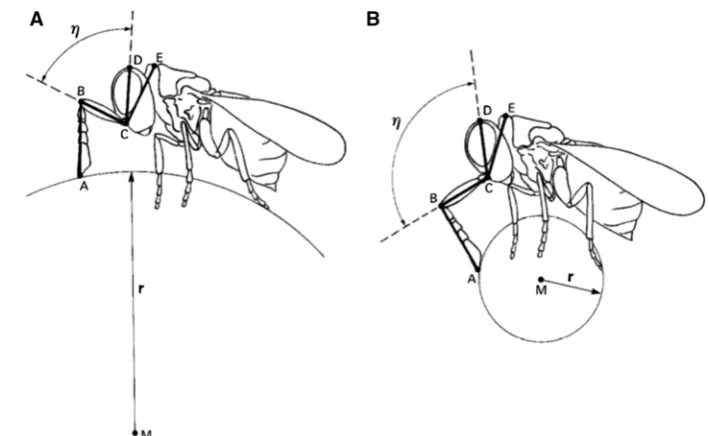
Matched filters are sensory systems that are tuned to specific aspects of the sensory landscape, so as to resonate with that particular aspect, filtering out irrelevant stimuli. A classical example would be that of parasitoid wasps of the genus Trichogramma (Ichneumonoidea), that match the number of their own progeny to the volume of each particular host egg (Schmidt and Smith 1986). The trick can be easily solved at the sensory level. The wasp determines the radius, and thus the volume, of her host (egg) not by performing some kind of spherical trigonometry, but by taking a single measure—the [wasp’s] head/scapus angle—monitored most probably by the mechanosensory bristles located at the joint between head and scapus, when the wasp is walking over the host’s egg (Fig.2). Thus, particular receptor distributions could incorporate fundamental aspects of the ecological problem, providing straightforward, high-level informa-tion to simplify otherwise relatively complex tasks (Wehner 1987).
The slits of the metatarsal vibration detector are high-pass filters, relatively insensitive to low frequencies (Barth 1982), and the primary sensory cells block the low fre-quencies typical of background noise (Barth 1998), thus filtering out unimportant stimuli from the sensory landscape.
Trichobothria (hairs in the cuticle, deflected by air flow) can have different lengths, and the longer they are, the lower the frequencies at which they resonate (Barth et al. 1993; Humphrey et al.2001). Groups of trichobothria with slightly different sizes represent a set of bandpass filters that enhance sensitivity. The air-flow fields generated by abiotic factors, for example, in tropical forests, are char-acterised by low-frequency and narrow-band spectrum, with low velocities, while the air-flow fields produced by prey items, such as flies, are characterised by high fre-quencies and wind velocity. Since the proportion of high frequencies in the spectrum increases quickly as the fly gets closer to the cursorial spider, the set of bandpass tri-chobothria hairs can process directly the information about the distance of the prey, enabling a quick and precise lunge. Spiders with ablated trichobothria do not jump towards flying prey (Barth2002a).
Although it is clear that matched filters process bio-logically relevant information coming from the environ-ment, as ablation experiments show, there is no indication that changes in the central nervous system of spiders will lead to changes in the functioning of the sensory organs themselves, a requirement of the reciprocal causation embedded in the MM. As the cognitive system of spiders most certainly cannot actively alter the functioning of the
sensory organs, cognition does not extend to the matched filters, according to MM.8 While matched filters do not satisfy our criteria for extended cognition, they may, nonetheless, be examples of embodied cognition, which is a broader related concept.
Advantages of extended minds
Extended spider cognition may help explain some rather unexpected experimental findings. For example, if web building is conceived as a centralised cognitive process, researchers might reasonably expect significant amounts of brain tissue to be dedicated to the organisation of the various behavioural units needed to obtain the final web. On this view, the ability to build a complex structure such as an orb-web should be correlated with those brain areas devoted to the processing of the multitude of simultaneous cues, of the different kinds of silks and spinnerets to use in different situations, of the organisation of the various components of the structure, such as frame lines, temporary spiral lines, radii, viscid spiral lines, hub building and rebuilding, while monitoring the spatial position of the spider within the emerging structure, and the properties of relevant environmental features, such as gravity, humidity,
8 Nevertheless, there is experimental evidence for the centralised
modulation of the most peripheral sensory neurons. Centrally released
Footnote 8 continued
octopamine (Seyfarth et al. 1993) causes a persistent increase in excitability in spider mechanosensory neurons (Widmer et al.2005), promoting a rise in sensitivity to higher frequencies (Torkkeli et al.
2011), and thus helping the spider to filter out irrelevant, low-fre-quency background noise. In this way, although the evidence avail-able implies that the cognitive system does not extend to the matched filters themselves, it also implies that it does extend from the CNS to the periphery of the nervous system.
[image:12.595.191.546.54.272.2]wind, prey abundance and type, etc. From the centralised cognition standpoint, these aspects of the web should be represented internally, in the organisation of a potentially relatively large and costly CNS tissue that would yield high foraging payoffs.
Conversely, from the extended cognition perspective, if the cognition for web building extends to the web itself, the amount of CNS neural tissue dedicated to web building would be expected to be significantly smaller than what the centralised cognition stance anticipates. It follows that the two approaches to cognition have contrasting predictions about the relative size of spider CNS tissue dedicated to solving specific tasks. Now, within the group of orb wea-vers, web building has been lost or simplified indepen-dently several times. For our purposes, the loss of web building among the kleptoparasitic genus Argyrodes is particularly relevant, because these spiders are particularly small in size, and smaller sizes involve higher maintenance costs for relatively larger brains (Haller rule, Striedter 2005). Miniaturisation should be accompanied by increased pressures for reducing relative brain size, because of a trade-off between energy demands and information processing in their nervous systems (Niven and Farris 2012). Indeed, from the centralised cognition standpoint, the loss of web building inArgyrodescould be thought of as an evolutionary response to these pressures, allowing these spiders to dispose of relatively large brain areas devoted to web building. Nevertheless, notwith-standing the loss of web-building ability, these tiny spiders did not change their relative brain size (Quesada et al. 2011). This result is unexpected from within the usual central approach to cognition, but is precisely what an extended approach to cognition would predict.
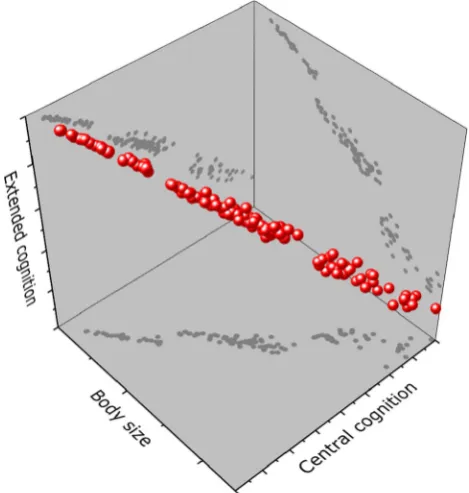
Extended cognition could also help to explain an unsolved puzzle in comparative analyses of brain–body allometry. It is well known that different taxa have dif-ferent slopes and elevations of brain–body scaling (Fig.3). Larger animals such as mammals or birds cannot be as small as ants, because they would have prohibitively large brains (Eberhard and Wcislo2011). This shows that small-sized animal taxa have apparently solved scaling problems seemingly insuperable for larger animals (Eberhard and Wcislo 2012). One possible explanation for these brain-scaling taxonomic differences would be that these tiny brains harbour a simpler behavioural system, but this does not seem to be generally the case, when one looks, for example, at the cognitive feats of jumping spiders (re-viewed above), or bees, that seem capable of complex learning, including the formation of concepts (Giurfa et al. 2001; Leadbeater and Chittka 2007), or even tiny spiders that do not have reduced ability to build functional orbs (Eberhard and Wcislo 2011; Hesselberg 2010). Another possible explanation would be at hand if these tiny brains
were inherently less precise in their performance, but that also does not always seem to be the case (Eberhard2011). Alternatively, tiny brains could be more richly modu-lated than larger brains. Neuromodulation could help the nervous system to multitask, by multiplexing the network (Wang 2010; Akam and Kullmann 2014). Although the available information about neuromodulation in spiders does not suggest that spiders have particularly sophisti-cated neuromodulatory systems (Seyfarth et al. 1993; Widmer et al.2005; Jones et al.2011; Torkkeli et al.2011; Barth2013; Hebets et al.2015), the dynamic properties of spider nervous system networks have just begun to be studied with new neurophysiological techniques (Menda et al. 2014), so that this possibility can now be better investigated in live animals.
[image:13.595.307.542.59.306.2]properties of web threads by increasing tension), or if the organisation of these environmental features help to assemble together different behavioural domains (like in the case of building silken sheets, see below), the stress over centralised control is reduced, allowing a tiny brain to perform better (Fig.3).
Miniaturisation is a common phenomenon and is per-haps becoming yet more common as the increasing tem-peratures in the Anthropocene select for smaller body sizes (Sheridan and Bickford 2011). Miniaturisation is consis-tently correlated with morphological simplification and novelty (Hanken and Wake 1993). For behavioural sys-tems, simplification is often understood as connected to reduced behavioural plasticity, because simpler systems would have lower number of internal stable states, hence a lower number of behavioural outputs (Arnellos and Mor-eno2015). Considering the web-building system, spiders have repeatedly evolved from orb to sheet or cob weavers (for example in Linyphiidae, Theridiidae, and Nesticidae: Bond et al. 2014), and this change is connected to major simplifications, with the loss of whole phases of the ancestral orb-web building algorithm (Benjamin and Zschokke2002,2004). Nevertheless, instead of exhibiting less plastic performance, these derived species of spiders are even capable of larger adjustments in web design rel-ative to ancestral forms. The derived forms have typically lost the stereotypic construction behaviour (Benjamin and Zschokke 2003,2004) and gained ample intra-individual, inter-individual, and species variability (Eberhard et al. 2008). This complexity of behavioural outputs (i.e., web variability), which arises in spite of apparent simplicity in underlying behavioural rules (e.g., a web algorithm), requires explanation. Extensive web variability and inno-vation appear connected to a higher behavioural impreci-sion in these hyper-variable spider groups (Eberhard 2000a,b; Eberhard et al.2008), which could be obtained, at a mechanistic level, from the simultaneous loss of several cues for setting various web parameters, particularly the loss of an important organiser of orb-webs, the delimiting frame threads (see Eberhard et al.2008). The absence of frame threads, of radial organisation, and of the whole phase of temporary spiral building turned the cob and sheet web algorithms much more dependent on the initial, exploratory phase of web building (Benjamin and Zschokke 2004), a phase that is much more variable, mainly involving the fixation of threads over the substrate (Hesselberg 2015). The dependence of the exploration phase (and independence of the remaining phases) on the substrate has been experimentally demonstrated for the ancestral orb weavers: while the length of the exploratory phase increases with the complexity of the substrate, the length of the remaining phases does not match substrate complexity (Zschokke1996). Since these remaining phases
are either absent or much less organised in derived cob or sheet weavers, the net result is a web much more dependent on the exploratory phase, and thus much more connected to the substrate. As a result, these webs seem to incorporate substrate organisation into the organisation of the web itself, and in this way substrate variability could help explain the large intra-individual, inter-individual and species variability in the group. What we see is a decrease in the dependence of central organisers (simplification of web building algorithm) with a simultaneous increase in the dependence of external organisers (substrate form), resulting not only in more plasticity, but also in the evo-lution of a huge diversity of web patterns (Eberhard et al. 2008). Thus, the outsourcing of information from beha-vioural algorithms to the environment could not only help to explain the huge success of a diverse group of spiders, but could also help to explain the taxonomic diversity of this group.
self-assembly between distinct aspects of the behaviour of the species, promoted by enduring niche-constructed aspects of the environment. In this way, a dynamic systems approach to cognition could help explain the emergence of less CNS-demanding, but still complex, behaviours. Given this easy first start, the evolution of silken sheets for particular purposes (protection, prey capture, courtship) would require only a few complementary organisational steps (which could even be based on central cognition).
Although self-reinforcing loops of this kind are well known to produce organised output in many distinct dynamical, including social, systems (Couzin 2009; Sumpter 2010), it is important to notice that extended processes always work in conjunction with centralised organisers, which allows the extended components to evolve. Extended cognition cannot entirely replace cen-tralised cognition; otherwise, the autonomy of the living system would disappear in a constant flux of ecological relations. Within social systems, extended cognition would be a logical intermediary step facilitating major evolu-tionary transitions (sensu Szathma´ry and Maynard-Smith 1995), a step that nevertheless further requires means to circumvent conflicts of interest within the newly emerging social system.
Conclusions
The literature we have reviewed, allied to the mutual manipulability criterion, leads us to conclude that spider cognition does extend to web threads and its configura-tions, but not to matched (sensorial) filters. Although matched filters process information adaptively, the cogni-tive system must simply take this information as input for its workings, and cannot manipulate directly the state of these sensory organs. The mutual manipulability criterion is thus very discriminating and allows researchers to detect the boundaries of the cognitive system effectively.
Despite allowing a straightforward distinction between centralised and extended cognition, the MM is also experimentally demanding, requiring interventions on the CNS and at the periphery of the nervous system (or in the niche-constructed environment). As a consequence, some well-known examples of spider cognition, like route planing and other impressive cognitive feats of jumping spiders, still require further investigation to allow the application of the MM criteria. Accordingly, we believe there are good opportunities for further experimentation leading to the recognition of other aspects of spider beha-viour as extended cognition.
More generally, spiders and other small-sized inverte-brates (and perhaps even many small verteinverte-brates) are nat-ural candidates for the discovery of further extended cognitive mechanisms, because these extended mecha-nisms would be especially relevant for small-brained ani-mals. Small-sized animals may have solved the brain–body scaling problems posed by miniaturisation by outsourcing information processing, that is, by extending cognition to the most peripheral parts of their bodies, or to the closest elements of their environment. This ingenious solution may be particularly successful when this closest environmental feature is produced by the organism itself, as in the case of nests, burrows, webs, retreats, and other artefacts produced by animals, because coevolutionary loops could then fine tune the properties and use of these artefacts more closely, allowing cognition to extend in a more complete form. It may be no coincidence that some of the most cognitively sophisticated invertebrates (e.g., social bees, wasps, ants) are renowned for their niche construction (e.g., nest building). We thus have a double prediction: that minia-turisation will select for extended cognition and that niche construction will facilitate the process of outsourcing information processing.
Moreover, by outsourcing cognition and building structures, organisms potentially make their world more predictable, and a predictable feature of the environment will frequently turn out to be a selective pressure (Odling-Smee et al. 2003). As a consequence of having a web, selection pressures appear for the web to be defended, maintained, regulated, and improved upon in design, as well as for others to hunt on it, destroy it, squat in it, or steal food from it. Such adaptive responses potentially evolved multiple times, perhaps producing parallel evolu-tion in independent lineages, and/or long-term evoluevolu-tionary trends spanning multiple characters, in ways that are potentially probabilistically predictable (Laland 2015; Laland et al. 2015). Such parallel evolution or trends, together with the aforementioned predictions concerning miniaturisation and simplification, could be investigated using comparative phylogenetic methods or through com-parative experiments. Hence, increasing attention to the possibility of extended cognition may open up exciting new opportunities for novel research.
Open Access This article is distributed under the terms of the Creative Commons Attribution 4.0 International License (http://crea tivecommons.org/licenses/by/4.0/), which permits unrestricted use, distribution, and reproduction in any medium, provided you give appropriate credit to the original author(s) and the source, provide a link to the Creative Commons license, and indicate if changes were made.
Appendix: Formal requirements to the mutual
manipulability criteria
Formally, the interventions realised to detect whether two elements belong to one-and-the-same system must comply with some conditions, so as to demonstrate that a putative component X (for example, the spider web) is causally connected to Y (for example, the perceptual system of the spider):
A necessary and sufficient condition for X to be a (type-level) contributing cause of Y with respect to variable set V is that (i) there be a directed path from X to Y such that each link in this path is a direct causal relationship; that is, a set of variables Z1…Zn such that X is a direct cause of Z1, which is in turn a direct cause of Z2, which is a direct cause of…Zn, which is a direct cause of Y, and that (ii) there be some intervention on X that will change Y when all other variables in V that are not on this path are fixed at some value (Woodward2003, p.59).
Also, there are some necessary conditions for an interven-tion (I) to appropriately test the causal relainterven-tionship between X and Y (Woodward2003, p. 98):
1. I causes X.
2. I acts as a switch for all the other variables that cause X. That is, certain values of I are such that when I attains those values, X ceases to depend on the values of other variables that cause X and instead depends only on the value taken by I.
3. Any directed path from I to Y goes through X. That is, I does not directly cause Y and is not a cause of any causes of Y that are distinct from X except, of course, for those causes of Y, if any, that are built into the I-X-Y connection itself.
4. I is (statistically) independent of any variable Z that causes Y and that is on a directed path that does not go through X.
These are indeed general conditions to test causality in any experimental setting. It must be clear that the MM account of cognition involves reciprocal causality and, as such, the planned interventions must be performed on both directions, from X to Y and from Y to X.
Baumgartner and Gebharter (2016) suggest that MM detects constitutive relevance, but that this does not imply the existence of causal relationships within the extended system, i.e., that constitutiveness does not entail causality.9 Nevertheless, this is only true when you consider the relationships between the overall system and its constituent parts, because these are spatiotemporally overlapping relations, that is, the system does not cau-sally act over its own parts, because it is merely con-stituted by these parts. Of course, this reasoning also works the other way round: the parts do not causally act over the system as a whole, because this would entail a causal loop whereby the part acts over itself. So, this reasoning is tailored to evaluate the relationship between the whole and its parts. Nevertheless, this is not the question we are trying to evaluate. We are not interested in the relationship between the whole extended (cogni-tive) system and one of its parts (threads, webs, sensorial fields). Instead, we are interested in the relationship between different parts of the system, and thus we do not analyse the system simultaneously at two levels of organisation (at the level of the whole, and at the level of the parts). We stick to one level of analysis, and we analyse only the parts and the interrelations between them: we are dealing with the causal structure among the parts (of the putative extended system), and this is suf-ficient for our purposes.
Also, the argument just make sense if one considers the macro- and micro-levels not as alternative descriptions of one system, but instead as distinct entities that could be causally independent from each other. This interpretation comes from the correct and well established idea that the whole is more than the sum of its parts, so that the description of the macro-system is more than the descrip-tion of its parts. But if we consider not only the parts, but also their interactions (additive or non-additive), which are not strictly predictable in complex systems, then the description of the macro- and micro-levels do coincide, and emergent properties will appear within these complex interactions. If a property of an entity change as a function of its interactions (as in multiplexing neural networks, that are differentially activated for different functions—see Wang2010), then the interactions must necessarily be part of the description of the system, at any (macro or micro) level.
9 They state that ‘‘Craver and Bechtel (2007) offer two reasons to