A thesis
submitted in partial fulfilment of the requirements for the degree
of
Doctor of Philosophy in the
University of Canterbury
by
Seamus D. Hogan ~
CONTENTS
CHAPTER
Abstract o • • • 0 • • • 0 • • • • • • • • • • • • • • • • • • • • • • "
Part A. Introduction
1. Thesis Overview
2. Equilibrium Search-A Survey 2.1 Introduction . . . 2.2 Pure Search Models
2.3 Existence of Equilibrium 2.4 Price Dispersion . . . .
2.5 Relation of the Literature to the Remaining Chapters
Part B. Pure Search Models
PAGE vii 1 3 5 5 7 13 17 22 25 3. Search and Duality-Deriving Demand Functions from FSS Search 27
3.1 Introduction
3.2 Notation and Setup of the Model 3.3 The Role of Duality
3.4 Diminishing Returns
3.5 Examples of Different Search Strategies 3.6 Demand Functions
3.7 Welfare
3.8 Concluding Remarks
4. Sequential Search without Replacement 4.1 Introduction . . . .
4.2 Notation and Setup of the Model 57
4.3 Reservation Prices 59
4.4 The Dual Function 68
4.5 Demand Functions 72
4.6 Concluding Remarks 76
5. Blind Search - Adapti ve Sampling with Minimum Information 79
5.1 Introduction 79
5.2 Blind Search 80
5.3 Notation and Setup of the Model 82
5.4 Properties of Blind Search 85
5.5 Comparative Statics 94
5.6 Comparisons with Rational-Expectations Search 95 6. Equilibrium Search without Rational Expectations 101
6. 1 Introduction 101
6.2 Rational Expectations and Equilibrium 103
6.3 An Example: Blind Search . 105
6.4 Approximating Adaptive Search 109
6.5 Concluding Remarks 111
Part C. An Equilibrium Model 113
7. Inefficiency in Oligopoly when Price Information is Endogenous 115 7.1 Introduction
7.2 The Model: No Arbitrage 7.3 Welfare Effects of Entry 7.4 Arbitrage
7.5 A Numerical Example 7.6 Concluding Remarks
Part D. Conclusion
8. Summary and Suggestions for Future Research 8. 1 Summary
8.2 Suggestions for Future Research
Appendices
Appendix A Appendix B Appendix C Appendix D
Acknowledgements References
143 145 145 146
149 151 157 167 179
This thesis is concerned with the problem of incorporating consumer
search into equilibrium-in particular with the relationship between oligopoly models where consumers search and those which assume perfect information.
Two chapters consider duality in search. The conventional way of
expressing a consumer's search strategy is to describe his decision variable as a function of the search cost. The dual approach is to find the search cost that leaves the consumer just indifferent between two decisions. Since cost is continuous this search-cost function is differentiable in more parameters than its inverse and so more readily yields comparative static results. Using this function it is possible to express the demand facing firms as explicit
functions of the distribution of consumers search costs.
The belief is commonly expressed in the literature that adaptive search models add little insight compared to the analytically simpler "rational expectations" models. It is shown that this is not valid when considering equilibrium, as the linkage between prices and consumers' search strategies
implied by rational expectations affects the reaction functions of
oligopolistic firms. This point is illustrated in a separate chapter which presents a Bayesian search model.
An equilibrium model allows the number of firms to be determined
endogenously, and then considers the effect that entry has on efficiency and welfare. It is shown that since the monopoly power of firms arises from the incomplete information of consumers, and since the amount of search for information is endogenous-determined in part by the number of firms-entry can reduce efficiency and increase prices. It is also shown that the entry of . a specialist dealer (an arbitrager) will generally reduce efficiency, and can lead to a wider dispersion of prices as the arbitrager profits from
1. Thesis Overview
2 Equilibrium Search a Survey
3
The now huge literature arising from the seminal article of Stigler (1961) has two main branches. The first-what may be termed "pure search
models"-investigates the information-acquiring behaviour of agents faced with uncertainty over the possibilities available in a market. The second branch considers market outcomes when the behaviour of firms confronted with
searching consumers is also modeled.
Pure search models include the formal model of Stigler's paper, in which consumers are assumed to choose the expected-price minimizing number of firms sampled from a known distribution of prices. This literature has developed by exploring the variations in sampling technique used, the objectives sought, and initial information available to the consumer.
Although these models can explain why consumers do not necessarily buy at the lowest available price, they leave open the question of why firms choose to charge different prices. In the earliest models incorporating search into a partial equilibrium-notably Diamond (1971) - the equilibrium degenerated to a single price. Rothschild (1973) challenged economists to develop models which produce price dispersion endogenously. Much subsequent literature is a
response to that challenge, and there are now many ingenious models of equilibrium price dispersion.
As well as explaining price dispersion, models of search in equilibrium can be useful for addressing questions about the characteristics of oligo-polistic markets when there is imperfect information. Here, the existing
interesting to know, for instance, if the equilibrium properties of search vary greatly as different assumptions are made about the search process, or if they depend mainly on the universal feature of search models-that consumers allocate scarce resources to the purchase of price information in such a way that the net benefit is maximized? To address this question, it is necessary to consider the demand functions facing firms that arise from search. Pure search models have generally been developed independently of the equilibrium literature and are rarely of a form that allows tractable demand functions to be derived, that not being their objective.
Generality is an objective of this thesis. The problems involved in deriving equilibria from search models are presented more fully in the following literature survey. Part B of this thesis (Chapters 3-6) develops pure search models where the emphasis is on deriving results relevant to equilibrium. Chapter 7, which makes up Part C, is an equilibrium model. It is used to make a comparison with perfect-information oligopoly models. In
particular, the role of a specialist dealer (arbitrager) is considered. As a summary of the results, some further directions of research are suggested in Part D (Chapter 8).
2.1 Introduction.
This survey is not exhaustive. Four excellent surveys of search models already exist: Rothschild (1973), Lippman and McCall (1976), McKenna (1987a), and McKenna (1987b). The aim here is to provide a context for the material in this thesis. In particular, two branches of search theory, job search and general equilibrium search, which are not directly relevant to this objective are ignored. Of course, many search models can be interpreted as either
consumer or job search; the branches become distinct in equilibrium modeling where the job search literature has been concerned with macroeconomic issues such as the search-theoretic foundations of the natural rate of unemployment. Lippman and McCall's is a survey of job search.
"Equilibrium search" refers here to a class of partial equilibrium models concerning the market for a consumer good. This class has the following
structure: A market for a homogeneous good is characterized by a number of firms who each post a price for that good, and by a group of consumers who initially do not know the prices posted by any particular firm. Before
deciding from which firm to buy, consumers can search; that is they can sample some firms at a cost to learn the prices posted by those firms. These models are concerned with establishing what prices can be posted by firms in an equilibrium, and how these are affected by search.
The demand for each firm depends on its own price through the effect price has on individual consumers' demand, and on all firm's prices through their effect on consumers' search. The profit function for each firm j is given by
(2-1-1)
cost function for firm j, and q.(p.,p .) is the expected demand for firm j.l
J J -J
The index j can take integer values only (if there are a finite number of firms), or it can be a member of a real interval (if there is a continuum of firms) .
The equilibrium definition used is Nash/Bertrand: Each firm chooses its price to maximize the profit from expected demand, taking the prices of the other firms as given. An equilibrium is then a vector of prices p* such that
* *
IT.(p.,p .) ~
J J -J II.(p.,p* .) J J -J
v
p., J V j. (2-1-2)The model structure given in (2-1-1) and (2-1-2) is equivalent to that of product-differentiation models. In those models, price-setting firms can face downward-sloping demand functions, as each firm's product is differentiated from its competitors. In equilibrium-search models, the good is homogeneous, so differences in the prices revealed by search are the only thing disting-uishing one firm from another for any particular consumer. The information that consumers have, however, will vary across consumers following a random search process, leading to downward-sloping demand. These models can therefore be interpreted as a variant of product differentiation.
In most product differentiation models, the demand functions are imposed rather than derived from consumer behaviour. 2 As a result, assumptions can be made about demand directly. This is not possible with equilibrium search: The
1
2
Since search is a random process, each firm's demand is generally a random variable. In all the equilibrium models surveyed here, the expected value of demand is used to give a deterministic demand function. This is simpler than assuming that firms maximize expected profit, which would generally require that the full density function of demand be derived. The expected profit from demand and the profit from expected demand will only be the same when the total-cost function is linear, or when the law of large numbers implies that demand has no variance.
particular assumptions made about search place restrictions on the demand functions.
One effect of having to derive demand from consumer behaviour is that it is difficult to guarantee the existence of an equilibrium when a standard search model is used. This is one reason why the equilibrium-search models tend to be special cases: So many assumptions are required to ensure existence that few free parameters remain to be used to address general questions. If, as has been the case in most equilibrium-search models, the objective of a model is to generate price dispersion in equilibrium and so explain search, further restrictions are imposed on the model.
The emphasis in this thesis is on investigating the relationship between search and the demand functions facing firms, and on the similarities between search models and other forms of product differentiation. The remainder of this chapter considers further the problem of generating existence and price dispersion, and summarizes the various solutions that have been found. The choice of search strategy by consumers is important to these solutions. The next section describes the variations that exist in the pure search literature that are relevant to equilibrium. Section 2.3 then considers existence, and Section 2.4, price dispersion. Finally, Section 2.5 outlines how the remaining chapters of the thesis fit into this literature and relate to the points made here.
2.2 Pure Search Models.
This section describes the original Stigler (1961) search model, and then presents other models as variations on it.
A. Stigler's Model.
range of prices. The consumer knows f but not the prices charged by particular firms. He views any price as a random variable with f(p) as its density.
Search is the process of realizing a value for this random variable. Stigler allowed only fixed-sample-size (FSS) search; that is, the consumer decides in advance how many firms to search, and then purchases at the lowest price sampled.
The consumer has a unit search cost for each firm sampled of c. Let g be n the probability density of the sample-minimum price resulting from a sample size of n. The expected total cost to the consumer is then
(2-2-1)
where
J
P'gn(p) dp is the expected minimum cost of the purchase, and nc is the cost of acquiring quotations. The consumer is assumed to minimize this value. Stigler showed thatJ
P'gn(p) dp is a concave function in n. The solution tothe consumer's problem is then to choose the largest sample size such that the unit search cost does not exceed the marginal benefit,
J
p' (gn(P)-gn+1 (P)) dp.Alternatives to all the major assumptions in this model now exist in the search literature. The remainder of this section will present a taxonomy of these alternatives rather than of specific models.
B. Assumptions about Sampling Technique.
An early reaction to Stigler's model (for example, in McCall (1970) and Nelson (1970)) was that, by assuming FSS search, only sub-optimal behaviour by consumers was considered. The optimal strategy, it was claimed, is sequential search, a strategy in which consumers reconsider whether to continue search after every price quotation taken. 3 This allows consumers who receive a low
quotation early to avoid wasteful additional search.
With sequential search, the consumer's problem is to calculate an optimal stopping rule. This is a function of the sequence of prices sampled that
determines whether search should stop or continue after each quotation taken. The marginal benefit of taking another quotation is the expected reduction in the minimum price sampled. When the distribution of prices is known and only one purchase is to be made, the marginal benefit depends only on the minimum price already sampled. Let Pi be that sample minimum. The expected reduction in the minimum price if a single additional quotation is taken is then
(2-2-2)
The simple model has the property of stationarity (the problem looks the same after each quotation). As a result of stationarity, it is also myopic
(the decision to take one more quotation is independent of the possibility of future sampling). This provides the reservation price rule: Stop search if and only if the lowest price quotation is at or below the reservation price r, where r equates the marginal benefit with the marginal cost of a quotation. That is,
M(r) - c. (2-2-3)
The alleged superiority of sequential over FSS search rests on the implicit assumption that there can be no savings from taking several price quotations at once. It is easy to find examples where such economies of scale exist. If there is a delay between seeking a quotation and receiving it--as with putting a contract to tender--and there is discounting, then there are
obvious gains to seeking several quotations simultaneously. The decision to drive to a many-shop mall within which marginal search is almost cost less can also be thought of as a form of FSS search. Morgan and Manning's (1985) model allows this generality. In it, consumers choose sample sizes sequentially; that is, at each period they must decide whether to continue search, and if so how many quotations to seek in the next period. This model allows both FSS and sequential search to emerge as special cases.
A feature of the reservation-price rule and stationarity in the simple sequential model is that consumers will always purchase from the last firm sampled. In more complicated sequential models, this may not be the case, so assumptions are required on the longevity of price offers. With full recall, consumers can always purchase from a firm previously sampled; with zero recall, they must purchase from the last firm sampled; partial recall describes all the possibilities between these two extremes. Less than full recall may be realistic in models where the duration of search is important-for instance with job search. In static consumer models, full recall is a natural assumption.
The distribution of prices faci~g consumers is usually assumed to be continuous. Carlson and McAfee (1983) modify sequential search to accommodate a discrete distribution of prices. Their motivation is to model equilibrium with a finite number of firms. When the price distribution is discrete, there arises a distinction between with-replacement and without-replacement
C. Assumptions about Consumers' Objectives.
Stigler's assumption that consumers seek to minimize expected expenditure has often been changed. Manning and Morgan (1982), in an FSS search model, have consumers maximize the expected indirect utility from price. While still addressing Stigler's question of how consumers behave when faced with price dispersion, this approach allows search theory to be merged into neo-classical consumer theory. For instance, the effect of income on the demand for price information can be easily considered in this framework. Veendorp (1984), using the expected indirect utility approach with sequential search, shows that, if there is a monetary cost to search (rather than only a utility cost), then the loss of stationarity that arises from search reducing income can prevent the existence of a reservation-price rule.
A particularly useful aspect of the indirect-utility-maximizing approach is that elastic consumer demand for the searched for good can be eas~ly accom-modated. Stiglitz (1987), in an equilibrium model, allows elastic demand this way, rather than using the conventional equilibrium assumption of inelastic demand with a choke price: the price at which demand discretely fall to zero.
Kohn and Shavell (1973) and Weitzman (1979) go further in widening consumers' objectives. In their very general models, consumers maximize expected utility when searching from a distribution of utilities. Search for the low prices is just one interpretation of this framework. For instance, Kohn and Shavell, by allowing the utility search cost to be negative, can model search for what Nelson (1970) terms experience goods: goods such as restaurants where sampling is through consumption rather than inspection, and where the utility of that consumption can more than compensate for the search
cost.
received little attention. This is the relationship between search, purchase, and consumption in time. The experience-good interpretation of Kohn and
Shavell is a rare exception to the implicit assumption that search precedes purchase which precedes consumption. Models recently addressing this aspect are Manning (1989a), where consumers consume while searching, and Manning
(1989b), where, even if consumption is postponed, consumers are allowed to spread risk by purchasing some units of a good before terminating sequential search. Search models of this form will be required if the equilibrium-search literature is to consider issues such as reputation where time is implicit.
D. Assumptions about the Information Known to Consumers.
Perhaps the strangest assumption used in search models is that of
rational expectations: the assumption that consumers know the distribution of prices of all firms without knowing the prices charged by specific firms. An alternative approach is adaptive search, in which sequentially searching consumers update their prior beliefs about the distribution of prices as
search reveals information. Adaptive search is considered in McCall (1970) and Pratt, Wise, and Zeckhauser (1979). Other adaptive models have been developed
~
by Axell (1974), Rothschild (1974), Kohn and Shavell (1974), Rosenfield and Shapiro (1981), and Morgan (1985).
There is a trade-off between the generality of adaptive search and the simplicity of rational expectations search. In the context of pure search models, the consensus has been that adaptive search models add too little insight to justify their complexity; rational expectations models are just Bayesean models with degenerate priors. In the context of equilibrium,
correct. This implies that if a firm changes its price, knowledge of that can affect consumers' search strategies. The demand functions of firms then
reflect that each can affect the behaviour of consumers yet to sample it. The importance of the rational-expectations assumption in equilibrium search models has not previously been considered. It is the subject of Chapter 6.
2.3 Existence of Equilibrium.
In product differentiation models which have the structure described by equations (2-1-1) and (2-1-2), a standard assumption is that the demand
fUnctions are continuously differentiable. With some other restrictions, this assumption is used to guarantee continuous best-reply correspondences, and hence the existence of an equilibrium. When demand functions are derived from search, each firm's demand is, in many cases, discontinuous at the prices of other firms. This implies discontinuous best-reply correspondences and result-ing problems for existence that are not easily assumed away.
The demand discontinuity in equilibrium-search models is a result of the assumption that firms are price setters. In the simple Bertrand model, each firm's demand function is discontinuous at the prices charged by other firms; as long as price exceeds marginal cost, each firm has an incentive to undercut its rivals. This competition for customers forces price down to marginal cost, even with only two firms.
been sampled by some consumer appear identical to that consumer, who therefore buys at the firm with the lowest price. This means that the demand discontinu-ities of the Bertrand model are likely to be present if there is a positive probability that two firms are both sampled by some mass of consumers. Unlike the Bertrand case, however, the competitive solution will not be an equi-librium since incomplete search by consumers also gives firms some monopoly power.
This feature, that the products of any two firms cease to be differ-entiated to a consumer who samples both, is common to all equilibrium-search models. Models can, however, be set up so that it does not result in
discontinuous demand functions, or, if it does, that existence can still be ensured for at least a range of parameters. Four approaches have been used in
the literature to generate existence of equilibrium.
First, even if some consumers are indifferent between two firms charging the same price, that price can still maximize profit if the demand function of each firm never lies above the average cost curve. If one of the two firms then lowered its price slightly, there would be a quantum increase in its demand but not in its profit. This is the case in the model of Salop and Stiglitz (1977),4 where free entry ensures price equals average cost for all firms. They derive a two-price equilibrium for some values of parameters. The
lower of the two prices is at the minimum of the U-shaped average cost curve. A demand discontinuity at the higher price is avoided because of the form of search assumed. In this special case of FSS search, consumers can either sample all firms' prices (for example, by buying a newspaper) and then buy at the lowest price, or they buy from a randomly chosen firm. As a result, no consumer samples more than one of the higher priced stores without also
sampling a lower price.
Second, if there is an infinity of firms with prices dispersed along a continuum with no mass points, there is zero probability of two identical prices being sampled by any consumer. Demand functions can therefore be continuous. This is the approach used by Wilde and Schwartz (1979), Sadanand and Wilde (1982), and Burdett and Judd (1983). They are formally similar to Butters' (1977) model which is not principally about search, but is very similar to FSS search in the way price information is disseminated (firms randomly issue advertisements to consumers, who purchase at the lowest price of these).
Third, if sequentially searching-consumers never use recall, then they are never indifferent between two prices. But zero recall does not have to be imposed: As noted in the previous section, it is a property of the basic sequential-search model that consumers purchase from the first firm visited that has a price lower than their reservation price, and so they are never indifferent between two prices. This practical attribute of sequential search perhaps explains its prevalence in equilibrium models: Axell (1977), Reinganum
(1979), Carlson and McAfee (1983), Rob (1985), and Stiglitz (1987), all employ sequential search.
If there are no pure-strategy equilibria, then it is sensible to look for mixed-strategy equilibria. This is the final way that has been found to deal with the problem of demonstrating existence. Shilony (1977) derives
mixed-strategy results in a model that can be interpreted as a Hotelling-style
equilibrium. 5
The use of mixed strategies in the Varian, and Salop and Stiglitz (1982) papers is a nice way of modeling price dispersion by firms across time. For static equilibria, the pure-strategy existence solutions are less satisfying as they lack robustness. For instance, the Salop and Stigliz (1977)/Braverman solution is very neat but it requires an ad hoc search model not drawn from the pure-search literature and not based on consumer behaviour. The models employing FSS search among an infinity of firms are preferable in this respect, and it does follow the tradition of pure-search models to assume a continuum of prices. Having an infinity of firms, however, is unfortunate for two reasons: First, continuous distributions are useful if they are the
limiting cases of discrete distributions, but they have no interpretation on their own (there not being any market with an infinity of firms). Second, some of the interesting questions raised by price dispersion models, which are oligopolistic in structure, concern the effects on the market from changes in the number of firms. The requirement that there be an infinity of firms
precludes these questions from being addressed.
An appealing generalization, applicable to the other continua models, is offered by Butters. He shows that, with a finite number of firms, there always exists an e-equilibrium, where e, the minimum profit required to induce a firm to change price, can be regarded as a proxy for adjustment costs. As the
number of firms tends to infinity, e tends to zero. This provides a limit interpretation of continuous models, but still precludes the use of firm numbers as a variable for comparative static analysis.
5 Mixed strategies are not required for equilibrium in this Salop and Stigliz model. With an infinity of firms, pure strategy equilibria exist; the
The third way of guaranteeing existence--using the no-recall property of sequential search--offers the most elegant solution to the problem. Again, however, existence is not robust: No-use-of-recall is a result of station-arity; it does not necessarily survive the introduction of income effects or adaptive learning. Also, without-replacement sampling (despite retaining no recall) troubles existence for other reasons. This is shown in Chapter 4.
2.4 Price Dispersion.
As noted in the previous section, mixed strategy solutions are one way of modeling dispersed-price equilibria. Generating price dispersion from pure strategies requires more work. The early models placing search in an equi-librium setting--for instance, Diamond (1971), Fisher (1970), (1972), (1973), and Hey (1974)--resulted in degeneration to a single-price equilibrium.
The reason for degeneration is that search is too successful in achieving its aim of avoiding high-priced firms. To illustrate, consider a simple FSS search model where identical consumers search for one unit of a good from a density of prices f(p). If this density is sufficiently spread to induce consumers to sample more than one firm, then there results a distribution of sample minimum prices, g (p), which has the same support as f(p) but is n stochastically dominated by it. The expected demand for firms charging the highest price is zero, so charging that price cannot be equilibrium behaviour.
If, however, the density of prices is so narrow that consumers sample only one firm--resulting in identical price-offer and sample-minimum distributions--then each firm is a perfect monopolist. Now it is the lowest prices that
cannot be explained. This is the logic behind the Diamond (1971), result where the only equilibrium entails every firm charging the monopoly price.
these yield profits at both high and low prices. This is necessary but not sufficient to explain heterogeneous price setting by firms; the assumptions made about firms are also important. This section considers both sides of the market, and finishes with a comment on the role that heterogeneity of
consumers and firms plays in these models.
A. Consumers.
The simplest way of achieving elastic demand for firms is to allow each consumer to have elastic demand. This is the approach of Reinganum (1979). In her model, the equilibrium price distribution has all prices at or below the reservation price of sequentially searching consumers. As a result, all consumers buy at the first firm visited and so each firm is a perfect mono-polist. It is the elastic consumer demand which provides an incentive for firms to charge below the reservation price.
Despite the consistency of elastic demand with neo-classical theory, all but Reinganum and Stiglitz (1987) of the equilibrium models cited in the previous section have eschewed this approach and assumed inelastic consumer demand. In each of these models, some, .but not all consumers, sample only one firm. The consumers who sample only one firm ensure some demand for the
highest priced firms; the other consumers provide the additional demand that justifies some firms' charging of lower prices. Heterogeneity in consumers' sampling behaviour has been achieved in three ways: assumed exogenously; derived endogenously as a result of ex-ante heterogeneity in other consumer parameters; and derived endogenously from ex-post heterogeneity that can result from the randomness of search.
beliefs about the price distribution. Rather, a certain proportion of consumers hate searching and so choose a sample size of one; the remainder love searching and choose some constant sample size exceeding one.
Heterogeneity in consumer parameters is employed by Axell (1977), Salop and Stiglitz (1977), Pratt, Wise, and Zeckhauser (1979), Braverman (1980), Von Zur Muehlen (1980), Carlson and McAfee (1983), Rob (1985), and Stiglitz
(1987),6 In each case, the consumers differ only in their search costs but this can be interpreted several ways. For instance, Salop and Stiglitz (1977) motivate search cost differences as reflecting differences in consumers' "ra tionali ty"; Gabszewicz and Garella (1985) in a degenerate-price model assume search costs to be a linear function of consumers' location along the real line.
In Burdett and Judd (1983), ex-post heterogeneity in consumer sampling can arise even with ex-ante homogeneity when, in the only dispersed price equilibrium, identical FSS searching consumers are indifferent between sampling one or two firms. This model, however, still imposes a form of heterogeneity in its assumption that consumers do choose differently when faced with equally appealing options. This difference can be reinterpreted as being based on a difference in search costs. This has the advantage of conver-ting a knife-edge result into a robust equilibrium. Albrecht, Axell and Lang
(1986) have a more appealing way of generating sampling differences ex-post. In their general-equilibrium model, consumers search simultaneously in a factor market and a goods market for wage/price offers. There is no recall, and search must stop in both markets simultaneously. Identical consumers will
then react to differently to the same sampled price in the goods market
6
Von Zur Muehlen also assumes elastic consumer demand, but it is the consumer heterogeneity that is important in generating a dispersed price equilibrium
because their concurrent wage offers differ, and vice-versa. Anglin (1989) has a similar model, where consumers search concurrently for two goods. Consumers also differ in their search costs in that model, so there are two sources of heterogeneity.
B. Firms.
As with consumer heterogeneity, differences in firms' behaviour can be achieved through heterogeneity in parameters, or generated from within the model. The first approach is that used by Reinganum (1979), and Carlson and McAfee (1983) who both assume firms have differing cost functions. Other ways of imposing heterogeneity, such as allowing different probabilities between firms of being sampled, remain to be modeled.
Price dispersion is possible with identical firms if each has aU-shaped average cost curve, and there is free entry, as in Salop and Stigliz (1977), Braverman (1980), Wilde and Schwartz (1979), Sadanand and Wilde (1982) and Von Zur Muehlen (1982).
An alternative approach, used by Axell (1977), Burdett and Judd (1982), Rob (1985), and Stiglitz (1987), has all firms earning the same amount of monopoly profit. These four models all have an infinity of firms and the equilibrium is a price distribution which, when merged with consumers' search strategies, produces unitary elastic demand functions from which the resulting set of profit-maximizing prices is that price distribution. The infinite
number of firms is important as it ensures that no deviating firm has the power to influence consumers' search behaviour and hence the profit function. For instance, Rogerson (1987) shows that Rob's model fails to produce price dispersion when there is a finite number of firms no matter how large. This is another example of why it is unsatisfactory to model equilibrium with an
Of course, if there is a finite number of firms, there may be Nash equilibria where identical firms earn non-identical amounts of profit.
Stiglitz (1987) gives a numerical example of a dispersed-price equilibrium in the case where there are three firms and consumers search sequentially without replacement.
C. The Role of Heterogeneity.
With the exception of the Albrecht, Axell and Lang paper, all these price-dispersion models have required heterogeneity among either consumers or firms. The Carlson and McAfee model, which is the most robust in the sense of allowing the most comparative static analysis, requires both consumers and firms to be non-identical. Imposing heterogeneity has been regarded by many authors as unsatisfactory, but the assumptions for both consumers and firms can be justified on grounds other than analytical convenience.
First, allowing differences in consumers may be an "explanation by taste", but it is consistent with differentiated product models, which formally differ from Bertrand models only when consumers are not identical. For instance, Rotelling-type differentiation-by-Iocation models are only interesting if consumers are also distributed locationally. A lot of the insight about the role of information in oligopoly comes from comparing its results to the other types of product differentiation. Since it is consistent with those models, the assumption of consumer heterogeneity in equilibrium-search models is desirable rather than a weakness.
technology. When there is imperfect competition, it is an interesting question how much technological inefficiency the market can sustain.
2.5 Relation of the Literature to the Remaining Chapters. In concluding his survey of search models, Rothschild commented:
"By now it should be clear that it is possible to build logically consistent models of markets which depart in one way or another from the classical standards of perfection.
In some ways it is almost too easy. The number and variety of different models make it hard to draw any firm
conclusions about the consequences of different types of market failure, and it is, after all, conclusions of this sort which make the game worth the candle."
Rothschild (1973, p 1303)
The previous two sections demonstrate that a similar comment can be applied to the search-based equilibrium price dispersion models that were inspired by Rothschild's survey: The problems of generating existence and price dispersion can be overcome, but, again, the specific assumptions employed to do so
produce very specific results. There is a need for equilibrium models that can .be applied to a variety of situations.
This thesis works in that direction. The connecting theme of the remain-ing chapters is the similarity, described in Section 2.1, between equilibrium-search models and other types of product-differentiation models, and the fact that the properties specific to the former come from the restrictions search places on the demand functions facing firms.
The pure-search models of Part B consider the relationship between the assumptions made about how consumers search and the resulting demand funct-ions, and on the implications these functions have for equilibrium. In doing so, these chapters fill in some of the gaps in the pure-search literature.
In Chapter 3, FSS search from discrete distributions of prices is
expressed parametrically; with-replacement and without-replacement sampling emerge as special cases from particular values of the parameters. A method is presented for deriving the demand functions facing firms as functions of the sampling strategy and a distribution of consumer search costs. The parametric form provides a means of comparison of different types of sampling strategy if these demand functions are used to derive an equilibrium. Chapter 4 considers discrete, without-replacement, sequential search (Carlson and McAfee having analysed the case of with-replacement sampling). The major result of this chapter is that, unlike with-replacement sampling (which produces analytically convenient demand functions), without-replacement sampling results in non-differentiable demand. The similarities between the results of Chapters 3 and 4 provide some interesting insights.
Chapter 5 describes an adaptive-search model where consumers have almost no information about prices before they search. Chapter 6 discusses why, contrary to the commonly stated view, the assumption that consumers have rational expectations about the price distribution is not just an innocuous special case of adaptive search when considering equilibrium. The model of Chapter 5 is used to illustrate this point.
Part C considers equilibrium directly. The single equilibrium-search there, Chapter7, draws comparisons with non-search, product-differentiation models in considering how changing the number of firms and adding a
3. Search and Duality-Deriving Demand Functions from FSS Search 4. Sequential Search without Replacement . . . .
5. Blind Search-Adaptive Search with Minimum Information 6. Equilibrium Search without Rational Expectations
27
55 79
3.1 Introduction.
In the standard form of equilibrium search models, described in the previous chapter, search only affects the equilibrium through the demand functions facing firms. Although different assumptions made about consumers' search behaviour will produce different demand functions, and hence different equilibrium results, the procedure used to derive these functions will in many cases be the same. Much economy of effort can therefore be achieved by concen-trating on the derivation of demand from search separately from specific equilibrium models.
This chapter presents a method of deriving demand functions for a broad class of fixed-sample-size (FSS) search strategies. This class includes the standard Stigler (1961) model of sampling from a continuum of prices, and various ways of sampling from discrete distributions. As well as collecting in one place a number of results that can be used in equilibrium, FSS search models, this approach allows easy comparison between the equilibrium results of different assumptions about search.
The main technique used is duality: describing consumer's search
describing consumer behaviour to be a differentiable function of the parameters in the model.
In the next section, the basic model is outlined and then duality is introduced in Section 3.3. It is shown there that, to be able to use the. duality approach, it is necessary that there be diminishing returns to search. Conditions for diminishing returns are presented in Section 3.4. These are illustrated in Section 3.5 which presents examples of search behaviour that are among those described by the model. Demand functions are then derived in Section 3.6. As equilibrium models are frequently used to address the welfare
implications of dispersed prices, measures of welfare appropriate to search are required. In Section 3.7, two measures of welfare, expressed in the same general notation as the rest of the chapter, are derived. In the final
section, some further extensions are suggested. Proofs of two results from this chapter are found in Appendix A.
3.2 Notation and Setup of the Model.
The sampling environment facing consumers is characterized by a set of prices for a homogeneous good and a search strategy (to be defined). Prices are indexed by the subscript j. When the price distribution is discrete, j is an integer from the set {1, '" J}. When the distribution is continuous, j is a member of the interval [l,J]. In either case, prices are ordered from lowest to highest so that
i < j V i, j.
minima rather than in the distribution of prices directly. It is the informa-tion about the sample minima distribuinforma-tions that we term a search strategy.
Definition 3-1:
A
search strategy is a set {gl' g2' ... goo}' of probability distributions over {Pl' ... PJ}' where gn(Pj) is the probability that Pj will be the minimum price in a sample of size n.The definition of a search strategy as a set of probability distributions admits a wide variety of sampling behaviour. Examples of different search strategies and values of g (p.) for each of these are presented in Section
n J
3.5. These include sampling with and without replacement. The latter clearly dominates the former, but, with the search strategy being considered part of
the environment facing consumers, we are not concerned here with the choice of an optimal search strategy. This approach does, however, allow easy compari-sons between different strategies.
G n is the cumulative probability distribution,
j
L
g (p.).i=l n 1
When the price distribution is continuous, g and G are density and distribu-n n tion functions defined over the interval [Pl,PJ]' In general, the discrete notation is used, but, by interpreting summations as integrals, the results extend to the continuous case.
it has a useful interpretation: All purchase involves sampling the price of the firm from whom the good is bought. The cost of sampling that firm is a necessary transactions cost. By assuming the first sample to be free, only the additional costs that arise from introducing search into a model are being
1 modeled as search costs.
The consumer's problem given this environment is to choose the
expected-*
utility maximizing sample size n E ~ \0 (the set of positive integers). Where +
there is more than one utility maximizing n, the convention is followed that the consumer will choose n* to be the minimum of these. A special case that is used a lot in the search literature, and that we shall often consider
separately, is where consumers' demand is inelastic and independent of income. In this case maximizing expected utility gives the same result as minimizing expected expenditure.
The main concern of this chapter is with how the demand functions facing firms can be derived when all consumers in the market follow the search
behaviour just described. Search mainly affects the demand functions of firms by affecting the expected number of consumers buying from particular firms. The probability that any consumer will buy from a particular firm depends on the number of firms sampled by that consumer. Let ben) be the proportion of consumers with sample size equal to n, and let B(n) be the proportion with sample size greater than n so that
1
ben) - B(n-l) - B(n).
If consumers were identical, they would all choose the same sample size,
This is also a common assumption in search models (e.g. see Salop (1977) and Stiglitz (1987)). An alternative way of ensuring that consumers enter the market is to assume that the marginal utility of the searched-for good tends to infinity as consumption of it tends to zero (e.g. see Manning and Morgan
say n*, giving b(n*)=l, and b(n)=O V n*n*. As noted in Section 2.4, p 17, some kind of consumer heterogeneity is usually required to generate interesting demand functions. The standard approach of assuming that consumers differ only in their unit search costs is followed here. Let Hand h be the distribution and density functions of consumers' search costs. Each value B(n) then depends on this distribution, the prices charged by firms, and the search strategy. To derive the demand functions facing firms, we need to find the relationship between {H, Pl' .. ,PJ' gl, .. ,goo} and B(n). This relationship is derived in the next two sections using duality.
Finally in this section, we state two notational conventions used
throughout the chapter. First, where any variable is parameterized by n, the standard forward difference notation is used. That is, for any variable X,
~X n - X n+l - X n
and ~2X n - ~X n+ 1 - ~X n .
Second, a circumflex II A II
x -
n E[Xln].is used to denote expected value conditional on n,
3.3 The Role of Duality.
The role of duality is illustrated here by using the example of search from a continuum of prices. This standard model was introduced in Section 2.1, p 5, but is presented here in more detail. Duality is then applied to the general model in Section 3.4.
A. Properties of the Standard Model.
prices for a good which can be sampled by a searching consumer seeking to buy one unit of the good. The distribution and density functions of sample minima are derived as follows:
The probability that all n prices sampled exceed a particular value p is
The probability that at least one price is lower than p is then
G (p) - 1 - (1-F(p))n. n
Differentiating gives
g (p)
n - n(1-F(p)) 'f(p) n-l (3-3-1)
A consumer with unit search cost c chooses n* to minimize the total expected expenditure on purchase and search,
J
P'gn(p) dp + (n-1)c. The marginal benefit of search isMB
=
-~pn
=
J
P'gn(p) dp -J
P·gn+1 (p) dp=
-J
p·~gn(p)
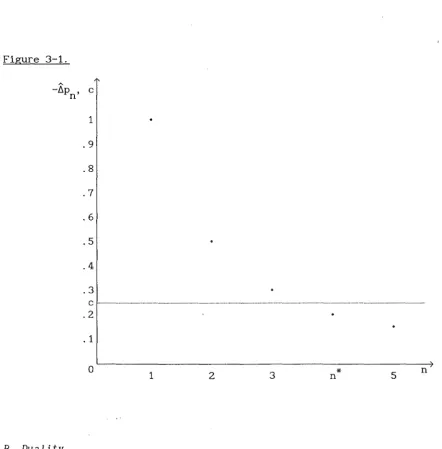
dp.This is illustrated in Figure 3-1 for the case where f is a uniform density of prices over the interval [0, 6], and c = 0.25.
Figure 3-1.
-l1
p n' c1
.9 .8
.7
.6
.5 .4
.3
c ... . . 2
.1
o
1 2 3B. Duality.
*
n 5 n
[image:37.550.46.489.194.643.2]In the present example, the marginal benefit of search is positive but decreasing in n. The dual function therefore exists with
C(n)
The dual function provides a convenient way of relating the distribution of search costs to the distribution of sample sizes. The diminishing marginal benefit of search implies that C(n) is monotonic decreasing. Therefore, for any consumer
c < C(n) n*(c) > n. V n (3-3-2)
It follows that the proportion of consumers whose optimal sample size is in excess of n will be the proportion whose search cost does not exceed C(n). That is,
B(n) = H(C(n)) (3-3-3)
B(O), the proportion of consumers who sample at least one firm, exists and equals one. It will be convenient in the derivation of some equations later in the chapter to be able to use equation (3-3-3) when n=O. We therefore define C(O) to give H(C(O)) = 1, and, so that (3-3-2) holds, C(O) > C(l). Formally,
C(O) - max{ min{cIH(c)=l}, C(l) }
Note the importance of the dual function having a continuous range and a discrete domain. The relationship between Band H could not be stated so easily as in equation (3-3-3) using the primal-that is, a relationship
n*(c) takes only discrete values.
The only property of the example of independent sampling from a continuum of prices that mattered in the above analysis was that the marginal benefit of search was positive and decreasing. As long as this property holds for a given search strategy, C will be a non-decreasing function defined for all positive n, and equation (3-3-2) will hold. This is why the level of generality used here can be maintained: The marginal benefit of search and sufficient condit-ions guaranteeing diminishing returns to search are easily stated as functcondit-ions of the set of gn; no specific search strategy needs to be appealed to. These conditions are derived in the following section under a number of assumptions about consumers' demand.
3.4 Diminishing Returns.
The characteristics of a search strategy that ensure a positive but decreasing marginal benefit of search can be described by a property of sampling distributions that is termed here distributional dominance.
Definition 3-2:
Let fa and fb be real-valued functions defined over {xl ,x2' ... xJ} with xl < x2 < '" < xJ and let Fa and Fb be the cumulative functions
with
j
F (x.)
=
L
f (x.), a J i=l a 1Then Fa distributionally dominates Fb if and only if
F a (x.) J
v
j,Distributional dominance is the same concept as stochastic dominance, except that the latter is defined only over distribution functions. Here it is not required that Fa and Fb be non-decreasing or that Fa(xj ) = Fb(xj ) = 1. The new term is introduced so that the concept can also be applied to the first differences of distribution functions.
Assumption 3-1:
a) G distributionally dominates G l' n n+ b) ~G n+ 1 distributionally dominates ~G n .
The following property of distributional dominance is the basis of its role in search theory:
Lemma 3-1:
A necessary and sufficient condition for F to distributionally dominate a
j
L
p(x.)· (f (x.) - fb(X.)) > «) 0j=1 J a J J
for all monotonic increasing (decreasing) functions p.
Proof:
This is a well-known result for stochastic dominance. 2 To show that it also holds for distributional dominance, a proof is given in Appendix A.
Assumption 3-1 is sufficient to guarantee a diminishing rate of decrease in the expected minimum sampled price. When demand is inelastic, the marginal
o
price reduction is proportional to the marginal benefit, and so Assumption 3-1
2
ensures the existence of the dual function C. With elastic demand, additional assumptions are required. To emphasize the role of Assumption 3-1, the case of inelastic demand is presented first.
A. Inelastic Demand.
Let the consumer have a demand,
X,
for the searched-for good that is independent of both price and income. The total expected cost that the consumer minimizes isJ
XLP.'g (p.) + (n-1)c.
j=1 J n J
Proposition 3-1:
If Assumption 3-1 holds, and if consumers have inelastic demand, then the function C exists and is non-increasing with
C(n)
Proof:
J
= -X
L
P .L1g (p.) j=1 J n JAssumption 3-1 and Lemma 3-1 together imply that
J
L
(P.,g +1(P.) - p.'g (P.)) j=1 J n J J n JJ
=
L
p,' L1g (p.) < 0j=1 J n J
J
and
L
p.L1 g (p.) 2j=1 J n J >
o
J
C(n)
=
-Xflp
n=
-X E p. ·flg (p.)j=1 J n J
J
and flC(n)
=
-X Ep.·fl2g (p.) < O.j=1 J n J
Also,
B. Elastic Demand with Quasilinear Utility.
(3-4-1)
(3-4-2)
o
The formulation with inelastic demand can be simply re-interpreted to allow for negatively sloped demand. Let consumers maximize expected utility with indirect utility functions of the form
u
=
V(p) + I - c, (3-4-3)where V'(p) ~ 0, I is income, and c can either be interpreted as a financial
cost or a direct utility cost representing the irritation of search.
Proposition 3-2:
If Assumption 3-1 holds, and if consumers have quasilinear utility, then the function C exists and is non-increasing with
J
C(n)
=
flV
n = E V(p.)·flg (p.)j=1 J n J (3-4-4)
Proof:
The proof follows as for Proposition 3-1, substituting -V(p.) for p ..
J J
o
With this formulation, the optimal sample size is given by
(3-4-5)
C. General Demand.
Now let consumers' indirect utility take the general form
Yep, p, I, n), I - w - (n-1)c
where p is the random price of the searched for good, p is the vector of all other prices (known with certainty), w is the pre-search wealth and so I is income available for consumption, and n as the fourth argument represents the direct effect search has on utility.3
We have already seen that Assumption 3-1 implies diminishing marginal price reductions. To ensure that this also implies diminishing marginal utility, the following assumptions are required:
Assumption 3-2:
(a) a2y aI2
~ 0
(b) aapaI 2y ~ 0
(c) a2y an21I
~ 0
(d)
a:(~~II)
~ 0(e)
a~ (~~I
I) ~ 0
Proposition 3-3:
If Assumptions 3-1 and 3-2 bold, then, in the problem with general utility functions, C exists, is non-increasing, and is the solution to
3
J
~V n =
E
V(p.,p,w-(n-l)C(n),n)·g (p.)j=1 J . n J
=
o
(3-4-6)with n*= min{ nln E 2+\0, ~V (p.) ~ c }
n J (3-4-7)
Proof:
Given in Appendix A.
The role of Assumption 3-2 is straightforward. There are two costs to searching: the financial cost (-
~~)
and the direct cost(~~II)'
To demon-strate diminishing returns to search, it is required that these costs be non-decreasing in n. As n increases, income is reduced due to the financial cost, and also the expected minimum price is reduced. The second partial derivatives therefore involve n, I, and p.This formulation of the consumer search problem in terms of the indirect
o
utility of price is due to Manning and Morgan (1982) who considered FSS search from a continuous distribution of prices. The contribution here is to extend that formulation to allow different search strategies and search from discrete price distributions. Two differences in approach between the Manning and
Morgan paper and this chapter merit comment. First, in their model n is regarded as a continuous variable, and second, they assume search has a financial cost only.
When n is continuous it can be shown that
V
n is concave in n, implying diminishing returns to search. For instance, Manning and Morgan's Appendix Theorems 1 and 2 are the continuous form of Lemma 3-1 in this chapter applied to the particular functional form of g appropriate for sampling from an continuous distribution of prices.
differentiable function of parameters such as income, the spread of prices etc. With the exception of two Slutsky equations (which have no interpretation when n is discrete), equivalent results to those presented by Manning and Morgan can be easily derived here by considering the effect on C(n). If C(n)
increases for all n when some parameter changes, then ~n* ~
o.
One such result is that the sample size will increase with income. Manning and Morgan comment that this result runs counter to the conventional wisdom about search. It is, however, a natural consequence of search having a financial cost only. When extending the model to allow direct effects on
utility from search, Assumptions 3-2 (d) and (e) are required to ensure that C is decreasing, from which
a~~n)
> 0 follows. It is these assumptions that violate the intuition underlying the conventional wisdom, which is that a greater income will imply a greater willingness to pay to avoid the irritation of search.3.5 Examples of Different Search Strategies.
The definition of a search strategy as a set of probability distributions over {Pl' .. , PJ} for all n encompasses a wide variety of consumer behaviour. The purpose of this section is to illustrate a number of these variations and to check whether Assumption 3-1 holds in each case. Section 3.3 gave the example of sampling from a continuum of prices; the three strategies given in this section all involve sampling from discrete distributions.
Strategy 1: With-Replacement Sampling.
Let F(p.) be the probability, independent of n, that a firm chosen at J
random will charge a price not exceeding p .. Then J
so ~G n J (p.)
=
(1 - F(p.))nF(p.) J J > 0so Assumption 3-1 holds.
Also gn(PJ')
=
(l-F(p. ))n - (l-F(p.))n J-1 J (3-5-1)and ~g n J (p.) = (l-F(p.))nF (p.) J J (3-5-2)
strategy 2: Without-Replacement Sampling.
Let there be J firms, each charging a different price and each equally likely to be sampled, so
Then 1-G n (p.) is found using the hypergeometric distribution J
giving
so
1-G (p.) n J
{(J-j)! (J-n)!
~G
(p.) = (J-j)! [(J-n)! _ (J-n-1)!]n J J! (J-j-n)! (J-j-n-1)!
~G (p.)
n J
((J-j)!) ( (J-n-1)! ) J! (J-j-n-l)! J-j-n
(~
_ 1)((J-j)!) ((J-n-1)!). J! (J-j-n)! J
n :s J-j
otherwise
n :s J-j
n :s J-j
2 (-(J-j)!) ((J-n-2)!) ('-1)' fl G (p.) n J
=
J! (J-j-n)! J J andso fl G (p.) 2 n J
{
<
0= 0
so Assumption 3-1 holds.
Also,
and
g (p.) n J = G n (p.) -J G n (p. 1)
J-flg (p.)
n J
{
(J-n)! (J- j)! n
=
J! (J-j-n+l)!o
{
(J-n-l
~!
(J-j)! ((J+1)- (n+1) .)J! (J-J-n+l)! J
=
o
n !:: J-j
n !:: J-j+l otherwise
n !:: J-j+l otherwise
n !:: J-j+l
n !:: J-l
otherwise
(3-5-3)
(3-5-4)
By adding consecutive terms of g (p.) together, the case of several firms
n J
charging the same price can be allowed for without affecting dominance.
strategy 3: An Example of Firm-Specific Sampling.
Let there be three firms, labelled A,B,C, posting prices Pi < P2 < P3' As usual the consumer does not know the matching between firms and prices, but has prior beliefs. These are summarized in Table 3-1 which gives the
(independent) probabilities of each firm's charging each price.
Table 3-1.
[image:47.550.41.513.83.409.2]consumers use without-replacement sampling in the order (ABC) that is, firm A is sampled when the sample size is one, and firms A and B when the sample size is two- then the sampling distribution is given by Table 3-2. In this case, the required properties of distributional dominance hold.
Table 3-2. Sampling order: (ABC)
If, however, the search strategy is to sample in the order (ACB), then the sampling distribution is as given in :~able 3-3, and Assumption 3-1 (b) is
violated. Note that the strategy with order (ABC) is better for the consumer than that with order (ACB) in the sense that the former results in an expected minimum price that is no greater than the latter for each sample size and is
less than for a sample of size 2. If the consumer were able to choose the order in which to visit firms- that is, if he were able to choose his search strategy- then (ABC) would be the opUmal order and Assumption 3-1 would hold.
Table 3-3. Sampling order: (ACB)
3.6 Demand Functions.
this section: demand functions are derived that are expressed in terms of C and {gl,gZ' .. , goo}· To obtain the functions for specific search strategies, the particular values for these variables, such as in the examples of the preceding section, need only be substituted in as the final stage of the derivation .. As long as the dual function exists, this method is appropriate.
As noted earlier, the main effect that search has on the demand functions facing firms is through its effect on the number of consumers purchasing from particular firms. When consumer demand 1s inelastic, this is the only thing producing elastic demand functions for firms. When consumer demand is elastic and search has a financial cost, the firms' demand functions can be affected by income effects as well. To emphas~ze these separate effects, we consider the cases of inelastic consumer demand, quasilinear utility, and general utility separately.
A. Inelastic Demand.
Let q. denote the expected demand facing firm j (where "firm j" refers to .J
the firm charging Pj)' and let there be M consumers each of whom buys X units of the good.
Theorem 3-1:
When consumer demand is inelasLLc, if there is a finite number of firms, 'V i;tj, then
q. = XM [
E
H ( C ( n) ) . togn (p .) + g 1 (p . )1
Proof:
By the definition of b(n),
00
qj = XM n=l
L
b(n)'g (p.) n J (3-6-1)= XM [ (B(n-l)-B(n)) ·gn(P.)
n=l J
= XM[ ;: B(n)o6gn (po) + gl (Po)]
n=l J J
= XM[ ;: H(C(n))o6g (po) + gl (p
j)]
(3-6-2)n=l n J
When p.*p. for j*i, then gl(P.) and ~g (p.) are constant and demand is
J 1 J n J
differentiable with
Now from (3-