University of Warwick institutional repository: http://go.warwick.ac.uk/wrap A Thesis Submitted for the Degree of PhD at the University of Warwick
http://go.warwick.ac.uk/wrap/61752
This thesis is made available online and is protected by original copyright. Please scroll down to view the document itself.
by
K.K. Murthy.
B.E •• M.E.
A thesis submitted to the University
of Warwick for the degree of
Doctor of Philosophy
School of Engineering Science
AVAILABLE
Acknowledgements (i)
Preface (ii)
PART I - Performance of the Second-order
Relay Servo under Non-ideal
Operating Conditions. 1
List of Principal Symbols. 2
l~ Introduction.
2. The Optimum System.
2.1, The Total Response Time.
3.
Effect of Departures from IdealSwitching Conditions.
3.1.
Errors in the Switching Locus.3.2. Effect of Friction.
3.3.
Relay Hysteresis and Threshold.3.4. Time Lags and Time Delays.
4. Sensitivity of the Optimal System.
5. Stability of the System.
6. Analogue Computer Studies.
6.1 •. Discussion of Results.
7.
Conclusions.8.
Appendices.A~l. Derivation of Response Time when
4
1015
16 16 17 19 19 20 2633
35
37
,A.2.
wp>wo'Derivation of Response Time when
wp<wo'
The Published Paper.
38
A.3.
40
44
PART II - Self-Optimisation using
Pseudo-Random Binary Sequences. 45
List of Principal Symbols.
47
1. Introduction. 50
3.2. Response of a Particular System. 69
4.
System with .Continuous Parameter Adjustment. 73 4.1. Response of a Particular System. 804.2. Dynamic Compensation. 81
4.2.1. Experimental Results. 82
5.
Effect of Noise. 5.1. General.5.2. Evaluation of Variance.
85
86 5.2.1. Variance of System with
Discontinuous Adjustment. 86 5.2.2. Variance of System with
Continuous Adjustment.
89
5.3.
System Response in the Presence of Noise.6~ Stability of the System with Continuous Adjustment.
92
6.1.6.2.
6.3.
General.System without Dynamics. System with Dynamics.
93
96
99
7.
The Electro-Mechanical Running Averager.7~1~ General. 103
7.2.
Methods of Simulation. 1057.3. Principle of Operation. 106
7.4.
Construction of the Running Averager. 1097.5.
Frequency Response of the RunningAverager. 111
8~ Special Computing Elements. 112
9.
Methods of Synthesis of New Binary Sequences.9.1. General. 115
9.2. Method of Synthesis using a
Non-Linearity. 115
9.3. Method of Synthesis using Impulse
Trains. 121
9.3.1. Necessary Conditions for the
New Sequences. 128
131 10. Conclusions.
11. Appendices.
A.1. Properties of Pseudo-Random
Binary Sequences. 134
A.2. Gain of Adaptive Loop. 137
A.3. Relationship between the Starting
Point of the Chain Code and the
Transient Factor a. 140
A.4. Calculation of the Theor~tical
Response for the System with
Continuous Parameter Adjustment~ 141
A.5. Proof that Certain Types of
Auto-Correlation Functions are
Unrealisable. 147
A.6.. The Published Papers. 148
PART III - Frequency Re9~onse of Linear
Sampled-Data ystems.
1. 2.
3.
4.
Introduction.
Derivation of Gsb(jw)
Stability AnalysYs. Conclusions.
149
150
152
155 158ACKNOWLEDGEMENTS
The author wishes to acknowledge with gratitude
the continual guidance and encouragement of
Professor J.L. Douce and Dr. K.C. Ng and expresses
his appreciation of the many helpful discussions
with his colleagues. during the course of the work
described in this thesis. The author is also
grateful to the Commonwealth Scholarship Commission
in the United Kingdom for the Scholarship award
and to the Board of Governors o~ the Regional
Engineering College. Durgapur. for the grant of
PREFACE
This thesis presents the results of a three
year research project carried out by the author
from October. 1964 to June. 1967 while a
Commonwealth Scholar in this country.
The contents of the thesis are divided into
three parts.
Part I describes the analytical and experimental
studies on a seoond-order b~ng-bang ~ervo under
non-ideal operating'oonditions.
The sen~itivity and
stability of the bang-bang system have been,
investigated •., This work
.waaoarried' out during
1964-65 while a,researoh scholar at the Queen's
Univer~ityof
Belfast,
Part II of the thesis is entitled "Self-optimisation
using Pseudo-Random
Binary Sequences".,
In this part.
the performance of the original hill-climbing
system
which employs discontinuous
parameter adjustment and
of the modified system using continuous paramet~r
adjustment is described.
It is shown that the system
with oontinuous parameter adjustment has a superior
performance.
A novel analogue running averager has
Part III describes an invest~gation
into the
frequency response of a sample-and-hold
element at
certain sampling frequencies.
As a result of the work described.
three papers
have been published and a fourth one has been
accepted for publication.
1.' "A Note on the Performance
of the Second-order
Maximum Effort Controller", X.K. Murthy.
International
Journal of Control, Vol.2, No.3.
September,
1965.
2.' "An Electro-Mechanical
Running Averager",
K.C. Ng and K.K. Murthy. Electronic
Engineering.
March, 1967.
3.
"Recent Advances in a Hill-climbing
System",
X.C. Ng, K.K. Murthy, D.H. Stockwell and
K.R. Morris, Second I.E.E. Convention
on
Advances
in Computer Control, Bristol,
April, 1967.
(Paper 1 is based on Part I and papers 2 and
3
are based on part II)
4.
"Frequency Response
of Linear Sampled-Data
Control Systems", J.L. Douce, X.C. Ng
accepted for publication in 'Controlto
(This paper is based on part III)
All the published papers are enclosed in the
PAR T I
PERFORMANCE OF THE SECOND-ORDER RELAY
SERVO UNDER NON-IDEAL OPERATING
CONDITIONS
SUMMARY
The behaviour of a second-order bang-bang
control system when the system parameters are varied
is investigated. For non-ideal operating conditions.
the response of the bang-bang servo is compared
with that of a saturating servoo The sensitivity
of the bang-ban.g servo for variations in the system
dynamics has been examined. The stability of the
system in the presence of additional time delays
and time lags is investigated. Analogue computer
LIST OF PRINCIPAL
SYMBOLS
9
i
::: Input position and input signal.
90 :::
Output position and output signal.
::: :::
=
Error signal.
:::
:::y
=Output velocity.
u,~
=
Control signal.
a
:::Maximum
developed
torque.
1 .
=
¥
:::
Undamped
resonance frequency.
:::Motor field build-up time constant.
TD
=
Delay time.
TR
=
Response time.
TAB
::: Time taken to travel over the phase path AB.
Kv
=
Gain factor of the stabiliser.
:::
Gain factor of the error processing
non-linearity.
S
=
Switching function.
:::
Initial position x(o).
:::
Coefficient
of viscous friction damping.
w = Plant parameter vector.
:: Nominal design value of motor acceleration.
= Actual motor acceleration.
= Relative sensitivity.
= Maximum value of relative sensitivity.
G(p)
N(m)
= Transfer function of the process.
:: Describing function.
= Phase angle of describing function.
R :: Magnitude of describing function.
1. INTRODUCTION
There are essentially two approaches to the
optimal control problem. One is concerned with
optimising the responses of the controlled variable
to disturbances of the system to be controlled. For
a single variable system. at each instant there is a
known desired value of the controlled variable. The
control engineer is primarily concerned with keeping
the maximum error to a minimum. and then with such
other aspects of the response as the number of
oscillations in the transients due to step disturbances,
the magnitudes of overshoots and undershoots, and
their durations. He is interested in the entire
response and thus simultaneously in many indexes of
performance. Reduction of the maximum system error
cannot normally be achieved regardless of the magnitude
of a step change. over the reduction tha~ can be
attained with linear control functions. Tests have
shown that simple non-linear control functions
definitely improve system response.
The early control engineers intuitively assumed
that any control system error which did not demand
if the maximum available control effort were applied.
Thus, when the control signal is constrained to take
on only its maximum or minimum values. it is called
a 'Steering Function'. Minimum response time is
obtained only if the sign of the steering function
is caused to change in the proper manner.
A 'Switching Function' is the function of the
controlled variable and its derivatives that defines
all the instants at which the steering or control
function must change sign for minimum response time.
A lot of work has been done on these optimum
switched systems. Minimum response time control was
obtained for an Aircraft engine propeller system as
early as 1944 by Oldenbergerl• In 1950, Mcdonald2
published a paper on th~ on-off time optimal control
of second-order systems with bounded inputs. This
was followed in 1951 by phase plane, topological and
analogue computer studies of the same system by
Hopkin
3,
Uttley and Hammond4• Flugg-Lotz5..
publisheda book in 1951 on the bang-bang control of
second-order systems with linear switching functions. West
et a16 in 1954 proposed a method of mechanising the
The second approach to the optimal control
problem is essentially a mathematical one. Busha~4
in 1953. originated this approach. In 1956. Bellman
et al9 gave a general treatment of the optimal
problem. In 1957. the Russian mathematician
Pontryagin published his maximum principle explained
in 1959 by RosonoerlO. Lasalle11 proved that an
on-off control system is the time optimal systemo Since
then. various authors have reported further work on
the mathematics of optimal systems.
In the work being reported in this thesis, the
first essentially engineering approach is takeno
The simplest example of a bang-bang servo is the
relay actuated servo motor position controllero In
all relay or bang-bang control systems, the system
always operates under maximum actuating torque
conditions. For half the time, maximum accelerating
torque is developed and for the other half maximum
e
de~leration torque is developed. In other words.
the direction of the torque is reyersed at exactly
second and fourth quadrants passing through the
origin. The switching from acceleration to
decele-ration takes place on this parabolic switching curveo
Such an optimum switching can be achieved by a suitably
designed non-linear e.rror processing deYice6 to actuate
the relay.
The operaticn of such a switched relay servo
system has been obtained under the following
assumptions:
(i) Inputs limited to step functions.
(ii) Instantaneous switching on the change-over
boundary.
(iii)
(iv)
No time delays present in the syst&m.
Accurate knowledge of the motor dynamics.
The limitation on the admissible inputs is in
general. severeo Bushawl2 has shown that f'or the
response to be optimal. only steps and ramps are
admissible as inputs to the pure inertia servo and
only steps are admissible inputs for the servo with
inertia plus Coulomb or viscous friction.
response and shown that considerable improvement in
performance can be achieved for sinusoidal inputs
also. '
The other two assumptions tend to be in general.
idealistico In practice. instantaneous switching on
the reversal curve cannot take place and finite time
delays have to be taken into account. In addition,
relay r~steresis, contact spacing, etcoo tend to
deteriorate the performance of the system., Time
delays have the effect of permitting the state of
the system to over-travel the switching trajectory,
reverse, over-tr~vel again and so forth. Thus the
trajectory may approach a terminal limit cycleo The
effect of inputs other than the ones considered in
the initial system concept. can also have disturbing
consequenceso
These remarks emphasize the fact that the on-off
control system can be extremely sensitive to variations
in system parameters. The qualitative nature of the
deterioration in performance under the non-ideal
conditions is investigated in this work. It is compared
with the performance of a saturating servo system
with a small linear regime and shown that the
additional lago The sensitivity of the system for
variations in the motor dynamics is examinedo If
the range of variations of the system parameter is
known, it is shown that by suitably designing the
switching curve, the response can be made to be least
2., THE OPTTMUM SYSTEM
The system used for the analysis is schematically
shown in Fi.g"lo The torque limited servo motor is
actuated by a relay so that the motor always develops
maximum torque the direction of which depends upon
the position of the relay or the sign of the control
signal uo Frictional forces in the motor are neglected.
The transfer function can then be represented by
G(p)
Th.e Equations of the switching curves or traj
ee·t-ories on which the po Lar-Lty of the control signal is
reversed is to be derivedQ since these are necessary
for synthesisi.ng the controller. Either a differential
equation approach or a matrix notation can be used.
The matrix notation is particularly suitable for
higher order systems.
For the system under consideration.
to
(1)
90 = ul • • •• 0
By defining
XJ.
= 90•
x2 =
the system Equation can be written in the matrix form
e x
-
A x + Bu o 0 • • 0 (2)where
A is an n x n matrix9 B is an n x m matrix
(m ~ n )9 .! is an n-vector and u an m-veot or-,
In our caseQ
The solution of Equation (2) is obtained by the
method of variation of parametersQ and is given by
Bellman9 as
x
=-1
Q
B u dt + 00000 (3)where the matrix
Q
is defined in such a way as tosatisfy the Equation
o
Q = 'A Q • • • • 0
and Q(O) = I • • • • 0 (5 )
and ~o is x at t = 00 (~o lies on the last
Equation
(4)
represents four simultaneous differentialequations:
o o o •
(6)
The solution of this set of equations with the
constraints of Equation (5) yields
• • • •• (7)
••••• (8)
When t = T, origin is reached and from Equation (3)
we get
T
- f
o
Solving the two simultaneous equations represented
x =
-0
-1
-Q B u dt ••••• (9)
by (9) • we get
u T2
Xo =
-r
1 9 Xo = - u1T1 2
Eliminating T between these two Equations, the
s
=x 2
2
2ul =
o
••••• (10)Equation (10) defines the curve in the phase plane
at which the control function ~ must change sign
for optimal response. On the phase plane (Xl=X,
x2=y), Equation (10) becomes
s
= x -o
••••• (11)which is the Equation of a Parabola.
For the system of Figol,
= = +- --2a
T
where 'a' is the maximum torque developed by the motor.
Hence Equation (11) can be written as
s
= +~
2ax=
T
o
•• ••• (12)positive sign in Region (i) and negative sign in
Region (ii).
s
= y Iyl + 2ax 0 (13)7
= •• • ••for S< o , the output of the relay is positive
for S >0. the output of the relay is negative
In Fig.2. ABC is a typical trajectory. With
correct reversal from acceleration to deceleration
on the critical trajectory, the response will be
optimumo This means that for minimum time of response.
all the constant acceleration trajectories from
different initial conditions must change over to the
same critical decelerating trajectory through the
origino
At the point of change-over B.
= - h /2
o
1/2 (aho/T')
)
l
• • • •• (14)=
The optimum change-over can be achieved by
mechanising Equation (13) using a non-linear error
processing device and a linear velocity feedback
stabilisation ter.m which has been called the SERME
2.1. The Total Response Time
The total time of response can be calculated easily
from the above equations.
It is assumed that no over-shoot is to occur at
c.
in Region
(i)
Integrating,
.
at/T2eo =
At B, 90
.
=
YB = atIlT2Hence TAB = YBT2/a
Substituting for YB from Equation (14), we get
=
Since the change-over takes place at the half-way point
=
••••• (15)
Thus from Equation
(15),
it is seen that the responsetime is dependent on the magnitude of the input step
only since 'a', th~ maximum torque developed is a
constant for a given servo motor. The response time
versus the input step magnitude characteristic is
,
30 EFFECT OF DEPARTURES FROM IDEAL SWITCHING
CONDITIONS
It is again emphasised that the response of the
system is optimal only when the assumptions of Section 1
(page
7)
are valido In this Sectionv some of thecommon practical departures from the ideal conditions
and their effect on the system response are consideredu
3010 Errors in the Switching Locus
When the switching trajectory is mechanisedv the
actual realisation of the switching curve may not
follow the ideal parabolic curve exactlyo Let us
first consider the effect when the actual switching
curve is nearer to the error axis than the ideal
curveo This is shown in Figo3(a)o Ar~ representative
point P moves along the acceleration trajectory till
it meets the change~over boundary at PI at which the
relay re~e~es the torqueo The system must then
follow a deceleration trajectory. The switching
locus itself is not a deceleration trajectory, so the
state point tries to follow the deceleration trajectory
.
"
P P which passes through Plo This causes the relay
to reverse again and follow an acceleration ~rajectory
switching locus to the origin with the relay
chatter-ing at high frequency. This response of the system
is slower than the ideal response.
On the other hand, if the actual switching
trajectory is nearer to the y-axis than the ideal,
the motion is shown in Fig.3(b). Relay reverses at
PI' follows the deceleration trajectory through PI'
reverses again at P2 and so ono Thus, the system
has overshoots and undershoots and the amplitude of
successlve oscillations decreases and the frequency
increases until the system reaches the origin.
3020 Effect of Friction
The effect of friction on the ideal trajectory
has been studied by Kazdal59 Stoutl6, Flugge-lotz
5
and otherso In principle, the presence of Coulomb
friction results in bringing the error rate to zero
but not the error when the steady state is reached.
This is not true in practice. In the presence of
friction. in practice, end-point oscillations (a kind
of convergent hunting) as shown in Fig.4(a) are
observed. This results in a larger time to reach the
steady state. If the magnitude of the Coulomb
switching from acceleration to deceleration, improved
performance can be obtained. With this modification
the Equation of the switching trajectory in the
fourth quadrant becomes
s
= 2a (1 + aC) xT2
ainstead of Equation (12) where ac is the magnitude of
Coulomb friction torqueo
If the effect of viscous friction has to be taken
into account properlY9 new switching trajectories
must be derived by solving the Equation
+ =
instead of solving Equation (1).
The solution of this yields the Equation of the
switching trajectory
s
= = 0It is seen that the Equation of the switching
3.3.
Relay Hysteresis and ThresholdThe presence of Hysteresis and Threshold in the
relay characteristic delays the change-over from
acceleration to deceleration. The delayed trajectories
are shown in Fig.4(a). The delayed trajectories are
also parabo1ico Because of the delayed trajectory
not passing through the origin. terminal limit cycles
are observed
17•
These limit cycle oscillations canbe stable or unstable. The system thus performs
wasteful gyrations resulting in an increase in response
time~ •
3.4.
Time Lags and Time DelaysTime delays and time lags are inevitably present
in any practical system. The effect is again to delay
the change-over from acceleration to deceleration.
The effect of time delay is shown in Fig.4(b). These
may produce terminal limit cycles. If the time constant
of the lag and the delay times are known. the magnitude
and frequency of the limit cycle can be calculated
40
SENSITIVITY
OF THE OPTIMAL
SYSTEM
In any successful optimal design. the achievement
of the desired response and its relative insensitivity
to system parameter changes or for small component
imperfeotions is one of the basic requirements. In
many applicationsQ the invariability of the response
or the insensitivity to parameter changes is even
more im.portant than nominal behaviour.
Consider the general control process described
by the Equation
•
x
=
f [~(t).~(t).~ ]
.0000(16)
where
~ is the state vector
~(t) is the control vector
w
is the plant parameter vectorIf
C =
T
f
¢(x,u..) dto
--••••• (17)
is the performance index on the basis of which the
optimum ~ is determined, then by solving Equations
Let
U opt =
t [~(
t ).z,(
t). t ] ••••• (18)The plant parameter vector ~ which appears in
Equation (16) seldom corresponds to the value of ~
in Equation (18) due to component inaccuracies,
environment effects, etc. Hence if w is the actual
-p
value of the plant vector, then from Equations (16)
and (18), we have
i
=
f [ ~(t). {~[ ~(t). :!!o(t). tJ}
'!!pJOptimum operation requires that ~o
=
~p'For every actual plant parameter value ~p' a best
value of ~o exists such that the performance index C
has an optimum value. Under such conditions, when
W is varying, C can be considered as a function of
-p
~o and wp' Therefore variations in C due to small
parameter variations is given by
AC
=Analytical solution for the evaluation of
AC
is inOne possible criterion of performance based on
the insensitivity to parameter changes would be to
minimise the maximum deviation from the optimal
behaviouro This can be achieved by evaluating the
"Relative sensitivity" and choosing the control
parameter such that the maximum value of the relative
sensitivity is a minimum19•
Relatiye sensit.ivity for the control ~(t) is
defined19 to be the difference between the actual
value of the performance index C(!!oowp) and that
which would be obtained if the control were the
optimal for the plant paramet ez- w 9 C(w ,wp> divided
.. -p p
-by the optimal performance index for normalisationo
=
c
(!!o9!_P) C(!!p'!!p)I
C(!!pII.!p )
I
••••• (19)
It is seen from Equation (19) that the relative
sensitivity SR is always a positive number and that
the optimal value of SR is zero. regardless of the
value of the performance index itself.
The relative sensitivity function can now be
evaluated for the bang-bang system considered in
From Equation (1). the plant considered in Section 2
is described by
=
=
where lui~ 1The control signal u is given by
u ~ - sign [
xl/
2 + y]
(2w )1/2
o
where
2
When wp
=
woQ the system is optimal.For a given range of variation in wp(i.e. in
'a)
a suitable value of wo(ioeo
XV)
can be chosen suchthat the maximum relative sensitivity is a minimum
thus resulting in a system which is relatively
insensitive to these variations.
The performance index for this system is the time
to reach the optimum from 'any initial point in the
phase planeo From Equation (15), the response time
=
=
••••• (20)Let us consider the normalised system in which
h =1, and nominal w =1. wTl is assumed to vary in the
o p ~
range 0.7,wp,lo3. That is a variation of ~30 percent
from the nominal value.
When wp>wo' as discussed in Section 3.1. the
system chatters to the origin along the switching
curve and the response time can be shown to be given
by (Appendix Aol)
=
•• •• • (21)
However. when wp<wo' again as discussed in
Section 301. an infini·te number of switchings are
required for the state point to reach the origin and
the response time can be derived as (Appendix A.2)
From Equations (20), (21) and (22). the relative
sensitivity
sR
is given by[1+
. 1/2
sR
1 ~]
1 ,=
-12
Wo..(2
=
w 1/2 w -w1/2
(l+wE)
[l-(wO
+wP) ]
o 0 p
1 , W ~w
p 0 ) ) )
l
) ~ ~ (23) •••••Equation (23) is plotted in Fig.5 as a function of
wp over the assumed range of wp for different values
of wo. The value of Wo is to be chosen such that
the maximum relative sensitivity SM is a minimum.
From Fig.5 it is seen that
SM (0.7, 1.3)
=
0.2SM (1.3. 0.7) = 1.45
8M (1. 0.7) = 0.89
and so on. Hence Wo
=
0.7 gives the minimum valuefor SM. Thus. when Wo is chosen ~s 0.7. the response
time will be'within ~ = 2.35 seconds for a
varia-.f0.7
tion of wp in the range 0.7,Wp,1.3. Hence by choosing
.
the switching curve corresponding to wo=0.7. the best
In this Section, the stability of the relay servo
considered in Section 2 is discussed. As stated in
Section 3. presence of time delays,.lags, etc. are
inevitable in practice and their presence gives rise
to non-ideal switching trajectorieso The object of
stability analysis for the bang-bang servo is to
determine the magnitude and frequency of the limit
cycle that may be present due to the non-optimum
operating conditions that may exist.
The system of Section 2 can be represented by the
block diagram of Figo6(a)o The stability analysis of
the system of Fig06(a) is difficult since the two
non-linearities are not in simple cascade. Since the
purpose of the non-linearity NI and the velocity
feed-back signal is to satisfy Equation (13), these can
be replaced by a single non-linearity satisfying the
boundary Equation (13)0 The equivalent system is
shown in Figo6(b)o The control computer obeys
Equation (13) and generates the control signal ec•
I
Now since NI and N2 are in simple cascade, stability
analysis is possible by the describing function
•
and N2 is only amplitude dependent. The frequency
•
dependent describing function of NI can be evaluated
from Equation (13). It is assumed that the system
has sufficient low-pass filtering effect so that the
harmonics above the fundamental ma.y be neglected.
The non-linearity N2 is of zero memory type and
does not 'introduce a phase shift to the describing
•
function. But NI contributes a phase shift to the
describing function which can be evaluated (Fig.7).
Let N(m) be the describing function of the two
non-linearities in cascade. Let
N(m) = R exp (j¢) ••••• (24)
If x = m cos wt,
. ';~I~""
the output of N2 is a square wave of magnitude ~a.
Hence the magnitude R of the describing function is
R , ••••• (25)
The phase shift
¢
is calculated by considering!
the control computer.
The control computer in Fig.6(b) evaluates the
2ax
ec
=
Y IYI
+ ~The phase shift is found by evaluating the instant
at which ec goes through zero
(Fig.?).
Consideringthe one half.cycle in which Y does not change sign,
2am
m2w2
')
ec =
T2 cos wt
-
san" wtec = 0
when
2am
cos wt m2w2 sin2 wt 0 (26)
. T2
-
=• • • • 0
Solving Equation (26) for cos wt, we get
I
cos
wt
=
cos 9=
f.;{-
;2
+[<;/
+<w
2
ml2J ~ }
The phase angle
¢
of the describing function=
thephase angle at which x passes through zero the
phase angle
e.
Therefore
N(m)
= ~
exp{j
Sin-{
*{;~
+ [(;/ + (w2m)
2J2}]}
••••• (27)
The amplitude and phase of N(m) as a function of
m are plotted in Fig.8.
If G(jw) is the transfer function of the control
process, then by Nyquist stability criterion, the
limit cycle must adjust itself to satisfy the Equation
- N(m)
=G(jw)
1 • • • • •(28)
The limit cycle may give rise to stable or
unstable oscillations.
This' can be easily checked
•
by plotting
G(1jw)
and
- N(m).
Since - N(m) is
frequency dependent. a family of N(m) curves for
different values of ware
to be plotted in the G(jw)
1
plane.
The point of intersection of
G(jw)
and
- N(m)
that corresponds to the same frequency on
both the curves gives the magnitude an~ frequency of
the limit cycle.
Alternatively. an analytical
solution can be obtained by equating the amplitudes
Simple Lag
:-If a simple lag representing the motor field
build-up time constant which was neglected earlier,
is included with the process of Section 2,
where Tl is the time constant of the lag.
Hence from Equation (28)',we have
1
=
CA)2T2(1
+w2Ti)2 exp
[j
tan-l(WT'l)]
••••• (29)
The amplitude and frequency of the limit cycle
are obtained by equating the magnitudes and phase
This results in
w
=
0..447
T1
Tl 2
5061 a (r)
} ••••• (30)
m =
From Equation (30) the amplitude and frequency
of the limit cycle can be calculated. It is seen
that the period of the limit cycle is proportional
to TI and the amplitude proportional to (TI/T)2.
Time Delay
:-If a pure time delay of magnitude TD is present
instead of a lag of time constant TI, proceeding in
a similar way, it can be shown that
w = 00485
TD
Tn 2
m = 5042 a (r)
} ••••• (31)
Thus the period and amplitude of the l~mit cycle
are again proportional to TD and (Tn/T)2 respectively.
Time Delay and Time Lag
-:-If both the time delay and the lag are present,
the same method can be applied to derive expressions
It can be shown that
1
w2=
-(Tl+TD)(~2+8)+{~4(Tl+TD)2+16rt[Ti+(Tl+TD)2J}2
2(Tl+Tn)[~2Ti-4(Tl+Tn)2]
m
=
•• ••• (32)
From Equation (32). wand m can be evaluated
6. ANALOGUE COMPUTER STUDIES
As pointed out in Sections
3
and4.
the bang-bangsystem is sensitive to departures from ideal operating
conditions and parameter variations. The deterioration
in the performance of the ideal system under these
operating conditions is studied by simulating the
system on the analogue computer. For comparison of
the performance under these different operating
conditions, a common performance index is necessary.
The time required to bring the state point to the
origin from an initial state in the phase plane is
chosen as the performance index. The response time
(TR) is defined to be the time taken for both the
error and error rates to become zero simultaneously
following an initial step disturbance to the system.
,
In the presence of terminal limit cycles, the error
I
and error rates cannot become zero. Hence response
time is reckoned as the time required to bring the
error and error rates into a small region around the
origin. This region is chosen to be a small rhombus
enclosing the origin.
The performance of the bang-bang controller is
parameter chosen for variation is the gain factor of
the stabilising network. When the stabiliser gain
factor is adjusted to have the critical value. the
bang-bang system has the optimal response and the
state point reaches the origin without any overshoot.
It ia easily seen that the critical value of the gain
factor is given by
K (critical)
V'
where Kl is the gain factor of the error processing
non-linearity.
The effect of additional lags representing field
build-up time constant of the motor on both the
bang-bang system and the saturating system are
studied. The magnitude and frequency of the terminal
limit cycle when the additional time lag and time
delay are present are measured and compared with the
calculated values using Equation (32).
The block diagram of the analogue computer set-up
is shown in Fig.9. The non-linear unit$ are built
using biased diode circuits. The bang-bang
characte-ristic has negligible hysteresis and threshold
effects. Response time ls measured by measuring the
a constant DoCo voltage is applied at the same instant
as the input step is applied to the systemo The
time delay is simulated using fourth order Pade'
approximation58• In the simulation. the saturation
characteristic had a slope of 10 and the time constant
1
of the additional lag
-ro
the integrator timeconstanto
601. Discussion of Results
The results of the computer studies are shown
in Figs. 10 and 11. It is seen that, from Fig.lO,
the theoretical and the practical response time
characteristics agree very closely for the system,
under the ideal conditions. It is seen that the
saturating system with the stabiliser gain set to
correspond to critical damping takes about 5 percent
more time to reach the origin than the bang-bang
system with critical stabiliser gain. Fig.ll shows
the response time characteristics for the different
non-ideal conditions. The bang-bang system is more
sensitive to changes in stabiliser gain than the
saturating system as can be seen from Figs.ll(a) and
ll(b). The response time increases by about 32 percent
value by 10 percent I.n the case of bang-bang system,
as compared to an increase of about 13 percent only
for the saturating system. The magnitude of the
overshoot or undershoot for the bang-bang system
can be calculated from the expression
[
K2. I)]
ho 1 T'z,
Ta
-
··~vx =
o.s ..
[ Kf
+K; ]
2a
where ho is the magnlt:ude of the step input"
The inclusion of the additional lag introduces
terminal limit cycles.. The response time for the
bang-bang system increases by about 45 percent with
the lag as compared to an increase of onl.y 3 to 4
percent for the saturati.ng system, as can be seen
from Figs ..ll(c) and (d) ..
When both a time delay and a lag are included,
the magnitude and frequency of the resulting limit
cycle in the bang-bang system has been measured ..
Fig.12 shows that the measured values agree closely
7. CONCLUSIONS
From experimental studies on the Analogue
computer, it has been shown that the performance of
the bang-bang controller is optimum only when the
conditions obtainable are ideal. In the presence
of switching curve errors, time lags and time delays
the saturating servo has a better performance. The
bang-bang servo is more sensitive to parameter
variations and non-ideal conditions than the
saturat-ing servo. The linear operating regime in
thesatu-rating servo is also extremely useful in eliminating
terminal limit cycles.
The stability of the SERME system has been studied
and expressions for the magnitude and fre~uency of
the limit cycle have been derived. Experimental
\ vfilues agree closely with the theoretically predicted
~:
values.
When the motor dynamics vary. if the range of
these variations are known, it has been shown that
by suitably altering the switching curve it is
possible to obtain a system response which is least
8.
APPENDICESA.1. Derivation of Response Time when w'> Wo
When the motor dynamics are such that wp>wo'
the nature of the response is similar to the case
when the switching curve is nearer the error axis
than the ideal curve as discussed in Section 3.1.
The state point reaches the origin along the
switch-ing curve, the relay chattering at high frequency.
For the calculation of response time, it can be
assumed that the system moves to the origin along
the switching curve. A typical trajectory is shown
in Fig.lJ(a) 0
•
The system Equation is given by
..
x =
The time required for the path PPI [Figo13(a)]
is given by
•••• 0 (A.1)
The motion along the path PP1 is described by
2 ;2
(xP1- ho)
Y - Yo = - 2w
P1 P
2
(xp - ho> (A.2 )
or
As point
PI
is on the deceleration trajectorypassing through the origin.
YPI
is also givenby
= ••••• (A.3)
(A.2) and
1/2 (2wpho)
wn
1/2(1+ ~)
o
(A.3). we get From Equations
••••• (A.4)
Hence
1/2 (2ho)
• ••••
(A.5)
The response time for the path PlO is given
by
YPI
(2W12
ho)1/2TPIO
=_-
= W 1/2Wo
wo(l+
vf2)
0
The total response time is hence
1/2 W 1/2
(2ho) (1+
vr-)
o
W 1/2
p
A.2. Derivation of Response Time when w (wo
When wp<wo' the nature of response is similar to
the case when the switching curve is nearer the y-axis
than the ideal curve. There will be more than one
intersection of the state point with the switching
curve as shown in Fig.13(b). There will be overshoots
and undershoot? and the number ofswitchings depends
on the initial position and wp. The total response
time is derived considering that an infinite number
of switchings take place and computing the time for
each switching59• Hence
• •• ex)
As derived in Equation (A.5)
1/2 (2ho)
••••• (A.?)
=
Time required for path PlP2 is given by
••••• (A.8)
2 2
YP2
-
YP1 = 2wp (XP2 - XP1) • 0 .00(A.
9)2
YP2 = - 2w x o • 0• 0
(A.IO)
0 P2
Solving·Equations
(Ao9)
and(AoI0)
and substituting=
x from Equations
(Ao4)
PI
1/2
w
1/2(2Wpho) _(1-
w!)
W·(1+
vf)
o
and
(A03)
givesfor Y and
PI
<>000.
(Aoll)
0000.
(A.12)Proceeding on similar lines the response times for
the paths P2P30 P3P4o 000 can be derived as
1/2 (2ho)
o o o
o o o
o o o
1/2 (2ho)
(1 + a)an-2
.0.00
(A.13)
where
1/2
a
=
[(1-~) /(1+~) ] .
Wo!
w.o
or
A Note on the Performance of the Second-order Maximum Effort Controller]
By K.K. MURTHY
Department of Electrical Engineering, Queen's University of Belfast, Belfast
[Received June 18, 1965]
ABSTRACT
The paper shows experimentally how the second-order maximum effort (bang-bang] servo system performance deteriorates when the system para-meters are varied. With reference to a particular criterion, it experimentally demonstrates the superiority of the torque limited saturating servo as compared to the relay servo when the system parameters are varied. The magnitude and the frequency of the resulting limit cycle for the bang-bang system are calculated.
List of Principal Symbols
Bj= input position and input signal.
Bo= output position and output signal. . x=Bo-Bj=error signal.
00=y= output velocity.
ec= control signal.
,\ = output signal of the relay.
a= maximum developed torque.
w=liT = undamped resonant frequency. Tl =motor field build-up time constant.
tr= response time. :..
K;= gain factor of the stabilizer.
N(m) = describing function.
G(p) = transfer function of the process.
Kl= gain of the error processing non-linearity.
§ 1. INTRODUCTION
FOR a second-order servo system it has beeu shown by West et al. (1954),
Mcdonald (1950), Neiswander and Macneal (1953) and by many other authors that the 'optimum' controller is the 'bang-bang' or the relay system. Such a controller is considered optimum since it takes minimum response time to reach the quiescent state following an applied input disturbance. The admissible input disturbances are steps and ramps, in general, though West and Nikiforuk (1956) have shown that considerable improvement in performance could be achieved for sinusoidal inputs also.
system always operates under maximum actuating torque conditions. For half the time, maximum acceleration torque is developed and for the other half maximum decelerating torque is developed. In other words, the direction of the torque is to be reversed at exactly half way following an initial disturbance from the state of rest. The switching trajectories for the ideal second-order system are half parabolas in the second and fourth quadrants passing through the origin. The switching from acceleration to deceleration is to take place on this parabolic switching trajectory. Such an optimum switching can be achieved by a suitably designed non-linear error processing device (West et al. 1954) to actuate the relay.
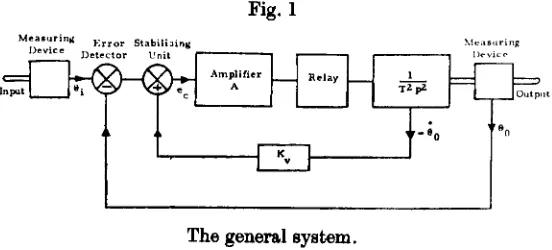
Fig. I
The general system.
The operation of such an optimum relay switching system is derived under the following assumptions.
(i) Inputs limited to step functions.
(ii) Instantaneous switching on the change-over boundary.
(iii) No time delays present in the system.
These ideal conditions are seldom satisfied in practice and the system, in general, will have to be modified even to give very nearly optimum response. Such modifications to give nearly optimum response under the non-ideal conditions cannot easily be derived, analytically.
The purpose of this paper is to show the qualitative nature of the deterioration in performance of the bang-bang system under non-idea.l conditions and to demonstrate the superiority of the saturating ser'\7o under such conditions. The magnitude of the resulting limit cycle in the case of the bang-bang servo under such conditions is calculated.
§2. THE OPTIMUM SYSTEM
[image:57.418.92.368.212.337.2]ee=A(Bi- Bo-KvBo}
or
eelA= -x-KvY on the phase plane. (x=Bo, y=Oo).
The position of the relay which turns on maximum acceleration in one direction or other depends on the sign of (-x-KvY).
Fig.2
~'alon (Ii)
Roaion (I)
Slope ...
i-v
x
The optimum switching boundary.
If a is the maximum torque developed by the motor, then maximum acceleration isa1T2:
00
=
±a/T2 =(a/T2) sign(ee)dy
I
.
ydx =(a T2)SIgn(ee).
}
(1)
or
Integrating, we get:
y2_Yo2= (2aIT2)(x-xo) sign (ee). (2)
Equation (2) represents a family of parabolas on the phase-plane. In fig. 2, ABC is a typical trajectory on the phase-plane. Ifthe response is not to overshoot, then eqn. (2) becomes:
yl- ±2ax/TI; (3)
- ylyl 2ax jT2
S=
ylyl
+2axjT2 =o.
I
(4) or
Equation (4) is the parabolic switching curve;
for S<0, the output of the relay is+ve. for S>0, the output of the relay is - ve ; At the point of change over B (fig.2),
xB = - hoj2, } (5)
YB= (aho/T)1/2.
Thus the change-over from acceleration to deceleration takes place on the curve S=0, at the point XB = - ho/2, for step inputs.
This optimum change-over can be achieved by mechanizing eqn. (4) by a non-linear error processing device and a linear velocity feedba.ck stabilization term which has been called the SER:ME system by West et al.
(1954).
Fig.3
-50 -40 _ 30 -20 -10 1" H! 111
Variation of response time with input.
The Total Response Time
The total response time can be calculated easily from the above equations.
Itis assumed that no overshoot is to occur (at C):
110=+a/T2 in region (i) integrating,
Oo=at/T2.
At B,
8
0=YB=atB/T2. Hence tB =yBT2/a•Thus, from eqn. (6), it is seen that the response time is dependent on the magnitude of the input step only sincea,the maximum torque developed is a constant for a given servo motor .. The response time versus input step magnitude characteristic is shown in fig. 3.
§3. SENSITIViTY OF THE OPTIMUM SYSTEM
In any successful optimum design the achievement of the desired response and its relative insensitivity to system parameter changes or for small component imperfections is one of the basic requirements. In many applications the invariability of the response is even more important than nominal behaviour. Analysis and synthesis procedures must take account of these requirements, as far as possible.
Consider the general control process described by the equation: x=/[x(t), u(t),w), (7)
where
x
and x are state vectors,u(t) is the control variable vector,
wis the plant parameter vector ..
"
If
0=
J:
F(x,u)dtis the performance index, on the basis of which the optimum uis determined, then by solving equs. (7) and (8), Uopt, in general, can be determined.
Let
(8)
UoPt(t) ='1'[x(t), w(t), tJ. (9)
The plant parameter vector w which appears in (7) seldom corresponds to the value of w used in (9), due to component inaccuracies, environment effects, etc.
From (7) and (9) we have:
x=/[x(t),{'I'[x(t), wo(t),t)}, w); (10) optimum operation requires that w=wo'
Variations in 0due to parameter variations is given by:
!:.O=O(wo, w)-C(wo, wo)· (11)
!:.C cannot be evaluated easily in general, even for small parameter variations analytically (Dorato 1963).
By experimental analysis the effect of parameter variations and other departures from the ideal conditions can be qualitatively observed.
The CfTl'I't of friction on the idenl trajectory ha!i Ix-en studied by Klu:d.,
(IH:;:l), Stout (11153), Flugg-Lotz (11153), and many others. Ideally, tho
pnoM('nc(Jof coulomb frict ion I11URt result in bringing the error rate to zero
but not the error when the steady state is reached, But it ill observed up ...-imontally that this is not true. In the presence of friction, or under highly over damped conditions, end-point oscillations as shown in fig. " 81'\'
observed. This results in a larger settling time required to reach tho
Fig.4
7
Effect of friction and hysteresis on the switching curve.
3.2. ReIllY lIystemJis and Threslwl{l
Presence of an additional time lag (as for example the motor field build-up time constant in the system of §2) or a pure time delay results in delayed switching and may produce terminal limit cycling. Ifthe time constant of the lag or the magnitude of the time delay is known, the magnitude and frequency of the limit cycle can be calculated as shown in §4.
Fig.5
atM.b11iaation
non·linear error processing device
.N.
Re1a.r
NZ
(I 1
Input Output
lIotor
The optimum system.
§4. STABILITY ANALYSIS
The optimum system of §2can be represented by the block diagram of fig.5.
The stability analysis of the system of fig. 5is difficult since the two non-linearities NI and N2are not in simple cascade. Since the purpose of NI and the velocity feed-back stabilization is to satisfy eqn. (4), for purposes of stability analysis, these can be replaced by a single non -linearity satisfying the boundary eqn. (4). The equivalent system is shown in fig. 6. The non-linearity NI' can be thought of as a control computer satisfying eqn. (4). Now since NI' and N2 are in simple cascade, stability analysis is possible by the describing function technique (Douce 1963).
Fig.6
to non-optimum operating conditions that may exist.
In this section, the magnitude and frequoney of the limit cycle due to
the presence of an additional lag with the process of §2 are calculated.
Itis assumed that the system has sufficient low-pass filtering effect so that the harmonics above the fundamental may Le neglected.
The describing function of the two non-Iinearities SI' and SI is evaluatod considering them in cnscade. The non-linearity}.", introduces a phase shift to the describing function, whereas SI does not contribute to the phase shift, Let ..Y(m) he the describing function of the two non-linearities in ('fiN('adc. Let
S(m) =Rexp (i4». (I:!)
Ifx""", ('08 wi, the output of NI is a square wave of magnitude fa.
Hence the magnitude R of the describing function is:
-la
R=-.
'lTm (13)
The ph ase shift
q,
is calculated by considering the control computer. The control computer in fig. 6evaluates the control signal fle:ee=
ylyl
+2axlTI,if ee>O, ,\= -a,
if ee<O, ,\= +a.
The phase shift is found by evaluating the instant at which ee goes through zero. Considering one-half cycle in which
y
does not change sign.ee=2l.11nlTIcoswt - m'wl sinl wt,
eo ....0, when 2amlT' coswt - maw'sin' wt
=
0 (1") or m1w'coslwt +2am/T'coswt -m'w'=O. (15)Solving (15) for coswt we get:
coswt =cos 8=-l/w'm{ -a/Tt +[(a/TI)' +(w'm)l]l/1}. (16)
The phase anglo 4> of the describing function =
phase anglo at which x passes through zero - phase angle O•
•. 4>=
i
-R=sin-1{l/w'm[ -a/T'+ f(aITl)'+ (wlm)I}lil]}.Hence
..Y(III) - (4almn)expU sin-1 [llwl.m{ - alP)' +[(aITl)' +(wtm)I]l.'1}]}. (17)
If G(jw) is the tra.nsfer function of the control process, then by Nyquist stability criterion, the limit cycle must adjust itself to satisfy the equation:
which was neglected earlier, is included in the process of §2,
G(p) =[1/{T2p2(1 +TIP)}], (19) G(jw)= [l/{-T2w2(1 +jTIW)}] (20)
or G(jw}= - (I/T2w2)(1/1 +w2TI2)1/2exp{jtan-l( -wTI)}. (21)
Hence from (18) we have:
(4a/7Tm)exp{jsin-I[(I/w2m){ -a/T2 +[(a/T2)2 +(w2m)2J1/2)]}
=w2T2(1 +w2TI2)1/2exp{jtan-l (wT1)). (22)
The amplitude and frequency of the limit cycle are 'obtained by equating the magnitudes and phase angles in (22) and solving for wand m.
This results in :
w=0'45ITI,
m=5·61a (TIIT)2.
(23) (24)
Equations (23) and (24) give the frequency and amplitude of the limit cycle, respectively.
I t is seen that the period of the limit cycle is proportional to T1and the
amplitude proportional to (T1/T)2.
Ifa pure time delay Tn is present instead of the lag of time constant
T1>p~oceeding in a similar way we can show that
w=O·485
I
Tnand m=5·42a(TnIT)2.
Thus the period and amplitudes of the limit cycle are proportional to Tn and (TnIT)2 respectively.
§5. ANALOGUE COMPUTER STUDIES
As has been observed in §3 the bang-bang system is very sensitive to parameter variations. The deterioration in the performance of the ideal system for parameter variations is studied by simulating the system on an analogue computer. For comparison of the performances under these different operating conditions, a common performance index is necessary. In these studies the total response time required to bring the system to rest for different magnitudes of input step disturbances is chosen as the index. Since the ideal bang-bang system is the minimum response time controller, this performance index is chosen. The response time
to have till'criticnl value. \\'h(,11 the stabilizer gain factor has the critical value the change-over from accvlcrafion to deceleration takes place at exactly the half-way point, resulting in a response running into the stendy state without nny over-shoot, It is ensily seen that the critical value of the gain factor is given by:
K; (criticnl)=K1/2a,
where Kl is tho gain of the error processing non-linearity. Tho response time is measured for different magnitudes of input step,
Fig.7
,
'0
Variation of response time with input. - Theoretical bang-bang.
o
Practical bang-bang.&. System wit h Iimiter.
The parameter chosen for variation is tho gain factor of the stabilizer, The response time is measured for gain factors other than the critical, Additional time lag representing the field build-up time constant of tho motor is included and the I"<'Hpon.'IC time is measured with the stabilizer gain factor unchanged at the critical value.
The same studies are repeated on the system with the bang-bang non-linearity replaced by a Maturating non-non-linearity or a ' limiter' with a small linear regime.
r
)0
--+----~--~~--~--~---~
40 se hc 20 30
(a)
T
•
..
10 20 10 40
(b)
Variation of response time with input.
(a) Bang-bang controller. (b) Controller with limiter. -- Critical gain factor for stabilizer.
o Critical gain factor+ 10%.
&. Critical gain factor-IO%.
Fig.9
'T
6
2·
)0 20 30 40
o
50 h )0 10 10 40
(a) (b)
Variation of response time with input.
(a)Bang-bang controller. (b) Controller with limiter. -- Ideal response.
o
With a lag 1+IT:tPwith the motor.&. With a lag 1+~:tP with the error detector.
• 6·
bang-bang system is more sensitive to changes in the stabilizer gain factor than the system with the limiter. The response time shows an increase of about 30 to 35% in the case of the bang-bang system as compared to all increase of only 12to 15
%
for the system with the limiter, when the stabilizer gain factor is reduced from the best (critical) value by 10%. The inclusion. of the additional lag results in terminal limit cycles of considerable magnitude in addition to the great increase in the response time as can beseen from fig. 9(a). For different values of the motor field build-up time constant Tt, the measured values of the magnitude and frequency of the limit cycle agree very closely with the calculated values using eqns, (23) and (24). Thus, for any departures from the ideal conditions, the performance of the bang-bang controller is seen to deteriorate more, both qualitatively and quantitatively.
§ 6. CONCLUSIONS
By experimental studies on an analogue computer, it has been shown. that the performance of the bang-bang controller is optimum only when the conditions obtainable are ideal. For situations where there is a likelihood of the existence of time lags and parameter variations, the saturating system gives a better response as far as the total response time is concerned. With the additional time lag, the magnitude and frequency of the resulting limit cycle for the bang-bang system have been calculated. The calculated and the observed values agree closely.
The percentage over-shoot observed is larger for the bang-bang system than for the saturating system, under the changed operating conditions, except inthe overdamped case. From fig. 9(a)and (b) it is seen that when the extra lag is added with the motor, the response time increases by nearly 45 to 50% for the bang-bang system as compared to the increase of onlv
3to 4
%
for the saturating system. ~ACK!\OWLEDGMENTS
The author is grateful to Dr. J. L.Douce for his constant guidance and
encouragement during the course of this work. The author is also grateful to the Commonwealth Scholarship Commission ofU.K.for having provided the opportunity to undertake research in this country.
REFERENCES
DORATO, P., 1963,Trans. Amer. Inst. elect. electron. Engrs, AC 8,256.
DOUOE, J. L., 1963,An Introduction to Matherrw,tics of Servomechanisms (English
Universities Press). ,. .
FLUGG-LoTZ, I., 1953, Discontinuous A utomatic Control (Princeton University
Press).. , . , •
GRAHAM, D., and l\ICRUER, D., 1961,Analysi8 of Non-linear Control Sy.~/em ...
NEISWANDER, R. S., and 11AcNEAL, R. H., 1953, Trans. Amer. Inst. elect. Enqre, 72.262.
STOUT, T.M., 1953, Trans. Amer. Inst. elect. Enqr«, 72,329.
WEST, J. C.,DOUCE, J. L.,and NAYLOR, R., 1954, Proc. Instn elect. Engrs, 101,
166.
WEST, J.C., and NIKIFORUK, P. N., 1956, Trans. Amer. Inst. elect. Enqre, 75.
PAR
T
II
SELF-OPTIMISATION
USING
PSEUDO-RANDOM BINARY SEQUENCES
SUMMARY
In this part of the thesis9 self-optimisation of
control systems by the Hill-climbing technique using
pseudo-random binary sequences as the perturbation
signal is studied. Two methods of closing the
adaptive'loop are examined.
In the first method. adjustments to the parameter
are made discontinuously once every period of the
binary sequence. The step change in parameter after
every adjustment sets up transients in the response
of the process which will in general be correlated
with the perturbing signal. The correlation of the
transient with the perturbation signal pr~duces
errors in the measured gradient during the subsequent
periods. It is shown that this error produces
dis-similar adaptive loop response from each side of the
optimum.
In the second method of closing the loop, the
*
by using a running averager • the gradient can be
measured continuously. thus resulting in a system
with continuous adjustment. Theoretical and
experi-mental responses for the two systems have been
obtained. It is shown that pontinuous parameter
adjustment reduces the effect of the transient to a
great extent resulting in similar forms of loop
,response from either side of the optimumo
The response of the system with continuous
adjustment is shown to be superior in regard to
response timev stability and errors due to output
noise disturbances when compared with the response
of the system with discontinuous adjustment.
An analogue running averager is developed which
is novel and inexpensive. The principle of operation
and performance of this running averager is described.
In a search for new uncorrelated periodic binary
sequences with a desired auto-correlation function.
two methods of synthesising these sequences are discussed.
Some new sequences have been derived.
*
A running averager.
f
t~(t) = x(s) ds
. t-TI
is defined as giving a response
LIST OF PRINCIPAL SYMBOLS
yet) = Response function of the controlled process.
x(t) = The per~rbation signal (PRBS).
h(~)
=
Impulse response of the process fromparameter to performance measure.
¢xy(~) = Cross-correlation function between
x(t) and yet) for a delay of ~.
K = Parameter being adjusted in the adaptive
system.
¢xx(~)
=
Auto-correlation function of x(t) for adelay of ~.
~
=
Gradient of the parameter-performancecharacteristic.
A
=
Clock period of the PRBS, Basic clockinterval.
T = Period of the chain code.
Wc
=
Repetition frequency of the PRES.N = Number of bits in the chain code or
Set)
=
SeT) =
ret) =
z(t)
=
Zl(t) =
binary sequence.
Slope or gradient at time t.
Slope evaluated at intervals T.
Running average of x(t).
Output signal of the integrator.
due to the transient in yet).
,
z
(t) = Output signal of the second runningaverager RA2.
,
Zl(t) = Error term in the measured gradient in
the system with continuous adjustment.
= rth adjustment step.
Transient factors in the system with
=
discontinuous adjustment.
g = Gradient at the working point.
q(t) = Unit step response from parameter to
performance index.
Ti = Time 'constant of an integrator.
TI = Time over which running average is taken.
Time constant of the plant.
=
Measurement time.
¢
= Phase angle of the running averagewave-form.
~'~k = Transient factors in the system with
continuous adjustment.
&K
rG
2
~c
~ 2
nn
net)
= rth step change in parameter.
= Loop gain.
= Mean square value of the chain code.
Mean square value of the signal net).
=