A FRAMEWORK FOR CLOUD ADOPTION
FROM ENTERPRISE ARCHITECTURE AND
BUSINESS PERSPECTIVE
June
2014
Validation case study:
The Implementation of Cloud-based Contact Distribution in
Philips Consumer Lifestyle
Diana Utomo – s1312448
A Framework for Cloud Adoption from Enterprise Architecture and Business
Perspective
Validation case: The Implementation of Cloud-based Contact Distribution in Philips Consumer Lifestyle
Important: Some parts of this research have been restricted from public due to confidentiality issue.
Eindhoven, June 26 2014
Author
Diana Utomo – student number: s1312448
Master of Science in Business Information Technology University of Twente (UT), Enschede, The Netherlands
Email: [email protected] or [email protected]
Graduation committee
Marten van Sinderen
Department: Electrical Engineering, Mathematics, and Computer Science (EEMCS) group of UT Email: [email protected]
Maria-Eugenia Iacob
Department: School of Management and Governance, UT Email: [email protected]
Jan Prinsen
Preface
Since July 2013, I had started to find a topic for my graduation project. One day before my flight back to Indonesia and three weeks before my marriage, I talked to Pascal van Eck, my professor for Architecture Information System course, and asked for his advice about the available research topics and how to find an internship with a subject related to Enterprise Architecture and governance. One advice he gave was to approach the companies first and then see what topics they offer instead of having a list of specific topics in mind and adjust them to the company needs. Thanks to his advice, I started to send CVs to some companies which offered internship vacancies for any topics related to IT implementation.
This search finally became fruitful by the mid of November 2013. I would like to give my sincere gratefulness to Mr. Jan Prinsen, from Consumer Care Team - Philips Consumer Lifestyle, who has accepted me to do a research project concerning cloud computing implementation. During this project, he has been a wonderful mentor who gives me valuable advices not only for the research but also for life, encouraging me to be a more energetic and confident person. Then, to his secretary – Ms. Anita van Ravenstein, I owe her thankfulness for lending me an ear and a helping hand during my time in office.
I would also express my appreciations to other Consumer Care team members, especially Mr. Jose Maria Boronat – the head of this division and Mr. Joost Hungerink, who have shared useful information about the processes in the contact centers. Also thanks to the IT project team - Mr. Aad Zwinkels, Mr. Nico Mannaerts, and Mr. Koen Wissink, I have learned about the challenges in managing the cloud project and received valuable feedbacks to improve my framework.
Without the directions from my supervisors, Mr. Marten van Sinderen and Ms. Maria Iacob, I will not be able to finish this report. Although the travelling from Eindhoven to Enschede was not always pleasant, the meetings I had with them had given me a helpful guidance in selecting papers and reminding me about certain aspects that I missed. Last but not least, I would like to convey my utmost love and gratitude to my husband, Paulus, who has been so patient to always supporting me and my parents who are continuously praying and encouraging me. And to all my friends, whom I cannot mention here one by one, thank you for your supports and prays.
Sincerely, June 26, 2014
Table of contents
1 – INTRODUCTION 1
1.1 PROBLEM STATEMENT 1
1.2 RESEARCH OBJECTIVES 3
1.3 APPROACH AND STRUCTURE 4
1.4 IMPACT AND RELEVANCY 5
2 – THEORETICAL FOUNDATION 7
2.1 THE GENERIC CONCEPTS SURROUNDING ENTERPRISE ARCHITECTURE (EA) 7
2.1.1 THE INTRODUCTION OF EA 8
2.1.2 EAFRAMEWORKS –WHY TOGAF? 8
2.1.3 EAMODELING FRAMEWORKS –WHY ARCHIMATE? 9
2.1.4 RELATING EA CHANGES TO BUSINESS VALUES USING BUSINESS-MODEL DRIVEN APPROACH 12
2.2 THE GENERIC CONCEPTS FOR TYPICAL IT INVESTMENTS 14
2.2.1 BUSINESS MODELS LITERATURE REVIEW 14
2.2.2 BUSINESS CASE LITERATURE REVIEW 16
2.2.3 CHANGE MANAGEMENT LITERATURE REVIEW 19
2.2.4 DETERMINANTS OF INTER-ORGANIZATIONAL SYSTEM ADOPTION LITERATURE REVIEW 21
2.2.5 ITRISK MANAGEMENT 22
2.3 THE SPECIFIC CONCEPTS ABOUT CLOUD COMPUTING 24
2.3.1 THE CLOUD ADOPTION STRATEGY 25
2.3.2 BUSINESS VALUE OF INTEGRATING CLOUD INTO ENTERPRISE ARCHITECTURE 30
2.3.3 COST-BENEFIT ANALYSIS FOR CLOUD 30
2.3.4 ARCHITECTURAL REQUIREMENTS FOR CLOUD 32
2.3.5 SERVICE LEVEL AGREEMENTS (SLA) FOR CLOUD COMPUTING 34
2.3.6 IT RISK MANAGEMENT IN CLOUD 35
3 – THE PROPOSED FRAMEWORK 37
3.1 FORMULATION OF A FULL LIFECYCLE FRAMEWORK FOR CLOUD ADOPTION 37
3.1.1 IDENTIFYING THE REQUIREMENTS FOR AN ARCHITECTURE FRAMEWORK 37 3.1.2 THE ALIGNMENT BETWEEN TOGAFADMCYCLES AND THE CLOUD ADOPTION STRATEGY 38 3.1.3 THE PROPOSED FRAMEWORK FOR A CLOUD ADOPTION STRATEGY FROM EA PERSPECTIVE 40
3.1.4 ROLES AND ASSOCIATED RESPONSIBILITIES DEFINITION 42
3.2 THE APPROACH FOR A CLOUD CHANGE MANAGEMENT IN INTER-ORGANIZATIONAL CONTEXT 48
4 – THE APPLICATION OF THE FRAMEWORK 53
4.1 PRELIMINARY –INTRODUCTION TO THE CASE 53
4.1.1 SCOPE THE ENTERPRISE ORGANIZATION IMPACTED 53
4.1.2 CONFIRM AND COLLECT THE EXISTING GOVERNANCE AND SUPPORT FRAMEWORKS 54
4.1.3 IDENTIFY THE ARCHITECTURE PRINCIPLES 55
4.1.4 TAILORED FRAMEWORK FOR CLOUD ADOPTION 55
4.2 PERFORM INITIAL PLANNING 56
4.2.1 START FROM THE UNDERSTANDING OF THE BASELINE EA 56
4.2.2 SPECIFY THE CORRESPONDING BUSINESS MODEL 61
4.2.3 IDENTIFY THE DRIVERS AND EXPECTED REQUIREMENTS TO MIGRATE TO CLOUD 70
4.2.4 ESTABLISH VENDOR SELECTION CRITERIA 71
4.2.5 DEFINE THE HIGH LEVEL PLAN 73
4.3 UNDERSTANDING EXISTING CAPABILITIES AND CLOUD VISION 73
4.3.1 IDENTIFY THE BUSINESS OPTIONS 73
4.3.2 IDENTIFY AND STRUCTURE THE EXPECTED BENEFITS 74
4.3.3 ESTIMATE THE TIMESCALE 77
4.3.4 CALCULATE THE REQUIRED COSTS 78
4.3.5 APPRAISE THE INVESTMENT 79
4.3.6 ANALYZE THE POTENTIAL RISKS 79
4.4 TARGETED ARCHITECTURE 80
4.4.1 PRODUCE A CONCRETE TARGETED ARCHITECTURE 80
4.4.2 IDENTIFY THE NEW VALUES OFFERED IN THE CORRESPONDING BUSINESS MODEL 80
4.5 GAP ANALYSIS AND TRANSITION PLANNING 82
4.5.1 PERFORM A GAP ANALYSIS 82
4.5.2 ESTABLISH A CHANGE MANAGEMENT PLAN 85
4.6 IMPLEMENTATION PLANNING 93
4.6.1 IDENTIFY AND PLAN THE SETUP EFFORTS 93
4.6.2 DEVELOP INTEGRATION REQUIREMENTS 96
4.6.3 DEFINE THE CLOUD VENDOR’S SLA 97
4.7 IMPLEMENTATION GOVERNANCE 101
4.8 ARCHITECTURE CHANGE MANAGEMENT 101
5 – THE EVALUATION OF THE FRAMEWORK 103
5.1 FRAMEWORK CREATION AND USAGE EXPERIENCE 104
5.2 THE EVALUATION FROM PRACTITIONERS 108
6– CONCLUSION 112
6.2 CONTRIBUTION 113
6.3 LIMITATIONS 114
6.4 FUTURE RESEARCH 114
6.5 RECOMMENDATIONS TO USE THE FRAMEWORK 115
BIBLIOGRAPHY 117
APPENDIX A – THE MOTIVATIONAL MODEL 122
List of Tables
Table 1 Research Questions and Selected Literature ... 7
Table 2 The Comparative Analysis of the existing frameworks ... 29
Table 3 Mapping between TOGAF ADM and the cloud adoption strategy ... 38
Table 4 The proposed step-wise framework for cloud adoption ... 46
Table 5 Factors influencing the adoption of IT system from different concepts ... 49
Table 6 Risk profile matrix (Stonebumer, Goguen, & Feringa, 2002) ... 52
Table 7 List of stakeholders ... 63
Table 8 Role-relation matrix ... 65
Table 9 Cost distribution for a large-size Contact Center (Bocklund & Hinton, 2008) ... 67
Table 10 Costs in Philips Contact Center (CONFIDENTIAL) ... 68
Table 11 Vendor selection criteria ... 72
Table 12 Benefit Classification ... 77
Table 13 Implementation Timescale ... 78
Table 14 Lesson learnt from similar project ... 83
Table 15 Shortfalls identified from project perspective ... 84
Table 16 SLAs for the Critical Performance Objectives ... 98
Table 17 SLAs for security requirements ... 99
Table 18 SLAs for service management ... 99
Table 19 Criteria for evaluating the framework ... 104
List of Figures
Figure 1 Research Methodology ... 5Figure 2 ArchiMate Metamodel (Iacob & Jonkers, 2006) ... 10
Figure 3 Relation between TOGAF and ArchiMate (Jonkers et al., 2010) ... 12
Figure 4 From enterprise architecture to business model and back (Iacob et al., 2012) ... 13
Figure 5 IT Risk Scenario Development (ISACA, 2009) ... 24
Figure 6 Cloud specifications (Jamsa, 2013) ... 25
Figure 7 Cloud adoption approach by Zardani and Bahsoon (2011) ... 26
Figure 8 Cloud Adoption Toolkit by Khajeh-Hosseini et al. (2012) ... 27
Figure 9 Cloud adoption strategy (Isom & Holley, 2012) ... 28
Figure 10 Categories of TCO Factors (David, Schuff, & St Louis, 2002) ... 31
Figure 13 A cloud risk management approach ... 52
Figure 14 As-is Architecture ... 61
Figure 15 Visualization of roles and relations in contact center ... 66
Figure 16 Procedure to calculate cost in Philips contact center ... 68
Figure 17 Baseline resource-capability model of Contact Center ... 69
Figure 18 Baseline Business Model ... 70
Figure 20 High level timeline for cloud contact center project (CONFIDENTIAL) ... 73
Figure 21 Cost analysis for hybrid approach – CONFIDENTIAL (financial sensitive data) ... 78
Figure 22 Projected costs for full and hybrid cloud (Intel, 2013) ... 79
Figure 23 Targeted Business Model ... 81
Figure 24 To-be architecture – CONFIDENTIAL ... 81
Figure 25 Work packages of Cloud Contact Center Project ... 84
Figure 26 Transitional Model of Cloud Contact Center ... 85
Figure 27 Knowledge formulation for Philips Cloud Contact Center ... 88
Figure 28 Strategic Vision for Organizational Change ... 89
Figure 29 Relationship Strategic Model adapted from Cousins et al. (2008) ... 90
Figure 30 RACI matrix for Philips Cloud Contact Center ... 92
Figure 31 Hybrid Cloud Topology adapted from Interactive Intelligence Group Inc (2012) ... 93
Figure 32 Monitoring Ports implementing in MPLS between sites and cloud data center (Interactive Intelligence Group Inc., 2012)... 95
Figure 33 The suggestions to use components from EA context to complement the BMC ... 107
1
1
– Introduction
This chapter provides an overview of the motivation underlying this research, followed by the research objectives. This is followed by the research approach and structure. Finally, the impact and relevance of this research to both the practical and theoretical development is outlined.
1.1
Problem statement
The gap between business expectations and actual information technology (IT) delivery is not uncommon. There is an increasingly perceived vision that cloud computing will be able to solve this gap by addressing business demands with faster, easier, and more flexible IT services. However, to achieve these high expectations, firms usually face significant obstacles while creating a holistic cloud strategy. This situation gives the motivation for this research to define a framework that will help the successful implementation of cloud solutions.
The gap between business expectations and IT delivery and the rising importance of cloud technology
Since the 20th century, IT has evolved rapidly and seems to bring promising revolutions in how
businesses may carry out their processes. However, none of these technologies is perfect. In her paper, Rettig (2007) mentioned that IT cannot fully cope with the agility of business changes. The increasing complexities in enterprise software cause the risks and costs, due to the system changes, to increase as well. Instead of streamlining and simplifying business processes, IT has brought high uncertainties and risks. Year after year, many organizations are trying to prove the values of IT to the business strategy. However, the delays, cost overruns, and difficulties to integrate various systems have widened the gap between IT and business needs.
More often than not, surveys have reported and still continue to show that many IT initiatives fail to deliver on the expected benefits, raising concerns that the expenditures do not deliver sufficient demonstrable value for money (Ward & Peppard, 2002). Some examples caused by this incoherent strategy are the missing business opportunities due to the unsupportive technology investments, ineffective integration of systems, poor quality and productivity of IT, misuse of resources, and uneconomical investments.
2
The interests toward cloud computing have resulted in a peak of inflated expectations. Gartner predicts its wide adoption will still occur in a time stamp of two to five years (Martens, Pöppelbuß, & Teuteberg, 2011).
The lack of consensus about cloud adoption strategies
Despite its alluring benefits, many organizations face obstacles while trying to make the implementation of cloud computing successful. Some of these obstacles, as surveyed by Forrester Research (2012), include the difficulties to transform the highly interconnected and mission-critical legacy applications into cloud computing, the technical requirements to maintaining the legacy systems and the concerns that the service level attainments of cloud are lower than the ones of internal infrastructure. Géczy, Izumi, and Hasida (2012) also mention that organizations need to carefully manage three main aspects that are a result of the transformation to cloud environments, i.e. secure environment, controls to data and system, and legislative issue. The other relevant aspects are related to the responsibility and accountability of each party, cost calculation, and organization change (Zardani & Bahsoon, 2011; Khajeh-Hosseini, Greenwood, Smith, & Sommerville, 2012). The number of concerns is still increasing as cloud services evolve over time.
To handle these challenges, a comprehensive cloud strategy is therefore needed to clearly approximate what benefits the business can get from the cloud and how to ensure and enable its seamless delivery. However, these open issues, such as how to ensure the cloud computing service delivers its promises and provides lasting benefits to the business, the best use of cloud and risk handling and controls, have been debated in many boardrooms but none has provided the consensus (Speed, 2011).
Concerning the aforementioned situation, in this thesis, a strategy for adopting cloud computing from the perspective of the enterprise architecture and the business fitness will be considered. Defining a robust and scalable architecture is pivotal to the success of cloud computing implementations because it provides a means of communication and coordination between the cloud service providers and the users (Rimal et al., 2011). Besides the technical capabilities, the architecture should also meet the intended business objectives. Therefore, this thesis intends to create a framework that provides a better understanding of the critical architecture strategy and business strategy decisions, offering a necessary guidance in making the changes more controllable and manageable.
The complexities of inter-organizational coordination associated with the implementation of cloud computing
3
rigorous and systematic guidance to identify and negotiate the requirements against the cloud computing providers (Zardani & Bahsoon, 2011).
Coordination will be more problematic whenever the cloud is used not only for internal enhancements but also in the interactions with other suppliers. Cloud computing can serve as a pooled of shared resources from which different parties can consume a service (Leukel, Kirn, & Schlegel, 2011). Likewise, the nature of typical inter-organizational systems and the intentions to improve the cooperation among the companies can be a subject to risks of adversarial conflict, depending on the level and the nature of interdependence among them (Kumar & Van Dissel, 1996). While companies use common resources, such as sharing networks and common applications, but are otherwise independent, the potential of conflicts among these parties are relatively low compared to the relationship with a higher level of interdependencies. Therefore, it is important to recognize the structure and level of inter-organizational interaction using the cloud as a service. While most of cloud computing literature focuses on its benefits and implementation, only a few works have started to recognize the importance of managing inter-organizational relationships. Both the cloud provider and the focal firm of the inter-organizational relationship should convince the users that cloud will directly enhance the overall IT performance and the effectiveness of the existing business processes. These relational aspects will be accommodated as a part of change management process within the cloud computing adoption framework proposed in this thesis.
1.2
Research objectives
To sum up the motivations underlying this research: cautious consideration should help decide whether or not the cloud computing solution should be adopted, how to make the implementation deliver its expected values should be considered and, subsequently, how to govern the overall operations. These questions should be addressed from the perspective of business fitness.
Therefore, the research objective of this thesis is defined as the following:
Based on this objective, the following research questions are formulated:
• RQ1: Which methodological frameworks can best provide a basis for the concept of cloud
computing adoption?
The adoption of cloud computing will have tactically, as well as strategically, impact on the Enterprise Architecture (Raj & Periasamy, 2011). Therefore, the changes on the existing IT infrastructure need to be managed carefully. TOGAF as the foremost framework for generic Enterprise Architecture will be used as a starting point to define the process-based approach for cloud-enabled architecture. Besides the technical architecture, cloud computing should also be incorporated to business and IT strategies. For this reason, a cloud adoption strategy by Isom and
This thesis aims to propose a framework for cloud adoption which is reusable and addresses the full cycle, starting from the initiation planning until the project delivery from both the enterprise
4
Holley (2012), which has strongly emphasized on cloud investment decision making and IT strategy, will be incorporated into the TOGAF framework. To model the enterprise architecture concepts of this suggested framework, the modeling framework and language, ArchiMate, is chosen.
• RQ2: How can a business migrate from an as-is to a to-be cloud-enabled architecture by using a
business model-driven approach?
This question reflects the first half of a full lifecycle framework for cloud adoption that concerns the business strategy, the requirements management and the changes on the design of enterprise architecture. To justify that the transformation in the architecture will bring demonstrable values to a business, a business model-driven approach proposed by Iacob et al. (2012) will be used. This approach relates the TOGAF enterprise architecture framework to a business model canvas and provides sufficient guidance for the migration to the desired situation by using the motivations provided by the improved business model.
• RQ3: How should the to-be cloud-enabled architecture be delivered?
The answer to this question is found in the second half of the full framework that focuses on the implementation and migration effort. For this, several aspects need to be scrutinized as reflected in the below questions.
a) How can the change process be managed, especially when cloud computing is used as a pool of shared resources accessed by multiple parties?
A change management plan, that considers the complexities in the technical level as well as the relational level with the involving parties within a cloud implementation, will be formulated.
b) Which key aspects should be prepared and managed for the implementation of cloud computing?
The key building blocks for implementing a cloud, comprising of the network setup until the integration testing, will be discussed in further detail. The modeling of this implementation phase will use the extension of ArchiMate proposed by Jonkers et al (2010).
c) How could it be ensured that the cloud computing implementation will deliver the promised benefits without putting the business at risk?
The implementation governance, containing activities such as the identification of deployment resources and the implementation review, needs to be conducted in order to ensure compliance towards the defined architecture and the organization’s standard. During this phase, the risks identified while developing the to-be architecture are also monitored and assessed to ensure that mitigation actions are in place and applied while tailoring the implementation.
1.3
Approach and Structure
5
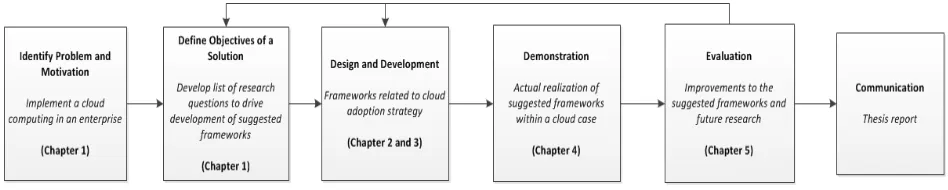
• Problem identification and motivation. The implementation of cloud computing is considered as a groundbreaking change that will significantly affect the system processing, will require large amounts of investment and cause changes in the way of working. A set of planning and strategy from either the technological, financial or relational perspective is therefore prerequisite to anticipate the challenges and outcomes of cloud computing. This becomes a strong motivation for this thesis to elaborate not only on the architectural perspective but also on the business strategy.
• Define the objectives for a solution. Several research problems, as listed in Section 1.2, are formulated and used as the direction and representation of the intended objectives of this research.
• Design and development. Concepts from various literatures, such as business models, business cases, enterprise architecture, TOGAF and cloud strategy, are reviewed and combined into a comprehensive workflow in order to lead a smooth transition to cloud computing in an organization. This workflow prescribes a step-wise approach from business planning until its implementation planning, within which there are also specific plans to manage the resistances to changes and to identify the critical risks.
• Demonstration. This framework will then be applied to the case of implementing a cloud-based contact distribution in Philips Consumer Lifestyle (CL). To gather a deeper understanding on the hurdles of ongoing processes and the drivers to implement the cloud computing solution, the semi-structured interviews with the management team of Philips CL and IT division were conducted. Several documents, such as the business vision for 2020, the contracts with current contact center outsourcers and the architecture landscape of the existing systems were collected and analyzed to fulfill the required inputs and expected outputs from this framework.
• Evaluation. The efficacy of this framework will be evaluated along with its application within the case. The feedback from IT and business practitioners in Philips CL will be obtained to develop further insights into the usefulness and weaknesses of this framework.
[image:13.595.58.532.538.633.2]• Communication. The design and realization of this framework will be documented within the thesis report. Some information is restricted and therefore not available to the public.
Figure 1 Research Methodology
1.4
Impact and Relevancy
6
the cloud solution is rolled-over. This framework is expected to give a notable contribution to both the practical purpose and theoretical impact.
• Practical impact
This framework helps organizations in making sound choices regarding the cloud adoption in the inter-organizational context. It starts with an initial planning that identifies the business goals and values to the respective stakeholders, and concludes with an implementation plan and governance. This end-to-end flow is expected to enable a transition from the business strategy into a concrete delivery that IT can actually realize.
• Theoretical impact
From the theoretical perspective, we expect that the suggested framework provides the subsequent contributions:
1. Though numerous books and papers are already discussing the successful implementation of cloud computing, few literatures have tried to combine the enterprise architecture concepts with business strategies like the business model and strategic change management. This research tries to complement TOGAF using practical approaches that will align IT initiatives with business strategies.
2. This framework incorporates various scientific literature, such as the modeling of EA, BM, risk governance, change management and cloud adoption strategy, making it more structured and comprehensive.
3. This end-to-end cycle of the cloud adoption strategy is implemented in a real case, giving more opportunities to foresee how this framework can actually accommodate the needs for a workable cloud strategy in an organization.
4. This cloud adoption lifecycle also includes an approach to manage the change processes, assisting an organization in planning efficient coordination among participating parties within the inter-organizational context.
7
2 – Theoretical Foundation
As we aim to propose a holistic framework that is a combination of TOGAF and cloud adoption strategy by Isom and Holley (2012), we will motivate our choice on these two concepts by briefly introducing the scientific literature that supports them. To prevent the conceptual discussion become overly extensive, the literature works described in this chapter are selected based on their relevancy to formulate answers to the research questions. As figured in Table 1, the selected literature sources are grouped into two main parts: the first part covers the frameworks or concepts for generic IT projects, while the second part specifically discusses the cloud computing.
Research Question The Generic Concepts/Frameworks The Specific Concepts about Cloud
RQ1 – Frameworks for the concept of cloud adoption strategy
2.1.2 Enterprise Architecture Framework - TOGAF 2.3.1 The cloud adoption strategy
2.1.3 EA Modeling Framework - ArchiMate
RQ2 - How can a business migrate from an as-is to a to-be cloud-enabled architecture by using a business model-driven approach?
2.1.2 Enterprise Architecture Framework - TOGAF (Phase B,C,D)
2.1.3 EA Modeling Framework - ArchiMate (Motivational model extension)
2.1.4 Relating EA changes to business model 2.2.1 Business model-driven approach 2.2.2 Business case concept
2.3.4 Architectural requirements for cloud
2.3.2 Business values of cloud 2.3.3 Cost-Benefit analysis for cloud
RQ3 - How should the to-be cloud-enabled architecture be delivered?
a) How can the change process be managed, especially when cloud computing is used as a pool of shared resources accessed by multiple parties?
a) 2.1.2 Enterprise Architecture Framework - TOGAF 2.2.3 Change management approach
2.2.4 Determinants of Inter-organizational System Adoption
b) Which key aspects should be prepared and managed for the implementation of cloud computing?
b) 2.1.2 Enterprise Architecture Framework - TOGAF (Phase E and F)
2.1.3 EA Modeling Framework - ArchiMate (Implementation and migration extension)
2.3.4 Architectural requirements for cloud
2.3.5 SLA for cloud
c) How could it be ensured that the cloud computing implementation will deliver the promised benefits without putting the business at risk?
c) 2.1.2 Enterprise Architecture Framework - TOGAF (Phase G and H)
2.2.5 IT Risk Management
[image:15.595.63.523.294.638.2]2.3.6 IT Risk Management in Cloud
Table 1 Research Questions and Selected Literature
2.1 The generic concepts surrounding Enterprise Architecture (EA)
8
2.1.1 The introduction of EA
The term of EA has been widely discussed within IS-related field as a critical aspect from IT strategies. Mahmood (2011) defines EA as a method and organizing principle that guides attempts to align business critical mission with the EA including the execution plans. EA depicts a firm’s systems and infrastructure in a macro (enterprise) level rather than a micro (individual) level and shows how they work together to achieve the goals and support the processes of the business (Iacob et al., 2012). Through an EA, we can gain an overall understanding of each IS-related component and the interaction between these components.
By having a deeper understanding on the ongoing systems and infrastructures, a firm can make a more controllable and manageable organizational changes, a better coherence between the actions and organizational resources, and a preventive action on overrun costs. In a strategic level, an EA optimizes the fragmented legacy of both automatic and manual processes into an integrated environment that can respond to the constantly changing needs of the business strategy (The Open Group, 2011). Therefore, a good enterprise architecture allows a firm to have a right between efficiency in its IT and business innovation.
A review or development on enterprise architecture is usually triggered by the needs of radical infrastructure changes caused by transformation in business needs. To identify which areas of change are required, a group of key users, commonly referred as the “stakeholders”, needs to be involved to develop views of new architecture to achieve their concerns and requirements.
2.1.2 EA Frameworks – Why TOGAF?
A framework is a way of working that provides list of generic actions with common vocabularies through which individuals can use to solve certain problems (Mahmood, 2011). This set of methods or actions is necessary while designing a targeted state of the enterprise architecture, describing a set of building blocks required and how they can fit together (The Open Group, 2011). An architectural framework should include these important ingredients as follows:
• A set of processes or actions to be performed, including the constraints or guidelines. • Guidelines or best practices for the execution of the processes.
• Techniques, such as the modeling approach, analysis or computation technique, to be used during the application of the processes.
There are various frameworks for enterprise architecture, such as Zachman’s framework, RM-ODP, C4ISR/DoDAF, and TOGAF (Mahmood, 2011). Being developed through the collaboration efforts of more than 300 members from world’s leading companies, TOGAF has comprehensively emphasized the importance of stakeholder concerns for EA development. It has been recognized for more than a decade as the foremost enterprise architecture (Iacob et al., 2012).
9
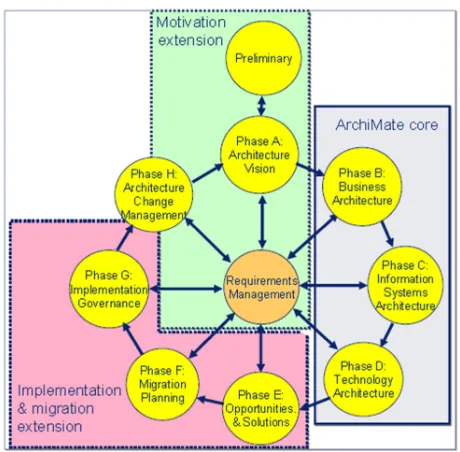
• To get the organizations committed and involved. This part consists of two initial phases within ADM, i.e. the preliminary phase and phase A – Architecture Vision. Within the preliminary phase, the preparation works are conducted, such as defining an architecture capability, tailoring the architectural methods, and establishing a set of architectural principles. While in phase A, this is where the main stakeholders formulate the architectural vision with a high-level outline of the envisaged changes.
• To get the architecture right. This part covers the next three steps within ADM, namely phase B – the business architectures, the phase C – the information system architectures, and the phase D – the technology architectures. It concerns the identification of current state of the actual baseline and the future state of the targeted architecture.
• To make the architecture work. This part discusses the migration plans required for the implementation of the targeted architecture. The first step for this part is phase E, Opportunities and Solutions, wherein the analysis is conducted to identify the gaps and the required work packages. It is then followed with phase F, Migration Planning, wherein the identified work packages are prioritized and translated into a migration plan. Then, the compliance of this implementation plan to the architectural principle is assessed within phase G – Implementation Governance.
• To keep the process running. This is phase H – Change Management, in which the requirements during the architecture development cycles are managed, prioritized, and controlled. The new cycle of architecture development may be initiated whenever there are critical new requirements identified.
2.1.3 EA Modeling Frameworks – Why ArchiMate?
To create uniform and consistent architectural descriptions, a modeling language or technique is critical in order to define the practical concepts and relationships used within each phase of architectural domain, including the relationships among the domains. ArchiMate language and framework, with its rapid acceptance in industrial community recently, appears as an integrated approach that provides a uniform modeling representation for EA (Iacob et al., 2012). The following characteristics demonstrate how ArchiMate can be seen as a lightweight and appropriate language to model the EA.
• ArchiMate architecture framework is simple yet comprehensive, covering aspects from the technical infrastructure to business processes and products. It provides a good mechanism to structure the architecture domains, layers, and aspects.
• ArchiMate accommodates the emerging concepts of the service-oriented system, promoting a new organizing approach of services within an organization.
10
[image:18.595.171.426.159.407.2]The core concept of ArchiMate consists of two main dimensions: the layers which represent the successive abstraction levels of enterprise architecture, and the aspects which represent different concerns that need to be modeled within enterprise architecture.
Figure 2 ArchiMate Metamodel (Iacob & Jonkers, 2006)
The aspect domain of ArchiMate Core is represented in Figure 2 as the vertical layer, consisting of these following aspects: 1) the structure aspect, also called active structure, represents the actors that may consist of people, systems, department, etc.; 2) the behavior aspect comprises the processes and services performed by the actors; 3) the information aspect, referred as passive structure, represents the objects of problem domain knowledge that are communicated among the actors through their behaviors.
Meanwhile, the layer dimension is the horizontal layer depicted in Figure 2, describing the differentiation of three main architectural layers that mainly fill in the views concerning the phase B, C, and D of the TOGAF ADM.
1. The business layer represents products or services provided to external consumers.
• The structural aspect in this layer refers to the static structure of an organization, which can be either an active entity that performs certain behavior (business actor) or a passive entity that is manipulated by behavior (business objects). Business role can be attached to these actors to indicate what works are performed within an organization. The collective roles that perform collaborative behavior can be conceptualized as a business collaboration entity. • The behavioral part can be distinguished into an internal and external behavior of an
11
functionalities are meaningful for the environment. Meanwhile, the internal behavior is the business process performed by one or more roles within an organization.
• The informational concept represents the products or services that a company offers to consumers in order to achieve the business objectives.
2. The application layer defines application services which are supported by the software.
• The main structural part of this layer is the application component, representing complete software applications that provide certain functionalities to support the accomplishments of organizational services.
• The behavioral aspect is quite similar with business layer behavior. However it represents a more precise internal behavior of application components to realize the services, as referred to application service. It is an externally visible unit of functionality, exposed through an application-to-application interface. Application function describes the internal behavior within the application component needed to realize certain application services.
• The informational part is represented with the concept of data object, in the sense of UML, seen as the object view of related tables.
3. The technology layer offers underlying infrastructure services, such as processing, storage, and communication services, needed to support the upper layers.
• The concept of node constructs the main structural concept of technology layer, which is the device. A device concept indicates a physical resource wherein the systems are deployed. Meanwhile, system software represents the software environment for certain types of components and data objects. The other main structural component is the communication infrastructure among nodes, realized with a network.
• The behavioral concept, called as infrastructure service, represents internal behavior within the infrastructure component which can be classified into processing services, data storage, and communication services.
• An artifact is the representation of piece of information which is produced or used during a
software deployment process.
As mentioned earlier, this ArchiMate Core represents the actual architectural layer which is defined within the phase B, C, and D of TOGAF ADM. In its version 2.0, two extensions of ArchiMate are introduced to cover thoroughly the other ADM phases. The coverage of ArchiMate modeling toward the TOGAF ADM is presented in Figure 3.
• Motivation extension is to facilitate the identification of the goals, the requirements and their realization in the enterprise architecture. It recognizes the concepts of stakeholders, drivers, and assessments. Drivers represent the internal or external factors that influence the aims of the enterprise. Thorough understanding and analysis of the main strength, weaknesses, opportunities as well as the threats are needed. The other main component in this extension is the requirement management in which the goals from different stakeholders are accommodated and realized within the enterprise architecture.
12
[image:20.595.183.413.143.369.2]proposed extension aims to cover the main project management standards or best practices, such as the MSP, PRINCE, and PMBoK.
Figure 3 Relation between TOGAF and ArchiMate (Jonkers et al., 2010)
2.1.4 Relating EA changes to business values using Business-model Driven Approach
In today fast-changing and competitive business environment, an organization does not merely need an architecture that is technically easily integrated, flexible, modular, and scalable, but also require the whole IT landscape that enables the business to effectively manage the processes they work with to be highly adaptive with the challenges (Moshiri & Hill, 2011). Paradoxically with this expectation, many surveys have reported and still continue to show that many IT initiatives fail to deliver the expected benefits. Iacob et al. (2012) in their paper argue that such projects fail due to a technology push without a proper analysis of the problem in enterprise context. Questions such as “what values are expected from the project”, “to whom these values are delivered?”, “who will pay for it” are usually neglected though they are essential to clearly understand what the IT project can do.
Therefore, any new requirements for architectural changes should also be justified from the perspective of business fitness. An approach is required to relate the enterprise architecture changes to business values. For this, Iacob et al. (2012) has proposed a business-model driven approach in which three research objectives are formulated:
• To relate EA to business models.
• To propose a realistic cost/benefit analysis that relates the architecture-based cost analysis to business model-based revenue analysis.
13
The processes described in this business-model driven approach represent the step-wise approach for the development of enterprise architecture, especially the phase B, C, and D. The outline of these processes is depicted in Figure 4 and described as follows:
1. Firstly, the baseline architecture including its cost analysis needs to be specified and reflects the current situation.
2. A corresponding baseline business model analyzing the costs and benefits of existing situation can then be derived from this architecture. This analysis may reveal drawbacks regarding the financial health of existing processes and trigger the intention to change the architecture.
3. The process begins with the design of a motivation model that delineates the drivers, goals, and requirements of the architecture change. It is also possible to indicate which parts of existing architecture require changes.
4. Referring to this motivation model, sequential analysis by following the phases B, C, and D of TOGAF is again carried out to specify in details the target architecture.
5. Chaining EA-based cost analysis with a BM-based cost and revenue analysis will once again be executed, this time for the target architecture.
[image:21.595.80.519.428.664.2]6. This BM should be compared with the previous one for existing architecture in order to have more justifications whether or not a decision for changes are necessary or not. If BM for target architecture shows less profit increase, we should refer back to motivation model and reconsider the drivers and goals. This may lead to another options for target architecture, and thus re-iterate the processes again.
14
2.2 The generic concepts for typical IT investments
This part discusses the other supporting concepts that are relevant for successful implementation of enterprise systems. We specifically select literature that examines on how to recognize business values from typical IT investments and how to manage resistances from users towards the system implementation.
2.2.1 Business models literature review
Business model (BM) has attained wide attention of its importance to unveil economic value of IT project to firms. BM is perceived to be fundamental to help business and respective stakeholders comprehend, analyze, communicate and manage strategic choices (AlDebei & Avison, 2010; Ostelwalder, Pigneur, & Tucci, 2005). There are several functions to be fulfilled with the use of BM (Chesbrough, 2010):
• Articulation of value proposition, i.e. the value users can capture from an offering of implementation of certain technology.
• Identification of the market segments, i.e. users who will be benefitted with the implementation of certain technology and for what purpose.
• Definition of the structure of the value chain to create and deliver the offering, and complementary assets required to support the chain.
• Specification of a mechanism to generate revenue, i.e. how to make profit from the offering. • Estimation of cost structure and profit potential.
• Description of how the firm positions itself among various parties, including the suppliers, consumers, substitutes, and competitors.
• Formulation of the competitive strategy through which the firm will gain advantages over rivals. Although BM seems to be appealing and promising, its concept is still considered as underdeveloped and sometimes been misinterpreted as a replacement of corporate strategy, business case or business process (AlDebei & Avison, 2010). Though often used interchangeably, some researches have explicitly differentiated BM from business strategy. Business strategy is a way for firm to position itself against its rivals within the industry structure through the following strategies: cost leadership, differentiation and focus (Porter, 1980). Therefore, defining a business strategy requires more granular practices than designing a business model. Strategy analysis provides an essential step for designing a sustainable business model (Teece, 2010). Meanwhile a business process is a term to define process elements which unite to allow the provision of particular service (de Cesare, Lycett, & Paul, 2003). The youthfulness of BM as an emerging concept as well as the condition wherein diverse disciplines, such as business strategy, management, and technology are involved, have caused murkiness for BM concept. Nevertheless, BM still has a vital role in nowadays turbulent environment (AlDebei & Avison, 2010).
15
sufficient formal foundation. The following paragraphs describe the key components of these two dominant approaches.
e3 value by Gordijn (2002). This conceptual modeling approach demonstrates values creation wherein business network is the central point. It aims to represent an integration of business and IT system which is already a distinct feature of e-business. Therefore the essences of e-business model and a deeper understanding of e-business system requirements and operation can be better communicated through e3 value. There are several concepts employed in this model:
1) Actor represents an independent economic entity who intends to make a profit or merely to provide a non-profit service.
2) Value object is valuable to at least one actor. These value objects which could be services, money, products, or even consumer experience are exchanged between actors.
3) Value port is used by an actor to show to its environment that it requires or provides certain value objects.
4) Value interface consists of inbound and outbound ports of an actor. It represents the value objects for which an actor is willing to exchange another value object through its port.
5) Value transfer connects two value ports from opposite directions of different actors with each other.
6) Value transaction is a set of value exchange between economic reciprocal pairs.
A business model is supposed to represent an ideal world wherein respective actors are able to capture values by being engaged in certain business transactions, and not to hold up all contingencies that might occur in the actual world (Wieringa & Gordijn, 2005).
Business model canvas (BMC) by Osterwalder (2004). BMC emphasizes more on resources required to create a value proposition. It employs four main areas that constitute essential issues within a company. These areas are then interpreted with nine-point decomposition characterizing the must-have resources.
• Product represents in what business the company is involved. It contains value proposition as one of the building blocks of business model, representing the bundle of products or services that are valuable to consumers.
• Consumer interface describes the following building blocks:
o Target consumer defines the segments of consumer to which the company offers value. o Distribution channel is a means through which the company can reach and communicate with
the consumers.
o Relationship represents what kind of link the company establishes with its consumer segments.
• Infrastructure management shows the logistical issues which allow the company to perform transactions and interact within the network enterprise. It comprises three building blocks, i.e. o Key resources define an arrangement of critical assets ranging from physical, intellectual,
16
o Key activities represent the most important actions the company should take in order to operate successfully.
o Key partnership is an array of networks the company has with its partners in order to make the business model work, to reduce risks, or to acquire necessary resources.
• Financial aspects delineate the mechanism to generate revenue. There are two building blocks entailed, i.e.
o Cost structure describes all relevant costs that are necessary to operate the business model. o Revenue stream represents the way the company pursues to generate cash from each
consumer segment.
Each of above approaches has its own advantages and limitations. On the one hand, e3 value provides rigorous modeling approach with well-defined notations contrasted to other more informal approaches. It helps not only for exploring business idea but also for assessing consequences or changes to existing business environment. However on the other hand, it lacks in marketing perspective to show how the entity can sustain its competitiveness within dynamic environment (Osterwalder, 2004). BMC is similarly not immune to limitations. Despite of its wide adoption by more firms and evident virtues of visualizing explicitly the underlying processes of a business model and its practice-oriented use, BMC ignores a notion of competitiveness, excluding the identification of key rivals and how they perform. It also does not set any priorities to the building blocks and thus causes ambiguity of where to start the analysis (Kraaijenbrink, 2013).
In the case of cloud-based contact center in Philips, the use of BMC is argued to be more applicable. It is partly due to its simplicity and easy-to-use approach by which non-academic audiences, in this case managerial level in Philips, will be able to easily grasp the main messages in a less sophisticated way. The other reason is that the work of this thesis is mainly based on an approach proposed by Iacob et al. (2012) in which Osterwalder’s business model canvas is used and related to enterprise architecture specified in ArchiMate.
2.2.2 Business case literature review
Most organizations merely focus on how to implement the technology and neglect the realization of expected benefits. Consequently, most of these IT projects when they have finally been deployed are still viewed as insufficient to deliver value of money for business (Peppard, Ward, & Daniel, 2007). Then how to make IT project successful?
17
1. No inherent value is entailed in IT. Benefits are not resulted from the technology itself but from the use of IT assets by the users.
2. Benefits occur when technology allow people to perform their tasks in more effective or efficient ways.
3. IT and project staffs are not accountable for realizing benefits of IT investment. It is business managers and users who should take on this responsibility and make themselves more involved into the IT project.
4. IT project may produce either positive or negative outcome. It is responsibility of managements to avoid such negative outcomes and to maximize the positive ones.
5. There can be a time gap until the investment yielding some benefits. Therefore, the benefit realization should be continuously performed though the implementation is completed.
To explore which alternatives offer the greatest values yet with acceptable costs, a business case is needed and has to be made comprehensive and robust enough in order to obtain funding approval. Peppard et al. (2007) expands the role of business case to the following extent:
1. Allow priorities to be set among different IT investment options for resources and funds
2. Identify a benefit realization plan to ensure the changes resulted from IT investment will deliver the expected values.
3. Sustain commitment from management to the IT investment
4. Create a basis for evaluating whether the expected benefits are actually fulfilled.
Rather than just focusing on the expected costs and benefits of the IT investment, Peppard, Ward, and Daniel (2007) describe different approaches in evaluating a business case, i.e.
1. Not only financial but also non-financial benefits are recognized
2. Measures are applied to all benefits including subjective or qualitative ones 3. Each benefit should be supported with sufficient evidence
4. An owner is assigned to each benefit to ensure its realization
5. Both the IT and the business changes are explicitly linked to each benefit
A six-step approach described in their paper to building a more rigorous and robust business case will be described in the following sections.
Define investment objectives as well as business drivers. To enable senior management make a decision concerning the IT investment, a business case should convincingly mention current hurdles facing the organization, namely the business drivers. The business case should clearly state how the investment can address some or all business drivers and allow organization to achieve its investment objectives.
18
among different groups and therefore it is unnecessary to have all stakeholders agree to each of them.
Structure the benefits. Rather than simply listing all relevant benefits as in most business cases, Peppard, Ward, and Daniel (2007) suggest to use a framework to structure the benefits which in turn encouraging more rigorous discussion and evidence gathering. The suggested framework differentiates the benefits into two main factors: 1) the types of business change that enable the benefit realization, and 2) the degree of explicitness to which certain benefit can be supported with tangible measurement or evidence.
Identify organizational changes enabling benefits. Identifying the changes is necessary for determining to which extent the IT investment can provide impacts to ongoing processes. There are three classifications for determining the change extent:
a. Do new things - new IT investment allows organization to do something in new ways which previously were not possible.
b. Do things better - the continuing operations can be performed better than that prior the investment.
c. Stop doing things – organization can omit unnecessary operations that contribute less to business performance.
Determine the explicit value of each benefit. Each identified benefit can then be classified in accordance to the ability to assign a value based on information obtained or known before the investment is realized. There are four categories for the degree of value explicitness:
a. Observable benefits – the value of certain benefits can merely be justified by observation, opinion,
and therefore are often categorized as qualitative, intangible, or subjective.
b. Measurable benefits – the value can be assessed with an identified measure in place, such as
organizational performance measurement indicators (KPIs). If such measures are not available, the benefit owner should decide the proper effort and method to value the benefits. However if the methods are too complex or not worthwhile, the benefits can be more suitable assigned with subjective criteria.
c. Quantifiable benefits - Similar to measurable benefits, the relevant measures are also already in
place. However in addition to this, the benefit owner can extrapolate the magnitude of the benefits to future business. Therefore the evidence for quantifiable benefits should also be more rigorous and can be obtained through these approaches: 1) modeling or simulation, 2) benchmarking, 3) use pilot implementation.
d. Financial benefits – the value can be calculated for an overall financial benefit, return of
investment, or payback. Sufficient evidence should be available and can be verified.
19
and not those associated with business changes when the system goes live are reported. This therefore results to significant cost overrun when the IT investment is deployed.
Besides above six-step approach by Peppard, Ward, and Daniel (2007), Harvard Business School Press (2010) also proposes a process for defining a business case. Meertens (2013) in his dissertation thesis has compared these two business case approaches and highlighted which components are mentioned by HBSP and not by Ward and Pepper.
1. The inclusion of alternatives. HBSP emphasizes that having analysis on alternatives is critical to have a more holistic overview of upcoming opportunities rather than just latching on one or two sound-good ideas. The only alternative mentioned by Peppard, Ward, and Daniel (2007) is the (non-) financial consequences that might occur when the proposed idea is not implemented. 2. The creation of implementation plan, including the estimated time frame. This plan is expected
to display how the progress can be traced and evaluated. Besides lists of actions, due dates, and in-charge personnel, a good implementation plan should also contain the following items: primary milestones, resources required, dates when benefits can be realized, impacts to expenses and revenue, and finally how to demonstrate that the expected results have been realized.
2.2.3 Change management literature review
Change management, in term of handling and controlling the new requirements in the enterprise architecture, has been discussed in the phase H of the TOGAF ADM. However, a change management process is not solely related to the architectural changes but also to the business process and cultural changes in an organization. A change management is essential to align the business changes with an organization’s people and culture (Nah, Lau, & Kuang, 2001). Tailoring a new system to users should be cautiously handled. The uncertainty due to this change process may bring fear to users which may become the biggest impediment to a successful use of new system (Kumar & Crook, 1999). The resistances are potentially to be higher when the new system is used not only for internal purpose but also for coordinating inter-organizational processes. Therefore in this section, we will discuss the generic approach for a change management and how to manage the changes within inter-organizational context.
20
a) Knowledge formulation. This is the phase where influential and relevant parties are identified and evaluated for their attitude and responses to system implementation. This identification is intended to answer the following questions:
a) Who are the resisting individuals or groups? b) What do they expect or need from the system? c) What are their perceived beliefs or values?
d) What are the benefits that make them interested?
These fundamental questions may assist in determining the sources of resistances to system implementation.
b) Strategy implementation. To influence the users to adopt the system, there are several suggested strategies.
a) Communication is a key to affect the users’ attitudes and beliefs toward the new system. Informing clearly the potential benefits to the users is considered as an effective communication strategy that can bring more effective awareness for the system implementation. The other communication strategy is to inform the users how the system will actually work.
b) Low-cost strategy can be a good reason why the users should support the adoption of the system. If the management can convince the users that the adoption cost and effort would be minimal and it is an opportunity to enhance their performance, then they will foster good feelings toward accepting the system.
c) Highlighting the high quality offered by new system could also affect the adoption attitude. This high quality can be characterized with a more user-friendly, robust, and highly-available system.
d) Giving a hands-on training is another important strategy for a successful system implementation. This will help the users adjust themselves to the changes and experience the functionalities introduced by the new system.
e) Convincing the group leaders to support the implementation process will secure their valuable commitment.
f) Introducing the system at the right time is critical. The organization should ensure that sufficient preparation has been conducted in order to prevent unexpected negative outcomes.
g) Strong commitment from top management is prominent for the success of overall system implementation process. This commitment will help in securing necessary conditions to ensure that the system will realize its long-term success.
21
2.2.4 Determinants of Inter-organizational system adoption literature review
The strategy for a change management needs to be more comprehensive while the users of a new system are not just the internal individual users but the external individual companies. Organizational issues with these companies in term of coordination and communication in the partnership make the arrangement more sophisticated. From the economic perspective, the collaborations in inter-organizational system (IOS) are established for having cost sharing, pooling of risks, increasing resource utilization, and other plausible motives. Nevertheless, IOS is subject to risks of adversarial conflicts and behavior (Kumar & Van Dissel, 1996). Therefore, it is important to understand the factors that may cause conflicts and hinder the successful implementation of IOS, as a part of knowledge formulation while formulating the right strategy for a change management.
Within their paper, Kumar and Van Dissel (1996) describe three types of interdependence-based topology for IOS.
• Pooled information resource IOS. In this type, common IT/IS resources is shared through an inter-organizational coordination, such as common databases, common communication networks, and common applications. The primary drivers for this cooperation are the economies of scales and the cost-risk sharing. The partners involved in this type could either be competitors or non-competitors within an industry.
• Value/supply-chain IOS. Here the IOS acts as a pipeline that connects the involving parties along the value/supply chain. This type represents a sequential interdependence between adjacent partners.
• Networked IOS. This type entails reciprocal interdependencies between partners which usually occur for a finite time for the development of certain projects or products. This type tends to use the IT/IS resources intensively to allow information and communication sharing throughout the network.
Each of these types has its own coordination mechanisms, the potentials for conflicts, and different determinants to implement the IOS. In relation to the selected validation case discussed in this thesis, that is the cloud computing for contact center operation, the analysis on the coordination in IOS will be focused more on the pooled information resource type. In this case, the interdependence structure is a typical one-to-one relationship or buyer-seller system. The initiative to implement cloud as a IOS comes mainly from the focal firm that acts as a hub with respective partners.
22
• Performance satisfaction is a measure of how the suppliers feel satisfied with the delivery of expected benefits from the IOS. When the suppliers perceive that the IOS will belittle the benefits they currently receive, the conflict will likely to occur and may affect the commitment for the change and speed of adaptation.
• Power is related to a power shift between exchange partners due to the existence of IOS. Buyers are perceived to have more power to enforce the IOS implementation. If the suppliers are less cooperative in adopting IOS, the buyers will seek the other alternative suppliers to fulfill their needs. The use of IOS is also identified to cause less switching costs that the link between supplier and buyer is easier to be transferred to alternative suppliers.
• Whilepowerdeterminant is usually possessed by the buyers, the seller can play its strategic role, how it is strategically important to focal firm and IOS relationship and its position is difficult to be replaced by the others. This is referred to as importance of the partner.
• Comparison level of alternatives is a degree to which one supplier is dependent on the other. A low comparison level means that there are not so many comparable partner alternatives, thus causing a high dependency on one partner.
These factors are then used within a relationship model and result to the following most common dependent variable.
• Commitment. A strong commitment implies a desire to continue the buyer-seller relationship, and a willingness to work toward its continuance in the future.
• Trust is perceived as the binding element within a productive buyer-seller relationship. One party believes that there is a mutual relationship that each party will act in the best interest of others and fulfill its obligations.
• Non-transferable investments are the specific investments made to accommodate the other partner’s needs, such as specialized training, or certain technologies or equipment.
2.2.5 IT Risk Management
In many organizations, IT risks are usually simply referred to operational risks of IT assets (e.g. the hardware, software, telecommunication, networking, etc.) and it is the responsibility of IT department to handle them. According to Goldstein, Chernobai, & Benaroch (2011), IT operational risks can be defined as any threat which may lead to the improper access, modification, theft, destruction, or lack of availability of IT assets. However, since IT has been the integral part of key enablers of business strategic, the risks associated with the use, operation, adoption of certain IT systems within an enterprise should also be considered as part of business risks (ISACA, 2009). Organizations have become increasingly dependent on the technology, and thus they become more vulnerable to the risks of IT failure.
23
constituents, we believe that the ISACA journal will provide a reliable theoretical background for this thesis.
IT risk management is a part of IT Governance. Within COBIT 4.1 published by IT Governance Institute (2007), IT governance is defined as “the set of responsibilities and practices exercised by the board and executive management with the goal of providing strategic direction, ensuring that objectives are achieved and ascertaining that risks are managed appropriately”. From this definition, value, risk, and controls constitutes the core concept of IT governance within an enterprise. There are five focus areas within IT governance, as presented in Figure 5.
• Strategic alignment – is about the link between business and IT plans that define, maintain, and validate the IT value proposition, and align the IT operations with enterprise operations.
• Value delivery – is about tailoring the value proposition within the IT delivery cycle to ensure that the promised benefits are delivered and in line with the business strategy, focusing on optimizing costs and enhancing the intrinsic value of IT.
• Resource management – is about optimizing the investment and properly managing the critical IT resources, i.e. the applications, information, people, and infrastructure.
• Risk management – is about a clear understanding of the risk appetite within an enterprise, compliance to the requirements, transparency of the significant risks, and embedding of responsibilities to manage risk into the organization.
• Performance measurement – is about the tracking and monitoring over the strategy implementation, project completion, process performance, resource usage, and service delivery. The first three focus areas are related to the realization of business value resulted from IT investments, i.e. how they can be aligned with business strategic, how they can maximize the benefits to business, and how the IT resources are used reasonably. These areas have been fairly covered within previous literature review. Meanwhile, the focus area - performance measurement is related to the monitoring over the measurable objectives of IT service delivery to ensure that it delivers the priorities and criteria set by the business. This continual monitoring can be found as a part of phase H – Change Management in TOGAF ADM which goal is to ensure that the implemented architecture actually achieves its original target business value and the improvements are identified in order to trigger changes to the architecture in a cohesive way. To this point, the area that has not been discussed is the risk management. Therefore, this section will primarily discuss about how to detect risks that need to be addressed in order to enable better business goals achievement.
In order to identify the relevant risks among all that are likely to go wrong within IT project, ISACA (2009) has developed a method for risk scenarios. There are two different mechanisms used in this method. The method overview can be found in Figure 5.