EXPEDITED
PUBLICATION
INTERVENTIONAL
Clopidogrel Hyper-Response and Bleeding Risk in
Neurointerventional Procedures
C. Goh, L. Churilov, P. Mitchell, R. Dowling, and B. Yan
ABSTRACT
BACKGROUND AND PURPOSE: Antiplatelet therapy is associated with decreased ischemic events after neurointerventional procedures. Antiplatelet resistance negates the protective effects of antiplatelet medication, leading to a higher incidence of ischemic events. A possible link between antiplatelet hyper-response and increased hemorrhagic complications has been inadequately investigated. We aimed to examine the correlation between antiplatelet hyper-response and the risk of hemorrhagic complications.
MATERIALS AND METHODS: Patients who were treated with antiplatelet medications and underwent neurointerventional procedures were prospectively recruited. We collected the following data: demographics, vascular risk factors, antiplatelet and anticoagulation treatment, antiplatelet responsiveness, coagulation profile, and hemorrhagic complications. P2Y12 receptor–mediated platelet inhibition was tested by using the VerifyNow assay device. The primary end points were postprocedural major and minor hemorrhagic complica-tions. Receiver operator characteristic analysis was used to evaluate the percentage of platelet inhibition as a diagnostic tool for bleeding events. The association between hemorrhage and percentage of platelet inhibition was investigated by using logistic regression modeling.
RESULTS:Forty-seven patients were enrolled. The mean age was 56⫾12 years, and 28% were men. Ten patients (21.3%) developed hemorrhagic complications. Clopidogrel response was higher in patients with a major bleeding complication compared with those with minor or no bleeding (median, 94% versus 24% platelet inhibition;P⫽.0084). Of the 7 patients (14.9%) defined as hyper-responders with
ⱖ72% platelet inhibition, 42.8% had a major bleeding complication.
CONCLUSIONS: Hyper-response to clopidogrel is associated with increased risk of hemorrhagic complications. Larger studies are ur-gently needed to validate a clinically useful threshold to define clopidogrel hyper-response and to examine the clinical effects of antiplatelet dosage adjustment.
ABBREVIATIONS:ACT⫽activated clotting time; aPTT⫽activated partial thromboplastin time; CI⫽confidence interval; IQR⫽interquartile range; ROC⫽ receiver operating characteristic
D
ual antiplatelet therapy with aspirin and clopidogrel is asso-ciated with reduced risk of thromboembolic complications of endovascular neurointerventions1and in percutaneous coro-nary intervention.2However, it is well-recognized that there is a high level of interindividual variability in the antiplatelet response to clopidogrel.3-5Hypo-response to clopidogrel has been shown to be associated with a higher incidence of adverse outcomes, including 3.4-fold increase in cardiovascular mortality, 3-foldin-crease in nonfatal myocardial infarction, and 4-fold inin-crease in stent thrombosis.3,6-9
Genetic polymorphism of theCYP2C19allele, crucial to me-tabolism of clopidogrel into its active metabolite, has been impli-cated as a mechanism of both hyper- and hypo-response. The interest in this area is demonstrable, with the institution of a boxed warning by the US Food and Drug Administration regard-ing the risk of adverse outcomes in carriers of the implicated variants.10
Of note, there exists a subset of patients with hyper-response to clopidogrel who may be at increased risk of hemorrhagic com-plications.11,12There are few studies that quantify the incidence of hemorrhage in patients with a high level of response to the anti-platelet effects of clopidogrel, and it remains unclear whether test-ing for response to antiplatelet therapy and adjustment of anti-platelet therapy will have an impact on bleeding risk. In addition, previous results arose from studies of coronary intervention.11,13
Received June 18, 2012; accepted after revision September 19.
From the Department of Radiology (C.G., R.D.), Neurointervention Service (R.D., P.M., B.Y.), and Comprehensive Stroke Centre (B.Y.), Royal Melbourne Hospital, Melbourne, Australia; Department of Mathematics and Statistics (L.C.), University of Melbourne, Melbourne, Australia; and National Stroke Research Unit (L.C.), Flo-rey Neuroscience Institute, Melbourne, Australia.
Please address correspondence to Prof. Bernard Yan, Division of Neurosciences, Royal Melbourne Hospital, Grattan St, Parkville, Victoria 3050, Australia; e-mail address: [email protected]
Patients undergoing endovascular neurointervention may differ from the percutaneous coronary intervention population in terms of demographics and cardiovascular risk factors, particu-larly those being treated for cerebral aneurysm. This difference has the potential to alter the balance of risk between ischemic complications of the procedure and hemorrhagic complications of antiplatelet treatment.
This study aimed to describe the incidence of hyper-response to clopidogrel in the population of patients undergoing neuroin-tervention and to investigate the association between clopidogrel hyper-response and the risk of hemorrhagic complications.
MATERIALS AND METHODS
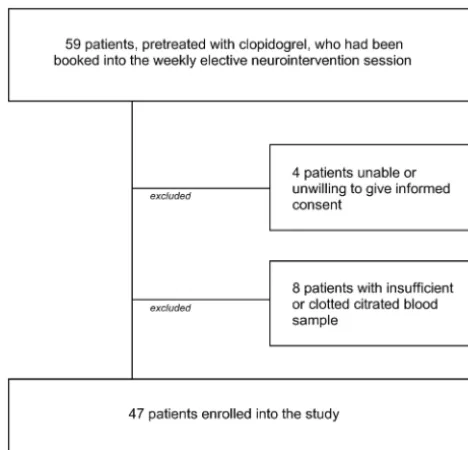
Patients were recruited from those undergoing endovascular neu-rointervention during the weekly elective session at the Royal Melbourne Hospital between May 2010 and May 2011 (Fig 1). Patients were excluded if they refused consent, were younger than 18 years of age, or had a history of an acute event (transient isch-emic attack, ischisch-emic infarct, or acute intracranial hemorrhage) within the 24 hours before the procedure. Demographic and clin-ical data collected included age, sex, and cardiovascular risk fac-tors (hypertension, dyslipidemia, diabetes mellitus, smoking his-tory, and history of previous cerebrovascular ischemic events). The study protocol received ethics committee approval.
The standard antiplatelet regimen at our institution is dual therapy with clopidogrel, 75 mg, and aspirin, 100 mg, for the 3 days before an endovascular neurointerventional procedure.
All procedures were performed by 1 of 3 experienced neuro-interventionalists. Arterial access was via a 6F femoral sheath, with hemostasis obtained postprocedure by use of an Angio-Seal device (St. Jude Medical, Minnetonka, Minnesota). Systemic an-ticoagulation with intravenous heparin during the procedure was titrated to an ACT twice normal. The postprocedural unfraction-ated heparin infusion rate was adjusted on the basis of aPTT.
Whole blood was obtained for testing at the time of the initial femoral puncture; following discard of the first 5 mL, citrated
Vacette tubes (VWR, Arlington Heights, Illinois) were filled and inverted 5 times with blood analyzed by using the VerifyNow assay device (Accumetrics, San Diego, California).
The VerifyNow assay is a point-of-care device using a 2-chan-nel disposable cartridge, with platelet aggregation measured by increasing light absorbance through the sample. The first cham-ber contains a strong agonist for platelet activation independent of aspirin or clopidogrel therapy, providing a baseline platelet function measurement (BASE). The second chamber gives a mea-surement expressed as P2Y12 reaction units (PRU), representing platelet activation by the adenosine diphosphate-P2Y12 pathway. Percentage of inhibition is calculated from the formula [1 ⫺ (PRU/BASE)]/100. The VerifyNow assay has been shown to cor-relate well with the current criterion standard light transmittance aggregometry and with other point-of-care assay devices,14-16and it has been validated in a head-to-head comparison of assay meth-ods based on outcome measures.17
Outcomes were measured by clinical assessment during the hospital admission and at the 6-week review appointment. The primary end point was Thrombolysis in Myocardial Infarction major or minor periprocedural bleeding events. The need for in-vestigation with Doppler sonography or CT or MR imaging of the brain was guided by clinical assessment.
Statistical analysis was performed by using the commercial statistical software STATA, Version 11IC (StataCorp, College Sta-tion, Texas). Platelet inhibition is reported as median IQR due to non-normal distribution as assessed by the Shapiro-Wilk test. The Wilcoxon-Mann-Whitney test was used to compare the percentage of platelet inhibition by clopidogrel between bleed-ing and nonbleedbleed-ing groups with the correspondbleed-ing effect size estimated by using median regression. The receiver operator characteristic analysis curve was used to evaluate the percent-age of platelet inhibition measured by the VerifyNow assay device as a diagnostic tool for bleeding events. Association between the presence of periprocedural bleeding and the per-centage of platelet inhibition was investigated by using logistic regression modeling (both unadjusted and adjusted for mean aPTT and intraprocedural ACT). The statistical significance threshold for all the tests performed was set asP⫽.05.
RESULTS
Study PopulationForty-seven patients were enrolled in the study, 34 women and 13 men, with a mean age of 56⫾12 years (range, 30 –78 years). There was a history of hypertension in 46.8%, dyslipidemia in 25.5%, and diabetes mellitus in 4.3% of patients, and 29.8% were current smokers. Previous TIA or ischemic stroke was documented in only 0.9%.
Procedure
[image:2.594.51.285.46.271.2]intravenous heparin following the procedure: 21 patients for up to 24 hours and 17 patients for 48 hours. One patient who had a Factor V Leiden deficiency received 10 hours of intravenous un-fractionated heparin postprocedure and then low-molecular-weight heparin until therapeutic anticoagulation with warfarin had been achieved.
Treatment of 3 patients deviated from the standard antiplate-let regimen. Two received a single loading dose of 450 mg of clopidogrel at 3 hours or at 5 hours before the procedure. The other had a history of Factor V Leiden deficiency and had been receiving subcutaneous low-molecular-weight heparin due to cessation of his usual long-term anticoagulation with warfarin. The decision was made to give him 3 days of clopidogrel loading at 75 mg daily, rather than dual antiplatelet therapy.
Clopidogrel Response and Bleeding Events
Response to the antiplatelet effects of clopidogrel varied widely, with the percentage of platelet inhibition ranging between 0% and 99% (median, 30%; IQR, 12%– 61%). Figures 2 and 3 illustrate the distribution of platelet inhibition and bleeding events among the study population.
Eleven patients had a bleeding event during the procedure or in the 24 hours postprocedure. Thrombolysis in Myocardial In-farction major bleeding events occurred in 3 patients (6.4%). Two of these had documented periprocedural intracranial hemor-rhages. A 5-mm left temporal intracerebral bleed occurred in a patient with 99% platelet inhibition and PRU 5, whose right pos-terior communicating artery aneurysm was treated by placement of a flow-diverting stent. MR imaging of the brain showed no evidence of an underlying cavernoma, mass, or infarct. A tiny subarachnoid bleed within a sulcus at the right vertex occurred in a patient with 94% platelet inhibition and PRU 21, who had a right supraclinoid carotid aneurysm treated by placement of a flow-diverting stent. The other patient had a large retroperitoneal hemorrhage, with levels of platelet inhibition measured at 72% and PRU 83 at the time of the procedure. Because this patient received premedication as a single 450-mg dose of clopidogrel 5 hours before the procedure, this may actually be an underestima-tion of the achieved platelet inhibiunderestima-tion. A large subarachnoid hemorrhage in 1 patient was related to on-table aneurysm
perfo-ration, so it was not included in the bleed-ing group for statistical analysis. Minor bleeding events in 7 (15%) patients were small groin hematomas of little clinical significance.
Clopidogrel response was greater in the 10 patients with a bleed of any size (median platelet inhibition, 63.5%; IQR, 36%–75%) compared with those with no bleeding complication (median platelet inhibition, 19%; IQR, 11%– 47%), result-ing in a median difference between the degree of platelet inhibition in bleeding and nonbleeding groups of 38% (95% CI, 10.6%– 65.4%;P⫽.015).
Comparison between clopidogrel re-sponse in the 3 patients with a major bleed and those with minor or no bleeding demonstrated a more pronounced difference, with median plate-let inhibition of 94% (IQR, 72%–99%) versus 24% (IQR, 11.5%– 55.5%), resulting in a median difference between percentage platelet inhibition in these 2 groups of 69% (95% CI, 23%–100%;
P⫽.008).
ROC analysis was undertaken to identify an optimal threshold to define hyper-response to clopidogrel. Using 72% or greater platelet inhibition as the criterion, 7 patients (14.9%) were de-fined as clopidogrel hyper-responders; 42.8% of these patients had a major bleeding complication, while all non-hyper-respond-ers were major bleeding complication–free. If we used a threshold ofⱖ72% inhibition to define hyper-response, the percentage of platelet inhibition by clopidogrel as a diagnostic tool for clinically significant bleeding events demonstrated high diagnostic capacity (ROC area⫽0.96; 95% CI, 0.89 –1), resulting in sensitivity of 100% and specificity of 90.9%. Due to the small sample size and low number of events, caution is required in the extrapolation of these results into clinical practice; larger studies would be re-quired to define and validate a robust threshold for clinical use.
Including minor with major bleeding in the ROC analysis re-sults in a lower diagnostic capacity (ROC area⫽0.75; 95% CI, 0.58 – 0.93), with a threshold ofⱖ53% inhibition corresponding to a sensitivity of 70% and a specificity of 75.7%, and is of limited clinical utility. The incidents of minor bleeding in our study were all small groin hematomas, a complication that may be influenced by puncture technique and by achieving inadequate hemostasis at the end of the procedure. Also, because the cutoff below which patients are deemed to be low responders has variably been nom-inated as anywhere between 23% and 40% platelet inhibition,6,7 use of this lower threshold would necessarily result in a narrow therapeutic window.
Systemic Anticoagulation with Intravenous Heparin and Bleeding Events
When divided by bleeding outcome, mean ACT was similar among all groups with 392.2 (95% CI, 354.32– 430.15) in those with no bleeding complication, 373.3 (95% CI, 315.67– 431) in those with any bleed, and 375 (95% CI, 207.9 –542.1) in those with clinically significant bleed.
[image:3.594.54.373.50.219.2]In the patients whose intravenous heparin was continued in the ward, the mean aPTT was also similar between each of the bleeding outcomes: the postprocedure aPTT was 63.3 (95% CI, (51.09 –75.57) in those with no bleeding complications, 60.4 (95% CI, 49.38 –71.38) in those with any bleed, and 60.6 (95% CI, 54.66 – 66.47) in those with a clinically significant bleed.
DISCUSSION
To our knowledge, no previous studies have investigated clopi-dogrel hyper-response and bleeding risk in the neurointervention population, though a few studies have examined variation in clopidogrel response in this population without describing how the rate of bleeding complications correlated with platelet func-tion test results.18-21
Two previously published studies in the cardiac population that specifically address bleeding complications in the context of antiplatelet medication showed a strong correlation between clopidogrel hyper-response and bleeding risk. Sibbing et al11 found that 38% of patients undergoing percutaneous coronary intervention were hyper-responders, who had a higher incidence of major bleeding (2.2%) compared with the remainder of the population (0.8%). Cuisset et al12assessed bleeding risk in the first month after discharge of patients with acute coronary syn-drome on dual antiplatelet therapy, finding that the risk of major or minor bleeding was 6.6% for those in the first quartile of clopi-dogrel response compared with 1.4% in the remainder.
This study showed that a strong correlation between the de-gree of platelet inhibition by clopidogrel and the incidence of periprocedural bleeding complications also exists in patients un-dergoing elective neurointerventional procedures.
Systemic anticoagulation with heparin remains a potential confounding factor linking clopidogrel hyper-response with an increased risk of perioperative bleeding in this population. The mean intraoperative ACT for the study population was at the upper end of the acceptable range, which could increase the risk of
bleeding events regardless of the individ-ual antiplatelet response to clopidogrel. However, because all patients received a similar dose of intraprocedural heparin and there were no differences in ACT measurements between bleeding and nonbleeding groups, the relatively high intraprocedural anticoagulation achieved does not unduly alter the validity of our hypothesis.
Of potential concern is the influence of postprocedural heparin on our results, given that the 2 intracranial hemorrhages occurred in patients who received intra-venous heparin following the procedure. However, when the patients who received heparin infusions were divided into groups based on bleeding outcome, there were no differences in the mean aPTT achieved by each group, in contrast to the large difference in clopidogrel effect be-tween the groups.
While the relatively high intraoperative ACT and the use of heparin anticoagulation in the postprocedural period may well potentiate the effects of antiplatelet medication on bleeding risk, they do not account for the preponderance of bleeding events among the patients with a high level of response to the antiplatelet effects of clopidogrel.
The possibility that the type of intervention performed may impact bleeding risk is another consideration. The 2 small intra-cranial hemorrhages in this study group occurred in patients who had undergone placement of a flow-diverting stent. However, it is difficult to implicate traction on arteries or altered flow dynamics related to stent placement in the etiology of these events, given that the bleeding site was distant from the treated vessel in both cases. The early experience of this method of aneurysm treatment emphasizes the potential thrombotic complications of parent ves-sel occlusion, small artery occlusion, and in-stent thrombosis. A multicenter study of 70 patients treated with the Silk flow-divert-ing stent (Balt Extrusion, Montmorency, France) reported 3 extracranial hemorrhages but no intracranial hemorrhage.22A multicenter study of 31 patients treated with the Pipeline flow-diverting device (Covidien, Irvine, California) reported no hem-orrhagic complications.23
A more likely mechanism by which flow-diverting stents could affect periprocedural bleeding risk is in their requirement for postprocedural anticoagulation with intravenous heparin, which accounts for the high number of such patients in our study. In addition, these patients continue to receive at least 6 months of antiplatelet medication, usually with clopidogrel. While the ad-ministration of heparin did not significantly affect the results of this study, the need for ongoing clopidogrel administration high-lights the potential for clopidogrel hyper-response to increase the cumulative risk of adverse bleeding events.
Differences between patients undergoing neurointerventional procedures and the cardiac patients who have been studied in greater numbers may influence the clinical impact of interindi-FIG 3. Percentage of platelet inhibition for patients with major or minor hemorrhagic
[image:4.594.54.371.49.266.2]vidual variability in the clopidogrel response. In concentrating on elective patients and excluding those with a recent ischemic or hemorrhagic event, our study population is strongly weighted to-ward patients undergoing treatment for a cerebral aneurysm. These patients tend to be younger with fewer cardiovascular risk factors than those undergoing cerebrovascular or coronary revas-cularization, so the background risk of thromboembolic events may be reduced. Whether this is offset, or perhaps overshadowed, in the periprocedural period by the need for catheterization of intracranial arteries is uncertain, but regardless, it may have im-plications for clopidogrel hyper-responders during the 6 –12 months postprocedure when patients with intracranial stents will receive maintenance dual antiplatelet therapy. It is possible that a given antiplatelet dose in a neurointervention patient will be as-sociated with an increased bleeding risk compared with patients undergoing cardiac percutaneous coronary intervention or cere-brovascular stent placement.
Authors of future research into the identification and manage-ment of clopidogrel hyper-response should bear in mind the les-sons from previous research into hypo-response. Despite the large body of evidence available linking low clopidogrel response to an increased risk of adverse cardiovascular outcomes, differences in assay devices and the choice of statistical methods to define “hy-poresponse ” mean that researchers have struggled to achieve con-sensus on the optimal cutoff defining low response.
A different approach to understanding the impact of variabil-ity in the clopidogrel response relies on identifying genetic poly-morphisms in theCYP2C19allele that are associated with high or low response. TheCYP2C19*2 variant is the most common of several loss-of-function alleles.5,24Conversely, theCYP2C19*17 variant allele causes increased metabolism and function of clopidogrel and has been shown to reduce the incidence of major adverse cardiovascular events in patients with acute cor-onary syndrome.25,26
A target of future research would be a prospective study com-paring genetic testing with measures of platelet aggregation to determine which is best able to predict the risk of an adverse bleeding outcome. The high specificity of genetic testing may prove to be a drawback, given the multifactorial etiology of clopi-dogrel response variability, and the time required to perform ge-netic testing may reduce its clinical utility in comparison with point-of-care assay devices. In addition, genetic testing will need to include the full panel ofCYP2C19alleles because there is evi-dence that the combination of high- and low-function variants will result in a low-to-normal function phenotype.27
CONCLUSIONS
Hyper-response to the antiplatelet effects of clopidogrel is associ-ated with a significant increase in bleeding risk in the setting of endovascular neurointervention. Any proposed threshold value for a clinically significant increased risk of major bleeding will require validation with a larger study population. Testing for ge-netic polymorphisms associated with increased platelet inhibition by clopidogrel is a promising avenue of further research. How-ever, point-of-care assay devices retain the advantage of speed and simplicity of use and will include the effects of nongenetic deter-minants of platelet function. Standardization of study
methodol-ogy in future research protocols is of critical importance to pro-vide statistically robust and clinically useful thresholds defining high and low response to clopidogrel.
Disclosures: Peter Mitchell—UNRELATED:Travel/Accommodations/Meeting Ex-penses Unrelated to Activities Listed: ev3,Comments: Neuro Exchange scientific meeting attendance,Other: Boston Scientific,Comments: unrestricted clinical re-search nurse support.
REFERENCES
1. Bhatt DL, Kapadia SR, Bajzer CT, et al.Dual antiplatelet therapy with clopidogrel and aspirin after carotid artery stenting.J Invasive Cardiol2001;13:767–71
2. Cohen M. Antiplatelet therapy in percutaneous coronary intervention: a critical review of the 2007 AHA/ACC/SCAI guide-lines and beyond.Catheter Cardiovasc Interv2009;74:579 –97 3. Snoep JD, Hovens MM, Eikenboom JC, et al.Clopidogrel
nonre-sponsiveness in patients undergoing percutaneous coronary inter-vention with stenting: a systematic review and meta-analysis.Am Heart J2007;154:221–31
4. Musallam KM, Charafeddine K, Bitar A, et al.Resistance to aspirin and clopidogrel therapy.Int J Lab Hematol2011:33:1–18
5. Scott SA, Sangkuhl K, Gardner EE, et al.Clinical Pharmacogenetics Implementation Consortium Guidelines for Cytochrome P450 – 2C19 (CYP2C19) Genotype and Clopidogrel Therapy.Clin Pharma-col Ther2011;90:328 –32
6. Ari H, Ozkan H, Karacinar A, et al.The EFFect of hIgh-dose ClopI-dogrel treatmENT in patients with clopiClopI-dogrel resistance (The EF-FICIENT Trial).Int J Cardiol2012;157:374 – 80
7. Campo G, Fileti L, de Cesare N, et al.Long-term clinical outcome based on aspirin and clopidogrel responsiveness status after elec-tive percutaneous coronary intervention.J Am Coll Cardiol2010;56: 1447–55
8. Price MJ, Endemann S, Gollapudi RR, et al.Prognostic significance of post-clopidogrel platelet reactivity assessed by a point-of-care assay on thrombotic events after drug-eluting stent implantation.
Eur Heart J2008;29:992–1000
9. Aradi D, Komo´csi A, Vorobcsuk A, et al.Prognostic significance of high on-clopidogrel platelet reactivity after percutaneous coronary intervention: systematic review and meta-analysis.Am Heart J
2010;160:543–51
10. Holmes DR, Dehmer GJ, Kaul S, et al.ACCF/AHA clopidogrel clin-ical alert: approaches to the FDA “boxed warning”—a report of the American College of Cardiology Foundation Task Force on Clinical Expert Consensus Documents and the American Heart Associa-tion.Circulation2010;122:537–57
11. Sibbing D, Schultz S, Braun S, et al.Antiplatelet effects of clopidogrel and bleeding in patients undergoing coronary stent placement.
J Thromb Haemost2010;8:250 –56
12. Cuisset T, Cayla G, Frere C, et al.Predictive value of post-treatment platelet reactivity for occurrence of post-discharge bleeding after non-ST elevation acute coronary syndrome: shifting from anti-platelet resistance to bleeding risk assessment?Eurointervention
2009;5:325–29
13. Serebruany V, Rao SV, Silva MA, et al.Correlation of inhibition of platelet aggregation after clopidogrel with post discharge bleeding events: assessment by different bleeding classifications.Eur Heart J
2010;31:227–35
14. van Werkum JW, Harmsze AM, Elsenberg EH, et al.The use of the VerifyNow system to monitor antiplatelet therapy: a review of the current evidence.Platelets2008;19:479 – 88
15. Varenhorst C, James S, Erlinge D, et al.Assessment of P2Y(12) inhi-bition with the point-of-care device VerifyNow P2Y12 in patients treated with prasugrel or clopidogrel coadministered with aspirin.
Am Heart J2009;157:562.e1– e9
non responder patients after coronary stenting.Arch Cardiovasc Dis
2010;103:39 – 45
17. Breet NJ, van Werkum JW, Bouman HJ, et al.Comparison of platelet function tests in predicting clinical outcome in patients undergoing coronary stent implantation.JAMA2010;303:754 – 62
18. Ryu DS, Hong C-K, Sim YS, et al.Anti-platelet drug resistance in the prediction of thromboembolic complications after neurointerven-tion.J Korean Neurosurg Soc2010;48:319 –24
19. Mu¨ller-Schunk S, Linn J, Peters N, et al.Monitoring of clopidogrel-related platelet inhibition: correlation of nonresponse with clinical outcome in supra-aortic stenting.AJNR Am J Neuroradiol2008;29: 786 –91
20. Prabhakaran S, Wells KR, Lee VH, et al.Prevalence and risk factors for aspirin and clopidogrel resistance in cerebrovascular stenting.
AJNR Am J Neuroradiol2008;29:281– 85
21. Lee DH, Arat A, Morsi H, et al.Dual antiplatelet therapy monitoring for neurointerventional procedures using a point-of-care platelet function test: a single-center experience.AJNR Am J Neuroradiol
2008;29:1389 –94
22. Byrne JV, Beltechi R, Yarnold JA, et al.Early experience in the
treat-ment of intra-cranial aneurysms by endovascular flow diversion: a multicentre prospective study.PLoS One2010;5. pii: e12492 23. Nelson PK, Lylyk P, Szikora I, et al.The Pipeline embolization device
for the intracranial treatment of aneurysms trial.AJNR Am J Neu-roradiol2011;32:34 – 40
24. Bauer T, Bouman HJ, van Werkum JW, et al.Impact of CYP2C19 variant genotypes on clinical efficacy of antiplatelet treatment with clopidogrel: systematic review and meta-analysis.BMJ2011:343: d4588
25. Tiroch KA, Sibbing D, Koch W, et al.Protective effect of the CYP2C19 17 polymorphism with increased activation of clopi-dogrel on cardiovascular events.Am Heart J2010;160:506 –12 26. Sibbing D, Koch W, Gebhard D, et al.Cytochrome 2C19*17 allelic
variant, platelet aggregation, bleeding events, and stent thrombosis in clopidogrel-treated patients with coronary stent placement. Cir-culation2010;121:512–18