3rd IBA Bachelor Thesis Conference, July 3rd 2014, Enschede, The Netherlands. University of Twente, Faculty of Management and Governance.
Is PDA a Beneficial Collection Development Tool for Libraries
in Higher Education?
Author: Giorgina Noordeloos University of Twente P.O. Box 217, 7500AE Enschede
The Netherlands
Supervisors: Tom De Schryver
Acknowledgement
I would hereby like to thank a couple of people who helped and supported me with writing this research paper:
First of all, I would like to thank Mrs. Koelen, who contacted Dutch university libraries to participate in my research and provided me with valuable information. Second, I would like to express my gratitude to my supervisors Mr. De Schryver and Mrs. Drent for the useful comments, remarks and
engagement through the learning process of this bachelor thesis. Also, I would like to thank Mrs. Brinkman- Dzwig, Mr. Lemmen, Mr. Claeyssens, Mr. Zonneveld, Mr. Schalken and Mrs. Caneda Cabrera who have willingly shared their precious time during the process of interviewing and have
Abstract
This paper‟s purpose is to investigate whether PDA is a beneficial acquisition method for libraries in higher education. Therefore an extensive literature review was conducted as well as interviews with five libraries to get insights in their motivation to engage in PDA, the implementation issues a library
is faced with and finally how PDA performs compared to the traditional method. Because the literature used for this paper focuses on the United States and describes mainly PDA for printed books, the interviews conducted with Dutch libraries that have implemented PDA for digital content,
give new and valuable insights to this research. Overall the findings show, that PDA is not a beneficial solution to all challenges the traditional collection method was faced with. However if the
main goal of a library is to satisfy the customer, to improve the efficiency of the acquisition process and to keep the collection up-to-date, it can be argued that PDA is overall beneficial for libraries in
higher education but not as a stand-alone acquisition method. Not all titles have an e-version available yet and the libraries do not want to fully rely on the patrons‟ choice, but have the possibility of collection specialists adding important titles.From a theoretical point of view, this paper contributes to existing literature by providing giving a comprehensive overview of PDA and is
of external relevance since it gives advice to the University of Twente and can be used by other libraries that consider implementing PDA. Since some topics of this research are, to the author‟s best knowledge, not elaborated on by the literature, own definitions and assumptions are sometimes used.
Table of Contents
1. Introduction ... 5
2. Definition of PDA ... 7
3. Methodology of Literature Search ... 9
4. Literature Review ... 10
4.1. Motivation to Engage in PDA ... 10
4.2. Implementation Issues ... 11
4.3. Performance of PDA ... 15
5. Reflection on Literature Review ... 20
6. Methodology of Data Collection ... 21
7. Empirical Research ... 22
7.1. Introduction of Libraries for Interviews ... 22
7.2. Motivation to Engage in PDA ... 24
7.3. Implementation Issues ... 25
7.4. Performance of PDA ... 33
8. Reflection on Interviews ... 36
9. Discussion ... 37
9.1. Motivation ... 37
9.2. Implementation... 37
9.3. Performance ... 38
9.4. The Influence of PDA on the Supply Chain ... 39
10. Advice to the University of Twente ... 42
11. Conclusion ... 44
12. Limitations and Further Research ... 45
13. References ... 46
Appendix A ... 49
Appendix B ... 50
Appendix C ... 51
Transcript 1: Interview with Mrs Brinkman Dzwig (University of Delft; 24.04.2014) ... 51
Transcript 2: Interview with Mr. Zonneveld (University of Utrecht; 12.05.2014) ... 60
1. Introduction
Traditionally, libraries acquired materials with the expectation that users may someday need an item (Way, 2009). However, this model of collection development was faced with many challenges. Explosive growth of information offered, the emergence of new technologies and a new generation of library users demanded the exploration of alternatives (Fischer, Wright & Clatnoff, 2012; Mouyal, 2007; Hodges, Hamilton & Preston, 2010; Brinkman Dzwig, 2013). In order to better meet the users‟ needs, the paradigm shifted from librarian-mediated to patron driven acquisitions (PDA) (Hodges et al., 2010). This method enables the user to participate actively in the acquisition process and instead of librarian-mediated “just-in-case” purchases; titles will only be bought when requested by the user (Way, 2009). In this paper the terms user, customer and patron are used interchangeably and describe the persons whose need is to get access to certain titles and who are therefore making use of the PDA program provided.
The increase of popularity of PDAs over the past decade (Tyler, Melvin, Xu, Epp & Kreps, 2011; Tyler, Epp, Kreps, Melvin & Xu, 2010) raised the question whether PDA is a beneficial solution for libraries to cope with those challenges. To answer this, multiple researchers investigated the topic and published different results: According to Tyler, Falci, Melvin, Epp & Kreps (2013), PDA programs have largely proven themselves and are well on their way toward becoming advisable, necessary, standard practices. It “seemingly guarantees that its [the patron driven] purchases will be relatively heavily used” (Tyler et al, 2011, p. 175) and enables libraries to become more cost effective and better at meeting the customer‟s needs (Tyler et al., 2010).
Although literature shows a high interest of libraries in PDAs there are still many concerns that have a discouraging effect on their adoption. Contradictory to the observation by Tyler (2011) that purchases will be relatively heavily used, the main concern is the narrow interest of the patrons in solely meeting their own immediate need (Tyler et al., 2011; Comer & Lorenzen, 2006) which could even result in collections with poor usage and little use value (Comer & Lorenzen, 2006; Tyler et al., 2010). Moreover the patrons will be less cautious with their spending than budget-bound librarians (Levine-Clark, 2010; Tyler et al., 2011) and will therefore select expensive materials that do not fit the library‟s collection priorities (Comer & Lorenzen, 2006). Librarians as selectors, however, are guided by a broad and deep knowledge of needs and interests of the department or university, as expressed through collection-development policies and approval plans (Tyler et al., 2011).
that, many local variations on the actual implementation of PDAs can be observed. This can include the amount of funding, the selection criteria and the degree of involvement by technical services in the pre- and post-order process, which makes the decisions making process more complex (Allen, Ward, Wray & Debus-López, 2003).
Existing literature only elaborates on the advantages and drawbacks of PDAs, or describes the implementation process at one particular university. This article will combine those elements and give a comprehensive overview of different approaches to PDA, which aims to help libraries to create an implementation strategy. Therefore this report will investigate the following question: Is it beneficial for libraries in higher education to use PDA as a collection development tool?
First, PDA will be defined to create a mutual understanding. Thereafter, to answer the research question, following topics will be analysed by comparing the literature with the experiences of five libraries which have already implemented PDA for e-content:
What are the main motivations to engage in PDA? Before considering implementing PDA it is crucial to see the value of PDA and how it differs from the traditional model.
Which types of PDA do exist? In order to get a full picture of PDA, libraries have to be informed about the different types which exist. This includes amongst others mediated versus unmediated PDA, the different kinds of acquisition namely loans, access and purchase as well as the different aggregators offering PDA to libraries under certain conditions.
How does PDA perform compared to librarian-selected collections? The reason why libraries would consider changing their current strategy is due to the new approach being more efficient. However researchers have different opinions whether PDA performs better than the traditional librarian selection. This depends to a great extent on the type of PDA and the context as e.g. the country in which is implemented in. Since the results are inconsistent, different opinions will be shown and elaborated on.
How do the conclusions from the literature differ from the interviews? Thereafter a discussion part will be provided comparing the results from the literature with the practical examples. This discussion builds a foundation to answer the following sub question.
Should the University of Twente implement PDA? In the context of the University of Twente an advice will be given and it will be made clear which topics have to be discussed before the actual implementation can take place.
2. Definition of PDA
Many different synonyms for PDAs exist and can be used interchangeably, e.g. demand driven acquisition, patron selected programs, user driven collection, research driven acquisition model, patron initiated purchase, purchase on demand or user-initiated collection development (Swords, 2011, Guy, 2013). Moreover PDA is defined differently throughout the literature:
“Many see patron-initiated collection development as a way to take advantage of technology to
move from just-in-case collecting to just-in-time collection development. In just-in-case collecting, libraries acquire materials anticipating that users may someday need an item, while in just-in-time
collecting materials are not actually purchased until requested by a user” (Way, 2009, p.299).
“PDA is in opposition to the just in case model most libraries previously subscribed to, and it
allows for the just in time model to flourish instead. Patrons are now able, through PDA programs, to purchase the book they need (if it is in the list of offered titles) using the library’s funds immediately” (Shen, Cassidy, Elmore, Griffin, Manolovitz, Martinez & Turney, 2011, p.20).
“Users request that a specific book, journal, or other item be added to a collection” (Guy, 2013,
p.2) which allows them to participate directly in the collection development process. (Guy, 2013).
“Titles are bought if they met certain pre-established criteria generally focused on variables such as
price, delivery, time, and appropriate content. After initial use by the requesting patrons, the books were added to the regular library collection” (Nixon, Freeman & Ward, 2010, p.120).
“Patron-driven acquisitions are a collection development tool that uses patron input to fulfil
just-in-time information needs. With PDA, just-in-just-in-time purchasing decisions are shifted from librarians to their patrons” (Schroeder, 2012, p.11).
While all of those quotes stress the shift from a “just-in-case” to a “just-in-time” collection method, they focus on different elements of the process. For example, Way (2009) sees PDA as a way to take advantage of technology and points to this as a reason why the paradigm shifted. Guy (2013) on the other hand, defines the role of the patron in the acquisition and Shen et al. (2011) as well as Nixon et al. (2010) explain the process by highlighting the selection of titles on pre-established criteria and the use of the library funds.
PDA is a collection development tool fulfilling “just-in-time” needs of patrons by letting them directly participate in the acquisition process. Instead of librarian-mediated “just-in-case” purchases, an overview of available titles is offered to the patrons (often on a platform). “Just-in-case” and “just-in-time” does not refer to time it takes to acquire a title, but to the point of time
when the acquisition decision is made. Only if a title is requested by a patron and if it meets certain pre-established criteria, the material is acquired by the library “just-in-time” to fulfil the user‟s need. Acquisition can be defined as gaining possession or obtaining something.1 Using this definition, patron driven acquisition does not only include the purchase of titles but also its temporary usage via inter library loan for printed materials and short-term loans for electronic titles.
1
3. Methodology of Literature Search
Two different approaches were chosen to find appropriate literature for this paper. First of all, finding literature based on the snowball collection method and second, on well selected keywords, which will be explained later. After scanning through articles on Google Scholar, Scopus and Web of Science, three relevant and import articles were identified which formed the basis of the literature collection and were afterwards used to conduct the snowballing method. The first article was “Patron-Initiated Collection Development: Progress of a Paradigm Shift” by Hodges et al. (2010)
which describes the history of PDA in a very detailed manner. Second, the article “Patron-Driven Purchase on Demand Programs for Printed Books and Similar Materials: A Chronological Review and Summary of Findings” by Tyler (2011) addresses all the sub questions of this report to some extent and especially stresses the different types of PDA. Last but not least the article “Head First into the Patron-Driven Acquisition Pool: A Comparison of Librarian Selections Versus Patron Purchases” by Shen et al. (2011) was selected. As the title indicates, its focus is on the comparison between the librarian and the patron selection and helps to answer the sub question on the performance of PDA. Those three articles cover the main questions of this report by referring to different aspects each and therefore build a good basis for a further collection of articles. To get more relevant titles, the references listed and the papers which cited those three articles were scanned and filtered based on their appropriateness. This process, which was facilitated by an application of Web of Science, was conducted with all new literature and continued until the circle closed and no new relevant literature appeared.
4. Literature Review
The following part of this paper analyses the motivation to implement PDA, different implementation issues, namely mediation, pricing strategies and PDA providers, and the performance of PDA.
4.1.Motivation to Engage in PDA
Traditionally, the ideal of a research library was to meet the needs of existing and future patrons (Hodges et al., 2010). This model was also known as “just-in-case” model of collection development (Hodges et al., 2010; Perdue & Van Fleet, 1999; Swords, 2011; Guy, 2013; Schroeder, 2012; Way, 2009; Shen et al., 2011) since libraries acquired materials with the expectation that users may someday need an item (Way, 2009). It was the bibliographer‟s job to identify the best materials, and the acquisitions department was responsible for purchasing those (Hodges et al., 2010).
Although the idea of involving the patrons in the purchasing decision has existed for at least a century (Hostetler, 2010, Chadwell, 2009), the users were never given the full responsibility of acquiring materials. Instead their suggestions were taken into consideration by the librarians (Waller, 2013). However, circulation rates were poor; only 20 percent of the books purchased accounted for 80 percent of the total circulation (Fischer et al., 2012; Perdue & Van Fleet, 1999). Since the beginning of the twentieth century, academic librarians acknowledged the difficulty of predicting the needs of the customers (Tyler et al., 2011). In today‟s rapidly changing world, meeting this challenge has become even more important. Therefore, libraries cannot stand still (Brinkman Dzwig, 2013). Due to a lack of space, increased cost of storing, an explosive growth of information offered, new technologies and a new generation of library users, the “just-in-case” model of collection development was faced with increasing challenges and demanded the exploration of new alternatives (Fischer et al., 2012; Mouyal, 2007; Hodges et al., 2010, Brinkman Dzwig, 2013). Hodges et al. (2010) even suggest that the pressure of economic factors banishes this collection method as economically feasible solution.
In the 1990s, PDA of printed books was tied to inter library loan, which led to an immense increase in the adoption of PDA since titles did not have to be purchased but could be borrowed for a short period of time for less money (Tyler, et al., 2013; Hodges et al., 2010). This development was the start of a growing popularity of PDA among academic and public libraries and, according to Lugg (2011), made PDAs This development was the initiator of a growing popularity of PDA among academic and public libraries (Shen et al. 2011) and made it, according to Lugg (2011), “one of the most discussed ideas in the world of library collections” (Swords, 2011, p.7).
Since 2000 the PDA concept has been reapplied in the context of demand-driven purchases of electronic books (Shen et al. 2011) and in 2008 the two major book vendors, Blackwell and YBP Library Services, adapted their ordering databases, to supply e-books from aggregators World Cat Local (OCLC), MyiLibrary, EBL, and Ebrary (Hodges et al., 2010). In most cases, e-book PDA involves streaming e-books in the online catalogue and purchasing them when used by patrons. This has the advantage of reducing the waiting time of patrons compared to print titles (Guy, 2013) and not taking up expensive physical space in a library (Swords, 2011). Since loans of the physical collection are steadily declining and online as well as offline access to e-books can be made available, this concept has gained popularity over the years (Hardy & Davies, 2007).
4.2.Implementation Issues
Many variations on the actual process of PDAs can be identified, complicating the decisions making process (Allen et al., 2003) for libraries. One of the main variations is the decision whether one allows the user to acquire titles without mediation or if the library personnel have to approve the titles beforehand. The libraries can also choose to implement different acquisition methods next to direct purchase, namely inter library loan and digital access via short-term-loans. Last but not least the libraries have to choose a PDA provider to work with. In the following section three well established e-content aggregation platforms will be introduced.
4.2.1.Mediation
As discussed, PDA rules out the acquisition of a set of titles that patrons would not choose for their collections. The next step in this process is to let the user solely determine what to be purchased (Chadwell, 2009; Hodges et al., 2010). This means moving from mediated to unmediated PDA where the final decision making is shifted from the librarian to the patron.
is appropriate and should be purchased (Schroeder, 2012). Only if the request is approved, the title will be acquired. Via this method the library personnel has more control over the budget used and cannot only preselect titles but can also control the acquisition decision later in the process. Unmediated patron-initiated selection charges the individual librarian‟s collection budget as well but if a title is purchased, there is no approval process and patron notification when the book is available (Schroeder, 2012). Instead users find these titles in the online catalogue and purchase them unknowingly with their clicks entirely on their own (Fischer et al., 2012).
4.2.2.Pricing Strategies
The libraries can also choose to implement different acquisition methods next to direct purchase, namely inter library loan for printed titles and digital access via short-term-loans.
Access to Printed Titles via Inter Library Loan (ILL): To meet their patrons‟ needs in a timely and cost-efficient manner, many libraries started to borrow selected books requested through ILL about thirty years ago (Tyler et al., 2010; Gibson & Kirkwood, 2008). This process involves borrowing printed material demanded by a library user and then returning it to the lending library after a few weeks' use (Allen et al., 2003). Next to direct costs of lending, each library incurs costs associated with among others staff time, supplies, shipping, equipment, and network fees, from which the borrowing library typically incurs about two-thirds (Allen et al. 2003). Savings will be realised by lending, if the costs to purchase an item are higher than the cost of the ILL fees (Zopfi-Jordan, 2008). This acquisition method is not yet feasible for digital titles but restricted to printed titles only.
ILL is described as fast and economical (Hodges et al., 2010) and provides a quick turnaround time (Foss, 2008). It is not cost-effective to purchase every requested item, hence purchases should be limited to titles meeting pre-established criteria as publication years, author and content whilst drop-outs should be borrowed (Gibson & Kirkwood, 2008). According to Foss (2008) it is a long-term benefit to all users if ILL becomes a permanent part of a library‟s collection.
be added to the collection (Zopfi-Jordan, 2008) and yield a re-usable capital asset to a library (Tyler, 2011). In addition, a research conducted by the Association of Research Libraries discovered that the cost of borrowing books approaches the cost of buying them when all costs are taken into account (Jackson, 1998).
Access to Digital Titles via Short Term Loans (STLs): Different e-content aggregation platforms offer libraries the choice whether they want to purchase titles chosen by patrons or to just give the patrons limited access to them. Both acquisition and access can be either mediated or unmediated which depends on the platform and the choice of the specific library. Through purchase, the selected titles become a permanent part of a library‟s collection (Foss, 2008) and therefore libraries can decide whether users can download or save acquired titles.
Via access, titles are made available to users without the library being obliged to buy them. This can be either “access only” via STLs with libraries paying a percentage of the selling price for each view or there are also platforms which offer a combination between access and purchase. This implies that after a certain amount of STLs a purchase will be triggered. The advantage of this method is that the titles which are accessed several times are likely to continue being requested in the future and buying it would therefore be cheaper than multiple STL fees for the same item (Tyler, 2011).
4.2.3.Different PDA Providers
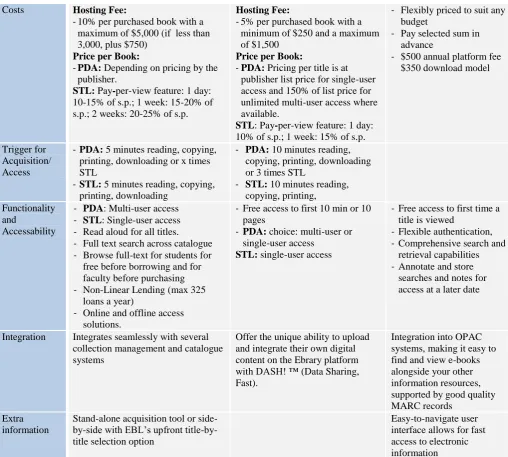
Amongst the e-content aggregation platforms for PDA, three established, well known and important ones are introduced below. They offer partially patron driven purchases and patron initiated STLs. Due to a lack of literature on this topic, the information below is taken from aggregators‟ websites2 and the research paper by Claeyssens (2011) for the Royal Library The Hague.
EBL Ebrary MyiLibrary
# of titles available
Nearly 350,000 titles Nearly 400,000 titles - PDA (2011): 180346 - STL (2011) 121570
250,000 titles, and additional 5,000 titles being added monthly
Mediated or Unmediated
- PDA: Both possible - STL: Both possible
- Combination: Libraries can choose to automatically purchase those e-book titles after a specified number of uses, or pattern of demand has been established
- Libraries can select their collection refined by subject, publisher, price, date and other key parameters
- Short-Term Loans in conjunction with PDA for mediation.
PDA: Unmediated. (only mediation tool: sum paid in advance)
Overall Access Time for STL
STL: choice between 1 day, 1 week, 2 weeks or 4 weeks loan
STL: choice between 1 day and 1 week loan. After 3 loans obligatory acquisition
2
Costs Hosting Fee:
- 10% per purchased book with a maximum of $5,000 (if less than 3,000, plus $750)
Price per Book:
- PDA: Depending on pricing by the publisher.
STL: Pay-per-view feature: 1 day: 10-15% of s.p.; 1 week: 15-20% of s.p.; 2 weeks: 20-25% of s.p.
Hosting Fee:
- 5% per purchased book with a minimum of $250 and a maximum of $1,500
Price per Book:
- PDA: Pricing per title is at publisher list price for single-user access and 150% of list price for unlimited multi-user access where available.
STL: Pay-per-view feature: 1 day: 10% of s.p.; 1 week: 15% of s.p.
- Flexibly priced to suit any budget
- Pay selected sum in advance
- $500 annual platform fee $350 download model
Trigger for Acquisition/ Access
- PDA: 5 minutes reading, copying, printing, downloading or x times STL
- STL: 5 minutes reading, copying, printing, downloading
- PDA: 10 minutes reading, copying, printing, downloading or 3 times STL
- STL: 10 minutes reading, copying, printing, Functionality
and
Accessability
- PDA: Multi-user access - STL: Single-user access - Read aloud for all titles.
- Full text search across catalogue - Browse full-text for students for
free before borrowing and for faculty before purchasing - Non-Linear Lending (max 325
loans a year)
- Online and offline access solutions.
- Free access to first 10 min or 10 pages
- PDA: choice: multi-user or single-user access
STL: single-user access
- Free access to first time a title is viewed
- Flexible authentication, - Comprehensive search and
retrieval capabilities - Annotate and store
searches and notes for access at a later date
Integration Integrates seamlessly with several collection management and catalogue systems
Offer the unique ability to upload and integrate their own digital content on the Ebrary platform with DASH! ™ (Data Sharing, Fast).
Integration into OPAC systems, making it easy to find and view e-books alongside your other information resources, supported by good quality MARC records
Extra information
Stand-alone acquisition tool or side-by-side with EBL‟s upfront title-by-title selection option
[image:14.595.52.561.69.526.2]Easy-to-navigate user interface allows for fast access to electronic information
Table 1: Comparison of PDA Providers
E-book Library (EBL): According to their website, EBL provides cost-effective access to titles “when they are needed, as they are needed” enabling the users to catalogue and display thousands
with several collection management and catalogue systems as the "Online Public Access Catalog" (OPAC) or OCLC. End users can browse through the full-text for free and after 5 minutes of reading or copying, printing and downloading, a title will be acquired via PDA or accessed by a one day, one week, two weeks or four weeks loan. A read-aloud option for all titles, a full text search across the catalogue and online as well as offline access solutions enhance the functionality and accessibility of the e-books.
Ebrary: Ebrary currently has more than 4,500 library customers around the world and more than 500 publishers distribute their e-books on the Ebrary platform. With nearly 400,000 titles it offers more e-books to their customers than the competition and enables them to upload and integrate their own digital content on the Ebrary platform. A customer can pre-select titles of the catalogue, refining by subject, publisher, price, date and other key parameters which will then be offered to the end users. This can be in the form of STL, direct purchase or a combination of both. An access or acquisition of a title is triggered after ten minutes or ten pages of reading, copying or printing a title by the end user. After the third loan an obligatory acquisition will be made. Via STL only one end user can access the title; however with PDA customers can choose whether they want to give multi-user or single-multi-user access to the e-books
MyiLibrary: MyiLibrarydefines itself as “an industry-leading e-content aggregation platform for public, academic and professional libraries around the world”. The platform works with reputable
commercial publishers and has hundreds of libraries as customers that have access to 50,000 titles, with an additional 5,000 titles being added monthly. MyiLibrary has a flexible pricing strategy, aiming to suit any budget, where a sum is agreed upon and paid in advance and from which a selection of titles that will be offered to the end users is made. The first time a pre-selected title is accessed is free to the library; thereafter it will be automatically purchased. Comprehensive search and retrieval capabilities facilitate the usage as well as annotations, store searches and notes for access at a later date. Moreover an easy-to-navigate user interface allows for fast access to electronic information. MyiLibrary is integrated into OPAC systems, which makes it easy to find and view e-books alongside other information resources.
4.3.Performance of PDA
have different budgets and a have a different context in which PDA is implemented e.g. the need for non-English PDA titles.
4.3.1.Circulation Rate
Compared to the “just-in-case” collection development model, it is observed that titles circulate more frequently (Foss, 2008; Hussong-Christian & Goergen-Doll, 2010; Nixon et al., 2010; Perdue & Van Fleet, 1999; Schroeder, 2012; Tyler et al., 2010; Tyler, 2011; Way, 2009) receiving at least one initial use (Waller, 2013) whilst a high percentage of traditionally purchased titles have never circulated (Nixon & Saunders, 2010). It can be argued that this increase in usage is because it is highly likely that those books will interest other patrons in the future (Nixon et al., 2010) e.g. other students tackle the same research assignments in subsequent semesters (Waller, 2013) at least in the short term (Anderson et al., 2002).
Anderson et al. (2002) found at the Purdue Library for Humanities, Social Sciences and Education that 68 percent of the Books on Demand titles acquired during the project‟s first two years have circulated at least once after the initial use compared to the 36 percent of titles normally acquired. Fischer et al. (2012) observed at the University of Iowa in 2009, that user-selected titles were used twice as often as librarian-selected. A research made by Shen et al. (2011), finds that e-books even “out circulate” (p.205) “just-in-case” selected titles.
4.3.2.Costs
Costs vary strongly between the pricing strategy used, e.g. if STLs are utilized, or if titles are acquired directly. One of the biggest scepticisms of universities against PDA is their fear that overall costs will increase. Libraries with fixed budgets do not like open ended commitments and are afraid that the budget will be reached early in the process (Hardy & Davies, 2007) although PDA is often described as a cost-effective collection development method (Nixon et al., 2010). Tyler et al. (2011) observed at the University of Nebraska-Lincoln that ILL PDA books did, on average, tend to cost a bit more than did books acquired through traditional means, but this is according to them, of little or no importance when circulation performance is taken into account. At the Sam Houston State University the following development was witnessed for PDA with e-books: “Overall, patron selections averaged less than $100, as did librarian selections, indicating that patron and librarian choices were similar with regard to cost” (Shen et al., 2011, p. 14).
4.3.3.Quality of Content
buying for immediate need, will change the nature of academic collections over time. PDA might polarize collection levels between introductory works and narrowly focused research materials and the content available through e-book aggregators is only a fraction of the titles published each year. However, an academic research library requires more content and is therefore still dependent on the expertise of subject librarians (Hodges et al., 2010). Contradictory to this statement it is argued that PDA titles fulfil actual needs expressed by patrons, whereas most titles acquired via traditional means, just fulfil perceived needs (Waller, 2013). As Rawlinson (1981) puts it: “a book of outstanding quality is not worth its price if no one will read it” (Rawlinson, 1981, p.2188). Throughout literature it is observed, that patron selected titles are actually appropriate, form a useful addition to a library‟s collection (Anderson et al., 2002; Hardy & Davies, 2007; Tyler et al., 2010; Reynolds, Harrell, Pickett, Smith, Tucker & van Duinkerken., 2010; Fischer et al., 2012; Tyler, 2011) and would have been ordered anyway if asked, or if the collection development funds had been larger (Perdue & Van Fleet, 1999).
At the Newton Gresham Library an extensive research was conducted by Shen et al. in 2011 comparing the quality of titles acquired via PDA versus traditionally acquired ones: “a comparison of the numbers shows that librarian and patron selections overall were remarkably similar in their content levels, with the exception that librarians selected significantly fewer popular titles than patrons. For the most part, whereas patron selections included additional popular titles, librarian selections instead included additional advanced academic titles, which was not especially surprising” (Shen et al., 2011, p.213). Reynolds et al. (2010) documented the following statistics at
the Texas A&M University: “When asked to comment on user requests aligning with current collection development policy, 62.5 percent of the librarians agreed that most requests had aligned; 37.5 percent stated that few of the requests were aligned. 88 percent said that they have not needed to adjust their collection development policies in response to users’ needs” (Reynolds et al., 2010,
p.250), indicating that the selections via traditional means and via PDA do not have significant differences.
4.3.4.Sustainability
„„immediate needs‟‟ of the patron (Sense & Fonseca, 2013). A study by Tyler (2011) at the University of Nebraska showed that titles selected by patrons would result in libraries purchasing “expensive, idiosyncratic, and possibly redundant books to meet particular patrons' narrow and
ephemeral needs. Books, that would not be suitable for the purchasing libraries' collections, that would experience relatively little circulation, and that would have, as a result, comparatively poor use value” (Tyler, 2011, p.03). Anderson et al. (2002) disagree with this statement and emphasize
that the potential longevity of collection cannot be generalized, but depends on the subject. They observe at the Purdue University, that the sections history and English hold the interest of researchers for a long period of time, while a title from the section political science is more likely to become outdated in the future will be more likely outdated in the future. Fischer et al. (2012) hold a different opinion on this topic. They state that PDA titles have the same potential long term value as the ones they had acquired by traditional means.
Overall it can be concluded that it is difficult to assess the long term value of PDA titles. Collection specialists might have more knowledge on what will be relevant in the future and make more conscious acquisition choices not only focusing on an immediate need. It can also be argued that with PDA titles will be read at least one time while many books purchased via traditional collection methods never circulate (Brinkman Dzwig, 2013).
4.3.5.User Satisfaction
Overall, patrons are satisfied with the “just-in-time” collection method (Allen et al., 2003; Foss, 2008; Nixon et al., 2010; Levine-Clark, 2010; Reynolds et al., 2010; Waller, 2013). Especially a quick turnaround time is, according to Hussong-Christian and Goergen-Doll (2010), of high importance to the patrons and a fast delivery of needed materials with PDA generates goodwill amongst them (Allen et al., 2013; Hussong-Christian & Goergen-Doll, 2010; Waller, 2013). Besides that, patrons show high levels of satisfaction with the quality of the titles acquired and their usefulness for the collection (Allen et al., 2003).
5. Reflection on Literature Review
According to the literature review provided earlier in this paper, the following conclusions can be drawn:
The motivation to engage in PDA is especially driven by the need to change, due to poor circulation rates (Fischer et al., 2012; Perdue & Van Fleet, 1999), the difficulty of predicting the needs of the customers (Tyler et al., 2011) and an explosive growth of information offered (Brinkman Dzwig, 2003) which challenges the “just-in-case” collection development method.
Extensive research exists on the performance of PDA titles compared to the traditional method: PDA titles circulate more frequently (Foss, 2008; Hussong-Christian & Goergen-Doll, 2010; Nixon et al., 2010; Perdue & Van Fleet, 1999; Schroeder, 2012; Tyler et al., 2010; Tyler, 2011; Way, 2009) and patron selected titles are appropriate and form a useful addition to a library‟s collection (Anderson et al., 2002; Hardy & Davies, 2007; Tyler et al., 2010; Reynolds et al., 2010; Fischer et al., 2012; Tyler, 2011). According to literature, patron initiated acquisitions do not lead to a sustainable collection (Allen et al, 2003; Hussong-Christian & Goergen-Doll, 2010; Sense & Fonseca, 2013; Price & McDonald, 2009), although Anderson et al. (2002) and Fischer et al. (2012) observe the opposite. The comparison of overall costs resulted in many different opinions: Nixon et al. (2010) states that “literature is convinced that the patron-driven acquisitions model has proved itself [to result in a] cost-effective collection” (Nixon et al., 2010, p.121). Tyler et al. (2011) find that PDA in conjunction with ILL for printed books is slightly more expensive and Shen et al. (2011) do not recognize any difference in price between PDA with EBL and the traditional method of acquiring books. Literature found that patrons are satisfied with the “just-in-time” collection method (Allen et al., 2003; Foss, 2008; Nixon et al., 2010; Levine-Clark, 2010; Reynolds et al., 2010; Waller, 2013). Reasons therefore are the provision of a quick turnaround time (Hussong-Christian & Goergen-Doll, 2010; Allen et al., 2013; Waller, 2013), the quality of the titles acquired and their usefulness for the collection (Allen et al., 2003).
6. Methodology of Data Collection
In order to give the University of Twente a suitable advice and relevant data, libraries that belong to a similar macro environment were chosen for the interviews. This includes being situated in the Netherlands and, if possible, being a university library. To do so, all the libraries which participated at the workgroup “Collection Management” of the UKB, which is a consortium of thirteen university libraries and the Royal Library of the Netherlands, were contacted via e-mail and asked to participate in this research. From those libraries, seven replied from which five were willing to conduct an interview. The reasons the two libraries cancelled were that they have not implemented PDA yet and are still in their planning phase. The libraries which approved the request were the Library of the Technical University of Delft (TUD), the Royal Library The Hague (KB), the University Library Utrecht (UU), the VU University Library Amsterdam (VU) and the University Library Leiden (UL).
All the interviewees received an e-mail before the actual interview with a couple of sample questions so they could prepare themselves and have all the information necessary. The interviews were conducted with one (TUD, UU, VU, UL) or even two persons (KB) responsible for the implementation of PDA and were open-ended interviews. Via this interviewing method, full and meaningful answers are encouraged and the answers tend to be more objective and less leading than closed-ended questions. A cognitive map providing an overview of all relevant topics was used by the interviewer to overcome missing out on any essential aspects (Appendix B). This cognitive map was preferred to a list with questions, since it allows more flexibility during the interviews. Instead of having to follow a specific order of questions it helps to react to the answers of the interviewees and to ask good follow-up questions.
7. Empirical Research
In this section, the different implementation strategies of PDA for digital content at the five Universities in the Netherlands will be described and compared to each other. To do so, the libraries will first be shortly introduced:
7.1. Introduction of Libraries for Interviews
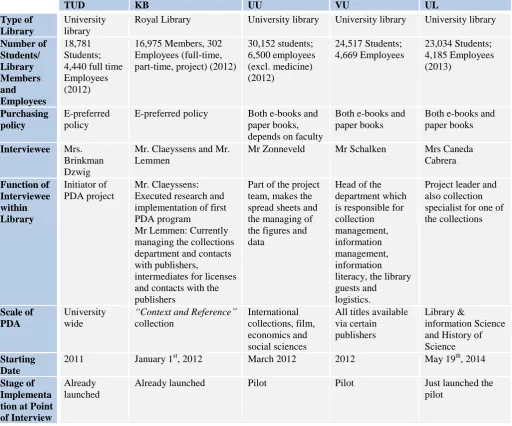
In the following abstract the different libraries which were interviewed are introduced including the interviewee representing the library:
TUD KB UU VU UL
Type of Library
University library
Royal Library University library University library University library
Number of Students/ Library Members and Employees 18,781 Students; 4,440 full time Employees (2012)
16,975 Members, 302 Employees (full-time, part-time, project) (2012)
30,152 students; 6,500 employees (excl. medicine) (2012) 24,517 Students; 4,669 Employees 23,034 Students; 4,185 Employees (2013) Purchasing policy E-preferred policy
E-preferred policy Both e-books and paper books, depends on faculty
Both e-books and paper books
Both e-books and paper books
Interviewee Mrs. Brinkman Dzwig
Mr. Claeyssens and Mr. Lemmen
Mr Zonneveld Mr Schalken Mrs Caneda Cabrera Function of Interviewee within Library Initiator of PDA project Mr. Claeyssens: Executed research and implementation of first PDA program
Mr Lemmen: Currently managing the collections department and contacts with publishers,
intermediates for licenses and contacts with the publishers
Part of the project team, makes the spread sheets and the managing of the figures and data
Head of the department which is responsible for collection management, information management, information literacy, the library guests and
logistics.
Project leader and also collection specialist for one of the collections
Scale of PDA
University wide
“Context and Reference”
collection
International collections, film, economics and social sciences
All titles available via certain publishers
Library &
information Science and History of Science Starting
Date
2011 January 1st, 2012 March 2012 2012 May 19th, 2014
Stage of Implementa tion at Point of Interview
Already launched
Already launched Pilot Pilot Just launched the
[image:22.595.45.558.258.684.2]pilot
All libraries, except of the Royal Library The Hague, are university libraries, which implies that most of their users are students. With 30,152 students and 6,500 employees (2012)3, the UU is the biggest university that takes part at this research. It is closely followed by the VU with 24,517 students and 4,669 employees4 and the UL with 23,034 students and 4,185 employees (2013)5. The TUD is the university library with the fewest students, 18,781, and employees, 4,440 (2012)6. Since the KB is not a university library, the size is measured by its 16,975 enrolled members and 302 employees (2012)7. Whilst the VU and the UL both purchase print and digital titles, the UU has different purchasing policies per faculty and the TUD as well as the KB have an e-preferred policy. This means that a print title will only be bought if a digital version is not available. Due to the KB not being a university library, they are following a different goal: Instead of providing materials that suit to the curriculum of the studies, they want to collect everything that is published about the Netherlands as a preservation purpose, independent of the usage per title by the patrons. Next to this main collection they have the “Context and Reference” collection, which is just an additional service to the users and for which mainly e-titles are bought.
At the TUD the interview was conducted with Mrs. Brinkman Dzwig, initiator of the PDA project which was already launched in 2011. This makes the TUD the first library in the Netherlands that introduced PDA as a purchasing method. At the KB, Mr. Claeyssens and Mr. Lemmen were interviewed: Mr. Cleanses conducted the research and implementation of first PDA programme at the library in January 2012, whilst Mr. Lemmen is currently managing the collections department contacting with publishers and intermediates for licenses. Mr. Zonneveld was the representative for the University of Utrecht. He forms part of the project team, makes the spread sheets and manages the figures and data. At this library, PDA was introduced in March 2012, the same year in which the VU started their PDA project as well. Mr. Schalken, the head of the department that is responsible for collection management, information management, information literacy, the library guests and logistics, was interviewed on behalf of the VU. Last but not least, Mrs. Mrs Caneda Cabrera provided information on the launch of PDA at the UL, which took place in March 2014. She is project leader as well as collection specialist for one of the collections and introduced PDA together with a metadata expert, a colleague who is working in the acquisition department for e-books and another collection specialist.
3http://www.uu.nl/university/utrecht/NL/profiel/cijfersenfeiten/Pages/default.aspx 4
http://www.vu.nl/nl/over-de-vu/profiel-en-missie/cijfers-en-naslagwerken/vu-in-cijfers/index.asp 5http://over.leidenuniv.nl/feitencijfers/cijfers.html
6
http://www.tudelft.nl/over-tu-delft/feiten-en-cijfers/ 7
As one can interpret from the starting dates of the introduction of PDA, all libraries are in different stages of their implementation: While the TUD and the KB have already launched the project, the VU and UL are still in their pilot. The UL just launched their pilot the day the interview was conducted. Despite those differences they have all the following in common: As already mentioned they are all located in the Netherlands, except of the KB they are all university libraries, they have all introduced PDA for e-content only and they all use PDA as an additional acquisition tool. These similarities make a comparison in their motivation, implementation issues and performance of PDA very interesting, since they are all exposed to similar macro-economic influences but implement PDA differently and therefore give different insights to the reader.
7.2. Motivation to Engage in PDA
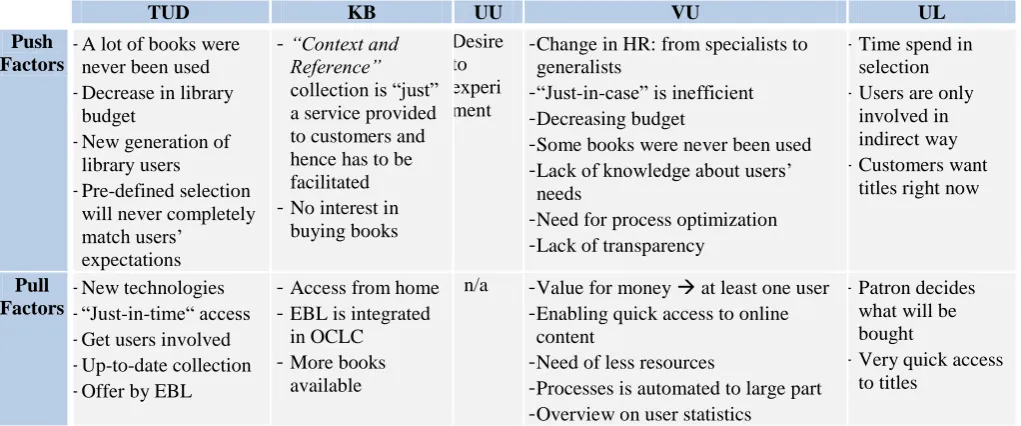
[image:24.595.44.555.404.617.2]Several push and pull factors can be recognized which have motivated the libraries to engage in PDA. Push factors can be defined as the negative conditions or causes that motivates one to change the current acquisition model, while pull factors are those factors that make PDA an attractive option.
Table 3: Motivation to Engage in PDA
7.2.1.Push Factors
The TUD, the VU and the UL observed that the traditional method of acquiring books was insufficient and required some changes: Some of the preselected books had, according to them, never been used and do not match user needs (TUD & VU) since they are only involved in an indirect way (UL). Moreover, a new generation of library users has different demands such as
TUD KB UU VU UL
Push Factors
-A lot of books were never been used
-Decrease in library budget
-New generation of library users
-Pre-defined selection will never completely match users‟
expectations
-“Context and Reference”
collection is “just” a service provided to customers and hence has to be facilitated
- No interest in buying books
Desire to experi ment
-Change in HR: from specialists to generalists
-“Just-in-case” is inefficient
-Decreasing budget
-Some books were never been used
-Lack of knowledge about users‟ needs
-Need for process optimization
-Lack of transparency
- Time spend in selection
- Users are only involved in indirect way
- Customers want
titles right now
Pull Factors
-New technologies
-“Just-in-time“ access
-Get users involved
-Up-to-date collection
-Offer by EBL
- Access from home
- EBL is integrated in OCLC
- More books available
n/a -Value for money at least one user
-Enabling quick access to online content
-Need of less resources
-Processes is automated to large part
-Overview on user statistics
- Patron decides what will be bought
having quick access to titles, which cannot be met by the traditional method (TUD & UL). Too much time is spent in the selection of titles (UL), which makes the “just-in-case” model inefficient and demands for process optimization (VU). A change in the nature of the collection specialists form a specialist to a generalist, a lack of transparency (VU) and a decrease in library budget (TUD and VU) are other push factors which were recognized. Unlike the other libraries, the KB and UU had different reasons: the desire to experiment with different acquisition tools for digital and printed books (UU) and the lack of interest in purchasing books for a certain collection which is not core of the library (KB).
7.2.2.Pull Factors
After having recognized the need to change, there are certain factors which make PDA as a new acquisition method attractive to the libraries: New technologies are allowing for a “just-in-time” access to PDA titles (TUD, UL & VU), access from home for the users (KB) and an automation of the processes (VU). Since the patrons are directly involved in the acquisition (TUD & UL) a title is at least used one time which increases the value for money (VU). The collection will automatically be kept up-to-date (TUD) and more titles will be offered to choose from (KB), although fewer resources will be needed (VU). Via this method more metadata will be available and can be used in terms of statistics on the patrons and their usage behaviour (VU). In addition, EBL made offers to the TUD suggesting to introduce PDA with them as an aggregator and the fact that the aggregator is integrated in OCLC makes it attractive for the KB.
7.2.3.Discussion
Except for the UU all the Universities recognized push as well as pull factors which shaped their decision making. The main reasons is the traditional system being insufficient and inefficient in meeting the customer needs. The libraries hope to overcome this by making use of the “just-in-time” method which is more customer centred, efficient and transparent.
7.3.Implementation Issues
7.3.1.Stakeholder Involvement
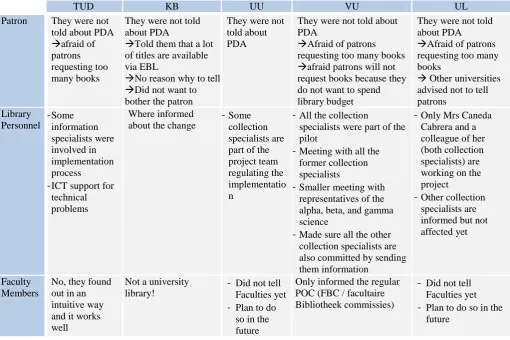
[image:26.595.44.555.154.494.2]To assess stakeholder involvement, the following part will elaborate on the role of the patrons, library personnel and faculty members during the implementation of PDA.
Table 5: Stakeholder Involvement
Patrons: All the libraries had in common that they did not tell their patrons about the implementation of PDA. A reason not to involve them was that they were afraid this would manipulate user behaviour and that it would result in patrons requesting too many titles (TUD, UU, VU & UL). The KB was the only library that was not afraid of this trend and argued that they did not want to bother the patron and that there is no reason to tell them. They even encouraged the patrons to read books by advertising the increase of titles available.
Library Personnel: In contrast to the patrons, the library personnel were informed about the implementation process from the beginning (TUD, KB, UU, VU & UL). Although not everyone is directly involved, PDA is managed at all universities by a small team, providing information to the personnel is regarded as important. This is because the introduction of PDA might have major implications on the working field of collection specialists (KB, UL & VU). Instead of selecting
TUD KB UU VU UL
Patron They were not told about PDA afraid of patrons requesting too many books
They were not told about PDA
Told them that a lot of titles are available via EBL
No reason why to tell Did not want to bother the patron
They were not told about PDA
They were not told about PDA
Afraid of patrons requesting too many books afraid patrons will not request books because they do not want to spend library budget
They were not told about PDA
Afraid of patrons requesting too many books
Other universities advised not to tell patrons Library Personnel -Some information specialists were involved in implementation process
-ICT support for technical problems
Where informed about the change
- Some collection specialists are part of the project team regulating the implementatio n
- All the collection
specialists were part of the pilot
- Meeting with all the former collection specialists
- Smaller meeting with representatives of the alpha, beta, and gamma science
- Made sure all the other collection specialists are also committed by sending them information
- Only Mrs Caneda
Cabrera and a colleague of her (both collection specialists) are working on the project
- Other collection specialists are informed but not affected yet
Faculty Members
No, they found out in an intuitive way and it works well
Not a university library!
- Did not tell Faculties yet
- Plan to do so in the future
Only informed the regular POC (FBC / facultaire Bibliotheek commissies)
- Did not tell Faculties yet
books for purchase they have to filter the titles available for PDA, approve them (if process is mediated) and work project related instead of faculty or subject related (VU (in the pilot) & UL).
Faculty members: Faculty members can be identified as non-student members of a faculty, including employees and researchers. Since they are also making use of the library collection they can overlap with the “patrons” defined earlier in this section. Some libraries did not tell the members of different faculties everything about the introduction of PDA, though they are planning to do so in the future (TUD, UU & UL). The UL first wants to implement PDA for more subjects before discussing the topic with the university staff. The UU on the other hand did not report to them about the budget used for PDA because the costs first have to be spread and made sustainable. Although the TUD has not told the employees of the faculties about the implementation, they found this out intuitively, which worked out well for the library. The VU only informed faculty members which are influenced by the introduction of PDA. It has to be kept in mind that the KB is not a university library and therefore this question is not applicable to them.
Discussion: The reason why those stakeholder groups are differently involved is the following: PDA, once it is implemented, has direct consequences on the working fields and processes of library personnel. They have to be informed and engaged in order to make PDA work. The introduction of PDA does, however, not have direct influence on the faculty members. Their interest is, that students have access to all relevant titles, no matter via which means it will be acquired. As long as the quantity and quality remains, and it is financed through a central budget, it will not affect them negatively. But if a library decides to finance PDA with the faculties‟ budget, they should be informed and persuaded that PDA is a beneficial method for them. Since the titles still remain free to the patrons and they do not recognize a difference in accessing them, PDA does not directly influence the users in their working processes. Eventually more titles will become available and though they might have to request a title, it will be available quickly. Therefore and to not bias their user‟s behaviour, many libraries do not involve them in the implementation of PDA.
7.3.2.Different Variations of PDA
Table 6: Different Variations of PDA
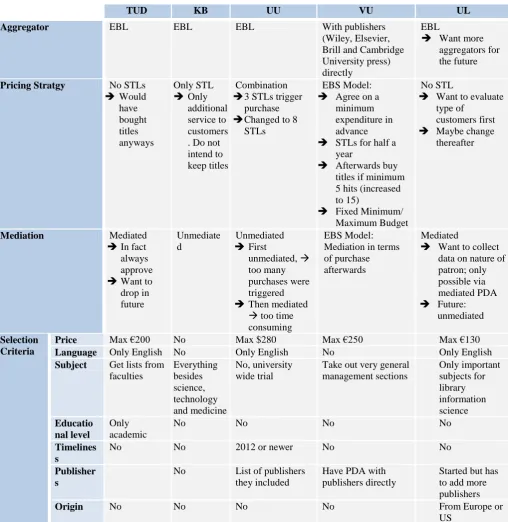
PDA Providers: Except for the VU, all the libraries have chosen for EBL as an aggregator for PDA. This decision was made due to the integration of EBL in OCLC (KB), not being obliged to buy titles after a certain number of STLs (KB) and already having worked with EBL before (TUD). The UL is starting their pilot with EBL but want to contact more aggregators in the future to diversify and to take advantage of better price deals. The reasons why the VU chose to contact the publishers
TUD KB UU VU UL
Aggregator EBL EBL EBL With publishers
(Wiley, Elsevier, Brill and Cambridge University press) directly
EBL
Want more aggregators for the future
Pricing Stratgy No STLs Would have bought titles anyways Only STL Only
additional service to customers . Do not intend to keep titles
Combination 3 STLs trigger
purchase Changed to 8
STLs
EBS Model: Agree on a
minimum expenditure in advance STLs for half a
year
Afterwards buy titles if minimum 5 hits (increased to 15)
Fixed Minimum/ Maximum Budget
No STL
Want to evaluate type of
customers first Maybe change
thereafter
Mediation Mediated
In fact always approve Want to drop in future Unmediate d Unmediated First unmediated, too many purchases were triggered Then mediated
too time consuming
EBS Model: Mediation in terms of purchase afterwards
Mediated
Want to collect data on nature of patron; only possible via mediated PDA Future:
unmediated
Selection Criteria
Price Max €200 No Max $280 Max €250 Max €130
Language Only English No Only English No Only English
Subject Get lists from faculties Everything besides science, technology and medicine No, university wide trial
Take out very general management sections Only important subjects for library information science Educatio nal level Only academic
No No No No
Timelines s
No No 2012 or newer No No
Publisher s
No List of publishers they included
Have PDA with publishers directly
Started but has to add more publishers
Origin No No No No From Europe or
directly instead of working with an aggregator are digital rights management issues and being in a better position for negotiations on prices, since no third party wants to profit from the deal. In the future however they are planning a pilot with EBL to get experience with the benefits of aggregators.
Pricing strategies: Although most libraries have chosen to work with EBL, the pricing strategies used differ from one another. The TUD and the UL have chosen for direct purchase to keep the image simple for the user (TUD & UL), because they would have bought the titles anyway (TUD) and to evaluate the nature of the patrons (UL). The UL is considering changing this strategy once they have the information needed. Since PDA is only implemented at the “Context and Reference” collection, which is not the core of the KB, they have chosen for STLs only. This implies that no purchase will be triggered because the library does not intend to keep the titles used via PDA. The UU, on the other hand, uses three STLs as a trigger for purchase. To stimulate the distribution of costs, the limit of three STLs was increased to eight STLs. By making use of similar model to EBS, the VU agrees with the publishers (Wiley, Elsevier, Brill and Oxford University Press) in advance on a minimum amount to spend and gives the patrons free access to the titles selected for approximately six months. Thereafter the library buys from the money invested, all the titles which were used at least five times. In advance they agreed with the publisher on a minimum and maximum amount to spend and if books were not used often enough they do not have to buy them. The usage was, against the expectations, really high and they increased the level of minimum usage to acquire a title from five to 15 times to stay within the budget.
Striking is that the two libraries with a larger budget for PDA have chosen against, whilst the libraries with a smaller budget chose for mediation. It can be assumed, that if a larger budget is available one can focus is on process optimization and libraries with a smaller budget are more concerned that the money might not be sufficient in the long term if mediation would be dropped.
Pre-Filtering of Offered PDA Titles: To prevent patrons from acquiring too expensive materials which are not in the profile of the library, the list of PDA titles available are often pre-selected. All of the libraries interviewed have done such a filtering to some extent. The TUD has set their price limit to €200 and selected only English and academic titles. The KB made a broader profile and selected everything EBL had except for science, technology and medicine, making even the most expensive titles available. A maximum of $280 was set by the UU on the acquisition of titles. They have to be in English and from 2012 or newer. There is no selection based on subject, since it is a university wide trial, but on the publishers included. The VU took out very general management sections like Dummies books offered by the publishers and set a price limit to €250 above which they could decide whether they want to buy them or not. The university with most selection criteria is the UL; they restricted the titles available to a maximum of €130, to the English language, to important subjects from library science and which have to be from Europe or the US. They started to limit it to some specific publishers, but have to insert more publishers to give a comprehensive selection of titles.
It can be recognized that all universities selected the PDA titles based on subject and on price (except of the KB that has a larger budget available and a different goal) which matches with their concerns that PDA titles might be of lower quality than titles acquired via traditional means and that the budget will not be sufficient for the long term. It is likely that the universities want to counteract and prevent those issues, via these selection criteria.
7.3.3.Collection Methods Used Next to PDA
Table 7: Collection Methods Used Next to PDA
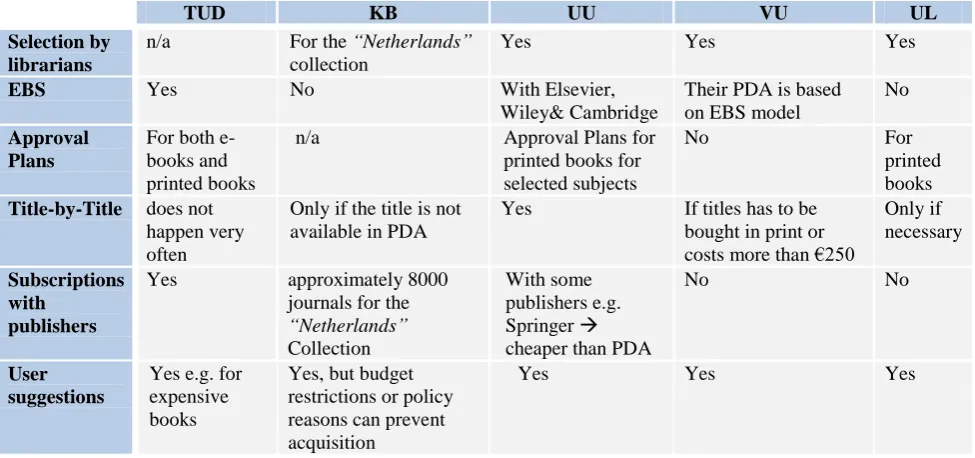
Traditionally the TUD used approval plans as an acquisition tool for both e-books and paper books. After having implemented PDA they still make use of approval plans and additionally order books title-by-title, if an extra book is needed, and get suggestions to buy certain books by users. The TUD is implementing PDA for printed books in the future.
The KB makes a difference between the “Context and Reference” collection and the “Netherlands” collection, which is the main topic of the library. In the first collection, PDA is
implemented with extra title-by-title purchases and user suggestions if a book is not available via PDA. The second collection still uses its traditional acquisition methods including subscription with publishers and selection by collection specialists. The reason not to implement PDA there is that most Dutch books are not available at an e-content aggregation platform and that all Dutch books should be purchased as a preservation purpose and not only the ones selected by patrons.
The aim of the UU is to experiment with as many acquisition tools as possible. For different faculties they make use of different models and implemented PDA for economic, social sciences, international collections and film. Besides that, the UU also make use of evidence based selection (EBS) for e-books with several publishers, buy printed books via approval plans, have subscriptions with some publishers and get user suggestions. If a title is not available via one of those methods, a title-by-title purchase is also possible.
The VU is still in its pilot phase and is therefore “working as usual” with PDA being an additional method to experiment with. “Working as usual” includes selection by collection specialists, title-by-title purchases and user suggestions. The library doubts that PDA is a perfect
TUD KB UU VU UL
Selection by librarians
n/a For the “Netherlands” collection
Yes Yes Yes
EBS Yes No With Elsevier,
Wiley& Cambridge
Their PDA is based on EBS model
No
Approval Plans
For both e-books and printed books
n/a Approval Plans for
printed books for selected subjects
No For
printed books Title-by-Title does not
happen very often
Only if the title is not available in PDA
Yes If titles has to be bought in print or costs more than €250
Only if necessary
Subscriptions with
publishers
Yes approximately 8000 journals for the
“Netherlands”
Collection
With some publishers e.g. Springer cheaper than PDA
No No
User suggestions
Yes e.g. for expensive books
Yes, but budget restrictions or policy reasons can prevent acquisition