http://www.scirp.org/journal/ss ISSN Online: 2157-9415
ISSN Print: 2157-9407
DOI: 10.4236/ss.2017.812056 Dec. 8, 2017 499 Surgical Science
The Effectiveness of Intraoperative Frozen
Section Analysis of Safety Margins in Breast
Conserving Surgery and the Role of Surgeon
in Decreasing the Rate of Positive Margins
Omar Farouk
1*, Ahmed Senbel
1, Mosab Shetiwy
1, Essam Attia
1, Ahmed Abdallah
1,
Osama El-Damshety
1, Ashraf Khater
1, Sameh Roshdy
1, Amr Abouzid
1, Amr Hossam
1,
Islam H. Metwally
1, Omar Hamdy
1, Amir M. Zaid
1, Mahmoud Abdelaziz
1, Mohamed Elmetwally
1,
Adel Fathi
1, Emad-Eldeen Hamed
1, Khaled Abdel Wahab
1, Wagdi El-Kashef
2, Mohamed Hafez
1,
Khaled Zalata
2, Mohamed Hegazy
1, Adel Denewer
11Surgical Oncology Department, Oncology Center, Faculty of Medicine, Mansoura University, Mansoura, Egypt 2Pathology Department, Faculty of Medicine, Mansoura University, Mansoura, Egypt
Abstract
Introduction: Nowadays the more accepted surgical option for treating early breast cancer is breast conserving surgery. The main challenge in this type of surgery is to get free safety margins without need of second surgical operation, so many breast surgeons have started to depend on intraoperative frozen sec-tions to ensure free safety margins. Aim of work: To assess our policy that we prefer to depend on intraoperative frozen section analysis to get free safety margin in breast conserving surgery from the 1st surgery, and its oncologic outcome. Patients and Methods: This is a retrospective study conducted in Oncology Center—Mansoura University (OCMU), where the data of 219 pa-tients with breast cancer, who were managed by breast conserving surgery with intraoperative frozen section analysis of the safety margins, was analyzed. Results: The intraoperative frozen section analysis of safety margin was nega-tive from the start in 183 (83.6%) patients, while it was posinega-tive in 36 patients (16.4%). Intraoperative decision of margin re-excision was applied for 29 pa-tients (13.2%) in order to reach negative margin, modified radical mastectomy was offered for 4 patients (1.8%), while nipple sparing mastectomy with im-mediate breast reconstruction using latissimus dorsi flap was offered for 3 pa-tients (1.4%). The postoperative paraffin results were typical with intraopera-tive frozen section analysis results in 216 patients (98.6%) and different results were obtained in only 3 patients (1.4%) who were managed by modified radi-How to cite this paper: Farouk, O., Senbel,
A., Shetiwy, M., Attia, E., Abdallah, A., El-Damshety, O., Khater, A., Roshdy, S., Abouzid, A., Hossam, A., Metwally, I.H., Hamdy, O., Zaid, A.M., Abdelaziz, M., Elmetwally, M., Fathi, A., Hamed, E.-E., Wahab, K.A., El-Kashef, W., Hafez, M., Zalata, K., Hegazy, M. and Denewer, A. (2017) The Effectiveness of Intraoperative Frozen Section Analysis of Safety Margins in Breast Conserving Surgery and the Role of Surgeon in Decreasing the Rate of Posi-tive Margins. Surgical Science, 8, 499-509.
https://doi.org/10.4236/ss.2017.812056
Received: November 11, 2017 Accepted: December 5, 2017 Published: December 8, 2017
Copyright © 2017 by authors and Scientific Research Publishing Inc. This work is licensed under the Creative Commons Attribution International License (CC BY 4.0).
DOI: 10.4236/ss.2017.812056 500 Surgical Science cal mastectomy in a second operation. Only 4 patients had local recurrence (1.8%) during the period of follow-up duration which was ranged from 1 to 86 months with mean ± SD (22.3 ± 14.1). Conclusion: The intraoperative frozen section analysis of safety margins in breast conserving surgery has very high-rate typical results with the paraffin section analysis and it is very helpful in de-creasing the rate of second surgical operation in cases of infiltrated margins. It should be used routinely in all cases of breast conserving surgery.
Keywords
Breast Conserving Surgery, Intraoperative Frozen Section Analysis, Safety Margins, Breast
1. Introduction
The result of progress in radiological diagnosis of breast cancer leading to early detection of breast cancer, more breast cancers is detected at a smaller sized breast. This makes breast conserving surgery an accessible and preferable choice for many patients; this is due to the improved cosmetic and Psychic effect over the patient to preserve her breast. The breast recurrence after BCS is related to age of women, grade and size of the neoplasm, and presence of multifocality or multicentricity [1] [2] [3] [4], whilst safety margin is the tremendous foreseeable of breast cancer local recurrence [5] [6] [7] [8].
As a routine, the paraffin histopathological result following the breast con-serving surgery will be received after few days, so if patient is in need for another operation to re-excise the residual tumor proved by positive safety margin, it will be cared out after many days later on the 1st one. The mentioned rates of re-excision in the literature ranged from 7% to 73%, with most of them report-ing range between 15% - 50% [9] [10] [11] [12].
Unfortunately, in unlucky cases the 2nd margin examined by paraffin is non-conclusive obligating the patient and surgeon to go for the 3rd time to the operating room. Imagine, the patient decision in these situations while we dis-cuss her for the 3rd or even second operation she ask for mastectomy to avoid going again to operation if still positive margin after ongoing operation this is in spite of the early stage of her disease. Another problem for depending on paraf-fin, that delay in the other oncological, non-surgical lines for the patient, psycholog-ical burden over the patient and surly affecting the cosmosis of the breast [13].
Our policy is to depend on the result of intraoperative frozen section analysis of the marginal status of the excised tumor, and if positive margins are found re-excision at same scene is done. Although, this may increase the cost and du-ration of the surgical opedu-ration but mostly it avoids the patient to be subjected to another operation. [13]
DOI: 10.4236/ss.2017.812056 501 Surgical Science necessity for a second operation in case of residual tumor proved by positive marginal status. In this study, we want to estimate the validation of our policy to depend on the frozen section to ensure negative safety margin and asses the role of surgeon in decreasing the rate of positive margins.
2. Patient and Methods
This is a retrospective study conducted between 1 January 2010 till 29 February 2017, in Oncology Center—Mansoura University (OCMU), where the data of all patients with breast cancer who were exposed to BCS (Breast Conserving Sur-gery) with intraoperative frozen section analysis of the safety margins (219 pa-tients) were reviewed. Patients with phylloides tumors and patients with inde-terminate results or missing data were excluded from this study. The design of this study was approved by the Institutional Research Board (IRB) of the Faculty of Medicine in Mansoura University and written informed consent was obtained from all patients before enrolment.
The tumor safety margins were marked by stitches and send for frozen section analysis with an extra safety margin for more confirmation in cases when the resection margin was near to the tumor (Figure 1). If there were any positive safety margins for residual tumor so another intraoperative re-safety margin was excised.
[image:3.595.238.510.473.678.2]We abstracted and recorded the following data; clinical characteristics (like age, side, site, size), radiologic findings (like microcalcifications), pathological characteristics (like preoperative biopsy, intraoperative frozen section status, paraffin section status, pathologic types, grade, staging, receptor status, surgical procedures (conventional breast conserving surgery or oncoplastic volume dis-placement techniques or reconstructive procedures with autologous flaps),
Figure 1. Resection of retroareolar breast tumor with safety margins marked by one
DOI: 10.4236/ss.2017.812056 502 Surgical Science number of surgical operations for each patient in order to calculate the percen-tage of second operation and how intraoperative frozen section analysis avoid this and follow-up visits for any local recurrent or distant metastasis and surviv-al.
3. Results
This study evaluated 219 patients with breast cancer with mean ± SD age 48 ± 10 ranging from 23 - 76 years. The tumor affected right breast in 109 patients (49.8%) and the left breast in 110 patients (50.2%). Regarding the site; the upper outer quadrant was the affected area in 129 patients (58.9%), upper inner qua-drant in 38 patients (17.4%), lower inner quaqua-drant in 17 patients (7.8%), lower outer quadrant in 22 patients (10.0%) and retro areolar area in 13 patients (5.9%). Tumor size was ranged from 10 to 70 mm with mean ± SD (25 ± 9 mm). Sixteen patients (7.3%) have no preoperative biopsy, 34 (15.5%) patients un-derwent fine needle aspiration cytology (FNAC) as preoperative biopsy, 154 pa-tients (70.3%) subjected to core needle biopsy (CNB), 2 papa-tients (0.9%) had an incisional preoperative biopsy and 13 patients (5.9%) had an excisional one. The preoperative pathological findings were found as follow; malignant with invasive type in 175 patients (79.9%), highly suspicious for malignancy in 16 patients (7.43%), atypical proliferative lesion in 4 patients (1.8%), ductal carcinoma in situ (DCIS) in one patient (0.5%), Paget’s disease in one patient (0.5%), fibroa-denosis with sclerosis in one patient (0.5%), fibroafibroa-denosis in one patient (0.5%), benign breast lesions in 4 patients (1.8%) but highly suspicious in radiologic as-sessment and lastly there were 16 patients with no preoperative biopsy but high-ly suspicious in radiologic assessment. The demographic data of the patients were shown in Table 1.
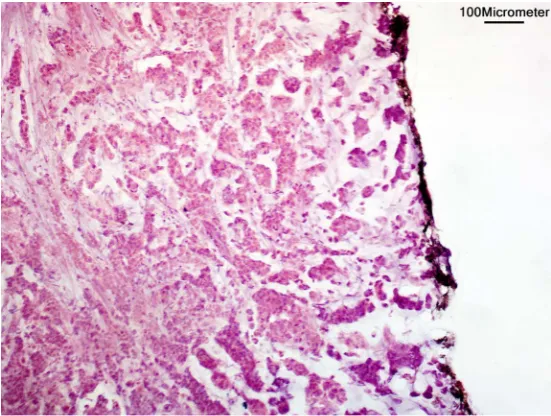
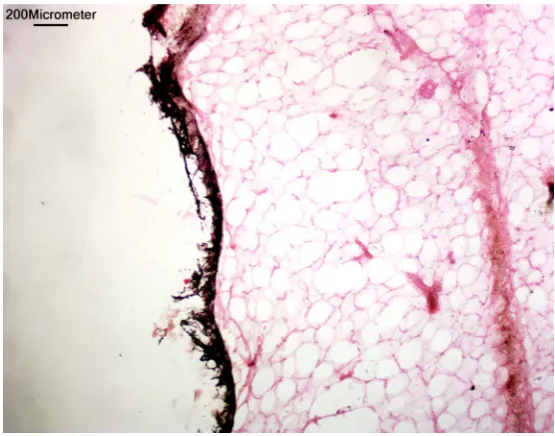
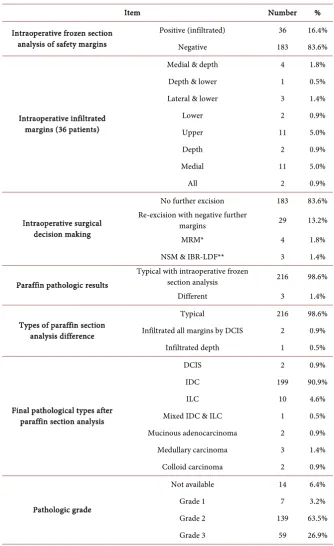
The intraoperative frozen section analysis of safety margin was negative from the start in 183 (83.6%) patients, while it was positive in 36 patients (16.4%) (Figure 2 & Figure 3). Intraoperative decision of margin re-excision was applied for 29 patients (13.2%) in order to reach negative margin, modified radical mas-tectomy was offered for 4 patients (1.8%), while nipple sparing masmas-tectomy with immediate breast reconstruction using latissimus dorsi flap was offered for 3 pa-tients (1.4%).
The postoperative paraffin results were typical with intraoperative frozen sec-tion analysis results in 216 patients (98.6%) and different results were obtained in only 3 patients (1.4%) as follow: two patient (0.9%) with infiltrated all mar-gins by DCIS, and one patient (0.5%) with infiltrated depth. Those 3 patients were managed by modified radical mastectomy in a second operation.
DOI: 10.4236/ss.2017.812056 503 Surgical Science
Table 1. Patient demographics.
Item Number %
Age Mean ± SD 48 ± 10 years
Range 23 - 76 years
Breast side Right 109 49.8%
Left 110 50.2%
Tumor site
Upper outer quadrant 129 58.9% Upper inner quadrant 38 17.4% Lower inner quadrant 17 7.8% Lower outer quadrant 22 10%
Retroareolar 13 5.9%
Tumor size Mean ± SD 25 (±9) mm
Range 10 - 70 mm
Preoperative biopsy technique
None 16 7.3%
FNAC* 34 15.5%
CNB** 154 70.3%
Incisional 2 0.9%
Excisional 13 5.9%
Preoperative pathologic diagnosis
None 16 7.3%
Atypical proliferative lesion 4 1.8% Highly suspicious 16 7.3% Malignant or invasive 175 79.9%
Benign breast lesions 4 1.8%
Fibroadenosis 1 0.5%
Fibroadenosis with sclerosis 1 0.5%
DCIS*** 1 0.5%
Paget disease of nipple 1 0.5% *Fine Needle Aspiration Cytology; **Core Needle Biopsy; ***Ductal Carcinoma In-Situ.
Figure 2. Positive surgical margin in intraoperative frozen section, black line indicate
[image:5.595.235.511.487.695.2]DOI: 10.4236/ss.2017.812056 504 Surgical Science
Figure 3. Negative surgical margin in intraoperative frozen section, black line indicate
inked margin (Hematoxylin & eosin staining, 100x).
and pathological grade was grade 2 in 139 patients (63.5%), grade 1 in 7 patients (3.2%) and grade 3 in 59 patients (26.9%) and no available grade in 14 patients (6.4%). The results of intraoperative frozen section analysis and pathological outcome were shown in Table 2.
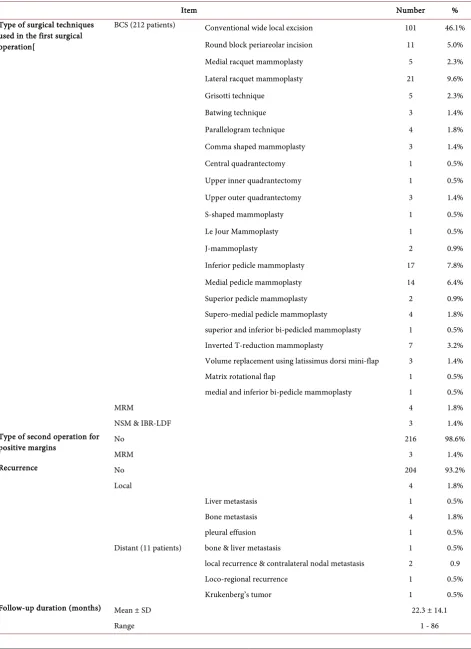
Breast conserving surgery was done in 212 patients (96.8%) with various tech-niques according to the breast volume and tumor size and its site. These surgical techniques are summarized in Table 3. Four patients (1.8%) had modified radi-cal mastectomy and 3 patients (1.4%) had nipple sparing mastectomy with im-mediate breast reconstruction using latissimus dorsi flap.
The intraoperative frozen section analysis avoids second surgical operation in 216 patients (98.6%) while second surgical operation in the form of MRM was done for 3 patients (1.4%) who had different paraffin section analysis results of safety margins.
Only 4 patients had local recurrence (1.8%) during the period of follow-up duration which was ranged from 1 to 86 months with mean ± SD (22.3 ± 14.1). Distant metastasis was developed in 11 patients during this period of follow-up as the following; 4 patients (1.8%) had bone distant metastasis, one patient (0.5%) had liver metastasis, one patient (0.5%) had pleural effusion, one patient (0.5%) had bone and liver metastasis, local recurrence & contralateral nodal me-tastasis was developed in 2 patients (1.8%), local and regional recurrence was noticed in one patient (0.5%) and krukenberg tumor was developed in one pa-tient (0.5%).
4. Discussion
DOI: 10.4236/ss.2017.812056 505 Surgical Science the last data received from The International Agency for Research on Cancer (GLOBOCAN 2012), the breast carcinoma is considered the most common one affecting female all over the world with some increased incidence with the de-veloping countries [14].
Table 2. The results of intraoperative frozen section analysis and pathologic outcome.
Item Number %
Intraoperative frozen section analysis of safety margins
Positive (infiltrated) 36 16.4%
Negative 183 83.6%
Intraoperative infiltrated margins (36 patients)
Medial & depth 4 1.8% Depth & lower 1 0.5% Lateral & lower 3 1.4%
Lower 2 0.9%
Upper 11 5.0%
Depth 2 0.9%
Medial 11 5.0%
All 2 0.9%
Intraoperative surgical decision making
No further excision 183 83.6% Re-excision with negative further
margins 29 13.2%
MRM* 4 1.8%
NSM & IBR-LDF** 3 1.4%
Paraffin pathologic results
Typical with intraoperative frozen
section analysis 216 98.6%
Different 3 1.4%
Types of paraffin section analysis difference
Typical 216 98.6%
Infiltrated all margins by DCIS 2 0.9%
Infiltrated depth 1 0.5%
Final pathological types after paraffin section analysis
DCIS 2 0.9%
IDC 199 90.9%
ILC 10 4.6%
Mixed IDC & ILC 1 0.5% Mucinous adenocarcinoma 2 0.9% Medullary carcinoma 3 1.4%
Colloid carcinoma 2 0.9%
Pathologic grade
Not available 14 6.4%
Grade 1 7 3.2%
Grade 2 139 63.5%
Grade 3 59 26.9%
DOI: 10.4236/ss.2017.812056 506 Surgical Science
Table 3. Surgical and oncologic outcome.
Item Number %
Type of surgical techniques used in the first surgical operation[
BCS (212 patients) Conventional wide local excision 101 46.1%
Round block periareolar incision 11 5.0%
Medial racquet mammoplasty 5 2.3%
Lateral racquet mammoplasty 21 9.6%
Grisotti technique 5 2.3%
Batwing technique 3 1.4%
Parallelogram technique 4 1.8%
Comma shaped mammoplasty 3 1.4%
Central quadrantectomy 1 0.5%
Upper inner quadrantectomy 1 0.5%
Upper outer quadrantectomy 3 1.4%
S-shaped mammoplasty 1 0.5%
Le Jour Mammoplasty 1 0.5%
J-mammoplasty 2 0.9%
Inferior pedicle mammoplasty 17 7.8%
Medial pedicle mammoplasty 14 6.4%
Superior pedicle mammoplasty 2 0.9%
Supero-medial pedicle mammoplasty 4 1.8%
superior and inferior bi-pedicled mammoplasty 1 0.5%
Inverted T-reduction mammoplasty 7 3.2%
Volume replacement using latissimus dorsi mini-flap 3 1.4%
Matrix rotational flap 1 0.5%
medial and inferior bi-pedicle mammoplasty 1 0.5%
MRM 4 1.8%
NSM & IBR-LDF 3 1.4%
Type of second operation for
positive margins No 216 98.6%
MRM 3 1.4%
Recurrence No 204 93.2%
Local 4 1.8%
Distant (11 patients)
Liver metastasis 1 0.5%
Bone metastasis 4 1.8%
pleural effusion 1 0.5%
bone & liver metastasis 1 0.5%
local recurrence & contralateral nodal metastasis 2 0.9
Loco-regional recurrence 1 0.5%
Krukenberg’s tumor 1 0.5%
Follow-up duration (months) Mean ± SD 22.3 ± 14.1
DOI: 10.4236/ss.2017.812056 507 Surgical Science Conserving the osmosis of the patient breast is now the corner stone for treating breast cancer. That is why breast conserving surgery became more pop-ular either among surgeons and patients. Breast conserving surgery resects the tumor with safety margin but what is the warranty that is no residual tumor? Some surgeons may depend on the preoperative radiological diagnosis and gross resection intraoperative with waiting the result of the paraffin histopathological about safety margins. Some prefer wide margin, however it may be difficult to gain due to size of the breast and tumor site [13]. The other strategy is to depend on the intraoperative frozen section analysis.
The disadvantage of depending on paraffin section analysis are that we may need another operation with more risk of anesthesia, delay to start adjuvant therapy lines for the patients, psychological trauma to the patient that she need another operation and surly more cost and the patient´s work disturbance [15].
In our work we depend mainly on the preoperative radiological and clinical assessment for intraoperative resection guide and frozen section to be sure of clear safety margin with discussion of other surgical option with patient preope-ratively if we need it. Our result revealed that intraoperative frozen section anal-ysis confirmed negative margin for residual malignancy in 183 patients (83.6%) positive for residual malignancy need more remargin in 36 patients (16.4%). For other patients with positive margins; intraoperative decision for re-excision was applied for 29 patients (13.2%) for attempt to gain another negative safety mar-gin guided by intraoperative frozen section analysis which was successful in this issue, modified radical mastectomy was offered for 4 patients (1.8%) due to ei-ther patient desire or extensive DCIS or due to the breast being small in volume not allowing more resection of margins, while nipple sparing mastectomy with immediate breast reconstruction using latissimus dorsi flap was offered for 3 pa-tients (1.4%). Our rate of positive margin was low (16.4%) in comparison to other authors in literature e.g. 57% [13], 30.3% [16] and 25% [15].
This low rate for re-excision in our work could be explained as we are usually resecting from the start margins being grossly free as possible as we can surly with the balance of cosmetic outcome. The postoperative paraffin results cor-responded with intraoperative frozen in 216 patients (98.6%) and different re-sults had occurred only in 3 patients (1.4%), this is little less than mentioned by Osako et al. (4%) [16].
The benefit of our strategy in surgical planning that is patient subjected only to one surgery, one anesthesia risk and one hospital admission as possible, moreover psychological suffering of one operation is less than two operations. Limitations are the need for special surgical training, expertise pathologist, equipment for frozen and apparently more cost but in total we think it is less cost.
5. Conclusion
DOI: 10.4236/ss.2017.812056 508 Surgical Science surgery has very high-rate typical results with the paraffin section analysis and we can depend on it in decreasing the rate of second surgical operation in cases of infiltrated margins. It should be used routinely in all cases of breast conserv-ing surgery.
Funding
Authors disclose no funding sources.
Competing Interests
Authors disclose no potential conflicts of interest.
References
[1] Kurtz, J.M., Jacquemier, J., Amalric, R., Brandone, H., Ayme, Y., Hans, D., et al. (1990) Breast-Conserving Therapy for Macroscopically Multiple Cancers. Annals of Surgery, 212, 38-44.https://doi.org/10.1097/00000658-199007000-00006
[2] Jobsen, J.J., van der Palen, J., Ong, F. and Meerwaldt, J.H. (2003) The Value of a Positive Margin for Invasive Carcinoma in Breast-Conservative Treatment in Rela-tion to Local Recurrence Is Limited to Young Women Only. International Journal of Radiation Oncology, Biology, Physics, 57, 724-731.
https://doi.org/10.1016/S0360-3016(03)00644-8
[3] Arriagada, R., Le, M.G., Rochard, F. and Contesso, G. (1996) Conservative Treat-ment versus Mastectomy in Early Breast Cancer: Patterns of Failure with 15 Years of Follow-Up Data. Institut Gustave-Roussy Breast Cancer Group. Journal of Clini-cal Oncology, 14, 1558-1564.https://doi.org/10.1200/JCO.1996.14.5.1558
[4] Fisher, B., Anderson, S., Bryant, J., Margolese, R.G., Deutsch, M., Fisher, E.R., et al. (2002) Twenty-Year Follow-Up of a Randomized Trial Comparing Total Mastect-omy, LumpectMastect-omy, and Lumpectomy plus Irradiation for The Treatment Of Inva-sive Breast Cancer. The New England Journal of Medicine, 347, 1233-1241.
https://doi.org/10.1056/NEJMoa022152
[5] Singletary, S.E. (2002) Surgical Margins in Patients with Early-Stage Breast Cancer Treated with Breast Conservation Therapy. The American Journal of Surgery, 184, 383-393.https://doi.org/10.1016/S0002-9610(02)01012-7
[6] Bedwinek, J.M., Brady, L., Perez, C.A., Goodman, R., Kramer, S. and Grundy, G. (1980) Irradiation as the Primary Management of Stage I and II Adenocarcinoma of the Breast: Analysis of the RTOG Breast Registry. Cancer Clinical Trials, 3, 11-18. [7] Park, C.C., Mitsumori, M., Nixon, A., Recht, A., Connolly, J., Gelman, R., et al.
(2000) Outcome at 8 Years after Breast-Conserving Surgery and Radiation Therapy for Invasive Breast Cancer: Influence of Margin Status and Systemic Therapy on Local Recurrence. Journal of Clinical Oncology, 18, 1668-1675.
https://doi.org/10.1200/JCO.2000.18.8.1668
[8] Freedman, G., Fowble, B. and Hanlon, A. (1999) Patients with Early Stage Invasive Cancer with Close or Positive Margins Treated with Conservative Surgery and Rad-iation Have an Increased Risk of Breast Recurrence That Is Delayed by Adjuvant Systemic Therapy. International Journal of Radiation Oncology, Biology, Physics, 44, 1005-1015.https://doi.org/10.1016/S0360-3016(99)00112-1
DOI: 10.4236/ss.2017.812056 509 Surgical Science Journal of Surgical Oncology, 8, 4.https://doi.org/10.1186/1477-7819-8-4
[10] Margenthaler, J.A., Gao, F., Klimberg, V.S. (2010) Margin Index: A New Method for Prediction of Residual Disease after Breast-Conserving Surgery. Annals of Surgical Oncology, 17, 2696-2701.https://doi.org/10.1245/s10434-010-1079-z
[11] Balch, G.C., Mithani, S.K., Simpson, J.F. and Kelley, M.C. (2005) Accuracy of Intraoperative Gross Examination of Surgical Margin Status in Women Undergoing Partial Mastectomy for Breast Malignancy. The American Journal of Surgery, 71, 22-27.
[12] Thompson, M., Henry-Tillman, R., Margulies, A., Thostenson, J., Bryant-Smith, G., Fincher, R., et al. (2007) Hematoma-Directed Ultrasound-Guided (HUG) Breast Lumpectomy. Annals of Surgical Oncology, 14, 148-156.
https://doi.org/10.1245/s10434-006-9076-y
[13] Osborn, J.B., Keeney, G.L., Jakub, J.W., Degnim, A.C., Boughey, J.C. (2011) Cost-Effectiveness Analysis of Routine Frozen-Section Analysis of Breast Margins Compared with Reoperation for Positive Margins. Annals of Surgical Oncology, 18, 3204-3209.https://doi.org/10.1245/s10434-011-1956-0
[14] Azim, H.A. and Ibrahim, A.S. (2014) Breast Cancer in Egypt, China and Chinese: Statistics and Beyond. Journal of Thoracic Disease, 6, 864-866.
[15] Nafissi, N., et al. (2012) Accuracy of Intraoperative Margin Investigation by Fro-zen-Section in Breast Conservative Surgery. Basic and Clinical Cancer Research, 4, 16-20.