Capacity and Fairness of MIMO Broadcast Algorithms
in Shadow Fading Environments
Timothy W. King, Peter J. Smith and Lee M. Garth Department of Electrical and Computer Engineering University of Canterbury, Christchurch, New Zealand
Email: [email protected], {p.smith, l.garth}@elec.canterbury.ac.nz
Mansoor Shafi Telecom New Zealand Ltd
PO Box 293, Wellington, New Zealand
Email: [email protected]
Abstract— For MIMO broadcast systems the effects of shad-owing on the channel capacity and the fairness of the system in sharing the resources amongst multiple users are important issues that need to be addressed. In this paper we consider a variety of capacity-approaching algorithms for MIMO broadcast channels. We compare the performance of these algorithms in terms of their ability to approach the sum-capacity and their fairness in sharing the channel resources amongst the multiple users. We also model distance-based attenuation effects and shadowing, yielding valuable insights into the relative performances of the algorithms under varying SNR conditions. Using a novel approach of map-ping the broadcast channel to an “equivalent’ single-user channel followed by power scaling, we derive closed-form analytical approximations for the capacity of MIMO broadcast channels. For the more evenly distributed SNR case our approximations are quite accurate, suggesting an analytical lower bound for the well known iterative waterfilling solution. Finally, our Monte Carlo simulations comparing the algorithms point to an inherent tradeoff between sum-capacity and fairness.
I. INTRODUCTION
There is increasing interest in understanding the capacity of multi-user MIMO systems. A communication system where multiple uncoordinated transmitters send their information to a common receiver (e.g., the uplink of a cellular network) is referred to as a multiple access channel (MAC). The dual of this uplink channel is the broadcast channel (BC) [1].
Computing the capacity regions of the MIMO-MAC and the MIMO-BC has attracted much interest. An achievable region for the capacity of a MIMO-BC channel was found in [2], and this region was shown to attain the sum-rate capacity in [1]. The capacity of the uplink MAC is easier to find than the downlink BC, which is a non-convex optimization problem. A duality technique in [1] transforms the non-convex downlink problem into a convex sum-power uplink problem. The duality establishes that the dirty paper [3] rate region for the BC is equal to the capacity region of the MIMO-MAC. This in turn implies that the sum-capacities of the MIMO-BC and MIMO-MAC are equal to each other. This duality also provides a method to convert the uplink covariance matrices to equivalent downlink covariance matrices.
The great majority of the work on the MIMO-BC has assumed that the users have equal SNR and has concentrated on the sum-rate capacity. In this paper, we have a different
focus. In the MIMO-BC, the multiple users are usually lo-cated separately. Hence, they experience different SNRs due to distance and shadowing effects. This has a considerable impact on the capacity and on the relative merits of broadcast algorithms. Furthermore, with the variation in SNR comes an increased likelihood that the capacity allocations are unequal. Fairness, therefore, becomes a more important issue. Hence, we focus on the effects of shadowing and on fairness issues. In [4], an iterative waterfilling (ITWF) technique is used to find the sum-rate capacity of the MIMO-MAC. In [5] the iterative algorithms are utilized to find the maximum sum-rate of a MIMO-BC channel. These ITWF methods are complex and do not result in a fair sharing of the resources at lower SNRs. Recently researchers have derived the capacity for the MIMO-BC where each user achieves the same capacity [6]. This is the perfectly fair approach. Again, the approach is complex and in scenarios with variable SNR, it might offer considerably less capacity than the higher SNR users would expect. Alternatively, ITWF can be modified using a weighted sum-rate maximization to increase fairness as done in [7]. However, such an approach may not be suitable in the highly shadowed environments that we study. Hence, we are moti-vated to look at simpler techniques that could approach ITWF capacity but with relatively low complexity and reasonable fairness to all users.
Beamforming has lighter demands for feedback and processing and the selection methods are simple in comparison. The baseline case requires no feedback and no extra processing.
To compare these methods, we adopt the analysis phi-losophy of [10]. Here, the idea is to derive approximately “equivalent” single-user MIMO capacities so that we can compare the schemes using simple power scaling and system size parameters. Such an approximate analysis is particularly useful since performance results on the MIMO-BC are rare.
The key results and contributions of this paper are: • We provide a simple way to compare techniques through
simple power scaling and system size parameters. • We show the extent to which ITWF is “unfair” in variable
SNR environments.
• We demonstrate that suboptimal approaches can be close to ITWF, yet remain fairer and simpler.
• We find that suboptimal approaches can be even closer to ITWF in the presence of shadowing.
II. SYSTEMMODEL FORMIMO-BC CHANNEL
Consider a MIMO-BC system with a single transmitter (TX) and K receivers (RX). The TX hasM antennas and receiver
ihasri antennas. The link equation for useriis given by [1]
yi=Hix+ni, for i= 1, . . . , K (1)
whereyiis theri×1received signal vector,xis the complex
M×1transmitted signal vector,niis anri×1additive white complex Gaussian noise vector with unit modulus variance, and Hi is anri×M complex channel matrix. Throughout, we assume that the entries ofHiare i.i.d. zero-mean complex Gaussian variables with modulus variance given by the shadow fading variable, denoted Γi. Standard lognormal shadowing is assumed so that Γi = A Lid−iγ, where A is a constant,
Li is lognormal with a standard deviation of σdB, di is the distance of userifrom the TX andγis the path-loss exponent. It is often convenient to write Hi in its standardized form, Hi=√ΓiUi, where the entries ofUiare i.i.d. unit variance complex Gaussians andΓiis the SNR for useri. Matrices or vectors containing such elements are denoted i.i.d.CN(0,1). Note that the analysis which follows can be extended to Ricean, Nakagami and correlated Rayleigh channels.
The transmitted signal is the superposition of the signals intended for theKusers. Hence,x=x1+· · ·+xK, wherexi is intended for user iand has the transmit covariance matrix
Σi. We assume a sum-power constraint at the TX, so that
K
i=1trace(Σi)≤P.
Analysis of the MIMO-BC is facilitated by considering the dual MIMO-MAC system, where theK users transmit to the
M-element array and the system equation is [1]
y=
K
i=1
H†ixi+n (2)
whereyis theM×1received signal vector,xiis the complex
ri×1 transmitted signal vector from user i and n is an
M ×1 i.i.d. CN(0,1) additive noise vector. The channel
matrix Hi is as defined for the BC channel and † denotes conjugate transposition. In the MIMO-MAC system, the i-th user employs the covariance matrixQi for signalxi.
III. PERFORMANCEMETRICS ANDALGORITHMS
A. Performance Metrics
In this paper we consider performance metrics for both throughput and fairness. For throughput, we consider the sum-capacity of ITWF and also the achievable sum-rates offered by the sub-optimal approaches. From the viewpoint of the dual MIMO-MAC, the sum-capacity can be written as [4],[5]
C= max
Q1,...,QK log2
det
IM+
K
i=1
H†iQiHi
b/s/Hz
(3) where the maximization in (3) is performed over all positive, semi-definite matrices,Qi, that satisfyKi=1trace(Qi)≤P. When suboptimal algorithms are used to select theQimatrices in (3), then an achievable rate is obtained.
The second family of metrics gauges the fairness of the strategy proposed. We consider the proportion of users in active communication, the proportion of the total number of spatial channels used, the proportion of the transmit power al-located to the dominant user and the minimum rates achieved.
B. Iterative Waterfilling
Iterative waterfilling has been shown in [5] to achieve the sum-capacity of the MIMO-BC channel. Note that the duality of the MIMO-MAC and MIMO-BC channels discussed in [1] allows us to perform iterative waterfilling in the MAC domain and to convert the resulting optimal Qi matrices to optimal Σi matrices for use at the BC transmitter.
C. Equal Power Independent Uncorrelated Transmission
As a simple suboptimal power allocation method we consider equal power independent uncorrelated transmission (EPIUT) in the MIMO-MAC, where Qi = KrPiIri, or in the MIMO-BC, whereΣi= KMP IM. These are the baseline (do nothing) approaches and act as convenient benchmarks for the other approaches. Note that we have found EPIUT in the MIMO-MAC to give better rate values for all systems considered, and hence we use this technique in this paper.
D. Beamforming Techniques
itransmittingi symbols along thei principal eigenvectors. Specifically, useriselects the topi≤min(ri, M) eigenchan-nels, which have eigenvalues λ(1i) > λ(2i) > . . . > λ(i)
i. These eigenvalues are the ordered eigenvalues of theri×ri matrix HiH†i. We denote the eigenvector of HiH†i corresponding to λ(ji) by v(ji). Then, beamforming results if we use a Qi matrix defined by
Qi=
v1(i)v2(i). . .v(ii)
Pi
v1(i)v2(i). . .v(ii)
† (4)
where Pi = diag(Pi1, Pi2, . . . , Pii) is a diagonal matrix which allocates powers to the eigenchannels.
1) Power Allocation: We consider both Pij constant and
Pij∝λ(ji) in this paper.
2) Selecting Eigenchannels: A key decision in the beam-forming approach is the number of eigenchannels to be em-ployed by each user. Hence, we consider the family of “fair” approaches, denoted BF2, where each user selects their largest
Leigenchannels andL≤min(r1, r2, . . . , rK, M). An alterna-tive approach, denoted BF1, is performance based and selects the bestLeigenchannels irrespective of the user. As an exam-ple combination of1)and2), for BF2 and proportional power, we havePi=P(KLj=1λ(ji))−1diag(λ(1i), . . . , λ(Li)), and for constant power allocation, we havePi=P(KL)−1IL.
E. Selection Techniques
With selection methods we are again faced with the trade-off between fairness and performance. We consider the following approaches:
1) Selecting Users: The optimum way to select an in-dividual user is to select the link with the largest single-user waterfilling capacity. Although optimal, this approach requires substantial feedback and is complex. A simpler ap-proach is to select the user with the greatest link gain, i.e.,
maxi=1,...,K||Hi||2. We denote this approach, SLG. This is simpler computationally and requires much less feedback. Once the user is selected, we assume they employ EPIUT. This aproach can be amended to cater for different link dimensions.
2) Selecting Antennas: We consider the family of “fair” approaches, denoted S2, where each user selects their bestL
antennas and L ≤ min(r1, r2, . . . , rK). The alternative ap-proach, denoted S1, is performance based and selects the best
L antennas irrespective of the user. For simplicity, antennas are ranked on the basis of the link gain rather than capacity calculations [10]. Hence, user iranks antennajfirst if rowj
ofHihas the largest row norm, denotedΓiαij=||(Hi)j.||2, where (Hi)j. is row j of Hi. The ordered row norms are denoted byΓiαi(1) >· · ·>Γiαi(ri). As in the beamforming approaches, there remains the issue of power allocation, and we employ the same two basic approaches here. A selected antenna for useri, say antennaj, can be allocated powerPij, where Pijis either constant orPij∝αij.
IV. EQUIVALENTSINGLE-USERSYSTEMANALYSIS
The optimal iterative waterfilling approach can be simulated, but little analytical progress appears possible. For most of
the other approaches, considerable insight can be achieved by converting the systems to the “equivalent” single-user systems where capacity results are well known and established results can be employed [11]. We denote the dimension of a single-user MIMO system with nT antennas at the transmitter and
nR antennas at the receiver by(nT, nR).
A. Equal Power Independent Uncorrelated Transmission
Using the EPIUT approach in the MIMO-MAC givesQi= P
KriIri. In the case where ri =r and Γi = Γ for all users, then (3) gives the rateR, where
R= log2 det
IM+PΓ
KrUU
† b/s/Hz (5)
with U =
U†1. . .U†K
. Hence, the resulting rate is that of a single-user MIMO system with M RX antennas, Kr TX antennas (i.e., a(Kr, M)system) and equivalent SNR=PΓ
for an i.i.d. Rayleigh channel. In more general cases with differing antenna numbers or link gains, Γi, we can also express the rate in terms of a single-user system, but the channel is no longer i.i.d. Instead, we have
R= log2
det
IM+UD1U†
b/s/Hz (6)
withU defined as before and diagonal matrixD1made up of
K diagonal matrices of the form PKrΓi
iIri. The mean rate for such a system can be computed as discussed in [12].
B. Beamforming Techniques
A coarse approximation to beamforming can be constructed in the following way. For simplicity, we only show the approach for the BF1 case with L = 1, where each user communicates over their maximal eigenchannel. For this case, (4) collapses to Qi = v(1i)Pi1v1(i)†. We require the singular value decomposition (SVD) Hi =ViΛiSi, whereVi,Si are unitary matrices, Λi is diagonal with principal ri×ri
submatrix given by diag
λ(1i), . . . ,
λ(rii)
andv(1i) is the
first column ofVi. SubstitutingQiand the SVD forHiinto (3) gives
R= log2
det
IM+
K
i=1
Si†diag(Pi1λ1(i),0, . . . ,0)Si
= log2
det
IM+S†D2S
b/s/Hz (7)
whereS†=
(S†1).1 (S†2).1 · · · (S†K).1
is anM×Kmatrix
containing the first columns of the S†i matrices and D2 =
diag(P11λ(1)1 , . . . , PK1λ(1K)). Now S† contains independent columns with column norm equal to 1. Hence, as a very coarse approximation, we might replace (7) by
R= log2
det
IM+U†D3U
b/s/Hz (8)
C. Selection Techniques
In principle, the user selection method based on waterfilling can be analyzed approximately by using results on Gaussian order statistics. However, this approach depends on the mean and variance of the capacity, and these are not known for waterfilling. Hence, we do not provide any analysis here.
User selection based on link gain (SLG) can be handled using the approach developed in [10]. For simplicity, we con-sider the case whereri=rfor all users. The link gain for user
iis thenΓiαi= Γirj=1αij= ΓiYi, whereYihas a complex
χ2distribution with rM degrees of freedom. Hence, the link gain of the selected user is gmax = max(Γ1Y1, . . . ,ΓKYK).
The approach in [10] is to create an equivalentr×Mchannel matrix for the chosen user, Hequiv = E(gmax)/(rM)U, which has the same mean link gain and for whichU is i.i.d. CN(0,1). This gives the rate
R= log2 det
IM+E(gmax)
rM U
†U b/s/Hz. (9)
Note thatE(gmax)can be obtained from standard order statistic
results for independent, non-identical random variables [13]. A similar approach holds for the antenna selection methods. We describe the approach for the S2 method with L = 1, with a similar methodology possible for the other techniques. In S2 with L = 1, user i selects antenna j if αij = max(αi1, . . . , αiri)and allocates powerPij. The correspond-ing Qi matrix is Qi=diag(0, . . . , Pij, . . . ,0) with the non-zero entry in positionj. For theL= 1case, we can simplify the notation, dropping thejsubscript inPij, denoting thej-th row ofHi by hi and using the order statistic notationαi(1) for the maximum row norm. Substituting forQiin (3) gives
R= log2
det
IM+
K
i=1
Pih†ihi
. (10)
Following [10] again, we replace the rows hi by
ΓiE(αi(1))ui, where ui is an i.i.d. CN(0,1) vector and (10) becomes
R= log2
det
IM+U†D4U
b/s/Hz. (11)
In equation (11), U is a K×M i.i.d. CN(0,1) matrix and D4 = diag[P1Γ1E(α1(1)), . . . , PKΓKE(αK(1))]. Note that the values of E(αi(1)) can be obtained from standard order statistic results for i.i.d. random variables [13].
V. RESULTS ANDMONTECARLOSIMULATIONS
A. System Comparison
Of the equivalent systems constructed, only (5) and (9) are in the form of rates for i.i.d. MIMO channels. The remaining equivalent systems, e.g., (6), (7), (8) and (11), have diagonal Dimatrices in the quadratic forms. This form of log determi-nant can be analyzed [12], but greater insight is achieved by converting all cases to approximate single-user MIMO systems in i.i.d. channels. Going further, we can also approximate these systems by replacing Di by E{trace(Di)/νi}Iνi, where νi is the dimension of Di. With this approach, we can compare
TABLE I
EQUIVALENTMIMO SYSTEMS
Method Dimension(n
T, nR) Equivalent SNR
EPIUT
(ri=r,Γi= Γ) (Kr, M) PΓ
EPIUT (general case)
K
i=1ri, M
P KKi=1Γi
BF2
(equal) (KL, M) KPKi=1ΓiE L
j=1λ(ji) ML
BF2
(proportional) (KL, M) KP
K i=1ΓiE
L j=1λ(ji)2 ML
j=1λ(ji)
SLG (ri, M) E(gmax)/M
S2
(equal) (KL, M) KPKi=1ΓiE L
j=1αi(j)
ML
S2
(proportional) (KL, M) PKKi=1ΓiE
L
j=1α2i(j)
MLj=1αi(j)
the different algorithms considered in terms of equivalent SNR and dimension, as shown in Table I. Note that the terms,
equal and proportional used in Table I refer to the power allocation method used, which can be equal or proportional to the eigenvalues (in BF1 and BF2) or the antenna link gains (in S1 and S2). Using Table I, we have the approximations
R≈log2 det
IM+SNR
nT U
†U b/s/Hz (12)
where SNR andnT are from Table I andU isnT×M. Note that the derivations and resulting equivalent MIMO systems for S1 and BF1 have been omitted for reasons of space.
B. Performance Results
We have simulated three users randomly located in a single hexagonal cell of radius 500m, where M = 4 and ri = 2 for all users. No specific cellular structure or inter-cellular interference is considered. The shadow fading is parameterized by a path-loss exponent of 3, and the standard deviation of the lognormal variable is 8dB. The constant, A in the definition of Γi is chosen so that the mean SNR received by an arbitrary user is SNRav∈ {0dB,10dB}. The methods simulated include ITWF, EPIUT, S1 (best 3 antennas), S2 (best antenna per user), BF1 (best 3 eigenchannels) and BF2 (best eigenchannel per user). It is important to keep in mind the types of SNR used: SNRav is defined above, the equivalent SNR is given in Table I and the SNR of useriisΓi.
0 5 10 15 20 25 0
0.1 0.2 0.3 0.4 0.5 0.6 0.7 0.8 0.9 1
Sum Rate (b/s/Hz)
CDF
[image:5.612.98.284.52.187.2]Simulation Approximation Simulation (Shadowing) Approximation (Shadowing)
Fig. 1. Sum-rate distributions for BF2 (SNRav= 10dB).
0 5 10 15 20 25
0 0.1 0.2 0.3 0.4 0.5 0.6 0.7 0.8 0.9 1
Sum Rate (b/s/Hz)
CDF
[image:5.612.345.533.53.191.2]Simulation Approximation Simulation (Shadowing) Approximation (Shadowing)
Fig. 2. Sum-rate distributions for S2 (SNRav= 0dB).
values will lead to some users dominating the performance, and this relationship to the shadowing takes the same form for EPIUT, BF2 and S2. Also, the eigenvalues in BF2 and the row norms in S2 contribute in the same way to the equivalent SNR. Hence, BF2 (or S2) becomes efficient when the leading eigenchannels (or row norms) are dominant, and this property is accentuated by proportional power allocation. Furthermore, since the leading eigenvalues tend to dominate more than the leading row norms, we see that BF2 will tend to give a higher equivalent SNR than S2 and improved sum-rate performance.
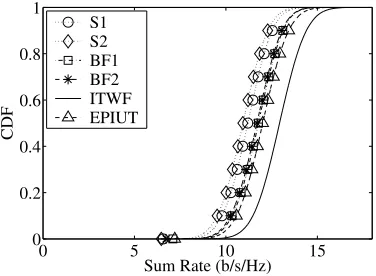
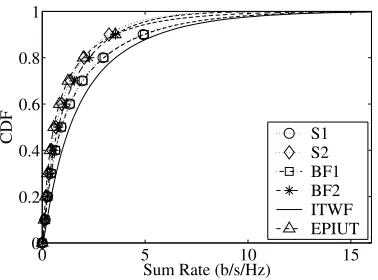
Figures 3 and 4 compare the simulated sum-rate CDFs for the case with no shadow fading (SNR = 10dB in Fig. 3) and shadowing (SNRav = 10dB in Fig. 4). In the absence of shadowing we observe the well-known approximately Gaus-sian CDF shapes. With shadowing, the averaging over theΓi variables results in a very different shape (see Fig. 4) similar to those found in [14]. Figures 3, 4 and 5 also allow us to compare the different algorithms at different SNR levels and with/without shadowing. Figure 3 shows the CDF of the sum-rate when SNR=10dB for each user. ITWF offers the largest capacity, but the simpler EPIUT and the two BF approaches are not far behind. This is to be expected because waterfilling advantages over equal power are more prominent under low SNR conditions. EPIUT has a higher dimensionality than the
0 5 10 15
0 0.2 0.4 0.6 0.8 1
Sum Rate (b/s/Hz)
CDF
S1 S2 BF1 BF2 ITWF EPIUT
Fig. 3. Sum-rate distributions with no shadowing (SNR = 10dB).
0 5 10 15 20 25
0 0.2 0.4 0.6 0.8 1
Sum Channel Capacity (b/s/Hz)
CDF S1
[image:5.612.98.283.215.356.2]S2 BF1 BF2 ITWF EPIUT
Fig. 4. Sum-rate distributions with shadowing (SNRav= 10dB).
BF approaches (sending 6 rather than 3 symbols), yielding a better performance. The selection antennas curves have the same dimensionality as the BF curves but are weaker due to their lower equivalent SNRs. Note that S1 and BF1 are superior to S2 and BF2 as expected, but the difference is slight. Figures 4 and 5 show the sum-rate CDFs with SNRav ∈ {0dB,10dB}. The relative performances in this case have changed with S1 and BF1 performing almost as well as ITWF. With the shadowing effects, skewing the channel in favor of particular users, concentrating the array gain in certain directions or using a subset of antennas yields excellent sum-rate gains. Note that S1 may provide a convenient lower bound on ITWF, since an equivalent MIMO system can be used to generate analytical approximations to the mean and variance. Hence, in the presence of shadowing we have the possibility of developing a tight analytical lower bound to the mean sum-rate and potentially to the CDF. This depends on an accusum-rate equivalent system and is the subject of further research.
C. Fairness Results
[image:5.612.342.534.226.362.2]0 5 10 15 0
0.2 0.4 0.6 0.8 1
Sum Rate (b/s/Hz)
CDF S1
[image:6.612.98.287.51.191.2]S2 BF1 BF2 ITWF EPIUT
Fig. 5. Sum-rate distributions with shadowing (SNRav= 0dB).
−150 −10 −5 0 5 10 15 20
40 60 80 100
SNRav (dB)
Average Percentage UsersUsers (Shadowing) Channels
[image:6.612.97.287.224.363.2]Channels (Shadowing)
Fig. 6. Fairness of ITWF: percentage of active spatial channels and users, with and without shadowing.
1) Percentage of Active Users and Channels: Figure 6 shows the increasing fairness of ITWF asSNRavincreases. At highSNRav, ITWF is essentially fair with each user getting a portion of the available power. However, for lower SNRav
values and in shadowing, ITWF is inherently unfair. This can cause one or more users to be “shutout” and not receive any signal for the time slot. In a fast-fading environment the lengths of these “shutouts” are minimal due to rapid changes in the channel parameters. In a slow-fading environment, these lengths of time can be significant. Note that in this particular simulation there were three users, and thus the percentage is lower bounded by 33%. Hence, the shadowed case is experi-encing communication with only 1 user extremely frequently. Figure 6 also indicates that the proportion of open spatial channels is very similar to that of active users. Note that S2 and BF2 by definition communicate with all 3 users, and simulations show that S1 and BF1 communicate with around 70% of users at SNRav = 0dB and 10dB.
2) The Dominant User and Minimum Rates: Simulations at SNRav = 0dB and 10dB show that the dominant user receives approximately 94% and 83% of the transmit power in ITWF in shadowing and 47% without shadowing. This power imbalance and the tendency of ITWF to select only 1 or 2 users means that, although the the minimum rate is usualy zero,
the minimum rate of a user in active communication ranges from 53% at 10dB to 85% at 0dB. The other methods are less sensitive toSNRav. For both S1 and BF1, the minimum rate of a user in active communication is approximately 15% and this drops to 6% for S2 and BF2.
VI. CONCLUSION
We have studied the effects of shadowing and the fairness properties of a variety of capacity-approaching algorithms for MIMO broadcast channels. We have found that shadowing can have a large impact on the relative performances of the algorithms as well as their fairness in distributing the channel resources. ITWF always achieves the best capacity, but at the cost of fairness, as it tends to allocate all of the resources to the best user, particularly in shadowing conditions. In contrast, we have found that relatively simple selection algorithms can approach the capacity while still maintaining a better level of fairness among the users than ITWF for varying SNR conditions. Finally, we have developed a new analytical ap-proximation method for the MIMO-BC capacity using power-scaled equivalent single-user channels which should prove to be a useful tool in better understanding these channels.
REFERENCES
[1] S. Vishwanath, N. Jindal, and A. Goldsmith, “Duality achievable rates and sum rate capacity of MIMO Gaussian broadcast channels,”IEEE Trans. Inform. Theory, vol. 49, no. 10, pp. 2658–2668, Oct. 2003. [2] G. Caire and S. Shamai (Shitz), “On the achievable throughput of a
multiantenna Gaussian broadcast channel,”IEEE Trans. Inform. Theory, vol. 49, no. 7, pp. 1691–1706, July 2003.
[3] M. Costa, “Writing on dirty paper,”IEEE Trans. Inform. Theory, vol. 29, no. 3, pp. 439–441, May 1983.
[4] W. Yu, W. Rhee, S. Boyd, S. A. Jafar, and J. M. Cioffi, “Iterative water-filling for Gaussian vector multiple-access channels,”IEEE Trans. Inform. Theory, vol. 50, no. 1, pp. 145–152, Jan. 2004.
[5] N. Jindal, W. Rhee, S. Vishwanath, S. A. Jafar, and A. Goldsmith, “Sum power iterative water-filling for multi-antenna Gaussian broadcast channels,”IEEE Trans. Inform. Theory, vol. 51, no. 4, pp. 1570–1580, Apr. 2005.
[6] J. Lee and N. Jindal, “Symmetric capacity of MIMO downlink channels,” inProc. IEEE Int’l Symp. on Inform. Theory, Seattle, USA, July 9-14, 2006, pp. 1031–1035.
[7] M. Kobayashi and G. Caire, “Iterative waterfilling for weighted rate sum maximization in MIMO-MAC,” inProc. IEEE 7th Workshop on Signal Processing Advances in Wireless Communications, Cannes, France, July 2-5, 2006, pp. 1–5.
[8] A. Goldsmith, Wireless Communications. New York: Cambridge University Press, 2005.
[9] A. Molisch, M. Win, and J. Winters, “Capacity of MIMO systems with antenna selection,” inProc. IEEE Int’l. Conf. on Communications, Helsinki, Finland, June 11-14, 2001, pp. 570–574.
[10] P. J. Smith, T. W. King, L. M. Garth, and M. Dohler, “An analysis of low complexity algorithms for MIMO antenna selection,” inProc. IEEE Int’l. Conf. on Communications, Istanbul, Turkey, June 11-15, 2006. [11] I. E. Telatar, “Capacity of multi-antenna Gaussian channels,”European
Trans. on Telecomm. Related Technol., vol. 10, pp. 585–595, Nov.-Dec. 1999.
[12] P. J. Smith, S. Roy, and M. Shafi, “Capacity of MIMO systems with semicorrelated flat fading,”IEEE Trans. Inform. Theory, vol. 49, no. 10, pp. 2781–2788, Oct. 2003.
[13] H. David and H. Nagaraja, Eds.,Order Statistics. Hoboken, NJ: John Wiley & Sons, 2003.