ORIGINAL RESEARCH
Structural Neural Phenotype of Autism:
Preliminary Evidence from a Diffusion Tensor
Imaging Study Using Tract-Based Spatial
Statistics
R.J. Jou N. Mateljevic M.D. Kaiser D.R. Sugrue F.R. Volkmar K.A. Pelphrey
BACKGROUND AND PURPOSE: There is mounting evidence suggesting widespread aberrations in
neural connectivity as the underlying neurobiology of autism. Using DTI to assess white matter abnormalities, this study implemented a voxelwise analysis and tract-labeling strategy to test for a structural neural phenotype in autism.
MATERIALS AND METHODS:Subjects included 15 boys with autism and 8 controls, group-matched on age, cognitive functioning, sex, and handedness. DTI data were obtained by using a 3T scanner. FSL, including TBSS, was used to process and analyze DTI data where FA was chosen as the primary measure of fiber tract integrity. Affected voxels were labeled by using an integrated white matter tractography atlas. Post hoc correlation analyses were performed between FA of each affected fiber tract and scores on the Social Responsiveness Scale.
RESULTS: The autism group exhibited bilateral reductions in FA involving numerous association, commissural, and projection tracts, with the most severely affected being the forceps minor. The most affected association tracts were the inferior fronto-occipital fasciculus and superior longitudinal fas-ciculus. There were no areas of increased FA in the autism group. All post hoc correlation analyses became nonsignificant after controlling for multiple comparisons.
CONCLUSIONS:This study provides preliminary evidence of reduced FA along many long-range fiber tracts in autism, suggesting aberrant long-range corticocortical connectivity. Although the spatial distribution of these findings suggests widespread abnormalities, there are major differences in the degree to which different tracts are affected, suggesting a more specific neural phenotype in autism.
ABBREVIATIONS:AMY ⫽amygdala; ASD⫽autism spectrum disorders; ATR⫽ anterior thalamic radiation; BCC⫽body of corpus callosum; CNG ⫽ cingulum; CST⫽ corticospinal tract; DAS⫽ Differential Abilities Scale; DTI⫽diffusion tensor imaging; FA⫽fractional anisotropy; FDT⫽FMRIB Diffusion Toolbox; FFA⫽fusiform face area; FMAJ⫽forceps major; FMIN⫽forceps minor; fMRI⫽ functional MR imaging; FMRIB⫽Oxford Centre for Functional Magnetic Resonance Imaging of the Brain; FSL⫽FMRIB Software Library; GRAPPA⫽generalized autocalibrating partially parallel acquisi-tion; IFOF⫽inferior fronto-occipital fasciculus; ILF⫽inferior longitudinal fasciculus; JHU⫽Johns Hopkins University; MNI⫽Montreal Neurologic Institute; SLF⫽superior longitudinal fasciculus; SRS⫽ Social Responsiveness Scale; SSC⫽somatosensory cortex; STS⫽superior temporal sulcus; TBSS⫽ Tract-Based Spatial Statistics; TDC⫽typically developing control; TPJ⫽temporal parietal junction; UNF⫽uncinate fasciculus; VMPC⫽ventromedial prefrontal cortex
A
dvances in anatomic and functional imaging techniques studying brain-behavior relationships and the application of these technologies to the study of ASD have resulted insubstantial evidence correlating both core and secondary symptoms to abnormalities in brain connectivity.1-3Over the past decade, there has been mounting evidence from struc-tural MR imaging, fMRI, and DTI suggesting that the brain phenotype in ASD includes deficiencies of long-range connec-tions such as association and commissural fibers connecting different lobes and hemispheres, respectively. However, the neuroimaging literature remains inconsistent, possibly owing to diagnostic heterogeneity, intersubject variability across sites, scanning protocols, and image processing and analysis methods. Because of the disjointed nature of the current body of evidence, the identification of an autism-specific neural phenotype remains elusive despite a rapidly growing body of research literature.
Since the widespread use of MR imaging in psychiatric re-Received December 11, 2010; accepted after revision January 14, 2011.
From the Yale Child Study Center (R.J.J., N.M., M.D.K., D.R.S., F.R.V., K.A.P.); Yale School of Medicine, New Haven, Connecticut; Investigative Medicine Program (R.J.J.), Yale University Graduate School of Arts & Sciences, New Haven, Connecticut; and Department of Diagnostic Radiology (N.M.), Yale School of Medicine, New Haven, Connecticut.
This work was supported by grants from the National Institute of Mental Health, Autism Speaks, and the Simons Foundation (SFARI 95489 to K.A.P.). This research also was made possible through 2008 –2009 American Academy of Child & Adolescent Psychiatry Pilot Research Award for Junior Faculty and Child Psychiatry Fellows supported by Lilly USA, LLC; and 2010 –2012 ANA/Pfizer Fellowships in Clinical Practice from Pfizer’s Medical and Academic Partnership program.
Paper previously presentated at: 2010 International Meeting for Autism Research; May 20 –22, 2010; Philadelphia, Pennsylvania.
Please address correspondence to Roger J. Jou, MD, Yale Child Study Center, 230 South Frontage Rd, New Haven, CT 06519-1124; e-mail: [email protected]
Indicates open access to non-subscribers at www.ajnr.org
http://dx.doi.org/10.3174/ajnr.A2558
PEDIATRICS
ORIGINAL
search, many studies examining the neurobiology of autism have been published. Early volumetric MR imaging studies first established the existence of larger brains in ASD,4and later research attributed this to increased white matter,5the substance of neural fiber tracts. Later work, again using volu-metric MR imaging techniques, suggested a pattern of short-range overconnectivity6and long-range underconnectivity.7 With the application of fMRI in autism-related research came many studies using this technique to demonstrate a pattern of activation consistent with impairments in long-range connec-tivity.8-11Finally, there are now many DTI studies that have consistently demonstrated abnormalities in FA in the brains of ASD participants.12-17Because FA is a widely accepted mea-sure of the structural integrity of white matter,18these studies have collectively demonstrated a pattern of findings consistent with neural disconnectivity in ASD. However, given the sig-nificant heterogeneity in methodologies and participants in these studies, it is difficult to identify a common underlying pattern of neuropathology across all studies. Greater confi-dence in the disconnectivity hypothesis could be gained if an autism-specific neural phenotype was identified from data collected and analyzed by using more standardized methods.
FSL is an image processing and analysis suite that is widely used, freely available, and well documented (www.fmrib.ox. ac.uk/fsl). FSL includes several tools for processing and ana-lyzing DTI data by using a standard processing and analysis pipeline that includes FDT and TBSS, discussed further in the Image Processing and Analysis section).19At the time of this writing, it has been used in at least 4 DTI studies identifying white matter abnormalities in ASD.17,20-22Although an en-couraging trend, generalization of abnormalities cannot yet be established with such few studies; therefore, more studies sharing these procedures are needed. The current investiga-tion responds to this need by implementing FSL with its rec-ommended processing and analysis pipeline while also imple-menting a voxelwise, atlas-based tract-labeling approach not used in previously published studies. The latter provides more precise and quantitative characterization of potentially af-fected fiber tracts that is essential for the assessment of an autism-specific neural phenotype.
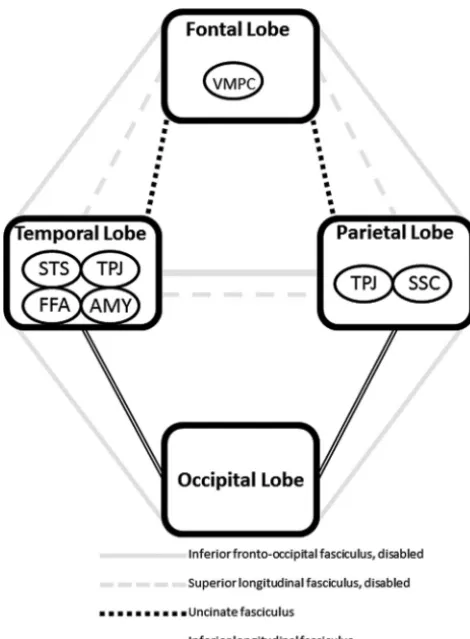
The specific hypotheses posed in the present study are motivated by 2 recently published DTI studies, both using an entirely different group of participants and processing and analysis procedures, demonstrating impairments in the inferior fronto-occipital fasciculus (among other associa-tion tracts) and the corpus callosum.17,23The inferior fron-to-occipital fasciculus is unique in that it connects all 4 major lobes of the brain,24potentially serving an important role in linking all the components in what is commonly called the “social brain” (Fig 1). Therefore, it is hypothe-sized that the neural phenotype in ASD consists of wide-spread impairments in long-range connections with higher aberrations seen in the inferior fronto-occipital fasciculus. This would be supported by DTI data demonstrating wide-spread reductions in FA with abnormalities skewed toward the aforementioned tract. In addition, reductions in FA also are ex-pected in fibers of the corpus callosum, a structure consistently reported as abnormal in ASD.25
Materials and Methods
Subjects
Study participants included 15 children and adolescents with ASD (mean age, 10.9⫾3.7 years; range, 4.9 –17.0 years) and 8 TDC par-ticipants (mean age, 11.5⫾2.6 years; range, 8.9 –16.7 years), matched on age, sex, handedness, and race. Female participants were very lim-ited in number and were excluded from the analysis because the sam-ple size was insufficient to accommodate the structural variability associated with sex. Those included in the ASD group had confirmed Diagnostic and Statistical Manual of Mental Disorders, 4th edition26
diagnoses and absence of medical and neurologic disease that might be associated with ASD. Diagnosis of ASD was based on parental information, clinical history, and expert evaluation. In addition, 2 standard research diagnostic instruments were used: Autism Diag-nostic Interview-Revised27and Autism Diagnostic Observation Schedule.28The TDC group consisted of healthy volunteers recruited from the same community as participants with ASD. A semistruc-tured clinical interview was conducted with TDC participants, their parents, or both to rule out any history of neurologic problems, neu-rologic insult resulting in loss of consciousness, psychiatric disorders, and history of ASD in first- or second-degree relatives. The DAS29was administered to study participants to assess the wider range of cogni-tive functioning inherent in ASD subjects. Additional psychological measurements were collected for all participants, including the SRS.30 The study was approved by the University Human Investigations Committee. Informed consent was obtained from the parent(s) or guardian(s) of all participants, as well as each participant’s verbal assent.
[image:2.594.301.533.38.357.2]Image Acquisition
MR imaging was performed by using a 3T Magnetom Tim Trio sys-tem (Siemens, Erlangen, Germany). Diffusion-weighted data were collected with an 8-channel head coil, using parallel imaging to gain better signal intensity at air-tissue interfaces. Diffusion imaging pa-rameters include: diffusion directions⫽30, B0⫽5, TR⫽6200 ms, TE⫽85 ms, FOV⫽240 mm2, section thickness⫽2.5 mm (isotro-pic), GRAPPA on, number of sections⫽55, averages⫽3, and total scan time⫽11 minutes. With a standard single-channel head coil, whole-brain T1-weighted MR imaging was performed by using a sag-ittal 1-mm3magnetization-prepared rapid acquisition of gradient echo sequence. The pulse sequence parameters were as follows: TR⫽ 2530 ms, TE⫽3.66 ms, TI⫽1100 ms, flip angle⫽7°, NEX⫽1, number of sections⫽176, bandwidth⫽181 Hz/pixel, matrix⫽ 256⫻256, FOV⫽256 mm2, GRAPPA off, and scan time⫽8 min-utes. All imaging was performed in the same session.
Image Processing and Analysis
Data preprocessing and local diffusion modeling were conducted us-ing FSL.31First, all volumes were inspected by an experienced rater for severe motion and other artifacts. Diffusion-weighted images were then corrected for eddy current distortion and simple head motion. Next, the 3 runs (per subject) of diffusion-weighted data were aver-aged to improve signal intensity–to-noise ratio. The program was then used to generate a mask to separate brain from nonbrain areas. The binary brain mask, averaged diffusion-weighted data, b-values, and vector information were then input into FDT, which fits a diffu-sion tensor model at each voxel. The result of this process was a FA map for each subject. Given the preliminary nature of this investiga-tion and the aim to eloquently identify a neural phenotype, FA was chosen as the sole measure of the structural integrity of axonal fiber tracts.
Voxelwise analysis of multisubject diffusion data was conducted using TBSS that provide a satisfactory solution to the challenge of aligning FA images from different groups for subsequent voxelwise analysis that differs from standard registration algorithms.19With the use of an optimized nonlinear registration followed by projection onto an alignment-invariant tract representation, TBSS allows for valid conclusions to be drawn from analysis of multisubject diffusion imaging studies. The procedure as implemented in the current study consists of the following steps: 1) conversion of FA data into appro-priate format, 2) application of nonlinear registration so all FA images are in MNI space, 3) creation of mean FA image, 4) skeletonization of mean FA image by using an FA threshold of 0.3,205) projection of all subjects’ FA data onto the mean FA skeleton, and 6) submission of the 4D-projected FA data for statistical testing. Voxel-wise analysis was performed on multisubject diffusion data. Areas of significant differ-ence were computed and displayed as 1Pvalue image, whereP⬍0.05, corrected for multiple comparisons across space via threshold-free cluster enhancement.32Using the T1-weighted MR imaging data, in-tracranial volume was calculated by using FreeSurfer image analysis suite (Martinos Center for Biomedical Imaging, Charlestown, Massa-chusetts) that consists of automated tools for reconstruction of the brain from MR imaging data.33
Affected white matter structures were identified by using the JHU White Matter Tractography Atlas,34which is fully integrated into the FSL software package. This atlas was not only useful for identification of po-tentially affected fiber tracts (ie, those tracts onto which the voxels of significant difference were mapped via the tractography atlas) but also for more precise characterization of potential pathology by quantifying
fected voxels based on their tract labels. The MNI coordinates of all af-fected voxels were captured and intersected with the JHU White Matter Tractography Atlas. These voxels were assigned to atlas labels numbered from 0 (no label) to 1–21, with the latter group consisting of association, commissural, and projection tracts. For all participants individually, af-fected voxels were grouped by label with their corresponding FA, and counts were generated for each fiber tract. The following summary sta-tistics were computed for each fiber tract: mean FA, SD, and effect size (Cohen d). Finally, exploratory Pearson correlation analyses were per-formed between mean FA data of the most severely affected fiber tracts and SRS scores, by using the Statistical Package for the Social Sciences 17.0 (SPSS, Chicago, Illinois). Bonferroni correction was used to control for multiple comparisons.
Results
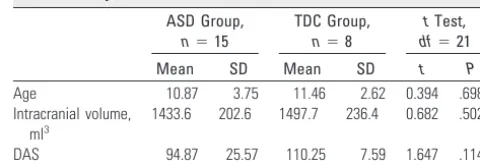
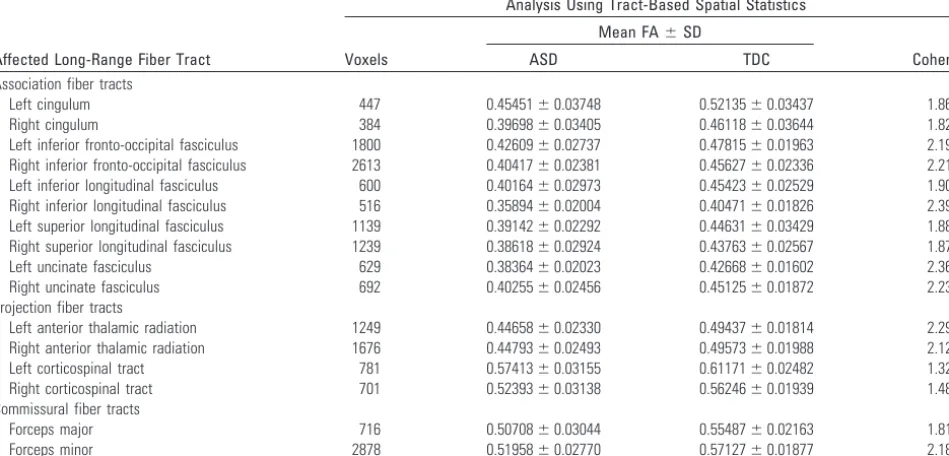
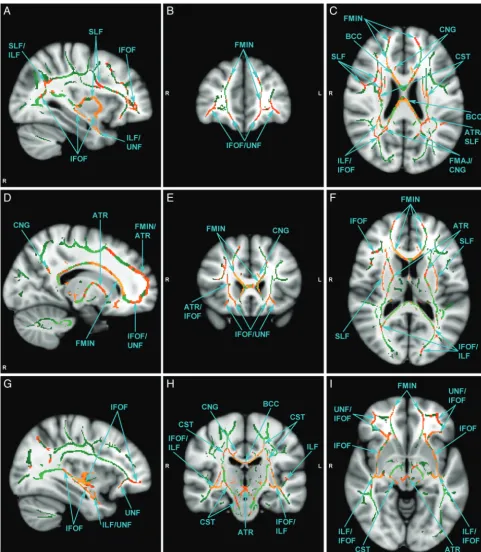
There were no significant group differences in age, intracranial volume, and cognitive functioning (Table 1). The main results of this study are summarized in Table 2 and Fig 2. The ASD group had significant bilateral reductions in FA involving nu-merous association, commissural, and projection tracts. Af-fected association tracts include inferior fronto-occipital fas-ciculus, superior longitudinal fasfas-ciculus, inferior longitudinal fasciculus, uncinate fasciculus, and cingulum. Commissural fibers include both forceps major and minor of the corpus callosum. Projection tracts included the anterior thalamic ra-diation and corticospinal tract. As evident from Table 2, all white matter structures were not equally affected, and the vari-ability was substantial. The fiber tracts with the greatest num-ber of affected voxels were the forceps minor, right inferior fronto-occipital fasciculus, and left inferior fronto-occipital fasciculus. Notably, there were no voxels where FA was signif-icantly increased in the ASD group. Exploratory Pearson cor-relation analyses did not yield any significant cor-relationships between mean FA within affected fibers and clinical measures (SRS) after adjusting for multiple comparisons.
Discussion
The central question addressed in the present study was whether an autism-specific neural phenotype can be identified from DTI data collected and analyzed by using more standard-ized methods (ie, FSL/TBSS). It was hypothesstandard-ized that the brain phenotype in ASD is characterized by a generalized pat-tern of impaired long-range connectivity with pathology skewed toward fiber tracts with probable connections to the modules of the social brain, particularly the inferior fronto-occipital fasciculus (Fig 1). This hypothesis was supported by DTI data presented in this preliminary study, where numerous long-range tracts (association, commissural, and projection) in both hemispheres were affected as evidenced by reductions in FA, a well-established measure of fiber tract integrity.18
Al-Table 1: Subject characteristics
ASD Group, n⫽15
TDC Group, n⫽8
tTest,
df⫽21
Mean SD Mean SD t P
Age 10.87 3.75 11.46 2.62 0.394 .698
Intracranial volume, ml3
1433.6 202.6 1497.7 236.4 0.682 .502
[image:3.594.299.539.56.139.2]though it is evident from Table 2 that all major long-range fiber tracts are affected, not all tracts were equally impaired. The fiber tract with the greatest number of affected voxels was the forceps minor. This was followed by the right and left inferior fronto-occipital fasciculi, respectively. Abnormalities in the corpus callosum may be a nonspecific manifestation of generalized deficits in long-range connectivity because abnor-malities also have been reported in other neuropsychiatric dis-orders such as schizophrenia,35Alzheimer disease,36and bipo-lar disorder.37 However, significant findings in the inferior fronto-occipital fasciculus may reflect ASD-specific atypicali-ties given its connections to all major cerebral lobes, thus po-tentially connecting all major modules in the social brain net-work (Fig 1). This does not imply that aberration of a single fiber tract can explain the diversity of clinical manifestations that characterize ASD. Although numerous tracts may be im-plicated, the pattern by which all tracts are affected may be revealing, raising the question of whether a unique disconnec-tivity “fingerprint” may be ascribed to ASD.
Why the inferior fronto-occipital fasciculus may play an important role in the neurobiology of ASD is evident after considering its spatial extent and what it known about the areas of the brain involved in social information processing. Postmortem studies show that the inferior fronto-occipital fasciculus has direct connections to the fusiform gyrus and provides connections between all major lobes of the human brain: frontal, temporal, parietal, and occipital.24This broad neuroanatomic extent is a unique quality of the inferior fron-to-occipital fasciculus and fits well with broad spatial distribu-tion of brain structures involved in social cognidistribu-tion (Fig 1), including but not limited to, the fusiform gyrus (temporal lobe), amygdala (temporal lobe), superior temporal sulcus (temporal lobe), ventromedial prefrontal cortex (frontal lobe), temporoparietal junction (temporal and parietal lobes), and somatosensory cortices (parietal lobe). More striking, however, is the recent report demonstrating the important role of the inferior fronto-occipital fasciculus in correctly
rec-ognizing emotion in faces. In a large group of patients with focal brain lesions (n⫽103), damage associated with the right inferior fronto-occipital fasciculus significantly predicted overall facial emotion recognition impairment with specific deficits recognizing sadness, anger, and fear.38The inability to properly identify and recognize facial emotions is a well-known impairment in ASD.39Moreover, previously published DTI studies lend support to abnormalities of the inferior fron-to-occipital fasciculus in ASD.15,17,21,23,40,41 In the present study, the right inferior fronto-occipital fasciculus was the most severely affected association tract, which suggests a po-tential mechanism for known impairments in facial emotion recognition in ASD.
Another severely affected association tract was the superior longitudinal fasciculus, which was the second most severely affected association tract in the current study. In the left hemi-sphere, this fiber tract connects the Broca and Wernicke ar-eas.42It is well known that damage to this pathway can cause a relatively rare language disorder called conduction aphasia.43 Given that language and communication abnormalities are core deficits in ASD, an abnormality in the left superior lon-gitudinal fasciculus comes as no surprise. In fact, this finding is consistent with an influential fMRI study that found impaired functional connectivity between language areas by using a sen-tence comprehension task in individuals with ASD.10 More-over, several DTI studies also have revealed abnormalities of the left superior longitudinal fasciculus in ASD.17,20,23,41,44 Al-though the important role the left superior longitudinal fas-ciculus has in language processing has been known since the 19th century, the importance of this structure in the right hemisphere is emerging. Abnormalities of the right superior longitudinal fasciculus also have important implications for ASD due to its connection to the superior temporal sulcus,42a region well known for its role in processing biologic motion, which is abnormal in ASD.45Moreover, several DTI studies have revealed abnormalities of the right superior longitudinal fasciculus.17,20-22,46Finally, similar to the inferior fronto-oc-Table 2: Characteristics of affected long-range fiber tract by type
Affected Long-Range Fiber Tract
Analysis Using Tract-Based Spatial Statistics
Voxels
Mean FA⫾SD
Cohen d
ASD TDC
Association fiber tracts
Left cingulum 447 0.45451⫾0.03748 0.52135⫾0.03437 1.86
Right cingulum 384 0.39698⫾0.03405 0.46118⫾0.03644 1.82
Left inferior fronto-occipital fasciculus 1800 0.42609⫾0.02737 0.47815⫾0.01963 2.19
Right inferior fronto-occipital fasciculus 2613 0.40417⫾0.02381 0.45627⫾0.02336 2.21
Left inferior longitudinal fasciculus 600 0.40164⫾0.02973 0.45423⫾0.02529 1.90
Right inferior longitudinal fasciculus 516 0.35894⫾0.02004 0.40471⫾0.01826 2.39
Left superior longitudinal fasciculus 1139 0.39142⫾0.02292 0.44631⫾0.03429 1.88
Right superior longitudinal fasciculus 1239 0.38618⫾0.02924 0.43763⫾0.02567 1.87
Left uncinate fasciculus 629 0.38364⫾0.02023 0.42668⫾0.01602 2.36
Right uncinate fasciculus 692 0.40255⫾0.02456 0.45125⫾0.01872 2.23
Projection fiber tracts
Left anterior thalamic radiation 1249 0.44658⫾0.02330 0.49437⫾0.01814 2.29
Right anterior thalamic radiation 1676 0.44793⫾0.02493 0.49573⫾0.01988 2.12
Left corticospinal tract 781 0.57413⫾0.03155 0.61171⫾0.02482 1.32
Right corticospinal tract 701 0.52393⫾0.03138 0.56246⫾0.01939 1.48
Commissural fiber tracts
Forceps major 716 0.50708⫾0.03044 0.55487⫾0.02163 1.81
[image:4.594.57.532.64.292.2]cipital fasciculus, the superior longitudinal fasciculus also has a broad neuroanatomic extent, connecting the frontal, pari-etal, and temporal lobes.42As evident in Fig 1, this tract also may potentially serve an important role in linking all the com-ponents of brain structures involved in social cognition.
The widespread presence of potential pathology is evident from Table 2 where numerous white mater tracts seem to be
[image:5.594.53.535.42.594.2]portance of all fiber tracts can be appreciated given that, as a group, they join centers of language and communication, modules responsible for processing social information, or both (Fig 1); therefore, disruption in any fiber tract can theo-retically cause disconnection. Moreover, the wide range of af-fected tracts remains consistent with the DTI literature on the neurobiology of ASD that, to date, consists of at least 25 pub-lished reports. Although a comprehensive review of this liter-ature is beyond the scope of this discussion, many of the af-fected tracts listed in Table 2 have been reported previously as abnormal. Therefore, abnormal connectivity need not be lim-ited to the inferior fronto-occipital fasciculus and superior longitudinal fasciculus. The possibility that other white matter structures are affected is expected, and this is consistent with the widely held belief that ASD are heterogeneous and distrib-uted disorders.47
Although speculative, the brain phenotype in autism may be characterized by widespread fiber tract compromise with bias toward the inferior fronto-occipital fasciculus, superior longitudinal fasciculus, and corpus callosum. How the inferior fronto-occipital and superior longitudinal fasciculi might ac-count for the social disability that characterizes autism is shown schematically in Fig 3. With the disability of major pathways connecting the modules of the social brain (ie, infe-rior fronto-occipital and supeinfe-rior longitudinal fasciculi that
connect frontal, temporal, and parietal lobes), there is possible reliance on smaller tracts that may lead to inefficient cortico-cortical communication. However, the aberrations present in all fiber tracts exacerbate the problem. Whether social infor-mation processing is possible may depend on how severely impaired the major pathways are and whether alternative pathways are available. The overall pattern of tract deficits may not only dictate the expression of autism but also its severity and heterogeneity.
Findings reported in this study must be interpreted in the context of several methodologic limitations. This is a prelim-inary study, and the sample size and age range reflect this fact; however, these impose limitations on the generalization of findings. This is further complicated by the relatively hetero-geneous nature of the ASD group. In addition, the control group imposed limitations due to absence of developmentally delayed children without ASD. In the absence of such a com-parison group, it remains unclear whether these findings are specific to ASD. Finally, there are several limitations in the voxelwise, atlas-based tract-labeling approach. The JHU White Matter Tractography Atlas provides a probability value and was constructed by using a different age group of subjects and registration procedure. Thus, this approach does not ac-count for multiple fiber tracts within a single voxel. The dif-ferences in the registration procedure and subject sample may potentially induce errors. However, this would not be ex-pected to bias the results given that the same procedure is used in both autism and control groups. Most important is that the autism subjects, who have aberrant long-range connections, also may have different fiber connections. Therefore, using the tractography atlas constructed from neurotypical subjects may potentially also introduce tract errors.
Conclusions
This study provides evidence of reduced FA along numerous long-range fiber tracts in ASD, supporting the existence of reduced long-range connectivity. The most severely affected association tracts include the inferior fronto-occipital fascicu-lus and superior longitudinal fascicufascicu-lus, both of which have important implications in language and social information processing. The distribution of these findings points to a wide-spread abnormality in long-range connections that may not only contribute to both core and associated symptoms but also the well-known heterogeneity of this spectrum of disorders. Most importantly, however, is the widely different degree to which individual tracts are affected, raising the question of whether a unique disconnectivity fingerprint may be ascribed to ASD. Although speculative, this neural phenotype may consist of widespread fiber tract compromise with bias toward the inferior fronto-occipital fasciculus, superior longitudinal fasciculus, and corpus callosum. However, additional work is clearly needed be-fore any conclusions can be made regarding an autism-specific brain phenotype. These future studies should implement a stan-dardized image collection, processing, and analysis protocol and include large samples of individuals with autism subjects matched with developmentally delayed individuals without au-tism. A customized tractography atlas should be implemented for voxel labeling to reduce the probability of tract errors.
[image:6.594.52.287.41.360.2]Acknowledgments
We acknowledge the help of Caitlin Hudac and Brent Vander Wyk, with data assembly. We are grateful for the effort and commitment of the participants and their families in this study.
Disclosures: Roger J. Jou,Research Support:Pfizer,Detail:ANA/Pfizer Fellowships in Clinical Practice from Pfizer’s Medical and Academic Partnership program: This program is intended to contribute to the career development of nurses, pharmacists, or physicians who have completed their clinical training and have elected to specialize as clinicians-scientists. Award period: 7/1/10-6/30/12. Fred R. Volkmar,Research Support:National Institute of Mental Health, National Institute of Child Health and Human Development,Details:Federal grant support (principal investigator of 2 program project grants),Other Financial Relation-ships:Editor–Journal,Details: Journal of Autism and Developmental Disorders, Springer.
References
1. Courchesne E, Pierce K.Why the frontal cortex in autism might be talking only to itself: local over-connectivity but long-distance disconnection.Curr Opin Neurobiol2005;15:225–30
2. Geschwind DH, Levitt P.Autism spectrum disorders: developmental discon-nection syndromes.Curr Opin Neurobiol2007;17:103–11
3. Minshew NJ, Williams DL.The new neurobiology of autism: cortex, connec-tivity, and neuronal organization.Arch Neurol2007;64:945–50
4. Piven J, Arndt S, Bailey J, et al.An MRI study of brain size in autism.Am J Psychiatry1995;152:1145– 49
5. Courchesne E, Karns CM, Davis HR, et al.Unusual brain growth patterns in early life in patients with autistic disorder: an MRI study. Neurology
2001;57:245–54
6. Herbert MR, Ziegler DA, Makris N, et al.Localization of white matter volume increase in autism and developmental language disorder. Ann Neurol
2004;55:530 – 40
7. Jou RJ, Mateljevic N, Minshew NJ, et al.Reduced central white matter volume in autism: implications for long-range connectivity.Psychiatry Clin Neurosci
2010;65:98 –101
8. Castelli F, Frith C, Happe F, et al.Autism, Asperger syndrome and brain mech-anisms for the attribution of mental states to animated shapes. Brain
2002;125:1839 – 49
9. Cherkassky VL, Kana RK, Keller TA, et al.Functional connectivity in a baseline resting-state network in autism.Neuroreport2006;17:1687–90
10. Just MA, Cherkassky VL, Keller TA, et al.Cortical activation and synchroniza-tion during sentence comprehension in high-funcsynchroniza-tioning autism: evidence of underconnectivity.Brain2004;127:1811–21
11. Villalobos ME, Mizuno A, Dahl BC, et al.Reduced functional connectivity between V1 and inferior frontal cortex associated with visuomotor perfor-mance in autism.Neuroimage2005;25:916 –25
12. Barnea-Goraly N, Kwon H, Menon V, et al.White matter structure in autism: preliminary evidence from diffusion tensor imaging. Biol Psychiatry
2004;55:323–26
13. Ben Bashat D, Kronfeld-Duenias V, Zachor DA, et al.Accelerated maturation of white matter in young children with autism: a high b value DWI study.
Neuroimage2007;37:40 – 47
14. Catani M, Jones DK, Daly E, et al.Altered cerebellar feedback projections in Asperger syndrome.Neuroimage2008;41:1184 –91
15. Pugliese L, Catani M, Ameis S, et al.The anatomy of extended limbic pathways in Asperger syndrome: a preliminary diffusion tensor imaging tractography study.Neuroimage2009;47:427–34
16. Thakkar KN, Polli FE, Joseph RM, et al.Response monitoring, repetitive be-haviour and anterior cingulate abnormalities in autism spectrum disorders (ASD).Brain2008;131:2464 –78
17. Shukla DK, Keehn B, Muller RA.Tract-specific analyses of diffusion tensor imaging show widespread white matter compromise in autism spectrum dis-order.J Child Psychol Psychiatry2011;52:286 –95
18. Mori S, Zhang J.Principles of diffusion tensor imaging and its applications to basic neuroscience research.Neuron2006;51:527–39
19. Smith SM, Jenkinson M, Johansen-Berg H, et al.Tract-based spatial statistics: voxelwise analysis of multi-subject diffusion data.Neuroimage2006;31:1487– 505
20. Barnea-Goraly N, Lotspeich LJ, Reiss AL.Similar white matter aberrations in
children with autism and their unaffected siblings: a diffusion tensor imaging study using tract-based spatial statistics.Arch Gen Psychiatry2010;67:1052– 60 21. Cheng Y, Chou KH, Chen IY, et al.Atypical development of white matter microstructure in adolescents with autism spectrum disorders.Neuroimage
2010;50:873– 82
22. Kumar A, Sundaram SK, Sivaswamy L, et al.Alterations in frontal lobe tracts and corpus callosum in young children with autism spectrum disorder.Cereb Cortex2010;20:2103–13
23. Jou RJ, Jackowski AP, Papademetris X, et al.Diffusion tensor imaging in au-tism spectrum disorders: preliminary evidence of abnormal neural connec-tivity.Aust N Z J Psychiatry2011;45:153– 62
24. Martino J, Brogna C, Robles SG, et al.Anatomic dissection of the inferior fronto-occipital fasciculus revisited in the lights of brain stimulation data.
Cortex2010;46:691–99
25. Frazier TW, Hardan AY.A meta-analysis of the corpus callosum in autism.Biol Psychiatry2009;66:935– 41
26. APA.Diagnostic and Statistical Manual of Mental Disorders, 4th edition, text revision(DSM-IV-TR). Washington, DC: American Psychiatric Association; 2000
27. Lord C, Rutter M, Le Couteur A.Autism Diagnostic Interview-Revised: a re-vised version of a diagnostic interview for caregivers of individuals with pos-sible pervasive developmental disorders.J Autism Dev Disord1994;24:659 – 85 28. Lord C, Rutter M, Goode S, et al.Autism Diagnostic Observation Schedule: a standardized observation of communicative and social behavior.J Autism Dev Disord1989;19:185–212
29. Elliott CD.Differential Ability Scale: Introductory and Technical Manual.San Antonio: The Psychological Corporation; 1990
30. Constantino JN.The Social Responsiveness Scale.Los Angeles: Western Psycho-logical Services; 2002
31. Smith SM, Jenkinson M, Woolrich MW, et al.Advances in functional and structural MR image analysis and implementation as FSL.Neuroimage
2004;23:S208 –19
32. Smith SM, Nichols TE.Threshold-free cluster enhancement: addressing prob-lems of smoothing, threshold dependence and localisation in cluster infer-ence.Neuroimage2009;44:83–98
33. Fischl B, van der Kouwe A, Destrieux C, et al.Automatically parcellating the human cerebral cortex.Cereb Cortex2004;14:11–22
34. Hua K, Zhang J, Wakana S, et al.Tract probability maps in stereotaxic spaces: analyses of white matter anatomy and tract-specific quantification. Neuroim-age2008;39:336 – 47
35. Innocenti GM, Ansermet F, Parnas J.Schizophrenia, neurodevelopment and corpus callosum.Mol Psychiatry2003;8:261–74
36. Di Paola M, Spalletta G, Caltagirone C.In vivo structural neuroanatomy of corpus callosum in Alzheimer’s disease and mild cognitive impairment using different MRI techniques: a review.J Alzheimers Dis2010;20:67–95 37. Bellani M, Yeh PH, Tansella M, et al.DTI studies of corpus callosum in bipolar
disorder.Biochem Soc Trans2009;37:1096 –98
38. Philippi CL, Mehta S, Grabowski T, et al.Damage to association fiber tracts impairs recognition of the facial expression of emotion. J Neurosci
2009;29:15089 –99
39. Hobson RP.The autistic child’s appraisal of expressions of emotion: a further study.J Child Psychol Psychiatry1986;27:671– 80
40. Keller TA, Kana RK, Just MA.A developmental study of the structural integrity of white matter in autism.Neuroreport2007;18:23–27
41. Sahyoun CP, Belliveau JW, Mody M.White matter integrity and pictorial rea-soning in high-functioning children with autism.Brain Cogn2010;73:180 – 88 42. Catani M, Jones DK, Ffytche DH.Perisylvian language networks of the human
brain.Ann Neurol2005;57:8 –16
43. Wernicke C.Der Aphatische Symptomencomplex: Eine Psychologische Studie auf Anatomischer Basis.Breslau, Germany: Cohn and Weigert; 1874
44. Fletcher PT, Whitaker RT, Tao R, et al.Microstructural connectivity of the arcuate fasciculus in adolescents with high-functioning autism.Neuroimage
2010;51:1117–25
45. Kaiser MD, Hudac CM, Shultz S, et al.Neural signatures of autism.Proc Natl Acad Sci U S A2010;107:21223–28
46. Cheung C, Chua SE, Cheung V, et al.White matter fractional anisotrophy differences and correlates of diagnostic symptoms in autism.J Child Psychol Psychiatry2009;50:1102–12