ORIGINAL RESEARCH
INTERVENTIONAL
Multicentric Experience in Distal-to-Proximal Revascularization
of Tandem Occlusion Stroke Related to Internal Carotid
Artery Dissection
XG. Marnat,XM. Bu¨hlmann,XO.F. Eker,XJ. Gralla,XP. Machi,XU. Fischer,XC. Riquelme,X M. Arnold,XA. Bonafe´,XS. Jung, XV. Costalat, andXP. Mordasini
ABSTRACT
BACKGROUND AND PURPOSE: Internal carotid dissection is a frequent cause of ischemic stroke in young adults. It may cause tandem occlusions in which cervical carotid obstruction is associated with intracranial proximal vessel occlusion. To date, no consensus has emerged concerning endovascular treatment strategy. Our aim was to evaluate our endovascular “distal-to-proximal” strategy in the treatment of this stroke subtype in the first large multicentric cohort.
MATERIALS AND METHODS:Prospectively managed stroke data bases from 2 separate centers were retrospectively studied between 2009 and 2014 for records of tandem occlusions related to internal carotid dissection. Atheromatous tandem occlusions were excluded. The first step in the revascularization procedure was intracranial thrombectomy. Then, cervical carotid stent placement was performed depending on the functionality of the circle of Willis and the persistence of residual cervical ICA occlusion, severe stenosis, or thrombus apposition. Efficiency, complications, and radiologic and clinical outcomes were recorded.
RESULTS:Thirty-four patients presenting with tandem occlusion stroke secondary to internal carotid dissection were treated during the study period. The mean age was 52.5 years, the mean initial NIHSS score was 17.29⫾6.23, and the mean delay between onset and groin puncture was 3.58⫾1.1 hours. Recanalization TICI 2b/3 was obtained in 21 cases (62%). Fifteen patients underwent cervical carotid stent placement. There was no recurrence of ipsilateral stroke in the nonstented subgroup. Twenty-one patients (67.65%) had a favorable clinical outcome after 3 months.
CONCLUSIONS: Endovascular treatment of internal carotid dissection–related tandem occlusion stroke using the distal-to-proximal recanalization strategy appears to be feasible, with low complication rates and considerable rates of successful recanalization.
ABBREVIATIONS:ICD⫽internal carotid dissection; sICH⫽symptomatic intracranial hemorrhage
A
cute obstruction or occlusion of the extracranial ICA and additional intracranial ICA or MCA thrombus, so-called tan-dem occlusion, causes a severe form of ischemic stroke, which accounts for 10%–20% of major strokes and is associated with high rates of disability and death.1,2Most stenotic or occlusivelesions of the ICA are caused by atherosclerotic disease or acute dissection. These 2 pathologies constitute distinct stroke etiolo-gies that affect 2 different patient populations, each with their own prognosis. Internal carotid dissection (ICD) is a frequent cause of ischemic stroke, especially in young adults.3In cervical carotid occlusive or near-occlusive disease, stroke is due to wall hema-toma, accompanied by downstream intracranial embolus or he-modynamic impairment.4
Tandem occlusion stroke was known to have a very poor prog-nosis at the time when treatment consisted of intravenous throm-bolysis alone.2,5,6 Endovascular treatment is now increasingly performed following the results from recent randomized con-trolled trials (Multicenter Randomized Clinical Trial of Endovas-cular Treatment for Acute Ischemic Stroke in the Netherlands [MR CLEAN], Endovascular Treatment for Small Core and Prox-imal Occlusion Ischemic Stroke [ESCAPE], Extending the Time for Thrombolysis in Emergency Neurological Deficits-Intra-Ar-terial [EXTEND IA], Endovascular Revascularization With Soli-Received December 7, 2017; accepted after revision February 7, 2018.
From the Interventional and Diagnostic Neuroradiology Department (G.M.), Bor-deaux University Hospital, BorBor-deaux, France; University Institute of Diagnostic and Interventional Neuroradiology (J.G., P.M.) and Department of Neurology (M.B., U.F., M.A., S.J.), Bern University Hospital, Bern, Switzerland; and Interventional and Diag-nostic Neuroradiology Department (O.F.E., P.M., C.R., A.B., V.C.), Montpellier Uni-versity Hospital, Montpellier, France.
Gaultier Marnet, Vincent Costalat, and Pasquale Mordasini contributed equally to the study.
Please address correspondence to Gaultier Marnat, MD, Interventional and Diag-nostic Neuroradiology Department, Bordeaux University Hospital, Place Ame´lie Raba-Le´on, 33000 Bordeaux, France; e-mail: [email protected]; [email protected]
Indicates article with supplemental on-line table.
taire Device Versus Best Medical Therapy in Anterior Circulation Stroke Within 8 Hours [REVASCAT], Solitaire With the Inten-tion For Thrombectomy as Primary Endovascular Treatment for Acute Ischemic Stroke [SWIFT PRIME], and DWI or CTP Assess-ment with Clinical Mismatch in the Triage of Wake Up and Late Presenting Strokes Undergoing Neurointervention with Trevo [DAWN]),7-12which demonstrated the superiority of combined endovascular strategies over stand-alone intravenous treatment in large-vessel occlusion stroke. Endovascular strategies, however, remain understudied in the specific setting of tandem occlusions and were even excluded from some thrombectomy clinical trials, such as ESCAPE and SWIFT PRIME.7,8Of several endovascular strategies that have been proposed during the past few years, the “proximal-to-distal” approach (the so-called antegrade ap-proach) has been predominant.13-21It consists of stepwise treat-ment of the arterial occlusion, starting from the cervical internal carotid lesion and finishing with the intracranial occlusion. We propose a different approach, the “distal-to-proximal” approach, in which the intracranial occlusion is treated first to quickly re-store cerebral blood flow. Then, treatment of the internal carotid cervical dissection is performed, depending on functionality of the circle of Willis and persistence of an occlusive dissection. This method had previously demonstrated promising results.22
The present study describes the technical and clinical results of the first multicenter study evaluating the distal-to-proximal en-dovascular approach in cases of tandem occlusion related to ICD.
MATERIALS AND METHODS
SampleRecords of all patients presenting with anterior circulation isch-emic stroke treated with an endovascular approach in 2 separate institutions between August 2009 and April 2013 (Montpellier) and January 2010 and September 2014 (Bern) were retrospec-tively retrieved from prospecretrospec-tively maintained stroke data bases.
Patient Selection
Endovascular therapy was performed immediately after CT or MR imaging under the following conditions: 1) Diagnosis of isch-emic stroke was established by CT/CTA/CT perfusion or MR/ MRA/MR perfusion imaging; 2) the baseline NIHSS score was ⱖ4, or isolated aphasia or hemianopia was present; 3) hemor-rhage had been excluded by cranial CT or MR imaging; 4) symp-tom duration was not longer than 24 hours; 5) no individual clinical or premorbid conditions or laboratory findings contrain-dicated treatment; and 6) tandem occlusion of the carotid-T or M1/M2 segment associated with cervical ICA obstruction or oc-clusion related to cervical ICA dissection was demonstrated by initial imaging and/or peri-interventional angiograms.
Decision-Making and Imaging
Initial NIHSS and Glasgow Coma Scale scores were assessed by a neurologist. CT and MR imaging were used, depending on the protocol of the center. The routine CT imaging protocol consisted of unenhanced CT and CT angiography and CT perfusion. The routine MR imaging protocol consisted of DWI, FLAIR, T2*/ SWI, contrast-enhanced MR angiography including the supra-aortic trunks, and MR perfusion imaging. If tandem occlusion
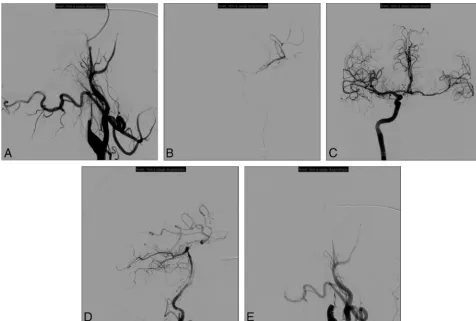
was suspected on initial imaging, it was confirmed with DSA based on the morphologic aspect of the cervical segment of the internal carotid artery (Fig 1) associated with a proximal intracra-nial vessel occlusion (carotid termination, M1, M1–M2 junction, and/or M2 segment of the middle cerebral artery). The ICD diag-nosis was based on clinical, imaging, and angiographic data. We aimed to distinguish dissection from atheromatous cervical ca-rotid artery lesions.
Intravenous Thrombolysis
Intravenous thrombolysis (0.9 mg/kg; 10% of the dose as a bolus and the remainder during 60 minutes) was administered to pa-tients within a maximum of 4.5 hours after stroke onset. Conven-tional clinical and laboratory inclusion and exclusion criteria for intravenous thrombolysis were applied.
Endovascular Procedure
Endovascular treatment was performed with the patient under general anesthesia or conscious sedation. The decision on the type of sedation was made on an individual basis by the neurologist, neuroradiologist, and anesthesiologist on call. DSA was per-formed via a transfemoral approach using a biplane, high-resolu-tion angiography system. In one center (Bern, Switzerland), a 4-vessel cerebral angiography was always performed before the intervention. In the other center (Montpellier, France), it was performed after intracranial recanalization through a second femoral approach to assess collateral circulation through the cir-cle of Willis and leptomeningeal collaterals. An 8F guiding cathe-ter or an 8F or 9F balloon-guiding cathecathe-ter (Guider Softip XF, Boston Scientific, Fremont, California; Merci retriever, Concen-tric Medical, Mountain View, California) was introduced into the common carotid artery, and an angiographic run was performed to evaluate the occlusion. During this step, cervical internal ca-rotid artery occlusion was demonstrated and eventually differen-tiated from carotid contrast agent stagnation related to isolated carotid termination thrombus. After we took into account both clinical data and angiographic morphology, ICD was distin-guished from atheromatous occlusion.
per-formed under flow arrest and manual aspiration through the in-termediate catheter to prevent clot fragmentation and distal embolism. As an alternative access technique, the stent re-triever was deployed first through the microcatheter; then, the intermediate catheter was advanced over the pusher wire of the stent retriever using the stent retriever as an intracranial an-chor (so-called anan-choring technique) to gain intracranial ac-cess with the intermediate catheter, especially in cases with very tortuous anatomy.
The result of intracranial recanalization was evaluated using the TICI score. Successful recanalization was defined as TICI 2b or 3. If intracranial recanalization was achieved, treatment of the cervical carotid dissection was left to the discretion of the opera-tor, taking into account the functionality of the circle of Willis, residual cervical occlusion/severe stenosis or thrombus apposi-tion, and difficulty of the endovascular access.
The 0.014-inch microwire was introduced into the petrous segment of the carotid artery to preserve distal access to the true arterial lumen for cervical stent placement. In 1 center (Bern, Switzerland), a filter protection device (FilterWire EZ; Boston Scientific) was placed distal to the dissection when anatomically possible. Then, the guiding catheter and the intermediate catheter were retrieved into the common carotid artery. A 250- to 500-mg bolus of aspirin was administered intravenously before stent
placement. Cervical carotid artery stent placement was performed using the carotid Wallstent (Boston Scientific), Precise (Cordis, Fremont, California), Cristallo Ideale (Medtronic, Roncadelle, It-aly), or, in case of distal cervical carotid dissection, the LEO (Balt Extrusion), Enterprise (Codman & Shurtleff), or Wingspan (Stryker) stent. Appropriate positioning and opening of the stent were imme-diately assessed angiographically, and additional angioplasty was per-formed if necessary. Several stents were used if the dissection was extensive and occlusive in the upper cervical and pre-petrous segments.
Follow-Up
Follow-up CT or MR imaging was performed 24 hours after the acute therapy to assess infarction volume and hemorrhagic status. Symptomatic intracranial hemorrhage (sICH) was defined as a documented hemorrhage associated with a decline ofⱖ4 points in the NIHSS score. If no hemorrhage occurred, double antiplate-let therapy was initiated and continued for 3– 6 months. Single antiplatelet treatment was then maintained for 1 year or life-long, depending on the protocol of the responsible center.
[image:3.594.54.531.46.367.2]outcome was quantified by 3-month mRS and mortality. Favor-able outcome was defined as a mRSⱕ2.
RESULTS
Patient Population
Between August 2009 and April 2013 (Montpellier) and January 2010 to September 2014 (Bern), 531 patients with anterior circu-lation ischemic stroke were treated in the 2 institutions. Tandem occlusion stroke related to ICD was identified in 34 of these pa-tients (12 women and 22 men). The mean age was 52.47⫾10.25 years (range, 30 –73 years), and the mean NIHSS score was 17.29⫾6.23 (range, 4 –36). A history of high blood pressure was noted in 14 patients. Except for patients with unknown symptom onset, such as wake-up strokes, the average time from symptom onset to arterial puncture was 215.8⫾66.07 minutes (range, 142– 360 minutes). Intravenous thrombolysis was performed in 21 cases (61.8%). Baseline characteristics of the population are given inTable 1. Patients with presumed atheromatous tandem occlu-sions were excluded from the study.
Procedural Results and Early Evolution
Thirty-three (97%) patients were treated under general anesthe-sia, and 1 (3%) patient, under conscious sedation. Successful in-tracranial recanalization (TICI 2b or 3) was achieved in 23 pa-tients (67.65%). The mean time from onset to revascularization was 329.71⫾ 128.82 minutes (range, 180 – 855 minutes). The mean number of stent retriever passes was 2.03 (range, 1– 4).
In our population of patients with ICD, 15 (44.12%) finally required cervical internal carotid stent deployment. Stent place-ment was technically feasible in all cases, and no distal thrombo-embolic events were associated with stent placement. Among the stented patient subgroup (n⫽15), intracranial recanalization TICI 2b–3 was achieved in 8 patients (53.3%). In the nonstented subgroup, 15 patients (78.9%) benefited from revascularization, achieving TICI 2b–3. No periprocedural complications were ob-served in our multicenter cohort.
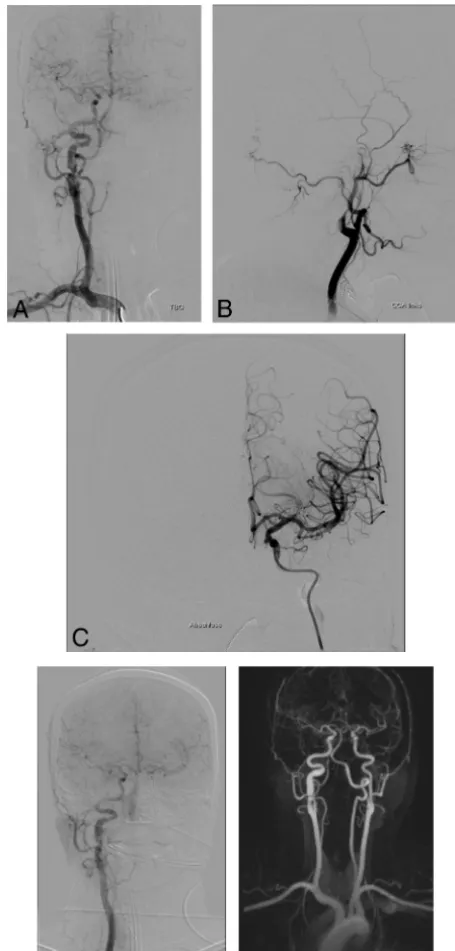
Representative endovascular strategies are illustrated inFigs 1 and2.
Two patients (5.9%) were affected by sICH. In 1 patient who received a cervical internal carotid artery stent, sICH in the basal ganglia occurred early despite a TICI 3 recanalization. Neverthe-less, the patient had a favorable outcome with an mRS of 2 after 3 months. In the second patient, severe intracranial hemorrhage occurred early on while the patient was in the intensive care unit after unsuccessful mechanical revascularization (TICI 1) without cervical carotid artery stent placement, resulting in a mRS of 4 at 3-month follow-up.
Clinical Assessment after 3 Months
[image:4.594.302.530.47.523.2]After 3 months, 23 (67.65%) of the 34 patients treated for ICD tandem occlusion demonstrated a favorable outcome (7 patients with mRS⫽0; seven with mRS⫽1; nine with mRS⫽2). The Table 1: Baseline characteristics of the population
Baseline Characteristics Values
Age (mean) (range) (yr) 52.47 (30–73)
Sex (No.) (%)
Female 12 (35.3%)
Male 22 (64.7%)
Initial NIHSS score (mean) (range) 17.29 (4–36)
High blood pressure (No.) (%) 14 (41.2%)
Associated IVT (No.) (%) 21 (61.8%)
Note:—IVT indicates intravenous thrombolysis.
[image:4.594.53.284.56.141.2]mortality rate was 8.8% (3 patients). No patients were lost to clinical follow-up.
In the subgroup of patients who underwent ICA stent place-ment, 10 (66.7%) had mRSⱕ2 at 3-month follow-up. In the unstented subgroup, 13 patients (68.4%) had a satisfactory clini-cal outcome. No stroke recurrence was observed in either of the subgroups.
The clinical results are summarized inTable 2and the On-line Table.
DISCUSSION
Ischemic strokes due to a tandem occlusion caused by either ath-eromatous disease or a carotid dissection, if untreated, commonly have a poor prognosis and clinical outcome. Before the emer-gence of endovascular treatment, a very modest efficacy of intra-venous thrombolysis was reported in the treatment of tandem occlusion.2,23Linfante et al23 reported a very low rate of 31% recanalization on late 3-day imaging follow-up. Engelter et al5 reported a 36% rate of good outcome after intravenous throm-bolysis in patients with tandem occlusions due to ICD.
Endovascular treatment approaches for tandem occlusions re-main insufficiently studied. In some of the recent multicenter randomized trials, tandem occlusion strokes have even been con-sidered an exclusion criterion.7,8 Most studies have analyzed tandem occlusion stroke by pooling atheromatous and ICD eti-ologies.13,15,18-21,24-29In our opinion, these 2 entities involve 2 different diseases, each with a specific pathophysiologic origin and patient population. ICD usually affects young patients with patent supra-aortic trunks and circle of Willis. Cervical ather-omatous disease affects an older population with chronic arte-rial lesions of the cervical and intracranial arteries and a high stroke recurrence rate.30Thus, we consider these 2 etiologies completely different pathologies with different treatment strategies and prognoses.
The literature specifically addressing ICD tandem occlusion is scant.14,17,31-35Reported satisfactory intracranial recanalization rates vary between 50% and 100%, and associated rates of favor-able outcome, between 50% and 80%. Our article reports the results of the first multicenter study of endovascular treatment of this specific lesion subtype.
Different approaches and strategies have been proposed for the treatment of tandem occlusions. Most of the published studies have reported the results of antegrade recanalization.13,20This
consists of stepwise revascularization beginning from the cervical carotid artery lesion and ending by treating the intracranial occlu-sion. Despite overall satisfactory results, we believe that this ap-proach can be improved. First, treating the cervical lesion with stent placement leads to significant prolongation of cerebral hy-poperfusion. Cervical carotid stent placement may be difficult in a dissected vessel, and dissection can be extensive. Intracranial recanalization is performed as the second step, extending the du-ration of brain ischemia and potentially leading to larger infarct core volumes. The second disadvantage is that systematic cervical carotid stent placement necessitates antiplatelet medication, which may increase the risk of sICH.
Our approach is to focus first on intracranial revasculariza-tion.22This shortens the duration of cerebral ischemia. The first step consists of navigating through the cervical carotid lesion up to the distal segments of the ICA. Avoiding the false lumen of the dissected vessel represents the main challenge. In our experience, it has never been impossible to reach the intracranial ICA via the true lumen. We routinely use a triaxial approach. If one positions the intermediate catheter beyond the dissection, the cervical oc-clusion is only crossed once to perform intracranial thrombec-tomy. This limits the maneuvers at the level of the dissected por-tion of the ICA, reducing the durapor-tion of the procedure and complication risk.
Our endovascular strategy also avoids cervical ICA stent place-ment in a significant number of cases. In our study population, the decision about stent placement was made taking into account cervical ICA residual steno-occlusion, circle of Willis functional-ity, intracranial recanalization TICI grade, and pretherapeutic in-farct volume based on imaging. In many cases, after we navigated inside the dissected ICA through the true lumen, this simple ma-neuver was sufficient to reopen the ICA lumen enough to obtain efficient blood flow. In these cases, no further stent placement procedure of the ICA was required. Then, depending on circle of Willis functionality, we did not systematically stented the cervical ICA. When there was a likelihood that stent placement would be technically difficult and/or a high risk of hemorrhage due to an-tiplatelet therapy because of large cerebral infarct volume, we spe-cifically studied circle of Willis functionality. Using previously published angiographic features demonstrating the functionality of the circle of Willis,36we could decide not to stent the ICA if there was an efficient vascular supply from the contralateral ICA through the anterior or posterior communicating artery or lepto-meningeal collaterals. Those 2 considerations leading to the deci-sion not to stent the dissected ICA are supported by the low rate of delayed stroke recurrence after ICD.4In the present study, no patient in the nonstented subgroup had a recurrence. Therefore, treatment of ICD by stent placement in tandem occlusion in pa-tients with acute stroke should be carefully weighed in the light of the potentially benign course of the disease under conservative management and taking into account clinical and angiographic information in decision-making.
The sICH rate of only 2 cases (5.9%) was low. In the first case, the patient benefited from complete intracranial recanalization and cervical ICA stent placement. He presented with a favorable neurologic outcome (mRS, 2 after 3 months). In the second pa-tient, sICH was likely related to extended cerebral infarction after Table 2: Clinical results
Procedural and Follow-Up Data Values Timing: onset-to-puncture (mean) (range) (min) 215.8 (142–360) Intracranial occlusion topography (No.) (%)
Internal carotid terminus 8 (23.5%)
M1 24 (70.6%)
M2 2 (5.9%)
No. of stent retriever passes (mean) (range) 2.03 (1–4) Cervical ICA stenting (No.) (%) 15 (44.1%)
TICI 2b/3 (No.) (%) 23 (67.65%)
Timing: onset-to-revascularization (mean) (range) (min)
329.71 (180–855)
Favorable outcome (No.) (%) 23 (67.65%)
Mortality (No.) (%) 3 (8.8%)
failure of endovascular treatment (TICI score⫽1), leading to a poor clinical outcome (mRS, 4 after 3 months).
Despite several limits of the present study, such as its retro-spective nature, it is the largest study to date dealing with the endovascular treatment of acute stroke related to tandem occlu-sions due to ICD using the distal-to-proximal recanalization strategy. We also present the first reported multicenter experience with the recanalization treatment of this specific stroke subtype.
CONCLUSIONS
Endovascular treatment of ICD-related tandem occlusion stroke using the distal-to-proximal recanalization strategy appears fea-sible, with low complication rates and considerable rates of suc-cessful recanalization. This endovascular approach prioritizes the restoration of intracranial blood flow and focuses on making an informed decision about the need for stent placement of the cer-vical ICA. The decision should take into account clinical and an-giographic information such as the degree of intracranial recana-lization, dissection extent, infarct volume on initial imaging, and the functionality of the circle of Willis.
Disclosures: Omer Faruk Eker—UNRELATED:Payment for Development of Educa-tional Presentations: Stryker, Medtronic*. Jan Gralla—UNRELATED:Consulting Fee or Honorarium: Medtronic,Comments: Global Principal Investigator of the STAR study and SWIFT DIRECT trial, consultant for Medtronic*;Grants/Grants Pending: SNF,Comments: research grant for MRI stroke imaging*. Urs Fischer—UNRELATED: Consultancy: Medtronic, Stryker,Comments: Advisory Board and consultancy*; Grants/Grants Pending: Medtronic, Swiss National Science Foundation,Comments: research grants for SWIFT DIRECT, ELAN, and SWITCH trials.* Marcel Arnold— UNRELATED:Board Membership: Amgen, Bayer, Bristol-Myers Squibb, Boehringer Ingelheim, Pfizer, Covidien, Daiichi Sankyo,Comments: honoraria for scientific advi-sory boards;Grants/Grants Pending: Swiss National Science Foundation, Swiss Heart Foundation*;Payment for Lectures Including Service on Speakers Bureaus: Bayer, Covidien,Comments: honoraria for lectures. Alain Bonafe´—UNRELATED: Consultancy: Stryker, Medtronic, MicroVention. Vincent Costalat—UNRELATED: Consultancy: Stryker, Medtronic, Balt, Cerenovus;Grants/Grants Pending: Stryker, Medtronic*;Payment for Development of Educational Presentations: Stryker, Medtronic, Balt Extrusion. *Money paid to the institution.
REFERENCES
1. Grau AJ, Weimar C, Buggle F, et al.Risk factors, outcome, and treat-ment in subtypes of ischemic stroke: the German stroke data bank.
Stroke2001;32:2559 – 66Medline
2. Rubiera M, Ribo M, Delgado-Mederos R, et al.Tandem internal carotid artery/middle cerebral artery occlusion: an independent predictor of poor outcome after systemic thrombolysis. Stroke 2006;37:2301– 05CrossRef Medline
3. Arauz A, Hoyos L, Espinoza C, et al.Dissection of cervical arteries: long-term follow-up study of 130 consecutive cases.Cerebrovasc Dis 2006;22:150 –54CrossRef Medline
4. Benninger DH, Georgiadis D, Kremer C, et al.Mechanism of isch-emic infarct in spontaneous carotid dissection. Stroke2004;35: 482– 85CrossRef Medline
5. Engelter ST, Rutgers MP, Hatz F, et al.Intravenous thrombolysis in stroke attributable to cervical artery dissection.Stroke2009;40: 3772–76CrossRef Medline
6. Engelter ST, Dallongeville J, Kloss M, et al; Cervical Artery Dissection and Ischaemic Stroke Patients-Study Group.Thrombolysis in cervi-cal artery dissection: data from the Cervicervi-cal Artery Dissection and Ischaemic Stroke Patients (CADISP) database.Eur J Neurol2012;19: 1199 –206CrossRef Medline
7. Saver JL, Goyal M, Bonafe A, et al; SWIFT PRIME Investigators.
Stent-retriever thrombectomy after intravenous t-PA vs. t-PA alone in stroke.N Engl J Med2015;372:2285–95CrossRef Medline
8. Goyal M, Demchuk AM, Menon BK, et al; ESCAPE Trial
Investiga-tors.Randomized assessment of rapid endovascular treatment of ischemic stroke.N Engl J Med2015;372:1019 –30CrossRef Medline
9. Jovin T, Chamorro A, Cobo E, et al; REVASCAT Trial Investigators.
Thrombectomy within 8 hours after symptom onset in ischemic stroke.N Engl J Med2015;372:2296 –306CrossRef Medline
10. Campbell BC, Mitchell PJ, Kleinig TJ, et al; EXTEND-IA Investiga-tors.Endovascular therapy for ischemic stroke with perfusion-im-aging selection.N Engl J Med2015;372:1009 –18CrossRef Medline
11. Berkhemer O, Fransen P, Beumer D, et al.A randomized trial of intraarterial treatment for acute ischemic stroke.N Engl J Med2015; 372:11–20CrossRef Medline
12. Nogueira RG, Jadhav AP, Haussen DC, et al; DAWN Trial Investiga-tors.Thrombectomy 6 to 24 hours after stroke with a mismatch between deficit and infarct.N Engl J Med2018;378:11–21CrossRef Medline
13. Mpotsaris A, Bussmeyer M, Buchner H, et al.Clinical outcome of neurointerventional emergency treatment of extra- or intracranial tandem occlusions in acute major stroke: antegrade approach with Wallstent and Solitaire stent retriever.Clin Neuroradiol2013;23: 207–15CrossRef Medline
14. Lavalle´e PC, Mazighi M, Saint-Maurice JP, et al.Stent-assisted endo-vascular thrombolysis versus intravenous thrombolysis in internal carotid artery dissection with tandem internal carotid and middle cerebral artery occlusion.Stroke2007;38:2270 –74CrossRef Medline
15. Cohen JE, Gomori JM, Rajz G, et al.Extracranial carotid artery stenting followed by intracranial stent-based thrombectomy for acute tandem occlusive disease.J Neurointerv Surg2015;7:412–17
CrossRef Medline
16. Dababneh H, Bashir A, Hussain M, et al.Endovascular treatment of tandem internal carotid and middle cerebral artery occlusions.
J Vasc Interv Neurol2014;14:26 –31Medline
17. Haussen DC, Jadhav A, Jovin T, et al.Endovascular management vs intravenous thrombolysis for acute stroke secondary to carotid ar-tery dissection: local experience and systematic review. Neurosur-gery2016;78:709 –16CrossRef Medline
18. Malik AM, Vora NA, Lin R, et al.Endovascular treatment of tandem extracranial/intracranial anterior circulation occlusions: prelimi-nary single-center experience. Stroke 2011;42:1653–57 CrossRef Medline
19. Papanagiotou P, Roth C, Walter S, et al.Carotid artery stenting in acute stroke.J Am Coll Cardiol2011;58:2363– 69CrossRef Medline
20. Spiotta AM, Lena J, Vargas J, et al.Proximal to distal approach in the treatment of tandem occlusions causing an acute stroke.J Neuroin-terv Surg2015;7:164 – 69CrossRef Medline
21. Stampfl C, Ringleb P, Mo¨hlenbruch M, et al.Emergency cervical internal carotid artery stenting in combination with intracranial thrombectomy in acute stroke.AJNR Am J Neuroradiol2014;35: 741– 46CrossRef Medline
22. Marnat G, Mourand I, Eker O, et al.Endovascular management of tandem occlusion stroke related to internal carotid artery dissec-tion using a distal to proximal approach: insight from the RECOST study.AJNR Am J Neuroradiol2016;37:1281– 88CrossRef Medline
23. Linfante I, Llinas RH, Selim M, et al.Clinical and vascular outcome in internal carotid artery versus middle cerebral artery occlusions after intravenous tissue plasminogen activator. Stroke 2002;33: 2066 –71CrossRef Medline
24. Kappelhof M, Marquering HA, Berkhemer OA, et al.Intra-arterial treatment of patients with acute ischemic stroke and internal ca-rotid artery occlusion: a literature review.J Neurointerv Surg2015; 7:8 –15CrossRef Medline
25. Fischer U, Mono M-L, Schroth G, et al.Endovascular therapy in 201 patients with acute symptomatic occlusion of the internal carotid artery.Eur J Neurol2013;20:1017–24, e87CrossRef Medline
26. Matsubara N, Miyachi S, Tsukamoto N, et al.Endovascular interven-tion for acute cervical carotid artery occlusion.Acta Neurochir (Wien)2013;155:1115–23CrossRef Medline
treat-ment of acute tandem occlusions in the anterior circulation.Clin Neuroradiol2015;25:397– 402CrossRef Medline
28. Suh DC, Kim JK, Choi CG, et al.Prognostic factors for neurologic outcome after endovascular revascularization of acute symptom-atic occlusion of the internal carotid artery.AJNR Am J Neuroradiol 2007;28:1167–71CrossRef Medline
29. Lescher S, Czeppan K, Porto L, et al.Acute stroke and obstruction of the extracranial carotid artery combined with intracranial tandem occlusion: results of interventional revascularization.Cardiovasc Intervent Radiol2015;38:304 –13CrossRef Medline
30. Lovett JK, Coull AJ, Rothwell PM.Early risk of recurrence by sub-type of ischemic stroke in population-based incidence studies. Neu-rology2004;62:569 –73CrossRef Medline
31. Baumgartner RW, Georgiadis D, Nedeltchev K, et al.Stent-assisted en-dovascular thrombolysis versus intravenous thrombolysis in internal carotid artery dissection with tandem internal carotid and middle ce-rebral artery occlusion.Stroke2008;39:e27–28CrossRef Medline
32. Fields JD, Lutsep HL, Rymer MR, et al; Merci Registry Investigators.
Endovascular mechanical thrombectomy for the treatment of acute ischemic stroke due to arterial dissection.Interv Neuroradiol2012; 18:74 –79CrossRef Medline
33. Mourand I, Brunel H, Vendrell JF, et al.Endovascular stent-assisted thrombolysis in acute occlusive carotid artery dissection. Neurora-diology2010;52:135– 40CrossRef Medline
34. Juszkat R, Liebert W, Stanisławska K, et al.Extracranial internal ca-rotid artery dissection treated with self-expandable stents: a single-centre experience. Cardiovasc Intervent Radiol 2015;38:1451–57
CrossRef Medline
35. Pham M, Rahme RJ, Arnaout O, et al.Endovascular stenting of ex-tracranial carotid and vertebral artery dissections: a systematic re-view of the literature.Neurosurgery2011;68:856 – 66; discussion 866
CrossRef Medline