Prediction of Reinforcement Effect by Screw on
Triangular Embedment Perpendicular to the
Grain with Variation of Screw Locations
Satoru Murakami, Akihisa Kitamori, Kiho Jung, Wen-Shao Chang, Kohei Komatsu
Research Institute for Sustainable Humanosphere (RISH), Kyoto University, Kyoto, Japan Email: [email protected]
Received August 1, 2012; revised September 2, 2012; accepted September 14,2012
ABSTRACT
In this study, the reinforcement by screws for the wood perpendicular to the grain subjected to a rotational moment has been studied. For the estimation of rotational stiffness and yield moment, the reinforcement effect by the screws which varies depending on their position under the bearing plate was evaluated by taking the internal displacement distribution of the wood into account. The Finite Element Analysis (FEA) was used to investigate the internal displacement bution of the wood. Then an appropriate function was found out to meet well with various internal displacement distri-butions under the bearing plate. The equations, which can estimate rotational stiffness and yield moment of the bearing performance of the wood reinforced by screws, were derived from the shear resistance mechanism between the screw and wood by considering their relative displacement distribution. Then rotational tests were carried out with the wood reinforced by the screws, setting screw thread at the various positions. Agreements between prediction and experimental results were very well. It was found that the screw reinforcement was effective, provided screw length should be longer for the wood height.
Keywords: Screw; Reinforce; FEA; Rotational Performance; Timber Structure
1. Introduction
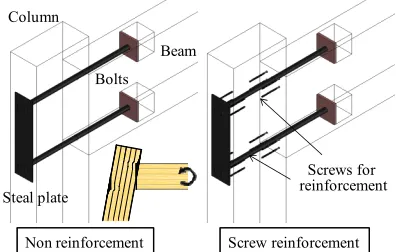
The compression performance of wood perpendicular to the grain is remarkably inferior to that of wood parallel to the grain. In the case of the portal frame of through-bolt type as shown in Figure 1 (on the left), the end grain of the beam and the steel plate will be embed-ded in the side surface of column triangularly.
In order to improve the joint performance of timber structures, the enhancement of the bearing performance might be one of the possible choices. It is an effective method to insert the screws into the wood perpendicular to the grain as shown Figure 1. Therefore the studies on the screw reinforcement of bearing performance by in-serting screws in the direction perpendicular to the wood grain has been carried out [1-3].
In reference [3], we have introduced a calculation method of stiffness and strength for screw reinforcement by considering the position of the thread of the screws. It was found that the effect of screw reinforcement varied depending on the position of screws thread. This was thought due to the inner displacement distribution on partial compression.
Since it was reported in the previous study [4] that there were outstanding differences on inner stress distri-bution of the wood depending on the cases subjected to uniform compression or triangular compression by the rotational moment, it was assumed that the tendency of inner displacement will not be the same for both cases. Although previous studies [1-3] focused on only uniform embedment case, as triangular embedment caused by moment resisting joint in portal frame structure has been getting interests among Japanese timber engineers re-cently, we intended to treat with triangular case.
2. Mechanical Model
In the case where the wood reinforced by the screws is subjected to rotational moment as shown in Figure 2, the resistance moment due to embedment resistance of wood (MW) and that due to individual screw (MS) are assumed to be independent. Hence, the total moment resistance can be expressed by Equation (1).
W S
M M nM
W S
R R nR
S i S
(1) In Equation (1), M is the total moment resistance and n
is the number of inserted screws.
Because M is the function of the rotational angle (θ), therefore, the total rotational stiffness (R) is obtained from rotational stiffness of the wood (RW) and that of the screws (RS) as shown in the Equation (2).
(2) Ms can be expressed as multiplying the distance of the screw form the rotational centre (xi) and the resistance force (PS).
S
M P x R (3) Then, θ can be expressed as below by using the dis-placement on the wood surface (δi) and xi.
i xi
(4) Then, RS can be shown by using the PS obtained from
Column
Beam
Non reinforcement Screw rei Steal plate
Bolts
[image:2.595.327.538.110.265.2]nforcement Screws for reinforcement
Figure 1. The models of portal frame of through-bolt type.
Wood
δW’s Distributions M
M
[image:2.595.73.271.424.550.2]θ
Figure 2. Distributions of compression displacement of wood.
previous study [3]. And, the displacement distribution of wood (δW) can be written as Equation (6).
2
S 0
0
0
0
cosh sinh
cosh
u i
S
x L
k x z b
R b a
z a
z
(5)
00
sinh 1
,
sinh
W
x L
z z
z x
x
(6)
Here, “a” and “b” are the positions on the vertical axis (z-axis) at the beginning and end of the thread. And ηis the function to decide the form of the displacement dis-tribution and is obtained as follows.
x
x L x L
(7)
0
In the case of the uniform embedment, the value of α
in Equation (7) is denoted as mentioned in previous study [3]. While in the case of triangular embedment, the value of α must be different from uniform case. Therefore, FEA was carried out in order to obtain the value of α for triangular embedment in the next chapter.
The yield rotational angle can be defined as the de-formation angle of the wood when whichever the screws or the wood reaches to the yield displacement earlier.
_
_
0
0
sinh
min ,
sinh sinh S y
y w y
i
x L
x b
z
(8)
where: W y_ is the yield displacement of the wood. The
yield strength (My) can be obtained by using the total initial stiffness (R) as follows.
y y
M R (9)
3. Materials and Methods
3.1. Finite Element Analysis
3.1.1. Continuous Wood Beam
[image:2.595.68.275.579.709.2]mm as a parameter.
The configuration of the wood analysed is shown in Figure 3. The centre of the wood was put between two rigid bodies and the wood forced to be deformed trian-gularly by letting two rigid bodies rotated with 0.001 rad, whose rotational centers were at the centers of the wood surface contacting with each rigid body. This moment makes triangle deformation to the wood. Since the inter-nal displacement on the z direction at the any positions hardly changed even if the friction coefficient changed, the friction coefficient was set to zero which was easier for computation only to acquire the reinforcement effect of the screws.
Five different widths ranging from 0.3 to 1.5 times of the height (z0) were modeled. The end distance was set at
400 mm, referring to report by Madsen [5]. Sitka Spruce (Picea sitchensis) was used for the specimen as the ex-perimental verification. The material constants inputted into FEA are indicated in Table 1, referring to [6].
3.1.2. Cantilever Wood Beam
The configuration of the wood analysed by FEA is shown in Figure 4 in accordance with [5]. The edge distance in each condition is 400 mm. Five different widths ranging from 0.3 to 1.5 times of z0 were modeled. The other test
conditions are the same as those of the pervious clause.
3.2. Rotation Tests
3.2.1. Continuous Wood Beam
The steel frame used for the rotational test of the wood is
θ
L: 30, 50, 80 100, 150
*Unit : mm
Z0
:100
400
M M x
z Plate Width 2L
Figure 3. Configuration of the wood analysed by FEA (Con-tinuous beam).
θ
L: 30, 50, 80 100, 150
*Unit : mm Z0:100
400
M M x
z Plate Width 2L
Figure 4. Configuration of the wood analysed by FEA (Can-tilever beam).
Table 1. Elastic constants.
Young’s modulus Shear modulus Poisson’s ratio
Ex Ez(N/mm2) G (N/mm2) vxz vzx
10689 706 755 0.3 0.25
shown in Figure 5. Every corner point was pin jointed. By applying the force to the top of the frame horizontally a rotational moment is induced in the wood. The steel plates directly contacted to the wood were not fixed to the centre jig mechanically. Because two 0.2 mm thick polytetrafluoroethylene sheets were placed between the two steel plates and steel frame to avoid the influence of friction, the steel plates contacted with the wood speci-men can be slid freely.
Two screws were inserted on the both sides of the wood 90 mm apart from the centre of specimen as shown in Figure 5. Since two parts on the wood to be embedded, 4 screws in total were inserted each specimen.
In order to change the positions of the thread on z-axis in the wood, four types of the screws with four different lengths respectively were used (Figure 6), having the equal thread length of 20 mm. Also, the condition of in-serting the full-threaded screws with the length of 50 mm (F50) was used for the test. After inserting the screw up to the designated position, the protruded parts of the screws over the wood surface were cut off with a grinder.
Glulam of spruce (density in dry condition: 409.3 ± 46.2 kg/m3, moisture Content: 12.2% ± 0.8%) with the
dimensions of 1000 (L) × 100 (R) × 50 (T) [mm] was used.
The screws with outer and inner diameters of its thread, 6.2 and 4.4 mm respectively, were inserted, 90 mm apart from the rotational centre. Transducers (Tokyosokki’s CDP-10) were put on the asymmetrical opposite sides, 95 mm apart from the centre of specimen to measure the rotation due to the embedment.
For comparison, the wood without the screws was also
θ
L: 30, 50, 80 100, 150
*Unit : m Z0:100 M
M x
z Plate Width 2L 400
m
Figure 4. Configuration of the wood analysed by FEA (Can-tilever beam).
500 500
50
0
50
0
10
0
50 200
P
10
00
(M=P×500) 50
z10 z30 z50 z70
10
0
20
20
20
20
40
20
60 50
F50
0 5 10 15
0 1 2 3 4 5
Mom
en
t (
kN
・
m)
Rotational angle (rad)
Figure 6. Positions of the thread on z-axis.
tested. Six replications were prepared for each condition. The rotational moment was applied at the constant speed of 1/1000 rad/min.
The moment was calculated by multiplying the load measured by the load cell and the vertical distance be-tween the centre of the specimen and the load cell. The rotational stiffness and yield moment in the condition without the screws (RW and MW_y) were calculated by using the automatic extraction program “PICKPOINT [7]” as shown in Figure 7.
3.2.2. Cantilever Wood Beam
Figure 8 shows the test set up for cantilever type speci-men. The test parameter was also the position of the thread in the vertical axis (z) as shown in Figure 6. The other test conditions are the same as those of the pervious clause.
4. Results and Discussion
4.1. Finite Element Analysis
4.1.1. Continuous Wood Beam
The FEA results are shown in Figure 9, as continuous lines. The vertical axis shows the z-directional position of the wood and the horizontal values indicates displace-ment in each location apart from the centre to that of the edge on the bearing area. The forms of the distribution become being arched as much as distant from the speci-men centre on x-axis.
The unknown parameter α in Equation (7) was deter-mined as 5.11 by employing least squares method so as to fir with FEA results. This value was rounded off to the natural number of 5. The displacement distributions cal-culated by Equation (8) using α= 5 were shown as open circles in Figure 9.
4.1.2. Cantilever Wood Beam
The FEA results are shown in Figure 10. The displace-ment distributions with the same distance from the centre of with and without the extra wood part were added at
Experiment 0.1-0.4 0.4-0.9
Line raised up Mmax
MW_y
0.4Mmax
0.1Mmax
0.9Mmax
θW_y Stiffness line
1.5
RW 1
0.5
Mo
m
en
t (
kN
m
)
0.03 0.04 0.05 0.01 0.02
Figure 7. Calculation method of RW and MW_y.
500 500
50
0
500
10
0
50 200
P
1000
50 (M=P×500)
Figure 8. Rotation test (Cantilever beam).
-100 -80 -60 -40 -20 0
z-di
rect
io
n
(m
m
; T
op:
0,
B
ot
tom
:
-10
0
)
20%
FEA Predicted Distribution 40% 60% 80% 100%
xi
Figure 9. Displacement distribution on each cross-section (Continuous beam).
-100 -80 -60 -40 -20 0
z-di
rec
ti
on
(m
m
; T
op:
0,
B
ot
to
m
:
-100
)
20%
FEA Predicted Distribution 40% 60% 80% 100%
xi
the same place with reversing the condition of the side without the extra length.
The unknown parameter α in Equation (7) was deter-mined as 4.87 by employing least squares method so as to fir with FEA results. Also, this value was rounded off to the natural number of 5 .The displacement distribu-tions calculated from Equation (7) in which the value of
α was substituted the number of 5 were shown as open circles in Figure 10.
Then, it is concluded that the number of 5 is appropri-ate for the value of α regardless of the extra wood part.
4.2. Rotation Tests
[image:5.595.368.479.85.196.2]4.2.1. Continuous Wood Beam
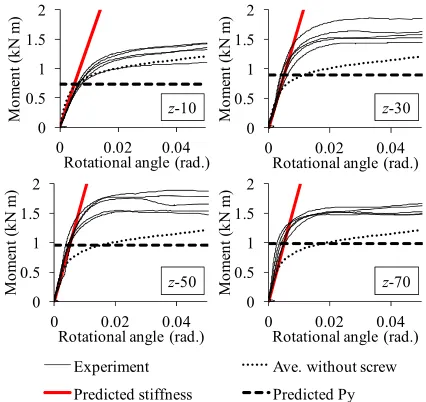
Figure 11 shows the relationships between the rotation moment and rotational angle (M-θ relationship). And Figures 12 and 13 show the comparisons between ex-perimental results and predicted results in rotational stiff-ness and yield moment respectively. For the prediction of rotational stiffness and yield moment, the date of the screw shown in Table 2 and the rotational stiffness and yield moment without screw reinforcement were substi-tuted into Equations (8) and (9). These characteristic val-ues of screw were obtained by using the same test and calculation methods in [3].
Comparison between the results for with and without the screw reinforcement, the improvement in strength is
0 0.5 1 1.5 2
0 0.02 0.04
M
omen
t (
kN
m)
Rotational angle (rad.) 0 0.5 1 1.5 2
0 0
M
omen
t (
kN
m)
Rotational angle (rad.).02 0.04
0 0.5 1 1.5 2
0 0
M
ome
nt
(
kN m)
Rotational angle (rad.).02 0.04 0
0.5 1 1.5 2
0 0.02 0.04
Mo
m
en
t (
kN
m
)
Rotational angle (rad.)
Experiment Ave. without screw Predicted stiffness Predicted Py
z-10 z-30
z-50 z-70
[image:5.595.369.477.223.333.2]max P
Figure 11. M-θrelationships (Continuous beam). Table 2. Characteristics value of screw.
uks (N/mm2) ups (N/mm) (mm)
Ave. 110.63 116.38 1.28
S.D. 42.34 7.24 24.88
0 100 200 300 400
10 30 50 70
R
ota
ti
on
al S
ti
ff
ne
ss
(k
Nm
/r
ad
)
Experiment Prediction
Figure 12. Comparison in rotational stiffness.
0 0.5 1 1.5
10 30 50 70
Yi
el
d M
om
en
t (
kN
m
)
Experiment Prediction
Figure 13. Comparison in rotational moment.
obvious. As concerns M-θ relationships with screw rein-forcement, their characteristics become near to ideal elasto-plastic behavior. In the case where the screw length was short for the wood height, the reinforcement effect is very lower. While, the reinforce effect increase with choosing longer screw. Longer screw increases the rotational stiffness. While the yield moments of z-70 are smaller than those of z-50. And it can be conclude that the experimental results were well predicted by the equa-tions derived in this study.
4.2.2. Cantilever Wood Beam
The curves of M-θ relationships on the conditions with the full-threaded screw were shown in Figure 14. These two graphs indicate the condition of continuous and can-tilever beams respectively. Because the pull-out per-formance of the full-threaded screw shows sudden crease of the resisting force, the moment gradually de-creased after reaching the maximum point.
Since there is no extra wood part on the one side in the case of the cantilever and the embedded volume in the case of cantilever beam is smaller than that in the case of the continuous beam, the moment of the continuous beam is a little bit higher than that of cantilever beam if they are the same rotational angle. But, as introduced earlier, it is considered that the effect of the screw were the same between them.
[image:5.595.66.279.427.628.2]0 0.5 1 1.5 2 2.5
0
Mom
ent
(
kN
m
)
Rotatio0.02nal angle (rad.)0.04 0
0.5 1 1.5 2 2.5
0 0.02 0.04
Mo
m
en
t (
kN
・
m)
Rotational angle (rad.)
Experiment Ave. without screw Predicted stiffness Predicted Py
[image:6.595.311.530.85.294.2]Continuous Cantilever
[image:6.595.67.278.85.202.2]Figure 14. M-θRelationships on the conditions of F50.
[image:6.595.99.243.231.348.2]Figure 15. Continuous beam rotated by 0.005 rad.
Figure 16. Cantilever beam rotated by 0.005 rad.
prevent brittle failure due to excessive number of screws, it is required to use appropriate numbers of screws.
Figure 17 shows M-θrelationships of cantilever beam. And, Figures 18 and 19 show the comparisons between experimental results and predicted results in rotational stiffness and yield moment respectively. In the case where the screw length for the wood height was short, the reinforce effect is very lower same as the case of the continuous beam. However, it can be concluded that the longer screws for the wood height are, the higher per-formance of screw reinforcement can be obtained.
While, in the case where the length of the inserted screw is too long, the declines of the yield moments were observed as well as the case of Continuous beam. It is thought that the reason of decline is because of the short length of the wood under the screw. This point should be noticed.
0 0.5 1 1.5 2
0 0.02 0.04
Mo
me
nt
(k
N
m
)
Rotational angle (rad.)
0 0.5 1 1.5 2
0 0.02 0.04
Mo
me
nt
(k
N
m
)
Rotational angle (rad.) 0 0.5 1 1.5 2
0 0.02 0.04
Mo
me
nt
(k
Nm)
Rotational angle (rad.) 0
0.5 1 1.5 2
0 0.02 0.04
Mo
m
en
t (
kN
m
)
Rotational angle (rad.)
z-10 z-30
z-50 z-70
Experiment Ave. without screw Predicted stiffness Predicted Py
Figure 17. Relationships between moment and rotational angle (Cantilever beam).
0 100 200 300 400
10 30 50 70
R
ot
at
io
nal
S
ti
ff
ness
(k
N
m
/ra
d)
Experiment Prediction
Figure 18. Comparison in rotational stiffness.
0 0.5 1 1.5
10 30 50 70
Y
ie
ld M
om
ent
(
kN
m
/r
ad) Experiment
[image:6.595.369.481.335.437.2]Prediction
Figure 19. Comparison in rotational moment.
5. Conclusion
[image:6.595.101.243.376.503.2] [image:6.595.367.482.466.570.2]6. Acknowledgements
Thanks are due to Kokubu Corp. for donations of screws. In this research work we used the supercomputer of ACCMS, Kyoto University.
REFERENCES
[1] I. Bejtka and H. J. Blass, “Self-Tapping Screws as Rein-forcements in Beam Supports,” CIB-W18, Florence, 2006.
[2] I. Bejtka, “Verstärkung von Bauteilen aus Holz mit Voll-gewindeschrauben,” Band 2 der Reihe Karlsruher Beri- chte zum Ingenieurholzbau. Herausgeber, Karlsruhe Uni- versity, Karlsruhe Germany, 2005 (In German).
[3] S. Murakami, A. Kitamori, K. Jung, I. B. Hassel and K. Komatsu, “Prediction of Reinforcement Effect by Screws on Compression Performance of Wood Perpendicular to the Grain,” Open Journal of Civil Engineering (Accepted).
[4] A. Kitamori, K. Jung, Y. Kataoka and K. Komatsu, “Ef-fect of Additional Length on Partial Compression Per-pendicular to the Grain of Wood: Difference among the Supporting Conditions,” Journal of Structural and Con-struction Engineering, Vol. 74, No. 642, 2009, pp. 1477- 1485 (In Japanese).
[5] B. Madsen, R. F. Hooley and C. P. Hall, “A Design Method for Bearing Stresses in Wood,” Canadian Jour-nal of Civil Engineering, Vol. 9, No. 2, 1982, pp. 338-349. doi:10.1139/l82-035
[6] Forest Research Institute of Forestry Agency, “Handbook of Wood Industry,” Maruzen, Tokyo, 1982 (In Japanese). [7] M. Karube, M. Harada and T. Hayashi, “A Proposal of