Trifluoromethylation of a well-defined square-planar
Aryl-NiII complex involving Aryl-NiIII/CF3 and NiIV−CF3 intermediate
species
ROVIRA, Mireia, ROLDÁN-GÓMEZ, Steven, MARTIN-DIACONESCU, Vlad,
WHITEOAK, Christopher <http://orcid.org/0000-0003-1501-5582>,
COMPANY, Anna, LUIS, Josep and RIBAS, Xavi
Available from Sheffield Hallam University Research Archive (SHURA) at:
http://shura.shu.ac.uk/16508/
This document is the author deposited version. You are advised to consult the
publisher's version if you wish to cite from it.
Published version
ROVIRA, Mireia, ROLDÁN-GÓMEZ, Steven, MARTIN-DIACONESCU, Vlad,
WHITEOAK, Christopher, COMPANY, Anna, LUIS, Josep and RIBAS, Xavi (2017).
Trifluoromethylation of a well-defined square-planar Aryl-NiII complex involving
NiIII/CF3 and NiIV−CF3 intermediate species. Chemistry - A European Journal, 23
(48), 11662-11668.
Copyright and re-use policy
See
http://shura.shu.ac.uk/information.html
Sheffield Hallam University Research Archive
Trifluoromethylation of a well-defined square planar aryl-Ni
IIcomplex involving
Ni
III/CF
3• and Ni
IV-CF
3intermediate species
Mireia Rovira,
[a]†Steven Roldán-Gómez,
[a]†Vlad Martin-Diaconescu,
[a]Christopher J. Whiteoak,
[a,b]
Anna Company,
[a]Josep M. Luis*,
[a]Xavi Ribas*
[a]Abstract: Ni-mediated
trifluoromethylation of an aryl-Br bond in model macrocyclic ligands, Ln-Br,
has been thoroughly studied, starting with an oxidative addition at Ni0 to obtain well-defined aryl-NiII-Br complexes ([Ln-NiII]Br). Abstraction of
the halide with AgX (X = OTf- or ClO 4 -) thereafter provides [Ln-NiII](OTf).
The nitrate analogue has been obtained through a direct C-H activation of an aryl-H bond using NiII salts, and this route has been studied by XAS. Crystallographic (XRD) and XAS characterization has shown a tight macrocyclic coordination in the aryl-NiII
complex, which may hamper their direct reaction with nucleophiles. On the contrary, enhanced reactivity is observed with oxidants, and the reaction of [Ln-NiII](OTf) with CF3+ sources
afforded Ln-CF3 products in
quantitative yield. A combined
experimental and theoretical
mechanistic study provides new insights into the operative mechanism for this transformation. Computational analysis indicate the occurrence of an initial Single Electron Transfer (SET) to 5-(trifluoromethyl)dibenzothiophenium triflate (TDTT) furnishing a transient L1-NiIII/CF3• adduct, which rapidly
recombines to form a [L1-NiIV-CF3](X)2
intermediate species. A final facile reductive elimination affords L1-CF3.
The well-defined square-planar model
system here studied permits
development of the fundamental knowledge on the rich redox chemistry of nickel, which is sought to facilitate the development of new Ni-based trifluoromethylation methodologies.
Keywords: nickel(IV) •
trifluoromethylation • mechanisms • single electron transfer • density functional calculations
Introduction
Tremendous efforts have been directed towards the develop-ment of new trifluoromethylating methodologies,[1] since the
CF3 group can dramatically influence the solubility and stability
properties of many pharmaceuticals and agrochemicals. Whilst the vast majority of these transformations use Pd-based catalysts,[1b, 2] interest is now being directed towards the
devel-opment of new catalytic protocols using cheaper first-row transition metals such as nickel. The vast majority of C-C and C-Heteroatom coupling reactions catalyzed by nickel typically involve Ni0/NiI/NiII/NiIII species in their proposed catalytic
pathways,[3] involving 1e- and 2e- redox steps.[3a, c, 4] More
recently, NiIV intermediate species have been proposed in transformations involving the NiII/NiIV redox couple,[5] although
well-characterized species have only been reported using model substrates designed for octahedral environments.[6] Such recent
studies, in parallel with the development of PdII/PdIV catalytic
cycles,[2b, 7] have sparked interest in high-valent NiIV
organometallic species in new catalytic protocols.
High-valent organometallic Ni complexes have been persistently proposed as putative intermediate species in catalysis, but it was not until 2014 and 2016 that Mirica and co-workers reported the isolation of an octahedral NiIII−dialkyl
complex that provided an opportunity to directly probe the involvement of organometallic NiIII and NiIV species in C−C
bond formation cross coupling reactions.[5b, 8] In 2015, Sanford and co-workers pioneered the isolation of octahedral NiIV
complexes utilizing tris-(2-pyridyl)methane and tris-(pyrazolyl)borate ligand scaffolds, capable of effecting reduc-tive elimination to form C-X bonds (X = O, S, N) and of particular interest, aryl-CF3 (Scheme 1).[5a, 9] Sanford’s group
previously investigated the reactivity of square-planar aryl-NiII
complexes with two electron oxidants, and aryl-NiIII-Br species
were proposed as intermediate towards the formation of the aryl-Br final products.[10]
The extremely rich redox chemistry of Ni complexes demands a deep mechanistic understanding of these processes in order to gain predictability in the development of new Ni-based trifluoromethylation methodologies. Moreover, it is of general interest to gain more mechanistic knowledge about the ability of this metal to form reactive high-valent Ni intermediates in atypical non-octahedral environments. With this idea in mind, we have designed and synthesized an organometallic square-planar aryl-NiII model system that would enable the
stabiliza-tion of high valent nickel species. Furthermore, a thorough experimental and theoretical mechanistic study on electrophilic trifluoromethylation of square planar aryl-NiII species has been performed.
[a] Dr. Mireia Rovira, Mr. Steven Roldán-Gómez, Dr. Vlad Martin-Diconescu, Dr. Christopher J. Whiteoak, Dr. Josep M. Luis and Dr. Xavi Ribas
Institut de Química Computacional i Catàlisi (IQCC) and Departament de Química, Universitat de Girona
Campus Montilivi, Facultat Ciències, E17071 Girona (Catalonia, Spain), Fax: (+34-972418150)
E-mail: [email protected] , [email protected] † These authors contributed equally to this work
[b] Current address:
Biomolecular Sciences Research Centre, Faculty of Health and Wellbeing, Sheffield Hallam University, City Campus, Sheffield S1 1WB, England
NiIII N N N MeCN, RT 24h FcPF6 (1 eq.) THF -50˚C NMe Me
Ac FcPF 6 (1 eq.) NiII N N N N B N N
Ph CF3
NBu4
S CF3TfO
+
(TDTT)
MeCN
RT, <5 min H NiIV N N N N B N N
CF3 CF3 H
55˚C CF3
a) Mirica (2014)
b) Sanford (2015)
c) This work
N N
N
H H
MeCN, r.t, 2h, N2 NiIV N N N NiII H H
"CF3+" OTf NiII N N N N Me Me Me Me Me Me Ni IV N N N N Me Me Me Me Me 2 Me Me 84-88%
+ NiII
Ac FcPF 6 (2 eq.)
MeCN, RT, 30 min
N N
N
H CF3 H
CF3
1OTf 3 L1-CF3
2+
Scheme 1. (a) NiIII and NiIV-dialkyl compounds reported by Mirica and
co-workers, (b) NiIV species reported by Sanford and co-workers and (c) the system
studied in this work.
Results and Discussion
Organometallic aryl-NiII complexes [L
n-NiII](X) (n = 1 or 5, X = OTf-,
ClO4- or NO3-) (1OTf, 1ClO4, 1NO3 and 5OTf) were obtained following
two distinct procedures: (a) oxidative addition of L1-Br to Ni0(COD)2
in THF at room temperature (RT), followed by treatment with AgX ( X = ClO4-, OTf-), or (b) through direct C-H activation of L1-H with
NiII(NO
3)2 (Scheme 2).[11] The synthesis of complex [L1-NiII](X) (1X)
through Csp2-H activation of L1-H was optimized by using
NiII(NO
3)2·6H2O as Ni source in MeCN at RT, affording the desired
organometallic compound in 55% yield. The addition of soft bases such as acetate did not improve yields (Table S1). All these compounds present diamagnetic NMR spectra as expected for square-planar NiII complexes.
Scheme 2. Synthesis of the organometallic aryl-NiII
complexes (1OTf, 1NO3 and 5OTf) via (a) oxidative addition at Ni0 and (b) direct C-H activation by NiII (DFT
optimized structure of the proposed intermediate, [L1-H···NiII-MeCN]2+, is shown).
Upon reaction of L1-H and NiII salt at low T (248 K) a paramagnetic
[L1-H···NiII]2+ species was obtained. The geometry at the NiII center
and the interaction with the C-H bond was further studied by XAS (Figure 1). XANES and EXAFS analysis point to a most probable trigonal bipyramidal geometry at the metal having 4 N/O scatters at an average distance of 2.09 Å (~ 2.09 Å from DFT) and a Caryl
scattering atom at 2.29 Å (~2.39 Å from DFT, see Scheme 2b and Supporting Information). This is in agreement with the complex bearing a coordinated acetonitrile, and consistent with a previously published DFT structure of an analogue complex.[11]
Figure 1. XANES spectra of [L1-H···NiII]+2 (blue) and 1NO3 in solution (black); Inset: expansion of the pre-edge region.
No Csp2-H activation was observed for L5-H (macrocyclic model
arene substrate bearing N-Me tertiary amines), even in the presence of several bases, or changing the NiII source, solvent or temperature
(Table S2). The corresponding organometallic aryl-NiII complex [L5
-NiII H C 2+ N N N H H
NiII(NO 3)2·6(H2O) (1 eq)
MeCN, 248 K Overnight N N N NiII H H
+ (NO3)
-N N N NiII R R + N N N R R
Ni0(COD) 2 (1 eq)
L1-Br (R = H)
L5-Br (R = CH3)
THF, r.t, N2 Overnight
(Br)
-Br
Ag+X- (1 eq)
N N N NiII R R + a) b) X
-X-= OTf, ClO 4
H
1Br(R = H)
5Br (R = CH3)
1X(R = H)
5X (R = CH3)
L1-H
[L1-H···NiII-MeCN]2+
1NO3
C1
N3
N2 N1 Ni1
NiII]OTf (5OTf) could only be prepared by the oxidative addition
using Ni0(COD)
2 and L5-Br (Scheme 2a). The latter results point
towards a key participation of the macrocyclic secondary amines for the Csp2-H activation process.
On the other hand, compounds 1ClO4, 1NO3 and 5OTf have been
crystallographically characterized (Figure 2 and Figure S1-S3), all three displaying a square planar geometry around the NiII center,
which is coordinated to three amines and an aryl moiety. NiII-C bond
distances are found in the range of 1.83-1.84 Å, and NiII-N in the
range of 1.95-2.06 Å. The NiII-C bond is significantly shorter than
analogous macrocyclic aryl-NiII species using
azacalix[1]arene[3]pyridine ligand scaffolds (1.88 Å).[12] Indeed, the aryl-NiII bond distances of 1
X are amongst the shortest reported[11, 13]
in the Cambridge Crystallographic Database (typically larger than 1.89 Å).[6d, 14] The larger NiII-N bonds for the trans coordinated
tertiary amine for all three structures arises from the stronger trans
effect of the aryl moiety. To further explore the coordination environment of the metal center in 1NO3, XAS at the Ni K-edge was
applied as a direct probe of the electronic structure for a solution sample of 1NO3. EXAFS analysis is consistent with the crystal
structure and show the presence of four coordinate complexes having a short Ni-C bond of ~1.83 Å with 3 nitrogen scattering atoms in the ~1.97 Å range (Figure S8 and Table S6). XANES spectra of a solution sample of 1NO3 (Figure S7) exhibits a well-resolved and intense
pre-edge at 8332.3 eV from 1sà3d pre-edge transitions, indicative of a NiII center with a rising shoulder having two well resolved features at
8334.8 eV and 8336.7 eV. Interestingly, square planar complexes having a centrosymmetric coordination environment are expected to have weak pre-edge intensities of below 0.02 normalized intensity units as exemplified by the spectra of [Ni(cyclam)](ClO4)2.[15] This is
due to the dipole forbidden nature of the 1sà3d pre-edge transitions which can only gain intensity through p-d mixing, a process not favored in square planar geometry.[16] However, the pre-edge of 1
NO3
having an intensity of ~0.3 units is similar to the well resolved pre-edge of a previously reported square planar NiII complex, [(bpy)Ni(Mes)Cl], having a Ni-Caryl bond of 1.94 Å.[17] This can be
explained by the highly covalent nature of the Ni-C bond, which facilitates p-d mixing through a configuration interaction model, as previously described.[18] Furthermore, the strength of the Ni-C
aryl
interaction in 1NO3 is further highlighted by the lower energy of the
[image:4.595.312.554.431.668.2] [image:4.595.72.244.524.630.2]features due to 1sà4p + shake-down contributions which occur ~2 eV lower in energy than in either the previously reported [(bpy)Ni(Mes)Cl] complex having a Ni-Caryl bond of 1.94 Å or the
[Ni(cyclam)](ClO4)2 analogue having no Ni-C bond.[19]
Figure 2. X-Ray crystal structures of 1ClO4 (left) and 5OTf (right) at 50% probability level. H atoms and counter anions omitted for clarity. Selected bond distances [Å] and angles [º] for 1ClO4: Ni(1)-C(1) 1.840(4), Ni(1)-N(3) 1.953(3), Ni(1)-N(1) 1.955(3), Ni(1)-N(2) 2.032(4); C(1)-Ni(1)-N(3) 83.33(18), C(1)-Ni(1)-N(1) 83.68(18), N(1) 164.53(16), C(1)-Ni(1)-N(2) 176.15(16), N(3)-Ni(1)-N(2) 96.68(15), N(1)-Ni(1)-N(3)-Ni(1)-N(2) 95.71(16). Selected bond distances [Å] and angles [º] for 5OTf: Ni(1)-C(1) 1.838(7), Ni(1)-N(3) 1.98(3), Ni(1)-N(1) 1.94(3), Ni(1)-N(2) 2.062(6); C(1)-Ni(1)-N(3) 80.6(11), C(1)-Ni(1)-N(1) 84.2(8), N(3)-Ni(1)-N(1) 163.0(13), C(1)-Ni(1)-N(2) 178.3(10), N(3)-Ni(1)-N(2) 98.9(10), N(1)-Ni(1)-N(2) 96.5(8).
Once the organometallic aryl-NiII complexes had been fully
charac-terized, we turned our attention towards their reactivity with a range of nucleophiles, such as phenols, boronic acids, and activated methylene compounds amongst others. Unfortunately, no reactivity
was observed using these compounds as coupling partners, indicating the high stability of the aryl-NiII species. This is in contrast to the
analogous macrocyclic aryl-NiII species using azacalix[1]arene[3]pyridine ligand scaffolds, which readily react with nucleophiles such as phenols, sodium azide and KBr.[12] The
significantly shorter NiII-C bond of 1
X (1.83-1.84 Å compared to 1.88
Å) suggests a stronger bond due to the tighter macrocyclic coordination compared to the complexes reported by Wang and coworkers, precluding reductive elimination.
The lack of reactivity towards nucleophiles suggested that the rigidity imposed by the macrocyclic environment enforces the superior stability of 1X. At this point we hypothesized that the system may only
undergo reactivity provided the NiII center is further oxidized, and the
highly donating macrocyclic ligand platform might allow the access to a high-valent nickel species.[20] Interestingly, the accessibility to
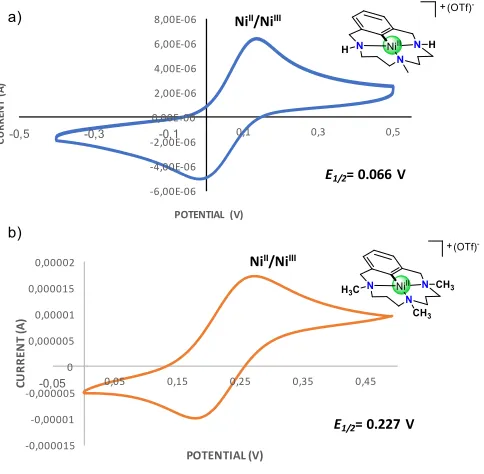
the NiIII oxidation state within the square-planar platforms is clearly visible in the CV spectrum of 1OTf and 5OTf showing quasi-reversible
1e- redox couples centered at E1/2 = 0.066 V and 0.227 V, respectively
(vs Ag/AgNO3) (Figure 3). However, all attempts to react 1OTf with
MeOH as nucleophile (and solvent) in the presence of different 1e
-oxidants (Fc+, nitrosonium cation (NOSbF
6)), yielded very complex
mixtures of side products involving the oxidation of the amine-based ligands to imines, as well as hydrogenation of the aryl moiety to the arene. Similarly, complex mixtures were obtained when malononitrile (active methylene), p-methoxyphenol and sodium cyanide were used as nucleophiles. Therefore, albeit generating a much more reactive species when 1e- oxidants are present, we have
not been able to control this enhanced reactivity to provide a clean NiIII reductive elimination with the nucleophile. The uncontrolled side reactions of in situ generated NiI species has been discussed very
recently by Sanford and coworkers.[21] Since NiIV species were reported to undergo reductive elimination with nucleophiles,[5, 9] we
tested 2e- oxidants such as F+ reagents
(N-fluoro-2,4,6-trimethylpyridinium triflate (NFTPT), Selectfluor®),[22] but again
multiple decomposition pathways occurred.
Figure 3. Cyclic Voltammograms of complexes a) 1OTf (0.5 mM) and b) 5OTf (1 mM). Conditions: [n-Bu4NPF6] = 0.1 M, CH3CN, 298 K, scan rate = 0.1 V/s, using non-aqueous
Ag/AgNO3 reference electrode.
-6,00E-06 -4,00E-06 -2,00E-06 0,00E+00 2,00E-06 4,00E-06 6,00E-06 8,00E-06
-0,5 -0,3 -0,1 0,1 0,3 0,5
CU
RR
EN
T
(A
)
POTENTIAL (V)
NiII/NiIII
E1/2= 0.066 V
-0,000015 -0,00001 -0,000005 0 0,000005 0,00001 0,000015 0,00002
-0,05 0,05 0,15 0,25 0,35 0,45
CU
RR
EN
T
(A
)
POTENTIAL (V)
NiII/NiIII
E1/2= 0.227 V a)
b)
C1
N1
Strikingly, reaction of 1OTf and 5OTf complexes with CF3+ sources
(5-(trifluoromethyl)dibenzothiophenium trifluoromethanesulfonate (TDTT), 3,3-Dimethyl-1-(trifluoromethyl)-1,2-benziodoxole (Togni reagent)) afforded the quantitative formation of L1-CF3 and L5-CF3
products. Reaction of 1OTf with 2.0 equiv. of TDTT in CD3CN at
room temperature afforded a 99% yield of L1-CF3 in less than 4 hours.
When the Togni reagent was used, quantitative trifluoromethylation was also observed, albeit in 12 hours. On the other hand, the reaction of 5OTf with both trifluoromethylating agents required higher
temperatures (70ºC) and longer reaction times (48 hours) to attain high yields (> 95%, Scheme 3).
Scheme 3. Reactivity of 1OTf and 5OTf in the presence of widely used CF3+ oxidants.
The trifluoromethylated product is likely generated via reductive elimination from a NiIV intermediate species, similarly to the work reported by Sanford and co-workers.[9] The slower reactivity observed with 5OTf suggests a lower stability of the high oxidation
state on the metal when tertiary amines are used.[23]
However, the putative aryl-NiIV intermediated species could not be
detected by 1H NMR spectroscopy even at -40ºC, suggesting that this
putative intermediate is highly reactive (Figure S6). Therefore, DFT calculations at B3LYP-GD3BJ/cc-pVTZ//B3LYP-GD3BJ/TZPV level (see Experimental section below for more computational details) were employed to further elucidate the reaction mechanism. Based on recent literature concerning Ni complexes and their reactivity, we initially suggested two different pathways (Scheme 4, mechanism A and B). The first proposal (A) was an oxidative-addition step followed by a reductive-elimination step (Figure S10). The second proposal (B) involved an initial Single Electron Transfer (SET) followed by a direct radical CF3· addition to the aryl group.
Scheme 4. The three proposed mechanisms, A, B and C. Mechanism A implies the transfer or flow of two electrons during the reaction (oxidative-addition-like step followed by a reductive-elimination step); B can be described as Single Electron Transfer (SET) followed by a direct radical CF3 addition on the aryl group. C contains the first
step of B and the last step of A, and then can be considered a combination of A and B.
Mechanism A involved an energetically demanding transition state for the S-CF3 bond breaking and formal CF3+ oxidative addition at the
aryl-NiII cation 1+ (34.0 kcal/mol) (Figure S10). Different approaches
of the CF3 moiety (SN2-like and lateral) were explored but in all cases
the oxidative addition barrier was too high (34.0 kcal/mol for the former and 43.7 kcal/mol for the latter). Therefore, we directed our attention towards an initial SET step to form an aryl-NiIII species and
a CF3· radical (mechanism B). The value of the SET barrier calculated
using the Marcus theory[24] (See section 6.1 of the Supporting
Information) was low enough (18.0 kcal/mol) to allow the formation of the transient aryl-NiIII/CF
3· adduct (6). Strikingly, the IRC
calculations used to explore the potential energy surface on the vicinities of the aryl-CF3 bond distance, show no direct recombination
between the radical and the aryl moiety, even if the CF3· radical was
placed on top of the aryl moiety. On the contrary, the system systematically evolved to a barrierless reaction of the CF3· radical and
the NiIII center (Scheme 5 and Figure S11) to form the aryl-NiIV-CF 3
intermediate (-0.7 kcal/mol), which then underwent facile reductive elimination to form L1-CF3, with a free energy barrier of only 7.8
kcal/mol. Thus, we have found a more-favorable third possibility (mechanism C) that can be seen as a combination of mechanisms A
and B (Scheme 4c and Figure 4). Indeed, mechanism C explains why the experimental stabilization of highly oxidized intermediates is hampered. The feasibility of the SET step is in line with the Cyclic Voltammetry experiments, easily accessing to NiIII (E
1/2 = 0.066 V
for 1OTf and -0.63 V for TDTT (vs Ag/AgNO3)).[25] In fact, the DGº
obtained (16.0 kcal mol-1) from the standard cell potential (Eºcell =
-0.70 V) closely matches the DFT thermodynamic energy difference between 1+ and the aryl-NiIII species obtained by SET (15.2 kcal mol -1). The ground spin state of all the compounds involved in the three
studied mechanisms are either closed-shell or open-shell singlet.
2+
A
N N
N
R R RN NiIVNNR
CF3 N N N CF3 R R S
F3C
TDT+ Oxidative Addition Reductive Elimination SET S DBT B NiII S DBT N N N NiIII R R
·CF3
NiII
S
CF3 TDT+
Addition to aryl
C
Addition to NiIII
Reductive Elimination 1+ 2 2 3 4 5 5 5 4 6 2+ + + N N N R NiII R
1+ NiII + + 5 4 NiII + + 2+ SET S DBT N N N NiIII R R
·CF3 S CF3 TDT+ 2 5 6 N N N R NiII R
1+ N N N NiIV R R CF3 3 2+ N N N R R
CD3CN, r.t - 50˚C, 4h - 48h,
N2 CF3 N N N NiII R R +(OTf)
-"CF3+" (2 equiv)
S CF3 OTf
"CF3+" = O
I CF3
(up to 99%) 1X(R = H)
5X (R = CH3)
L1-CF3(R = H)
L5-CF3 (R = CH3)
Scheme 5. Energy profile computed at B3LYP-GD3BJ/TZPV level and snapshots sequence of the CF3· attack of the NiIII to generate NiIV. The plot shows the electronic
energy profile of the barrierless approach of the radical to the NiIII. The spin density
allowed us to locate the bond distance at which the NiIV-CF
3 can be initially formed (no
spin density on the CF3). Atomic color code: NiIII in dark red, NiIV in light blue.
The lifetime of the CF3· radical generated was evaluated by
conducting the trifluoromethylation reaction of 1OTf and 5OTf in the
presence of the spin trap N-tert-butyl-α-phenylnitrone (PBN). The yield of the desired product was maintained and no decomposition of the radical trap was observed. This is in line with the DFT study, i.e. the transient aryl-NiIII/CF
3· adduct (6) has a very short lifetime since
the CF3· radical attack to the NiIII complex is barrierless (Figure 4).
Figure 4. Free Energy profile for the Mechanism C. Free energy values were calculated at (B3LYP-GD3BJ/cc-pVTZ//B3LYP-GD3BJ /TZPV). The blue profiles correspond to most stable open or close shell singlet states, while the triplet states are represented by the fuchsia lines. The determining-step barrier free energy of the mechanism A (TS1, magenta color) is depicted to contrast with the value of the single electron transfer Marcus barrier. The zero Gibbs free energy value of the profile correspond to the free energies of reactants at infinite distance. Color code: N blue, F orange, S yellow, NiII green, NiIII dark red, NiIV light blue.
4,59, 16,37
4,07, 14,87 3,64, 14,13
2,669, 8,84
2,12, -0,04
1,95, -6,16
-10 -5
0 5 10 15 20 25 30
1,0 1,5 2,0 2,5 3,0 3,5 4,0 4,5 5,0
SC
F
En
er
gy
(k
ca
l/m
ol
)
CF3-Ni Distance (Å) Radical CF3attack on Nickel(III)
I
III IV
V VI
[image:6.595.48.286.62.245.2]Conclusions
In conclusion, we have described the synthesis and full charac-terization of well-defined organometallic aryl-NiII complexes using
macrocyclic model systems (1X and 5OTf), which can be obtained by
either oxidative addition at Ni0 or NiII C-H activation. These
macrocyclic aryl-NiII complexes show very short Ni-C bond lengths
(1.82 Å) and under the conditions trialed in this study do not react with nucleophiles. However, we have demonstrated their reactivity in the presence of electrophilic CF3+ sources, obtaining quantitative
yields of the trifluoromethylated products L1-CF3 and L5-CF3 under
mild conditions. Furthermore, experimental and theoretical mechanistic investigations supported a feasible SET step followed by CF3· radical and aryl-NiIII recombination to form an aryl-NiIV-CF3
intermediate, which rapidly reductively eliminates to afford the trifluoromethylated products. These well-defined square-planar model platforms allow stepwise information through the redox chemistry of nickel, thus gaining insight into the geometry-dependent reactivity of multiple oxidation states. These results are sought to facilitate the development of new Ni-based trifluoromethylation methodologies.
Experimental Section
Synthesis of complexes 1X (X = OTf- or ClO4-) and 5OTf. The
synthesis of aryl-Ni(II) complex 1OTf was achieved by reacting the
model aryl-halide ligand L1-Br with 1 equiv. of Ni(COD)2 in dry THF
under a N2 atmosphere overnight, affording [NiII(L1)]Br (1Br, >98%
yield). A counter anion exchange was performed in order to improve the solubility of the complex using 1.0 eq. of AgOTf or AgClO4. This
complex is benchtop stable and has been fully characterized both spectroscopically and crystallographically. Full characterization of the complexes can be found in the Supporting Information.
Synthesis of L1-CF3 and L5-CF3. A screw cap NMR tube was
charged with [NiII(L
1)](OTf)(1OTf) complex (8 mg, 0.0176 mmol, 1.0
equiv) in 0.3 ml CD3CN, a solution of
5-(Trifluoromethyl)dibenzothiophenium trifluoromethanesulfonate (TDTT) (14.6 mg, 0.035 mmol, 2.0 eq.) in 0.3 ml CD3CN was
subsequently added at room temperature, and the reaction remained light yellow. In a separate experiment, the hypervalent iodine reagent, 3,3-Dimethyl-1-(trifluoromethyl)-1,2-benziodoxole (12.2 mg, 0.035 mmol, 2.0 eq.) was added to [NiII(L1)](OTf)complexes in CD3CN at
room temperature for 12 hours. Under these conditions, the yellow solution turned orange. 1H NMR spectroscopic analyses of the crude reaction mixtures were consistent with the formation of the trifluoromethylated product in more than 99% of yield. Full characterization of the compounds can be found in the Supporting Information.
Preparation of samples for XAS analysis: A 10 mM solution sample of [L1-H--NiII](ClO4)2 was prepared in butyronitrile by
mixing 1.0 eq. of nickel(II) perchlorate with L1-H and immediately
freezing the mixture upon loading into a sample cell. Similarly, a 10mM solution of the 1NO3 was formed by reacting two eq. of the L1
-H with 1 eq. of Ni(NO3)2 in acetonitrile. The reaction was stirred
overnight and then filtered.
Computational details: Gaussian 09 program[26] was use to perform all DFT calculations. All Structures were optimized using the functional B3LYP[27] and the Ahlrichs basis set TZVP,[28] including the Grimme’s empirical dispersion model GD3BJ8[29] and the solvent
effect of acetonitrile with the PCM-SMD[30] model. Also, under the
same conditions, frequency calculations were carried out to assign the stationary points as transition states (only with one imaginary vibrational frequency) or intermediates (minima with vibrational frequencies real). The frequency calculations were also used to compute thermal and entropic contributions to the Gibbs free energy of each species. All optimized structures were connected by IRC
calculations. Single point energy calculations with a more flexible basis set (cc-pVTZ)[31] including also the GD3BJ dispersion
correction and PCM-SMD solvent correction were performed to obtain better energy estimates. Finally, the correction due to change of conventional 1 atm standard state for gas-phase calculations to a standard-state gas-phase concentration of 1M (except for acetonitrile which is considered at its liquid concentration) was included in all the computed free energies.
XAS experiments details: Solution samples of [L1-H--NiII]+2 and
1NO3 were run on the XAS beamline at Elettra Sincrotrone Trieste
equipped with a Si(111) double crystal monochromator. Solution data was collected in fluorescence mode and samples were kept at ~90 K using a liquid nitrogen finger dewar. Solid samples of 1NO3and 1ClO4
were diluted in boron nitride and were run at the ALBA synchrotron, CLAESS beamline, equipped with a Si(111) double crystal monochromator. A liquid nitrogen flow cryostat was again used to maintain samples at liquid nitrogen temperatures and data was collected in transmission mode.
More details of the XAS spectroscopy experiments and DFT calculations can be found in the Supporting Information.
Crystallographic data for compounds 1ClO4 (CCDC-1526515), 1NO3
(CCDC-1526514) and 5OTf (CCDC-1526516) can be obtained free of
charge from the Cambridge Crystallographic Data Centre via www.ccdc.cam.ac.uk/data_request/cif.
Acknowledgements
This work was supported by grants from the European Research Council (Starting Grant Project ERC-2011-StG-277801), the Spanish MICINN (CTQ2016-77989-P and CTQ2014-52525-P), the Catalan DIUE of the Generalitat de Catalunya (2014SGR862 and 2014SGR931). X.R. thanks an ICREA-Acadèmia award. We thank STR from UdG for technical support. XAS experiments were in part performed at CLAESS beamline at ALBA Synchrotron with the collaboration of ALBA staff. X-ray absorption data was also collected at the Elettra facility XAFS beamline and we would like to thank Dr. Luca Olivi for his help with experimental setup.
[1] a) T. Furuya, A. S. Kamlet and T. Ritter, Nature 2011, 473, 470-477; b) E. J. Cho, T. D. Senecal, T. Kinzel, Y. Zhang, D. A. Watson and S. L. Buchwald, Science 2010, 328, 1679-1681.
[2] a) A. Maleckis and M. S. Sanford, Organometallics 2014, 33, 2653-2660; b) N. D. Ball, J. B. Gary, Y. Ye and M. S. Sanford, J. Am. Chem. Soc. 2011, 133, 7577-7584.
[3] a) B. M. Rosen, K. W. Quasdorf, D. A. Wilson, N. Zhang, A.-M. Resmerita, N. K. Garg and V. Percec, Chem. Rev. 2011, 111, 1346-1416; b) R. Jana, T. P. Pathak and M. S. Sigman, Chem. Rev. 2011,
111, 1417-1492; c) S. Z. Tasker, E. A. Standley and T. F. Jamison,
Nature 2014, 509, 299-309; d) V. P. Ananikov, ACS Catal. 2015, 5, 1964-1971; e) C. M. Lavoie, P. M. MacQueen, N. L. Rotta-Loria, R. S. Sawatzky, A. Borzenko, A. J. Chisholm, B. K. V. Hargreaves, R. McDonald, M. J. Ferguson and M. Stradiotto, Nat. Commun. 2016, 7, 11073.
[5] a) N. M. Camasso and M. S. Sanford, Science 2015, 347, 1218-1220; b) J. W. Schultz, K. Fuchigami, B. Zheng, N. P. Rath and L. M. Mirica, J. Am. Chem. Soc. 2016, 138, 12928-12934.
[6] a) Y. Aihara and N. Chatani, J. Am. Chem. Soc. 2014, 136, 898-901; b) Y. Aihara and N. Chatani, J. Am. Chem. Soc. 2013, 135, 5308-5311; c) X. Wu, Y. Zhao and H. Ge, J. Am. Chem. Soc. 2014, 136, 1789-1792; d) G. E. Martinez, C. Ocampo, Y. J. Park and A. R. Fout,
J. Am. Chem. Soc. 2016, 138, 4290-4293.
[7] a) T. W. Lyons and M. S. Sanford, Chem. Rev. 2010, 110, 1147-1169; b) A. J. Hickman and M. S. Sanford, Nature 2012, 484, 177-185; c) K. Muñiz, Angew. Chem. Int. Ed. 2009, 48, 9412-9423. [8] a) B. Zheng, F. Tang, J. Luo, J. W. Schultz, N. P. Rath and L. M. Mirica, J. Am. Chem. Soc. 2014, 136, 6499-6504; b) W. Zhou, S. Zheng, J. W. Schultz, N. P. Rath and L. M. Mirica, J. Am. Chem. Soc. 2016, 138, 5777-5780; c) M. B. Watson, N. P. Rath and L. M. Mirica,
J. Am. Chem. Soc. 2017, 139, 35-38.
[9] J. R. Bour, N. M. Camasso and M. S. Sanford, J. Am. Chem. Soc. 2015, 137, 8034-8037.
[10] a) A. T. Higgs, P. J. Zinn, S. J. Simmons and M. S. Sanford,
Organometallics 2009, 28, 6142-6144; b) A. T. Higgs, P. J. Zinn and M. S. Sanford, Organometallics 2010, 29, 5446-5449.
[11] X. Ribas, C. Calle, A. Poater, A. Casitas, L. Gómez, R. Xifra, T. Parella, J. Benet-Buchholz, A. Schweiger, G. Mitrikas, M. Solà, A. Llobet and T. D. P. Stack, J. Am. Chem. Soc. 2010, 132, 12299-12306. [12] C. Yang, W.-D. Wu, L. Zhao and M.-X. Wang, Organometallics 2015, 34, 5167-5174.
[13] a) D. M. Grove, G. Van Koten, H. J. C. Ubbels, R. Zoet and A. L. Spek, Organometallics 1984, 3, 1003-1009; b) J.-P. Cloutier, B. Vabre, B. Moungang-Soumé and D. Zargarian, Organometallics 2015, 34, 133-145; c) M. Stol, D. J. M. Snelders, M. D. Godbole, R. W. A. Havenith, D. Haddleton, G. Clarkson, M. Lutz, A. L. Spek, G. P. M. van Klink and G. van Koten, Organometallics 2007, 26, 3985-3994; d) L. A. v. d. Kuil, Y. S. J. Veldhuizen, D. M. Grove, J. W. Zwikker, L. W. Jenneskens, W. Drenth, W. J. J. Smeets, A. L. Spek and G. v. Koten, Rec. Trav. Chim. Pays-Bas 1994, 113, 267. [14] a) N. D. Schley and G. C. Fu, J. Am. Chem. Soc. 2014, 136, 16588-16593; b) Z. He and Y. Huang, ACS Catal. 2016, 6, 7814-7823. [15] G. J. Colpas, M. J. Maroney, C. Bagyinka, M. Kumar, W. S. Willis, S. L. Suib, N. Baidya and P. K. Mascharak, Inorg. Chem. 1991,
30, 920-928.
[16] a) V. Martin-Diaconescu, M. Gennari, B. Gerey, E. Tsui, J. Kanady, R. Tran, J. Pécaut, D. Maganas, V. Krewald, E. Gouré, C. Duboc, J. Yano, T. Agapie, M.-N. Collomb and S. DeBeer, Inorg. Chem. 2015, 54, 1283-1292; b) T. E. Westre, P. Kennepohl, J. G. DeWitt, B. Hedman, K. O. Hodgson and E. I. Solomon, J. Am. Chem. Soc. 1997, 119, 6297-6314.
[17] A. Klein, A. Kaiser, W. Wielandt, F. Belaj, E. Wendel, H. Bertagnolli and S. Záliš, Inorg. Chem. 2008, 47, 11324-11333. [18] a) S. DeBeer George, P. Brant and E. I. Solomon, J. Am. Chem. Soc. 2005, 127, 667-674; b) V. Martin-Diaconescu, K. N. Chacón, M. U. Delgado-Jaime, D. Sokaras, T.-C. Weng, S. DeBeer and N. J. Blackburn, Inorg. Chem. 2016, 55, 3431-3439.
[19] R. Sarangi, Coord. Chem. Rev. 2013, 257, 459-472.
[20] a) K. Koo and G. L. Hillhouse, Organometallics 1995, 14, 4421-4423; b) K. Koo and G. L. Hillhouse, Organometallics 1996, 15, 2669-2671; c) R. Han and G. L. Hillhouse, J. Am. Chem. Soc. 1998,
120, 7657-7658; d) G. G. Dubinina, W. W. Brennessel, J. L. Miller and D. A. Vicic, Organometallics 2008, 27, 3933-3938; e) J. Jover, F. M. Miloserdov, J. Benet-Buchholz, V. V. Grushin and F. Maseras,
Organometallics 2014, 33, 6531-6543.
[21] J. R. Bour, N. M. Camasso, E. A. Meucci, J. W. Kampf, A. J. Canty and M. S. Sanford, J. Am. Chem. Soc. 2016, 138, 16105-16111. [22] H. Lee, J. Börgel and T. Ritter, Angew. Chem. Int. Ed. 2017,
DOI: 10.1002/anie.201701552.
[23] G. Golub, H. Cohen, P. Paoletti, A. Bencini, L. M. Bertini and D. Meyerstein, J. Am. Chem. Soc. 1995, 117, 8353-8361.
[24] a) R. A. Marcus, J. Chem. Phys. 1956, 24, 966-978; b) V. Postils, A. Company, M. Solà, M. Costas and J. M. Luis, Inorg. Chem. 2015,
54, 8223-8236; c) A. Amini and A. Harriman, J. Photochem. Photobiol. C: Photochem. Rev. 2003, 4, 155-177.
[25] S. Mizuta, S. Verhoog, X. Wang, N. Shibata, V. Gouverneur and M. Médebielle, J. Fluor. Chem. 2013, 155, 124-131.
[26] M. J. T. Frisch, G. W.; Schlegel, H. B.; Scuseria, G. E.; Robb, M. A.; Cheeseman, J. R.; Scalmani, G.; Barone, V.; Mennucci, B.; Petersson, G. A.; Nakatsuji, H.; Caricato, M.; Li, X.; Hratchian, H. P.; Izmaylov, A. F.; Bloino, J.; Zheng, G.; Sonnenberg, J. L.; Hada, M.; Ehara, M.; Toyota, K.; Fukuda, R.; Hasegawa, J.; Ishida, M.; Nakajima, T.; Honda, Y.; Kitao, O.; Nakai, H.; Vreven, T.; Montgomery, J. A., Jr.; Peralta, J. E.; Ogliaro, F.; Bearpark, M.; Heyd, J. J.; Brothers, E.; Kudin, K. N.; Staroverov, V. N.; Kobayashi, R.; Normand, J.; Raghavachari, K.; Rendell, A.; Burant, J. C.; Iyengar, S. S.; Tomasi, J.; Cossi, M.; Rega, N.; Millam, M. J.; Klene, M.; Knox, J. E.; Cross, J. B.; Bakken, V.; Adamo, C.; Jaramillo, J.; Gomperts, R.; Stratmann, R. E.; Yazyev, O.; Austin, A. J.; Cammi, R.; Pomelli, C.; Ochterski, J. W.; Martin, R. L.; Morokuma, K.; Zakrzewski, V. G.; Voth, G. A.; Salvador, P.; Dannenberg, J. J.; Dapprich, S.; Daniels, A. D.; Farkas, Ö.; Foresman, J. B.; Ortiz, J. V.; Cioslowski, J.; Fox, D. J. in Gaussian 09, Revision D.01, Vol. Gaussian Inc., Wallingford CT, 2009.
[27] a) A. D. Becke, J. Chem. Phys. 1993, 98, 1372-1377; b) C. Lee, W. Yang and R. G. Parr, Phys. Rev. B 1988, 37, 785-789; c) S. H. Vosko, L. Wilk and M. Nusair, Can. J. Phys. 1980, 58, 1200-1211; d) P. J. Stephens, F. J. Devlin, C. F. Chabalowski and M. J. Frisch, J. Phys. Chem. 1994, 98, 11623-11627.
[28] a) A. Schäfer, C. Huber and R. Ahlrichs, J. Chem. Phys. 1994,
100, 5829-5835; b) A. Schäfer, H. Horn and R. Ahlrichs, J. Chem. Phys. 1992, 97, 2571-2577.
[29] S. Grimme, S. Ehrlich and L. Goerigk, J. Comput. Chem. 2011,
32, 1456-1465.
[30] A. V. Marenich, C. J. Cramer and D. G. Truhlar, J. Phys. Chem. B 2009, 113, 6378-6396.