Teaching and Learning Experience in Accounting Education:
A UK perspective
Doç. Dr. İsmail Ufuk Mısırlıoğlu* Abstract
This paper describes teaching methods and other aspects of accounting education based on the experience in two different accounting modules from one UK institution. The aim of the paper is to show how teaching techniques are used in accounting education in a UK context. I found that well-structured lectures constructing an academic argument in large group teaching and group-based working within small group teaching are very important in accounting education on the basis of my teaching experience in undergraduate and graduate programmes.
Keywords: accounting education, group-based working.
Özet
Bu makale, Birleşik Krallık’ taki bir üniversitenin iki farklı muhasebe dersindeki eğitim ve öğretim tecrübeleri temelinde, öğretim yöntemlerini ve muhasebe eğitiminin bu kapsamdaki diğer özelliklerini açıklamaktadır. Makalenin amacı; muhasebe eğitiminde, öğretim tekniklerinin nasıl kullanıldığını Birleşik Krallık bakış açısı ile göstermektir. Lisans ve yüksek lisans programlarındaki öğretim tecrübelerim; büyük grupların eğitiminde bir akademik tartışma ortamı sağlayacak iyi yapılandırılmış derslerin, küçük grupların eğitiminde ise grup temelli çalışmaların muhasebe eğitimi açısından çok önemli olduğunu göstermektedir.
Anahtar Kelimeler: muhasebe eğitimi, grup çalışması.
*
Teaching and Learning Experience in Accounting Education:
A UK perspective
1. Introduction
The paper is comprises five main sections. The first describes the learning cycle in theory and practice. The learning cycle based on experiential learning was adopted for teaching in small groups. In the second section teaching strategies for effective learning are presented on the basis of my large group teaching experience in undergraduate education. The third and fourth sections show examples in assessment, curriculum planning and evaluation of a module1. The last section describes the teaching and learning of accounting in small groups based on the experience of an accounting module in masters. Finally, the paper concludes with the discussion of findings.
2. The Learning Cycle in Theory and Practice
Learning is about how we perceive and understand the world, about making meaning (Marton and Booth, 1997). It can be about ideas, abstract principles, factual information, and the acquisition of methods, techniques and approaches (Fry et al., 1999, p.21).
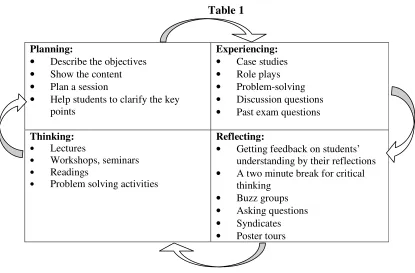
Experience gained through life, education and work plays a central role in the process of learning. This perspective on learning is called “experiential learning” or “learning by doing”. Probably the most popular theory of learning from experience can be attributed to David Kolb (1984) who developed ideas from other models of experiential learning (Fry et al., 1999, p.26). Under this approach the learning cycle has been modelled into four stages as follows (Gibbs and Habeshaw, 1996):
1
• TTTThinking: Lectures, seminars, reading, essays, dissertation.
• PPPPlanning: Action planning, drawing up learning contracts, setting objectives, embarking on action research, experimental design, devising criteria.
• EEEExperiencing: Work experience, projects, practical and laboratory work, visits, case studies, simulations, role plays, field work, participant observation.
• RRRReflecting: Using video recording, peer appraisal, self assessment, mutual interviewing.
The most direct application of this model is through the tutor asking questions to encourage reflection, conceptualisation, and testing new ideas.
Students vary in their approaches to learning. A key issue is whether the student is searching for meaning or not when engaging with a learning task. That is what the original researchers meant by deep-level and surface-level processing (Ramsden, 1992, p.42).
The deep approach to learning is one in which students aim to understand the subject and seek meaning. They express intrinsic interest in, and derive enjoyment from, studying. The surface approach to learning is one in which students aim primarily to memorise or reproduce material (Lucas, 2001, p.162). The learning cycle based on experiential learning might be a general application for a small group of students registered on accounting modules
TTTT P
P P
to achieve teaching and learning objectives. Table 1 shows how to apply the learning cycle for teaching and learning in accounting.
Table 1
Planning:
• Describe the objectives • Show the content • Plan a session
• Help students to clarify the key points
Experiencing:
• Case studies • Role plays • Problem-solving • Discussion questions • Past exam questions
Thinking: • Lectures
• Workshops, seminars • Readings
• Problem solving activities
Reflecting:
• Getting feedback on students’ understanding by their reflections • A two minute break for critical
thinking • Buzz groups • Asking questions • Syndicates • Poster tours
It is clear that a deep approach to learning is expected to be practised by the students. This approach allows students to use academic knowledge to control and clarify the world outside academic knowledge. Good teaching implies engaging students in ways that are appropriate to the deployment of deep approaches (Ramsden, 1992, p.61).
3. Teaching Strategies for Effective Learning
Encouraging a deep approach is one of the important elements for effective learning. It is identified that (Biggs, 1989; Gibbs, 1992) motivational context, learner activity, interaction with others and a well structured knowledge base are the requirements for “good teaching” i.e.
My large group teaching experience from the Corporate Reporting Theory and Practice (CRTP) module in the undergraduate level at Bristol Business School2 shows that a context should meet the student’s need to know something – such that the student is motivated to learn. The structured goals and objectives should encourage a motivational context. The students need to see the whole picture to understand how and why it is done. These principles are applied to our teaching modules by providing a structured outline with clear objectives and content. Students are always informed about what we are doing and why we are doing it before the lecture starts. The students are provided with a variety of resources to help their understanding about every lecture topic.
Student-centered learning (Canon and Newble, 2000, p.16) is mostly preferred on our teaching. Students interact as they answer short questions on the relevant topic. In addition to that, critical questions are posed to make sure that the students are interested in the topic. The teaching module in CRTP has been designed as a one-hour lecture and one-hour workshop in every week. The workshop is based on problem-solving which involves learning through tackling relevant problems. The aim is to learn rather than simply solve a problem. Group working is required for students to work on the problem provided in the lecture hour. During the workshop lecturer is a guide, mentor and facilitator. Interaction with others is encouraged during workshops, tutorials and seminars.
The structure of knowledge is designed according to the student needs thus forming a link with interdisciplinary approaches. The existing knowledge of students is carefully considered when the framework of new concepts is articulated. The following teaching ideas are taken into account on the teaching processes:
2
• For helping the student to see the whole picture, a module guide containing all the information a student might want about a module is prepared.
• The learning cycle mentioned above has been adopted as a pattern for achieving experiential learning.
• Students’ responsibilities are extended by providing options on online resources, the choice of assignments, the review of books and the selection of some topics.
• Encouraging a deep approach to learning is fundamental to the teaching process. • To increase the performance of students into the original level, a few minutes rest
after 20 minutes of the lecture hour is given. During this time students are usually invited to think and discuss critical issues with peers. After this short break, students are asked relevant questions to get feedback about their understanding of the subject delivered.
• Essential and supporting readings are provided for every topic.
• Good time management is very important. The outlined objectives are achieved within a time-limit.
• The lecture notes are provided to the students before every lecture.
• The students’ information processing capacity is considered in the teaching processes.
• Enthusiasm and clarity are very important for the students and for the lecturer too. Students need to get excited, gain confidence and feel satisfied about their learning.
This point of view is the fundamental of “good teaching”. Not only having a strong knowledge of subject but also engagement in a dialogue with students is a requirement for the teacher. In addition, the structured goals and activity are essential to support a deep approach. However, without dialogue or conversation with students, the structured objectives or activities are not achieved.
Making a dialogue or a conversation between the students and the lecturer may be achieved by the following learning experiences during a lecture:
• Encourage students to ask questions during the lecture.
• Showing enthusiasm to the students is very important. In this way students get more interested in the topic.
• Make a good link between theory and practice. Students always prefer a real-life example in accounting subject.
• Make a link with previous sessions.
• Listen to student comments or explanations to understand their approach on learning the subject.
• Research shows that students have to engage with alternative ways of viewing the subject and that educators have to engage with alternative ways of viewing the student (Lucas, 2001, p.180).
• Effective use of the Information Communications Technology (ICT) in teaching for students. Not only PowerPoint but also using flip chart at the same time is really effective.
4. Assessing for Understanding
Assessment is defined as a judgment on the progress (formative assessment) or achievement (summative assessment) of a particular student’s learning (Ashcroft and Peck, 1998, p.54). Assessment also provides a framework for sharing educational objectives with students and for charting their progress. The feedback information generated by assessment helps teachers realign their teaching in response to learners’ needs (Nicol and Dick, 2004).
Assessment plays an important part in the teaching-learning process at all levels of education. It is about understanding the quality of students’ learning and how they use the knowledge. The assessment strategy needs to be reflected in the module content.
The following factors are important for effective assessment process (Fry et al., 1999; Cannon and Newble, 2000), and they were applied to the teaching modules:
• Validity: A content validity is the first priority of assessment in teaching Modules. Assessment contains the materials taught in Modules and also meets learning objectives.
the students’ performance. The model answer shows how marks are allocated to each section to avoid being subjective.
• Fairness: Mark plans are designed to ensure fairness and equity. The methods used for assessment of student performance are fair.
• Feedback on learning: Feedback to students on assessment is provided in groups in an appropriate format and within a reasonable period. An example of students’ feedback teaching staff is explained in the following part.
According to the University Assessment Policy3, there are wide ranges of assessment methods appropriate to our modules and programme. Two assessment methods are used in one of our teaching modules, CRTP. The first method is a 2,000-word paper requiring students to examine some current problems in corporate reporting. The second method is an essay-based examination. Students are allowed to see past exam papers and marking schemes in advance (usually a month) of the examination.
The assessment methods and their criteria are disclosed to the students at the beginning of the semester. The submission dates and times for each assignment are also specified at the beginning of the module delivery period. The submission date for coursework normally closes at the end of each semester.
5. Curriculum Planning and Evaluation
Curriculum planning is the logical link between planned intentions (goals and objectives), course content, teaching and learning methods, and the assessment of student learning (Cannon and Newble, 2000, p.142). The defined objectives of a Module are matched
3
with appropriate teaching and learning methods and the assessment methods. It is in this area that the structured questions on course design (Manwaring and Elton, 1984) and Bloom’s taxonomy (Anderson and Krathwohl et al., 2001) are definitely useful to design a module.
Evaluation is a different process from assessment. It is defined as a means of understanding the effects of our teaching on students’ learning. It implies collecting information about our work, interpreting information, and making judgments about which actions should be taken to improve practice (Ramsden, 1992, p.218).
Evaluation is a part of accountability after an action. If the action is assumed as a whole teaching and learning process, the evaluation would be a measurement of teaching performance at the end of that process. This process also helps to develop the curriculum planning. At UWE4 student feedback is also used as a part of the appraisal process of academic staff.
There are several methods for obtaining student feedback on teaching and learning in higher education (Fry at al., 1999; Cannon and Newble, 2000). In terms of our teaching module, a questionnaire was used to collect feedback several times on the master programme. The feedback collected will be discussed in the next part of the paper. The feedback questionnaires to be issued for the undergraduate programme teaching as a whole are collected at the end of second term of the academic year.
4
6. Teaching and Learning in Small Groups
This part of study explores the teaching and learning of accounting in small groups from my teaching experience on Corporate Financial Reporting (CFR) module of MSc in Financial Management at Bristol Business School.
The heading of small-group teaching includes a wide variety of different kinds of classes in higher education, some of the most common being seminars, tutorials, workshops and problem based learning meetings. The size of small-group teaching is from 4 to 25 students (Exley and Dennick, 2004 p.2).
Small-group teaching methods have been applied in the CFR module. Every session was two hours with a total of 23 sessions in the semester programme. The exploration of small-group teaching related to the module has been discussed in the following parts: curriculum planning, teaching and learning process, assessment and evaluation.
6.1. Curriculum planning
The overall goals of small-group teaching are to develop discussion skills and to get students to think about issues. These goals should be subdivided further into specific problems or issues related to content and aims of the course (Brown and Atkins, 1993, p.78).
• Understand and communicate the current strength, the past performance and the
future prospects of business entities on the basis of an analysis of a full set of
financial statements,
• Critically appraise the current state of external financial reporting in the context of
international financial reporting standards,
• Contribute to the debate on a number of important current issues in corporate
financial reporting.
The teaching methods adopted are designed to meet the educational objectives set. The titles and topics covered by each lecture are outlined in the syllabus and disclosed to the students at the beginning of the teaching period. The lecture provides a broad outline structure for each topic covered, but the students take responsibility for developing the provided outline structure by independent study to gain in depth knowledge and understanding.
6.2. Teaching and learning process
Active participation, face to face contact and purposeful activity are the main characteristics for effective small-group teaching. Research and practical experience have established that a group of five to eight students is ideal for group working (Canon and Newble, 2000, p.40).
• Lecturing: Structured objectives are provided to help students learn to define and solve the problems in the CFR module at the beginning of every session. The lecture handouts given to the students before the lecture are designed to contain the structure of the lecture, an explanation of key concepts, critical thinking, questions and case studies, follow up summaries and references. During each lecture, students are encouraged to engage in active participation in discussions or problem solving. • The post-lecture tutorial: Students are given specific questions related to the lecture
materials and requested to discuss or solve the problem with their peers.
• Case studies: At the end of lectures students are given a case study connected with the subject covered in the lecture. They are given time to read, digest and note the issues involved. The objectives are also clarified by the tutor. In the following lecture, students are divided into small groups then start to discuss and present the best solution during the time allocated in the session.
• Role-play: This method is used in workshops or lectures. The main goal is to direct students towards critical thinking and to develop their analysis and synthesis abilities. A situation or a case is given to students. The purpose of the exercise is also explained. Students are split into the smaller groups and allowed sufficient time for the role-play of putting themselves in a position of the rationally-acting person, making a decision regarding what action would be taken in each circumstance given in the exercise.
question and previous knowledge. Where possible, the solution and explanation are given in several different ways for the same outcome.
• Buzz groups - discussion questions: The previously structured activity is introduced to the subgroups of two students. Each group has 5 minutes to discuss the task. After the discussion, each group reports their opinion about the task. This method has always made a positive impact on students learning in critical thinking.
• Syndicates: Two or three team of students are given the same question, and invited to present their own solution to the whole class.
• Mini-presentation: The groups of students have been given several topics related to provisions and contingencies with appropriate sources. Each group of students is invited to teach the class about the topic provided. Other groups of students are allowed to ask questions during the presentation. This method has made a significant contribution to students’ oral skills, critical thinking and management of discussion. At the end of the session the tutor makes a summary of the topics covered.
• Revision sessions: There are two revision sessions during one semester. The relevant revision questions without answers have been provided to the students before each session. During the sessions, answers to the questions were reviewed, and each solution made by students was compared with the solution. The problem-solving method is also used in the revision sessions.
before the session under poster tours or focused listing. They are quick way to collect written feedback on student learning (Angelo and Cross, 1993).
In addition to that, using Bloom’s Taxonomy5 “revised” model questions, verbs for objectives instructional strategies will make teaching more effective for learning.
All the materials used in the teaching process are distributed to the students by way of hard copies. UWE-online, which is the virtual learning environment resource of the University, is used as a back up and a resource center with the following communication activities in the CFR Module:
• Announcements and Emails
• Module information, assignments, lecture slides • Links to the readings and the useful websites
6.3. Assessment
The summative approach (i.e. counts for marks and grades) is used to assess the students’ progress in the CFR module. In addition to a closed-book exam, written work i.e. an assignment is required from students. The assessment methods are disclosed to students at the beginning of the semester as follows:
There are two pieces of assessed work. The first piece of work is a 3,000-word
assignment6, which is defined and provided separately. The second assessment
is a two-hour closed book exam where students have to answer three questions
5
Bloom’s Taxonomy is the hierarchical classifications of thinking and learning processes. In 1956, the cognitive domain of Bloom’s Taxonomy was published (Bloom, 1956). The taxonomy was updated and revised in 2001 (Anderson and Krathwohl et al., 2001).
6
from five. Students must pass both assessments to pass the module. The
assessments are equally weighted.
The 3,000-word assignment is designed to develop the student’s transferable and practical skills. Exam questions, answers and the assignment are moderated both internally and externally.
6.4. Students’ evaluation of the module
A questionnaire is usually used to collect information about the teaching and learning on the CFR module. In addition to that, a formal feedback form is collected from students to evaluate the module overall. Student evaluation feedback, as an example is shown in the Appendix 1, identifies whether the content of the module is clearly understood, how to improve the content or structure of the module and other constructive comments on the module content, structure, delivery or lecturer.
Students’ feedback provides valuable information on which to base enhancement of the module. Our experience from feedback shows that asking students to notify their outstanding questions at the end of each lecture and then addressing their questions in the beginning of the following lecture helps the tutor of students to improve their understanding about the topic covered.
According to the learning outcomes of the programme specification of MSc Financial Management7, the students enrolled in the CFR module are expected to develop and demonstrate knowledge and understanding, qualities, skills and other attributes. The content and structure of the CFR module are prepared and delivered based on the knowledge and
7
understand of the subject content described in section 6.1 of this paper as the learning outcomes of the module. In addition, the students are expected to develop their subject specific skills, intellectual skills and transferable skills in the module. These are summarised as follows:
• Apply relevant knowledge, techniques and concepts in corporate financial reporting. • Employ a range of accounting and reporting skills.
• Analyse and critically appraise published financial reports.
• Interpret and apply international financial reporting standards to specific situations. • Create a range of valid alternative responses to situations.
• Communicate information, ideas, arguments, concepts, theories and develop an argument in a clearly and effectively organised essay or report.
Expectations of students from studying a subject can play an important role to identify whether the learning objectives are achieved and the teaching methods are appropriate. In addition student perceptions of their learning, as well as their enjoyment and satisfaction in relation to a subject can also have a positive impact on the achievement of learning outcomes.
In the questionnaire, students were asked four open-ended questions and one other question about how to rate for the module content, structure and delivery (teaching methods). The analysis of the raw data collected from 16 questionnaires was first made with sorting the responses according to the requirements of each open-ended question.
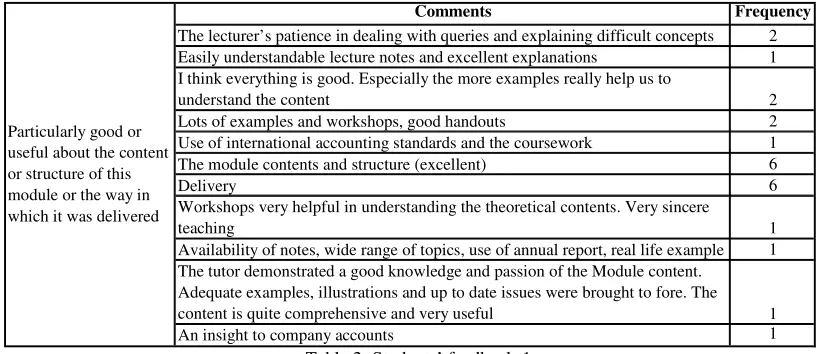
The students were first asked what to consider particularly good or useful about the content or structure of the module or the way in which it was delivered. The statements of students related to this question are shown in Table 2.
Table 2 provides twenty four comments made by the students related to the content or, structure of the module and the teaching methods used by the lecturer. According to the statements, the students seemed to satisfy with the module content and structure designed on basis of the programme specifications, and the teaching methods explained in this paper.
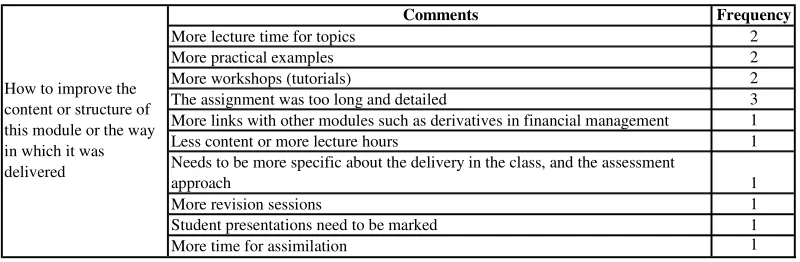
[image:18.612.99.509.285.462.2]The students were also asked how to improve the content or structure of this module or the delivery. The student statements related to this question are shown in Table 3.
Table 2: Students’ feedback-1
Comments Frequency
The lecturer’s patience in dealing with queries and explaining difficult concepts 2
Easily understandable lecture notes and excellent explanations 1
I think everything is good. Especially the more examples really help us to
understand the content 2
Lots of examples and workshops, good handouts 2
Use of international accounting standards and the coursework 1
The module contents and structure (excellent) 6
Delivery 6
Workshops very helpful in understanding the theoretical contents. Very sincere
teaching 1
Availability of notes, wide range of topics, use of annual report, real life example 1 The tutor demonstrated a good knowledge and passion of the Module content.
Adequate examples, illustrations and up to date issues were brought to fore. The
content is quite comprehensive and very useful 1
An insight to company accounts 1
Particularly good or useful about the content or structure of this module or the way in
Table 3 indicates fourteen statements made by the students about how to improve the module content or structure and the teaching methods. The statements indicate that the most frequent response is made for the assignment size. Other feedback on the lecture duration, more practical examples and workshops will provide further support for achievement of the module learning outcomes in future periods.
Other feedback related to the assessment content or process for the module with constructive comments is shown in Table 4.
[image:19.612.109.509.73.204.2]The comments in Table 4 bring out a satisfactory standard of works in teaching and learning of the module. Feedback from students suggests that the needs of students from the module seem to be met in this module.
[image:19.612.107.509.464.604.2]Table 3: Students’ feedback-2
Table 4: Students’ feedback-3
Comments Frequency
More lecture time for topics 2
More practical examples 2
More workshops (tutorials) 2
The assignment was too long and detailed 3
More links with other modules such as derivatives in financial management 1
Less content or more lecture hours 1
Needs to be more specific about the delivery in the class, and the assessment
approach 1
More revision sessions 1
Student presentations need to be marked 1
More time for assimilation 1
How to improve the content or structure of this module or the way in which it was
delivered
Comments Frequency
The class presentations 3
Real life situations and understanding financial accounts 2
The lecture notes 1
The assignment 2
Use of an annual report 1
Clear workshop 1
Relevant and useful module 2
The quality of the lectures were excellent 1
The tutor was helpful at all times and has extreme best to ensure students
participated & understood the module content 1
Very good in-depth knowledge in the area 1
Overall module structure is good 1
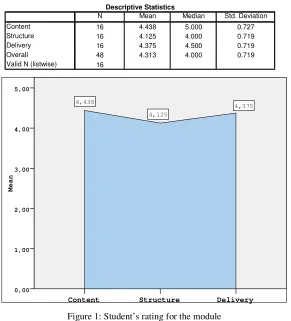
Finally the students rating on the module content, structure and the teaching methods are analysed in Figure 1. The students were required to rate for this module as Very good = 5, Better than “average” = 4, Average = 3, Below average = 2, Very poor =1.
Overall, students had fairly good perceptions of the module with a mean of 4.313 and a standard deviation of 0.719. The mean response for the module content was 4.438 and the median was 5. The structure was also highly rated by a mean of 4.125 and the teaching methods used in this module were rated by a mean of 4.375. Although the mean response for the module content was higher than the structure and the delivery, the difference for these elements is not statistically significant (p-value < 0.05).
The rating results in Figure 1 and the students’ feedback on the module provide support for perceptions of learning outcomes and effectiveness of teaching methods discussed in this paper.
Delivery Structure
Content
M
e
a
n
5,00
4,00
3,00
2,00
1,00
0,00
4,375 4,125
[image:20.612.164.455.325.646.2]4,438
Figure 1: Student’s rating for the module
N Mean Median Std. Deviation
Content 16 4.438 5.000 0.727
Structure 16 4.125 4.000 0.719
Delivery 16 4.375 4.500 0.719
Overall 48 4.313 4.000 0.719
Valid N (listwise) 16
7. Conclusion
This paper has described the experience of teaching in accounting education in a UK context. Based on my experience, I found that group-based working in small-group teaching and well-structured lectures constructing an academic argument in large groups teaching are very important in accounting education.
In general terms, the lecture is a motivational tool in teaching large groups and encourages students to appreciate the importance of the subject material. On the other hand the workshop, which is a social event, provides an opportunity for active participation and an important contact between peers and teachers. From our experience, the small-group teaching is more effective way to teach students. This might be encouraged in accounting education.
There might be several other characteristics related to effective accounting teaching. I find that it is useful to consider the following characteristics in accounting education:
• A deep approach for effective learning,
• Having structured goals and objectives in the preparation of a lecture series and of individual lectures,
• Subject knowledge
• Reliable and valid assessment and the evaluation of teaching • Dialogue or conversation with students,
APPENDIX 1:
MSc Financial Management Module
STUDENT EVALUATION FEEDBACK
This is an anonymous feedback process so please feel free to draw module leader’s attention to any issues that you might have. The process can also help to identify and disseminate aspects of good practice, so we would urge you to offer praise where it is due!
MODULE: AWARD:
What do you consider was particularly good or useful about the content or structure of this module or the way in which it was delivered?
What if anything, could be done to improve the content or structure of this module or the way in which it was delivered?
Overall, how would you rate the following for this module?
Content Structure Delivery
Very Good 5 5 5
Better than “average” 4 4 4
Average 3 3 3
Below average 2 2 2
Very poor 1 1 1
What do you consider was particularly good or useful about the assessment content or process for this module?
Are there any constructive comments that you would like to make about the module content, structure, delivery, assessment or tutor?
REFERENCES
Anderson, L.W., Krathwohl, D.R., Airasian, P.W., Cruikshank, K.A., Mayer, R.E., Pintrich, P.R., Raths, J. and Wittrock, M.C. (2001) A Taxonomy for Learning, Teaching, and Assessing – A Revision of Bloom's Taxonomy of Educational Objectives. Addison
Wesley Longman, Inc.: New York.
Angelo, A. and Cross, K.P. (1993) From Classroom Assessment Techniques: A Handbook for College Teachers, 2nd Ed., Jossey-Bass: California.
Ashcroft, K. and Peck, L.F. (1998) Managing Teaching and Learning in Further and Higher Education, The Falmer Press, London.
Bloom, B. (ed.) (1956) Taxonomy of Educational Objectives, Book 1: Cognitive Domain, New York: David McKay.
Brewer, I.M. (1985) Learning More and Teaching Less, SRHE & NFER Nelson.
Biggs, J. (1999) Teaching for Quality Learning at University, Buchingham, Open University.
Brown J. and Atkins, M. (1993) Effective Teaching in Higher Education, Routledge, London.
Canon, R. and Newble, D. (2000) A handbook for Teachers in Universities and Colleges, Kogan Page Ltd., London.
Exley, K. and Dennick, R. (2004) Small Group Teaching Tutorials, Seminars and Beyond, Routledge, London.
Fry, H., Ketteridge, S. and Marshall, S. (1999) A Handbook for Teaching & Learning in Higher Education, Kogan Page Ltd., London.
Kolb, D.A (1984) Ecperiential Learning: Experience as the Source of Learning and Development, Prentice-Hall, New Jersey.
Lucas, U. (2001) “Deep and Surface Approaches to Learning within Introductory Accounting: A Phenomenographic Study” Accounting Education 10, 161-184.
Manwaring and Elton (1984) Workshop on course design. In P.Cryer (ed.) Training Activities for Teachers in Higher Education 2, 13–32.
Marton, F. and Booth, S. (1997) Learning and Awareness, Mahwah, New Jersey. Nicol, D. and Dick, D.M. (2004) “Rethinking Formative Assessment in HE: a theoretical model and seven principles of good feedback practice”, Highr Education Academy.