Engineering context-aware systems and applications : a
survey
IBARRA, Unai Alegre, AUGUSTO, Juan Carlos and CLARK, Tony
<http://orcid.org/0000-0003-3167-0739>
Available from Sheffield Hallam University Research Archive (SHURA) at:
http://shura.shu.ac.uk/13364/
This document is the author deposited version. You are advised to consult the
publisher's version if you wish to cite from it.
Published version
IBARRA, Unai Alegre, AUGUSTO, Juan Carlos and CLARK, Tony (2016).
Engineering context-aware systems and applications : a survey. Journal of Systems
and Software, 117 (C), 55-83.
Copyright and re-use policy
See
http://shura.shu.ac.uk/information.html
Engineering Context-Aware Systems and Applications: A survey
Unai Alegrea,∗, Juan Carlos Augustoa, Tony Clarkb
aResearch Group On the Development of Intelligent Environments (GOODIES),
Middlesex University, London, United Kingdom
bDepartment of computing,
Sheffield Hallam University, Sheffield, United Kingdom
Abstract
Context-awareness is an essential component of areas like Intelligent Environments, Pervasive & Ubiquitous Computing and Ambient Intelligence. In these emerging fields, there is a need for computerized systems to have a higher understanding of the situations in which to provide services or functionalities, to adapt accordingly. The difficulties that developing a context-aware system entails, drive researchers to modify already existing engineering methods or explore new ones in order to give a better response to the needs that they have. This reveals the need of a specialized development process for context-aware systems. We analyse the efforts of the community in order to encourage a Context-Aware Systems Engineering process, focusing on: (A) The state-of-the-art engineering techniques applied in the most common development stages; (B) Analysis of existing methodologies within these development stages; (C) The main challenges that are still open in the context-aware computing field.
Keywords: Context-Aware Systems Engineering, Context-Aware Computing, Context-awareness, Context-sensitive, Sentient Computing, Pervasive & Ubiquitous Computing, Intelligent Environments, Ambient Intelligence, Software Engineering, Systems Engineering.
1. Introduction
The miniaturization process of electronics has made a wide range of small devices available with sensing and computing capabilities, taking the computational paradigm out of the desk-top. This has opened up new possibilities for interacting with technologies and bringing them closer to people’s daily life ex-periences. The vision of Mark Weiser [1], predicted a trend where computers will disappear by becoming embedded in our daily lives. His view has influenced research in areas such as Pervasive & Ubiquitous Computing, Intelligent Environments or Ambient Intelligence. The common feature to these emerg-ing fields is their need to know about the context in which they are functioning. Such feature, allows the system to understand the situations in which the user expects services delivered and in which way. Context-aware computing is a young field that aims at making computational devices capable to easily inter-pret both explicit and relevant implicit information during its execution. The primary aspiration is to serve users with mini-mal effort on their part, enhancing the usability of the systems and enabling a better human-computer interaction. Neverthe-less, it is easy to have a gap between expectations on these sys-tems and their real abilities [2]. The difficulties in its devel-opment make many of these systems remain as prototypes in
∗Corresponding author. Tel.:+447871513023
Email addresses:[email protected](Unai Alegre),
[email protected](Juan Carlos Augusto),[email protected](Tony Clark)
laboratories. There is a significant contrast between the devel-opment needs of systems with contextual awareness, compared to the traditional ones. In order to better fit these needs, the traditional development techniques and methods are constantly being modified in the literature, what reveals a need of a diff er-ent engineering process. The appropriate developmer-ent meth-ods and tools can be the key to successfully achieving a way out from laboratories, reaching the general public. The aim of this survey is to provide a bit more understanding on the ba-sis for engineering C-AS, reviewing the associated techniques and tools to support its development, analysing existing meth-ods for engineering them and studying its open challenges. The intention of this work is not to provide a whole new engineer-ing process, however, we hope the findengineer-ings of this article may encourage and inform such future steps within our community. This work is based on a literature review and the results of a questionnaire carried out to a total of 750 researchers1. The
remainder of this paper is as follows: Section 2 presents the
main challenges in the development of C-AS, shedding light on the conceptualization and understanding of these systems. In Section 3the main engineering methods are analysed for each
1From which almost the 5% answered during the period between 12thSept.
of the most common stages of a system development process.
Then, several methodologies are reviewed inSection 4,
com-paring their methods and tools. We conclude inSection 5, sug-gesting new directions for context-aware computing.
2. Main challenges and concepts in Context-Aware Systems development
The aim of this section is to understand the main challenges that a developer has to face when creating a C-AS. First, we explain the conceptual challenges behind the development of these kind of systems. With these in mind, we try to shed a bit of light on their conceptualization. For this, we analyse the different ways of interacting with C-AS as well as the fea-tures of these systems. Second, we analyse the technological requirements of C-AS, to better understand the challenges of its development. For illustration purposes, two examples will be used through the explanations. For the first subsection, we will imagine a context-aware smart-phone that is able to detect when is intruding into social situations in order to avoid unnec-essary interruptions [2]. For the second subsection, we will use
the following example: Jack has just arrived at a bus stop. At
the moment, Jack’s cellular phone rings alarm sound with dis-playing the following message: “Waiting time info: circulation shuttle bus arrives in 10 min. commuter bus arrives in 5 min” [3].
2.1. Concepts and conceptual challenges
Many multi-disciplinary areas use context to enhance their possibilities. Each area understands the notion as a reflection of its own concerns, making it difficult to define and categorize [4] [5]. In the literature, several definitions can be found [6] [4] [7] [8] [9] [10] [5]. A detailed comparison between the dif-ferences and similarities of these is out the scope of this survey. Nevertheless, it has to be acknowledged that there is no consen-sus on the definition of context. Also, we highlight that Dey’s
[11] is the most acknowledged one, considering it as“any
in-formation that can be used to characterize the situation of an entity”, where“an entity can be a person, place, or object that is considered relevant to the interaction between a user and an application, including the user and applications themselves”.
They also defined a system as context aware if “it uses
con-text to provide relevant information and/or services to the user, where relevancy depends on the user’s task”. Independently from its definition, the adjective “context-aware ” is generally used in the literature to describe any type of system that is able to use context. Nevertheless, the process of embedding contex-tual awareness can be dramatically different if it has to be done, for example: In a smart-phone application, a robot, a ubiqui-tous system or a web application [12], a context-aware animal species recognition [13], or an adaptive e-book [14], etc. What it has to be understood, is that context-awareness is a feature added on top of an existing system or functionality. By under-standing this, the reader will also comprehend that the imple-mentation of a contextual feature depends intrinsically on the system where it is going to be implemented. Let us take the
example of the context-aware smart-phone that is able to detect when is intruding into social situations in order to avoid unnec-essary interruptions. In this case, the features will be developed on top of the phone, its operating system, and its application to make calls. This fact turns the system into a very ad-hoc solu-tion. The main problem of being so specific, is that the amount of work employed to develop it will be difficult to reuse, even for developing the same context-aware smart-phone for a diff er-ent operating system. So, there are two main issues conceptu-alizing context-awareness for development purposes: A) High
contrast between systems considered as “context-aware” and
the way they are developed; B) Since context-awareness defi-nition depends on context, and since there is no agreement on what context is, it is difficult to define and conceptualize what a C-AS is.
2.1.1. Deeper Awareness: Human activity and behaviour Although primitive C-AS can be relatively easy developed
(e.g., weather display depending on user location), there is
much more potential in applications involving deeper context consciousness. For this purpose, machines need to better under-stand context in human activity and behaviour. Nevertheless, the difficulty of developing C-AS grows exponentially with re-gards to the depth of the contextual awareness to be embedded. Generally, the attempts to create models of people in order to understand what the person is trying to do fail, due to the com-plexity of how human actions are determined by contextual fac-tors [15]. Some theories try to explain the context in human activity and behaviour. Following, we briefly analyse some of them:
Situated Action: Suchman [16] acknowledged that
com-puter artefacts are build relying on an underlying concep-tion, based on the planning model of human action. She introduces the Situated Action, an alternative in which it is analysed how people find meaning in actions or how should they construct it. Instead of producing formal mod-els of knowledge and action, she proposes exploring the relationship of knowledge and action to the particular cir-cumstances in which they occur. The unit of analysis of Situated Action is not the individual, not the environment, but a relation between the two [17].
Activity Theory: Claims that context is defined by the ac-tivity itself. “Activity comprises a subject (the person or group doing the activity), an object (the need or desire that motivates the activity), and operations (the way an activ-ity is carried out). Artefacts and environment are seen as entities that mediate activity”[18]. The unit of analysis of this theory is an activity [17].
The Locales Framework:Tries to understand the nature of social activity and work, and howlocalecan support these activities [18]. Locales are considered as a social worlds that apportion and use particular locations and means for accomplish work. These, are abstract, and do not neces-sarily need to have a fixed meaning or be associated to a physical space.
Ethnomethodology: Focuses on the way people make
sense to their everyday world, capturing a range of phe-nomena associated with the use of mundane knowledge and reasoning procedures.
Initially, the reader could think that embedding a deeper con-textual awareness into systems is just a matter of understanding the context through one of these theories and then programming the resultant model. But the fact is that these theories work in a different manner. They all share an understanding of social facts as having no objective reality beyond the ability of indi-viduals and groups to reorganise and orient towards them. Con-versely, the developers of C-AS will naturally seek to reduce complex observable phenomena to essences or simplified mod-els that capture underlying patterns, abstracted from the detail of particular occasions. These models, try to seek an objec-tive reality in social facts, entering in conflict with the founda-tions of most theories in social analysis, which are incompatible with the idea of a stable external world which is unproblemati-cally recognized by all. This issue, was recognised by Dourish [7]. He acknowledged that the problem comes from the over-lapping of two philosophical traditions behind the understand-ing of context: Positivism and phenomenology. Context-aware computing stems from computer science, that derives from the rational, empirical and scientific tradition of positivism. On the other hand, phenomenology, is the background behind many of the theories to explain context in complex human behaviour and activity. The incompatibilities between these standpoints help to explain what are the limitations that exist when developing C-AS, as it is further described in the next subsection.
2.1.2. The limits of Context-Aware Systems
As mentioned before, there is no consensus on the definition of context. Once that the reader is aware that there are tensions
between two incompatible philosophical backgrounds, s/he
can start to understand why is so difficult to find an agreement on the definition of context. In what regards to its concep-tualization, positivism looks at context as a representational problem, considering it as a “form of information, delineable, stable and separable from activity” [7]. The definitions made in the context-aware field, naturally adopt this point of view. For instance, Dey’s definition [11] allows designers to use the concept for determining why a situation occurs and use this to encode some action in the application [20], making the concept operational in terms of the actors and information
sources [18]. Nevertheless, since the definition inherently
has a positivist view, the potential of C-AS remains limited to the context that developers are able to encode and foresee. Let us retake the example of the context-aware phone that is able to silence itself at certain situations. For instance, let
us imagine that developers want to detect that the user is at the cinema. For this task, they can use the built-in sensors of the phone to detect luminosity, location, motionlessness and ambient sound. Then, they can program a rule to silence the phone whenever the sensors indicate certain values. In this way, the phone can detect when the user is at the cinema, but for detecting a completely different situation, the values of the sensors that will silence the phone (or even the sensors used) could be completely different. The problem of having to program computers, is that developers must know beforehand the context that they need to program. But they might not be able to foresee, or they just can not make the system infer some situations. The user might be at a job interview, s/he might be sleeping when some irrelevant notifications or calls arrive, the user could be in the middle of a wedding, a funeral, a trial, having a very important conversation, in the library, etc. The list of unforeseen or undetectable situations can be endless. Besides, some situations can be specific issues of one user,
may not be useful enough to carry the effort of implementing
them or may just happen once in the whole system life-cycle. Summarizing, if developers can not determine all that can be affected by an action, it will be very difficult to write a closed and comprehensive set of actions to take in those cases. There
are three tasks that a developer may find difficult, or even
impossible, when developing a C-AS under this perspective [18]: (A) Enumerate the set of contextual states that may exist; (B) Know what information could accurately determine a contextual state within that set; (C) State what appropriate action should be taken from a particular state.
On the other hand, phenomenology interprets context in a different way, recognizing it as an interactional problem and
considering that: “(I) Context is particular to each occasion
of activity or action; (II) The scope of contextual features is defined dynamically; (III) Context may or may be not relevant to some particular activity; (IV) Context arises from activity, being actively produced, maintained an enacted.” [7]. In this approach, the context can only be understood as the situation
arises. Then, there is no need to unearth the underlying
models that will describe the objective reality behind context, alleviating developers from the task of having to foresee it. For making this possible, there is a need to make machines exhibit human-like cognitive skills [21]. The idea is to extract the mathematical model of a brain, imitate it in a computer,
and train it to satisfy the user needs. But is important to
have a clear vision over what contemporaneous computerized
systems can do. The contextual awareness of machines is
from a radically different nature than the one of humans.
them, we would like to stress that they acknowledge some issues that artificial intelligence and context-aware computing have not been able to solve yet. For example, the limitation of computers to acquire expertise in the same degree and areas as humans, due to their different form of embodiment [23]. Also, the phenomenological perspective on context naturally gives rise to unpredictability. If the behaviour of the system can not be predicted, it can not be relied. So, a C-AS able to mimic human-like context conciousness, is intrinsically in conflict with the essence of computer science, that supports the creation of reliable systems, according to verifiable and well-defined specifications.
As explained, the development of C-AS is inherently in con-flict with two opposite paradigms. Due to the limitations in both approaches, the near future of C-AS development can not be seen directly towards creating systems that exhibit human-like contextual awareness, nor to directly programming them on the basis of foreseen context. The creation of C-AS in the near future, comes through a combination of the current ad-vances in both approaches, providing a higher cooperation be-tween humans and computers and making the most of each oth-ers qualities. The demand of relating the needs and preferences of the users to the services of a system, becomes marked when it comes to set them up with contextual awareness. Contexts are closely related to the services that the system wants to pro-vide, and these always involve people. In some cases it may in-volve robots or agents, but behind them there is always people as stakeholders of a system. Therefore, it will be more likely to create C-AS that meet the demands of users, if their opin-ion and preferences are taken into account, not only during the development, but during the whole life-cycle of the system.
2.1.3. Interacting with a Context-Aware System
The limitations explained in the previous subsection also in-fluence the way in which systems interact with users. Inspired in the human-like contextual awareness, C-AS were originally intended to monitor the context and then act accordingly without any human mediation. The aim of being autonomous is to reduce the user intervention, easing the use of the system
and decreasing user distraction [27]. As discussed in the
previous section, humans are fitted with better contextual understanding capabilities. So, when a system takes away the control from the user due to a misinterpretation of the context, in situations where the user has a better understanding of what is happening, the user can reject the system and stop using it. In order to alleviate this problem, other viewpoints propose to change the autonomy of C-AS, enabling the users to have more control over the actions of the system. Let us retake the example of the smart-phone that is able to silence itself autonomously. Instead of letting the phone itself decide when to silence, a machine could answer when someone is calling [2]: “Lee has been motionless in a dim place with a high ambient of sound for the last 45 minutes. Continue with the call or leave a message?”. In this way, the higher understanding of context that humans naturally have, can be used to make the decisions about the actions of the system depending on the
situation. As the reader can observe, there are different ways to interact with C-AS. Barkhuus et al. [28] classified them into: A) Personalization, in which the users are able to set their preferences, likes and expectations to the system manually [5]; B) Passive context-awareness, where the system is constantly monitoring the environment and offers choices to the users in order to take actions; C) Active context-awareness, where the system is continuously monitoring the environment and acts autonomously.
We have classified the interaction with C-AS taking into two
different dimensions: Execution and configuration. The first
one, encompasses the involvement of the user in the system ac-tions as the situation arises. The second one is related with the entanglement of the user for personalizing and adjusting the behaviour of the C-AS after the implementation of the
sys-tem. Both dimensions can have different degrees of autonomy
in between: I) Active, where the system changes its content autonomously; II) Passive, where the user has explicit involve-ment in the actions taken by the system. Following, we analyse them more in depth:
Active Execution: Systems that act autonomously, on the basis of pre-programmed rules, when a certain context is detected. For example, the screen of a smart-phone can switch from landscape to portrait automatically,
depend-ing on the values of the accelerometer. The heater in
a smart-house can be autonomously switched on and off
when the values of a thermometer sensor reach certain val-ues. In this approach the vision of self-adaptive systems is paramount, which are able to adjust their behaviour in response to their perception of the environment and the system itself [29] [30]. Mizouni et al. [31] presented a framework for context-aware self-adaptive mobile appli-cations using the advantages of the software product line feature modelling to manage variability. Projects such as MUSIC [32] [33] [34], also support the development of self-adaptive systems in ubiquitous environments.
Active Configuration: In this interaction mode, the sys-tem is able to learn from the user preferences in order to autonomously evolve his rules for future behaviour, after the system is implemented. Mori and Inverardi [39] [40] present a software life-cycle process for context-aware adaptive systems, where they characterize context by fore-seen and unforefore-seen variations. In the first case the system evolves in order to keep satisfied a fixed set of require-ments while in the second one the system evolves in order to respond to requirements variations that are unknown at design-time. In a further work [41], they focus on a de-cision support mechanism for simultaneous adaptation to system execution context and user preferences. Aztiria et al. [42] introduce a system which is able to discover pat-terns in the user actions to learn their frequent behaviour when interacting with Intelligent Environments. In a fur-ther work, the system has been aimed for the automated generation of context-aware reasoning rules [43].
Passive Configuration: In this approach, the user is in-volved in the manual personalization of his preferences, likes, and expectations of the system, after its
implemen-tation. The users, acting as non-professional
develop-ers, can create, modify, or extend existing context-aware
artefacts [44]. Dey et al. [45] proposed iCap, a system
that is the intermediate layer between low level tool-kits and users. They also present a specific solution [46] for user control, based on their Context Toolkit [47]. Guo et al. [48] present a meta-design approach to an Ubiq-uitous Computing management system that enables
soft-ware co-design and knowledge sharing named iPlumber.
Wojciechowski et al. [49] [50] also focus on the con-text modelling for End-User Development in Ambient As-sisted Living (AAL). Lieberman et al.[44], originally in-troduced the End-User Development, classifying the type of activities involved in it as: A)Parametrization or cus-tomizations, considered as activities that allow users to choose among alternative behaviours already available in the application; B)Program creation and modification, in the form of activities that imply some alteration, aiming at creating from scratch or modifying existing software arte-facts. Further information about the different ways of cus-tomization can be found in his work.
As stated before, systems do not necessarily have to be com-pletely autonomously or dependent on the user, they can have
hybrid approaches with different degrees of active and
pas-siveness. For example, the autonomy level can be adjustable, enabling human users to collaborate with computational sys-tems managing the system behaviour as a team. Ball et al. [51] consider enabling human-agent teamwork in Intelligent Environments by employing concepts of adjustable-autonomy and mixed-initiative interaction. Such approaches reduce the chance of guesswork needing to be done. If the user or agent can not manage the system in the usual way, they can seek help from each other, inheriting the benefits from autonomy level that is implemented. On the other hand, it also inherits the drawbacks from the opposite autonomy level. The advantages
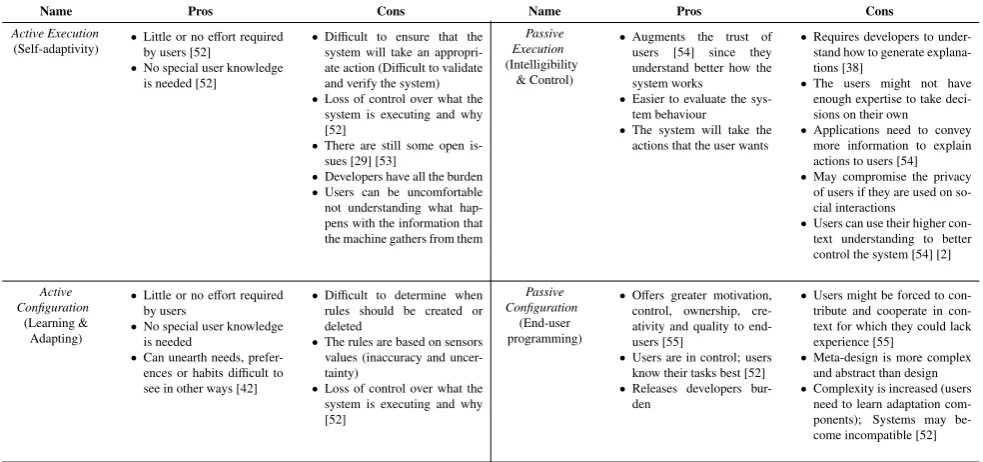
and disadvantages of the different interaction approaches are presented in Table 1.
2.1.4. Features of a Context-Aware System
Schilit et al. [56] first identified different classes of context-aware applications. Pascoe et al. [57], later aimed at identifying the core features of context-awareness. Dey and Abowd [6] pre-sented a categorization for features of context-aware applica-tions, based on the classification of Schilit and Pascoe, namely:
1. Presentation of information and services to the user. 2. Automatic execution of a service.
3. Tagging of context to information for a latter retrieval.
The first feature decides which information and services are presented to the user, based on context. Nearby located ob-jects might be emphasized, or for instance, a printer command might print to the nearest printer. The second feature is the au-tomatic execution of a service. For example, let us consider a
smart home environment. “When a user starts driving home
from their office, a context-aware application employed in the house should switch on the air condition system the coffee ma-chine to be ready to use by the time the user steps into their house” [5]. Finally, they present “contextual augmentation”, which extends the capabilities of sensing, reacting and interact-ing with the environment by usinteract-ing additional information. This is achieved by associating digital data with a particular context. For example, a tour guide can augment reality by presenting information about the attractions that they are surrounded by or are approaching [57]. In the previous subsections, we dis-cuss the need to: A) Take into account the current limitations of C-AS; B) Include the different interaction levels; C) Have a more user-centred perspective. In order to accommodate these demands, we propose to extend Dey and Abowd’s features of C-AS into:
1. Presentation of information to the stakeholders
2. Automatically triggered, approved or chosen execution of a service
3. Personalization of a service 4. Tagging context to information
The first one is very similar to Dey and Abowd’s. It keeps the essence of Pascoe’s “presenting context”, but Schilit’s “proxi-mate selection” and “contextual commands” are merged with our second feature. We have introduced the notion of collabo-ration between different stakeholders rather than just the users. The contextual information might arrive to some secondary or tertiary users that make the choices over the actions of the sys-tem, based on the users needs. Such as what happens in projects
like POSEIDON2[58], where there is a need of secondary users
to take care of the primary ones. Our second feature includes all the different involvement degrees of the user in the system actions, as the situation arises when it is executing. A service can be automatically triggered, being the system autonomous in
2POSEIDON stands for PersOnalized Smart Environments to increase
Name Pros Cons Name Pros Cons
Active Execution (Self-adaptivity)
•Little or no effort required
by users [52]
•No special user knowledge
is needed [52]
•Difficult to ensure that the
system will take an
appropri-ate action (Difficult to validate
and verify the system)
•Loss of control over what the
system is executing and why [52]
•There are still some open
is-sues [29] [53]
•Developers have all the burden
•Users can be uncomfortable
not understanding what hap-pens with the information that the machine gathers from them
Passive Execution (Intelligibility
& Control)
•Augments the trust of
users [54] since they
understand better how the system works
•Easier to evaluate the
sys-tem behaviour
•The system will take the
actions that the user wants
•Requires developers to
under-stand how to generate explana-tions [38]
•The users might not have
enough expertise to take deci-sions on their own
•Applications need to convey
more information to explain actions to users [54]
•May compromise the privacy
of users if they are used on so-cial interactions
•Users can use their higher
con-text understanding to better control the system [54] [2]
Active Configuration
(Learning & Adapting)
•Little or no effort required
by users
•No special user knowledge
is needed
•Can unearth needs,
prefer-ences or habits difficult to
see in other ways [42]
•Difficult to determine when
rules should be created or deleted
•The rules are based on sensors
values (inaccuracy and uncer-tainty)
•Loss of control over what the
system is executing and why [52]
Passive Configuration
(End-user programming)
•Offers greater motivation,
control, ownership, cre-ativity and quality to end-users [55]
•Users are in control; users
know their tasks best [52]
•Releases developers
bur-den
•Users might be forced to
tribute and cooperate in con-text for which they could lack experience [55]
•Meta-design is more complex
and abstract than design
•Complexity is increased (users
[image:7.595.52.544.79.310.2]need to learn adaptation com-ponents); Systems may be-come incompatible [52]
Table 1: Comparative analysis on the interactivity levels that context-aware systems can have.
its decision. But it also can ask the approval of the user, or dis-play a certain list of possible choices, as in Schilit’s “proximate selection”, to enable further collaboration between the system and the users. The third feature is related with being more use-ful to the stakeholders, relating its services to their preferences and needs, which can evolve in time. C-AS can adapt to these through the active or passive configuration of the system, as ex-plained in the previous subsection. Finally, the last feature is the same as Dey and Abowd’s.
2.2. Technological Challenges
Once the concepts of C-AS development are clearer, the reader has to understand the technological challenges and de-mands that creating these systems entails. The following sub-section highlights them, focusing more in the context informa-tion handling, as it is the major and more complex need, to finally analyse other important technological demands.
2.2.1. Context information handling
In order to enable context-awareness, there is always a need of capturing context information and making it available to ap-plications and systems [59]. C-AS require separating how con-text is acquired from how it is used, so that applications are able to use contextual information without knowing the details of a sensor and how can it be implemented [47] [60]. The tech-niques for context information management have been widely researched and are well understood [5]. Despite the advances, the challenge for an engineering process is to facilitate the de-velopment and reuse of structures that enable context infor-mation management and support the adaptation to the specific needs of the applications/systems. Following, the life-cycle [5] of context information is used as a reference to better clarify the issues that this information management may entail:
Acquisition: First, the context information needs to be gathered. Generally, this happens from multiple and dis-tributed resources, which makes the quality and authen-ticity of information difficult to achieve. Let us take the example of the smartphone able to inform about buses de-pending on the context. For developing such a system, Jack’s position can be obtained via the GPS of his phone. The information about the buses can come from an ex-ternal server and the bus that Jack takes regularly can be manually provided by him. As it can be observed, for a reasonably simple system, the ways of sensing the diff er-ent contexts are disparate. On the other hand, sensors in general, are likely to provide inaccurate, overlapping, con-tradictory or missing data (e.g., providing the same infor-mation at different timings or with a jitter) [61]. It also has to be mentioned, that the addition and removal of context resources can give rise to scalability issues. For instance, in a future, the system of our example may not be prepared for obtaining the position from Jack’s PDA instead of his phone. Finally, it has to be taken into account that it will be difficult to obtain contextual information if many users share the same physical sensors and service resources [62].
uncertainty.
Reasoning: Based on the modelled data, different kinds of conclusions can be inferred, where this data can be seen as evidence to support the conclusion [15]. In this way, new knowledge and understanding is obtained, based on the available context [64]. In our example, what the system needs at this point, is to relate Jack’s position to check whether if he is at a bus stop, so that it can find the time remaining for the next approaching bus and send a message to him. This process has typically three dif-ferent phases [5]: (1) Context pre-processing, where data is cleaned to get rid of invalid, inaccurate and non desir-able values; (2) Sensor data fusion, in which sensor data is combined to produce more accurate and dependable infor-mation; (3) Context inference, from low-level information to high-level one. In what regards to reasoning, represen-tation expressiveness is in mutual conflict with soundness, completeness and efficiency [65].
Dissemination: Finally, both low-level and high-level con-text need to be distributed to the consumer. The concon-text information must have high availability, ideally to be pro-vided it in real-time. Another desirable feature is to dis-cover new services that could provide new context infor-mation [15].
It also has to be mentioned that context information will in-herently contain important data related to the users, what raises some privacy issues. Privacy concerns may differ from user to user, and may also be dynamically changing over time. The bal-ance between privacy and the potential of the system is delicate, where the developer may fall into ethical issues. A detailed ex-amination of these issues is not the focus of this survey, but the reader can have more information about ethical concerns that can influence the area at engineering level in [66]. Besides, it is difficult to obtain, ensure and evaluate the good Quality of Context (QoC) information, which depends on its [67]: Preci-sion, probability of correctness, trustworthiness, resolution and contemporaneity.
2.2.2. Technological demands
The technological challenges are not only focused on the in-formation management. We have classified the remaining most relevant needs of C-AS systems into:
• Flexibility versus change:Once the context information is provided, the rest of the system configuration can happen in many forms, that depend on the specific implementation of the system itself. Although the particular implementa-tions can vary, a need that seems invariant is supporting a high amount of changes.
• Cost:C-AS are expensive to develop, deploy, execute and maintain. The amount of information that they need to manage makes them resource hungry [68] and dependable on a very expensive structure.
• Reliability: C-AS must be reliable, especially if they are going to be used in tasks where an error can put a human
life at risk. Even if they are not able to offer a continu-ous delivery of some services properly, they at least should be capable to perform its required basic functions tolerat-ing errors, faults and failures. Fault tolerance in pervasive systems can be increased by [69]: (1) Efficiently detect-ing faults; (2) Isolatdetect-ing faults, to prevent its propagation to other parts of the system; (3) Providing a transparent fault tolerance; and (4) Good fault reporting mechanisms. Be-sides, it is difficult to evaluate the correctness of C-AS due to their increasing size and device diversity.
• Infrastructure: The expensiveness and complexity of C-AS development makes highly desirable for developers to have tools that support and ease their effort during the de-velopment of their systems. An infrastructure [70], is ware that supports construction or operation of other soft-ware, comprising systems that range from tool-kits to net-work services or other sorts of platforms. So, it enables applications that could not otherwise be built or would be prohibitively difficult, slow or expensive. These kind of in-frastructures are typical in C-AS development. Neverthe-less, a certain infrastructure affords only certain styles of application and interface. This creates a tension between easing the development and the flexibility of the infras-tructure, and it is a challenge itself.
Although the field has matured in the latest years, developers have still many issues to overcome when developing C-AS. The next step is to fathom the techniques proposed to develop these kind of systems.
3. State-of-the-art in the development of Context-Aware Systems
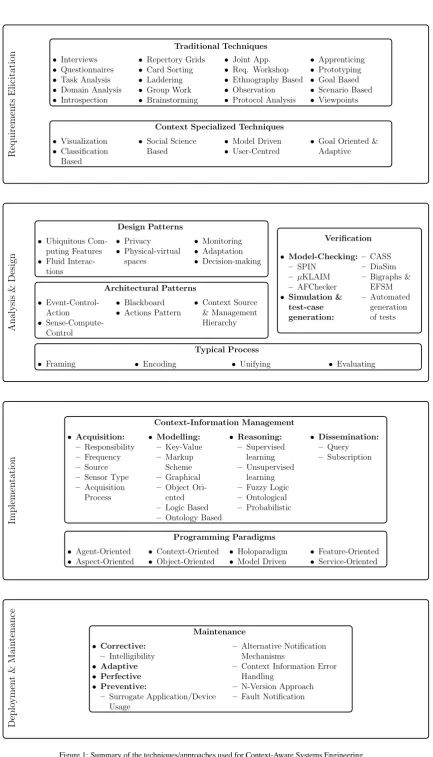
The previous section gives the reader a better understanding of the complications that C-AS developers may face. These, drive researchers to modify already existing engineering meth-ods or to explore new ones in order to give a better response to the needs of context-aware computing. This section stud-ies these specialized development methods and techniques in the literature for creating C-AS throughout the most common stages of a development process: (1) Requirements Elicitation; (2) Analysis & Design; (3) Implementation; and (4) Deploy-ment and Maintenance.
3.1. Requirements elicitation
repertory grids, card sorting, laddering, group work, brain-storming, joint application development, requirements work-shops, ethnography based, observation, protocol analysis, ap-prenticing, prototyping, goal based, scenario-based and view-points. The aim of this subsection is not to deeply review them, but to focus in requirement elicitation techniques that have been tailored for meeting the needs of C-AS development.
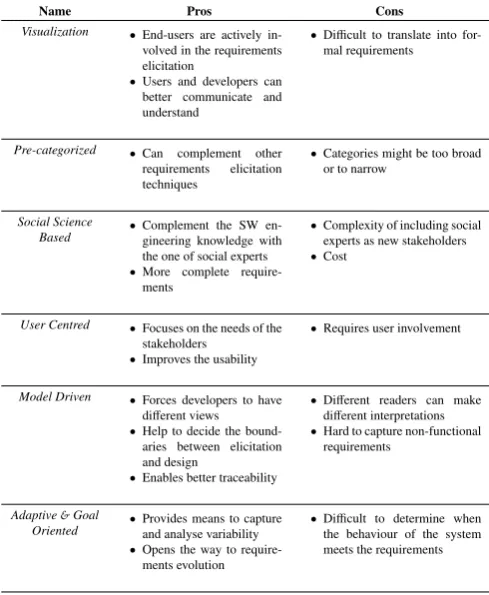
We have classified the different requirements elicitation tech-niques specialized for C-AS development into: (1) Require-ments through visualization; (2) Based on previous context classifications; (3) Social sciences based; (4) User-centred; (5) Model-driven; and (6) Adaptive and goal oriented. We com-pare their advantages and disadvantages in Table 2. Finally, we analyse previous works for identifying common features of re-quirements elicitation techniques for C-AS, to which we add our conclusions.
3.1.1. Requirements through visualization
Some of the approaches are concerned with the visualiza-tion of requirements in order to improve the communicavisualiza-tion be-tween stakeholders. Jorgensen and Bossen [75] presented Ex-ecutable Use Cases (EUC) for gathering requirements in a per-vasive health care system. EUCs are designed to (A) Narrow the gap between informal ideas about requirements and their formalization during system implementation and (B) Spur com-munication between users and developers. EUCs are based on UML-style use cases and have three different tiers: (1) Prose, where descriptions in prose of work processes and their pro-posed computed support (e.g., in the form of typical-language use cases). (2) Formal, that provides a formal, executable model of the work processes and their proposed computer support, where several modelling languages can be used; (3) Anima-tion, where the second tier will be graphically represented and animated with concepts that users are familiar with and under-stand. Perez and Valderas [76], present a tool-supported re-quirements elicitation technique that involves the end-user in the task of describing the main characteristics of pervasive sys-tems and their requirements. Instead of interviews, their tech-nique allows the natural visualization of the requirements which helps the end users interact with requirements engineers. The process has four phases: (A)Context scope, where the
require-ments engineer defines the role3 of end users and the domain
of the system to be developed; (B) System specification, in
which end-users describe the main characteristics and select re-quirements from a predefined catalogue and closed option
in-terfaces; (C) During theAdvanced systemphase, the end users
and the engineers refine the predefined requirements with new ones not available in the catalogue; (D) InValidation, the re-quirements engineers validate with the end-users the captured requirements. They remove any ambiguities or mistakes, creat-ing a formal specification of them.
3The roles could be: End-User, with limited skills;Advanced End-User,
familiar with computer applications; andRequirements Engineerswho are pro-fessional computer experts.
3.1.2. Based on previous classifications of context
Some of the requirements engineering techniques are based on
context-classifications. Krogstie [77] studies the challenges
that specify the requirements to applications running on mo-bile technology. He presents six context categories (i.e., spatio-temporal, environment, personal, task-oriented, social and in-formation contexts) to guide the design of customised stake-holder interviews. Hong et al. [78] discuss that the context in which an application is being used becomes an integral part of the activity carried out with the application. Starting with the context categorization proposed by Dey et al. [6] (i.e., location, identity, activity and time), the solution they propose addresses two goals of Interaction Design: (A) Usability and (B) User experience goals. For the requirements elicitation, they divide context into: (I) Computing, (II) User and (III) Physical.
Kolos-Mazuryk et al. [79] acknowledge the difference between C-AS
properties and those of traditional systems, classifying them into (A) Contextual and (B) Non-Contextual. They present a context-aware oriented requirements engineering method that is a hybrid between the general theory on design methodology and the inherent properties of pervasive services. Their method starts observing the stakeholders of the system to develop. Tak-ing into account the different notions of context they use in-terviews, diaries, user testing and workshops to determine the needs of the stakeholders in what regards to the system. Using the information obtained, they build a model of the environment to refine the requirements. They use “games” to involve users in the requirements elicitation process.
3.1.3. Social sciences based
3.1.4. User-Centred
Sutcliffe et al. [83] introduce a Personal and Contextual Re-quirements Engineering framework (PC-RE). It captures and analyses requirements for helping developers to decide how personal requirements should be implemented. They include different layers for stakeholders, user characteristics and per-sonal goals. In this way they encourage not only an analysis for evolving requirements, but also for contextual influences. The framework is designed to complement complement ex-isting requirements. engineering methodologies via scenario-based techniques. Their model aims to provide a framework of questions that drive the requirements investigation and interpret this as a check-list. An important feature of this work is the use of personalized user requirements. They argue that taxonomies for context-awareness have been personalized to groups rather than to individuals. They also remark that changes can happen in user characteristics over time, as well as social and cultural aspects. Evans et al. [84] present R4IE, a framework for a requirements engineering process for Intelligent Environments, in which context-awareness is a primary feature. Their work is similar to Sutcliffe’s but they include stakeholder profiling with individual user customization. They also introduce a core ethical model, enhancing the addressing of the issues of social context and ethnicity and considering privacy. Zachhuber et al. [85] introduce a framework that is a combination of context simulation with the Wizard of Oz (WOz) technique, where a hidden human “wizard” simulates missing functionalities and system intelligence.
3.1.5. Model-Driven
Desmet et al. [86] present a Context-Oriented Domain Anal-ysis (CODA) for identifying and modelling context-aware soft-ware requirements. It forces modellers to think by means of “context-unaware” behaviour, which can be further refined ac-cording to “context-aware dependant adaptations” at certain validation points. CODA can be represented: in a tree structure (graphically), using XML for writing its diagrams (textually) and mapping its semantics to elements in the decision tables (structurally). Choi et al. [87] propose a method for require-ments gathering in C-AS based on variations of UML Use Case Diagrams. They introduce the following techniques: (1) Defin-ing the scope of systems; (2) Service identification. In a further work [88], they introduce (3) Decision table or trees. They raise the context as a major issue in requirements analysis, encourag-ing analysts and stakeholders to pay attention to context related issues such as system platform, target users, intelligence, pos-sible context-aware services and agreement with other stake-holders as well as understanding context with decision tables and trees. Ruiz et al. [89] describe a model-driven engineering approach targeting non-functional requirements, where they: (1) Derive a model-driven system design that meets specific requirements; (2) generate code that implements such design. Sitou and Spanfelner [90] present RE-CAWAR a requirements engineering process for context-aware and adaptive systems. It provides an integrated model for the usage context based on
different models: (1) User Model, where the participants
as-pects are represented, characterizing the users and user groups;
(2) Task Model, to represent the activities aspects, identifying which task and interactions are needed to perform it; (3) Do-main Model, that consists of any user visible, operable objects in the applications domain, representing the operational envi-ronment aspects; (4) Platform Model, that represents the phys-ical infrastructure and the relationship between the involved devices; (5) Dialog model, where the interaction between the user and the system is depicted; (6) Presentation model, that shows visual haptic and audio elements needed for the interac-tion. Through an iterative process, stable needs are identified, as well as such that may change according to the context. The stable needs result in the functionality of the system, while the situational needs are further analysed to specify the adaptation logic.
3.1.6. Adaptive and Goal-Oriented
Finkelstein and Savigni [91] present a framework for require-ments engineering in context-aware services, where they pro-pose that requirements themselves can change during the sys-tem execution. They difference between: (1) Goals, as a fixed objective of the service; (2) Requirements, as a more volatile concept that can be influenced by the context. Oyama et al. [92] describe an approach of service requirements analysis us-ing the feedback of contexts, to support the elicitation of user intentions and goals in a robust manner. They identify two ap-proaches in the evolvability of C-AS: (1) Short-term evolution, to handle exceptions and to make correct reactions at runtime; (2) Long-term evolution, to monitor user behaviour and capture new system requirements based on human intentions. Baresi et al. [93] present FLAGS, a goal model that adds adaptive goals in order to embed adaptation countermeasures, fostering self-adaptation by considering requirements as live, runtime entities. They distinguish between: (1) Crisp goals, whose satisfaction is Boolean, and (2) Fuzzy goals, whose satisfaction is repre-sented through fuzzy constraints. Adaptation countermeasures are triggered by violated goals and the goal model is modified accordingly to maintain a coherent view of the system and en-force adaptation directives on the running system. Siadat and Song [94] discuss the state-of-the-art requirements for adaptive systems, under the notion that requirements that are engineered at design time may require further reasoning or refinement at runtime in order to adapt to dynamic context-driven changes.
3.1.7. Conclusions
Name Pros Cons
Visualization •End-users are actively
in-volved in the requirements elicitation
•Users and developers can
better communicate and understand
•Difficult to translate into
for-mal requirements
Pre-categorized •Can complement other
requirements elicitation
techniques
•Categories might be too broad
or to narrow
Social Science Based
•Complement the SW
en-gineering knowledge with the one of social experts
•More complete
require-ments
•Complexity of including social
experts as new stakeholders
•Cost
User Centred •Focuses on the needs of the
stakeholders
•Improves the usability
•Requires user involvement
Model Driven •Forces developers to have
different views
•Help to decide the
bound-aries between elicitation and design
•Enables better traceability
•Different readers can make
different interpretations
•Hard to capture non-functional
requirements
Adaptive&Goal
Oriented
•Provides means to capture
and analyse variability
•Opens the way to
require-ments evolution
•Difficult to determine when
[image:11.595.42.287.79.377.2]the behaviour of the system meets the requirements
Table 2: Comparative analysis on the advantages and disadvantages of the different requirements elicitation techniques that are specialized for
context-aware systems development.
when the context change. Alshaikh and Boughton [10] analyse how context works in requirements elicitation. In early stages, context is associated with the task of setting system bound-aries, while in later stages, context is used implicitly within the scenario-based requirements (common-sense approach).
Fi-nally, they distinguish between context and requirements.
Con-text is defined through the user’s situation andRequirements
are described focusing on the user’s interaction with the sys-tem. Evans et al. [84] classify the prominent themes in require-ments elicitation focused on context-awareness for Intelligent Environments: (1) The consideration, adoption and possible en-hancement of a context taxonomy; (2) A general assumption that systems need to be adaptable to be context-aware; (3) Elic-itation techniques used to capture end-user cognitive tasks re-quire enhancement to account for context-awareness; (4) Iden-tification of target user groups and acknowledgement that con-textual requirements for either profile may evolve over time; (5) Requirements themselves might be context-driven; (6) The con-sideration of cultural context; (7) The adoption of goal-oriented requirements engineering where higher-order goals are appar-ent in the domain. They also acknowledge that there is lack of standards in what regards to requirements engineering for C-AS. From the literature review, we insight that:
1. A contextual adaptation stems from a functionality of the system. Typically, the functionality is first identified and then its possible contextual adaptations.
2. The different contextual adaptations are affected by the
needs of specific users or user groups.
3. Social sciences and social experts help to understand better the notion of context in requirements elicitation.
4. The notion of context in requirements elicitation is still not clear.
3.2. Analysis and Design
When the system requirements are well specified, an analysis can ease the development plan through a better understanding of the system implementation. The design brings developers
closer to a feasible implementation plan. It has to be
ac-knowledged that there is no set of universally accepted basic design and development principles, or standards, which lead
to a uniform approach to the efficient C-AS development. The
aim of this subsection is to study the different approaches for analysing and designing C-AS. We first focus on the design
process itself, to examine more in depth: (1) The different
architectures of C-AS and architecture patterns used for design; (2) Middleware; (3) Design-Patterns and (4) Verification.
3.2.1. Design process
Bauer et al. [96] identified the most common practices used by developers when designing a C-AS, dividing the process into: A)Framing: Designers will articulate and explore a con-cept of context, which imposes a set of limitations on what exist inside and outside the design space their work inhabits [96]. B)Encoding: In this stage designers will discuss the be-haviour of the system and instantiate a vocabulary or codes to express its behaviour. C)Unifying: As the designers explore the design space, certain possible design solutions are brought to the foreground, which impose additional constraints over other
concerns the designers address. D)Evaluating: As the process
continues, the designer will focus on a solution that satisfies the constraints according to their encoded formulation of context. This allow them to determine when they have arrived at a satis-factory solution.
3.2.2. Architectures
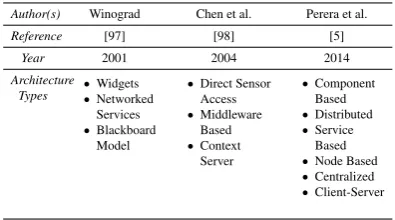
An architecture is an abstraction, that generalizes the sys-tems, without showing detailed implementation such as code or circuits. This subsection studies the architectures used for C-AS development. Due to their diversity, C-AS have adopted disparate ranges of architectures. Table 3 shows the different classifications of architectures according to existing literature surveys. Following, we analyse the works that classify generic architectures and we study the different architectural patterns that can be used for creating C-AS.
3.2.2.1. Generic architectures. Other works also study the
common parts that different architectures have, providing a
Author(s) Winograd Chen et al. Perera et al.
Reference [97] [98] [5]
Year 2001 2004 2014
Architecture Types
•Widgets
•Networked
Services
•Blackboard
Model
•Direct Sensor
Access
•Middleware
Based
•Context
Server
•Component
Based
•Distributed
•Service
Based
•Node Based
•Centralized
[image:12.595.64.262.80.190.2]•Client-Server
Table 3: Different architecture classifications for context-aware systems.
C-AS, in which they classify architectural layers of this sys-tems into: (1) Concept and Research; (2) Network infrastruc-ture layer; (3) Middleware layer; (4) Application layer and (5) Infrastructure layer.
3.2.2.2. Architectural patterns. An architectural pattern is a set of architectural design decisions that are applicable to a re-curring design problem, and parametrized to account for diff er-ent software developmer-ent contexts in which that problem ap-pears [100]. We have gathered from the literature, the following patterns:
• Event-Control-Action [101]: A high level structure for systems that proactively react upon context changes. It provides a structural scheme to enable the coordination, configuration and cooperation of distributed functionality within services platforms. Divides the information man-agement related tasks from the ones that trigger actions, under the control of an application behaviour description. It improves the extensibility and flexibility of the platform, since context processors and action components can be de-veloped and deployed on demand. Besides, enables the dynamic deployment of context-aware applications and al-lows the configuration of the platform at runtime. It is di-vided into: (1) Event, where context concerns are placed in, that depend on the definition modelling of context in-formation; (2) Control, that is provided with application behaviour descriptions, and connects the context events with the actions to take; (3) Action, that triggers the be-haviour, which can be a service invocation on (external or internal) service providers or a network.
• Context Sources & Managers Hierarchy [101]: Aims at providing a structural schema to enable the distribution and composition of context information processing com-ponents (Context Sources and Context Managers). The structural schema consists of hierarchical chains of them, in which the outcome of a context information process-ing unit may become input for the higher level unit in the hierarchy. A context Manager inherits the features of context sources and implements additional functions to handle gathering context information from various context sources and managers. It enables encapsulation and a more effective, flexible and decoupled distribution of context processing activities (sensing, aggregating, inferring and predicting). It also improves collaboration among context
information owners allowing new parties to join the col-laborative network in order to provide richer context in-formation.
• Actions Pattern [101]: An action might be performed in-dependently or in parallel, while some actions depend on or trigger others. In order to provide mechanisms to man-age coordination of actions, this pattern provides a struc-ture of components to support designing and implement-ing action concerns within context-aware services plat-forms. An action purpose defines an abstract action in-tention, while its implementation represents the realiza-tion of it, using specific implementarealiza-tion technologies. By defining a structure of Action Resolvers, Providers and Im-plementors, enables the coordination of compound actions and the separation of abstract action purpose from its im-plementations.
• Sense-Compute-Control [100]: It is a common pattern for structuring embedded control applications and pervasive environments that interact with the physical surroundings. This pattern consists of context operators fuelled by sens-ing entities whose operators refine (aggregate and inter-pret) the information given by the sensors. These refined data are then passed to controller operators that trigger ac-tions on entities. The structure is based on a computing element that (1) reads all the sensor values; (2) computes control outputs and (3) sends the controls to all actuators.
• Blackboards [97]: Adopts a data-centric point of view. Rather than sending requests to distributed components and getting call-backs from them, a process post messages to a common message board, to which others can subscribe to receive messages matching a specified pattern that have been posted. All communications go through a centralized server.
3.2.3. Middleware
Middleware is the most used structure to collect context in-formation, support the deployment of sensors and hide hetero-geneity. By separating how context is used from how it is ac-quired, it eases the development of a generic set of applica-tions by reusing and customizing the necessary structure for context manipulation. Although many middleware approaches have been presented, it is difficult to achieve a universal mid-dleware tool, applicable to any area, and capable of solving all the challenges involved in the context provision to applications, despite the many standpoints in the literature [5]. In this di-rection, approaches like UniversAAL4, aim at creating an open platform and reference specification that makes technically fea-sible and economically viable to develop Ambient Assisted Liv-ing solutions. In order to better reuse their middleware, they provide a market in which developers will upload their
appli-cations to make them available to users. Besides, the ReAAL5
initiative has rolled-out active and independent living applica-tions on top of UniversAAL, and has tested them with users in
Pattern Applicability Benefits
Event-Control-Action
•Gathering context info
•Full time connectivity
•Real time
•Extensible and flexible
appli-cations
•Dynamic deployment of
appli-cations
•Separation of concerns
(Con-trol and Context Information)
Context Sources &Managers Hierarchy •Context information processing
•Encapsulation, effective,
flexi-ble and decoupled distribution of context information man-agement activities
•Filtering unnecessary
informa-tion
Actions Pattern •Actions performed in
parallel
•Dependency
between actions
•Avoids permanent binding
be-tween action and purpose
•Enables different
implementa-tions at platform run-time
•Actions may be changed or
ex-tended independently
Sense-Compute-Control
•Large number of
het-erogeneous devices
•Embedded control
applications
•Static environments
•Allows the control of various
devices
•Enables adaptation
•Reuse of existing components
•Diminution of complexity
Blackboards •Distributed
applications
•Complex problem
solving
•Knowledge is reusable
•Knowledge sources can work
concurrently
•Easy to add/remove
[image:13.595.51.287.79.372.2]knowl-edge
Table 4: Benefits and applicability of architectural patterns for context-aware systems.
real life. Middleware has been deeply analysed in the literature. For this reason, it is out of the scope of this survey to deeply analyse them. The reader can find broader comparisons and studies related to middleware in Perera et al. [5], Preuveneers and Novais [95], Kjaer [102], Baldauf et al. [99] or Henricksen et al. [103], among others.
3.2.4. Design patterns
A design pattern is a semi-structured description of an ex-pert’s method for solving a recurrent problem, which includes a description of the problem itself and the context in which the method is applicable, but does not include directives which bind the solution to unique circumstances [104]. As in other domains, design patters have also been suggested for context-aware computing. They can help designers to focus on what they want to implement without having to resolve recurrent is-sues. Usually, problems have a strong relationship with the plat-form where they are going to be executed, which makes their identification ad-hoc and difficult to reuse. We have classified the different patterns that can be obtained from the literature, according to the problem they intend to solve:
• Ubicomp features: Enable ubiquitous and pervasive com-puting features.
• Fluid interactions: Solve common problems that arise
from providing a better interaction with the users.
• Privacy:Address issues related with the confidentiality of the user data.
• Physical-virtual spaces: Looks at how physical objects and spaces can be merged with the virtual.
• Monitoring: Enable to systematically observe the system itself and environmental conditions.
• Adaptations: To dynamically perform structural and be-havioural changes in an adaptive system without leaving it in an erroneous or inconsistent state.
• Decision making: Mechanisms to solve problems related
with taking decisions.
It is difficult to determine design patterns that can be
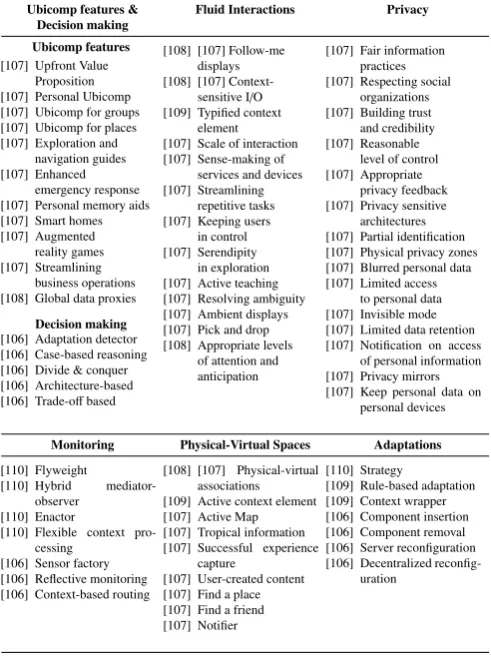
universally reused. Instead, they help to solve some specific problems that might not be necessarily applicable to any C-AS. Besides, it must also be acknowledged that there is no widely recognized technique for finding appropriate design patterns from existing C-AS. Due to space restrictions, a further anal-ysis of these patterns is not provided, but each of the patterns is related to its corresponding paper in table 5. More informa-tion about design patterns can be also found in [95] [105] [106].
Ubicomp features & Decision making
Fluid Interactions Privacy
Ubicomp features
[107] Upfront Value Proposition [107] Personal Ubicomp [107] Ubicomp for groups [107] Ubicomp for places [107] Exploration and
navigation guides [107] Enhanced
emergency response [107] Personal memory aids [107] Smart homes [107] Augmented
reality games [107] Streamlining
business operations [108] Global data proxies
Decision making
[106] Adaptation detector [106] Case-based reasoning [106] Divide & conquer [106] Architecture-based
[106] Trade-offbased
[108] [107] Follow-me displays [108] [107]
Context-sensitive I/O
[109] Typified context element [107] Scale of interaction [107] Sense-making of
services and devices [107] Streamlining
repetitive tasks [107] Keeping users
in control [107] Serendipity
in exploration [107] Active teaching [107] Resolving ambiguity [107] Ambient displays [107] Pick and drop [108] Appropriate levels
of attention and anticipation
[107] Fair information practices [107] Respecting social
organizations [107] Building trust and credibility [107] Reasonable
level of control [107] Appropriate
privacy feedback [107] Privacy sensitive
architectures [107] Partial identification [107] Physical privacy zones [107] Blurred personal data [107] Limited access
to personal data [107] Invisible mode [107] Limited data retention [107] Notification on access
of personal information [107] Privacy mirrors [107] Keep personal data on
personal devices
Monitoring Physical-Virtual Spaces Adaptations
[110] Flyweight
[110] Hybrid
mediator-observer [110] Enactor
[110] Flexible context pro-cessing
[106] Sensor factory [106] Reflective monitoring [106] Context-based routing
[108] [107] Physical-virtual associations [109] Active context element [107] Active Map [107] Tropical information [107] Successful experience
capture
[107] User-created content [107] Find a place [107] Find a friend [107] Notifier
[110] Strategy
[109] Rule-based adaptation [109] Context wrapper [106] Component insertion [106] Component removal [106] Server reconfiguration [106] Decentralized
[image:13.595.311.557.329.659.2]reconfig-uration
Table 5: Classification of design patterns used for context-aware systems development based on their applicability.
3.2.5. Verification
effective way to show the presence of bugs, it is inadequate for showing their absence [111]. In these cases, verification techniques are used to explore some general properties about the behaviour of a program. Most of the verification done in C-AS is in the form of model checking, an approach to formal verification that proves whether if a model meets a given specification. Other simulation and use-case based techniques
are also employed. The rest of the section discusses some
representative samples of the state-of-the-art.
3.2.5.1. Formal Verification. Formal verification techniques provide a safer development of systems in intelligent environ-ments, what leads to increase their reliability [112]. Augusto et al. [113] show techniques as well as tools that can be used to model processes and interactions, detecting problems through simulation and verification in early stages of the
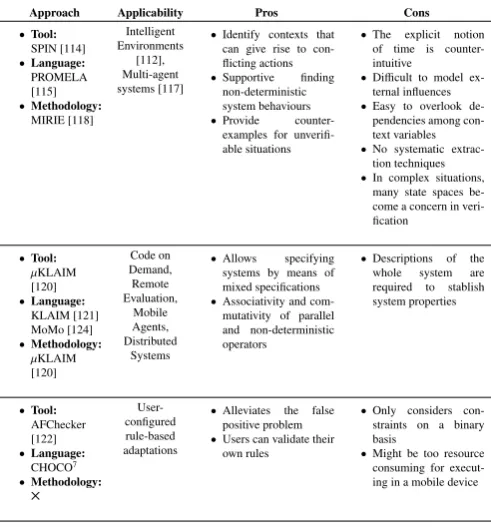
develop-ment. They acknowledge SPIN [114], a generic and open
verification system that supports the design and verification of asynchronous process systems, as a good tool for this task. SPIN accepts design specifications written in the verification language PROMELA [115], and it accepts correctness claims specified in the syntax of standard Linear Temporal Logic
[116]. These tools have also been proved as supporters in
the development of more correct and reliable Multi-Agent Systems [117]. On a further work, Augusto and Hornos [118], present a methodological guide which provides strategies and suggestions on how to model, simulate and verify these types of systems, divided in four stages: (1)Informal modelling, where informal descriptions of both the application domain and the correctness properties to be checked using natural language; (2)Structural modelling, in which entities to be considered are
identified; (3) Behavioural modelling, where the contents of
each process created in the previous phase is defined or refined by modelling the dynamic behaviour of the corresponding
entities involved; (4) Simulation and verification, in which
both techniques are used to increase the reliability of the models created. This phase also will require moving back to
the previous phases and redefine models. Preuveneers and
Berbers [119] also support a model checking approach in order to being able to verify the many possible configurations and contextual situation that a C-AS can be in. They discuss the major benefits and weaknesses of the SPIN tool. On one hand
they acknowledge SPIN to be helpful identifying different
contexts that give rise to conflicting actions, to be supportive finding non-deterministic system behaviours and to be capable of producing counter examples for unverifiable situations. On the other hand, they highlight that the explicit notion of time is counter-intuitive, that is difficult to model external influences making the outcome of the simulation subject of interpretation and that is very easy to overlook dependencies among context variables. Also there are no systematic extraction techniques and that in complex situations with multiple context variables, rules and assertions is likely that the exponential state space explosion becomes a critical concern for verifying the rule.
D’Errico and Loreti [120] present a set of formal tools that
allows specifying systems along with a model-checking algorithm to verify whether considered specification satisfy
the expected properties. They introduceµKLAIM, based on a
simplified version of a Kernel language for agent interaction and mobility [121], which is based on an assume-guarantee approach: A system is not considered as isolated, but in conjunction with assumptions on he behaviour of the environ-ment where is executed. The system can be specified in: (1) Process, accurately defined; (2) Environment, more abstract and formalized by logical formulae. To specify properties of
µKLAIM systems they use modal logic (MoMo) that allows
describing interactions that the enclosing environments can have.
Liu et al. [122] present AFChecker, a public available tool to improve user’s fault detection and inspection experiences. It
has three major components: (I) Model checker based on a
technique for fault patterns and their automated identification [123]. Which derives a state transition model from a set of user-configured adaptation rules and verifies the model to de-tect five6common types of adaptation faults; (II)Constraint in-ference engine, that infers both deterministic and probabilistic
constraints based on CHOCO7 by analysing the propositional
atoms in the user-configured adaptation rules; (III)Fault Report Processor, that processes the fault reports generated by its un-derlying model checker. The ranking of fault reports for user’s inspection can be dynamic or static, depending on the interac-tion mode.
3.2.5.2. Simulation and test-case generation. Park et al. [125] present CASS, a simulation tool for smart-homes that is able to generate virtual people in order to perceive its movements and actions through sensors. The tool is programmed in Java, and it allows to modify and delete sensor and devices according to the preferences of the developers. After, it can perceive simulated movements of virtual people, generating proper values for each sensor type. They also describe the system architecture and hierarchical rule structure model for smart-homes. Wang et al. [126], provide an approach for automating the generation of tests for context-aware pervasive applications. They provide an integrated solution to identify when context changes may be relevant, and a control mechanism to guide the execution of tests into potentially interesting contextual scenarios as defined by a coverage criterion that is context-cognizant. Their solution can be used to enhance other test suites of context-aware appli-cations. Bertran et al. [127] introduced DiaSuite, a tool suite for the development of sense-compute-control applications. Within their suite of tools, they present DiaSim [128], a parametrized simulator to ease the acquisition, testing and interfacing of a variety of software and hardware components. The simulator is parametrized to a high-level description of the target environment, written in their own specification
6Non-deterministic adaptations, dead rule predicates, dead states (meaning
that no rules can be satisfied in these states), adaptation traces and unreachable states.