Reasoning about visibility in mirrors: A comparison
between a human observer and a camera
BERTAMINI, Marco and SORANZO, Alessandro <http://orcid.org/0000-0002-4445-1968>
Available from Sheffield Hallam University Research Archive (SHURA) at:
http://shura.shu.ac.uk/21249/
This document is the author deposited version. You are advised to consult the publisher's version if you wish to cite from it.
Published version
BERTAMINI, Marco and SORANZO, Alessandro (2018). Reasoning about visibility in mirrors: A comparison between a human observer and a camera. Perception, 47 (8), 821-832.
Copyright and re-use policy
See http://shura.shu.ac.uk/information.html
1
Reasoning about visibility in mirrors:
A comparison between a human observer and a camera
Marco Bertamini
&and Alessandro Soranzo
°&
Department of Psychological Sciences
–
University of Liverpool
°
Faculty of Development and Society
–
Sheffield Hallam University
Contact:
Marco Bertamini
Department of Experimental Psychology Eleanor Rathbone Building,
University of Liverpool, Liverpool, UK
2
Abstract
Human observers make errors when predicting what is visible in a mirror. This is true for perception with real mirrors as well as for reasoning about mirrors shown in diagrams. We created an illustration of a room, a top-down map, with a mirror on a wall, and objects (nails) on the opposite wall. The task was to select which nails were visible in the mirror from a given position (viewpoint). To study the importance of the social nature of the viewpoint we divided the sample (N=108) in two groups. One group (N=54) were tested with a scene in which there was the image of a person. The other group (N=54) were tested with the same scene but with a camera replacing the person. Participants were instructed to think about what would be captured by a camera on a tripod. This manipulation tests the effect of social perspective taking in reasoning about mirrors. As predicted, performance on the task shows an overestimation of what can be seen in a mirror, and a bias to underestimate the role of the different viewpoints, i.e. a tendency to treat the mirror as if it captures information independently of viewpoint. In terms of the comparison between person and camera there were more errors for the camera, suggesting an advantage for evaluating a human viewpoint as opposed to an artificial viewpoint. We suggest that social mechanisms may be involved in perspective taking in reasoning rather than in automatic attention allocation.
3
Introduction
Different viewpoints give the observer different views of the surrounding environment. This is a common occurrence in the course of people's interaction with the environment, and therefore
everybody has vast experience about what can be seen as the viewpoint changes. For example, the objects we see in a room of our own house differ when we have just entered from the door as compared to when we have walked to the other side. When people reason about viewpoint, however, they may find it difficult to accurately predict what is visible. This is surprising and counterintuitive, but can be understood as the cost that the visual system pays for its exceptional ability to extract distal information and discard accidental aspects of the image. In other words constancy mechanisms ensure that only distal information is retained, and not the changes created by displacements of either the object or the observer.
In this study we used a diagram of a room and the task was to indicate what could be seen when looking at a mirror on a wall. In particular the task was to evaluate which objects behind the observer were visible using the mirror. Previous studies have found a tendency to overestimate what is visible and a lack of sensitivity to viewpoint. Here we introduce a new variable, a comparison between a human observer and a camera. In the next part of the introduction we review the literature on perspective tasks, and in particular about egocentric and allocentric biases. Then we consider the special case of a mirror.
Egocentric and allocentric biases
When people think about what is visible from a given viewpoint responses are often biased. One aspect that has been studied is an egocentric bias. When thinking about what someone else is seeing (as well as what they are thinking or feeling), people are influenced by their own perspective (Apperly, Samson, & Humphreys, 2009). This is particularly easy to see in children. Before the age of 4, children tend to respond according to their own viewpoint and mental state (e.g., Moore et al., 1995; Piaget & Inhelder, 1956; 1967).
4
the phenomenon (Cole et al., 2015; Santiesteban et al., 2014; Wilson et al. 2017). According to this perceptual interpretation, people are not directly affected by the others' perspective but rather by basic perceptual directional characteristics of the stimuli. For example, Wilson et al. (2017) compared the effects of the presence in the scene of a person with the presence of a camera, and they found no difference. In other words a person has the same function as any other cue that bias spatial attention.
Egocentric and allocentric biases suggest that responses may be biased depending on whether the question involves another individual and also when another individual is present. They do not make any specific prediction about task difficulty overall and sensitivity to viewpoint, except in the sense that presence of another person in a scene may have a special role in directing attention.
Viewpoint and mirrors
In general visibility is directly related to line of sight, and an unobstructed line must exist between observer and object. However, in the case of a mirror this strategy is not available. In the case of a planar mirror rays are reflected in such a way that angle of incidence is the same as angle of reflection. There are, therefore, two possible ways to answer the question of what is visible, one is to calculate geometrically the path of the light, the other is to try and remember similar situations from experience. Despite these two possible strategies, people make mistakes and show a bias towards thinking that what is visible in a mirror is what is in front of the mirror itself (Bertamini et al., 2010; Bertamini & Parks, 2005).
Individual responses vary, and errors can be overcome using strategies like those described above. However, variability in the responses is not associated with a feeling that the question is hard. People seem to adopt different strategies or heuristics when answering (Croucher et al., 2002;
Bertamini et al., 2003; Savardi et al., 2010). Sometimes one may focus on the fact that there is an image on the mirror, and just like for an image on a photograph, as long as one can see the mirror so the image should be visible. Other times the mirror is thought as capturing some extent of the space in front of the mirror itself. In both cases the role for the viewpoint is not factored in correctly or at all. As a consequence people tend to overestimate what is visible with a mirror, partly because they assume information is available from many different viewpoints. This is true in children as well as adults, although the bias gets stronger with development, as is the case also for intuitive beliefs about motion (Bertamini & Wynne, 2009; Kaiser, Proffitt, & McCloskey, 1985).
5
Because of the role of the viewpoint, when the position of the observer was to the left of the mirror she could see the nails to the right, and when the observer was to the right she could see the nails to the left. From the position in front of the mirror she could see the nails in the middle. This is a task about what objects can be seen, assuming free exploratory gaze movements.
There was a strong trend in the direction of selecting nails in the centre of the room. This is evidence that the viewpoint is not properly taken into account. Bertamini (2014) confirmed the
difficulty of taking another viewpoint into account when reasoning about mirrors. The task was adapted so that the question was about which carriages of a train were visible. The reason was to compare a situation where the question is directly about what can be seen, and a question about what could be seen after movement by the train. A mirror and a window condition were compared. Results confirmed an additional cost in reasoning about mirrors compared to windows.
A study comparing the viewpoint of a person and a camera
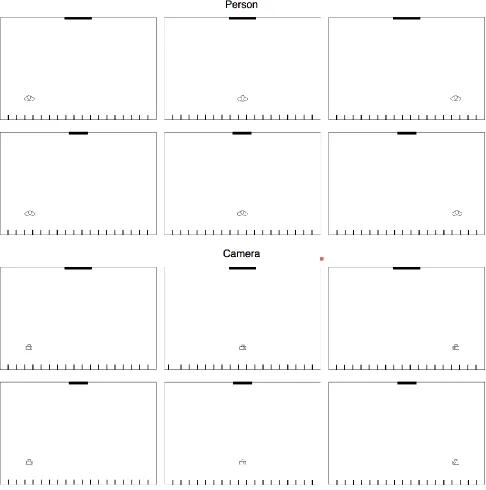
The study was conducted using a top down map of a rectangular room. The stimuli are shown in Figure 1. For one group of participants there was a simple drawing in the room described as a person. For another group the viewpoint was described as a camera that had been positioned to take a
photograph. On the one hand it may be easier to adopt the viewpoint of another person. In this case performance should be better for the Person condition. On the other hand a camera may provide a more objective task, focused on viewing angle rather than a personal memory of a scene. If so, performance should be better for the Camera condition. Geometrically the conditions are comparable, and therefore a conservative prediction is that there will be no difference between Person and Camera.
By comparing a person to a camera we will learn something about the process of evaluating someone else's perceptive (Samson et al. 2010). The claim that allocentric information is available to perception is controversial (e.g., Wilson et al. 2017). What is novel in this study is that we are focusing on allocentric information for reasoning rather than perception.
Experiment
The study was conducted using top down diagram of a room. The room had a rectangular shape like that in Experiment 5 in Bertamini et al. (2010), and the task was similar to the task used in
6
Method
Participants.
One hundred and eight individuals took part in the experiment (age range: 18 - 54; 53 females). All participants were unaware of the purpose of the study at the time they were tested. The experiment was approved by the Ethics Committee of the University of Liverpool and was conducted in
[image:7.595.57.543.226.716.2]accordance with the Declaration of Helsinki (2008).
7
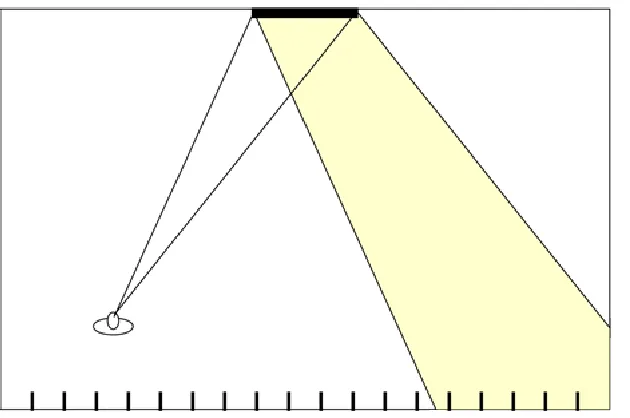
Figure 2. Illustration of the correct answer for one of the stimuli. The five nails on the right are visible when the observer is standing on the left in the room. For the smaller mirror only four nails would be visible.
Design and Procedure.
The stimuli were diagrams printed on A4 paper. They depicted a top-down view of a room. The images are shown in Figure 2. Each observer saw all three positions of where the person or object was placed (Left Middle and Right) and two sizes (Small and Large) of the mirror. Therefore they saw and responded to six questions on six separate A4 sheets of paper. The variable type of object (Camera or Person) was a between subject factor, and therefore each person saw only one type.
Each participant was tested individually. They were given the relevant A4 paper diagram and an explanation of the map. They were told to imagine what the individual represented in the scene would see. The individual was free to look in any direction. For the camera they were told that a person would set the camera and it could point it in any direction, although the location could not change. This is important because the angle of view of a camera may be considerably narrower than that of a human observer. In particular if one were to assume a 50mm lens and a 35mm film the angle of view would be approximately 40 deg (horizontally). The task was to decide which nails would be visible reflected in the mirror, and to circle them with a pen on the paper.
Results and Discussion
8
Figure 3. Illustration of the how often each nail was selected by participants for each of the condition of Figure 1. Therefore the scale has a maximum of 54 (the sample size). The yellow shading shows the correct response.
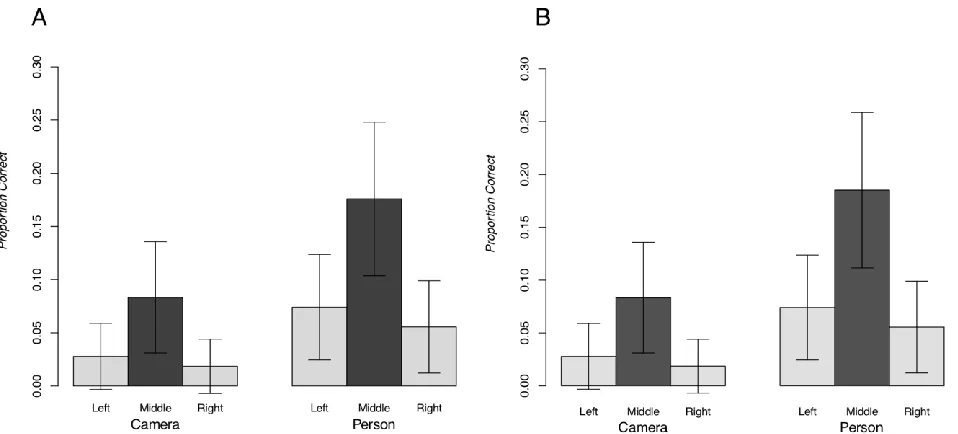
The first statistical analysis was based on proportion of correct answers according to a strict criterion. That is, how often the correct nails and only the correct nails were circled. According to this test percentage of correct responses were on average 10.1% for the Person and 4.3% for the Camera. The results are shown in figure 4. As the criterion is strict, we are more interested in the relative differences between conditions. We performed a mixed ANOVA with Size (Large and Small) and Position (Left, Middle, and Right) as within-subjects factors, and Object (Person, Camera) as the between factor. There was a significant main effect of Object (F(1,106)=4.59, p<0.05, partial 𝜂2=0.04).
This result shows that the percentage of correct responses was significantly higher for the Person than for the Camera. There was also a main effect of Position (F(2,212)=13.44, p<0.01, partial 𝜂2=0.11) but
9
no significant difference between the Left and Right conditions (p = 0.26). Note that if the difficulty with the camera was linked to the narrower field of view the problem would be confined to the left and right positions thus producing an interaction between Object and Position, but there was no evidence of such interaction.
In some cases, especially when the viewpoint was in the centre, the responses had a gap, suggesting that participants assumed that the person or the camera hid some nails. We analysed the data after an interpolation; specifically, we included those nails as if they had been circled. The overall difference compared to the first analysis was small (10.5% for the Person and 4.3% for the Camera) and the statistical tests confirmed the same effects [Object main effect (F(1,106)=5.51, p<0.05, partial
𝜂2=0.05; Position main effect (F(2,212)=14.6, p<0.01, partial 𝜂2=0.12; Size main effect and all
interactions n.s. (p>0.05)].
Figure 4. (Left) For each of the three positions the graphs show the overall proportion of correct responses as a function of the type of object. (Right) The same graph after interpolation, meaning that if there was a gap in the selected nails we counted also the missing nails in the gap (see text for details).
[image:10.595.53.532.302.519.2]10
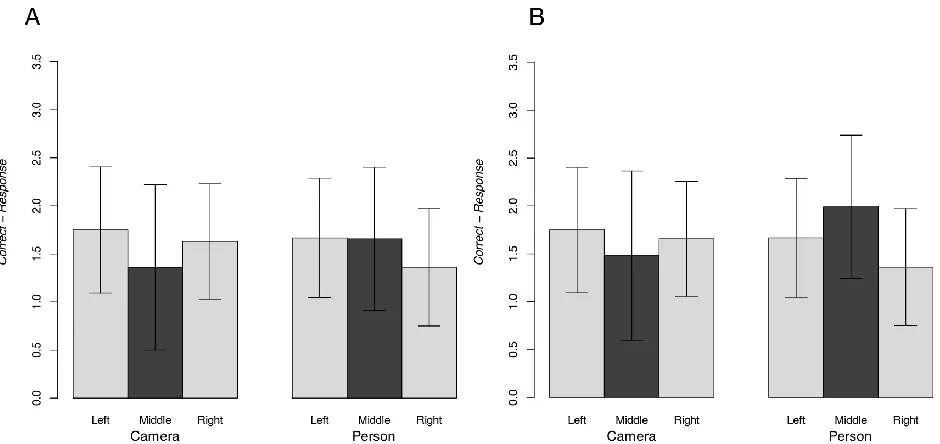
Figure 5. (A) For each of the three positions the graphs show the average overestimation as a function of the type of object. (B) Same information after interpolation.
On the data about overestimation we performed a mixed ANOVA with Size (Large and Small) and Position (Left, Middle, and Right) as within-subjects factors, and Object (Person and Camera) as the between factor. There were no significant main effects or interactions, indicating that the overestimation was a general tendency.
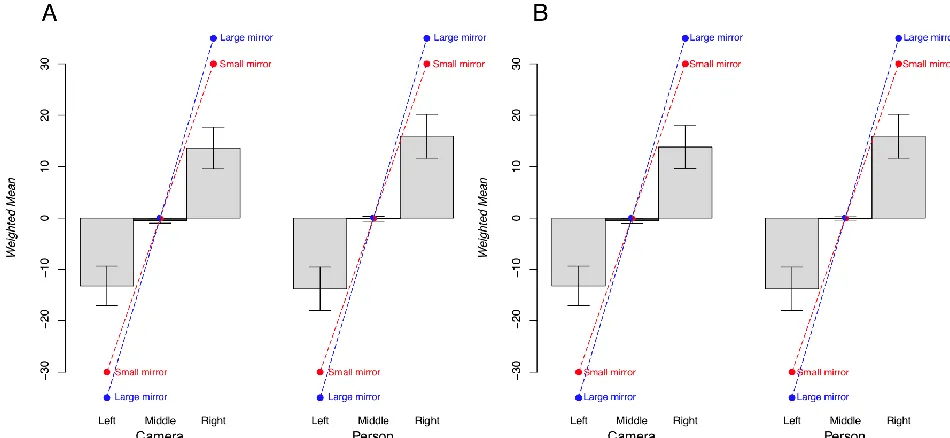
The first two analyses were about accuracy (proportion correct) and overestimation (total number of nails circled by the participants minus the correct number). The third analysis is about how much responses were shifted to the right and to the left, and we call this eccentricity. To perform this latter analysis, we weighted each nail from -9 to 9 (left to right) and computed a weighted mean. For the three positions and two sizes of the mirrors there are expected values of eccentricity. In particular when the object was on the left the expected response is to select nails on the right, when the object was on the right the expected response is to select nails on the right, and when the object was in the middle there should be no eccentricity in the response.
[image:11.595.55.525.62.284.2]11
Figure 6. (A) For each of the three positions the graphs show the eccentricity. Lines connect the values of the correct eccentricity for the Large mirror (blue line) and the Small mirror (red line). (B) The graph shows the same analysis after interpolation.
We performed a mixed ANOVA on the eccentricity data with Size (Large and Small) and Position (Left, Middle, and Centre) as within-subjects factors, and Object (Person and Camera) as the between factor. There was a significant main effect of Position (F(2,106)=51.52, p<0.01, partial
𝜂2=0.33), and a significant interaction between Position and Size (F(2,212)=5.62, p<0.01, partial
𝜂2=0.05). Main effects of Size and Object as well as the other interactions were non-significant
(p>0.05).
As we did in the previous analyses, we considered the Eccentricity after interpolation. Overall the pattern was not changed and statistical tests confirmed the same effects of Position (F(2,106)=51.68, p<0.01, partial 𝜂2=0.33), and the interaction between Position and Size
(F(2,212)=5.7, p<0.01, partial 𝜂2=0.05). The main effects of Size and Object as well as other
interactions were not significant (p>0.05).
Discussion
[image:12.595.48.523.60.279.2]12
The within-subjects design in which three different viewpoints were presented to each observer may have contributed to this.
These studies focus on the role of viewpoint. The task is, therefore, not directly related to the size of the visual field, which is the region of the world visible during one fixation (Howard & Rogers, 1995). Also interesting, but not directly related to this task, is the debate on the difference between visual space and physical space (Baldwin, Burleigh, Pepperell, & Ruta, 2016; Hatfield, 2003; Indow, 2004; Koenderink & van Doorn, 2008).
The novel factor in this study was a comparison between what a person can see and what a camera can capture. We analysed three aspects of the data, accuracy (proportion correct),
overestimation (total number of nails selected compared to the expected total), and eccentricity (how far to the left and to the right the responses were spread). There was a clear overestimation, of how much of the back wall was visible in the reflection. However, this overestimation was true across conditions and equally strong for Person and for Camera. There was also a clear pattern of errors in terms of eccentricity. The part of the room that was judged to be visible was shifted toward the middle, and the responses did not extend sufficiently to the left and to the right side. Even in this case,
however, this pattern was similar for Person and for Camera. It was only in terms of accuracy that we found a difference between Person and Camera, because there were more errors for the Camera.
The difficulty that many people have with reasoning about mirrors is also at the origin of The Venus effect (Bertamini, Latto, & Spooner, 2003; Bertamini et al. 2010). This effect arises in situations where an observer looks at a scene in which a person is present together with a mirror, and the observer can see the person directly as well as the person's image reflected in the mirror. The observer often believes that the person can see a reflection of her face, even when this is not possible given the layout. The Venus effect suggests a difficulty by the observer to notice when another individual is looking at them using a mirror. This is surprising given the human ability to interact with mirrors (Keenan, Gallup, & Falk, 2003), and in particular given that sensitivity to gaze direction is very good, especially the ability to know whether another person is making eye contact (Gamer & Hecht, 2007; Gibson & Pick, 1963).
It is interesting that for our participants taking the perspective of a person was easier than reasoning about what would be captured by a camera. This may be due to the greater familiarity of the task when the question describes a person, although taking images with a camera is also an everyday task. Alternatively it could be a form of allocentric intrusion with respect to spatial reasoning.
13
according to the social perspective taking, taking a different viewpoint than our own depends on 1) the property of the different point of being able to see (mental state attribution; Samson et al. 2010;
Furlanetto et al., 2016; Nuku & Bekkering, 2008; Teufel, Alexis, Clayton & Davis, 2010); 2) the extent to which the different point of view is social in nature (social relevance; Nielsen et al., 2015); 3) the explicit attribution to the different point of view of social characteristics; that is, knowing that in that specific location there is a person rather than an object (social attribution; Capozzi, Cavallo, Furlanetto & Becchio, 2014). The social perspective-taking theory has been applied to interpret the Reflexive Shift of Attention (RAS) phenomenon: the attentional interference occurring when our viewpoint is incongruent with a different viewpoint. However, Wilson et al. (2017) have argued that the social interpretation of RAS is not necessary and that perceptual mechanisms are sufficient (see also Cole et al., 2015).
The results of this study may provide a compromise between the social and perceptual
14
References
Apperly, I. A., Samson, D., & Humphreys, G. W. (2009). Studies of adults can inform accounts of theory of mind development. Developmental Psychology, 45, 190–201.
Baldwin, J., Burleigh, A., Pepperell, R., & Ruta, N. (2016). The perceived size and shape of objects in peripheral vision. i-Perception, 7(4).
Bertamini, M. (2014). Understanding what is visible in a mirror or through a window before and after updating the position of an object. Frontiers in Human Neuroscience, 8, 476.
Bertamini, M. & Wynne, L.A. (2009). The tendency to overestimate what is visible in a planar mirror amongst adults and children. The European Journal of Cognitive Psychology, 22, 516 - 528. Bertamini, M. Lawson, R. Jones, L. & Winters, M. (2010). The Venus effect in real life and in
photographs. Attention Perception & Psychophysics, 72, 1948-1964.
Bertamini, M., & Parks, T.E. (2005). On what people know about images on mirrors. Cognition, 98, 85-104.
Bertamini, M., Latto, R., & Spooner, A. (2003). The Venus effect: people's understanding of mirror reflections in paintings. Perception, 32, 593-599.
Bertamini, M., Spooner, A., & Hecht, H. (2003). Naive optics: Predicting and perceiving reflections in mirrors. Journal of Experimental Psychology: Human Perception & Performance, 29, 982-1002. doi: 10.1037/0096-1523.29.5.982
Capozzi, F., Cavallo, A., Furlanetto, T., & Becchio, C. (2014). Altercentric intrusions from multiple perspectives: beyond dyads. PloS One, 9(12), e114210.
Cole, G. G., Smith, D. T., & Atkinson, M. A. (2015). Mental state attribution and the gaze cueing effect. Attention, Perception & Psychophysics, 77(4), 1105–1115.
Croucher, C.J., Bertamini, M., & Hecht, H. (2002). Naive optics: Understanding the geometry of mirror reflections. Journal of Experimental Psychology: Human Perception and Performance, 28, 546-562. doi:10.1037//0096-1523.28.3.546
Furlanetto, T., Becchio, C., Samson, D., & Apperly, I. (2016). Altercentric interference in level 1 visual perspective taking reflects the ascription of mental states, not submentalizing. Journal of
Experimental Psychology. Human Perception and Performance, 42(2), 158–163.
Gamer, M. & Hecht, H. (2007). Are you looking at me? Measuring the cone of gaze. Journal of Experimental Psychology: Human Perception and Performance, 33(3), 705-715.
Gibson, J. J., & Pick, A. D. (1963). Perception of another person’s looking behavior. American Journal of Psychology, 76, 386–394
Hatfield, G. (2003). Representation and constraints: The inverse problem and the structure of visual space. Acta Psychologica, 114, 335–378.
15
Kaiser, M., Proffitt, D., & McCloskey, M. (1985). The development of beliefs about falling objects.
Perception & Psychophysics, 38(6), 533-539.
Keenan, J. P., Gallup, G. G., and Falk, D. (2003). The face in the mirror: The search for the origins of consciousness. HarperCollins Publishers.
Koenderink, J. & van Doorn, A. (2008). The structure of visual spaces. Journal of mathematical imaging and vision, 31(2-3), 171.
Moore, C., Jarrold, C., Russell, J., Lumb, A., Sapp, F., & MacCallum, F. (1995). Conflicting desire and
the child’s theory of mind. Cognitive Development, 10, 467–482.
Nielsen, M. K., Lance, S., Levy, J. P., & Amanda, H. (2015). Inclined to see it your way: Do
altercentric intrusion effects in visual perspective taking reflect an intrinsically social process?
The Quarterly Journal of Experimental Psychology, 68(10), 1931–1951.
Nuku, P., & Bekkering, H. (2008). Joint attention: Inferring what others perceive (and don’t perceive). Consciousness and Cognition, 17(1), 339-349.
Piaget, J., & Inhelder, B. (1956). The Child's Conception of Space. London: Routledge & Kegan Paul. Piaget, J., & Inhelder, B. (1967). The child’s conception of space. New York: W. W. Norton.
Samson, D., Apperly, I. A., Braithwaite, J. J., Andrews, B. J., & Bodley Scott, S. E. (2010). Seeing it their way: evidence for rapid and involuntary computation of what other people see. Journal of experimental psychology. Human perception and performance, 36(5), 1255-1266.
doi:10.1037/a0018729
Santiesteban, I., Catmur, C., Hopkins, S. C., Bird, G., & Heyes, C. (2014). Avatars and arrows: Implicit mentalizing or domain-general processing? Journal of Experimental Psychology. Human
Perception and Performance, 40(3), 929.
Savardi, U. Bianchi, I. & Bertamini, M. (2010). Naive predictions of motion in mirrors. From what we see to what we expect reflections to do. Acta Psychologica, 134, 1-15.
Teufel, C., Alexis, D. M., Clayton, N. S., & Davis, G. (2010). Mental- state attribution drives rapid, reflexive gaze following. Attention, Perception, & Psychophysics, 72, 695–705.