A strategy for trust propagation along the more trusted
paths
KIANINEJAD, Marzieh and KABIRI, Peyman
<http://orcid.org/0000-0001-5143-0498>
Available from Sheffield Hallam University Research Archive (SHURA) at:
http://shura.shu.ac.uk/23220/
This document is the author deposited version. You are advised to consult the
publisher's version if you wish to cite from it.
Published version
KIANINEJAD, Marzieh and KABIRI, Peyman (2018). A strategy for trust propagation
along the more trusted paths. In: 2018 3rd Conference on Swarm Intelligence and
Evolutionary Computation (CSIEC). IEEE, 1-6.
Copyright and re-use policy
See
http://shura.shu.ac.uk/information.html
Sheffield Hallam University Research Archive
A strategy for trust propagation along the more
trusted paths
Marzieh Kianinejad
Department of Computer Engineering Iran University of Science and Technology
Tehran, Iran [email protected]
Peyman Kabiri
Department of Computer Engineering Iran University of Science and Technology
Tehran, Iran [email protected]
Abstract— The main goal of social networks are sharing and
exchanging information among users. With the rapid growth of social networks on the Web, the most of interactions are conducted among unknown individuals. On the other hand, with increasing the biased behaviors in online communities, ability to assess the level of trustworthiness of a person before interacting with him has an important influence on users’ decisions. Trust inference is a method used for this purpose. This paper studies propagating trust values along trust relationships in order to estimate the reliability of an anonymous person from the point of view of the user who intends to trust him/her. It describes a new approach for predicting trust values in social networks. The proposed method selects the most reliable trust paths from a source node to a destination node. In order to select the optimal paths, a new relation for calculating trustable coefficient based on previous performance of users in the social network is proposed. In ciao dataset there is a column called helpfulness. Helpfulness values represent previous performance of users in the social network. Advantages of this algorithm is its simplicity in trust calculation, using a new entity in dataset and its improvement in accuracy. The results of the experiments on Ciao dataset indicate that accuracy of the proposed method in evaluating trust values is higher than well-known methods in this area including TidalTrust, MoleTrust methods.
Keywords- Trust, Trust propagation, Trust network, Trust chain, Trust paths
I. INTRODUCTION
Nowadays, popularity of social networks such as Facebook, Twitter and YouTube is undeniable. Each of these networks has different applications and provides distinct services to its users. These networks with dozens or hundreds of millions of members are considered as powerful tools for managing the flow of information. Unlimited number of users, the widespread impact of changing structure of the social communications within communities and facilitating the spread of news and information are partial reasons behind the importance of these networks. Although these networks provide researchers and users with a wealth of information, sometimes they can confuse their users. There are many types of networks, especially social networks that are largely dynamic. These networks grow rapidly adding new links that each represent new interactions between the network nodes. The most of interactions taking place within a social network are between anonymous people. Individuals in virtual societies may express their trust to other members, which,
Distrust is one of the controversial issues in the trust prediction. Indeed, distrust and trust are the opposite of each other, and distrust is defined as a contradiction to the trust [9]. Research conducted in this area shows that distrust in the social networks is as important as the trust itself. Reported work by Gans et al. [10] was one of the first research tried to recognize the importance of distrust and considered clear distinction between trust and distrust. This research has pointed out that distrust in social networks can be very important. However, in many works, only trust has been considered and distrust has been completely ignored [9, 11, 12]. Our proposed method for predicting trust is in the category of trust prediction in valued networks, which considered trust values. In this paper, in order to implement the proposed method to predict trust values, the first step is to select the strongest and the shortest paths. Thus, users should be ranked according to their previous performance in the social network. For this purpose, information provided in the dataset is used. Finally, the new trust prediction method based on trust propagation is proposed. Basis of the local trust metrics is propagation of trust values along trust paths. For this purpose, the source user asks its neighbours to assess the trust value of an unknown user. If its neighbours directly know this unknown user, they will return their information to the source user. Otherwise, they will ask their neighbours about it. Hence, trust information propagates along the trust paths. In this research, propagation of trust information is limited to the shortest path among the most trusted paths since trust values obtained from these paths are more reliable. Additionally, research suggests a trust model based on the importance of users in social network. Therefore, nodes are ranked based on their previous performance in social network in order to predicted trust values. To this end, using the structural data of the network, firstly, users are ranked in terms of their significance and their impact on trust relationships, then using these ratings, a new relationship is proposed to predict the trust value.
The rest of this paper is organized as follows: section 2 briefly describes previous works in measuring trust that are related to the proposed method. In section 3 the proposed method is explained. In section 4, the proposed method is evaluated and in the last section, concluding remarks are presented.
II. RELATED WORKS
Many scholars have worked in the field of propagation and composition of trust. TidalTrust algorithm [12] is one of the most important methods for trust prediction. In this method, trust calculations are reciprocal, in the sense that initially, trust value moves from the source node towards the target node and stores a series of necessary information. In the next step, it returns from the destination node to the source node where it calculates the value of trust. The general process of this approach begins with the source node searching for the destination node and calculating the trust value of each one of its neighbours to the destination. The path from the source node to the current depth, as well as the strength of the path is stored. Each one of the neighbours keeps the most trusted path. Whenever a path from the source node to the destination node is found, that depth is considered as the maximum depth. Since the search of the corresponding graph is breath first search, the first found path has the lowest depth. However, search continues to find other
Guha et al. [22] use matrix multiplication operations. With matrix multiplication, the trust propagates in one-step. Finally, a
𝑝^𝑘 matrix is generated, in which, (𝑖, 𝑗) represents the amount of propagated trust between 𝑖 and 𝑗 after the k atomic propagation. One of the issues that exists in this model is not considering the most reliable paths.
III. PROPOSED METHOD
Where the source node does not have direct interaction with the target node, calculating value of the trust between the two entities is one of the challenges in the area of trust management. If the goal is prediction level of trust according to path discovery, the first step is to choose the optimal paths and then propagate trust values along them. At this point, the main problem is the length of these optimal paths. Trust prediction models are highly influenced by length of the paths. Jøsang et al. [23] stated that longer the trust path is the weaker the predicted trust will be. Any combination of path length and combination methods can be used to select the best paths of trust in order to predict trust value. In this research, goal is to find the shortest and the most trusted path between the source and the destination node to calculate the trust value. For this purpose, the strongest paths among shortest paths are selected. One of the advantage of this strategy is that when the strategy considers the shortest trust paths from the source node to the target node, it doesn’t need to use the information available on all the trust paths (various length paths) to estimate the value of trust of the target node. Therefore, this strategy decreases the computational complexity. In other words, the more trusted shortest paths are more likely to have an accurate trust prediction. One way to understand the importance of nodes and their reliability in a trust path is that the user ranks other users based on their previous performance in the social network. In trust networks with node rankings, using the structural information of the network, the impact of each node in the relationship of trust is calculated. In this paper, background of the users in the social network is used and users are ranked based on their previous performance. For this purpose, information that is provided in the dataset are used. The Ciao dataset contains a column called helpfulness. The helpfulness values present the usefulness of opinions of a user from the perspective of other users in the network. Helpfulness values determine which nodes are more reliable for calculating trust values. Using helpfulness values to find the most trusted paths makes the algorithm significantly resistant against malicious nodes. Therefore, helpfulness values can be used to identify the most trusted paths to propagate trust values. Thus, a coefficient is assigned to each user along the trust path according to (1):
𝑎𝑖= ∑𝑘𝑗=1ℎ𝑗
𝑁 . (1)
In (1), hj refers to the helpfulness of user 𝐽 and 𝑁 is number
of all users in trust network. In next step, the strength of trust paths is calculated according to (2):
1 www.Ciao.org
𝑠𝑡𝑟𝑒𝑛𝑔𝑡ℎ(1. 𝑖)
=∑𝑗∈𝑜𝑢𝑡𝑙𝑖𝑛𝑘 𝑛𝑜𝑑𝑒𝑠(1)𝑡𝑟𝑢𝑠𝑡(1𝑗) ∗ 𝑟𝑎𝑛𝑘(𝑗) ∗ 𝑠𝑡𝑟𝑒𝑛𝑔𝑡ℎ(𝑗𝑖) ∑𝑗∈𝑜𝑢𝑡𝑙𝑖𝑛𝑘 𝑛𝑜𝑑𝑒𝑠(1)𝑡𝑟𝑢𝑠𝑡(1𝑗) ∗ 𝑟𝑎𝑛𝑘(𝑗
(2)
In (2), outlink nodes(1) denotes immediate neighboring nodes whom the first node trusts to them in any path and rank(j) refers to rank of user(j) which has been calculated according to (1). The final stage is the use of a weighted average to predict the trust between the two nodes in the network according to (3).
𝑡𝑟𝑢𝑠𝑡(1,𝑛)
=∑𝑘∈𝑖𝑛𝑙𝑖𝑛𝑘 𝑛𝑜𝑑𝑒𝑠(𝑛)𝑠𝑡𝑟𝑒𝑛𝑔𝑡ℎ(1,𝑘) ∗ 𝑟𝑎𝑛𝑘(𝑘) ∗ 𝑡𝑟𝑢𝑠𝑡(𝑘,𝑛)
∑𝑘∈𝑖𝑛𝑙𝑖𝑛𝑘 𝑛𝑜𝑑𝑒𝑠(𝑛)𝑠𝑡𝑟𝑒𝑛𝑔𝑡ℎ(1,𝑘)∗ 𝑟𝑎𝑛𝑘(𝑘)
(3)
where inlink nodes(n) refers to nodes that are immediate neighboring nodes that trust to node(n) and rank(k) refers to rank of user(k) which has been calculated according to (1).
IV. RESULTS
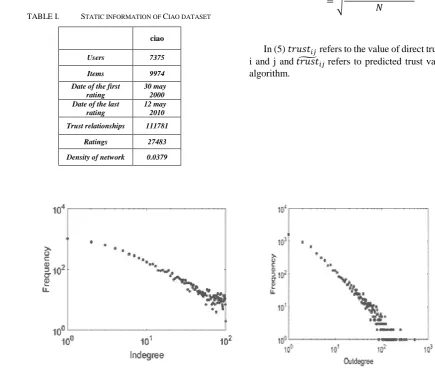
To evaluate accuracy of the proposed algorithm and compare it against TidalTrust and MoleTrust, all three methods are evaluated using the Ciao1 dataset that is a real-world dataset. The Ciao website is an e-commerce website where users write their opinions about the items, announce their trust to other users and, most importantly, they can rate other users' opinions. Trust information has two key uses. First, many users are looking at a particular category rather than a specific product. Therefore, a series of items should be displayed to them. To select the right items, they can use trust information. For the second key use, whenever a specific product is displayed to the user, a number of comments from other users about that product should also be displayed to him. Since the total number of related comments is often too many and study of them is time consuming, considering that quality of these comments will vary as well, hence, trust information can be used. Thus, with the help of trust relationships between the user and those who gave the ratings, and users who have expressed their views, it would be easy to choose the specific comments that will be useful for the user. The dataset consists of two subsets: a trust network dataset and a dataset for rating items. The statistical information of this dataset is presented in the table I.
Fig. 1 displays the number of trustors and trustees for each user in trust network. As fig. 1 shows, trust matrix is usually sparse since usually most people trust a small number of people. Fig. 2 displays the distribution of the input and output of the graph within the dataset. As fig. 2 shows, the distribution of input and output of the graph of the Ciao dataset has a power low distribution [20] that is common in social networks.
as follows: At first, one node is randomly selected, then 10 nodes among the neighbours of this node are randomly selected. For each of these 10 nodes, the previous steps are repeated again. This will continue until the number of nodes obtained reaches the number of desired nodes. Moreover, the trust values of the Ciao dataset include discrete numbers, and the proposed method requires use of a continuous dataset with trust values within [0-1] interval. Therefore, extracted datasets are converted to the continuous dataset using (4).
{
𝑇
1 = 𝑟𝑎𝑛𝑑(
01)
𝑇2 =
(
1 − 𝑇1)
∗ 𝑟𝑎𝑛𝑑(
01)
𝑇
3= 𝑇
1+ 𝑇
2∗
ln(𝑖𝑛𝑝𝑢𝑡
𝑑𝑒𝑔𝑟𝑒𝑒(𝐵))
ln (max _𝑑𝑒𝑔𝑟𝑒𝑒)
(4)
In (4), 𝑖𝑛𝑝𝑢𝑡_𝑑𝑒𝑔𝑟𝑒𝑒 (𝐵) is the number of nods who trust the node 𝐵, 𝑚𝑎𝑥_𝑑𝑒𝑔𝑟𝑒𝑒 is the maximum degree between all
of the nodes within the trust network. In this strategy, trust values are assigned to the edges so that nodes with higher inputs are more likely to be trusted.
In order to evaluate accuracy of the proposed method and compare it versus the TidalTrust and MoleTrust algorithms, the Leave-One-Out method that is commonly used in trust researches has been used. In this method, for nodes 𝑣𝑖 and 𝑣𝑗,
where the direct trust 𝑣𝑖 and 𝑣𝑗 is available, the indirect trust
(propagated trust) 𝑣𝑖 to 𝑣𝑗 is calculated using the proposed
algorithm then according to (5) difference between direct trust and propagated trust will be calculated. The mean absolute error value and the second root mean square error (The difference between direct trust and indirect trust of the two nodes) are considered as the criteria for evaluating accuracy of the algorithm.
𝑀𝐴𝐸 =|𝑡𝑟𝑢𝑠𝑡𝑖𝑗− 𝑡𝑟𝑢𝑠𝑡̃𝑖𝑗|
𝑁 . 𝑅𝑀𝑆𝐸
= √𝑡𝑟𝑢𝑠𝑡𝑖𝑗− 𝑡𝑟𝑢𝑠𝑡̃𝑖𝑗
𝑁
(5)
In (5) 𝑡𝑟𝑢𝑠𝑡𝑖𝑗 refers to the value of direct trust between users
[image:5.595.341.493.246.306.2]i and j and 𝑡𝑟𝑢𝑠𝑡̃𝑖𝑗 refers to predicted trust value by proposed algorithm.
TABLE I. STATIC INFORMATION OF CIAO DATASET ciao
7375 Users
9974 Items
30 may 2000 Date of the first
rating
12 may 2010 Date of the last
rating
111781 Trust relationships
27483 Ratings
0.0379 Density of network
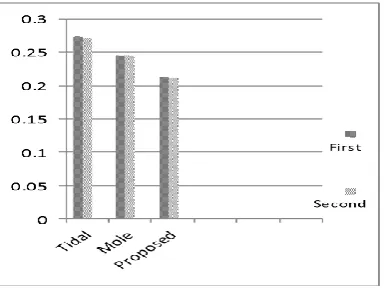
[image:5.595.57.493.289.660.2]Fig. 3 and fig. 4 show results of this method on the first and second subsets of Ciao dataset.
As these figures show, precision of the proposed method is more than TidalTrust and MoleTrust metrics. Results show that the proposed method outperforms the aforementioned methods applied on Ciao dataset.
V. CONCLUSION AND FUTURE WORK
Considering only the shortest paths and local prediction are main problems for TidalTrust and MoleTrust metrics. Considering only the shortest paths between any two nodes and using only limited local information leads to low accuracy in trust value prediction. It is noteworthy to say that it is possible to use a strategy where all the trusted paths considered. However, this strategy will suffer from high computational complexity and consequently it will not be applicable on large datasets.
High complexity of earlier methodologies increases the required computational power and consequently makes them unsuitable for online use. On the contrary, simplicity of the proposed method provides opportunities for online implications. In this paper, a trust prediction model to calculate trust propagation was proposed. In the future works, intention is to use other ranking methods that improve discovery of the most trusted path. For evaluating the proposed method, a small dataset has been used. In future works, using a much larger dataset to examine the proposed method will help to hammer and harden the method and to improve it. Dataset used in this research only includes trust relationships. The proposed method can be extended to use ranking methods in signed networks if a dataset with distrust information is applied.
VI. REFRENCES
[1] R. T. Mahani and M. Analoui, "Trust prediction in multiplex networks," in Knowledge-Based Engineering and Innovation (KBEI), 2015 2nd International Conference on, 2015, pp. 263-268: IEEE.
[2] J. Leskovec, D. Huttenlocher, and J. Kleinberg, "Signed networks in social media," in Proceedings of the SIGCHI conference on human factors in computing systems, 2010, pp. 1361-1370: ACM.
[image:6.595.139.443.65.206.2] [image:6.595.54.247.306.451.2][3] J. Leskovec, D. Huttenlocher, and J. Kleinberg, "Predicting positive and negative links in online social networks," in Proceedings of the 19th international conference on World wide web, 2010, pp. 641-650: ACM. Figure 2. Correlation between number of trustors and trustees
[image:6.595.53.242.505.656.2]Figure 3. RMSE results on first dataset
[4] K.-Y. Chiang, N. Natarajan, A. Tewari, and I. S. Dhillon, "Exploiting longer cycles for link prediction in signed networks," in Proceedings of the 20th ACM international conference on Information and knowledge management, 2011, pp. 1157-1162: ACM.
[5] J. Golbeck and J. Hendler, "Inferring binary trust relationships in web-based social networks," ACM Transactions on Internet Technology (TOIT), vol. 6, no. 4, pp. 497-529, 2006.
[6] C.-N. Ziegler and G. Lausen, "Propagation models for trust and distrust in social networks," Information Systems Frontiers, vol. 7, no. 4-5, pp. 337-358, 2005.
[7] P. S. Chakraborty and S. Karform, "Designing trust propagation algorithms based on simple multiplicative strategy for social networks,"
Procedia Technology, vol. 6, pp. 534-539, 2012.
[8] Y. A. Kim and H. S. Song, "Strategies for predicting local trust based on trust propagation in social networks," Knowledge-Based Systems, vol. 24, no. 8, pp. 1360-1371, 2011.
[9] A. Abdul-Rahman and S. Hailes, "Supporting trust in virtual communities," in System Sciences, 2000. Proceedings of the 33rd Annual Hawaii International Conference on, 2000, p. 9 pp. vol. 1: IEEE. [10] G. Gans et al., "Requirements modeling for organization networks: a (dis)
trust-based approach," in Requirements Engineering, 2001. Proceedings. Fifth IEEE International Symposium on, 2001, pp. 154-163: IEEE. [11] L. Mui, M. Mohtashemi, and A. Halberstadt, "A computational model of
trust and reputation," in System Sciences, 2002. HICSS. Proceedings of the 35th Annual Hawaii International Conference on, 2002, pp. 2431-2439: IEEE.
[12] J. A. Golbeck, "Computing and applying trust in web-based social networks," 2005.
[13] U. Kuter and J. Golbeck, "Sunny: A new algorithm for trust inference in social networks using probabilistic confidence models," in AAAI, 2007, vol. 7, pp. 1377-1382.
[14] P. Massa and P. Avesani, "Trust metrics on controversial users: Balancing between tyranny of the majority," International Journal on Semantic Web and Information Systems (IJSWIS), vol. 3, no. 1, pp. 39-64, 2007. [15] H. Shakeri and A. G. Bafghi, "RTBIMS: Accuracy enhancement in
iterative multiplication strategy for computing propagated trust," in
Information Security and Cryptology (ISCISC), 2011 8th International ISC Conference on, 2011, pp. 9-14: IEEE.
[16] M. Lesani and S. Bagheri, "Applying and inferring fuzzy trust in semantic web social networks," Canadian Semantic Web, pp. 23-43, 2006. [17] S. Schmidt, R. Steele, T. S. Dillon, and E. Chang, "Fuzzy trust evaluation
and credibility development in multi-agent systems," Applied Soft Computing, vol. 7, no. 2, pp. 492-505, 2007.
[18] S. Nefti, F. Meziane, and K. Kasiran, "A fuzzy trust model for e-commerce," in E-Commerce Technology, 2005. CEC 2005. Seventh IEEE International Conference on, 2005, pp. 401-404: IEEE.
[19] M. Lesani and N. Montazeri, "Fuzzy trust aggregation and personalized trust inference in virtual social networks," Computational Intelligence,
vol. 25, no. 2, pp. 51-83, 2009.
[20] J. Tang, H. Gao, and H. Liu, "mTrust: discerning multi-faceted trust in a connected world," in Proceedings of the fifth ACM international conference on Web search and data mining, 2012, pp. 93-102: ACM. [21] M. Hosseinzadeh Aghdam, M. Analoui, and P. Kabiri, "Modelling trust
networks using resistive circuits for trust-aware recommender systems,"
Journal of Information Science, vol. 43, no. 1, pp. 135-144, 2017. [22] R. Guha, R. Kumar, P. Raghavan, and A. Tomkins, "Propagation of trust
and distrust," in Proceedings of the 13th international conference on World Wide Web, 2004, pp. 403-412: ACM.
[23] A. Jøsang, E. Gray, and M. Kinateder, "Simplification and analysis of transitive trust networks," Web Intelligence and Agent Systems: An International Journal, vol. 4, no. 2, pp. 139-161, 2006.