Open source e-learning application adoption: Medical
colleges in a developing world.
MOURADY, Ahmed.
Available from Sheffield Hallam University Research Archive (SHURA) at:
http://shura.shu.ac.uk/20764/
This document is the author deposited version. You are advised to consult the
publisher's version if you wish to cite from it.
Published version
MOURADY, Ahmed. (2011). Open source e-learning application adoption: Medical
colleges in a developing world. Doctoral, Sheffield Hallam University (United
Kingdom)..
Copyright and re-use policy
| Learning and ST
Services
' ;; Centre
‘ Co’le .'^ e Crescent
Campus
Sheffield SI 0 2BP
1 02 0 0 5 5 2 3 5
ProQuest Number: 10702866
All rights reserved
INFORMATION TO ALL USERS
The quality of this reproduction is dependent upon the quality of the copy submitted.
In the unlikely event that the author did not send a com plete manuscript and there are missing pages, these will be noted. Also, if material had to be removed,
a note will indicate the deletion.
uest
ProQuest 10702866
Published by ProQuest LLC(2017). Copyright of the Dissertation is held by the Author.
All rights reserved.
This work is protected against unauthorized copying under Title 17, United States C ode Microform Edition © ProQuest LLC.
ProQuest LLC.
789 East Eisenhower Parkway P.O. Box 1346
Open Source E-Learning Application Adoption: Medical Colleges in a
Developing World
Ahmed Mourady
A thesis submitted in partial fulfilment of the requirements of Sheffield Hallam University
for the degree of Doctor of Philosophy
PhD Abstract
A review of normative literature, in the field of Electronic Learning (e-learning) implementation, indicates that traditional approaches to e-learning implementation in higher education have failed to result in cost effective, integrated and sustainable learning environment. In addressing this issue, a new movement called Open Source (OS) has emerged and addresses most of traditional e-learning application by resulting in the development of reusable and manageable platforms. The use of Open Source E- Learning Applications (OSELA) in Higher Education Institutes (HEI) is a new research area with many research issues needing to be investigated. At this end, OSELA adoption has not efficiently studied with HEI and researchers needing to understand and analyze OSELA adoption.
This work examines the introduction of Open Source E-Learning Applications in Higher Education Institutes and proposes a novel model for its adoption. The model is based on a comprehensive set of factors that influence the introduction of OSELA in HEI.
The work is based on a qualitative case study approach to examine the concepts of the proposed model for the adoption of OSELA. In doing so, three case studies were conducted in Medical Higher Education Institutions. The case studies were presented and analyzed. However, some modifications were made to the conceptual model as some complementary factors emerged during the empirical research. The main factors that influence the adoption of OSELA are: (a) costs; (b) benefits; (c) barriers; (d) external pressures; (e) support; (f) level of IT sophistication; (g) limitations of existing IT infrastructure, (h) internal pressure and, (i) an evaluation framework that supports higher education institutes to assess OSELA.
Acknowledgments
I would like to thank my supervisors Dr Frances Slack and Dr. Martin Beer for their time, guidance and kind support during my thesis. I would like to express my deep gratitude to Dr. Frances for guiding me as I discover a lot of my strength and my passion for learning and research.
I acknowledge the case studies Institutions and their staff, for their time and assistance in collecting empirical data to ensure the completion of this thesis. I would like to extend my thanks to Professor Dr. Mahmoud El Zalabany for his support and encouragement.
To my brothers and sisters, who were supportive with their prayers for me in this journey, I say thank you for your patience, continuous support and encouragement and
Say, "O my Lord! Advance me in knowledge."
To Samro and Fatuma,
Shahira,
Ta b l e o f Co n t e n t s
Chapter 1. Introduction... 1
1.1 Background to the Research Problem: e-learning evolution in higher education and the need for innovative solutions...2
1.2 Proprietary Software in higher education... 4
1.3 The need for an Integrated Open Source E-Learning Application (OSELA) 5 1.4 OSELA...7
1.5 Research Aim and Objectives...9
1.5.1 Research A im ... 9
1.5.2 Research Objectives...9
1.5.3 Thesis O utline... 10
Chapter 2. Literature review ... 13
2.1 Open Source...14
2.2 Limitation of proprietary software in higher education...18
2.2.1 Financial... 18
2.2.2 Technical... 19
2.2.3 Managerial...19
2.2.4 Pedagogical...19
2.3 Motivation of OSS adoption in HEI...19
2.3.1 C o st...22
2.3.2 Community... 27
2.3.3 Freedom...29
2.4 Benefits of OSS in H E I... 32
2.4.1 Pedagogical... 32
2.4.2 Technological...33
2.4.3 Economical... 34
2.4.4 Philosophical...34
2.5 Barriers to OSS in H E ... 36
2.6 Opportunities for Developing Countries... 37
2.7 Challenges for developing countries... 38
2.7.1 Lack of local OSS talents... 39
2.7.2 OSS Governmental Policies...39
2.7.3 ICT convergence and governance...39
2.7.4 Procurement and selection...40
Chapter 3. Open Source E-Learning Application Adoption M odel... 42
3.1 Novel taxonomy for classifying types of O SE LA ... 43
3.1.1 Learning Applications...47
3.1.2 Supportive Services...49
3.1.3 Business Services...50
3.1.4 OS Infrastructure... 52
3.2 Open Source Applications Requirements... 53
3.3 Application Purpose...58
3.4 Novel Evaluation framework for Evaluating OSELA in H E I...58
3.5 A Novel Model for the Adoption of OSELA...62
3.5.1 Costs...68
3.5.2 B enefits... 68
3.5.3 Barriers... 69
3.5.4 External pressures... 69
3.5.5 Support... 69
3.5.6 The level of IT sophistication...70
3.5.7 IT infrastructure... 70
3.5.8 The evaluation fram ework... 71
Chapter 4. Research Methodology... 73
4.1 Selecting an Appropriate Research A pproach...75
4.2 Identifying Research m ode... 76
4.3 Identifying Research Strategy...78
4.4 Empirical Research methodology... 80
4.4.1 Justification for multiple case study strategy...80
4.4.2 Case Study protocol...81
4.4.3 Case Study Overview...82
4.4.4 Fieldwork procedures...82
4.4.5 Gaining Access to key institutions...82
4.4.6 Identifying appropriate resources while in field ...83
4.4.7 Developing a procedure for assistance and guidance...83
4.4.8 Develop contingency plan...83
4.4.9 Fieldwork questions...85
4.4.10 Data Collection...85
4.4.11 Data A nalysis...91
Chapter 5. Case Studies and Preliminary Research Findings...94
5.1 Case Study one - The ALM EDCO...97
5.1.1 Background to the organisation... 97
5.1.2 Background to e-leaming adoption drivers... 97
5.1.3 Motivation to OSELA adoption... 101
5.1.4 OSELA adoption process...103
5.1.5 Evaluation of O SELA ... 105
5.1.6 Assessment of the proposed Evaluation Framework for OSELA adoption 106 5.1.7 Pilot of OSELA Adoption...115
5.1.8 B enefits...117
5.1.9 Barriers...119
5.1.10 Costs... 120
5.1.11 Support...121
5.1.12 External Pressure...122
5.1.13 IT Sophistication...123
5.1.14 ICT infrastructure...124
5.2 Case Study Two - The ALDENCO...126
5.2.1 Background to the organisation...126
5.2.2 Background to e-learning adoption drivers...126
5.2.3 Motivation to OSELA adoption...129
5.2.4 OSELA adoption process...130
5.2.5 Evaluation of O SELA ...131
5.2.6 Assessment of the proposed Evaluation Framework for OSELA adoption 131 5.2.7 Pilot of OSELA Adoption...139
5.2.8 B enefits... 139
5.2.9 Barriers...141
5.2.10 Costs...142
5.2.11 Support...143
5.2.12 External Pressure...143
5.2.13 IT Sophistication...144
5.2.14 ICT infrastructure... 144
5.3 Case Study Three - The M AM EDCO...146
5.3.2 Background to e-leaming adoption drivers...146
5.3.3 Motivation to OSELA adoption...149
5.3.4 OSELA adoption process... 150
5.3.5 Assessment of the proposed Evaluation Framework for OSELA adoption 151 5.3.6 OSLMS A doption...158
5.3.7 B enefits...158
5.3.8 Barriers... 159
5.3.9 Costs...160
5.3.10 Support... 161
5.3.11 External Pressure... 162
5.3.12 IT Sophistication...162
5.3.13 ICT infrastructure...163
Chapter 6. Case study analysis...164
6.1 Environment...165
6.2 Organisation...166
6.3 Technology... 168
6.4 Learning from case studies... 169
6.5 The revised conceptual model of OSELA adoption...172
6.5.1 C o st...172
6.5.2 B enefits... 173
6.5.3 Barriers... 173
6.5.4 External pressures...174
6.5.5 Support... 174
6.5.6 The level of IT sophistication... 175
6.5.7 IT infrastructure... 175
6.5.8 Internal pressure... 175
6.6 The revised evaluation framework...178
Chapter 7. Conclusions and future research...180
7.1 Thesis Review ...180
7.2 Research contributions... 183
7.2.1 Novel model for OSELA adoption and evaluation... 183
7.2.2 Novel framework for evaluating O SELA ...183
7.2.3 Novel taxonomy for classifying types of O SE LA ... 184
References 186
Appendix I - Egyptian Educational Systems... 205
Egyptian Educational System ...205
Egyptian Higher Education challenges...207
Egyptian Higher Education Reform...208
E-learning in Egyptian Higher Education Sector... 208
E-learning in Egyptian Medical sector... 210
Egyptian Universities challenge...213
Appendix H - Interviewees... 215
Appendix III - Interview Agenda...216
Section A - General Institution Information...217
Section B - Technical Inform ation...219
Section C - Business Information... 223
Section D -Framework Assessment...226
L
ist of Tables
Table 2.1: Classification for the value proposition for open source application to
proprietary software...22
Table 2.2: Deployment cost differences between Proprietary and Open Source Software ... 25
Table 3.1: Application requirements... 57
Table 3.2: Evaluation Criteria...60
Table 3.3: Novel Evaluation Framework for the selection of Open Source E-Learning A pplications... 61
Table 4.1: Data collection using interviews...84
Table 4.2: Qualitative data sources and their use in this research...86
Table 4.3: Classification of interviews... 88
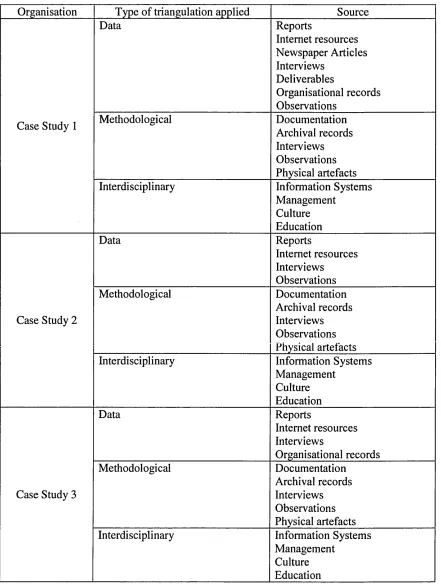
Table 4.4 Types of Triangulations used in this research... 92
Table 5-1: Importance of Application requirements at ALM ED CO... 107
Table 5.2: ALMEDCO evaluating OSELA using application purpose...109
Table 5.3: ALMEDCO evaluating OSELA using e-learning m ode... 113
Table 5.4: ALMEDCO evaluating OSELA using Application purpose and e-learning m ode... 114
Table 5.5: Classification of ALMEDCO"s OSELA adoption costs... 121
Table 5.6: Importance of Application requirements at ALD ENCO... 132
Table 5.7: ALDENCO evaluating OSELA using application purpose...134
Table 5.8: ALDENCO evaluating OSELA using e-learning m ode...136
Table 5.9: ALDENCO evaluating OSELA using Application purpose and e-learning mode... 138
Table 5.10: Classification of ALDENCO's OSELA adoption costs... 142
Table 5.11: Importance of Application requirements at M AM ED CO...152
Table 5.12: MAMEDCO evaluating OSELA using application purpose... 154
Table 5.13: MAMEDCO evaluating OSELA using e-learning m ode...156
Table 5.14: MAMEDCO evaluating OSELA using Application purpose and e-learning m ode... 157
Table 5.15: Classification of MAMEDCO’s OSELA adoption co sts... 161
L
ist of figures
Chapter
Introduction
Chapter 1. INTRODUCTION
During the last decade, the continuous and rapid advancement and development in Information and Communication Technology (ICT) have led Higher Education Institutes (HEI) to dramatically change learning methodologies, create new learning environments and adopt various Information Systems (IS) to automate their learning processes. Moreover, the Internet has radically changed the way professors and students can access information. The concept aimed at utilising ICT tools and the Internet to improve the learning processes and its availability and accessibility is referred to as Electronic Learning or simply (e-learning).
In recent years, emerging software called Open Source Software (OSS) has attempted to effectively address many proprietary software problems and thus, result in the development of free, flexible, and maintainable information systems. OSS is a new research area and therefore, scientific research and literature around it, remain limited. Moreover, the impact of OSS on HEI remains under explored especially in developing countries.
In addressing this issue, the research presented in this thesis investigates and evaluates the impact o f adopting open source software on e-leaming implementation in public higher education institutes in developing countries as well as its adoption. This chapter explains why existing proprietary software has limitations in providing e-learning solutions to higher education institutes, introduces OSS as an alternative method to implement e-learning, and discusses the need for the development of a single integrated Open Source E-Learning Application (OSELA). The aim and objectives of this research are defined with an outline of the dissertation presented at the end of this chapter.
1.1 Ba c k g r o u n d t o t h e Re se a r c h Pr o b l e m: e-le a r n in g
EVOLUTION IN HIGHER EDUCATION AND THE NEED FOR INNOVATIVE
SOLUTIONS
integration of IT and the curriculum to achieve a new learning style which can fully reflect the main role of the education to train large members of high quality personnel".
In higher education, e-learning is emerging and becoming increasingly prominent, with universities increasing provision and more students engaging. There is a great hope that e-learning will solve many problems, improve professional development, encourage collaboration, and integrate technology into curricula (Broadbent 2002). In the literature, many authors like (Baltes 2010, Dhanarajan 2001) claim that the implementation of e-learning tools will raise the number of students who have access to higher education. In the UNESCO teacher report, there are strong beliefs that e- learning will have huge potential for government to meet a growing demand for education while facing an escalating shortage of teachers (Mason 2006).
In the normative literature, many researchers identified the benefits of e-learning, such as time reduction, large volume and diversity of learners, cost reduction, higher content retention, flexibility, updated and consistent material, and the creation of a fear free learning environment (Zhang et a l, 2004); (Liaw et al. 2007, Delahoussaye et a l 2001, Urdan and Weggen 2000).
Despite the numerous potential benefits, (Turban, et a l 2010) cite some drawbacks like:
• the need of instructor retraining, • equipment needs and support services, • maintenance and updating,
• protection of intellectual property, • Computer literacy and student retention.
Wan et al. 2008, Sife et al., 2007). Still, there are many other challenges other than educational technology to be considered, such as the lack of e-leaming components in certain areas for example, computers, internet accessibility and proper bandwidth (Heeks 2002, Rajesh 2003), the lack of skills, shortage of online teachers and lack of active participative students (Evans 2005, Sehrt 2004). In their recent study, Andersson and Gronlund (2009) found 30 specific challenges for e-leaming in both developed and developing countries. Those 30 challenges were grouped into four categories, namely: courses, individuals, technology and context.
While technology plays a major part in any e-leaming initiatives, still the decision to use this technology is crucial in a way that is aligned with institution’s merits and values (Olla, 2007) and with different learning styles (Collins, 2009), and the technology chosen should support the chosen learning model and pedagogy (Dewever, 2006). In today’s global changes in education environment, leaders must be innovative to not only elevate the stature of their institutions, but simply to survive. The demands on higher education require both a fundamental change in direction, and the technology to facilitate that change.
1.2 Pr o pr ieta r y So ftw a r e in h ig h ere d u c a t io n
While some HEI have been well served by proprietary Software, others have been disappointed. In their research Courant and Griffiths (2006) found dissatisfaction among sixty-six stakeholders across higher education with the cost, performance, and control of proprietary software. Some interviewees expressed concerns that large vended systems gave institutions too little flexibility to adapt systems for specific needs. They were charged for adaptation and were required to pay high fees for local customisations to meet their academic needs. Indeed, proprietary software does not always allow modification of the code, nor access to application databases, making it difficult to customise or localise the application for a particular campus environment without incurring extra cost. From a technical perspective, this vendor lock "Closed Source" makes it difficult to integrate the proprietary system with other campus technologies such as student information systems and financial systems (Brooks, 2007). These scenarios left HEI locked in to software that is expensive to upgrade and to maintain.
Moreover, studies reported the decline of the number of commercial Learning Management Systems (LMS) over the past ten years from a dozen to just a few, causing many HEI to become concerned about the risk of monopolisation in the commercial LMS marketplace (Collins, 2009, Lakhan and Jhunjhunwala 2008). The changing proprietary software vendor business models and increasing mergers and acquisitions, created fear, uncertainty, and doubt about the future of proprietary software in the higher education sector (van Rooij 2009).
1.3 Th e n e e d fo r a n In t e g r a t e d Op e n So u r c e E-Le a r n in g
Applic a tio n (OSELA)
differ in the type of solution they provide and none of these applications alone combine all features to fulfill HEI requirements (Sclater 2008).
Today's students and staff have high expectations for the IT services that colleges and universities should provide. They assess colleges and universities' IT services with other public services free offerings (unlimited storage for e-mail, videos and files; social networking, accessibility to personalised contents, etc.). Technology expectations of students who were born in the digital age, and a long list of staff requirements for e- learning functionality are beyond the capability of any LMS (Smith et a l 2009, Palfrey and Gasser 2008). These challenging expectations are forcing HEI to improve efficiencies and enhance performance whilst adopting new technologies to remain competitive. HEI are looking for a comprehensive, fully functional system which is built for higher education, to fit its unique business processes and interactively linking the different layers and functions of governance (Wilsdon and Bentley 2003). Expectations are growing for updated and effective systems that are more usable for end users, more flexible for administrative, regulatory, and policy changes and that provide the necessary functionality required by higher education. Van Rooij (2009) clarified HEI need to have an integrated learning environment that serves both academic and administrative needs, and create a balance between sound pedagogy and business efficiency.
It is becoming clear that in order to fulfill HEI requirements and meet students and staff expectations, there is a need to piece together different available open source e-learning programmes into one single integrated Open Source E-Learning Application (OSELA) that can coordinate resources, sustain software, and enable campus-wide interoperability. By the use of OSELA, the cost of integration could be significantly reduced, as most of the possible selected applications are using the same software architecture and share the same coding platform. Gozdiskowski and Chen (2007) considers open source as a great solution for any university looking to start an integrated virtual university. They claim that with open source, HEI can start immediately with a base and develop from it to incorporate more applications.
1.4 OSELA
Following on from discussions in the previous sections, HEI need a unified e-learning system that integrates all e-leaming applications. The present and next paragraphs introduce the main research area of this dissertation, which is Open Source E-Learning Application (OSELA) adoption and evaluation.
Whilst OSS innovation has been extensively studied with several studies of OSS adoption in public organisations (Rentocchini and Tartari 2010, Lundell et a l 2006, Rossi et al. 2006, Ven et a l 2007), there is very little research literature on the adoption of Open Source Learning Management System (OSLMS) in higher education institutes (Machado 2005, van Rooij 2009, van Rooij 2007, Albarrak et al. 2010, Khelifi et a l
According to Source Forge, a large open source public repository, the number of registered open source projects specifically intended for the education sector is 5,235 projects and applications (SourceForge 2010). Adding other large open source public repositories like FreshMeat, and EduForge , the number of projects and application is over 7,000. Those educational projects focus on a variety of solutions, such as portals, classroom testing and assessment, library systems, learning management systems, content development and authoring tools amongst other applications.
As the Open Source E-learning market offering is very heterogeneous with a large product variety, there is a confusion surrounding the use of open source applications and tools in higher education institutes. For this diversity OS e-leaming applications exist, and there is an increasing need to know how to evaluate them in order to choose the best applications that can interoperate together and share a common, managed set of features that will satisfy and accommodate the ever changing needs of HEI. In the same context, the variation of HEI needs, and increased system complexity, trigger the need for an evaluation framework to assist decision makers in their selection process.
The OSS term in this thesis will refer to all software that is produced and developed following the model of Open Source as defined by the OSI. It will include all applications developed either for general use, specific industrial purpose, education domain or any other domain. Meanwhile, the term OSLMS will be used to identify the Open Source Learning Management System that is used solely for teaching and learning purposes and is developed for e-leaming activities (E.g. Moodle, Sakai, Kuali, etc.). While the term OSELA is introduced by the author and will be used to determine the integrated platform that integrates all applications related to the creation of e-leaming environment and campus wide e-learning applications.
the code) but say different things about the software values and represents different philosophies in the open source movement.
1.5 Rese a r c h Aima n d Objectives
1.5.1 Research Aim
Much of the research surrounding OSS has focused inward on the phenomenon itself, studying the motivations of developers and community members to contribute to OSS projects, or investigating the characteristics of specific OSS products and projects. Far less has been done in looking outward at the process of OSS adoption, and to the author's knowledge to date; only a few studies have focused on the adoption of OSS for e-leaming in HEI. Furthermore, to the best of the author's knowledge, OSELA adoption and evaluation is the first study into adoption of integrated open source e-leaming applications in public HEI.
Therefore, to better understand the issues surrounding OSELA, HEI may benefit from a frame of reference to support the building of an integrated learning environment. Such a frame of reference will better help HEI to understand the impact of OSELA on both academic and administrative stmctures, before proceeding with their investment strategy. In doing so, HEI may maximise business benefits, gain strategic advantages, and transform the institution. As a result, the aim of this thesis is to:
Evaluate the adoption of Open Source E-Learning Application (OSELA) inn Higher Education Institutes in developing countries.
1.5.2 Research Objectives
• To conduct a comprehensive literature review in the area of e-learning in Higher Education with a particular focus on Open Source Software adoption and evaluation.
• To assess approaches associated with the adoption of OSELA. In doing so, identifying why, how and in what way OSELA has been adopted.
• To develop and propose a frame of reference that can be translated into a model for OSELA adoption and evaluation.
1.5.3 Thesis Outline
The structure of this PhD thesis follows the methodology described by (Phillips and Pugh 2005) and consists of four elements namely: (a) background theory; (b) focal theory; (c) data theory and (d) novel contribution. Background theory focuses on assessing the field of research and identifying the problem domain (Chapters 2 and 3). The second element of the dissertation (focal theory) deals with generating conceptual models. This is explained and discussed in Chapter 4. Data theory addresses issues such as: (a) the most appropriate epistemological stance to adopt; (b) the development of a suitable research methodology and, (c) the conditions affecting the choice of research strategy. These issues are discussed in Chapter 5 of this thesis. In addition, data theory deals with the data collection process and analysis, which is reported in Chapter 6. The fourth element (novel contribution) is concerned with aligning the importance of the thesis, to the development of the discipline being researched which is reported in Chapter 7. The conclusions and future reaserchs are summarised in Chapter 8. The dissertation is composed of eight chapters with each of the chapters providing an understanding to various issues viewed to be critical for this research. The dissertation outline is explained in the following paragraphs.
Chapter 1: Introduction
Chapter 2: Egypt Higher Education System
Chapter two explores the Higher Education System in Egypt. By discussing the nature of Egyptian HE system, the author attempts to clarify the challenges of the current situations and the opportunities e-learning will bring to the sector reform.
Chapter 3: Literature Review - Background Theory
Having provided a brief introduction to the area of research and establish the scope, the dissertation then begins to review the literature on Open source. It begins with describing the limitations of proprietary software in higher education; explore the opportunities, benefits and barriers to open source adoption in HEI with more focus on developing countries.
Chapter 4: Open Source E-Learning Application Adoption Model - Focal Theory
Chapter 4 attempts to review the diversity of open source e-learning applications and proposes a novel taxonomy for categorising Open source e-leaning applications types. Thereafter, Chapter 4 investigates the nature of different OSELA and proposes a novel evaluation framework to evaluate them. The evaluation framework contributes towards a better understanding of the capabilities of each application. Thereafter, a novel model for the adoption of Open Sourced E-Learning Applications (OSELA) is developed and analysed. The model proposes factors that influence the adoption of OSELA namely: (a) costs; (b) benefits; (c) barriers; (d) external pressures; (e) support; (f) level of IT sophistication; (g) limitations of existing IT infrastructure and, (h) an evaluation framework that supports higher education institutes to assess (OSELA). Chapter 4 ends by discussing opportunities and challenges for developing countries to use OSELA.
Chapter 5: Research Methodology - Data Theory
research methods is stated within Chapter 5. The inherent problems within the various research philosophies are stated and the suitability to this research is provided. The research strategies existing within the IS field are also described and discussed within this chapter.
Chapter 6: Case Studies and Preliminary Research Findings - Data Theory
Having obtained an understanding of all the relevant issues for this research, the dissertation then provides a description of the case studies studied for this research. In this context, three Higher education medical colleges in a developing country are studied and their attempts to implement OSELA are reported. Chapter 6 provides a background to the colleges and describes and analyses the main issues including: (a) the motivations to OSELA adoption; (b) the adoption process; (c) the evaluation of OSELA; (d) the pilot case studies and (e) OSELA benefits, barriers and costs.
Chapter 7: OSELA Adoption Model - Novel Contribution
Based on the case studies and the research findings, the conceptual model proposed in Chapter 4 is revised. The revision implies adding and removing some factors.
Chapter 8: Conclusions and future research
Chapter ^
Literature review
Chapter 2. L
it e r a t u r e r e v ie wThis chapter presents a critical review of e-learning literature with focus on Open Source Software adoption in higher education sector. The chapter starts by investigating the general applicability of OSS in higher education in general, and goes on to focus on issues relevant to developing countries in specific. The aim of this chapter is to provide the background knowledge needed to identify and analyse factors and why they influence the adoption of OSS by HEI. Moreover, the review of previous studies in this field allows for the identification of lessons that can help in better understanding the adoption of OSS by HEI in this study. In doing so, this chapter presents: (a) Key factors in adopting OSS in higher education (b) classification for OSS benefits and barriers, and (c) factors related to OSS adoption in HEI in developing countries.
the adoption of OSS in HEI and classify them. Sections 2.6 and 2.7 discuss issues related to the opportunities and challenges for the adoption of OSS by HEI in developing countries.
2.1 Open So u r c e
Open source software (OSS) has elicited a great deal of research interest across a range of disciplines since the term was introduced in late 1990s. The underlying concept of open source software is access to statement and codes written by developers of a certain programme in a programmeming language such as Java, Php, and C++. This accessibility allows the user to use and modify the code as needed.
The term free software was first proposed and adopted by Richard M. Stallman, the father of the free software movement (Stallman, 2010). To accomplish his cherished goal of free software sharing, Stallman decided to devise an open operating system, the source code of which can be accessed, used, and modified freely by any one. Stallman called the result free software and named it GNU Project. Along with the GNU Project, Stallman also established the Free Software Foundation (FSF) to further promote the concept of free software and announced four types of freedom:
1. Run a software programme for any purpose,
2. Study how the programme works, and adapt it to an individual’s or organisation’s needs,
3. Redistribute copies to help other developers, and
4. Improve the programme and release those improvements to the whole community.
without modifications, either gratis or charging a fee for distribution, to anyone anywhere. Publishing changes should not be required to notify anyone in particular, or in any particular way. The freedom to redistribute copies must include binary or executable forms of the program, as well as source code, for both modified and unmodified versions.
As mentioned above, free software does not refer to software that is distributed at no charge, but the term was found to be misleading and hindered the commercialization of free software. Therefore, an alternative term was sought. Finally the term open source software was chosen, its characteristics defined, and the Open Source Initiative (OSI) which is an organisation dedicated to managing the open source campaign and its certification mark, has expanded beyond the freedom to use software and specified what is permissible in a software licence for that software to be referred to as open source (Open Source Initiative 2009), including:
1
. Free redistribution; 2. Source code access;3. Distribution of modification works; 4. Integrity of author’s source code;
5. No discrimination against persons or groups; 6. Distribution of Licence;
7. Licence not specific to a product;
8. Licence non-restrictive of other software, and 9. Licence is technology neutral.
The FSF and the OSI represents two distinct philosophies in the open source movement. FSF considers that proprietary software limits the users' right of sharing is immoral. Therefore, FSF is against private software patents and other restrictions. However, open source software's core idea is that open source software represents a more efficient development model than proprietary software. OSI thought perhaps in the end the open source culture will triumph not because cooperation is morally right or proprietary software is morally wrong, but simply because the closed source world cannot win the race with open source communities can put orders of magnitude more skilled time into a problem. From Stallman's view, open source is a development methodology; free software is a social movement. The FSF continues to use the term “Free Software”, to express the idea that freedom, not just technology, is important. While the OSI continues to use the term "Open Source", to refer to the concept and practice of making programme source code openly available. “Free Software” and “Open Source” describe the same category of software, more or less, but say different things about the software, and about values. Common to both the FSF and OSI is the belief in access to source code.
However, there is a dangerous ambiguity in the term "Free Software" in the FSF definition, due to "free" meaning both "freedom" and "gratis". Free Software does not have to be gratis, even more it usually is not, or at least, not completely. Moreover, the FSF believes it to be immoral and unethical to use anything other than free software, whereas the OSI believes that there is a place for both open and closed-source software.
In this thesis, in order to eliminate the confusion surrounding the term (Free) and to conform with OSI beliefs of open and closed-source systems coexistence, the term "Open Source Software (OSS)" will be the term used when referring to programmes and software with code openness availability (accessibility to use and modify the code) and users' freedom of use and redistribution of software. Therefore, it is the OSI's concept of open source that is used throughout this thesis.
that ensure the integrity of OSS. Users of OSS have access to the source code, and are free to modify it to suit their specific requirements. In the same context, the open source model promotes collaboration and sharing of resources. It creates a community of people that work together to achieve common goals and OSS users can rely on the Open Source Community or a third party vendor for technical support. Finally, OSS is mostly free; users do not have to pay upfront fees to purchase the software nor do they have to pay for annual licence, fees for upgraded versions, or updates.
In the literature, many arguments are favouring OSS when compared to proprietary software. Olla (2007) and Lakhan and Jhunjhunwala (2008) noted that benefits using OSS, amongst many others, are increased quality, greater stability, reduced vendor reliance, reusability, service community, and reduced cost and reliability. Voightmann and Coleman (2003) included OSS as an example of technology for the common good. Moreover, van Rooij (2009) considers it a means of eliminating vendor Licence fees and identified five benefits dominating the literature surrounding OSS, namely; (a) Social and philosophical benefits; (b) software development methodology benefits; (c) security and risk management benefits; (d) software adoption life cycle benefits; and (d) total cost of ownership benefits.
2 .2 Lim it a t io n o f p r o p r ie t a r y s o f t w a r e in h ig h e r e d u c a t io n
In their comprehensive report, Courant and Griffiths (2006) noted that the use of proprietary software in e-leaming implementation in higher education sector in the past few years has resulted in many drawbacks including among others the need for extra cost to prepare IT infrastructure for special hardware requirements. Pfaffman (2007) claimed Proprietary software to be inconvenient when used in the higher education sector. It is inconvenient to purchase additional Licences for new machines, to negotiate a new Licence agreement each year, to support multiple versions of a package for machines purchased at different times, and it is inconvenient for students not to have the same software at home and at university. Moreover, in their study, Machado (2005) claims that the most popular reasons HEI respondents gave for choosing OSS packages over proprietary software was interoperability. Interoperability and open standards are fundamental prerequisites for a holistic and integrated IT environment which ensure the reusability of many of the objects that are free copyrighted. In the same context, the eLearning Industry Group (e-Leaming Industry Group 2009) fully supports the openness of the learning process and the interoperability of learning related services and digital educational resources. Moreover, it calls for the Internet-scale platforms used for educational and learning purposes to be open standards based and should allow open integration with complementary services. This limitation of proprietary software is reflected in various areas. These areas are represented in the following sub sections.
2.2.1 Financial
2.2.2 Technical
E-learning projects tend to integrate various services into one integrated platform to support different institutional needs and requirements. The closed model offered by the proprietary software causes many obstacles for institutions that need to unify their information systems and fully automate their operations. The situation becomes more complicated when future needs to add different applications or services to the platform as in the majority of cases in higher education.
2.2.3 Managerial
Many studies have noted that the adaptation from industry proved to be of little use in higher education sector and often does not fit or comply with educational institutions (Courant and Griffiths 2006). Furthermore, proprietary software was shoehomed into academic environment and resulted in less functionality, expensive customisation, and locking institutions into single source contracts (Brooks 2007). Meanwhile, HEI administrators started questioning the ability of proprietary software vendors to provide the higher education sector with specific products in academic areas in a stable and affordable manner (Abel 2006).
2.2.4 Pedagogical
In many reported case studies, academic staff were not happy with the performance and results of some systems after being purchased and deployed. This could be justified as in the majority of cases, decision making related to the selection of LMS was done by administration (biased to financial and managerial issues) and not by academics (biased to pedagogical and learning features). The only solution for some systems was to move from one provider to another, which is costly since expensive customisations and localisation had to be repeated and interfaces with other systems had to be rebuilt.
2.3
Mo t iv a t io no f OSS a d o p t io n in HEIsame time, there is rising pressure on colleges and universities to contain the cost of higher education and to leave more money in the treasury for academic pursuits, rather than for overhead expenditure (Machado and Thompson 2005, Dewever, 2006). Colleges' tight resources will be unable to keep pace with the rapidly growing demand for IT services or meet students and staff high expectations (Wheeler, 2007) nor can they afford to pay for a proprietary application that can be locked and will not be able to interoperate with future needed applications (Brooks, 2007). On the contrary, colleges and universities need applications and systems capable of continuously reconfiguring themselves to create new sources of public value. These contradictions, and the combined effect of financial and technological pressure, have encouraged many HEI to look towards creative, and alternative ways, as well as innovative approaches of using scarce resources to support inducing technology to learning, teaching and research (Bayne, 2009).
Today's higher education environment is marked by heightened accountability and decreased budgets. In such an environment, no higher education institution can afford to ignore alternative approaches that could result in more effective and less costly solutions (Trappier 2009). Many studies have noticed an increase in the adoption of OSS in e-leaming. In their study among more than 450 further and higher education institutions in the U.K., Cox and Emmott (2007) noticed a dominance of OSS in LMSs adoption with Moodle adoption of (39%) followed by Blackboard (19%) and WebCT (9%). These adoption trends increased noticeably in 2008 (Canas 2009). Similar study in the U.S.A found a dramatic increase in awareness and in OSS LMSs adoption in the past few years (van Rooij 2011). In order to understand the reasons that led HEI to adopt OSS in their e-learning projects, this section summarises the main motivations to OSS adoption in HEI.
et al. (2004) noted the increasing interest in OSS by HEI due to the promise of: a reduced total cost of ownership of the software, potentially better support, freedom from vendor lock-in, ability to tailor the software and pedagogic benefits of being able to view the source code, which is most useful when having staff who understand it. Charpentier and Carbone (2004) stated in their report that the need for greater flexibility, more competition in software supplies, and, finally, direct cost savings will tend to justify considering OSS in the next decade. Miralles et al. (2005) included factors like technological attributes, network externalities, organisational capabilities, vendor lock-in, influence of the user community, and low total cost when making OSS adoption decisions.
Recently, a study conducted by Ven et al. (2008) identified five distinct adoption factors for OSS as: (1) Cost advantages, (2) Source code, (3) Maturity, (4) Vendor lock-in, and (5) External support. A similar study conducted by the Alliance for Higher Education Competitiveness proposed total cost of ownership, integration with campus infrastructure, better functionality and security to be the strengths of open source software in higher education context (Abel, 2006). Factors such as much lower cost, being more customised, easier Licence management, being community driven and community serving were affecting the decision of HEI to adopt OSS (Gozdiskowski and Chen, 2007). Coppola and Neelley (2004) documented some of the most compelling drivers for use of Open Source Software in education to be: (1) tight budgets that focused attention on software acquisition costs, (2) Growing resentment of vendor power, and (3) Lack of innovation. Brooks noted that the value proposition for open source applications has derived HEI to favour OSS on proprietary applications (Brooks, 2007). The value proposition for open source applications can be summarised as a combination of cost (total cost of ownership), control (freedom to use the code) and the possibility of innovation (the community source).
Classification Sub Classification References
Cost cost savings, reduced total cost of
ownership, low total cost, lower cost, cost advantages
Brooks, 2007
Gozdiskowski, 2007 Ven et al. 2007 Ven et al. 2008 Abel, 2006
Miralles et al. 2005
Waring and Maddocks, 2005 Glance et al. 2004
Charpentier and Carbone, 2004
Fitzgerald and Kenny, 2003 Community better support, influence of the user
community, community driven,
community serving, external support
Gozdiskowski, 2007 Miralles et al. 2005 Glance et al. 2004 Ven et et al. 2008
Freedom Freedom from vendor lock in, ability
to tailor software, integration,
greater flexibility, functionality, security, customisation, Licence management
Gozdiskowski, 2007 Abel, 2006
Glance et al. 2004 Ven et al. 2008
Table 2.1: Classification for the value proposition for open source application to proprietary software
2.3.1 Cost
Many studies have shown that organisations tend to appreciate the fact that OSS is free of charge (Ven and Mannaert, 2008) whilst other studies showed that the term free is misleading, and that OSS might not be much less expensive than proprietary software due to reasons such as switching costs (costs necessary to migrate data from the old system to the new one and the costs required to retrain personnel) (Goode 2005, Morgan and Finnegan 2007) and the Total Cost of Ownership (TCO) (Lundell 2006, Larsen et al., 2004). A recent study showed that the cost saved by not paying a proprietary software Licence by adopting OSS is spent on the salaries and benefits of people who maintain and support the OSS, i.e. there are some spending which will happen internally (Wang et a l 2010). Therefore, HEI adopting OSS need to calculate all the costs associated with the implementation and deployment of OSS in their local context resulting in better analysis for the TCO of software in order to provide a valuable insight into adoption decisions.
Calculating the TCO of software is a complex, multifaceted issue and must be computed over the lifetime of the project. It requires consideration of many factors, including software purchase, maintenance and upgrade costs, labour costs, personnel training, and legal and administrative costs (David and Shapiro 2007, Russo, et al.
2005). According to Weber (2003), the TCO for OSS and proprietary software analysis has been controversial, in part because the cost details of upgrades, maintenance and support of OSS is rather ambiguous relative to proprietary pricing. Moore (2009) amongst others oversees the usage of open source application in higher education, which could be more expensive than proprietary software.
that case, the deployment could be risky, and the high demand on scarce support resources could increase the cost of OSS implementation.
Therefore, Ven and Verelst (2008) suggest that the result of one TCO cannot be generalised in other environments. That is why TCO comparison studies should be performed in the environment in which the adoption will occur. Yet, in some stages of ownership, OSS may be advantageous to the TCO. For instance, OSS can be downloaded and tested instantly without making any payment making the OSS acquisition gratis. Deployment, support and training are sometimes more expensive with OSS, in this context, Alterman (2004) claims that open source is a marketing strategy by which vendors make money from selling support and other services to institutions adopting open source software. In contrast, several proprietary software companies have put a great deal of effort into making their software simple to install and configure.
Nevertheless, the accessibility to the source code allows the use of internal expertise to repair errors or modify customisation, as well as to enlist external support from the open-source community worldwide. Given this complexity, proprietary and open source advocates predictably have each claimed a lower TCO (Wheeler, 2010). The following section highlights the differences between open source and proprietary software deployment costs.
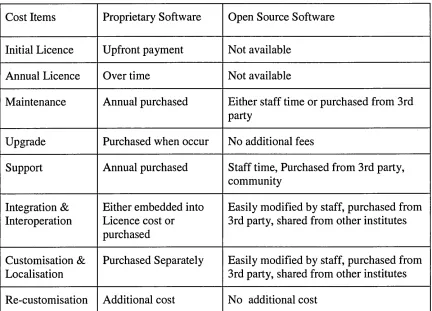
Table (2.2) summarises the deployment cost differences between Proprietary and Open Source Software:
Cost Items Proprietary Software Open Source Software
Initial Licence Upfront payment Not available
Annual Licence Over time Not available
Maintenance Annual purchased Either staff time or purchased from 3rd
party
Upgrade Purchased when occur No additional fees
Support Annual purchased Staff time, Purchased from 3rd party,
community
Integration &
Interoperation Either embedded intoLicence cost or purchased
Easily modified by staff, purchased from 3rd party, shared from other institutes
Customisation &
Localisation Purchased Separately Easily modified by staff, purchased from3rd party, shared from other institutes
[image:39.612.81.513.88.399.2]Re-customisation Additional cost No additional cost
Table 2.2: Deployment cost differences between Proprietary and Open Source
Software
On the other hand, eliminating annual subscription, updates and upgrade costs will direct all available budgets for implementation to other areas such as the support, training and maintenance. Using open source software, institutions will benefit from the decoupling of software from the support (Wheeler, 2007). This separation which unlocks the support to the software vendor only gives HEI better options to choose from, which could be: (a) recruit permanent talented staff, (b) rent third party support services, and (c) buy commercial open source packages that come with support from the vendor. Moreover, large institutes can establish a unit with talented staff and outsource the support to other institutions, thus making a profit from introducing the open source e-learning applications.
According to Wichmann (2004), half of the most important criteria for deciding in favour of OSS applications are related to cost saving. Although the importance of cost as an influencing factor in the adoption of OSS, different articles and research papers had contradictory claims regarding it being the advantage or disadvantage of OSS adoption. The previous sections showed different claims on OSS cost varying from zero cost claims up to being more expensive than the proprietary software.
Furthermore, table (2.2) showed an analysis for the payments needed in different categories of software deployment and compared with OSS and proprietary software. While these studies inform us of the influence of cost on the adoption of OSS, in the current literature there is a dearth of studies and reports to investigate the TCO of adopting OSS and comparing it to the adoption of proprietary software. There is a paucity of research on how much is spent after an open source product or service has been adopted. The body of knowledge is sparse in this crucial area, more studies are needed to report cases and implementation processes for adopting OSS and the TCO associated with it.
localisation, number of users, size and number of campus, etc.) and the availability of the talented human support (staff for installation, maintaining, and support). Furthermore, the payment due will be distributed depending on the phases of deployment, which will give the adopting organisation more control over its spending. In the same context, the OSS will have an economical impact on the adopting society, especially in case of developing countries. The cycle of spending will be initiated and terminated inside the society. This will have a major impact on decreasing unemployment rates, increasing the number of businesses, decreasing the dependence on foreign currencies to pay Licence to "usually" foreign software companies, and strengthening the local economy.
2.3.2 Community
One of the reported drivers for open source adoption in education is the availability of the support community. Sclater (2008) said that one of the most valuable benefits an institution can have when deciding to select open source application is full engagement with the community behind that product. Several studies have suggested that the availability of a support community is an important factor that influences the decision to adopt OSS and that the absence of external support may be an important barrier to the adoption of OSS (Li et al. 2005 Morgan and Finnegan 2007, Goode 2005, West and Dedrick 2006, Ven and Mannaert 2008). The community of an Open Source application is a very important factor throughout the application life cycle. It is the community that does most of the testing and provides quality feedback. Instead of using financial resources to put the software through extensive testing and Quality Assurance (QA), like a proprietary vendor will do, the Open Source projects have the community as a resource.
more people are interested in a project, the more likely it is that it will be active and keep going. A large and active community says something about the acceptance of the software. If the software was not good enough to use, there would not be so many people who cared about its development (Duijnhouwer and Widdows 2003).
Moreover, the community provides external support to end-users after implementation decreasing the total cost of ownership for the application on the institution. However, these communities greatest appeal is the leveraging of resources of the partners and the community for shared value creation. One solution to an HE problem could involve many partners to help solve. Once the solution is valid and tested, all HEI can use it. The community source model for developing and sustaining software is a remarkable fit to the culture and core values of higher education (i.e. discovery, knowledge sharing, and scholarly communities) (Coppola and Neelley, 2004). Such leverage and collaboration is motivating institutional contributions by colleges, universities and commercial firms to provide tools for software to be created for educators by educators. This value added option never applicable in proprietary applications.
Lambert (2005) warned that higher education still needs to work with the vendor community to minimise risk. Wheeler (2007) also emphasised the importance of 3rd party service providers. These service providers offer support and training to institution seeking OSS adoption but may not have staff with the necessary knowledge or capability. The influence of technical support in OSS adoption is further confirmed by the fact that it, along with software quality, significantly impacts the satisfaction of individual OSS users. In contrast, van Rooij (2007) claims that these professional services organisations are mostly technical and are providing their services directly to the technical users, and there is still a need for supporting services available for academic and business applications. Similarly, Wang et al., (2010) emphasised that it is critical to have communities where their members are from the same industry.
communities focusing on the code, development, and programming. Despite considerable recent evidence available in the literature that OSS LMSs have sustainable committees that provide support as well as technical expertise (Collins 2009, McDonald 2009), the academic staff needs OSS LMS to be easy to use, essential, and evident, so that they know how to use it (Haymes, 2008). There is little knowledge on communities that provide training and support for the learning functionality of the software (i.e. how can academics use this software to achieve learning goals and outcomes). Most of the e-learning open source applications are written by technologists, academics need to have communities which get the best out of the software and support its functional usage (i.e. the what's in it for me (WIFM) is clear).
2.3.3 Freedom
The Free Software Foundation (FSF) enumerates four basic freedoms it deems necessary for the distinction of OSS the freedom to use software any way one wishes, the freedom to modify it to do whatever one wants it to, the freedom to pass it on to others, and the freedom to distribute modifications to others (Stallman, 2010). However, the author argues that this definition though available for both individuals and organisations, is more individual oriented. Hereby, the author draws on the FSF definition for the freedom of "free" OSS in the author's classification for the major distinctive factors for OSS adoption in HEI. Based on Stallman's definition, he used the term freedom to combine the three terms widely available in the literature. Freedom from vendor (avoiding vendor lock-in) freedom to use the code (to modify and to develop new software), and freedom to use the support (decoupling the vendor from the support)
2.3.3.1 Reducing Vendor lock-in
cost in the proprietary software model. On the contrary, in Open source models, where OSS supports for open standards facilitate the development of compatible products which then eliminate the dependency of a single vendor. Even when organisations decide to move from one vendor to another, the cost is significantly less, as there will be no lost cost for Licence of the old system or new costs for the new Licences (costs may still be incurred for moving data, and retraining personnel) (Ven and Verelst, 2008).
2.3.3.2 Source Code
The source code availability is one of the advantages of the OSS movement. However, the literature is controversial in this area. Lakhan and Jhunjhunwala (2008) claim that although OSS offers open code, typical users are not interested in the availability of source code; they are more concerned with the software's usability. This is consistent with early studies in this field (Dedrick and West 2004, Larsen et al. 2004, Fitzgerald and Kenny 2003) questioned the importance of code availability if no one uses it. In contrast Coppola and Neelley (2004) emphasis that open source Licence corrects the balance of power between producers and consumers of software and gives control and freedom to the users. Courant and Griffiths (2006) also claim that open-source development provides the shortest distance between a software user and a software developer leading to a more rapid and diverse innovation.
The author argues that the need to use the code will depend on the maturity and standardisation of the software and the level of customisation needed. In the author's understanding, mature and standard software will need less interference with the code. In the same context, standardised software will lead to less customisation. At that point, the advantage of the availability of source code will not be of use. On the contrary, institutions looking for innovative solutions and who are willing to shorten the gap between the production of the software and its usage, will certainly find the availability of the code to be the most important factor in the OSS adoption decision.
2.3.3.3 Support
Many acquisitions and mergers have led proprietary software vendors to drop support for older versions leaving HEI locked in running a proprietary software without the cost of upgrading their system (Wang et al. 2010) Using open source software, institutions will benefit from decoupling of software from the support (Wheeler, 2007). This separation, which unlocks support to the software vendor only, gives HEI better options to choose from. Many studies highlighted that organisations will have the ability to choose the most affordable model that aligns with its budget, such as: (a) recruitment of talented permanent staff to provide local support, (b) hire third party support services from a commercial support provider, and (c) buy commercial open source packages which come with support from the vendor (Dedrick and West 2004, Fitzgerald and Kenny 2003, Morgan and Finnegan 2007, Goode 2005).
2.4
Benefits o fO
SS
inH
EI
A number of different models exist in the literature to classify the benefits of information systems. As a starting point, the author drew on Machado (2005) framework for the flourishing of OSS in HEI. This framework extends the four dimensional model for reasoning the proliferation of OSS in HEI of De Praetere (2002) within the domains of education. This model can be adopted for the classification of OSS benefits. Machado (2005) proposes the following classification as presented in table (2.3)
Domain Reasons
Pedagogical - Possibility of using different learning scenarios
- Web-based learning - Modular and multilingual - Variety of tools
Technological - Reliable and secure technology - Open architecture
- Inter-operational
- Open protected copyrights and Licences
Economic - Eases the burden of software Licence
management.
- Open Sources cost less to acquire and run than proprietary software
- Independence - Generic Product
Philosophic - Collaborative approach
[image:46.612.141.435.221.486.2]- Anti-monopolistic - Free as education
Table 2.3: Classifications of OSS proliferation in HEI - source: Machaddo (2005)
2.4.1 Pedagogical
complement education by providing tools that promote teaching and learning activities while the standardised educational software packages often fail to meet specific content related needs (Machado, 2005) thus OSS environments bring opportunities to reduce cost whilst nevertheless increasing the use of educational technology. OSS provides idiosyncratic solutions that fulfill specific higher education requirements and also provide a model for collaborative learning and capacity building (Tong, 2004).
In the same context, there is a strong believe that OSS in education provided developing sustainable economics and advancing the frontiers of innovation (Moyle, 2004). In her recent study among 285 higher education institutions in the U.S.A., Williams van Roij identified the main benefits of OSS in e-leaming to be the ability to support engaged learning and to create a high challenge low threat learning environment (van Rooij,
2011).
More specifically, for computing schools (i.e. schools of information systems, computer sciences, etc.) teaching the code will enhance students learning activities and give them the opportunity to collaborate internationally with other students and professionals working in collaborative environment. Open source uses the power of collaboration to provide students with hands-on learning and to equip them with an expanded skill set that is very attractive to businesses (Whitehurst 2009, Whitfield 2008). Such a scenario will: (1) enhance students programming skills, (2) offer students opportunities to work and leam at the same time, and (3) provide the society with more talented and skillful staff.
2.4.2 Technological
et a l 2004, Lakhan and Jhunjhunwala 2008, AlMarzouq et al. 2005), easily and freely audit their systems, auditability (Olla, 2007) Continuous improvement (Lakhan and Jhunjhunwala 2008), potentially better support (Glance et a l 2004, AlMarzouq et al.
2005)
2.4.3 Economical
As discussed in previous sections, cost effectiveness and the lower TCO are the major benefits for organisations and HEI to adopt OSS (Khelifi et al. 2009, Benton 2005, AlMarzouq et al. 2005, Yalta and Lucchetti 2008, Ajila and Wu 2007, Glance et a l,
2004). From another perspective, the academic institutions can add to the OSS community by embedding source code teaching in the curriculum. This will create more groups of people interested in the OSS, which will enrich the global OSS movement and lead to the availability of more work forces for the development of OSS. Meanwhile, providing HEI with group of students ready to work for the support and development of OSS projects in the institution itself develops a market in which HEI act as producer and consumer at the same time which results in more cost saving (Machado, 2005).