Assessing the Relevance of Practical Activities in the Teaching
and Learning of Integrated Science in Juniour Secondary Schools
in Gombe Metropolis of Gombe State
Felicia O.Agbo (Phd)1 Usman Ahmed2 Ibrahim M. Alhaji2 Ali Auta2 1. Faculty of Education, Department of Science and Technology, University of Jos, Nigeria
2. School of Science, Integrated Science Department, Federal College of Education (Technical) Gombe, Gombe State, Nigeria
Abstract
The study was carried out to find out the level of application of practical activities in learning science concepts in integrated science in the secondary schools in Gombe metropolis, also it sought to find out the problems that militate against the successful application of practical activities in learning science concepts. The study was guided by five research questions and one hypothesis. The study adopted a quasi experimental research design and consists of the control and experimental group in determining the effect of practical activities on students’ academic achievement, the control group received no treatment while the experimental group was taught for a period of two weeks employing practical activities. Also a questionnaire was designed for the teachers, to get their opinion about practical activities in learning science concepts as test was administered to the students to determine the difference in the academic achievement of students taught employing practical activities and those taught with the conventional method. The SPSS was used for the statistical analysis of Pearson Product moment correlation coefficient and the study made the following findings, practical activities in learning science concepts increases students achievement in science, spurs their motivation for learning and makes learning more meaningful as theories are concretized. The study also suggested training and retraining of integrated science teachers to enable the mastery of methodologies recommended for the teaching of integrated science and application of practical activities in the learning of science concepts.
Introduction
Integrated Science Education was introduced to Nigerian Educational System in 1972 to serve as a beginning course in science at the Primary and Junior Secondary School Level, it is also to serve as a panacea for all the problems bedeviling science teaching and learning especially at the lower level. The emphasis of the programme is on the development of skills of inquiry, manipulative skills, and scientific processes as opposed to rote learning (Emeke and Odetoyinbo, 2003).
Furthermore, there has been growing public concern about state of teaching and learning of Integrated Science in Nigeria, Bimbola and Daniel (2009) reveals that this situation arise mainly as a result of a failure within teaching and learning context, which clearly fails to illustrate the connections between classroom Integrated Science teaching and the environment where learners come from. Adejoh, 2006 also lamented on the delivery methods, where it was stated that theory is emphasized than acquisition of practical skills, teachers teach Integrated Science without designing practical activities or experiment (Aworanti, 2006).
Agbo and Emmanuel (2011) supported this view where they explained that teaching science in our schools has been talk and chalk with no meaningful practical works. This implies that, the entire teaching process in junior secondary schools is theory based; aspect of practical activities is completely neglected.
Absence of practical activities in the teaching of integrated Science makes the teaching and learning in-effective. A practical activity here means a state of being active in the classroom teaching, where pupils can use their manipulative skills in learning of science concepts. Bimbola and Daniels, (2010) Showed that large number of students learn very little aspect of science at the lower level of Education as a result of poor methods of instructions and lack of materials for practical activities, in this situation learning tend to be by rote and copying of notes from the chalkboard, which make learning of science concepts very difficult. And this has serious implication for the students in cognitive and psychomotor achievement in the subjects.
Ajeyalami, (2011) summarized how practical activities are conducted in primary and secondary school levels in Nigeria as follows that; at primary school level there is little or no science taught, so little opportunities for pupils to practice what scientist do. At the junior secondary school level the teacher engages more in information giving and/or lecture demonstration type of practical activities, which is highly teacher – centered. At the senior secondary school level, students are not normally exposed to laboratory activities until, may be a few months before senior school certificate examination (SSCE) in most schools.
The above shows that the aims and objectives of practical work in Nigerian schools have not been achieved.
Statement of the Problem
Federal Government of Nigeria in National Policy on Education 2004 and 2009 has clearly explained how Integrated Science is to be taught at primary and junior secondary schools where it was stated that science and technology shall continue to be taught in an integrated manner in our schools in order to promote in students the practical application of basic ideas in science. It is the Government desire to make teaching of science activity based as it was prescribed in the national policy on education, that the teaching methods to be employ in the Primary and Junior Secondary Schools should de-emphasize the memorization and regurgitation of facts; therefore only methods that encourage practical and experimental method are to be use. This will in turn promote in students the appreciation of practical activities (FGN 2009).
However, many Nigerian science students do not possess the depth knowledge or skills, as a result of lack of exposure into practical activities, this lead to poor performance in science, as was evident from second international science competition where Nigerian student came last in Primary Science and second to the last in secondary science category among participating countries (Ogunmade, 2005). The above showed that students have been performing poorly in Integrated Science.
Also, several studies have shown that students perform poorly in Integrated Science as indicated by Uzoji, (2011) reveals that, an analysis of junior secondary school certificate examinations (J.S.S.C.E) in Integrated Science in public Junior Secondary Schools in Jos North L.G.A of Plateau State from 2000 – 2004 showed consistence poor performance with majority of the students scoring less than 50% in Integrated Science each year. This statistics corroborates with the result given by Gombe State Ministry of Education (M.O.E) which reveals that from 2002 – 2011 only 30% of the total number of students that sat for JSSCE pass Integrated Science with credit level. This poor performance is as a result of teacher dominated method of teaching as well as non inclusion of practical activities in the teaching and learning of Integrated Science. It Moreover, it was stressed that lecture method pattern does not produce effective learning of science. It is against this backdrop that, this study sought to find out the efficacy or otherwise of practical activities as a strategy for improving the teaching and learning of Integrated Science at junior secondary school in Gombe State.
Objective of the Study
The objectives of the study are as follows:
(i). To find out if there is any difference in learning science concept between lessons taught with practical activities and those taught without practical activities.
(ii). To determine the extent to which teachers use practical activities in the teaching of Integrated Science. Research Questions
The following research questions were asked:
(i). What are the differences in learning science concept between lesson taught with practical activities and those taught without practical activities?
(ii) What are the differences in teaching Integrated Science between teachers that design and use practical activities and those that do not?
Research Hypotheses
(i) Ho1 There is no significant difference in learning science concepts between Integrated
Science lessons taught with practical activities and those taught without practical activities. RESEARCH DESIGN
The research design used in this study is the quasi experimental research design. It is used to estimate the causal impact of an intervention on its target population and allows the researcher to control the assignment to the treatment condition, but using some criterion other than random assignment (Encyclopedia Wikipedia 2013). This design was chosen for this study due to the nature of the sample that is divided into the control group and experimental group to be able to determine the degree of difference between teaching/learning of integrated science through the practical activity oriented method and the traditional method of chalk and talk method. Population of the study
The population of the study comprised all the available Integrated Science teachers and all students in junior secondary schools in Gombe Metropolis of Gombe State. The study consisted of junior secondary school students offering Integrated Science in the respective schools that were sampled.
Sample of the study
The sample of the study was made up of a total of 80 junior secondary school students from the JSS 2 and were drawn from the four secondary schools that were chosen for the study, each of the schools provided 20 students who were sampled for the study as an intact group due to the difficulties that were encountered in trying to draw the students out of their class arrangement, 40 of the students from two schools in the control group were selected, while the other 40 made up the experimental group from two different schools. The students from schools were designated A and B as the control group and were exposed to the traditional method of teaching and the other schools were designated CandD and made up the experimental group, and taught Integrated
Science using practical activities. The simple random sampling technique was used in sampling the subjects for the study, while all Integrated Science teachers in the sampled schools were chosen as samples for the study. Instruments for Data Collection
The instruments for collection of data were Students Practical Activities Learning Test (SPALT), made up of twenty-one (21) items drawn from the integrated science JSS 2 syllabus meant to measure the students’ academic achievement and Integrated Science Practical Activities Questionnaire (ISPAQ) made up of eighteen (18) items, administered on the teachers only.
The validity and reliability of the instruments were determined, the content validity was done by three experts in the department of Educational Foundation of the University of Jos, whereas the reliability of the instrument was determined using the Kuder-Richardson K-21 formula and the reliability was found to be 0.81 Data Analysis
Responses were analyzed using frequency and simple percentages. Whereas, the Pearson Product Moment Correlation Coefficient was used to analyse the data obtained.
Results and Discussion
This section deals with the analysis of data, presentation of results and discussions. The data were presented according to the research questions and hypotheses that guided the study.
Research question one
What are the differences in learning science concept between lesson taught with practical activities and those taught without practical activities?
In response to this research question, questionnaire items 5 – 7 were analyzed in order to know what the teachers think on this question.
Table 1: Difference in learning science concepts between practical activities and non practical activities
s/n Question items No. A % D % U %
5 Teaching with practical activities help teachers understand the level of student’s
learning 71 37 52 34 48 0 0 6 Students learn better when taught with practical
activities 71 35 49 21 30 15 21 7 Students show more interest in learning
when practical activities are included. 71 43 61 20 28 8 11 In table 2, 52% of the respondents constituting of teachers agreed strongly that the teaching and learning process involving practical activities help them understand the level of students learning. 48% of the teachers will rather think otherwise, 49% of the teachers also agreed that students learn better when practical activities are involved in the teaching and learning of integrated science, and 30% of the teachers wouldn’t go with that fact as 21% of the teachers wouldn’t indicate their opinion to that question. Lastly in that section, 61% of the teachers sampled for the study are of the opinion that students show higher interest in learning when practical activities are included alongside instruction and 11% of the teachers sampled did not relate their opinion to that question item. From the responses above, practical activities in the teaching and learning integrated science in our secondary schools cannot be underscored.
Research Question Two.
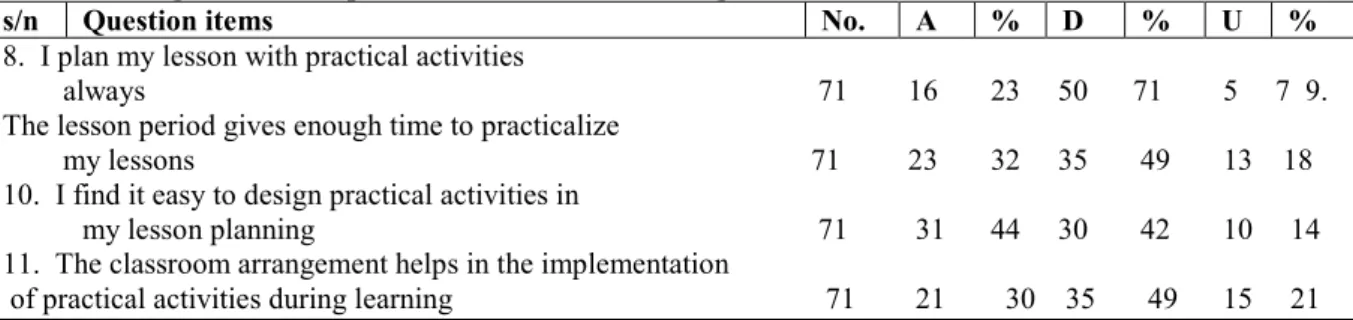
How often do teachers design and use practical activities in the teaching of integrated science lesson? In reaction to this research question, questionnaire items 8 – 11 were analyzed based on teacher’s opinion.
Table 3: Design and use of practical activities in teaching
s/n Question items No. A % D % U %
8. I plan my lesson with practical activities
always 71 16 23 50 71 5 7 9. The lesson period gives enough time to practicalize
my lessons 71 23 32 35 49 13 18 10. I find it easy to design practical activities in
my lesson planning 71 31 44 30 42 10 14 11. The classroom arrangement helps in the implementation
of practical activities during learning 71 21 30 35 49 15 21 Above shows teachers responses as it relates to practical activities at the process of planning, 23% of the teachers sampled for the study suggested that they plan their lessons to include practical activities as against 71% who plan without the inclusion of practical activities and 7% of the teachers sampled aired no view to that question item. 32% of the teachers also argued that the lesson period gives time for practical activities as 49% of the teachers sampled argued otherwise, claiming the lesson period gave no time for practical activities during instruction and 18% reserved their opinion. 44% of the teachers sampled suggested that they can plan their
lessons along practical activities as against 42% who honestly suggested they cannot plan their lessons to include practical activities and 14% reserved their opinion, which the researcher probed a bit further to understand that they are likely to belong to those who may not be able to plan lesson including practical activities in their planning. 30% of the teachers agreed that the classroom arrangement aids in the inclusion of practical activities during instruction, 49% of the teachers think otherwise as 21% of the teachers withheld their opinion to that effect.
Hypothesis one
There is no significant difference in learning science concepts between integrated science lessons taught with practical activities and those taught without practical activities. In testing this hypothesis, the test score of the students test were analyzed in relation to the variables being measured, the scores of students from single parents will be analyzed to determine the correlation coefficient of the students and table 6 presents the summary of the analysis.
Table 2: Test of correlation between learning integrated science with practical activities and learning without practical activities
Variables N df α r Cal. r Crit. Decision
Practical activities 40
78 .05 0.088 1.378 Accept Ho
Non Prac. Activities 40
The table summarizes the analysis of students test on the academic performance of students taught applying practical activities and those taught without the application of practical activities. The calculated value of r is 0.088 and the critical value of r is 1.378 which is higher to the calculated value of r the null hypothesis is therefore rejected due to the difference in the cal r and critical r. this shows that there is a difference in learning science concepts between integrated science lessons taught with practical activities and those taught without practical activities.
SUMMARY OF FINDINGS
The importance of practical activities in learning science concepts in integrated science is central to the development of the inquiry mindset of the students mostly at the junior secondary level; the role of the teacher in achieving this objective cannot therefore be undermined.
The major findings of this study include;
a. The lecture method is the major and most convenient method integrated science teachers adopt in their mode of instruction and the recommended various teaching methods recommended in the curriculum is not very familiar with most of the teachers in the study area as their responses indicated. Most of the teachers cannot adapt to any other form of teaching method except the familiar one, the chalk and talk method which has dominated the teaching method of learning integrated science.
b. Teaching students science concepts with practical activities aids the teachers in having a good understanding of the level of learning of students as they would not hide all that have been learnt inside the brain but can practicalize them, which shows they learn better when taught applying practical activities. also revealed is that students show more interest and enthusiasm to learning when practical activities are integrated in the teaching and learning process of integrated science in the secondary schools.
c. Teachers shy away from planning practical activities in their lesson plan and therefore will avoid integrating it in their lessons, as most teachers in the area of study find it difficult to design practical activities in their lessons.
d. The nature of the classroom in the area of study is another major reason the implementation of practical activities in the teaching and learning of integrated science is difficult, most of the classrooms are over populated as some of them house up to 70 students when it was initially meant to house a maximum of 40 students, and the allocated period for teaching integrated science is barely not enough for the teacher to practicalize his instruction, rather covering the syllabus becomes his major objective.
e. The application of practical activities in instruction aids students achievement in integrated science as learning is concretized and made meaningful for the students.
f. Educational qualification of teachers resulting from teacher training play a vital role in the process of integrating practical activities in the teaching and learning of integrated science in the secondary schools, trained teacher in integrated science can integrate practical activities in their lessons better than those not trained in the field.
CONCLUSION
a. Integrated science teachers in Gombe metropolis are not properly utilizing recommended methods of instruction as recommended in the curriculum in the teaching and learning of integrated science in the secondary schools,
b. The inclusion of practical activities in the teaching and learning of integrated science is completely lacking as teachers tend to subscribe to a particular teaching method that is most convenient for teaching (chalk and talk)
c. Students achievement in integrated science is improved when practical activities are integrated in the teaching and learning of integrated science as their interest and motivation is heightened in the learning process
d. Educational level of teachers determine how effective they can integrate practical activities in the learning of science concepts in the secondary schools, as those with poor qualification cannot effectively integrate practical activities due to their level of understanding in the subject area.
RECOMMENDATIONS
Based on the findings of this study, the researcher therefore recommends the following;
a. Practical activities should be the major area of planning in the lesson plan for teachers teaching integrated science in the secondary schools as students’ achievement is enhanced when practical activities are integrated in the lessons.
b. Teacher training should be paramount to produce effective teachers who can properly integrate practical activities in the learning of science concepts as most of the teachers barely understand what the curriculum entails in the teaching methods outlined for the teaching and learning of integrated science in the secondary schools.
c. The school management and the educational ministries should ensure the provision of learning materials mostly in the sciences to enable students move away from the completely theoretical dependent approach to learning to practical based approach that will lead to learning not in abstract terms but concretized learning that can spur the psychomotor domain not just the cognitive.
d. Workshops and seminars should be organized from time to time for teachers to properly communicate the new methods of instruction as well as appraisals on how the methods of instruction are being implemented so that other teachers can borrow a lift on the implementation of practical activities as well as better teaching methodologies in the process of teaching and learning of integrated science. e. The period for learning science, mostly integrated science which is the basis for other sciences should
be double period in the schools to enable the teachers and the students explore the concepts practically and concretize what the teacher is saying.
REFERENCES
Adejoh, M. J. (2006). Evaluation of integrated science and introductory technology programmes in secondary schools in benue state. Un published Ph.D dissertation university of jos. Agbo, F.O & Emmanuel, T. (2011). Enhancing effective teaching of cellular biology through science
technology and society approach. In F.O. Agbo; M. Mankilik, and K Henry. (Eds) readings in effective strategies for the teaching of S.T.M.E Vol.1 pp. 59-60. Jos. PSTAN Publication.
Ajayalemi, O. (2011). Practical work in Science: Are the aims and Objectives being achieved? STAN memorial lecture presented at the 52nd Annual Conference of the Science Teachers Association of Nigeria held at Akure, Ondo State.
Aworanti, O.A (2008). Students’ perception of integrated science teaching in Nigeria. Retrieved from http://www.academicjournal.org/BRR in 4th February 2012.
Bimbola, O. & Daniel, O.J (2009). Pre-service: Nigerian science teachers Concepts of Integrated Science Educational Review Journal 4 (7). Retrieved from http://www. academicjournal.org/err. On 4th February 2012.
Bimbola, O. & Daniel, O.J. (2010). Effect of constructivist based teaching strategy on academic performance of students in integrated science at the junior secondary school level. Educational research and review journal.5 (7). Retrieved from http://www academicjournals.org/ERRS on 6th June 2012.
Emeka, E.A & Odetayinbo, B.B (2003) Teacher factors as determinants of Achievement in Integrated science: Journal of the Science Teachers Association of Nigeria (STAN) 38, (1 & 2). pp 94-95.
F.G.N. (2009). The National Policy on Education Lagos: NERDC press Ltd Nigeria.
Ogunmade, T.O. (2005). The Status and Quality of Secondary Science Teaching and Learning in Lagos State, Nigeria. Unpublished Ph.D. Dissertation Edith Cowan University Perth, Western Australia.
Ozoji, B.E (2011). Effect of concept mapping strategy and gender on students’ performance in Integrated Science: In F.O. Agbo,; M. Manklik. & K. Henry, (Eds). Readings in effective strategies for the
teaching of (S.T.ME) (1). pp. 151-152. Jos: PSTAN Publications.
Wikipedia free encyclopedia. Quasi-experiment. Retrieved from http://en.wikipedia.org/wiki/ quasi-experiment, on 5th april 2014.