ISSN: 2089-9823, DOI: 10.11591/edulearn.v12i2.7728 ˆ 244
School Effectiveness Policy in the Context of
Education Decentralization
Nurkolis1*, Dwi Sulisworo21Department of Educational Administration, Universitas PGRI Semarang, Indonesia 2Department of Physics Education, Universitas Ahmad Dahlan, Indonesia
Article Info ABSTRACT
Article history: Received Nov 2, 2017 Revised Feb 12, 2018 Accepted Apr 23, 2018
This article examines the characteristics of school effectiveness and how the school effectiveness policy works in the context of education decentralization. The research approach is qualitative exploratory and was conducted in 2016 in 10 out of 35 districts/cities in Central Java Province. The results showed that there are eight characteristics of effective schools: effective school leadership, efficient learning processes, active community participation, a conducive school environment, increased professionalism of educators, heightened expectations of students, the commitment of teachers, which together lead to good student achievement. Local government policy has not been mentioned explicitly to build an effective school. The government system should contribute to creating effective schools through human resource development, community participation, provision of facilities and infrastructure, professional development of educators, guiding VWXGHQWV¶ DQG WHDFKHUV DFKLHYHPHQW PRQLWRULQJ VWXGHQW SURJUHVV HGXFDWLRQ financing to some degree, and the commitment of local governments to give appreciation to education actors.
Keywords: Community participation Professionalism of teachers School environment School leadership Teacher commitment
Copyright © 2018 Institute of Advanced Engineering and Science. All rights reserved. Corresponding Author:
Nurkolis,
Educational Administration, Universitas PGRI Semarang,
Jl. Lingga Raya Nomor 6 Semarang 50125, Central Java, Indonesia. Email: [email protected]
1. INTRODUCTION
Effective school theories or more generally effective education theories have developed in modern times. So far there have been five stages of research development and school effectiveness theories [1]. The first phase grew in the 1970s, the second phase in the 1980s, the third phase in the 1990s, the fourth phase in the 2000s, and the fifth phase began in 2007. In developed countries, the effectiveness of education has become a rapidly growing discipline [2]. Meanwhile, in developing countries, the study of the effective school has been neglected.
According to school effectiveness experts [3], the most common meaning of school effectiveness refers to the level of school goals attainment. The purpose of the school effectiveness study is to understand how schools function and their effects on students and to influence improvements in how schools function [2]. Preliminary research results in schools show five influential factors: strong educational leadership, emphasis on necessary skills acquisition, a clean and secure environment, high student achievement expectations, and regular assessment of student progress [4].
Research by other expert shows there are ten factors affecting school effectiveness. There are professional leadership, vision and disseminated goals, a conducive learning environment, a focus on learning and teaching, high expectations, positive reinforcement, progress monitoring, rights and
responsibilities of students, clear teaching aims, good education management, and cooperation between school and family [5].
One expert offers an integrated model of school effectiveness covering the input, process and output aspects. School inputs include teacher experience, budget per pupil, and parental support. The process can be separated between the school level and the classroom level. The process at school level includes achievement-oriented policies, educational leadership, inter-teacher cooperation, curriculum quality regarding content, curriculum structure, and the school learning environment. The process at the classroom level includes tasks assigned to students including homework, teaching structure, opportunities for learning, high student progress expectations, evaluation and monitoring of student progress, and enrichment and remediation [4].
Outputs include student achievement, both academic and non-academic. Output in education is not just output in the traditional sense of knowledge and the necessary skills of reading, writing, and arithmetic. The output is defined as more than just academic development, as it includes measuring students' social skills and attitudes. Outputs also involve high-level skills such as problem-solving skills [6]. Some experts argue that effective schools should produce stable and consistent results over time and apply these to all students. Effective school criteria include resource input criteria and abstract input, transformational or process criteria, and output criteria [7].
A good, quality and effective school is a thriving school. Developing schools for success can be realized through academic achievement and community support. Schools can ensure that they have adequate buildings: good teaching quality, an appropriate curriculum, a learning environment that suits students' needs, a professional learning environment for teachers, learning-centered leadership, networking with communities, progress monitoring, and performance accountability [8].
Educational effectiveness can be assessed, according to some experts, at three levels: class level, school level, and education system level [9]. Other opinions propose [10] that the effectiveness of education consists of four levels: student level, classroom level, school level, and system level. Student effectiveness assessment is referred to as the effectiveness of learning outcomes, the effectiveness of the classroom level as the efficiency of the learning processes, the effectiveness of the school level as the effectiveness of school management, and the effectiveness of system level relates to various levels of education policies. Those four levels of effectiveness are interrelated to one another, the effectiveness of higher levels of the education system will influence the lower levels.
In Indonesia, research on the effectiveness of education is more prevalent at the student level, and classroom level, few studies on the effectiveness of management and policy level can be found. Research on the effectiveness of student level and classroom level have been conducted by [11-15]. Meanwhile, studies of effective school management have been conducted by [16-18]. The author has not found a study on the effectiveness of systems related to educational policy. There are various opinions on the characteristics of an effective school as conveyed by these experts [19-22]. These conclude that effective school has the characteristics of effective principal leadership, effective learning processes, a favorable school climate, utilization of school resources to achieve the objectives, monitoring and evaluation of student progress, high expectations, professional development of teachers and educational staff, and the involvement of parents and community in the school.
This article aims to examine two questions: what are the characteristics of the effective school, and what should effective school policies in the context of education decentralization at the local government? The school policy in this article reflects the educational system at basic education level in line with Act Number 23, 2014 on basic education as the responsibility of local government.
2. RESEARCH METHOD
This research used a qualitative exploratory approach and was conducted in 2016 in Semarang City and the Districts of Semarang, Wonosobo, Jepara, Demak, Sragen, Purbalingga, Banjarnegara, Batang, and Pekalongan, all in Central Java. The determination of the districts and city was done purposively based on the area of residency, one district or city each residency. Data collection included reviewing documents, observation, and interviews. The documents used to analyze the effectiveness of educational policy included regional mid-term development plans (in Indonesia called Rencana Pembangunan Jangka Menengah Daerah-PRJMD), local regulations on education (in Indonesia called Peraturan Daerah Pendidikan-Perda Pendidikan), and strategic planning of District education offices (in Indonesia called Perencanaan Strategis or Renstra). The documents were analyzed using NVivo 11 Plus software. Researchers visited schools to observe the school climate, school environment, and school facilities. To complete the information, the researcher interviewed the head of the district or city education office or the secretary or the subhead of the primary and secondary departments, subhead of education planning, school principals, and teachers.
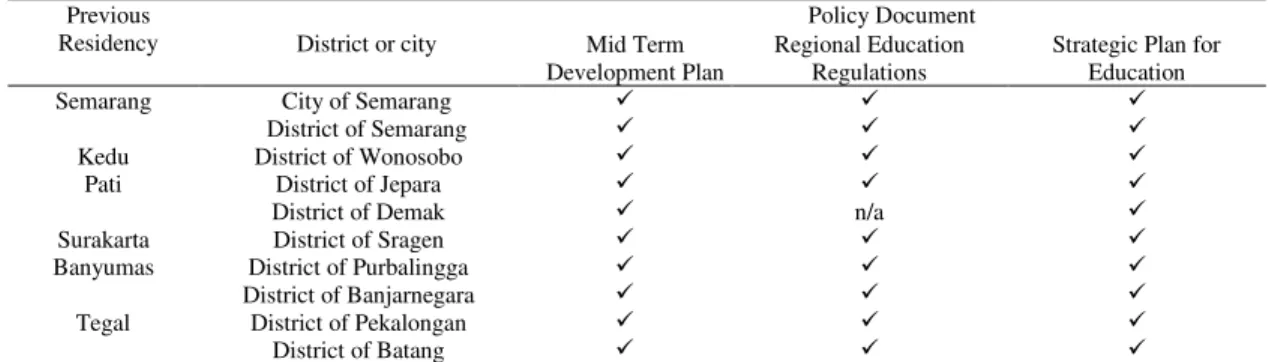
Triangulation held to validate the data either through source person of policymakers, school principals, and teachers chose purposively. Another triangulation is by a method of interview, observation, and documentation. The kinds of document reviewed in each local government are set out in table 1.
Table 1. Policy Document according District or City Previous
Residency District or city
Policy Document Mid Term
Development Plan
Regional Education Regulations
Strategic Plan for Education
Semarang City of Semarang 9 9 9
District of Semarang 9 9 9
Kedu District of Wonosobo 9 9 9
Pati District of Jepara 9 9 9
District of Demak 9 n/a 9
Surakarta District of Sragen 9 9 9
Banyumas District of Purbalingga 9 9 9
District of Banjarnegara 9 9 9
Tegal District of Pekalongan 9 9 9
District of Batang 9 9 9
Note: 9= document available. n/a=document not available
3. RESULTS AND ANALYSIS
To answer those two questions mentioned above, the researchers visited schools to meet the school principal and teachers and observe school conditions. The findings of school visits were then checked with the school development plans from the visited schools, mid-term development plans of each district or city, regional regulations on the education of each district or city, and strategic plan of the district or city education office of each district or city.
3.1. The Characteristics of School Effectiveness
The results of this research confirmed that there are eight characteristics of the effective school. They are effective principal leadership, effective learning processes, active participation from the community, a conducive school environment, continuing increased professionalism of teacher, high expectations of students, consistent and ethical teacher commitment, all leading to high student achievement. Effective principal leadership was manifested in the school principal's policy of implementing school-based management; applying active, creative, effective, and enjoyable learning; developing a reading culture for everyone in the school and, in some schools, creating elite classes to achieve special academic quality. The leadership of the school principal in building an effective school often faces challenges and the principal's strategy for realizing an effective school depends on his/her ability and understanding of effective schooling [23].
Strong school principal leadership was evident in every school that had a school development plan or school work plan (rencana kerja sekolah-RKS), annual work plan (rencana kerja tahunan-RKT), activity plan and school budget (rencana kegiatan dan anggaran sekolah-RKAS). The leadership was also visible from reports of new student admissions and use of school operational assistance budget (bantuan operasional sekolah-BOS). Strong school principal leadership related to the administration of education was demonstrated in his/her ability to drive teachers to develop syllabi, lesson plans, and tools for evaluation.
Principals who demonstrated strong leadership also provided academic supervision to their teachers; educational supervision provided by the principal to improve teachers' ability in teaching. The use of a learning methodology with PAKEM approach, which is a student-centered learning approach, is recommended by the government. Based on research [24], the visionary leadership of the principal influences effective schools. It is therefore important to improve school principals' understanding of effective schools and to use their influence to mobilize teachers and children in the realization of effective schools.
Based on school observations, all schools had implemented the PAKEM learning model to some degree, although on average only 50% of teachers in schools implemented active learning regularly. Active learning is characterized by the intense participation level of students both physically and mentally. Some teachers had received PAKEM training from the district or city education office or other sources. Those teachers who had received training in PAKEM were expected to disseminate their knowledge to other teachers who had not yet received training.
Effective schools showed active participation from the community. Representatives of community participation include the school committee, public figures, and the business and industrial worlds. Community participation in supporting school activities was in the form of financial support, goods, ideas,
and even energy. Based on the results of the study, the school committee's role in supporting the success of school programs and activities was quite high [25]. In some schools, the school committee had implemented its programs and activities well. It confirms the results of other research in Indonesia [26].
People who are financially capable but do not have enough time often provided financial support. Parents and community members who have good ideas and have the time often provided support to school activities through the school committee or class committee (in Indonesia called paguyuban kelas). In primary schools, especially where there are low-income students, some parents who accompanied their children to VFKRRO EHFDPH SHHS WHDFKHUV´ LQ ,QGRQHVLD FDOOHG JXUX LQWLS ZKRVH MRE LV WR DVVLVW WHDFKHUV LQ VXSHUYLVLQJ and supporting students learning in the classroom. There were also parents who volunteered to distribute the "charity box (in Indonesia called kotak amal)" to help disadvantaged students or to help improve educational facilities in schools.
Effective schools had a conducive school environment. When the school managed the facilities and infrastructure well, this it supports student learning activities. Factors that are especially important include that the classroom environment was well laid out, and the walls filled with students' work and the classrooms were well decorated and equipped with air conditioners (AC) so that students were comfortable learning in the classroom. It is an indication of conducive and healthy school culture. Based on the research [27], conducive and healthy school culture or environment has positive effects on students' learning outcomes. The library in the school should also be well laid out with sufficient reading books. Book lending processes in the library should be quick and easy so that students are keen to borrow reading books. In some schools, reading books were not only placed in the library, but also in the classroom or outside the classroom. This concept is to bring books closer to students so they can read at any convenient time such as during school breaks. This enabled school principals to implement a reading culture as mandated by the Ministry of Education and Culture.
Increased professionalism of teachers and other staff was another characteristic of the effective school. Many teachers had continued their education up to postgraduate level (masters level) at their own expense or with assistance from the district or city government. Training for teachers and principals regularly arranged by the district education office. Teachers who had attended the training were required to disseminate materials to other teachers through teacher working groups (KKG) forums at primary school level or subject teachers' working groups (MGMP) at the junior secondary school level. The materials given by district education office were related to the improvement of pedagogic and professional competence. The central government has also facilitated the development of online teacher professional teachers called µWHDFKHUV OHDUQLQJ RQOLQH 7KH UHVXOWV RI ILYH RXW RI VL[ VWXGLHV FRQGXFWHG E\ WKH :RUOG %DQN UHODWHG WR WKH improvement of teacher professionalism show that the in-service training of teachers shows a positive influence [28].
Continuous professional development is not only important for teachers but also for educational personnel or more often called administrative staff. A study by Muhyadi in Yogyakarta Special Region found that much administrative personnel did not have reasonable competence. In Central Java, there is still a need for professional development of administrative personnel, but the continuous professional development of both teachers and other education personnel should be based on the results of needs analysis as shown by research results [29].
Another characteristic of the effective school is high expectations of teachers and students. Schools have high expectations for teachers so that teachers also provide high expectations to students. High expectations by schools to teachers were communicated at academic meetings. Teachers provided high expectations to students in the form of setting minimum criteria of achievement (KKM) that should be achieved by students. Student achievement differed between one school and another school, and differences were evident between subjects in the same school. It was highly dependent on the condition of students, teachers, facilities and infrastructure, and the characteristics of the subject matter. Three research results showed a positive influence of high expectations of teachers on student learning outcomes and achievement of KKM [28].
Effective schools demonstrate high and consistent commitment from principals and teachers. Regular briefings of teachers and school staff were a characteristic of effective school principals. Some principals provided briefings once a week; others gave briefings every day. This activity was to remind the school community to provide its best services to the students and the community. Teacher's consistency and commitment were demonstrated by following school rules and arriving at schools before 7 a.m. and returning home after 14.30. Teachers not only showed discipline in arriving at school and going home but also discipline in teaching in the classroom. If the teacher was unable to teach because he/she was given another task by the principal, then the teacher had to find a substitute teacher for the class, so there was not an empty classroom. The commitment and discipline of teachers were also shown in their completion of administrative task including developing a syllabus, lesson plans (in Indonesia called Rencana Pelaksanaan
Pembelajaran-RPP), and related evaluation tools. At the beginning of each semester, the teachers had to prepare these and submit them to the principal for approval. Teacher discipline in teaching influences student achievement. In contrast, the teacher's lack of discipline in teaching, shown by frequent teacher absences, negatively affects student learning outcomes [30].
The consistency and commitment of teachers should provide excellent services to the students by paying full attention to them. Based on the results of the research, attention given to students whether by way of talking to them, paying them attention, and giving appreciation improved the welfare of students at school [31]. High student achievement is a characteristic of the effective school. Student achievement is not only academic achievement such as high test scores or winning in various Olympic championships. It could also be non-academic values related to cultural, artistic, and religious skills. Effective schools have a balance between academic and non-academic achievement.
There were no significant influences between school-level variables and student achievement [32]. But school level variables have an indirect effect on student achievement such as principal leadership with various policies. Therefore, all efforts of schools need to directed to supporting the achievements of students both academic and non-academic. Based on the results of studies at the secondary education level in Africa, several school-level factors positively affect school effectiveness such as the effectiveness of management structures, strong school committees, a healthy school environment and climate, and good infrastructure [33]. 3.2. The Policy of School Effectiveness in the Context of Education Decentralization
At the central government and local government levels, no policy explicitly builds, encourages, and IDFLOLWDWHV µHIIHFWLYH VFKRRO¶ LPSOHPHQWDWLRQ )URP WKH DQDO\VLV RI UHJLRQDO SROLF\ GRFXPHQWV WKHUH LV QR term "education effectiveness or school effectiveness," but a variety of policies support the effort to build an effective school. The analysis of regional mid-term planning, provincial regulations on education, and strategic plans for education show support for the characteristics of effective schools. All districts and cities have regional mid-term plans, and all KDYH D YLVLRQ PLVVLRQ DQG JRDOV VWDWHPHQWV DLPHG DW ³LPSURYLQJ WKH quality of human resources." The development in this area aims to improve society through higher levels of education and behavior.
An example of targets to improve the quality of educatioQ FDQ EH VHHQ LQ 6HPDUDQJ &LW\¶V PLG-term plan as set out in regulation number 12 the year 2011 concerning enhanced access to and quality of education, the improvement of quality and education infrastructure, and the improved relevance and competitiveness of education. To achieve these targets, the strategies implemented by local governments vary and include improving the education budget, providing assistance to underprivileged students, and improving the quality of education services to the broader community.
Among the 10 sample districts or cities, the only one did not have any local regulations on education it was Demak Regency. However, one district had more than one regional regulation on education, namely Banjarnegara Regency. The following are some of the contents of the local regulations on education related to efforts to develop effective schools. Based on the finding that community participation had not been high enough to support the progress of education in Semarang Regency, it was considered necessary to have the policy to strengthen public involvement in education. The regulation states that the participation of community has not sufficiently supported the completion of education in junior secondary school as stipulated in the regulation of Regency of Semarang number 6 of 2009 on the implementation of education. In the Semarang Regency regulation, two chapters govern the participation of the community in education. Chapter 4 deals with the role of the business and industrial communities, article 84, paragraph 1 state that the business and the industrial communities should participate in the provision of funds to improve the quality of education. Section 2 says that such participation can be in the form of real educational contributions, the establishment of instructional units, training, and cooperation in the implementation of education.
Chapter 11 on the education council and the school committee also regulates community participation. Article 72 states that the community can participate in improving the quality, equity, and efficiency of education, and the achievement of educational democracy through education councils. Article 73 states that the community can participate in improving the quality of education services including planning, supervision, and evaluation of education programs. These activities undertook by the school committee or madrasah committee. School policies can be established to improve educational facilities and infrastructure and help to develop an effective school. Education facilities and support are also a concern of local government, as can be seen from the local regulation of City of Semarang number 1 of 2007. Services and infrastructure covered in the regulation include textbooks as well as space and buildings. The textbook is mentioned in article 52, which provides for the procurement of teaching manuals by the regional government; in addition to the government textbook; schools may use textbooks other than government textbooks as support learning materials; and educators, education personnel, and school committees are prohibited from selling textbooks to learners. Policy on space and buildings is set out in article 53 that includes: each
educational unit shall have at a minimum a tutorial space, room for administration staff, and supporting area. The specification and size of these should be in accordance with the provisions of applicable laws and regulations; the local government shall provide maintenance of space and building of educational units according to its ability to do so.
Facilities and infrastructure regulations also cover educational land as stated in environmental regulation of Banjarnegara District number 22 of the year 2015. For example, article 18 states that the regional government can help with the procurement of land, facilities, and educational infrastructure at basic education units implementing the nine years basic education program. Furthermore, article 20 states that the local government guarantees the availability of land, facilities, and infrastructure other than educational land for each implementation unit (school) in the nine-year compulsory education program for which the regional government is responsible.
Policy to support the professional learning of teachers and education personnel is also regulated by local government. The development of teacher professionalism in all the Districts studied is comprehensively addressed. For example, in Wonosobo Regency, there is a statement in Regional Regulation number 1 the year 2012 article 116 about career coaching. Five paragraphs regulate teacher career development. Paragraph 1 states that regional government shall develop and establish the pattern of career development of teachers and education personnel by the provisions of the legislation. Paragraph 2 states that the regional government is obliged to support the career development of teachers and education personnel by the pattern of career coaching as referred to in paragraph 1. Paragraph 3 states that educational providers established by the community shall undertake instructional career training for educational personnel in the educational units it runs following the pattern of career coaching as referred to in paragraph 1. Paragraph 4 states that teacher career development shall be implemented in the form of enhancement of academic qualifications and competence as an educator in line with national education standards. Paragraph 5 states that career training of education staff shall be carried out in the form of enhancement of academic qualification and managerial and managerial competence as educational staff in line with national education standards.
The development of the teaching profession in Demak, Semarang, Purbalingga and Batang regencies is regulated explicitly in the form of a Regent (District Head) Regulation (Peraturan Bupati-Berpub). Teachers are mainly encouraged to develop their professionalism continuously using various means of funding from local government, foundations, schools, and from the individual teachers themselves. Policy on student achievement to ensure the academic success of learners is also regulated in a local regulation on education in Wonosobo District. Article 145 states that learners should be competent, which means they must have a diploma certificate. A certificate of competence, and awards from an accredited educational unit recognizing their learning achievement and successful completion of each level of education.
Policies on the non-academic curriculum for students are contained in the District Education Regulation of Jepara number 1 of 2011 in articles 25 through 27. Article 25 states that each educational unit (school) shall prepare and develop an education unit level curriculum. The curriculum should include the local content curriculum to be delivered by education units from primary and secondary education (Sekolah Dasar-SD or Madrasah Ibtidaiyah-MI, Sekolah Menengah Pertama-SMP or Madrasah Tsanawiyah-MTs, and Sekolah Menengah Atas-SMA or Madrasah Aliyah-MA). Article 26 paragraph 1 states that the local curriculum for primary schools in the district shall choose one of carving or other typical crafts, a foreign language, good manners, and the environment. Meanwhile, article 27 states that the local curriculum content of districts for junior secondary and senior schools (SMP, MTs, SMA, and MA) should include carving skills.
Similarly, the regional regulations on education in Pekalongan Regency are set out in Article 54 paragraphs 3, 4, and 5. Paragraph 3 states that the preparation of competency-based local curriculum should take into account the following. It should include Islamic religious education, improving faith and obedience, enhancing good character, increasing the potential, intelligence and interests of learners, and cover the diversity of local and environmental potential. The curriculum should also consider regional and national development demands, workplace demands, the development of science, technology, and art, the dynamics of JOREDO JURZWK DQG QDWLRQDO XQLW\ DQG QDWLRQDO YDOXHV´ 3DUDJUDSK VWDWHV that the development of local content subjects is delegated to the educational unit by environmental conditions and the capabilities of learners as well as the resources available to the relevant instructional group. Paragraph 5 states that at the level of primary and secondary education the Javanese language must be taught.
Policies on monitoring of student progress and teacher performance are included in regulations. Measurement of student progress is to be conducted through learning evaluations. The assessment of learning also forms part of a policy set out in the local rules on education. For example, in the Semarang City Regional Regulation on Education, article 55 provides for the evaluation of student learning. Paragraph 1 states that the assessment of learners' knowledge is the responsibility of teachers and the educational unit concerned, and includes learning process and outcomes focusing on learning mastery. Paragraph 2 set the
type of evaluation of learning outcomes in educational units which should include: grade assessment, final examination, basic ability tests, and quality assessment. Paragraph 3 states that the evaluation of learners is to be conducted periodically, thoroughly, transparently, and systematically to achieve specific competency standards. Paragraph 4 states that learners are entitled to certification based on an evaluation. Paragraph 5 requires that certification is in the form of a diploma and certification of competence. Paragraph 6 states that accredited educational institutions have the right to award certificates to learners in recognition of their learning achievements and completion of an educational level upon passing the exam. Paragraph 7 states that education and training providers are entitled to provide competence certificates to learners and citizens in recognition of their competence to perform particular work after passing the competency test.
Measurement of teacher success is conducted by teacher performance evaluations. In the City of Semarang, teacher performance evaluation is covered in the regional regulations on education. Article 56 paragraph 1 states that the evaluation of the performance of teachers is the responsibility of the direct supervisor. The evaluation should include planning, lesson implementation, assessment of learning outcomes, analysis of learning outcomes, and improvement and enrichment. The evaluation process outlined in paragraph 2 states that the performance evaluation of teachers should be conducted periodically, thoroughly, transparently, and systematically. Then, paragraph 3 states that the competency test and certification of educators is one form of evaluation of the performance of educators in the context of the improvement and development of educational personnel. Paragraph 4 states that performance evaluation should be conducted by the community on the provision of services received from educational units (schools) based on the minimum service standards.
Establishment of a fair cost of education policy is also found in the regional education regulations. The determination of tuition fees is also covered in local regulations, such as in Jepara Regency. Article 100 covers contributions to educational units. Paragraph 1 states that funds for the development of educational units may come from voluntary contributions based on discussion with stakeholders, school committees, parents of learners and the community and there must be no element of coercion and they must be non-binding. Paragraph 2 states that voluntary contributions not be imposed for learners from needy families.
The cost of education is also set in regulations, as outlined in the District education regulation of Batang Number 3 of 2013. Article 87 states in paragraph 1 that education funding shall be a joint responsibility of the government, provincial government, local government, and community. Paragraph 2 states that management of education funding should base on the principles of justice, efficiency, transparency and public accountability, and paragraph 3 states that education providers shall utilize the resources available to each educational unit, to ensure the sustainability and improvement of education quality. The financing of equitable education is also clarified in article 92 of education regulation in Batang District. This states in paragraph 1 that the regional government shall allocate scholarships at the level of primary and secondary education for students with good achievement, whose parents have low incomes. Paragraph 2 states that the provincial government shall allocate educational assistance for primary school students, who are in danger of dropping out of school due to economic factors. Paragraph 3 states that the local government shall assign educational aid to learners whose parents are not economically able to pay for them to continue their education in secondary education. Paragraph 4 states that the regional government will allocate operational assistance for remote, marginal and remote schools with fewer students than the required national standards of education.
The government makes policy on the high commitment to educational success. Achieving success is dependent on promotions and awards. One example of local regulations that regulate this issue is the regulation of education in Batang District. Awards are given to the best learners in the form of scholarships and educational support. As stated in article 92 paragraph 1 the regional government is obliged to allocate scholarships for exceptional learners whose parents cannot afford to pay for the levels of primary and secondary education. Paragraph 2 states that the regional government allocates educational assistance for primary education students that are in danger of dropping out of school due to economic factors. Paragraph (3) states that the Regional Government is to allocate educational assistance to independent learners whose parents are not economically able to support them to continue their education in secondary education. Paragraph (4) indicates that the Regional Government allocates operational aid for remote, marginal and remote schools with fewer students than the required by the national education standards. Article 78 paragraph (2) states that the Regional Government will provide promotions and awards to educators and education personnel by legislation. Meanwhile, paragraph (3) states that the development of FDUHHUV SURPRWLRQV DQG DZDUGV IRU HGXFDWRUV DQG HGXFDWLRQDO VWDII LQ WKH UHJLRQ VKDOO EH LQ OLQH ZLWK UHJHQW¶V regulations (Peraturan Bupati).
An expert mention that In South Australia one cannot accomplish changes in school culture on any scale without dramatically improve the role of the district [34]. In Indonesia, the role of the district on education has a big change. Now the responsibility of the elementary school and junior secondary school are
in the district government. It is time to district to make policy on school effectiveness for school improvement.
What is the role of central government? The experts see that the central government have a wide role in developing school effectiveness. At least three roles of central government: re-establishing a new national vision and aims; restructuring school systems at a different level; and market-driving, privatizing and diversifying school education. The role of district involves parent and community in school education [35].
4. CONCLUSION
Research on education effectiveness or school effectiveness covers four levels namely the level of students and their learning outcomes, the classroom level and the learning processes, the school level of the educational unit including schools management, and at the education system level in the form of local and national policy. Effective schools are schools that can achieve their set goals. There have been many studies on the effectiveness of learning outcomes and learning process. Unfortunately, there has not been much research on the effectiveness of education management and no research has been found on the effectiveness of educational policy or systems of education.
There are eight characteristics of effective schools namely: effective principal leadership, effective learning processes, active participation from the community, a conducive school environment, improvement of teacher professionalism, high expectations of students, consistency and teacher commitment, all of which lead to high student achievement. In the context of local government policies, the school effectiveness policy in the form of regional mid-term planning, regional regulation on education, and local regulations have not explicitly directed towards effective schools. But they have led to efforts to build effective schools by regulating: human resource development, community participation, the school environment through the provision of educational facilities and infrastructure. Also teacher professional development, student achievement and teacher performance, student progress monitoring, equitable education financing, and local government commitment to give appreciation to education personnel. However, these policies were not part of an explicit statement of an aim to build effective schools.
It is urgent for policymakers to develop specific policies or regulations on effective schools or school effectiveness. But the knowledge of policymakers and education actors in Indonesia on effective schools needs to be improved. It is necessary to develop the awareness of education officials, supervisors, teachers, and parents on effective schools. By understanding the concept of school effectiveness, they will be able to make more specific policies on school effectiveness to build quality education in Indonesia. Furthermore, to see the impact of the system on the effectiveness of the school, it will be necessary to do further research with various approaches and types of analysis. Finally, the authors encourage other researchers to conduct new research on effective schools.
ACKNOWLEDGEMENTS
This research is funded by the Ministry of Research Technology and Higher Education of the Republic of Indonesia in the fiscal year 2016, contract number 24/LPPM UPGRIS/SP2H/ PENGEMBANGAN KAPASITAS/5/2016.
REFERENCES
[1] D. Reynolds, P. Sammons, B. De Fraine, J. Van Damme, T. Townsend, C. Teddlie, S. Stringfield. Educational effectiveness research (EER): A state-of-the-art review. School Effectiveness and School Improvement, 25, 2014, 197-230.
[2] D. Reynolds. School Effectiveness in Developed Societies, 2010, 269-273.
[3] J.D. Wright, D. G. Hodgson. International Encyclopedia of the Social & Behavioral Sciences, vol. 21, 2015, http://dx.doi.org/10.1016/B978-0-08-097086-8.92080-4.
[4] J. Scheerens. Menjadikan Sekolah Efektif [Making School Effective]. Jakarta: Logos Wacana Ilmu. 2000. [5] J. Macbeath, P. Martimore. Improving School Effectiveness. Buckingham: Open University Press. 2001.
[6] A. Haris, N. Bennett, and M. Preedy. Organizational Effectiveness and Improvement in Education. Buckingham: Open University Press. 1997.
[7] W.K. Hoy, C.G. Miskel. Administrasi Pendidikan: Teori, Riset, dan Praktik [Educational Administration: Theory, Research, dan Practices]. Yogyakarta: Pustaka Pelajar. 2014.
[8] J. Murphy. The Architecture of School Improvement: Lesson Learned. California: Corwin. 2013.
[9] B.P. Creemers, J. Scheerens. Developments in the educational effectiveness research program. International Journal of Educational Research, 21, 125-140, 1994.
[10] 1 $OILUHYLü - %XUXãLü - 3DYLþLü 5 5HOMD 6FKRRO (IIHFWLYHQHVV DQG (GXFDWLRQDO 0DQDJHPHQW 7RZDUGV D South-Eastern Europe Research and Public Policy Agenda. Springer. 2016.
[11] L. Tiurma, H. Retnawati. Keefektifan pembelajaran multimedia materi dimensi tiga ditinjau dari prestasi dan minat Belajar Matematika di SMA [The effectiveness of multimedia learning of the three-dimensional material viewed from the achievement and interest in learning mathematics in high school]. Jurnal Kependidikan, 44, 175-186, 2016.
[12] A.A. Istiningrum. Efektivitas Open-Ended Experiential Learning Cases Dalam Peningkatan Pertimbangan Profesional [The Effectiveness of Open-Ended Experiential Learning Cases In Professional Consideration Improvement]. Jurnal Cakrawala Pendidikan, XXXIV, 47-57, 2015.
[13] S. Edriati, V. Anggraini, M. Siska. Efektivitas Model Jigsaw Disertai Penilaian Diskusi Untuk Meningkatkan Kemampuan Matematis Mahasiswa [Effectiveness of Jigsaw Model Accompanied by Discussion Assessment to Improve Student Mathematical Ability]. Jurnal Cakrawala Pendidikan, XXXIV, 288-295, 2015.
[14] Widjiningsih, Sugiyono, A. Gafur. Efektivitas Dan Efisiensi Pembelajaran Teknik Draping Berbantuan Video Di Perguruan Tinggi [Effectiveness and Learning Efficiency Video-assisted Drafting Techniques In Higher Education]. Jurnal Cakrawala Pendidikan, XXXIII, 62-70, 2014.
[15] Hartono. Efektivitas Weblog Dan Facebook Terintegrasi Untuk Pembelajaran Virtual [The Effectiveness of Weblog And Facebook Integrated For Virtual Learning]. Cakrawala Pendidikan, XXXIII, 120-127, 2014.
[16] A. Salabi. Analisis Proses Internal Keefektifan Organisasi Madrasah Aliyah Negeri di Provinsi Kalimantan Selatan [Internal Process Analysis of the Effectiveness of Organization of Public Madrasah Aliyah in South Kalimantan Province]. Jurnal Kependidikan, 44, 117-126, 2016.
[17] C. Chairunnisa. Kepemimpinan, Sistem dan Struktur Organisasi, Lingkungan Fisik, dan Keefektifan Organisasi Sekolah [Leadership, Systems and Organizational Structure, Physical Environment, and School Organization's Effectiveness]. Jurnal Ilmu Pendidikan, 19, 56-60, 2013.
[18] K.I. Supardi. Kesehatan Sekolah, Sumber Daya Manusia, Prestasi Akademik, dan Keefektifan SMP Standar Nasional [School Health, Human Resources, Academic Achievement, and SMP Effectiveness of National Standards]. Jurnal Ilmu Pendidikan, 17, 387-392, 2012.
[19] R. Edmonds. Effective schools for the urban poor. Educational leadership, 37, 15-24, 1979.
[20] L.W. Lezotte. School improvement based on the effective schools research. International Journal of Educational Research, 13, 815-825, 1989.
[21] Lezotte. Correlates of Effective Schools: The First and Second Generation. Okemos, MI: Effective Schools Products, Ltd., 1999.
[22] P. Mortimore, P. Sammons, L. Stoll, D. Lewis, R. Ecob. A study of effective junior schools. International Journal of Educational Research, 13, 753-768, 1989.
[23] M. Muspawi. Pengembangan Model Kepemimpinan Kepala Sekolah Yang Berorientasi Pada Kinerja Sekolah Efektif (Studi Kepemimpinan Kepala SD Number 02/VII Pasar Sarolangun Kabupaten Sarolangun) [Development of Leadership Model Leadership Oriented On Effective School Performance]. Jurnal Penelitian Universitas Jambi: Seri Humaniora, 16, 19-22, 2014.
[24] A. Mappaenre. Kepemimpinan Visioner Kepala Sekolah, Kepemimpinan Diri Guru Dan Sekolah Efektif [Leadership Visionary Principal, Teacher Leadership And Effective School]. JIANA (Jurnal Ilmu Administrasi Negara), 12, 217-228, 2014.
[25] I. Hanafi, 0 0D¶VXP $QDOLVLV ,PSOHPHQWDVL .HELMDNDQ 3HQGLGLNDQ 3HUDQ .RPLWH 6HNRODK 3DGD 6HNRODK Menengah Kejuruan [Analysis of the Implementation of Education Policy: The Role of School Committees In Vocational Secondary Schools]. Jurnal Cakrawala Pendidikan, XXXIV, 58-66, 2015.
[26] A. Mustadi, E. Zubaidah, S. Sumardi. Peran Komite Sekolah Dalam Peningkatan Mutu Pembelajaran Di Sekolah Dasar [School Committee's Role in Improving the Quality of Elementary School]. Jurnal Cakrawala Pendidikan, XXXV, 312-321, 2016.
[27] A.J. MacNeil, D. L. Prater, S. Busch. The effects of school culture and climate on student achievement. International Journal of Leadership in Education, 12, 73-84, 2009.
[28] B. Fuller. What school factors raise achievement in the Third World? Review of educational research, 57, 255-292, 1987.
[29] S. Waluyanti, S. Sunarto. Analisis Kebutuhan Materi Pengembangan Profesionalisme Berkelanjutan Guru Smk Teknik Audio Video [Needs Analysis Materials Continuous Professionalism Development of Teachers Smk Audio Video Techniques]. Jurnal Kependidikan, 44, 146-157, 2016.
[30] D. Suryadarma, A. Suryahadi, S. Sumarto & F. H. Rogers. Improving student performance in public primary schools in developing countries: Evidence from Indonesia. Education Economics, 14, 401-429, 2006.
[31] D.L. Anderson, A. P. Graham. Improving student wellbeing: having a say at school. School Effectiveness and School Improvement, 27, 348-366, 2016.
[32] - 7HRGRURYLü &ODVVURRP DQG VFKRRO IDFWRUV UHODWHG WR VWXGHQW DFKLHYHPHQW :KDW ZRUNV IRU VWXGHQWV" 6FKRRO Effectiveness and School Improvement, 22, 215-236, 2011.
[33] R. Botha, T. Makoelle. Exploring Practices Determining School Effectiveness: A Case Study in Selected South African Secondary Schools. International Journal of Education Sciences, 4 (2), 79-90, 2012.