NOTICE: This is the author’s version of a work accepted for publication in The
Computer Journal Published by Oxford University Press. All rights reserved.
Changes resulting from the publishing process, including peer review, editing,
corrections, structural formatting and other quality control mechanisms, may not
be reflected in this document. A definitive version was subsequently published
in The Computer Journal, Volume 54, Issue 11, pp. 1901
−
1924, November
2011.
Type Inference to Optimize a Hybrid
Statically and Dynamically Typed
Language
Francisco Ortin
Computational Reflection Research Group, Department of Computer Science, Calvo Sotelo s/n, 33007, Oviedo, Spain
Email: [email protected]
Dynamically typed languages are becoming increasingly popular for different software development scenarios such as Web engineering, rapid prototyping, or the construction of applications that require runtime adaptiveness. In contrast, statically typed languages have undeniable advantages such as early type error detection and more opportunities for compiler optimizations. Since both approaches offer different benefits, hybrid statically and dynamically typed programming languages have emerged, and some statically typed languages have also incorporated dynamic typing capabilities. In this paper we present the minimal core of StaDyn, a hybrid typing language that performs static type inference of both statically and dynamically typed references. The type information gathered by the compiler is used to generate efficient .NET code, obtaining a significant runtime performance improvement compared to C# 4.0
and Visual Basic 10.
Keywords: Hybrid Static and Dynamic Typing; Union Types; Intersection Types; Runtime Performance; Type Systems
Received 15 February 2011
1. INTRODUCTION
Dynamically typed programming languages have re-cently turned out to be really suitable for specific sce-narios such as Web development, application frame-works, game scripting, interactive programming, rapid prototyping, dynamic aspect-oriented programming, and any kind of runtime adaptable or adaptive soft-ware. The main benefit of these languages is the sim-plicity they offer to model the dynamicity that is some-times required to build high context-dependent soft-ware. Common features of dynamic languages are meta-programming, reflection, mobility, and dynamic recon-figuration and distribution.
Taking the Web engineering area as an example, Ruby [1] has been successfully used together with the Ruby on Rails framework for creating database-backed web applications [2]. This framework has confirmed the simplicity of implementing the DRY (Don’t Repeat Yourself) [3] and the Convention over Configuration [2] principles with this kind of languages. Nowadays, JavaScript [4] is being widely employed to create interactive Web applications with AJAX (Asynchronous JavaScript And XML) [5], while PHP (PHP Hypertext Preprocessor) is one of the most popular languages to develop Web-based views.
Python [6] is used for many different purposes, being the Zope application server [7] (a framework for building content management systems, intranets and custom applications) and the Django Web application framework [8] two well-known examples. Due to its small size, portability and ease of integration, Lua
[9] has gained great popularity for extending games [10]. Finally, a wide range of dynamic aspect-oriented tools has been built over dynamic languages [11, 12, 1, 13], offering a higher runtime adaptiveness than the common static ones.
The benefits offered by dynamically typed program-ming languages have caused the recent addition of dy-namic typing to some statically typed languages. A clear example of this trend is the newly addeddynamic
type to the C# 4.0 programming language [14]. This new type instructs the compiler to postpone every static type checking operation until runtime. With this new characteristic, it is possible to develop more flexible code, even in the presence of the advanced C# static type system. It is also possible to directly access dy-namically typed programs written in IronPython, Iron-Ruby and the JavaScript code used in Silverlight, ex-ploiting the Dynamic Language Runtime (DLR) ser-vices [15].
F. Ortin
Java Specification Request (JSR) 292 [16], expected to be included in Java 1.7, incorporates the new
invokedynamic opcode to the Java Virtual Machine (JVM) in order to support the implementation of dynamically typed object-oriented languages. Since the computational model of dynamic languages requires
extending the JVM semantics, Sun Microsystems
launched theDa Vinci Machineproject in January 2008 [17]. This project is aimed at prototyping a number of enhancements to the JVM, so that it can run non-Java languages, especially dynamic ones, with a performance level comparable to that of Java itself.
The great flexibility of dynamic languages is, however, counteracted by limitations derived by the lack of static type checking. This deficiency implies two major drawbacks: no early detection of type errors, and commonly a considerable runtime performance penalty. Static typing offers the programmer the detection of type errors at compile time, making it possible to fix them immediately rather than discovering them at runtime –when the programmer’s efforts might be aimed at some other task, or even after the program has been deployed [18]. Moreover, the runtime type inspection and type checking performed by dynamic type systems commonly involve a significant performance penalty.
Since both approaches offer important benefits, there have been former works on providing both typing approaches in the same language (see Section 6). Meijer and Drayton maintained that instead of providing programmers with a black or white choice between static or dynamic typing, it could be useful to strive for softer type systems [19]. Static typing allows earlier detection of programming mistakes, better documentation, more opportunities for compiler optimizations, and increased runtime performance. Dynamic typing languages provide a solution to a kind of computational incompleteness inherent to statically-typed languages, offering, for example, storage of persistent data, inter-process communication, dynamic program behavior customization, or generative programming [20]. Hence, there are situations in programming when one would like to use dynamic types even in the presence of advanced static type systems [21]. That is, static typing where possible, dynamic typing when needed [19].
Our work breaks the programmers’ black or white choice between static or dynamic typing. We have designed a programming language, called StaDyn [22], that supports both static and dynamic typing in the very same programming language—an informal description of the language can be consulted in [23]. Dynamic typing offers higher flexibility, whereas static typing implies better robustness and performance. The major contribution of our programming language, compared to the existing hybrid typing languages, is that the compiler keeps performing type checking even over dynamic references. The type information
gathered at compile time is used for both improving the runtime performance and the early type error detection of the programming language.
In this paper we reduce the StaDyn programming language to its minimal core, making it easy to describe its type system and its erasure semantics. The key contributions of this paper are:
• A type system to infer static type information of dynamic references (Section 3.2). The type system is flow-sensitive [24] and interprets static information along the control flow path, merging the type information of the incoming branches with union and intersection types [25]. This information is used to improve both the efficiency and the robustness of programs written in this language. • Its erasure semantics specification by translating
the StaDyn core to C# (Section 4). The translation scheme uses the static type information gathered by the compiler to generate efficient.Net code.
• A runtime performance assessment to measure the runtime performance of our proposal (Section 5.2). We compare runtime performance of the StaDyn
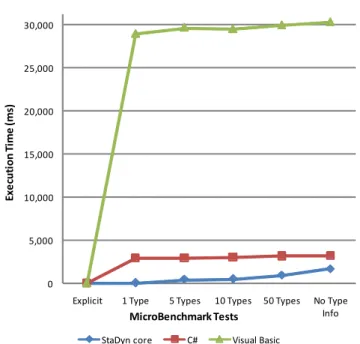
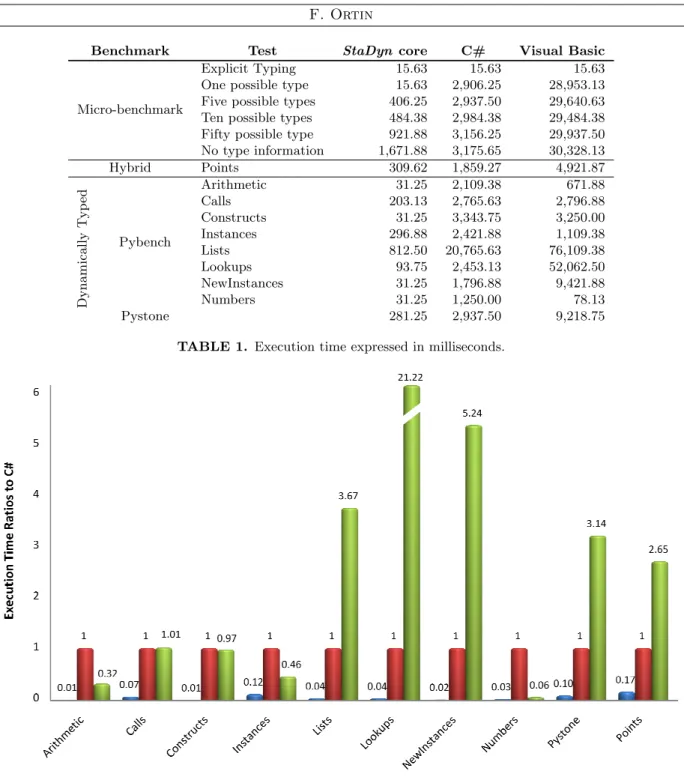
core with that of the C# 4.0 and Visual Basic 10 programming languages. For this evaluation, we have used two dynamically typed benchmarks, a hybrid statically and dynamically typed program, and a synthetic micro-benchmark that measures the relationship between execution time and type information inferred by the compiler.
The rest of this paper is structured as follows. In the next section, we provide an informal overview of the
StaDyn core to motivate our work. Section 3 formally describes the abstract syntax (Section 3.1) and the type system (Section 3.2) of the StaDyn core. Section 4 presents its erasure semantics by translating it into C#, and a runtime performance assessment is detailed in Section 5. Related work is commented in Section 6 and, finally, Section 7 presents the conclusions and future work.
2. AN INFORMAL OVERVIEW OF THE
STADYN CORE
Figure 1 shows an example use of the dynamic type recently included in C# 4.0. The first benefit is
duck typing. Duck typing [1] is a property offered by most dynamically typed languages that means that an object is interchangeable with any other object that implements the same dynamic interface, regardless of whether those objects have a related inheritance hierarchy or not. In line 33 (Figure 1) the x field of thedataattribute in thellist is accessed regardless of its type (list and lhave been declared as dynamic). This means that the first parameter of the positiveX
method could be any linked list whose data objects implement an x field. These objects do not need to
Type Inference to Optimize a Hybrid Statically and Dynamically Typed Language
01: using System; 02: class Points {
03: static dynamic createNode(dynamic data, dynamic next){ 04: return new { data = data, next = next };
05: }
06: static dynamic createPoint(int dimensions, int x, int y, int z) { 07: dynamic point;
08: if (dimensions == 2)
09: point = new { x=x, y=y, dimensions=dimensions }; 10: else
11: point = new { x=x, y=y, z=z, dimensions=3 }; 12: return point;
13: }
14: static dynamic createPoints(int number) { 15: int i;
16: dynamic list, point; 17: i = 0;
18: list = null; 19: while (i < number) {
20: point = createPoint(i%2 + 2, number/2 - i, i, i); 21: list = createNode(point, list);
22: i = i + 1; 23: }
24: return list; 25: }
26: static dynamic positiveX(dynamic list, int n) { 27: int i; 28: dynamic l, result; 29: i = 0; 30: result = null; 31: l = list; 32: while (i < n) { 33: if (l.data.x >= 0)
34: result = createNode(l.data, result); 35: l = l.next;
36: i = i + 1; 37: }
38: return result; 39: }
40: static double distance3D(dynamic point) { 41: double value;
42: value = Double.MaxValue;
43: // point.center++; // No compiler error
44: if (point.dimensions == 3)
45: value = Math.Sqrt(point.x*point.x +
point.y*point.y + point.z*point.z); 46: return value;
47: }
48: static dynamic closestToOrigin3D(dynamic list, int n) { 49: int i;
50: double minDistance; 51: dynamic l, point3D = null; 52: minDistance = Double.MaxValue; 53: l = list; 54: i = 0; 55: while (i < n) { 56: if (distance3D(l.data) < minDistance) { 57: minDistance = distance3D(l.data); 58: point3D = l.data; 59: } 60: l = l.next; 61: i = i + 1; 62: } 63: return point3D; 64: }
65: static void Main() { 66: int numberOfPoints;
67: dynamic list, positive, point; 68: numberOfPoints = 10;
69: list = createPoints(numberOfPoints); 70: // list.data = 10; // No compiler error
71: positive = positiveX(list, numberOfPoints); 72: point = closestToOrigin3D(list, numberOfPoints); 73: }
74: }
FIGURE 1. Sample C# 4.0 code that makes use of dynamic typing.
belong to a specific hierarchy defining the shared x
message, and they do not have to be instances of the same type either. An example of this flexibility is shown in Figure 1, where the list reference passed to the positiveX method (line 71) holds a linked list with objects of two different types (two and three dimensional points). The method returns another list containing those objects whosexfield value is positive, regardless of their type.
Dynamic typing is also used in the
closestToOrigin3D method. In this case, the first parameter should be a linked list whose data is any object that implements adimensionsfield compa-rable with an integer. Moreover, those objects whose
dimensions field value is 3 must implement the x, y
and z fields, and they must be subtypes of double
(they are passed as parameters to the Math.Sqrt
method). The returned object is the one that fulfills these conditions, being that nearest to the origin of coordinates. This example shows how the C# 4.0 type system can consider dynamic conditions.
StaDyn is an object-oriented programming language based on C# 3.0 that supports both dynamic and static typing. Although the current implementation of
StaDyn offers most of the features of C# 3.0 [22], its minimal core is focused on formalizing how to include dynamic and static typing in the same programming language. For that purpose, only its minimal core
features are specified here: functions, objects (without methods), arrays, assignments, and integer and boolean expressions. Type variables are also included to offer implicit type reconstruction by means of extending the usage of the var reserved word added in C# 3.0 [26]. In theStaDyn core,varreferences can be set as static (by default) or dynamic, modifying how type-checking is performed.
A formal specification of the StaDyn core program-ming language is presented later in this paper: its ab-stract syntax is specified in Section 3.1; Section 3.2 de-tails the hybrid (static and dynamic) type system; and, based on the semantics of C#, Section 4 describes the erasure semantics of the minimal core of StaDyn, de-picting the translation templates used to generate.Net code optimized by means of the static type information gathered by the compiler.
Figure 2 shows the StaDyn core version of the C# program in Figure 1. In the StaDyn core, the dynamism of var references is explicitly stated with the dyn reserved word. The major benefit of using
StaDyn is that static type checking is performed even over dynamic references. For instance, the positiveX
function statically checks that eachdataobject inlist
provides a public x field. Unlike C#, the StaDyn
core prompts a compilation error in line 70 (function invocation in Figure 2), if code in line 69 is commented out. The error indicates that one of the elements in
F. Ortin 01: var createNode(var data, var next) {
02: return new { data=data, next=next};
03: }
04: var createPoint(int dimensions, int x,int y,int z) {
05: var point;
06: if (dimensions == 2)
07: point = new {x=x, y=y, dimensions=dimensions};
08: else
09: point = new {x=x, y=y, z=z, dimensions=3};
10: return point;
11: }
12: var createPoints(int number) {
13: int i;
14: var list, point;
15: i = 1;
16: point = createPoint(3,0,0,0); // Last node (null)
17: list = createNode(point, 0);
18: while (i < number) {
19: point = createPoint(i%2 + 2, number/2-i, i, i);
20: list = createNode(point, list);
21: i = i+1;
22: }
23: return list;
24: }
25: var positiveX(var list, int n) {
26: int i; 27: var l, result; 28: result = i = 0; 29: l = list; 30: while (i < n) { 31: if (l.data.x >= 0)
32: result = createNode(l.data, result);
33: l = l.next;
34: i = i+1;
35: }
36: return result;
37: }
38: int distance3D(/*dyn*/ var point) {
39: int value;
40: value = 2147483647;
41: // point.center; // Compiler error
42: if (point.dimensions == 3)
43: value = point.x*point.x + point.y*point.y + point.z*point.z;
44: return value;
45: }
46: var closestToOrigin3D(var list, int n) {
47: int i, minDistance; 48: var l, point3D; 49: minDistance = 2147483647; 50: l = list; 51: i = 0; 52: while (i < n) { 53: if (distance3D(l.data) < minDistance) { 54: minDistance = distance3D(l.data); 55: point3D = l.data; 56: } 57: l = l.next; 58: i = i+1; 59: } 60: return point3D; 61: } 62: 63: 64: void main() { 65: int i, numberOfPoints;
66: var list, positive, point;
67: numberOfPoints = 10;
68: list = createPoints(numberOfPoints);
69: // list.data = 3; // Compiler error
70: positive = positiveX(list, numberOfPoints);
71: point = closestToOrigin3D(list, numberOfPoints);
72: }
FIGURE 2. Example coded in the minimal core ofStaDyn.
the list (the integer) does not provide the x message. In contrast, C# 4.0 compiles the code and the error is produced at runtime (line 70 in Figure 1).
Our compiler gathers type information at compile time in order to perform static type checking over dynamic references. One of the elements we have used for this purpose is union types [25]. A union typeT1∨T2 denotes the ordinary union of the set of values belonging to T1 and the set of values belonging to T2 [27], representing the least upper bound ofT1andT2[28]. A union type holds all the possible types a reference may have. The set of operations (e.g., addition, field access, assignment, invocation or indexing) that can be applied to a union type are those accepted by every type in the union type (inference rules of static union types are
S-SUnionLandS-SUnionRin Figure 11). Union types
were already included in object-oriented languages, in type systems where they were explicitly declared [29] or inferred from implicitly typed references [30].
In our example, the type inferred forlist in line 68 (Figure 2) is a list of{x:int, y:int, dimensions:int} ∨ {x:int, y:int, z:int, dimensions:int}, meaning two or three dimensional points. In the invocation of the
positiveX function (line 70), it is statically checked that the argument is a list of objects that provide an
x field. Since this condition is statically fulfilled, the program is compiled without errors (and the static type information is used to optimize its execution). However,
if we uncomment line 69, an error message will be shown.
The closestToOrigin3D function imposes more constraints to the list parameter. Objects in list
must provide thedimensions,x,yandzfields because of the invocation to distance3D. We represent these constraints by means of intersection types [25]. T1∧T2 denotes all the values belonging to bothT1andT2 [27], representing the greatest lower bound ofT1andT2[28]. A type promotes to a static intersection type only if it is a subtype of all the types collected by the intersection type (S-SInterRrule in Figure 11).
In our example, the argument list of the
closestToOrigin3D function must be a list ofX type, being X ≤[dimensions:X1]∧[x:X2]∧[y:X3]∧[z:X4] (an object with all these four fields). However, the invocation in line 71 produces a compilation error becauselist holds a union type of both two and three dimensional points, and the former do not provide the
z field. Our approach is to make the type system more lenient, without renouncing static type checking. The point parameter of thedistance3D function can be declared as dynamic (uncommenting the dyn type qualification in line 38 of Figure 2). In this case, the promotion to intersection types is more permissive: the argument should be a subtype of at least one of the types in the intersection type (rule S-DInterRin Figure 11). Then, the program would generate no error
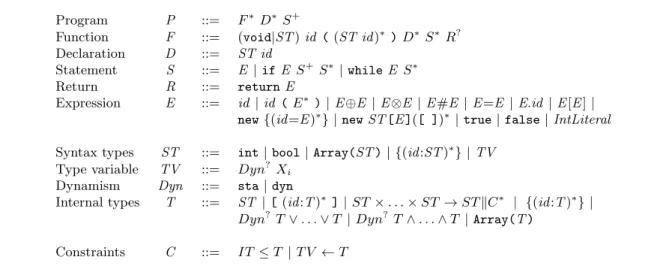
Type Inference to Optimize a Hybrid Statically and Dynamically Typed Language Program P ::= F∗D∗S+ Function F ::= (void|ST)id ((ST id)∗)D∗S∗R? Declaration D ::= ST id Statement S ::= E |ifE S+ S∗ |whileE S∗ Return R ::= returnE Expression E ::= id |id (E∗)|E⊕E |E⊗E |E#E |E=E |E.id |E[E]| new{(id=E)∗} |newST[E]([ ])∗|true|false|IntLiteral
Syntax types ST ::= int|bool|Array(ST)| {(id:ST)∗} |TV
Type variable TV ::= Dyn?Xi Dynamism Dyn ::= sta|dyn
Internal types T ::= ST |[(id:T)∗]|ST×. . .×ST →STkC∗ | {(id:T)∗} | Dyn?T ∨. . .∨T |Dyn?T∧. . .∧T |Array(T)
Constraints C ::= IT≤T |T V ←T
FIGURE 3. Abstract Syntax of theStaDyn minimal core.
because both types of points offer a publicdimensions
field. This relaxation of the subtyping relation when references are declared as dynamic is also applied to union types (S-DUnionL): the promotion should be fulfilled by at least one of the types in the union type.
It is worth noting that type checking is still performed at compile type even when the programmer uses dynamic references. As an example, if line 41 in Figure 2 is uncommented, an error is shown even though
point has been declared as dynamic (the center
message is not accepted by either of the two possible points); whereas C# compiles the code, producing the type error at runtime (line 43 in Figure 1). This example informally shows the objective of StaDyn: to offer both the flexibility of dynamic typing and the robustness and efficiency of static typing.
3. THE STADYN CORE LANGUAGE
After an informal overview of the aim of the StaDyn
core programming language, we describe its syntax and type system. Next section describes its erasure semantics by translating it into to C#.
3.1. Syntax
The first part of Figure 3 shows the abstract syntax of the minimal core (the second and third parts are, respectively, types and constraints). EBNF is used, where + means repetition of at least one element, ∗ matches zero or more occurrences, ? means optionally matching the previous element, and | represents alternative.
A program (P) is composed of a sequence of function declarations (F∗) followed by the local variable declarations (D∗) and statements (S+) of the main
function. Although the programmer may use the
return statement the same way as in C#, it could only be placed as the last statement of the abstract syntax. This transformation is performed by the parser to facilitate type inference in conditional and iterative
control structures (Section 3.2.6).
A statement can be any expression (including assign-ments), a conditional statement (if), or an iterative one (while). Since assignments are expressions, the parser annotates every expression node of the Abstract Syn-tax Tree (AST) with a boolean value (lhsAssign) that reveals whether or not it is a direct left child of an as-signment. This value will be used by the type system for type-checking purposes.
The ⊕ operator represents arithmetic operations, ⊗ logical ones and # symbolizes relational operators. Objects are created following the syntax of the C# 3.0 feature of anonymous types [26]: between curly braces, there is listed a sequence of field identifiers followed by the assignment operator and an expression representing their initial values (see lines 9 and 11 in Figure 1). The newexpression for arrays creates one-dimensional arrays. Multidimensional arrays should be built in loops repeating the construction of one-dimensional arrays. 3.2. Type System
Types used to describe the StaDyn minimal core type system are shown in the second part of Figure 3. Syntax types (ST) are those that may be directly written by the programmer, whereas internal types (T) are internally used by the type system without the knowledge of the programmer. The point of avoiding the direct use of internal types is to offer the programmer the greatest possible simplicity without losing the expressive power of the type system.
Object types are specified describing a collection of their fields between curly braces, not including methods1. Methods can be represented by functions where this is the first parameter. Although this representation does not support method overriding, it allows us to significantly reduce the StaDyn core type system. StaDyn (the whole programming language) does support method overriding by extending the
1A class-based core like the one proposed in [31] would be more appropriate to formalize methods and overriding.
F. Ortin
behavior described in [29]: when a message is passed to a dynamic union type, it is checked that at least for one possible signature, the actual argument types are subtypes of the corresponding formal parameters; the type of the method invocation expression is the union of the return types declared by those methods that satisfy the previous condition.
Although the var keyword is part of the concrete syntax of type variables (included in C# 3.0 to allow avoiding type specification of initialized local variables [26]), the parser assigns them unique sequential numbers (Xi metavariables range over type variables). Type variables can be declared as dynamic (dyn) or, by default, static (sta). Only intersection and union types can also be qualified as dynamic or static. Member types ([(id:IT)∗]) represent the collection of fields an object may hold. Member types have been introduced in constraints to define structural width coercion of object types to member types (S-OMember rule in Figure 11), because objects in StaDyn do not define width subtyping (S-Objectin Figure 11). This subtyping relation is used in the constraint resolution algorithm when function calls are type-checked (T-Inv
in Figure 17).
Type inference is specified with the general judgment Γ; Ω`E:T kC; Γ0, meaning that under constraintsC, environment Γ, and context Ω, expressionE has type
T, producing the output environment Γ0. Environments (Γ) bind variables (identifiers) to types in the scope represented by Γ, and they also bind type variables to types (if type variables have been inferred). Γ holds the environment before the scope of E, and Γ0 stores the environment after typing E. Γ0 might differ from Γ, containing inferred types of local variables and new types bound to type variables inferred in E. Output environments have already been used to define flow-sensitive type systems [24], because type variables may change their types depending on the control flow [32].
A context (Ω) stores the information of the function being analyzed, in order to type-check its statements. Ω.paramssaves the parameter list of the current function, Ω.rt holds its declared return type, and Ω.tifp collects the types inferred from function parameters (see Section 3.2.2).
Figure 4 shows another example program of our core language. Elements of the environment and generated constraints are shown in the right part of the figure. For example, in the scope of the main function in Figure 4, Γ holds the assumptions Γ(increment):int, Γ(list1):X18, and, in line 16, Γ(X18):{data:X20,
next:X21}, Γ(X20):bool and Γ(X21):int. Since Γ(X20):bool in line 16, the statement in line 17 is accepted by the type system. However in line 19 the type of the object data field is changed to int and, hence, line 20 compiles without any error, whereas line 21 is now erroneous. This example shows how a variable can hold different types in the same scope, depending on the execution flow. This is a common feature of
01: var createNode(var data, var next) { Γ(data):X10, Γ(next):X11
02: returnnew { data=data, next=next};
03: } Γ(createNode):X10×X11→X12 ║ {data:X10,next:X11} ≤ X12
04: void setData(var node, var data) { Γ(node):X13, Γ(data):X14
05: node.data = data; X13≤ [data:X15], X15← X14
06: } Γ(setData): X13×X14→void ║ X13≤ [data:X15], X15 ← X14
07: void clearList(var list, bool clear) { Γ(list):X16
08: if (clear)
09: list.next = 0; X16 ≤ [next:X17], Γ(X17)←int
10: } Γ(X17):X17∨int, Γ(clearList):X16xbool→void ║
X16≤ [next:X17], Γ(X17)←X17∨int
11: void main() {
12: var list1; Γ(list1):X18
13: var list2; Γ(list2):X19
14: int increment; Γ(increment):int
15: bool boolean; Γ(boolean):bool
16: list1 = createNode(true, 0); Γ(X18):{data:X20,next:X21},
Γ(X20):bool, Γ(X21):int
17: boolean = list1.data;
18: list2 = createNode(boolean, list1); Γ(X19):{data:X22,next:X18},
Γ(X22):bool
19: setData(list1, 3); Γ(X20):int
20: increment = list2.next.data + 1;
21: boolean = list1.data; // Compiler error
22: clearList(list2, false); Γ(X19):{data:X22,next:X18∨int},
Γ(X18):{data:X20,next:X21}
23: }
FIGURE 4. Example concrete program.
dynamically typed languages, but StaDyn offers it in a statically typed way. This process has also been applied to control structures (Section 3.2.6).
We also define two kinds of constraints (the last part of Figure 3). Subtyping constraints (T ≤T) require the type on the left to be a subtype of (promote to) the type on the right. Assignment constraints (T V ← T) not only check that an assignment could be performed, but they are also used to infer types, binding a type variable to another type. Therefore, assignment constraints may modify type variable bindings in type environments, when function invocation expressions are checked. In line 5 of Figure 4, a subtyping constraint is generated for the node variable; it should be an object with a
data field, i.e., a subtype of a member type: X13 ≤ [data:X15]. This constraint must be statically fulfilled wherever the function setData is called, e.g., line 19. Line 5 is also an example of an assignment constraint generation: X15←X14. When thesetDatafunction is invoked, the data type of thenode argumentX15 will be assigned the type of thedata parameterX14. This is the reason whyX20is then bound to intin line 19.
3.2.1. Functions
We use to denote well-formedness. Inference rules in Figure 5 not only check well-formedness, but they also generate output environments and constraints that are used for type-checking subsequent expressions. As an example, T-Func adds the identifier of the function being declared to the output environment. This identifier type is now T1×. . .×Tn →T kC, denoting that it is possible to type-check subsequent calls to it. Function types include the constraint set (C) that must be satisfied by the arguments at each invocation. These constraints are those produced by the statements within the function. For instance, the type expression of thesetDatafunction in Figure 4 (line 6) has the two
Type Inference to Optimize a Hybrid Statically and Dynamically Typed Language
(T-Func)
Ω.params=id1...idn,Ω.locals=idn+1...idn+m,Ω.rt=T ,Ω.tifp=T1...Tn id /∈dom(Γ) Γ; Ω`T1id1: k ∅; Γ1... Γn−1; Ω`Tnidn: k ∅; Γn Γn; Ω`Tn+1idn+1:k∅; Γn+1... Γn+m−1; Ω`Tn+midn+m:k∅; Γn+m Γn+m; Ω`S1: kC1; Γn+m+1... Γn+m+l−1; Ω`Sl: kCl; Γn+m+l Γn+m+l; Ω`R: kCl+1; Γn+m+l+1 Γ0= Γ, id:T1×. . .×Tn→TkC1∪. . .∪Cl+1 Γ;∅ `T id(T1id1...Tnidn)Tn+1idn+1...Tn+midn+mS1...SlR: k ∅; Γ0 (T-Decl) id /∈dom(Γ) Γ0= Γ, id:T Γ; Ω`T id: k ∅; Γ0 (T-Decls) Γ; Ω`D1: k ∅; Γ1. . . Γn−1; Ω`Dn: k ∅; Γn Γ; Ω`D1. . . Dn: k ∅; Γn (T-Funcs) Γ; Ω`F1: k ∅; Γ1. . . Γn−1; Ω`Fn: k ∅; Γn Γ; Ω`F1. . . Fn: k ∅; Γn
FIGURE 5. Program, declarations and functions.
constraintsX13≤[data:X15] andX15←X14. The rest of the rules in Figure 5 generate no constraint at all, and output environments become the input of the following terms, obtaining a flow-sensitive type checking.
3.2.2. Context
It is necessary to store information regarding a function in order to subsequently perform type checking of the terms in the function scope. This information is saved in the function context (Ω) by means of
T-Func (Figure 5) and the rules shown in Figure 6.
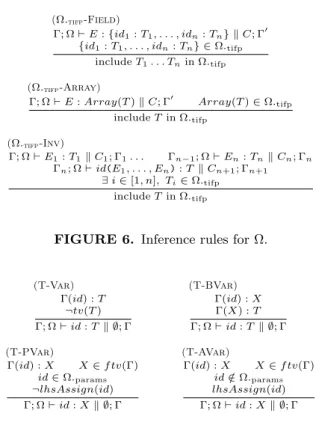
At function declaration (T-Func), local variables are stored in Ω.locals, parameters in Ω.params, and Ω.rtsaves the return type specified in the function declaration. The types inferred from the type parameters are stored in Ω.tifp(it will be described later why this information is necessary to perform type-checking of assignments, field accessing and array indexing). First, T-Func (Figure 5) adds parameter types to Ω.tifp; in Figure 6, Ω.tifp-Field inserts field types in Ω.tifp whenever an object type is in Ω.tifp; Ω.tifp-Array and Ω.tifp-Inv
do the same with arrays and function calls, respectively. Notice that not only type variables are inserted in Ω.tifp. Objects are also added because they may indirectly hold type variables in their fields. The same happens with arrays, whose elements could be type variables.
3.2.3. Basic Expressions
This subsection describes the type-checking of variables, object field access, vector indexing, arithmetic, rela-tional and logical expressions. Although assignments and function calls are also expressions, they will be de-scribed in Sections 3.2.5 and 3.2.7, respectively.
Figure 7 shows inference rules that type-check variables. The tv predicate tests whether a type is a type variable or not, and the ftv function returns the set of unbound type variables in an environment.
T-Var types a variable previously declared, when its
(Ω.tifp-Field) Γ; Ω`E:{id1:T1, . . . , idn:Tn} kC; Γ 0 {id1:T1, . . . , idn:Tn} ∈Ω.tifp includeT1. . . Tnin Ω.tifp (Ω.tifp-Array)
Γ; Ω`E:Array(T)kC; Γ0 Array(T)∈Ω.tifp includeTin Ω.tifp (Ω.tifp-Inv) Γ; Ω`E1:T1kC1; Γ1. . . Γn−1; Ω`En:TnkCn; Γn Γn; Ω`id(E1, . . . , En):TkCn+1; Γn+1 ∃i∈[1, n], Ti∈Ω.tifp includeTin Ω.tifp
FIGURE 6. Inference rules for Ω.
(T-Var) Γ(id) :T ¬tv(T) Γ; Ω`id:Tk ∅; Γ (T-BVar) Γ(id) :X Γ(X) :T Γ; Ω`id:T k ∅; Γ (T-PVar) Γ(id) :X X∈f tv(Γ) id∈Ω.params ¬lhsAssign(id) Γ; Ω`id:Xk ∅; Γ (T-AVar) Γ(id) :X X∈f tv(Γ) id /∈Ω.params lhsAssign(id) Γ; Ω`id:Xk ∅; Γ FIGURE 7. Variables.
type is not a type variable. When the type of an identifier is a type variable and it is bound to another type, T-BVar types the identifier to the type bound to the type variable. This happens, for instance, in line 17 of Figure 4, where the type variable of
list1 (X18) was previously bound to the object type {data:X20,next:X21} in line 16.
Both T-PVar and T-AVar type-check identifiers when their types are free type variables (not bound to any other type). In the first case, the variable can be used when it is a parameter (thus, it has a value) and it is not the left-hand side of an assignment2. On the other hand, T-AVar allows a free type variable that is not a parameter to be used as an expression as long as it is the left-hand side of an assignment (because the type variable will be then bound to a type in the subsequent expression). For example, the utilization of the data parameter in line 2 of Figure 4 is allowed because, despite its type is a free type variable (X10), it is contained in Ω.params. list1can be used in line 16 because, although its type (X18) is not in Ω.tifp, it is in the left-hand side of an assignment.
Figure 8 shows the T-Arith inference rule of arithmetic expressions (for the sake of brevity, relational and logical expressions are not shown). Operands
2TheStaDyn core does not allow assigning values to function
parameters in order to make type-checking easier. This
feature could be obtained by a syntactical transformation where parameters are assigned to local variables, because parameters
in C# are passed by value—by default, when no ref and out
F. Ortin (T-Arith) Γ; Ω`E1:T1kC1; Γ 0 Γ0`T1≤intkC2; Γ 00 Γ00; Ω`E2:T2kC3; Γ 000 Γ000`T2≤intkC4; Γ 0000 Γ; Ω`E1⊕E2:intkC1∪C2∪C3∪C4; Γ0000 (T-NObject) Γ; Ω`E1:T1kC1; Γ1...Γn−1; Ω`En:TnkCn; Γn Γ; Ω`new{id1=E1, ..., idn=En}:{id1:T1, ..., idn:Tn} kC1∪...∪Cn; Γn (T-NArray) Γ; Ω`E:TekC1; Γ0 Γ0`Te≤intkC2; Γ00
Γ; Ω`newT[E][ ]1...[ ]n:Array1(...Arrayn(Array(T)))kC1∪C2; Γ00
(T-Field)
Γ; Ω`E:TkC1; Γ0 Xfresh Γ0`T≤[id:X]kC2; Γ00 X∈f tv(Γ00)∧X /∈Ω.tifp⇒lhsAssign(E.id)
Γ; Ω`E.id:XkC1∪C2; Γ00 (T-Array) Γ; Ω`E1:T1kC1; Γ 0 Xfresh Γ0`T1≤Array(X)kC2; Γ 00 Γ00; Ω`E2:T2kC3; Γ 000 Γ000`T2≤intkC4; Γ 0000 X∈f tv(Γ0000)∧X /∈Ω.tifp⇒lhsAssign(E1[E2]) Γ; Ω`E1[E2] :XkC1∪C2∪C3∪C4; Γ0000
FIGURE 8. Basic expressions.
of arithmetic and relational expressions must be subtypes of int; logical expressions should promote
to bool. Output environments are used as the
input environments of the subsequent expressions, the one returned by the whole expression being the last environment. The constraint set generated by each expression is the union of all the constraints produced by each of the four premise judgments.
The new object expression (T-NObject) infers an object type comprising the field labels and types of the corresponding expressions. Line 2 in Figure 4 is an example of this inference rule, where the type of the expression is {data:X10, next:X11}. In a similar way, the T-NArrayrule types the array construction expressions. The expression that specifies the array size must promote to integer. Only one-dimensional arrays can be constructed at a time, and the type returned is an array of the same dimensions as pairs of square brackets. The type of the new expression in line 11, Figure 9, is Array(X34), X34 being a new fresh type variable.
When accessing object fields (T-Field), the object should promote to the member type [id:X],X being a new fresh type variable. A member type is an internal type that denotes the set of fields an object should hold. Therefore, an object promotes to a member type following the same rules as structural subtyping for objects described in [33] (rule S-OMember in Figure 11). Moreover, if the object field is a free type variable not inferred from the parameters, i.e., not in Ω.tifp, it must be a direct left child of an assignment expression. Line 42 in Figure 2 is an example of a correct term. Although the dimensions field of the
point object is a free type variable and it is not the
01: void vector(var[] w) { Γ(w):Array(X30)
02: var[] v; Γ(v):Array(X31)
03: int a;
04: v = new var[2]; Γ(X31):X32
05: a = v[3]; // Compiler error
06: v[0] = w[0] = 0; Γ(X32):int, Γ(X30):X30∨int
07: v[1] = w[1] = true; Γ(X32):int∨bool, Γ(X30):X30∨int∨bool
08: }
09: void main() {
10: var[] ve; Γ(ve):Array(X33)
11: ve = new var[3]; Γ(X33):X34
12: ve[2] = new { attribute = 3 }; Γ(X34):{attribute:int}
13: vector(ve); Γ(X34):{attribute:int}∨int∨bool
14: }
FIGURE 9. Example use of arrays.
left-hand side of an assignment, its type is in Ω.tifp.
T-Array requires the first expression to be a
subtype of an array, and the index to be an integer. As with objects, if the calculated type is a free type variable, it should be the left-hand side of an assignment. This predicate generates a compilation error in line 5 of Figure 9. The type of the elements of thevarray is the free type variableX32, not inferred from the parameters (v is a local variable), producing a compilation error because no value has been assigned to it.
3.2.4. Subtyping
Judgments in subtyping rules (Γ ` T1 ≤ T2 k C; Γ0) require an input environment (Γ) and generate a set of constraints (C) and an output environment (Γ0). The input environment is used to know the type variables that might be bound to other types. In effect, the
T-TVBS rule in Figure 10 types any expression to the
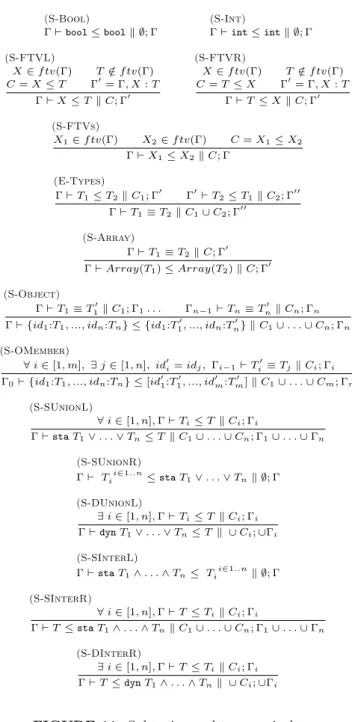
type which is bound to the expression type variable. The output environment is used to bind a type variable to a type when the type variable must be a subtype of a particular type. This is precisely the behavior of the S-FTVL and S-FTVR rules in Figure 11 that, in addition, generate a subtyping constraint. An example expression where theS-FTVL
rule is applied is node.data in Figure 4, line 5. The
T-Field rule requires the type of node (the X13 free type variable), to be a subtype of the member type [data:X15]—X15being a new fresh type variable. Then, the S-FTVL rule generates a new X13 ≤ [data:X15] constraint and binds [data:X15] to X13 in the output environment Γ0.
S-FTVR offers the same functionality when a
concrete type must promote to a free type variable. This rule is used inreturnstatements inside functions that return a type variable (e.g., line 2 in Figure 4). When both type variables are not bound to any type, only a subtyping constraint is produced (S-FTVs in Figure 11).
The arrays (S-Array) and objects (S-Object) type constructors are invariant. Array(T1) is a subtype of
Array(T2) when T1 and T2 are equivalent. T1 and
T2 are equivalent under the subtype relation, when
Type Inference to Optimize a Hybrid Statically and Dynamically Typed Language
(T-TVBS)
Γ; Ω`E:XkC; Γ0 Γ0(X) :T Γ; Ω`E:TkC; Γ0
FIGURE 10. Type variable binding substitution.
to another one when both have the same number of fields and equal field labels, and the corresponding types are equivalent (S-Object).
Member types were introduced for structural subtyp-ing of objects. An object type is a subtype of a member type when the former has all the members of the latter, and their corresponding types are structurally equiva-lent (S-OMember). This rule is necessary in the ful-fillment of subtyping constraints of function invocation (Section 3.2.7). As an example, the setData function in Figure 4 has theX13≤[data:X15] constraint (line 6). When the function is called in line 19 passing the {data : X20, next : X21} object as the first argument, theS-OMember subtyping rule confirms that the ar-gument promotes to the parameter.
Subtyping rules for union and intersection types are an enhancement of the ones defined by other authors such as [25] and [34] (S-SUnionL, S-SUnionR,
S-SInterRandS-SInterL), adding new dynamic typing
rules (S-DUnionLandS-DInterR)—[35] details this new interpretation of union and intersection types. If the type variable bound to a union type has been declared as static, the set of operations that can be applied to that union type are those accepted by every type in the union type (S-SUnionL). However, if the reference is dynamic, type-checking is more permissive. In that case, it is possible to perform an operation when it is accepted by at least one of the types in the union type (S-DUnionL)—in the conclusion of the rule, ∪Γi and ∪Ci represent the union of all the Γi and Ci that fulfill the predicate in the premise. If the operation cannot be applied to any type, a type error will be generated even if the reference is dynamic. This behavior can be seen in lines 18 and 19 of Figure 12. The type of bothstaand din variables isint∨bool, butstais static whereasdinis dynamic. This difference prevents the arithmetic operation in line 18 from compiling (the plus operator cannot be applied to a bool), while it is correct in line 19 (addition is defined for integers).
In parallel, a type promotes to a static intersection type only if it is a subtype of all the types collected by the intersection type (rule S-SInterR). Similarly, we have defined the dynamic behavior to be more lenient, accepting the promotion when a type promotes to at least one of the types in the intersection type (rule
S-DInterR). An example is the function call in line
71 of Figure 2: data of thelist argument must be a subtype of [dimensions:X1]∧[x:X2]∧[y:X3]∧[z:X4]; the program is compiled only when thepointparameter in
(S-Bool) Γ`bool≤boolk ∅; Γ (S-Int) Γ`int≤intk ∅; Γ (S-FTVL) X∈f tv(Γ) T /∈f tv(Γ) C=X≤T Γ0= Γ, X:T Γ`X≤TkC; Γ0 (S-FTVR) X∈f tv(Γ) T /∈f tv(Γ) C=T≤X Γ0= Γ, X:T Γ`T ≤XkC; Γ0 (S-FTVs) X1∈f tv(Γ) X2∈f tv(Γ) C=X1≤X2 Γ`X1≤X2kC; Γ (E-Types) Γ`T1≤T2kC1; Γ0 Γ0`T2≤T1kC2; Γ00 Γ`T1≡T2kC1∪C2; Γ00 (S-Array) Γ`T1≡T2kC; Γ0 Γ`Array(T1)≤Array(T2)kC; Γ0 (S-Object) Γ`T1≡T 0 1kC1; Γ1. . . Γn−1`Tn≡T 0 nkCn; Γn Γ` {id1:T1, ..., idn:Tn} ≤ {id1:T10, ..., idn:Tn0} kC1∪. . .∪Cn; Γn (S-OMember) ∀i∈[1, m],∃j∈[1, n], id0i=idj,Γi−1`Ti0≡TjkCi; Γi Γ0` {id1:T1, ..., idn:Tn} ≤[id01:T 0 1, ..., id 0 m:T 0 m]kC1∪. . .∪Cm; Γm (S-SUnionL) ∀i∈[1, n],Γ`Ti≤TkCi; Γi Γ`staT1∨. . .∨Tn≤TkC1∪. . .∪Cn; Γ1∪. . .∪Γn (S-SUnionR) Γ` Tii∈1..n≤staT1∨. . .∨Tnk ∅; Γ (S-DUnionL) ∃i∈[1, n],Γ`Ti≤TkCi; Γi Γ`dynT1∨. . .∨Tn≤Tk ∪Ci;∪Γi (S-SInterL) Γ`staT1∧. . .∧Tn≤ Ti ∈1..n i k ∅; Γ (S-SInterR) ∀i∈[1, n],Γ`T≤TikCi; Γi Γ`T≤staT1∧. . .∧TnkC1∪. . .∪Cn; Γ1∪. . .∪Γn (S-DInterR) ∃i∈[1, n],Γ`T≤TikCi; Γi Γ`T≤dynT1∧. . .∧Tnk ∪Ci;∪Γi
FIGURE 11. Subtyping and type equivalence.
line 38 is dynamic (two and three dimensional points providedimensions,x, andyfields), producing an error in case it is static (thezfield is not implemented by two dimensional points).
It is worth noting that the definition of subtyping is not complete for union and intersection types. We include inference rules for neither dynamic union types on the right-hand side (supertypes), nor dynamic intersection types on the left-hand side (subtypes). This is because the StaDyn core type system never type-checks whether a dynamic intersection type is a subtype of another type—they always appear in the right-hand side of subtyping constraints—or any type promotes to a dynamic union type—they are always checked to be subtypes of another type.
F. Ortin
01: var getElement(var list, var fstOrSnd) { 02: var element; 03: if (fstOrSnd) 04: element = list.data; 05: else 06: element = list.next.data; 07: return element; 08: }
09: int increment(int value) { 10: return value + 1;
11: }
12: void main() { 13: int integer;
14: var listOfTwo, sta; 15: dyn var din;
16: listOfTwo = createNode(1,createNode(true,0)); 17: din = sta = getElement(listOfTwo, true); 18: integer = sta + 1; // Compiler error
19: integer = din + 1;
20: increment(din); // Compiler error
21: }
FIGURE 12. Example use of dynamic and static references.
Since StaDyn does not yet support higher-order functions (delegates in C# terminology), we do not specify subtyping of the function type constructor. Subtyping is not defined between member types either, because they only appear in constraints. Therefore, the current definition of the subtyping relation is neither reflexive nor transitive.
3.2.5. Assignments
The abstract syntax in Figure 3 allows any expression to be the left-hand side of an assignment. The type system rejects all those expressions that cannot be used in that context. Only identifiers, array indexing and field access expressions can be the left-hand side of an assignment. For the sake of brevity, we do not show those rules.
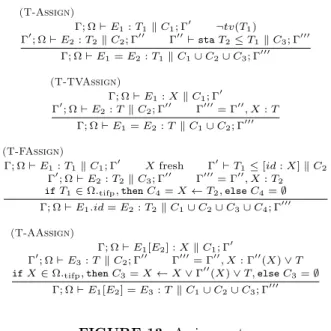
The four inference rules in Figure 13 describe assignment expressions. T-Assign types assignment expressions when the left-hand side expression type is not a type variable. This straightforward rule only requires the right-hand side to be a subtype of the left-hand side. In case the left-left-hand side is a type variable, it will from now on be bound to the type of the right-hand side expression (T-TVAssign).
T-FAssign types the assignment of an object field
when it is a type variable. As with the T-Fieldrule, the object should be a subtype of a member type with the specific field label. The new field type will be the type of the right-hand side expression, regardless of its previous type. Finally, if the field type has been inferred from a parameter, a new assignment constraint will be generated. This constraint will cause changing the field type of the argument when the function is called. An example of this kind of assignment constraint generation is shown in thesetDatafunction in Figure 4 (X15 ← X14). Calling this function with an object as the first argument (line 19) changes the type of the argument’s data to the type of the second argument (int), making the statement in line 20 correct.
For an array type whose elements are type variables (T-AAssign), the new type of its elements will be a union type comprising its previous type and the type of the right-hand side. Therefore, the type of v in line 8 of Figure 9 is an array of integers or booleans (int∨bool) because it holds both. If the type variable
(T-Assign) Γ; Ω`E1:T1kC1; Γ0 ¬tv(T1) Γ0; Ω`E2:T2kC2; Γ00 Γ00`staT2≤T1kC3; Γ000 Γ; Ω`E1=E2:T1kC1∪C2∪C3; Γ 000 (T-TVAssign) Γ; Ω`E1:XkC1; Γ 0 Γ0; Ω`E2:TkC2; Γ 00 Γ000= Γ00, X:T Γ; Ω`E1=E2:TkC1∪C2; Γ000 (T-FAssign) Γ; Ω`E1:T1kC1; Γ0 Xfresh Γ0`T1≤[id:X]kC2 Γ0; Ω`E2:T2kC3; Γ00 Γ000= Γ00, X:T2 ifT1∈Ω.tifp,thenC4=X←T2,elseC4=∅ Γ; Ω`E1.id=E2:T2kC1∪C2∪C3∪C4; Γ000
(T-AAssign)
Γ; Ω`E1[E2] :XkC1; Γ0
Γ0; Ω`E3:TkC2; Γ00 Γ000= Γ00, X: Γ00(X)∨T ifX∈Ω.tifp,thenC3=X←X∨Γ00(X)∨T ,elseC3=∅
Γ; Ω`E1[E2] =E3:TkC1∪C2∪C3; Γ 000
FIGURE 13. Assignments.
has been inferred from the function parameters, a new assignment constraint will be generated including the own type variable in the right-hand side of the assignment. This is the case of the w variable in the
vector function (line 8 in Figure 9). Unlike the type of v, the type of w (X30) is included in the union type (X30∨int∨bool), denoting that the type of the actual parameter in the invocation will be included in the union type. Therefore, the type of the elements of vewhen the function vector is called in line 13 is {attribute:int}∨int∨bool.
3.2.6. Statements
The minimal core includes the return, if and while
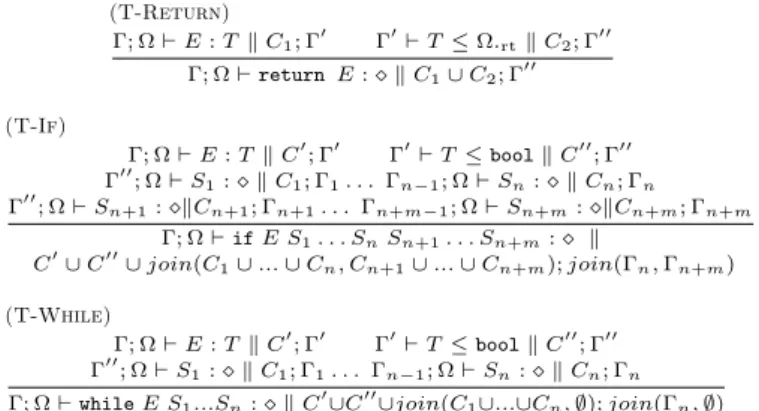
statements (Figure 14). For the returnstatement, the expression type to be returned must be a subtype of the declared return type (T-Return).
Control-flow branches ofifandwhilestatements are taken into consideration to keep the flow-sensitiveness of our type system. The join of constraints and the union of type environments take into consideration this difficulty, taking the type information obtained on each execution path and combining both into a single constraint list and type environment. Each parameter
Type Inference to Optimize a Hybrid Statically and Dynamically Typed Language
represents the type information of an exclusive control flow. Since it might happen that thewhilebody is not executed at runtime (it is not exclusive), the empty set is passed as its second argument (T-While). An example use of the join function is the type of the
point variable ({x:int, y:int, dimensions:int} ∨ {x:int, y:int, z:int, dimensions:int})—line 10 in Figure 2—that is created from its types in lines 7 ({x:int, y:int, dimensions:int}) and 9 ({x:int, y:int, z:int, dimensions:int}). The same happens with constraints: the joined constraint for the point parameter of the distance3D function (X1 ≤ [dimensions:X2] ∧ [x:X3] ∧ [y:X4] ∧ [z:X5])
is obtained from the constraints generated
in lines 42 (X1 ≤ [dimensions:X2]) and 43 (X1≤[x:X3]∧[y:X4]∧[z:X5]).
The union of environments used in Figure 14 is also based on the join function described in Figure 15: variable bindings must be the same in both environments, and the resulting type variable binding set is thejoinof the type variable binding sets of each flow path. (T-Return) Γ; Ω`E:TkC1; Γ 0 Γ0`T≤Ω.rtkC2; Γ 00 Γ; Ω`return E: kC1∪C2; Γ00 (T-If) Γ; Ω`E:TkC0; Γ0 Γ0`T≤boolkC00; Γ00 Γ00; Ω`S1: kC1; Γ1. . . Γn−1; Ω`Sn: kCn; Γn Γ00; Ω`Sn+1:kCn+1; Γn+1. . .Γn+m−1; Ω`Sn+m:kCn+m; Γn+m Γ; Ω`ifE S1. . . SnSn+1. . . Sn+m: k C0∪C00∪join(C1∪...∪Cn, Cn+1∪...∪Cn+m);join(Γn,Γn+m) (T-While) Γ; Ω`E:TkC0; Γ0 Γ0`T≤boolkC00; Γ00 Γ00; Ω`S1: kC1; Γ1. . .Γn−1; Ω`Sn: kCn; Γn Γ; Ω`whileE S1...Sn: kC0∪C00∪join(C1∪...∪Cn,∅);join(Γn,∅)
FIGURE 14. Statements.
Figure 15 shows the algorithm used to implement the join function. Each set holds either constraints (subtyping and assignment) or type variable bindings (X:T in environments). The algorithm has been defined employing the compare and union operations defined by the axioms in Figure 16. The algorithm takes elements of both sets, adding new union and intersection types [25] to the return set. It first processes the elements in the first set, and then those included in the second set but not in the first one (÷). As Figure 16 shows, comparisons between constraints are based on the type in the constraint’s left-hand side. This is because constraints are always generated with a free type variable in its left-hand side. Definitions of the compare and union operations in Figure 16 ensure that every constraint set will never have two different constraints with the same left-hand side type variable. The only statement that generates subtyping constraints with a particular type on the left-hand side
join(Set1, Set2)≡Set in Set← ∅
∀elem1∈Set1
if∃elem2∈Set2, compare(elem1, elem2) Set←Set∪union(elem1, elem2) else
Set←Set∪union(elem1) ∀elem∈Set2÷Set1
Set←Set∪union(elem) Set1÷Set2≡Set in
Set← ∅ ∀elem1∈Set1
if 6 ∃elem2∈Set2, compare(elem1, elem2) Set←Set∪elem1
FIGURE 15. The join algorithm.
(J-Compare)
compare(X1←T1, X1←T2) compare(X1≤T1, X1≤T2)
compare(X1:T1, X1:T2)
(J-Union)
union(X←T1, X←T2) =X←T1∨T2 union(staX≤T1,staX≤T2) =X≤staT1∧T2
union(dynX≤T1,dynX≤T2) =X≤dynT1∧T2 union(X:T1, X:T2) =X:T1∨T2 union(X←T) =X←X∨T
union(staX≤T) =staX≤T union(dynX≤T) =∅ union(X:T) =X:X∨T
FIGURE 16. Comparison and union operations.
is the return statement. However, this statement cannot appear in a control flow statement because of the AST transformation described in Section 3.1.
Joins of assignment constraints and type variable bindings create a union type consisting of the two types in each execution path. However, subtyping constraints are joined in a new intersection type. If a static reference should promote toT1in one flow path and be a subtype ofT2in the other, it must then be a subtype of both (subtype of the intersection type).
The union function is also defined for constraints or type variable bindings generated in only one of the optional execution paths (last four axioms in Figure 16). The union of a single static subtyping constraint is the own constraint, because static typing must check every possible flow of execution. However, if the type variable is dynamic, there is no resulting constraint because it has been produced in a single optional execution path and, since it is dynamic, the constraint fulfillment is not mandatory. In assignment constraints and type variable bindings, the type to be bound is included in the right-hand side of the assignment. This means that the type variable will be bound to a new union type including the type it was previously bound to, because a new type could be assigned to the existing one in an optional control flow. As an example, thenext field of the list variable (X17) has the type X17∨intin line
F. Ortin
(T-Inv)
shif t(Γ(id)) :T p1×. . .×T pn→TkC
∀i∈[1, n],Γi`Ei:TikCi; Γi+1 ∀i∈[1, n], Ti∈/f tv(Γi+1) ∀i∈[1, n],Γn+i`staTi≤T pikCn+i; Γn+i+1
Γ2n+2C; Γ2n+1
Γ1`id(E1. . . En) : Γ2n+2(T)kC1∪. . .∪C2n; Γ2n+2
(T-FTVInv)
shif t(Γ(id)) :T p1×. . .×T pn→TkC
∀i∈[1, n],Γi`Ei:TikCi; Γi+1 ∃i∈[1, n], Ti∈f tv(Γi+1) ∀i∈[1, n],Γn+i`staTi≤T pikCn+i; Γn+i+1 Γ1`id(E1. . . En) :TkC∪C1∪. . .∪C2n; Γ2n+1
FIGURE 17. Function invocation.
10 of Figure 4. This implies that the type of list2 in line 22 is converted from {data:X22, next:X18} (being Γ(X18):{data:X20, next:X21}) to{data:X22, next:X18∨
int}. The result is that the next field is changed because one possible flow of execution in theclearList
function may change its type toint.
3.2.7. Function Invocation
Figure 17 shows the two inference rules of function invocation. The difference is in the existence of free type variable arguments (T-Invif there is no free type variable argument, andT-FTVInvotherwise). In both cases, the shift function takes a function type and returns an equivalent one, renaming the numbers of type variables to new fresh type variables. This process permits multiple invocations of the same function, creating new type variables for each function invocation. On each invocation, the types of the arguments are checked to be subtypes of the parameter types.
If no argument is a free type variable, constraints resolution is performed. The judgment ΓsC,Γ means that under the Γ input environment, Γs is a solution for C; i.e., Γs holds all the substitutions to fulfill C under the Γ environment. In that case, the type of the function call is the substitution Γ2n+2(T), where Γ2n+2 is a solution for C. Under these circumstances, the C constraint set is solved and, hence, it is not included in the constraints generated by the function call. This shows how constraint resolution is part of the type inference process (it is not global, i.e., it is not performed after traversing the whole AST). If any argument is a free type variable, C is added to the constraint set produced by a function invocation expression (T-FTVInv).
The constraint resolution algorithm implemented is an adaptation of the algorithm defined by Aiken and Wimmers [28] that performs inclusion constraint resolution using union and intersection types. Its detailed description can be consulted in [36].
3.2.8. Converting Implicit to Explicit Types
Our language defines an automatic conversion of dynamic implicitly typed union types to explicit (particular) types (in assignments and function calls).
When the union type is static, the subtyping rules described in Section 3.2.4 require types in the union type to promote to the explicit type. However, if the implicit type is dynamic, the conversion is too lenient because only one single promotion is necessary to allow the conversion. This is why a static promotion is forced in both assignments (ruleT-Assignin Figure 13) and function invocations (rules T-Inv and T-FTVInv in Figure 17). As an example, the din variable (typed
dyn int∨bool in line 20 of Figure 12) is passed as an argument to theincrementfunction that explicitly requires its value parameter to be int. Therefore, a compilation error is generated even though the argument is dynamic, because the value parameter is explicitly typed (and, hence, static).
4. ERASURE TRANSLATION
The objective of this section is twofold. First, to describe the translation templates used to generate code for the .Net platform employing the static type information gathered by the compiler. Second, based on the semantics of C# [37], to describe the erasure semantics of the minimal core of StaDyn.
TheStaDyncore may be translated into C# following either of two implementation styles: first, by type-passing, augmenting the runtime system to carry information about type parameters; second, by erasure, removing all information about type parameters at runtime [31]. We have used the second approach, giving an erasure mapping from the StaDyn minimal core into C#. This style corresponds to the current implementation of StaDyn, which is compiled into the .Net platform by generating IL code (before the executable files), maintaining no information about type parameters at runtime—here we describe the translation to C# for simplicity. Figure 18 shows an example translation that will be used throughout this section. TheStaDyn core source code is shown on the left, while the corresponding output C# program is displayed on the right.
The translation is performed traversing the AST. This traversal is performed after type checking, where the AST nodes were annotated with their types and a copy of the state of the type environment (Γ) and context (Ω) in the conclusion of each typing rule (written Γnode and Ωnode).
4.1. Type Erasure
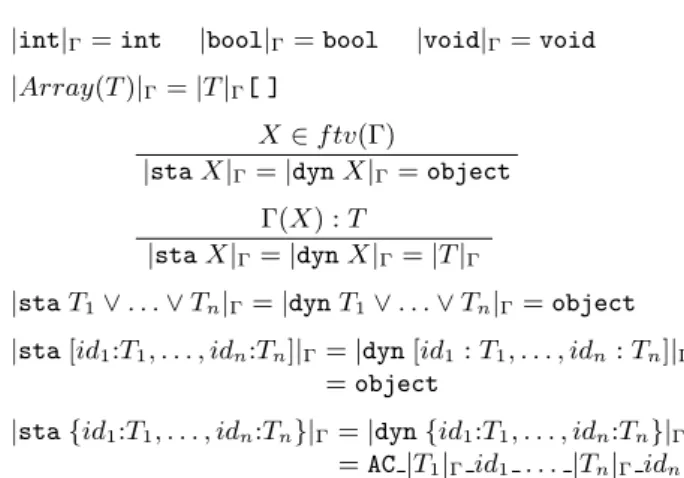
The erasure of a type in the StaDyn core is the corresponding C# type that we will use in the code generation process. Since type erasures depend on environments (Γ), we write |T|Γ for the erasure of the typeT with respect to the environment Γ. Translation rules insert type casts when necessary using the type information obtained by the compiler, and omitting them when it is trivially safe to do so, e.g., when the
Type Inference to Optimize a Hybrid Statically and Dynamically Typed Language 01: using System
02: class AC_int_x_int_y {
03: public int x;public int y;
04: }
05: class AC_int_x_int_y_int_z {
06: public int x; public int y; public int z;
07: }
08: public class MainClass {
dyn var point2D(int x, int y) { 09: static AC_int_x_int_y point2D(int x, int y) {
10: object _temp;
return new { x=x, y=y}; 11: return new AC_int_x_int_y {x=x, y=y};
} 12: }
dyn var point3D(int x, int y, int z) { 13: static AC_int_x_int_y_int_z point3D(int x, int y, int z) {
14: object _temp;
return new { x=x, y=y, z=z}; 15: return new AC_int_x_int_y_int_z {x=x, y=y, z=z};
} 16: }
dyn var point(dyn var dim, dyn var x,
dyn var y, dyn var z) {
17: static object point(int dim, int x, int y, int z) {
18: object _temp; dyn var result; 19: object result;
if (dim==2) 20: if (dim == 2)
result = point2D(x,y); 21: result = point2D(x, y);
else 22: else
result = point3D(x,y,z); 23: result = point3D(x, y, z); return result; 24: return result;
} 25: }
void main() { 26: public static void Main() {
27: object _temp;
var sta; 28: object sta;
dyn var din; 29: object din;
sta = point(2, 0, 4, 3); 30: sta = point(2, 0, 4, 3); din = point(3, 0, 4, 3); 31: din = point(3, 0, 4, 3);
sta.x + 32: _temp = ((_temp=sta) is AC_int_x_int_y ?
(int)(((AC_int_x_int_y)_temp).x) : (int)(((AC_int_x_int_y_int_z)_temp).x) ) + din.y 33: ((_temp=din) is AC_int_x_int_y ?
(int)(((AC_int_x_int_y)_temp).y) : _temp is AC_int_x_int_y_int_z ? (int)(((AC_int_x_int_y_int_z)_temp).y) : (int)(_temp.GetType().GetField("y").GetValue(_temp))) * * din.z; 34: ((AC_int_x_int_y_int_z)din).z; } 35: } 36: }
StaDyn core (source) C# (destination)
FIGURE 18. Example translation fromStaDyn core to C#.
top type in C#, object, is the erased type that an expression should have.
|int|Γ=int |bool|Γ=bool |void|Γ=void |Array(T)|Γ=|T|Γ[ ]
X∈f tv(Γ)
|staX|Γ=|dynX|Γ=object
Γ(X) :T
|staX|Γ=|dynX|Γ=|T|Γ
|staT1∨. . .∨Tn|Γ=|dynT1∨. . .∨Tn|Γ=object |sta[id1:T1, . . . , idn:Tn]|Γ=|dyn[id1:T1, . . . , idn:Tn]|Γ
=object
|sta{id1:T1, . . . , idn:Tn}|Γ=|dyn{id1:T1, . . . , idn:Tn}|Γ
=AC|T1|Γid1 . . . |Tn|Γ idn
where id1. . . idnare lexicographically ordered, and
inAC |T1|Γid1 . . . |Tn|Γ idn,
T[ ]1. . .[ ]n is replaced with T n
FIGURE 19. Type erasure definition.
Figure 19 shows type erasures of theStaDynminimal core. Function and intersection type erasures are not used in our translation rules, because our language does not support high-order functions, and intersection types only appear in constraints (no code is generated for them).
4.2. Anonymous Classes
As shown in Figure 19, an anonymous class
(AC|T1|Γ id1 . . . |Tn|Γ idn) is the type erasure of each different object structure. Since subtyping rules in our language require two objects to have the same struc-ture (S-Object), we create a unique anonymous class for each object structure. To do so, the name of the anony-mous class is the concatenation of each field name (lex-icographically ordered) followed by its type erasure— arraysT[ ]1. . .[ ]nare replaced with T n because square brackets are not allowed in C# identifiers.
These anonymous classes are generated in the first traversal (J KAC), after type-checking the AST. The visit of each AST node receives the set of classes that have already been declared. Starting from the AST
F. Ortin
root node (P), this set is passed from each node to their descendants. The only nodes that generate a new class declaration are the object type and thenewobject expression. The following translation template shows the anonymous class generation for the latter node.
AC|T1|Γid1 . . . |Tn|Γidn∈/classes
JE=new{id1=E1, . . . , idn=En}KAC(classes) ,
classes←classes∪AC|T1|ΓE id1 . . . |Tn|ΓE idn class AC |T1|ΓE id1 . . . |Tn|ΓE idn { public|T1|ΓE|id1|ΓE ; . . . public|Tn|ΓE|idn|ΓE ; } where ΓE1; ΩE1`E1:T1 . . . ΓEn; ΩEn`En:Tn, id1. . . idnare lexicographically ordered, and
in AC|T1|Γ id1 . . . |Tn|Γidn,
T[ ]1. . .[ ]nis replaced with T n
Figure 18 shows how two anonymous classes (lines 2 to 7 of the C# code on the right) are created in the traversal of twonew object nodes (lines 11 and 15 of the StaDyn core code on the left).
The second scenario where an anonymous class declara-tion is generated is when an object type is used and its class has not been previously declared.
AC|T1|Γid1 . . . |Tn|Γidn∈/classes
JT ={id1:T1, . . . , idn:Tn}KAC(classes) ,
classes←classes∪AC|T1|ΓT id1 . . . |Tn|ΓT idn class AC |T1|ΓT id1 . . . |Tn|ΓT idn {
public|T1|ΓT |id1|ΓT ; . . .
public|Tn|ΓT |idn|ΓT ;
}
where id1. . . idnare lexicographically ordered, and
in AC|T1|Γ id1 . . . |Tn|Γidn,
T[ ]1. . .[ ]nis replaced with T n 4.3. Translation of Programs
The translation of a program consists of the import of the main.Netnamespace (System) followed by the declaration of anonymous classes (J KAC) (passing an empty set of
classes) and the final generation of code (J KCG).
JPKprogram , import System ;
JPKAC(∅) JPKCG
Code generated for a program (JPKCG) consists of a C#
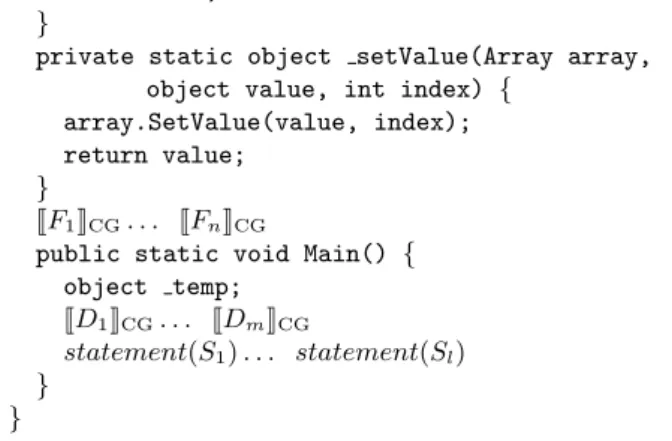
public class (MainClass) followed by two helper setValue methods (explained in Sections 4.7 and 4.8). Each function is translated into a correspondingstaticC# method, and the main declarations and statements are placed inside the program’s entry point (the C# Main method of the MainClass)—the example translation in Figure 18 omits the two setValuemethods.
JP =F1. . . FnD1. . . DmS1. . . SlKCG , public class MainClass {
private static object setValue(object obj, string id, object value) {
obj.GetType().GetField(id).SetValue(obj,value); return value;
}
private static object setValue(Array array, object value, int index) {
array.SetValue(value, index); return value;
}
JF1KCG. . . JFnKCG
public static void Main() { object temp;
JD1KCG. . . JDmKCG
statement(S1). . . statement(Sl) }
}
Since not every single expression is a valid statement in C#, we define the statement function to generate an artificial assignment to a temporary reference ( temp), converting an expression into a valid C# statement when necessary.
Definition4.1.Given a statement nodeS, we define:
statement(S) ≡ temp=JSKCG; ifSisEand S6=E1=E2and S6=id(E∗) JSKCG; otherwise 4.4. Declarations
The .Net platform forces the declaration of each single variable with a unique type. We could simply declare variables and function parameters with their type erasures. However, this would generate many unnecessary casts. As an example, if a free type variable parameter is always used as an integer it is better to declare it as int rather than as object—its type erasure—(examples are the x, y and z parameters of the point function in Figure 18). This involves a faster execution because no cast will be generated. For this purpose, we define the J Ktypes traversal of
the AST that collects all the possible types which a local variable may have in a function scope. Notice that this type collection is not the output environment obtained after type checking every function body, because our type system is flow sensitive: types bound to type variables change while type checking is performed. The typestraversal returns an environment with all the possible types a local variable may have in a specific function. If a variable has more than one type, a union type is then used to represent its least upper bound.
Definition 4.2.Given two environmentsΓ1 andΓ2, we
define:
Γ1∨Γ2 ≡Γ in Γ←Γ1
∀id:T ∈Γ2, add(id, T,Γ) ∀X:T ∈Γ2, add(X, T,Γ)
Definition 4.3.Given a type variable or identifier x, a typeT, and an environment Γ, we define:
add(x, T,Γ)≡
Γ←Γ, x:T ifx /∈dom(Γ) Γ←Γ, x: Γ(x)∨T otherwise To obtain all the possible types of a local variable, it is also necessary to know the actual C# types of the