Dynamic Difficulty Adaptation for
Heterogeneously Skilled Player
Groups in Collaborative
Multiplayer Games
Master ThesisMiguel Cristian Greciano Raiskila KOM-M-0539
Fachbereich Elektrotechnik und Informationstechnik Fachbereich Informatik (Zweitmitglied) Fachgebiet Multimedia Kommunikation Prof. Dr.-Ing. Ralf Steinmetz
Dynamic Difficulty Adaptation for Heterogeneously Skilled Player Groups in Collaborative Multi-player Games
Master Thesis KOM-M-0539
Eingereicht von Miguel Cristian Greciano Raiskila Tag der Einreichung: 31. Mai 2016
Gutachter: Prof. Dr.-Ing. Ralf Steinmetz Betreuer: Christian Reuter
Department of Electrical Engineering and Information Technology Department of Computer Science (Adjunct Professor)
Multimedia Communications Lab (KOM) Prof. Dr.-Ing. Ralf Steinmetz
Ehrenwörtliche Erklärung
Hiermit versichere ich, die vorliegende Master Thesis ohne Hilfe Dritter und nur mit den angegebenen Quellen und Hilfsmitteln angefertigt zu haben. Alle Stellen, die aus den Quellen entnommen wurden, sind als solche kenntlich gemacht worden. Diese Arbeit hat in dieser oder ähnlicher Form noch keiner Prüfungsbehörde vorgelegen. Die schriftliche Fassung stimmt mit der elektronischen Fassung überein.
Darmstadt, den 31. Mai 2016 Miguel Cristian Greciano Raiskila
Contents
1. Introduction 3
2. State-of-the-art and Related Work 7
2.1. Collaborative Gaming . . . 7
2.1.1. Basic definitions . . . 7
2.1.2. Characteristics and challenges . . . 8
2.1.3. Additional research . . . 9
2.2. Dynamic Difficulty Adjusting in Video games . . . 9
2.2.1. Basic definitions . . . 9
2.2.2. Challenges, advantages and disadvantages of DDA . . . 10
2.2.3. Characteristics and Design Patterns of DDA . . . 11
3. Concept of Dynamic Difficulty Adaptation in Collaborative Games 13 3.1. Challenges of DDA in collaborative games . . . 13
3.2. Distinct-role collaborative games . . . 14
3.3. Classification of Dynamic Difficulty Adaptation Algorithms . . . 16
3.3.1. DDA according to WHEN to detect . . . 16
3.3.2. DDA according to WHAT to detect . . . 16
3.3.3. DDA according to HOW to react . . . 17
3.3.4. DDA classification summary table . . . 18
4. Co-op Craft - the implemented game 19 4.1. A brief background to StarCraft . . . 19
4.2. The StarCraft II Galaxy Editor . . . 21
4.3. Co-op Craft: Game concept . . . 24
4.3.1. Game definition . . . 24
4.3.2. Map layout and Gameplay . . . 25
4.3.3. Description of Player characters (Heroes) . . . 29
4.4. Dynamic Difficulty Adaptation in Co-op Craft . . . 31
4.4.1. DDAA #1: Resources DDAA . . . 31
4.4.2. DDAA #2: Respawning DDAA . . . 33
4.4.3. DDAA #3: Milestone DDAA . . . 34
4.4.4. Possible alternatives for DDA in Co-op Craft . . . 37
4.5. Instructions to play Co-op Craft online . . . 38
4.5.1. Installing StarCraft II in a computer . . . 38
4.5.2. Playing Co-op Craft . . . 39
5. ADappTowr - an alternative 41 5.1. Game concept . . . 41
5.2. DDA in ADappTowr . . . 42
6. The Test 45 6.1. Phase #1: Introductory Video . . . 45
6.2. Phase #2: Playing the Co-op Craft game . . . 45
6.3. Phase #3: Questionnaire . . . 46
7. Results 49
7.1. Numerical Data . . . 49
7.1.1. Tables . . . 49
7.1.2. Graphs . . . 52
7.2. Analysis of Player and Team Performance . . . 54
7.3. Questionnaire analysis . . . 55
7.4. Encountered problems and possible solutions . . . 56
8. Final Remarks 61 8.1. Conclusion . . . 61 8.2. Future Work . . . 61 A. Glossary of terms 63 Bibliography 65 iv Contents
Abstract
This work focuses on the combination of two key concepts: Dynamic Difficulty Adjustment/Adaptation (video games adapting their difficulty according to the in-game performance of players, making them-selves easier if the player performs poorly or more difficult if the player performs well) and Collaborative Multiplayer Games (video games where two or more human players work together to achieve a com-mon goal). It considers and analyzes the challenges, potential and possibilities of Dynamic Difficulty Adaptation in Collaborative Multiplayer Games, which has to date been quite unexplored. In particular, it addresses the heterogeneously skilled player groups challenge: players with different skill levels play together in a video game, but how should the game adapt its difficulty if one player performs well when another performs badly?
We use previous research on Dynamic Difficulty Adaption in single player games to mold, define and classify general approaches to Dynamic Difficulty Adaptation in collaborative games. We then focus on a subgroup of collaborative games - distinct-role collaborative video games, where we believe there is a viable way to address the heterogeneously skilled player groups challenge.
To test our general approach to Dynamic Difficulty Adaptation in collaborative games we present a game that has been exclusively developed for this purpose: Co-op Craft. It is a collaborative game that uses the StarCraft II™engine and includes three Dynamic Difficulty Adaptation Algorithms. We analyze, justify and classify these algorithms and we also outline other valid alternatives. We had players from different gaming backgrounds test this game both with Dynamic Difficulty Adaptation active and with Dynamic Difficulty Adaptation disabled. We analyzed their performance in both cases and asked their opinion on the matter based on their experience. From the numerical data representing their performance and their impressions we then extract conclusions about our approach and also the potential of including Dynamic Difficulty Adaptation in popular collaborative games of today.
1 Introduction
Video games are a relatively recent phenomenon, having seen widespread use since only a few decades. The world of video games is rapidly and constantly evolving, and it is expected to be a very relevant area in the future. What started as a simple way of entertainment has come to even been cataloged as an art by some. Not only are people playing more and more varied video games due to the increasing use of mobile devices and the Internet, in our recent era video game development tools have become easily accessible and the average person can indeed design, create and publish a game. Some initially not so popular genres like serious games or cooperative games are receiving increasing attention, and there is more research being done on video games than ever before. Video games are also a great way to express creativity and imagination. Cutting-edge innovation has the potential to lead to commercial success, as the entertainment role of video games is still the predominant role.
When producing a video game, the designers hope for it to be successful, and while a video game’s success can indeed be defined in many different ways, most video games are defined as "successful" if they sell well. Large amount of sales are the consequence of the game appealing to a large crowd, or in other words, the game is entertaining for a lot of people. With the advent of the Internet games have even begun to include micro-transactions: small additional payments that users of a game make in order to download and access additional content developed after the game’s release. If a game’s micro transactions keep on selling well after its release it is also a good sign of commercial success.
A key and tricky element in a game’s entertainment is its difficulty and its learning curve: the game should neither be too easy nor too difficult, otherwise the interest is lost. However, the audience is heterogeneous: people are different, and different players will have contrasting skills and motivations when playing games. How can designers cater for this diversity in order for their video game to be entertaining to the widest crowd possible? The most popular approach is to introduce static levels of difficulty in their game (for example: easy, medium and hard). An alternative and not yet very extended approach is to dynamically adapt the difficulty of the game, a concept known as Dynamic Difficulty Adaptation and into which we will delve deeply in this work.
Another key concept in this work is collaboration in video games. Since the beginning there has been both single and multiplayer games, and in the vast majority of multiplayer games humans play and compete against each other. However, another genre of multiplayer games, commonly known as "co-op games", has seen significant growth in the past few years, to the point that some co-op games have become extremely popular. In co-op games two or more humans work and play together as a team to achieve a common goal. An example of popular co-op games is games belonging to the relatively new MOBA game genre.MOBAstands for "Multiplayer Online Battle Arena", is a subgenre ofRTS(Real-Time Strategy) games, and defines games where teams of human players control different hero characters and push along weaker allied computer-controlled creatures to progress in a map and eventually destroy the enemy’s main structure to win. Humans in the same team work together to defeat the opposing human team. Playable heroes have different abilities and roles, so teams aim to seek good synergy and combinations between them, but the team members also must use skill (casting spells, engaging battles...) to effectively perform their assigned role.
Let’s look at the numbers of League of Legends™(commonly abbreviated to LoL), one of the most popular MOBAs. As of 2014, over 67 million players battle it out in LoL every month, more than 27 million people play at least one game of LoL every day and over 7.5 million players simultaneously play LoL during daily peak hours. 1 Even the 2012 numbers were astonishing: 2. Tassi [28] analyzes the significance of these numbers in his article. Interestingly enough, LoL is free to play, i.e. anyone can download and play it. However it includes micro transactions that allow players to buy new "skins" or 1 http://www.riotgames.com/articles/20140711/1322/league-players-reach-new-heights-2014
2 http://majorleagueoflegends.s3.amazonaws.com/lol_infographic.png
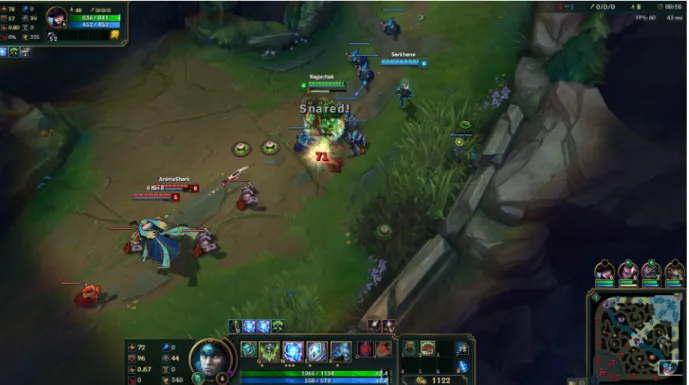
Figure 1.1.:Screenshot of a game of League of Legends™. The UI, heroes (champs) from opposing teams and computer-controlled minions can be clearly observed.
hero clothes/appearances. Such is the devotion of the player database that these micro transactions have more than paid off for the initially free game and the developers have successfully cashed in their product!
Both LoL and DotA 2 (another game of the same genre) top the eSports annually. eSports (also known as electronic sports) is a new form of sports where the primary aspects of the sport are facilitated by electronic systems (normally computers); and it has recently attracted large audiences that like to see professional video game players. Hamari and Sjöblom [15] delve deeper into the eSports appeal.
Looking at the data and the facts, we can conclude that collaborative play has come to stay. It is not just fun to tag along with a friend and play a video game together, it has even become a sport.
Returning to the difficulty factor in video games, how does it apply in co-op games? Certainly ev-erything said and researched about difficulty in single player games can be extended to co-op games, if instead of the player we consider the whole team of players. But a new challenge appears: heteroge-neously skilled players in the same team. Indeed, for a certain static level of difficulty a skilled player may find the game to be too easy, whereas a not-so-skilled player may find the game too difficult. There certainly would be a problem to choose a correct level of difficulty if both players belong to the same team. Due to this, the implementation of the traditional Dynamic Difficulty Adaptation for single players is also far from trivial. Dynamically adapting the difficulty would include observing all players in the team and adapting the difficulty for each of them accordingly, but also adapting the difficulty of the game for the team as a whole.
And what about the difficulty factor in the popular co-op games mentioned above? In general, LoL, DotA 2 and similar games have a steep learning curve, which means newcomers have a very hard time learning to play the game in the beginning. The frustration is hugely amplified in co-op games if new-comers play alongside experienced players, as their inability to play the game well enough does not only bother the newcomers, but also the experienced players who belong to the same team. In a toxic player community this leads to frequent rages, flaming and name-calling, making everyone’s experience rather unpleasant. Tassi [28] mentions this problem and Allbrecht [3] delves into it. These games include a report system where players get banned if they misbehave, a system that has incited research too (See
Kou and Nardi [19]). Apart from better educating our teenagers (and not so teenagers) and the report system, what else could be done to mitigate this problem? What about addressing the steep learning curve and difficulty problems?
Figure 1.2.:Screenshot of an unfortunate League of Legends chat. Sadly newcomers face this type of harassment frequently.
In this work we want to address Dynamic Difficulty Adaptation in Collaborative Games, which could potentially see an effective use in the popular co-op games of our day. Especially, we wish to successfully adapt the difficulty in co-op games where players in a same team have different skill levels. We will first delve into previous research on both Dynamic Difficulty Adaptation and Collaborative Games. Then we will proceed to establish, define and explain an abstract and generic approach to Dynamic Difficulty Adaptation in Collaborative Games. And afterwards we will of course want to see this tested in an actual game! For the purposes of this work we have implemented and programmed a new collaborative game called Co-op Craft that dynamically adapts its difficulty according to the players’ performance. We will present this game and explain how it adapts its difficulty. We will also define the testing procedure and detail the obtained results. We will then analyze the results to extract significant conclusions and detect limitations and problems. Finally, we will evaluate our work and suggest possibilities to continue this work in the future.
2 State-of-the-art and Related Work
"Dynamic Difficulty Adaptation in Collaborative Video games" is quite unexplored as of yet and I have failed to find detailed scholar work on the subject. However, there is plenty of previous work in both "Collaborative Gaming" and "Dynamic Difficulty Adjusting in video games", separately. Therefore, here we will address relevant information and related work on these two subjects (also separately). We wish to present basic definitions, basic characteristics and challenges to these two subjects as portrayed by other authors, as well as interesting examples of implemented work. For the purpose of this work it would make sense to then apply established information and procedures from both subjects, as we treat "Dynamic Difficulty Adaptation" in combination with "Collaborative Gaming". We will do this in Chapter 3.
2.1 Collaborative Gaming
Whereas the intricacies of collaboration and team work have been researched and pondered upon for a long time, the concept of collaboration in video games is obviously not older than video games them-selves. Most agree that video games became relevant about 50 years ago. Still, the vast majority of designed video games have been single player games or competitive multiplayer games, not collabo-rative multiplayer games. Though co-op games have been around for a while (two-player shooters in arcade machines are a prime example), it is only in recent years when scholars and video game devel-opers have taken a keen interest in them. In recent years several co-op-only games have been developed (e.g. The Legend of Zelda: Tri Force Heroes™for Nintendo 3DS™) whereas other games and genres have included co-op mode as one of their attractive assets (e.g. Call of Duty™). The recently new game genre called MOBA (Multiplayer Online Battle Arena), which focuses on co-op gameplay, has become the star genre of the worldwide competitive eSports phenomenon. The MOBA game League of Legends™has become so popular that researchers have begun analyzing its features (e.g. Ferrari [10]) The advent of the Internet has definitely increased the interest in co-op gaming, as players can now find companions and partners to play with without the need of friends coming to their physical location. Sophisticated matchmaking systems are developed to pitch players of similar skill levels and make the game interesting for all players. We can expect co-op games and genres to continue to rise in popularity within the next few years.
2.1.1 Basic definitions
Before defining Collaborative Gaming, we should first look into "collaboration", which is more complex than one may think at first. According to Roschelle and Teasley [25]:
"Collaboration can be defined as a coordinated, synchronous activity that is the result of a continued attempt to construct and maintain a shared conception of a problem"
A similar concept is "cooperation", and many wonder if "collaboration" and "cooperation" are synonyms. Strictly speaking, they are not. Dillenbourg [9] asserts:
"In Cooperation, partners split the work, solve sub-tasks individually and then assemble the partial results into the final output"
Therefore, collaboration is strictly speaking much more than cooperation, as it attempts to produce a better output than just the simple sum of individual and separate outputs of the different team mates.
In this work we shall adopt a lax position, however, as in the video game industry "Cooperative gam-ing" (or "Co-op gamgam-ing") is regarded as the feature that allows players to work together as teammates to achieve a common goal.1 Hence, when a game includes a "co-op mode", it is strictly speaking including a "collaborative mode", not a "cooperative mode". "Collaboration" will however be addressed much more often in this work than "strict cooperation", so for simplicity purposes we will not be that strict and treat "collaboration" and "cooperation" as synonyms. If we do want to refer to the strict definition of coop-eration given by Dillenbourg [9] above, we will then refer to it as"strict(ly) cooperation". Otherwise, "co-op games" will be a simpler and shorter way to mean "collaborative video games". Indeed, Dynamic Difficulty Adaptation in single-player games could be directly used in strictly cooperative games, as the individual sub-games can be treated as single-player games. This work would serve no purpose if it did not pursue Dynamic Difficulty Adaptation in collaborative games, which is a much more complicated task than applying Dynamic Difficulty Adaptation to several single-player games, as we will see in Chapter 3.
Returning to the beginning, we can now finally present the definition:
"Collaborative Games are the set of video games that involve two or more human players playing and working together as a team to accomplish a common goal."
And as stated before, in this work "co-op games" will generally refer to this set of games too. 2.1.2 Characteristics and challenges
Collaborative games are obviously multiplayer games, so their design should take into consideration well-established elements from these games. Wendel et al. [30] outlines elements from traditional games:
• Fun • Narration
• Immersion (how well does the player identify himself with his game character and actually feels the experience in the game world)
• Graphics • Sound
and also elements/challenges exclusive to multiplayer games: • Concurrent gaming
• Interaction between the players
Additionally, thefive essential elements for cooperative workfrom Johnson and Johnson [18] are often valued when it comes to designing collaborative games:
• Positive interdependence: being aware that you are linked with other players in a way that you cannot succeed unless they do
• Individual accountability: individual assessment of each player’s performance and reporting back the results to both the group and the individual
• Face-to-face promotive interaction: promoting each other’s success by helping, encouraging, praising...
• Social skills: Interpersonal and small group skills are very useful for the success of a cooperative effort
• Group processing: Group members discuss their progress and working relationships
All of the above apply when conceiving and designing a collaborative game. Although relevant, it must be noted that these elements are not strictly essentialper se. For instance, there are games that lack sound or outstanding graphics that are still interesting and/or popular.
1 https://en.wikipedia.org/wiki/Cooperative_gameplay
2.1.3 Additional research
Many research articles focus on describing characteristics and implementations of co-op games. For example, Seif El-Nasr et al. [27] delves on understanding and evaluating cooperative games, and Rocha et al. [23] examines cooperative game mechanics. Their views can offer additional light to the outlined characteristics in the previous subsection.
Quite a lot of research has also gone into Collaborative Learning, Computer Supported Collaborative Learning (CSCL) and Game-based Learning (examples: Hämäläinen et al. [14]; Wendel et al. [29]; Admiraal et al. [2]) One of the interests in collaborative games is the possibility of making the players learn collaborative skills or simply learn things together as a group. Dynamic Difficulty Adaptation could potentially be very useful in Collaborative Game-Based Learning, adapting the difficulty of the game for a better learning experience. As explained by Wendel et al. [30], designing collaborative learning serious games is definitely possible, so Collaborative Learning may yet be another reason why co-op games see a rise in use in the future. In this work, however, Collaborative Learning is not the focus, so it will not receive further mention than this paragraph.
2.2 Dynamic Difficulty Adjusting in Video games
Traditionally the approach to set and adjust the difficulty of a video game has been static: before be-ginning the game the player is often asked to choose a difficulty setting (e.g. - easy, medium or hard) and levels and challenges become increasingly more difficult (normally linearly) as the player advances in the game. This approach does not take into account the player’s input in the game to vary the game’s difficulty and this is why it is called astaticapproach. An advantage to this approach is its simplicity, but a considerable disadvantage is frequently failing to achieve the entertainment sought in the first place (more advantages and disadvantages will be discussed in Section 2.2.2). As correctly pointed out by Hunicke [16], in contrast to films, books or televised media, video games areinteractive, i.e. the player and his/her input is an essential factor in a video game. Gilleade and Dix [11] explain that the player as a human is an unpredictable dynamic entity who will also absorb information and adapt to the game experience as he plays, thus his skill improvement will normally not be linear. A lot of research has gone into "Dynamic Difficulty Adjustment", which does take into consideration the player’s input to balance the game’s difficulty - hence the termdynamic. Dynamic Difficulty Adjustment can be applied to any game genre.
2.2.1 Basic definitions
There are several definitions for Dynamic Difficulty Adaptation, although they are all intrinsically the same. First we should note that it has several synonyms: Dynamic Difficulty Adjustment, Dynamic Game Difficulty Balancing - or simply"Dynamic Game Balancing" (DGB), and the commonly used acronymDDA all mean the same thing asDynamic Difficulty Adaptation. Now some definitions. Ac-cording to Kuang [20]:
"The main idea of DDA is to have facilities in the game available to gauge the player’s performance and skill, and adjust the difficulty accordingly during gameplay to provide the most consistent (and hopefully most fun) experience for the player."
The definition by Glassner [12]:
"Games that apply DDA adapt themselves during gameplay to offer the player a consistent degree of challenge based on his changing abilities at different tasks."
I personally find the definition in the Wikipedia article very accurate:2
"DDA is the process of automatically changing parameters, scenarios, and behaviors in a video game in real-time, based on the player’s ability, in order to avoid them becoming bored (if the game is too easy) or frustrated (if it is too hard)."
The algorithm that operates DDA in a particular game is called the Dynamic Difficulty Adjustment Algorithm, and we will call it DDAA in this work. There can be several DDAAs in a game, or a big DDAA that can be subdivided in individual DDAAs, as we will see in Section 3.3.
2.2.2 Challenges, advantages and disadvantages of DDA
While DDA can definitely have benefits, it does not come cheaply. Hunicke [16] warns that DDA systems take control away from the designers and put it in the hands of code, which is not always reliable. DDA has been implemented commercially in few cases - a discussion of commercial DDA system designs and failures is presented in the work done by Arey and Wells [4]. It is also not easy to keep the player interested and challenged in interactive contexts. Hunicke et al. [17] gives proposals and tips to design DDA and address this problem, some of which we will see in the next subsection.
In the excellent article by Adams [1], dangers and disadvantages of implementing DDA instead of the traditional static difficulty levels are exposed. He mentions that:
• Some players hate DDA.For them, playing, and beating, a very difficult game is where the fun is, even if it means dying 500 times on the way to eventual success.
• DDA can be exploitable. Players may pretend to be worse than what they actually are so that the game becomes easier.
• As opposed to what theory says, DDA may not work for all kinds of challenges in practice.It is definitely not easy to modify the difficulty of a set puzzle which is already in-game. DDA could still however drop hints to the player to solve the puzzle, or choose a less complex puzzle for the next level.
• DDA can create absurdities. For example, in some car racing games, if you crash your car, the game slows down the other drivers so as to give you a chance to catch up. Then there is the notoriousrubber-band effect: if you get too far ahead your opponents always catch up, and if you get too far behind, they always slow down.
• DDA has the potential to ruin pacing and obviate good level design. A hypothetically perfect DDA system that always kept all challenges at the same level of perceived difficulty would ruin the pacing of the game, which is intended to increase in difficulty with time.
Adams [1] is not totally opposed to DDA, however. He gives suggestions to the developer in case he wishes to implement it, notably that DDA should be as subtle and secret as possible so that players can not exploit it. He concludes that:
"DDA is difficult to implement, complicates tuning, and your player may not want it at all. Think long and hard before you commit yourself to it."
We will keep these warnings in mind throughout this work, but we are not discouraged of the possible disadvantages of DDA, since we believe it has significant advantages to offer. These advantages have probably been mentioned already or will be mentioned further ahead, but to contrast them with their disadvantages we will list them here. Here are some advantages of using DDA (the last three are given by Glassner [12]) over static levels of difficulty:
2 https://en.wikipedia.org/wiki/Dynamic_game_difficulty_balancing
• DDA eases the learning process in games with a steep learning curve or that are too difficult for beginners. One example that has been discussed is League of Legends ™.
• DDA can ease the process of balancing a game’s difficulty. Balancing is traditionally achieved with iterative testing feedback, which allows the developers to tweak behaviors and settings until the game is reasonably balanced. This is a difficult and time consuming process, as per Rollings and Adams [24]. However, while game balancing and tuning can not be totally automated, an effective DDA system can reveal deeper structures and relationships within a game system in less time and with greater accuracy, says Hunicke [16], thus greatly easing the balancing task.
• In co-op games players in the same team can work effectively together regardless of their skill level.This is actually one of the main motivations for this work!
• Static difficulty levels are too broad. What is "easy" for some may be "hard" for others. What level should a player choose in the beginning?
• Static difficulty levels could be too coarse. What if medium mode is too easy, but hard mode is too hard? Or what if the hardest difficulty mode is too easy? (something that usually happens to me when I become experienced in a certain game)
• Static difficulty levels are too persistent. A difficulty setting does not adjust to the player’s rate of improving skill, especially if he is not allowed to change the setting later. The difficulty growth curve, at whatever setting, may prove to be too steep or too shallow for the player.
2.2.3 Characteristics and Design Patterns of DDA
Now we will turn our attention to DDA characteristics and design patterns and approaches suggested and/or implemented by researchers. They will be very useful when we consider DDA in co-op games in Chapter 3.
What is to be considered when designing a DDA system? According to Gilleade and Dix [11] there are three main factors to be considered:
1. Physiological Motivators- Why do players play? Is it for fun? Is it for the challenge? (e.g. if the players play for the challenge maybe they will not appreciate the game becoming easier - one of the disadvantages mentioned in the last subsection.)
2. Experience/Skill - How strong are the players? This factor definitely influences the level and nature of the changes to be performed.
3. Detection - When should a game adapt? Between levels? At certain periods of time? When a player expresses certain feelings? (the so-called "affective computing adaptation")
For Hunicke [16] DDA is a design problem that involves estimating WHEN and HOW to intervene, two key questions.
• WHEN: While we tend to think that DDA performs in real-time, this is not always necessarily the case. Bakkes et al. [5] suggest a case-based adaptive game AI, where the DDAA gathers information of previous games and starts taking decisions even before the game starts. In this work we will only consider DDAAs that only perform in real-time in-game though. Key question: "what should trigger the change in the game’s difficulty?" "Affective computing adaptation" is interesting and has been researched quite a lot (e.g: Chanel et al. [6]). It consists of observing a player’s feelings and triggering DDA according to them instead of the player’s performance in-game. Gilleade and Dix [11] explore frustration as the trigger, and concludes that adaptive games based on a player’s affective state must be taken with extreme care. In this work we will not use feelings as a trigger. We will use the traditional DDA approach of observing the player’s performance in-game (See Section 3.3), because it is much less complex than "affective computing adaption".
• HOW: Performing a change/adjustment in the game difficulty is tricky. As stated by Gilleade and Dix [11], catering in excess for heterogeneity can lead to a bloated game, whereas tweaking the wrong features will disrupt the player’s sense of disbelief (again, see disadvantages of DDA). It is important to support/challenge the player "just enough", to perform the changes smoothly and to avoid predictability. Hunicke [16] presentsadjustment policies: the combination ofadjustment actionsandcost estimations. Actions can either be reactive or proactive. Reactive actions adjust elements already "in play", e.g. enemies already visible; proactive actions adjust elements "off stage", e.g. enemies spawning in the future. The designer must analyze the cost of these actions (benefits and drawbacks), and determine which one to apply. An example of a policy could be "Staying in the Comfort Zone", where ideally a player always has between 25% and 75% of his total health left. If a player drops below 25% enemies could be made to have lower precision whereas if a player hovers above 75% enemies could spawn in larger numbers. We will use some of these concepts in our own classification of DDAAs (Section 3.3).
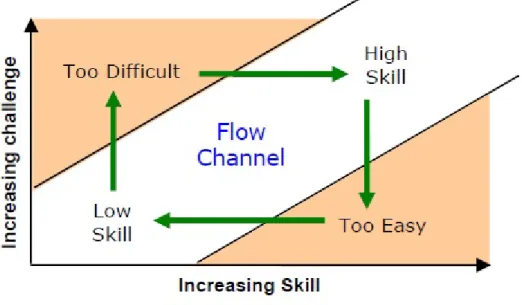
M. Csikszentmihalyil [8] developed the so-called "flow model", which he explains in his book. This can be applied to DDA, where the aim is to keep the player in the flow channel (see Figure 2.1).
Figure 2.1.:Flow state transition over the course of a dynamic experience.
Despite needing a careful implementation and not being trivial, DDA does not need to be overly complicated. The Mario Kart™series is a prime example of simple yet effective DDA - in this racing game players get items that either tamper with opponents’ driving or boost their own driving. Players at the end of the queue normally receive more powerful items than those leading the race. This produces the already mentioned "rubber-band" effect which allows for those that are behind to catch up with the rest of the drivers, while the leaders can not escape from the pack and create an unsurmountable advantage. Adams [1] is skeptical of this, as we have already seen, but in cases like Mario Kart™some claim it is part of the fun and charm of the game. In this work we strive for a similarly simple yet effective implementation of DDA, and because we will not be implementing a racing game, the "rubber-band" effect will not come into play and we will avoid its controversy.
To finish we will mention the work by Combs [7], where he discusses the AI for Massive Multiplayer Online Games (MMOG). He indirectly hints at DDA in MMOG, which could be very useful in this game genre. MMOGs can greatly benefit from "on-the-fly" adjustments for balancing their difficulty, as the always changing community of active players has a huge influence on the overall difficulty of these games. On the other hand the big complexity of MMOGs would make implementing DDA in them a challenging task.
3 Concept of Dynamic Difficulty Adaptation in Collaborative Games
As was already mentioned, very little or no research has been done specifically on DDA in co-op games, and that is why we gathered information about DDA separately from co-op games. With this background we will now present a general and abstract approach for DDA in co-op games, utilizing concepts seen in the state-of-the-art chapter as well as defining new concepts where needed.
Firstly we wish to establish our own definition of Dynamic Difficult Adaptation(or simply "DDA"), based on the ones from the previous chapter:
"DDA is the process of analyzing a player’s ability and performance in a video game, and then accordingly adjust and change significant parameters, scenarios, and AI behaviors in order to adapt the game’s difficulty and thus avoid the player from becoming bored (if the game is too easy) or frustrated (if it is too hard)."
As mentioned before, aDDAA(Dynamic Difficulty Adaptation Algorithm) is an algorithm that is respon-sible for executing DDA in a video game. These algorithms can vary in size, complexity and number in a game.
3.1 Challenges of DDA in collaborative games
Apart from the challenges to DDA that have been already exposed in the previous chapter, what addi-tional challenges does DDA carry when we intend to apply it in collaborative games?
First we have thescalability challenge, which applies not only to co-op games but also to multiplayer games in general. If a DDA consumes a lot of the machine’s resources when only adapting the difficulty for a single player, this same machine may not be able to tolerate calculations for several players. Simple DDAAs are normally safe to be scaled from single to multiplayer, but resource-demanding DDAAs require attention, as scaling them can lead to game crashes or online lag, none of which are ever welcome. In the implemented game in this work the DDAAs did not have a major impact on computer performance, but this challenge remains as a warning.
The heterogeneously skilled player groups challenge is a major one for DDA in co-op games. It refers to the dilemma of modifying the general difficulty of a game where players of different skills play together in a certain team. A certain team may include a talented player and a not-so-talented player, a seasoned veteran and a fresh newcomer, an attentive player and a distracted one... If the game becomes generally easier, the skilled players will become even more bored; and if the game becomes generally more challenging, the less-skilled players will find it even more challenging and frustrating (probably impossible for them). Subdividing the game and adjusting certain parts to avoid this problem is not trivial and requires consideration and good design. In the next section we present a general approach to deal with this challenge, which is one of the main contributions of this work.
Finally we can also mention the interference challenge. It can take many forms, but it generally refers to the malfunctioning of DDA due to the unexpected influence of other players. Of course several DDAAs assigned to different players can interfere with each other in the same way concurrent threads can also interfere with each other (classical challenges of concurrent computing), but interference can also happen through the behavior of other players. For example, imagine an FPS co-op game where the difficulty increases as you deal damage (the more damage you deal means you aim better and you are considered a better player). A player throws high-damage grenades to deal with enemies, but the explosions also hurt nearby players from his team. The DDA detects that the player is dealing a lot of damage and substantially increases the difficulty of the game, when in reality the game should be made easier because the team is overall in worse shape! There are of course ways to deal with this problem:
turn friendly fire off, make the DDAA not count friendly fire as damage dealt or ease the game difficulty when players take damage. The underlying premise is: when implementing DDA in co-op games, be aware of the possible influence of ALL players.
3.2 Distinct-role collaborative games
Among all co-op games, we find one subgroup to be especially viable for DDA: distinct-role co-op games. In these games players in a same team have clearly distinct and complementary roles. Players depend on each other to achieve their common goal, and one player alone should not be able to "solo" the game by himself, i.e. complete the game with little to no help from the teammates. For example, in an FPS game one teammate may be able to heal his comrades while another may be able to snipe far away enemies. To emphasize the need for each role, maybe in one part of the stage a toxic gas forces players to depend on the healer to survive, whereas in another stage remote mines need to be sniped from far away to allow teammates to progress in a stage.
On the other hand these distinct roles should not be so exclusive and opposing that they make the collaborative game turn into an strictly cooperative game (recall the difference between collaboration and strictly cooperation as explained in Section ??). Players are still supposed to be able to combine their input and work effectively side by side, hence the term "complementary" roles. Roles do not need to be permanent and can indeed be switched or changed for other roles in different phases of the game, as long as the roles remain complementary. In the previous example, the "healer" could become the "sniper" and the "sniper" could become the "ammo collector" in another level of the game (a level where hopefully there is no toxic gas and thus no need for a "healer").
Why would DDA be easier to implement in distinct-role co-op games? The reason is that lots of aspects from traditional single-player DDA can be then applicable, as they would only affect the one player with a determined role. This also means that the heterogeneously skilled teams challenge can be tackled more easily.
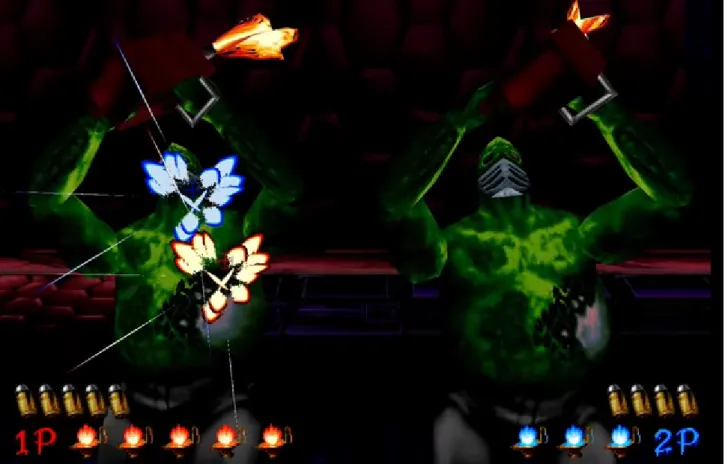
Let’s look at an example of a co-op game that does NOT belong to this group: the classic arcade game House of the Dead™by Sega. This is a very straight forward "shoot the zombies" game, and it has a multiplayer co-op mode. Both players could be considered clones, because their roles are the same (shoot at the enemies that appear on the screen). Their health, ammunition and even their weapon is also the same (see Figure 3.1). Indeed, if one of the players excels at this game, he can single-handedly destroy all of the enemies without the help from his teammate. Changing the difficulty by spawning more or less monsters would not make a significant impact because the good player would still be the one who kills most or all of the zombies. It is a clear of example of the difficulty presented by the heterogeneously skilled teams challenge. In contrast, thinking back on our original example with a "healer" and a "sniper", modifying the amount of targets that have to be sniped would only affect the difficulty for the player who has the "sniper" role, which means traditional single-player DDA can be effectively applied here. DDA can still be applied to co-op games that are not role-distinct (in the House of the Dead™example, maybe the good player could be made to take a bit longer to reload and thus give the other player a chance to shine more). However, and as we have already discussed, it is definitely much more difficult to apply traditional single-player DDA in co-op games that are not role-distinct. For this reason, in this work we will focus solely on DDA in distinct-role co-op games.
The MOBAs presented in the introduction are examples of distinct-role co-op games, because cham-pions have a role assigned to them. In LoL the roles are Assassin, Fighter, Mage, Support, Tank and Marksman. (See figure 3.2). Hero stats (attack, defense, health...) and abilities highly depend on the role. Normally one can see a variety of roles in the same team, but sometimes players do choose cham-pions with overlapping roles. Thus it could be argued that LoL is not a pure distinct-role co-op game, or at least, not always.
Figure 3.1.:Screenshot of the arcade game House of the Dead™by Sega, (co-op mode)
Figure 3.2.:League of Legends champions listing in the official webpage. Champions have distinct roles, so they logically can be filtered according to their role
3.3 Classification of Dynamic Difficulty Adaptation Algorithms
DDA can take a myriad of forms, even in distinct-role co-op games. Due to the many possibilities devel-opers have when implementing DDA in their own particular games, we aim to now classify the possible DDA algorithms according to their characteristics. We will also try to present possible advantages and disadvantages of choosing a certain characteristic for a DDAA, as well as to illustrate these characteristics with examples.
Hunicke [16] already pointed out that two key elements in DDA is figuring out WHEN the system should intervene and also HOW the system should intervene. We are going to take this a step further and present different DDA classifications according to WHEN does the game detect that change is needed, WHAT does the game detect and HOW should the game adapt or react. These three elements are very important to be taken into account when designing a DDAA.
3.3.1 DDA according to WHEN to detect
1. Timed-based triggering - The DDAA activates at specified moments/times during the game. Within this classification we have to distinguish between periodic timed-based triggering and non-periodic timed-based triggering. In periodic timed-based triggering the DDAA activates every certain period of time. An example would be checking every 30 seconds the ammo of a player in an FPS game. Innon-periodic timed-based triggeringthe DDA activates at points in time that are heterogeneously separated in time. In many kinds of games it is important to frequently adapt the game difficulty in the beginning, but as the game advances the DDAA will have gathered enough data to determine a level of difficulty for the rest of the game, and the DDAA does not need to acti-vate that frequently. An example of this situation would be checking the average speed of a player in a racing game: in the beginning averages tend to fluctuate much more than later in the game, when they tend to be stable. There is also ahybridoption, where the DDAA activates every certain period of time, this period however varies in length in different phases of the game. An advantage of the pure periodic timed-based triggering is obviously its simplicity: with only a starting moment and a constant period one can determine every time the DDAA will activate.
2. Event-based triggering - The DDAA activates when certain events occur in the game. It could be argued that timed-based triggering is a subgroup of event-based triggering, the triggering event being "X amount of time has elapsed". We will exclude elapsed-time events here however, and refer exclusively to time-independent events (otherwise "Timed-based triggering" would only be a partic-ularization of "Event-based triggering"). Within this classification we will distinguishindependent eventsfrom linked or iterative events. An example of the former would be triggering the DDAA every time a player dies (generally past deaths do not influence future deaths). An example of the latter would be triggering the DDAA every time a player picks up a key object, when all key objects are linked with each other - for instance a DDAA triggers if the player picks up a lock, but only if the player has picked up a key before; otherwise the DDAA for the lock will fire once the player picks up the key.
3.3.2 DDA according to WHAT to detect
1. Parameter probing - The DDAA observes one or more significant parameters in order to decide how to adapt the game. A parameter is significant if it effectively measures one or more features of a player’s performance, so it follows that the choice of significant parameters to be observed is key to the DDAA’s effectiveness. Examples of possibly significant parameters: total amount of collected resources, damage dealt, number of enemy units killed... According to what the parameter’s value is being compared to, we can distinguish comparing-to-standard parameter probing and player-progression-analysis parameter probing. Comparing to standardinvolves, as its name suggests,
comparing the parameter’s value to a standard value. If the parameter value falls behind the standard, the DDAA should attempt to make the game easier, whereas if the parameter is ahead of the standard, the game’s difficulty should be increased. Deciding what the standard value of a parameter should be is also a design decision that must be justified. Analyzing the player’s progression, on the other hand, compares the parameter’s value to previous values of the same parameter in the game and determines how to react based on the progression. For example, the DDAA probes the player’s score. If the score starts to increase at a slower rate than before, maybe the DDAA will take action so that the player picks up the pace again. The score in itself is however not compared to a given standard.
2. No probing - Sometimes probing parameters is not necessary. For example, if a game objective is taking too long to complete the developer may decide to have a DDAA ease the difficulty. One could argue that in this case the parameter "elapsed time" is being observed, but on the other hand it could also be argued that "elapsed time" is not a significant parameter to player’s performance (taking long does not always translate to performing poorly). Personally I do think "time elapsed" is significant in many types of games, but in this work we will still consider a DDAA to be non-probing if it does not probe a significant parameter other than the elapsed time. "Time" is normally a special parameter, common to all players in the game, which can normally be measured and accessed in its own particular way in many game development tools, so it is worthy to be treated specially.
3.3.3 DDA according to HOW to react
In this section there are many characteristics to be considered, and we will classify the DDAs by pairing excluding or opposing actions. Pairs of opposing actions are independent from each other, so a DDAA can have, for example, both a reactive and explicit action (but not a reactive and proactive action - if a DDAA is reactive and proactive it is because it has reactive actions and proactive actions).
1. Reactive/Proactive- Here we will take the definition presented by Hunicke [16]. The DDAA is reactive if it adjusts elements that are already "in play" or "on stage" (e.g. enemies the player is fighting right now), thus these existing elements "react". The DDAA is proactive if it adjusts elements that are "off stage" (e.g. enemies that will spawn in the future), thus the future elements "proact" (act before they exist in the game). As explained by Hunicke [16], there is a trade off: reactive DDA has an immediate effect, but can disrupt the player’s sense of disbelief; whereas proactive DDA is more powerful but is affected by the distance factor - if the effects are too far away in the future, it is uncertain whether the DDAA will achieve the desired effects, it may even produce undesired effects!
2. Discrete/Continuous- Many DDAAs will involve calculations to produce their output. According to the output we can classify DDAAs as discrete - the output can only take a fixed set of values (e.g. "On/Off", "{-1,0,1}"...) or continuous - the output can take any value in an infinite set of values (e.g. "any real number between 0 and 1", "any positive number"...). Please note that discrete/continuous are not necessarily related to integer/real values as in Math.
3. Implicit/Explicit- A DDAA is explicit when its changes are intentionally visible and perceptible for the player. For example, the DDAA may choose to highlight the weak spot of enemies so that the player can destroy them more easily. On the other hand the DDAA is implicit when the changes are intended to go unnoticed. For example, the DDAA may adjust an enemy’s precision so that it hits the player 10% less of the time. Intuitive players may still perceive differences and changes, especially if they compare the game when they play to the game when others play, but with implicit DDAAs the developer aims to make difficulty adjustments as less obvious and as smooth as possible, and tries to avoid disrupting the player’s sense of disbelief.
4. Suggestive/Auto-corrective - A DDAA is suggestive when it drops hints and tips to the player in order to improve his/her performance, but does not modify the player’s input, i.e. all actions
performed are still traced solely to the player. An auto-corrective DDAA, in contrast, can modify significant parameters and/or the player’s actions with the intent to improve performance. For example, in many RTS games a key factor is to gather resources with worker units, but sometimes workers are left idle. A suggestive DDAA might highlight idle workers so that the player is aware of them and orders them to get to work, whereas an auto-corrective DDAA might automatically order workers to harvest resources if they have stood idle for too long. Developers must be careful with auto-corrective DDAAs, because players may perform "less than ideal" actions on purpose and get displeased when they find out that the game is not obeying their actions. In the mentioned example, maybe the player wants to leave a worker standing idle outside the base to spot incoming enemies, but if the DDAA sends him back to work, the player’s intention is brought to naught. 5. Standardizer/Progressive/Predictive- In the previous subsection we discussed how a
parame-ter probing DDAA could either observe the progression of values of said parameparame-ter or compare the parameter to a given standard. Apart from observing, a DDAA can also react according to a given standard or according to the progression of one or more parameters. A standardizer DDAA attempts to bring the player’s performance closer to the standard (if the player’s performance is below standard the game will tune down the difficulty, and if above standard, the DDAA will in-crease the game’s difficulty.) A standardizer DDAA’s effectiveness can be measured relatively easily - how closer does the player’s performance get to the given standard with the DDAA active? A progressive DDAA attempts to maintain the player’s performance progression according to his pre-vious performance in the game. It does not attempt to bring the performance closer to a given standard, but rather deduces a standard according to the player’s performance so far. We must also consider predictive DDAAs, which analyze the player’s performance so far and predict how (s)he will fare in their future tasks to know how to react. For example, if a player performed not so well in mini-bosses (lost too much health, took too many hits, missed several attacks...) the DDAA might simulate the outcome against the boss and predict that the performance so far will not be enough to defeat the final boss, and thus decide to tune down the boss’ difficulty.
6. Single-player/Multi-player- This characteristic comes naturally when applying DDA to collabora-tive games. The DDAA’s actions may directly affect either one of the players (Single-player DDAA) or several players (Multi-player DDAA). If there were different teams of players in the game we could even add the term Team DDAA to refer to a DDAA that affects all players in the same team.
3.3.4 DDA classification summary table
WHEN WHAT HOW
- Timed-based triggering - Parameter probing - Reactive/Proactive
- Event-based triggering - No probing - Discrete/Continuous
- Implicit/Explicit - Suggestive/Auto-corrective - Standardizer/Progressive/Predictive
- Single-player/Multi-player
4 Co-op Craft - the implemented game
Now that we have defined and explained DDA in co-op games and our general approach, it is time to actually see an example of implemented DDA in a co-op game and test its effectiveness. The following paragraphs and sections are here to provide the background that lead to the implemented game. The background is not necessary to understand the game concept, so the reader may choose to jump directly to Section 4.3.
To test our general conception of DDA in co-op games, we could ideally take an existing open source co-op game and implement some DDAAs in it. However there is very few multiplayer open source games to start off with 1. Out of these, even fewer are co-op games, and none are clearly distinct-role co-op games. The mentioned League of Legends™, though a distinct-role co-op game, is not open source and is also quite complex, so even if we had access to the code, developing significant DDA for this game would be tedious work more fit for a video game development team.
In this situation I was left to program a distinct-role co-op game all by myself. To keep things as simple as possible, the game would be a two player human team against the computer AI. But even if we attempt to make it as simple as possible while still testing out DDA in co-op games, programming a game from scratch is still a strenuous task that must not be underestimated, especially with the time constraints this master thesis had.
To develop the game one could opt for a general video game development tool like the Unity cross-platform game engine, which students have had the chance to use in university lectures and labs. From my own experience I did know that programming a game all by myself in a few months would mean an extremely basic gameplay, with very lackluster graphics and possibly no sound. The idea for such a game (named "ADappTowr") did hit the paper, and will be explained here as an alternative to the actual implemented game (See Chapter 5).
Instead of the broad Unity game engine, I decided to develop my co-op game based on the RTS-specific StarCraft II engine. StarCraft II™, a 2010 RTS developed by Blizzard Entertainment, is not totally open source, but provides some powerful modding tools for the fan community to develop and create their own games based on the StarCraft II engine. A great advantage in using this engine is that graphics, sound and a lot of the gameplay is already set and has a professional feel. The end result would not be spheres jumping on rectangular platforms, which was the best I could manage to program in Unity in a few months. The biggest disadvantage to using the StarCraft II engine is that it is of course not as flexible as a broad engine. As we will see, though, an RTS-game engine still offers a great variety of possible games to develop.
4.1 A brief background to StarCraft
In 1998 Blizzard Entertainment released a military science-fiction real-time strategy (RTS) game known as StarCraft™. It is a highly acclaimed and popular game that has sold millions of copies worldwide, and critics consider it one of the most influential games of all time2. Its praise comes mainly for being the first RTS game that introduced unique and distinct factions (Terran, Zerg and Protoss) that play very differently from each other, but still keep a balanced gameplay, i.e. no race/faction is overpowered against the other. Its multiplayer is excellent and a big number of gamers have played this game in LAN parties and in the online Blizzard server Battle.net for many years. Over the years much research on the RTS genre has included the StarCraft game - see for example Ontanón et al. [22], Sánchez-Ruiz [26] and Lewis et al. [21].
1 https://en.wikipedia.org/wiki/List_of_open-source_video_games
2 http://web.archive.org/web/20080913085022/http://www.gamepro.com/article/features/110068/
the-52-most-important-video-games-of-all-time-page-4-of-8/
Figure 4.1.:Original StarCraft: a Protoss force attacks a Zerg colony
StarCraft spawned an expansion later in the year 1998 called StarCraft: Brood War™, but 12 more years would need to pass until the sequel StarCraft II: Wings of Liberty™was released. StarCraft II included improved graphics and a much more user-friendly User Interface, while preserving the lauded gameplay and balance from the original. StarCraft II has made it to the eSports too, although it is less popular than the aforementioned LoL and DotA 2. Two expansion packs have been launched: Heart of the Swarm™in 2013 and Legacy of the Void™in 2015, but Blizzard keeps patching and updating the game up to this day as well as releasing more content through micro-transactions. StarCraft II clearly shines as one of the best RTS ever and clearly as the best RTS game of today, in part because the pure RTS-genre has hugely decreased in popularity in recent years and thus StarCraft II stands as the last survivor game of its genre.
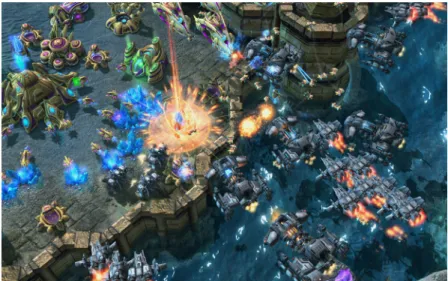
Figure 4.2.:StarCraft II: a Terran air fleet attacks a Protoss base. The improvement in graphics is notable.
I have personally played countless hours both the original StarCraft and the sequel StarCraft II, it is one of my favorite games. Its learning curve is steep though, even higher than the MOBA games already mentioned. Even if my skills are far from professional in the game, my in-depth knowledge of the franchise and the games is a big advantage when designing a game with this engine - I know the game units, spells/abilities, the core mechanics...
4.2 The StarCraft II Galaxy Editor
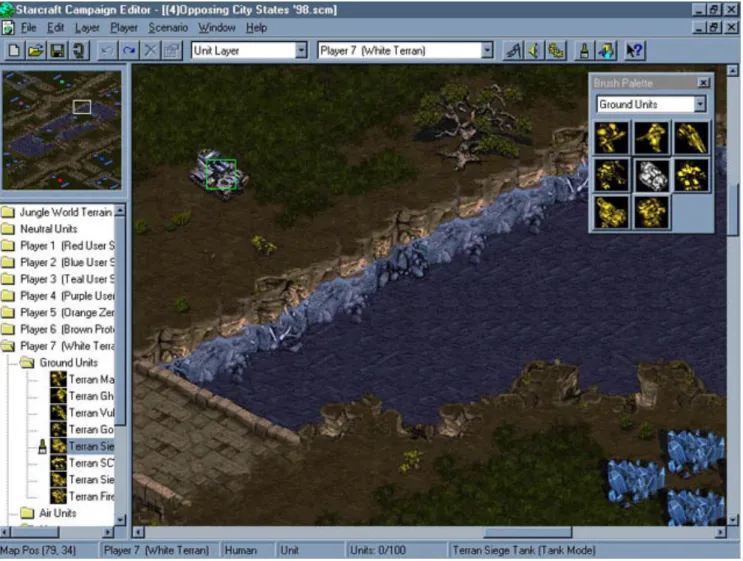
Apart from its addictive online multiplayer and amazing campaigns for single player, another factor for StarCraft’s success were the custom games (or "custom maps") that anyone could create with Blizzard’s development tool, the StarCraft Map Editor. Blizzard has the tradition of releasing development tools that greatly extend the lifetime of its games, as new games or maps were constantly published during the years following StarCraft’s release. The original editor allowed to modify the terrain in the map, basic unit stats and provided a bunch of hard-coded functions called "triggers". Triggers would fire on events, check conditions and then perform actions. Even though the original editor had some serious limits as to what developers could create, still many different maps and ideas where implemented and a fan community of developers evolved. The community would eventually publish enhanced Editors that transcended the limits imposed by the original, which led to StarCraft’s modding to take off. I personally enjoyed creating maps back then in the original Editor and those were my first steps into programming, long before I even learned a programming language!
Figure 4.3.:Screenshot of StarEdit - the original StarCraft Map Editor
To emphasize the potential the StarCraft Editor had, a map called "Aeon of Strife" was created with the Editor, a precursor to the current popular MOBA games. In there, stronger StarCraft hero units battled in an arena where other weaker computer-controlled StarCraft units fought in a tug-of-war. Later the same idea was implemented and refined with the WarCraft III™Editor, and the resulting map was called "Defense of the Ancients" (original DotA). The map became extremely popular, to the point
that tournaments began to be held - tournaments to play a fan-developed custom map! 3 The developers were afterwards hired by Valve and they developed the aforementioned DotA 2, this time outside the WarCraft III engine. Blizzard tried to gain the rights for this custom map/game which had spawned from their own Editors, but lost the lawsuit (See Haas [13]). This is the summarized history on how the MOBA genre spawned from the RTS engine. All from a user-friendly and deceptively simple RTS Map Editor!
With the release of StarCraft II in 2010 Blizzard made available the new StarCraft Galaxy Map Editor. Quoting the Blizzard team4:
"All our StarCraft II development tools are in your hands. When you install the free StarCraft II Starter Edition, you also get the StarCraft II Editor. Fire it up, make your own maps and mods, and share them with the world via Battle.net."
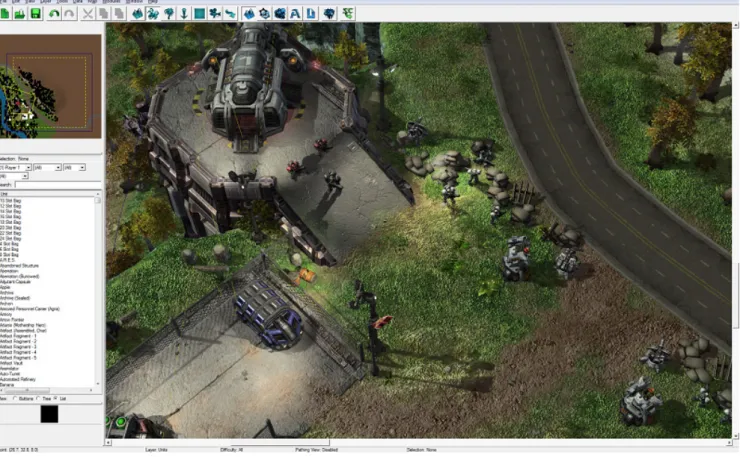
Including modules enabling the editing of Data fields, Triggers and Terrain, the StarCraft II Map Editor improves upon its predecessor, the World Editor from Warcraft III, in every way. The Editor even features a proprietary scripting language called Galaxy based on C. Every mission within the single player Cam-paign for StarCraft II was created by using the Galaxy Editor. One can open every CamCam-paign Map and check out every aspect (Terrain, Triggers, Regions and so on) of it. 5 The Editor allows for even replays of played games to be analyzed and debugged.
Figure 4.4.:Screenshot of the Galaxy Editor.
While the Galaxy Editor improves over its predecessors in Terrain, Data and Triggers and allows to mod almost every single aspect of the game, it is also much more complex. Complexity means it is quite difficult to start off and learn how to use the Editor. Even with the official tutorials in http: 3 https://www.facebook.com/notes/yaphets-pis/a-history-of-dota-part-1/377203832338260/
4 http://us.battle.net/sc2/en/game/maps-and-mods
5 http://wiki.teamliquid.net/starcraft2/StarCraft_II_Editor
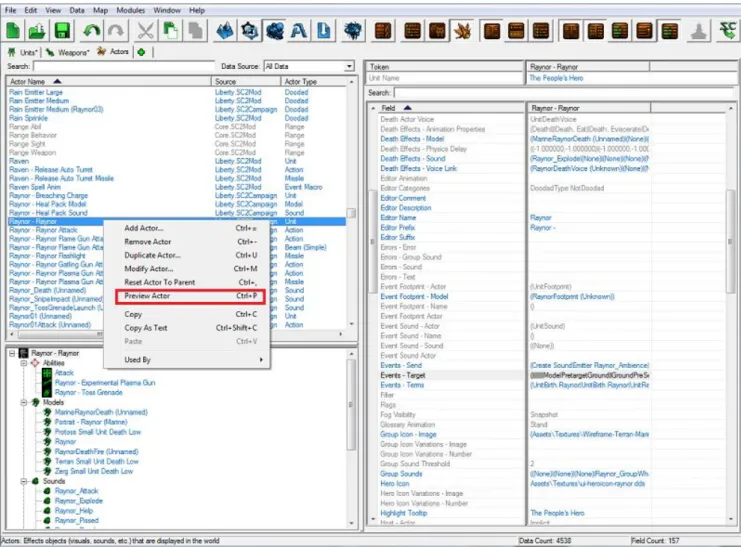
//us.battle.net/sc2/en/game/maps-and-mods, most of the community agrees that it is a difficult tool to get started with. The Data Editor is quite imposing the first time. For example, imagine you just want to modify the damage a unit inflicts when attacking. You go to the Units section, but find out you need to go to the Weapons section and find the weapon associated to the unit. There you are redirected again to the Effects the weapon causes. And finally, once you find the "Damage Effect" of the weapon can you find a numerical field where you can modify the inflicted damage. It is quite tedious for a beginner.
Figure 4.5.:Screenshot of the Data Module in the Galaxy Editor. Possibilities for modification are endless, but one can be overwhelmed in the beginning if one attempts to understand what all the fields are for.
Despite its initially overwhelming complexity, the Galaxy Editor is considered to be the best RTS De-velopment Tool there currently is, and one only needs to know just a bit of all that the Editor can do in order to create interesting and excellent maps. I personally had not had any experience with the Galaxy Editor before this work, but with the tutorials and with a lot of patience and effort, I was able in just over two months to create the Co-op Craft game that was used to test DDA in co-op games in this work.
4.3 Co-op Craft: Game concept
With the StarCraft game and editor background explained, we can now delve into the Co-op Craft map/game itself, which was developed for the sole purpose of this work. First of all it is important to not confuse this custom map with the official Co-op mode in StarCraft II. In the Co-op Mode (formerly known as "Allied Commanders") players take on the role of various commanders from the StarCraft universe, each of them possessing unique abilities and upgrades and bestowing special bonuses on their armies. Players are able to battle through a series of special scenarios together, leveling up their commanders’ capabilities as they progress. 6 This could have been an interesting option for testing DDA in co-op games, but even though different commanders have their own combinations and upgrades, their roles are not totally distinct as explained in Section 3.2. Good players are able to "solo" (beat by themselves) the missions even on the hardest mode without help from their ally. Besides, the co-op maps, unlike the single player Campaign, are not open to the public.
All in all, despite the traditional pains of programming, I have really enjoyed programming this game! And it really provides a distinct-role co-op experience where we will be able to apply DDA, as we will see in Section 4.4.
4.3.1 Game definition
Co-op Craft(the name is a cross between "Co-op" and "StarCraft") is areal-time battle arena distinct-role collaborative two-player game. Both players control a hero unit with high combat stats and abilities. Both heroes complement each other, as we will see when we describe each one individually in Section 4.3.3. Waves of weaker computer-controlled units spawn periodically and stream through a main lane. There are waves of both allies and enemies, each pushing in the opposite direction in a tug-of-war. The objective for the players is to destroy the map boss unit (a Xel’Naga Construct) while protecting a friendly structure (the Holy Temple). The game resembles mostly a MOBA, with the difference that the two human players do not face equivalent enemy heroes. Co-op Craft also includes some RTS aspects that MOBAs do not have, mainly being able to recruit extra troops for the allied minion waves.
6 http://starcraft.wikia.com/wiki/Co-op_Missions
4.3.2 Map layout and Gameplay
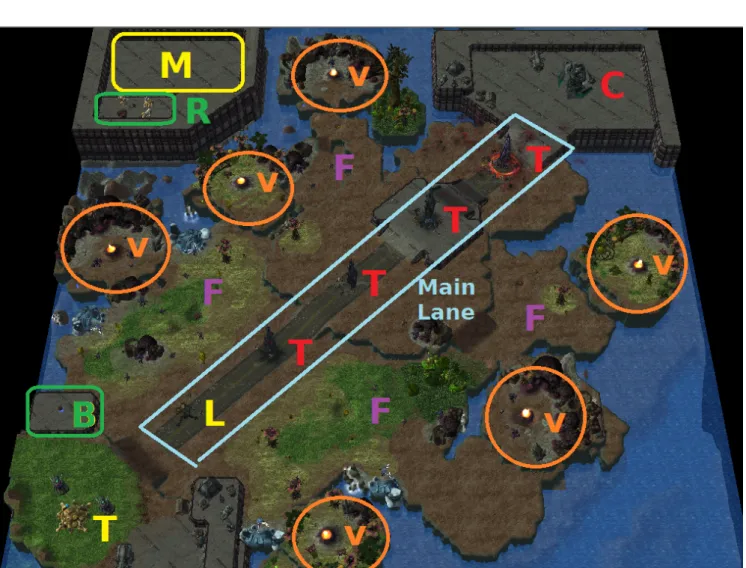
Figure 4.6.:Co-op Craft Map Layout.
LEGEND:C=Construct (Map Boss); T(red)=Enemy Tower; L=Laser Drill (allied Tower); T(yellow)=Temple; B=Base;
M=Minion Sample Units; R=Recruiting and Researching structures; V=Volcano; F=Feral Monsters
A map layout of Co-op Craft can be seen in Figure 4.6. Unlike other popular MOBA maps, Co-op Craft only includes one main lane where minions (the weaker computer-controlled units) will be marching through. Allied minion waves spawn periodically in the Temple grounds and push toward the Construct, whereas the enemy minion waves spawn in the Construct platform and push toward the Temple. In the way there is one allied Tower (aLaser Drillthat can hit any enemy in the map as long as it is visible for the players) andfour enemy Void Towersthat increase in health and have better defensive abilities the closer they are to the final Construct.
Players obtainresourcesas they kill enemy minions, but they can also "farm" more abundant resources if they killFeral Monstersoutside the Main Lane. These Feral Monsters do not push in the Main Lane, but they are still hostile to the players and have much higher health and attack than regular minions. Feral Monsters and minion waves are divided into air and ground units to emphasize the distinct-role nature of the game. There are alsosix volcanoeson the map that periodically erupt resources, which can then be collected by simply touching them with the hero unit. There is a "catch" though: the volcanoes are situated on high ground plateaus, erupted resources have an expiry time (they disappear if not collected on time), and there is also a high concentration of feral monsters on the volcano plateaus. If
players can collect those resources it definitely pays off, as they provide much more income than killing regular minions.
Figure 4.7.:A volcano guarded by feral monsters. Minerals have erupted.
Gathered resources can be spent to either recruit more minions for the allied waves or to upgrade the hero’s stats, spells and abilities. In the top left corner of the map players can see what units are currently spawning in the allied waves (M=Minion Sample Units) and they can also select theRecruiting and Researching Structures. These structures can also be accessed through the normal UI and players can buy new upgrades or units in any moment of the game. There are different types of recruitable units, but also a limit to each unit type (which keeps players from "spamming" only one type of unit). The upgrades in the Research Structure are divided into: basic upgrades (Increase Attack, Armor and Health of a hero); spells (improve the spells the hero already has or unlock new ones) and army improvements (the minion wave units and the Temple can also be upgraded). Players are always given two options to improve an existing spell or research a new spell, in order to give the game some replay value. Spells include damaging spells, defensive spells, AoE (Area of Effect) spells and powerful ultimate spells. Spending gathered resources in both recruiting new minions and upgrading the hero is crucial for success in the game.
Figure 4.8.:Sample minions at the top left screen of the map. A Recruiting Structure (Zeratul’s Forge) is selected and the player can recruit more minions for the allied waves.
Figure 4.9.:A Research Structure (Kerrigan’s Evolution Chamber) where a player can upgrade the hero and the minions.
The game is intended to see players perform in three major ways: (1) pushing and fighting along the allied minion waves in the main lane (main objective); (2) harvesting resources by "farming" on feral monsters; (3) sneakily collecting the volcano resources. Both the player’s ability to meaningfully move around the map as well as their ability to cast spells and fight effectively are put to the test and reflect the overall player’s performance. All along both players must also communicate, develop strategies and work together to fulfill their goals.