Veli-Pekka Kestilä
Helsinki May 5, 2020
M. Sc. Thesis
UNIVERSITY OF HELSINKI Department of Computer Science
Faculty of Science Department of Computer Science
Veli-Pekka Kestilä
Modern web-programming language concurrency
Computer Science
M. Sc. Thesis May 5, 2020 66 pages
distributed systems
This Masters Thesis compares Elixir, Go and JavaScript (Node.js) as programming language candi-dates for writing concurrent RESTful webservice backends. First we describe each of the languages. Next we compare the functional concurrency characteristics of the languages to each other. Finally we do scalability testing for each of the languages. Scalability testing is done using the Locust.io framework. For testing purposes we introduce for simple REST-api implementations for each of the languages. Result from the tests was that JavaScript performed the worst of the languages and Go was the most verbose language to program with.
ACM Computing Classification System (CCS):
Computing methodologies → Concurrent computing methodologies → Concurrent programming languages
Software and its engineering → Software notations and tools → General programming languages
→Language features→Concurrent programming structures
Software and its engineering → Software notations and tools → General programming languages
→Language features→Concurrent programming structures→Coroutines
Computer systems organization→Architectures→Distributed architectures→Cloud computing
Tekijä — Författare — Author
Työn nimi — Arbetets titel — Title
Oppiaine — Läroämne — Subject
Työn laji — Arbetets art — Level Aika — Datum — Month and year Sivumäärä — Sidoantal — Number of pages
Tiivistelmä — Referat — Abstract
Avainsanat — Nyckelord — Keywords
Säilytyspaikka — Förvaringsställe — Where deposited
Contents
1 Introduction 1 1.1 Background . . . 1 1.2 Overview . . . 3 2 Concurrency 3 3 Languages 5 3.1 JavaScript . . . 5 3.1.1 Frameworks . . . 15 3.1.2 Threading . . . 15 3.2 Elixir . . . 16 3.2.1 Language features . . . 163.2.2 Erlang and OTP . . . 23
3.3 Go . . . 25
3.3.1 Simple Go program . . . 26
3.3.2 Language features . . . 27
3.3.3 Concurrency and channels . . . 31
3.4 Conclusion . . . 35
4 Comparison methodology 36 4.1 Feature comparison . . . 36
4.2 Empirical performance testing . . . 38
5 Comparison 39 5.1 Go Implementation . . . 40 5.2 Node.js Implementation . . . 45 5.3 Elixir Implementation . . . 50 5.4 Feature comparison . . . 54 5.5 Empirical comparison . . . 56
5.6 Findings . . . 60
6 Conclusion 61
In this thesis I will describe and compare three web-service programming languages. Namely Go, Elixir and JavaScript (in Node.js run-time). My plan was to find out how each of the languages and their run-times deal with concurrency. Concurrency is important for web-services as it enables serving multiple clients from a single server.
In the tests I found that all of the languages perform reasonably well and most of the tests results were similar. Go and Elixir both were best in some of the tests and JavaScript was a bit slower than the other two with failure to perform in some of the CPU intensive tests. From this we can conclude that the lightweight threading approach used in Go and Elixir performs better than Event based concurrency used in JavaScript.
1.1
Background
In the last 10 years there has been emergence of new languages and frameworks for implementing web-services. Of course there are still a lot of projects done using PHP or Java. But for the new projects programmers are looking to more modern technologies as the basis for their project. One reason programmers are looking for these new languages is stricter memory requirements when running multiple Docker images. These stricter requirements are especially true in cloud services where price is often dictated on physical resources consumed.
One aspect of the new languages is how they handle concurrency. Concurrency and how it is handled is important when trying to serve as many clients as possible with minimal resources. Languages selected for closer examination have differing strategies on how concurrency is handled.
There are different ways to implement concurrency for Internet service[1]. In the lowest level there is threading, which uses either system threads or some kind of light weight threading scheme. Next level is using operating system processes. When a single computer does not have enough capacity, then the concurrency can be implemented using multiple computers. In practice modern Internet services use a combination of these strategies to implement concurrency. There are usually multiple computers and/or virtual machines serving the clients. These computers can have multiple processes running, and finally a single process can use multiple
threads internally.
What are then the benefits of using the different concurrency implementations? For multiple servers benefits come from added redundancy and the possibility to bring the servers closer to the clients. Both of these benefits can be expanded further by using the servers located in different data-centers around the world. Of course this decentralization of servers comes with the cost of more complicated implementation and problems, such as consistency and timely access of data.
Inside the servers we usually have multiple processors, and one way to gain benefit from those processors is to run multiple copies of the server program. This is easily done with using the operating system resources. A problem with process level con-currency is that sharing of data between processes is not necessarily very efficient. Another issue is that switching between the processes is an expensive operating system level operation. Also a simple process can only serve one client at the time.
To make it convenient to serve multiple clients we can utilize threads. All mod-ern operating systems provide threading implementation. Threads share the same memory space, therefore communication between threads is easy. Scheduling of the threads happens at the operating system level so switching from one thread to another takes similar time as switching from one process to another.
To solve the problem with expensive context switches, programs can use lightweight threading. This lightweight threading does not suffer context switching penalty. Another way to avoid the context switches is to use event based concurrency.
Lightweight threads and event based concurrency both have the same weakness where badly behaving code can lead thread starvation and one event prevents others from running. These problems can be mitigated. In case of the thread this is done by forcing the switching of the running thread. And with even processing it is done by interrupting event processing code during its execution to divide it in smaller chunks and interleaving execution of multiple events.
Then the next question with all of these concurrency options is, who needs this increased concurrency? The simple answer is; all internet services. To a certain degree this is probably true. But one segment which will benefit this increased concurrency is large scale internet services like Google or Amazon. According to the definition in [2] a large scale internet service is one with millions hits per day and hundreds of servers.
in the front-end, connected with REST-API to stateless back-end. These back-ends usually need to handle multiple concurrent clients in a timely manner with ability to scale up and down depending on the load.
Functional and imperative programming style, as well as variable mutability are also important things to consider when doing concurrent programming. Functional style and immutable variables force programmers to write code which avoids certain kinds of hard to debug errors.
1.2
Overview
In this chapter I have shown background about how concurrency affects the internet services and have given background on reading the following chapters.
Next chapter is an overview of what the concurrency means in Computer Science. I will especially talk about the types of concurrency used in the languages in question.
In chapter 3. I will describe the three languages selected for the comparison and their background. I will also talk on the concurrency methods the languages use.
After describing the languages I will introduce the selected comparison methodology in chapter 4. Chapter 5. first describes the language implementations done for the empirical performance testing. After the implementation descriptions it will first have the feature comparison and then empirical comparison results.
Finally in Chapter 6. I will have conclusions and opinions on the test results. I will also talk about how to refine these tests and improve the test results.
2
Concurrency
What does the concurrency mean in Computer Science? Leslie Lamport explores this question in his ACM article[3]. According to him the beginning of research in concurrent systems is Edsger Dijkstra’s 1965 paper describing the mutual exclusion problem. Most of the early concurrent system research concentrated on algorithms and correctness. Especially correctness is still an issue on poorly implemented con-current algorithms and programs. Modern concurrency research is a wide field inside of Computer Science.
So to answer the question in context of this thesis; In Computer Science concurrency means that events, programs, processes and so on seemingly execute at the same
time. What this same time means is then implementation specific. For example in single processor this means that processor executes two or more items in smaller interleaved chunks. This definition of executing smaller interleaved chunks is im-portant as it is the basis on which all of the languages explored reach seemingly concurrent processing of multiple requests.
On operating system level program execution happens in processes which are sched-uled on the operating system level. Processes can then be divided in multiple threads[4]. Threads can be either scheduled by operating system or by virtual machine running inside the process. Threads can also be scheduled co-operative manner. In this thesis I will call these threads run inside of the process without operating system lightweight thread. Some implementations or sources call them green threads, user threads, coroutines or fibres.
The main difference between the operating system threads and lightweight threads is the way they are scheduled. Operating system thread scheduling is closer to scheduling processes and needs multiple operating system and CPU level operations. Lightweight threads can have more lightweight scheduling operations which take less time and resources.
One way of implementing lightweight threads is cooperative multitasking. In coop-erative multitasking thread or process executes code for a certain number of steps before yielding the execution turn to the next thread or process. Classic well known examples of co-operative multitasking are Windows versions before windows NT and 95.
Event based concurrency has been an important part of computing for a long time as evident in a 1975 paper by Leon Presser [5]. Early concurrency related events were often related to the peripherals connected to the computers. Most common event based task even in most modern operating systems is handling of clock interrupt which is used for scheduling different processes to run. User interfaces often have this kind of event based model where the user presses a button or inputs text which is then processed by the event processor.
In this chapter I described what concurrency means and also introduces the con-currency concepts most prevalent to the following chapters. Each of the languages described in this thesis use either even based co-operative multitasking or lightweight threads based multitasking.
3
Languages
In this section I will look into three programming languages used in modern web-service back-ends. These languages were selected for their different characteristics which will be described in this chapter. One selection criteria was that they are modern or in case of JavaScript modern in web-service use, but still used widely enough. Another criteria was that each of the languages used new paradigms to implement concurrency instead of the traditional way of implementing concurrency with threads and processes.
These languages present different programming paradigms from functional to pro-cedural and from dynamic typing to static typing. Each of the selected languages also has its own strengths and drawbacks. I will discuss these in detail when talking about the specific languages.
For each language I will briefly talk about their history. I will also introduce the language syntax. Then I will give the overview of the run-time system and how the concurrency is implemented in each of the languages. In conclusion I will look into the non concurrency related differences of these languages.
Next chapter after this will introduce the methodology used for comparing the con-currency features of these languages. After the methodology chapter follows the chapter describing the comparison process and its results.
3.1
JavaScript
JavaScript[6][7] is a language aspiring from humble beginnings. The language was designed by Brendan Eich during 10 days in 1995 for Netscape, and has come far from the beginnings. Most important steps for its development to the current state was the implementation of Ecma standardization process, Microsoft’s XMLHttpRequest and Google’s V8 interpreter. V8 virtual machine gave push for implementation of Node.js framework and upgraded JavaScript as a language which can also be used for server side implementations.
JavaScript syntax is heavily influenced by C. One of the reasons was that the lan-guage was created to be a lightweight version of the Java lanlan-guage. As a result JavaScript does not have Java like class and interface syntax. However this does not mean that JavaScript is not an object oriented language. It uses a Prototype-based object model. The language is also imperative, structured and functional.
JavaScript functions also have different characteristics depending on where they are used. This means JavaScript functions can work as object definitions when used as constructor. If a function is defined as an object property it will work as a member method. Finally it can work as a regular function when defined elsewhere in the code.
One of the main reasons of JavaScript’s popularity is its use of event based concur-rency. This stems from the language’s original target to be used in user interfaces where a lot of functionality is related to user triggered events. In addition time consuming operations like network, database or disk access can be easily handled asynchronously using events. This makes the language perform well despite it being single threaded.
Version Published Description 1 Jun 1997 Initial standard.
2 Jun 1998 Edited to conform ISO/IEC 16262.
3 Dec 1999 Improved language by adding regular expression, exception handling and other improvements. 4 Abandoned
5 Dec 2009 JSON support, "strict mode" and other enhancements. 5.1 Jun 2011 Conformation to ISO/IEC 16262:2011
6 Jun 2015
Multiple changes to language including
but not limited to: classes, modules, for/of loops, generators, arrow functions, collections and promises.
7 Jun 2016 Language refactoring, exponential operator and Array.prototype.includes
8 Jun 2017 concurrency, atomics and async/await
9 Jun 2018 asychronous iteration and generators, enhancements to regular expressions and rest/spread parameters
Table 1: ECMAScript versions
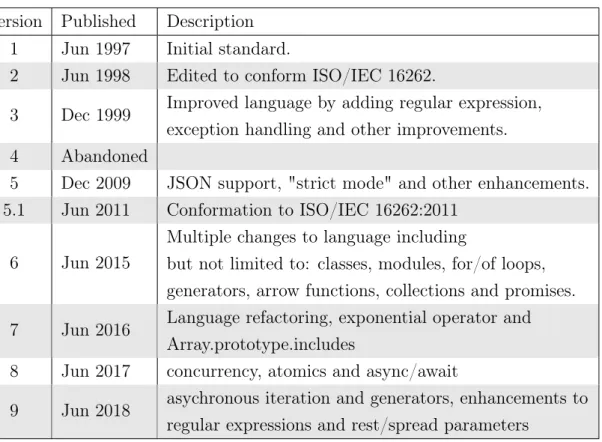
The functionality of JavaScript language is defined through the ECMAScript stan-dardization process. Currently there are nine versions of standard as seen in Table 1. The fourth version of the standard was abandoned. It is also clear that the pace of change to the language has picked up in recent four years.
1 function callingFunction(callback, errorCallback) { 2 firstAsyncTaskWithCallback((result1) => {
3 secondAsyncTaskWithCallback(result1, (result2) => {
4 thirdAsyncTaskWithCallback(
5 result1, result2, (result3) => {
6 callback(result3); 7 }, (error3) => { 8 console.log(’Error’, error3); 9 errorCallback(error3); 10 }); 11 }, (error2) => { 12 console.log(’Error’, error2); 13 errorCallback(error2); 14 }); 15 }, (error1) => { 16 console.log(’Error’, error1); 17 errorCallback(error1); 18 }); 19 }
Listing 1: Nested code using callback functions.
1 function longRunningTask(param1, param2) { 2 return new Promise((resolve, reject) => {
3 // Do some asynchronous processing
4 if (result == ’successful’) { 5 resolve(’Success’); 6 } else { 7 reject(’Failure’); 8 } 9 }); 10 }
Listing 2: Example of promise definition.
1 function callingFunction() {
2 return firstAsyncTaskWithPromise() 3 .then((result1) => {
4 return secondAsyncTaskWithPromise(result1) 5 .then((result2) => {
7 .then((result3) => { 8 return result3; 9 }); 10 }); 11 }) 12 .catch((error) => { 13 console.log(’Error’, error); 14 throw error; 15 }; 16 }
Listing 3: Code from Listing 1 implemented with promises
Version six of the standard named ECMAScript 2015 is important for concurrency features in the language. Most important feature was to introduce a standard way to implement promises. The Promises were first introduced by Daniel Friedman and David Wise in 1976 and are well described in Wikipedia[8]. An example of a promise is given in Listing 2 that shows declaration of the promise and how resolve and reject functions are used to signal the result of the promise.
Promises help to deal problems with multiple nested callback functions. These problems are evident in Listing 1 where there are multiple callback functions and errors have to be handled in multiple different places. Reading and reasoning this kind of code becomes quickly cumbersome and can lead to programmer mistakes [9]. In Listing 2 we see the code with callbacks transformed in more manageable form with use of promises. There is only one place to deal with errors and results come asreturn value for the function so we don’t need to give callback functions as parameters.
1 async function callingFunction() { 2 try {
3 const result1 = await firstAsyncTaskWithPromise();
4 const result2 = await secondAsyncTaskWithPromise(
5 result1
6 );
7 const result3 = await thirdAsyncTaskWithPromise(
8 result1, result2
9 );
11 console.log(’Error’, error); 12 throw error;
13 }
14 return result3; 15 }
Listing 4: Code from Listing 3 implemented using async/await.
The version 8 of the standard introduced async/await functionality to the language. With this improvement to the language programmers can declare function to be asynchronous using an async keyword. Inside an async function it is possible to use await keyword to wait for results from the functions returning promises. This async/await functionality is demonstrated in Listing 4 where it is easy to see how the program is cleaner and more concise when compared to the previous examples.
With the previously mentioned fast pace of innovation in the language, it has become usual for the JavaScript community and virtual machine implementations to adopt more popular features of the language standard even before actual standardization. This sometimes can lead to features to be implemented which does not end up in the final standard. An example of this is theWeakMap.prototype.clear()[10] method which was planned to ECMAScript version 6, but dropped before the fi-nal standard. On the other hand some of the standard mandated features can be implemented years after the standard has been published.
To counter this problem of unimplemented features, it is common to use libraries called polyfill[11] to patch the missing functionality on the JavaScript execution environment. This environment missing the standard defined functionality could be for example an old web-browser like Microsoft’s Internet Explorer, which isn’t updated anymore, but is widely used.
Another way to deal with the problems of unsupported language features is using a technique called source, to source compilation or transpiling[12]. Transpiling is a process of transforming source code of one programming language to another one. In the context of ECMAScript, transpiling is usually used to convert from newer versions to older and more widely supported versions. Usually the target for conversion has been the well supported version five of the language standard.
The most common transpiler for conversion between ECMAScript versions is called Babel[13]. Babel started in 2014 as a tool called 6to5. It was created by Sebastian McKenzie as a project to better understand programming languages. It was renamed
as Babel in 2015. Babel can be also used for other transformations like transforming JavaScript XML (JSX) to pure JavaScript code. JSX is a way to embed HTML code into JavaScript files and eliminating separate needs for visual template files.
Sometimes it is desirable to transpile from a different language to ECMAScript. This is done so that programmers can implement the program with language they are familiar with and then transpile it to JavaScript for execution in web-browsers, where you can only run some version of ECMAScript. Another reason for transpiling may be to add features not present in ECMAScript like static typing.
Microsoft has implemented a super set of ECMAScript with static typing called TypeScript[14]. It adds the possibility of giving type information to variables and function definitions, and checking that there are not unintentional type conversions in compile time. The weakness of TypeScript is that it does not protect against assignment and use of items (objects or functions) with wrong types during program execution. This problem is present in most of the statically typed languages in run-time. Mixing of plain JavaScript code and TypeScript code makes this problem worse in TypeScript than most of the other statically typed languages.
1
2 function ExampleClass(name, value, privateName) {
3 var privateValue = 5; 4 this.memberName = name; 5 this.memberValue = value; 6 7 this.getPrivateName = function() { 8 return privateName; 9 } 10 11 this.getPrivateValue = function() { 12 return privateValue; 13 } 14 15 this.setPrivateValue = function(value) { 16 privateFunction(value) 17 } 18 19 function privateFunction(value) {
20 privateValue = value; 21 } 22 } 23 24 ExampleClass.prototype.getName = function() { 25 return this.memberName; 26 } 27 28 ExampleClass.prototype.getValue = function() { 29 return this.memberValue; 30 } 31 32 ExmapleClass.prototype.setValue = function(value) { 33 this.memberValue = value; 34 } 35
36 var instance = new ExampleClass(
37 ’public_name’, 42, ’private_name’ 38 );
39 instance.getPrivateName(); // Returns ’private_name’ 40 instance.getName(); // Returns ’public_name’
41 instance.getValue(); // Returns 42 42 instance.setValue(84);
43 instance.getValue(); // Returns 84 44 instance.setPrivateValue(10);
45 instance.getPrivateValue(); // Returns 10
46 instance.memberName; // Direct access to instance variable 47 instance.memberValue; // Direct access to instance variable 48
49 instance = null; // Releases instance to be
50 // garbage collected.
Listing 5: ECMAScript 5 class
1
2 class ExampleClass { 3
5 this.memberName = name; 6 this.memberValue = value; 7 } 8 9 get name() { 10 return this.memberName; 11 } 12 13 get value() { 14 return this.memberValue; 15 } 16 17 set value(value) { 18 this.memberValue = value; 19 } 20 } 21
22 let instance = new ExampleClass(’public_name’, 42); 23 instance.name(); // Returns ’public_name’
24 instance.value(); // Returns 42 25 instance.value(84);
26 instance.value(); // Returns 84
27 instance.memberName; // Direct access to instance variable 28 instance.memberValue; // Direct access to instance variable 29
30 instance = null; // Releases instance to be
31 // garbage collected.
Listing 6: ECMAScript 6 class
1
2 class ExampleClass { 3
4 private privateName: string; 5 private privateValue: number; 6 public memberName: string; 7 public memberValue: number; 8
9 constructor(
10 name: string, value: number, privateName: string
11 ) { 12 this.privateName = privateName; 13 this.memberName = name; 14 this.memberValue = value; 15 } 16
17 public getName(): string { 18 return this.memberName; 19 }
20
21 public getValue(): number { 22 return this.memberValue; 23 }
24
25 public setValue(value: number) { 26 this.memberValue = value; 27 }
28
29 public getPrivateName(): string { 30 return this.privateName;
31 } 32
33 public getPrivateValue(): number { 34 return this.privateValue;
35 } 36
37 public setPrivateValue(value: number) { 38 this.privateFunction(value);
39 } 40
41 private privateFunction(value: number) { 42 this.privateValue = value;
43 } 44 }
45
46 let instance = new ExampleClass(
47 ’public_name’, 42, ’private_name’ 48 );
49 instance.getPrivateName(); // Returns ’private_name’ 50 instance.getName(); // Returns ’public_name’
51 instance.getValue(); // Returns 42 52 instance.setValue(84);
53 instance.getValue(); // Returns 84 54 instance.setPrivateValue(10);
55 instance.getPrivateValue(); // Returns 10
56 instance.memberName; // Direct access to instance variable 57 instance.memberValue; // Direct access to instance variable 58
59 instance = null; // Releases instance to be
60 // garbage collected.
Listing 7: TypeScript class
As mentioned before JavaScript is an object oriented language. In Listing 5 we can see how ECMAScript 5 class is initialized. This looks quite foreign for people who are used to how classes are defined for example in Java. Class is defined as a constructor function which can then be instantiated. Its parameters are by default private variables inside of the class. One can also define more private variables by using var keyword. It is also possible to define private functions which are only visible inside of the class. Functions defined inside the constructor can access both public and private instance variables. Functions defined using a prototype can only access the public instance variables.
ECMAScript 6 introduced a new way of defining classes. It is shown in Listing 6. The main differences are the use of a more Java like way of defining classes with class keyword and separate constructor. All methods are defined inside the class body. The listing also demonstrates new ways to define the methods by get and set to define getter and setter methods. The big difference to the previous example is that there are no private methods or instance variables. There is a proposal for private instance variables which is not standardized or widely implemented.
Many people are more familiar with the way classes are defined in TypeScript, as shown in Listing 7. In TypeScript there is a way to define variables and methods to
be private or public. Another important aspect shown here is the definition of static types for variables and parameters. Some of these definitions might be omitted as their types can be inferred from the usage and still enforced by the compiler.
3.1.1 Frameworks
Node.js[15][16] is the engine making server side JavaScript to happen. It is im-plemented on top of Google’s V8[17], which is the JavaScript run-time build for Google’s Chrome Internet browser. The project was started by Ryan Dahl in 2009. In addition to the simple event loop on top of V8 engine Node.js includes a low level I/O API and package manager in the form of npm (Node Package Manager).
As it happens sometimes with Open Source projects there was disagreement on how Node.js should be developed and for a while there was a competing fork of the run-time called IO.js. This disagreement ended in 2015 when Node.js Foundation was founded and both projects were merged to form Node.js version 4.0.
Technically Node.js runs a single main thread with an event loop to process messages. These messages consist of data and a function reference to process it. This single threaded design eliminates most of the thread switching overhead. Thread switching overhead is caused by maintenance work that needs to be done by the operating system when changing from one thread to another. In addition to this main thread it has helper threads to implement the non blocking I/O calls. This non blocking I/O is implemented using observer pattern[18]. Observer pattern is defined as one to many relation where many observers subscribe to information updates from a single producer.
There are also other projects implementing JavaScript on the server side, but none of them have grown as big as Node.js. This is because of the rapid growth of the Node.js ecosystem, especially in the form of npm package manager and related repositories consisting of over 800 000[19] packages. Because of this other platforms will be excluded from the evaluation.
3.1.2 Threading
Browser implementations of JavaScript virtual machines have WebWorker API [20] which defines how to use background threads to execute long-running CPU intensive code in browsers. Node.js introduced worker threads in release 10.5.0[21], which will allow running longer background tasks outside of the thread for the main event loop.
3.2
Elixir
Elixir[22][23] is a concurrent and functional programming language created by José Valim. Elixir is implemented on top of the Erlang[24] virtual machine BEAM (Bog-dan’s Erlang Abstract Machine) named after the Bogumil "Bogdan" Hausman who was the virtual machine’s original creator. Elixir and Erlang are compiled to byte-code. This bytecode is then executed by the BEAM. Because both languages com-pile to the same bytecode, it is possible to invoke functions written in either of the languages from both of them. This is very similar to cross function call ability of languages targeting Java Virtual Machine (JVM) or Microsoft’s Common Language Runtime (CLR) virtual machine.
The path[25] that led to creation of Elixir started when José Valim wanted to find a good solution for running code concurrently. Because of this need he started to explore different languages and ideas to use multi-core capabilities of the computers. This exploration led him to Erlang-language and BEAM which in his opinion were the answer. He also felt that Erlang was missing important features from other languages. Elixir was created to bring these features to the BEAM platform.
3.2.1 Language features
Next I will explore some of the features of Elixir[23]. In Elixir everything is an expression. Another choice is that the code is divided into the statements and expressions. The expressions are language constructs composed of variables and operations, which when evaluated return a result. An example of expression is a + b, which calculates together variables a and b. Statements on the other hand affect the flow of the program without returning results. While loop is a common example of a statement. While loop executes itself until the given condition is false without returning a result.
Erlang interoperability is an important part of the Elixir. This interoperability means that Erlang functions can be called from Elixir without run-time cost and enables usage of libraries written for Erlang in Elixir. This has had a positive effect on the speed of adaptation of the language, as there are already libraries for accessing outside resources like databases.
1 defmodule Unless do
2 defmacro macro_unless(clause, do: expression) do
4 if(!unquote(clause), do: unquote(expression))
5 end
6 end
7 end
Listing 8: Elixir macro definition [26].
The language also includes a way to change and extend itself with the help of macros. These macros can be used to manipulate Abstract Syntax Tree (AST). AST is the internal presentation of Elixir code and it is made of tuples. In the above Listing 8, I define macro called macro_unless. One should note the defmacro, quote, and unquote operators. Defmacro starts the macro definition. Quote returns given expressions in AST format. All the variables are evaluated on quote. Because of this there is unquote which can be used to inject variables which have not been yet evaluated. In the above example clause and expression are not defined before the macro is called, and because of that they are unquoted.
Macros are quite a powerful language feature and many of the Elixirs features are implemented as macros. Example of this kind of feature isunless-expression which is implemented as a macro using if-expression.
Polymorphism was introduced by Strachey in 1967 and reprinted in 2000[27]. Poly-morphism is a way for the function to accept multiple inputs. For example in Java this means that different objects implementing interfaces either via superclass or interface definition can be processed with the same method. In Elixir this polymor-phism is done with protocols. Protocols work with providing a dynamic dispatch mechanism. This is similar to Clojure[28] which is a language designed for JVM environments. This feature of Elixir should not be confused with the multiple dis-patch feature. Multiple disdis-patch means that the method selections are based on the run-time type or other dynamic attribute. In contrast to multiple dispatch, Elixir protocols dispatch only on a single type.
Because documentation is often an important part of the program, Elixir provides a way to document code using docstrings[29]. Docstrings were introduced in the original TECO implementation of popular text editor Emacs. There are multiple other languages which support docstrings. For example Lisp, Clojure, Gherkin, Julia and Python. Python is probably the most popular one of these languages.
Contrary to many popular programming languages like Java, Elixir doesn’t have variables or shared data structures. Function calls in Elixir are implemented by
message passing. In Elixir programs mutable data is stored in processes implement-ing the actor model. This makes it easy to implement concurrent programs in Elixir, because data-access concurrency issues disappear when using this kind of shared-nothing architecture. Pure shared-shared-nothing architecture also makes scaling up to be as simple as adding one more computing node.
Functional design can be seen in Elixir on use of recursion instead of loops and in use of higher-order functions. It is also usual that functional languages prefer immutable data structures over mutable ones. Functional features are becoming more popular and are adopted by procedural and object oriented languages like Java. For example Java 8 has higher order functions, recursion capabilities and immutable data structures.
1 defmodule Loops do
2 def recursive([head|tail]) do
3 IO.puts "Head #{head}"
4 recursive(tail) 5 end 6 7 def recursive([]) do 8 end 9 10 def for_loop(list) do
11 for item <- list do
12 IO.puts "Item: #{item}"
13 end 14 end 15 end 16 17 Loops.recursive([1, 2, 3, 4]) 18 Loops.for_loop([1, 2, 3, 4])
Listing 9: Elixir iteration examples.
1 import java.util.List; 2 import java.util.Arrays; 3
4 class Loops {
6 if (!list.isEmpty()) { 7 System.out.println("Head: " + list.get(0)); 8 recursive(list.subList(1, list.size())); 9 } 10 } 11
12 public static void loop(List<Integer> list) {
13 for (int item: list) {
14 System.out.println("Item: " + item);
15 }
16 } 17
18 public static void main(String[] args) {
19 List<Integer> list = Arrays.asList(1, 2, 3, 4);
20 recursive(list);
21 loop(list);
22 } 23 }
Listing 10: Java iteration examples.
Listing 9 demonstrates two examples on how to loop through a list in Elixir. First the recursive one is calling itself, processing the head of the list and passing the end of the list to the next recursion. When the list is empty, it will match to the function expecting an empty list, and the recursion will end. This is also an example showing how pattern matching in Elixir works when calling functions. The second function shows how to do the same thing using an iterator.
Listing 10 display an example in modern Java for comparison. As there is no pattern matching capability, a recursive method needs to use the if-operator to determine if recursion should end. Also extracting items from the list is more cumbersome without the pattern matching operations. The iterator version of the function is quite similar to the Elixir version.
The common belief is that threads and processes are better handled as operating system features. The problem is that it is relatively expensive to create either threads or processes in programs. Because of this cost, it is preferable to create threads or processes and use them multiple times. Even recycling threads and processes has its cost as it needs operating system intervention to schedule them for execution,
which is an expensive context switch.
The context switch happens when the processor changes the execution from one thread to another. In context switch the execution of the current thread is stopped and the state of it is saved. This state saving includes all of the registers, other necessary data and program counter pointing to the next instruction to be executed when a thread is rescheduled. After this the operating system decides which thread to execute next and that thread’s state is loaded in the processor to be executed. After loading data the processor starts to execute the new thread.
Because of this Elixir via Erlang has lightweight processes, which do not suffer aforementioned penalties. This is because the creation and scheduling of processes are implemented on language and virtual machine level. This is helped by the fact that the language does not have mutable variables which might make it imperative to have safeguards against accidental modification on different threads or processes data.
To make it cleaner to handle error cases in the chain of functions, one can use a technique called Railway oriented programming[30]. In this technique we have two tracks(paths) through the program. One of the tracks is the success track and another one is the error track. Any function in the chain of functions can go from the success track to the error track, but not vice versa.
The main idea is that the chained functions after the first one accept success and error inputs and emit both of them according to the rules laid out in the previous paragraph. It is also possible to adapt functions which do not support Railway oriented programming to this paradigm by using higher-order functions.
1 defmodule Railway do
2 def process(data) do
3 with {:ok, true} <- verify_data(data),
4 {:ok, value} <- process_data(data)
5 do
6 value
7 else
8 {:error, error} -> error_handler(error)
9 end
10 end 11 end
Listing 11: Elixir railway oriented programming.
Railway oriented programming in Elixir benefits from the languageswith-construct. With-construct makes it easy to test things and go to the error case when neces-sary. Also it is easy to make functions wrapping other functions. And finally it is common for elixir functions to return {:ok, data} and {:error, error} constructs as a result. In Listing 11 we can see a function called process which is using with-construct to do railway oriented programming. As long as the functions return patterns starting with:ok and matching the second parameter it will return extracted value in the end. In the case of the first error it will go to the else section where the error can be handled.
Usually programming projects consist of multiple files and use third party libraries in addition to standard libraries shipping with the language. With Elixir there are two tools shipped with the language which are helpful. These tools are called Mix and Hex. Mix is the build tool similar to Make, Maven or Gradle. Hex is the package manager similar to popular NPM for JavaScript or Bundler for Ruby. Maven and Gradle also include package management for Java projects. It is also possible to format source code and run tests with mix. Unified formatting for the code and automated testing help working in teams and maintaining code quality.
Like many modern languages Elixir ships with an interactive shell for running source code interactively. In Elixir this tool is called iex. With iex it is possible to test small pieces of code or load your program and call its functions to check that they work as intended. Debugging is also done with the help of iex. User first starts an iex session with the program code loaded, and then starts the graphical Erlang debugger called Debugger. This method can be also used to do remote debugging by connecting iex and the debugger to a program that is already executing in a remote or local machine.
Elixir also contains lazy and asynchronous collections which can be used to minimize the need of computations when transforming data from one form to another. These collections are implemented with stream-module. The operations of stream-module can be chained together and combined so that there is reduced need for intermediate data structures. This way of processing data is especially beneficial when we need to handle very large or infinite data-sets.
near to the place where they are introduced. In programming fail-fast can be done by using assertions which leads this technique to be also called assertive programming. Assertions are used to declare how the program state should be and cause failure if the current state does not match the expected state. A common example of an unexpected state is when a method receives a parameter which is Null instead of the expected object.
1 defmodule Example do
2 def example({:ok, x}) do
3 "Got :ok with value #{x}."
4 end
5
6 def example({:error, x}) do
7 "Got :error with value #{x}."
8 end
9
10 def example(_) do
11 "Error. Wrong input." 12 end
13 end
Listing 12: Elixir function pattern matching examples.
In Elixir there are two mechanisms to enforce validity of the program state. Both of the ways check the parameters function receives. First of them is pattern match-ing in function parameters as shown in Listmatch-ing 12. In the listmatch-ing there are three functions. Each of the functions take one parameter. Functions will be matched in the order they are introduced. This means that the first function will match with tuple containing two values, atom :ok and any. The second function will match with tuple containing two values, atom :error and any. And the last function will match everything else.
1 defmodule Example do
2 def example({:ok, x}) when is_integer(x) do
3 "Got :ok with value #{x}."
4 end
5
6 def example({:error, x}) when is_integer(x) do
8 end 9
10 def example(_) do
11 "Error. Wrong input." 12 end
13 end
Listing 13: Elixir function with guard.
The Second mechanism is called guards. This feature comes from Erlang and it can be used to assert the type of the function parameter. In Listing 13 is the same code from Listing 12 with amended guard clauses. This causes that variable x needs to be of type integer for the functions to be called. With pattern matching and guards programmers can write more assertive code and also fail fast when functions are called with wrong parameters. As the Elixir code is based on supervisors and processes. In Elixir it is actually preferable for processes to fail and then program to return to a known state from before the process was called.
In most modern programming languages there is usually some support of extended character sets. The most common of these is UTF-8. Problem we often encounter is that programming languages do not support this Unicode character set properly[31]. In Elixir all of the strings are stored as UTF-8 and these strings work according to the standard.
It is a common problem with programming languages that the Unicode support does not behave according to the standard. Common operations with problems are, reversing multibyte strings and converting the case of the letter.
3.2.2 Erlang and OTP
When talking about Elixir it is impossible not to talk about Erlang at the same time. This is because a lot of the libraries in the language come from Erlang. Elixir also benefits from all the features provided by the Erlang runtime system (ERTS) and Open Telecom Platform (OTP). OTP and Erlang are actually so intertwined that when the name Erlang is used it means the combination of both language and OTP runtime system and libraries.
The name of the language Erlang, is reference to "Ericsson language" and Danish mathematician Agner Krarup Erlang. Originally the language was developed as a
replacement to Programming Language for Exchanges (PLEX) used in AXE line of telecommunication network switches. The first version of the language was im-plemented in Prolog and influenced by the aforementioned PLEX language. The language was released as open source in 1998.
Erlang is a functional, dynamically typed and concurrent general purpose program-ming language. It is known especially for its good support for concurrency. The concurrency support comes from the use of lightweight co-operative processes which are scheduled at runtime level. In some other concurrent languages these processes are called Agents[32]
1 -module(fact). % Module and file name ’fact.erl’
2 -export([fac/1]). % Function exported by module 3
4 fac(0) -> 1; % If 0, then return 1, otherwise 5 fac(N) when N > 0, is_integer(N) -> N * fac(N-1).
Listing 14: Erlang example, adapted from Wikipedia.
Listing 14 shows an example of a simple Erlang module and a function calculating factorials iteratively. Comments are denoted with %. Erlang code is organized in modules, and here this module is called fact. Module also exports one function called fac which takes one parameter for other modules to call. This is done with export definition-export([fac/1]). If the function would take two parameters it would be exported with -export([fac/2]) definition. The function fac has two implementations. One for parameter zero which returns 1 and another for when parameter isN > 0.
Calling a function with a parameter that is smaller than zero or not an integer will cause the function to crash. This crash will be then propagated to the supervisor of the current process. It is common to organize programs in Erlang so that the processes are allowed to crash when there is error. This works because processes are started by the supervisor process which then handles the error by rerunning the process.
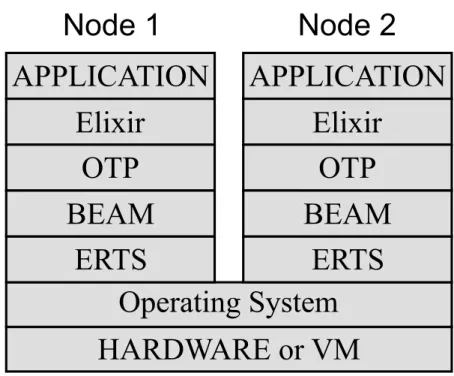
As you can see in Figure 1 running application in Erlang is composed of multiple layers. The bottom layer is actual hardware (or virtualized hardware in case of most cloud services. On top of that is the operating system layer, providing file access and other operating system services. ERTS runs on top of the operating system layer. Moving up, the next layer is a BEAM-virtual machine running on top of ERTS.
Figure 1: Erlang runtime stack.
OTP runs on top of the BEAM-virtual machine as it is written in Erlang and one can think of it as the standard library for Erlang language. Last, but not least is the application layer or in case of Elixir programs, Elixir layer and Elixir applications.
3.3
Go
Go[33][34] is a programming language designed by Robert Griesemer, Rob Pike and Ken Thompson at Google. The motivation for creation of the language was to ad-dress the perceived shortcomings of other programming languages used at Google while also importing the perceived good qualities of those languages. Some of these perceived features are static typing, run time efficiency, reliability, usability, high performance networking and multiprocessing. The languages from where these fea-tures were adapted from are C++, Python and JavaScript.
When designing the language three authors had agreement that they would only include features which all three of them agreed on. This meant that some of the features found in other modern programming languages were not implemented in the new language. Some of these are inheritance, generic programming, assertions, pointer arithmetic, implicit type conversions and unions (tagged or untagged). De-signers are especially against pointer arithmetic and assertions.
Go was designed 2007 and the first public version was published by Google in 2009. Version 1.0 of the language was announced three years later in 2012. There exist different compilers for the language. There are two compilers which compile Go to native executable. These two compilers are the Google compiler and GCC Go compiler. Google compiler is faster and only supports x86, amd64 and arm plat-forms. GCC Go compiler is slower, but supports more code optimizations shared with all languages supported by GCC. GCC Go also supports architectures which are not supported by Google compiler. There is also a GopherJS compiler whose responsibility is to compile Go code into JavaScript, which can then be used either in Node.js-runtime or virtual machines in web-browsers.
3.3.1 Simple Go program
Next I will define a simple Go program and go through some basic features of the language. These features include how code is packaged and how the program is compiled and run.
1 package main 2 3 import "fmt" 4 5 func main() { 6 fmt.Println("Simple example") 7 }
Listing 15: Simple Go example.
In Listing 15 we can see a minimal Go program. The first line defines the package where the code belongs to. Package main is special as it is used as the program entry point with main function. An import function is used for importing other packages. In this example I import one package called fmt which is used for for-matted I/O operations. If there are multiple packages to be imported, then it is recommended to use the version of import with braces to enclose the package names.
Inside of main function there is only one statement. In this statement we can see how functions exported from the package have names starting with capital letter. Functions which have names starting with a lowercase letter are not exported and are considered private to that package. Strings are denoted with double quotes and
bool string
int int8 int16 int32 int 64 uint unit8 uint16 uint32 uint64 byte rune
float32 float64 complex64 complex128
Table 2: Basic types provided by Go
statements are by default terminated at the end of the line. It is also possible to use semicolon to terminate the statement.
Because Go is a compiled language, to run this example one needs to use the com-mandgo buildto create an executable. Building is done with information provided by the source files, and separate Makefile or similar is not needed. After the build finishes a single executable file is produced. Users can then run this file in any system which is compatible with the build environment to produce the result.
3.3.2 Language features
Go has a limited set of basic types which are listed in Table 2. Bool is normal boolean type. String type is composed of bytes. The encoding used in strings is UTF-8. Size of the default int and uint is architecture dependent, and is 32bits in code compiled for 32bit systems and 64bits for 64bit systems. Rune is a special type which is 32bits in size and contains one Unicode code-point. It can be thought to have the same functionality as char type in C when it is used in storing characters.
Memory in Go is allocated either automatically in the case of declaring new variables of a certain type or by using keywords new and make. New keyword allocates a zeroed out block of memory and returns a pointer to it. Type of the allocated pointer is decided by the parameter given to the new-function. Keyword make is used when initializing slices, maps and channels. The make does not return a pointer. It instead returns a data structure which can be used to access the actual data. Because of this it can be passed as value instead of pointer to functions which mutate the data structure.
1 package main 2
3 import "fmt" 4
5 type ExampleType struct {
6 intvalue int
7 stringvalue string
8 } 9
10 var pkgVariable int = 0 11 var pkgArray [4]int 12
13 func main() {
14 var a = 1
15 b := 2
16 c := new(ExampleType)
17 c.intvalue = 3; c.stringvalue = "Go" 18 d := make([]int, 5)
19 fmt.Println(a, b, pkgVariable, c, d) 20 }
Listing 16: Go memory reservation examples.
In Listing 16 we can see different ways to allocate memory. On line 10 and 11 are the examples on how to declare package level variables. The first one is a declaration of a simple basic type variable, and the second one is declaration of a static array. Inside the main function lines 14 and 15 show the two different ways to declare function level variables. Variable allocation on line 15 is the recommended and usually used form. On line 16 memory is allocated forExampleType struct and its contents are initialized to zeros. Finally on line 18 I allocate slice of 5 int-values. Slices are the way to make array manipulation simpler and more dynamic in Go.
After allocating all the memory, the next question is how to release it. As Go is garbage collected language, it does this memory release automatically when memory is no longer needed. To decide when the memory block is no longer needed Go keeps track on the references to it. This usually means that the memory allocated in a function is released when the function exits. Exception to this of course is if the function returns a pointer to the memory it allocated. On the other hand package level variables are allocated when the program starts and will remain in the memory until the program exits.
Another aspect in addition to garbage collection is that Go is a memory safe lan-guage. This means it is not possible to access memory which is outside of the
allocated size of an object. This prevents many of the common attacks which try to access outside of the memory area to execute arbitrary code. These types of attacks are very common against programs written in C and C++.
One thing to take note about memory access in Go is that it is not thread safe. So it is important to take care not to use the same memory areas in different Go routines at the same time. These Go routines and how to safely communicate with them will be introduced in the next section.
1 package main 2
3 import "fmt" 4
5 type WrittenWork interface {
6 Author() string
7 Title() string
8 } 9
10 type Thesis struct {
11 writer string
12 topic string
13 } 14
15 func (t Thesis) Author() string { 16 return t.writer;
17 } 18
19 func (t Thesis) Title() string { 20 return t.topic
21 } 22
23 func main() {
24 var w WrittenWork
25 t := Thesis{"Jane Doe", "Really exciting thing."}
26 w = t
27 fmt.Printf("type of w = %T, value of w = %v\n", w ,w) 28 fmt.Printf("type of t = %T, value of t = %t\n", t ,t) 29 }
30 // type of w = main.Thesis, value of w = {Jane Doe Really
exciting thing.}
31 // type of t = main.Thesis, value of t = {%!t(string=Jane
Doe) %!t(string=Really exciting thing.)}
Listing 17: Example of Go interface.
Go uses a structural type system[35] for its interfaces. In structural type systems the equivalence between two things are determined according to their properties. So two interfaces which have the same properties are considered equal despite their names. In Listing 17 we can see how interfaces can be declared and then a combination of struct and functions created to conform the declared interface. In the printouts we can see that the line 30 struct is accessed as interface and in line 31 it is accessed as plain struct when dumping the contents.
1 package main 2 3 type A uint32 4 type B uint32 5 6 func main() { 7 var a A = 32 8 var b B = 64 9 c := a + b 10 }
11 // Results: prog.go:9:12: invalid operation: a + b (
mismatched types A and B)
Listing 18: Example of declaring two nominal types in Go
Suppose that you declare two types A and B like in Listing 18, and A and B share the same basic type. If you try to add them together you will get an error from the compiler complaining that the types A and B are not compatible. This happens because Go is a strongly typed language. Because of the strictness of this type system it is also often called strictly typed language.
As previously mentioned Go programs start executing from a package called main. Go programs are usually divided into packages. One package includes variables, types, functions and sub-packages. Package in Go is defined by creating a folder with a package name. This folder then contains files belonging to the package. Package
can be divided to multiple files to make the code cleaner and more manageable. Sub-package is created just by adding a folder inside of the parent Sub-package. Import string for the package would be "package" and for sub-package "package/sub-package".
Go distribution includes a build tool which can be invoked through go command. Build tool will automatically find the project files and compile them to the executable binary.
3.3.3 Concurrency and channels
One of the main features of Go language is easy concurrency by using Go routines. Go routines are lightweight threads scheduled by the Go run-time environment. This scheduling happens in predetermined points. Some of these scheduling points are channel sending and receiving, thread blocking on syscall, garbage collection and starting new a thread using the go keyword.
When a new Go routine is created with the go keyword, it goes to the queue of waiting to be scheduled. There is no guarantee that it will be scheduled next. Calling of the go keyword forces the program to run the Go routine scheduler. Go routine scheduler will start executing the Go routine waiting at the top of the execution queue. Also the newly created Go routine will be allocated two kilobytes of stack space which can be grown if needed. Compared to the operating system threads this process of creating Go routine is very lightweight, because it does not involve context switches and saving of CPU registers like an operating system thread would need.
This same lightness is applied to scheduling of Go routines. The Go run-time creates a necessary amount of operating system threads when it starts up, and then it can schedule any of the waiting Go routines to one of these threads. When run-time schedules a Go routine to the currently running thread, from the operating system point of view nothing changes. As Go routines are always in known state when rescheduling, Go run-time just needs to save three registers, namely program counter (PC), stack pointer (SP) and data register (DX). This is very little compared to 48 registers which needs to be saved when switching between operating system threads or contexts.
1 package main 2
4 import "time" 5
6 func msgSender(sendMsg chan<- string) { 7 sendMsg <- "Hello"
8 sendMsg <- "World!" 9 }
10
11 func msgReceiver(receiveMsg <-chan string) { 12 msg := <- receiveMsg 13 fmt.Println(msg) 14 msg2 := <- receiveMsg 15 fmt.Println(msg2) 16 } 17 18 func main() {
19 msgChannel := make(chan string)
20 go msgReceiver(msgChannel) 21 go msgSender(msgChannel) 22 time.Sleep(2 * time.Second) 23 } 24 25 // Result: 26 // Hello 27 // World
Listing 19: Basic example of channels in Go
Languages with multiple threads need a simple and efficient way to communicate between these threads. In Go this is handled by channels. Channels in Go are typed communication streams which can be read from and written to. By default channels are blocking and are created with the make keyword.
Listing 19 is an example on how the channels can be used to communicate between Go routines. I first allocate a channel on line 19 which can be used for sending and receiving messages. This channel is then given as a parameter to msgReceiver function which is started as a Go-routine. This function will receive a message two times from the channel before it exits. As channels are blocking it will stop on line 12 if it is run beforemsgSender Go-routine is run.
On line 21 I start msgSender Go-routine. This is responsible for sending two messages. The first message when the routine is run is "Hello". This is sent to the channel and then the channel blocks and the next Go-routine is scheduled. When msgReceiver is scheduled it will read this message, print it out and block on the receiving next message on line 14.
Then at some point msgSender is scheduled again to send the second message, and this will then result in themsgReceiver receiving the message. The main Go routine will wait for two seconds which should be enough time for both of the other Go routines to execute.
Another thing to note is that programmers can limit the use of the channel. On the msgSender function sendMsg channel is limited only for sending messages. And on themsgReceiver functionreceiveMsg is limited only to receive messages.
In Listing 20 there is a more advanced channel example. It has a buffered channel with buffer size of 5 and an example of dual direction channel as a function param-eter. There is also an example of using boolean channel to wait when it is time for the program to end. From the example it can be seen that the channel buffers are fixed and will need to be decided during creation. When the channel buffer is full it will block. Buffered channel will also block if someone tries to read from it when it is empty.
Usually using the same channel to communicate between Go routines is not very practical. In the example of dual direction channel in Listing 20, it is possible that the same process sends and reads messages from the channel. Because of this it is recommended to pass one channel for reading and another channel for writing to the Go routines if two way communication is needed.
1 package main 2 3 package main 4 5 import "fmt" 6 import "time" 7
8 func msgSendReceiver(sendReceiveMsg chan string) { 9 msg := <- sendReceiveMsg
10 fmt.Println("received: ", msg) 11 sendReceiveMsg <- "pong"
12 } 13
14 func bufferedReceiver(bufferedChannel <-chan string, exit chan<- bool) { 15 fmt.Println("received: ", <- bufferedChannel) 16 fmt.Println("received: ", <- bufferedChannel) 17 fmt.Println("received: ", <- bufferedChannel) 18 time.Sleep(5 * time.Second) 19 exit <- true 20 } 21 22 func main() {
23 msgChannel := make(chan string)
24 bufferedChannel := make(chan string, 5)
25 exitChannel := make(chan bool)
26 go msgSendReceiver(msgChannel) 27 msgChannel <- "ping" 28 msg := <- msgChannel 29 fmt.Println("received: ", msg) 30 bufferedChannel <- "msg 1" 31 fmt.Println("Send msg 1") 32 bufferedChannel <- "msg 2" 33 fmt.Println("Send msg 2") 34 bufferedChannel <- "msg 3" 35 fmt.Println("Send msg 3") 36 go bufferedReceiver(bufferedChannel, exitChannel) 37 <- exitChannel
38 fmt.Println("Exit after ~5 seconds") 39 } 40 41 // received: ping 42 // received: pong 43 // Send msg 1 44 // Send msg 2 45 // Send msg 3 46 // received: msg 1
47 // received: msg 2 48 // received: msg 3
49 // Exit after ~5 seconds
Listing 20: Advanced example of Channels in Go
When implementing multithreading applications in Go, it is important to remember that the memory access between Go routines (and in extension underlying operating system threads) is not exclusive, which means that the Go-routines using the same memory area need to agree between themselves which of them can access the given area of memory. This coordination is usually done using channels.
Another concurrency related issue is that two Go routines can end up in deadlock if they are waiting for messages from each other. This of course is a common synchronization related problem in most languages providing concurrency.
3.4
Conclusion
In this chapter I went through the three different languages used for implementing a web-service back-end. Of these three languages Elixir is functional and Go is procedural language. JavaScript is a mix of functional and procedural programming styles. JavaScript is also the only of these languages to support Object-oriented programming style through its prototype based inheritance.
Another difference between the languages is that JavaScript is a scripting language which is run in a virtual machine without any beforehand compilation. Elixir is compiled to byte-code which can be run in a BEAM virtual machine. Go on the other hand is compiled to machine code which can be then executed in the target processor. Also for Node.js there exists tools to package the node interpreter and all of the JavaScript files into one executable.
There are drawbacks in each of these choices. Go programs can only be run on the processor and operating system type they are compiled to. This is actually true of Elixir programs as well, because they have dependencies to OS level components like libraries, which need to be the same versions used for compiling the program. Dif-ference here is that Go programs can be statically linked. This means the resulting binary can be run on any of the operating systems supporting it.
Each of the languages have an ecosystem comprising tooling, dependency manage-ment and libraries. JavaScript is ahead of the other languages with its NPM-package
manager and very active developer community. Elixir also has npm-style package management and can use Erlang libraries. This means that Elixir can use all of the time tested frameworks and libraries from Erlang. Go is the least complete one in this aspect, but it also has most commonly used libraries available, but no centralized way of accessing them.
4
Comparison methodology
In the previous chapter I described three programming languages and their execution environment. In this chapter I will describe methodology for comparing concurrency features of these languages. Traditional way for comparing performance related characteristics of languages is to create series of test programs as evident in [36] [37] [38] [39].
This way of comparing languages isn’t without its pitfalls. As described in [39] there are measurable differences on code quality and use of beneficial language features between different programmers depending on their familiarity of the language and programming experience. Also choice of running hardware can affect the comparison results. For example Go and Elixir can benefit from multiple cores more than NodeJS can.
Another way to compare languages is to compare individual features. This can be accomplished by selecting a list of features and then marking up if a given language supports the feature or not. Here problem comes from biases in selecting the features to compare and different ways to implement things in languages which can lead ambiguities on deciding if a feature is implemented or not.
For the comparison I have selected to do feature comparison and empirical perfor-mance testing. Feature comparison is selected so that we can form a clear picture of what selected languages offer for the programmer in terms of tackling concur-rency. Empirical performance testing on the other hand will give more objective comparison on the performance difference between languages.
4.1
Feature comparison
In feature comparison we will compare the following concurrency related features of the languages. Some of the languages might not have all of the features listed in the following list. I will take note of this when making the comparison and give examples
of ways one could circumvent the missing feature from the language. Things in this comparison mostly affect the implementation phase of the program’s life-cycle. And they can make the implementation harder or make it necessary for the programmer to write more code in one of the languages than on the other.
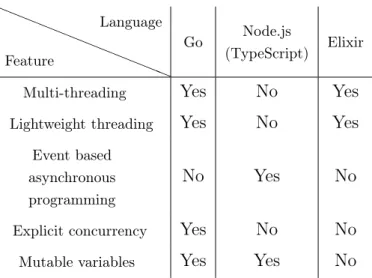
• Multi-threading
• Lightweight user space threading • Event based asychronous programming
• Thread/concurrent execution starting (implicit / explicit) • State handling and Mutability
• Inter-process (thread) communication method • Error handling
Multi-threading was selected as it is a common way to use multiple processors or processor-cores when running in the single node computer. Another choice for this would be using multiple processes with a technique called forking. Main difference with these is that in multi threading the threads can access memory of the other threads. Using multiple processes programmers need to use special memory areas or other inter-process communication methods. Both of these methods suffer from task switching overhead when used in single processor or processor-core.
Lightweight user space threading is used to minimise task switching overhead. An-other benefit with this technique is that single thread can have mode dynamic stack handling. Usually implementations start with a small stack per thread and may enlarge it if necessary.
Event based reactive programming is a technique where usually blocking operations are delegated to happen in background asynchronously and will call event hooks when operation finishes or needs to interact with other parts of the program. Tech-niques like callbacks, promises, events and reactive programming can be used to implement this technique.
In some languages thread starting might need multiple lines of code. In other lan-guages threads can be started with single instruction or even without any program-mer interaction. These differences affect how likely and how easily programprogram-mers can add thread based concurrency in their programs.