Applicability of the ParaDNA® Screening System to Seminal Samples
Nicholas D. Tribble1; Jamie A.D. Miller2; Nick Dawnay1; and Nicola J. Duxbury1.
1LGC Forensics, Culham Science Centre, Abingdon, Oxfordshire OX14 3ED, U.K.
2School of Biomedical Sciences, King’s College London, Franklin-Wilkins Building, Stamford Street, London SE1 8WA, U.K.
Abstract
Seminal fluid represents a common biological material recovered from sexual assault crime scenes. Such samples can be pre-screened using different techniques to determine cell type and relative amount before submitting for full STR profiling. The ParaDNA Screening System is a novel forensic test which identifies the presence of DNA through amplification and detection of two common STR loci (D16S539 and TH01) and the Amelogenin marker. The detection of the Y allele in samples could provide a useful tool in the triage and submission of sexual assault samples by enforcement
authorities. Male template material was detected on a range of common sexual assault evidence items including cotton pillow cases, condoms, swab heads and glass surfaces and shows a detection limit of 1 in 1000 dilution of neat semen. These data indicate this technology has the potential to be a useful tool for the detection of male donor DNA in sexual assault casework.
Keywords: forensic science, sexual violence, semen, DNA, short tandem repeats, triage
Introduction
The current method of DNA profiling amplifies target STRs through polymerase chain reaction (PCR) (1) and uses capillary electrophoresis to discriminate alleles based on size variation. The commercial STR kits interrogate ten or more STRs, along with the gender marker Amelogenin. Using this process, random match probabilities of less than one in a billion are routinely generated. Using DNA
technology in this way is a powerful tool in forensic science, although many processing difficulties still arise. Currently, full DNA analysis turnaround times in forensic laboratories range from days to weeks for non-urgent samples, and many forensic samples arrive without any prior knowledge as to
whether they may hold sufficient cellular material to yield an STR profile. It is not uncommon for a number of samples from a crime scene to undergo STR profiling before an STR profile is obtained. Being able to rapidly screen samples at a crime scene or within a police submissions unit would allow a forensic scientist to be selective in which samples to send for full profiling.
LGC has developed a rapid DNA technology named ParaDNA which uses HyBeacon™ probes and melt curve analysis to interrogate STRs (2). The ParaDNA Screening System (consisting of a Screening Test, Sample Collector and Screening Unit) profiles alleles at the D16S539 and TH01 loci along with Amelogenin X and Y alleles. Designed for non-expert users such as enforcement officers, this technology serves as a presumptive test for the identification of DNA on evidence items and is able to do so directly from blood, saliva, and touch DNA, without the need for a separate extraction step (3). Extraction of DNA from body fluids can be a time-consuming process (4). The ability to use the ParaDNA technology on un-purified samples eliminates any delay from the overall process as well as allowing for non-laboratory-based analysis and fewer steps in the methodology. The ParaDNA software automatically processes the fluorescence associated with amplification of the DNA markers and displays a “DNA detection score” (%) which is the sum of the fluorescence detected across the four reaction tubes. The software also generates a gender call associated with the presence of Amelogenin X and Y alleles.
Blood, saliva, and semen are three of the most commonly encountered bodily fluids in forensic science. In physical and sexual assaults, these substances may be transferred between suspect and victim. Consequently, generating a DNA profile that links suspect to victim can provide evidence to support or refute a claim. In a sexual assault case, the most important bodily fluid is often semen. This can be used to support a rape allegation if found on a high vaginal swab taken from a victim, or a sexual assault if found elsewhere on the body or at the crime scene. Common detection methods such as alternative light source (ALS) have low specificity to the intended target and can suffer from a high rate of false positives as a result (5). Other more specific methods such as the acid
phosphatase test look indirectly for the presence of DNA and are not routinely performed by non-expert users due to the use of chemicals in a fume hood.
Semen poses a big challenge for DNA amplification as the outer membrane of sperm cells contain strong disulfide bonds that make them difficult to break when performing DNA extraction (6). A strong reducing agent such as dithiothreitol (DTT) or tris(2-carboxyethyl)phosphine (TCEP) is normally required to break these bonds and allow cell lysis (7). This together with the viscosity of neat semen samples and the presence of polyamines such as spermine and spermidine (8) may present further problems for the analysis of this sample type. As the ParaDNA Screening Test uses a
direct amplification approach, it is necessary to assess its performance with seminal samples on a variety of substrates and at different volumes and concentrations.
Methods
To test the sensitivity of the Screening Test (chemistry mix), semen samples were obtained from five anonymous donors and stored in vials at 20°C. Dilution series were prepared with 1 9 Tris-EDTA buffer (Integrated DNA Technologies, Leuven, Belgium) in ratios of 1:10, 1:100, 1:1000 and 1:10,000, making sure to vortex thoroughly between each dilution to ensure the cells were evenly distributed. 2 lL of each semen dilution was added to each of the four wells comprising the test. To test the sensitivity of the ParaDNA Sample Collector, a range of volumes from 0.5 to 10 lL from a single donor were pipetted onto cotton swabs and left to air-dry at room temperature overnight before indirect sampling was performed.
The ParaDNA Sample Collector functions in a similar fashion to a traditional cotton swab. Operators can use the collector to recover evidence either “directly” from the surface of the item or
“indirectly” from a moist swab used for the primary evidence collection. The reproducibility of each collection approach was assessed by spiking replicate cotton pillow case material and 3 9 3 cm sections of non-spermicidal condoms with a single donor’s seminal fluid before performing direct sampling for approximately 30-sec. Independent replicates of cotton and condom samples
underwent traditional wet–dry swabbing for indirect recovery using the ParaDNA Sample Collector. Indirect sampling was performed by wetting the head of a Sterilin® cotton swab in sterile distilled water (Sigma-Aldrich, Gillingham, U.K.) and using this to gently rub the seminal stain for 1 min making sure to rotate the head to ensure the sample was well distributed over the swab. The swab was then subsampled using the ParaDNA Sample Collector for 1 min.
Mock casework samples were prepared by pipetting 5 lL of neat semen from five donors onto approximately 3 9 3 cm pieces of clean cotton material, Sterilin Rayon swabs (Thermo Fisher Scientific, Leicestershire, U.K.) and glass slides. Samples were left overnight at room temperature to air-dry. Glass slides and cotton material underwent direct sampling, while spiked rayon swab underwent indirect sampling.
All ParaDNA Screening Tests were prepared in accordance with the screening assay manufacturing guidelines with PCR and melt analysis conducted on a ParaDNA Screening Unit (Life Technologies, Paisley, U.K.). Data analyses were performed using screening chemistry 1.0 and software version 1.1.2.
Results and Discussion
Serial dilutions of semen were tested to determine the sensitivity of the assay and to establish any problems that may arise from the concentration of the sample. The data show that best results are obtained with 1:10 or 1:100 dilutions (equivalent to 0.2 and 0.02 lL of semen in each well). At these concentrations, DNA was detected and correct gender profiles called (Table 1). The performance of the assay starts to drop off at a dilution of 1:1000 (2 nL) with Y amplification beginning to fail, although the test was still able to detect the presence of DNA. The ParaDNA Screening Test was no longer able to detect the presence of DNA at the 1:10,000 (0.2 nL) level.
There was a single instance of Y dropout in one replicate at the 1 in 1000 dilution level (Table 1). The problem of allelic dropout is more pronounced in haploid sperm cells than diploid cells, as each cell only contains one allele, and so many more are needed to be representative of the entire genotype (9). Based on “healthy” sperm count figures of 20–40 million/mL (10), using 2 lL of a 1 in 1000 dilution, we would expect to see between 40 and 80 sperm cells. In theory, the number of sperm cells needed (n) to observe both alleles for a certain number of loci (k) with a probability (a) in a population, where the two allele frequencies are equal and with an expected number of
homozygous loci (qh), can be calculated using this equation (9):
𝑛 =log(1−∝1/(𝑘−𝑞ℎ)) log(0.5)
In the case of Amelogenin, to observe both X and Y alleles with a probability of 99%, only about 8 sperm cells are required (n = 7.6). It therefore seems logical that the observed dropout is an artefact of low amounts of DNA released from the haploid sperm cells and the stochastic nature of PCR (11). It is most likely a combination of these two factors that accounts for the unknown or female gender calls observed at the 1:1000 dilution level.
It was hypothesized that as the amount of semen on a mock casework sample increases, so too would the amount of DNA that is picked up by the sampling device which should be reflected in an increase in DNA detection score. A trend of this nature was observed (Fig. 1) with the Y allele detected at all tested levels. The limit of detection for the screening system (which takes into account the chemistry sensitivity and the amount of sample pick up from the sampling device) appears to be lower than the 0.5 lL tested. This volume is 1000 times lower than that tested by Nelson et al. (5) who noted that with 0.5 ml seminal fluid, only 25% of users could accurately differentiate between semen and other items that also fluoresce when using ALS. The ParaDNA
Screening System is designed to augment existing methods and the complementary use of ALS and the ParaDNA Screening System while not yet tested may prove beneficial.
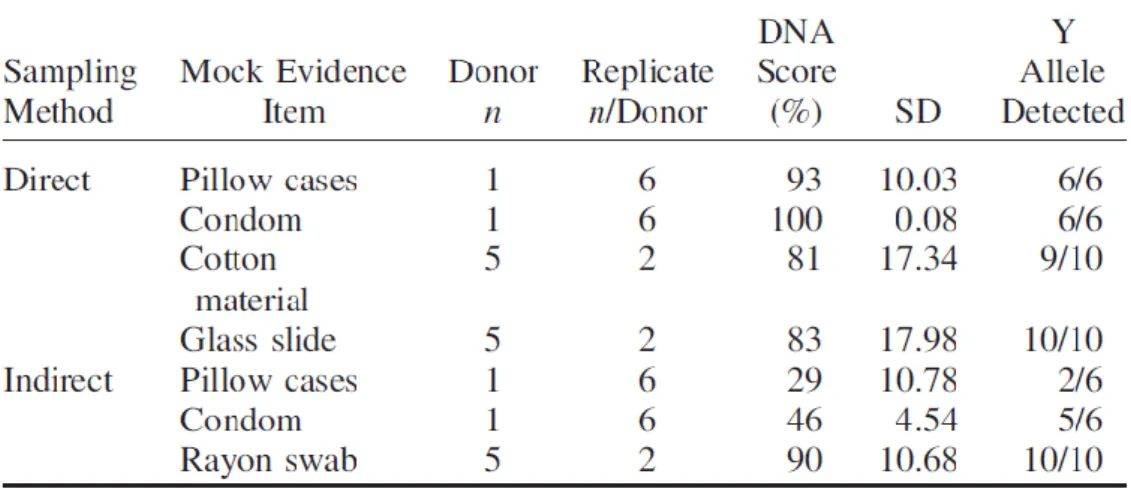
The reproducibility of the ParaDNA Screening System was assessed with mock sexual assault casework samples consisting of semen spotted onto cotton material (to represent underwear), swabs (to represent high vaginal swabs), glass, and condoms. Gender was correctly called from all of the samples (Table 2). Sampling from any of the materials gave results indicating the presence of DNA. The direct sampling method gave significantly higher DNA detection scores (Mann–Whitney U-test p = 0.00) which together with the higher Y allele detection rate suggests this method may be preferable when working with sexual assault samples.
The accuracy of the ParaDNA Screening System with regards to false-negative and false-positive DNA detection results as reported in Dawnay et al. (3) is not a measurement that was directly assessed in this experiment as none of the items were sent for confirmatory STR profiling. Such a measurement would also be slightly misleading for sexual assault applications because a user would not only be interested if they had amplified DNA but specifically that they amplified male DNA. A basic measure of the false-negative rate in sexual assault applications could be a count of how many times the Y allele was identified on the spiked casework items. Of the 54 casework items tested, six did not provide a male gender call (11% false-negative rate). Five of these fails were when sampling
indirectly and one fail was observed when performing direct sampling, again suggesting that the use of direct sampling method may reduce the level of false negatives resulting from the
non-amplification of the Y allele. Additional work looking at the correlation between the direct sampling strategy and downstream results has been performed (12) although not in the context of sexual assault samples.
In summary, the results show that the presence of DNA can be detected from these samples and that sampling from the common sexual assault materials of cotton, condoms, and swabs is possible. Limits of detection are in the region of a 0.5-lL stain size or the equivalent of 8 nL of semen (2 nL per well) added directly to the PCR assay, although signal intensity varies from donor to donor, possibly due to varying sperm or epithelial cell count. While the overall success with semen is encouraging further exploration of the false-negative and false-positive DNA detection and gender identification rate is required by confirming results through traditional STR profiling. This should be of great benefit to law enforcement agencies, who may wish to use the technology in sample submission offices and Sexual Assault Referral Centres.
The authors would like to thank the following institutions for supporting the publication of this technical note; Department of Forensic and Analytical Science, School of Biomedical Sciences, King’s College London and LGC Forensics. The authors would like to specifically thank Jim Thomson for reviewing the manuscript before submission.
References
1. Saiki RK, Scharf S, Faloona F, Mullis KB, Horn GT, Erlich HA, et al.Enzymatic amplification of beta-globin genomic sequences and restriction site analyses for diagnosis of sickle-cell anemia. Science 1985;230:1350–4.
2. French DJ, Archard CL, Brown T, McDowell DG. HyBeacon probes: a new tool for DNA sequence detection and allele discrimination. Mol Cell Probes 2001;15:363–74.
3. Dawnay N, Stafford-Allen B, Moore D, Blackman S, Rendell P, Hanson EK, et al. Developmental validation of the ParaDNA screening system – a presumptive test for the detection of DNA on forensic evidence items. Forensic Sci Int Genet 2014;11:73–9.
4. Walsh DJ, Corey AC, Cotton RW, Forman L, Herrin GL, Word CJ, et al. Isolation of deoxyribonucleic acid (DNA) from saliva and forensic science samples containing saliva. J Forensic Sci 1992;37:387–95. 5. Nelson DG, Santucci KA. An alternate light source to detect semen. Acad Emerg Med
2002;9:1045–8.
6. Balhorn R. A model for the structure of chromatin in mammalian sperm. J Cell Biol 1982;93:298– 305.
7. Butler J. Fundamentals of forensic DNA typing. San Diego, CA: Elsevier Academic Press, 2010. 8. Wilson IG. Inhibition and facilitation of nucleaic acid amplification. Appl Environ Microbiol 1997;63:3741–51.
9. Lucy D, Curran JM, Pirie AA, Gill P. The probability of achieving full allelic representation for LCN-STR profiling of haploid cells. Sci Justice 2007;47:168–71.
10. Dindyal S. The sperm count has been decreasing steadily for many years in Western
industrialised countries: is there an endocrine basis for this decrease? Int J Urol 2003;2(1) (accessed February 6, 2014).
11. Walsh PS, Erlich HA, Higuchi R. Preferential PCR amplification of alleles: mechanisms and solutions. PCR Methods Appl 1992;1:241–50.
12. Ballantyne J, Hanson E, Mills D, Kallifatidis B, Mendel J, Dawnay N, et al. DNA first. Forensic Mag;
TABLE 1 - Sensitivity of DNA detection and male gender call.
Data based on duplicate samples tested at four 109 dilutions. Male Y allele detection in given as count of observed instances. *Indicates a single instance of Y dropout leading to an incorrect female gender call.
FIG. 1 - Results from different volumes of neat seminal sample pipette onto cotton swabs. The Y allele was detected at all tested levels. Two replicates tested. Error bars = 1 SD.
TABLE 2 - Reproducibility of direct and indirect sampling results from 5 lL of a single seminal sample on case type items.