Graduate Theses Student Scholarship
2016
Developing Assessment Methods to Benefit
Middle School Art Students
Christine Melo
Salem State University
Follow this and additional works at:https://digitalcommons.salemstate.edu/graduate_theses Part of theArt Education Commons, and theEducational Assessment, Evaluation, and Research Commons
This Thesis is brought to you for free and open access by the Student Scholarship at Digital Commons at Salem State University. It has been accepted for inclusion in Graduate Theses by an authorized administrator of Digital Commons at Salem State University.
Recommended Citation
Melo, Christine, "Developing Assessment Methods to Benefit Middle School Art Students" (2016).Graduate Theses. 17. https://digitalcommons.salemstate.edu/graduate_theses/17
Developing Assessment Methods to Benefit
Middle School Art Students
Christine T. Melo
Salem State University Spring 2016
A thesis presented in partial fulfillment of the requirements for the degree of Master of Arts in Teaching
Abstract
The purpose of this study was to determine what assessment rubrics middle school art students
find most beneficial. The need for more reliable and effective assessment tools for visual arts
teachers is addressed. Literature is reviewed on the risks and benefits of assessment in art
education; the variety of assessment strategies that are available for art teachers; and how to
design a scoring rubric, which is the most common assessment strategy used among art teachers.
Eighth-grade art students in Massachusetts were surveyed to determine which of three rubrics
were most helpful to them. The results allow art teachers to better understand how to
communicate students’ grades through rubrics, how much information to include in rubrics, and students’ preferred rubric formats. This study can help art teachers develop rubrics that are consistent with what students find most useful and maximize the benefits that assessment can
Philosophy of Art Education
With the ability to be both personal and communal, the visual arts can convey ideas about
an individual, a culture, or an environment. Learning to create something with one’s own hands, recognize and appreciate aesthetics, communicate ideas, more closely observe the world around
you, self-evaluate, and envision and invent something new are all important skills that are
learned uniquely through the arts. Participating in the arts promotes creativity, builds confidence
and skill, and provides an outlet for expression.
A major goal of my art program is to help students express themselves effectively
through the visual arts. Students may use their art to visually convey an emotion or reveal the
way they view the world around them. By demonstrating techniques, teaching the elements and
principles of design, presenting challenges, and providing guidance and feedback, I strive to help
students develop skills they need in order to be able to communicate their ideas through their art.
An effective art educator helps students become proficient in visual language in order to
successfully express themselves.
I assign projects that serve as a prompt for student artwork, but also, act as a challenge in
which students need to discover their own solution. The prompt may be a specific medium or
technique; an element or principle of design; or a theme such as portraits, abstraction, culture,
landscapes, or another topic. There must be enough freedom of choice within the assignment for
students to be able to express individuality in their artwork. Without any sort of prompt or
assignment, students may stick to what feels comfortable to them, thus becoming hesitant to take
risks in the social environment of the art classroom. The assignment motivates students to apply
their personal style or meaning to a new context, encouraging innovation and original thinking,
It is my responsibility as their teacher to ensure that students are learning the
predetermined objectives and making progress in their work. Assessment strategies help students
become aware of all aspects of their artwork, recognizing both their strengths and the areas in
need of further development. I facilitate this growth by giving students guidance and assistance
during studio time as needed, and by offering feedback on artwork. Providing opportunities for
students to write and talk about their own artwork promotes self-reflection. Critiques play a role
in art class by giving students the opportunity to describe their own work, receive feedback from
their peers, and to observe and analyze the work of their classmates. Rubrics can be used to
assess the level in which the artwork achieves the learning goals of the lesson. Assessment
makes students more critically aware of their artwork and allows them to better self-evaluate
their work in the future.
As visual arts programs are being reduced in school districts across the country, it
becomes necessary to address the importance of student participation in art classes. An
education in the arts allows individuals to learn how to express themselves and share their ideas
with others. Learning a skill and creating artwork strengthens craftsmanship and builds
confidence and pride. While many school subjects expect students to learn rote information, art
is one of the few subjects that encourages students to develop an idea that is completely original,
thus promoting creativity. I aim to teach art in a way that maximizes all these important benefits
Table of Contents
Developing Assessment Methods to Benefit Middle School Art Students……….…6
The Need for Research in Art Assessment….…….………….….…...…………...….……...……7
Aims and Objectives of the Study………….………….……….8
Literature Review……….……….……….…….…..…….…………10
Why Do We Assess Student Artwork?.……….………10
Different Assessment Strategies………….……….……….….……13
Designing and Implementing Scoring Rubrics………..14
Methods and Materials……….….….….….….……….17
Participants……….….….….….….….….……….17
The Three Rubrics……….……….…18
The Questionnaire………..22
Results………….……….……….…….………23
The White Rubric……….……….……….………25
The Yellow Rubric……….………26
The Blue Rubric……….……….……….…………..27
Developing a Helpful Rubric…….……….……….………..28
Discussion …….…….…….….……….……….……..…….….…….………….…….28
Students Want Their Grade Clearly Communicated to Them………...28
Students Want to Receive Detailed Information about Their Artwork….………29
Students Want a Rubric to be Easy to Read and Use….……….………….……….31
An Ideal Assessment Rubric……….…….33
Reflection and Conclusion……….……….…...……….………...33
Contributions to the Field of Art Education………..34
Teacher’s Experience Using the Rubrics………...34
Recommendations for Further Study……….………36
Conclusion………..………..……….47
References……….………...……….……….39
Bibliography……….………...……….……….42
Appendix A: O’Keeffe Close-Up Lesson………...…………...………...…………46
Appendix B: O’Keeffe Close-Up Student Artwork……….…………...………...…...……49
Appendix C: The White Rubric………...………..………50
Appendix D: Inspired Self-Portrait Lesson………51
Appendix E: Inspired Self-Portrait Student Artwork ………54
Appendix F: The Yellow Rubric………...……….…...….55
Appendix G: Charcoal Creatures Lesson………..….56
Appendix H: Charcoal Creatures Student Artwork ……….….59
Appendix I: The Blue Rubric………..………...…60
Appendix J: Letter of Agreement………...………...……61
Appendix K: Parental Consent Form………...………..62
Appendix L: Disclosure Statement……….………...………63
Developing Assessment Methods to Benefit
Middle School Art Students
Reporting a child’s progress to his or her parents or guardians is one of the essential
functions of a school. As such, assessment becomes one of the major responsibilities of a
teacher in order to produce an accurate report. For the purposes of this research, I define
assessment as a method used to gather information about something in order to make an
evaluation. This is based on definitions by Donna Kay Beattie (1997) and Carolyn Coil (2014). In addition to assessment being a means of reporting student progress to parents, assessment also
helps students understand how they are learning and applying the objectives and skills that are
being taught. Concerning art education, assessments help students recognize the strengths of
their art making process and help them understand how to make the improvements needed in
order to achieve the desired effects of their work.
The K-8 school where I teach in Massachusetts requires that an art grade is assigned to
students. For the first seven years of my teaching career, I graded students on a numerical scale
of one (lowest) to four (highest), based on their levels of participation and involvement. In the
year of this study, the school changed this system to traditional letter grades for art in grades
seven and eight. As a result, I have found it even more crucial to measure and record my
students’ progress in order to accurately generate such a grade. I have found it necessary to develop a more effective and transparent grading system that supports my students’ learning. I would like my students to be immersed in the assessment process, so they feel more responsible
for their own growth and development. Through this study, I aimed to determine which
assessment methods were beneficial for my students, while also being practical for me to
The Need for Research in Art Assessment
As an art teacher, I am responsible for assessing my students’ progress in order to assign them a letter grade for art class. However, I did not have a system in place that I was satisfied
with, and in my school, there is no established system for how art teachers are expected to reach
such a grade. This is not an uncommon situation. Though numerous school districts and State
Education Departments in the United States insist that art teachers assess and report on student
performance, the state or district often does not put forth any school art assessment plans (Dorn,
Madeja, & Sabol, 2004). Assessments can be helpful to students if they give valuable
information about how well they are achieving the goals of the lesson, what the strengths and
weaknesses are in their art making process, and how they can work towards improvement. I
would like to develop methods that best utilize these benefits.
Art teachers are receiving very little training or professional development in the area of
assessing student progress. Studies have found that less than half of art teachers receive
assessment training from college courses, and about one-fourth of art teachers reported having no
assessment training (Dorn et al., 2004). Other art teachers received assessment training through
workshops, conferences, and in-service sessions, and gained assessment information from
colleagues, professional journals or magazines (Dorn et al., 2004). While assessments have the
potential to be beneficial to students, they could also potentially harm students’ self-esteem and stifle their creativity if conducted improperly (Gruber & Hobbs, 2002; Hurwitz & Day, 2011). It
is necessary for art teachers to increase our knowledge of assessment methods in art education in
order to best serve students. The National Art Education Association (NAEA) has identified
identify successful ways to authentically measure learning in art and assess student creativity
(NAEA Research Commission, 2014).
In expressive learning such as art, there is often no clear correct answer. Teachers cannot
simply mark an artwork as correct or incorrect, as they might for a math or history test. Grading
artwork is more subjective in that sense and there is a risk that biases may interfere when grading
student work. Rubrics are commonly used tools for art teachers who need to quantify their
students’ achievements in the form of a grade. A rubric can break a lesson down into categories, and describe in detail the varying levels of achievement, which make it an efficient and effective
way to more objectively measure a student’s learning in art (Coil, 2014; Dorn et al., 2004;
Gruber, 2008; Howell, 2011; Jonsson & Svingby, 2007; Popovich, 2006). Helping students to
understand their progress is a central role of assessment, and ensuring that the rubric meets that
role is of utmost importance.
Aims and Objectives of the Study
My research aimed to discover which assessment methods middle school students find
most helpful. As discussed previously, art teachers are in need of more information on
developing effective assessment strategies. The results of this action research project will
provide me and other art teachers with the knowledge required to improve methods of
assessment.
In addition to advancing the field and my own professional practice, this study will also
benefit my students by allowing me to design rubrics that are optimized to best suit their needs.
As previously mentioned, assessment in the form of a letter grade is required at my school.
Assessment is important because it informs parents and administrators about student progress,
weaknesses within their own art making processes (Andrade, Hefferen, & Palma, 2014; Coil,
2014; Dorn et al., 2004; McCollister, 2002; Hurwitz & Day, 2011). My goal is to design a
grading system that is practical, transparent, and beneficial for my students.
Based on my Literature Review, I have established that analytic scoring rubrics are an
effective and viable method of assessing student art. Since there is such a wide variety of ways
to design a scoring rubric, this study focused on determining which scoring rubric students find
most helpful. My research involved surveying the eighth-grade students who participated in my
study, as outlined in more detail in the Methods and Materials section. Through analysis of a
quantitative and qualitative questionnaire, I discovered which rubric designs were the easiest for
students to understand, which components of the rubric were most important to students, and
what students found most helpful about each of the rubric designs.
As mentioned in my Literature Review, assessment can potentially stifle creativity, lower
self-esteem, or shift focus from the art process to the art product. Rubrics come with the risk of
narrowing a student’s vision to the rubric’s individual criteria. It is important to be aware of these potential risks when developing assessment methods and when assessing student
performance. Considerations should be made to ensure that assessment strategies allow room for
creative expression, are constructive rather than destructive, and focus on the process rather than
the product.
I aim to develop assessment strategies that will help my students better understand the
learning goals of a lesson, recognize the strengths and weaknesses of their art making process,
and consider ways in which they can make improvements to their artwork. In order for the
assessment to be effective, it is necessary that the methods be comprehensible and
rubrics do middle school art students find most helpful? The results of my research will help me to design rubrics that are useful for my students and most conducive to their learning.
Literature Review
This section reviews the literature that informed my study on developing assessment
methods to benefit art students. I reviewed scholarly literature centered on assessment in art
education. The purpose of this Literature Review is to demonstrate an understanding of 1) the
risks and benefits of assessing student artwork; 2) the range of assessment strategies that are
available to art teachers; and 3) how to design assessment rubrics that will benefit art students.
Why Do We Assess Student Artwork?
In the current educational climate which places a tremendous emphasis on accountability,
it is more important than ever to develop reliable assessment systems. The No Child Left Behind
(NCLB) Act of 2001 added to the pressures of providing objective evidence of student learning
(Boughton, 2014; Gruber, 2008). With an increased focus on evaluating products of learning,
subjects that do not provide such evidence of student learning risk losing priority in school
curriculums (Boughton, Eisner, & Ligtvoet, 1996; Dorn et al., 2004). Elliot Eisner notes that
without evidence of learning, art educators are asking people to support art programs “on faith” (2002, p. 179). It has become essential for educators in all disciplines to find ways to measure
and demonstrate student learning through assessment.
Historically, there have been conflicting views on whether student art should be assessed.
Some believe that assessment has many benefits, while others believe that assessing artwork is
unnecessary and could, in fact, be harmful to students. Viktor Lowenfeld, Elliot Eisner, and
other art educators have argued that grading a child’s artwork can divert attention away from the creative process and inhibit personal expression (Eisner, 2002; Gruber & Hobbs, 2002; Hurwitz
& Day, 2011). Art teachers who participated in Dorn et al.’s 2004 study expressed similar
concerns that students’ focus on reaching a high grade could stifle creativity and risk-taking initiatives. Lowenfeld asserted that placing emphasis on the product rather than the process could
actually be damaging to the child's psychological development (Gruber & Hobbs, 2002). The
teachers in Dorn et al.’s 2004 study also noted the negative impacts assessment may have on
their students’ anxiety and self-esteem. With so many potential drawbacks associated with assessing student artwork, it is crucial that art educators be well equipped with assessment
strategies that focus on the process rather than the product, reward creativity and risk-taking, and
employ methods of critique that are constructive and supportive.
While some scholars argue against assessment in art, there have been others who support
it, including proponents of Discipline-Based Art Education (DBAE) (Dorn et al., 2004). There
are many reasons to assess student artwork. Students can use assessment tools to guide them
through the concepts they are to learn (Andrade et al., 2014; Dorn et al., 2004; Hurwitz & Day,
2011). Assessment methods can inform students of the relationship between the goals of the
assignment and their current efforts, and feedback can motivate and help students to make
improvements (Andrade et al., 2014; Coil, 2014; Dorn et al., 2004; McCollister, 2002; Hurwitz
& Day, 2011). And, while some teachers believe that assessment can lower students’
self-esteem, other teachers note that it can actually boost students’ self-esteem (Dorn et al., 2004). When executed skillfully, assessment can indeed prove beneficial to students by helping them
better understand the strengths and weaknesses of their art making process.
Assessment can be useful to the art teachers as well as to the students. It provides
credibility for the art education program and increases respect from administrators (Dorn et al.,
program as a whole, and can indicate to teachers and administrators what the goals of the
program are and whether these goals and student educational needs are being met (Dorn et al.,
2004; Hurwitz & Day, 2011; McCollister, 2002). Assessment is important because it grades
student achievement and provides feedback to students, teachers, parents, and administrators
about students’ learning (Beattie, 1997; Dorn et al., 2004; Hurwitz & Day, 2011). Art teachers, students, and other stakeholders can use assessment as a means of communication about the art
program and about students’ progress.
As outlined above, it is evident that there are opposing views on whether art should be
assessed. Risks include the impacts on self-esteem and creativity, and shifting focus from the
process to the grade. However, many advantages of assessment have also been established,
including communicating learning objectives and program goals to students, parents, and
administrators; making students more aware of their accomplishments; and providing feedback
about a student’s achievement. The art teachers who participated in Dorn et al.’s study listed both positive and negative effects of assessment in art. Though they identify several drawbacks
of using formal assessment, the majority of the teachers still held the belief that assessment
should, in fact, be a part of an art program. The study revealed that 80% of elementary art
teachers and 83% of secondary art teachers strongly agreed that student artwork should be
assessed (Dorn et al., 2004, p. 14). While Elliot Eisner (2002) warns that grading student work
could be harmful if done insensitively, he insists that it is necessary in order to ensure the
students are meeting the learning goals. He explains, “Without some form of assessment and evaluation, the teacher cannot know what the consequences of teaching have been. Not to know,
teachers still recognize the important role of assessment in art education. It is crucial that
assessment methods be optimized to avoid potential risks.
Different Assessment Strategies
There are a variety of assessment strategies art teachers can use to provide feedback to
students, help them analyze their own work and the work of others, and produce grades for
students as required by their school district. An assessment strategy is any tool or technique
educators use to gather and quantify complex and multifaceted information about student
learning (Dorn et al., 2004, p. 14). Traditional paper-and-pencil assessment formats are
prevalent in many school subjects, but visual arts is such a complex and subjective discipline,
that it lends itself to a wide range of alternative assessments that are more authentic and
meaningful (Beattie, 1997; Dorn et al., 2004; Hurwitz & Day, 2011).
Since no singular assessment tool can give an accurate measure of students learning,
several authors agree that the most effective assessment plans are those that include a wide range
of strategies (Boughton et al., 1996; Dorn et al., 2004; Gruber, 2008; Hurwitz & Day, 2011).
Formative or ongoing assessments can be conducted through critique, interviews, journals,
student self-assessment, and observations; while summative or post-productive assessments can
include tests, questionnaires, visual identifications, essays, reports, and analyzing student work
using portfolio reviews, checklists, and scoring rubrics (Dorn et al., 2004; Hurwitz & Day, 2011;
Gruber, 2008; Gruber & Hobbs, 2002 Popovich, 2006; Stokrocki, 2005). Art teachers can
consider which of these assessment strategies fit into their art program, and design a plan that
encompasses a variety of these strategies.
As described previously, there is a lack of resources and guidance available for art
examples of devices for art teachers to use (Dorn et al., 2004; Gruber & Hobbs, 2002).
Strategies must be developed to support learning, not interfere with or interrupt it (Dorn et al.,
2004; Hurwitz & Day, 2011). Furthermore, assessment strategies should also not require an
undue amount of paperwork so that little time is left for teaching and lesson planning (Gruber,
2008; Hurwitz & Day, 2011). Assessment devices must be relevant to the learning goals, and
should encourage students to progress, revise, and improve their art-making skills (Dorn et al.,
2004; Hurwitz & Day, 2011). In my teaching practice, I aim to incorporate a range of assessment
tools and techniques. This study focuses specifically on developing scoring rubrics that support
learning and encourage students to improve their fluency in visual communication and reflect on
their art-making process.
Designing and Implementing Scoring Rubrics
Scoring rubrics are the most frequently used method of assessment in art class (Connelly
& Wolf, 2007; Dorn et al., 2004; Mason & Steedly, 2006; Popovich, 2006). They can be
beneficial as they emphasize teaching goals and identify the purpose of a lesson (Connelly &
Wolf, 2007; Popovich, 2006). When students use a rubric as a guide to an assignment, it helps
them to develop self-reflection and self-assessment skills (Jonsson & Svingby, 2007). Scoring
rubrics help provide clarity and transparency, giving students clear guidelines of the expectations
of their work (Coil, 2014; Howell, 2011; Jonsson & Svingby, 2007; Popovich, 2006). The
structure of a rubric can also increase consistency and validity in an area that is highly subjective
in nature (Coil, 2014; Dorn et al., 2004; Gruber, 2008; Jonsson & Svingby, 2007; Popovich,
2006). With the practicality, customizability, and effectiveness that come with scoring rubrics, it
makes sense why so many art teachers rely on them as an integral component of their assessment
While rubrics can be beneficial, there are also some drawbacks associated with their use.
Some risks include limiting a student’s artistic vision to the criteria listed on the rubric and
causing the student to focus on individual criteria instead of the artwork as a whole (Connelly &
Wolf, 2007). There is also a high potential for human error for teachers scoring the works,
including tendencies to generalize, overestimate, underestimate, interject personal biases, judge
too quickly, or judge students against one another (Beattie, 2007). Being aware of these risks
and flaws can help the art teacher consciously try to prevent them from occurring when using a
scoring rubric.
In order to design an analytical scoring rubric, an art teacher must clearly define the
levels of achievement. A teacher may use a scale of four or five achievement levels and describe
them by using numbers, letters, words, or graphics (Beattie, 2007; Dorn et al., 2004). In this
study, I have tested a variety of descriptors for levels of achievement to determine what may be
most helpful to my own students.
Another key step in designing an analytical scoring rubric is the development of the
criteria to be measured. Wolf, Connolly, and Komara (2008) recommend limiting the number of
criteria between three and seven so that students will easily be able to remember and keep track
of them all. The criteria should be stated in terms that are easy for students to comprehend (Dorn
et al., 2004). Teachers should choose criteria that are the focus of instruction, so students have a
fair chance to learn those skills and techniques (Boughton et al., 1996; Dorn et al., 2004; Hurwitz
& Day, 2011). When the criteria are consistent with the learning objectives, the rubric can be
used to guide students toward meeting those objectives.
It is important that the selected criteria reflect the wide range of the technical, creative,
understanding of a concept, process, or media along with the elements and principles that are a
focus of the particular lesson (Sabol, 2006). The development of technical skill or general
craftsmanship should also be considered (Eisner, 2002; Sabol, 2006). To reduce the risk of
stifling creativity, the uniqueness of the concept and other expressive and creative aspects of art
making should also be recognized in the rubric (Dorn et al., 2004; Eisner, 2002; Hurwitz & Day,
2011; Sabol, 2006). Student behaviors such as effort, problem-solving, self-discipline, reflection,
and following directions should be taken into account when developing criteria as well. While
these student behaviors may not be visible in the finished product, they are pertinent to a
student’s overall achievement in art programs (Dorn et al., 2004; Sabol, 2006). In developing the scoring rubrics for this study, I included criteria such as the elements, concepts, or techniques
studied in that lesson; craftsmanship; creativity; and work habits, and I elaborated on each
criterion so that the meaning of the criteria was clearly expressed.
Presenting students with the criteria for a lesson early on during an art project helps
students focus on the learning goals for the lesson. If a rubric is given towards the beginning of a
project, it allows students to use the rubric as a guide to self-determine what areas of their work
are in need of improvement (Dorn et al., 2004). In a study conducted by Eshun and Osei-Poku
(2013) on the impact rubrics can have on art learning, 75% of the students who participated in
the study agreed or strongly agreed that their learning process had seen improvement since the
implementation of the assessment rubric. The focus of art assessment should be on the learning
of art concepts and skills, and students will realize that art is, in fact, something that can be
taught and learned (Hurwitz & Day, 2011).
Developing a high-quality, comprehensive assessment plan that places emphasis on
allows students to recognize their accomplishments and understand how to improve their
art-making process (Beattie, 1997). It is my intention to develop an assessment plan that supports
student learning and elevates students’ understanding of their work. Scoring rubrics have proven to be an effective assessment strategy for teachers and students. For the purposes of this study, I
have defined a scoring rubric as an assessment tool that identifies the level to which students
achieve the criteria outlined in a lesson. The methodology that follows will determine which
scoring rubrics my students found most helpful.
Methods and Materials
This research study is aimed at improving teaching practice and student learning by
identifying which assessment methods middle school students find most helpful. I have
conducted a “mixed methods” approach which uses both qualitative and quantitative research to answer the question, what assessment rubrics do middle school art students find most helpful? I provided students with three different scoring rubrics to accompany three art projects. I then
conducted a survey that included quantitative closed-ended questions and qualitative open-ended
questions to determine what qualities of the three rubrics students found most helpful.
Participants
Students in two eighth-grade art classes were selected to participate in this study. The
students attended a parochial K-8 school in an urban Massachusetts city and were taking art once
a week all year as a required course. I chose this age group because I observed that they were
generally more aware of, concerned about, and involved in their grades than my younger K-7
students. I think that this interest and awareness of their grades helped make their responses
more valuable to my study. The twenty students who provided parental consent per order of the
survey. This was slightly less than half of the total combined size of the two eighth-grade classes.
Limitations of this study included the small sample size of twenty students, who were all in the
eighth-grade in the specific demographic described above. More comprehensive research is
needed to determine if the results of this study are applicable to a larger population and across
varying age levels and demographics.
The Three Rubrics
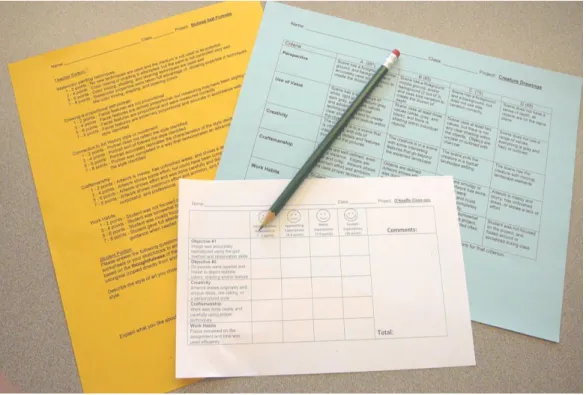
Each of the three rubrics (Figure 1) had five criteria that correlated with the various art
techniques, elements of art, or other skills or habits that represented the learning goals of that
lesson. The rubrics varied in their content, formats, and the way the levels of achievement were
labeled and described. The three rubrics were printed on three different colored papers, and will
hereafter be referred to accordingly as the “White Rubric”, “Yellow Rubric”, and “Blue Rubric”.
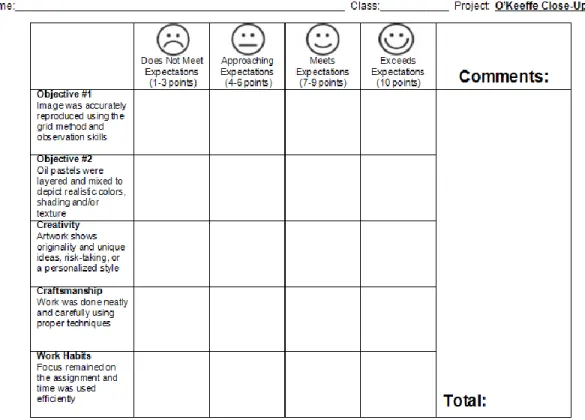
The White Rubric. This rubric, shown in Figure 2 (Appendix C), was modeled after
simple matrix rubrics as seen in Mason and Steedly’s 2006 article on Lessons and Rubrics for Arts Integration (p. 5). This rubric used anchors that included a visual of cartoon faces showing different emotions that represented the four different levels of achievement, along with a
description of “Does Not Meet Expectations”, ”Approaching Expectations”, “Meets
Expectations”, and “Exceeds Expectations”, respectively. Each level corresponded to a range of points for the purpose of establishing a grade. For this White Rubric, there were no descriptions
of the specific performances of the criteria for each level of achievement; but rather a blank
matrix where a number score was written by the teacher for each criterion. Each criterion did
include a definition of what the general expectations were for the criteria. The White Rubric also
had a space for Teacher’s Comments.
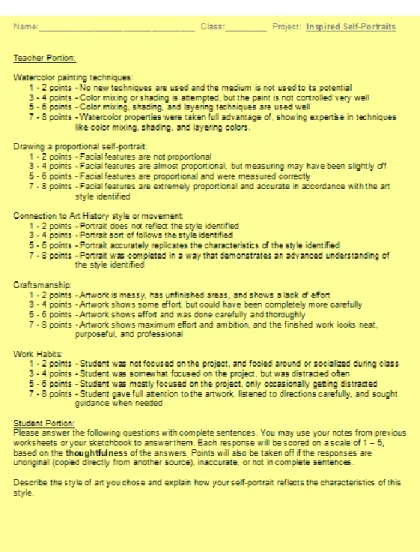
The Yellow Rubric. This rubric, seen in Figure 3 (Appendix F), was in list format and
was modeled after a different style of rubric also seen in Mason and Steedly’s 2006 publication (p.4). It was the only rubric formatted as a list rather than a grid-like matrix. The four
performance levels were described beneath each of the five criterions, with a choice of two
numbers assigned to each level that ranged from 1-8 for the purpose of establishing a grade. In
the Yellow Rubric, there were also two open-ended questions that allowed the students to reflect
on and describe their own artwork. There was no area designated for Teacher Comments.
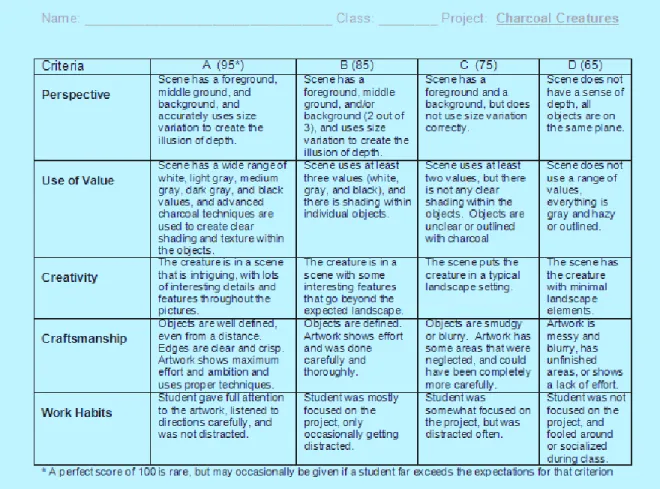
The Blue Rubric. This rubric, seen in Figure 4 (Appendix I), encompasses
characteristics of the other two rubrics. It was in a matrix format similar to the White Rubric but
had specific descriptions of the performances levels for each of the five criterions like the
Yellow Rubric. This rubric was modeled after descriptive matrix rubrics published in Connelly
and Wolf’s 2007 article, The Art of Rubrics: Painting by Numbers? (pp. 281, 283). The anchors of “A (95*)”, “B (85)”, “C (75)”, and “D (65)” were listed across the top from highest level to lowest, in reverse order from the first two rubrics which were listed from lowest level to highest.
The grade was established by averaging the five grades from the five criteria. There was a space
at the bottom for Teacher Comments.
The Questionnaire
My methodology concluded with students completing a pencil-and-paper questionnaire
regarding what qualities of each of the three rubrics were most helpful to them (Appendix M).
The six quantitative closed-ended, or forced-choice, questions asked students to rank whether
they found rubrics to be a helpful method of assessment on a Likert Scale, which is a rating scale
that is used for measuring a participant’s feelings, attitudes, or opinions (Miraglia & Smilan, 2014). The quantitative questions also asked students to rank the importance of various parts of
a rubric, some of which were included in all three rubrics and some of which were only included
in one or two. The questionnaire then asked students to select which rubric provided them with
the most valuable information, gave them the best idea of how to improve their work, was the
easiest to understand, and was the most helpful overall. These quantitative questions helped
gather specific information that provided standardized data (Miraglia & Smilan, 2014).
The questionnaire had seven qualitative questions that allowed students to express ideas
or concerns that may not have been addressed in the forced-choice questions. These responses
were expected to more clearly communicate individualized, complex, or in-depth views, and
elicit unpredicted responses that would provide important implications for my study (Miraglia &
Smilan, 2014). The qualitative questions required that students describe what was most helpful
and least helpful about each of the three rubric designs, as well as how a rubric could be
designed to better help students understand and improve their artwork.
After the students completed the survey, the responses to the quantitative questions were
tallied and the responses to the qualitative questions were color-coded to develop themes
(Miraglia & Smilan, 2014). The analysis of these results determined what students found most
Results
In this section, I present the results of surveys completed by the twenty eighth-grade art
students who participated in this study. Ten students agreed and nine students strongly agreed
that rubrics are a helpful method of assessment, while one student was neutral on the topic, and
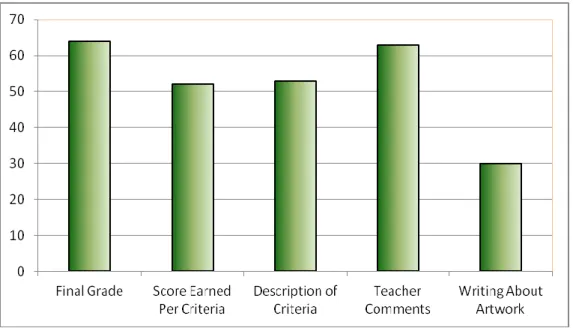
no students disagreed or strongly disagreed. Students ranked “Final Grade” as the most
important part of the rubric, closely followed by “Teacher’s Comments” (Figure 5). “Score Earned for Each Criterion” and the “Descriptions of the Different Levels for Each Criterion” were both ranked in the mid-range by students. Being able to write about their artwork ranked
least important to the students.
Students responded to which rubric best fit the four following descriptions, illustrated in
Figure 6. Students reported that the Blue Rubric gave them the most valuable information about
their art making process, followed by the White Rubric. Students reported that the Blue Rubric
gave them the best idea of how to improve their artwork and art-making process, followed by the
Yellow Rubric. Students reported that the Blue Rubric was the easiest to understand, followed
by the White Rubric. As the other responses foreshadowed, sixteen of the twenty students
reported that the Blue Rubric was the most helpful overall. Three students reported the White
Rubric as most helpful overall, and no students chose the Yellow Rubric as most helpful. The
The White Rubric
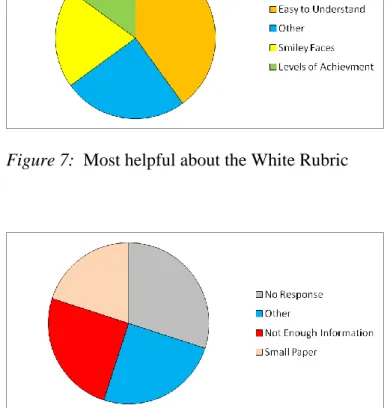
When asked what was most helpful about the White Rubric (Appendix C), the most
common response, conveyed by eight students, was that the White Rubric was simple, clear, and
easy to understand (Figure 7). Four students responded that the smiley faces used to illustrate
the levels of achievement were also helpful. When asked what was least helpful about the White
Rubric, six students wrote “no answer” or left the question blank (Figure 8). Five students reported that the White Rubric did not provide enough information or detail for the different
levels of achievement. Four students reported that the half-sheet of paper was too small.
Figure 7: Most helpful about the White Rubric
The Yellow Rubric
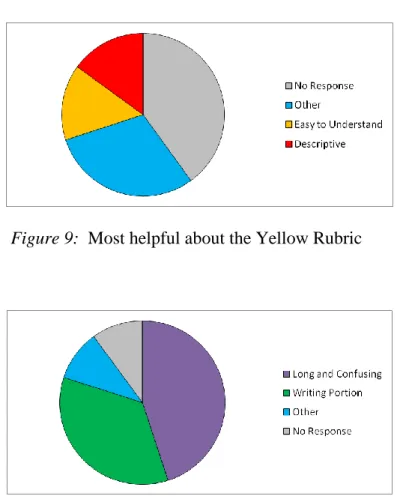
When asked what was most helpful about the Yellow Rubric (Appendix F), eight students
offered no input, including some students who left the question blank, some who wrote “no answer”, and one who explained that they “did not like the Yellow Rubric” (Figure 9). Three students expressed that the Yellow Rubric was descriptive, giving them a lot of information.
Three students responded that it was easy to read and understand. When asked what was least
helpful about the Yellow Rubric, nine students communicated that it was long and confusing
with too many words and a lack of organization (Figure 10). Seven students responded that they
did not like the student response portion of the rubric, where they were asked to write about their
artwork.
Figure 9: Most helpful about the Yellow Rubric
The Blue Rubric
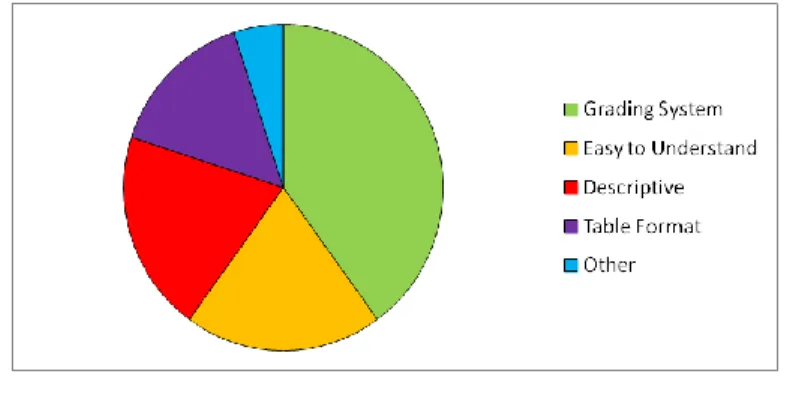
When asked what was most helpful about the Blue Rubric (Appendix I), eight students
noted that their grade was clearly communicated to them (Figure 11). Four students responded
that the Blue Rubric was easy to understand. Four students liked that the Blue Rubric described
the levels of achievement for the lesson requirements. Three students mentioned the table format
as being helpful. When asked what was least helpful about the Blue Rubric, sixteen of the
twenty students had no response, including students who stated that “the Blue Rubric was very helpful” and they “didn’t think there was anything wrong with it” (Figure 12). Only four students reported anything that was unhelpful, which included varied responses such as the
layout, that it was complicated, the teacher’s comments, and that it was more difficult to see on the blue paper.
Figure 11: Most helpful about the Blue Rubric
Developing a Helpful Rubric
Students offered a variety of responses when asked to describe how a rubric could be
designed to better help them understand their achievements. Six students communicated that a
rubric should clearly tell them what grade they received and why. Four students expressed that a
rubric should give them an idea about how they could improve their work. Four students
emphasized the importance of the teacher’s comments. Four students indicated that a rubric
should be easy to understand; it should be concise and should not require a lot of time to look
through it. Three students noted that the Blue Rubric was the ideal rubric for them.
Based on the results of this survey, I have determined that students found the Blue Rubric
to be the most helpful of the three rubrics. In the section that follows, I discuss the patterns that
were present in these results and the implications that they have on developing assessment
methods to benefit art students.
Discussion
The purpose of this study was to determine which assessment methods were most
beneficial to middle school art students. To reach this understanding, eighth-grade art students
participated in a survey that aimed to uncover which aspects of three different assessment rubrics
they found most helpful. Based on their responses, I have learned that the students found a
rubric most helpful when it 1) communicated their grade to them in a straightforward way, 2)
gave them a lot of information and descriptions, and 3) was easy to read and understand. This
knowledge will allow me to develop assessment rubrics that are most beneficial to the students.
Students Want their Grade Clearly Communicated to Them
When coding responses to how a rubric could be designed to be more helpful, the most
and why. The Blue Rubric received overwhelmingly favorable rankings as being the most
helpful of the three rubrics, and the most frequently occurring explanation was that students liked
the clear way their grade was communicated to them. This correlates to the Final Grade
receiving rankings as being the most important part of a rubric to students. The Blue Rubric was
the only rubric that used the letters A, B, C, and D to correspond with the four achievement
levels. This labeling was familiar to students and clearly told them what grade range they fell
into based on what they achieved for each criterion. Students preferred this system over the
points system used in the White and Yellow Rubrics. One student explained, “I didn’t like how [the White Rubric] didn’t show what requirements I needed to meet to get a B, C, D”. Labeling the levels with traditional letter grades rather than using a points system made more sense to
students. Dorn et al. (2004) list improving students’ understanding of their grades as one of the
positive outcomes of assessment. It is clear that defining their grade is a priority for students,
and a rubric should make the grade easy to see and interpret.
Students Want to Receive Detailed Information about Their Artwork
Students clarified that the Blue Rubric gave them the most information and guidance on
how to improve their artwork and art-making process. Students found the Blue Rubric helpful
because of the way it explained and described the levels of achievement for the lesson
requirements. While the Yellow Rubric received low scores on how easy it was to understand
and how helpful it was overall, it did fare better on providing students with insight into ways of
improving their work. The few students who responded to what was most helpful about the
Yellow Rubric conveyed that it gave them good descriptions and explanations of the levels of
achievement. Both the Blue Rubric and the Yellow Rubric provided detailed descriptions of the
specific descriptions of performances, writing “I like when rubrics have the requirements that I
would need to meet to get a certain grade”. Students benefit from understanding the goals for their learning, realizing the gap between those goals and their current performances, and
knowing how to close the gap through relearning and revision (Andrade et al., 2014). Another
student expressed a preference for when a rubric “shows where you are now and instructions on how to improve your artwork”. Thorough descriptions for the levels of achievement are indeed necessary in order to increase students’ awareness of their performances in relation to the learning goals of the lesson.
The White Rubric was the only rubric that did not provide explanations of the levels of
achievement specific to each criterion. This is likely the reason it did not score well on giving
students an idea of how to improve their work or on being most helpful overall. Several students
reported that the White Rubric did not provide enough information or detail to differentiate
between the varying levels of achievement. One student expressed that the White Rubric was
not helpful because of “the fact that it doesn’t say grade by grade an explanation of what is lacking”. The White Rubric did not give detailed descriptions of performances and left students yearning for more information. For these students, it is important that a rubric not only states the
levels of achievement, but also describe what an artwork would have to accomplish in order to
meet the next achievement level. While writing descriptions of performances for each criterion
at each level is challenging and time-consuming for the teacher, Wolf et al. (2008) stress how
essential that step is. The time and effort taken to write the descriptions are offset when the
descriptions make it easier to grade projects and justify that grade to students and parents in the
of the performance and that the descriptions should be clearly written so that students can draw
parallels across performance levels for comparison.
In addition to descriptions of the performance levels, students also want teacher feedback
specific to their artwork. When instructed to rank each part of the rubric in order of importance
to them, “Teacher’s Comments” were ranked highly, second only to the student’s “Final Grade”. When asked how a rubric could be developed to better help them understand and improve their
work, students emphasized the importance of the teacher’s comments. Students place a high
value on receiving information about their artwork in the form of individualized comments and
descriptions of achievement levels.
Students Want a Rubric to be Easy to Read and Use
Students indicated that a rubric should be concise and simple to understand without
having to take much time to look through it, which confirms assertions made by Dorn et al.
(2004). Of the three rubrics, students reported that the Blue Rubric was the easiest to
understand, followed by the White Rubric. Both of these rubrics were in matrix formats, as
opposed to the Yellow Rubric which was the only one in a list format. No students chose the
Yellow Rubric as most helpful overall, and only one student chose the Yellow Rubric as easiest
to understand. Many students could not produce a response when asked what was most helpful
about the Yellow Rubric, including one student who simply stated that she did not like the
Yellow Rubric. When asked what was least helpful about the Yellow Rubric, most students
reported that it was confusing with too many words and a lack of organization. One student
articulated that the Yellow Rubric “is crowded with words which is hard to understand”. Alternatively, students expressed that they liked the organization of the Blue Rubric; some even
specifically mentioned the table format as being helpful. The list format of the Yellow Rubric
was clearly not preferred by students, as it was long for students to read.
It is evident that students preferred rubrics that were in a table format as opposed to a list
format. When students looked at a paper filled with words, it appeared overwhelming and
confusing, and students were reluctant to read through it. Similarly, students preferred using an
organized chart. According to these students, visual presentation of a rubric is important.
Students also noted that the smiley faces used in the White Rubric were helpful. Graphics like
smiley faces help students quickly recognize the meaning of the achievement levels. Students
should be able to derive the meaning of a rubric by looking at it, without having to read through
many words to develop an interpretation.
Students have expressed that they want a rubric to clearly communicate the expectations
of the art lesson to them without requiring much reading. The fact that students wanted to do
minimal work in interpreting the rubric may be related to the fact that students responded
unfavorably to writing about their artwork as part of a rubric. Students ranked writing about
their artwork as being the least important part of a rubric. Many students did not like the student
response portion of the Yellow Rubric, where they were asked to answer questions about their
artwork. Students had not expressed why they disliked writing about their artwork so much, many simply stated, “I didn’t like answering the questions” or something similar. It is quite possible that the students simply did not like having to do more work. It is interesting that while
students wanted their teacher to provide comments and descriptions of performances, students
In contrast, one student in the study explained how writing about his or her work could be
helpful:
I believe a section to explain the theme and reason behind my portrait could help me
to better express my artwork, and I believe it could help the teachers understand my
artwork and be able to grade it more according[ly], or with more insight.
This student seemed to understand the benefits of writing about one’s work. Writing about
artwork can help a student reflect on their work and articulate the meaning they are trying to
communicate. However, it seems that with such strong reactions against the writing portion of
the Yellow Rubric, that perhaps a rubric is not the proper outlet for this mode of reflection. A
separate channel for response and reflection would be preferable to including that component in
a rubric.
An Ideal Assessment Rubric
Students overwhelmingly reported that the Blue Rubric was the most beneficial of the
three rubrics. The majority of students offered no suggestions when asked what was least helpful
about it. Some students noted in their survey that the Blue Rubric was the ideal rubric for them.
It provided students with detailed explanations of the levels of achievement for each criterion
and communicated the student’s grade to them in a way that made sense. The table format made it more organized and easier for students to understand. The Blue Rubric encompassed many of
these qualities that students expressed as important to them.
Reflection and Conclusion
Art teachers are in need of more resources for developing assessment tools. Data
collection and measurement of student progress is becoming increasingly prevalent in today’s
art-specific assessment and many school districts do not provide guidelines for assessment in art
(Dorn et al., 2004). For that reason, the National Art Education Association has identified
Assessment as an area in need of more research (NAEA Research Commission, 2014). This
study helps to fulfill this call for exemplary assessment devices.
Contributions to the Field of Art Education
This study has contributed to the available assessment devices that are designed to benefit
students. Students are the ones who are primarily served by these devices, and therefore are in
the best position to offer information and insight about their usefulness (Boughton et al., 1996).
Students want a rubric to communicate their grade to them in simple and familiar terms. They
have also expressed a desire for specific descriptions of what they must accomplish in order to
reach each level of achievement on a rubric. Students find rubrics most helpful when they are
visually organized into a chart that is easy to read.
The results of this study suggest that the Blue Rubric used in this research project was
highly preferred by students. This can serve as a model design for teachers who wish to develop
rubrics that meet the needs of their students. Teachers can also consider adding a visual graphic
to the Blue Rubric to accompany the grade assignments for the four levels, such as the smiley
face used in the White Rubric. The smiley faces were well-received by students, as they quickly
communicated the meaning of each of the four levels. This study provides art teachers with
resources to assist them in developing assessment rubrics that are most helpful to students.
Teacher’s Experience Using the Rubrics
The qualities of the rubrics that were most preferred by students were consistent with
what I preferred as their teacher. The Blue Rubric was the most efficient one for me to grade
made grading easier and quicker in the long run. This is an important consideration to explore:
“From the teacher’s point of view, the [assessment] system used should not demand a
disproportionate amount of clerical work” (p. 383, Hurwitz & Day, 2011). The amount of work taken to write the descriptions was compensated with time saved later. Without these
descriptions of performances, the White Rubric felt too subjective. In trying to decide what
number of points to assign to each student per criteria, I had to come up with my own unofficial
benchmarks for each criterion to establish the standard for each point range. I found it helpful
when the rubric spelled out these benchmarks for me, as was the case with the Blue and Yellow
Rubrics. The Yellow Rubric, however, still had a choice of two points per each level of
achievement. This required more time on my part to decide which of the two numbers applied to
each student, even after I had determined which level that student fit into. The Blue Rubric
helped me to grade more quickly, as each level of achievement only had one option.
I also preferred the grading system used by the Blue Rubric, as opposed to the points
system used by the Yellow and White Rubrics. I observed that with the White and Yellow
Rubrics, I had a tendency to rate too high for all projects. This is a risk that was mentioned by
Dorn et al. (2004) and noted in my Literature Review. Because of the points system ranging
from 1-10, a score in the “Approaching Expectations” level for all criteria would result in the
student receiving a D or an F on the project. I did not desire this result for my students unless
they clearly did not meet expectations of the assignment, so I tended to score most students in the
“Meeting Expectations” or “Exceeding Expectations” range. A similar scenario presented itself with the Yellow Rubric. Students who were scored in the lower two of the four levels for all
criteria could receive an F or at best a D-, and so I tended to score higher to avoid this result. As
did I want to damage their self-esteem, which is another risk of assessment that was discussed in
my Literature Review. With the Blue Rubric, I could place a student in the “approaching expectations” level if that is what best described their work, and that student would receive a C for that criterion. This made it easier for me to be honest when describing my student’s
achievements without worrying about the negative impact on their final grade and their
self-esteem.
There are certain risks involved when using assessment in art. These include the risk of
grading too subjectively, assessment taking too much time away from lesson planning, the
potentially negative impact on a student’s self-esteem, and tendencies for error while scoring the rubrics (Dorn et al., 2004). It is important to be conscious of these drawbacks and risks when
developing assessment rubrics. I found that use of the Blue Rubric helped me to minimize these
risks in comparison to the other two rubric designs.
Recommendations for Further Study
Rubrics are common assessment tools used in art classes across many grade levels. More
research is needed in this area to help maximize the benefits of these scoring rubrics. This study
was conducted with eighth-grade students acting in the role of research participants. It is
important to conduct additional studies to determine if the results of this study are applicable to
high school and elementary school students as well. Additionally, the eighth-grade students who
participated in this study were taking art as a requirement, and it is possible that some of these
students would not elect to take art if given the option. Students who elect to take art may have a
higher interest and investment in their artistic growth, and may have different needs with regard
to the scoring rubrics. I would recommend a similar study be conducted with students who are
graded solely by the teacher. Some studies have been conducted that support peer- or
self-assessment in art (McMillan & Hearn, 2008) and more research could be done in this area of
applying peer- and self-assessment in art rubrics. These suggestions for further research would
help satisfy the need for more assessment resources available to art teachers.
Conclusion
Assessment is an important and often required aspect of a school’s visual arts program.
While many school systems necessitate a grade for art class, the field of art education does not
have a common and standardized approach to assessment that is acknowledged and implemented
across the discipline. Many art teachers are left to develop their own systems for assessing and
grading students’ progress. Through my research, I aimed to develop assessment methods that can benefit my students by focusing on the attributes that students identify as being most helpful
to them.
Assessment can help outline learning objectives for students and can inform them of the
relationship between the goals of the lesson and their current efforts. Feedback can motivate and
help students to make improvements. When executed skillfully and tactfully, assessment can
indeed prove beneficial to students by helping them better understand the strengths and
weaknesses of their art making process. Assessment supports students in becoming proficient in
visual language so they can more effectively communicate their ideas through their artwork.
An assessment system should not be limited to any one method. A comprehensive
assessment system is balanced with both formative and summative assessments in the forms of
critiques, written reflections, interviews, portfolio reviews, and rubrics. Rubrics increase
students’ awareness of the goals of a lesson, help students evaluate their performances in terms of the expectations of the lesson, and serve as a viable tool for teachers to determine and assign a
grade for the student. I have recognized that the rubric is an essential component of my
assessment system.
This study analyzed three different rubric designs and determined what eighth-grade art
students found most helpful about the rubrics. A survey that employed both quantitative and
qualitative methods revealed what was most important to these students in the design of a rubric.
Students prefer a rubric that clearly communicates their grade to them, so they can understand
how well they are meeting the expectations of the course. Detailed descriptions of the levels of
achievement for each criterion helped students evaluate the degree to which they were achieving
the goals of the lesson, and what they could do to improve their work. Students also wanted a
rubric that was easy to read and use, and specifically favored rubrics that were visually organized
into a matrix format. The results of this study will help me and other art teachers develop rubrics
References
NAEA Research Commission. (2014). NAEA Research Agenda. Retrieved from
http://www.arteducators.org/research/commission/Research_Agenda_Digital.pdf. [PDF
file]
Andrade, H., Hefferen, J., & Palma, M. (2014). Formative Assessment in the Visual Arts. Art Education, 67(1), 34-40.
Beattie, D. K. (1997). Assessment in Art Education. Art Education in Practice Series. Worcester, MA: Davis Publications
Boughton, D. In Miraglia, K. & Smilan, C. (Eds.). (2014). Inquiry in Action: Paradigms, Methodologies, and Perspectives in Art Education Research. Reston, VA: National Art Education Association.
Boughton, D. (1997). Reconsidering Issues of Assessment and Achievement Standards in Art
Education. Studies in Art Education, 38(4), 199-213.
Boughton, D., Eisner, E., & Ligtvoet, J. (1996). Evaluating and Assessing the Visual Arts in Education: International Perspectives. New York: Teachers College Press.
Coil, C. (2014). Creativity in an assessment driven environment. Knowledge Quest, 42(5), 48-53. Connelly, M., & Wolf, K. (2007). The art of rubrics: Painting by numbers? Teaching Artist
Journal, 5(4), 279-288.
Dorn, C. M., Madeja, S. S., & Sabol, F. R. (2004). Assessing Expressive Learning: A Practical Guide for Teacher-Directed Authentic Assessment in K-12 Visual Arts Education. Mahwah, NJ: Lawrence Erlbaum Associates.
Eshun, E. F., & Osei-Poku, P. (2013). Design students’ perspectives on assessment rubric in
studio-based learning. Journal of University Teaching and Learning Practice, 10(1) Gruber, D. D. (2008). Measuring student learning in art education. Art Education, 61(5), 40-45. Gruber, D. D., & Hobbs, J. A. (2002). Historical analysis of assessment in art education. Art
Education, 55(6), 12.
Howell, R. J. (2011). Exploring the impact of grading rubrics on academic performance:
Findings from a quasi-experimental, pre-post evaluation. Journal on Excellence in College Teaching 22(2), 31-49.
Hurwitz, A., & Day, M. (2011). Children and their Art: Art Education for Elementary and Middle Schools. 9th ed. Fort Worth: Harcourt Brace College Publishers.
Jonsson, A., & Svingby, G. (2007). The use of scoring rubrics: Reliability, validity and
educational consequences. Educational Research Review, 2, 130-144
Mason, C. Y., & Steedly, K. S. (2006). Lessons and rubrics for arts integration. Teaching Exceptional Children Plus, 3(1)
McCollister, S. (2002). Developing criteria rubrics in the art classroom. Art Education, 55(4), 46. McMillan, J. H., & Hearn, J. (2008). Student self-assessment: The key to stronger student
motivation and higher achievement. Educational Horizons, 87(1), 40-49.
Miraglia, K. & Smilan, C. (Eds.). (2014). Inquiry in Action: Paradigms, Methodologies, and Perspectives in Art Education Research. Reston, VA: National Art Education
Association.
Popovich, K. (2006). Designing and implementing "exemplary content, curriculum, and
Sabol, F. R. (2006). Identifying exemplary criteria to evaluate studio products in art education.
Art Education, 59(6), 6-11.
Stokrocki, M. (2005). Reconsidering Everyday Assessment in the Art Classroom: Ceramics and
Science. Arts Education Policy Review, 107(1), 15.
Wolf, K., Connelly, M., & Komara, A. (2008). A tale of two rubrics: Improving teaching and
learning across the content areas through assessment. Journal of Effective Teaching, 8(1), 21-32.
Bibliography
NAEA Research Commission. (2014). NAEA Research Agenda. Retrieved from
http://www.arteducators.org/research/commission/Research_Agenda_Digital.pdf. [PDF
file]
Andrade, H., Hefferen, J., & Palma, M. (2014). Formative assessment in the visual arts. Art Education, 67(1), 34-40.
Beattie, D. K. (1997). Assessment in Art Education. Art Education in Practice Series. Worcester, MA: Davis Publications
Beattie, D. K. (1997). Visual arts criteria, objectives, and standards: A revisit. Studies in Art Education, 38(4), 217-31.
Boughton, D. (2005). From fine art to visual culture: Assessment and the changing role of art
education. International Journal of Education through Art, 1(3), 211-223.
Boughton, D., Eisner, E., & Ligtvoet, J. (1996). Evaluating and Assessing the Visual Arts in Education: International Perspectives. New York: Teachers College Press.
Coil, C. (2014). Creativity in an assessment driven environment. Knowledge Quest, 42(5), 48-53. Connelly, M., & Wolf, K. (2007). The art of rubrics: Painting by numbers? Teaching Artist
Journal, 5(4), 279-288.
Cotner, T. L. (2001). Why study classroom art talk? Art Education, 54(1), 12.
Cunliffe, L. (2008). Using assessment to nurture knowledge-rich creativity. Innovations in Education and Teaching International, 45(3), 309-317.
Dikici, A. (2009). An application of digital portfolio with the peer, self and instructor
assessments in art education. Eurasian Journal of Educational Research (EJER), (36), 91-108.
Dorn, C. M., Madeja, S. S., & Sabol, F. R. (2004). Assessing Expressive Learning: A Practical Guide for Teacher-Directed Authentic Assessment in K-12 Visual Arts Education. Mahwah, NJ: Lawrence Erlbaum Associates.
Eshun, E. F., & Osei-Poku, P. (2013). Design students’ perspectives on assessment rubric in
studio-based learning. Journal of University Teaching and Learning Practice, 10(1) Gruber, D. D. (2008). Measuring student learning in art education. Art Education, 61(5), 40-45. Gruber, D. D., & Hobbs, J. A. (2002). Historical analysis of assessment in art education. Art
Education, 55(6), 12.
Hetland, L., Winner, E., Veenema, S, & Sheridan, K. (2007). Studio Thinking: The Real Benefits of Visual Arts Education. New York: Teachers College Press.
Howell, R. J. (2011). Exploring the impact of grading rubrics on academic performance:
Findings from a quasi-experimental, pre-post evaluation. Journal on Excellence in College Teaching 22(2), 31-49.
Hurwitz, A., & Day, M. (2011). Children and their Art: Art Education for Elementary and Middle Schools. 9th ed. Fort Worth: Harcourt Brace College Publishers.
Joe, J. N., Harmes, J. C., & Barry, C. L. (2008). Arts and humanities general education
assessment: A qualitative approach to developing program objectives. JGE: The Journal of General Education, 57(3), 131-151.
Jonsson, A., & Svingby, G. (2007). The use of scoring rubrics: Reliability, validity and
educational consequences. Educational Research Review, 2, 130-144
Leong, S., & Qiu, X. (2013). Designing a "creativity and assessment scale" for arts education.