Core Progress
™
for Math
Empirically validated learning progressions
Integral
components of
Accelerated Math
Live
™and
STAR Math
Enterprise
™All logos, designs, and brand names for Renaissance Learning’s products and services, including but not limited to 2Know!, Accelerated Math, Accelerated Reader, AccelScan, AccelTest, AR, ATOS, Core Progress, DEEP, English in a Flash, KeyWords, Learnalytics, MathFacts in a Flash, NEO, Renaissance Home Connect, Renaissance Learning, Renaissance Place Real Time, Renaissance School Excellence, Renaissance Training Center, STAR, STAR Early Literacy, STAR Math, STAR Reading, STAR Reading Spanish, Successful Reader, and Subtext are trademarks of Renaissance Learning, Inc., and its subsidiaries, registered, common law, or pending registration in the United States and other countries. All other product and company names should be considered the property of their respective companies and organizations.
© 2013 by Renaissance Learning, Inc. All rights reserved. Printed in the United States of America.
This publication is protected by U.S. and international copyright laws. It is unlawful to duplicate or reproduce any copyrighted material without authorization from the copyright holder. For more information, contact:
RENAISSANCE LEARNING P.O. Box 8036 Wisconsin Rapids, WI 54495-8036 (800) 338-4204 www.renlearn.com [email protected]
Contents
Executive Summary ...ii
Introduction ... 1
What are learning progressions? ... 2
Evolution of the Core Progress learning progression for mathematics ... 3
Phase I: Scope and sequence ... 3
Phase II: Revised scope and sequence, addition of core objectives and prerequisites ... 5
Phase III: Learning progression ... 6
Phase IV: Empirical analysis of Core Progress ... 10
Mapping Core Progress to the Common Core State Standards ... 12
Phase V: Building a new learning progression specifically for the Common Core ... 13
Core Progress: an integral component of Accelerated Math Live and STAR Math Enterprise ... 15
Conclusion ... 19
References ... 32
Appendices Core Progress for Math Learning Progression Appendix A: Examples of skill progressions across grade levels ... 20
Appendix B: Core Progress for Math includes four domains and 23 skill areas ... 21
Appendix C: Core skills per grade, per domain ... 22
Appendix D: Example of how one core skill serves as a prerequisite for many other core skills ... 23
Appendix E: Common Core State Standards and Core Progress... 24
Core Progress Learning Progression for Math - Built for the Common Core State Standards Appendix F: Organization of Skill Areas within the 11 Domains for K-8 ... 25
Appendix G: Organization of Skill Areas within the 21 Domains for high school ... 26
Appendix H: Examples of skill progressions across grade levels, Whole Numbers: Place Value ... 28
Appendix I: Core skills per grade, per domain ... 29
Appendix J: Example of mapping a core skill to many other core skills, Fractions ... 31
Figures Figure 1: Core Progress for Math ... 7
Figure 2: Prerequisite map of place value ... 9
Figure 3: Correlation of STAR Math Enterprise to Core Progress ... 11
Figure 4: Correlation of STAR Math Enterprise to Core Progress Math built for CCSS ... 13
Figure 5: Accelerated Math Live Student Record Report ... 16
Figure 6: STAR Math Enterprise provides your entry point into Core Progress ... 17
Figure 7: Example of Instructional Planning Report generated by STAR Math Enterprise ... 18
Figure 8: STAR Record Book ... 18
Executive Summary
Learning progressions are descriptions of how learning typically advances in a subject area. “Empirically based learning progressions can visually and verbally articulate a hypothesis, or an anticipated path, of how student learning will typically move toward increased understanding over time with good instruction” (Hess, Kurizaki, and Holt, 2009). This paper describes Core Progress for mathematics, the learning progression developed by Renaissance Learning. We begin by explaining what learning progressions are, how they operate in relation to the standards, and how they support assessment, instruction, and practice. This paper then describes the research-based approach used to develop Core Progress.
A learning progression as comprehensive and interrelated as Core Progress takes years to develop through a continuous process of research, expert review, and iterative revision. Continually refined since 2007, the Core Progress for Math learning progression is an interconnected web of prerequisite skills.
The skills and understandings in the Core Progress learning progressions provide the intermediate steps along with prerequisite skills necessary to reach the levels of expertise identified through the Common Core State Standards. They begin with early numeracy and progress to the level of competence in mathematics required to be college and career ready.
Core Progress was originally developed to provide a research-based framework for Accelerated Math personalized practice software. Once built, the Core Progress skills were field tested through the STAR Math assessment.
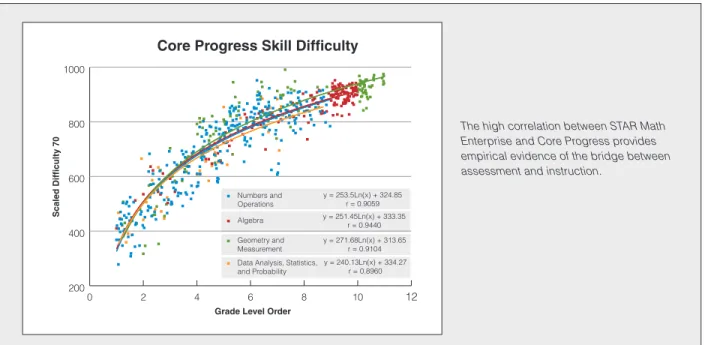
The results were remarkable. As illustrated in the graph below, the order of skills in Core Progress are highly correlated with the difficulty level of STAR Math assessment items. With a strong correlation, the natural next step was to statistically link Core Progress to the STAR Math Enterprise assessment.
As a result of the statistical link between STAR Math Enterprise and Core Progress, a student’s STAR Math score provides insight into her achievement level, as well as skills and understandings she is ready to develop next. Core Progress is now an integral component of both Accelerated Math Live and STAR Math Enterprise— a true bridge between assessment, instruction, and practice.
0 2 4 6 8 10 12 200 400 600 800 1000
Data Analysis, Statistics, and Probability Geometry and Measurement Algebra Numbers and Operations
Core Progress Skill Difficulty
Scaled Difficulty 70
Grade Level Order
y = 240.13Ln(x) + 334.27 r = 0.8960 y = 271.68Ln(x) + 313.65 r = 0.9104 y = 251.45Ln(x) + 333.35 r = 0.9440 y = 253.5Ln(x) + 324.85 r = 0.9059
Introduction
Over the last decade, much of the focus of educational reform in the United States has been on the creation and improvement of standards of learning. A watershed moment of this movement was the 2010 publication of the Common Core State Standards (CCSS) for learning in Mathematics and English language arts. As the CCSS mission statement explains, “The Common Core State Standards provide a consistent, clear understanding of what students are expected to learn, so teachers and parents know what they need to do to help them.”
At the same time, within the field of education, the idea of learning progressions has received increasing attention (for example, Alonzo and Gearhart, 2006; Corcoran, Mosher, and Rogat, 2009; Heritage, 2008, 2009, 2011; Hess, 2010; Hess, Kurizaki, and Holt, 2009; Leahy and Wiliam, 2011). One of the reasons for this interest is the desire to provide descriptions of
incremental steps of learning. These steps, more precise than are currently represented in standards, can be used to guide design of curriculum, instruction, and assessment. Learning occurs when students see these incremental steps as special cases of more general and basic processes and principles.
While the Common Core State Standards represent a clear step toward providing a more coherent pathway to meeting educational goals than many prior standards, the CCSS do not describe a fully formed pathway along which students are expected to progress. The next step, clarified by the CCSS, is the development of learning progressions that mirror the CCSS.
Originally built to provide a framework for Accelerated Math personalized practice software, Core Progress now serves as an integral component for both Accelerated Math Live and the STAR Math Enterprise assessment. Now, with all three pieces linked, there is a true bridge between assessment, instruction, and practice.
The next step, clarified by
the CCSS, is the development
of learning progressions that
mirror the CCSS.
What are learning progressions?
Simply put, learning progressions are descriptions of how learning typically advances in a subject area. Specifically, Pellegrino (2011, p. 9) defines learning progressions as “descriptions of successively more sophisticated ways of thinking about key disciplinary concepts and practices across multiple grades” which outline “the intermediate steps toward expertise.” Leahy and Wiliam (2011, p. 1) view learning progressions as descriptions of “what it is that gets better when someone gets better at something.” “Empirically based learning progressions can visually and verbally articulate a hypothesis, or an anticipated path, of how student learning will typically move toward increased understanding over time with good instruction” (Hess, Kurizaki, and Holt, 2009).
Confrey and colleagues suggest that learning progressions assume a progression of cognitive states that move from simple to complex and, while not necessarily linear, the progression is not random, but rather is sequenced and ordered as “expected
tendencies” or “likely probabilities” of how learning develops (Confrey and Maloney, 2010). Masters and Forster (1996, p. 1) describe progressions as “a picture of what it means to ‘improve’ in an area of learning.”
Finally, Heritage (2011, p. 3) suggests that learning progressions provide descriptions of “how students’ learning of important concepts and skills in a domain develops from its most rudimentary state through increasingly
sophisticated states over a period of schooling.”
Inherent in these views of progressions is the idea of a coherent and continuous pathway along which students move incrementally through states of increasing competence in a domain. Every incremental state builds on and integrates the previous one as students accrue new levels of expertise with each successive step in the progression. It is important to note, however, that while progressions may provide clear
descriptions of how learning develops in a domain, they are not developmentally inevitable. Rather, they are dependent on well-mapped curriculum and sound instruction (Duschl, Schweingruber, and Shouse, 2007; Pellegrino, 2011). It should also be noted that the strong hierarchical nature of mathematics makes such progressions absolutely necessary.
As Herman (2006, p. 122) observes, “whether and how children are able to engage in particular learning performances and the sequence in which they are able to do so are very much dependent on previous opportunities to learn.” The benefit of progressions is that they lay out a continuum to guide teaching and learning over time so that student competence in the domain can be advanced coherently and continuously. Several views of how learning progressions can be developed have been set forth (for example, Alonzo and Steedle, 2008; Anderson, 2008a; Corcoran, Mosher, and Rogat, 2009; Confrey and Maloney, 2010; Hess, 2010; Hess, Kurizaki, and Holt, 2009; Pellegrino, 2011; Smith, Wiser, Anderson, and Krajcik, 2006). Common to these perspectives is the idea that the development of learning progressions is an iterative process. It begins with a hypothesis, informed by what we know about student learning, which undergoes empirical testing and subsequent refinement based on the data. Core Progress for Math was developed according to this iterative model.
“Empirically based learning
progressions can visually and
verbally articulate a hypothesis, or
an anticipated path, of how student
learning will typically move toward
increased understanding over time
with good instruction.”
Evolution of the Core Progress
™learning progression for mathematics
Core Progress began as a scope and sequence and evolved into an empirically validated learning progression. Since its inception in 2007, Core Progress has gone through a continuous cycle of research, review, and revision.
Core Progress was developed to provide a research-based framework for Accelerated Math personalized practice software. Once built, the Core Progress skills were field tested through the STAR Math assessment1.
The results were noteworthy and gratifying. The order of skills in Core Progress was highly correlated with the difficulty level of STAR Math Enterprise assessment items. With a strong correlation, the natural next step was to statistically link Core Progress to the STAR Math assessment. As a result, a student’s STAR Math score provides insight into his/her achievement level, as well as skills he/she is ready to learn next. Core Progress is now an integral component of both Accelerated Math Live and STAR Math Enterprise—a true bridge between assessment, instruction, and practice.
Phase I: Scope and sequence
Research
The origin of the Core Progress learning progression dates back to 2007. It started as a scope and sequence for Accelerated Math Enterprise2, spanning grade 1 to algebra.
To develop the original scope and sequence, Renaissance Learning’s mathematics team relied heavily on research and standards including the National Council of Teachers of Mathematics (NCTM) Curriculum Focal Points (2006), the early work of the National Mathematics Advisory Panel (2008), state and international mathematics standards, and the American Diploma Project Benchmarks (Achieve, Inc., 2007) which provide one of the key foundations for the Common Core State Standards.
Review
The scope and sequence was reviewed by several experts including the Education Northwest,3 a research
laboratory funded by the U.S. Department of Education; a panel of mathematics teachers; and a panel of prominent mathematicians:
• Dr. Sybilla Beckmann, University of Georgia, (grade 5 review) • Dr. Richard Bisk, Worcester State College, (grade 6 review) • Dr. Tom Hogan, University of Scranton (all core objectives) • Dr. James Milgram, Stanford University (grade 3 core review)
• Dr. Sharif Shakrani, Michigan State University (grade 8, Algebra 1, and Geometry review)
Revision
The initial review focused on Numbers and Operations. Items were analyzed for difficulty, alignment to objectives, accuracy, item quality, and relationship to current pedagogy. Based on the reviews, Renaissance Learning’s mathematics team identified two principal goals: (1) reduce the overlap of objectives between grades, and (2) establish a clear progression of difficulty levels through the grades.
To reduce the grade-level overlap, the team decided to develop a set of core objectives that students must master at each grade in order to advance to the next grade. The NCTM’s Curriculum Focal Points served as the basis for decisions about which topics to include at each grade level. The team also referred to several seminal works to inform their decisions (e.g. Ma, 1999; Milgram and Wu, 2005).
The core objectives closely follow the Mathematics Advisory Panel’s recommendations that curricula focus on mastery of key topics and provide a progression of increasing difficulty, rather than use the spiraling approach of revisiting topics from previous grades.
In addition, researchers at Renaissance Learning examined empirical Accelerated Math data that included 66,000 students in 88 schools over three years. The analysis provided real-world insight into the objectives in mathematics students struggle with the most. As a result of this analysis, additional objectives were identified for possible inclusion as core objectives.
When the draft core objectives were complete, Dr. Tom Hogan from the University of Scranton provided expert review. Renaissance Learning incorporated Dr. Hogan’s objective-by-objective feedback and general comments.
Phase II: Revised scope and sequence, addition of core objectives
and prerequisites
Research
With the core objectives for grades 1 through 8 identified, Renaissance Learning began work on a new and improved scope and sequence. Development of the scope and sequence reflected the second goal identified in the review process: to establish a clear progression of achievable difficulty levels through the grades. To begin this process, Renaissance Learning’s mathematics team identified core objectives by continually consulting the National Mathematics Advisory Panel (2008), NCTM focal points (2006), the Singapore primary and secondary mathematics standards, and the American Diploma Project Benchmarks (Achieve, Inc., 2007). After the core objectives were identified and put
into skill areas, the team distilled each objective to its most basic elements including concepts, skills, and terminology needed to learn that objective. The team also identified prerequisite objectives, which were then linked together in a progression of associated skills.
For example, as illustrated in Table 1, in the skill area Fraction Concepts and Operations, third-grade students are expected to develop an understanding of the meaning of a fraction. Having established this understanding, students move incrementally through successive steps of increasing competence. By fourth grade, students should understand that fraction addition and subtraction for fractions with like denominators is
defined by the rule . By fifth grade, students should add and subtract fractions and mixed numbers with unlike denominators. In sixth grade, students should progress incrementally through multiplication and division of fractions. By seventh grade, students should be able to solve multistep problems involving fractions or mixed numbers. Additional examples of cross-grade progressions are in Appendix A.
Review and standards alignment
Once the core and prerequisite objectives in mathematics were identified, the standards alignment process began. Renaissance Learning uses an alignment process developed with input from Mid-continent Research for Education and Learning (McRel) and Education Northwest.4
This alignment process balances the objective and subjective aspects of alignments to standards.
The strategy is documented with definitions and examples for each specific purpose of the alignment, such as practice or assessment, and incorporates an “unpacking process” of separating the standard into skill, action, vocabulary, and context. To standardize the quality of the alignments, Renaissance Learning’s standards team received extensive training, including training in how to calibrate alignment results. After the scope and sequence was complete, it was submitted to Education Northwest for external review.
Revision
After the review by Education Northwest was complete, the scope and sequence, including core and
Table 1: Cross-grade progression of Fraction Concepts and Operations
Domain: Numbers and Operations Skill Area: Fraction Concepts and Operations
Grade Skill
3 Students develop an understanding of the meaning of a fraction 4 Students are able to add and subtract fractions with like denominators 5 Students are able to add and subtract fractions and mixed numbers with unlike denominators 6 Students progress incrementally through multiplication and division of fractions 7 Students are solving multistep problems involving fractions or mixed numbers a b c b a c b = +-
+-Phase III: Learning progression
The shift from scope and sequence to learning progression began in Phase II with the identification of core objectives, prerequisite skills, and the progression of associated skills. Now firmly down the learning progression path, Renaissance Learning was
ready to go farther.
Two critical events led to the next breakthrough in Renaissance Learning’s learning progression work. First, the Common Core State Standards Initiative (CCSSI) began. Second, the
Mathematics Framework for the 2011 National Assessment of Educational Progress was published.
Since 2007, Renaissance Learning had been studying and aligning to the Achieve standards,
which are a key foundation of the Common Core State Standards. Then, when the CCSSI began, the standards team closely followed every stage of CCSS development. As a result, aligning the Core Progress learning progression with the CCSS was a natural and familiar process.
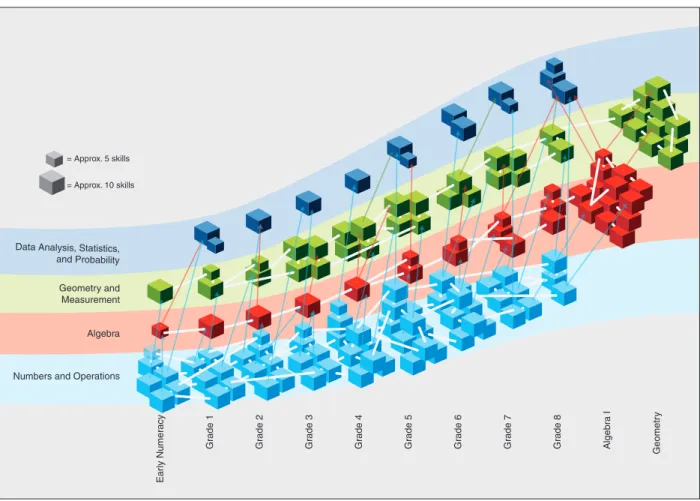
The refinements to the learning progression, made as a result of studying the Common Core State Standards, led to a new organizational structure: domains (4), skill areas (23), and core skills (398).
Core Progress for Math has four domains, which form the base of the learning progression: 1) numbers and operations; 2) algebra; 3) geometry and measurement; and 4) data analysis, statistics, and probability. The four domains are represented by the four different colors in Figure 1 (next page).
The skills areas (e.g. whole numbers, place value, symbols and expressions, time, etc.) represent the various skills and concepts students acquire as they progress the development of mathematics. There are 23 skill areas, which can be found in Appendix B.
The core skills and prerequisites act as building blocks, each representing a specific
level of competency of a skill or understanding that rests on prior development and that also provides a foundation for the next level of learning. There are 1,326 skills in the Core Progress learning progression. Of these, 398 are core skills, and many of these serve as prerequisites within and across domains, not to be learned in isolation, but as important parts of a single whole. See Appendix C for a complete count of skills per grade, for each domain.
The skill areas and skills were reviewed for coherence and continuity across grade levels to ensure that each contributed to the larger goal of improving student mathematical understanding. In addition to internal analysis, a focus group of teachers across various grade levels was convened. This group provided feedback on how well the progressions align with their own knowledge of students’ development of mathematics. Feedback on Core Progress will continue to be solicited in this way from teachers and administrators.
Since 2007, Renaissance Learning
has been studying the Achieve
standards, which are a key
foundation of the Common Core
State Standards. As a result,
aligning our learning progression
with the CCSS was a natural and
familiar process.
The network of interrelated skills
and prerequisites in Core Progress
is extensive. Many core skills for one
grade serve as prerequisite skills for
subsequent grades, reflecting the
hierarchial nature of mathematics.
Ear ly Numer acy Gr ade 1 Gr ade 2 Gr ade 3 Gr ade 4 Gr ade 5 Gr ade 6 Gr ade 7 Gr ade 8 Algebr a I Geometr y Geometry and Measurement Algebra
Data Analysis, Statistics, and Probability
Numbers and Operations
= Approx. 10 skills = Approx. 5 skills
Core Progress for Math is an empirically validated continuum to guide teaching and learning over time so that student competence in mathematics can be advanced coherently and continuously.
Prerequisite mapping in Core Progress
The Core Progress learning progression is an interconnected web of prerequisite skills. Moving toward increased
understanding over time requires continually building up and building on a solid foundation of knowledge, concepts, and skills.
One indication of the interrelated network of concepts in Core Progress is the number of skills that build up and build on each other. Specifically, 121 of the 398 core skills in Core Progress serve as prerequisites to others in subsequent grades.
Figure 1: Core Progress for Math
The Core Progress
learning progression is
an interconnected web
of prerequisite skills.
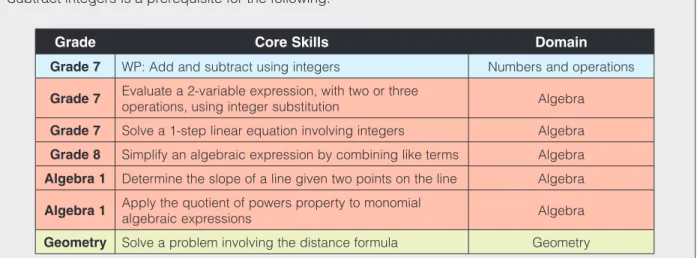
To illustrate the interrelated nature of the core skills and how they serve as prerequisites to each other, see
Table 2. In this example, the seventh grade core skill, subtract integers, serves as a prerequisite for seven core skills spanning four grades and three domains. For an additional example, see Appendix D.
Table 2: Example of how one core skill serves as a prerequisite for many other core skills
Grade Core Skills Domain
Grade 7 WP: Add and subtract using integers Numbers and operations
Grade 7 Evaluate a 2-variable expression, with two or three operations, using integer substitution Algebra
Grade 7 Solve a 1-step linear equation involving integers Algebra
Grade 8 Simplify an algebraic expression by combining like terms Algebra
Algebra 1 Determine the slope of a line given two points on the line Algebra
Algebra 1 Apply the quotient of powers property to monomial algebraic expressions Algebra
Geometry Solve a problem involving the distance formula Geometry
Example of how one core skill serves as a prerequisite for seven skills across four grade levels in three domains.
Skill 9
Determine an equivalent form of a 4-digit whole number using thousands, hundreds, tens, and ones
Skill 2
Determine the word form of a 4- or 5-digit whole number
Skill 5
Represent a 4-digit whole number as thousands, hundreds, tens, and ones
Skill 14
Represent a 3-digit number as hundreds, tens, and ones
Skill 1
Read a 4- or 5-digit whole number
Skill 2
Determine the word form of a whole number to 1,000
Skill 1
Read a whole number to 30
Skill 2
Read a whole number from 31 to 100
Skill 3
Determine the word form of a whole number to 30
Skill 4
Determine the word form of a whole number from 31 to 100
Skill 12
Model a number using hundreds, tens, and ones to 1,000
Skill 13
Recognize a number from a model of hundreds, tens, and ones to 1,000
Skill 15
Determine the 3-digit number represented as hundreds, tens, and ones
Skill 6
Determine the 4-digit whole number represented in thousands, hundreds, tens, and ones
Grade 1 Grade 2
Grade 2
Grade 3
Grade 3
Skill 1
Read a whole number to 1,000
Skill 11
Determine the result of changing a digit in a 3-digit whole number
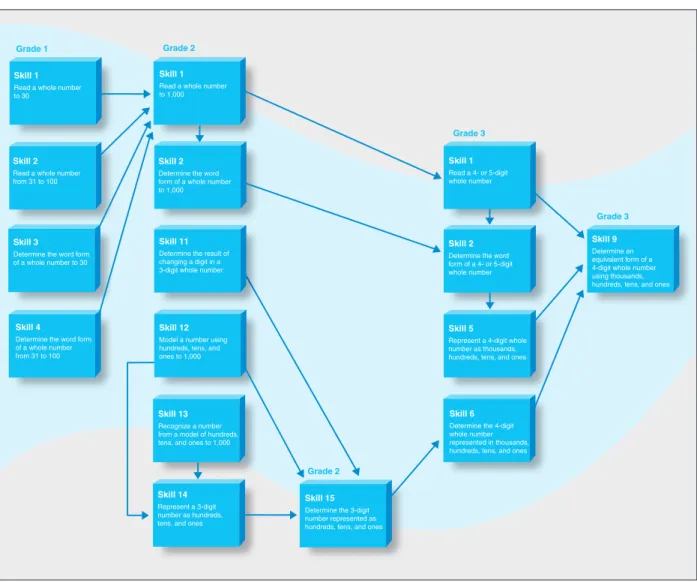
Figure 2 offers a different way to think about the deeply interrelated nature of Core Progress for Math. This figure shows a true mapping of skills, illustrating how skills build on each other, serving as prerequisites to one another.
As Figure 2 illustrates, Core Progress is an interconnected web of prerequisite skills. It’s important to recognize that a learning
progression as comprehensive and interrelated as
Core Progress for Math takes years to develop and could only come to fruition through a continuous process of research, expert review, and iterative revision.
Figure 2: Prerequisite map of place value
Core Progress is a true map of skills: new learning is built on previous, foundational understandings. The arrows identify a typical developmental path within the learning progression. In the Common Core Standards the student is expected to see the expanded form as the “name” of a number.
A comprehensive and interrelated
learning progression like Core
Progress takes years to develop
through a continuous process of
research, expert review, and
iterative revision.
Phase IV: Empirical analysis of Core Progress
™Method
In 2008, Renaissance Learning began Phase IV of Core Progress development: empirical analysis. The order of skills in the learning progression was re-examined empirically through a calibration process used to analyze assessment items. The purpose was to compare the empirically observed order of skills (i.e. where skills fall on an assessment scale) to a pedagogically determined ordering of skills (i.e. the most productive order of skills for teaching, mastering, and learning a concept).
Between June 2008 and February 2012 over 9,500 items were field tested, calibrated, and analyzed using a process called dynamic calibration.5 In this process, a small number of experimental items (one to three) were
added onto each student’s STAR Math Enterprise assessment nationwide. Response data from thousands of students were collected for each of these experimental items, and the items were then calibrated by fitting a logistic regression model (the Rasch model) to the relationship between scores on each item and a student’s Rasch ability scores on STAR Math. The result was to calibrate the difficulty of each new item on the same Rasch scale that is used for adaptive item selection in STAR Math.
Following the calibration process, the average of the calibrated Rasch response functions for each of the items assessing a skill was determined; the average is a “skill characteristic curve.” For each skill, a skill difficulty parameter was then calculated: the point on the Rasch scale at which a student of the same Rasch ability would have an expected percent correct of 70 if tested on all of the items that measure the skill. This parameter is designated SD70, or Scaled Difficulty 70. Finally, the relationship between the empirically calibrated SD70 skill difficulties and the sequential order of STAR Math skills in the learning progression was evaluated, as a means of validating the Core Progress for Math learning progression.
Results
Core Progress for Math includes 1,326 skills. Figure 3 (next page) shows 626 of the skills plotted by their difficulty level on the STAR Math Enterprise assessment scale and their instructional order according to the learning progression.
Each datapoint in Figure 3 represents a skill on the learning progression. The difficulty value (vertical scale) of each skill is derived from the calibrated difficulty of the test items from STAR Math that assess that skill. There are several assessment items per skill, called an item-set.
Best-fitting logarithmic functions relating the SD70 value of each item-set to instructional order were calculated for each of the four domains of STAR Math. These are plotted in Figure 3 as color-coded curved lines superimposed on the scatter plot. For each domain, the parameters of the fitted logarithmic function are displayed, along with the correlation between the skill difficulty parameters and instructional order. These correlations range from approximately 0.90 (for the Data Analysis, Statistics and Probability domain) to 0.94 for the Algebra domain. These correlations may be thought of as measures of the validity of the Core Progress learning progression for describing the developmental sequence of the hundreds of skills that make up the STAR Math domains.
0 2 4 6 8 10 12 200 400 600 800 1000
Data Analysis, Statistics, and Probability Geometry and Measurement Algebra Numbers and Operations
Core Progress Skill Difficulty
Scaled Difficulty 70
Grade Level Order
y = 240.13Ln(x) + 334.27 r = 0.8960 y = 271.68Ln(x) + 313.65 r = 0.9104 y = 251.45Ln(x) + 333.35 r = 0.9440 y = 253.5Ln(x) + 324.85 r = 0.9059
The high correlation between STAR Math Enterprise and Core Progress provides empirical evidence of the bridge between assessment and instruction.
Mapping Core Progress
™to the Common Core State Standards
The Common Core State Standards represent a clear step toward providing a more coherent pathway to meeting educational goals than many prior state standards. At the same time, they do not describe a fully formed pathway along which students are expected to progress. The next step, clarified and made possible by the CCSS, is the development of such fully formed learning progressions.
The concepts, skills, and understandings in Core Progress align with the Common Core State Standards, and also provide the intermediate steps and prerequisite skills necessary to reach the levels of expertise
identified through the standards. Core Progress begins with early numeracy and progresses to the minimal level of ability in mathematics required to be college and career ready.
Our process of analyzing and mapping the Common Core State Standards began before the final draft of the standards was released. As the movement to create the Common Core State Standards was getting underway, Renaissance Learning was already reviewing and learning from the work of independent
educational organizations such as Achieve. Then, as the Common Core State Standards entered into various stages of completion, Renaissance Learning carefully monitored them in draft form and provided public commentary. Core Progress was developed with a deep understanding of the CCSS.
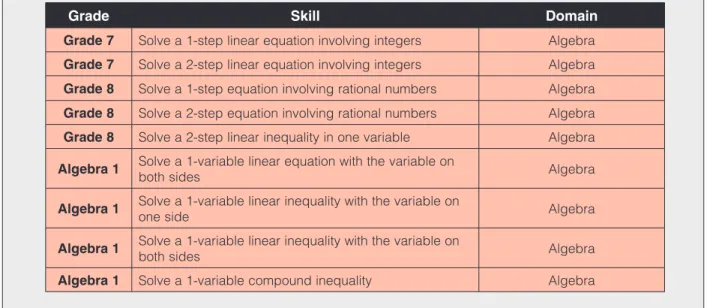
Table 3 illustrates the Core Progress skills needed to master the Common Core State Standard CC A-REI.3:
“Solve linear equations and inequalities in one variable, including equations with coefficients represented by letters.” For another example, see Appendix E.
Table 3: Example of Core Progress alignment to Common Core State Standard
Grade Skill Domain
Grade 7 Solve a 1-step linear equation involving integers Algebra
Grade 7 Solve a 2-step linear equation involving integers Algebra
Grade 8 Solve a 1-step equation involving rational numbers Algebra
Grade 8 Solve a 2-step equation involving rational numbers Algebra
Grade 8 Solve a 2-step linear inequality in one variable Algebra
Algebra 1 Solve a 1-variable linear equation with the variable on both sides Algebra
Algebra 1 Solve a 1-variable linear inequality with the variable on one side Algebra
Algebra 1 Solve a 1-variable linear inequality with the variable on both sides Algebra
Algebra 1 Solve a 1-variable compound inequality Algebra
The Common Core State Standards set the bar. Core Progress provides the prerequisite and intermediary steps for achieving the standards.
Students work through each incremental skill involving linear equations and inequalities, developing and expanding these skills at each grade level.
Phase V: Building a new learning progression specifically for the Common Core
The Core Progress for Math learning progression was originally developed to provide a research-based framework for Accelerated Math personalized practice. When development of the learning progression began in 2007, the content team at Renaissance Learning drew heavily on the American Diploma Project Benchmarks, which provided the foundation for the Common Core State Standards (CCSS). Since then, the new standards were published and have been adopted by the majority of states. The need for a learning progression built specifically for the CCSS was recognized, and the content team embarked on this project. In July 2013, the Core Progress Learning Progression for Math - Built for the Common Core State Standards was released. It included incremental steps of learning that fulfill the intent and specifics of the standards, culminating in college and career readiness.
To create a learning progression built on the CCSS, the content team started with an analysis of each set of standards by grade. They identified the intent of each standard and the inherent skills, as well as key terminology used to describe the standard. Developers also immersed themselves in the literature and resources regarding the Common Core to inform them as they worked to interpret the standards. The team then evaluated how states and relevant consortia implemented the standards.
The organization of the learning progression is identical to the framework of the standards. Grades K-8 have 11 domains and 49 skill areas. Grades 9-11 have 21 domains and 44 skill areas. For a list of the skill areas within each domain, see Appendices F and G.
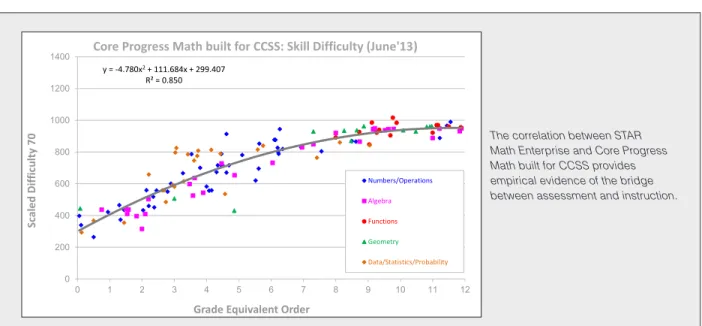
With an overall structure in place, the content team began the process of identifying skills for each standard— within each grade and from grade to grade. Many of the skill statements from the original Core Progress for Math were perfect matches to the standards in the Common Core. These skill statements have been quantitatively analyzed in the calibration process (see Phase IV—Empirical analysis of Core Progress) so they were known to be accurate grade-level indicators of student learning. Figure 4 shows a sampling of the skills plotted by their difficulty level on the STAR Math Enterprise assessment scale and their instructional order according to the Core Progress Math built for CCSS learning progression. As new skills were identified, they were written to meet the specific needs of the CCSS. Throughout the process of developing the CCSS learning progression, the content team verified that skills within a grade were presented in a teachable order. To see how skill areas progress across grades, see Appendix H.
Figure 4: Correlation of STAR Math Enterprise to Core Progress Math built for CCSS
y = -4.780x2 + 111.684x + 299.407 R² = 0.850 200 400 600 800 1000 1200 1400 Scale d Diff ic ulty 70
Core Progress Math built for CCSS: Skill Difficulty (June'13)
Numbers/Operations Algebra Functions Geometry Data/Statistics/Probability
The correlation between STAR Math Enterprise and Core Progress Math built for CCSS provides empirical evidence of the bridge between assessment and instruction.
For each grade, the team cross-referenced several CCSS guides. The Common Core State Standards for Mathematics (CCSSM) was the deciding factor for the placement and pace of skill development. Skills from adopter states and other states such as Texas and Minnesota were added when they enhanced and clarified the meaning of the CCSSM. Before an augmented skill was included in the learning progression, the team verified the skill did not contradict the Common Core.
The K-8 and High School Publishers’ Criteria were used to identify clusters, which were tagged as major, supportive, or additional. The K-8 Publishers’ Criteria for the Common Core State Standards for Mathematics specifies clusters as indicators of algebra readiness—a crucial level needed for high school success. This information was compared against core skills and their prerequisites. If a prerequisite was missing, it was added into the learning progression. See Appendix I for a list of core skills per grade and Appendix J for an example of how one core skill serves as a prerequisite for many other skills. The Common Core typically describes the ultimate way students are expected to use and understand key concepts, but the detailed steps needed for them to attain this level are usually not discussed there. This is where the true value of a learning progression becomes apparent.
Once a grade band (K-2, 3-5, 6-8) was completed, it was reviewed holistically to ensure the difficulty of skills made sense across the grades. Skills were reviewed by domain to verify the progression was accurate. The team also confirmed that the skills met the conditions of the K-8 Publishers’ Criteria for the Common Core State Standards for Mathematics.
As with the original Core Progress for Math, Renaissance Learning worked with external experts
throughout the development of the learning progression. These experts provided guidance and suggestions for each grade band in the Core Progress Math built for CCSS. They considered the adequacy of each skill in addressing the standards, the progression of skills from grade to grade, and the language used to describe skills. The expert reviewers are:
• Dr. Amanda VanDerHeyden (Kindergarten-grade 2) • Dr. Karin Hess (grades 3-5)
• Dr. James Milgram (grades 6-8 plus algebra I, geometry, and algebra II)
Core Progress Math built for CCSS embodies the Common Core and provides a teachable order of skills grade by grade. Each skill was reviewed from the perspective and stated philosophy of the Common Core. The progression includes skills that may not be explicitly stated in the CCSS but are considered key logical steps to student learning. In following the skills progression in Core Progress Math built for CCSS,
students will be on the path to achieving the common goal of attaining college and career readiness.
Each skill was reviewed from the
perspective and stated philosophy
of the Common Core. The
progression includes skills that
may not be explicitly stated in the
CCSS but are considered key
logical steps to student learning.
Core Progress
™: an integral component of Accelerated Math Live
™and STAR
Math Enterprise
™The more comprehensive a learning progression is, the more ways it can be used. Because of the depth and breadth of Core Progress, it now serves as an integral component for STAR Math Enterprise and Accelerated Math Live. As a result, there is now a true bridge between assessment (STAR Math Enterprise),
instruction (Core Progress for Math or Core Progress Math built for CCSS learning progressions), and practice (Accelerated Math Live).
Core Progress was developed to provide a research-based step-by-step framework for Accelerated Math personalized practice software. Once built, the Core Progress skills were translated into assessment items and field tested via STAR Math Enterprise. As illustrated in Figure 3 (p.11), the results were gratifying. The order of skills in the learning progression was highly correlated with the difficulty level of the skills-turned-STAR Math Enterprise items.
With a strong correlation, the natural next step was to statistically link Core Progress to the STAR Math assessment. As a result, students’ STAR Math Enterprise score now provides insight into their achievement level, as well as skills they are ready to develop next.
Accelerated Math Live
Accelerated Math Live software enables monitored, differentiated practice in mathematics. It provides daily information to teachers about student progress toward mastery, skill by skill. Accelerated Math is recognized as a “mastery measure” by the U.S. Department of Education6 (U.S. DOE). A mastery measure tracks “a
student’s successive mastery of a hierarchy of objectives” (NCRTI, 2010). Accelerated Math met the U.S. DOE’s strict definition of “mastery measure” because of the instructional hierarchy provided by Core Progress. Accelerated Math Live generates personalized practice assignments for each student based on the skills that they are ready to learn next and/or need to review. The order in which Accelerated Math the objectives are arranged and typically assigned to students is based on the Core Progress learning progression. If a skill needs to be reviewed, the instructor can use the learning progression to quickly locate prerequisite skills. The prerequisite skills the student needs to review, in order to successfully complete the assignment, can then be associated with objectives in Accelerated Math Live to fill any gaps in understanding the student might have. Completing the review of the prerequisite skills can then lead to success with completing the assignment. In this way, by utilizing the learning progression, Accelerated Math Live personally tailors daily practice in mathematics to meet the student’s immediate learning needs.
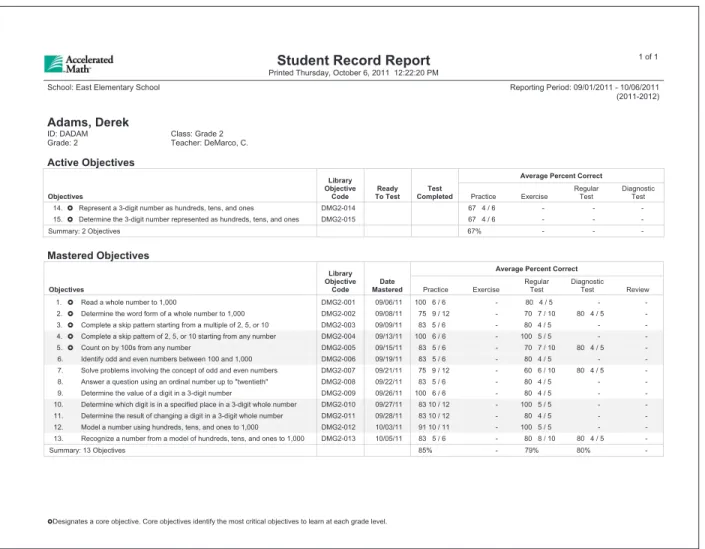
Figure 5 (next page) shows an Accelerated Math Live report for hypothetical student, Derek Adams. He has mastered the first 13 skills in the Core Progress learning progression for his grade (numbers 1-13) and is working on the next two (numbers 14-15). Typically, a teacher will run this report weekly to monitor each student’s progress and pace.
Because of the depth and breadth
of Core Progress, it now serves
as an integral component for STAR
Math Enterprise and Accelerated
Math Live.
Figure 5: Accelerated Math Live Student Record Report
Student Record Report
Printed Thursday, October 6, 2011 12:22:20 PM
School: East Elementary School Reporting Period: 09/01/2011 - 10/06/2011 (2011-2012)
˜Designates a core objective. Core objectives identify the most critical objectives to learn at each grade level.
Adams, Derek
ID: DADAM Class: Grade 2 Grade: 2 Teacher: DeMarco, C.
Active Objectives
Objectives
Library Objective
Code To Test Ready Completed Test
Average Percent Correct
Practice Exercise Regular Test DiagnosticTest
14.˜ Represent a 3-digit number as hundreds, tens, and ones DMG2-014 67 4 / 6 - - -
15.˜ Determine the 3-digit number represented as hundreds, tens, and ones DMG2-015 67 4 / 6 - - -
Summary: 2 Objectives 67% - - -
Mastered Objectives
Objectives
Library Objective
Code Mastered Date
Average Percent Correct
Practice Exercise Regular Test DiagnosticTest Review
1.˜ Read a whole number to 1,000 DMG2-001 09/06/11 100 6 / 6 - 80 4 / 5 - -
2.˜ Determine the word form of a whole number to 1,000 DMG2-002 09/08/11 75 9 / 12 - 70 7 / 10 80 4 / 5 -
3.˜ Complete a skip pattern starting from a multiple of 2, 5, or 10 DMG2-003 09/09/11 83 5 / 6 - 80 4 / 5 - -
4.˜ Complete a skip pattern of 2, 5, or 10 starting from any number DMG2-004 09/13/11 100 6 / 6 - 100 5 / 5 -
-5.˜ Count on by 100s from any number DMG2-005 09/15/11 83 5 / 6 - 70 7 / 10 80 4 / 5
-6. Identify odd and even numbers between 100 and 1,000 DMG2-006 09/19/11 83 5 / 6 - 80 4 / 5 -
-7. Solve problems involving the concept of odd and even numbers DMG2-007 09/21/11 75 9 / 12 - 60 6 / 10 80 4 / 5 -
8. Answer a question using an ordinal number up to "twentieth" DMG2-008 09/22/11 83 5 / 6 - 80 4 / 5 - -
9. Determine the value of a digit in a 3-digit number DMG2-009 09/26/11 100 6 / 6 - 80 4 / 5 - -
10. Determine which digit is in a specified place in a 3-digit whole number DMG2-010 09/27/11 83 10 / 12 - 100 5 / 5 -
-11. Determine the result of changing a digit in a 3-digit whole number DMG2-011 09/28/11 83 10 / 12 - 80 4 / 5 -
-12. Model a number using hundreds, tens, and ones to 1,000 DMG2-012 10/03/11 91 10 / 11 - 100 5 / 5 -
-13. Recognize a number from a model of hundreds, tens, and ones to 1,000 DMG2-013 10/05/11 83 5 / 6 - 80 8 / 10 80 4 / 5 -
Summary: 13 Objectives 85% - 79% 80% -
1 of 1
The Student Record Report in Accelerated Math Live enables teachers to monitor students’ mastery of successive skills from the Core Progress learning progression.
STAR Math Enterprise
In the landmark report, Knowing What Students Know, the authors establish learning progressions as the foundation for assessment. Specifically, the authors state, “models of student progression in learning should underlie the assessment system, and tests should be designed to provide information that maps back to the progression” (Pellegrino, Chudowsky, and Glaser, 2001, p. 256).
In a 2011 paper, Pellegrino, one of the report’s authors, suggested that learning progressions can guide the specification of learning performances, which in turn can guide the development of tasks that enable educators to infer students’ level of competence for the major constructs that are the target of instruction and assessment. If assessments are developed from a progression, they can provide a continuous source of evidence as student learning evolves toward increasingly sophisticated levels of understanding and skills. Because of the strong statistical correlation between STAR Math Enterprise and Core Progress, students’ scaled scores (from STAR Math Enterprise) are their entry point into the learning progression, enabling research-based inferences about which skills they have likely already developed, which skills are ready to be developed, which skills and understandings need remediation, and which skills will likely develop soon. Think of a student’s STAR Math Enterprise score as the entry point into the learning progression. (See Figure 6)
Figure 6: STAR Math Enterprise provides your entry point into Core Progress
College & Career Ready
1400
Skills Mastered Skills Ready to Learn Skills Remaining to Learn741
CMr. Steward is buying a house. He can spend no more than 31% of his income on monthly house payments. If he earns $4,600 per month, what is the largest monthly house payment he can make?
$148 $1,480 $1,426 $1,326 A B C D
Instructional Planning Reportfor Jasmine Major
Printed Thursday, September 5, 2013 4:15:12 PM 1 of 2 Class: 5th Hour Math
Teacher: Mrs. T. Williams Grade: 7 School: Pine Hill Middle School
STAR Math Test Results Current SS (Scaled Score): 741Test Date: 9/5/2013 Projected SS for 06/16/14: 785 Based on research, 50% of students at this student's
level will achieve this much growth Algebra Readiness: Jasminehas not y
et met the algebra readiness grade level expectations. Jasmine's Current Performance
Current Current School Benchmarks Projected Scaled Score 550 600 650 700 750 800 850 Projected
ûUrgent Intervention ûIntervention ûOn Watch ûAt/Above Benchmark
Jasmine's recent STAR Math scaled score(s) suggests these skills from Core Progress™ learning progressions w ould be challenging, but not too difficult for her.
Combine this information with your own knowledge of the student and use y our professional judgment w
hen designing an instructional program. Use the Core Progr ess learning progressions to see how these skills fit within the larger context of the progression.
Skills to Learn
K-8 Geometry
GR7
Students draw and construct geometrical figures and describe the relationship betw een figures with different attributes. They solve real-world and mathematical problems involving angle measure and the area of
2-dimensional figures. They solve real-world and mathematical problems involving the surface area and
volume of 3-dimensional figures . Relate volume found using unit cubes to multiplic
ation of edge lengths in a right rectangular prism
7
Find the volume of a right rectangular pris
m with fractional edge lengths using formulas »
7
WP: Find the volume of a right rectangular pr
ism with fractional edge lengths using formulas
7
Plot coordinates to form a polygon on the coordinate plane
7
Find a side length of a polygon on the coordinate plane
7
Ratios and Proportional Relationships
7
Students analyze proportional relationships in real-world and mathematical problems. T hey write equations to represent a proportional relationship. T
hey solve multi-step real-world and mathematical ratio and percent problems. Understand the concept of a unit rate
7
Determine a unit rate »
7
Identify an input-output table that contains values for a given ratio
7
Find missing values in a ratio table
7
Graph in the coordinate plane the values of a ratio table
7
WP: Use tables to compare ratios
7
WP: Solve a unit rate problem »
7
The Number System
7
» Designates a core skill. Core skills identify the most critical skills to learn at each grade level.
Core Progress learning progressions help to inform instruction within STAR Math Enterprise. Educators access a learning progression through Instructional Planning Reports (which are generated by STAR Math Enterprise in real time), or the STAR Record Book.
Instructional Planning Reports
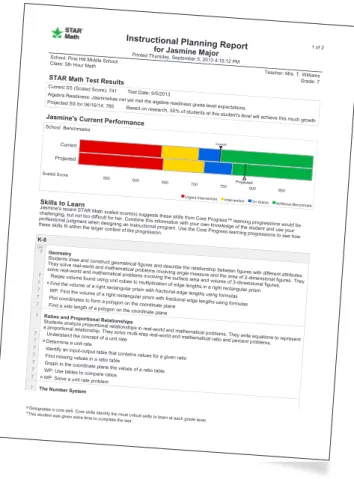
Skills-based information for students is provided by the Instructional Planning Reports produced instantly by STAR Math Enterprise after a student completes a test. These reports use the Core Progress learning progression to identify the range of skills students are ready to develop next. The Student Instructional Planning Report also shows an individual student’s current performance in relation to pre-selected benchmarks, so teachers can keep an eye on whether a student is on track to meet state or locally established proficiency goals. (See Figure 7)
STAR Record Book
The STAR Record Book highlights suggested skills from Core Progress that a student is ready to learn. It is a tool that bridges assessment and instruction. The student’s STAR scaled score is placed on the learning progression and suggests skills that are appropriate to focus on. To further expand understanding of skills and support instruction, educators will
find Sample Items and Worked Examples associated with skills. Each skill includes prerequisite skill mapping, ELL support, and content-area vocabulary. In addition, the Record Book includes Depth of Knowledge 3 (DOK3) items and performance tasks. These resources are designed to help teachers probe more deeply into the skills and knowledge of each student. (See Figure 8)
Instructional Planning Reportfor Jasmine Major Printed Thursday, September 5, 2013 4:15:12 PM
1 of 2 Class: 5th Hour Math
Teacher: Mrs. T. Williams Grade: 7 School: Pine Hill Middle School
STAR Math Test Results
Current SS (Scaled Score): 741
Test Date: 9/5/2013
Projected SS for 06/16/14: 785 Based on research, 50% of students at this student's
level will achieve this much growth Algebra Readiness: Jasminehas not y
et met the algebra readiness grade level expectations.
Jasmine's Current Performance
Current Current School Benchmarks Projected Scaled Score 550 600 650 700 750 800 850 Projected ûUrgent Intervention û
Intervention ûOn Watch ûAt/Above Benchmark Jasmine's recent STAR Math scaled score
(s) suggests these skills from Core Progress™ learning progressions would be challenging, but not too difficult for her.
Combine this information with your own knowledge of the student and use y our professional judgment w
hen designing an instructional program. Use the Core Progr
ess learning progressions to see how these skills fit within the larger context of the progression.
Skills to Learn
K-8
Geometry
GR
7
Students draw and construct geometrical figur
es and describe the relationship betw
een figures with different attributes. They solve real-world and mathematical problems involving angle measure and the area of
2-dimensional figures. They solve real-world and mathematical problems involving the surface area and
volume of 3-dimensional figures. Relate volume found using unit cubes to multiplic
ation of edge lengths in a right rectangular prism
7
Find the volume of a right rectangular pris
m with fractional edge lengths using formulas »
7
WP: Find the volume of a right rectangular pr
ism with fractional edge lengths using formulas
7
Plot coordinates to form a polygon on the coordinate plane
7
Find a side length of a polygon on the coordinate plane
7
Ratios and Proportional Relationships
7
Students analyze proportional relationships in real-world and mathematical problems. T
hey write equations to represent a proportional relationship. T
hey solve multi-step real-world and mathematical ratio and percent problems. Understand the concept of a unit rate
7
Determine a unit rate »
7
Identify an input-output table that contains values for a given ratio
7
Find missing values in a ratio table
7
Graph in the coordinate plane t
he values of a ratio table
7
WP: Use tables to compare ratios
7
WP: Solve a unit rate problem »
7
The Number System
7
» Designates a core skill. Core
skills identify the most critical skills to learn at each grade level. aThis student was given extra time to complete
the test.
Figure 7: Example of Instructional Planning Report generated by STAR Math Enterprise
Conclusion
The goal of school districts is to ensure that all students in all schools be fully prepared for college or career by the time they graduate from high school. The benefit of learning progressions is that they lay out a pathway to guide teaching and learning over time so that student competence in the domain can be advanced coherently and continuously. Core Progress for Math and Core Progress Learning Progression for Math - Built for
the Common Core State Standards describe fully formed progressions of learning within the domain of mathematics, including the intermediate steps not evident in state standards and the Common Core. They help educators locate where students are on their pathway, not only pointing in the right direction, but also providing tangible and achievable next steps for getting there. Together, STAR Math Enterprise assessments, Core Progress learning progressions for mathematics, and Accelerated Math Live content help educators achieve the intent and spirit of the standards their state has adopted, while propelling their students toward college and career readiness.
The benefit of learning progressions
is that they lay out a pathway to guide
teaching and learning over time so
that student competence in the
domain can be advanced coherently
and continuously.
Appendix A: Examples of skill progressions across grade levels
Domain: Numbers and Operations Skill Area: Whole Numbers: Place Value
Grade Skill
1 • Write and identify a 2-digit number from a model of tens and ones• Determine a value of a digit in a 2-digit number
2 • Write and identify a 3-digit number as hundreds, tens, and ones• Recognize equivalent forms of a 3-digit number using hundreds, tens, and ones
3 • Write and identify a 4- or 5-digit number as thousands, hundreds, tens, and ones• Recognize equivalent forms of a 4-digit number using thousands, hundreds, tens, and ones • Write and identify a 4- or 5-digit number in expanded form
4 • Round a 4- to 6-digit number to a specified place
Domain: Numbers and Operations Skill Area: Decimal Concepts and Operations
Grade Skill
4
• Write and identify a decimal number from a model of tenths and hundredths • Represent a decimal number to tenths by a point on a number line
• Recognize an equivalent form of a decimal number and a fraction • Compare and order decimal numbers through hundredths • Round a decimal to a specified place through hundredths
5
• Compare and order decimal numbers of differing places to thousandths • Add and subtract decimal numbers to differing places to thousandths
• Solve word problems involving addition and subtraction of decimal numbers through thousandths • Estimate decimal sums and differences through thousandths.
6
• Divide whole numbers resulting in a decimal quotient through thousandths • Recognize and represent decimal numbers in expanded form using powers of ten • Multiply a decimal number through thousandths by a whole number
• Divide a decimal number by 10, 100, or 1,000
• Divide a decimal number through thousandths by a whole number • Divide a whole number by a decimal number to tenths
• Multiply and divide decimal numbers through thousandths
• Solve word problems involving multiplication and division of decimal numbers through thousandths • Estimate decimal products and quotients
• Compare and order numbers in decimal and fraction forms
7 • Solve a multi-step word problem involving decimal numbers
8 •Convert between standard form and scientific notation of decimal numbers
Appendix B: Core Progress
™for Math includes four domains and 23 skill areas
Domain Skill Area
Numbers and Operations
• Whole Numbers: Counting, Comparing, and Ordering • Whole Numbers: Place Value
• Patterns, Relations, and Functions • Whole Numbers: Addition and Subtraction • Money
• Whole Numbers: Multiplication and Division • Fraction Concepts and Operations
• Decimal Concepts and Operations • Percents, Ratios, and Proportions • Integers
• Powers and Roots
Algebra
• Algebra: Variable Equations and Expressions • Symbols and Expressions
• Functions • Linear Equations • Nonlinear Equations • Algebra of Polynomials • Quadratic Equations
Geometry and Measurement
• Measurement • Time
• Geometry: 2-Dimensional • Geometry: 3-Dimensional Data Analysis, Statistics,
and Probability • Data Representation and Analysis
Appendix C: Core skills per grade, per domain
Grade Domain Core skills (398) Total skills (1,326)
Early Numeracy
Numbers and Operations 0 58
Algebra 0 5
Geometry and Measurement 0 9
Totals 0 72
Grade 1
Numbers and Operations 27 59
Algebra 4 10
Geometry and Measurement 7 16
Data Analysis, Statistics, and Probability 0 14
Totals 38 99
Grade 2
Numbers and Operations 23 64
Algebra 3 11
Geometry and Measurement 4 14
Data Analysis, Statistics, and Probability 4 9
Totals 34 98
Grade 3
Numbers and Operations 27 55
Algebra 2 11
Geometry and Measurement 1 38
Data Analysis, Statistics, and Probability 0 10
Totals 30 114
Grade 4
Numbers and Operations 24 83
Algebra 5 9
Geometry and Measurement 13 42
Data Analysis, Statistics, and Probability 6 9
Totals 48 143
Grade 5
Numbers and Operations 30 97
Algebra 4 14
Geometry and Measurement 8 40
Data Analysis, Statistics, and Probability 1 16
Totals 43 167
Grade 6
Numbers and Operations 42 91
Algebra 7 16
Geometry and Measurement 2 32
Data Analysis, Statistics, and Probability 0 18
Totals 51 157
Grade 7
Numbers and Operations 24 60
Algebra 7 23
Geometry and Measurement 9 41
Data Analysis, Statistics, and Probability 5 14
Totals 45 138
Grade 8
Numbers and Operations 14 30
Algebra 17 25
Geometry and Measurement 4 20
Data Analysis, Statistics, and Probability 0 24
Totals 35 99
Algebra 1 Algebra 43 127
Appendix D: Example of how one core skill serves as a prerequisite for many
other core skills
Grade Core Skill Domain
Grade 1 Count objects grouped in tens and ones (grade 1) Numbers and operations
Grade 1 Tell time to the half hour (grade 1) Geometry and measurement
Grade 2 Complete a skip pattern starting from a multiple of 2, 5, or 10 Numbers and operations
Grade 2 Complete a skip pattern of 2, 5, or 10 starting from any number Numbers and operations
Grade 2 Count on by 100s from any number Numbers and operations
Grade 2 Use a pictograph to represent data (1 symbol = more than 1 object) Data analysis, statistics and probability
Grade 3 Tell time to the minute Geometry and measurement
Grade 4 Answer a question using information from a line graph Data analysis, statistics and probability
Grade 4 Use a double-bar graph to represent data Data analysis, statistics and probability
Grade 4 Answer a question using information from a double-bar graph Data analysis, statistics and probability
Example of how one core skill serves as a prerequisite for 10 skills across four grade levels in three domains.
Count by 5s or 10s to 100 starting from a multiple of 5 or 10, respectively is a prerequisite for the following:
Appendix E: Common Core State Standards and Core Progress
™Grade Skill Domain
Grade 4 WP: Solve a 2-step problem involving addition and/or subtraction of multi-digit whole numbers Numbers and operations
Grade 4 WP: Solve a 2-step whole number problem using more than 1 operation Numbers and operations
Grade 5 WP: Solve a 2-step problem involving whole numbers Numbers and operations
Grade 6 WP: Solve a multi-step problem involving whole numbers Numbers and operations
Grade 6 WP: Solve a 2-step problem involving fractions Numbers and operations
Grade 6 WP: Solve a 2-step problem involving decimals Numbers and operations
Grade 7 WP: Solve a multi-step problem involving decimals Numbers and operations
Grade 7 WP: Solve a multi-step problem involving fractions or mixed numbers Numbers and operations
Grade 7 WP: Estimate the result of dividing or multiplying a whole number by a fraction Numbers and operations
The Common Core State Standards set the bar. Core Progress provides the prerequisites and intermediary steps for achieving the standard.
CCSS performance standard Grade 7, Expressions and Equations Domain, Standard 3 (7.EE.3) “Solve multi-step real-life and mathematical problems posed with positive and negative rational numbers in any form” is mapped to the following Core Progress skills:
Appendix F: Organization of Skill Areas within the 11 Domains for K-8
Domain Skill Area
Counting and Cardinality Whole Numbers: Counting, Comparing, and Ordering
Operations and Algebraic Thinking
Algebraic Thinking
Evaluate Numerical Expressions
Whole Numbers: Addition and Subtraction
Whole Numbers: Counting, Comparing, and Ordering Whole Numbers: Multiplication and Division
Number and Operations in Base Ten
Decimal Concepts and Operations Powers, Roots, and Radicals
Whole Numbers: Addition and Subtraction
Whole Numbers: Counting, Comparing, and Ordering Whole Numbers: Multiplication and Division
Whole Numbers: Place Value Number and Operations —
Fractions Decimal Concepts and OperationsFraction Concepts and Operations
Ratios and Proportional
Relationships Percents, Ratios, and Proportions
The Number System
Coordinate Geometry
Decimal Concepts and Operations Fraction Concepts and Operations Integers
Whole Numbers: Multiplication and Division
Expressions and Equations
Evaluate and Use Variable Expressions Evaluate Numerical Expressions Linear Equations and Inequalities Powers, Roots, and Radicals
Quadratic and Nonlinear Equations and Inequalities Systems of Equations and Inequalities
Functions Relations and Functions
Geometry
Angles, Segments, and Lines Congruence and Similarity Coordinate Geometry
Fraction Concepts and Operations
Geometry: Three-Dimensional Shapes and Attributes Geometry: Two-Dimensional Shapes and Attributes Perimeter, Circumference, and Area
Right Triangles and Trigonometry Surface Area and Volume Transformations
Measurement and Data
Angles, Segments, and Lines Data Representation and Analysis
Geometry: Two-Dimensional Shapes and Attributes Measurement
Money
Perimeter, Circumference, and Area Surface Area and Volume
Time
Whole Numbers: Addition and Subtraction
Whole Numbers: Counting, Comparing, and Ordering
Appendix G: Organization of Skill Areas within the 21 Domains for high school
Domain Skill Area
The Real Number System Fraction Concepts and OperationsPowers, Roots, and Radicals
Quantities* Data Representation and Analysis
Seeing Structure in Expressions
Algebra of Polynomials
Linear Equations and Inequalities
Quadratic and Nonlinear Equations and Inequalities Relations and Functions
Arithmetic with Polynomials
and Rational Expressions Algebra of Polynomials
Creating Equations* Linear Equations and Inequalities
Reasoning with Equations and Inequalities
Linear Equations and Inequalities
Quadratic and Nonlinear Equations and Inequalities Relations and Functions
Systems of Equations and Inequalities
Interpreting Functions Relations and Functions
Building Functions Relations and Functions
Linear, Quadratic, and
Exponential Models* Linear Equations and InequalitiesQuadratic and Nonlinear Equations and Inequalities
The Complex Number System Algebra of PolynomialsComplex Numbers
Trigonometric Functions Right Triangles and Trigonometry
Congruence
Angles, Segments, and Lines Congruence and Similarity
Geometry: Two-Dimensional Shapes and Attributes Polygons and Circles
Transformations Similarity, Right Triangles, and
Trigonometry
Congruence and Similarity Right Triangles and Trigonometry Transformations
Circles Polygons and Circles
Expressing Geometric Properties with Equations
Coordinate Geometry Polygons and Circles Geometric Measure and
Dimension
Geometry: Three-Dimensional Shapes and Attributes Perimeter, Circumference, and Area
Surface Area and Volume
Modeling with Geometry
Coordinate Geometry
Geometry: Three-Dimensional Shapes and Attributes Perimeter, Circumference, and Area
Polygons and Circles
Right Triangles and Trigonometry Surface Area and Volume Conditional Probability and the
Rules of Probability Combinatorics and Probability
Using Probability to Make
Decisions Combinatorics and Probability
Domain Skill Area
Interpreting Categorical and
Quantitative Data Data Representation and Analysis
Making Inferences and
Justifying Conclusions Data Representation and Analysis