Australian Journal of Basic and Applied Sciences
ISSN:1991-8178Journal home page: www.ajbasweb.com
Corresponding Author: Musran Munizu, Hasanuddin University, Department of Management, Faculty of Economics, Jl. Perintis Kemerdekaan KM. 10, 90245. Makassar, Indonesia, Telp./Fax.: (+62) 0411-587218; E-mail: [email protected]
A Study on Relationship between TQM Practices and Competitive Advantage: Case at
Basic Metal Industry in Indonesia
Musran Munizu
Hasanuddin University, Department of Management, Faculty of Economics, Jl. Perintis Kemerdekaan KM. 10, 90245. Makassar, Indonesia A R T I C L E I N F O A B S T R A C T
Article history: Received 25 June 2014 Received in revised form 8 July 2014
Accepted 25 July 2014 Available online 20 August 2014 Keywords:
TQM practices, competitive advantage, operation management, basic metal industry
Background: In past two decades, TQM has been widely studied as a philosophy, approach and strategy to achieve competitive advantage. TQM isa new paradigm of doing business that attempts to maximize the competitiveness of the organization through a focus on customer satisfaction, involvement of all employees, and continuous improvement of the quality of products, services, people, processes and organizational environment. Objective: To empirically investigate the impact of TQM practices on competitive advantage at basic metal industry in Makassar, Indonesia. Results: There is a positive and significant effect of critical factors of TQM practices on competitive advantage. They were consists of leadership, strategic planning, customer focus, training, and suppliers management. Leadership factor is the strongest significant predictor of competitive advantage. Conclusion: The results of this study can be used by managers to prioritize the implementation of TQM practices. For instance, those practices that are found to have a positive impact on competitive advantage can be recommended to managers so that they can allocate resources to improve these practices to get the best competitive advantage in their organization.
© 2014 AENSI Publisher All rights reserved. To Cite This Article: Musran Munizu., A Study on Relationship between Tqm Practices and Competitive Advantage: Case at Basic Metal Industry in Indonesia. Aust. J. Basic & Appl. Sci., 8(13): 290-295, 2014
INTRODUCTION
In the last few years, the core ideas of total quality management (TQM) have been generally accepted by the business community throughout the world. TQM has been described as a new model of thinking in business management (Chorn, 1991). TQM has become a global phenomenon, as it affects Japanese companies as much as US, European and Asia-Pacific ones (Chen, 1997; Corbett and Rastrick, 2000). TQM has been widely studied as a philosophy, approach and strategy to achieve competitive advantage. According to Sila (2007) Total quality management plays a very important role in increasing the strength of the competitiveness of enterprises. In a global market that is continuously changing, in addition to fast delivery, product quality is also one important element for the company to win in the competition.
Total Quality Management (TQM) is a new paradigm of doing business that attempts to maximize the competitiveness of the organization through a focus on customer satisfaction, involvement of all employees, and continuous improvement of the quality of products, services, people, processes and organizational environment (Krajewski and Ritzman, 2004 ). Tjiptono and Anastasia (2003) asserted that TQM is a philosophy that is built on the concept of quality. In addition, it is also seen as a system that can be developed into an approach in running the business to maximize the competitiveness of the organization through continuous improvement of the products, services, labor, and environmental processes. Voss (2005) says that TQM is one of the best management practices in manufacturing strategy paradigm that emphasizes the overall quality of the company. Quality has become one of the main aspects of the competition in the global market. Organization Efforts in improving the company performance is done by the continuous improvement of business activities which is focused on the consumer, which is covers the entire organization and it is emphasis on flexibility and quality. Therefore, the management quality always associated with continuous improvement. It has been done many companies to win the competition. So that, management have to properly manage the product quality, unless their performance will be gradually declined (Chase et al., 2005).
Attention to quality give two positive impact on the business. First, the impact on production costs. It is related to many activities i.e: free of raw material damage, efficiently operation generates lower cost of production and it makes the products has competitive price in marketplace. Second, the impact on revenue, high
quality product can increase customer satisfaction. Therefore, TQM practices can be generated best performance of the company. In addition, the quality problem have to become focus of management attention, and overall members of the organization. Total quality management (TQM) is a management system that emphasizes quality as a business strategy which is oriented to customer satisfaction by involving all organization members to achieve company’s goals through the creation of superior competitiveness of the organization (Gaspersz, 2005).
Conceptually, competitiveness relates to the ability of the company extensively in creating the defensive over its competitors. Companies are fundamentally different because they have a set of resources in organization. Competitive advantage can be achieved of every company by using both effectively and efficiently the company's resources and capabilities (Barney, 1991). Competitiveness consists of a set of capabilities which makes an organization different from its competitors, and it is results significant management decisions (Porter, 2002). Based on the literature study, it can be identified that the price/cost, quality, delivery, and flexibility as source of competitive advantage in organization. In addition, Skinner in Krajewski and Ritzman (2004) developed four competitive priorities i.e: cost, quality, speed of delivery and flexibility to improve both performance and competitiveness of the company.
Many studies have been examined the relationship between TQM and competitive advantage. Han et al. (2007) conducted a study on 441 manufacturing companies in the USA that has been certified by ISO 9000. The study found that TQM practices have a direct positive relationship with firm performance. Furthermore, Ramlawati (2010) founds that practice of TQM has a positive effect on the competitiveness of enterprises. While Flynn et al. (1995) founds that TQM does not significant toward competitiveness of the company. Therefore, this study will confirm and examine the effect of TQM practices on competitive advantage at basic metals companies in Makassar, Indonesia.
2.0 Conceptual Framework and Hypotheses: 2.1 Conceptual Framework:
Total Quality Management (TQM) is a systematically approach to improve the quality of many dimensions in organization. TQM has been widely applied by many companies with the goal in improving performance such as quality, productivity and profitability (Tjiptono and Anastasia, 2003). Implementation of critical factors of TQM practices in an organization is very important to get benefits and to achieve competitive advantage of company. TQM principles have been widely found in literature, but in practice each company can vary from one to another. Generally, companies follow a standard model that has been known and accepted by many companies as a guideline for quality management practices. Examples of TQM principles is embodied in practice and used as a standard business practice evaluation criteria of quality in the company is Malcolm Bridge National Quality Award (MBNQA), Singapore Quality Award (SQA), the Japan Quality Award (JQA) and the Deming Prize (DP).
Today, there is no consensus or agreement from experts about components or constructs of total quality management (TQM). From the review of the literature and empirical studies it is known that the component or indicator used is different among the researchers, because they use variety of approaches in their studies. According to Bemowski (1992), the expression TQM was firstly used in 1985 by the Naval Air Systems Command to describe the Japanese style of management focused on quality improvements. In spite of a lot of controversy exists on finding a definition able to include the efforts made by the different researchers and professionals about TQM (Gehani, 1993).
According to Saraph et al. (1989), there were eight critical factors TQM i.e.: leadership of top management, reporting of quality data, process management, design of products or services, training, supplier quality management, the role of the quality department, and employee relations. Furthermore, Flynn et al. (1995) stressed 7 factors of TQM practices implementation, namely: top management support, information quality, process management, product design, workforce management, supplier involvement and customer involvement. Black and Porter (1996) states that TQM constructs composed of 10 elements, and the Malcolm Baldrige National Quality Award (MBNQA) develop into 7 elements namely; (1) Customer focus and satisfaction, (2) Employee training, (3) Leadership and top management commitment, (4) Teamwork (5) Employee involvement (6) Continuous improvement and innovation, and (7) Quality and performance. TQM constructs consisting of 7 elements MBNQA is a standard version of the TQM initiative that has been widely used in the manufacturing industry in Europe and was followed by a variety of industries both manufacturing, and service industries throughout the world.
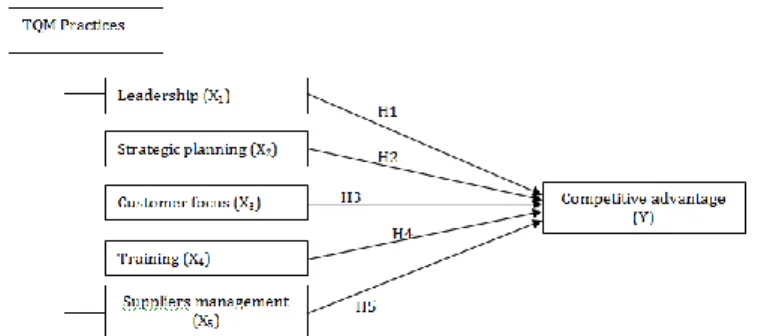
Based on conceptual review, the constructs of TQM practices in this study refers to research conducted by previous researchers. They are consists of leadership, strategic planning, customer focus, training, and suppliers management (Saraph et al., 1989; Flynn et al., 1995; Black and Porter, 1996; Sila and Imbrahimpour, 2003). While the construct of competitiveness is measured by four indicators, namely cost, quality, speed of delivery, flexibility, and product innovation (Krajewski and Ritzman, 2004; Han et al., 2007). Refer to the above illustration, this research model can be clearly presented in the following figure.
Fig. 2.1: Research Model.
2.2 Hypotheses:
Hypotheses of this study are developed based on reviews toward literature, previous research and research model. Therefore, hypotheses of this study can be formulated as follows:
H1: There is a significant positive relationship between leadership and competitive advantage. H2: There is a significant positive relationship between strategic planning and competitive advantage H3: There is a significant positive relationship between customer focus and competitive advantage H4: There is a significant positive relationship between training and competitive advantage
H5: There is a significant positive relationship between suppliers management and competitive advantage
3.0 Research Method:
3.1 Study Approach, and Variables Measurement:
The study was used quantitative approach which is an approach that emphasizes the testing of theories or concepts through measurements in metric or numeric variables, then it performs data analysis procedures which is using statistical tools with aimed to test the hypothesis (Sekaran, 2007). This study was included in the category of explanatory research that intends to provide an explanation of the causal relationship among variables by hypothesis testing (Sugiyono, 2008).
The variables were tested in the study consists of two variables: (1) independent variable; and (2) the dependent variable. TQM practices consists of leadership, strategic planning, customer focus, training, and suppliers management as independent variable, while the competitive advantage that consists of cost, quality, speed of delivery, and flexibility as dependent variable. The variables were measured by 5 point Likert scale. According to Sugiyono (2008) Likert Scale is used to measure attitudes, responses, and opinion about social phenomena.
3.2 Population and Sample:
There are 1.800 employees at basic metal industry in Makassar, Indonesia. So, the number of sample were 180 persons (10%) from the population. Simple random sampling is used as sampling technique. Hair et al. (1998) and Sugiyono (2008) argue that simple random sampling could be chosen by researchers, if characteristics of population is relatively homogenous. Data is collected by observation, questionnaire, and documentation. Questionnaire technique includes: (1) the question of the identity of the respondents such as: age, gender, tenure, and level of education, and (2) question about the all variables and their indicators.
3.3 Validity and Reliability Test:
Validity and reliability of instrument was tested by both product moment correlation and Cronbach Alpha method. Each item or indicator is valid if the score of correlation more than 0.30. Then, each variable can be say reliable if it has value more than standard 0.60 (Hair et al., 1998). The test results show that the instrument was used in the study has good validity and reliability. There were two methods is used to analyze the data, namely: (1) Analysis of Descriptive Statistics; and (2) Multiple Regression Analysis. Data is performed by IBM SPSS 21.
Table 3.3: Results of Reliability Test.
No. Variables Number of indicator Cronbach
Alpha (α)
Description
1. Leadership (X1) 4 0,666 Reliable
2. Strategic planning (X2) 4 0,720 Reliable
3. Customer focus (X3) 4 0,678 Reliable
4. Training (X4) 4 0,655 Reliable
5. Suppliers management (X5) 4 0,688 Reliable
4.0 Results:
4.1 Respondents Characteristics:
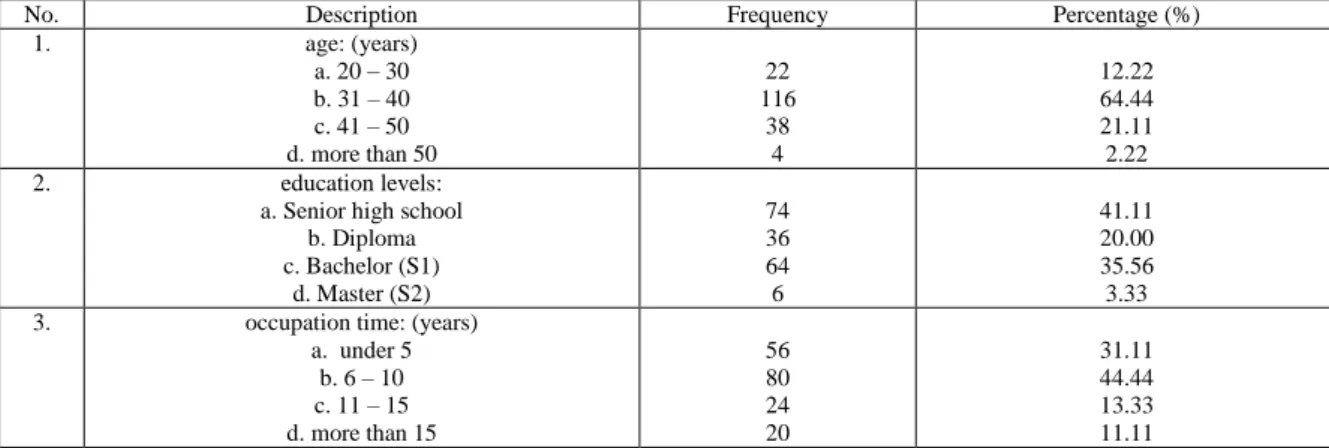
This part describes the complete results of the research which is included an overview about respondent characteristics, characteristics of variables, and the results of hypothesis testing. Based on the calculation and analysis of data, results of descriptive analysis that completely describe the characteristics of the respondents according to age, education level, and occupation time are presented in the following table.
Table 4.1: Respondents Characteristics.
No. Description Frequency Percentage (%)
1. age: (years) a. 20 – 30 b. 31 – 40 c. 41 – 50 d. more than 50 22 116 38 4 12.22 64.44 21.11 2.22 2. education levels:
a. Senior high school b. Diploma c. Bachelor (S1) d. Master (S2) 74 36 64 6 41.11 20.00 35.56 3.33
3. occupation time: (years)
a. under 5 b. 6 – 10 c. 11 – 15 d. more than 15 56 80 24 20 31.11 44.44 13.33 11.11
The above table shows that in terms of age, respondents were dominant in category of 31-40 years i.e. 116 persons or 64.44%. Furthermore, most of respondents have education at high school level i.e.: 74 persons or 41.11%. According to occupation time, most of the respondents have occupation time between 6-10 years i.e. 44.44% or 80 persons.
4.2 Mean of Variables:
Mean of variables shows the rate of implementation of variables in organization based on employee perception. Clearly, the overview of characteristics of variables were presented in the following table.
Table 4.2: Average Value of Variables.
No. Variable Mean Description
1. Leadership (X1) 4.22 very good
2. Strategic planning (X2) 3.70 good
3. Customer focus (X3) 4.12 good
4. Training (X4) 4.05 good
5. Suppliers management (X5) 3.88 good
6. Competitive advantage (Y) 3.55 enough
The above table shows that leadership factor has higher score than other factors i.e. 4.32. it means that leadership in the implementation is very good. The next TQM factor is customer focus and employee training. They have mean value are 4.12, and 4.05. While factors such strategic planning and suppliers management relatively have mean value smaller than other. Therefore, these factors have to improve by managers in organization.
4.3 Hypotheses Test:
Testing the hypothesis of the research is done by using multiple regression analysis. The summary of the results of calculation are presented in the following table.
Table 4.3: Results of Hypothesis Testing.
Variables Regression Value () t-value Sig. Description
Leadership (X1) 0.570 6.275 0.000 H1, accepted
Strategic planning (X2) 0.296 3.385 0.025 H2, accepted
Customer focus (X3) 0.528 5.460 0.000 H3, accepted
Training (X4) 0.406 4.022 0.001 H4, accepted
Suppliers management (X5) 0.283 3.260 0.032 H5, accepted
R2 = 0.640
r = 0.800 Constant: 0.115
The table shows that the value of the regression coefficient () for all variables are positive and significant at α = 0.05. Value of determination coefficient (R2
advantage variable can be explained by factors of TQM namely leadership, strategic planning, customer focus, training, and suppliers management, whereas 36% is explained by other variables outside the model.
5.0 Discussion:
Based on table, leadership factor has significant effect on competitive advantage (Hypotheses 1, accepted). These results indicate that better leadership can generate best competitive advantage. Management commitment should support the successful of TQM implementation of in organization, because it could directly increase the organization competitiveness (Han et al., 2007). The results are consistent with the statement that management commitment is one of the key elements of a successful implementation of TQM (Munizu, 2002; Sila and Ebrahimpour, 2003; Prayogo and Brown, 2004; Sila, 2007). Then, strategic planning has significant effect on competitive advantage (Hypotheses 2, accepted). It means that better strategic planning can support the implementation of TQM practices. Strategic planning in organizations is absolutely necessary as a basic reference for control programs that running in the companies. Either policies or programs have to formulate and implement properly in organization. If the organization has strategic planning document, they will do overall activities consistently in the organization (Krajewski and Ritzman, 2004; Chase et al., 2005; Prajogo and Hong, 2008).
Customer focus has significant effect on competitive advantage (Hypotheses 3, accepted). It means that better level of customer focus can lead to best competitive advantage in organization. Customer service should be addressed from two main areas: internal customer service and external customer assurance. Components of an internal customer service plan should include providing timely and dependable deliveries, presenting improvements or cost saving suggestions to management and authorizing employees to self-implement solutions, cross training employees for mastery of more than one job and providing adequate technical training. Then, an external customer service program should include providing customers with timely information and quick responsiveness to complaints, and maintaining a corporate goal to reduce the quantity of questions or complaints while recognizing all successful efforts by employees in providing outstanding service (Kasul and Motwani, 1995).
Employee training has significant effect on competitive advantage (Hypotheses 4, accepted). Employees must be oriented to a company's philosophy of commitment to never ending improvement, be informed of company goals, and be made to feel a part of the team. Proper training includes explanation of overall company operations and product quality specifications. Where SPC is practiced, training in statistical methods must be included. Specific measures for evaluating training include: the time and money spent by organizations in training employees and management in quality principles, problem solving skills, and teamwork (Black and Porter, 1996; Saraph et al., 1989).
Suppliers management factor has significant effect on competitive advantage (Hypotheses 5, accepted). These results indicate that best supplier management can improve competitive advantage of company. Supplier management by the company related to both selection of the supplier quality activities based on quality performance of suppliers and offer long-term contracts with credible suppliers. These findings consistent with Sila and Ebrahimpour (2003) that suppliers management is one of the important factors in the implementation of TQM in organization.
Conclusions:
It can be concluded that the factors of TQM practices consisting of leadership, strategic planning, customer focus, training, and suppliers management could be able to lead best competitive advantage in organization. Leadership factor affect competitive advantage dominantly. It indicates that quality improvement program should supported by strong management leadership. Therefore, managers should consistent over time in order to achieve the best sustainable competitive advantage in their organization. TQM practices should be implemented to overall in organization activities. This study was only conducted in basic metals industry, so the results could not be generalized to all type of companies. Therefore, next research could be done to other sectors in manufacturing industry to generate best results.
ACKNOWLEDGEMENT
The author would like to acknowledge both Mr. Mizwar Munizu and Mr. Didik Kardy for their three months long activity of data collection. Without their support and perseverance this study would not have been possible.
REFERENCES
Barney, J., 1991. Firms Resources and Sustained Competitive Advantage. Journal of Management, 17: 791-400.
Bemowski, K., 1992. The quality glossary, Quality Progress, 25 (2): 18-29
Black, S.A. and L.J. Porter, 1996. Identification of the critical factors of TQM. Decision Sciences, 27(1): 1-21.
Chase, Richard, B., Nicholas, J. Aquilano, F. Robert Jacobs. 2005. Operation Management for Competitive Advantage, Eleventh Edition, USA: McGraw-Hill Inc.
Chen, W.H., 1997. The human side of total quality management in Taiwan: leadership and human resource management, International Journal of Quality & Reliability Management, 14(1): 24-45.
Chorn, N.H., 1991. Total quality management: panacea o pitfall?, International Journal of Physical Distribution & Logistics Management, 21(8): 315-320.
Corbett, L.M. and K.N. Rastrick, 2000. Quality performance and organizational culture: a New Zealand study, International Journal of Quality & Reliability Management, 17(1): 14-26
Flynn, B.B., R.G. Schroeder, S. Sakakibara, 1995. The impact of Quality Management Practices on Performance and Competitive Advantage. Decision Science, 26: 5-12.
Gaspersz, V., 2005. Total Quality Management, Jakarta: Gramedia Pustaka Utama Press.
Gehani, R.R., 1993. Quality value-chain: a meta-synthesis of frontiers of quality movement, Academy of Management Executive, 7: 29-42.
Hair Jr., Yoseph F., Rolph E. Anderson, Ronald L. Papham, William Black, 1998. Multivariate Data Analysis, 5th edition, USA: Prentice-Hall, Inc.
Han, S., Bruce, Chen, Shaw, K. Maling Ebrahimpour, 2007. The Impact of ISO 9000 on TQM and Business Performance. Journal of Business and Economic Studies, 13(2): Fall 2007.
Kasul, R. and J. Motwani, 1995. Total quality management in manufacturing: Thematic factor Assessment, International Journal of Quality and Reliability Management, 2(3): 57-76.
Krajewski, J., Lee and P. Ritzman, 2004. Operations Management: Strategy and Analysis, Fifth Edition, Addison-Wesley Publising Company Inc.: USA
Munizu, Musran, 2002. Analisis Persepsi Karyawan atas Keberhasilan Pelaksanaan Gugus Kendali Mutu (GKM) pada Karyawan Produksi Pabrik Karung (PK) Rosella Baru, PTPN XI (Persero) Surabaya. Tesis. Program Pasca Sarjana, Unair, Surabaya.
Porter, E., Michael, 2002. Keunggulan Bersaing: Menciptakan dan Mempertahankan Kinerja Unggul, Jakarta: Binarupa Aksara Press.
Prajogo, I., Daniel and Soon W. Hong, 2008. The effect of TQM on performance in R&D environments: A perspective from South Korean firms, Technovation, 28: 855–863.
Prajogo, I., Daniel and A. Brown, 2004. The Relationship Between TQM Practice and Quality Performance and the Role of Formal TQM Programs: An Australian Empirical Study, Quality Management Journal. 11(4): 31-42.
Ramlawati, 2010. Implikasi Praktek Total Quality Management (TQM) terhadap Daya Saing, Kepuasan Konsumen, dan Kinerja Bisnis Pada Perusahaan Manufaktur di Kota Makassar, Disertasi PPs. FE-Universitas Brawijaya, Malang.
Saraph, J.V., P.G. Benson and R.G. Schroeder, 1989. An instrument for measuring the critical factors of quality management. Decision Sciences, 20(4): 810-92.
Sekaran, Uma, 2007. Research Methods for Business, Fourth Edition, USA: John Wiley and Sonc Inc.. Sila, Ismail and M. Ebrahimpour, 2003. Examination and comparison of the critical factors of total quality management (TQM) across countries. International Journal of Production Research, 41(2): 235–268.
Sila, Ismail, 2007. Examining The effects of contextual factors on TQM and performance through the lens of organizational theory: an empirical study, Journal of Operations Management, 25(1): 83-109.
Sugiyono, 2008. Statistik Untuk Penelitian, Bandung: Alfabeta Press.
Tjiptono, Fandy dan Anastasia Diana, 2003. Total Quality Management, Edisi Ke-4, Yogyakarta: Andi Press.
Voss, C.A., 2005. Alternative paradigms for manufacturing strategy, International Journal of Operations & Production Management, 25(12): 1211-1222.