Automatic Heap Layout Manipulation for Exploitation
Sean Heelan
[email protected]
University of Oxford
Tom Melham
[email protected]
University of Oxford
Daniel Kroening
[email protected]
University of Oxford
Abstract
Heap layout manipulation is integral to exploiting heap-based memory corruption vulnerabilities. In this paper we present the first automatic approach to the prob-lem, based on pseudo-random black-box search. Our approach searches for the inputs required to place the source of a heap-based buffer overflow or underflow next to heap-allocated objects that an exploit developer, or au-tomatic exploit generation system, wishes to read or cor-rupt. We present a framework for benchmarking heap layout manipulation algorithms, and use it to evaluate our approach on several real-world allocators, showing that pseudo-random black-box search can be highly effective. We then present SHRIKE, a novel system that can per-form automatic heap layout manipulation on the PHP in-terpreter and can be used in the construction of control-flow hijacking exploits. Starting from PHP’s regression tests, SHRIKE discovers fragments of PHP code that in-teract with the interpreter’s heap in useful ways, such as making allocations and deallocations of particular sizes, or allocating objects containing sensitive data, such as pointers. SHRIKE then uses our search algorithm to piece together these fragments into programs, searching for one that achieves a desired heap layout. SHRIKE allows an exploit developer to focus on the higher level concepts in an exploit, and to defer the resolution of heap layout constraints to SHRIKE. We demonstrate this by using SHRIKE in the construction of a control-flow hi-jacking exploit for the PHP interpreter.
1
Introduction
Over the past decade several researchers [5, 7, 9, 16] have addressed the problem of automatic exploit genera-tion (AEG) for stack-based buffer overflows. These pa-pers describe algorithms for automatically producing a control-flow hijacking exploit, under the assumption that an input is provided, or discovered, that results in the
corruption of an instruction pointer stored on the stack. However, stack-based buffer overflows are just one type of vulnerability found in software written in C and C++. Out-of-bounds (OOB) memory access from heap buffers is also a common flaw and, up to now, has received little attention in terms of automation. Heap-based memory corruption differs significantly from stack-based mem-ory corruption. In the latter case the data that the at-tacker may corrupt is limited to whatever is on the stack and can be varied by changing the execution path used to trigger the vulnerability. For heap-based corruption, it is the physical layout of dynamically allocated buffers in memory that determines what gets corrupted. The at-tacker must reason about the heap layout to automatically construct an exploit. In [25], exploits for heap-based vul-nerabilities are considered, but the foundational problem of producing inputs that guarantee a particular heap lay-out is not addressed.
To leverage OOB memory access as part of an exploit, an attacker will usually want to position some dynami-cally allocated bufferD, the OOB access destination, rel-ative to some other dynamically allocated buffer S, the OOB access source.1 The desired positioning will de-pend on whether the flaw to be leveraged is an overflow or an underflow, and on the control the attacker has over the offset from S that will be accessed. Normally, the attacker wants to positionSandDso that, when the vul-nerability is triggered, Dis corrupted while minimising collateral damage to other heap allocated structures.
Allocators do not expose an API to allow a user to control relative positioning of allocated memory regions. In fact, the ANSI C specification [2] explicitly states
The order and contiguity of storage allocated by successive calls to the calloc, malloc, and realloc functions is unspecified.
1Henceforth, when we refer to the ‘source’ and ‘destination’ we
mean the source or destination buffer of the overflow or underflow.
1 typedef struct { 2 DisplayFn display; 3 char *n; 4 unsigned *id 5 } User; 6
7 User* create(char *name) {
8 if (!strlen(name) || strlen(name) >= 8)
9 return 0;
10 User *user = malloc(sizeof(User)); 11 user->display = &printf;
12 user->n = malloc(strlen(name) + 1); 13 strlcpy(user->n, name, 8);
14 user->id = malloc(sizeof(unsigned)); 15 get_uuid(user->id);
16 return user;
17 } 18
19 void destroy(User *user) { 20 free(user->id);
21 free(user->n); 22 free(user); 23 }
24
25 void rename(User *user, char *new) { 26 strlcpy(user->n, new, 12); 27 }
28
29 void display(User *user) { 30 user->display(user->n); 31 }
Listing 1: Example API offered by a target program.
Furthermore, applications that use dynamic memory al-location do not expose an API allowing an attacker to di-rectly interact with the allocator in an arbitrary manner. An exploit developer must first discover the allocator in-teractions that can be indirectly triggered via the appli-cation’s API, and then leverage these to solve the layout problem. In practice, both problems are usually solved manually; this requires expert knowledge of the internals of both the heap allocator and the application’s use of it.
1.1
An Example
Consider the code in Listing 1 showing the API for a target program. Therename function contains a heap-based overflow if the new name is longer than the old name. One way for an attacker to exploit the flaw in the renamefunction is to try to position a buffer allocated to hold thenamefor aUserimmediately before aUser structure. TheUserstructure contains a function pointer as its first field and an attacker in control of this field can redirect the control flow of the target to a destination of their choice by then calling thedisplayfunction.
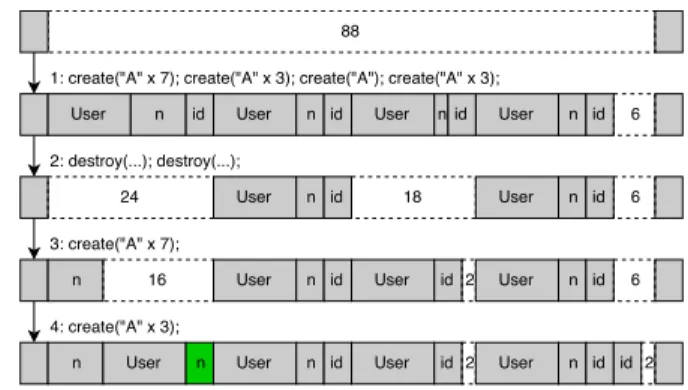
Figure 1: An series of interactions which result in a name buffer immediately prior to aUserstructure.
As the attacker cannot directly interact with the al-locator, the desired heap layout must be achieved in-directly utilising those functions in the target’s API which perform allocations and deallocations. While the create and destroy functions do allow the attacker to make allocations and deallocations of a controllable size, other allocator interactions that are unavoidable also take place, namely the allocation and deallocation of the buffers for theUserandid. We refer to these unwanted interactions asnoise, and such interactions, especially al-locations, can increase the difficulty of the problem by placing buffers between the source and destination.
Figure 1 shows one possible sequence in which the createanddestroyfunctions are used to craft the de-sired heap layout.2 The series of interactions performed
by the attacker are as follows:
1. Four users are created with names of length 7, 3, 1, and 3 letters, respectively.
2. The first and the third user are destroyed, creating two holes: One of size 24 and one of size 18. 3. A user with a name of length 7 is created. The
al-locator uses the hole of size 18 to satisfy the alloca-tion request for the 12-byteUserstructure, leaving 6 free bytes. The request for the 8-byte name buffer is satisfied using the 24-byte hole, leaving a hole of 16 bytes. An allocation of 4 bytes for the idthen reduces the 6 byte hole to 2.
4. A user with a name of length 3 is created. The 16-byte hole is used for theUserobject, leaving 4 bytes into which the name buffer is then placed. This re-sults in the name buffer, highlighted in green, being directly adjacent to aUserstructure.
Once this layout has been achieved an overflow can be triggered using therename function, corrupting the 2Assume a best-fit allocator using last-in-first-out free lists to store
free chunks, no limit on free chunk size, no size rounding and no inline allocator meta-data. Furthermore, assume that pointers are 4 bytes in size and that aUserstructure is 12 bytes in size.
displayfield of theUserobject. The control flow of the application can then be hijacked by calling thedisplay function with the corruptedUserobject as an argument.
1.2
Contributions
Our contributions are as follows:
1. An analysis of the heap layout manipulation prob-lem as a standalone task within the context of auto-matic exploit generation, outlining its essential as-pects and describing the factors which influence its complexity.
2. SIEVE3, an open source framework for construct-ing benchmarks for heap layout manipulation and evaluating algorithms.
3. A pseudo-random black box search algorithm for heap layout manipulation. Using SIEVE, we evalu-ate the effectiveness of this algorithm on three real-world allocators, namelydlmalloc,avrlibcand tcmalloc.
4. An architecture, and proof-of-concept implementa-tion, for a system that integrates automatic HLM into the exploit development process. The im-plementation, SHRIKE4, automatically solves heap layout constraints that arise when constructing ex-ploits for thePHPinterpreter. SHRIKE also demon-strates a novel approach to integrating an automated reasoning engine into the exploit development pro-cess.
2
The Heap Layout Manipulation Problem
in Deterministic Settings
As of 2018, the most common approach to solving heap layout manipulation problems is manual work by ex-perts. An analyst examines the allocator’s implementa-tion to gain an understanding of its internals; then, at run-time, they inspect the state of its various data structures to determine what interactions are necessary in order to manipulate the heap into the required layout.
Heap layout manipulation primarily consists of two activities: creating and fillingholesin memory. A hole is a free area of memory of a particular size. Holes are filled to force the positioning of an allocation of a particular size elsewhere, or the creation of a fresh area of memory under the management of the allocator. Holes are cre-ated to capture allocations that would otherwise interfere with the layout one is trying to achieve. This process is documented in the literature of the hacking and com-puter security communities, with a variety of papers on the internals of individual allocators [1, 4, 20, 22], as well
3Source code to be released upon publication 4Source code to be released upon publication
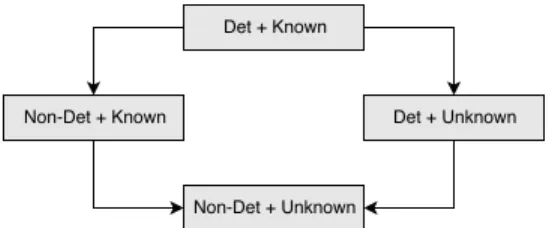
Figure 2: The challenges in achieving a particular layout vary depending on whether the allocator behaves deter-ministically or non-deterdeter-ministically and whether or not the starting state of the heap is known.
as the manipulation and exploitation of those allocators when embedded in applications [3, 19, 26].
The process is complicated by the fact that – when constructing an exploit – one cannot directly interact with the allocator, but instead must use the API exposed by the target program. Manipulating the heap state via the program’s API is often referred to asheap feng shui in the computer security literature [27]. Discovering the relationship between program-level API calls and alloca-tor interactions is a prerequisite for real-world HLM but can be addressed separately, as we demonstrate in sec-tion 4.2.
2.1
Problem
Restrictions
for
a
Deterministic Setting
There are four variants of the HLM problem, as shown in Figure 2, depending on whether the allocator is deterministic5 or non-deterministic and whether the starting state is known or unknown. In this paper we con-sider a known starting state and a deterministic allocator, as it both corresponds to a set of real world exploitation scenarios and provides a building block for addressing the other three problem variants.
In the ‘deterministic allocator, known starting state’ problem variant there three restrictions:
1. The allocator’s behaviour is deterministic.
2. The starting state of the heap must be known or the attacker must have a means by which to force the heap into a known state.
3. There are no other actors interacting with the heap, or if there are then their interactions are deterministic and known, in terms of what the in-teraction is and when it takes place.
Local privilege escalation exploits are a scenario in which these restrictions are usually met, although some 5A deterministic allocator is one that does not utilise any
ran-dom behaviour when servicing allocation requests. The majority of allocators are deterministic but some, such as theWindowssystem al-locator andjemalloc, do utilise non-determinism to make exploitation more difficult
remote, and client-side, targets offer the ability for an at-tacker to force the creation of a heap in a known state and with which they are the only actor interacting (e.g. by the creation of a Web Worker in Firefox or Chrome).
When unknown starting states and non-determinism must be dealt with, approaches such as allocating a large number of objects on the heap in the hope of corrupting one when the vulnerability is triggered are often used. However, in the problem variant we address it is usually possible to position the overflow source relative to a spe-cifictarget buffer. Thus our objective in this variant of the HLM problem is as follows:
Given the API for a target program and a means by which to allocate a source and desti-nation buffer, find a sequence of API calls that position the destination and source at a spe-cific offset from each other.
2.2
Challenges
There are several challenges to that arise when trying to perform HLM and when trying to construct a general, automated solution. In this section we outline those that are most likely to be significant.
2.2.1 Interaction Noise
Before continuing we first must informally define the concept of an ‘interaction sequence’: an allocator in-teraction is a call to one of its allocation or dealloca-tion funcdealloca-tions, while an interaction sequence is a list of one or more interactions that result from the invo-cation of a function in the target program’s API. As an attacker cannot directly invoke functions in the alloca-tor they must manipulate the heap via the available in-teraction sequences. As an example, when thecreate function from Listing 1 is called the resulting interaction sequence consists of three interactions in the form of the three calls tomalloc. Thedestroyfunction also pro-vides an interaction sequence of length three, in this case consisting of three calls tofree.
For a given interaction sequence there can be interac-tions that are beneficial, and assist with manipulation of the heap into a layout that is desirable, and also interac-tions that are either not beneficial (but benign), or in fact are detrimental to the heap state in terms of the layout one is attempting to achieve. We deem those interactions that are not actively manipulating the heap into a desir-able state to benoise.
For example, thecreatefunction from Listing 1 pro-vides the ability to allocate buffers between 2 and 8 bytes in size by varying the length of thename param-eter. However, two other unavoidable allocations also take place – one for theUser structure and one for the id. As shown in Figure 1, some effort must be invested
in crafting the heap layout to ensure that the noisyid al-location is placed out of the way and anameandUser structure end up next to each other.
2.2.2 Constraints on Allocator Interactions
An attacker’s access to the allocator is limited by what is allowed by the program they are interacting with. The interface available may limit the sizes that may be allo-cated, the order in which they may be allocated and deal-located, and the number of times a particular size may be allocated or deallocated. Depending on the heap layout that is desired, these constraints may make the desired layout more complex to achieve, or even impossible.
2.2.3 Diversity of Allocator Implementations
The open ended nature of allocator design and imple-mentation means any approach that involves the produc-tion of a formal model of a particular allocator is going to be costly and likely limited to a single allocator, and perhaps even a specific version of that allocator. While avrlibcis a mere 350 lines of code, most of the other allocators we consider contain thousands or tens of thou-sands of lines of code. Their implementations involve complex data structures, loops without fixed bounds, in-teraction with the operating system and other features that are often terminally challenging for semantics-aware analyses, such as model checking and symbolic execu-tion. A detailed survey of the data structures and algo-rithms used in allocators is available in [33].
2.2.4 Interaction Sequence Discovery
Since in most situations one cannot directly interact with the allocator, an attacker needs to discover what interac-tion sequences with the allocator can be indirectly trig-gered via the program’s API. This problem can be ad-dressed separately to the main HLM problem, but it is a necessary first step. In section 4.2 we discuss how we solved this problem for thePHPlanguage interpreter.
3
Automatic Heap Layout Manipulation
We now present our pseudo-random black box search al-gorithm for heap layout manipulation, and two evalua-tion frameworks we have embedded it in to perform heap layout manipulation on both synthetic benchmarks and real vulnerabilities. The algorithm is theoretically and practically straightforward. There are two strong moti-vations for initially avoiding complexity.
Firstly, there is no existing prior work on automatic HLM and a straightforward algorithm provides a base-line that future, more sophisticated, implementations can be compared against if necessary.
Second, despite the potential size of the problem mea-sured by the number of possible combinations of
avail-able interactions, there is significant symmetry in the so-lution space for many problem instances. Since our mea-sure of success is based on the relative positioning of two buffers, large equivalence classes of solutions exist as:
1. Neither the absolute location of the two buffers, nor their relative position to other buffers, matters. 2. The order in which holes are created or filled
usu-ally does not matter.
It is often possible to solve a layout problem using sig-nificantly differing input sequences. Due to these solu-tion space symmetries, we propose that a pseudo-random black box search could be a solution for a sufficiently large number of problem instances as to be worthwhile.
To test this hypothesis, and demonstrate its feasibility on real targets, we constructed two systems. The first, de-scribed in section 3.1 allows for synthetic experiments to be run against any allocator exposing the standard ANSI interface for dynamic memory allocation. The second system, described in section 3.2, is a fully automated HLM system designed to work with thePHPinterpreter.
3.1
SIEVE: An Evaluation Framework for
HLM Algorithms
To allow for the evaluation of search algorithms for HLM across a diverse array of benchmarks we constructed SIEVE. There are two components to SIEVE:
1. The SIEVE driver which is a program that can be linked with any allocator exposing themalloc, free, calloc andrealloc functions. As input it takes a file specifying a series of allocation and deallocation requests to make, and produces as out-put the distance from two particular allocations of interest. Allocations and deallocations are specified via directives of the following forms:
(a) <malloc size ID> (b) <calloc nmemb size ID> (c) <free ID>
(d) <realloc oldID size ID> (e) <fst size>
(f) <snd size>
Each of the first four directives are translated into an invocation of their corresponding memory manage-ment function, with theIDparameters providing an identifier which can be used to refer to the returned pointers frommalloc,callocandrealloc, when they are passed to free or realloc. The final two directives indicate the allocation of the two buffers that we are attempting to place relative to each other. We refer to the addresses that result from the corresponding allocations asaddrFstand
Algorithm 1 Find a solution which places two alloca-tions in memory at a specified distance from each other. gis the number of candidates to try,d the required dis-tance,mthe maximum candidate size andrthe ratio of allocations to deallocations for each candidate.
1: functionSEARCH(g,d,m,r)
2: fori←0,g−1do
3: cand←ConstructCandidate(m,r)
4: dist←Execute(cand)
5: ifdist=dthen 6: returninst 7: end if 8: end for 9: returnNone 10: end function
11: functionCONSTRUCTCANDIDATE(m,r)
12: cand←InitCandidate(GetStartingState())
13: len←Random(1,m)
14: f stIdx←Random(0,len−1)
15: fori←0,len−1do 16: ifi=f stIdxthen
17: AppendFstSequence(cand)
18: else ifRandom(1,100)≤rthen 19: AppendAllocSequence(cand) 20: else 21: AppendFreeSequence(cand) 22: end if 23: end for 24: AppendSndSequence(cand) 25: returncand 26: end function
addrSnd, respectively. After the allocation direc-tives for these buffers have been processed, the value of(addrFst−addrSnd)is printed.
2. The SIEVE framework which provides a Python API for running HLM experiments. It has a vari-ety of features for constructing candidate solutions, feeding them to the driver and retrieving the result-ing distance, which are explained below. This func-tionality allows one to focus on creating search al-gorithms for HLM.
SIEVE allows for flexible and scalable evaluation of new search algorithms, or testing existing algorithms on new allocators, new interaction sequences or new heap starting states. The framework is made freely available and can be used to test solutions to all variants of the HLM problem, not just the one we address here.
We implemented a pseudo-random search algorithm for HLM on top of SIEVE, and it is shown as Algo-rithm 1. The m and r parameters are what make the searchpseudo-random. While one could potentially use a completely random search, it makes sense to guide it
away from candidates that are highly unlikely to be use-ful due to extreme values formandr. There are a few points to note on the SIEVE framework’s API in order to understand the algorithm:
• The directives to be passed to the driver are represented in the framework via a Candidate class. TheInitCandidatefunction creates a new Candidate.
• Often one may want to experiment with performing HLM after a number of allocator interactions, repre-senting initialisation of the target applicationbefore the attacker can interact, have taken place. SIEVE can be configured with a set of such interactions that can be retrieved via theGetStartingState func-tion.InitCandidatecan be provided with the re-sult ofGetStartingState(line 12).
• The available interaction sequences impact the dif-ficulty of HLM, i.e. if an attacker can trig-ger individual allocations of arbitrary sizes they will have more precise control of the heap lay-out than if they can only make allocations of a single size. To experiment with changes in the available interaction sequences, the user of SIEVE overrides the AppendAllocSequenceand AppendFreeSequence6functions to select one of the available interaction sequences and append it to the candidate (lines 18-21).
• The directive to allocate the first buffer of interest is placed at a random offset within the candidate (line 17), with the directive to allocate the second buffer of interest placed at the end (line 24). To ex-periment with the addition of noise in the alloca-tion of these buffers, theAppendFstSequenceand AppendSndSequencefunctions can be overloaded. • TheExecutefunction takes a candidate, serialises it into the form required by the SIEVE driver, exe-cutes the driver on the resulting file and returns the distance output by the driver (line 4).
• As the value output by the driver is (addrFst− addrSnd), to search for a solution placing the buffer allocated firstbeforethe buffer allocated second, a negative value can be provided for thed parameter toSearch. Providing a positive value will search for a solution placing the buffers in the opposite or-der. In this manner overflows and underflows can be simulated, with either order of allocation for the source and destination (line 5).
The experimental setup used to evaluate pseudo-random search as a means for solving HLM problems on synthetic benchmarks is described in section 4.1.
6AppendFreeSequencefunction will detect if there are no
allo-cated buffers to free and redirect toAppendAllocSequenceinstead.
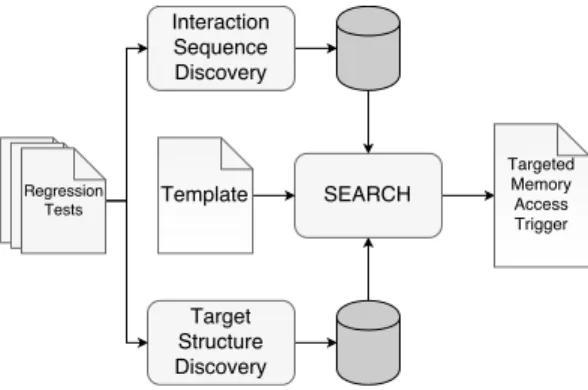
Figure 3: Architecture diagram for SHRIKE
3.2
SHRIKE: A HLM System for PHP
For real-world usage the search algorithm must be em-bedded in a system that solves a variety of other problems in order to allow the search to take place. To evaluate the feasibility of end-to-end automation of HLM we con-structed SHRIKE, a HLM system for thePHPinterpreter. We choosePHPas it is a large, modern application with a non-trivial interface for manipulating its internal state, and the state of its allocator; namely, programs written in thePHPlanguage. Furthermore,PHPis an interesting tar-get from a security point of view as the ability to exploit heap-based vulnerabilities locally inPHPallows attack-ers to increase their capabilities in situations where the PHPenvironment has been hardened [12].
The architecture of SHRIKE is shown in Figure 3. We implemented the system as three distinct phases:
• A component that identifies fragments ofPHPcode that provide distinct allocator interaction sequences (Section 3.2.1).
• A component that identifies dynamically allocated structures that may be useful to corrupt or read as part of an exploit, and a means to trigger their allo-cation (Section 3.2.2).
• A search procedure that pieces together the frag-ments triggering allocator interactions to produce PHP programs as candidates (Section 3.2.4). The user specifies how to allocate the source and desti-nation, as well as how to trigger the vulnerability, via a template (Section 3.2.3).
The first two components can be run once and the re-sults stored for use during the search. If successful, the output of the search is a newPHPprogram that manipu-lates the heap to ensure that when the specified vulnera-bility is triggered the destination buffer is either read or corrupted, depending on the vulnerability.
To support the functionality required by SHRIKE we implemented an extension forPHP. This extension pro-vides functions that can be invoked from aPHP script
to enable a variety of features including recording the allocations that result from invoking a fragment ofPHP code, monitoring allocations for the presence of inter-estingdata, and checking the distance between two allo-cations. We carefully implemented the functionality of this extension to ensure that it does not modify the heap layout of the target program in any way that would inval-idate search results. However, all results are valinval-idated by executing the solutions in an unmodified version ofPHP.
3.2.1 Identifying Available Interaction Sequences
To discover the available interaction sequences it is nec-essary to synthesise self-contained fragments of PHP code and determine the allocator interactions each frag-ment triggers. Correlating code fragfrag-ments with the re-sulting allocator interactions is straightforward: we mod-ify thePHPinterpreter to record the allocator interactions that result from executing a given fragment. This is done in a manner that does not modify the heap layout in any way, and so false positives are avoided. Synthesising valid fragments ofPHPcode that trigger a diverse set of allocator interactions is more involved.
We resolve the synthesis problem by implementing a fuzzer for thePHPinterpreter that leverages the regres-sion tests that come withPHP, in the form ofPHP pro-grams. This idea is based on previous work that used a similar approach for the purposes of vulnerability detec-tion [17,18]. The tests provide examples of the funcdetec-tions that can be called, as well as the number and types of their arguments. The fuzzer then uses mutation and com-bination to produce new fragments with new behaviours. To tune the fuzzer towards the discovery of fragments that are useful for HLM, as opposed to vulnerability dis-covery, we made the following modifications:
• We use mutations that are intended to produce an interaction sequence that we have not seen before, rather than a crash. For example, fuzzers will often replace integers with values that may lead to edge cases, such as 0, 232−1, 231−1 and so on. We
are interested in triggering unique allocator inter-actions however, and so we predominantly mutate tests using integers and string lengths that relate to allocation sizes we have not previously seen. • Our measure of fitness for a generated test is not
based on code coverage, as is often the case with vulnerability detection, but is instead based on whether a new allocator interaction sequence is pro-duced, and the length of that interaction sequence. • We discard any fragments that result in the
inter-preter exiting with an error.
• We favour the shortest, least complex fragments with priority being given to fragments consisting of a single function call.
1 $image = imagecreatetruecolor(180, 30); 2 imagestring($image, 5, 10, 8, "Text",
0x00ff00);
3 $gaussian = array(
4 array(1.0, 2.0, 1.0),
5 array(2.0, 4.0, 2.0)
6 );
7 var_dump(imageconvolution($image, $gaussian,
16, 0));
Listing 2: Source for aPHPtest program.
1 imagecreatetruecolor(I, I) 2 imagestring(R, I, I, I, T, I) 3 array(F, F, F) 4 array(R, R) 5 var_dump(R) 6 imageconvolution(R, R, I, I)
Listing 3: The function fuzzing specifications produced from parsing Listing 2. The letters replacing the function arguments indicate their types. ‘R’ for a resource, ‘I’ for an integer, ‘F’ for a float and ‘T’ for text.
As an example, lets discuss how the regression test in Listing 2 would be used to discover interaction sequences. From the regression test the fuzzing speci-fication shown in Listing 3 is automatically produced. Fuzzing specifications indicate the name of functions that can be called, along with the types of their argu-ments. SHRIKE then begins to fuzz the discovered functions, using the specifications to ensure the correct types are provided for each argument. For example, the code fragments$x = imagecreatetruecolor(1, 1), $x = imagecreatetruecolor(1, 2), $x = imagecreatetruecolor(1, 3) etc. might be cre-ated and executed to determine what, if any, allocator interactions they trigger.
The output of this stage is a mapping from fragments of PHPcode to a summary of the allocator interaction sequences that occur as a result of executing that code. The summary includes the number and size of any allo-cations, and whether the sequence triggers any frees.
3.2.2 Automatic Identification of Target Structures
In most programs there is a diverse set of dynamically allocated structures that one could corrupt or read to vi-olate some security property of the program. These tar-gets may be program-specific, such as values that guard a sensitive path; or they may be somewhat generic, such as a function pointer. Identifying these targets, and how to dynamically allocate them, can be a difficult manual task in itself. To further automate the process we
imple-mented a component that, as with the fuzzer, splits the PHPtests into standalone fragments and then observes the behaviour of these fragments when executed. If the fragment dynamically allocates a buffer and writes what appears to be a pointer to that buffer, we consider it to be a potentially interesting corruption target and store the fragment. The user can indicate in the template which of the discovered corruption targets to use, or the system can automatically select one.
3.2.3 Specifying Candidate Structure
Different vulnerabilities inPHPrequire different setup in order to trigger e.g. the initialisation of required objects or the invocation of multiple functions. To avoid hard-coding vulnerability-specific information in the candi-date creation process, we allow for the creation of can-didate templates that define the structure of a cancan-didate. A template is a normalPHPprogram with the addition of directives starting with#X-SHRIKE7. The template is processed by SHRIKE and the directives inform it how candidates should be produced and what constraints they must satisfy to solve the HLM problem. The supported directives are as follows:
• <HEAP-MANIP [sizes]> Indicates a location where SHRIKE can insert heap-manipulating sequences. Thesizesargument is an optional list of integers indicating the allocation sizes that the search should be restricted to.
• <RECORD-ALLOC offset id> Indicates that SHRIKE should inject code to record the address of an allocation and associate it with the provided id argument. The offset argument indicates the allocation to record. Offset 0 is the very next allocation, offset 1 the one after that, and so on. • <REQUIRE-DISTANCE idx idy dist> Indicates
that SHRIKE should inject code to check the dis-tance between the pointers associated with the pro-vided IDs. Assumingxandyare the pointers asso-ciated withidxandidyrespectively, then if(x−y=
dist) SHRIKE will report the result to the user, indicating this particular HLM problem has been solved. If(x−y6=dist)then the candidate will be discarded and the search will continue.
A sample template for CVE-2013-2110, a heap-based buffer overflow inPHP, is shown in Listing 4. In sec-tion 4.3 we explain how this template was used in the construction of a control-flow hijacking exploit forPHP.
3.2.4 Search
The search in SHRIKE is outlined in Algorithm 2. It takes in a template, parses it and then synthesises and 7As the directives begin with a ‘#’ they will be interpreted by the
normalPHPinterpreter as a comment and thus can be run in both our modified interpreter and an unmodified one.
1 <?php 2 $quote_str = str_repeat("\xf4", 123); 3 #X-SHRIKE HEAP-MANIP 4 #X-SHRIKE RECORD-ALLOC 0 1 5 $image = imagecreate(1, 2); 6 #X-SHRIKE HEAP-MANIP 7 #X-SHRIKE RECORD-ALLOC 0 2 8 quoted_printable_encode($quote_str); 9 #X-SHRIKE REQUIRE-DISTANCE 1 2 0 10 ?>
Listing 4: Exploit template for CVE-2013-2110
executesPHPprograms until a solution is found or the execution budget expires. Candidate creation is shown in theInstantiatefunction. Its first argument is a rep-resentation of the template as a series of objects. The ob-jects represent either SHRIKE directives or normal PHP code and are processed as follows:
• The HEAP-MANIP directive is handled via the GetHeapManipCode function (line 15). The database, constructed as described in section 3.2.1, is queried for a series ofPHPfragments, where each fragment allocates or frees one of the sizes speci-fied in the sizesargument to the directive in the template. If no sizes are provided then all available fragments are considered. If multiple fragments ex-ist for a given size then selection is biased towards fragments with less noise. Between 1 andm frag-ments are selected and returned. The rparameter controls the ratio of allocations to frees.
• The RECORD-ALLOC directive is handled via the GetRecordAllocCode function (line 17). APHP fragment is returned consisting of a call to a func-tion in our extension for PHP that associates the specified allocation with the specified ID.
• The REQUIRE-DISTANCE directive is handled via theGetRequireDistanceCodefunction (line 19). APHPfragment is returned with two components. Firstly, a call to a function in ourPHPextension that queries the distance between the pointers associated with the given IDs. Secondly, a conditional state-ment that prints a success indicator if the returned distance equals thedistanceparameter.
• All code that is not a SHRIKE directive is included in each candidate verbatim (line 21).
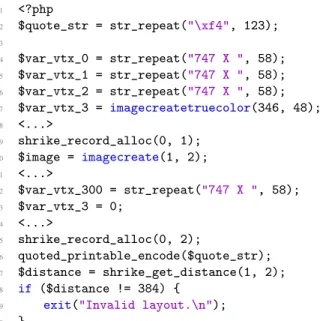
TheExecutefunction (line 5) converts the candidate into a validPHPprogram and invokes thePHPinterpreter on the result. It checks for the success indicator printed by the code inserted to handle theREQUIRE-DISTANCE directive. If that is detected then the solution program is reported. Listing 5 in the appendix shows a solution
Algorithm 2Solve the HLM problem described in the provided templatet.gis the number of candidates to try, dthe required distance,mthe maximum number of frag-ments that can be inserted in place of eachHEAP-MANIP directive, and r the ratio of allocations to deallocation fragments used in place of eachHEAP-MANIPdirective.
1: functionSEARCH(t,g,m,r)
2: spec←ParseTemplate(t)
3: fori←0,g−1do
4: cand←Instantiate(spec,m,r)
5: ifExecute(cand)then 6: returncand
7: end if 8: end for 9: returnNone
10: end function
11: functionINSTANTIATE(spec,m,r)
12: cand←NewPHPProgram()
13: whilen←Iterate(spec)do 14: ifIsHeapManip(n)then
15: code←GetHeapManipCode(n,m,r)
16: else ifIsRecordAlloc(c)then 17: code←GetRecordAllocCode(n)
18: else ifIsRequireDistance(n)then 19: code←GetRequireDistanceCode(n)
20: else
21: code←GetVerbatim(n)
22: end if
23: AppendCode(cand,code)
24: end while 25: returncand
26: end function
produced from the template in Listing 4.
4
Experiments and Evaluation
The research questions we address are as follows: • RQ1: What factors most significantly impact the
difficulty of the heap layout manipulation problem in a deterministic setting?
• RQ2: Is pseudo-random search an effective ap-proach to heap-layout manipulation?
• RQ3: Can heap layout manipulation be automated effectively for real-world programs?
We conducted two sets of experiments. Firstly, to in-vestigate the fundamentals of the problem we utilised the system discussed in section 3.1 to conduct a set of synthetic experiments involving differing combinations of heap starting states, interaction sequences, source and destination sizes, and allocators. We chose the
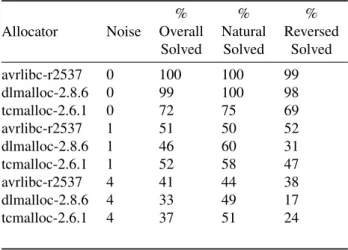
Table 1: Synthetic benchmark results after 500,000 can-didate solutions generated, averaged across all starting se-quences. The full results are in Table 4 in the appendix. All experiments were run 10 times and the results presented are an average. Allocator Noise % Overall Solved % Natural Solved % Reversed Solved avrlibc-r2537 0 100 100 99 dlmalloc-2.8.6 0 99 100 98 tcmalloc-2.6.1 0 72 75 69 avrlibc-r2537 1 51 50 52 dlmalloc-2.8.6 1 46 60 31 tcmalloc-2.6.1 1 52 58 47 avrlibc-r2537 4 41 44 38 dlmalloc-2.8.6 4 33 49 17 tcmalloc-2.6.1 4 37 51 24
tcmalloc (v2.6.1), dlmalloc (v2.8.6) and avrlibc (v2.0) allocators for experimentation. These allocators have significantly different implementations and are used in many real world applications.
An important difference between the allocators used for evaluation is thattcmalloc(andPHP) make use of segregated storage, whiledlmallocandtcmallocdo not. In short, for small allocation sizes (e.g. less than a 4KB) segregated storage pre-segments runs of pages into chunks of the same size and will then only place allocations of that size within those pages. Thus, only allocations of the same, or similar, sizes may be adjacent to each other, except for the first and last allocations in the run of pages which may be adjacent to the last or first allocation from other size classes.
Secondly, to evaluate the viability of our search algo-rithm on real world applications we ran SHRIKE on 30 different layout manipulation problems in PHP. All ex-periments were carried out on a server with 80 Intel Xeon E7-4870 2.40GHz cores and 1TB of RAM, utilising 40 concurrent analysis processes.
4.1
Synthetic Experiments
The goal of the synthetic experiments is to discover the factors which influence the difficulty of problem in-stances and to highlight the capabilities and limitations of our search algorithm in an environment that we precisely control. The experiments were configured as follows:
• As mentioned, in real world scenarios it is often the case that the available interaction sequences are noisy. We evaluated the effect of prefixing and suf-fixing both the source and destination allocations
Figure 4: For an allocator that splits chunks from the start of free blocks, the natural order, shown on the left, of allocating the source and then the destination produces the desired layout, while the reversed order, shown on the right, results in an incorrect layout.
with varying amounts of noise.
• For each source and destination combination, we made available to the analyser an interaction se-quence which triggers an allocation of the source size, an interaction sequence which triggers an al-location of the destination size, and interaction se-quences for freeing each of the allocations.
• We initialise the heap state prior to executing the in-teractions from a candidate by prefixing each candi-date with a set of interactions. Previous work [33] has outlined the drawbacks that arise when using randomly generated heap states to evaluate alloca-tor performance. To avoid these drawbacks we cap-tured the initialisation sequences ofPHP8,Python andRuby to use in our experiments. A summary of the relevant properties of these initialisation se-quences can be found in the appendices in table 2. • As it is not feasible to evaluate layout manipulation
for all possible combinations of source and destina-tion sizes, we selected 6 sizes which we deemed to be both likely to occur in real world problems and to exercise different allocator behaviour. The sizes we selected are 8, 64, 512, 4096, 16384 and 65536. For each pair of sizes (x,y)there are four experi-ments to be run: xallocated first overflowing into y,xallocated first underflowing intoy,yallocated first overflowing intox, andyallocated first under-flowing intox. Thus from the six sizes selected we end up with 72 experiments to run for each com-bination of allocator, noise and starting state (2592 experiments in total).
The mand rparameters to Algorithm 1 were set to 1000 and .98 respectively, based on our intuition as to the likely maximum length of a solution and the ratio of heap filling to hole creation required. Theg parameter was set to 500,000. A larger value would have provided 8PHPmakes use of both the system allocator and its own
alloca-tor. We captured the initialisation sequences for both, giving us four different starting states in total.
Figure 5: A solution for the reversed allocation order to corruption direction relationship. A hole is created via a placeholder which can then be used for the source.
more opportunities for the search algorithm to find solu-tions but with 2592 total experiments to run, and 500,000 executions taking in the range of 5-15 minutes depend-ing on the number of interactions in the startdepend-ing state, this was the maximum viable value given our computa-tional resources. The results of the experiments averaged across all starting states can be found in Table 1, with the full results in the appendices in Table 4.
To understand the ‘% Natural’ and ‘% Reversed’ columns in the results table we must define the concept of theallocation order to corruption direction relation-ship. We refer to the case of the allocation of the source of an overflow first, followed by its destination, or the allocation of the destination of an underflow first, fol-lowed by its source as thenaturalrelationship. This is because most allocators split space from the start of free chunks and thus for an overflow if the source and desti-nation are both split from the same chunk and the source is allocated first then it will naturally end up before the destination, and the reverse holds for an underflow. We refer to the relationship asreversedin the case of the al-location of the destination first followed by the source for an overflow, or the allocation of the source first fol-lowed by the destination for an underflow. We expect this case to be harder to solve for most allocators, as the so-lution is more complex than for thenaturalrelationship. A visualisation of this idea can be seen in Figure 4 and a solution for the reversed case is shown in Figure 5.
From the experiments a number of points emerge: • When segregated storage is not in use, as with
dlmalloc and avrlibc, and when there is no noise, 98% to 100% of the benchmarks are solved. • Segregated storage significantly increases problem
difficulty. With no noise, the overall success rate drops to 72% fortcmalloc.
• With the addition of a single noisy allocation, the overall success rate drops to close to 50% across all
allocators.
• The order of allocation for the source and destina-tion matters. A layout conforming to the natural allocation order to corruption direction relationship was easier to find in all problem instances. With four noisy allocations the success rate for problems involving the natural allocation order ranges from 44% to 51%, but drops to between 17% and 38% for the reversed order. It is also worth noting that the difference in success rate between natural and reversed problem instances is lower for avrlibc than fordlmallocandtcmalloc. This is because in some situations avrlibc will split space from free chunks from the end instead of from the start, in effect swapping the natural and reversed orders. • We ran each experiment 10 times, and if all 10 times
500,000 executions are taken together then 78% of the benchmarks are solvedat leastonce. In other words, only 22% of the benchmarks were never solved by our approach, which is quite encouraging given the simplicity of the algorithm.
4.2
PHP Experiments
To determine if automatic HLM is feasible in real world scenarios we selected three vulnerabilities that result in OOB memory access on the heap and ten dynamically al-located structures that were identified by SHRIKE as be-ing useful corruption targets (namely structures that have pointers as their first field). An experiment was then run for each vulnerability paired with each target structure in which SHRIKE was used to search for an input which would place the source buffer and destination buffer ad-jacent to each other.
A successful outcome means the system can discover how to interact with the underlying allocator viaPHP’s API, identify how to allocate sensitive data structures on the heap, and construct aPHPprogram which places such a structure adjacent to the source of an OOB mem-ory access. This saves an exploit developer a significant amount of effort, allowing them to focus on how to lever-age the resulting OOB memory access.
We utilised the following vulnerabilities in our evalu-ation:
• CVE-2015-8865. An out-of-bounds write vulnera-bility inlibmagicthat is triggerable viaPHPup to version 7.0.4.
• CVE-2016-5093. An out-of-bounds read vulnera-bility inPHPup to version 7.0.7, related to string processing and internationalisation.
• CVE-2016-7126. An out-of-bounds write vulnera-bility inPHPup to version 7.0.10, related to image processing.
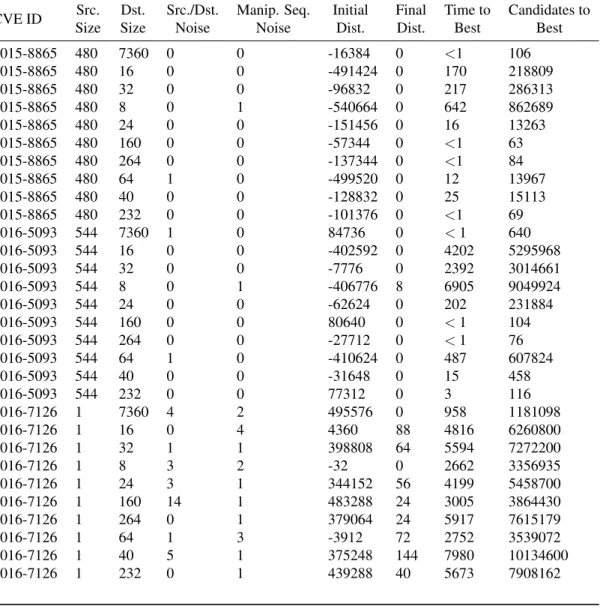
The ten target structures are described in the appendix in Table 3 and the full details of all 30 experiments can be found in Table 5. As with the synthetic experiments, themandrarguments to theSearchfunction were set to 1000 and .98 respectively. Instead of limiting the number of executions via thegparameter the maximum run time for each experiment was set to 12 hours. The following summarises the results:
• SHRIKE succeeds in producing a PHP program achieving the required layout in 21 of the 30 exper-iments run and fails in 9 (a 70% success rate). • There are 15 noise-free experiments of which
SHRIKE solves 100%, and 15 noisy experiments of which SHRIKE solves 40%. This follows what one would expect from the synthetic experiments. • In the successful cases the analysis took on average
571 seconds and 720,000 candidates.
Of the nine experiments in which SHRIKE does not solve, eight involve CVE-2016-7126. The most likely reason for the difficulty of experiments using this vul-nerability is noise in the interaction sequences involved. The source buffer for this vulnerability results from an allocation request of size 1, whichPHProunds up to 8 – an allocation size that is quite common throughoutPHP, and prone to occurring as noise. There is a noisy al-location in the interaction sequence which allocates the source buffer itself, several of the interaction sequences which allocate the target structures also have noisy al-locations, and all interaction sequences which SHRIKE discovered for making allocations of size 8 involve at least one noisy allocation. For example, the shortest se-quence discovered for making an allocation of size 8 is a call toimagecreate(57, 1)which triggers an allo-cation of size 7360, two alloallo-cations of size 8 and two allocations of size 57. In contrast, there is little or no noise involved in the experiments utilising CVE-2016-5093 and CVE-2015-8865.
4.3
Generating a Control-Flow Hijacking
Exploit for PHP
To show that SHRIKE can be integrated into the devel-opment of a full exploit we selected another vulnerabil-ity inPHP. CVE-2013-2110 allows an attacker to write a NULL byte immediately after the end of a heap-allocated buffer. One must utilise that NULL byte write to corrupt a location that will enable more useful exploitation prim-itives. Our aim is to convert the NULL byte write into both an information leak to defeat ASLR and the ability to modify arbitrary memory locations.
We first searched SHRIKE’s database for interaction sequences that allocate structures that have a pointer as their first field. This lead us to the imagecreate func-tion which creates a gdImagestructure. This structure
uses a pointer to an array of pointers to represent a grid of pixels in an image. By corrupting this pointer via the NULL byte write, and then allocating a buffer we control at the location it points to post-corruption, an attacker can control the locations that are read and written from when pixels are read and written.
Listing 4 shows the template provided to SHRIKE. In less than 10 seconds SHRIKE finds an input that places the source immediately prior to the destination. Thus the pointer that is the first attribute of thegdImagestructure is corrupted. Listing 5 in the appendices shows part of the automatically generated solution. After the corrup-tion occurs the required memory read and write primi-tives can be easily achieved by allocating a controllable buffer into the location where the corrupted pointer now points. For brevity we leave out the remaining details of the exploit, but it can be found in full in the SHRIKE repository. The end result is aPHPscript that hijacks the control flow of the interpreter and spawns a shell.
4.4
Research Questions
RQ1: What factors most significantly impact the dif-ficulty of the heap layout manipulation problem in a deterministic setting?
The following factors had the most significant impact on problem difficulty:
• Noise. In the synthetic experiments noise clearly impacts difficulty. As more noise is added, more holes typically have to be created. In the worst case (dlmalloc) we see a drop off from a 99% overall success rate to 33% when four noisy allo-cations are included. A similar success rate is seen foravrlibcandtcmallocwith four noisy alloca-tions. In the evaluation onPHPnoise again played a significant role, with SHRIKE solving 100% of noise-free instances and 40% of noisy instances. • Segregated storage. In the synthetic benchmarks
segregated storage leads to a decline in the over-all success rate on noise-free instances from 100%-99% to 72%.
• Allocation order to corruption direction rela-tionship. For all configurations of allocator, noise and starting state, the problems involving the natu-ral order were easier. For the noise-free instances on avrlibcanddlmallocthe difference is in terms of solved problems is just 1%-2%, but as noise is introduced the success rate between the natural and reversed experiments diverges. Fordlmallocwith four noisy allocations the success rate for the natu-ral order is 49% but only 17% for the reversed order, a difference of 32%.
RQ2: Is pseudo-random search an effective ap-proach to heap-layout manipulation?
Without segregated storage, when there is no noise then 99% of problems were solved, with most experi-ments taking 15 seconds or less. As noise is added the rate of success drops to 44% and 49% for a single noisy allocation, fordlmallocandavrlibcrespectively, and then to 30% and 39% for four noisy allocations. The ex-tra consex-traints imposed on layout by segregated storage present more of a challenge. On noise-free runs the rate of success is 72% and drops to 57% and 51% as one and four noisy allocations, respectively, are added. However, as noted in section 4.1, if all 30 runs of each experiment are considered together then 78% of the benchmarks are solved at least once.
Overall, on the synthetic experiments it is clear that the effectiveness of pseudo-random search varies depending on whether segregated storage is in use, the amount of noise, the allocation order to corruption direction rela-tionship and the available computational resources. In the best case scenarios pseudo-random search can solve problem instances in seconds, while in the more diffi-cult ones it still attains a high enough success rate to be worthwhile given its simplicity.
When embedded in SHRIKE, pseudo-random search approach also proved effective, with similar caveats re-lating to noise. 100% of noise-free problems were solved, while 40% of those involving noise were. On av-erage the search took less than 10 minutes and 750,000 candidates, for instances on which it succeeded.
RQ3: Can heap layout manipulation be automated effectively for real-world programs?
Our experiments with PHP indicate that automatic HLM can be performed effectively for real world pro-grams. As mentioned in RQ2, SHRIKE had a 70% suc-cess rate overall, and a 100% sucsuc-cess rate in cases where there was no noise.
SHRIKE demonstrates that it is possible to automate the process in an end-to-end manner, with automatic dis-covery of a mapping from the target program’s API to in-teraction sequences, discovery of interesting corruption targets, and search for the required layout. Furthermore, SHRIKE’s template based approach show that a system with these capabilities can be naturally integrated into the exploit development process.
4.5
Generalisability
Regarding generalisability, our experiments are not ex-haustive and care must be taken in extrapolating to benchmarks besides those presented. However, we be-lieve that the presented search algorithm and architecture for SHRIKE are likely to work similarly well with other language interpreters, for two reasons. Firstly, the search algorithm has demonstrated its capabilities on a diverse set of synthetic benchmarks. Secondly, the approach in SHRIKE of using regression tests to seed the generation
of new programs is based on previous work on vulner-ability detection that has been shown to work on inter-preters for Javascript and Ruby, as well as PHP [17, 18].
4.6
Threats to Validity
The results in our synthetic evaluation could be affected by our choice of source and destination sizes. There may be combinations of these that trigger pathological behaviour in the allocators we have evaluated that we are unaware of. A different set of starting sequences, or available interaction sequences may also impact the re-sults. We have attempted to mitigate these issues by se-lecting a diverse set of sizes, capturing starting sequences from multiple programs and allowing the analysis engine to utilise only a minimal set of interaction sequences.
Our non-synthetic results are affected by our choice of vulnerabilities and target data structures, and we could have inadvertently selected for cases that are outliers. We have attempted to mitigate this possibility by util-ising ten different target structures and vulnerabilities in three completely different sub-components ofPHP.
The limitation of our evaluation to a language inter-preter also poses a threat, as the available interaction se-quences may differ when other classes of target program are considered. We have attempted to mitigate this threat by limiting the interaction sequences used to those that contain an allocation of a size equal to one of the allo-cation sizes found in the sequences which allocate the source and destination.
5
Related Work
The hacking and security communities have exten-sively published on reverse engineering heap implemen-tations [30, 34], leveraging weaknesses in those imple-mentations for exploitation [21, 23, 24], and heap layout manipulation for exploitation [19,22]. There is also work on constructing libraries for debugging heap internals [8] and libraries which wrap an application’s API to pro-vide layout manipulation primitives [27]. Manually con-structed solutions for heap layout manipulation in non-deterministic settings are also commonplace in the liter-ature of the hacking and security communities [6, 15].
Several papers [5, 7, 16] have focused on the AEG problem. These implementations are based on sym-bolic execution and exclusively focus on exploitation of stack-based buffer overflows. More recently, as part of the DARPA Cyber Grand Challenge [10] (CGC), a number automated systems [13, 14, 28, 29] were devel-oped which combine symbolic execution and high per-formance fuzzing to identify, exploit and patch software vulnerabilities in an autonomous fashion. As with ear-lier systems, none of the CGC participants appear to
specifically address the challenges of heap-based vul-nerabilities. Over the course of the CGC finals only a single heap-based vulnerability was successfully ex-ploited [11]. No details are available on how this was achieved but it would seem likely that this was an inad-vertent success, rather than a solution which explicitly attempted to reason about heap-based exploitation.
In [25] the authors present work on exploit generation for heap-based vulnerabilities that is orthogonal to ours. Using a driver program the system first builds a database of conditions on the heap layout that, if met, would al-low for an exploit to be produced. Then, an exploit can be generated for a real program if an input is provided that places the heap into the state that is found in the database. For all but the most trivial of layout require-ments, and unhardened allocators, it is highly unlikely this condition will be satisfied by a vulnerability trigger taken directly from a fuzzer, or similar tool. In this pa-per we have demonstrated an approach to producing in-puts that satisfy heap layout constraints, and thus could be used to process vulnerability triggers into inputs that meet the requirements of their system.
In Vanegue [32] defines a calculus for a simple heap allocator and also provides a formal definition [31] of the related problem of automatically producing inputs which maximise the likelihood of reaching a particular program state given a non-deterministic heap allocator.
6
Conclusion
In this paper we have outlined the heap layout manipulation problem as a distinct task within the con-text of automated exploit generation. We have presented a simple, but effective, algorithm for HLM in the case of a deterministic allocator and a known starting state, and shown that it can produce the required layout in a sig-nificant number of synthetic experiments. We have also described an end-to-end system for HLM and shown that it is effective when used with real vulnerabilities in the PHPinterpreter.
Finally, we have demonstrated how a system for au-tomatic HLM can be integrated into the exploit develop-ment process. The directives provided by SHRIKE allow the exploit developer to focus on the higher level con-cepts in the exploit, while letting SHRIKE resolve heap layout constraints. To the best of our knowledge, this is a novel approach to adding automation to exploit gen-eration, and shows how an exploit developer’s domain knowledge and creativity can be combined with auto-mated reasoning engines to produce exploits. Further re-search is necessary to expand on the concept, but we be-lieve such human-machine hybrid approaches are likely to be an effective means of producing exploits for real systems.
References
[1] Anonymous, “Once Upon a free(),” http://phrack.com/issues/57/9.html, Aug. 11 2001.
[2] ANSI X3.159-1989, American National Standard Programming Language C, Dec. 14 1990.
[3] argp, “OR’LYEH? The Shadow over Firefox,” http://phrack.com/issues/69/14.html, May 6 2016. [4] argp and huku, “Pseudomonarchia jemallocum,”
http://phrack.com/issues/68/10.html, Apr. 14 2012. [5] T. Avgerinos, S. K. Cha, B. L. T. Hao, and D. Brum-ley, “AEG: Automatic Exploit Generation,” in Net-work and Distributed System Security Symposium, Feb. 2011.
[6] D. Blazakis, “Interpreter Exploitation. Pointer In-ference and JIT Spraying,” inBlackhat USA, 2010. [7] D. Brumley, P. Poosankam, D. Song, and J. Zheng, “Automatic Patch-Based Exploit Generation is Pos-sible: Techniques and Implications,” in Proceed-ings of the 2008 IEEE Symposium on Security and Privacy, ser. SP ’08. Washington, DC, USA: IEEE Computer Society, 2008, pp. 143–157.
[8] CENSUS, “Shadow,”
https://github.com/CENSUS/shadow.
[9] S. K. Cha, T. Avgerinos, A. Rebert, and D. Brum-ley, “Unleashing Mayhem on Binary Code,” in Pro-ceedings of the 2012 IEEE Symposium on Security and Privacy, ser. SP ’12. Washington, DC, USA: IEEE Computer Society, 2012, pp. 380–394. [10] DARPA, Cyber Grand Challenge, 2016.
[Online]. Available: http://archive.darpa.mil/ cybergrandchallenge/
[11] C. Eagle, “Re: DARPA CGC Recap.” [Online]. Available: http://seclists.org/dailydave/2017/q2/2 [12] S. Esser, “State of the Art Post Exploitation in
Hardened PHP Environments,” in Blackhat USA, 2009.
[13] ForAllSecure, Feb. 9 2016. [Online]. Avail-able: https://forallsecure.com/blog/2016/02/09/ unleashing-mayhem/
[14] GrammaTech, http://blogs.grammatech.com/the-cyber-grand-challenge, Sep. 26 2016.
[15] R. Hay, “Exploitation of CVE-2009-1869,” https://securityresear.ch/2009/08/03/exploitation-of-cve-2009-1869/.
[16] S. Heelan, “Automatic Generation of Control Flow Hijacking Exploits for Software Vulnerabilities,” Master’s thesis, University of Oxford, 2009. [17] ——, “Ghosts of Christmas Past: Fuzzing
Lan-guage Interpreters using Regression Tests,” in In-filtrate, 2014.
[18] C. Holler, K. Herzig, and A. Zeller, “Fuzzing with Code Fragments,” inProceedings of the 21st USENIX Security Symposium (USENIX Security 12), 2012, pp. 445–458.
[19] huku and argp, “Exploiting VLC - A case study on jemalloc heap overflows,” http://phrack.com/issues/68/13.html, Apr. 14 2012.
[20] jp, “Advanced Doug Lea’s Malloc Exploits,” http://phrack.com/issues/61/6.html, Aug. 13 2003. [21] T. Mandt, “Kernel Pool Exploitation on Windows
7,” inBlackhat DC, 2011.
[22] MaXX, “Vudo Malloc Tricks,”
http://phrack.com/issues/57/8.html, Aug. 11 2001.
[23] J. McDonald and C. Valasek, “Practical Windows XP/2003 Exploitation,” inBlackhat USA, 2009. [24] Phantasmal Phantasmagoria, “The Malloc
Malefi-carum,” http://seclists.org/bugtraq/2005/Oct/118, Oct. 11 2005.
[25] D. Repel, J. Kinder, and L. Cavallaro, “Modular synthesis of heap exploits,” inProceedings of the 2017 Workshop on Programming Languages and Analysis for Security, ser. PLAS ’17. New York, NY, USA: ACM, 2017, pp. 25–35.
[26] Solar Designer, “JPEG COM Marker Processing Vulnerability (in Netscape Browsers and Mi-crosoft Products) and a generic heap-based buffer overflow exploitation technique,” Jul. 25 2000. [Online]. Available: http://www.openwall.com/ articles/JPEG-COM-Marker-Vulnerability [27] A. Sotirov, “Heap Feng Shui in Javascript,” in
Blackhat USA, 2007.
[28] N. Stephens, J. Grosen, C. Salls, A. Dutcher, R. Wang, J. Corbetta, Y. Shoshitaishvili, C. Kruegel, and G. Vigna, “Driller: Augmenting Fuzzing Through Selective Symbolic Execution,” in Proceedings of the Network and Distributed System Security Symposium, 2016.
[29] Trail of Bits, https://blog.trailofbits.com/2015/07/15/how-we-fared-in-the-cyber-grand-challenge/, Jul. 15 2015.
[30] C. Valasek and T. Mandt, “Windows 8 Heap Inter-nals,” inBlackhat USA, 2012.
[31] Vanegue, Julien, “The Automated Exploitation Grand Challenge,” inH2HC, 2013.
[32] ——, “Heap Models for Exploit Systems,” in LangSec Workshop, 2015, Invited talk.
[33] P. R. Wilson, M. S. Johnstone, M. Neely, and D. Boles, Dynamic Storage Allocation: A Survey and Critical Review. Berlin, Heidelberg: Springer Berlin Heidelberg, 1995, pp. 1–116.
[34] M. V. Yason, “Windows 10 Segment Heap Inter-nals,” inBlackhat USA, 2016.
Appendix
Title # Allocator
Interactions # Allocs # Frees
php-emalloc 571 366 205
php-malloc 15078 12714 2634
python-malloc 6160 3710 2450 ruby-malloc 70895 51827 19068
Table 2: Summary of the heap initialisation se-quences for synthetic experiments. All sese-quences were captured by hooking the malloc, free, reallocandcallocfunctions of the system allo-cator, except forphp-emallocwhich was captured by hooking the allocation functions of the custom allocator that comes withPHP.
Type Size Allocation
Function gdImage 7360 imagecreate
xmlwriter object 16 xmlwriter open memory php hash data 32 hash init
int * 8 imagecreatetruecolor
Scanner 24 date create
timelib tzinfo 160 mktime
HashTable 264 timezone identifier list php interval obj 64 unserialize
int * 40 imagecreatetruecolor php stream 232 stream socket pair
Table 3: Target structures used in evaluating SHRIKE. Each has a pointer as its first field.
1 <?php 2 $quote_str = str_repeat("\xf4", 123); 3 4 $var_vtx_0 = str_repeat("747 X ", 58); 5 $var_vtx_1 = str_repeat("747 X ", 58); 6 $var_vtx_2 = str_repeat("747 X ", 58); 7 $var_vtx_3 = imagecreatetruecolor(346, 48); 8 <...> 9 shrike_record_alloc(0, 1); 10 $image = imagecreate(1, 2); 11 <...> 12 $var_vtx_300 = str_repeat("747 X ", 58); 13 $var_vtx_3 = 0; 14 <...> 15 shrike_record_alloc(0, 2); 16 quoted_printable_encode($quote_str); 17 $distance = shrike_get_distance(1, 2); 18 if ($distance != 384) {
19 exit("Invalid layout.\n"); 20 }
Listing 5: Part of the solution discovered for using CVE-2013-2110 to corrupt thegdImage structure, which is the 1st allocation made by imagecreate on line 11. Multiple calls are made to functions that have been discovered to trigger the desired allocator interactions. Frees are triggered by destroying previously created objects, as can be seen withvar shrike 3on line 14. The overflow source is the 1st allocation performed by quoted printable encodeon line 17
Table 4: Synthetic benchmark results. For each experiment the search was run for a maximum of 500,000 candidates. All experiments were run 10 times and the results below are the average of those runs. ‘% Solved’ is the percentage of the 72 experi-ments for each row in which an input was found placing the source and destination adjacent to each other. ‘% Natural’ is the percentage of the 36 natural allocation order to corruption direction experiments which were solved. ‘% Reversed’ is the percentage of the 36 reversed allocation order to corruption direction experiments which were solved.
Allocator Start State Noise % Solved % Natural % Reversed
avrlibc-r2537 php-emalloc 0 100 100 100 avrlibc-r2537 php-malloc 0 100 100 100 avrlibc-r2537 python-malloc 0 100 100 100 avrlibc-r2537 ruby-malloc 0 99 100 98 dlmalloc-2.8.6 php-emalloc 0 99 100 99 dlmalloc-2.8.6 php-malloc 0 100 100 100 dlmalloc-2.8.6 python-malloc 0 99 100 97 dlmalloc-2.8.6 ruby-malloc 0 99 100 98 tcmalloc-2.6.1 php-emalloc 0 73 79 67 tcmalloc-2.6.1 php-malloc 0 77 80 75 tcmalloc-2.6.1 python-malloc 0 63 63 62 tcmalloc-2.6.1 ruby-malloc 0 75 78 71 avrlibc-r2537 php-emalloc 1 55 51 59 avrlibc-r2537 php-malloc 1 51 46 56 avrlibc-r2537 python-malloc 1 49 51 46 avrlibc-r2537 ruby-malloc 1 49 50 48 dlmalloc-2.8.6 php-emalloc 1 49 65 32 dlmalloc-2.8.6 php-malloc 1 49 62 37 dlmalloc-2.8.6 python-malloc 1 42 56 27 dlmalloc-2.8.6 ruby-malloc 1 43 58 27 tcmalloc-2.6.1 php-emalloc 1 52 59 45 tcmalloc-2.6.1 php-malloc 1 55 61 48 tcmalloc-2.6.1 python-malloc 1 50 52 48 tcmalloc-2.6.1 ruby-malloc 1 53 61 44 avrlibc-r2537 php-emalloc 4 43 44 42 avrlibc-r2537 php-malloc 4 40 41 40 avrlibc-r2537 python-malloc 4 42 47 37 avrlibc-r2537 ruby-malloc 4 39 45 33 dlmalloc-2.8.6 php-emalloc 4 34 51 16 dlmalloc-2.8.6 php-malloc 4 31 44 17 dlmalloc-2.8.6 python-malloc 4 33 50 16 dlmalloc-2.8.6 ruby-malloc 4 35 51 20 tcmalloc-2.6.1 php-emalloc 4 40 53 27 tcmalloc-2.6.1 php-malloc 4 39 53 25 tcmalloc-2.6.1 python-malloc 4 32 42 22 tcmalloc-2.6.1 ruby-malloc 4 38 54 22
Table 5: Results of heap layout manipulation for vulnerabilities inPHP. Experiments were run for a maximum of 12 hours. All experiments were run 3 times and the results below are the average of these runs. ‘Src. Size’ is the size in bytes of the source allocation. ‘Dst. Size’ is the size in bytes of the destination allocation. ‘Src./Dst. Noise’ is the number of noisy allocations triggered by the allocation of the source and destination. ‘Manip. Seq. Noise’ is the amount of noise in the sequences available to SHRIKE for allocating and freeing buffers with size equal to the source and destination. ‘Initial Dist.’ is the distance from the source to the destination if they are allocated without any attempt at heap layout manipulation. ‘Final Dist.’ is the distance from the source to the destination in the best result that SHRIKE could find. A distance of 0 means the problem was solved and the source and destination were immediately adjacent. ‘Time to best‘ is the number of seconds required to find the best result. ‘Candidates to best‘ is the number of candidates required to find the best result.
CVE ID Src. Size Dst. Size Src./Dst. Noise Manip. Seq. Noise Initial Dist. Final Dist. Time to Best Candidates to Best 2015-8865 480 7360 0 0 -16384 0 <1 106 2015-8865 480 16 0 0 -491424 0 170 218809 2015-8865 480 32 0 0 -96832 0 217 286313 2015-8865 480 8 0 1 -540664 0 642 862689 2015-8865 480 24 0 0 -151456 0 16 13263 2015-8865 480 160 0 0 -57344 0 <1 63 2015-8865 480 264 0 0 -137344 0 <1 84 2015-8865 480 64 1 0 -499520 0 12 13967 2015-8865 480 40 0 0 -128832 0 25 15113 2015-8865 480 232 0 0 -101376 0 <1 69 2016-5093 544 7360 1 0 84736 0 <1 640 2016-5093 544 16 0 0 -402592 0 4202 5295968 2016-5093 544 32 0 0 -7776 0 2392 3014661 2016-5093 544 8 0 1 -406776 8 6905 9049924 2016-5093 544 24 0 0 -62624 0 202 231884 2016-5093 544 160 0 0 80640 0 <1 104 2016-5093 544 264 0 0 -27712 0 <1 76 2016-5093 544 64 1 0 -410624 0 487 607824 2016-5093 544 40 0 0 -31648 0 15 458 2016-5093 544 232 0 0 77312 0 3 116 2016-7126 1 7360 4 2 495576 0 958 1181098 2016-7126 1 16 0 4 4360 88 4816 6260800 2016-7126 1 32 1 1 398808 64 5594 7272200 2016-7126 1 8 3 2 -32 0 2662 3356935 2016-7126 1 24 3 1 344152 56 4199 5458700 2016-7126 1 160 14 1 483288 24 3005 3864430 2016-7126 1 264 0 1 379064 24 5917 7615179 2016-7126 1 64 1 3 -3912 72 2752 3539072 2016-7126 1 40 5 1 375248 144 7980 10134600 2016-7126 1 232 0 1 439288 40 5673 7908162