CDE February 2011
MODELLING AND FORECASTING THE INDIAN
RE/US DOLLAR EXCHANGE RATE
Pami Dua
Email: [email protected] Delhi School of EconomicsUniversity of Delhi
Rajiv Ranjan
Reserve Bank of IndiaMumbai
Working Paper No. 197
Centre for Development Economics
Modelling and Forecasting the Indian Re/US Dollar Exchange Rate
Pami Dua1
1
Corresponding author: [email protected]
Department of Economics, Delhi School of Economics University of Delhi, Delhi, India
and Rajiv Ranjan
Reserve Bank of India, Mumbai, India
Abstract
This paper develops vector autoregressive and Bayesian vector autoregressive models to forecast the Indian Re/US dollar exchange rate which is governed by a managed floating exchange rate regime. It considers extensions of the monetary model that include the forward premium, capital inflows, volatility of capital flows, order flows and central bank intervention. The study finds that the monetary model generally outperforms the naïve model. It also finds that forecast accuracy can be improved by extending the monetary model to include forward premium, volatility of capital inflows and order flow. Information on intervention by the central bank also helps to improve forecasts at the longer end. The study also reports that the Bayesian vector autoregressive models generally outperform their corresponding VAR variants.
JEL classification: C11, C32, C53, F31, F47
Key words: exchange rate; monetary model; VAR and Bayesian VAR models
Acknowledgments
We are grateful to the Development Research Group, Reserve Bank of India for providing support for this project. A longer version of the study is available as DRG Study No. 33, Reserve Bank of India. We also gratefully acknowledge support from the Research and Development Programme of the University of Delhi in the preliminary stages of this research. We gratefully acknowledge insightful inputs and suggestions from Rakesh Mohan, R.K Pattnaik, Charan Singh, Rekha Misra, Sangita Misra, Harendra Behera, Binod B. Bhoi and Vijay Raina from the Reserve Bank of India. Special thanks are also due to Ganesh Manjhi, Chhanda Mandal and Reetika Garg for competent research assistance.
1. Introduction
The exchange rate is a key financial variable that affects decisions made by foreign exchange investors, exporters, importers, bankers, businesses, financial institutions, policymakers and tourists in the developed as well as developing world. Exchange rate fluctuations affect the value of international investment portfolios, competitiveness of exports and imports, value of international reserves, currency value of debt payments, and the cost to tourists in terms of the value of their currency. Movements in exchange rates thus have important implications for the economy’s business cycle, trade and capital flows and are therefore crucial to understanding financial developments and changes in economic policy. Timely forecasts of exchange rates can therefore provide valuable information to decision makers and participants in the spheres of international finance, trade and policy making. Nevertheless, the empirical literature is skeptical about the possibility of accurately predicting exchange rates. The seminal paper by Meese and Rogoff (1983) showed that models based on economic fundamentals are unable to outperform a naïve random walk. Empirical research undertaken since then provides mixed evidence on the success of economic models to predict exchange rates.
This study is yet another attempt to gauge the forecasting ability of economic models with respect to exchange rates with the difference that this is done in the context of a developing country that follows a managed floating (as opposed to flexible) exchange rate regime. Starting from the naïve model, this paper examines the forecasting performance of the monetary model and various extensions of it in the vector autoregressive (VAR) and Bayesian vector autoregressive (BVAR) framework. The focus is on the exchange rate of India vis-à-vis the US dollar, i.e., the Re/$ rate.
India has been operating on a managed flexible exchange rate regime from March 1993, making the start of an era of a market determined exchange rate regime of the rupee with provision for timely intervention by the central bank. Prior to that, up to 1990, the exchange rate regime was an adjustable nominal peg to a basket of currencies of major trading partners with a band. In the early 1990s, India was faced with a severe balance of payment crisis due to the significant rise in oil prices, the suspension of remittances from the Gulf region and several other exogenous developments. Amongst the several measures taken to tide over the crisis was a devaluation of the rupee in July 1991 to maintain the competitiveness of Indian exports. This initiated the move towards greater exchange rate flexibility. After a transitional 11-month period of dual exchange rates, a market determined exchange rate was established
in March 1993. The current exchange rate policy relies on the underlying demand and supply factors to determine the exchange rate with continuous monitoring and management by the central bank.
This study thus concentrates on the post March 1993 period and provides insights into forecasting exchange rates for developing countries where the central bank intervenes periodically in the foreign exchange market. The alternative forecasting models are estimated using monthly data from July 19962 to December 2006 while out-of-sample forecasting performance is evaluated from January 2007 to June 2008.
Extensions of the monetary model considered in this paper include the forward premium, capital inflows, volatility of capital flows, order flows and central bank intervention. The study therefore examines, first, whether the monetary model can beat a random walk. Second, it investigates if the forecasting performance of the monetary model can be improved by extending it. Third, the paper evaluates the forecasting performance of a VAR model vs a BVAR model. Lastly, it considers if information on intervention by the central bank can improve forecast accuracy.
The following section briefly describes economic theories and reviews the empirical literature. Section 3 describes the econometric methodology and Section 4 gives the empirical results. Section 5 concludes.
2. Economic Theory and Review of Literature
In the international finance literature, various theoretical models are available to analyze exchange rate determination and behaviour. Most of the studies on exchange rate models prior to the 1970s were based on the fixed price assumption3
2
The starting period is based on availability of data for all series. 3
See e.g. Marshall (1923), Lerner (1936), Nurkse (1944), Mundell (1961, 1962, 1963) and Fleming (1962). . With the advent of the floating exchange rate regime amongst major industrialized countries in the early 1970s, an important advance was made with the development of the monetary approach to exchange rate determination. The dominant model was the flexible-price monetary model that has been analyzed in many early studies like Frenkel (1976), Mussa (1976, 1979), Frenkel and Johnson (1978), and more recently by Vitek (2005), Nwafor (2006), Molodtsova and Papell, (2007). Following this, the sticky price or overshooting model by Dornbusch (1976, 1980) evolved, which has been tested, amongst others, by Alquist and Chinn (2008) and Zita and Gupta (2007). The portfolio balance
model also developed alongside4, which allowed for imperfect substitutability between domestic and foreign assets, and considered wealth effects of current account imbalances.
With liberalization and development of foreign exchange and assets markets, variables such as capital flows, volatility in capital flows and forward premium have also became important in determining exchange rates. Furthermore, with the growing development of foreign exchange markets and a rise in the trading volume in these markets, the micro level dynamics in foreign exchange markets increasingly became important in determining exchange rates. Agents in the foreign exchange market have access to private information about fundamentals or liquidity, which is reflected in the buying/selling transactions they undertake, that are termed as order flows(Medeiros 2005, Bjonnes and Rime 2003). Microstructure theory evolved in order to capture the micro level dynamics in the foreign exchange market (Evans and Lyons, 2001, 2007). Another variable that is important in determining exchange rates is central bank intervention in the foreign exchange market.
Nevertheless, despite the use of a variety of models over the last half a decade or so, forecasting the exchange rates has remained a challenge for both academicians as well as market participants. In fact, Meese and Rogoff’s seminal study (1983) on the forecasting performance of the monetary models demonstrated that these failed to beat the random walk model. This has triggered a plethora of studies that test the superiority of theoretical and empirical models of exchange rate determination vis-a-vis a random walk. An extensive survey of literature on theoretical and empirical findings is available in Dornbusch (1990), Frankel and Rose (1995), Taylor (1995), Cuthbertson (1996), Sarno and Taylor (2002), Gandolfo (2006) and Schmidt (2006).
Against this backdrop, various models of exchange rate determination are examined to derive the relevant macroeconomic fundamentals affecting exchange rates.
Exchange Rate Models: Theoretical Considerations
The earliest and simplest model of exchange rate determination, known as the
purchasing power parity (PPP) theory, represented the application of ‘‘the law of one
price’’. This states that arbitrage forces will lead to the equalization of goods prices internationally once the prices are measured in the same currency. PPP theory provided a point of reference for the long-run exchange rate in many of the modern exchange rate theories. It was observed initially that there were deviations from PPP in short-run, but in the
Purchasing power parity, monetary and portfolio balance models
4
long-run, PPP holds in equilibrium. However, many of the recent studies like Jacobson, Lyhagen, Larsson and Nessen (2002) find deviations from PPP even in the long-run. Reasons for the failure of PPP have been attributed to heterogeneity in the baskets of goods considered for construction of price indices in various countries, presence of transportation cost, imperfect competition in goods market, and increase in the volume of global capital flows during the last few decades which led to sharp deviation from PPP.
The failure of PPP models gave way to monetary models which took into account the possibility of capital/bond market arbitrage apart from goods market arbitrage assumed in the PPP theory. In the monetary models, it is the money supply in relation to money demand in both home and foreign country, which determine the exchange rate. The prominent monetary models include the flexible and sticky-price monetary models of exchange rates as well as the real interest differential model and Hooper-Morton’s extension of the sticky-price model. In this class of asset market models, domestic and foreign bonds are assumed to be perfect substitutes.
The flexible-price monetary model (Frenkel, 1976) assumes that prices are perfectly flexible. Consequently, changes in the nominal interest rate reflect changes in the expected inflation rate. A relative increase in the domestic interest rate compared to the foreign interest rate implies that the domestic currency is expected to depreciate through the effect of inflation which causes the demand for the domestic currency to fall relative to the foreign currency. In addition to flexible prices, the model also assumes uncovered interest parity, continuous purchasing power parity and the existence of stable money demand functions for the domestic and foreign economies.
The model further implies that an increase in the domestic money supply relative to the foreign money supply would lead to a rise in domestic prices and depreciation of the domestic currency to maintain PPP. Further, an increase in domestic output would lead to an appreciation of the domestic currency since an increase in real income creates an excess demand for domestic money supply. This, in turn, causes a reduction in aggregate demand as agents try to increase their real money balances leading to a fall in prices until money market equilibrium is restored.
In the sticky-price monetary model (due originally to Dornbusch, 1976), changes in the nominal interest rate reflect changes in the tightness of monetary policy. When the domestic interest rate rises relative to the foreign rate, it is because there has been a contraction in the domestic money supply relative to the domestic money demand without a matching fall in prices. The higher interest rate at home attracts a capital inflow, which causes the domestic currency to appreciate. This model retains the assumption of stability of the money demand
function and uncovered interest parity but replaces instantaneous purchasing power parity with a long-run version.
Since PPP holds only in the long-run, an increase in the money supply does not depreciate the exchange rate proportionately in the short-run. In the short-run, because of sticky prices, a monetary expansion leads to a fall in interest rates resulting in a capital outflow. This causes the exchange rate to depreciate instantaneously and overshoot its equilibrium level to give rise to an anticipation of appreciation in order to satisfy the uncovered interest parity condition. The above analysis assumes full employment so that real output is fixed. If instead, output responds to aggregate demand, the exchange rate and interest rate changes will be dampened.
Frankel (1979) argued that a drawback of the Dornbusch (1976) formulation of the sticky-price monetary model was that it did not allow a role for differences in secular rates of inflation. He develops a model that emphasizes the role of expectation and rapid adjustment in capital markets. The innovation is that it combines the assumption of sticky prices with that of flexible prices with the assumption that there are secular rates of inflation. This yields the real interest differential model.
Hooper and Morton (1982) extend the sticky price formulation by incorporating changes in the long-run real exchange rate. The change in the long-run exchange rate is assumed to be correlated with unanticipated shocks to the trade balance. They therefore introduce the trade balance in the exchange rate determination equation. A domestic (foreign) trade balance surplus (deficit) indicates an appreciation of the exchange rate.
The four models can be derived from the following equation specified in logs with starred variables denoting foreign counterparts:
et = γ + δ(mt-mt*) + φ(yt-yt*) + α(it-it*) + β(πt-πt*) + η(tbt-tbt*) + µt
where e = price of foreign currency in domestic currency m = money supply
y = real output
i = nominal interest rate π = inflation
TB = trade balance
The alternative testable hypotheses are as follows:
Flexible-price model: δ>0, α>0, φ<0, β=η=0 Sticky price model: δ>0, α<0, φ<0, β=η=0
Real interest differential model: δ>0, α<0, φ<0, β>0, η=0 Hooper-Morton model: δ>0, α<0, φ<0, β>0, η<0
These models can be further extended to incorporate portfolio choice between domestic and foreign assets. The portfolio balance model assumes imperfect substitutability between domestic and foreign assets. It is a dynamic model of exchange rate determination that allows for the interaction between the exchange rate, current account and the level of wealth. For instance, an increase in the money supply is expected to lead to a rise in domestic prices. The change in prices, in turn, can affect net exports and thus imply changes in the current account of the balance of payments. This, in turn, affects the level of wealth (via changes in the capital account) and consequently, asset market and exchange rate behaviour. Under freely floating exchange rates, a current account deficit (surplus) is compensated by accommodating transactions in the capital account i.e. capital account surplus (deficit). This has implications for the demand and supply of currency in the foreign exchange market, which can lead to appreciation (depreciation) of the exchange rate. Thus the coefficient of the current account differential in the exchange rate model is hypothesized to have a positive sign.
The portfolio approach thus introduces current account in the exchange rate equation. The theoretical model can be expressed as a hybrid model as follows:
et = γ + δ(mt-mt*) + φ(yt-yt*) + α(it-it*) + β(πt-πt*) + η(tbt-tbt*) + θ(cat-cat*) + µt
where CA denotes current account balance and θ > 0
With an increase in liberalization and opening up of capital accounts the world over, capital flows have become important in determining exchange rate behaviour. The relation between capital flows and exchange rates is hypothesized to be negative (with the exchange rate defined as the price of foreign currency in domestic currency). This is because capital inflow implies purchase of domestic assets by foreigners and capital outflow as purchase of foreign assets by residents. Since the exchange rate is determined by the supply and demand for foreign and domestic assets, the purchase of foreign assets drives up the price of foreign currency. Likewise, the purchase of domestic assets drives up the price of domestic currency. Thus, an increase in capital inflows leads to appreciation of the domestic currency when there is no government intervention in the foreign exchange market or if there is persistent
sterilized intervention. In the case of unsterilized government intervention, the potential of capital inflows to influence exchange rates decreases to a great extent.
Dua and Sen (2009) develop a model which examines the relationship between the real exchange rate, level of capital flows, volatility of the flows, fiscal and monetary policy indicators and the current account surplus, and find that an increase in capital inflows and their volatility lead to an appreciation of the exchange rate. The theoretical sign on volatility can, however, be positive or negative.
The forward premium measured by the difference between the forward and spot exchange rate can provide useful information about future exchange rates. According to covered interest parity, the interest differential between two countries equals the premium on forward contracts. Thus, if domestic interest rates rise, the forward premium on the foreign currency will rise and the foreign currency is expected to appreciate. The exchange rate defined as the price of foreign currency in domestic currency and the forward premium are therefore expected to be positively related.
Order flow is the cumulative flow of transactions, signed positively or negatively depending on whether the initiator of the transaction is buying or selling. Order flow takes positive values if the agent purchases foreign currency from the dealer and takes negative values if it sells at the dealer’s bid. Conventionally, order flow is taken as purchase minus sales of foreign currency. Hence an increase in order flow (i.e. an increase in the volume of positively signed transactions) will generate forces in the foreign exchange market such that there is pressure on the domestic exchange rate to depreciate. Hence the order flow and the
Microstructure Framework
The microstructure theory of exchange rates provides an alternative view to the determination of exchange rates. Unlike macroeconomic models that are based on public information, micro-based models suggest that some agents may have access to private information about fundamentals or liquidity that can be exploited in the short-run. In microeconomic models of asset prices, transactions play a causal role in price determination (Evans and Lyons, 2001, 2007). The causal role arises because transactions convey information that is not common knowledge. These models assume that information is dispersed and heterogeneous agents have different information sets. The trading process in foreign exchange markets is not transparent and features bid-ask spreads that reflect the costs to market makers / dealers of processing orders and managing inventories. Thus, a distinctive feature of the microstructure models is the central role played by transactions volume or order flows in determining nominal exchange rate changes (Medeiros 2005, Bjonnes and Rime 2003).
exchange rate are positively related. The explanatory power or information content of order flow depends on the factors that cause it. Order flow is most informative when it is caused due to dispersion of private information amongst agents with respect to macroeconomic fundamentals (Lyons 2005). Order flow is less informative when it is caused due to management of inventories by the foreign exchange dealers in response to liquidity shocks.
Intervention
Intervention by the central bank in the foreign exchange market also plays an important role in influencing exchange rates in countries that have managed floating regime. With the growing importance of capital flows in determining exchange rate movements in most emerging market economies, intervention in foreign exchange markets by central banks has become necessary from time to time to contain volatility in foreign exchange markets. The motive of central bank intervention may be to align the current movement of exchange rates with the long-run equilibrium value of exchange rates; to maintain export competitiveness; to reduce volatility and to protect the currency from speculative attacks. Many studies in the literature including Edison (1993), Dominguez and Frankel (1993), Almenkinders (1995) and more recently Sarno and Taylor (2001), Neely (2005) survey the literature on modelling the reaction function of the central bank and assessing the effectiveness of intervention.
The impact of sterilised and unsterilised intervention on exchange rates can, however, be quite different. In case of non-sterilised intervention, say, purchase of foreign exchange (to prevent appreciation) not accompanied by contractionary open market operations, money supply increases, which reduces the rate of interest and increases demand. This leads to capital outflow on the one hand and an increase in import demand on the other. All this leads to an increase in the demand for foreign currency and hence the exchange rate depreciates. Thus non-sterilised intervention and exchange rates are positively related.
While non-sterilised intervention directly influences the exchange rate through the monetary channel, sterilised intervention also influences exchange rate through different channels -- by changing the portfolio balance, through the signaling channel where sterilised purchase of foreign currency will lead to a depreciation of the exchange rate if the foreign currency purchase is assumed to signal a more expansionary domestic monetary policy and more recently, the noise-trading channel, according to which, a central bank can use sterilised interventions to induce noise traders to buy or sell currency. Hence the overall effect of sterilised intervention on exchange rates is ambiguous.
Recognizing the importance of both monetary models as well as micro structure theory in determining the exchange rates, the paper uses a combination of both the models. Exchange rate is determined by monetary variables as well as order flows. Theory has been further expanded to include forward premia, capital inflows, volatility of capital flows and central bank intervention as determining the exchange rate behaviour. The theoretical model so generated can be expressed as follows:
et = γ + δ(mt-mt*) + φ(yt-yt*) + α(it-it*) + β(πt-πt*) + η(tbt-tbt*) + θ(cat-cat*) + νcapt +
ρvolt + ωfdpmt + ψoft + ξ intt + µt
where capt = capital inflow
volt = volatility of capital flows
fdpmt = 3-month forward premia
oft = order flow
intt = central bank intervention
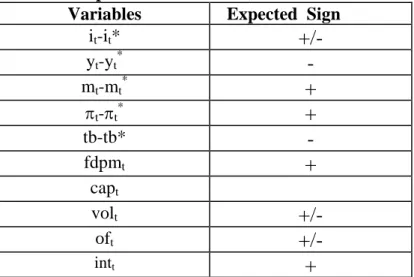
The additional signs are as follows: θ>0; ν<0; ρ>or<0; ω>0; ψ>or<0; and ξ>or<0. The expected signs can be summarized as follows:
Expected Signs of Independent Variables Dependent Variable: et
(price of foreign currency in terms of domestic currency) Variables Expected Sign it-it* +/- yt-yt* - mt-mt* + πt-πt* + tb-tb* - ca-ca* + fdpmt + capflowt - volt +/- oft +/- intt +/-
Exchange Rate Models: Empirical Results
The previous section discusses sequentially the theoretical models that potentially determine exchange rate behaviour. The empirical performance of these theoretical models in forecasting and explaining exchange rate behaviour is crucial in determining the superiority of one theory over the other. A caveat, of course, is that if a theory can explain the behaviour of the exchange rate better than others, it does not necessarily imply that it can also forecast exchange rates with relatively greater accuracy, and vice versa.
Examination of the empirical literature suggests that there is no consensus among economists on the appropriate monetary model that explains exchange rates well. It is also observed that the in-sample predictive performance of monetary models was good in the years following the breakdown of the Bretton Woods system (see e.g. Bilson 1978, Frankel 1979), but their performance collapsed in the 1980s.
Meese and Rogoff (1983) examined the out-of-sample predictive performance of the monetary models vis-à-vis the simple random-walk model. They observed that the forecasts using models based on economic fundamentals were in all cases worse than a random walk model. Meese (1990) attributed the failure of monetary models to weaknesses in their underlying relationships such as the PPP condition, the instability found in money demand functions and expectations that agents’ forecasts do not obey the axioms of rational expectations. Studies by MacDonald and Taylor (1991, 1993, 1994), Choudhry and Lawler (1997), Diamandis, Georgoutsos and Kouretas (1998), Mark and Sul (2001) attribute monetary models to be long-run equilibrium phenomena. Empirical literature (eg: Chinn and Meese 1995, Taylor 1995, Neely and Sarno 2002, Sarno and Taylor 2002) suggests that over short horizons of one to three years, monetary fundamentals generally do not predict changes in the spot rate. However, over longer horizons of four to five years, fundamentals do provide some predictive power for some currencies (Kim and Mo 1994, Mark 1995, Chinn and Meese 1995).
Some of the recent empirical studies on the monetary model performance have also exhibited mixed results. Studies have shown that inclusion of exchange rate expectations and the degree of openness in the Dornbusch sticky price monetary model improves forecast ability of the monetary model (Zita and Gupta, 2007).
For the portfolio balance model (PBM) of exchange rate determination, not much empirical literature is available because of data limitations, which restricts the empirical application of the portfolio balance model. The earlier studies that estimated the log-linear version of the reduced form portfolio balance model such as Branson, Halttunen and Masson (1977), Bisignano and Hoover (1982) and Dooley and Isard (1982) find dismal performance of the portfolio balance model in explaining exchange rate behaviour. Studies by Frankel (1982a, b) and Rogoff (1984) did not find any support in favour of the model. On the other hand, some empirical support for the portfolio balance model is provided by Backus (1984), Lewis (1988) and Dominguez and Frankel (1993).
Regarding capital flows, Dua and Sen (2009) find that an increase in both net capital inflows and their volatility lead to an appreciation of the exchange rate, and that they jointly
explain a large part of the variations in exchange rate in the Indian economy. Kohli (2001) analyses the effect of capital flows in the Indian context and finds that inflow of foreign capital results in a real appreciation of the exchange rate. Calvo, Leiderman and Reinhart (1993) and Edwards (1999a), analyze the impact of capital flows on the exchange rate for Latin American and Asian countries and find that an increase in capital flows cause the exchange rate to appreciate. However, the degree of appreciation or the strength of the relation between capital flows and exchange rate may vary across countries and time.
With respect to forward premia, Della Corte, Sarno and Tsiakas, (2007) examine the predictive ability of exchange rate models based on lagged values of the forward premium and other macroeconomic variables, as compared to the random walk model. The study finds that the predictive ability of forward exchange rate premia has substantial economic value in predicting exchange rates compared to a random walk model.
Considering the effect of intervention, Dominguez and Frankel (1992) examine its impact on exchange rates using primary survey data along with secondary intervention data. They find that intervention has significant effect on exchange rates. Neely (2000) surveyed central bankers who conduct intervention, and reports that intervention is effective in changing exchange rates. Fatum and King (2005) analyse the effects of Canadian intervention and find that intervention does systematically affect exchange rates and is associated with reduced volatility in exchange rates. Other studies that use high frequency data (see e.g. Payne and Vitale, 2003; Dominguez 2003a,b) form a consensus that intervention has significant effects on exchange rates, especially in the very short-run. Reitz (2002) concludes that the predictive power of forecasting methods increases in the case of intervention in the foreign exchange market by the central bank, relative to cases when the central bank does not intervene.
The micro structure theory of exchange rates gained popularity since the late 1990s when it was empirically tested that information in order flows drive exchange rates (Evans and Lyons, 1999, Luo, 2001, Medeiros, 2005). Evans and Lyons (2007) quantify the effect of news on exchange rates and observe that two-thirds of the effect of macro news on exchange rates is transmitted via order flow. Bjonnes and Rime (2003) find that private information plays an important role in the foreign exchange market and has a permanent effect on exchange rates. Order flows carrying this private information are hence important in determining exchange rates. Marsh and Rourke (2005) find that order flows from profit seeking financial institutions are positively correlated with exchange rate and flows from non–financial corporates are negatively correlated. They also find that the impact of order flow on exchange rate increases, as
probability of flow from the informed source increases. These views are also supported by Menkhoff and Schmeling (2006) who find that order flows coming from centres of political and financial decision-making influence exchange rates permanently.
In sum, several exchange rate models available in the literature have been tested during the last two and a half decades. No particular model seems to work best at all times/horizons. Monetary models based on the idea of fundamental driven exchange rate behaviour work best in the long run, but lose their predictability in the short run to naïve random walk forecasts. Order flows also play an important role in influencing the exchange rate. Keeping in view the above results, this paper attempts to develop a model for the rupee-dollar exchange rates taking into account all the different monetary models along with the microstructure models incorporating order flow, as well as capital flows, forward premium and central bank intervention.
3. Econometric Methodology
This paper employs vector autoregressive (VAR) and Bayesian vector autoregressive (BVAR) models to estimate the monetary model of the exchange rate (Re/$) and its augmented variants. Vector autoregression models, vector error correction models and Bayesian vector autoregression formulations of the monetary models of exchange rate determination for developed countries are known to have produced forecasts which beat the random walk (see. e.g. MacDonald and Taylor (1993, 1994) and Choudhry and Lawler (1997) for VAR; Chen and Leung (2003) for BVAR and BVECM; Zita and Gupta (2007) for VAR, VECM, BVAR and BVECM. Thus, this paper applies this technique to a developing country with a managed floating exchange rate regime.
The first step in the econometric exercise is to test for nonstationarity followed by tests for cointegration and Granger causality. Finally, the VAR and BVAR models are estimated and tested for out-of-sample forecast accuracy. This section briefly describes the tests for nonstationarity, VAR and BVAR modelling, cointegration and Granger causality and tests for out-of-sample forecast accuracy.
Tests for Nonstationarity
The classical regression model requires that the dependent and independent variables in a regression be stationary in order to avoid the problem of what Granger and Newbold (1974) called ‘spurious regression’ characterized by a high R2, significant t-statistics but results that are without economic meaning. A stationary series exhibits mean reversion, has a finite, time invariant variance and a finite covariance between two values that depends only on their distance apart in time, not on their absolute location in time. If the characteristics of the stochastic process
that generated a time series change overtime, i.e. if the series is nonstationary, it becomes difficult to represent it over past and future intervals of time by a simple algebraic model. Thus the first econometric exercise is to test if all the series are nonstationary or have a unit root.
A battery of unit root tests now exists to discern whether a time series exhibits I(1) (unit root) or I(0) (stationary) behaviour. In this paper, we employ the augmented Dickey-Fuller (ADF) test (1979, 1981) and its more powerful variant, the Dickey-Fuller generalized least squares (DF-GLS) test proposed by Elliot, Rothenberg and Stock (1996). These two tests share the same null hypothesis of a unit root. An alternative test is that proposed by Kwiatkowski et al. (1992) which has a null hypothesis of stationarity. If two of these three tests indicate nonstationarity for any series, we conclude that the series has a unit root.
VAR and BVAR Modelling
In this study, we employ multivariate forecasting models in the vector autoregressive (VAR) and Bayesian VAR framework.
A vector autoregressive (VAR) model uses regularities in the historical data to specify the model. Economic theory only selects the economic variables to include in the model. A serious drawback of the VAR model, however, is that overparameterisation produces multicollinearity and loss of degrees of freedom that can lead to inefficient estimates and large out-of-sample forecasting errors. A possible solution is to exclude insignificant variables and/or lags based on statistical tests.
An alternative approach to overcome overparameterisation uses a Bayesian VAR model as described in Litterman (1981), Doan, Litterman and Sims (1984), Todd (1984), Litterman (1986), and Spencer (1993). Instead of eliminating longer lags and/or less important variables, the Bayesian technique imposes restrictions on these coefficients on the assumption that these are more likely to be near zero than the coefficients on shorter lags and/or more important variables. If, however, strong effects do occur from longer lags and/or less important variables, the data can override this assumption5
5
Thus, the Bayesian model imposes prior beliefs on the relationships between different variables as well as between own lags of a particular variable. If these beliefs (restrictions) are appropriate, the forecasting ability of the model should improve. Several prior beliefs can be imposed so that the set of beliefs that produces the best forecasts is selected for making forecasts.
. The restrictions on the coefficients specify normal prior distributions with means zero and small standard deviations for all coefficients with decreasing standard deviations on increasing lags, except for the coefficient on the first own lag of a variable that is given a mean of unity. This so-called "Minnesota prior" was developed at the Federal Reserve Bank of Minneapolis and the University of Minnesota.
The standard deviation of the prior distribution for lag m of variable j in equation i for all i, j, and m -- S(i, j, m) can be expressed as function of a small number of hyperparameters:
w, d, and a weighting matrix f(i,j). This allows the forecaster to specify individual prior variances for a large number of coefficients based on only a few hyperparameters. The standard deviation is specified as follows:
S(i, j, m) = {wxg(m)xf(i, j)}si/sj; f(i, j) = 1, if i = j;
= k otherwise (0 < k < 1); and
g(m) = m-d, d > 0.
The term si equals the standard error of a univariate autoregression for variable i. The ratio
si/sj scales the variables to account for differences in units of measurement and allows the specification of the prior without consideration of the magnitudes of the variables. The parameter w measures the standard deviation on the first own lag and describes the overall tightness of the prior. The tightness on lag m relative to lag 1 equals the function g(m), assumed to have a harmonic shape with decay factor d. The tightness of variable j relative to variable i in equation i equals the function f(i, j).6
In the case of a VAR, Sims (1980) and others, e.g. Doan (1992), recommend estimating the VAR in levels even if the variables contain a unit root. The argument against differencing is that it discards information relating to comovements between the variables such as cointegrating relationships. The standard practice in the presence of a cointegrating relaionship between the variables in a VAR is to estimate the VAR in levels or to estimate its error correction
The above description of the BVAR models assumes that the variables are stationary. If the variables are nonstationary, they can continue to be specified in levels in a BVAR model because as pointed out by Sims et. al (1990, p.136) ‘……the Bayesian approach is entirely based on the likelihood function, which has the same Gaussian shape regardless of the presence of nonstationarity, [hence] Bayesian inference need take no special account of nonstationarity’. Furthermore, Dua and Ray (1995) show that the Minnesota prior is appropriate even when the variables are cointegrated.
6
Examples of selection of hyperparameters are given in Dua and Ray (1995), Dua and Smyth (1995), Dua and Miller (1996) and Dua, Miller and Smyth (1999); Dua, Raje and Sahoo (2003, 2008). Empirical evidence on comparative out-of-sample forecasting performance generally shows that the BVAR model outperforms the unrestricted VAR model. A few examples are Holden and Broomhead (1990), Artis and Zhang (1990), Dua and Ray (1995), Dua and Miller (1996), Dua, Miller and Smyth (1999), Dua, Raje and Sahoo (2003, 2008).
representation, the vector error correction model, VECM. If the variables are nonstationary but not cointegrated, the VAR can be estimated in first differences.
Cointegration and Granger Causality
The possibility of a cointegrating relationship between the variables is tested using the Johansen and Juselius (1990, 92) methodology. If the presence of cointegration is established, the concept of Granger causality is also tested in the VECM framework. For example, if two variables are cointegrated, i.e. they have a common stochastic trend, causality in the Granger (temporal) sense must exist in at least one direction (Granger, 1986; 1988). Since Granger causality is also a test of whether one variable can improve the forecasting performance of another, it is important to test for it to evaluate the predictive ability of a model.
Granger-causality with respect to a particular variable can be tested by a joint test of statistical significance of the lagged error correction term and the lags of that explanatory variable.
Evaluation of Forecasting Models
Evaluation of the forecasting models is based on RMSE, Theil’s U (Theil, 1966), and the Diebold-Mariano (1995) test. The models are initially estimated using monthly data over the period July 1996 to December 2006 and tested for out-of-sample forecast accuracy from January 2007 to June 2008. Recursive forecasts are generated from one- through twelve-months-ahead and out-of-sample forecast accuracy of monetary model and its augmented variants is assessed. The overall average of the U statistic and the RMSE for up to twelve-months-ahead is also calculated to gauge the accuracy of a model7
The Diebold-Mariano test compares the forecast performance of alternative models, i.e., it tests the null hypothesis of no difference of the accuracy of two competing forecasts. Let
. The forecast accuracy across techniques (VAR vs BVAR) is evaluated using the Diebold Mariano test. .
t
Y1
∧
and Y2t
∧
, where t=1,2…n, be a pair of h-step ahead forecasts of Yt and e1t and e2t be
the associated forecast errors. If g(e) be a function (e.g., mean square error) of the forecasts
7
To test for accuracy, the Theil coefficient is used that implicitly incorporates the naïve forecasts as the benchmark. If At+n denotes the actual value of a variable in period (t+n), and tFt+n the forecast made in period t for (t+n), then for T observations, the Theil U-statistic is defined as follows:
U = [Σ(At+n - tFt+n) 2 /Σ(At+n - At) 2 ] 0.5 .
The U-statistic measures the ratio of the root mean square error (RMSE) of the model forecasts to the RMSE of naive, no-change forecasts (forecasts such that tFt+n= At). A comparison with the naïve model is, therefore, implicit in the U-statistic. A U-statistic of 1 indicates that the model forecasts match the performance of naïve, no-change forecasts. A U-statistic >1 shows that the naïve forecasts outperform the model forecasts. If U is < 1, the forecasts from the model outperform the naïve forecasts.
errors, then the null hypothesis of equality of expected forecast performance is: E[g(e1t) –
g(e2t)] = 0. Define dt = g(e1t) – g(e2t); t = 1,2,…n. For optimal h-step ahead forecasts, the
sequence of forecasts errors follows a moving average process of order h–1. Therefore, it is assumed that for h-step ahead forecasts, all autocorrelations of order h or higher of the sequence dt are zero. Then the variance of
∑
= − = n t t d n d 1 1 ) ( is, asymtotically, + ≈
∑
− = − 1 1 1 2 ) ( h k k o a n d V γ γ ,where γk is the kth autocovariance of dt. This autocovaiance can be estimated by
∑
+ = − − ∧ − − = n k t k t t k n d d d d y 1 1 ) )( ( .The Diebold-Mariano test statistic is given by
d d V S 2 / 1 1 ( ) − ∧ = where V(d) ∧
is the estimated variance of d. Under the null hypothesis, Diebold-Mariano test statistic has an asymptotic standard normal distribution.
Harvey et. al (1997) note that the Diebold-Mariano test could be seriously over-sized as the prediction horizon, h, increases. They therefore provide a modified Diebold-Mariano test statistic 1 2 / 1 1 * 1 ) 1 ( 2 1 S n h h n h n S − − + − + − =
Harvey et. al also recommend a further modification of comparing the statistics with critical values from the Student’s t distribution with (n–1) degrees of freedom, rather than from the standard normal distribution.
Summary of steps in econometric estimation
In sum, the study proceeds as follows. First, the series are tested for the presence of a unit root using the augmented Dickey-Fuller, DF-GLS and KPSS tests.
Second, multivariate models (Models 2 through 4) described in the previous section on theoretical models are estimated using the VAR and BVAR techniques. Since Model 2 is the monetary model, Models 3 and 4 examine if the forecast performance of the monetary model can be improved by including additional variables. To estimate VAR models, if all the variables are nonstationary and integrated of the same order, the Johansen test is conducted for the presence of cointegration. If a cointegrating relationship exists, the VAR model can be estimated
in levels. Tests for Granger causality are also conducted in the VECM framework to evaluate the forecasting ability of the model. Lastly, Bayesian vector autoregressive models are estimated that impose prior beliefs on the relationships between different variables as well as between own lags of a particular variable. If these beliefs (restrictions) are appropriate, the forecasting ability of the model should improve. Thus, the performance of the VAR models against the corresponding BVAR versions is also assessed.
4. Estimation of Alternative Forecasting Models
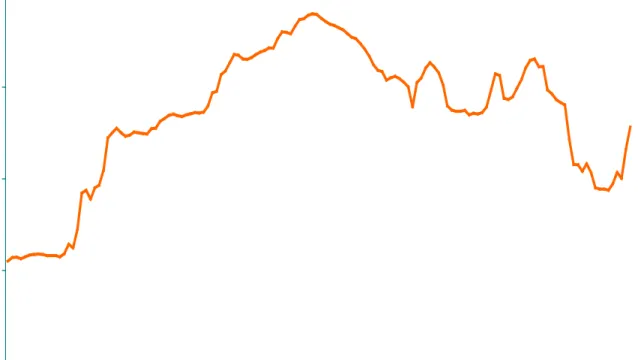
Figure 1 shows the movements in the Re/$ rate in the period under study: July 1996 through June 2008. Table 1 reports the summary statistics of the exchange rate over the full period and sub-periods. These statistics, along with the plot indicate turning points in May 2002 (maximum of Rs. 49/$), January 2007 (maximum of Rs. 44.33/$), and January 2008 (minimum of Rs. 39.37). The alternative models are estimated from July 1996 through December 2006. The out-of-sample forecasting performance of the alternative models is evaluated over January 2007 to June 2008 and also over the sub-period January 2007 to January 2008 to take into account the turning point in January 2008.
The various models estimated in the VAR and BVAR framework are described in Section 2 and are summarized below:
Theoretical Models
Model 1: Naïve forecast
tet+n = et
Model 2: Monetary Model
et = f[(it-it*), (yt-yt*), (mt-mt*)]
Model 38
8
Current account differential is not included due to its correlation with trade balance differential.
: Model 2 + other variables (inflation differential + trade balance differential +
forward premium + capital inflows + volatility of capital inflows + order flow)
et = f((it-it*), (yt-yt*), (mt-mt*), (πt-πt*), (tb-tb*), fdpmt, capt, volt, oft)
Model 4: Model 3 + central bank intervention
et = f((it-it*), (yt-yt*), (mt-mt*), (πt-πt*), (tb-tb*), fdpmt, capt, volt, oft, intt)
Dependent Variable: et
Variables Expected Sign
it-it*
+/-
yt-yt*-
mt-mt*+
πt-πt*+
tb-tb*-
fdpmt+
capt volt+/-
oft+/-
intt+
The notation is as follows:
et Log of exchange rate of India (Rs./$)
it-it* Difference between Indian (domestic) and US (foreign) Treasury bill rate
yt-yt* Difference between log of Indian and US index of industrial production
mt-mt* Difference between log of Indian and US money supply
πt-πt* Difference between inflation rate of India and US
tb-tb* Difference between trade balance of India and US
fdpmt 3-month forward premia
volt Volatility of capital inflows
oft Order Flow
intt Government intervention in open market
Data definitions and sources are given in Annexure 1.
Unit root tests are conducted on the above variables. Tests for the existence of a cointegrating relationship as well for Granger causality are also undertaken for the multivariate models given above. The models are then estimated in the VAR and BVAR framework.
Tests for Nonstationarity
The first step in the estimation of the alternative models is to test for nonstationarity. Three alternative tests are used, i.e., the augmented Fuller (ADF) test, the Dickey-Fuller Generalized Least Squares test and the KPSS test. If at least two of the three tests show the existence of a unit root, the series is considered as nonstationary. The tests for nonstationarity are reported monthly data from June 1996 to December 2006.
Table 2.1 reports the three tests with constant and trend. The inference at the 5% significance level is given in Table 2.2. This shows that apart from order flow and intervention, all other variables are nonstationary. Testing for differences of each variable confirms that all the variables are integrated of order one.
Tests for Cointegration and Granger Causality
Various specifications of the theoretical Model 3 were estimated using the cointegration approach. The final model was selected based on diagnostic checking and signs of the coefficients. The empirical models selected are given below and their cointegration equations are reported in Table 3.
Empirical Models (based on overall fit)
Model 1: Naïve forecast
tet+n = et
Model 2: Monetary Model
et = f((it-it*), (yt-yt*), (mt-mt*)
Model 3′: Model 2 + other variables (forward premium + volatility of capital inflows +
order flow)
et = f((it-it*), (yt-yt*), (mt-mt*), fdpmt, volt, ∆oft)
Model 4′: Model 3 + central bank intervention
et = f((it-it*), (yt-yt*), (mt-mt*), fdpmt, volt, ∆oft, ∆intt)
Models 1 and 2 above are the same as the theoretical versions. Model 3′ has fewer independent variables compared to its theoretical counterpart. This directly feeds into Model 4′. Since the order flow and intervention variables are stationary, their sign and significance is determined in the framework of an error correction model. The empirical signs of all the variables conform to economic theory and are given below:
Empirical Signs of Variables: Model 4′ Dependent Variable: et
Variables
Estimated Sign
it-it*
-
yt-yt*-
mt-mt*+
fdpmt+
volt-
∆oft+
∆intt+
The Granger causality tests for Models 2-4 are reported in Tables 4.1-4.3. Apart from the intervention variable, all other variables Granger cause the exchange rate9
9
The null hypothesis of no causality is tested up to 15% level of significance.
justifies the inclusion of all the variables that Granger cause the exchange rate since these variables can potentially improve the predictive performance of the model.
Models 2 through 4 are estimated both in the VAR and BVAR frameworks and their predictive ability is evaluated over two out-of-sample periods taking into account the turning point in January 2008: January 2007 through January 2008 and January 2007 through June 2008.
Empirical Results: Out-of-sample forecasts - January 2007 to January 2008
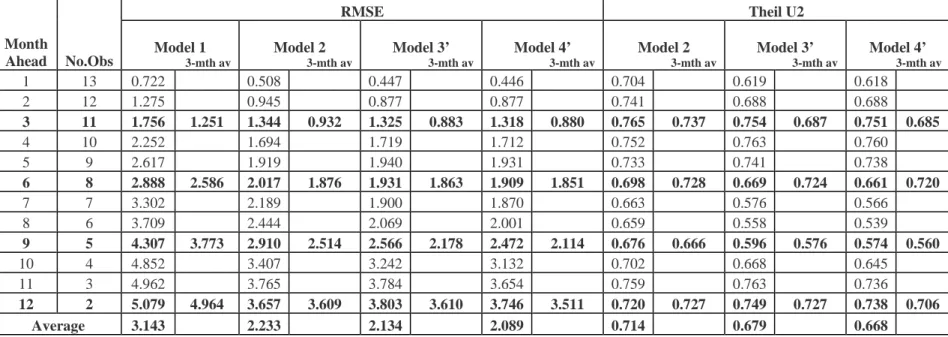
1. Model 2 performs consistently better than Model 1. This implies that the monetary model outperforms the random walk model.
VAR Models: January 2007 to January 2008
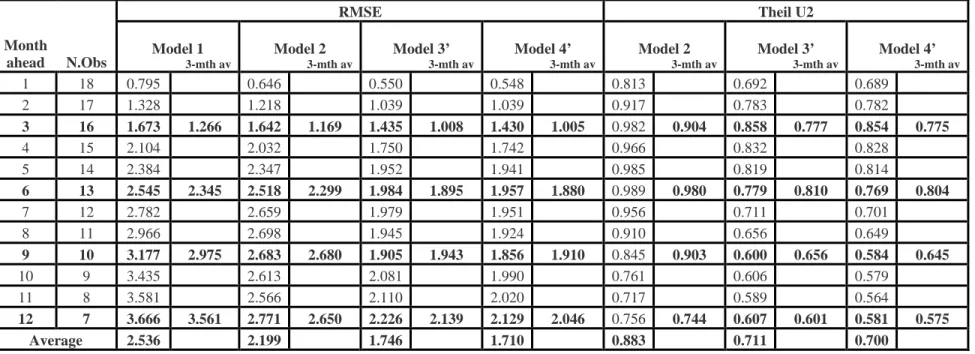
The forecast accuracy results for the VAR models are reported in Table 5. The main results are summarized below:
2. Model 3′ performs better than Model 2. Thus, forecast accuracy can be improved by extending the monetary model to include forward premium, volatility of capital inflows and order flow.
3. Model 4′ performs better than Model 3′ especially for longer term forecasts. Information on intervention by the central bank thus helps to improve forecasts at the longer end.
1. Model 2 (monetary model) performs consistently better than Model 1 (random walk).
BVAR Models: January 2007 to January 2008
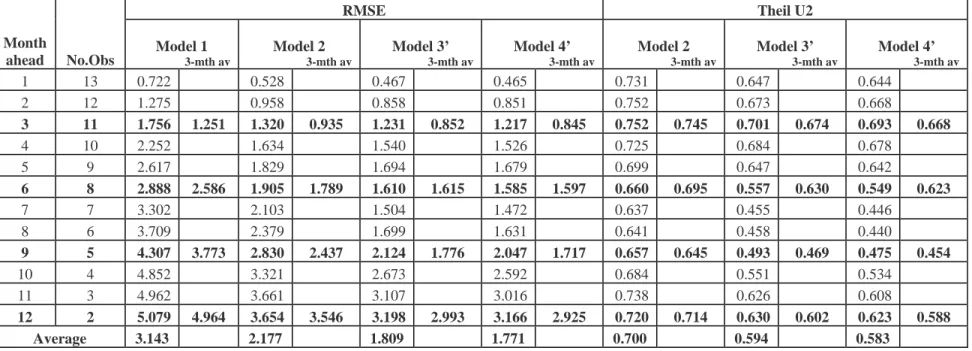
The forecast accuracy statistics for the BVAR models are reported in Table 6. Overall, the results are generally similar to those obtained for VAR models.
2. Model 3′ performs consistently better than Model 2.
3. Model 4′ performs better than Model 3′ especially for longer term forecasts implying that information on central bank intervention produces more accurate forecasts at the longer end.
1. BVAR Model 3′ performs almost consistently better than the corresponding VAR model.
VAR vs BVAR Models: January 2007 to January 2008
The Diebold Mariano test results for the comparison of VAR and BVAR models for Models 3 and 4 are reported in Table 7.
2. BVAR Model 4′ performs almost consistently better than the corresponding VAR model.
The above results show that BVAR models yield more accurate forecasts than the VAR models.
1. The monetary model outperforms the naïve forecast model.
Observations: January 2007 to January 2008
2. Information on the forward premium, volatility of capital inflows and order flows improve the accuracy of forecasts. It is thus possible to beat the monetary model. 3. Including data on central bank intervention (Model 4′) helps to improve forecast
accuracy further.
4. BVAR models yield more accurate forecasts than their VAR counterparts.
Empirical Results: Out-of-sample forecasts - January 2007 to June 2008
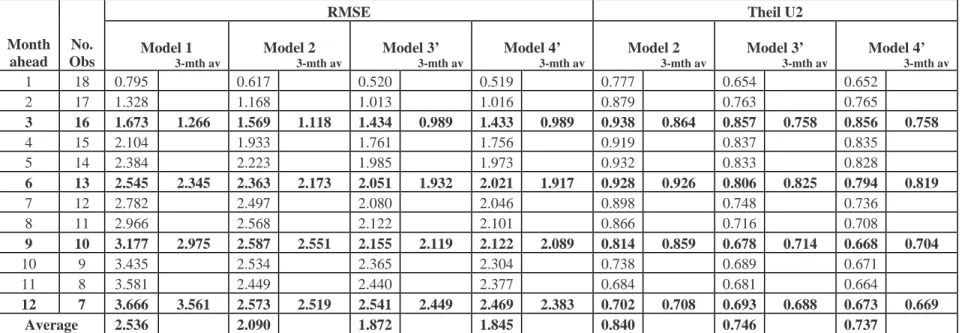
The out-of-sample forecast accuracy statistics for the VAR model are reported in Table 8. The corresponding table for the BVAR model is 9.
This period includes a turning point in January 2008. Possibly due to this, the empirical results are not as sharp as those obtained in the shorter period. At certain forecast horizons, the monetary model is not able to beat the random walk although the extended model (Model 3′) is almost consistently better than the monetary model for the VAR model. The results are similar for BVAR models although the result that Model 3′ produces better forecasts than Model 2 comes out more clearly in the BVAR case. Furthermore, a comparison of the VAR and BVAR Models 3′ and 4′ show that BVAR models have a distinct advantage in producing more accurate longer term forecasts.
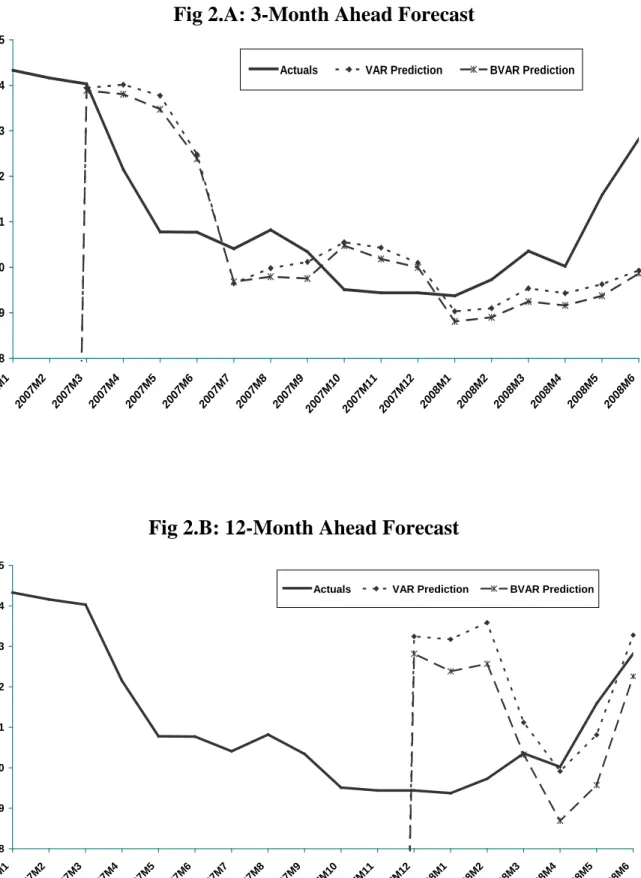
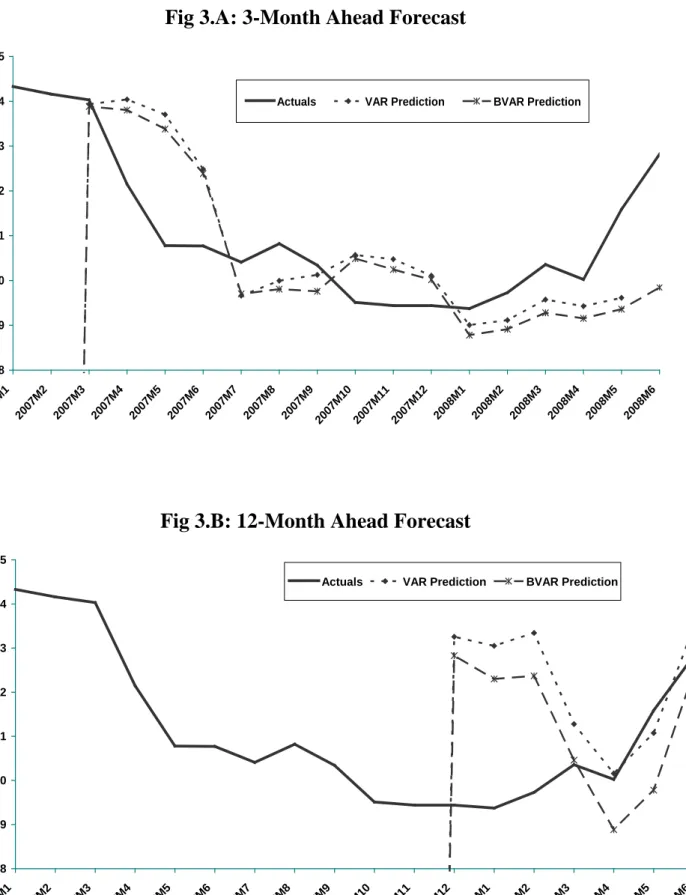
Figures 2A and 2B illustrate the 3 and 12-month-ahead out-of-sample forecasts made using both the VAR and BVAR versions of Model 3′. Likewise, Figures 3A and 3B report the same on the basis of Model 4′. It is clear from these figures that the VAR and BVAR forecasts move in tandem. Further, the differences between the direction of forecasts made using Model 3′ vs Model 4′ are not obvious from the graphs. The two sets of graphs look similar. Therefore the benefit of including intervention data is not apparent by examining the graphs.
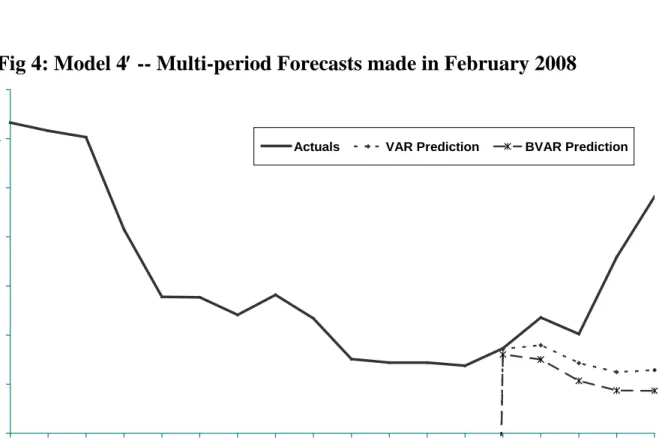
We also examine the direction of forecasts made around a turning point. This is illustrated by using Model 4′ to forecast in February 2008 up to June 2008. The forecasts are shown in Figure 4 and highlight the problem common to forecasting models – that forecasters tend to miss the turning point. The forecasts exhibit a downward trend while the series has moved upwards.
1. The monetary model does not always beat the naïve forecast.
Observations: January 2007 to June 2008
2. Information on the forward premium, volatility of capital inflows and order flows improve the accuracy of forecasts. It is thus possible to beat the monetary model. 3. Including data on central bank intervention (Model 4′) helps to improve forecast
accuracy further especially at the longer end.
4. BVAR models yield more accurate forecasts than their VAR counterparts especially at longer forecast horizons.
5. Conclusions
This study attempts to gauge the forecasting ability of economic models with respect to exchange rates with the difference that this is done in the context of a developing country that follows a managed floating (as opposed to flexible) exchange rate regime. Starting from the naïve model, this study examines the forecasting performance of the monetary model and various extensions of it in the vector autoregressive (VAR) and Bayesian vector autoregressive (BVAR) framework. Extensions of the monetary model considered in this study include the forward premium, capital inflows, volatility of capital flows, order flows and central bank intervention. The study therefore examines, first, whether the monetary model can beat a random walk. Second, it investigates if the forecasting performance of the monetary model can be improved by extending it. Third, the study evaluates the forecasting performance of a VAR model vs a BVAR model. Lastly, it considers if information on intervention by the central bank can improve forecast accuracy. The main findings are as follows:
♦ The monetary model generally outperforms the naïve model. This negates the findings of the seminal paper by Meese and Rogoff (1983) that finds that models which are based on economic fundamentals cannot outperform a naive random walk model.
♦ Forecast accuracy can be improved by extending the monetary model to include forward premium, volatility of capital inflows and order flow.
♦ Information on intervention by the central bank helps to improve forecasts at the longer end.
♦ Bayesian vector autoregressive models generally outperform their corresponding VAR variants.
♦ Turning points are difficult to predict as illustrated using Model 4′ with predictions made in February 2008.
Thus, availability of information on certain key variables at regular intervals that affect the exchange rate can lead to a more informed view about the behavior of the future exchange
rates by the market participants, which may allow them to plan their foreign exchange exposure better by hedging them appropriately. Such key variables could include past data on exchange rates, forward premia, capital flows, turnover, and intervention by central banks etc. As regards availability of data on key variables relating to the Indian foreign exchange market, most of the data are available in public domain and can easily be accessed by market participants, academicians and professional researchers. Using these variables skillfully will help them to gain sound insight into future exchange rate movements.
In this context, it is important to recognize that the Indian approach in recent years has been guided by the broad principles of careful monitoring and management of exchange rates with flexibility, without a fixed target or a pre-announced target or a band, coupled with the ability to intervene if and when necessary, while allowing the underlying demand and supply conditions to determine the exchange rate movements over a period in an orderly way. Subject to this predominant objective, the exchange rate policy is guided by the need to reduce excess volatility, prevent the emergence of establishing speculative activities, help maintain adequate level of reserves, and develop an orderly foreign exchange market. The Indian market, like markets of other developing countries, is not yet very deep and broad, and can sometimes be characterized by uneven flow of demand and supply over different periods. In this situation, the central bank (Reserve Bank of India) has been prepared to make sales and purchases of foreign currency in order to even out lumpy demand and supply in the relatively thin forex market and to smoothen jerky movements.
Annexure 1
Data Definitions and Sources
Variable Definition Source
e Rupee/ US Dollar Spot Exchange Rate Handbook of Statistics on the Indian
Economy and RBI Bulletin
i
Auctions of 91-day Government of India Treasury Bills
Handbook of Statistics on the Indian Economy and RBI Bulletin
i∗
3-Month Treasury Bill of US, Secondary Market Rate
Board of Governors of the Federal Reserve System
y
Index of Industrial Production for India seasonally adjusted using Census X12.
Handbook of Statistics on the Indian Economy and RBI Bulletin
y∗
Industrial Production Index for US, seasonally adjusted
Board of Governors of the Federal Reserve System
π
Year-on-year Inflation Rate calculated from Consumer Price Index for Industrial Workers for India
Handbook of Statistics on the Indian Economy and RBI Bulletin
π∗
Year-on-year Inflation Rate calculated from Consumer Price Index for All Urban Consumers; All Items for US
U.S. Department of Labor: Bureau of Labor Statistics
m
Money supply(M3) for India, seasonally adjusted using Census X12
Handbook of Statistics on the Indian Economy and Weekly Statistical Supplement
m∗
M2 for US, seasonally adjusted Board of Governors of the Federal
Reserve System
tb Trade Balance of India in US $ Billion RBI Bulletin
tb*
Trade Balance of US in US $ Billion US Census Bureau of Economic
Analysis
fdp
Three-month forward premium ( % per annum)
Handbook of Statistics on the Indian Economy and Weekly Statistical Supplement
cap
Capital flows measured by Foreign Direct Investment plus Foreign Private Investment Inflows in India in US $ Billion
Handbook of Statistics on the Indian Economy and RBI Bulletin
vol Volatility of capital inflows measured
by three period moving average standard deviation of sum of FDI and FII:
∑
= +− +−−
=
m i i t i t tm
Z
Z
V
1 2 / 1 2 2 1)
]
(
)
/
1
[(
where m=3 and Z is cap
Calculated
of
Order flow - Turnover in foreign exchange market in US $ Billion
Handbook of Statistics on the Indian Economy and RBI Bulletin
int
(Purchase minus Sale) of US Dollars by RBI
Handbook of Statistics on the Indian Economy and RBI Bulletin
References
Almekinders, G.J. (1995), “Foreign Exchange Intervention: Theory and Evidence,” Edward Elgar.
Alquist, R. and M. Chinn (2008), "Conventional and Unconventional Approaches to Exchange Rate Modelling and Assessment," International Journal of Finance and Economics, Forthcoming.
Artis, Michael J. and W. Zhang (1990), “BVAR Forecasts for the G7,”International Journal of Forecasting, 6, 349-62
Backus D. (1984), “Empirical Models of the Exchange Rate: Separating the Wheat from the Chaff,” The Canadian Journal of Economics / Revue Canadienne d'Economique, 17, 824-846.
Bilson J. F. O. (1978), “The Monetary Approach to the Exchange Rate: Some Empirical Evidence,” Staff Papers, International Monetary Fund, 25, 48-75.
Bisignano J. and K. Hoover (1982), “Some Suggested Improvements to a Portfolio Balance of Exchange Rate Determination with Special Reference to US Dollar/Canadian Dollar Rate,” Weltwirtschaftliches Archiv, 118, 1305-11.
Bjønnes, G. H. and D. Rime (2003), “Dealer Behavior and Trading Systems in Foreign Exchange Markets,” Norges Bank, Working Paper, Research Department, November.
Branson, W. H. (1983), “Macroeconomic Determinants of Real Exchange Risk,” in R. J. Herring (ed.) Managing Foreign Exchange Risk, Cambridge: Cambridge University Press Branson, W. H. (1984), “A Model of Exchange Rate Determination with Policy Reaction: Evidence from Monthly Data,” in P. Malgrange and P.A. Muet (eds.), Contemporary Macroeconomic Modelling, Oxford: Basil Blackwell.
Branson, W. H., H. Halttunen and P. Masson (1977), “Exchange Rates in the Short Run: The Dollar-Deutschemark Rate,” European Economic Review, 10, 303-24
Calvo, Guillermo A., Leiderman, Leonardo and Reinhart, Carmen M. (1993), “Capital Inflows and Real Exchange Rate Appreciation: The Role of External Factors,” International Monetary Fund Staff Papers, 40, 108–51.
Chen A. and M. T. Leung (2003), “A Bayesian Vector Error Correction Model for Forecasting Exchange Rates,” Computers and Operations Research, 30, 887–900.
Chinn M. D. and R. A. Meese (1995), “Banking on Currency Forecasts: How Predictable is Change in Money?” Journal of International Economics, 38, 161-178.
Choudhry T. and P. Lawler (1997), “The Monetary Model of Exchange Rates: Evidence from the Canadian Float of the 1950s,” Journal of Macroeconomics, 19, 349–362.
Cuthbertson, K. (1996), “Quantitative Financial Economics: Stocks, Bonds and Foreign Exchange,” John Wiley and Sons, Chichester.
Della Corte, P., L. Sarno, and I. Tsiakas (2007), “An Economic Evaluation of Empirical ExchangeRate Models,” CEPR Discussion Paper 6598.
Diamandis P. F., D. A. Georgoutsos and G. P. Kouretas (1998), “The Monetary Approach to the Exchange Rate: Long-Run Relationships, Identification and Temporal Stability,” Journal of Macroeconomics, 20, 741-766.
Dickey, D. A. and W. A. Fuller (1979), “Distribution of the Estimators for Autoregressive Time Series with a Unit Root,” Journal of the American Statistical Association, 74, pp. 427- 31.
______________ ( 1981), “Likelihood Ratio Statistics for Autoregressive Time Series with a Unit Root,” Econometrica , 49, pp. 1057- 72.
Diebold F.X. and R. Mariano (1995), “Comparing Predictive Accuracy,” Journal of Business and Economic Statistics, 13, 253-62.
Doan, T. A. (1992), RATS User’s Manual, III, Estima.
Doan,T.A., Litterman, R.B., and Sims (1984), “Forecasting and Conditional Projection Using Realistic Prior Distributions,” Econometric Reviews,3, 1-100.
Dominguez, K. and J. Frankel (1992) "Does Foreign Exchange Intervention Matter? The Portfolio Balance Effect," American Economic Review, 83, 1356-1369.
Dominguez, K. (2003a). “The Market Microstructure of Central Bank Intervention,” Journal of International Economics, 59, 25-45.
Dominguez, K. (2003b), “When Do Central Bank Interventions Influence Intra-Daily and Longer-Term Exchange Rate Movements?” NBER Working Paper 9875.
Dominguez K. M. and J.A. Frankel (1993), “Does Foreign Exchange Intervention Work?” Washington D.C., Institute for International Economics.
Dooley M. and P. Isard (1982), “A Portfolio Balance Rational Expectations Model of the Dollar Mark Exchange Rate,” Journal of International Economics, 12, 257-76.
Dornbusch R.(1976), “ Expectations and Exchange Rate Dynamics”, Journal of Political Economy, 84, 1161-76
Dornbusch R. (1980), “Exchange Rate Economics: Where Do We Stand?” Brookings Papers on Economic Activity,1, 143-85
Dornbusch, R. (1990),
Dornbusch, Rudiger and Fischer, Stanley, 1980.
Dua, P. and S.M. Miller (1996), “Forecasting Connecticut Home Sales in a BVAR Framework Using Coincident and Leading Indexes, Journal of Real Estate Finance and Economics, 13, 219-235.
Dua, P., S.M. Miller and D.J. Smyth (1999), “Using Leading Indicators to Forecast U.S. Home Sales in a Bayesian Vector Autoregressive Framework”, Journal of Real Estate Finance and Economics, 18, 191-205.
Dua, P., N. Raje and S. Sahoo (2008), “Forecasting Interest Rates in India,” Margin – The Journal of Applied Economic Research, 2008, 2, 1-41.
Dua, P., N. Raje and S. Sahoo (2003), “Interest Rate Modelling and Forecasting in India, ” Reserve Bank of India Development Research Group study No. 24.
Dua, P. and S.C. Ray (1995), “A BVAR Model for the Connecticut Economy,” Journal of Forecasting, 14, 217-227.
Dua, P. and P. Sen (2009), “Capital Flow Volatility and Exchange Rates: The Case of India,” in Macroeconomic Management and Government Finances, Asian Development Bank, Oxford University Press.
Dua, P. and Smyth, D.J. (1995), “Forecasting U.S. Home Sales Using BVAR Models and Survey Data on Households’ Buying Attitudes for Homes,” Journal of Forecasting, 14, 167-180.
Edison, H.J. 1993. “The Effectiveness of Central Bank Intervention: A Survey of the Literature after 1982.” Princeton Special Papers in International Economics, No. 18, July. Elliott, Graham and Rothenberg, Thomas J and Stock, James H. (1996),
64, 813-36.
Evans M.D.D. and R.K. Lyons (1999), “Order Flow and Exchange Rate Dynamics,” NBER, August.
_______________ (2001), “Why Order Flow Explains Exchange Rates,” NBER, November. _________________ (2007), “How is Macro News Transmitted to Exchange Rates?” NBER, May 2007.
Fatum, R. and M.R. King (2005) “Rules versus Discretion in Foreign Exchange Intervention: Evidence from Official Bank of Canada High- Frequency Data,” Working Paper No. 04-24,
Santa Cruz Center for International Economics.
Fleming, J.M. (1962), “Domestic Financial Policies under Fixed and Floating Exchange Rates”, IMF Staff Papers, 12, pp. 369-80.
Frankel J. A. (1979), “On the Mark: A Theory of Floating Exchange Rates Based on Real Interest Differentials,” American Economic Review, 69, 610-622.
___________ (1982a), “A Test of Perfect Substitutability in the Foreign Exchange Market,”
Southern Economic Journal, 49, 406-16.
___________ (1982b), “In Search of the Exchange Risk Premium: A Six-Currency Test Assuming Mean-Variance Optimization,” Journal of International Money and Finance, 1, 255-74.
Frankel J.A. and A.K. Rose (1995), “ Empirical Research on Nominal Exchange Rates”, in G. Grossman and K. Rogoff (eds.), Handbook of International Economics, Vol III, Elsevier Science, 1689-729.
Frenkel J. A. (1976), “A Monetary Approach to the Exchange Rate: Doctrinal Aspects and Empirical Evidence,” Scandinavian Journal of Economics, 78, Proceedings of a Conference on Flexible Exchange Rates and Stabilization Policy, 200-224.
Frenkel J.A. and H.A. Johnson (eds.) (1978), “The Economics of Exchange Rates: Selected Studies,” Addison-Wesley.
Gandolfo, G. (2006), “International Finance and Open Economy Macroeconomics”, Springer. Granger, C. W. J. (1986), “Developments in the study of Cointegrated Variables,” Oxford Bulletin of Economics and Statistics , 48, pp. 213- 27.
Granger, C. W. J. (1988), "Some Recent Developments in the Concept of Causality," Journal of Econometrics, 39, 199- 212.
Granger, C.W.J. and P. Newbold (1974), “Spurious Regressions in Econometrics,” Journal of Econometrics, 2, 111-20.