New Universal Current-mode Biquad
Using Only Three ZC-CFTAs
Bhopendra SINGH
1, Abdhesh Kumar SINGH
2, Raj SENANI
31Dept. of Electronics and Communication, Vira College of Engineering, Bijnor UP, India 2Dept. of Electronics and Communication, ITS Engineering College, Greater Noida, UP. India
3Division of Electronics and Communication Engineering, Netaji Subhas Inst. of Technology, Sector-3, Dwarka, New Delhi 110078, India
[email protected], [email protected], [email protected]
Abstract. The objective of this paper is to present a new
universal current-mode biquad capable of providing all the five basic filter functions, namely, low pass (LP), band pass (BP), high pass (HP), band reject (BR) and all pass (AP) from the same configuration using only three Z - copy current follower transconductance amplifiers (ZC-CFTA) along with the provision of independent electronic tunabil-ity of the filter parameters 0 and Q0 (or bandwidth)
through two separate DC bias currents while employing both grounded capacitors as desirable for integrated cir-cuit implementation. The workability of the proposed structure is verified by PSPICE simulations based on CMOS implementation of the ZC-CFTA.
Keywords
Analog circuits, current mode circuits, Z-copy current follower transconductance amplifier (ZC-CFTA), universal filters, CMOS circuits.
1.
Introduction
Recently, a new active element known as current fol-lower transconductance amplifier (CFTA) has been intro-duced for analog circuit design in [1] and [2] and its vari-ous applications, such as those in realizing universal biquads and oscillators, have been presented in [3-6] and [10] . The universal biquad circuits of [3]-[5], although exhibit the important advantages of (i) realisability of all the five generic filter functions without requiring any com-ponent-matching conditions, (ii) independent electronic tunability of the filter parameters ω0 and Q0, and (iii) em-ployment of both grounded capacitors as preferred for IC implementation, but suffer from the drawback of employ-ing four CFTAs (which is more than the minimum number of CFTAs actually necessary i.e. three). On the other hand, the circuit proposed in [6] accomplishes the advantages (i)-(iii) above with only three CFTAs but suffers from the drawbacks of (a) realizing neither a voltage mode nor a current mode but instead a transadmittance mode biquad
(with voltage input and current outputs) and (b) needing an additional resistor also (apart from two grounded capaci-tors).
The object of this paper is to present a new ZC-CFTA-based universal biquad which offers all the three advantages (i)-(iii) quoted above like the circuits of [3]-[6], but by contrast, offers following advantages: (i) unlike the circuits of [3]-[5], which need four CFTAs, the new circuit needs only three CFTAs; (ii) unlike the circuit of [6] which needs an additional resistor, the new circuit does not re-quire any additional resistor; (iii) unlike the circuit of [6], which is neither a VM nor a CM, the new circuit realizes all the five standard filter responses in proper current mode (CM). The proposed new circuit provides an additional advantage of the tuning of BW without disturbing angular frequency ω0 in comparison to the biquad of [7] which although uses only two Z-copy current inverter transcon-ductance amplifiers (ZC-CITAs) (which are almost the same as ZC-CFTAs ) but does not offer this advantage. The workability of the proposed structure has been con-firmed by PSPICE simulations.
2.
Z-copy Current Follower
Transcon-ductance Amplifier (ZC-CFTA)
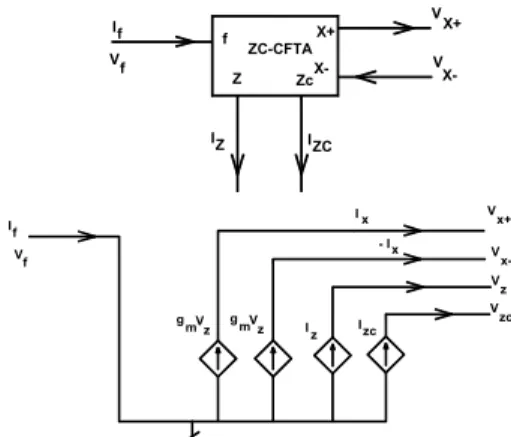
The symbolic representation and the equivalent circuit of the ZC-CFTA are shown in Fig. 1.ZC-CFTA I f Z Zc X+ X-Z IZC f I f V X+ V X-V I V I g I V I f f x+ V x-z V Vzc zc z mVz z m g V x - I x
The ZC-CFTA is characterized by the following set of equations z m x -z m x f zc z f , i i i , i g V, i -g V V 0 . (1)
According to the above equations and equivalent circuit of Fig. 1, the input current if is transferred by the
current follower to z terminal and the voltage drop at the terminal z is transformed into currents ix+ and ix- at the
terminals x+ and x- respectively using transconductance
gm, which is electronically-controllable by an external bias
current. The copy of z terminal current is conveyed to zc
terminal. An exemplary CMOS implementation of the ZC-CFTA is shown in Fig. 2, which has been obtained by an appropriate modification of the structure published earlier in [4]. The transconductance gmof the ZC-CFTA is given
by ) / ( 0C W L I gm set
ox (2)where Iset controls the transconductance gm, µ0 is free
elec-tron mobility of channel, Cox is the gate oxide capacitance
per unit area as W/ L is the aspect ratios of the identical MOSFETs M13 and M14 forming the differential pair.
Fig. 2. An exemplary CMOS implementation of the ZC-CFTA.
Z I X+ X-ZC-CFTA 1 X-f ZC-CFTA 2 Z Zc ZC-CFTA 3 f Z X-X+ P in set 1 I Iset 2 Iset 3 HP I LP I BP I 2 C C1
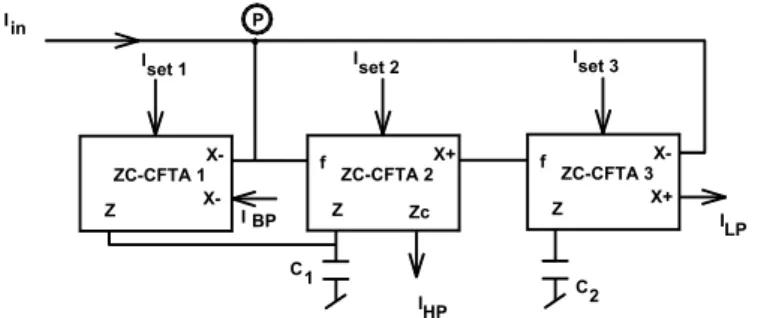
Fig. 3. New current mode universal biquad configuration using ZC-CFTAs.
3.
Proposed Universal Biquad
Employing only Three ZC-CFTAs
The proposed circuit is shown in Fig. 3. An analysis of the proposed circuit of Fig. 3 reveals the following current transfer functionsD C g s I I m in BP 1 1 , (3) D C C g g I I m m in LP 1 2 3 2 , (4) D s I I in HP 2 . (5)
Adding the output currents ILP and IHP, one obtains
IBR = ILP + IHP which is given by D C C g g s I I m m in BR 1 2 3 2 2 . (6)
Lastly, adding ILP, IBP and IHP to get IAP= ILP + IHP + IBP, one
obtains D C C g g C g s s I I m m m in AP 1 2 3 2 1 1 2 (7) where D is given by 2 1 3 2 1 1 2 C C g g C g s s D m m m . (8)
It is, thus, seen that the proposed circuit is capable of realizing all the five basic functions, without requiring any component-matching or realization conditions.
From (3)-(8), the various filter parameters are given by 2 1 3 2 0 C C g gm m
, (9) 1 1 C g BW m , 2 3 2 1 1 0 1 C g g C g Q m m m (10)whereas H0 is unity in all the cases.
It is clear from (9) and (10) that 0 can be tuned inde-pendently of BW in case of band pass and notch filter, former by gm2 and /or gm3 and the later by gm1, while
keep-ing the gain constant.
In order to attain all the five filter outputs simultane-ously, one requires ZC-CFTA1 with two more outputs of X- type, CFTA2 with two more ZC outputs and ZC-CFTA3 with two more X+ type outputs.
It is, thus, seen that the proposed circuit employs one less active building block (ABB) in comparison to the universal biquads published earlier in [3]-[6] and yet ex-hibits all the properties of the earlier circuits, in that, it realizes all the five basic filter functions with electronic tunability of two parameters1 namely, 0 and Q0 (or band-width), offers ideally zero input impedance and explicit current outputs at high impedance nodes in all cases while employing both grounded capacitors as preferred for IC implementation.
4.
Sensitivity Analysis
The effect of changes in active/passive element values on the various filter parameters is determined by evaluating sensitivity coefficients which are found to be as follows
2 1 0 1 0 2 0 3 0 2 C C g g S S S S m m , (11) 1 1 1 Bw C Bw g S S m , (12) 1 0 1 Q gm S , (13)
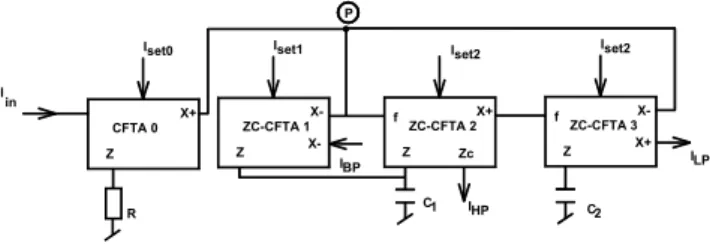
1The independent control of gain may also be achievable if the circuit is modified as shown in Fig. 4 by adding one more CFTA along with an additional resistor R connected from its Z terminal to ground with input Iin applied at terminal f of this additional CFTA and its output x+ connected at node P of the circuit, with Iset0 being the external DC bias current for this CFTA. In this case, the grounded resistor R can be realized by a simple two-MOSFET-resistor [8] to obtain a version suitable for CMOS implementation. With this modification, the gain factor H0 of all the realized filters can also be independently tuned by this additional bias current Iset0. It is worth pointing out that for voltage mode circuits, an interesting method of achieving gain control has been outlined in [9].
2 1 0 1 0 2 0 2 0 3 Q C Q C Q g Q g S S S S m m . (14)
From (11)-(14) it is clear that all the sensitivities of the various parameters of the filters realized from the pro-posed configuration are very low.
5.
Effect of Main Parasitic Impedances
and Non- idealities
For more accurate analysis, the effects of main para-sitic impedances and non idealities are to be taken into account. The model for ZC-CFTA including various para-sitics is shown in Fig. 5. In case of non-ideal ZC-CFTA, relationships of current and voltages given in equation (1) can be rewritten as
Vf 0, iz izc
if, ix
gmVz, ix --
gmVz. (15)where α = 1 - εiand εi (|εi| << 1) is the current tracking error
from f to Z and ZC terminals. The transconductance inac-curacy factor from Z to X+/- terminal is denoted by β.
Z I I X+ X-ZC-CFTA 1 X-f ZC-CFTA 2 Z Zc ZC-CFTA 3 f Z X-X+ P in BP HP I LP I set1 I set2 I I set2 2 C 1 C CFTA 0 Z set0 I X+ R
Fig. 4. Modified structure to obtain independent control of gain also. Rf f ideal X+' Zc Cz Z Rz ZC-CFTA Z' f' Zc Rx Cx X
Fig. 5. Model of ZC-CFTA including parasitic elements.
From Fig. 5 it is clear that the parasitic resistance Rx
and the parasitic capacitance Cx appear between the high
impedance X+/- terminal and ground. To eliminate the effect of these parasitic impedances in the proposed circuit of Fig. 3, ZC-CFTA2 and ZC-CFTA3 should be designed to have a very low input parasitic resistance Rf. Ideally, the
value of Rf is zero and terminal f is virtually grounded.
Since these parasitic impedances are connected between true ground and virtual ground, these are, therefore almost ineffective.
The parasitic impedances Rz and Cz appear between
The effect of above mentioned parasitic impedances con-sists in adding the Rz parasitic resistance at terminal Z and
increasing the working capacitances C1 and C2 to C1' and
C2' respectively by absorbing the parasitics as addition to
these external capacitances. Non ideality of current gain parameter α, transconductance inaccuracy factor β, para-sitic resistances and capacitances at terminal Z, modify the current transfer function in equation (3) to
2 3 3 2 3 2 3 1 1 2 2 3 3 2 2 1 2 3 1 1 1 2 2 1 3 2 2 3 2 1 1 1 2 1 1 1 2 ' 1 ' ' ' ' ' 1 ' 1 ' ' '
Z m m m m m Z Z m m m Z Z Z m m in BP R g g g g g R R C C g g C g R C R C S S R C C g C g S I I (16) where C1C1Cz1Cz2 , (17) z3 2 2 C C C , (18) Rz2' = Rz2 || Rz1 (19)and Rz and Cz are the parasitic resistance and capacitance
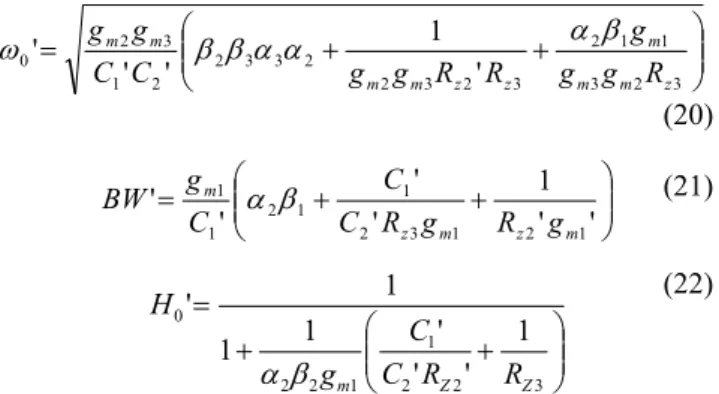
appearing at terminal Z of respective number of ZC-CFTA. Natural frequency, bandwidth and gain for the circuit shown in Fig.3 are now modified to
3 2 3 1 1 2 3 2 3 2 2 3 3 2 2 1 3 2 0 ' 1 ' ' ' z m m m z z m m m m R g g g R R g g C C g g (20) ' ' 1 ' ' ' ' 1 2 1 3 2 1 1 2 1 1 m z m z m g R g R C C C g BW (21) 3 2 2 1 1 2 2 0 1 ' ' ' 1 1 1 ' Z Z m C R R C g H (22)
Since gain H0 (ideally unity) gets modified as H0' and turns out to be dependent on gm1, from the expression for
H0', it is found that nonideally, the gain H0' increases from -1.52 dB to -1.02 dB and then to 0.82 dB when Iset1 is
varied from 20 μA to 60 μA and then to 180 μA. This explains the different values of the gain as observable in Fig. 7. The appearance of parasitic resistance Rz3 changes
the type of impedance at Z terminal of ZC-CFTA for the circuit of Fig. 3, which should be purely capacitive in character. The possible solution to this problem is to make the operating frequency ω0 > 1/(Rz3C2).
6.
SPICE Simulation Results
The proposed biquad has been simulated in PSPICE using CMOS ZC-CFTA of Fig. 2 with component values:
C1 = C2 = 16 pF and DC power supply voltages taken as
Vcc = 1.5 V, Vee = -1.5 V and V1 = 0.5 V. The dimensions of
the MOSFETs were taken as shown in Tab. 1. The simula-tion was carried out using TSMC 0.35µm CMOS technol-ogy parameters shown in Tab.2.
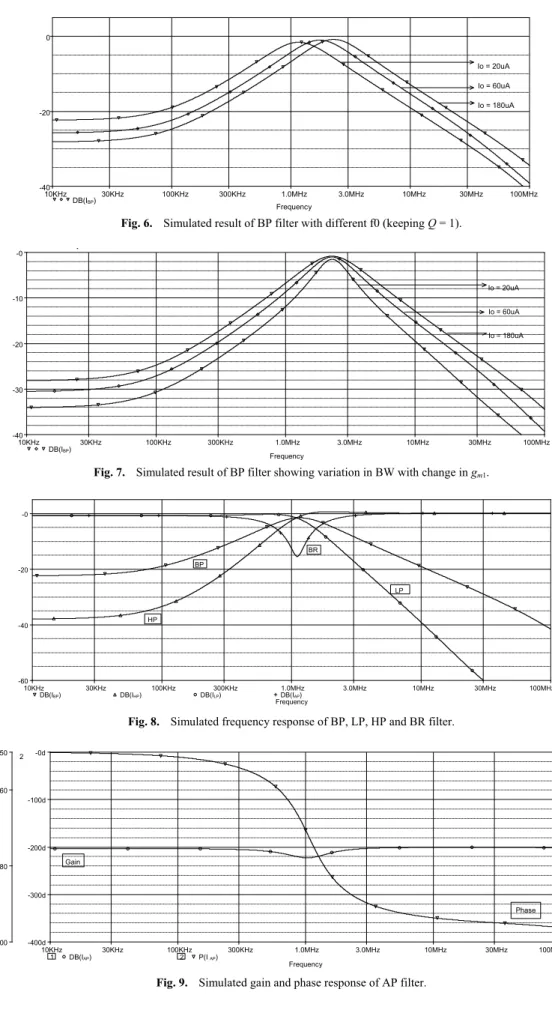
The tunability of f0 for band pass filter has been verified by the circuit of Fig. 3 designed for values of f0 as 1.157 MHz, 1.735 MHz, 2.268 MHz, by varying gm1, gm2
and gm3 simultaneously with the values of bias currents I0 (i.e I0 = Iset1 = Iset2 = Iset3) taken as 20 µA, 60 µA and
180 µA respectively, at constant Q = 1 (Fig. 6). The bandwidth values 1.348 MHz, 1.915 MHz, 2.45 MHz, were obtained by varying gm1 through the bias currents Iset1
taken as 20 µA, 60 µA, and 180 µA respectively and
Iset2 = Iset3 = 180 µA for maintaining a constant center
frequency of 2.286 MHz (see Fig. 7). The circuit is designed to obtain LP, BR, BP, HP and AP responses with
f0 = 1.1 MHz and Q = 1 (simulation results for the same are shown in Fig. 8 and Fig. 9.
Transistor type Transistor name W(µm) L(µm)
PMOS M5, M6 1.4 0.35 PMOS M1- M4 2.8 0.35 PMOS M7 2.71 0.35 PMOS M15- M21, 4 1 NMOS M8- M12 0.7 0.35 NMOS M13 , M14, M22-M26 4 1
Tab. 1. Dimensions of CMOS transistors.
NMOS: Level= 3 Tox= 7.9E-9 NSUB = 1E17 GAMMA = 0.5827871 PHI = 0.7, VTO = 0.5445549, DELTA = 0, U0 = 436.256147 ETA = 0 THETA = 0.1749684 KP = 2.055786E-4 VMAX = 8.309444E4 KAPPA = 0.2574081 RSH = 0.0559398 NFS = 1E12 TPG = 1 XJ = 3E-7 LD = 3.162278E-11 WD = 7.046724E-8 CGDO = 2.82E-10 CGSO = 2.82E-10 CGBO = 1E-10 CJ = 1E-3 PB = 0.9758533 MJ = 0.3448504 CJSW= 3.777852E-10 MJSW = 0.3508721
PMOS: Level = 3 Tox=7.9E-9 NSUB = 1E17 GAMMA = 0.4083894 PHI = 0.7 VTO = -0.7140674 DELTA = 0 U0= 212.2319801 ETA = 9.999762E-4 THETA = 0.2020774 KP= 6.733755E-5 VMAX = 1.181551E5 KAPPA = 1.5 RSH = 30.0712458 NFS = 1E12 TPG = -1 XJ = 2E-7 LD = 5.000001E-13 WD = 1.249872E-7 CGDO = 3.09E-10 CGSO = 3.09E-10 CGBO = 1E-10 CJ = 1.419508E-3 PB = 0.8152753 MJ = 0.5 CJSW = 4.813504E-10 MJSW = 0.5
Tab. 2. CMOS process parameters.
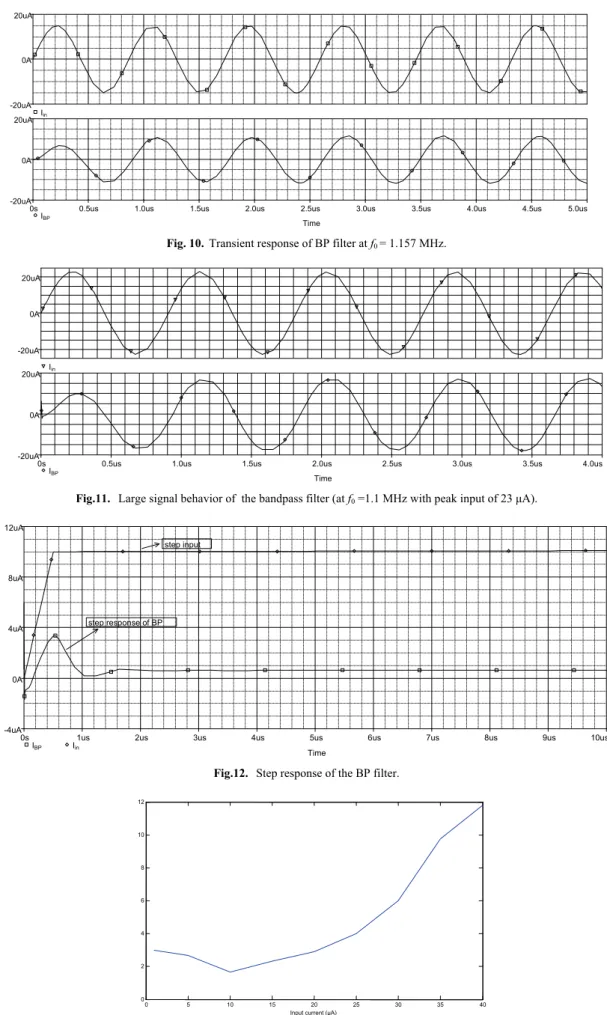
In addition to the above, transient response of the band pass filter is shown in Fig. 10, with a 1.157 MHz sinusoidal input current signal having 15 μA peak value applied at the input of the filter. Total harmonic distortion (THD) analysis has been carried out on BP filter at
f0 = 1.157 MHz at various sinusoidal peak input currents and results for the same are shown in Fig. 13.
Simulated DC transfer characteristics are shown in Fig. 14 where it is shown that linear range of ZC-CFTA is from -25 μA to 22.5 μA. The dynamic range is 1 nA to 35 μA and THD percentage would be low till input current
does not exceed ± 22.5 μA (at f0 = 1.1 MHz). The
simulation results of the proposed circuit shown in Fig.6 – 14, thus, are seen to confirm the validity of the theoretical results.
Frequency 10KHz 30KHz 100KHz 300KHz 1.0MHz 3.0MHz 10MHz 30MHz 100MHz DB(IBP) -40 -20 0 Io = 20uA Io = 60uA Io = 180uA
Fig. 6. Simulated result of BP filter with different f0 (keeping Q = 1).
Frequency 10KHz 30KHz 100KHz 300KHz 1.0MHz 3.0MHz 10MHz 30MHz 100MHz DB(IBP) -40 -30 -20 -10 -0 Io = 180uA Io = 60uA Io = 20uA
Fig. 7. Simulated result of BP filter showing variation in BW with change in gm1.
Frequency
10KHz 30KHz 100KHz 300KHz 1.0MHz 3.0MHz 10MHz 30MHz 100MHz
DB(IBP) DB(IHP) DB(ILP) DB(IAP)
-60 -40 -20 -0 LP BR BP HP
Fig. 8. Simulated frequency response of BP, LP, HP and BR filter.
Frequency 10KHz 30KHz 100KHz 300KHz 1.0MHz 3.0MHz 10MHz 30MHz 100MHz 1 DB(IAP) 2 P(I AP) -100 -80 -60 -50 1 -400d -300d -200d -100d -0d 2 Phase Gain
Time
0s 0.5us 1.0us 1.5us 2.0us 2.5us 3.0us 3.5us 4.0us 4.5us 5.0us IBP -20uA 0A 20uA Iin -20uA 0A 20uA
Fig. 10. Transient response of BP filter at f0 = 1.157 MHz.
Time
0s 0.5us 1.0us 1.5us 2.0us 2.5us 3.0us 3.5us 4.0us
IBP -20uA 0A 20uA Iin -20uA 0A 20uA
Fig.11. Large signal behavior of the bandpass filter (at f0 =1.1 MHz with peak input of 23 μA).
Time
0s 1us 2us 3us 4us 5us 6us 7us 8us 9us 10us
IBP Iin -4uA 0A 4uA 8uA 12uA step input step response of BP
Fig.12. Step response of the BP filter.
0 5 10 15 20 25 30 35 40 0 2 4 6 8 10 12 Input current (μA)
Fig.14. Simulated DC transfer Characteristics of ZC-CFTA.
7.
Concluding Remarks
A new CFTA-based universal biquad has been pre-sented which offers all the advantages of its predecessors of [3]-[6] namely, (i) realisability of all the five generic filter functions without requiring any component-matching conditions; (ii) independent electronic tunability of the filter parameters ω0 and BW; and (iii) employment of both grounded capacitors as preferred for IC implementation. When compared with the four-CFTA circuits of [3]-[5], the new circuit has the advantage of requiring only three CFTAs. On the other hand, when compared to three-CFTA biquad of [6], the new circuit has the advantage of (i) not requiring any additional resistor as in [6], and (ii) provid-ing a true CM operation unlike the transadmittance opera-tion as in the circuit of [6]. The workability of the proposed structure has been confirmed by PSPICE simulation re-sults.
The paper has, thus added a new universal biquad, having advantageous features as shown above, to the existing repertoire [3]-[6] of CFTA-based analog circuits.
Lastly, it may be mentioned that for realizing elec-tronically controllable functions use of OTAs is well established, the use of CCCIIs is rigorously being investi-gated recently but by contrast, CDTAs as well as CFTAs are relatively newer building blocks from a wide variety of possible new building blocks, see [1]. Consequently, very few publications have appeared on CFTAs and its full potential is still to be exploited. In view of this, we believe that newer applications of CFTAs deserve to be investi-gated further.
Acknowledgements
This work was performed at Analog Signal Process-ing Research Lab, NSIT, New Delhi. The authors thank the
anonymous reviewers for their constructive suggestions and comments.
References
[1] BIOLEK, D., SENANI, R., BIOLKOVA, V., KOLKA, Z. Active
elements for analog signal processing: Classification, review, and new proposals. Radioengineering, 2008, vol.17, no.4, p. 15-32. [2] HERENCSAR, N., KOTON, J., VRBA, K. Realisation of current
mode KHN equivalent biquad using current follower amplifiers (CFTAs). IEICE Transactions Fundamentals, 2010, E93-A (10), p. 1816-1819.
[3] TANGSRITAT, W. Single-input three output electronically
tunable universal current mode filter using current follower transconductance amplifiers. International Journal of Electronics and Communication (AEU), doi: 10.1016/j.aeue.2011.01.002.
[4] SATANSUP, J., PUKKALANUM, T., TANGSRITAT, W.
Current mode KHN biquad filter using modified CFTAs and grounded capacitors. Proceedings of IMECS, 2011, vol.2.
[5] SATANSUP, J., TANGSRIRAT, W. Single-input five-output
electronically tunable current-mode biquad consisting of only ZC-CFTAs and grounded capacitors. Radioengineering, 2011, vol. 20, no. 3, p. 650 – 655.
[6] HERENCSAR, N., KOTON, J., VRBA, K., LAHIRI, A. Novel
mixed-mode KHN-equivalent filter using Z-copy CFTAs and grounded capacitors. Latest Trends on Circuits, System and Signal, North Atlantic University Union (NAUN) WSEAS, 2010, p. 87-90. [7] BIOLEK, D., BIOLKOVA, V., KOLKA, Z., BAJER, J.,
Single-input multi-output resistorless current-mode biquad. In Proc. of ECCTD '09, European Conference on Circuit Theory and Design.
Antalya (Turkey), August 23-27, 2009, p. 225-228.
[8] WANG, Z. 2-Mosfet transresistor with extremely low distortion for output reaching supply voltages. Electronics Letters, 1990, vol. 26, no. 13, p. 951- 952.
[9] KOTON, J., HERENCSAR, N., VRBA, K. KHN-equivalent
voltage-mode filters using universal voltage conveyors.
International Journal of Electronics and Communications (AEU), 2011, vol. 65, no. 2, p. 154-160.
[10] HERENCSAR, N., KOTON, J., VRBA, K., LAHIRI, A. Realizations of single-resistance controlled quadrature oscillators using a generalized current follower transconductance amplifier and a unity- gain voltage follower. International Journal of Electronics, 2010, vol. 97, no.8.
About Authors ...
Bhopendra SINGH was born on June 10, 1977 at Bijnor,
UP, India. He obtained BE from Gulbarga University, Karnataka, India in 1999 and M. Tech in VLSI design from Uttar Pradesh Technical University, Lucknow, Uttar Pradesh, India, in 2009. He has been with the Electronics and Communication Engineering Department, Vira college of Engineering, Bijnor, Uttar Pradesh, India since 2000. Currently, he is pursuing PhD from Gautam Buddha Tech-nical University, Lucknow, Uttar Pradesh, India. His areas of research interest are electronic communication, analog signal processing and analog integrated circuits.
Abdhesh Kumar SINGH was born on December 20,
1965 at Dumra, Purnia, Bihar, India. He obtained his M.Sc. in 1991 and M.Tech in Electronics and Communication Engineering in 2007 from IASE Sadarsahar University, Rajasthan, India. He obtained PhD in the area of Analog Integrated Circuits and Signal Processing, from Netaji Subhas Institute of Technology (NSIT), University of
Delhi, in 1999. He is a Professor in Electronics and Com-munication Engineering Department of ITS, Engineering College, Greater Noida, India. His teaching and research interests are in the area of Analog Electronics, Signals and Systems, Filter design, Analog Integrated Circuits, DSP and VLSI design. He has published 33 research papers in various international journals.
Raj SENANI was born on March 14, 1950 at Budaun, UP,
India. He received B. Sc from Lucknow University in 1966, B.Sc. Engg. from Harcourt Butler Technological Institute, Kanpur in 1971, M.E. (Honors) from Motilal Nehru National Institute of Technology (MNNIT), Allaha-bad in 1974 and Ph.D in Electrical Engg. from the Univer-sity of Allahabad in 1988. He is currently Head of Division of ECE and the institute Director at Netaji Subhas Institute of Technology, New Delhi, India. Professor Senani’s teaching and research interests are in the areas of Bipolar and CMOS analog integrated circuits, Current–mode Sig-nal Processing, Electronic Instrumentation, Chaotic Nonli-near circuits and Trans-liNonli-near circuits. He has authored or co-authored 130 research papers in various international journals. He is serving as an Associate Editor of Circuits, Systems and Signal Processing, Birkhauser Boston, since 2003 and has been functioning as Editorial reviewer for a number of IEEE (USA), IEE (UK) and other internatio-nal jourinternatio-nals.