Capstone Collection SIT Graduate Institute
Spring 2018
Beyond the Numbers: Comprehensive
Internationalization at Miami University
Andres OliverSIT Graduate Institute
Follow this and additional works at:https://digitalcollections.sit.edu/capstones
Part of theInternational and Comparative Education Commons
This Thesis (Open Access) is brought to you for free and open access by the SIT Graduate Institute at SIT Digital Collections. It has been accepted for inclusion in Capstone Collection by an authorized administrator of SIT Digital Collections. For more information, please contact
[email protected]. Recommended Citation
Oliver, Andres, "Beyond the Numbers: Comprehensive Internationalization at Miami University" (2018).Capstone Collection. 3088. https://digitalcollections.sit.edu/capstones/3088
Beyond the Numbers:
Comprehensive Internationalization at Miami University Andres Oliver
PIM 76
A capstone paper submitted in partial fulfillment of the requirements for a Master of Arts in International Education at SIT Graduate Institute in Brattleboro, Vermont, USA.
Capstone Seminar May 2018 Advisor: Sora Friedman, PhD
Consent to Use of Capstone
I hereby grant permission for World Learning to publish my capstone on its websites and in any of its digital/electronic collections, and to reproduce and transmit my CAPSTONE
ELECTRONICALLY. I understand that World Learning’s websites and digital collections are publicly available via the Internet. I agree that World Learning is NOT responsible for any unauthorized use of my capstone by any third party who might access it on the Internet or otherwise.
Student Name: Andres Oliver
Table of Contents Abstract ... v Introduction ... 1 Institutional Context ... 4 Miami University ... 4 Global Initiatives ... 7 Literature Review ... 9 Research Methodology ... 16 Limitations ... 19 Findings... 19
Pillar 1: Articulated Institutional Commitment ... 20
Pillar 2: Administrative Leadership, Structure, and Staffing ... 26
Pillar 3: Curriculum, Co-Curriculum, and Learning Outcomes ... 30
Pillar 4: Faculty Policies and Practices ... 37
Pillar 5: Student Mobility... 42
i. Inbound Mobility ... 43
ii. Outbound Mobility ... 47
Pillar 6: Collaboration and Partnerships ... 55
Conclusion ... 59
References ... 63
Appendix A: Miami 2020 & Foundational Goal 2, Objectives and Metrics ... 72
Appendix B: Miami 2020—College of Engineering and Computing (CEC) ... 73
Appendix C: Miami 2020—College of Education, Health, and Society (EHS) ... 76
Appendix D: Sample Faculty Job Postings ... 81
Appendix E: Tenured and Tenure-Track Faculty Promotion and Tenure Guidelines ... 82
Appendix F: Template for Tenure/Tenure-Track Annual Activity Report ... 85
Appendix G: On-Campus Student Support Services and Their Functions ... 91
List of Figures
Figure 1: Comparable Internationalization Models ... 10
Figure 2: Responsibility-Centered Management Funding Model ... 23
Figure 3: Global Miami Plan ... 32
Figure 4: MU International Student Enrollment 2014-2017... 44
Figure 5: Study Abroad and Away Program Categories ... 48
Figure 6: Study Abroad/Away Participant Count and Total Participation Rate ... 49
Abstract
Marketing materials for Miami University, a public doctoral university in Oxford, Ohio, frequently reference the caliber and popularity of the university’s outbound student mobility programs. With almost sixty percent of undergraduates studying abroad or away before
graduation, outbound mobility has become a core element of both the Miami student experience and the university’s vision for global engagement. This study seeks to go beyond the numbers (i.e. student mobility rates) in examining whether the success of outbound student mobility programs is indicative of successful internationalization across the university as a whole. Using the American Council on Education (ACE) Center for International and Global Engagement (CIGE) Model for Comprehensive Internationalization, this study analyzes Miami University’s internationalization progress since 2012 according to six “pillars” of internationalization: 1) articulated institutional commitment; 2) administrative leadership, structure, and staffing; 3) curriculum, co-curriculum, and learning outcomes; 4) faculty policies and practices; 5) student mobility, and 6) collaboration and partnerships. Findings revealed a clear institutional
commitment to internationalization in the form of Miami 2020, the university’s most recent strategic plan, as well as the presence of international, intercultural, and multicultural elements in areas such as faculty hiring, promotion, and tenure policies; inbound and outbound student mobility opportunities; and requirements of the core curriculum. At the same time, the implementation of certain internationalization initiatives continues to present challenges, including cultural, social, and academic issues faced by international students; questions surrounding sustainable leadership in Global Initiatives, the university’s centralized internationalization hub; and the overabundance of short-term, faculty-led programs.
Introduction
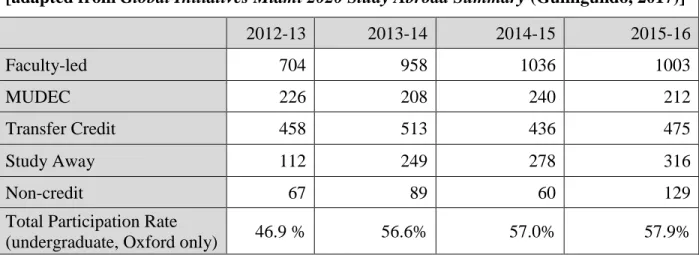
The benefits, challenges, and drivers of internationalization in higher education have been well documented in scholarly discourse (Altbach & Knight, 2007; Knight, 2013, 2015; Seeber, Cattaneo, Huisman, & Paleari, 2016). Institutional internationalization can take many forms, and may include global or intercultural components of a core curriculum, partnerships with institutions abroad, and campus diversity initiatives, among other elements. While only one facet of internationalization, student mobility serves as an especially powerful marketing tool for higher education institutions, with these vying to send and receive ever greater numbers of students to and from abroad (Knight, 2012). Miami University (MU), a public doctoral university in Oxford, Ohio, has certainly recognized the value of student mobility. With 49.1 percent of undergraduates studying abroad between 2014 and 2015, and 46.3 percent between 2015 and 2016 (Institute of International Education, 2016, 2017), MU frequently markets itself as a top university for undergraduate study abroad participation. A long-running study center in Luxembourg epitomizes the university’s global reach and vision, while growing numbers of international students speak to the allure of the Miami brand abroad (Office of Institutional Research, 2014, 2015, 2016).
In June of 2017, I embarked upon a practicum at MU with the Study Abroad and Away1 unit of Global Initiatives, a hub for five offices and centers with a multicultural, intercultural, or global focus. I was immediately struck by both the large numbers of international students on campus and the apparent popularity of study abroad among domestic students. Clearly, the university was not lacking for participants in its student mobility initiatives. Over the next few
1 “Study Away” refers to mobility programs operating outside of Oxford or any of the regional campuses, yet still within the continental United States. All subsequent references to “outbound student mobility” should be understood to include both study abroad and study away programs.
months, I began seeing a more nuanced picture of student mobility and internationalization at MU. I learned that though MU has undergone significant expansion of its short-term, faculty-led study abroad and away programs, assessment of these programs has failed to demonstrate comparable growth in students’ global awareness and intercultural competence. Furthermore, while MU hosts a growing number of international students, these students may be poorly integrated due to a variety of reasons. My review of Miami 2020, the university’s most recent strategic plan, placed student mobility within the larger context of institutional policy. With one foundational goal dedicated entirely to internationalization, Miami 2020 conveys a vision for comprehensive internationalization through not only student mobility, but also student and staff diversity, international collaboration, and other strategies (Miami University, 2013). Informal conversations with Global Initiatives staff shed light on the challenges of translating broad institutional policy (e.g. internationalization) into effective practice. In this way, I settled on a research question that would allow me to examine whether the success of MU’s student mobility programs is truly indicative of broader progress toward comprehensive internationalization.
The American Council on Education (ACE) Center for International and Global Engagement (CIGE) Model for Comprehensive Internationalization defines comprehensive internationalization as “a strategic, coordinated process that seeks to align and integrate
international policies, programs, and initiatives, and positions colleges and universities as more globally oriented and internationally connected institutions” (Brajkovic, Helms, & Struthers, 2017, p. 1). The CIGE Model specifies six “pillars” that form the foundation of comprehensive internationalization:
1. Articulated institutional commitment
2. Administrative leadership, structure, and staffing 3. Curriculum, co-curriculum, and learning outcomes 4. Faculty policies and practices
5. Student mobility
6. Collaboration and partnerships (Brajkovic et al., 2017, p.1)
2012-2013 marked a pivotal stage in MU’s internationalization efforts. Though MU pursued different elements of internationalization prior to these dates, 2012-2013 witnessed two milestones in the university’s internationalization progress. Between 2012 and 2013, five offices and centers with a multicultural, intercultural, or global focus consolidated into Global
Initiatives. 2013 also saw the drafting of the Miami 2020 strategic plan. With one foundational goal, Foundational Goal 2, dedicated entirely to internationalization, this plan represented the university’s first concerted effort toward comprehensive internationalization. Furthermore, Foundational Goal 2 set ambitious targets for student mobility, student and faculty diversity, and global engagement, among other areas (see Appendix A).
Taking the CIGE Model as a theoretical foundation, this study examines MU’s internationalization progress since 2012. As noted in a later section on Practitioner Inquiry Design, this study focuses heavily on internationalization within the context of Global Initiatives, whose units coordinate, assess, and develop a range of programs related to internationalization. Findings revealed the presence of an articulated institutional commitment to internationalization in the form of Miami 2020, the university’s most recent strategic plan, as well as in the strategic plans of individual academic divisions. Other signs of internationalization progress include: active assessment of MU’s internationalization initiatives; improved collaboration between the
three study abroad and away units as a result of administrative centralization; incentives for international engagement in the faculty tenure and promotion standards for teaching and service; integration of study abroad and intercultural learning into the core curriculum; a broad study abroad and away portfolio; and a new co-curricular program aimed at expanding and capitalizing upon on-campus opportunities for intercultural learning. Challenges include: questions
surrounding sustainable leadership in Global Initiatives; an overabundance of faculty-led programs; limited integration between international and domestic students; limited cultural sensitivity among faculty; a lack of incentives for faculty participation in cultural sensitivity trainings; limited diversity among MU’s international students, study abroad and away participants, and international partners; and uncertainty surrounding proposed policy changes related to study abroad and away.
Institutional Context Miami University
Founded in 1809, MU is a four-year, public doctoral university in Oxford, Ohio, with regional campuses in Hamilton, Middletown, and West Chester, and a study center in
Differdanges, Luxembourg. The Oxford campus hosts 17,147 undergraduates and 2,305 graduate students, with the three regional campuses hosting another 4,972 undergraduates and graduate students between themselves. The Miami University Dolibois European Center (MUDEC) in Differdanges typically hosts between 100 and 150 undergraduates per semester. MU’s academic divisions include the College of Arts and Science, the College of Engineering and Computing, and the highly ranked Farmer School of Business. MU has received particular recognition for its commitment to undergraduate teaching, ranking first among public doctoral universities
participation rate, the third highest of all public doctoral institutions nationwide according to the most recent Open Doors report (Institute of International Education, 2017).
All MU students must fulfill the requirements of the Global Miami Plan for Liberal Education, which aims to help students “develop mental agility and problem-solving ability to think for [themselves] and adapt to a changing world” (“Core Curriculum,” 2018). This core curriculum includes courses in the arts and sciences, an experiential component, and a capstone course, all of which comprise about 30 percent of a student’s total undergraduate coursework. Students interested in pursuing additional academic, research, and service learning opportunities can apply to the University Academic Scholars Program or the University Honors Program, both of which connect students with internships, scholars, faculty members, and fellowships.
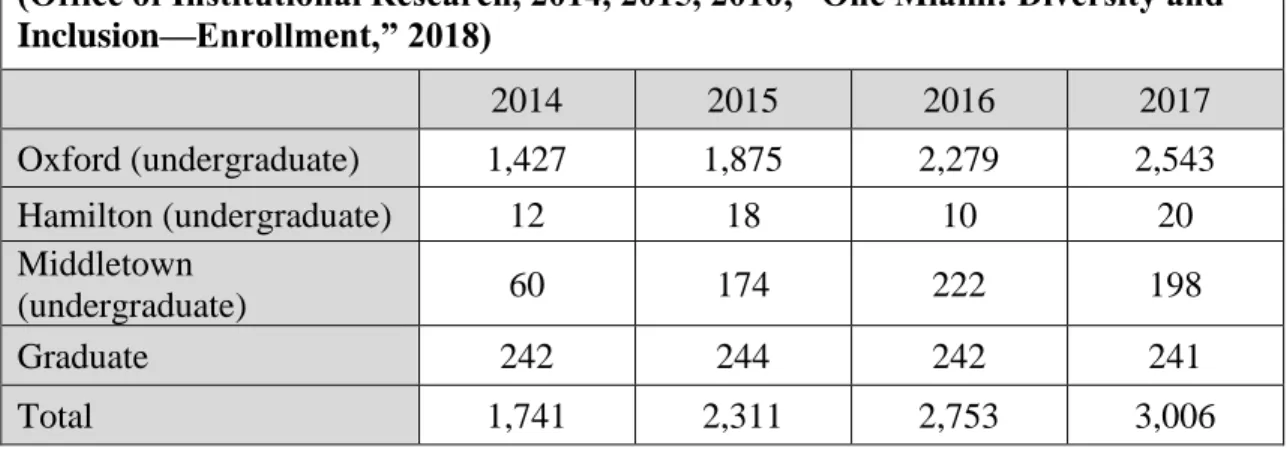
As of 2017, undergraduates and graduate students identifying as “white and unknown” made up 74 percent of MU’s enrollment across all campuses, at 18,207 (“One Miami: Diversity and Inclusion—Enrollment,” 2018). Non-white domestic students (American Indian/Alaska Native; Asian; Black/African American; Native Hawaiian/Pacific Islander; Hispanic/Latino; Multi-Racial) made up 14 percent, at 3,459, while “Non-Resident Aliens” (international students) made up 12 percent, at 3,006. In 2016, female undergraduates and graduate students outnumbered male undergraduates and graduate students 13,114 to 11,391 across all campuses (“Miami University Fact Sheet 2016,” 2016). In 2016, faculty identifying as “white and
unknown” made up 81 percent of time faculty across all campuses, at 917. Non-white, full-time faculty (see above) made up 19 percent, at 215 (“Full-Time Faculty,” 2018). Male full-full-time faculty outnumbered their female counterparts 606 to 526.
As shown by the above data, MU students and faculty exhibit a relatively low degree of diversity. However, these demographics generally align with those of surrounding Butler
County, which is 85.7 percent white (U.S. Census Bureau, 2016), as well as of Ohio, which is 82.5 percent white (U.S. Census Bureau, 2016). Other variables, such as cost and socio-cultural factors, may also play a part in determining student and faculty diversity. MU’s limited diversity is relevant to a discussion of internationalization in two respects. Firstly, the lack of diversity among study abroad and away participants has been a historic area of concern for both MU and the wider higher education community. The makeup of MU’s student body as a whole suggests that limited diversity among study abroad and away participants is symptomatic of a more general problem across the institution, rather than something unique to student mobility. Secondly, the limited diversity of MU faculty and students highlights the importance of
comprehensive internationalization, which can include increasing diversity among its aims. That said, institutions may differ in their interpretation of diversity. While responding institutions in the 2016 Mapping study cited “diversifying students, faculty, and staff at the home campus” as the number-two motivation for pursuing internationalization (Brajkovic et al., 2017, p. 5), and recruiting international students as the number-two priority activity for internationalization, institutions made no mention of recruiting diverse domestic students, faculty, and staff. In other words, some institutions may either: 1) view diversity as arising from inbound mobility alone, and not from racial and/or ethnic variance among domestic students, faculty, and staff, or 2) view the diversity of domestic students, faculty, and staff as being unrelated to internationalization. The prevalence of “intercultural competence” as a desired outcome of many institutional internationalization plans, combined with the wealth of intercultural, if not necessarily
international, perspectives among diverse domestic students, faculty, and staff, suggests that the diversity of domestic populations is, in fact, highly pertinent to the internationalization process.
Global Initiatives
In 2012, Provost Bobby Gempesaw tasked then-Director of Extended and Global Studies Cheryl Young with consolidating several independent offices and centers with a global,
multicultural, or intercultural focus into one front-facing unit. Operating under the CIGE Model of Comprehensive Internationalization, Young reorganized Continuing Education, International Education and Lifelong Learning, and other offices and centers into Global Initiatives, of which she became associate director. As MU’s premier internationalization hub, Global Initiatives coordinates, develops, and assesses a range of programs related to institutional
internationalization. What follows is a brief profile of each of the units comprising Global Initiatives.
Global Initiatives’ Continuing Education unit administers credit and non-credit programs catering to audiences outside of the traditional classroom (“Continuing Education,” 2018). For example, Continuing Education’s Corporate and Community Institute provides training
workshops for industry professionals, with workshops staffed by MU faculty or outside instructors/consultants. In partnership with ed2go, an online education service, Continuing Education offers non-credit online career and professional development programs. The Global Partners Summer School brings students and accompanying faculty from around the world to campus, where students take courses approved by their home institution and participate in scheduled cultural excursions. Continuing Education also extends learning opportunities to local Ohio residents through both the Senior Citizen Audit program and a variety of credit workshops, including faculty-led study abroad and away.
Originating in 2007 from a partnership between MU and the Ohio and Liaoning Normal University in Dalian, China, the Confucius Institute at Miami University promotes harmony and
collaboration between the United States and China through a range of programs and services (“Confucius Institute—About,” 2018). The Confucius China Studies Program offers six
subprograms in the area of Humanities and Social Sciences, including a joint PhD fellowship, a PhD in China fellowship, and an international conference grant. The Confucius Institute
Scholarship Program provides funding for students, scholars, and Chinese language teachers to undertake a Chinese language studies program at Chinese universities or pursue majors in Chinese Language and Literature, Chinese History, and other areas. The China Visit Program and Chinese Bridge Summer Camp for High School Students take MU students and high school students, respectively, to China for a two-week program dealing with Chinese language and culture. The Confucius Institute also administers Chinese language proficiency exams, runs a Chinese language and culture summer camp for children, offers non-credit, conversational Chinese language classes, hosts a weekly Chinese Corner, and organizes a variety of events aimed at bringing Chinese culture to the local Miami and Oxford communities.
Having undergone a major restructuring between 2015 and 2016, the Center for
American and World Cultures now serves as a clearinghouse for programs and activities aimed at celebrating “racial, ethnic, religious, social, and lifestyle differences” (“Center for American and World Cultures—About,” 2018). Recent programs include the César Chavez Celebration, the Genocide and Holocaust Education Program, and the UniDiversity Festival. The Center also administers a changing roster of courses, including Introduction to Study Abroad, Study Abroad Re-Entry, Strength through Cultural Diversity, and Introduction to the Miami Tribe of
Oklahoma.
Study Abroad and Away administers and develops credit and non-credit study abroad and away programs at MU (“Study Abroad and Away—About,” 2018). Consisting of three smaller
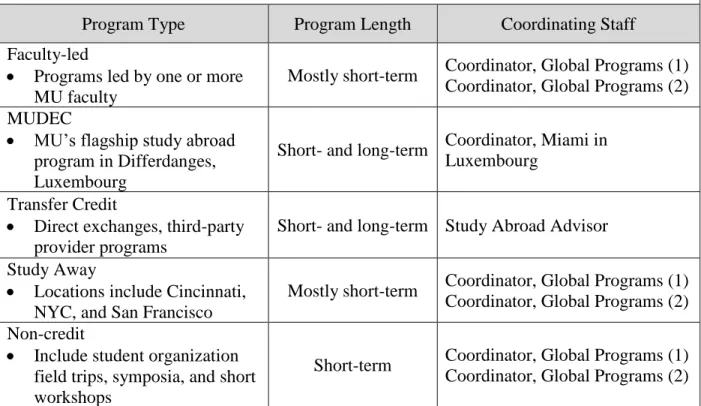
units corresponding to the three types of outbound student mobility—faculty-led, transfer credit, and the Miami University Dolibois European Center (MUDEC)—Study Abroad and Away advises students, faculty directors, and local, non-Miami program participants (e.g. senior citizens) on all aspects of the study abroad and away process. Study Abroad and Away conducts study abroad marketing and outreach through student orientations, online media campaigns, tabling, and the annual study abroad fair. Study Abroad and Away also collects and reports data on outbound student mobility for use with Miami 2020 and Open Doors, in addition to serving as a passport center for students and local residents.
International Students and Scholar Services supports inbound students and scholars through orientation and transition services, immigration advising and reporting, and academic monitoring (“International Students and Scholar Services—About,” 2018). Staff advise students and scholars regarding U.S. immigration and work authorization policies, in addition to hosting a number of events throughout the year aimed at supporting the well-being of MU’s international community. Sample events include the annual Thanksgiving dinner, day trips to Cincinnati, interviewing skills workshops, and international tea tastings.
Literature Review
Though this study uses the CIGE Model for Comprehensive Internationalization as its theoretical framework, other scholars have proposed different models for, and definitions of, comprehensive internationalization. Altbach and Knight (2007) distinguish between
globalization and internationalization, with globalization being the “economic, political, and societal forces pushing 21st century higher education toward greater international involvement,” and internationalization being the “policies and practices undertaken by academic systems and institutions—and even individuals—to cope with the global academic environment” (p. 290).
However, globalization can influence elements of an internationalization campaign, as seen in the following discussion of internationalization motivations.
Figure 1 below presents two comparable models of internationalization. Though Paige’s (2005) model is more comprehensive than that of the Institute of International Education (2009), with the former including co-curricular programs, infrastructure, and monitoring among its key performance categories, both share the essence of Knight’s (2003) revised definition of
internationalization—namely, that internationalization is a process, rather than an end goal, and that it must be integrated across an institution’s programs and policies. As Brustein (2017) argues, incorporating internationalization-oriented goals into an institutional strategic plan is unlikely to bring about lasting, systemic change without a corresponding effort on the part of individual colleges, departments, and schools.
Figure 1: Comparable Internationalization Models
Internationalization Model: Key Performance Categories (reproduced from Paige, R.M., 2005, p. 109)
Internationalization Strategies (reproduced from Institute of International Education, 2009, p. 3)
1. University Leadership for Internationalization
2. Internationalization Strategic Plan 3. Institutionalization of International
Education
4. Infrastructure-Professional International Education Units and Staff
5. Internationalized Curriculum 6. International Students and Scholars 7. Study Abroad
8. Faculty Involvement in International Activities
9. Campus Life: Co-Curricular Programs 10.Monitoring the Process
1. Take a strategic approach
2. Articulate an international vision and commitment
3. Facilitate faculty and curriculum integration
4. Develop international institutional partnerships
5. Attract international students 6. Promote study abroad
Just as higher education institutions can subscribe to different models of
internationalization, they can also be influenced by different motivations at the micro and macro levels. In their study of 400 European higher education institutions, Seeber et al. (2016) found that those operating in a global context more frequently cited prestige as a motivation for internationalization. Rankings are among the most well-known sources of institutional prestige, with annual publications such as the Times Higher Education World University Rankings assessing excellence across a variety of areas, including diversity, research, and citations. Though not a ranking in itself, the Institute of International Education’s annual Open Doors report enables institutions to assess how their inbound and outbound student mobility rates compare with those of other institutions. Coelen (2009) views rankings and internationalization as complementary; higher rankings facilitate recruitment of international students and scholars, which in turn leads to higher rankings. Interestingly, in their study of the top 50 universities in the Times Higher Education World Reputation Rankings,2 Delgado-Márquez, Bondar, and Delgado-Márquez (2012) found that while investment in teaching and research contributed positively to universities’ reputation, internationalization appeared to have no significant effect on reputation. In other words, the world’s most prestigious universities may not necessarily be the most internationalized.
Economic considerations can also be a powerful driver of internationalization. Student mobility provides tangible benefits in the form of revenue, as shown by the $37 billion
international students contributed to the U.S. economy during the 2016-2017 academic year (NAFSA, 2018). Universities can reinvest this revenue in different areas of internationalization
2 This is distinct from the Times Higher Education World University Rankings. While both the World Reputation Rankings and the World University Rankings allot points for teaching and research, only the latter allots points for citations, industry income, and international outlook.
or use it to subsidize unrelated institutional initiatives (Knight, 2004). However, revenue
generation need not be the only, or even the primary motivation for engaging in student mobility and other elements of internationalization. In his study of internationalization among European higher education institutions, Hudson (2016) found that perceived benefits of internationalization such as increased cultural understanding and improved quality of teaching, learning, and research played a greater part in driving internationalization than did economic considerations. Hill and Helms (2012) uncovered similar motivations behind inbound and outbound student mobility initiatives. Of course, teaching and learning objectives do not exist in a vacuum. With the growth of the “‘customer service’” model of education, in which higher education institutions are
increasingly called upon to provide “‘value for money’” (as cited in Hudzik & Stohl, 2009, p.11), internationalization outcomes such as increased intercultural awareness and global competency represent a return on investment for students and parents.
As key stakeholders in any institution, faculty and students may also share an interest in engaging with different aspects of internationalization. Faculty can engage with
internationalization through international committees and projects, faculty-led study abroad programs, international partnerships, and teaching and lecturing abroad (Dewey & Duff, 2009). Friesen (2013) found that “personal motivations… primarily based on a commitment to
furthering intercultural understanding at an individual level, both for themselves [faculty] and their students” can influence faculty’s willingness to participate in international opportunities (p. 222). Alignment between individual and institutional rationales for internationalization appeared to contribute positively to faculty engagement with internationalization, as did a shared
Having once made the choice to pursue higher education, students arguably became passive participants in, and recipients of, certain institutional aspects of internationalization, such as global or intercultural course requirements of a core curriculum; institutional diversity policies regarding hiring and admissions practices; and international partnerships. In contrast, students become active participants in internationalization when choosing to study abroad or away. In their study of U.S., French, and Chinese students, Sánchez, Fornerino, and Zhang (2006) found that the desire to “search for a new experience” and “search for liberty/pleasure” both influenced the intention to study abroad among U.S. and French students, while the desire to “improve a social situation” influenced the same among students from all three countries (p. 46). In a separate study, Anderson & Lawton (2015) assessed U.S. students’ motivations for studying abroad across four dimensions: world enlightenment (learning about the world); personal growth; career development; and entertainment. World enlightenment and personal growth figured most prominently in the results. The authors failed to establish a relationship between motivations for studying abroad and the degree of improvement in students’ cultural
competence—a surprising finding, given the authors’ hypothesis that students motivated by a desire for personal or professional growth would see greater benefits than would students motivated by a desire for entertainment.
The expansion of internationalization initiatives has uncovered a number of challenges facing higher education institutions. Hill and Helms (2014) discuss how inadequate resources and low participation in student mobility opportunities can hamper internationalization at many institutions. Neither is student mobility in itself a guarantee of increased cultural competency; the authors note that social isolation and a lack of institutional support can limit international
satisfaction rates can be valuable “brand ambassadors” for their host institutions (Roy, Lu, & Loo, 2016, iv), they face significant challenges in the form of low English proficiency, limited social and professional networks, discrimination, and feelings of loneliness and homesickness. Regarding faculty-centered internationalization initiatives, Brustein (2017) argues that higher education institutions must do more to incentivize faculty to pursue international opportunities. As it stands, faculty may perceive teaching abroad and other international opportunities as detrimental to their advancement within their respective departments.
While curricula and learning outcomes play a significant role in comprehensive
internationalization initiatives (Brajkovic et al., 2017), Svensson and Wihlborg (2010) believe that research into curriculum issues and the practice of internationalization in the classroom is currently lacking. The authors highlight the contrast between concrete language and thinking surrounding organizational and administrative aspects of internationalization, and vague language and thinking surrounding curricular aspects. For example, institutional stakeholders may hold wildly different views of what constitutes “‘world citizen[ship]’” (as cited in Svensson & Wihlborg, 2010, p. 602). Clarifying curricular learning outcomes becomes all the more
pressing when one considers that many students in the United States may be developing their international awareness and competency through on-campus courses with an international component (Wamboye, Adekola, & Sergi, 2015, p. 389), such as courses requiring students to conduct research on a foreign country or those featuring a foreign guest speaker.
The challenges of internationalization arguably become most evident when examining the ways in which higher education institutions assess, monitor, and evaluate their
internationalization. While the 2016 Mapping survey (Brajkovic et al., 2017) revealed an unexpected drop in the number of U.S. institutions reporting having conducted formal
assessments of their internationalization progress or impact, assessment can serve several important functions, including providing quality assurance; holding institutions accountable to stakeholders; and supplying data for rankings and league tables (Beerkens, Brandenburg, Evers, van Gaalen, Leichsenring, & Zimmermann, 2010). In their survey of higher education
institutions in the European Higher Education Area, Engel, Sandstrom, van der Aa, and Glass (2015) found a positive correlation between the presence of an international strategy and high levels of monitoring and evaluation. That said, an institution’s motivations for pursuing internationalization will influence the ways in which it assesses its progress, with some
conducting self-evaluations, in which “an internal situation is tested against objective indicators that have been established internally,” and others using tools such as benchmarking, in which “internal processes are measured and compared with those of other institutions” (Beerkens et al., 2010, pp. 21-22).
Deardorff et al. (2009) suggest using the “SMART goal format (Specific, Measurable, Action-oriented, Realistic, and Time-delineated)” when developing goals and objectives for internationalization (p. 24). In this model, measurable quantities, such as the number of students participating in education abroad programs, serve as inputs leading to meaningful outcomes, such as “a heightened sense of global interconnections and interdependencies… new abilities to describe the host country from the inside out… [and the ability to] describe a social problem requiring collective remedies that transcend national boundaries” (p. 26). However, some scholars worry that meeting numerical targets has become an end in itself. Whether it is signing more international agreements or chasing a higher ranking in global league tables (Knight, 2013, 2015), some institutions have “confuse[d] an international marketing campaign with an
numbers and branding, some scholars are calling for greater focus on quality over quantity in internationalization. As Beerkens et al. (2010) contend,
It is not just about more internationalization, but also about better internationalization, and the choice of indicators and measurement methodologies needs to reflect this (p. 12).
Research Methodology
This study aims to draw connections between comprehensive internationalization as a broad institutional policy and practices and initiatives on the ground, including student mobility schemes and curricular frameworks. The inquiry process relies heavily on the participation of Global Initiatives staff, who offer both ease of access and direct insight into how
internationalization is being implemented at MU. The following staff participated in interviews for the purpose of this study:
1. Assistant Provost of Global Initiatives Cheryl Young: Young has played a pivotal role in shaping MU’s vision for internationalization, with over 15 years of continuous service at the university. As senior internationalization officer at MU, Young made
internationalization a pillar of the Miami 2020 strategic plan, in addition to coordinating the consolidation of various offices and centers into one centralized internationalization hub, Global Initiatives. Until spring 2018, which saw the hiring of a new director for the Center for American and World Cultures, Young served as director of all of Global Initiatives’ individual units (i.e. Study Abroad and Away, International Students and Scholar Services, Continuing Education, Center for American and World Cultures), with the exception of the Confucius Institute. Young collaborates with offices, departments, centers, and divisions across the university to manage and coordinate programs,
particularly in the areas of study abroad and away, e-learning, and adult/professional education.
2. Global Learning Program Specialist Martha (Marty) Petrone: A former humanities professor with several decades of service at MU, Petrone now provides leadership, advising, and assistance to support embedding global learning outcomes and assessment into curricular and co-curricular global programming. As Global Initiatives’ global learning program specialist, Petrone audits and assesses current programming and curricula; provides instructional design support for the development of a study
abroad/away curriculum aligned with the existing Global Miami Plan; and develops and implements assessments for study abroad/away and international student programs. Most recently, Petrone has spearheaded the development and implementation of a global leadership program known as the Global Readiness Passport Program.
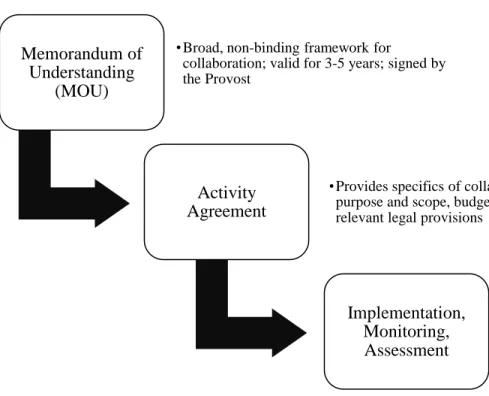
3. Director of Global Partnerships Karla Guinigundo: Guinigundo coordinates the drafting, approval, and tracking of Memoranda of Understanding and other agreements related to the establishment of new partnerships abroad. Other duties include serving as coordinator and host for visiting international delegations; advising students regarding national scholarship opportunities such as the Benjamin A. Gilman Scholarship, the Fulbright Scholarship, and the Freeman-Asia Scholarship; writing grants and managing funded projects in support of campus internationalization; coordinating International Education Week; and representing Assistant Provost Cheryl Young in Young’s absence.
Guinigundo is a MU alum and has been with the university in a professional capacity since 2012.
4. Associate Director of International Students and Scholar Services Molly Heidemann: Having worked at Miami University since 2008, first as senior international student and scholar advisor and then as associate director of international student and scholar
services, Heidemann now heads a staff of three advisors and one program coordinator at Global Initiatives. Heidemann and her staff are responsible for supporting over 3000 international students and scholars across all of MU’S campuses. As associate director, Heidemann advocates for the university’s international population, manages inbound mobility and enrollment data for internal and external reporting purposes, and oversees orientations, programs, and activities for international students and scholars.
5. Staff E: Staff E chose to remain anonymous. Though Staff E served as a resource for certain elements of this study, this paper refrains from citing Staff E directly to minimize the possibility of identification.
This study also employed document analysis of various materials related to internationalization, including:
• Miami 2020 (see Appendix A)
• Divisional strategic plans (see Appendix B and Appendix C)
• Sample faculty job postings (see Appendix D)
• Miami University promotion and tenure guidelines and templates (see Appendix E and Appendix F)
• Global Assessment Project: Initial Report and Recommendations of the Pilot
Phase (Curme et al., 2013)
• Global Assessment Project: Initial Report and Recommendations of the Pilot
• Global Initiatives Miami 2020 Study Abroad Summary (Guinigundo, 2017)
• Miami University Global Initiatives Study Abroad Open Doors History
(Guinigundo, 2017)
• Global Readiness Passport Program Proposal (Petrone, 2018)
• Global Miami Plan (“Global Miami Plan—Fall 2015,” 2015)
• Miami University web pages
Limitations
Being comprehensive in scope, internationalization at MU has brought about varying results, both profound and superficial, across a range of colleges, departments, and offices. A correspondingly comprehensive analysis of these results might have included interviews with stakeholders from these locations (e.g. administrators, faculty, students). However, an analysis of this nature would have required a degree of time, resources, and access beyond the bounds of this two- to three-month study.
Findings
Findings are presented below in six sections corresponding to the six pillars of the CIGE Model for Comprehensive Internationalization. Each section begins by highlighting relevant data from the 2016 Mapping Internationalization on U.S. Campuses study (Brajkovic et al., 2017) before moving into an analysis of my own interviews and document review. Sections conclude with a brief summary of findings, as well as insights into, and recommendations regarding, the state of each internationalization pillar at MU.
Pillar 1: Articulated Institutional Commitment
The American Council on Education (ACE) defines articulated institutional commitment, the first pillar of the CIGE Model of Comprehensive Internationalization, as “mission
statements; strategic plans; funding allocation; [and] formal assessment mechanisms” (Brajkovic et al., 2017, p. 1). Mapping Internationalization on U.S. Campuses (Brajkovic et al., 2017) provides context on what articulated institutional commitment looks like at other institutions:
• 47 percent of responding institutions listed internationalization or related activities among their top five priorities in their strategic plans.
• 27 percent of institutions had separate strategic plans in place to address internationalization.
• Over 70 percent of institutions saw internal funding for internationalization increase or stay the same over the past three years.
• 29 percent of institutions recently carried out formal assessment of their internationalization progress or impact.
Interviews with Assistant Provost of Global Initiatives Cheryl Young, Global Learning Program Specialist Martha (Marty) Petrone, and Director of Global Partnerships Karla
Guinigundo (see Practitioner Inquiry Design), combined with document review of Miami 2020 and official university web pages, shed light on the genesis of Miami 2020 and the ways in which MU has made an articulated institutional commitment to internationalization. In 2012, David C. Hodge, MU’s president at the time, brought together a number of senior-level faculty and administrators with the goal of drafting a 2020 plan. This plan represented the university’s response to a rapidly evolving higher education landscape, as noted in President Hodge’s 2012
Annual Address (“Annual Address 2012,” 2018). Areas of concern included “increasing budget constraints… growing global competition… changing demographics… rapid technological change… [and] degree valuation and assessment of learning.” The drafting process brought together 20 individuals from throughout the university into one Coordinating Team. Five Target Goal Teams, each comprising four members of the Coordinating Team and six community members with relevant expertise, were tasked with developing the following three elements of what would ultimately become the Foundational Goals of Miami 2020: 1) an aspirational statement; 2) three to five specific and measurable objectives, and 3) metrics, timetables, and action plans for achieving the goals.
As head of her Target Goal Team, Young helped incorporate internationalization-focused outcomes into what would later become Foundational Goal 2 of Miami 2020, making
internationalization a core element of MU’s institutional strategy (see Appendix A). Young went one step further by calling for each of the university’s academic divisions to develop strategic plans addressing internationalization. In doing so, Young echoed Hudzik’s and Stohl’s (2009) view that internationalization must be more than simply “one of the shops in the university mall from which some elect to purchase a product, [but rather] something to which all shops in the mall contribute in unique ways” (p.9). Young’s push to infuse internationalization at all levels of the university resulted in divisional strategic plans that reflect the language and vision of Miami 2020 (see Appendix B and Appendix C). Individual departments within these academic divisions developed their own strategic plans in the style of Miami 2020. Having internationalization-focused strategic plans in place at each level of the universityacademic divisiondepartment hierarchy helps break down far-reaching goals and objectives of Miami 2020, such as
Foundational Goal 2, Objective 1—“Attract and retain a diverse community of students, faculty, staff, and administrators” (Miami University, 2013, p.4)—into actionable strategies.
Young also highlighted how Global Initiatives is funding its internationalization activities, on the one hand, and how these activities help fund the university at large, on the other. Between 2013 and 2014, MU rolled out a new budget model known as Responsibility-Centered Management. Drawing on the budget model Young had adopted as head of Continuing Education, Responsibility-Centered Management established the funding mechanisms shown in Figure 1 below. Under this model, university revenue, which may include state subsidies, study abroad tuition, and domestic and international student tuition, is first divided among the
academic divisions. Each academic division pays a so-called “Global Initiatives tax,” with higher divisional revenue resulting in a higher tax. This tax, along with revenue from the Global
Initiatives-administered passport center, the Global Partners summer school, and credit workshop administrative fees, funds Global Initiatives’ activities from year to year. The dotted lines in Figure 1 denote Global Initiatives’ investment of time and resources toward inbound and outbound mobility initiatives, which contribute revenue to the university in the form of tuition. Young noted that even though Global Initiatives, specifically its International Students and Scholar Services and Study Abroad and Away units, now supports an unprecedented number of international students and scholars and study abroad and away programs, Global Initiatives lacks the resources to increase staff in these units. In other words, though Global Initiatives invests heavily in student mobility, which in turn contributes tuition revenue to the university as a whole, it receives no direct share of this revenue under the current budget model.
Though under a third of responding institutions in the 2016 Mapping study reported conducting formal assessment of their internationalization progress or impact (Brajkovic et al., 2017), assessment plays an important part in comprehensive internationalization. If mission statements and strategic plans represent an institution’s verbal commitment to
internationalization, the goals, metrics, objectives, and outcomes (i.e. indicators) associated with formal assessment help translate this verbal commitment into action, while also holding
institutions accountable to themselves and their stakeholders. At MU, a handful of offices and staff are responsible for assessing the university’s progress toward different aspects of
internationalization. For example, MU’s Office of Institutional Research assesses the university’s
Figure 2: Responsibility-Centered Management Funding Model
University Revenue Academic Divisions “Global Initiatives tax” international students and scholars study abroad and away Global Initiatives study abroad admin. fee Global Partners summer school credit workshop admin. fee passport center
progress toward the Miami 2020 goals, including Foundational Goal 2. Sample datasets include “student race/ethnicity by level, division, and department” and “historical study abroad
participation rates” (“Resources for the 2020 Metrics,” 2013), both for use with Metric 18 of Miami 2020 (see Appendix A). The Office of Institutional Research also provides goals and metrics response templates for use by divisions and departments in aligning their individual strategies with the goals of Miami 2020.
Global Initiatives Director of Global Partnerships Karla Guinigundo contributes to ongoing assessment by managing data related to objectives and metrics of Foundational Goal 2, including Metric 20—“60% of Miami students will study abroad or study away”—and Metric 23—“ Miami will expand, virtually and physically, by 25%, its international partnerships and activities to increase its impact on the global stage” (Miami University, 2013, p. 7). Metric 20 serves as both a self-evaluation and benchmarking tool, with different data collection methods for each. When calculating student mobility numbers for use with Metric 20, Guinigundo
includes international students studying abroad in a third country (i.e. somewhere other than their home country), as well as any domestic or international programs with a learning component. When reporting MU’s student mobility numbers to an external body, such as Open Doors, Guinigundo tailors her data to the recipient’s criteria. In the case of Open Doors, neither international students nor non-credit programs are taken into account when calculating study abroad participation rates. As a result, many Global Initiatives staff feel that the Open Doors report, though a useful marketing and assessment tool, fails to accurately represent mobility rates at MU.
A more recent addition to the Global Initiatives team, Global Learning Program
at MU. Petrone discussed how an early assessment tool implemented in 2013, the Global Perspectives Inventory, examined the impact of different elements of the MU curriculum on students’ global and intercultural awareness. The Global Assessment Project Report (Curme et al., 2013), which summarized the findings of the Global Perspectives Inventory as well as those of other assessments, revealed that curricular components such as study abroad, global courses, and foreign language requirements had no significant impact on students’ global and intercultural awareness. Petrone later experimented with self-assessment tools, allowing students on study abroad programs to assess their learning through her own adaptation of the Global Competence Inventory. Often used among executives and other senior staff at companies and institutions, the Global Competence Inventory is ordinarily both time-consuming and expensive. Petrone’s adaptation slimmed down the assessment categories and allowed students to develop personal development plans based on their results. For example, students scoring low in the area of self-awareness could commit to checking in with friends regarding their behavior.
MU has made a clear verbal commitment to internationalization in its current strategic plan, Miami 2020. Foundational Goal 2 touches on several aspects of comprehensive
internationalization, including student and faculty diversity, student mobility, and global
partnerships, and provides actionable targets and strategies for individual colleges and academic departments. Taking Miami 2020 as a model, these same colleges and departments have
developed their own strategic plans with internationalization goals in mind. MU has also established mechanisms for assessing its internationalization progress through the combined efforts of the Office of Institutional Research and assessment specialists within Global Initiatives, including Director of Global Partnerships Karla Guiniguno and Global Learning Program Specialist Martha (Marty) Petrone. That said, assessment is not without its pitfalls.
While quantifying learning outcomes, mobility rates, and international partnerships enables institutions to track and assess their progress toward certain aspects of internationalization, there exists a danger of becoming enamored of rankings, percentages, and targets. For example, the desire to maintain or improve upon MU’s standing in the annual Open Doors report, which compiles and presents data on student mobility rates, among other areas, should not outweigh the need to develop quality student mobility programs and support staff responsible for managing those same programs. The topic of assessment as it relates to student mobility programs will be discussed in further detail in the section on Student Mobility.
Pillar 2: Administrative Leadership, Structure, and Staffing
ACE defines the second comprehensive internationalization pillar, “administrative leadership, structure, and staffing,” as “reporting structures [and] staff and office configurations” (Brajkovic et al., 2017, p. 1). These elements are important given the increasingly
“administrative-intensive” nature of internationalization (p. 10). According to the Mapping study:
• 58 percent of colleges and universities reported having a single office in charge of internationalization activities and programs.
• 53 percent of institutions had a full-time administrator, such as a senior
internationalization officer, in a supervisory role over multiple internationalization activities or programs.
• The aforementioned administrator most commonly reported either to the university’s chief academic officer or to the president.
The Mapping study also found that reporting institutions viewed institutional presidents as the main drivers of internationalization. Though both Miami 2020 and Global Initiatives came into existence during President Hodge’s administration, with significant implications for the progress of internationalization at MU, Young noted that internationalization was not a top institutional priority at that time. Perhaps owing partly to this lack of higher leadership in the area of internationalization, Young took on the mantle of senior internationalization officer, a title she carries to this day. As senior internationalization officer, Young focuses on “sustaining and expanding student mobility, international partnerships, faculty globally focused efforts, and diverse co-curricular programming” (“Provost and Staff,” 2018). Reporting to Phyllis Callahan, provost and executive vice president for academic affairs, Young works across the entire
institution to advance internationalization, as seen in her work helping shape the strategic plans of MU’s academic divisions. Now moving toward retirement, Young envisions a future in which the university president will adopt the role of senior internationalization officer—an idea
supported by the findings of the Mapping study. While recognizing that the current president, President Crawford, has proven eager to engage with internationalization, Young believes that “globally focused” should become a standard part of any president’s job description.
The establishment of Global Initiatives arguably represents the greatest shift in
administrative leadership, structure, and staffing as it relates to internationalization since 2012. The shift is particularly pronounced in the case of Study Abroad and Away. Prior to 2012, faculty-led study abroad was housed under Continuing Education in McGuffy Hall, with transfer credit programs operating separately. Though transfer credit programs shared a wing with the Luxembourg (MUDEC) program, Young saw little, if any, collaboration taking place between the two offices. For example, MUDEC advisors did not provide backup for transfer credit
program advisors, and vice versa. This divide between faculty-led, transfer credit, and MUDEC extended to their respective budget models. Whereas faculty-led study abroad brought in funding for staff development and other projects through administrative fees attached to each program, the other two offices saw no such returns. Since coming together as Study Abroad and Away in 2012, the three study abroad units have seen immediate benefits in the form of shared revenue and increased collaboration. All study abroad advisors now have access to professional
development opportunities, such as NAFSA and Forum on Education Abroad conferences. Equally important, advisors can conduct site visits abroad, allowing them to offer more in-depth guidance during advising sessions. With all study abroad and away advising now housed in one wing of Macmillan Hall, advisors for each of the three study abroad units—faculty-led, transfer credit, and MUDEC—are able to provide backup for each other during peak advising times.
Like Study Abroad and Away, International Students and Scholar Services has undergone structural and operational changes since 2012/2013. Originally known as the Office of
International Education, International Students and Scholar Services became incorporated into Global Initiatives around 2012, followed by a roughly two-year transition period. Associate Director Molly Heidemann described experiencing some uncertainty during this period as new roles and reporting structures came into effect. For example, David Keitges’s retirement from the role of International Students and Scholar Services Director meant that Heidemann now reported to Cheryl Young, who represented an unknown quantity for Heidemann and her staff. Young’s comments on the transition period hinted at a similar state of flux. For example, Young spoke of the difficulty of shifting International Students and Scholar Services’ focus away from the staff member (e.g. work-life balance) and toward the student—a shift which Young admits may have driven away some former staff. Nonetheless, both Young and Heidemann reported a
normalization of roles and expectations since the end of the transition period. Both also
expressed a desire for greater collaboration between International Students and Scholar Services and Study Abroad and Away, with Heidemann citing the example of having returned study abroad students participate in international student programming. However, Heidemann does not necessarily share Young’s interpretation of greater collaboration between International Students and Scholar Services and Study Abroad and Away. Whereas Young feels that Study Abroad and Away should be able to provide coverage for International Students and Scholar Services when the latter are away for trainings and conferences, Heidemann believes an advising model of this nature would require an unrealistic amount of cross-training.
Additional structural changes since 2012/2013 include the revamping of the Center for American and World Cultures. Between 2015 and 2016, the Center for American and World Cultures underwent a program review by Dawn Whitehead of the Association of American Colleges and Universities and Chris Cartwright of the Intercultural Communication Institute in Portland. Under its previous programming model, the Center for American and World Cultures coordinated and promoted multicultural events, including the UniDiversity Festival and Freedom Summer Lectures. Young described this model as “tired,” with little change in the roster of events from year to year. Since the end of the program review, the Center for American and World Cultures has transitioned into more of a clearinghouse for multicultural, intercultural, and global events across campus. These events, in turn, will become incorporated into the
co-curricular Global Readiness Passport Program. Students participating in this multi-year program will be required to seek out opportunities for cross-cultural learning on campus with the aim of developing global readiness through cultural understanding, cultural intelligence, and
intercultural communication (Petrone, 2018). A later section on Curriculum, Co-Curriculum, and Learning Outcomes will discuss the Global Readiness Passport Program in further detail.
Whether in the form of a single internationalization hub (i.e. Global Initiatives) or a single senior internationalization officer (i.e. Cheryl Young), centralization and consolidation have allowed MU to better focus its resources toward internationalization since 2012/2013. As mentioned previously, bringing in future university presidents as sole or additional senior internationalization officers may prove a more sustainable leadership model as Young
approaches retirement. Though this study was limited in its ability to gain extensive, in-depth insight into the daily challenges faced by the Global Initiatives units, my work with Study Abroad and Away did highlight one area of concern as it relates to staffing. MU currently offers over 100 faculty-led programs during the winter, fall, spring, and summer terms (see Student Mobility). Two full-time staff shoulder responsibility for managing this broad portfolio— reviewing and approving proposals, liaising with faculty directors, meeting with students, managing student applications, communicating with students regarding pre- and post-departure requirements, etc. Given the prospect of continued growth in faculty-led program enrollment, the university should consider increasing coordinating staff for these programs. That said, the current iteration of the Responsibility-Centered Management budget model may limit Young’s (or her successor’s) ability to take on additional staff.
Pillar 3: Curriculum, Co-Curriculum, and Learning Outcomes
ACE defines the third internationalization pillar as “general education and language requirements… co-curricular activities and programs… [and] specified student learning outcomes” (Brajkovic et al., 2017, p. 1). Whether through required language courses,
international festivals, or student mobility programs, curricular and co-curricular components of an internationalization plan make global, intercultural, and multicultural learning a core element of the student experience. According to the Mapping study:
• The number of institutions with specified international or global student learning outcomes increased by nine percent, to a total of 64 percent.
• Over half of all participating institutions reported engaging in efforts to internationalize the curriculum—up from around 45 percent in 2011.
• Among fields of study, business offered the most options for international/global tracks, concentrations, or certificates, while physical and natural sciences offered the least.
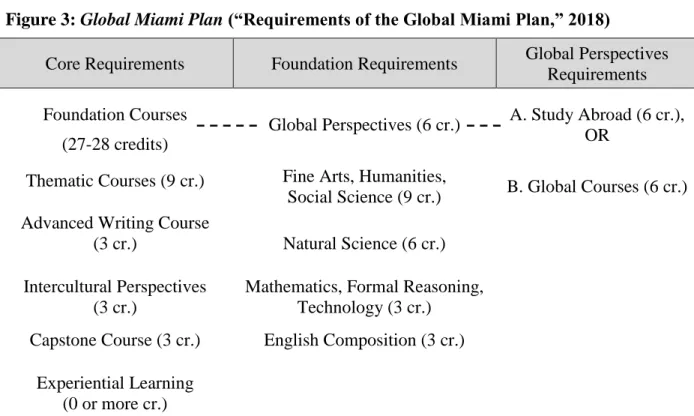
• More institutions are requiring varying degrees of foreign language study. Since 2012/2013, MU has implemented initiatives aimed at internationalizing its curriculum and co-curriculum. Prominent among these was a major revision between 2012 and 2014 of its core curriculum, the Global Miami Plan. As mentioned previously in the section on Institutional Context, MU’s core curriculum comprises about 30 percent of a student’s total undergraduate coursework, with the remaining 70 percent devoted to courses for one’s major, divisional requirements, and electives (“Core Curriculum,” 2018). Figure 3 below illustrates how intercultural, global, and/or multicultural components are integrated into the core curriculum through the Global Perspectives requirement, itself a component of the required Foundation Courses.
Figure 3: Global Miami Plan (“Requirements of the Global Miami Plan,” 2018)
Core Requirements Foundation Requirements Global Perspectives Requirements Foundation Courses
(27-28 credits)
Global Perspectives (6 cr.) A. Study Abroad (6 cr.), OR
Thematic Courses (9 cr.) Fine Arts, Humanities,
Social Science (9 cr.) B. Global Courses (6 cr.) Advanced Writing Course
(3 cr.) Natural Science (6 cr.) Intercultural Perspectives
(3 cr.)
Mathematics, Formal Reasoning, Technology (3 cr.)
Capstone Course (3 cr.) English Composition (3 cr.) Experiential Learning
(0 or more cr.)
Students can fulfill the Global Perspectives requirement through study abroad, Global Courses (i.e. courses taken on campus), or a combination of both. While all courses taken abroad grant credit toward Global Perspectives, regardless of the subject matter, students may choose to participate in short-term study abroad programs that only offer three credits. In such cases, students must also take at least one Global Course on campus to fulfill the Global Perspectives requirement. Courses fulfilling the Global Perspectives requirement include:
• Introduction to Asian/Asian American Studies
• Arts of Africa, Oceania, and Native America
• Lost Cities and Ancient Civilization
• Metal on Metal: Engineering and Globalization in Heavy Metal Music
• The Rise of Industrialism in East Asia
• Understanding Jazz: Its History and Content
• Global Perspectives of Sport
• Intro. to Women's Studies (“Foundation III—Global Perspectives,” 2018)
As shown by the course list above, MU has designated a broad array of courses across a range of departments as fulfilling the Global Perspectives requirement. This diversity of choice reflects Young’s vision of “internationalization at home,” a vision predicated on the practical assumption that not all student want or are able to study abroad. Courses such as Global Perspectives of Sport and Introduction to Global Health extend opportunities for global, intercultural, and/or multicultural learning to students in the physical or natural sciences, two fields often considered unconducive to international or global learning opportunities (Brajkovic et al., 2017). Moving forward, Young aims to make such opportunities more accessible on the home campus through the use of innovative technology. Taking SUNY’s Center for Online International Learning (COIL) as a model, Young hopes to transform the Great Room in
Macmillan Hall, a space currently being used as a regular classroom, into a “global classroom of the future” that will use cutting-edge technology to connect MU students to students around the world.
Recently, there has been discussion about reviewing the practice of allowing all study abroad courses to count toward Global Perspectives. Some question whether students are truly gaining a global perspective by merely taking one or more classes abroad. Indeed, Petrone’s early assessment work with the Global Perspectives Inventory (see Articulated Institutional Commitment) suggests that none of MU’s pre-2012/2013 efforts at internationalizing the
curriculum or co-curriculum, whether through study abroad or through Global Courses, effected significant change in students’ cultural competence. Young is now in the early stages of
overhauling the existing policy regarding study abroad courses and fulfillment of the Global Perspectives requirement. Though the particulars of this new policy remain unclear, it has been suggested that all study abroad or away programs will be required to undergo an evaluation process to determine whether they meet MU’s academic standards for fulfilling Global Perspectives.
Young’s proposed policy presents two major areas of concern. Firstly, it is unclear who will be charged with vetting programs. Likely candidates include Study Abroad and Away or the Office of Liberal Education, the latter of which currently handles petitions for new Global Miami Plan-approved courses. Regardless of who ultimately takes on this responsibility, vetting
programs will be a daunting task, to say the least. MU offers over 100 faculty-led programs and several hundred transfer credit programs, with programs in both categories changing regularly from year to year. Secondly, this policy may present a further barrier to potential study abroad participants. Though this study was unable to obtain data on study abroad participation rates by major, anecdotal evidence, including my advising work with Study Abroad and Away, suggests that being able to automatically fulfill the Global Perspectives requirement can be a major factor in students’ decision to study abroad, particularly for: 1) students in fields such as kinesiology that offer fewer global or intercultural curricular tie-ins, and 2) students considering six- to nine-credit short-term faculty-led programs. A later section on Student Mobility will discuss additional barriers to student mobility.
In its 2015-2016 program review of the Center for American and World Cultures (see Administrative Leadership, Structure, and Staffing), the Association of American Colleges and Universities recommended that MU develop a co-curricular distinction program to both
Plan to the next level,” as Young described it. Building on this recommendation, and having conducted a benchmarking assessment of 35 comparable distinction programs at higher education institutions in the United States and abroad, Global Learning Program Specialist Martha (Marty) Petrone has developed the co-curricular Global Readiness Passport Program. This program is structured to align with the goals and objectives Foundational Goal 2 of Miami 2020 (see Appendix A), and aims to cultivate cultural intelligence through knowledge,
attitudes/dispositions, and skills. Students can apply as early as the second semester of their freshman year. If accepted, students commit to the following requirements and components of the program:
• “Orientation Experience: Workshop, course, or weeklong laboratory
• Coursework: 15 hours selected from approved list will fulfill Global Miami Plan requirements
• ICC Lectures or Programs: At least 2 per semester for 3 semesters for a total of six
• Transcending & Within Borders: Affinity group and Intergroup Dialogue or diverse (to) student organization participation
• Community Engagement: Volunteerism or service learning
• Off-Campus Sustained Cross-Cultural Experience: Approved study abroad or away, or internship
• Assessment: Integrated, multiple direct and indirect measures of student learning and program effectiveness” (M. Petrone, personal communication, February 2018)
Though certain aspects of this program are still in development, the assessment component will include a review of students’ e-portfolios summarizing their learning while in the program. Depending on the results of the final assessment, students receive either a designation or a distinction on their diploma.
The Global Readiness Passport Program provides a promising model of co-curricular learning, for several reasons. Though the application process is lengthy, requiring proof of prerequisites, an autobiography, and an essay of intent, the program is designed to be less exclusive than the university honors program, allowing for a broader base of participation. The program also balances required components with those open to student choice. For example, students are free to choose which Intercultural Center (ICC) lectures or programs to attend, so long as their total attendance fulfills the per-semester attendance requirement. Students can also choose between joining an inherently diverse student organization, such as the Black Student Action Association, or joining an affinity group (e.g. fraternities, sororities, recreational sports) and attending an Intergroup Dialogue. This freedom of choice, combined with built-in
opportunities for dialogue and self-reflection, allow participants to build cultural intelligence in a variety of groups and situations. Lastly, the Global Readiness Passport Program provides a captive audience, so to speak, for intercultural, international, and multicultural events on campus.
MU has made progress in internationalizing its curriculum, co-curriculum, and learning outcomes through programs and initiatives such as the Global Miami Plan and the Global Readiness Passport Program. The former in particular establishes a sustainable framework for intercultural, global, or multicultural learning, while also extending such learning opportunities to students who may be unwilling or unable to study abroad. However, efforts to revise the