A First Approach to the Multipurpose Relational
Database Server
I.J. Blanco
1, C. Mart´ınez-Cruz
1, J.M. Serrano
2and M.A. Vila
1 1Dept. Comp. Science and Art. Intelligence, University of Granada
C/ Periodista Daniel Saucedo Aranda S/N, 18071, Granada, SPAIN
{
iblanco,cmcruz,vila
}
@decsai.ugr.es
2Dept. Computer Science, University of Jaen
Las Lagunillas Campus, 23071, Jaen, SPAIN
[email protected]
Abstract
In this paper, an architecture and an implementation of a multipurpose relational database server are proposed. This architecture enables classical queries to be executed, deductions to be made, and data mining operations to be performed on fuzzy or classical data. The proposal of this integration is to combine several ways of querying different types of data. In order to achieve this, a combination of existing meta-knowledge bases and new data catalog elements is presented. We also introduce a language for handling all these data coherently and uniformly on the basis of classical SQL sentences.
1
Introduction
In order to increase the expressiveness of Codd’s relational model [14], various ex-tensions have been proposed. While some of these improvements focused on the integration of fuzzy logic into the model so that imprecise and flexible values can be represented [6, 21], another extension of the model was based on the logical repre-sentation of a relational database[17] and the possibility of making deductions using classical inference mechanisms. Following the introduction of these extensions, it was obvious that it would be interesting to merge fuzzy relational databases and logical relational databases [1, 4, 5].
Data mining is the process by which information is extracted from a potentially large volume of data. The data mining community is currently well aware of the importance of databases in the process. Because of this, Imielinski et al.[18] proposed merging databases with data mining, and for aKnowledge Discovery and Data Mining System(KDD System) to be converted into a Knowledge Discovery and Database Mining System (KDDB System). On the basis of this, Carrasco [11, 9, 10, 8] has proposed the integration of data mining operations with a fuzzy extension of the relational database model GEFRED[21].
All architectures and implementations shown in this paper have been sug-gested on the basis of a specific proposal for fuzzy relational databases, called GEFRED[21]. Each of these has been developed to deal with a specific type of information (fuzzy, logical or referring to data mining processes). When the capa-bilities of all these implementations are merged, the power of the relational model is increased since complex queries can be executed. With such a system, data mining on relations that are defined using logical rules is possible.
The aim of this paper is therefore to combine data mining, and flexible and logical approaches in order to enhance the query capability of the system. This proposal of an extended RDBMS enables new architectures and implementations to be included due to its scalability.
The paper is organized in the following way: Section 2 describes previous imple-mentations and architectures; Section 3 examines the architecture for the unified server and the information which needs to be added so that existing servers can be connected; Section 4 presents an example of how the data are stored in the database when a query has been run on the new architecture; and finally, Section 6 presents the conclusions and future lines of research.
2
Previous Implementations, Architectures and
Models
As we mentioned above, we propose to combine existing implementations for fuzzy querying, making deductions with imprecise data, and data mining querying the relational model into a unified architecture. These existing implementations are described in this section.
2.1
Representing Imprecise Information in the Relational
Model
2.1.1 Theoretical Model (GEFRED)
This model was introduced by Medina et al. [21] to represent flexible and imprecise information within the relational model. In order to achieve this, the concept of domain is extended into thegeneralized fuzzy domain. This extension of the concept enables a relational attribute to store values such as non-numerical discrete values, numerical values, a set of possible non-numerical discrete values, a set of possible numerical values, possibility distributions on the basis of a non-numerical domain and possibility distributions on the basis of a numerical domain. This definition enables three special values to be represented: unknown(when no concrete value is known),undefined(when the attribute is not applicable), andnull(when the value can be unknown or undefined).
The second extension introduced by this model is the concept of thegeneralized fuzzy relationas a pair (H,B). His called thehead(the scheme of the relation where each attribute can take a value in a generalized fuzzy domain with a compatibility
value in the [0,1] interval) andB is called thebody(the instance of the relation as a set of tuples).
Due to the extension of the domain concept, the concept of the comparison operator is also extended into ageneralized fuzzy comparison operatorconcept (see Table 3).
2.1.2 An Architecture (FIRST)
In order to represent all the values in a generalized fuzzy domain, various authors entered three new data types into a classic RDMBS [22]. These data types are:
• Fuzzy data type 1, or CRISP data type, which represents those attributes storing classical data which can be fuzzy queried;
• Fuzzy data type 2, orPOSSIBILISTIC data type, which represents those at-tributes storing fuzzy data represented using trapezoid possibility distribu-tions defined on a numerical domain, (values for the attributes are shown in Table 1); and
• Fuzzy data type 3, or SCALAR data type, which allows attributes storing fuzzy data to be represented using possibility distributions defined on a non-numerical domain (see Table 2).
Table 1: Fuzzy Type 2 Representation
Value Types FT F1 F2 F3 F4
Unknown 0 NULL NULL NULL NULL Undefined 1 NULL NULL NULL NULL Null 2 NULL NULL NULL NULL Crisp 3 d NULL NULL NULL Label 4 Fuzzy ID NULL NULL NULL Interval[n,m] 5 n NULL NULL m
Approx(d) 6 d d-margin d+margin margin trapezoid[α, β, γ, δ] 7 α β γ δ
Table 2: Fuzzy Type 3 Representation
Value Types FT FP1 F1 . . . FPn Fn
Unknown 0 NULL NULL . . . NULL NULL Undefined 1 NULL NULL . . . NULL NULL Null 2 NULL NULL . . . NULL NULL Simple 3 p d . . . NULL NULL Distribution 4 p1 d1 . . . pn dn
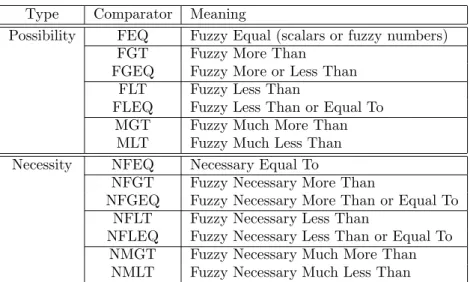
Type Comparator Meaning
Possibility FEQ Fuzzy Equal (scalars or fuzzy numbers) FGT Fuzzy More Than
FGEQ Fuzzy More or Less Than FLT Fuzzy Less Than
FLEQ Fuzzy Less Than or Equal To MGT Fuzzy Much More Than MLT Fuzzy Much Less Than Necessity NFEQ Necessary Equal To
NFGT Fuzzy Necessary More Than
NFGEQ Fuzzy Necessary More Than or Equal To NFLT Fuzzy Necessary Less Than
NFLEQ Fuzzy Necessary Less Than or Equal To NMGT Fuzzy Necessary Much More Than
NMLT Fuzzy Necessary Much Less Than
Table 3: Fuzzy Comparators
The aim of this extension is to provide a new set of capabilities to a classical RDBMS. So that this may be achieved, all accesses to relations in the data catalog must be intercepted so that new types and relations can be processed. Some new data catalog relations involved in this processing have therefore been defined, and this new set has been named theFuzzy Meta-knowledge Base (FMB). Each FMB relation is described
below:-• FUZZY COL LIST relation, storing information about attributes of relations that can contain fuzzy data or can be fuzzy queried;
• FUZZY OBJECT LIST relation, storing common information about all the
fuzzy conceptsstored in the database such as labels;
• FUZZY LABEL DEF relation, storing the possibility distribution related to every fuzzy label defined in the database;
• FUZZY APPROX MUCH relation, storing information for designing pos-sibility distributions on predefined fuzzy concepts in the database such as
greater than, much greater than;
• FUZZY NEARNESS DEF relation, storing information about similarity re-lations between every pair of values of a fuzzy type 3 attribute;
• FUZZY COMPATIBLE COL relation, storing those attributes whose do-main is copied from another fuzzy attribute in the database; and
• FUZZY QUALIFIERS DEF relation, storing the minimum threshold that is assigned to every qualifier and is defined on a linguistic label.
A set of fuzzy comparators has also been proposed and implemented for making fuzzy queries. All these comparison operators, which are described in Table 3, are implemented as procedures in the database system.
2.1.3 An Implementation (FSQL)
In order to manage all the concepts and relations defined by theFIRST architec-ture, an extension of theData Description Language(DDL) was introduced. This extension includes a syntax and an implementation of several BNF expressions such as the ones shown below.
The following sentence shows how to define the previously described fuzzy at-tributes:
CREATE TABLE table_name
’(’ { col_name (clasic_type |
( FTYPE1 ’(’margin ’,’much’)’ clasic_type | FTYPE2 ’(’margin ’,’much’)’ clasic_type | FTYPE3 [’(’number’)’][DOMAIN col_reference] ) [ NULL |ONLY LABEL | NOT NULL | NOT UNDEFINED |
NOT UNKNOWN | NOT LABEL | NOT CRISP |
NOT TRAPEZOID | NOT INTERVAL | NOT APPROX]) }+ ’)’
table_clauses;
where margin represents the triangular base in an approximate (approx) value,
much represents the minimum distance required in order for two values to be considered different. Col reference is a reference to a previously defined FTYPE3 attribute and the remaining commands (i.e. NOT LABEL, NOT CRISP, etc.) restrict the types allowed in the definition.
This expression defines linguistic labels as values for the fuzzy domain of fuzzy types 1 and 2:
CREATE LABEL
( * ON column FROM colum |
ID ON column VALUES alfa,beta, gamma, delta ) ;
This expression states symbols as values for a fuzzy type 3 attribute and estab-lishes the values of the similarity function for each pair of domain values.
CREATE NEARNESS ON column
LABELS label_name, label_name {’,’ label_name}* VALUES similarity_value{’,’ similarity_value}*
Furthermore, the sentences for altering (ALTER) and dropping (DROP) the structures mentioned above have been implemented.
An extension of the Data Management Language (DML) was introduced to handle tuples within this relation [2, 15], with an extended syntax for theINSERT
sentence:
INSERT INTO table_name VALUES
’(’ { clasic_value |
UNDEFINED | UNKNOWN |NULL |
\$’[’ number , number, number, number ’]’ |
id | # number }+
’)’
where the symbol$enables the representaion of trapezoidal and interval values, the symbol#that of triangular values, andid allows a linguistic label to be referenced. In order to query all the data defined by theGEFREDModel and implemented by the FIRST architecture, Galindo[16, 15, 2, 3] introduced an extension of the
SELECT relational sentence (DML sentence) which incorporates management of the fuzzy comparison of the extended model and allows classical or fuzzy data to be queried.
2.2
Representing Logical Information in the Relational Model
2.2.1 Theoretical Model: The Logical View of a Relational Database
The translation of a relational database into a logic database was first proposed by Gallaire et al.[17]. In this proposal, the authors provided translations for every element in the relational model into the logic language and the necessary axioms for the correct and complete description of a database. This correspondence enabled the application of logic programming languages such as theProlog[7, 19] language to a database and the development of a specific language for deduction in relational databases calledDatalog[13].
After the first attempt at introducing fuzzy data into the relational model, Vila et al.[23] proposed a logical representation for a fuzzy relational database. As in the classic relational case, this correspondence includes the translation for every element in the fuzzy relational database and the necessary axioms for the complete representation of data in the logical model.
On the basis of this logical equivalence, Blanco et al.[4] defined two new kinds of relations depending on whether the instance of the relation is explicitly stored (extensional relation, either fuzzy or classical) or if it is calculated using logical rules (intensional relation, either fuzzy or classical). The classical rules are extended into the concept ofa generalized fuzzy rule with matching degree in order to deal with fuzzy values and fuzzy comparisons.
2.2.2 An Architecture (Extended FREDDI)
The FREDDI architecture was proposed by Medina et al.[20] to incorporate a way of storing and executing logical rules within an RDBMS. In order to combine
al.[4] introduced an extension ofFREDDI. All of these extensions are represented in a set of catalog relations called theRule Base (RB)and described below:
• DED INTENSIONAL CATALOG relation, storing an index of all the inten-sional relations in the database;
• DED INT TABLE DESCRIPTION relation, storing the index of all the rules for the calculation of the instance of an intensional relation;
• DED RULE DESCRIPTION relation, representing the definition of every rule defining the content of an intensional relation as a conjunction of pred-icates (related to other extensional and intensional predpred-icates) and compar-isons;
• DED PREDICATE DESCRIPTION relation, describing the structure of ev-ery predicate in evev-ery rule (variable, position, . . . ); and
• DED COMPARISON DESCRIPTION relation, describing the structure of every predicate that is present in any rule (variables, comparison operator and threshold).
2.2.3 An Implementation (DFSQL)
Intensional relations, extensional relations, and generalized rules in the Extended FREDDIarchitecture are managed by means of an extension of theDDLlanguage provided by Blanco et al.[2]. This extension includes the syntax and management of expressions such as:
CREATE INTENSIONAL TABLE table_name ’(’ list_columns ’)’ ;
this expression enables an intensional table to be created, specifying the attributes of the relation to replacelist columns.
CREATE RULE table_name FOR ’(’
list_identifier AS [NOT]
{ ( predicate_name ’(’ identifier
(FEQ|NFEQ) identifier.identifier [THOLD number] ’)’ | predicate_name ’(’ identifier SOURCE colum
(FEQ|NFEQ) identifier.identifier [THOLD number] ’)’ | identifier.identifier (FEQ|FGT|FGEQ|FLT|FLEQ|MGT|MLT| NEQL|NFGT|NFGEQ|NFLT|NFLEQ|NMGT|NMLT)
identifier.identifier [THOLD number])
[AND]}* ’)’
wherelist identifieridentifies the name of the predicate or predicates that are being defined. The meaning of FEQ, NFEQ, FGT, FGEQ, FLT, FLEQ, MGT, MLT, NEQL, NFGT, NFGEQ, NFLT, NFLEQ, NMGT, NMLT is described in Table 3 and all of these represent fuzzy comparators.
The sentences for dropping these objects are also defined.
¿From the functional point of view, the calculus of an intensional relation in-stance can be performed by two implementations of the basic algorithms Prolog
andDatalogintroduced by Blanco et al.[4, 5].
2.3
Data Mining in the Relational Model
2.3.1 Theoretical Model (GEFRED*)
Based on the GEFRED model, this model redefines the previous concept of fuzzy domain, giving it a more universal sense: the Complex Generalized Fuzzy Do-main(GEFRED*) [12, 11] where its definition is not limited to a specific domain. In addition, GEFRED* defines complex data types where more than one classic attribute can be included. The concept of Generalized Fuzzy Comparatoris also extended into the concept ofComplex Generalized Fuzzy Comparator and this pro-vides the mechanism for comparing values in this domain. On the basis of this complex domain, a Complex Generalized Fuzzy Relation has been defined in the same way as theGeneralized Fuzzy Relation.
2.3.2 Architecture: (DmFIRST)
A new data type is introduced to represent the new set of values that were not contained in the Generalized Fuzzy Domain. This data type is a super-type that can contain values of any classical data type and the three data types introduced byFIRST (Fuzzy data type 1, Fuzzy data type 2, and Fuzzy data type 3). Fuzzy data type 4[11] consists of:
• a part storing information about the value, and
• another part storing meta-data about the type of value.
This type is included in an intermediate modification of the FIRST architec-ture, calledFIRST*. The representations of the attributes defined in the FIRST
architecture are now collected inFuzzy data type 4.
Following the idea expressed in FIRST, the data catalog relations that are in-volved in this processing are made up of an extension of the Fuzzy Meta-knowledge Base (FMB*)[11]. These relations provide the capability of representing the new fuzzy data type and executing data mining
operations:-• DMFSQL LABEL DEFINITION relation, storing information about the fuzzy labels defined for the new fuzzy data type;
• DMFSQL COL COL relation, storing information about all the attributes capable of containing or handling this new type;
• DMFSQL FUNCTIONS relation, storing the index of functions that define the extended comparators;
• DMFSQL FUNCTIONS COL relation, storing relations between an attribute and its related comparison function;
• DMFSQL COL PAR relation, storing the interface to call functions imple-menting extended comparisons.
There are also another two relations in the data catalog that are part of the so-called DmFMB. This extension of the catalog enables the system to define certain required parameters for executing some data mining operations such as:
• clustering
• fuzzy classification
• characterization
• fuzzy global dependencies searching: Fuzzy Functional Dependencies(FFD) and Fuzzy Gradual Dependencies (FGD)
The data mining fuzzy meta-knowledge base (DmFMB) maintains the necessary information for performing a data mining operation. Some of these relations store temporary data, determine the default function for an operation, parameters such as the minimum confidence or support, etc. and these are:
• DMFSQL PROJECT relation, storing general information about the data mining process, such as the source relation, the clustering process status;. . .
• DMFSQL COL LIST relation, storing information about source attributes that are significant for the data mining process, the type of operation, and the relation created for storing the results, calledproject.
These relations enable table names to be defined where the results of data mining operations will be stored. These tables are created when a data mining project is defined. The definition of a data mining project is described in the following section.
2.3.3 An Implementation (DmFSQL)
In order to manage all the concepts and relations defined by the FIRST* and the DmFIRST architecture, in [11], Carrasco proposed the syntax of an extended DDL language. This extension includes the syntax of expressions such as CRE-ATE MINING, ALTER MINING, DROP MINING, GRANT MINING, or
REVOKE MININGto enable the user to create, drop, alter, or revoke constraints in a data mining project. A data mining project stores the required information for performing a data mining process. The syntax of theCreate mining project is described below:
CREATE_MINING PROJECT id_project [ON OWNER id_owner] ON TABLE id_table
[CLUSTERING ’(’ list_columns_clu |list_columns_clu_cen’)’] [CLASSIFICATION ’(’list columns_cla’)’]
[FGLOBAL_DEPENDENCIES ’(’
{ANTECEDENT list_columns_fgd [THOLD_ANT thold] CONSEQUENT list_columns_fgd [THOLD_CON thold] } ...
’)’]
[STORAGE_SPECIFICATIONS storage_stm]
This BNF sentence declares a data mining project, and fixes the parameters of the mining process. A data mining project is associated with a relation, id table
(and sometimes with a schema or owner). Each data mining process requires the definition of different parameters:
• A clustering process specifies inlist columns clu andlist columns clu cen the set of relevant attributes in the process and certain specifications for obtain-ing the distance matrix such as weight establishment, specification of the comparison operator, etc. If a classification process is applied after the clus-tering process, parameters for obtaining the attribute centroids will also be established.
• A classification process specifies in list columns cla the set of relevant at-tributes in the process and some specifications about the comparison oper-ator, if it is necessary to use a t-norm or a t-conorm, weight establishment, etc.
• A search of functional dependencies involves defining some attributes as an-tecedents and some as consequents inlist columns fgdand whether they must accomplish a certain threshold.
Carrasco[11] also implements a sentence for managingFuzzy data type 4. Furthermore, the DML defined for the data mining process is included as an extension of the SELECT sentence[11]. This sentence incorporates operations for clustering, classifying, or extracting global functional dependencies. One example of the syntax of this sentence when a clustering process is executed is:
SELECT MINING CLUSTERING id_project
INTO TABLE_CLUSTERING id_table_result_clu [’,’ TABLE_CENTROIDS id_table_result_cen ]
OBTAINING {n_clusters|OPTIMAL_ABS|OPTIMAL_H3|OPTIMAL_MED} CLUSTERS
whereid projectidentifies a previously defined data mining project,id table result clu
represents the name of a new relation created for storing the clustering results,
id table result cen is the name of the relation where the characterization process stores all the sets and centroids obtained. The parameter n clusters specifies the
number of clusters to be obtained andOPTIMAL ABS,OPTIMAL H3 and OPTI-MAL MED allow the system to obtain the number of clusters using other imple-mented processes.
The example in Section 4 shows a sentence for obtaining some fuzzy global dependencies.
3
Architecture for a Unified Server
Using the previously described architectures, we propose the infrastructure for a unified server that integrates the capabilities of all of these architectures and enables their functionalities to be combined.
These architectures are defined below and include:
• a database server for fuzzy querying;
• a database server for making deductions with classical and fuzzy data; and
• a database server for executing data mining operations.
This integration is capable of processing several types of queries in the same sen-tence. For example, queries about deductions with fuzzy data or deductions using the results of a data mining process can be included in a single sentence.
Moreover, the proposed architecture establishes a mechanism to add more imple-mentations of new servers with different functionalities on the GEFRED extension of the relational model.
The elements to be described are:
• the combination of the different meta-knowledge bases; and
• the way to process a query so that the server can decide which modules must participate in its execution and the order for this participation.
3.1
Meta-knowledge Base (MB)
This set of catalog relations stores the definition of objects and data types used by the different modules and by the unified server. It is divided into:
• FMB, which represents fuzzy data types, fuzzy domains, fuzzy labels; . . .
• RB, which stores intensional predicates and their definition, described by means of several logical rules;
• FMB*, which defines a new data type capable of representing text, XML, objects,. . . and the operations that can be applied to this data type;
• DMFMB, which stores information about clustering, classification and fuzzy global dependencies, for applying data mining operations on classic data types of the classical RDBMS, or the fuzzy types defined in FMB.
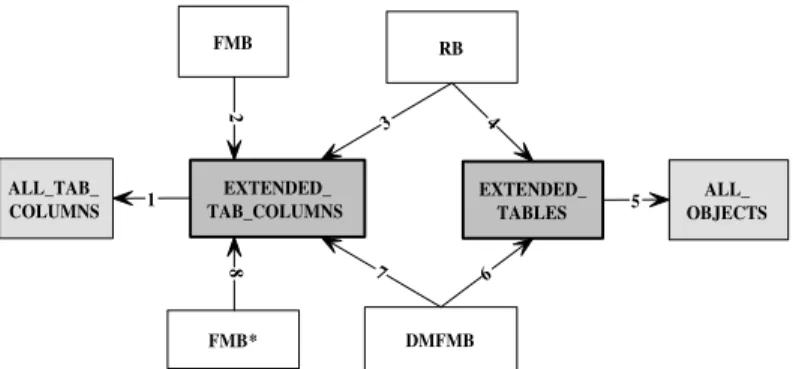
The FMB must be defined in any system that uses either FIRST, FREDDI or DMFIRST, because the FMB implements the basic structure of fuzzy data. The fuzzy comparison operators implemented in FIRST are outside the FMB. Further-more, the RB stores all the rules included in the system, referencing attributes that can be fuzzy or not, so that the FMB must be visible to this architecture. On the other hand, the FMB* is only an extension of the FMB for managing a new data type. The DMFMB works with all the attributes of the database defined in FIRST and in DMFIRST, so it is necessary to include the FMB relations for managing fuzzy data. EXTENDED_ TAB_COLUMNS EXTENDED_ TABLES FMB RB DMFMB FMB* ALL_TAB_ COLUMNS ALL_ OBJECTS 1 2 3 4 5 6 7 8
Figure 1: Extended Knowledge Base
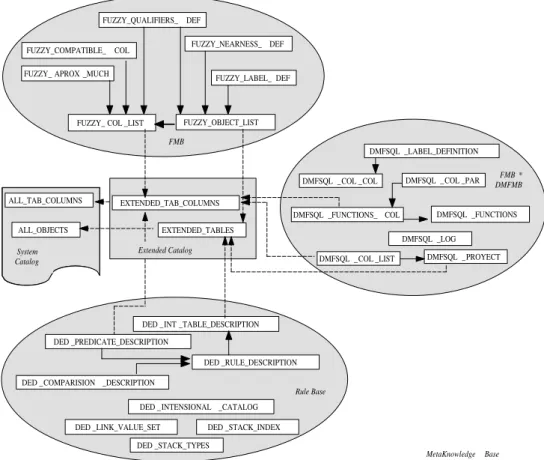
In Figures 1 and 2, the different meta-knowledge bases are interconnected by means of two new relations. The connections introduced in order for cross-queries to be processed are:
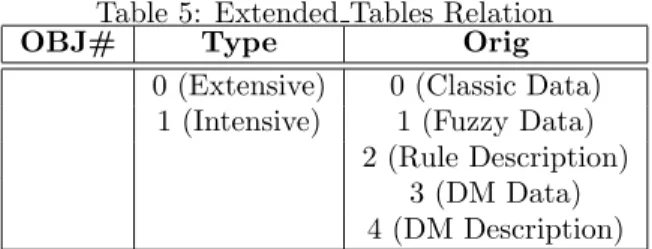
• EXTENDED TABLES, storing the relations (classical or extended) defined in the DB that can be used by fuzzy, deductive or data mining queries. These relations stored inALL OBJECTS(only those tuples referring to tables) are included in this relation (connection (5)). Consequently, this relation is a specialization of ALL OBJECTS and all the relations included in it have some of the previously mentioned special characteristics. Table 5 shows the attributes of this relation and the values that it can take.
• EXTENDED TAB COLUMNS, providing information about all of the at-tributes (classical or extended) accessible to the user. This includes some of the columns stored in ALL TAB COLUMNS (connection (1)) and a de-scription of this. As in the previous item, this relation is a specialization of
ALL TAB COLUMNS and the tuples that this relation can contain could be the fuzzy attributes described in FIRST, the intensive attributes described in FREDDI, the attributes that can be used in a data mining process, or the attributes that can store data mining temporary information or results. TheTYPEattribute (see Table 4) therefore stores the type of data that the attribute contains (a rule, fuzzy data, etc.).
These new relations must be related to a specific relation of the Relational Database Management System (RDBMS) catalog containing information about all the columns and tables defined in the database. In this proposal, the specific relations of the RDBMS (Oracle c) catalog (All Tab ColumnsandAll Object) are shown as an example.
The remaining connections with the new relations in Figure 1 are:
• Connections 2 and 8 enable the FMB and the FMB* to be related to EX-TENDED TAB COLUMNSsince they extend the definition of attributes and their domains;
• Connection 3 enables the RB to be related toEXTENDED TAB COLUMNS
since the RB extends the definition of relations;
• Connection 4 makes the RB be related toEXTENDED TABLESbecause the schema of this extension must be obtained from attributes in other relations;
• Connection 7 enables the DMFMB to be related toEXTENDED TAB COLUMNS
because data mining operations are applied on attributes;
• Connection 6 enables DMFMB to be related to EXTENDED TABLES be-cause the results of these operations must be stored in other relations.
Table 4: Extended Tab Columns Relation
OBJ# COL# Type
0 (Fuzzy Column) 1 (Logic Column) 2 (Data Mining Column)
Table 5: Extended Tables Relation
OBJ# Type Orig
0 (Extensive) 0 (Classic Data) 1 (Intensive) 1 (Fuzzy Data)
2 (Rule Description) 3 (DM Data) 4 (DM Description)
The inclusion of these unifying catalog relations makes the extended MB easily scalable.
3.2
Server Architecture and Operation
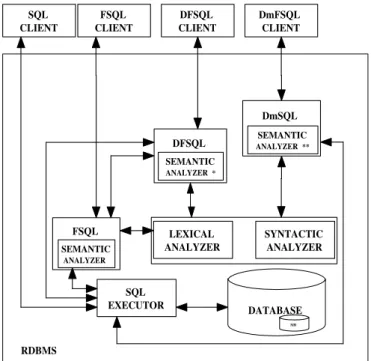
Figure 3 shows the relations between the different modules within the RDBMS. As the figure shows, there is at this moment an independent client for every module
FUZZY_ APROX _MUCH
FUZZY_COMPATIBLE_ COL
FUZZY_QUALIFIERS_ DEF
FUZZY_LABEL_ DEF
FUZZY_NEARNESS_ DEF
FUZZY_ COL _LIST FUZZY_OBJECT_LIST
DED _INT _TABLE_DESCRIPTION
DED _RULE_DESCRIPTION DED _COMPARISION _DESCRIPTION
DED _PREDICATE_DESCRIPTION
DED _LINK_VALUE_SET DED _STACK_INDEX
DED _STACK_TYPES DED _INTENSIONAL _CATALOG ALL_OBJECTS ALL_TAB_COLUMNS DMFSQL _COL _COL DMFSQL _LOG DMFSQL _LABEL_DEFINITION DMFSQL _FUNCTIONS_ COL DMFSQL _COL _PAR DMFSQL _FUNCTIONS DMFSQL _PROYECT DMFSQL _COL _LIST EXTENDED_TAB_COLUMNS EXTENDED_TABLES System Catalog Extended Catalog FMB Rule Base FMB * DMFMB MetaKnowledge Base
Figure 2: MetaKnowledge Base
providing the specific functionality. Not only will a simple SQL query be sent to the SQL executor directly, but also fuzzy, deductive, or data mining queries will be parsed by the appropriate module so that they may be translated into a classic SQL sentence or a set of sentences.
As Figure 3 shows, Galindo[16, 15] implemented lexical and syntactical parsers forFSQL language so that it could be easily modified to increase the number of processed sentences. In this way, developers ofDFSQLandDMFSQLtook advan-tage of this feature when developing analyzers for their extensions. In addition, semantic parsers are implemented separately and each translates a different query into a classical SQL sentence to be processed by the classical RDBMS.
Compilation betweenFSQL andDFSQL is tight because the second is imple-mented using the first as a basis and re-using some of its functions and modules.
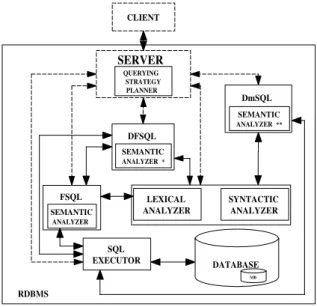
Our proposal consists of a unified server that enables all flows of information to be integrated from and to a single client. This client communicates to only one server which is capable of identifying the type of relations involved in every
LEXICAL ANALYZER FSQL DFSQL DmSQL SYNTACTIC ANALYZER SQL EXECUTOR SEMANTIC ANALYZER** DATABASE MB SEMANTIC ANALYZER* SEMANTIC ANALYZER RDBMS DFSQL CLIENT DmFSQL CLIENT SQL CLIENT FSQL CLIENT
Figure 3: Independent Servers
query. Once the query has been parsed, the server controls the execution of all the modules that must translate some parts of the query, and integrates their responses. There is also another module inside the server, the Querying Strategy Planner, which schedules the order that the queries must be executed in order to increase the efficiency of the server. The solution strategy of this planner is to analyze a complex query (a query that implies different modules to be solved) and to determine the order of execution of each subquery that this complex query involves.
The modifications provided by this architecture are shown in Figure 4 using solid lines.
The processing of a query can be resumed as follows:
• the client application sends a query to the server;
• the query is analyzed by the server using lexical and syntactic analyzers in order to determine the modules involved in the query resolution;
• the sentence is divided (if necessary) and sent to the corresponding module (here the Querying Strategy Planner schedules the execution of the different subqueries);
• every module analyzes the assigned part of the query semantically and trans-lates it into a classical sentence;
LEXICAL ANALYZER FSQL DFSQL DmSQL SYNTACTIC ANALYZER SQL EXECUTOR SEMANTIC ANALYZER** DATABASE SEMANTIC ANALYZER* SEMANTIC ANALYZER RDBMS CLIENT SERVER MB QUERYING STRATEGY PLANNER
Figure 4: Multipurpose Server
• the processed part of the original query is returned to the server which inte-grates the translations provided by the modules into a single classical query that is sent to the SQL Executor; and
• the server formats the resulting set of tuples provided by the SQL Executor before sending it to the client application.
As Figure 4 shows, both the server and all the modules need to query theMB.
4
Example
As suggested in the previous sections, the integration of the different architectures provides both the capacity for parsing several types of queries and for storing the results of independent queries as relations, rules, calculated data, etc. that other processes can subsequently use.
This section shows how a typical data mining process may be combined with the fuzzy logic rules handling. More specifically, the search for fuzzy functional dependencies (FFDs) can (when they are found) generate rules that can be stored in the database as generalized fuzzy rules with a matching degree (described in Section 2.2).
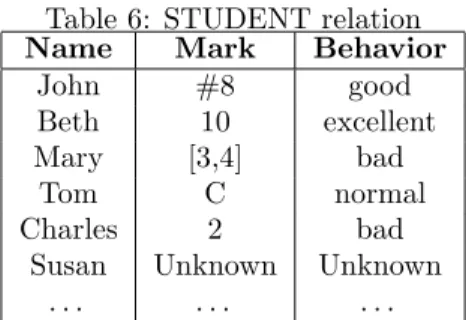
In order to illustrate this example, we suggest the following query: we want to know if there is a relationship between a student’s marks and his/her behavior. The real problem to solve is whether there is a fuzzy functional dependency (FFD) between the attributemark and the attributebehavior in theSTUDENT relation (Table 6).
In order to achieve this, it is necessary to explain how the information is stored in the database, and, more specifically, the structure of the data in the meta-knowledge base (MB).
Table 6: STUDENT relation
Name Mark Behavior
John #8 good Beth 10 excellent Mary [3,4] bad
Tom C normal Charles 2 bad
Susan Unknown Unknown . . . .
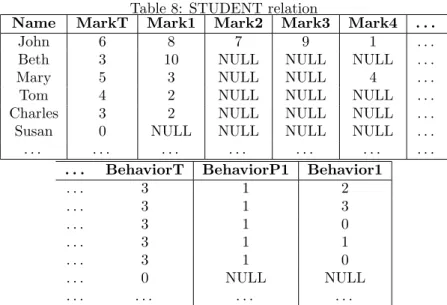
TheSTUDENT relation shown in Table 6 has been stored in the database with the structure described in Table 8, i.e. in order to represent the distinct fuzzy data types (defined in Section 2).
As we can see in the attribute F TYPE in Table 12,Mark is a Fuzzy Type 2 andBehavioris a Fuzzy Type 3. The similarity relation ofBehavior(described in Table 7) is stored in the MB in theFuzzy Nearness Def Relation(Table 10).
Labels such as mark ’C’ are described in the Fuzzy Label Def Relation(Table 11) of the MB. TheFuzzy Object List Relation (Table 9) stores the labels used in the attributeBehavior and all the labels that can be used to describe a value of the attributeMark. Furthermore, this table establishes a single identifier for each label so as to avoid confusion.
Table 7: Similarity Relationsrover BEHAVIOR
Sr(d,d’) Bad Normal Good Excellent
Bad 1 0.8 0.5 0.1 Normal 0.8 1 0.7 0.5 Good 0.5 0.7 1 0.8 Excellent 0.1 0.5 0.8 1
This is only the specification of the data structures in the FMB, however, and the data must be defined in other relations, more specifically in the new relations of the MB. These definitions are shown in Tables 14 and 15. Table 14 contains a reference to the attributes used in this example and the type of data that they represent (fuzzy data). Table 15 keeps the description of the relations used in this example, an extensive tableSTUDENT and an intensive tableFDD that will be described subsequently. The ’-’ in Table 15 means that this value is not relevant. The tuple STUDENT is inserted into this table once it has been defined in the database as a fuzzy table, and the tuple FDD inserted when the data mining process has successfully finished and an conclusion extracted from it.
Before performing any data mining operation, a newprojectmust be defined on the database. This project definition generates a few new rows in certain relations of the MB (corresponding to the previous DmFMB). The sentence for defining this
Table 8: STUDENT relation
Name MarkT Mark1 Mark2 Mark3 Mark4 . . .
John 6 8 7 9 1 . . .
Beth 3 10 NULL NULL NULL . . . Mary 5 3 NULL NULL 4 . . . Tom 4 2 NULL NULL NULL . . . Charles 3 2 NULL NULL NULL . . . Susan 0 NULL NULL NULL NULL . . . . . . .
. . . BehaviorT BehaviorP1 Behavior1
. . . 3 1 2 . . . 3 1 3 . . . 3 1 0 . . . 3 1 1 . . . 3 1 0 . . . 0 NULL NULL . . . .
Table 9: Fuzzy Object List Relation
OBJ# COL# FUZZY ID FUZZY NAME FUZZY TYPE
STUDENT Mark 0 ’A’ 0
STUDENT Mark 1 ’B’ 0
STUDENT Mark 2 ’C’ 0
STUDENT Mark 3 ’D’ 0
STUDENT Behavior 0 ’BAD’ 1 STUDENT Behavior 1 ’NORMAL’ 1 STUDENT Behavior 2 ’GOOD’ 1 STUDENT Behavior 3 ’EXCELLENT’ 1
Table 10: Fuzzy Nearness Def Relation
OBJ# COL# FUZZY ID1 FUZZY ID2 DEGREE
STUDENT Behavior 0 1 0.8 STUDENT Behavior 0 2 0.5 STUDENT Behavior 0 3 0.1 STUDENT Behavior 1 2 0.7 STUDENT Behavior 1 3 0.5 STUDENT Behavior 2 3 0.8
Table 11: Fuzzy Label Def Relation
OBJ# COL# FUZZY ID ALFA BETA GAMMA DELTA
STUDENT Mark 0 9 9 10 10
STUDENT Mark 1 6 6 8 9
STUDENT Mark 2 4.5 5 6 6
STUDENT Mark 3 0 0 4.5 5
Table 12: Fuzzy Col List Relation
OBJ# COL# F TYPE LEN COM
STUDENT Mark 2 NULL ”STUDENT.MARK” STUDENT Behavior 3 1 ”STUDENT.BEHAVIOR”
Table 13: Fuzzy Aprox Much Relation
OBJ# COL# MARGEN MUCH
STUDENT Mark 1 3
Table 14: Extended Tab Column Relation
OBJ# COL# COL TYPE
STUDENT Mark 0 STUDENT Behavior 0
Table 15: Extended Tables Relation
OBJ# TAB TYPE ORIG
STUDENT 0 1
-project has the following structure:
CREATE_MINING PROJECT STUDENT_PRJ ON TABLE STUDENT
WITH COLUMNS FOR
FGLOBAL_DEPENDENCIES ’(’ {
ANTECEDENT MARK FCOMP_GLOBAL_DEPENDENCIES FEQ THOLD_ANT 0.6 CONSEQUENT BEHAVIOR FCOMP_GLOBAL_DEPENDENCIES FEQ THOLD_CON 0.7}
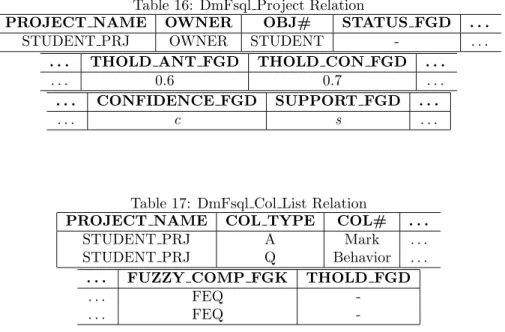
where STUDENT PRJ is an identifier of a data mining project that keeps infor-mation about the parameters of the data mining process: fuzzy functional depen-dencies search. Some of the parameters that this project contains are the type of functional dependencies to search, the matching degree of the attributes, etc. This project has been defined as the first step in a data mining process. The struc-ture of the DmFMB is described in Tables 16 and 17. Table 16 stores the general specification about the fuzzy functional dependence proposed and Table 17 stores information about each column involved in the fuzzy functional dependence search.
Table 16: DmFsql Project Relation
PROJECT NAME OWNER OBJ# STATUS FGD . . .
STUDENT PRJ OWNER STUDENT - . . .
. . . THOLD ANT FGD THOLD CON FGD . . .
. . . 0.6 0.7 . . .
. . . CONFIDENCE FGD SUPPORT FGD . . .
. . . c s . . .
Table 17: DmFsql Col List Relation
PROJECT NAME COL TYPE COL# . . .
STUDENT PRJ A Mark . . . STUDENT PRJ Q Behavior . . .
. . . FUZZY COMP FGK THOLD FGD
. . . FEQ
-. -. -. FEQ
-The fuzzy functional dependence we are searching for has been called FDD and it is described in the following expression:
0.6 - 0.7 FDD MARK F EQ∗F EQ −→BEHAVIOR with confidence c and
sup-ports
The goal is obviously to discover whether a student’s mark influences his/her behavior, where 0.6 is the matching degree of the mark, and 0.7 is the matching
degree of the behavior. In order to accomplish this operation, a DML sentence is run on the data mining server:
SELECT_MINING FGLOBAL_DEPENDENCIES STUDENT_PRJ USING T_NORM THOLD_ANT_CON
This query is actually the last in a set of basic queries such as the following:
SELECT COUNT(*) FROM STUDENT A1, STUDENT A2 WHERE(A1.NAME<>A2.NAME) AND
(A1.MARK FEQ A2.MARK
THOLD 0.6) AND NOT
(A1.BEHAVIOR NFEQ A2.BEHAVIOR THOLD 0.7)
Fuzzy functional dependence (FDD), support and confidence are calculated with a similar sentence, counting the number of antecedent and consequent appearances. If support and confidence are high enough, the FDD will be accepted and auto-matically stored in the database as a logic rule. If not, the functional dependence must be rejected or its matching degrees must be decreased.
The structure of this rule is:
FDD(MARK,BEHAVIOR) :- STUDENT(X,Y)∧
(X =0.6 MARK)∧(Y =0.7 BEHAVIOR)
The sentence which enables us to define the rule on the database is:
CREATE INTENSIONAL TABLE FDD (MARK FTYPE2 (2,3) NUMBER (3,2) BEHAVIOUR FTYPE3 );
CREATE RULE FOR FDD (Mark, Behavior) AS
STUDENT (X SOURCE Mark, Y SOURCE Behavior) AND
( X FEQ MARK THOLD 0.6) AND (Y FEQ BEHAVIOR THOLD 0.7)
whereCreate Intensional Tableinserts a new tuple into Table 18 and makes a new relationFDDin the database, without tuples because this is an intensive relation. This process also involves inserting tupleFDDinto the Table 15. Create Rulestores information in the remaining tables of the rule base (RB), i.e. Tables 19, 20, 21 and 22. In these tables, the structure of the rule, each predicate and variable that conforms to it are defined.
Table 18: Ded Intensional Catalog Relation
ID PRED MARCADO NVARS
FDD 1 2
Table 19: Ded Int Table Description Relation
Table ID Rule Id
FDD 1
Table 20: Ded Rule Description Relation
Table ID Rule Id Pred Id Occ Number Negated Type
FDD 1 2 1 0 0
FDD 1 - 2 0 2
FDD 1 - 3 0 2
Once we have defined this rule in the database, for each insertion run on the database, the system checks whether this tuple keeps the threshold for each at-tribute (the rule antecedent and consequent). If it does, the new tuple will validate the FDD and will be inserted into the database increasing the confidence and sup-port of the rule.
The previous query has only shown how the mixed architecture has increased the number of queries that can be made on the database. Other possibilities for querying the unified database are described in the following section.
5
Operations in the New Integrated System
Once the architecture of the unified system has been designed, a number of new capabilities are introduced. In general, the purpose of this union is:
• to increase the number of operations and data types that a fuzzy RDBMS (FRDBMS) can manage, these operations include:
– making deductions on data mining structures
– making data mining on logical structures (such as intensive relations)
– storing data mining results as association rules, or as logical rules, in the case of fuzzy functional dependencies
• to convert this architecture into a new, more scalable one, since the system must be extended to enable new operations and data types.
Table 21: Ded Predicate Description Relation
Table ID Rule Id Pred Id Occ Number . . .
FDD 1 2 1 . . .
FDD 1 2 1 . . .
. . . Var Id Col Id Source Col
. . . 3 1 Mark . . . 4 2 Behavior
Table 22: Ded Condition Description Relation
Table ID Rule Id Pred Id Occ Number . . .
FDD 1 - 2 . . .
FDD 1 - 3 . . .
. . . Var Id1 Var Id2 ComOp Thold
. . . 3 1 6(FEQ) 0.6 . . . 4 2 6(FEQ) 0.7
The possibility of using fuzzy data, however, is presented in every operation of the unified system since all the architectures have been developed with this functionality.
This unified system represents a single system which is capable of making any type of query with fuzzy or classic data on a database, while enabling new processes to be implemented in the system when necessary.
In order to implement this unified architecture, the entire Querying Strategy Planner must be implemented so as to enable the query to be separated and scheduled depending on the operation to be performed. FIRST, FREDDI, and DMFIRST, the initial architectures, have been developed and they are currently running.
6
Conclusions and Future Work
As we have shown in this paper, this architecture connects several existing servers that are demoted to modules. It also unifies the way of communicating with a single extended RDBMS. From our point of view, the structure ofMBallows new servers to be easily incorporated to the extension.
Added connections enable the result of a query to be used as an input for another module execution and to calculate the content of certain relations prior to a query. The automatic storing of the retrieved knowledge without an explicit query writing is another feature of the system proposed. In short, results of the different integrated server can be combined, and additional types of data can be stored and handled.
theSQL philosophy, but the language incorporated byDmFSQLmust be unified with this philosophy and some sentences for the management of data types must be completed.
Acknowledgments
This research has been partially supported by the Spanish ”Ministerio de Ciencia y Tecnolog´ıa” (MCYT) with projects TIC2002-04021-C02-02 and TIC2002-00480.
References
[1] J. F. Baldwin and S. Q. Zhou. A fuzzy relational inference language. Fuzzy Sets and Systems, (14):155–174, 1984.
[2] I. Blanco, J. C. Cubero, O. Pons, and M. A. Vila. An implementation for fuzzy relational databases. In G. Bordogna and G. Passi, editors, Recent Research Issues on the Management of Fuzziness in Databases, Studies in Fuzziness and Soft Computing, pages 183–207. Physica-Verlag, 2000.
[3] I. Blanco, N. Mar´ın, O. Pons, and M. A. Vila. An extension of data description language (ddl) for fuzzy data handling. In Larsen, Kacprzyk, Zadrozny, An-dreasen, and Christiansen, editors,Flexible Query Answering Systems, Recent Advances, Advances in Soft Computing, pages 54–64. Physica-Verlag, 2000. [4] I. Blanco, M. J. Martin-Bautista, O. Pons, and M. A. Vila. A mechanism for
deduction in a fuzzy relational database.International Journal of Uncertainty, Fuzziness and Knowledge-Based Systems, 11:47–66, September 2003.
[5] I. Blanco, O. Pons, J. M. Serrano, and M. A. Vila. Deduction in a gefred database using datalog. InInternational Conference in Fuzzy Logic and Tech-nology EUSFLAT 2003, pages 550–553, September 2003.
[6] P. Bosc, M. Galibourg, and G. Hamon. Fuzzy querying with sql: Extensions and implementation aspects. Fuzzy Sets and Systems, 28:333–349, 1988. [7] I. Bratko. Prolog, Programming for Artificial Intelligence. Addison Wesley, 2
edition, 1990.
[8] R.A. Carrasco, J. Galindo, M.C. Aranda, J.M. Medina, and M.A. Vila. Clas-sification in databases using a fuzzy query language. In 9th International Conference on Management of Data, COMAD’98, 1998.
[9] R.A. Carrasco, J. Galindo, M.A. Vila, and J.C. Cubero. Fsql: a tool for obtaining fuzzy dependencies. In 8th International Conference on Informa-tion Processing and Management of Uncertainty in Knowledge-Based Systems, IPMU’2000, pages 1916–1919, 2000.
[10] R.A. Carrasco, J. Galindo, M.A. Vila, and J.M. Medina. Clustering and fuzzy classification in a financial data mining environment. In 3rd International ICSC Symposium on Soft Computing, SOCO’99, pages 713–720, 1999. [11] Ram´on Alberto Carrasco, Mar´ıa Amparo Vila, and Jos´e Galindo. Fsql: a
flexible query language for data mining. Enterprise information systems IV, pages 68–74, 2003.
[12] Ram´on A. Carrasco. Lenguajes e Interfaces de Alto Nivel para Data Min-ing con Aplicaci´on Pr´actica a Entornos Financieros. PhD thesis, E. T. S. I. Inform´atica, Universidad de Granada, Spain, 2003.
[13] S. Ceri, G. Gottlob, and L. Tanca, editors.Logic Programming and Databases. Surveys in Computer Science. Springer-Verlag, 1990.
[14] E. F. Codd. A relational model of data for large shared data banks. Commu-nications of the ACM, 13(6):377–387, 1970.
[15] J. Galindo, J.M. Medina, A. Vila, and O. Pons. Fuzzy comparators for flexible queries to databases. In Iberoamerican Conference on Artificial Intelligence, IBERAMIA’98, pages 29–41, 1998.
[16] Jos´e Galindo, Juan Miguel Medina, Olga Pons, and Juan C. Cubero. A server for fuzzy sql queries. InProceedings of the Third International Conference on Flexible Query Answering Systems, pages 164–174, 1998.
[17] H. Gallaire, J. Minker, and J. M. Nicholas. Logic and databases: A deductive approach. Computing Surveys, 16(2):153–185, June 1984.
[18] T. Imielinski and Heikki Mannila. A database perspective on knowledge dis-covery. Communications of the ACM, 39(11):58–64, 1996.
[19] D. Li and D. Liu. A Fuzzy Prolog Database System. Computing Systems Series. John Wiley & Sons, 1990.
[20] J. M. Medina, O. Pons, J. C. Cubero, and M. A. Vila. Freddi: A fuzzy relational deductive database interface. International Journal of Intelligent Systems, 12:597–613, 1997.
[21] J. M. Medina, O. Pons, and M. A. Vila. Gefred. a generalized model of fuzzy relational databases. Information Sciences, 76(1-2):87–109, 1994.
[22] J. M. Medina, M. A. Vila, J. C. Cubero, and O. Pons. Towards the imple-mentation of a generalized fuzzy relational database model. Fuzzy Sets and Systems, 75:273–289, 1995.
[23] M. A. Vila, J. C. Cubero, J. M. Medina, and O. Pons. Some recent advances in fuzzy relational and fuzzy deductive databases. InEuropean Research Con-sortium for Informatics and Mathematics, pages 161–176, Barcelona, Spain, Noviembre 1994.