E- Learning in Higher Education Institutions and Its
Determinants
Mohamed Fathima Rashida
Department of Management and Information Technology, South Eastern University of Sri Lanka, Oluvil, Sri Lanka
Abstract
In the knowledge era, the e-learning has become vital. E-learning incorporates numerous tools that provide academic institutions efficient and effective ways to store, manage, share its academic resources and knowledge and supplement their traditional way of teaching. The adoption of e-learning has become a requirement at universities as it is enhancing the teaching and learning environment.The students’ viewpoints, lecturers’ performance, characteristics of LMS and support of university that play a significant role in determining e-learning implementation. In conclusion, universities should support e-e-learning deployment through improving learners’ viewpoints, must ensure that lecturers are entirely on board regarding the implementation of e-learning, should guarantee the quality of the utilized system, must highlight the importance of LMS on curriculum and provide good enough service for effective LMS implementation in blended learning environment.
Keywords: E-Learning, Blended Learning, Determinants of E-Learning 01. Introduction
The use of Information and Communication Technology (ICT) is a dynamic qualification for the growth of a knowledge-based economy, to develop human resources specifically for developing countries. Because of the greater use of information and communications technologies, Universities are enduring typical shifts. The result of this typical shift in the consumption and implementation of e-learning, which has arisen as an overbearing tool to communicate knowledge in the academic as well as corporate sectors.
According to Kelly and Bauer, E-learning is the use of Web-based communication, collaboration, learning, knowledge transfer, and training in order to add value to learners and businesses (Managing Intellectual Capital via E-Learning at Cisco, 2004). E-learning is controlled to become an essential module of information propagation, and develops as the new standard of modern education meanwhile it has several advantages such like increased efficiency and cost reduction, transparency, scalability, flexibility, accessibility consistency and improved student performance. As Fathi and Wilson, all methods of Internet-mediated learning continue to succeed across all stages of higher education and are increasing continually (2009).
Some academic and technical training organizations are using e-learning systems to support for traditional ways of teaching (blended learning), same time others use it to supporting tool for distance learning (pure exclusive e-learning). In case of blended learning environment, according to Gribbins et al, it is mixes instructional delivery in a face-to-face manner with online learning, either synchronously or asynchronously (2007). Hence, it is defined as a combination of online-learning and face-to-face classroom learning environments (Graham, 2006; Wu et al., 2010; Nawaz et al., 2015). On the other hand, in distance learning, e-learning can be used to construct a complete virtual e-learning environment with all course works can be done absolutely in an online manner.
Additionally, the progress of e-learning systems is fairly a challenge for both government and government universities and industry. Success of the education does not rely only on technology, but it depends on careful planning and strategies for the implementation must be closely examined and that the implementation among users is a vital concern (ElT artoussi, 2009). Both Information System researchers and professionals deal various complications in theoretical and methodological concepts (Ozkan et al 2008). Most of the initiative institutions of e-learning in developing countries have not been successful (Borstorff, et al 2007, Saeedikiya, M., et al 2010, Sife, A. S. et al 2008). Some of them only know that why many initiatives stop their online learning after their initial experience (Sun et al, 2008). As a significance of these issues, the development of theories and principles for guiding e-learning triumph to lead to achieve an efficient system is become as a requirement. Furthermore, according to the importance of measuring IS success in terms of e-learning application increase, the requirement for the investment on e-learning also increase. But before investing in on an e-learning system, there is a crucial need to evaluate the success of the systems.
02. E – Learning Background
Many researchers have encouraged to develop internet technologies and web based applications by the growing convention of internet. The character of e-learning and information technologies in higher education endures to multiply in scope and density. Every public educational institution has got the chance to make the use of Internet as a backbone of communicating medium with the students with the help of the rapid development of ICT
infrastructures. To confirm that the higher education programs delivered thru technology are in standard, it is significance and only way to evaluate the e-learning systems (Nawaz et al., 2017) used by them. In Sri Lankan context, the government also identify the potential of new technologies as a tool for making changes and innovation in education system. So that, through the Higher Education for Twenty first Century (HETC) project Sri Lankan government give highest priority for technology base education in universities. Therefore, it has invested large sum of money to purchase and develop technology infrastructures not only at university level but school level too. So, in terms of research, since the e-learning system is increasing effectively, it has become as one of the most practically and theoretically important.
Measuring the e-learning system is the only way to confirm that higher education courses delivered thru technology are in high quality, subsequently ICT is used in teaching and learning has won the significance place in all the universities in Sri Lanka.
2.1 E-Learning Assessment
E-learning can be referred as a learning process using internet, intranet or extranet, audio, video, interactive TV, satellite broadcast and CD-ROM to remotely deliver the instructional materials to learners (Holsapple & Lee, 2006). Nowadays, according to them, many authors use the terms of “distance education or distance learning,” for e-learning interchangeably.
03. Prior Studies On E- Learning
Rather there are many surveys conducted on learning, very small amount of them discuss the vocal issue of e-learning determinant factors (Selim 2007). According to Ingram et al., (2010) in 1980 the first-time determinant factors was introduced in literatures since some organizations are seems as they were getting more competitive advantages when comparing to others, meanwhile surveys were conducted to explore the success components of competitive advantage. And determinant factors should have following characteristics: few in number, measurable and controllable.
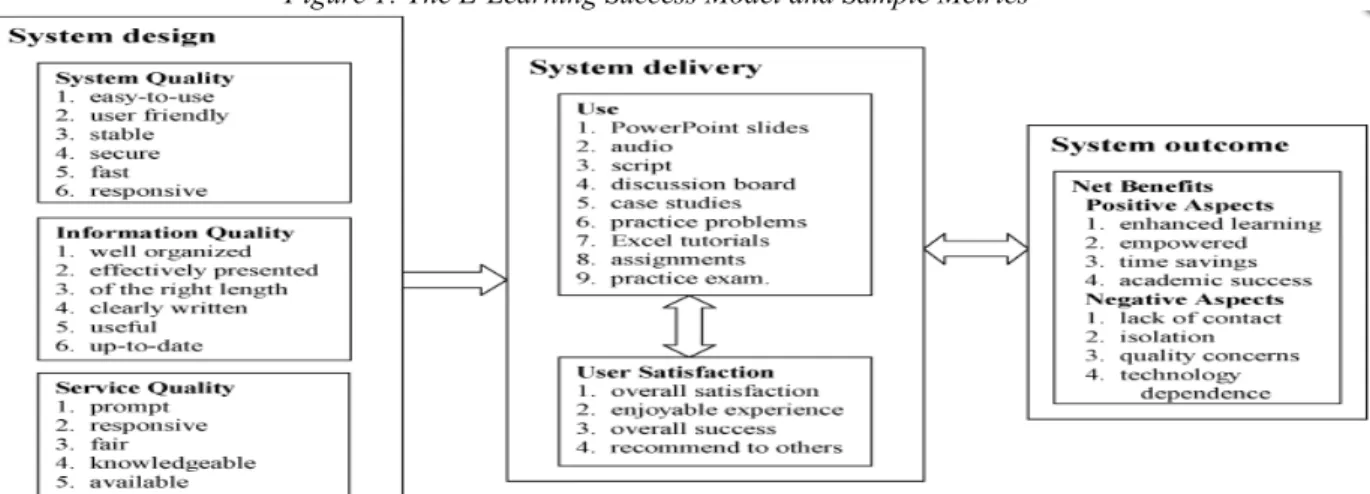
In 2006 Holsapple and Lee-Post proposes that the e-learning success model makes visibility on process to measure and evaluate the success based on the updated IS success model introduced by DeLone and McLean’s (2003). On their model, they have included success metrics which was specifically introduced for e-learning context being examined. They use the knowledge on process approach to suggest that complete success of e-learning activities depend on the three phases of e-e-learning system development success achievement: design, delivery and outcome analysis. Design phase success included another three-dimension success: system quality, information quality, and service quality. Delivery phase success included use and user satisfaction dimensions. At last outcome phase success is depended on net benefits dimension. The following figure explaining the E-Learning Success Model proposed by Clyde W. Holsapple and Anita Lee- Post in 2006. On the figure, the arrows used to interpret the dependences within between the three success assessment stages. System design success is very important to the system delivery success, which affects the system outcome success as well. System outcome success, still, has influence on complete system delivery success, as system delivery and outcome stages interpreted by double arrow.
Figure 1: The E-Learning Success Model and Sample Metrics
The first dimension of system design is system quality. It evaluates the e-learning environment characteristics such as easy to use, user friendly, stability, security, fast and responsiveness. The second dimension is information quality. It measures the how the course organized, presented, length, clear, usefulness of course and whether it is up-to-dated. The last dimension is service quality. It examined the student-lecturer relation relate to promptness, responsiveness, fairness, competency and availability.
Under the system delivery phase, the first dimension is use which evaluate the element used to deliver the course such as PowerPoint slides, audio, lecture scripts, discussing boards, case studies, practical problems Excel tutorials, assignments and practical examinations. The other dimension, user satisfaction, measures the thoughts of students regarding e-learning experience with the course. It measures from perceptions of satisfaction, enjoyment, success and recommend-ability.
The system outcome phase evaluates the net benefits from positive aspects and negative aspects. Positive aspect includes learning enhancement, empowerment, time savings and academic achievement meanwhile negative aspects includes lack of face-to-face content, social isolation, quality concerns and dependence on technology. The proposed E-Learning success model mainly focus on the e-learning system’s effects in terms of technical characteristics on its’ effectiveness.
In 2007, Liaw et al., mentioned as the way on which we use e-learning as learning and/ or teaching mechanism is covering more space on educational concept. While the popularity of e-learning environment, there are very few studies available in terms of e-learning from instructors and learners’ approaches. The scope of his study is to explore e-learning usage from instructors’ and learners’ point of view. Therefore, he examined 30 instructors and 168 college students by providing and getting response for two different questionnaires. The outcomes of this study put forward that the instructors have positive thoughts on using e-learning as a supportive tool for teaching. Also, behavioral intention to use of e-learning is effected by supposed usefulness and self-efficiency. In case of learners’ approaches, self-paced, teacher-led, and multimedia instruction are main item which affect the learners’ approach in e-learning as an effective learning supportive tool. From the outcomes of the survey he proposes some guidelines to follow when developing e-learning environments.
According to Liaw et al., (2007), he proposes three constraints to be fellow up to design an effective e-learning environment: learner characteristics, instructional structure, and interaction. And they also mentioned that it is very important to find out the target group of people when developing e-learning environment. First target is learners’ characteristics, for example, approach, motivation, belief and confidence need to be recognize at first (Passerini and Granger, 2000). Basically, e-learning means that self-directed learning environment. The second scope is instructional structure such as use of multimedia provides learners to increase complex cognitive skills such as understanding the important components of conceptual complexity, ability to use theoretical knowledge for reasoning and inference, and competency to use theoretical knowledge to unique situation with flexibility (Spiro et al., 1995). The last target is group interaction offered by e-learning environments, such as learner to leaners, and / or learners to instructors. Group interaction can be referred as group learning that support learners to improve their knowledge by activities in whey participated (Vygotsky, 1978). When learners interacting more and more with instructors and other learners, they are increasing their chances to increase their own knowledge because since much of much of learning predictably take place in social context, and the process contains the shared structure of understanding (Bruner, 1971).
In 2010 Wu et al, examined the effectiveness of e-learning for blended course environment in colleges, it explained the usefulness of e-learning and its background, ease of use and media richness are important factors of a technical system; although extrinsic motivation and learning climate are essential factors of the social system. These factors directly control and moderate the impact on students’ use of e-learning and their performance on it. Hence administration of the government universities need to concern technical as well as social factors when thy attempt to develop and increase e-learning performance of students’.
In 2011, Riaz et al studied impact of students’ characteristics, instructors’ characteristics, technical resources and system characteristics relate to students’ recognition and commitment with e-learning. The findings of this study confirm that if the instructors are keen on e-learning, then students felt as happy while using technology and have adequate technological resources, and if they could be able to easily access to internet wherever they are then all such facts help to them to continue their studies with e-learning forever.
In 2012, Puri, G stated about six e-learning determinant factors categories that can promote universities and instructors to efficiently and effectively implement learning technologies and in activity learning. The stated e-learning determinant factors categories were based on students’ viewpoint are pedagogical (alternative submission of assignment, student commitment, prompt feedback, interactive course, teacher as facilitator, multimedia tool to technologies, and learning styles), technological (system reliability and availability, slower download speed of audio or video, high broadband internet connection, system backup procedures, and system error tracking), evaluation (online test or quizzes, learn from past performance, and teaching effectiveness,), resource (language support, IT support), and interface design (user friendly e-learning system, and features to come back on left off task). Each determinant factor was critically examined. The survey has extended the knowledge of growing learning occurrence through determining the students’ viewpoints within different e-learning courses.
In 2000, Volery and Lord illustrate based on the findings of the study conducted with 47 students registered for an e-learning based management course at an Australian university. On their survey, they notified three determinant factors in e-learning are technology (level of interaction, ease of access and navigation and interface
design), instructors (classroom interaction, approach towards students and instructor technical competence) and previous use of technology from students’ viewpoint. For the use of technology in learning, Webster and Hackly (1997), step forward with Dillon and Gunawardena’s reference, directed that the technology-mediated learning success might be impact by numerous issues correlated with technology, the instructor, course, learners, and classmates.
Wan et al. (2007), in a survey study, suggested that key contributors (learners and instructors), quality of technology, and instructional design influence learning procedures, and, accordingly, learning conclusions.
In a confirmatory survey conducted by Selim in 2007, he has examined students’ approach through using e-learning. The sample wat 37 class sections with 538 responses was used to verify the proposed determinant factors of e-learning. E-learning has been implemented by many territory institutions and will be implement too. Accordingly, many implementations related determinant factors must be sensibly examined before, during and after completion of the implementation. Implementing e-learning as an integrated information technology system is a complex process while starting and developing it. He classified the outcomes of his research into eight determinant factors that can support universities and lecturers to efficiently and effectively implement e-learning technologies. Each determinant factor was deeply evaluated. The categorization of determinant factors was based on students’ viewpoint and it included characteristics of instructor (control of the technology, approach towards and teaching style), characteristics of students (e-learning course content, design, interactive collaboration and computer competency), technological infrastructure (ease of access and infrastructure), and support from the university. The findings exposed that students supposed characteristics of instructor as the main determinant factor of e-learning success, then IT infrastructure and then support from the university. The characteristics of students were exposed as the last determinant factor of e-learning success.
On a research conducted by Sun et al in 2008 surveyed the influence of learners’ characteristics, instructors’ characteristic, course characteristics, system quality, and classmates’ interaction towards leaner gratification with e-learning. And their research points out followings as determinant factors that affecting the learners’ perceived satisfaction: learners’ computer anxiety, instructor approach toward learning, learning course flexibility, e-learning course quality, perceived usefulness, perceived ease of use and diversity in assessment.
In 2001, with the use of various case studies, Soong et al verified that technical proficiency of both instructor and student, human factors, mindset regarding e-learning of both instructor and student, level of interaction with others, and perceived information technology infrastructure for the e-learning are determinant factors of e-learning. They suggested that all these determinant factors should be considered in a complete manner by e-learning implementers.
In 2002 Govindasamy argued about seven types of e-learning quality standards, which are support of the institution, course development, teaching and learning, course structure, support from students, faculty support and evaluation and assessment. With the idea of study conducted by Baylor and Ritchie in 2002, there are seven influencing independent factors related to educational technology which are planning, leadership, curriculum alignment, professional development, technology use, instructor openness to change and instructor computer use outside school and five dependent factors which are instructor’s technology competency, instructor’s technology integration, instructor morale, impact on student content acquisition and higher order thinking skills acquisition were examined using stepwise regression. The survey stemmed in models clarifying each of the five dependent measures.
If we concern e-learning some determinant factors are technological such as bandwidth, hardware reliability, network security, and accessibility. Another determinant factor is engagement of the students on learning models. E-learning models are synchronous, asynchronous and sometime mix of this two. There are several tools that can used by instructors to implement an e-learning model: mini-lectures, electronic conventional discussion, active learning and many more. The third determinant factor is user (instructor and students) related. User must be encouraged and dedicated. In online based courses, students are taking the charge of their learning activity. 04. Conclusion
This attempt to provide a discussion relevant to e-learning. As several researchers explained, students’ viewpoints, lecturers’ performance, characteristics of e-learning tool, and organizational characteristics were the predictors to e-learning implementation. Outcomes of this report have donated into the body of knowledge from practical stance. From practical stance, the instrument can be used as a tool to measure students’ viewpoints, lecturers’ performance, characteristics of e-learning tool, and organizational characteristics in an e-learning implementing environment. This report could be further extent to identify the determinant factors of successful e-learning concept in higher education institutions.
References
Baylor, A. L., & Ritchie, D. (2002). What factors facilitate teacher skill, teacher morale, and perceived student learning in technology-using classrooms?. Computers & Education, 39(4), 395–414.
Borstorff, P. C., and Keith, L. S. (2007). Student perceptions and opinions towards e-Learning in the college environment. Academy of Educational Leadership Journal, 11(2): ISSN 1095-6328.
Bruner, J.S. (1971). The Relevance of Education. Harvard University, Cambridge, MA
DeLone, W.H. and McLean, E.R. (2003). The Delone and Mclean model of information systems success: a ten-year update. Journal of Management Information System, 19(04)
Graham, C.R. (2006). Chapter 1: Blended Learning System: Definition, Current Trends, Future Directions” in Bonk. C. J. and C.R. Graham (eds.) Handbook of Blended Learning, San Francisco, CA: Pfeiffer
Gribbins, M.L., et al. (2007). Technology-Enhanced Learning in Blended Learning Environments: A Report on Standard Practices. Communications of the Association for Information Systems, 20(46), pp. 741–759. Govindasamy, T. (2002). Successful implementation of e-learning; pedagogical considerations. The Internet and
Higher Education, 4(3–4), 287–299.
Holsapple, C.W. and Lee-Post, A. (2006). Defining, assessing, and promoting e-learning success: an information systems perspective. Decision Sciences Journal of Innovative Education, 4(1), pp. 67-85.
Ingram, H., Biermann, K., Cannon, J., Neil, J., & Waddle, C. (2000). Internalizing action learning: a company perspective. Establishing critical success factors for action learning courses. International Journal of Contemporary Hospitality Management, 12(2), 107–113.
Kelly, T. and D. Bauer (2004). Managing Intellectual Capital via E-Learning at Cisco.
Liaw, S. S., Huang H.M., and Chen G.D. (2007). Surveying instructor and learner attitudes toward e-learning.
Computers & Education, 49(4):1066-1080.
Nawaz, S. S., Thowfeek, M. H., & Rashida, M. F. (2015). School Teachers’ Intention to Use E-Learning Systems in Sri Lanka: A Modified TAM Approach.
Nawaz, S.S., Rashida, M.F., & Sameem, M.A.M. (2017). Students’ Perspectives on Use Behaviour of Learning Management Systems (LMS) in Sri Lankan Universities. 2nd International Research Conference on
Economics Business and Social Sciences, Malaysia.
Passerini, K. and Granger, M.J. (2000). A development model for distance learning using the internet.
Computers & Education, 34(1), pp. 1-15.
Puri, G. (2012). Critical success factors in e-learning – an empirical study. International Journal of Multidisciplinary Research, 2(1), ISSN 2231 5780.
Riaz, A., Riaz, A., Hussain, M.(2011). Students’ Acceptance and Commitment to E-Learning. Journal of Educational and Social Research, 1 (5), ISSN 2240‐
S. Sife, E.T. Lwoga and C. Sanga, (2007), New technologies for teaching and learning: Challenges for higher learning institutions in developing countries, International Journal of Education and Development using Information and Communication Technology (IJEDICT), 3(2), pp. 57-67. Available at http://ijedict.dec.uwi.edu/viewarticle.php?id=246/&layout=html (24/02/2016)
Saeedikiya, M., Mooghali, A., and Setoodeh B. (2010). Stages of the Implementation of E-Learning in Traditional Universities. Edulearn10 Proceedings, Pp. 6620-6624. http://library.iated.org/view/saeedikiya2010sta.
Selim, H.M. (2007). Critical Success Factors for e-learning acceptance: confirmatory factor models. Computers & Education 49 (2007) pp369-413.
Sevgi Ozkan, Refika Koseler & Nazife Baykal., (2008). Evaluating Learning Management Systems: Hexagonal E-Learning Assessment Model (HELAM). European and Mediterranean Conference on Information Systems 2008 (EMCIS2008)
Soong, B. M. H., Chan, H. C., Chua, B. C., & Loh, K. F. (2001). Critical success factors for on-line course resources. Computers & Education, 36(2), 101–120.
Spiro, R.J., Feltovich, P.J., Jacobson, M.J. and Coulson, D.K. (1995). Cognitive flexibility, constructivism, and hypertext: random access instruction for advanced knowledge acquisition in ill-structured domain.
Educational Technology, 31(5), pp. 24-33.
Sun, P., et al. (2008). What Drives a Successful E-Learning? An Empirical Investigation of the Critical Factors Influencing Learner Satisfaction. Computers & Education (50)4, pp. 1183–1202
Volery, T., and Lord, D. (2000). Critical success factors in online education. The International Journal of Educational Management, 14(5):216–223.
Webster, J. and Hackley, P. (1997). Teaching Effectiveness in Technology-Mediated Distance Learning.
Academy of Management Journal (40)6: pp1282–1309.
Wan, Z., Y. Fang, and H. Neufeld (2007). The Role of Information Technology in Technology-Mediated Learning: A Review of the Past for the Future. Journal of Information Systems Education 18(2), pp. 183– 192.
Wu, W. C, Hwang, L. Y.(2010). The Effectiveness of e-Learning for Blended Courses in Colleges.