Compass Guide to WCM, Q3 2010
Evaluation of Sitecore
AUGUST 30, 2010
All content copyrighted by Ars Logica. You are permitted to use this report solely for your own personal use or your organization’s internal use. You agree to honor the Ars Logica copyright by not distributing this report without Ars Logica’s express written permission. All statements and analysis are based on Ars Logica’s experience and opinion. Readers assume all responsibility and liability for their usage of this report, and further agree that Ars Logica shall
ars logica Position
3
notes & Resources
3
Vendor overview
4
Vendor History & Key Recent Developments
5
Profile of the Ideal Customer
6
Key Product strengths
7
Key Product limitations
8
Vendor / Product Report Cards
9
Report Card evaluation Criteria - business Users
11
aRs logICa PosITIon
noTes & ResoURCes
Sitecore is without question the marketing-leading .NET-centric, enterprise-scale CMS platform. The product boasts some of the most robust online marketing capabilities on the market today, and the user interface generates the market’s highest ease-of-use ratings from non-technical business users. Relative to its most direct competition, Sitecore’s pricing is a bargain, with an excellent functionality-to-price ratio. The company’s dramatic growth rate over the past three years demonstrates the market’s recognition of the product’s strengths and its appreciation of Sitecore’s pricing.
Compass Guide Vendor Questionnaire
Some company and product information contained in this report was collected via Ars Logica’s 172-item Vendor Questionnaire. Vendor responses were always
independently verified through customer interviews, implementation monitoring, Ars Logica’s comprehensive knowledge base, and hands-on product testing.
Hands-On Product Testing
Ars Logica conducted hands-on product testing in April 2009 at Sitecore’s U.S. headquarters in Mill Valley, California. Subsequent product updates supplement these results.
Customer Interviews
Ars Logica interviewed users of every product covered in the Compass Guide, including Sitecore.
Implementation Monitoring
Since the 1990s, Ars Logica founder Tony White has kept close tabs on ongoing WCM implementations. Some of this knowledge is represented in the Compass Guide reports.
No Vendor Influence
Ars Logica retains complete editorial control over the Compass Guides and receives no funding in their production.
Sitecore CMS 6.2
Product Evaluation
By: Tony White
Sitecore Vendor Overview
Company Profile
Sitecore is a midsize, market-leading, Copenhagen and Bay Area, California, based CMS vendor. The company was founded in Denmark in 1999 and it released Sitecore 1.0 in 2001 after two years of growth as a CMS professional services firm. The vendor currently markets its CMS platform to midsize to large enterprises with .NET technical infrastructures and requirements that include online marketing campaign management, demonstrated ease-of-use for non-technical users, and a strategic focus on engaging web-site visitors. Sitecore’s recent growth rate has been among the highest in the market, and the vendor has done a surprisingly good job of maintaining strong partner relations and high customer satisfaction ratings (which usually suffer with such rapid growth).
Year Founded: 1999
Headquarters: Copenhagen; North American headquarters in Mill Valley, California Employees (or FTE equivalents): 200
Geographies: Global Revenue: $35 million (est.) Product Types Offered: WCM
Commercial or Open Source: Commercial Strategic Implementation Partners: Accenture,
iCrossing, Razorfish, Molecular, Ogilvy Top Competitors: Interwoven (Autonomy),
SDL Tridion, Day Software
Key Vertical Industries: Education, Government Retail, Publishing
Product Profile
Product Name: Sitecore CMS Version: 6.2
Next version release date: July 2010 Market segment: Enterprise
Average Sales Price (License Only): $105,000 Technology Platform: .NET
Key Strengths: Ease of Use, Flexible Architec-ture, Online Marketing Capabilities Key Limitations: Strictly for .NET environments,
Lacks the last bit of high scalability Highest-Value Use Case: Departmental or
Enter-prise deployment at midsize to large organization with a .NET infrastructure, significant number of non-technical business users (marketers, e.g.), and robust online marketing requirements.
5 Copyright © 2010 Ars Logica. All Rights Reserved.
Compass Guide to Web Content Management
Sitecore CMS 6.2 Product Evaluation
Vendor History & Product Evolution
Founded in Denmark in 1999 as a professional services company, Sitecore productized in 2001 much of what it had developed for its clients in the form of CMS 1.0, its first commercially-available offering. After opening offices and doing quite well in Sweden and Germany, the company repeated the success by opening other offices throughout Europe. In 200, Sitecore launched in the U.S., with similar results. The vendor’s growth stems from a number of factors, but chief among them are the its focus on a pure .NET product architecture and reliance on a network of development partners. Whereas some CMS vendors with beginnings as systems integrators continued to rely on revenue from their professional services business after launching their first software product, Sitecore immediately off-loaded as much implementation work as possible to partners, allowing the vendor itself to focus almost exclusively on product development. This phenomenon has resulted in an unheard-of 93% of the vendor’s current rev-enue coming from product licenses, a major factor behind Sitecore’s ability to keep its prices low relative to other similarly functional offerings in the marketplace.
As with other .NET-centric technologies with a heavy reliance on Microsoft-defined standards, there is some risk that Microsoft itself may launch a product competitive with Sitecore CMS. Ars Logica believes that this risk is so near zero as to be completely negligible. Microsoft has never demonstrated serious interest in WCM, despite initiatives over the past 10 years ranging from the acquisition of NCompass Labs (2001) to the latest release of SharePoint (2010). Aside from such competitive considerations, but relevant to .NET infrastructure, no other vendor has so tightly tied itself to Microsoft technologies as Sitecore, and this includes other Microsoft-centric CMS vendors such as Ektron, Ingeniux, EPiServer, and Alterian.
Key Recent Developments
Since 2008, Sitecore has focused the bulk of its attention on the development of the marketing cam-paign management functionality contained in its Online Marketing Suite, Foundry, SEO, and Web Forms for Marketers modules. Early initiative in this area has positioned the vendor as a market leader in the emerging area of Web Engagement Management. For the remainder of 2010 and into 2011, Ars Logica believes that Sitecore will center its development efforts around improving scalability to support ultra-large websites and providing the technical foundation for ultra-large-scale cloud-based deployments.
Profiling the Ideal Buyer
The ideal buyer of Sitecore CMS is normally a midsize to large company with a Web presence that under-lies mission-critical marketing initiatives. The vendor’s traditional strengths in the retail and government sectors result primarily from the high value of the product (“bang for the buck”), but its recent gains in retail reflect the quality of the product’s online marketing capabilities. As we have said before -- but don’t feel we can say too often -- this product is only for companies with engrained Microsoft application development standards. Java, open source, and PHP shops should move along. For companies with heterogeneous technical infrastructure (and therefore no real loyalties to any one development standard), Sitecore’s .NET foundation benefits from a plentiful, and therefore relatively inexpensive, pool of ers in the marketplace. This may result in considerable savings over time when compared to the develop-ment and maintenance of CMS platforms based on proprietary tools and technologies. As evidence of this, 93 percent of Sitecore’s revenue comes from software licenses, far more than any other vendor that we know of. This would be impossible if customers were using many Sitecore’s professional services.
Midsize to Large Company with .NET Development Environment
Although nothing prevents other companies from using Sitecore, the customer who can extract the most value from the product is typically a midsize to large enterprise with a preference for .NET ap-plication development.
Significant Online Marketing Requirements
As a core strength, the online sales and marketing capabilities of Sitecore CMS distinguish it from many competitors. Ars Logica recently ranked Sitecore the #2 vendor in this category.
Web Engagement Initiatives Managed by Non-Technical Resources
Sitecore leads the industry in product usability, which makes it a favorite among non-technical users.
•
•
•
Sitecore Will Not Be a Good Fit, If...
Customers dedicated to Java, PHP, or any other non-.NET development environment will want to look elsewhere. Much of the product’s value proposition rests on the widespread availability of .NET develo-eprs and their facility with configuring and customizing the Sitecore platform. It is also important for Sitecore buyers to realize that, under the hood, the product is a complex one. You will need an significant pool of .NET developers to implement and maintain the product properly. The product’s $105,000 aver-age sales price leads some to underestimate its complexity. And although improvements in scalability are on the vendor’s short-term product roadmap, to date the platform has not demonstrated the “last bit” of enteprise scalability that would be required to run the largest of websites.
Copyright © 2010 Ars Logica. All Rights Reserved.
Compass Guide to Web Content Management
Sitecore CMS 6.2 Product Evaluation
Key Product Strengths
Sitecore consistently gets the highest ratings from its customers for ease-of-use. Ars Logica’s product testing confirms these ratings, and we believe that Sitecore’s intuitive user interface provides a best-of-breed content creation, publishing, and editing experience for non-technical users. Our socre of 9.0 on the Product Report Card is the highest score for any of the vendors covered in the Compass Guides. This achievement on the part of Sitecore should not be underestimated, as it is easier for entry-level products to achieve excellent usability, whereas enterprise products must always balance usability against com-plexity. We know of no better success in this arena than Sitecore.
Sitecore CMS, along with four optional modules (Sales and marketing capabilities (Online Marketing Suite, Foundry, SEO, and Web Forms for Marketers) provide strong online sales and marketing capabili-ties. In conjunction with the product’s superior usability, these modules make the product a leading can-didate for non-technical marketing resources. Within a .NET environment, if product usability, high user adoption rates, and online marketing campaigns are among the potential buyer’s top evaluation criteria, Ars Logica recommends shortlisting Sitecore (barring any unusual requirements).
Technical flexibility of Sitecore CMS is very good, due in part to the product’s clean architecture and its consistent compliance with .NET development best practices. This standards-based approach improves long-term product viability and reduces the risks of vendor lock-in.
Source of Information: Product testing (January 2010), customer interviews, Vendor Questionnaire
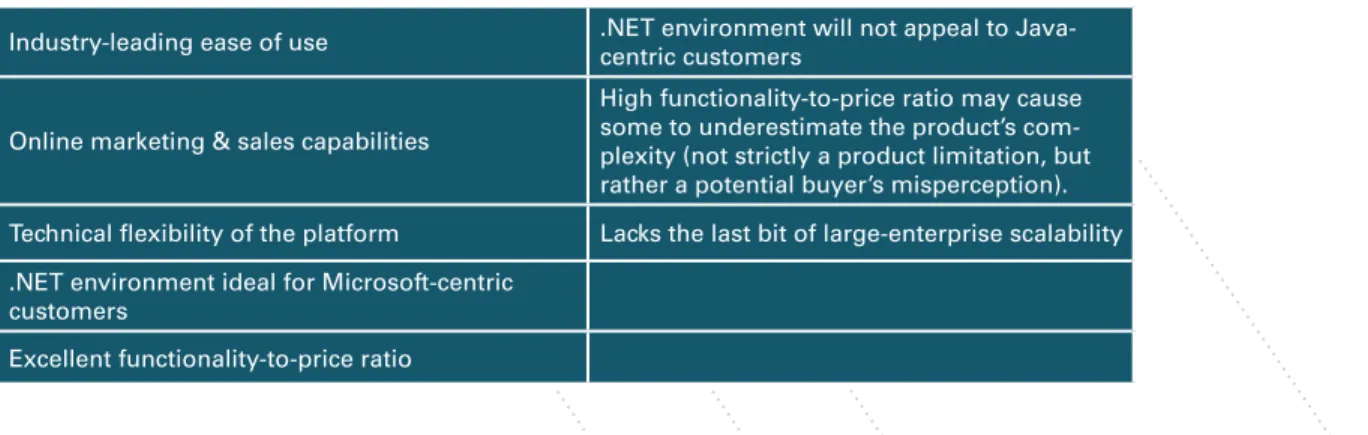
Below are several key product strengths and limitations that potential buyers should keep in mind when assembling vendor shortlists.
KEY STRENGTHS KEY LIMITATIONS
Industry-leading ease of use .NET environment will not appeal to Java-centric customers
Online marketing & sales capabilities
High functionality-to-price ratio may cause some to underestimate the product’s com-plexity (not strictly a product limitation, but rather a potential buyer’s misperception). Technical flexibility of the platform Lacks the last bit of large-enterprise scalability .NET environment ideal for Microsoft-centric
customers
Excellent functionality-to-price ratio
Key Product Limitations
Ars Logica believes that Sitecore CMS lacks the last bit of large-enterprise scalability, as evidenced by anecdotal market feedback and the vendors’ own comments on enhancements to the next version of the product. That said, this will not be a problem for all but the largest of global websites. Sitecore is addressing this issue in part by laying the technical foundation with hosting partners such as Fujitsu and Rackspace to offer dynamic, unlimited cloud-based scalability. Aside from this partner approach, we believe that any remaining scalability issues for on-premise implementations will be resolved in the .0 release, if not sooner (while the final version of this report was being edited, Sitecore announced the availability of 6.3. Ars Logica will publish vendor update later this quarter.).
One of Sitecore’s key product strengths is also one of its key limitations. For all the benefits the product offers Microsoft-centric companies, it estranges Java shops, PHP enthusiasts, and open source propo-nents. To be fair, this is not a shortcoming of Sitecore the vendor, but rather a wisely chosen strategy that has enabled Sitecore to distinguish itself both from other CMS vendors and Microsoft itself. Given the recent evolution of SharePoint, some worry that Microsoft may become a competitor of Sitecore. Ars Logica does not believe this will be the case, as Microsoft has never been very serious (in our opinion) about WCM. And even in the unlikely case that Microsoft does become a direct competitor, Sitecore cus-tomers will bear little risk of vendor lock-in since Sitecore CMS is built on a very clean .NET architecture. Ars Logica has long been annoyed by market misperceptions of Sitecore based solely on the product’s price. Not only do potential customers themselves tend to underestimate the product’s sophistication as a result of the high functionality-to-price ratio, they also commonly rely on analyst reports that group WCM products into price-based tiers. Given the amount of inaccurate vendor and product information available to prospective WCM buyers, we certainly understand why customers sometimes group prod-ucts together on this basis. But we are left to conclude that among analyst firms that do not perform product testing, their WCM reports become outdated as a result of reliance on information from custom-ers with three-to-five year-old implementations. In this market, it is important to keep in mind that techni-cally similar products sometimes vary in price by factors of two or three (and sometimes more).
The flip side of this high functionality-to-price ratio is a caveat not to underestimate the complexity of implementing Sitecore CMS. We have seen customers conclude that since Sitecore offers more feature-functionality than some other CMS applications at a similar price, it must be a better choice. This is not always true. Customers must take into account how long product implementation will take, what IT ex-pertise will be required on an ongoing basis, whether added product complexity will reduce user adoption rates, and whether lower license costs will be negated by higher staffing levels over time.
9 Copyright © 2010 Ars Logica. All Rights Reserved.
Compass Guide to Web Content Management
Sitecore CMS 6.2 Product Evaluation
Vendor/Product Report Cards
The features, functions, and technical underpinnings of WCM products vary wildly, as do the customer requirements they are intended to satisfy. For this reason, the only reliable way to assure the best prod-uct fit for a particular client is to spend anywhere from several weeks to several months assessing the client’s specific needs and analyzing product capabilities line by line. Still, Ars Logica is frequently asked to rate products in categories such as those in Figures 2 and 3. In using these ratings, please take care not to compare products in different market segments (see the Product Profile section of Page ). For example, a Scalability score of 9 for an “Enterprise” product does not equate to the same score for an “Entry Level” product.
Figure 2 shows Ars Logica’s rating of Sitecore 6.2 in four categories of critical importance to busi-ness users. Refer to Page 11 for an explanation of the evaluation criteria.
Source of Information: Product testing (January 2010), customer interviews, Vendor Questionnaire
fIgURe 2 Sitecore CMS Report Card for the Business User
COLOR KEY S O L I D S G R A D I E N T S 0 2 4 6 8 10 Market Presence, Product Viability Multi-site, Multi-channel, Multi-lingual Marketing & Sales Tools Usability
9.0
8.1
7.9
8.3
Figure 3 shows Ars Logica’s rating of Sitecore 6.2 in four categories of critical importance to tech-nologists. Refer to Page 12 for an explanation of the evaluation criteria.
Source of Information: Product testing (January 2010), customer interviews, Vendor Questionnaire
fIgURe 3 Sitecore CMS Report Card for Technologists
COLOR KEY S O L I D S G R A D I E N T S 0 2 4 6 8 10 Ease of Administration Development Tools Flexibility Scalability
7.3
8.0
8.0
7.7
11 Copyright © 2010 Ars Logica. All Rights Reserved.
Compass Guide to Web Content Management
Sitecore CMS 6.2 Product Evaluation
Report Card Evaluation Criteria
In the process of analyzing WCM solutions, Ars Logica has established a set of evaluation criteria, which at the highest level can be separated into four categories for non-technical business users and four cat-egories for technologists. Scores in these catcat-egories represent averages of a large number of detailed criteria, and are meant to be used as a means of quickly comparing products within the same market segment -- not as a substitute for painstaking requirements and product matching.
Criteria for Business Users
UsabilityUsability refers to the relative ease of learning and using a WCM application. For non-technical busi-ness users, factors contributing to high scores in this category include intuitive and consistent user interfaces, streamlined task completion (i.e. minimal number of steps to complete a task), integration with the desktop, contextual editing capabilities, and documented high user adoption rates among a vendor’s customers.
Marketing & Sales Tools
Increasingly, enterprises are relying on marketing and sales tools within WCM applications to improve sales conversion rates, increase average transaction amounts, draw customers back to their Web sites, analyze online behavioral patterns, and so on. This category rates the presence and quality of such tools.
Multi-Site, Multi-Channel, Multi-Lingual Capabilities
This category assesses a product’s ability to support multiple sites; deliver content to multiple chan-nels on multiple devices; and create, store, present, disseminate, and/or translate content into mul-tiple languages. Scores in this category represent an average of a product’s capabilities in all three of these broad functional areas.
Market Presence, Product Viability
The Market Presence, Product Viability category rates both a vendor’s overall market presence rela-tive to competitors and its dedication to the continued development of its WCM products. If these two factors are not aligned with each other, an explanation of why will be included.
•
•
•
Criteria for Technologists
ScalabilityScalability refers to the ability of a product to function well as system demands increase. Factors contributing to scalability are database size, query efficiency, bandwidth consumption, ease of sys-tem management, caching efficiency, load balancing, and mass content deployment capabilities.
Flexibility
Flexibility denotes a product’s ability to integrate easily with existing enterprise infrastructure, includ-ing operatinclud-ing systems, Web servers, databases, directories, development tools, and other enterprise applications such as ERP, CRM, document management systems, search, portals, and so forth.
Development Tools
This category describes the quality of a product’s integrated development environment (IDE), the technologies that the IDE incorporates, and overall ease of customized application development. Although this category refers primarily to development frameworks (Eclipse, e.g.), other ad hoc tools are also included, such as page templates, HTML/XML editors, WYSIWYG editors, PDF generators, and any other software that enables or eases the production, formatting and dissemination of con-tent.
Ease of Administration
Some WCM products require significantly more work to administer (sometimes 5-10 times more) than others. This category rates the relative resource intensity required to keep the system running smoothly, where higher scores reflect less work. Roughly speaking, higher scores also indicate bet-ter coordination of application components due to more methodical system design.
•
•
•
Advisory Services
Software and Technology Selection
Tel: +1 61.93.5611 Fax: +1 61.226.55 5 Arlington Street Suite 500 Boston, MA 02116 www.arslogica.com
Contact
seRVICes
Ars Logica is a vendor-neutral analyst firm helping companies evaluate their WCM requirements and select appropriate WCM software. To address clients’ content management-related questions and problems that arise throughout the year, Ars Logica offers unlimited direct analyst access through its Analyst Anytime advisory services. These annual, subscription-based services provide guidance by phone or email within 2 hours on a wide range of issues. The number of inquiries submitted throughout the year is not limited.
In our Software and Technology Selection engagements, Ars Logica maps clients’ functional, technological, and strategic requirements to potential WCM solutions and identifies the software vendors whose products best satisfy these requirements. We maintain a continuously updated comprehensive matrix of the feature-functionality of most WCM vendors’ products and solutions. We also receive frequent briefings from these vendors and have in-depth conversations and consulting engagements with their customers, ensuring that we always understand the actual state of vendors’ offerings as well as their forward-looking strategic directions.
Custom Engagements
Ars Logica’s expertise in WCM and related technologies such as digital asset management, records management, marketing campaign management, search, and portals, gives us the open-ended ability to help clients on a wide range of projects, including: building the internal business cases, assessing technology requirements, analyzing software products and vendors, selecting and assembling software solutions, crafting Web strategies, and running corporate educational seminars. We also assist vendors in developing strategic roadmaps, and we and present our view of the WCM market at industry