7
th
Annual Report 2013
Aarhus University
• Quantifying the infl uences of bio-geochemical processes on carbon dynamics in Godthåbsfjord. • Paleoclimate and sediment
biogeo-chemistry.
• Otoliths and mussel shells as record-ers of potential future pollution on a section from Nuuk to the proposed Isua iron-mine.
• Seasonality of marine mammals and background noise level in Godthåbs-fjord.
• Quantifying grazing impact of krill and copepods in the Godthåbsfjord system.
Marine Chemistry Group
• Greenhouse gases (CO2-CH4-N2O) dynamics within fjord sea ice. • Underwater eddy correlation
mea-surements of ice-ocean heat and mass exchange.
• Evolution and distribution of pH in natural fi rst-year sea ice.
• Assessment of sea ice algae produc-tion in Kanajorusuit Fjord.
• Mercury transport and transformation across the sea ice environment. • Circulation and exchange processes at
the entrance to Godthåbsfjord.
Atmosphere Group
• Interactions between atmospheric processes and marine emissions of carbon.
Land and Freshwater Group
• Infl uence of environmental gradients on Arctic plant communities.
• Impact of shrub expansion and climate, and climate gradients on arthropod assemblages.
• Ecosystem patterns and processes at retreating glaciers.
• Snow cover in the Godthåbsfjord area 2007-2013.
• Fingerprints in lake sediments from retreating and expanding glaciers in a changing climate.
• Limnic ecosystem patterns and pro-cesses near retreating glaciers. • Glacial activity and its consequences
to terrestrial and limnic systems in Kobbefjord.
• Evolution potential. Arctic char and three-spined stickleback in Greenland. • Carbon cycling in glacier forelands
and the microbial terrestrial-atmos-pheric coupling.
• A millennium of changing environ-ment in Godthåbsfjord.
• Permafrost – preserving the cultural heritage of Greenland in a changing climate.
For more information on the ASP partners, fi eld campaigns and other activities please visit the website: http://asp-net.org/
6.2 Soil microarthropods
collected in Kobbefjord
and Zackenberg
Paul Henning Krogh, Peter Gjelstrup, Helena Wirta, Tomas Roslin, Zdenek Gavor, Elin Jør-gensen, Niels Martin Schmidt, Henning Pe-tersen, Katrine Raundrup, Josephine Nymand and Peter Aastrup
During the last few years, we have in-vested specifi c effort in generating a library of DNA barcodes sensu Hebert et al. (2003) for the microarthropod fauna of both BioBasis Nuuk and Zackenberg locations. Our prime objectives include generating a species identifi cation tool for the benefi t of all ecologists, creating the means for molecularly-based diet analy-sis and for quantifi cations of food web structure, and establishing the identity of microarthropod taxa encountered on both sides of Greenland.
Microarthropods collected during the barcoding campaign in 2012 were prepared according to the guidelines of BOLD (www.boldsystems.org) and submitted for sequencing in 2013 and 2014. Each specimen was photographed and subsequently placed in a well containing about 50 µl of 96% ethanol in a 96 well microplate. DNA extrac-tion, amplifi cation and sequencing were carried out by the Canadian Centre for DNA Barcoding (CCDB) following their standard procedures (CCDB, 2014). For both mites and collembolans, the primer set C_LepFolF/C_LepFolR was used for amplifi cation. Collection details for each specimen together with its taxo-nomic assignment and its photograph are provided at the BOLD website. No physical vouchering was carried out for the sequenced specimen, but the species are in most cases available at Department of Bioscience, AU. When using the BOLD facility the Barcode Index Numbers (BIN) assigned to similar barcodes, guides the
species identifi cation and could possibly discover errors and synonymy of the barcoded specimen (Ratnasingham and Hebert, 2013).
At the time of writing this report, sixteen of 22 collembolan species collected in 2012 (table 6.1) had been barcoded. All species seem to form well-defi ned and identifi able clades, with no cases of barcode-sharing among taxa (fi gure 6.2). Some taxa were characterised by surprisingly high levels of intraspecifi c variation, with sequence differences more than 5 % within Oligaphorura groenlandica
from Zackenberg, hence cryptic species diversity is suspected (fi gure 6.2); (Kimura 2-parameter dis-tance). In Folsomia quadrioculata, individuals differed by as much as 19% (fi gure 6.3), which is still within the range of up to 20% (mean 14 %) found for this species in BOLD1. Whether or not the species then
corresponds to a single lineage or a larger species complex is then a topic worth further investiga-tion. The genetically most variable species was
Megalothorax minimus with up to 27 % intraspecifi c
1www.boldsystems.org
Order Species Habitats
Entomobryo-morpha
Desoria olivacea Kaer (5)
Desoria tshernovi ZA (5)
Folsomia bisetosa ZA (5)
Folsomia cf. near penicula MArt2 (5)
Folsomia quadrioculata Sitka Østerild DK
(2)1, Urteli (5), ZA (5)
Folsomia sexoculata ZA (5)
Isotomiella minor MArt2 (5)
Lepidocyrtus violaceus Urteli (5)
Parisotoma ekmani ZA (5)
Parisotoma notabilis Urteli (5)
Tetracanthella Arctica MArt2 (5)
Neelipleona Megalothorax minimus2 ZA (5) Poduromorpha Ceratophysella denticulata ZA (5)
Friesea quinquespinosa ZA (5)
Hypogastrura concolor ZA (5)
Neanura muscorum MArt2 (5)
Oligaphorura groenlandica Kaer (5), ZA (5)
Willemia anophthalma MArt2 (5)
Willemia scandinavica ZA (2)
Symphypleona Sminthurides schoetti ZA (5)
Sminthurinus aureus ZA (5)
1Two specimen from a Danish spruce forest included for reference 2Formerly considered a symphypleonid
Table 6.1 Collembola submitted for barcoding at CCDB by March 2014. Numbers in brackets indicates the number of individuals compiled from specifi c habitats within the Kobbefjord monitoring area (Krogh et al. 2013) or from the Zackenberg sampling location, ZA.
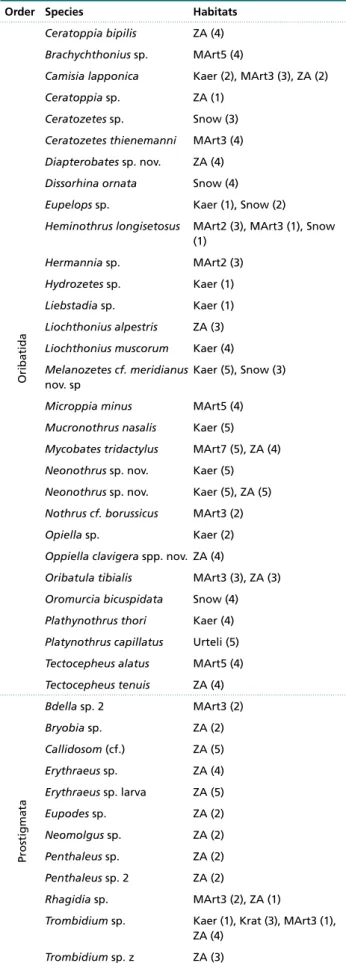
Table 6.2 Acari species submitted for barcoding to CCDB by March 2014. Numbers in brackets indicate the number of individuals compiled from specifi c habitats within the Kobbefjord monitoring area (Krogh et al. 2013) or from the Zackenberg sampling location, ZA.
Order Species Habitats
Oribatida
Ceratoppia bipilis ZA (4)
Brachychthonius sp. MArt5 (4)
Camisia lapponica Kaer (2), MArt3 (3), ZA (2)
Ceratoppia sp. ZA (1)
Ceratozetes sp. Snow (3)
Ceratozetes thienemanni MArt3 (4)
Diapterobates sp. nov. ZA (4)
Dissorhina ornata Snow (4)
Eupelops sp. Kaer (1), Snow (2)
Heminothrus longisetosus MArt2 (3), MArt3 (1), Snow
(1)
Hermannia sp. MArt2 (3)
Hydrozetes sp. Kaer (1)
Liebstadia sp. Kaer (1)
Liochthonius alpestris ZA (3)
Liochthonius muscorum Kaer (4)
Melanozetes cf. meridianus
nov. sp
Kaer (5), Snow (3)
Microppia minus MArt5 (4)
Mucronothrus nasalis Kaer (5)
Mycobates tridactylus MArt7 (5), ZA (4)
Neonothrus sp. nov. Kaer (5)
Neonothrus sp. nov. Kaer (5), ZA (5)
Nothrus cf. borussicus MArt3 (2)
Opiella sp. Kaer (2)
Oppiella clavigera spp. nov. ZA (4)
Oribatula tibialis MArt3 (3), ZA (3)
Oromurcia bicuspidata Snow (4)
Plathynothrus thori Kaer (4)
Platynothrus capillatus Urteli (5)
Tectocepheus alatus MArt5 (4)
Tectocepheus tenuis ZA (4) Prostigmata Bdella sp. 2 MArt3 (2) Bryobia sp. ZA (2) Callidosom (cf.) ZA (5) Erythraeus sp. ZA (4) Erythraeus sp. larva ZA (5) Eupodes sp. ZA (2) Neomolgus sp. ZA (2) Penthaleus sp. ZA (2) Penthaleus sp. 2 ZA (2) Rhagidia sp. MArt3 (2), ZA (1)
Trombidium sp. Kaer (1), Krat (3), MArt3 (1),
ZA (4)
NU l. minor NU l. minor NU l. minor NU l. minor ZA F. bisetosa ZA F. bisetosa ZA F. quadruoculata ZA F. quadruoculata NU F. quadruoculata NU F. quadruoculata NU F. quadruoculata NU F. quadruoculata NU F. quadruoculata NU F. cf. penicula NU F. cf. penicula NU T. arctica NU T. arctica NU T. arctica NU T. arctica NU P. notabilis NU N. moscurum NU N. moscurum NU N. moscurum NU N. moscurum NU P. notabilis ZA P. ekmani ZA P. ekmani ZA P. ekmani ZA O. groenlandica ZA O. groenlandica ZA O. groenlandica ZA O. groenlandica ZA O. groenlandica ZA S. aureus ZA W. scandinavica ZA W. scandinavica ZA H. concolor ZA H. concolor ZA H. concolor ZA H. concolor ZA C. denticulata ZA C. denticulata ZA C. denticulata ZA C. denticulata ZA C. denticulata ZA D. tshernovi ZA M. minimus ZA M. minimus ZA M. minimus ZA M. minimus NU F. cf. penicula ZA F. bisetosa ZA F. sexoculata ZA F. sexoculata ZA F. sexoculata ZA F. sexoculata ZA F. sexoculata NU l. minor 0.05 ZA Neonothrus sp. nov. ZA Neonothrus sp. nov. ZA Neonothrus sp. nov. ZA Neonothrus sp. nov. NU Neonothrus sp. nov. NU Neonothrus sp. nov. NU Neonothrus sp. nov. NU Neonothrus sp. nov. 0.05 NU Heminotrus longisetosus NU P. thori NU P. thori NU P. thori NU P. thori NU O. tibialis NU O. tibialis ZA O. tibialis ZA O. tibialis ZA O. tibialis ZA Diapterobates sp. nov. ZA Diapterobates sp. nov. ZA Diapterobates sp. nov. NU Eupelops sp. NU Brachychthonius sp. NU Brachychthonius sp. ZA L. alpestris NU L. muscorum NU Hydrozetes sp. NU T. alatus ZA C. lapponica NU Opiella sp. NU Opiella sp. NU Liebstadia sp. NU C. thienemanni NU C. thienemanni NU C. thienemanni NU C. thienemanni ZA C. bipilis ZA Ceratoppia sp. ZA C. bipilis ZA C. bipilis ZA C. bipilis NU M. meridianus NU M. nasalis NU M. meridianus NU M. meridianus NU M. meridianus NU M. nasalis NU M. nasalis NU M. nasalis NU M. nasalis ZA Opiella clavigera spp. nov. ZA Opiella clavigera spp. nov. ZA Opiella clavigera spp. nov. NU T. alatus NU M. tridactylus NU M. tridactylus NU M. tridactylus NU M. tridactylus NU M. tridactylus ZA M. tridactylus ZA M. tridactylus ZA M. tridactylus ZA M. tridactylus ZA M. tridactylus NU Nothrus cf. borussicus NU Nothrus cf. borussicus ZA C. lapponica NU Kaer C. lapponica NU Kaer C. lapponica NU MArt3 C. lapponica NU MArt3 C. lapponica NU MArt3 C. lapponica
Figure 6.2 A cladogram showing the relationship among 58 COI sequences from 16 species of Collembola. The topology of the tree was reconstructed by MEGA version 6 (Tamura et al. 2013) as based on the K2P model (Kimura 1980). All nucleotide positions containing gaps and missing data were eliminated, resulting in a data set of 558 bp. Individual sequences derive from a total of 16 collembolan species identifi ed by morphological criteria, with species designations shown at the end of each branch. ZA: Zackenberg; NU: Nuuk, Kobbefjord.
Figure 6.3 A cladogram showing the relationship among 73 COI sequences from oribatid mites. The topology of the tree was reconstructed by MEGA version 6 (Tamura et al. 2013) as based on the K2P model (Kimura 1980). All nucleotide positions containing gaps and missing data were eliminated, resulting in a data set of 606 bp. Individual sequences derive from a total of 23 mite species identi-fi ed by morphological criteria, with species designations shown at the end of each branch. ZA: Zackenberg; NU: Nuuk, Kobbefjord.
variability, supporting the conclusion of Schneider et al. (2011) that this taxon is a species complex containing many spe-cies yet to be discovered. Nonetheless, as M. minimus is likely parthenogenetic, the variability observed may also refl ect intraspecifi c differences between clones. Most of the collembolan species were still characterised by remarkably low levels of intraspecifi c variability (fi gure 6.2). Hence, beyond the variability mentioned above, haplotypes within species were either identical or differed by a few bp only (fi gure 6.2). This pattern brings confi dence to our ecological investiga-tion of these collembolan species at the Kobbefjord monitoring site, proving that morphologically-identifi ed taxa are indeed valid species. On a more syste-matic note, it should be stressed that the tree shown in fi gure 6.2 is not providing any more generally valid phylogenetic hypothesis of Collembola, as e.g. species like the sminthurid Sminthurinus aureus
(a symphypleonid) are here grouped together with the genetically distant poduromorph onychiurids.
Patterns observed within mites were more complex. Of the 41 mite species found in Kobbefjord and Zackenberg (table 6.2), 73 individuals have now been barcoded (fi gure 6.3). Here, a number of challenges were revealed by the sequenc-ing exercise, as related partly to the morphologically-based identifi cation of oribatids and partly to the barcoding itself. A few cases of barcode-sharing emerged, of which one was related to Mucronothrus nasalis – a species belonging to the primi-tive oribatid superfamily, Crotonoidea, of moss mites. This taxon is, from a system-atic point of view, rather distant from the higher oribatids, but yet it shared its bar-code with Melanozetes meridianus (fi gure 6.3) – and was grouped by BOLD into a single molecular taxonomic unit (MOTU) together with Ghilarovizetes longisetosus
collected in Manitoba (Young et al. 2012) (BIN: BOLD:AAF907). For two other species, Camisia lapponica and Mycobates tridactylus, haplotypes encountered within the Kobbefjord area and Zackenberg proved distinctly different (fi gure 6.3), and only added material will show whether the taxa encountered in Western and Northeastern Greenland are indeed identi-cal or not.
6.3 Comparing Late Holocene
climate changes in low and
high Arctic regions using
lake sediments and annual
rings of dwarf tundra
shrubs records
Daniel Nývlt, Jiří Lehejček and Petra Polická
Due to lack of long instrumental climatic records and their spatial scarcity (Weijers et al. 2010) as well as missing written sources from the Arctic, paleoclimatological studies are important evidence of climatic varia-tions in Polar Regions (AICA 2005). Our study aims to reconstruct past climate development prior instrumental measure-ments. We used two main approaches combining high-resolution record of re-sponses for recent climate (dendroclima-tology of dwarf tundra shrubs and record from lake sediments). In addition, soil characteristics and vegetation cover were recorded in order to display the current state of ecosystem to understand past changes better.
Multi-proxy record from lake sediments is combining litological (mainly grain-size composition), petrophysical (magnetic sus-ceptibility), geochemical (determination of basic lithophile elements, organic and anor-ganic carbon and sulphur, possibly also stable isotopes), and biological proxy (pig-ments, biostratigraphy of different groups of organisms) approaches. Petrophysical and geochemical analysis were fi nalized recently. Remaining analysis is being processed at the moment. This will show climatic and environmental variability. For determination of the time development of sedimentation appropriate dating methods will be applied (AMS radiocarbon dating, OSL, 210Pb and 137Cs for the youngest parts
of sediments accumulated in last centuries; see Nehyba et al. 2011).
Dendroclimatology of dwarf tundra shrubs (Juniperus communis, Salix glauca, Alnus crispa) will give up to three century long climatic record. The age of the old-est shrub (Juniperus communis) spans to 17th century. Using microtome knife and
staining solutions the micropreparates were prepared (Gärtner and Schweingruber 2013) to obtain reliable information from this archive on the cell level. Subsequently, the digital photos were taken under micro-scope with 100x magnifi cation (fi gure 6.4) and growth parameters (width of rings,